Sample Category Title
AUD/USD Finds Little Support From the RBA
- The pace of future RBA hikes is up for question
- AUD/USD is below the key 0.70 psychological level
The Same Old Story
The RBA raised its policy rate by 50 bps on Tuesday to 1.85% - its fourth consecutive hike and the steepest in nearly 30 years. But that’s done little to lift AUD/USD, which at the time of writing was down by nearly 1% from the start of the week. This once again leaves the pair trading below the key psychological level of 0.70. Granted, the recent flare up in tensions between China and Taiwan have contributed to a weaker Australian dollar, but some of the same factors I outlined in early July, in my opinion, have been the primary driver behind this latest move lower.
Less Aggressive Hikes Ahead?
In particular, Tuesday’s guidance from the RBA that near-term future hikes may not be so steep as the one this week was likely the overarching factor behind the fall in AUD/USD. Even the RBA admits that it is walking a tightrope in terms of trying to cool inflation, which hit 6.1% in Q2 without severely impacting the Australian economy. Meanwhile, a cadre of Fed speakers this week haven’t given any indication that Fed is looking to ease up on raising interest rates. As things currently stand, the RBA, like many other major central banks, doesn’t appear capable of keeping pace with the Fed in terms of policy tightening.
Negative Technical Setup
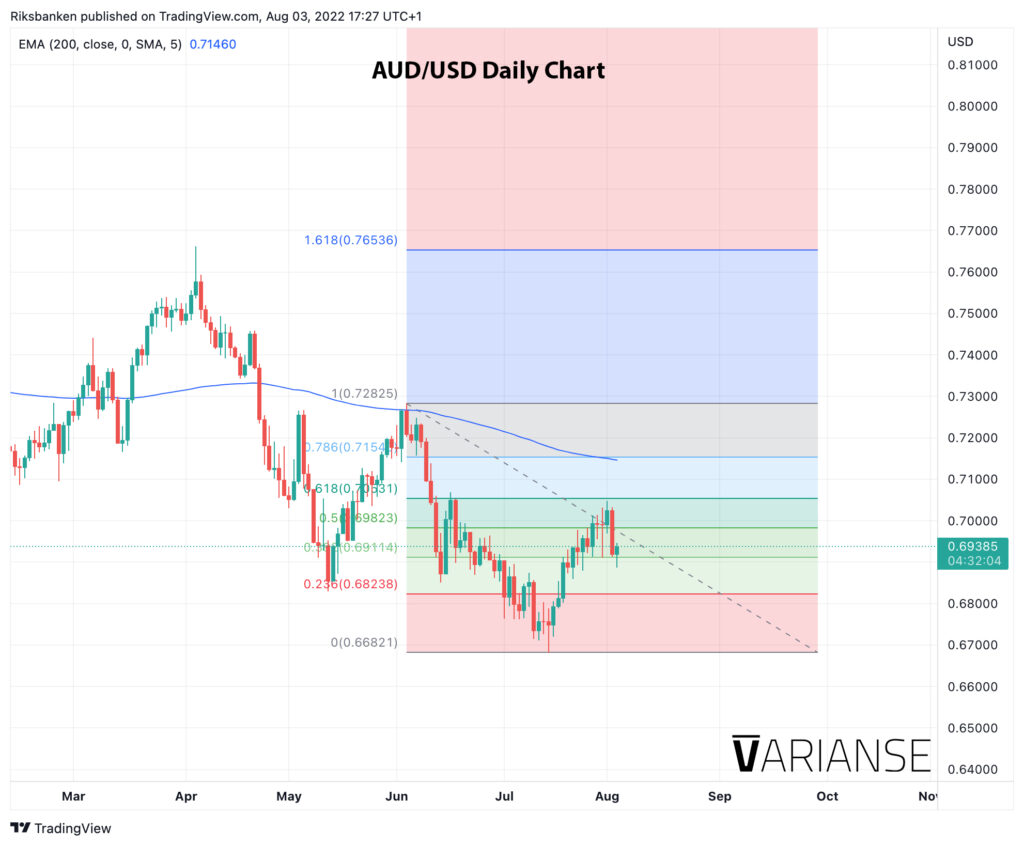
The current fundamental backdrop also very much mirrors the technical setup. AUD/USD is trading below the 200-day exponential moving average, indicating the pair is more biased toward a downtrend. Structurally, a case can be made that the 3 June swing high of 0.72830 marks the last corrective move before the prior to the last impulsive swing low of 0.66816. If so, Tuesday's substantial decline may very well represent a rejection of the intervening 50% Fibonacci resistance level of 0.68923. If so, that would portend a further fall in AUD/USD.
Those brave enough to consider buying, might wait for price to pierce and successfully retest the 1 August high of 0.7040. A sustained break above that level, followed by subsequent break above 0.72830 would provide greater confidence that the pair was headed in another direction. Any such move, however, would likely come commensurate with a more positive shift in general market risk sentiment.
Eco Data 8/4/22
[php_everywhere instance="1"]
Fed Daly: 3.4% by year end is a reasonable place to get to
San Francisco Fed President Mary Daly said, "about 50% of the elevated inflation we're seeing is from demand factors, 50% from supply factors."
"50 bps hike would be a reasonable thing to do in September but if we see inflation roaring ahead undauntedly then perhaps 75 bps hike would be more appropriate," she added.
Also, she does not believe that Fed has reached the threshold for interest rate to be considered restrictive As for tightening, having rate at 3.4% by the end end is a "reasonable place" to get to.
Fed Barkin: There’s a path to control inflation, but recession could happen in the process
Richmond Fed President Thomas Barkin said in a speech, "we are committed to returning inflation to our 2 percent target and have made clear we will do what it takes." He expected Fed's tools to "work over time" and "inflation to come down but not immediately, not suddenly and not predictably".
"There is a path to getting inflation under control," he said. "But a recession could happen in the process."
"We are out of balance today because stimulus-supported excess demand overwhelmed supply constrained by the pandemic and global commodity shocks. Returning to normal means products on shelves, restaurants fully staffed and cars at auto dealers. "
"Most importantly, moderating demand has a higher purpose squarely in our mandate: containing inflation. If there is any lesson that's been relearned in the last year, it is that inflation is painful, and everyone hates it."
Weak Eurozone Demand Could Drag the Euro Down
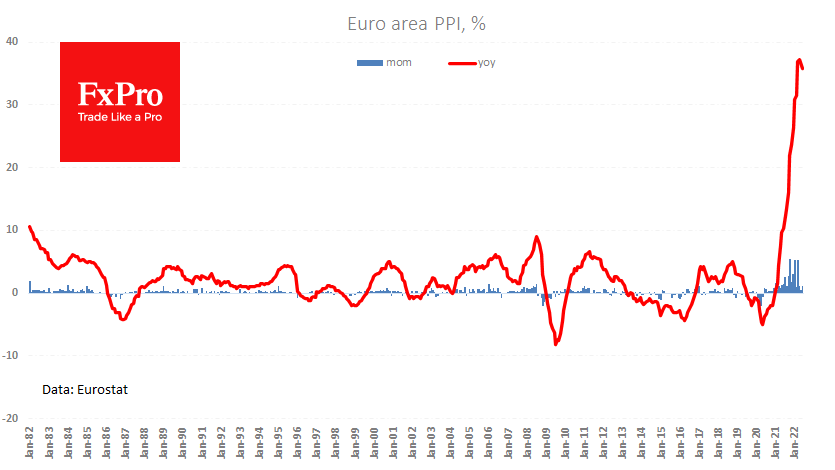
In contrast to many other countries and regions, the Eurozone recorded a slowdown in output inflation. The year-over-year PPI growth rate declined for the second month, showing a fall in June to 35.8% from 36.2% and 37.3% in the previous two months.
Although average forecasts had expected a slightly lower rate, one cannot ignore the significant cooling of inflation in the last three months after the dizzying trend from the second half of last year to the beginning of this year.
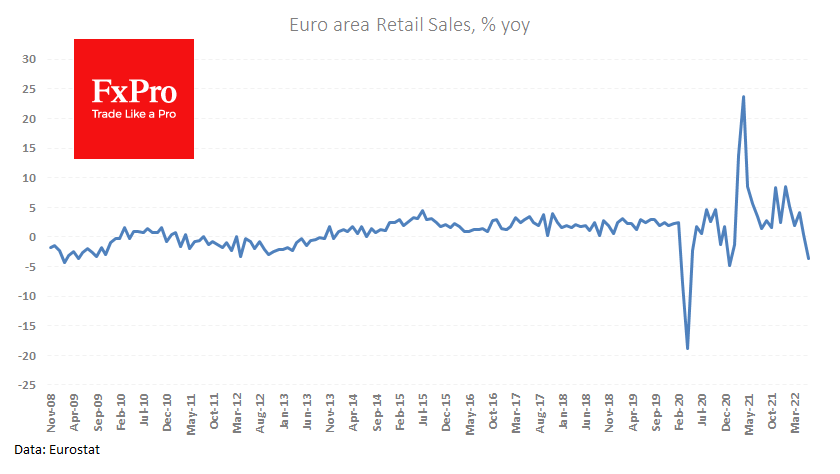
The dip in retail sales underlines that the slowdown in inflation has more to do with weak demand than with a recovery in logistics and the normalisation of commodity prices. Published data for June marked a fall in sales of 1.2% m/m and 3.7% y/y.
One must consider that the price increase rate remains prohibitive and requires further tightening from the ECB. However, signs of a sharp cooling in demand will sharply deter the fight against inflation. This is sad news for the Euro, which with these reports loses any chance of fighting back against the dollar in the coming days or weeks.
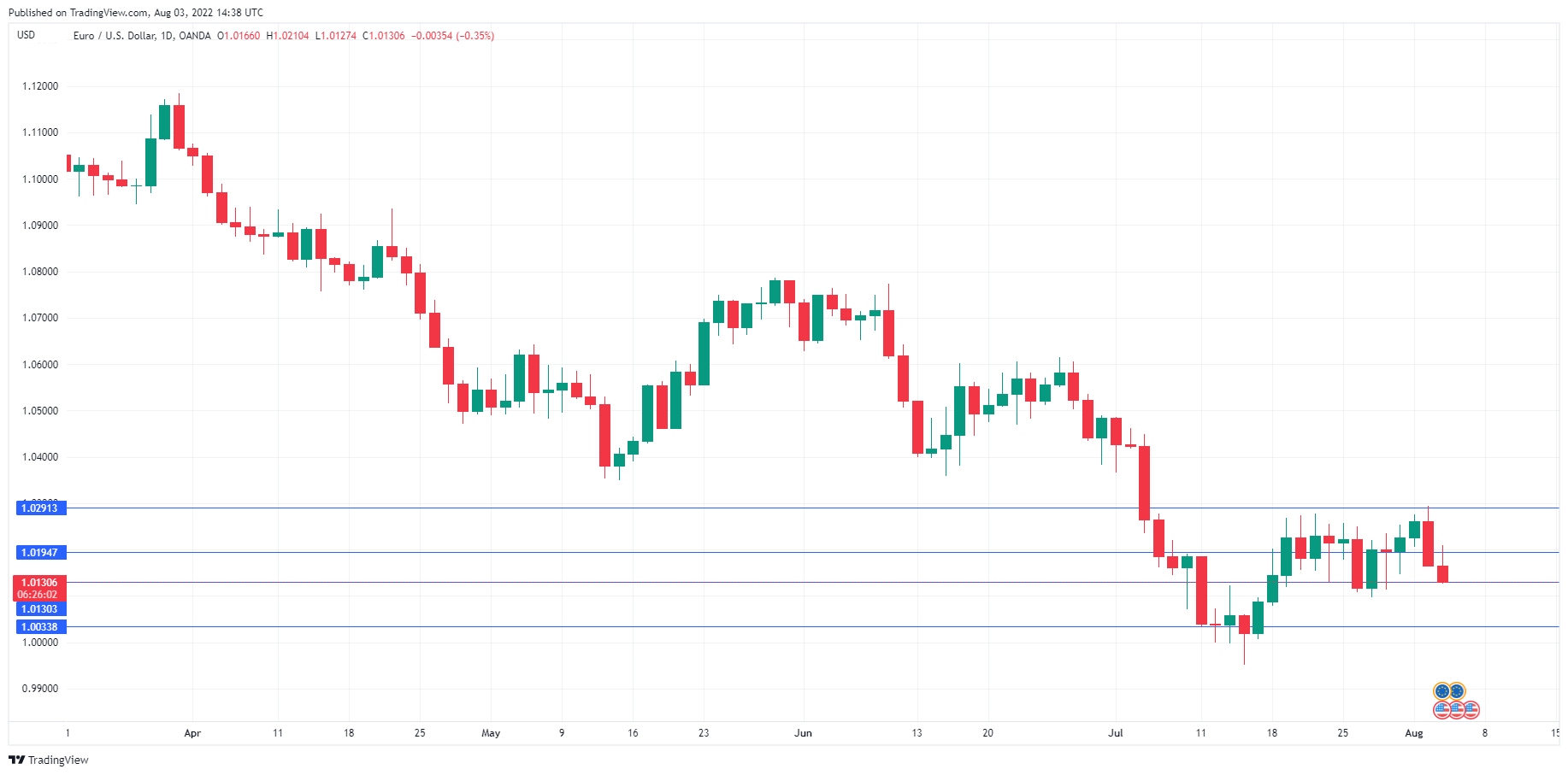
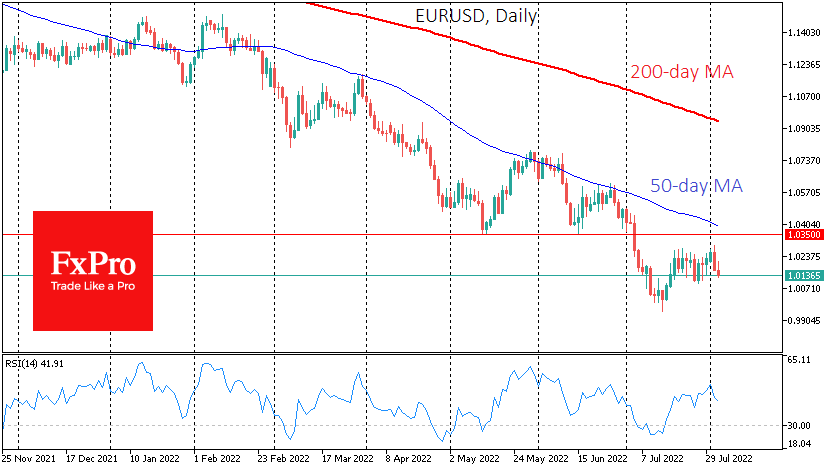
Over the past two weeks, the EURUSD consolidation in the 1.01-1.03 range may be just a respite before a new round of declines. Historically, parity has not been any significant support or turning point. Do not be surprised if the Euro experiences a new wave of pressure in the coming days or weeks with a retest of the July lows below 1.0.
EURJPY Wave Analysis
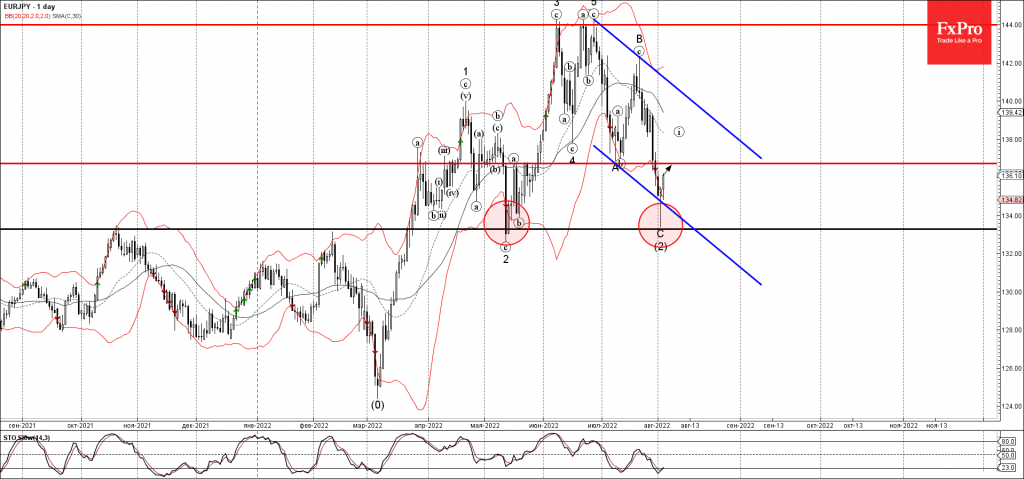
- EURJPY reversed from support level 133.30
- Likely to rise to resistance level 136.75
EURJPY currency pair recently reversed up from the key support level 133.30 (which stopped wave 2 in May) – standing far outside of the lower daily Bollinger Band.
The upward reversal from the support level 133.30 created the daily candlesticks pattern Hammer – which started the active intermediate impulse wave (3).
EURJPY currency pair can be expected to rise toward the next resistance level 136.75 (low of wave A of the previous ABC correction (2)).
CADJPY Wave Analysis
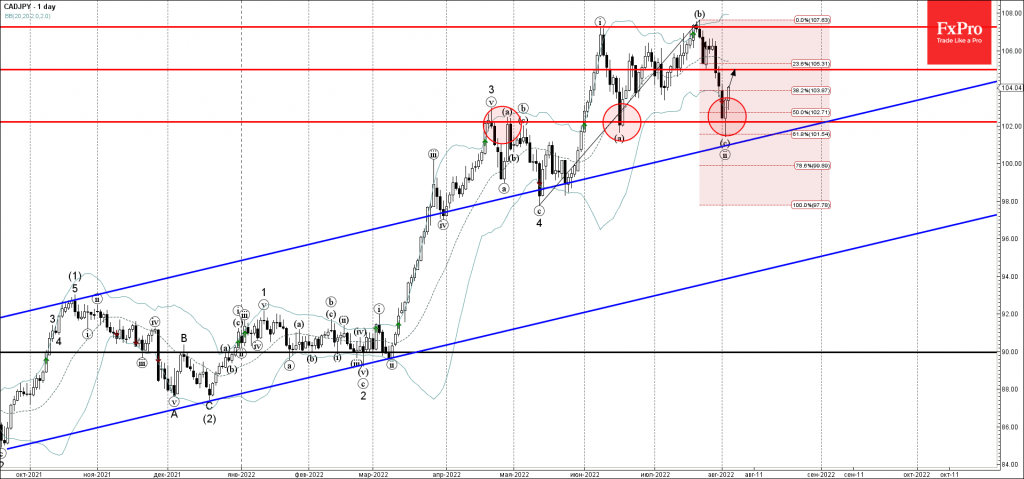
- CADJPY reversed from support level 102.00
- Likely to rise to resistance level 105.00
CADJPY currency pair recently reversed up from the key support level 102.00 (former resistance from April, which stopped the earlier minor correction (a) in June).
The support zone near the support level 102.00 was strengthened by the lower daily Bollinger Band and by the 50% Fibonacci correction of the upward impulse from May.
Given the strong daily uptrend, CADJPY currency pair can be expected to rise in the active impulse wave (iii) toward the next resistance level 105.00 (former support from last month).
US: The Services Sector Gains Momentum in July
The ISM Services Index accelerated in July, adding 1.4 percentage points (ppts) with a reading of 56.7 – higher than the 53.5 expected by the consensus.
Demand factors added 2 ppts to the overall index. The biggest contributor was the new orders subindex, which rose by 4.3 ppts to 59.9, while business activity subindex added 3.8 ppts to match the new orders reading of 59.9.
Supply bottlenecks eased in July with the supplier deliveries losing 4.1 ppts to 57.8 and the backlog of orders subindex (which doesn't have a weight in the aggregate measure but is a good gauge of supply-demand imbalances) declining by 2.2 ppts to 58.3.
Employment activity remained in contractionary territory, but gained 1.7 ppts to reach 49.7.
Inventories contracted by 2.5 ppts to 45.0 in June, while inventory sentiment moved out of contractionary territory with a reading of 50.1 – gaining 3.9 ppts.
The prices paid component declined further, dropping below 80 for the first time since September 2021 with a considerable decline of 7.8 ppts to 72.3.
Thirteen industries expanded in July. Industries reporting a contraction are Agriculture, Forestry, Fishing & Hunting; Retail Trade; and Finance & Insurance.
Key Implications
The services sector proved again that it won't wear down easily when there is still plenty of pent-up demand. Whether this will prove to be a harbinger of stronger consumption relative to the disappointing June PCE report is yet to be seen, however, high frequency indicators suggest no material change in spending on services in July.
The one factor that weighed the headline index down was the supplier deliveries subindex, which indicates normalization of supply side factors. Notably, the gap between the supplier deliveries time and the rest of the index's drivers continued to narrow – the trend we first observed at the end of last year. This seems to have contributed to a decline in the prices paid component and, should this trend persist, will help ease the inflationary pressure and soothe consumer sentiment.
The employment component was stronger than last month's reading but remained below 50, indicative of a contraction. This sub-index has been too volatile and often negatively biased by persistent labor shortages, so it seems likely that the slight improvement in the subindex will result in healthy employment gains on Friday.
EURGBP Maintains Bearish Bias Despite Some Upside Pressures
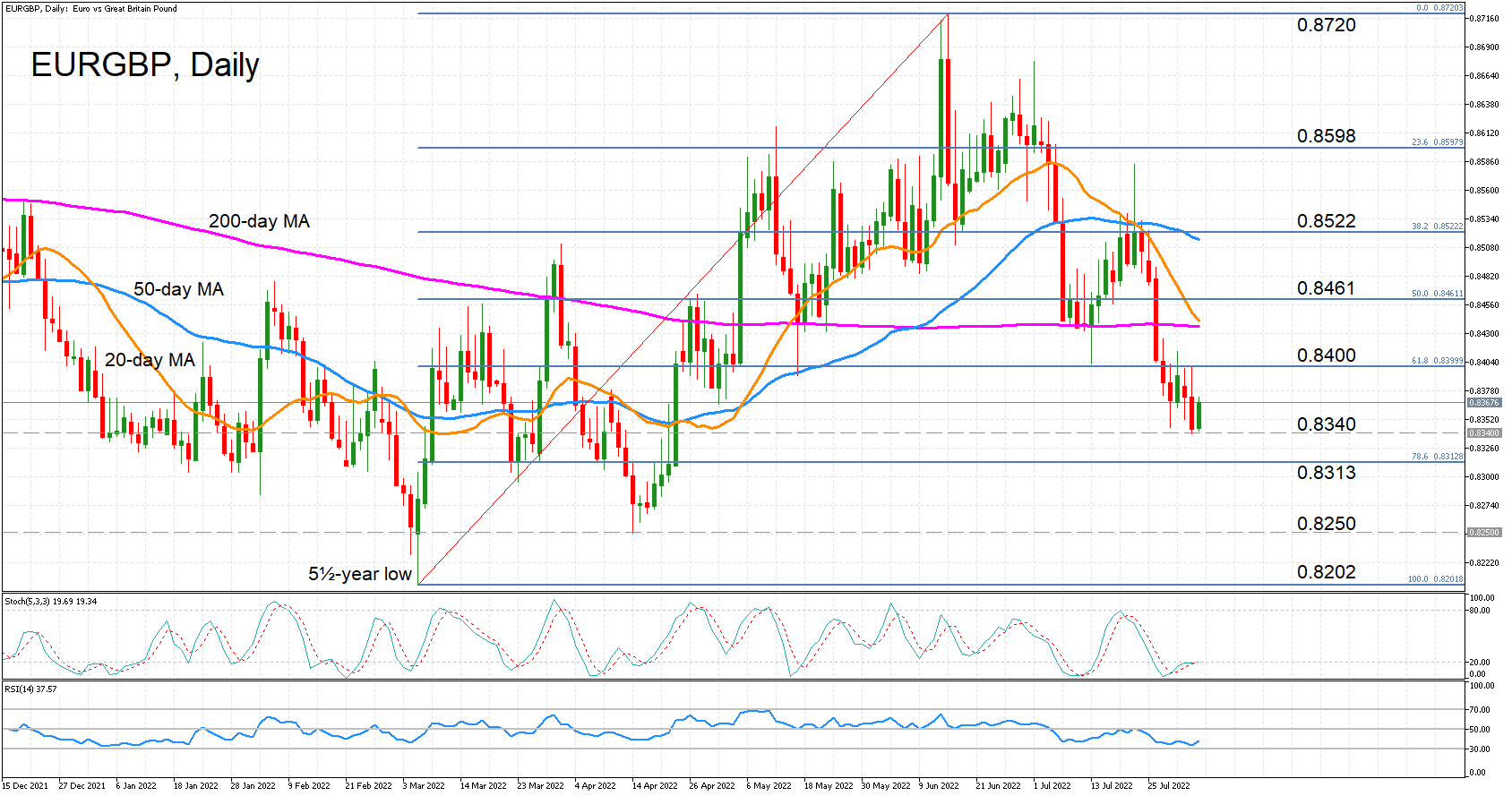
EURGBP is recovering from three-month lows after yesterday sinking to 0.8339, suggesting that a new support base has been formed around 0.8340. This level is above the 78.6% Fibonacci retracement of the March-June uptrend at 0.8313 so it may provide only temporary support as the momentum indicators continue to point to downside risks.
The %K and %D lines of the stochastic oscillator have flatlined around the 20 oversold mark after a minor rebound, while the RSI remains well below the 50 neutral level.
If today’s upside momentum increases in strength, the bulls are likely to be challenged at the 61.8% Fibonacci of 0.8400, which has successfully fought off advances several times in the last week. But there are multiple other hurdles further up, namely, the 200-day moving average (MA) at 0.8436, the 50% Fibonacci at 0.8461, and the 38.2% Fibonacci of 0.8522 slightly above the 50-day MA.
However, the positive momentum could easily dissipate as the 20-day MA is about to cross below the 200-day MA. If EURGBP resumes its downtrend, the 78.6% Fibonacci of 0.8313 could stall the decline before the April trough of 0.8249 is reached. Breaching this would clear the way for a retest of the 5½-year low of 0.8202 set in March.
Summing up, the improvement in the short-term bias has some way to go before it turns bullish and at the minimum, the pair needs to reclaim the 0.84 handle. However, in the medium term, restoring the positive outlook that only recently switched to neutral will require a lot more work as the June peak of 0.8720 is some distance away from current price levels.
Euro Shrugs after Soft Data
The euro has edged lower and is trading at 1.0138 in the North American session, down 0.27% on the day.
Eurozone retail sales, Services PMI fall
Today’s Eurozone data de-accelerated, which is bound to raise concerns about the health of the eurozone economy. Eurozone Services PMI dropped to 51.2 in July, down from 53.0 in June (50.6 est.). Eurozone business activity is still expanding but is barely above the 50.0 level which separates contraction from expansion. Germany’s Services PMI fell into contraction territory, dropping from 52.4 to 49.7 (49.2 est.). Earlier in the week, Germany’s Manufacturing PMI for July fell to 49.3, down from 52.0 in June. This is the first time in over two years that Germany’s manufacturing sector has recorded a decline.
There was no relief from Eurozone retail sales for June, which came in at -3.7% YoY, down from 0.4% in May. This shouldn’t come as a surprise after German retail sales in June plunged 8.8% YoY, after a 1.1% gain in May. Both readings were weaker than expected and are indicative of pessimistic consumers who are alarmed at deteriorating economic conditions in Europe and are cutting back on spending.
Will things get better before they get worse? Unfortunately, very possibly not. The war in Ukraine remains a stalemate with no sign of ending anytime soon. The fighting has caused a huge rise in wheat and oil prices, resulting in spiralling inflation worldwide, including the eurozone. Russia has cut back on energy imports in response to Western sanctions and this could result in an energy crisis in Europe this winter. The Nord Stream 1 pipeline, a major conduit of natural gas from Russia to Europe, is operating at just 20% of capacity Moscow does not seem to have any compunction about leaving Western Europe in the cold if it doesn’t ease sanctions.
EUR/USD Technical
- There is resistance at 1.0194 and 1.0291
- EUR/USD is testing support at 1.0130. Below, there is support at 1.0033