

Sample Category Title
The Weekly Bottom Line: The Good, the Bad and the Ugly
U.S. Highlights
- U.S. CPI came in above expectations, with the headline reading reaching a new 40-year high. Core inflation also surprised with a broad-based acceleration.
- The U.S. trade deficit narrowed in April with both lower U.S. imports and rising exports contributing. We expect further narrowing will add to GDP growth in the second quarter.
- Meanwhile, consumer credit made bad headlines this week, but as long as household income stays on the rise, credit growth should remain sustainable.
Canadian Highlights
- The Bank of Canada Financial System Review (FSR) report reaffirmed that financial institutions remain resilient, but that vulnerabilities related to high household debt and elevated home prices have increased during the pandemic.
- In the press conference that followed the FSR release, Governor Macklem struck a decisively hawkish tone on inflation and interest rates, leaving the door open on the outsized 75 basis points hike in July.
- The labour market added 40k new jobs and the unemployment rate declined by 0.1 percentage points to 5.1% in May. Wage growth continued to accelerate amid competition for workers in a drum tight labour market.
U.S. - The Good, the Bad and the Ugly
Market anticipation built through the week for Friday’s CPI data release. Inflation came in above expectations and markets reacted by ratcheting up their expectations for rate hikes. Financial markets have now priced in three consecutive 50 basis-point hikes, starting with next Wednesday’s FOMC decision. The 10-Year Treasury yield jumped seven basis points on the news, finishing the week 18 basis points higher at 3.11% (at the time of writing). Equity markets’ timid attempts to regain their footing early in the week came crashing down Friday, as Thursday’s sell-off intensified.
Indeed, “ugly” seems like an appropriate epithet for May’s CPI print. Energy prices pushed the headline print to a new 40-year high. Since May, the nationwide average retail gasoline price has continued to rise and is likely to reach $5 per gallon in the coming days. This will keep the headline reading elevated in June. Food prices also continued to accelerate, adding to the headline print.
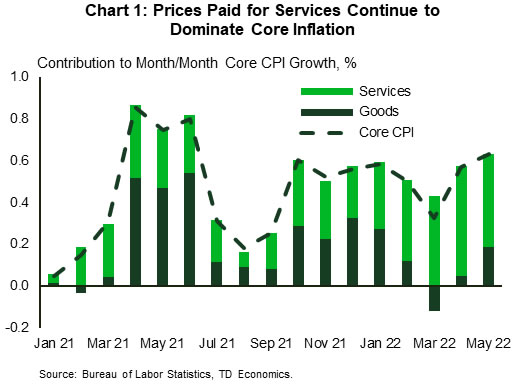
Excluding energy and food, May’s month-on-month core inflation matched the April’s reading. What came as a surprise was an acceleration in core goods inflation. In turn, core services inflation, which tends to be stickier and less volatile, decelerated only slightly remaining above last year’s average (Chart 1). This suggest that core inflation – the main yardstick for monetary policy– is not coming down to a level the Fed would like it to be at any time soon. What’s needed is a further easing in demand, particularly for goods, to lower price pressures. Since some retailers are starting to discount their merchandise in the wake of excessive inventories, we expect pressures there to ease in the coming months.
Some good news came from trade data. The U.S. trade deficit narrowed in April to $87.1 from a record of $107.7 billion in March. Over the past two years demand for imported goods outweighed the value of American exports, contributing to a significant wedge in the trade balance, but this week’s report delivered a snapback, providing some evidence of declining demand for imported items. Meanwhile, exports of goods and services expanded. Trade data is quite volatile and it’s possible to see it zag after the current zig, but we think the recent report portends a reversal of the two-year trend, and we will see the gap narrowing further, adding to GDP growth in the second quarter.
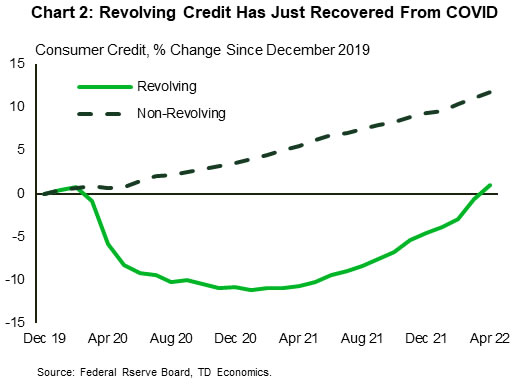
Meanwhile, consumer credit made bad headlines this week as it expanded by $38.1 billion in April after an already sizeable increase in March. This increase suggests that consumers are relying more on credit for their purchases, which could become a burden should they face trouble repaying this debt. Zooming in on details, however, much of this growth was due to an acceleration in revolving credit, which has only just recovered to its prepandemic level(Chart 2). This conincides with a normalization in spending on discretionary services, such as in-person entertainment and travel, which are usually financed by revolving credit, such as credit cards. As long as household income stays on the rise, credit growth should remain sustainable.
Canada - The Rising Stakes of Rising Rates
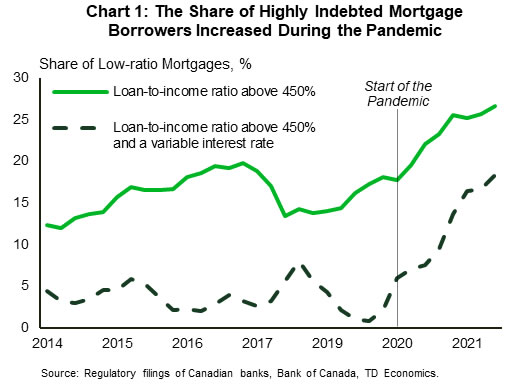
May's jobs data and The Bank of Canada Financial System Review (FSR) made for an eventful week in Canada. Thursday's FSR report offered an update on key risks to Canada's financial system. While maintaining that financial institutions remain resilient, the Bank sounded more concerned about elevated household debt and home prices, stating that those vulnerabilities have worsened. In particular, many Canadians have taken out mortgages which are large relative to their income during the pandemic, often by taking advantage of ultra-low variable rates (Chart 1). These borrowers are more vulnerable to higher interest rates, an income shock or a house price correction.
BoC Governor Macklem and Senior Deputy Governor Rogers's comments at the press conference accompanying the report's release made headlines. Macklem struck a decisively hawkish tone stating that they are "not going to sleep easy until Canadians can stop worrying about inflation" and that "the likelihood that the rate will need to go to the top of the 2-3% range or possibly somewhat above it … has increased."
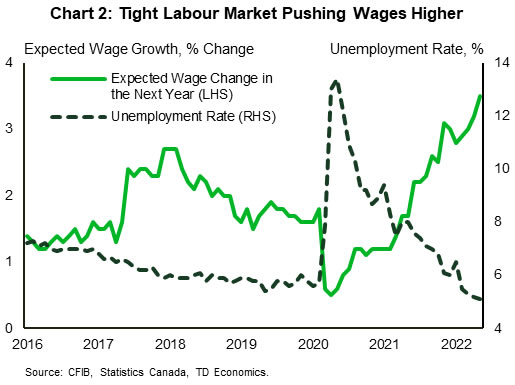
The governor also stated that the economy was overheating. Indeed, May's jobs report supported the notion that the Canadian economy is operating beyond full employment (Chart 2). Canada saw a net gain of 40k jobs, record low unemployment and rising wages in May's labour force survey. While rising employment and wages are helping to ease the drag of inflation on household finances, they are also adding more fire to domestic demand, complicating the job for the BoC. As a result, the jobs report further adds to the speculation of even higher interest rates, with short-term bond yields moving higher today.
The Bank is working hard to convince consumers and businesses that it will be able rein in inflation before higher inflation expectations become firmly entrenched. But, keeping inflation expectations anchored might not be easy while gasoline prices set new records (up a few cents from last week and 56% from a year ago) and food prices remain elevated. According to the survey conducted by Statistics Canada, Canadians are feeling higher food and energy costs acutely: 43% answered that food was the area where they were most affected by rising prices in the last six months, while 32% said it was transportation.
All in all, this week's developments suggest that the BoC is leaving the door open for an outsized 75 basis point hike in July, particularly if the incoming data shows that inflation and inflation expectations continue to drift higher. However, while the Bank might be eager to stomp out inflation, two years of ultra-low interest rates have allowed vulnerabilities to build up. As a result, reining in inflation while at the same time achieving a soft landing now becomes a "delicate" act.
Week Ahead – Rate Hikes Keep Coming
Will a recession follow?
It’s been a slow start to the month in financial markets but the ECB rate decision on Thursday finally got things moving and the US inflation data on Friday kept it going into the weekend. With so much to look forward to next week, it’s going to get really interesting.
The Fed rate decision on Wednesday is naturally the highlight, as traders look for further indications of the level of tightening that’s going to be required and whether it will ultimately tip the economy into recession. The inflation data did not make for good reading for policymakers.
The BoE is expected to raise rates on Thursday but could it be tempted to go super-sized like many of its peers? Markets suggest there’s an outside chance. Then there’s the BoJ on Friday which has a very different problem to many of its peers.
US
The main event of the week will be the FOMC decision on Wednesday. The Fed is widely expected to deliver a half-point rate increase and to signal more are coming as inflation remains scorching hot. The Fed will need to signal more aggressive hikes are warranted and that they will do what is needed to get inflation under control.
It is a busy week for economic data and it will start on Tuesday with PPI likely to tell a similar story as Friday’s hot inflation report. In addition to the Fed decision, Wednesday has two big reports: The Empire manufacturing survey should show a modest rebound. Most traders will fixate over retail sales for May, which could show consumer spending is weakening. Thursday will see the release of housing starts, jobless claims, and the Philly Fed business outlook.
The 2022 midterms are not that far away and many traders will pay close attention to see if Republicans have a clean sweep. Tuesday has primaries in Maine, Nevada, North Dakota, and South Carolina.
EU
A quiet week for the euro area with final inflation data among the highlights. Big revisions to the upside would pile further misery on households and businesses, not to mention the ECB which has finally come around to the idea that something needs to be done. And it absolutely will, a little bit next month and maybe more so again next quarter. The ECB really knows how to address urgent problems. Central bank speak including Christine Lagarde later in the week will be of interest although markets have already gone ahead and priced in 1.5% of hikes this year. Why bother waiting for the ECB to inevitably catch up?
The first round of French parliamentary elections will take place on Sunday.
UK
The highlight next week is obviously the Bank of England meeting, with the central bank expected to hike by another 25 basis points to 1.25%. Given the shift of gear from numerous other central banks recently, could the MPC be persuaded to join the 50 basis point club? Markets view a one in three chance of it happening. It arguably should be higher given the same central bank is expecting double-digit inflation later in the year.
Next week also offers the usual data dump that comes around the third week of the month, with jobs, retail sales, GDP and industrial production figures all due. Needless to say, it’s going to be eventful for the pound.
Russia
Next week is relatively quiet for Russia, with revised GDP for Q1 the only notable release. The CBR cut rates to pre-war levels on Friday at 9.5% but the currency remains near its recent highs thanks to a ballooning current account as imports have collapsed in the aftermath of the invasion.
The central bank has been patient in cutting rates again in the hope of lowering inflation which fell to 17.1% in May, down from 17.8% in April, giving the impression it may have peaked. With the economy performing better than feared and inflation heading in the right direction, further rate cuts could follow in an attempt to revive consumer demand and support the economy.
South Africa
A quiet week with retail sales on Wednesday the only notable release.
Turkey
Nothing much on offer next week from Turkey, with the focus still being on the collapse of the lira as the most vulnerable EM currencies are punished in the global tightening environment. While the Turkish government and central bank repeatedly try to deflect blame for the currency woes and surging inflation, the blame lies much closer to home as the monetary experiment continues to go from bad to worse.
China
China releases industrial output, retail sales and fixed asset investment on Wednesday and the 1-year MLF rate in the second half of the week. Chinese data should improve on the appalling April numbers in May as Shanghai and Beijing reopen, but will still be weak to negative. The 1-year MLF rate should stay unchanged at 2.85% as China persists with targetted stimulus aimed at MSME’s.
The main driver of volatility will be the Covid-zero policy with China announcing that 7 of Shanghai’s 16 districts will be tested over the weekend. Markets have been complacent around Covid-zero believing China was one and done. Unfortunately, omicron doesn’t work that way and if strict lockdowns spread once again, Chinese equities will be pummelled. Watch for developments on this front over the weekend and during the week.
India
India hiked rates again this past week and the RBI will be closely watching Wednesday’s inflation release for May. Inflation is expected to fall to around 7.0% from 7.80%, but a higher print will see RBI tightening expectations ratcheted up, which could weigh heavily on local equities.
Notably, the RBI rate hike and hawkish outlook did not benefit the Indian rupee this week and it remains near record lows at 77.800 to the US Dollar. A hawkish FOMC next week and softer inflation data could spur another bout of weakness in the currency. High oil prices are also another serious headwind.
Australia
Australian unemployment on Thursday is the only material data point this week and is usually only good for intraday volatility.
Both Australian equities and the AUD remain under pressure with the price action particularly negative on AUD/USD. Wobbly risk sentiment globally has pushed the currency lower, and fears over renewed Chinese lockdowns are also weighing heavily as a proxy for China. Readers should watch virus developments in China for directional inputs on AUD.
New Zealand
NZ GDP on Thursday and Business PMI on Friday are both expected to retreat sharply. Nerves continue rising around the NZ economy as it slows while the RBNZ tightens policy. Poor data this week could weigh heavily on the NZD/USD, which, like AUD/USD, is also extremely vulnerable to negative virus developments/slowdown risk from China this week.
Japan
The Bank of Japan announces its monetary policy decision on Friday, a day after the FOMC announcement (Asian time). Despite the huge fall in the Japanese yen in the past week, it would be an enormous surprise if Japan tinkered with monetary policy. Given the weight of long USD/JPY positioning out there, a tightening move by the BOJ, no matter how tenuous, could see USD/JPY correct strongly.
Otherwise, the yen continues to be pummeled as US yields rise back above 3.0%, widening the US/Japan rate differential.
Japan releases industrial production on Monday, and the Tankan Survey and Machinery Orders on Tuesday. Both should show a slight improvement on the economic reopening and a weaker yen, but will only drive short-term intraday liquidity.
Singapore
Singapore releases non-oil exports on Friday. A volatile series and poor data could be a short-term negative factor for local stocks. The SGD has been heavy this week and negative virus developments from China in the week ahead could accelerate USD/SGD strength.
Economic Calendar
Sunday, June 12
Economic Data/Events
- France holds the first round of parliamentary elections
- The World Trade Organization begins its ministerial meeting
Monday, June 13
Economic Data/Events
- China medium-term lending
- India CPI
- Japan business conditions index
- New Zealand net migration
- Turkey current account, industrial production
- UK industrial production, trade data
- Norway monthly GDP
- ECB’s Luis De Guindos participates in a meeting on “The challenges of enhancing financial stability in the recovery phase from the Corona pandemic” organized by the Arab Monetary Fund.
- Italian Prime Minister Mario Draghi travels to Israel
Tuesday, June 14
Economic Data/Events
- US PPI
- Australia household spending, business confidence
- Germany CPI, ZEW survey expectations
- India trade, wholesale prices
- Japan industrial production, capacity utilization
- Mexico international reserves
- New Zealand food prices
- UK jobless claims, unemployment
- ECB’s Schnabel speaks at Universite Paris 1 Pantheon-Sorbonne
Wednesday, June 15
Economic Data/Events
- FOMC Decision: To raise rates by a half-point and update economic projections
- US cross-border investment, business inventories, empire manufacturing, retail sales
- Poland CPI
- Germany CPI
- France CPI
- Sweden CPI
- Australia consumer confidence
- Canada housing starts, existing home sales
- China retail sales, industrial production, surveyed jobless rate, fixed assets, residential property sales
- Eurozone industrial production, trade balance
- Japan machinery orders, tertiary index
- New Zealand BoP, current account GDP ratio
- Russia GDP
- South Africa retail sales
- ECB President Christine Lagarde participates in a discussion hosted by the London School of Economics
- ECB’s Mario Centeno, Pablo Hernandez de Cos, Klaas Knot and Joachim Nagel speak at Young Factor web event
- ECB’s Panetta gives an introductory statement at a hearing on the digital euro before the Committee on Economic and Monetary Affairs in the European Parliament
- UK Prime Minister Boris Johnson due to take questions in Parliament
Thursday, June 16
Economic Data/Events
- US housing starts, initial jobless claims
- Australia unemployment, consumer inflation expectations
- China property prices
- Eurozone new car registrations
- Hungary one-week deposit rate
- Italy CPI
- Japan trade, department store sales
- New Zealand GDP
- Spain trade
- Switzerland rate decision: No change expected with Policy Rate
- UK BOE rate decision: Expected to raise Bank Rate by 25bps to 1.25%
- ECB’s Centeno, de Cos, de Guindos, Knot, Vasle, Visco and Villeroy speak at Young Factor web event.
- ECB’s Panetta speaks at European Payments Council’s 20th-anniversary event in Brussels.
- ECB’s Vasle speaks at a Slovenian banking conference.
Friday, June 17
Economic Data/Events
- US Conference Board leading index, industrial production
- BOJ Rate Decision: To stand pat on rates
- Eurozone CPI
- Hong Kong jobless rate
- Italy trade
- UK retail sales
- New Zealand PMI
- Singapore non-oil domestic exports, electronic exports
- Thailand foreign reserves, forward contracts, car sales
SNB Meeting: Higher Rates or Patience?
The Swiss National Bank will announce its policy decision at 07:30 GMT Thursday. This meeting is ‘live’ as market pricing implies a 70% probability for a rate increase. Even though Swiss inflation has started to creep up, there is no great urgency for the SNB to raise rates. Waiting until September and staying one step behind the ECB makes more sense, which implies downside risks for the franc next week.
Inflation returns
The inflationary impulse that has swept through the global economy has finally infected Switzerland too. Consumer prices are rising at the fastest clip in 14 years as fuel and food costs have gone through the roof, putting pressure on the central bank to raise interest rates from the lowest level in the world.
One key difference between Switzerland and other economies plagued by high inflation is that wage growth remains suppressed. This suggests that inflation is truly driven by temporary factors like supply shocks, so there is no fear of a wage-price spiral that keeps feeding inflation for a long time. Inflation expectations remain subdued as well, arguing the same point.
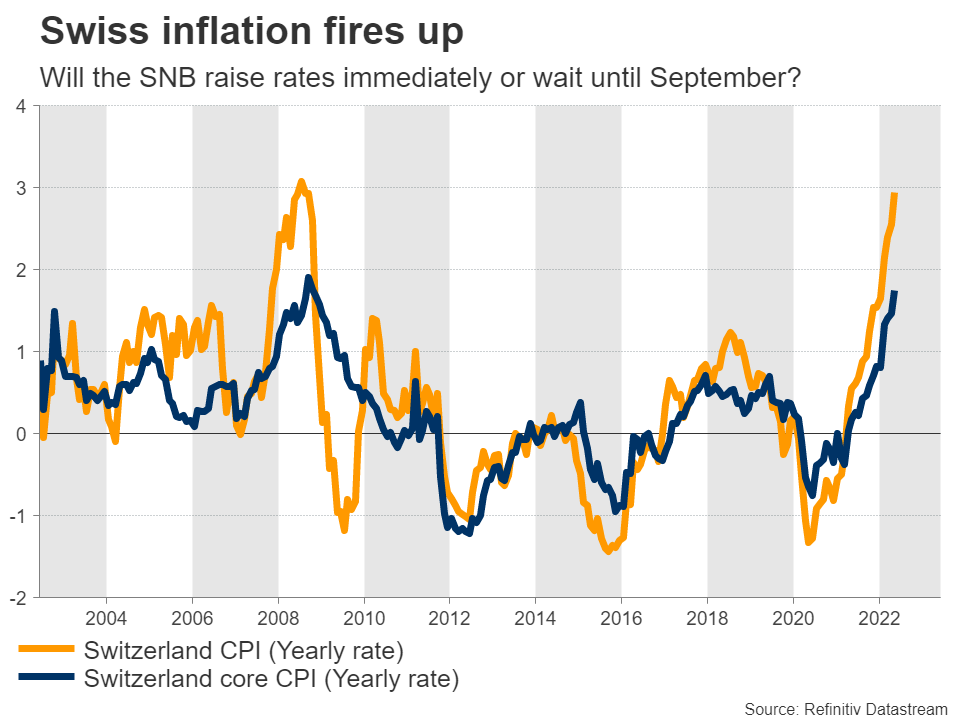
Put another way, there’s no great rush to tighten monetary policy. The latest forecasts from the SNB expect inflation to fall back to 0.9% in the next few years. Those will most likely be revised upwards, but even so, they would need to show inflation running above 2% in the coming years before the SNB can justify raising rates.
In the ECB’s shadow
Turning to the upcoming meeting, SNB officials have not said anything concrete about raising rates lately. The most hawkish remark was that they would ‘not hesitate’ to take action if inflation proves persistent, which doesn’t seem to be the case so far.
Over the last decade, the classic pattern has been that the SNB follows in the footsteps of the European Central Bank, with a lag of a few months. This was done to avoid any excessive moves in the Swiss franc, by allowing the bigger player in the region to take action first.
The ECB just telegraphed its own rate increase for July, so the SNB would be breaking its own habits if it decided to act first at this meeting.
Trading playbook
Since market pricing is tilted in favor of a rate increase, with a 70% chance of that happening, the risks surrounding the franc from this decision seem asymmetric. If the SNB does raise rates, the franc could gain but not massively, since this is already the market’s baseline scenario.
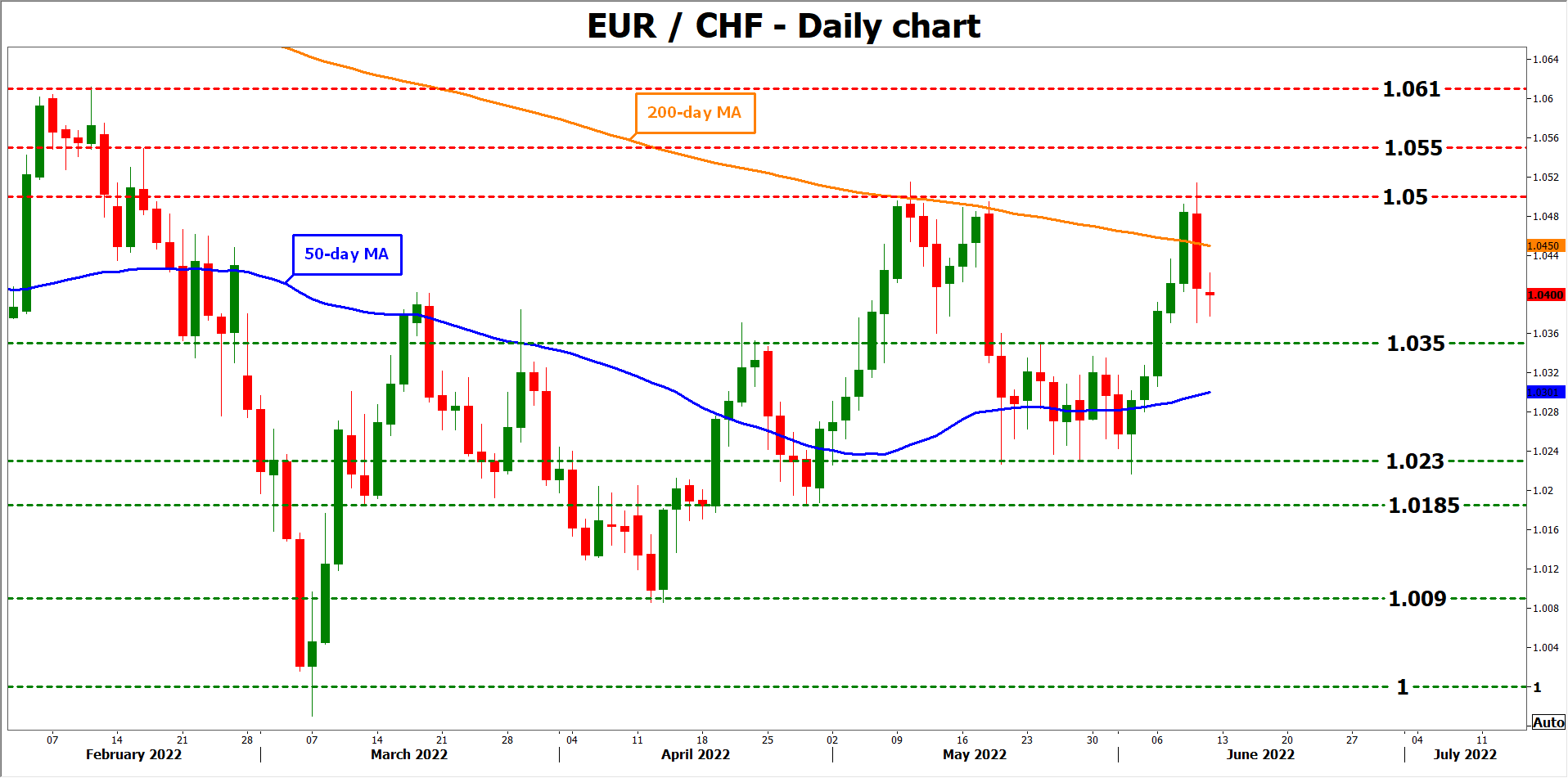
Taking a technical look at euro/franc, in this scenario the pair could edge lower towards the 1.035 zone. If that is violated, the spotlight would turn towards the recent lows around 1.0230.
On the contrary, if the SNB decides to wait until September, that might come as a surprise for traders given where market pricing stands, sparking a bigger negative reaction in the franc. In this case, euro/franc could pierce above the 1.0500 region and aim for a test of the 1.0550 barrier.
In the bigger picture, whether the SNB raises rates immediately or waits until September won’t make much of a difference. What’s important is that higher rates are coming. Negative interest rates are infamous as a tool that destroys currencies, and Switzerland has the lowest rates in the world.
Once the SNB finally exits negative rates, the franc could regain its composure.
Week Ahead – Fed Gets Ball Rolling in Busy Central Bank Week
The coming week is loaded with central bank meetings to shake things up in the FX arena. Fed officials are almost certain to raise rates by half a percentage point, so markets will be driven mostly by their future projections. The Bank of England could also lift rates but strike a cautious tone. Nothing is expected in Japan, while Switzerland might disappoint those looking for immediate action.
Fed to keep options open
The Federal Reserve has long telegraphed a 50 basis points rate increase for Wednesday’s meeting, and another one of equal size next month. Markets have done their part and have fully priced in both moves, which means the reaction in the dollar will boil down to Chairman Powell’s comments and the updated interest rate projections in the ‘dot plot’.
It’s pretty clear the US economy has started to lose momentum. Consumers are getting squeezed by rising living costs and are drawing down on their savings to compensate, the housing market is under stress amid soaring mortgage rates, and corporations are warning they might lay off workers as they try to defend profit margins.
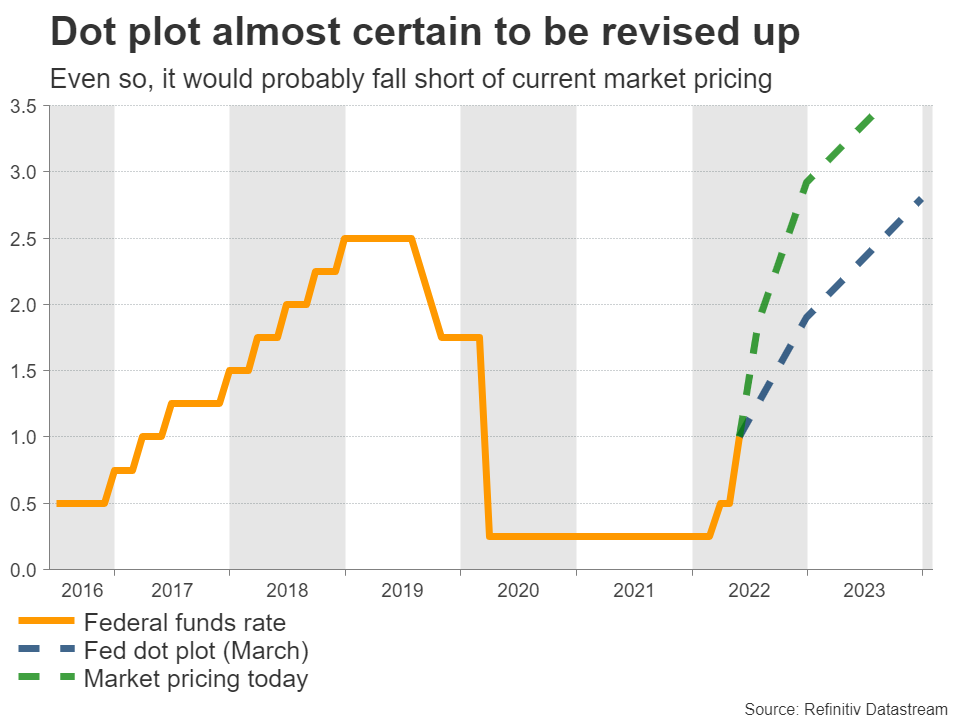
But none of this will stop the Fed from delivering the two summer hikes it has committed to. Inflation is simply too high right now and the central bank has to act, despite signs the economy is slowing. The question is what happens in September and beyond - will the Fed keep its foot heavy on the brakes or is a ‘pause’ possible in case inflation cools or recession risks intensify?
Most likely, the Fed won’t signal anything concrete. Policymakers always prefer to keep their options open and wait for incoming data to guide their decisions. They’ve already outlined their summer plans - that’s enough for now. The interest rate forecasts in the dot plot will inevitably be revised higher, but are unlikely to exceed current market pricing.
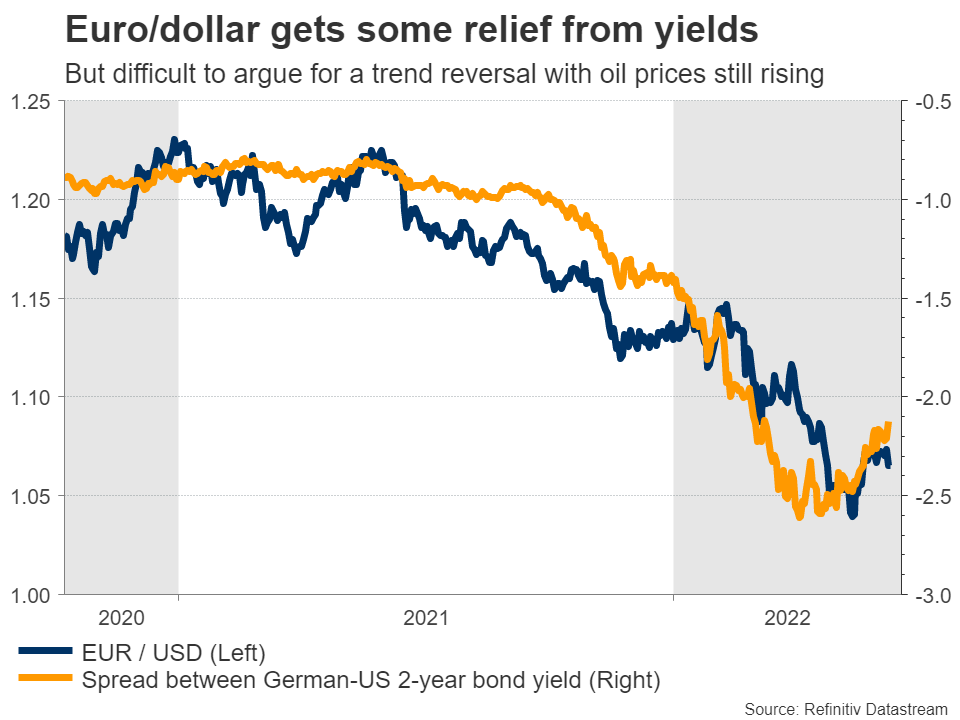
As for the dollar, it’s difficult to call for a trend reversal while every other major currency is in the gutter. The euro is suffering at the hands of soaring energy prices, the yen has been slaughtered by the Bank of Japan’s refusal to tighten, and the British pound is trading like a proxy for unstable stock markets. Not to mention that panic about a recession usually drives capital flows into the reserve currency.
In other words, the dollar won’t fall out of favor until the economic outlook for the rest of the world starts to improve. The nation’s retail sales for May will be released a few hours ahead of the Fed decision.
BoE - A hesitant rate hike
The Bank of England will conclude its own meeting on Thursday. A quarter-point rate increase is already fully priced in, and money markets also assign a 30% chance for a bigger, half-point move. Admittedly, a bigger move would not make much sense.
At its meeting last month, the BoE was already on red alert about recession risks. Some officials even supported a ‘pause’ in rate increases moving forward despite high inflation. Since then, their concerns were validated by incoming data, with business surveys signaling a sharp slowdown in the economy.
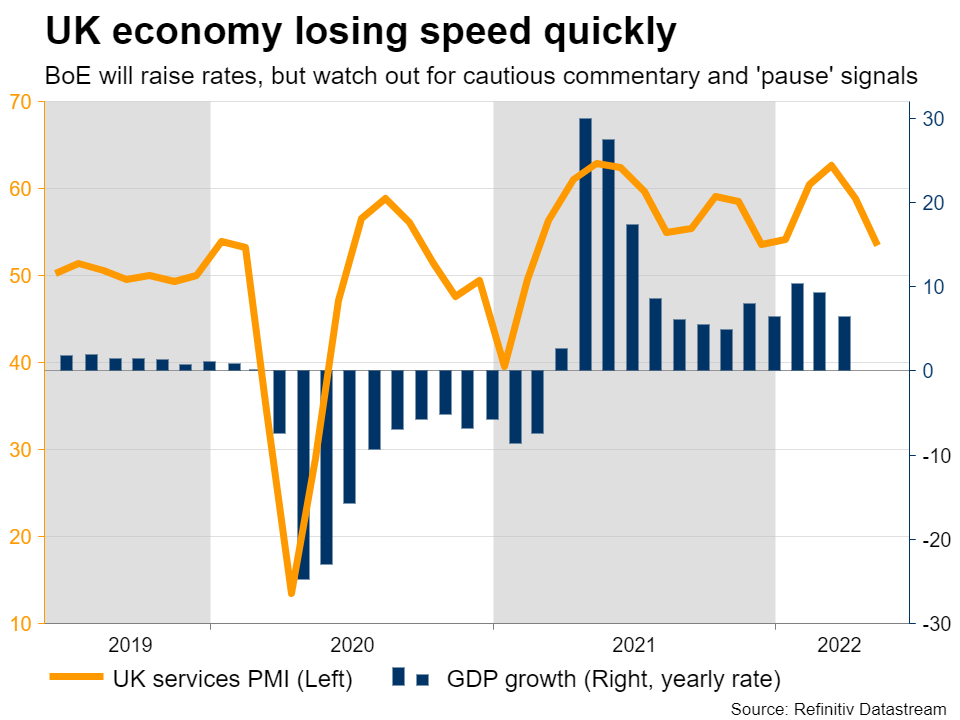
The BoE has not raised interest rates by 50 basis points so far in this cycle when the sun was shining - why would it do so now that storm clouds are on the horizon? This spells downside risks for sterling on the decision, as those looking for a bigger move are left disappointed.
In fact, market pricing seems way too aggressive right now. Six quarter-point rate increases are priced in over the next five meetings, so there’s plenty of scope for those bets to be dialed back, especially if the BoE emphasizes that a pause is possible.
Heading into the meeting, the nation’s GDP stats for April will be released on Monday ahead of the latest jobs report on Tuesday.
SNB - In the ECB’s shadow
Over in Switzerland, the central bank will also announce its decision on Thursday and it will be the most important one in many years as markets imply a 70% chance for an immediate rate increase.
Inflation has finally accelerated and is running at the fastest pace in 14 years, although most of that reflects soaring energy and food costs. Wage growth remains subdued, which means there’s no real danger of a wage-price spiral that keeps feeding inflation and therefore no real urgency to raise rates.
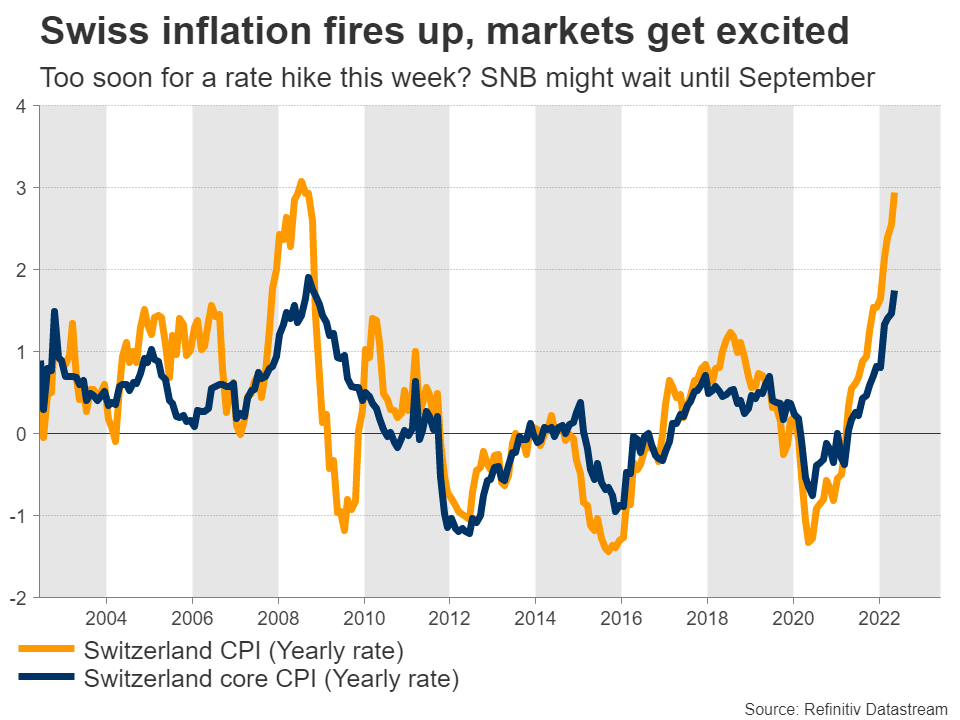
Waiting until the next meeting in September to begin the hiking cycle seems more appropriate, as that would also allow the SNB to stay one step behind the European Central Bank, preventing any excessive appreciation in the franc.
BoJ refuses to join party
The only major central bank that is not even thinking about raising interest rates is the Bank of Japan, which will wrap up its meeting on Friday. A parade of BoJ officials made it very clear lately that policy changes are not on the agenda for this meeting.
That dealt another blow to the devastated yen. By holding their ground and allowing the yen to weaken so much, BoJ officials hope to import enough inflation from abroad to lift inflation expectations in an economy that has been battling deflation for decades.
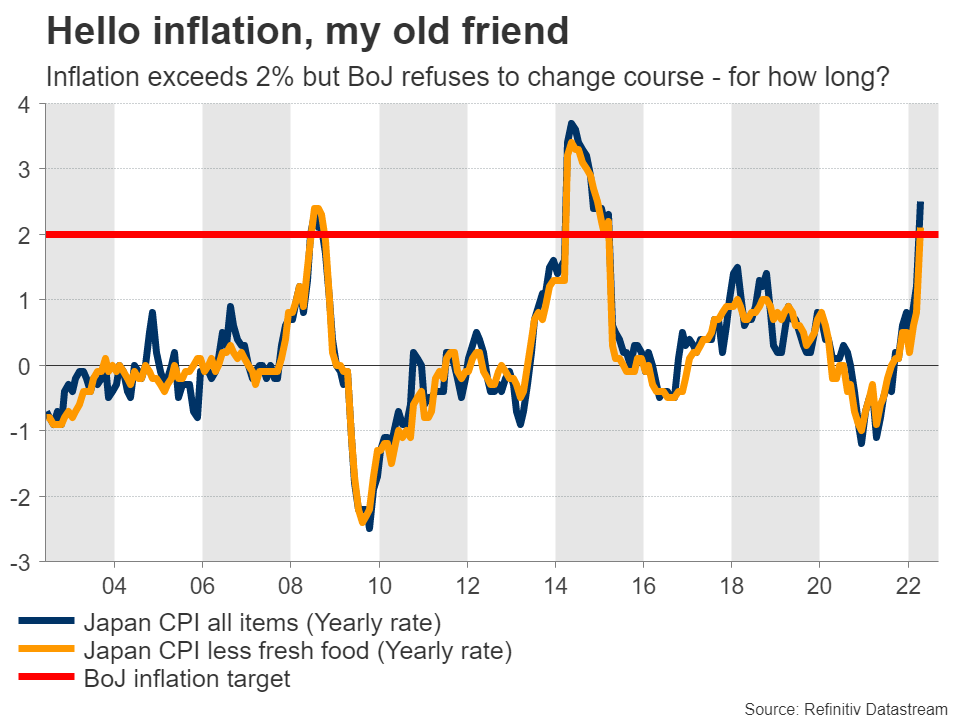
But everything has limits. The yen’s collapse has become a political issue and with inflation already above its 2% target, there’s tremendous pressure on the BoJ to change course. While nothing is likely to happen this time, don’t be surprised if the BoJ begins to turn the ship around by July or September if inflation keeps accelerating. That could finally mark the bottom in the yen.
Finally in the commodity currency spectrum, Australia’s jobs report for May and New Zealand’s GDP growth stats for Q1 will both be released on Thursday.
Weekly Focus – ECB Pre-Announces Rate Hikes
The ECB took centre of attention this week. According to the monetary policy meeting statement, the ECB intends to end QE by 1 July and hike policy rates by 25bp in connection with the July meeting. The ECB also opened the door for hiking by 50bp in September "if the medium-term inflation outlook persists or deteriorates". European yields and EUR/USD rose after the announcement. 10yr German bund yields are trading at 1.43% at the time of writing. We now expect the ECB to hike by 25bp in July, 50bp in September and 25bp on each of the following meetings until March 2023 when the hiking cycle is likely to end, in our view. We see risks as skewed towards more 50bp rate hikes. For more see ECB Review: Ready for lift-off - confirmed!, 9 June 2022.
Several central banks are meeting next week. We expect the Federal Reserve to hike by another 50bp on Wednesday and signal that at least one more 50bp rate hike is likely in July. With still high underlying inflation pressure and high labour demand, risk is skewed towards the Fed signalling that more 50bp is needed, not least after Fed's Waller opened the door for continuing with larger 50bp rate hikes in the autumn.
In the UK, we expect the Bank of England to hike the Bank Rate by another 25bp to 1.25% but simultaneously still sending slightly mixed signals by repeating that "some degree of further tightening in monetary policy may still be appropriate in the coming months" (own highlight).
In Switzerland, we do not expect the SNB to hike at next week's meeting but the pressure is increasing, as the ECB is about to hike policy rates and CPI inflation is now running close to 3%.
The Bank of Japan has made it very clear that they do not see the weak yen as a problem. With still modest inflation pressure, we expect no changes to the bank's accommodative stance on the policy meeting ending Friday. In other words, the Bank of Japan remains an outlier among advanced central banks.
Besides plenty of central bank meetings, we have several important data releases next week. In the US, the key release is retail sales in May. In the euro area, ZEW expectations due out on Tuesday will give some hints about growth momentum/confidence. Otherwise focus remains on inflation, including on the announcement of more support measures for consumers and final May HICP figures will give more insights into the core inflation drivers. In China, we get data for credit growth, industrial production and retail sales. Especially credit growth is interesting in the light of more stimulus. We cannot rule out that the Chinese authorities ease monetary policy further (rate cut or lower reserve requirement), which is quite different compared to what is going on in advanced economies.
In Scandi, Swedish inflation data is due out on Tuesday. In Norway, we also receive the monthly GDP estimate for April.
Accelerating US Inflation Weighs on Stocks, Strengthens USD
The US consumer price index accelerated by 8.6% in May from 8.3% a month earlier. The new data exceeded expectations, rebutting hopes that US inflation is already slowing.
Today’s inflation report is the last big release before the Fed meeting next Wednesday. A renewal of inflation to 40-year highs will surely attract the public’s attention at the weekend and will pressure the Fed.
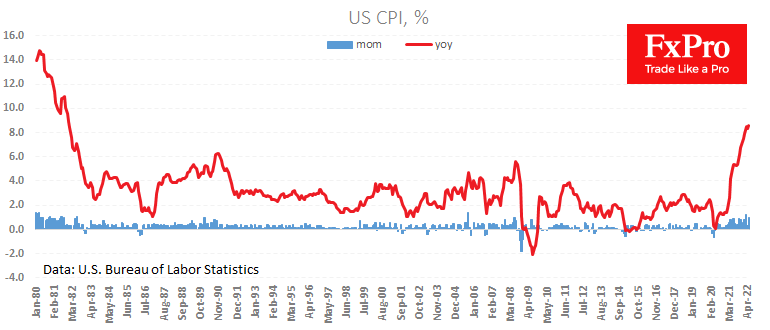
Potentially, such high reading could trigger a tougher FOMC stance in the accompanying commentary. Recently, the Fed has been expected to raise rates by 50 points next week and hints of another such move in late July.
However, with a strong labour market and persistently high inflation, there are increasing chances that more such double-sized rate hikes are required, which is speculatively good news for the dollar in the coming weeks.
A separate issue is quantitative tightening. The Fed could also adjust its plans to sell assets off the balance sheet to tighten financial conditions in the country further. Proponents of such an approach point to the record amounts of excess liquidity that commercial banks are parking on central bank balance sheets.
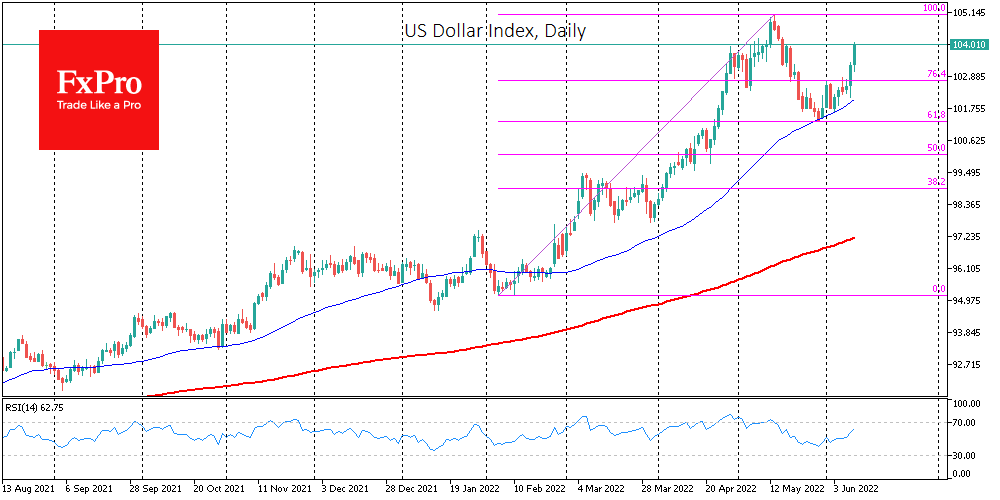
High inflation is bad news for the stock market because it will force the Fed to tighten the monetary policy screws even further. The Fed’s open intention to suppress inflation creates risk-off market sentiment when the price growth remains high. In this environment, dollar-denominated money market assets become attractive because of higher yields.
This is in stark contrast to last year when the Fed reassured us that everything would pass itself, so investors preferred to sell dollars that were losing value.
So Much for the “we’ve moved past the peak”
Markets
Yesterday’s ECB meeting will go down in history books as one of the most important ones. The central bank committed to kill off surging inflation by ending asset purchases and hiking rates from July on. First by 25 bps, then double that in September and possibly October. European yields went crazy and rose across the curve, the short end underperforming. That part of the curve still went strong today. The long end however eases several bps, in a potential sign of markets fearing the impact of aggressive ECB normalization on the economy going forward. Yet, the central bank has no choice. And neither has the Fed.
We move from the ECB yesterday to US CPI today. Inflation unexpectedly shot up from 8.3% to 8.6% in May, thanks to very strong monthly dynamics (1% m/m). So much for the “we’ve moved past the peak”. Price pressures were once again broad-based, ranging from food (1.2% m/m), over housing (0.8%) and transportation (2%) to airline fares (12.6%). As a result, core inflation eased less-than-hoped, from 6.2% to 6% (0.6% m/m, unchanged from April). Wage gains coming from a tight labour market are simply too little with these kind of numbers. Separate data showed that inflation-adjusted hourly earnings in May fell 3% y/y, the 14th (!) straight decline. The data all but cement market expectations for a third 50 bps rate hike in September with a 85% chance priced in for another such move in November.
American yields soar between 3 bps (30y) to 14 bps in the 2y. The latter easily surpasses the previous intraday cycle high of 2.85% to trade at 2.95%. The 5y set a new cycle high as well. The 10y (3.11%) is attacking the 3.12% closing high from early May. European/German yields jump another 8.2-11 bps (5y-2y). About half of that was due to further repositioning post-ECB with the remainder taking place on the back of surprisingly high US CPI serving as proof that inflation won’t go down without a proper fight.
All of this central bank anticipation/speculation is demanding a heavy toll on equities. European stocks tank almost 3%. The EuroStoxx50 is testing support at 3630. A break paves the way to the May low of 3526. Wall Street tumbles between 1.7-1.9%. The S&P 500 gaps below the March 2021 top and already attacks the February interim highs.
It’s classic risk-off on currency markets. The dollar advances against all but one … the Japanese yen. USD/JPY eases slightly but remains near the 22-year high of 134.56. That’s surprising given the strong core bond yield increases. On a trade-weighted basis, DXY is testing the 104 barrier – the final hurdle before a return to the 105 cycle high. EUR/USD sinks below 1.06 to 1.0537, turning the technical picture increasingly complicated, if not disastrous.News HeadlinesInflation in Norway rose a more-than-expected 0.2% M/M resulting in a 5.7% Y/Y print. Underlying inflation at 0.4% M/M and 3.4% Y/Y also surpassed expectations. The Norges Bank (NB) since September last year followed a gradual path of quarterly rate hikes. In its May policy statement the NB said that ’If there are prospects of persistently high inflation, the policy rate may be raised more quickly than indicated by the policy rate forecast in the March Report’. The NB could consider a bigger 50 bps hike at the June 23 meeting or an additional 25 bps step at the August meeting. The Norwegian krone gained modestly today with EUR/NOK falling to 10.15 from the 10.18 area before the start of trading this morning. Similar story for inflation in neighboring Demark. The domestic measure of inflation rose 0.9 M/M to be up 7.4%Y/Y (from 6.7% in April). EU harmonized CPI even jumped from 7.4% to 8.2%. Inflation in the Czech Republic also jumped 1.8% M/M bringing the Y/Y measure to 16.0% Y/Y (was 14.2% in April). Prices rises on a monthly basis were mainly driven by food and non-alcoholic beverages (3.4% M/M), housing water energy and fuel (1.5% M/M) and hotels and restaurants (3.0%). The jump in inflation is fueling speculation that the MPC of the Czech national Bank at the last meeting in its current composition might go for an final ‘outsized’ hike (100/125 bps). From July, the MPC with new governor Michl, who opposes the aggressive approach, and three other new members then might keep rates unchanged for a longer period. The Czech koruna today traded little changed in the EUR/CZK 24.70 area as markets take into account the presumed change in the policy approach beyond June.
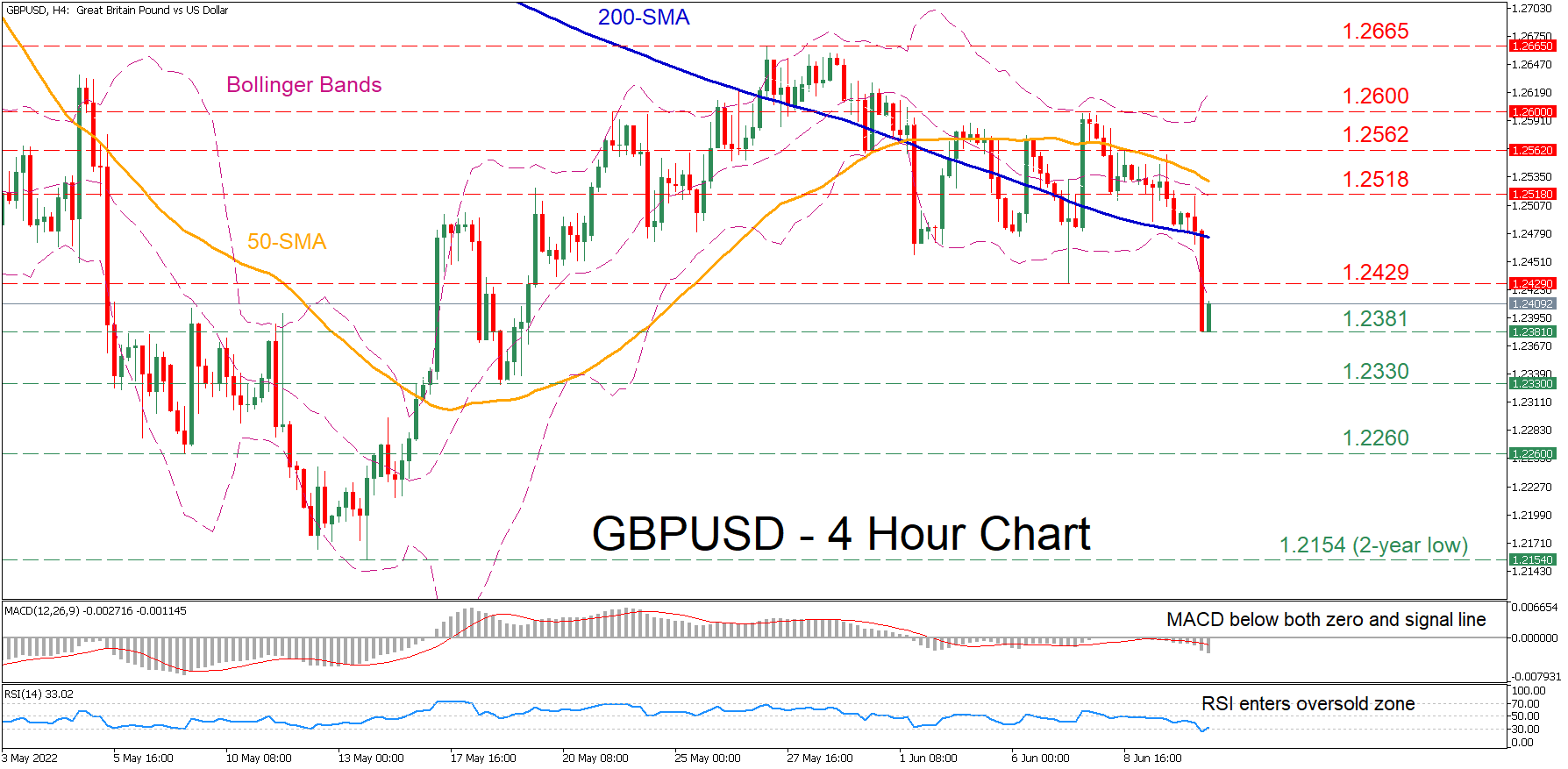
GBPUSD Tumbles after Stronger US CPI Print
GBPUSD has been in a downtrend after it failed to jump beyond the 1.2600 region, generating a profound structure of lower highs and lower lows. Additionally, the price has sharply dropped beneath both the 200-period simple moving average (SMA) and the lower Bollinger band, endorsing a broader bearish short-term picture.
The short-term oscillators also confirm that bearish forces are in total control. Specifically, the RSI has entered its 30-oversold area, while the MACD histogram is currently beneath both zero and its red signal line.
Should selling interest intensify, the 1.2381 hurdle might act as immediate support for the pair. If that floor collapses, the price could descend towards 1.2330 or lower to test the 1.2260 obstacle. A violation of the latter could set the stage for the two-year low of 1.2154.
On the flipside, should negative momentum wane and the price reverses upwards, initial resistance could be encountered at the previous support region of 1.2429. Violating this area, the bulls could aim for 1.2518 before the spotlight turns to the 1.2562 barrier. Higher, further advances could then cease at the 1.2600 psychological mark.
In brief, GBPUSD’s short-term picture seems to be deteriorating as it experiences a new wave of downside pressures. For that bearish tone to reverse, the price needs to clearly jump above the 1.2600 ceiling.
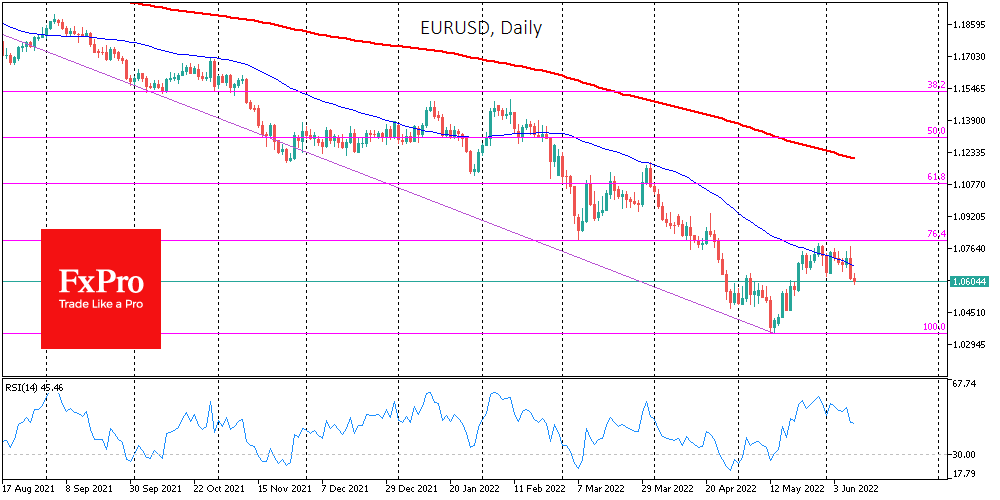
ECB is Two Steps Behind the Fed, Digging a Hole Under the Euro
As expected, euro buyers’ optimism faded immediately after the ECB press conference began, returning EURUSD back below 1.0600.
Shortly after the initial surge in reports of an actual reversal in ECB policy, investors and traders delved into assessments of how slower the policy reversal in Europe was.
The ECB will only stop buying assets on its balance sheet later this month – two steps behind the US, where purchases were curtailed months ago and active sales are already due to begin in June.
The Fed raised its rate by 25 points in March and 50 points at the start of May, promising two more 50-point hikes in June and July. From the ECB, we see a conditional promise to consider a rate hike of more than 25 points in September in case of high inflation forecasts for 2023.
That said, inflation in the eurozone is comparable to the US, and economic growth is just as, if not more, vulnerable to logistical failures and energy prices.
Not only has the ECB started its policy turnaround later, but it is also doing so more slowly than the Fed so that the interest rate differential only widens over time.
Such differences are a fundamental reason to sell the euro against the dollar. Moreover, the EURUSD bounce in the second half of May erased the pair’s oversold conditions, clearing the way for another step down.
Yesterday’s comments from the ECB convinced us not to expect any hawkish surprises from Lagarde and Co, triggering a new sell-off impulse. It won’t be surprising if EURUSD makes another test of the May low at 1.0350 or if it makes a new 20-year low below that level during the next couple of weeks.
Canada’s Labour Market Bounces Back in May
The Canadian labour market gained 40k positions in May, with full-time employment up 135k and part-time employment down 96k.
The unemployment rate dropped by 0.1 percentage points, to 5.1%. The participation rate was unchanged at 65.3%.
By industry, employment in the services producing sector rose 81k, "with gains spread across several industries, including accommodation and food services." Meanwhile, employment in the goods-producing sector dropped by 41k, "mostly due to a decline in manufacturing."
On a geographic basis, the report noted employment gains in Alberta (+28k), Newfoundland and Labrador (+4.1k), and Prince Edward Island (+1.1k), while New Brunswick (-3.9k) was the one province seeing a drop. Employment in Ontario and Quebec held steady over the month.
Lastly, total hours worked declined 0.3% month-on-month and wages were up 3.9% year-on-year (versus 3.3% last month).
Key Implications
It was a nice bounce-back for Canadian employment in May. Following April's Omicron-induced slowdown in job gains (recall nearly 10% of workers were absent due to illness), there has been a noticeable return to more normal life for Canadians. As we commence the ritual of filling patios and hit the road for overdue vacations, employers continue to search for workers to meet heighten demand. This has job vacancy rates at record levels, making it clear that the Canadian economy is operating beyond full employment.
With more people employed and wage growth climbing, the strength in domestic demand will be sufficient to keep inflation as a thorn in the side of the Bank of Canada. Just yesterday, Governor Macklem stated his openness to speeding up the rate hike cycle given the overheating economy. Today's jobs report will only continue to fuel speculation of even higher interest rates. This has short-term Canadian bond yields moving higher this morning, with most yield tenors comfortably above 3%.