

Sample Category Title
EUR/USD Daily Outlook
Daily Pivots: (S1) 1.0469; (P) 1.0555 (R1) 1.0605; More...
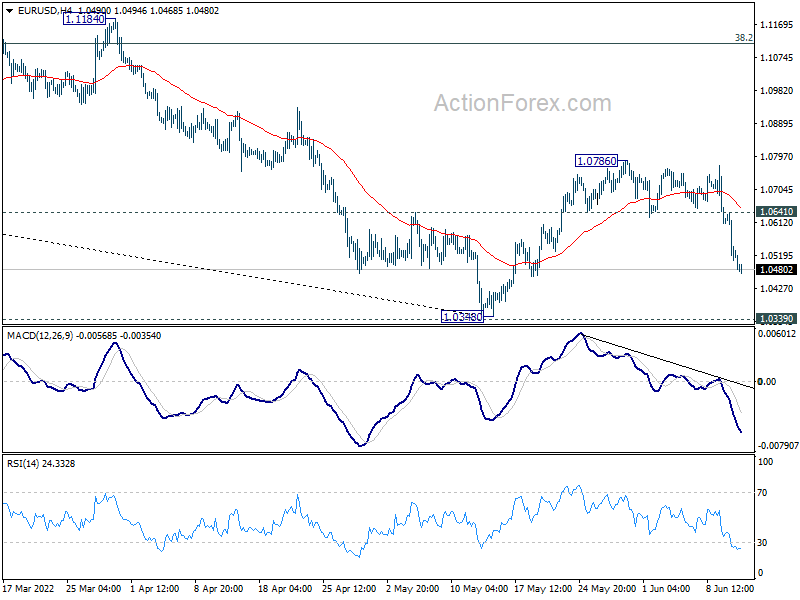
Intraday bias in EUR/USD remains on the downside for retesting 1.0348 and 1.0339 long term support. Decisive break there will resume larger down trend. On the upside, above 1.0641 minor resistance will turn intraday bias neutral first.
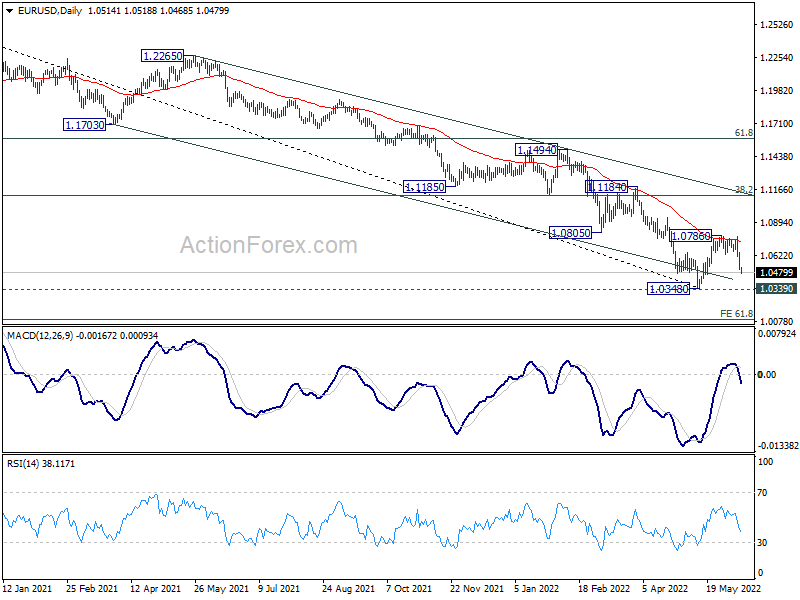
In the bigger picture, focus stays on 1.0339 long term support (2017 low). Decisive break there will resume whole down trend from 1.6039 (2008 high). Next target is 61.8% projection of 1.3993 to 1.0339 from 1.2348 at 1.0090. However, firm break of 1.0805 support turned resistance will delay this bearish case. Rise from 1.0348 is at least a correction to the down trend from 1.2348. Stronger rebound would be seen to 38.2% retracement of 1.2348 to 1.0348 at 1.1112.
GBP/USD Daily Outlook
Daily Pivots: (S1) 1.2242; (P) 1.2380; (R1) 1.2459; More...
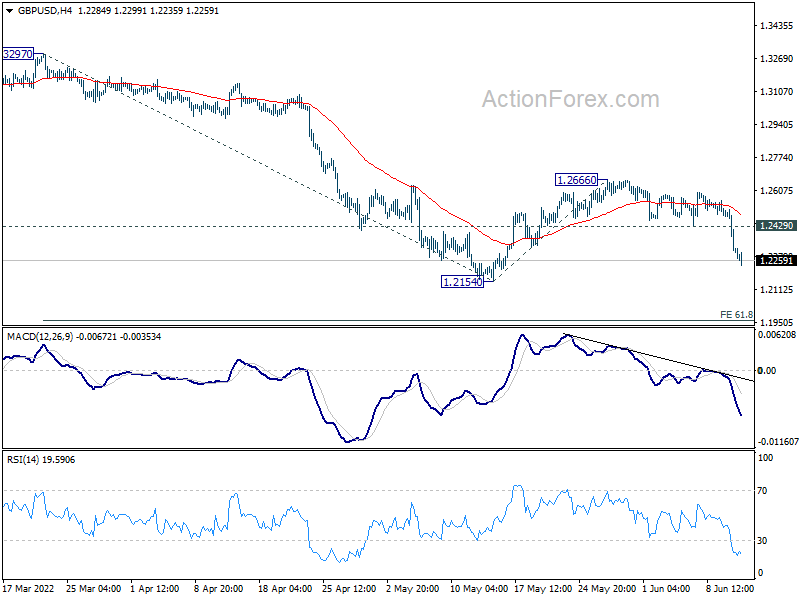
Intraday bias in GBP/USD remains on the downside for retesting 1.2154 low. Firm break there will resume larger down trend. Next target is 61.8% projection of 1.3297 to 1.2154 from 1.2666 at 1.1960. On the upside, above 1.2429 minor resistance will delay the bearish case, and turn intraday bias neutral first.
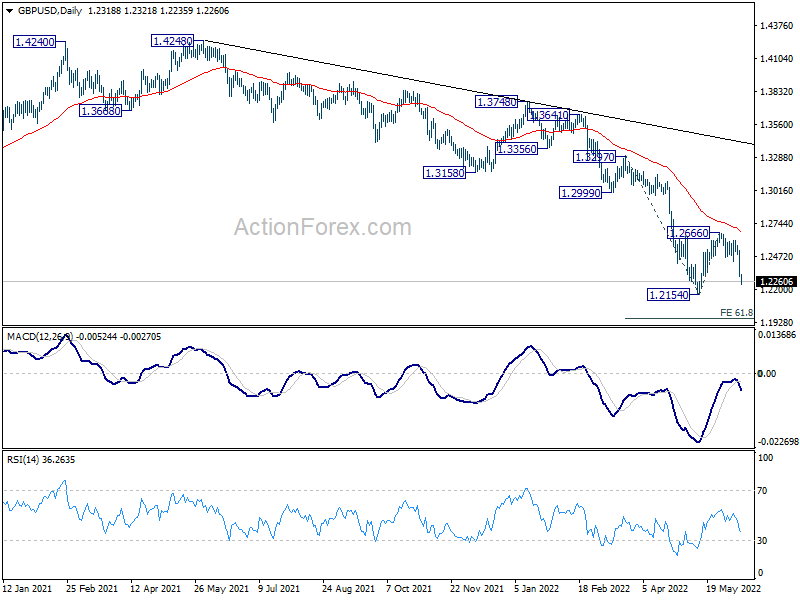
In the bigger picture, fall from 1.4248 (2018 high) could be a leg inside the pattern from 1.1409 (2020 low), or resuming the longer term down trend. Deeper decline is expected as long as 1.2999 support turned resistance holds. On resumption, next target is 1.1409 low.
USD/CHF Daily Outlook
Daily Pivots: (S1) 0.9793; (P) 0.9845; (R1) 0.9925; More...
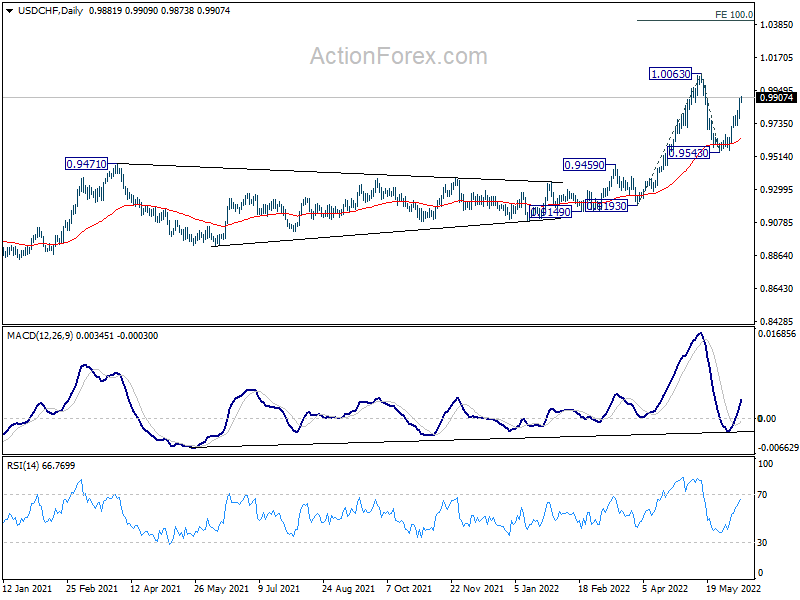
Intraday bias in USD/CHF remains on the upside for retesting 1.0063 resistance. Firm break there will resume larger up trend. Next target is 100% projection of 0.9193 to 1.0063 from 0.9543 at 1.0413. On the downside, below 0.9764 minor support will delay the bullish case and turn intraday bias neutral first.
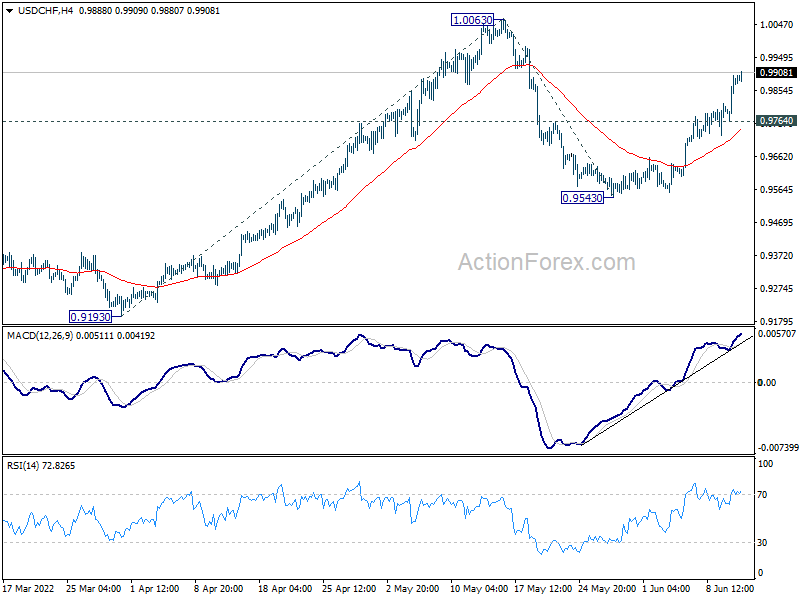
In the bigger picture, down trend from 1.0342 (2016 high) should have completed with three waves down to 0.8756 (2021 low) already. Rise from 0.8756 is likely a medium term up trend of its own. Next target is 1.0237/0342 resistance zone. This will remain the favored case as long as 0.9471 resistance turned support holds. However, sustained break of 0.9471 will extend long term range trading with another falling leg.
BoJ Kuroda: Recent sharp falls in Yen negative and undesirable
BoJ Governor Haruhiko Kuroda told the parliament today that recent sharp yen falls are "negative and undesirable" to the economy. The depreciations raise uncertainty over the outlook and make it difficult for companies' business planning. He pledged again to carefully monitor the developments and their impacts.
Kuroda also reiterated that BoJ must maintain ulta-loose monetary policy. He added that Japan is not facing stagflation, where high inflation and economic stagnation co-exist, and was not facing the risk of sliding back into that state.
Global Inflation Watch – Still No Sign of Easing US and Euro Inflation Pressure
Overview: Higher oil prices and very tight labour markets continue to keep inflation pressures high. There is some relief, though, from lower gas prices and some foodstuff prices. The decline in freight rates has come to a halt lately but they are still lower from the peak. . US gasoline prices have continued higher now nearing USD5 per gallon. While we look for a peak in inflation soon in the US and euro area, it is expected to remain high into 2023.
Inflation expectations: Market-based long-term inflation expectations are moving broadly sideways and still above 2%. US household inflation expectations jumped to a new high in May and looks increasingly unanchored. Euro consumer inflation expectations are also high but declined in May.
US: CPI increased 1.0% in May compared to 0.3% in April. The higher inflation was primarily driven by increases in the energy index of 3.9% and the food index of 1.2% during the month. However, core CPI still increased by 0.6% which highlights that inflation is broadly based and not only driven by rising energy prices. Inflation rose 8.6% for the 12 month ending in May, which is the largest increase since December 1981. The high underlying inflation adds fuel to the Federal Reserve's plan to raise interest rates. We expect that core inflation to stay elevated for the rest of the year.
Euro: Headline inflation rose to yet a new record high of 8.1% in May, driven by a further surge in food, energy and goods prices. Rising input costs are still working their way through the pricing chain, keeping goods price inflation elevated well into 2023 in our view. Service price inflation also remains supported by pent-up demand for travel and recreational services. Overall, we project core inflation to remain above target, averaging 3.5% in 2022 and 2.9% in 2023. The continued building of underlying inflation pressures leaves little room for complacency for ECB, especially as producer prices have yet to see a peak, inflation expectations still stand above the 2% goal and negotiated wage growth picked up to 2.8% in Q1 (from 1.6% in Q4 21, although partly due to one-off payments in Germany).
China: CPI inflation remained low in May at 2.1% leaving room for Chinese stimulus. PPI inflation declined from 8.0% y/y in April to 6.4% y/y in May.
Fed Should Get More Aggressive if it Wants to Take Control of Inflation
Ouch. Released Friday, the US CPI data unexpectedly advanced to 8.6% in May. The data slashed hope that inflation had peaked, and revived the hawkish expectations that the Federal Reserve (Fed) should get more aggressive if it wants to take control of inflation.
Plus, the University of Michigan’s consumer confidence index fell to the lowest level since the data started in 1978, which gave just another hit to investors who were already knocked out by the inflation figure.
The unexpected U-turn in US inflation number also removed the 3% speed bump on the US 10-year yield. The 10-year yield shot up to 3.20% this morning, and the 2-year yield hit 3.19%. We shall see a further selloff in the US short and long-term treasuries on revived hawkish Fed expectations into Wednesday’s FOMC decision.
On Wednesday, the FOMC is expected to raise the interest rates by another 50 bps, yet the possibility of a 75-bp hike is now being priced in. Before inflation data, activity on Fed funds futures assessed around 5% chance for a 75bp hike at this week’s meeting. Now, they price a 23% chance of a 75bp hike.
More importantly, the chance of a 75bp hike in July meeting is now more than 50%, and the market even gives a 14% chance for a 100bp hike. This is how hawkish the Fed expectations got following the Friday’s unfortunate CPI read.
A major hit to equities, and to Bitcoin
The S&P500 took an ugly dive after the US CPI data revived hawkish Fed expectations. The index lost near 2.90% on Friday, as Nasdaq lost more than 3.5%. Bitcoin tumbled to $25K.
The data was so ugly that even the American crude slipped below the $120 per barrel, on fear that the Fed may not have a choice but to push the US economy into recession to tame inflation. The Atlanta Fed’s GDPNow projection is at 0.9% for the second quarter growth, down from 1.3% a week ago. The next release is on Wednesday, and won’t look any better.
US dollar up
The US dollar is roaring again, with the dollar index trading at 104.50 at the time of writing. All majors are down against the greenback, starting with the euro which fell below the 1.05 mark this morning against the US dollar.
The dollar-yen jumped above the 135 mark for the first time in 20 years. Cable fell below the 1.23 level, and the Aussie-dollar is about to slip below the 70 cents level.
There is little chance we see the US dollar soften before the FOMC decision this week, as not many investors have the guts to swim against such a strong tide, and such a strong reality!
The latest hit on the EURUSD will likely call for more aggressive action from the European Central Bank (ECB) to keep up with the Fed’s pace of tightening. Christine Lagarde made clear that she won’t conduct a catch-up policy with the Fed, nor the others. But the truth is, when the dollar becomes more expensive, many USD-denominated goods that Europeans import – starting with energy, become more expensive and boost inflation.
But in the short run, the hawkish shift in Fed expectations will likely continue weighing on single currency, until the ECB expectations catch up. The next natural target for euro bears stands at 1.0350, May support.
Black Monday
A market perpetually looking for reasons to temper Federal Reserve hiking expectations (so they can buy equities), had those quashed on Friday. US headline inflation accelerated to 8.60% YoY from 8.30% previously, with core inflation holding at 6.0%, slightly lower than April’s 6.0%. That sparked a scramble to reassess Fed hiking expectations, with some calling for a 0.75% hike at this week's FOMC meeting.
Equities were sold heavily while the US yield curve saw short-dated yields shoot higher while the 10-year to 30-year was also sold. That has left the 2/10-year tenor at just 10 basis points and 2/30-year at just 16 basis points. That is uncomfortably close to flat and with the R-word now on everyone’s lips, we can’t rule out the possibility of an inversion, which markets use as a signal for a recession. The 5/10-year already is.
With higher yields and markets running for cover, the US Dollar soared, with the Euro getting pummelled along with fellow sentiment indicators, the Australian Dollar, New Zealand Dollar and the Korean Won. Oil has also retreated again today as a US recession is complicated by mass covid-19 testing over the weekend in Beijing and Shanghai. I’ll say it again, under covid-zero policies, the virus only has to get lucky once and anyone trying to pick the bottom in China's growth and equity markets on the basis that China was “one and done” on lockdowns is naïve.
It is turning into a Black Monday in Asia as well after US and European equity markets were pummelled on Friday, as China risks also rise again. US equity index futures have continued their selloff this morning, oil continues to fall, the US Dollar has risen as Asian currencies play catchup to Friday's greenback rally, and Asian equity markets are taking some serious selling pressure.
It is a measure of how quickly sentiment has turned that gold managed to disengage itself from its inverse correlation on Friday, finishing the day higher at $1871.50 an ounce. That indicates just how nervous investors out there are now, although I would like to see another positive close in the face of US Dollar strength and higher US yields before calling a medium-term low. Given that gold has fallen in Asia, I am not so sure that this isn’t another false dawn for gold bugs.
Perhaps the biggest carnage has been in the crypto space which is on the verge of a reckoning now that the gloves are off around global inflation and the realities of a new world where fixed interest actually pays a yield – albeit one still deeply negative in real terms. Bitcoin fell by around 10% over the weekend, while Ethereum was cremated, falling by around 20%. That sell-off also continues this morning and I am wondering if some cross-margining stop losses are going to start washing through real asset classes. Things may get uglier if the pegs on (un)stable coins like tether start becoming untethered.
Today’s data calendar is non-existent, which means markets will be allowed to continue stewing in sentiment and risk aversion. Australian markets are closed today, but looking at the price action around Asia, they may be glad they are.
This week’s centrepiece is undoubtedly the FOMC policy meeting this Wednesday (NYT). I am not sure if Friday’s inflation reading is enough to provoke a 0.75% rate hike, although that won’t stop people from forecasting it. A 0.50% hike is done and dusted, and the crucial point will be what the Fed’s outlook is from here and whether they remain confident about a soft landing. The post-meeting press conference will surely be one of the most exciting of the year.
Elsewhere, China will release its latest Medium Lending Facility rate sometime between today and Thursday. Cutting it from 2.85% would be a surprise (not a huge surprise), as the government remains intent on targeted stimulus and bank lending has already soared after the government ordered the banks to lend more.
The Federal Reserve is not the only central bank with a policy decision this week. The Swiss National bank on Thursday would love to raise rates from -0.75% I am sure, but with risk aversion lifting the Swiss Franc the Euro falling once again, it is boxed in. The Bank of England also meets on Thursday and markets are pricing in a 0.25% hike to 1.25%. Talk of 0.50% will come to nought as the BOE has raised the white flag on inflation already.
Perhaps the most interesting one, which is usually the most boring, is the Bank of Japan on Friday. A continuation of the quantitative easing forever and the 0.25% cap on 10-year JGB yields is expected. However, USD/JPY has hit 135.00 this morning and if it reaches for 138.00 this week, the temptation/need to tinker with the JGB yield corridor may become irresistible. Despite all the rhetoric to the opposite recently, I don’t fully discount the mother of all spoofs occurring on Friday. Given the amount of long USD/JPY positioning out there, a slight hike in the JGB yield cap could see an ugly washout, maybe even back to the 130.00 region or lower. Wouldn’t that be something?
Equity sell-off continues in Asia
On Friday, the higher-than-expected US inflation data dissolved hopes of a less aggressive FOMC, prompting a mass sell-off of equity markets in the US and Europe. The S&P 500 slumped by 2.91%, the Nasdaq tumbled by 3.52%, and the Dow Jones fell by 2.73%. things aren’t looking any better with US futures in Asia today, as the selling continues, perhaps with one eye on the weekend crypto meltdown. S&P 500 futures are 1.40% lower, Nasdaq futures have fallen by 1.80%, and Dow futures are 1.0% lower.
Obviously, the slump by Wall Street has provoked a negative reaction in Asian markets today, and mass testing in China over the weekend has lockdown nerves elevated once again. Japan’s Nikkei 225 has tumbled by 2.70%, with South Korea’s Kospi doing slightly worse, retreating by 2.75%, while Taiwan is down by 2.25%.
In Mainland China, the Shanghai Composite is 0.85% lower, with the CSI 300 down by 0.95%. There is no solace for Hong Kong, the Hang Seng has slumped by 2.90% today. In regional markets, Singapore is 0.65% lower, Kuala Lumpur is down by 1.50%, and Jakarta has retreated by 1.95%. Bangkok has lost 1.25%, and Manila is 0.55% lower. Australian markets are closed, but New Zealand has slumped by 2.30%.
Given the price action seen today in Asia, especially the continuing selloff of US index futures, it is unlikely that European markets will look to buy the dip. More likely is that they will continue to jail without passing go. Even the perpetually bullish FOMO gnomes of Wall Street may struggle to find a reason to buy the dip this afternoon, especially if the US yield curve continues to flatten.
Haven buying lifts the US Dollar
The US inflation data spurred a sharp rise in US yields across the curve, a selloff by equities, and in turn, a haven-derived rush into US Dollar. The dollar index tore through resistance at 104.00 on its way to a 0.85% gain to 104.18 on Friday, rising another 0.26% to 104.46 in Asia. The index looks to have formed a medium-term low now as the reality of monetary policy divergence permeates the financial world. The dollar index will now have 105.00 in its sights with support at 104.00 and 103.00.
EUR/USD slumped on Friday, carving through support at 1.0600, almost reaching my 1.0500 targets for this week. It finished 0.93% lower at 1.0520 and has fallen another 0.30% to 1.0490 in Asia. With the ECB only likely to hike a total of 0.50% by September, with the Fed likely to have booked 1.50% of hikes by then, it is no surprise that the single currency has resumed its selloff. The fact that EUR/USD never seriously attempted to regain its multi-decade breakout around 1.0800 suggests that a medium-term high is now in place. Weekend developments in Ukraine were not good news either, and that is likely to further sap sentiment. EUR/USD has resistance at 1.0610 initially, with support at 1.0460.
Sterling fell by 1.43% to 1.2320 on Friday on widening yield expectations from the BOE and the Fed. In Asia, GBP/USD has fallen another 0.23% to 1.2290. Resistance is distant at 1.2425, while a retest of the May lows around 1.2150 has become a distinct possibility.
Quite surprisingly, given the move in US yields on Friday, USD/JPY was almost unchanged at 134.40, before rising 50 points to 134.90 in Asia today. I suspect the broad selloff across asset markets on Friday provoked quite a lot of haven-derived yen repatriation by Japanese investors, capping USD/JPY’s gains. That has ebbed today, allowing the USD/JPY rally to resume. A daily close above 135.00 suggests more gains to 138.00 in the week ahead, while only a fall below 133.00 changes the bullish picture. Some nerves around Friday’s BOJ policy meeting may also be tempering USD/JPY gains.
The Australian and New Zealand Dollars held up relatively well on Friday, falling 0.74% to 0.7040, and 0.45% to 0.6355 respectively. An Australian holiday and severe weather in New Zealand are probably muting volumes in both today, sparing further blushes, but I do not rule out a catchup selloff in London this afternoon. AUD/USD has fallen 0.25% to 0.7025 today, with support at 0.7000 and 0.6950, with resistance at 0.7050. NZD/USD has fallen by 0.20% to 0.6340, with support/resistance is at 0.6300 and 0.6450.
USD/Asia has risen sharply today after a mixed performance by Asian currencies on Friday night. USD/CNH rose 0.50% on Friday to 6.7350, climbing 0.30% to 7.6550 today, with onshore USD/CNY has risen by 0.30% today to 7.7370. USD/KRW rallied sharply by 1.23% to 1279.30 on Friday, gaining another 0.60% to 1286.70 this morning. The rest of USD/Asia is higher by between 0.15% to 0.30% this morning and it seems probable that regional central banks are doing a bit of smoothing today. Lower oil prices are modestly supportive, as was a neutral USD/CNY fixing today. However, USD/KRW looks on track to retest 1292.00 and USD/MYR, which gained no benefit from a weaker US Dollar last week, could potentially reach 4.4500 this week. Higher Fed-rate-hike expectations will keep the pressure on Asian currencies this week and renewed lockdowns in China will make the situation darker still.
Recession fears push oil lower
Oil prices edged lower on Friday as US inflation eroded hopes of a Fed-derived soft landing. The falls were modest though, highlighting that despite economic slowdown nerves, the supply/demand situation remains as stagflationary tight as ever. Brent crude finished 0.83% lower at $121.85 a barrel, and WTI fell just 1.0% to 121.25 a barrel.
In Asia, oil has fallen again, this time after mass testing in Beijing and Shanghai over the weekend raised fears that lockdowns would return, diminishing local demand. Brent crude and WTI have eased by 1.30% to $120.25 and $118.90 a barrel respectively, near Friday’s intraday lows.
Unless US markets move to price in a full-blown recession, and China does actually hit the lockdown button again, it is unlikely that we see an extended sell-off by oil prices. With OPEC+ compliance approaching 200% and the continuing squeeze on refined products such as diesel around the globe, the supply/demand dynamics remain supportive of prices.
In the near term, Brent crude has support at $119.50 and $118.50, with resistance at 122.00 and $124.40 a barrel. Brent crude has traced out four recent daily highs just above $124.00 suggesting further gains will be challenging, even if the downside is limited. WTI has support at $118.00 ad $117.00 a barrel, with resistance at $120.25 and $123.00 a barrel.
Gold rises on haven buying
Gold had an interesting session on Friday, shrugging off higher US yields and a powerful US Dollar rally to record a 1.28% gain to $1871.60 an ounce. Haven buying as equities and cryptos melted down lifted gold as investors parked cash in the yellow metal to hedge weekend risk.
With the new week starting, there unfortunately for gold bugs, seems to be a business as usual air around gold’s price action today. Gold has fallen by 0.46% in Asia to $1863.10 an ounce, as the US Dollar rally continues. Unfortunately, gold does have a habit of teasing gold investors, only to dash hopes with whipsaw corrections lower. I would really like to see another session or two of gold defying a stronger US Dollar before erring to the bullish side after a month of range trading.
With that in mind, I do not discount a continued correction lower and in the bigger picture, gold remains stuck in a $1830.00 to $1880.00 range with its 100-day moving average just above $1890.00 an ounce. Realistically, the technical picture requires a close or two above $1900.00 an ounce to suggest that gold is on the move once again.
UK GDP fell -0.3% mom in Apr, all sectors contracted
UK GDP contracted -0.3% mom in April, worse than expectation of 0.2% mom growth. Services fell -0.3% mom. Production fell -0.6% mom. Construction also fell by -0.4% mom. This is the first time that all main sectors have contributed negatively to a monthly GDP estimate since January 2021.
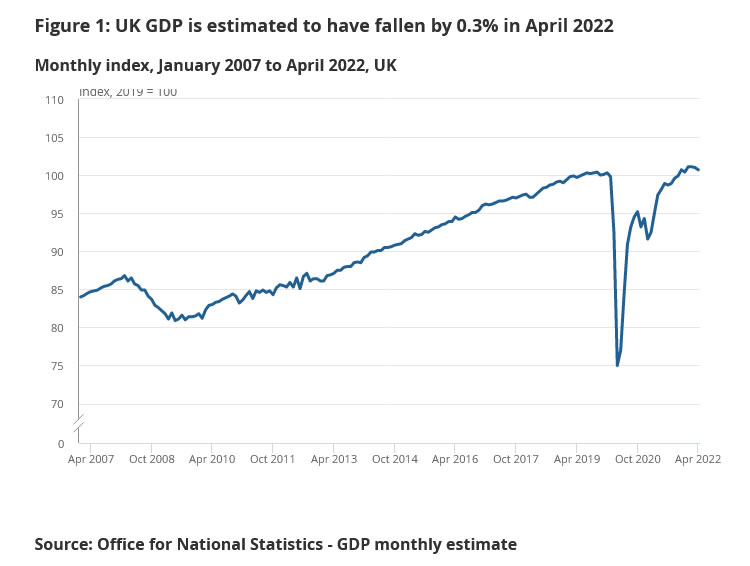
Also released, manufacturing production came in at -1.0% mom, 0.5% yoy, versus expectation of 0.2% mom, 1.8% yoy. Industrial production was at -0.6% mom, 0.7% yoy, versus expectation of 0.2% mom, 0.5% yoy. Goods trade deficit widened to GBP -20.9B.
USD/JPY Daily Outlook
Daily Pivots: (S1) 133.71; (P) 134.09; (R1) 134.82; More...
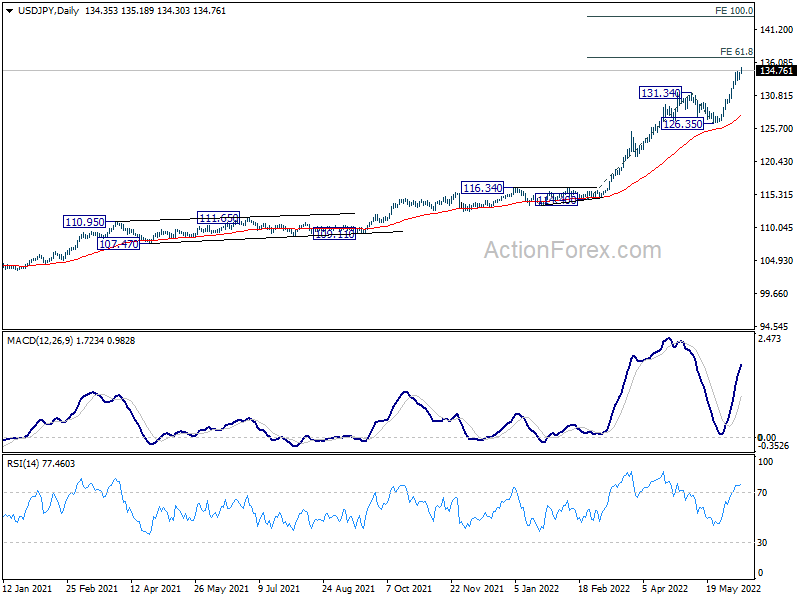
USD/JPY's rally resumed after brief consolidations and intraday bias is back on the upside. Current up trend should target 61.8% projection of 114.40 to 131.34 from 126.35 at 136.81. Firm break there will target 100% projection at 143.29. On the downside, below 133.17 minor support will turn intraday bias neutral first and bring consolidations, before staging another rise.
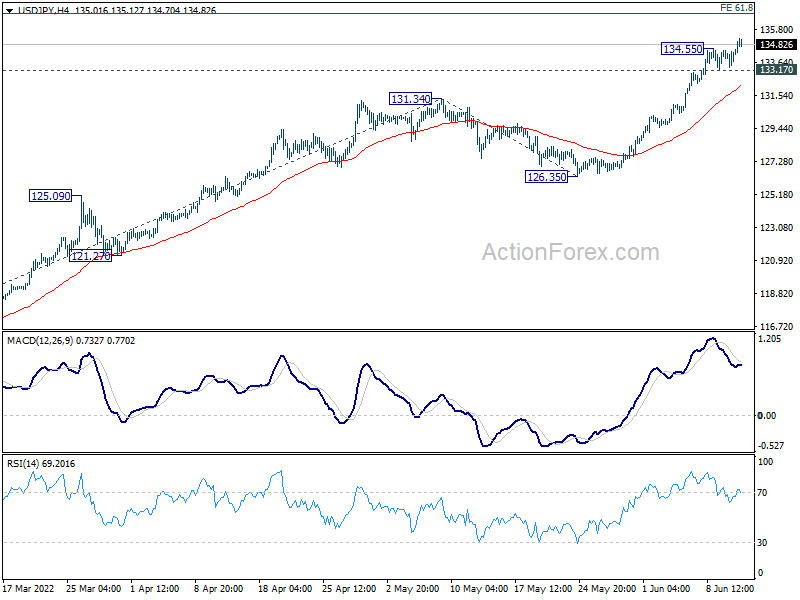
In the bigger picture, current rally is seen as part of the long term up trend from 75.56 (2011 low). Next target is 100% projection of 75.56 (2011 low) to 125.85 (2015 high) from 98.97 at 149.26, which is close to 147.68 (1998 high). This will remain the favored case as long as 126.35 support holds.
Dollar Starts the Week Strong; Fed, SNB, BoE and BoJ to meet
Dollar rises broadly as the week starts as risk aversion extended into Asia session. But Yen is not benefiting much this time, as recovery lost momentum. Commodity currencies are also weak together with Euro. Swiss Franc and Sterling are just slightly better the others, but still weak against the greenback. The meetings of four major central banks ahead would shape the next moves, at least until the end of H1.
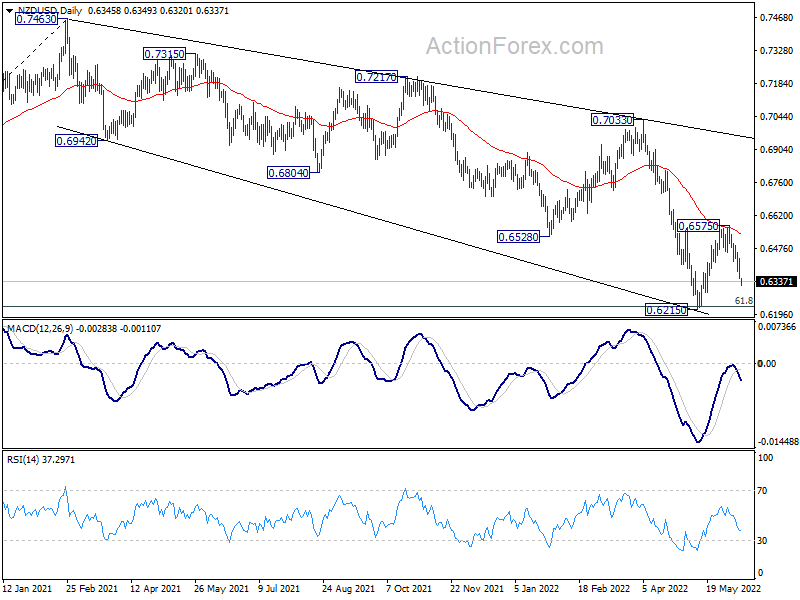
Technically, AUD/USD's break of 0.7034 support should confirm that rebound from 0.6828 has completed at 0.7282. Larger down trend from 0.8006 might be ready to resume through 0.6828 low. Similarly, NZD/USD's rebound from 0.6215 should also be finished at 0.6575, after rejection by 55 day EMA. Focus will be on any downside acceleration towards 0.6215, and through, together with AUD/USD.
In Asia, at the time of writing, Nikkei is down -3.13%. Hong Kong HSI is down -2.81%. China Shanghai SSE is down -1.11%. Singapore Strait Times is down -0.62%. Japan 10-year JGB yield is up 0.0066 at 0.261.
NZIER downgrades NZ GDP forecasts, upgrades inflation
In the new Consensus Forecasts of NZIER, growth projections for the forecast horizon were revised down while inflation projections were revised up. NZIER noted "increasing headwinds" for the New Zealand economy, including "continued global supply chain disruptions as countries continue to grapple with COVID-19, the war in Ukraine and rising interest rates." The highest inflation outlook reflects "expectations that high inflation will remain persistent".
In June survey (comparing to March survey):
- 2022/23 GDP growth at 2.9% (revised down from 3.6%).
- 2023/24 GDP growth at 1.9% (down from 2.7%).
- 2024/25 GDP growth at 2.1% (down from 2.5%).
- 2022/23 CPI at 4.1% (up from 3.5%).
- 2023/24 CPI at 2.6% (up from 2.5%).
- 2024/25 CPI at 2.4% (up from 2.3%).
Bitcoin and ethereum in free fall again on Celsius Network news
Cryptocurrencies were in free fall again on news that Celsius Network, one of the biggest crypto lenders, paused withdrawals, swaps and transfers on its platform. In the background, bitcoin and ethereum were already under pressure last week, as risk-off sentiments intensified after data showed reacceleration in consumer inflation in the US.
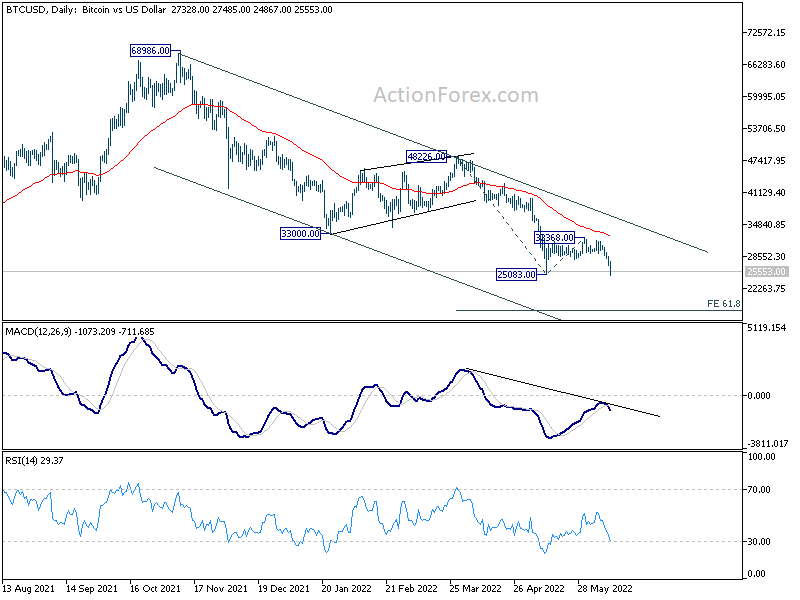
The breach of 25083 support in bitcoin suggests that medium term down trend is ready to resume. 20k handle is the next target but in could indeed fall to as low as61.8% projection of 48226 to 25083 from 32686 at 15258. Overall outlook will stays bearish as long as 32368 resistance holds, even in case of strong recovery.
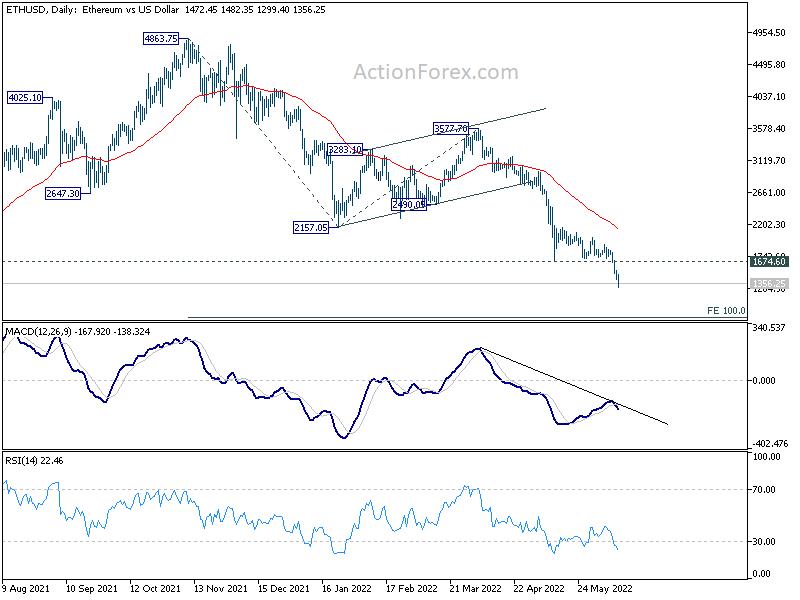
Ethereum is also extending the down trend from 4863. 1000 handle is the next target but it could fall to as low as 100% projection of 4683 to 2157 from 3577 at 870. Outlook will stay bearish as long as 1674 support turned resistance holds, in case of recovery.
Fed, SNB, BoE and BoJ to meet
Four central banks will meet this week. Fed is widely expected to continue its plan of 50bps hike per meeting, and raise federal funds rate to 1.25-1.50%. Given that CPI reaccelerated to new 40-year high in May, main focus will be on how is that reflected in the new economic projections, and the dot plot. Back in only 7 of 16 FOMC member penciled in interest rate above 2% by the end of 2022. The balance would likely shift further to the hawks' side.
SNB is expected to keep interest rate unchanged at -0.75% for now. But with inflation at 14-year high, and more importantly, ECB's pre-commitment to July and September hike, there are talks that SNB could act a small step this week. A 25bps hike to -0.50%, a less negative one, cannot be totally ruled out.
BoE is expected to raise interest rate by 25bps to 1.25%. But opinions are also divided. The government's plan to cut taxes and provide relief to households on energy bills, there is room for BoE to act larger. Yet, the central bank might still want to wait for the next monetary policy report before altering the pace.
BoJ is expected to stand pat. But both the government and the central bank have expressed deep concerns regarding Yen's rapid depreciation. The markets would look for something from the BoJ to stabilize it.
On the data front, the UK calendar is busy with GDP, employment and retail sales. US calendar will feature PPI and retail sales. Germany ZEW, Australia business confidence and employment, and a batch of China data will also be watched. Here are some highlights for the week:
- Monday: Japan BSI manufacturing; UK GDP, production, trade balance, NIESR GDP estimate.
- Tuesday: Australia NAB business confidence; Germany ZEW, CPI final; UK employment; Canada manufacturing sales; US PPI.
- Wednesday: Japan machine orders, tertiary industry index; China industrial production, retail sales, fixed asset investment; Swiss SECO economic forecasts, PPI; Eurozone industrial production, trade balance; Canada housing starts; US retail sales, Empire state manufacturing, import prices, business inventories, NAHB housing index, FOMC rate decision.
- Thursday: New Zealand GDP; Australia employment; Japan trade balance; SNB rate decision; BoE rate decision; Canada wholesale sales; US jobless claims, housing starts and building permits, Philly Fed survey.
- Friday: New Zealand BusinessNZ manufacturing index; BoJ rate decision; UK retail sales; Italy trade balance; Eurozone CPI final; Canada IPPI and RMPI; US industrial production.
USD/JPY Daily Outlook
Daily Pivots: (S1) 133.71; (P) 134.09; (R1) 134.82; More...
USD/JPY's rally resumed after brief consolidations and intraday bias is back on the upside. Current up trend should target 61.8% projection of 114.40 to 131.34 from 126.35 at 136.81. Firm break there will target 100% projection at 143.29. On the downside, below 133.17 minor support will turn intraday bias neutral first and bring consolidations, before staging another rise.
In the bigger picture, current rally is seen as part of the long term up trend from 75.56 (2011 low). Next target is 100% projection of 75.56 (2011 low) to 125.85 (2015 high) from 98.97 at 149.26, which is close to 147.68 (1998 high). This will remain the favored case as long as 126.35 support holds.
Economic Indicators Update
| GMT | Ccy | Events | Actual | Forecast | Previous | Revised |
|---|---|---|---|---|---|---|
| 23:50 | JPY | BSI Large Manufacturing Index Q/Q Q2 | -9.9 | -4.2 | -7.6 | |
| 06:00 | GBP | GDP M/M Apr | 0.20% | -0.10% | ||
| 06:00 | GBP | Index of Services 3M/3M Apr | 0.40% | 0.40% | ||
| 06:00 | GBP | Manufacturing Production M/M Apr | 0.20% | -0.20% | ||
| 06:00 | GBP | Manufacturing Production Y/Y Apr | 1.80% | 1.90% | ||
| 06:00 | GBP | Industrial Production M/M Apr | 0.20% | -0.20% | ||
| 06:00 | GBP | Industrial Production Y/Y Apr | 0.50% | 0.70% | ||
| 06:00 | GBP | Goods Trade Balance (GBP) Apr | -20.3B | -23.9B | ||
| 13:00 | GBP | NIESR GDP Estimate (3M) May | 0.60% | 0.30% |