Sample Category Title
GBPUSD Tumbles after Stronger US CPI Print
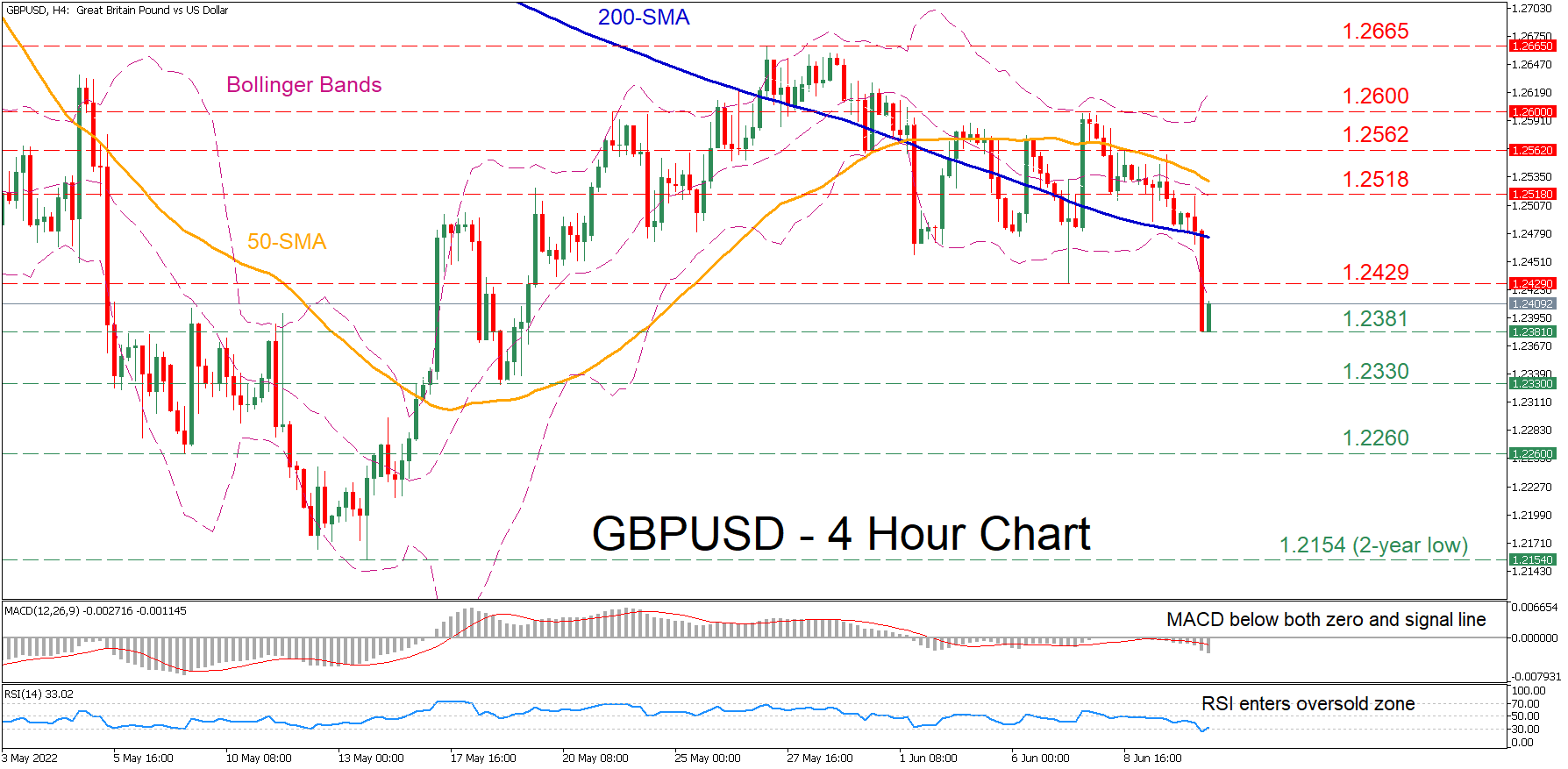
GBPUSD has been in a downtrend after it failed to jump beyond the 1.2600 region, generating a profound structure of lower highs and lower lows. Additionally, the price has sharply dropped beneath both the 200-period simple moving average (SMA) and the lower Bollinger band, endorsing a broader bearish short-term picture.
The short-term oscillators also confirm that bearish forces are in total control. Specifically, the RSI has entered its 30-oversold area, while the MACD histogram is currently beneath both zero and its red signal line.
Should selling interest intensify, the 1.2381 hurdle might act as immediate support for the pair. If that floor collapses, the price could descend towards 1.2330 or lower to test the 1.2260 obstacle. A violation of the latter could set the stage for the two-year low of 1.2154.
On the flipside, should negative momentum wane and the price reverses upwards, initial resistance could be encountered at the previous support region of 1.2429. Violating this area, the bulls could aim for 1.2518 before the spotlight turns to the 1.2562 barrier. Higher, further advances could then cease at the 1.2600 psychological mark.
In brief, GBPUSD’s short-term picture seems to be deteriorating as it experiences a new wave of downside pressures. For that bearish tone to reverse, the price needs to clearly jump above the 1.2600 ceiling.
ECB is Two Steps Behind the Fed, Digging a Hole Under the Euro
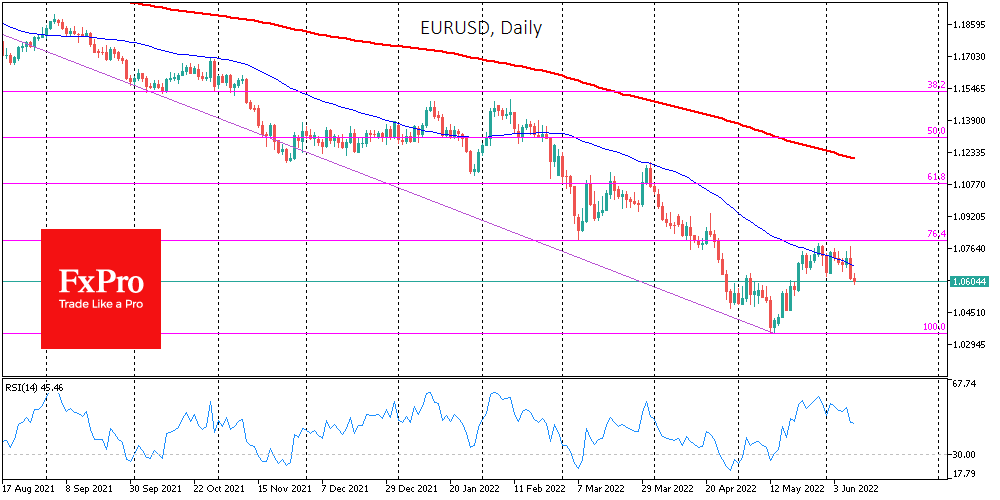
As expected, euro buyers’ optimism faded immediately after the ECB press conference began, returning EURUSD back below 1.0600.
Shortly after the initial surge in reports of an actual reversal in ECB policy, investors and traders delved into assessments of how slower the policy reversal in Europe was.
The ECB will only stop buying assets on its balance sheet later this month – two steps behind the US, where purchases were curtailed months ago and active sales are already due to begin in June.
The Fed raised its rate by 25 points in March and 50 points at the start of May, promising two more 50-point hikes in June and July. From the ECB, we see a conditional promise to consider a rate hike of more than 25 points in September in case of high inflation forecasts for 2023.
That said, inflation in the eurozone is comparable to the US, and economic growth is just as, if not more, vulnerable to logistical failures and energy prices.
Not only has the ECB started its policy turnaround later, but it is also doing so more slowly than the Fed so that the interest rate differential only widens over time.
Such differences are a fundamental reason to sell the euro against the dollar. Moreover, the EURUSD bounce in the second half of May erased the pair’s oversold conditions, clearing the way for another step down.
Yesterday’s comments from the ECB convinced us not to expect any hawkish surprises from Lagarde and Co, triggering a new sell-off impulse. It won’t be surprising if EURUSD makes another test of the May low at 1.0350 or if it makes a new 20-year low below that level during the next couple of weeks.
Canada’s Labour Market Bounces Back in May
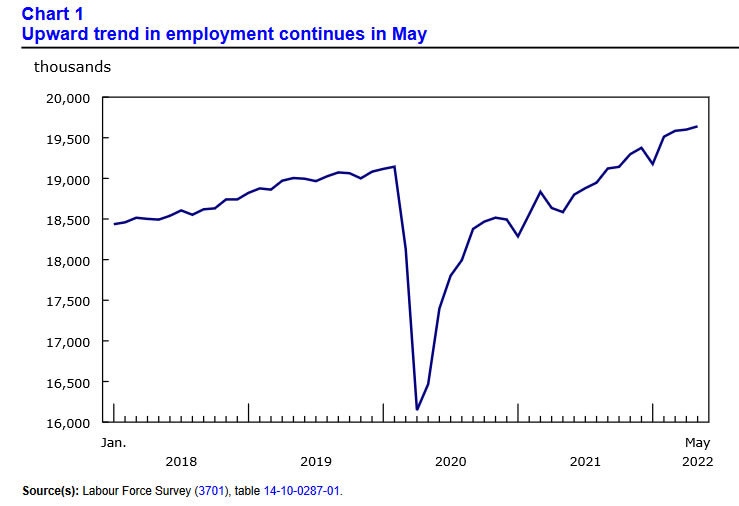
The Canadian labour market gained 40k positions in May, with full-time employment up 135k and part-time employment down 96k.
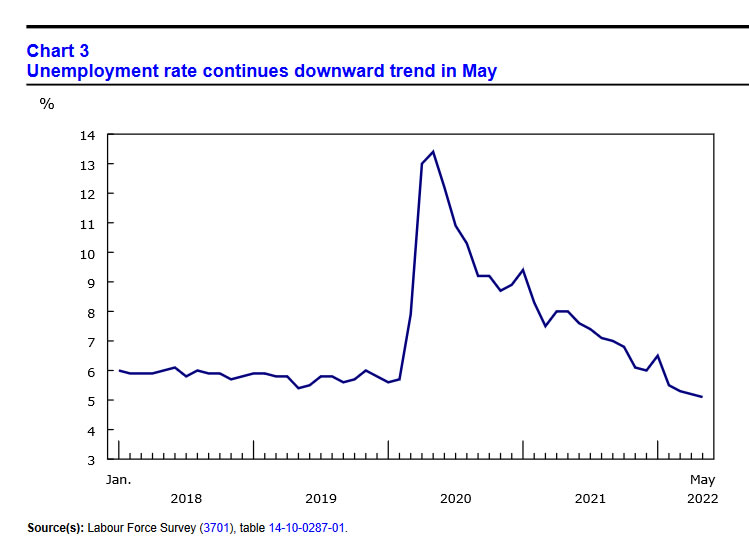
The unemployment rate dropped by 0.1 percentage points, to 5.1%. The participation rate was unchanged at 65.3%.
By industry, employment in the services producing sector rose 81k, "with gains spread across several industries, including accommodation and food services." Meanwhile, employment in the goods-producing sector dropped by 41k, "mostly due to a decline in manufacturing."
On a geographic basis, the report noted employment gains in Alberta (+28k), Newfoundland and Labrador (+4.1k), and Prince Edward Island (+1.1k), while New Brunswick (-3.9k) was the one province seeing a drop. Employment in Ontario and Quebec held steady over the month.
Lastly, total hours worked declined 0.3% month-on-month and wages were up 3.9% year-on-year (versus 3.3% last month).
Key Implications
It was a nice bounce-back for Canadian employment in May. Following April's Omicron-induced slowdown in job gains (recall nearly 10% of workers were absent due to illness), there has been a noticeable return to more normal life for Canadians. As we commence the ritual of filling patios and hit the road for overdue vacations, employers continue to search for workers to meet heighten demand. This has job vacancy rates at record levels, making it clear that the Canadian economy is operating beyond full employment.
With more people employed and wage growth climbing, the strength in domestic demand will be sufficient to keep inflation as a thorn in the side of the Bank of Canada. Just yesterday, Governor Macklem stated his openness to speeding up the rate hike cycle given the overheating economy. Today's jobs report will only continue to fuel speculation of even higher interest rates. This has short-term Canadian bond yields moving higher this morning, with most yield tenors comfortably above 3%.
US: Inflation Back to Breaking Records in May
Consumer price inflation rose by 1.0% month-over-month (m/m) in May – an acceleration from the 0.3% recorded the month prior. On a year-over-over basis, inflation accelerated by 0.3 percentage points from April, rising to 8.6%.
Energy prices were a big contributor to the monthly gain – rising 3.9% m/m – as both gasoline (4.1% m/m) and energy services (3.0% m/m) were up on the month. Food prices also continued to accelerate, rising 1.2% m/m and are now up over 10% on year-ago basis.
Core inflation (excludes food and energy) rose 0.6% m/m – matching April's gain. On a year-over-year basis, core inflation edged lower by 0.2 percentage points compared to April, rising by 6.0% y/y.
Price growth across service categories remained relatively broad-based, with core service prices rising 0.6% m/m. Shelter costs (0.6% m/m) were again a meaningful contributor, though transportation (1.3% m/m) and medical services (0.4% m/m) also notched gains. Airline fares decelerated relative to April, though were still up by 12.6% m/m.
After having shown some signs of easing in recent months, core goods prices – includes all goods except food and energy commodities – accelerated by 0.6% m/m. Gains were seen across all major categories, with used (1.8% m/m) and new (1% m/m) vehicle prices seeing the biggest moves, while apparel was up 0.7% m/m.
Key Implications
After having shown some signs of easing in April, headline inflation reversed course and accelerated to a new multi-decade high in May. Unfortunately, the recent move higher in energy prices will only exacerbate the problem over the near-term, and keep sustained upward pressure on the headline measure through the summer months.
The broad-based acceleration in core goods prices came as a surprise, particularly after having shown some signs of softening in recent months. With many big box retailers reportedly carrying excess inventory, and consumer demand already showing some signs of pivoting towards more service-based consumption, we'll likely start to see some discounting in seasonal items in the months ahead – helping to ease some of the price pressures on select core goods items.
The job ahead for the FOMC is not an enviable one. Inflation pressures are proving to be both more persistent and far-reaching than previously thought, implying more policy action will need to be taken in the months ahead. We expect the Federal Reserve to raise rates by an additional 50bps next week (taking the policy rate to 1.5%) and also signal more 50bps moves to come through the second half of the year.
USD/JPY Mid-Day Outlook
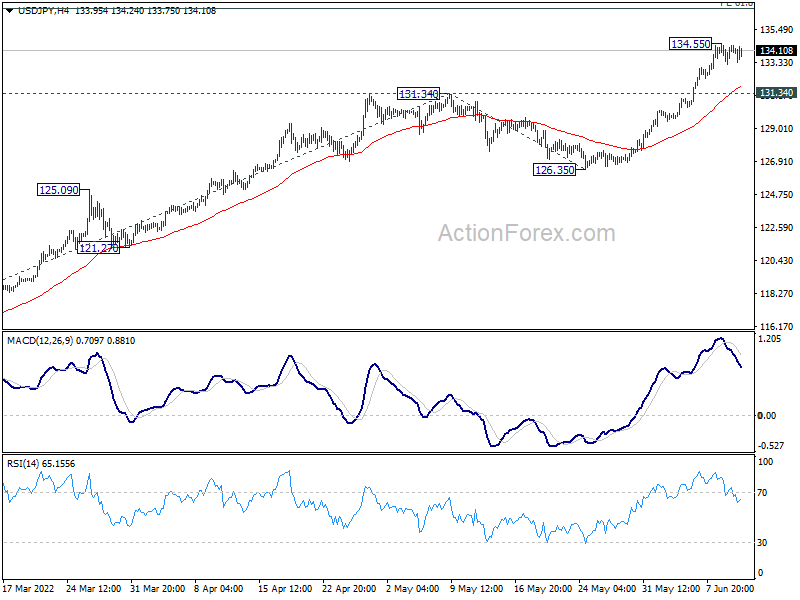
Daily Pivots: (S1) 133.53; (P) 134.04; (R1) 134.90; More...
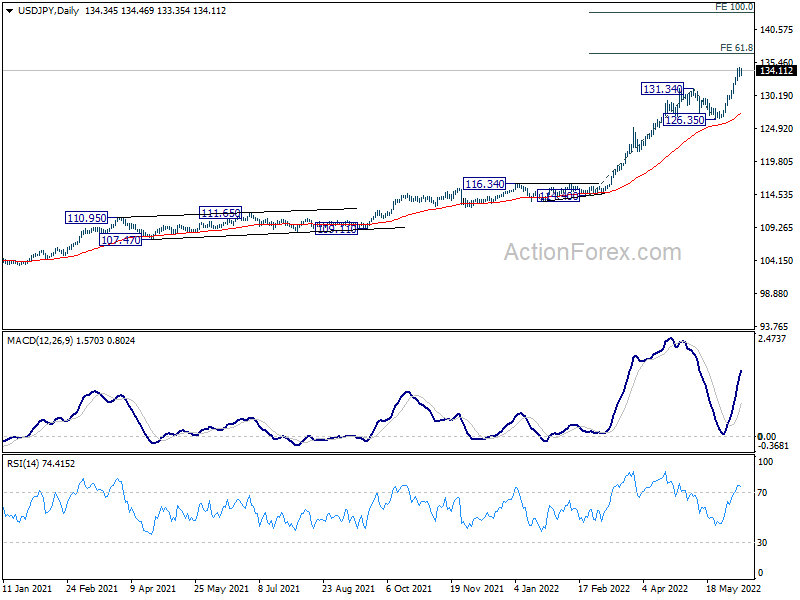
Intraday bias in USD/JPY stays neutral as consolidation from 134.55 is still extending. Downside of retreat should be contained above 131.34 resistance turned support. Break of 134.55 will resume larger up trend to 61.8% projection of 114.40 to 131.34 from 126.35 at 136.81. Firm break there will target 100% projection at 143.29.
In the bigger picture, current rally is seen as part of the long term up trend form 75.56 (2011 low). Next target is 100% projection of 75.56 (2011 low) to 125.85 (2015 high) from 98.97 at 149.26, which is close to 147.68 (1998 high). This will remain the favored case as long as 126.35 support holds.
USD/CHF Mid-Day Outlook
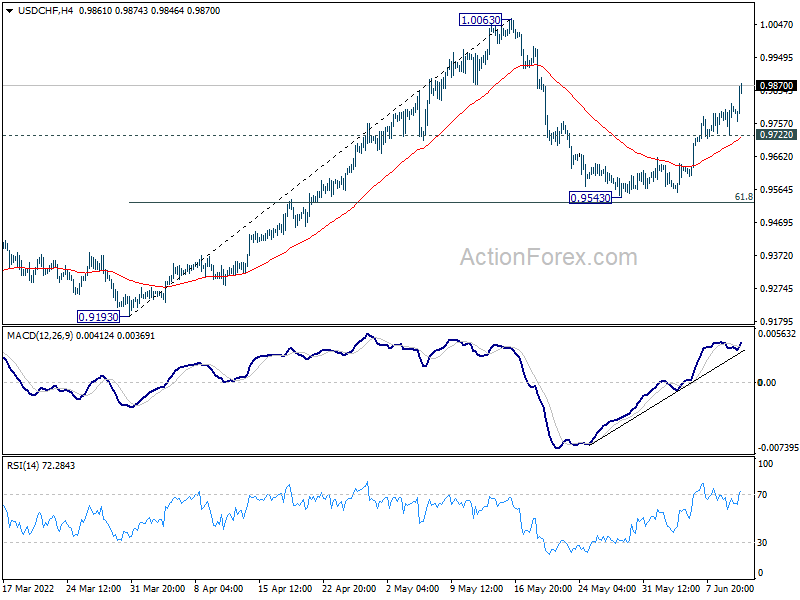
Daily Pivots: (S1) 0.9745; (P) 0.9781; (R1) 0.9839; More...
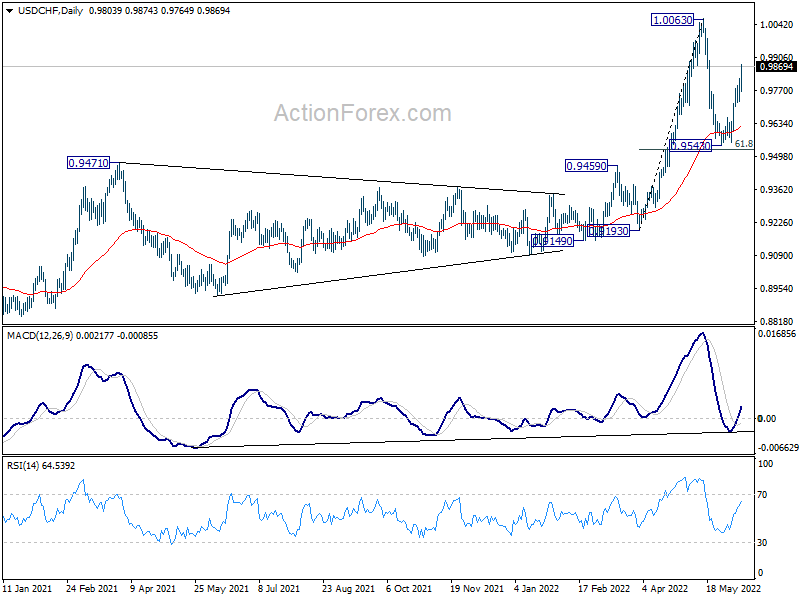
Intraday bias in USD/CHF stays on the upside for the moment. Rise from 0.9543 should target a test on 1.0063 high. Firm break there will resume larger up trend. On the downside, below 0.9722 minor support will turn intraday bias neutral first.
In the bigger picture, down trend from 1.0342 (2016 high) should have completed with three waves down to 0.8756 (2021 low) already. Rise from 0.8756 is likely a medium term up trend of its own. Next target is 1.0237/0342 resistance zone. This will remain the favored case as long as 0.9471 resistance turned support holds. However, sustained break of 0.9471 will extend long term range trading with another falling leg.
EUR/USD Mid-Day Outlook
Daily Pivots: (S1) 1.0561; (P) 1.0668 (R1) 1.0724; More...
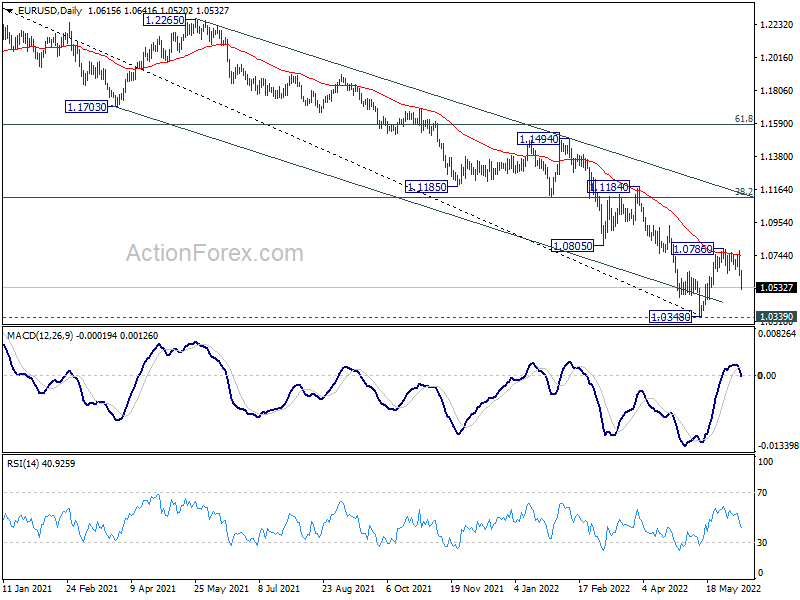
Intraday bias in EUR/USD stays on the downside at this point. Rebound from 1.0348 should have completed at 1.0786, , after multiple rejection by 55 day EMA. Deeper fall would be seen back to retest 1.0348 low, and more importantly 1.0339 long term support. On the upside, above 1.0651 minor resistance will turn intraday bias neutral first.
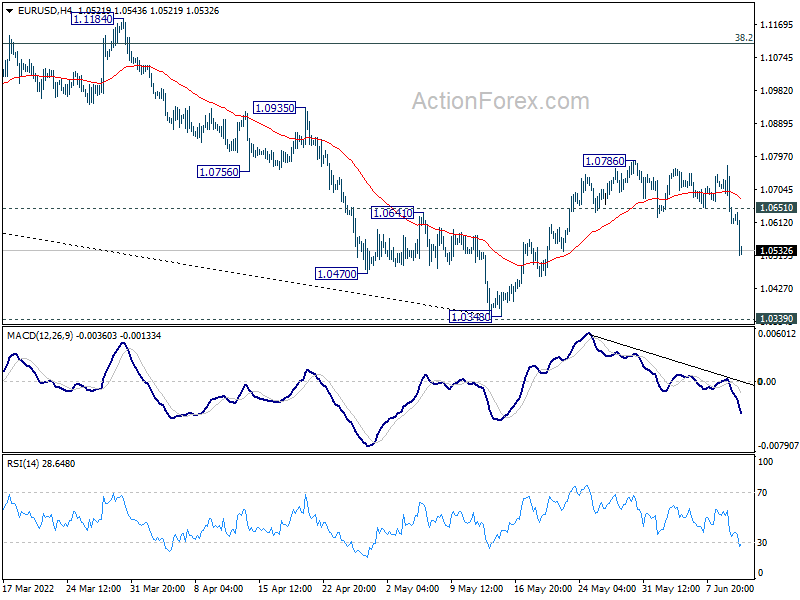
In the bigger picture, focus stays on 1.0339 long term support (2017 low). Decisive break there will resume whole down trend from 1.6039 (2008 high). Next target is 61.8% projection of 1.3993 to 1.0339 from 1.2348 at 1.0090. However, firm break of 1.0805 support turned resistance will delay this bearish case. Rise from 1.0348 is at least a correction to the down trend from 1.2348. Stronger rebound would be seen to 38.2% retracement of 1.2348 to 1.0348 at 1.1112.
GBP/USD Mid-Day Outlook
Daily Pivots: (S1) 1.2469; (P) 1.2514; (R1) 1.2540; More...
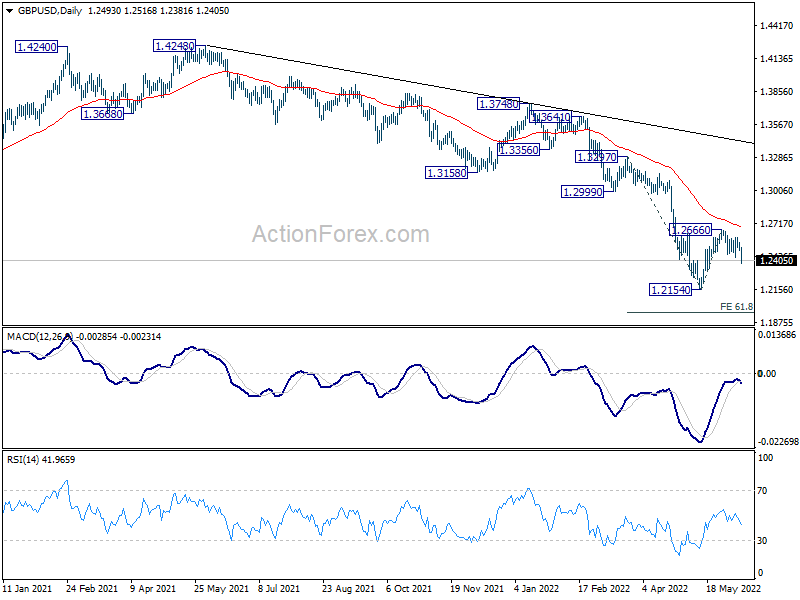
GBP/USD's break of 1.2429 minor support argues that rebound from 1.2154 has completed at 1.2666 already. Intraday bias is back on the downside for retesting 1.2154 low. Firm break there will resume larger down trend. Next target is 61.8% projection of 1.3297 to 1.2154 from 1.2666 at 1.1960. For now, risk will stay on the downside as long as 1.2666 resistance holds, in case of recovery.

In the bigger picture, fall from 1.4248 (2018 high) could be a leg inside the pattern from 1.1409 (2020 low), or resuming the longer term down trend. Deeper decline is expected as long as 1.2999 support turned resistance holds. On resumption, next target is 1.1409 low.
Dollar Surges as CPI Reaccelerates on Energy and Food Prices
Dollar rises strongly in early US session after CPI data. Headline inflation reaccelerated with strong rise in energy and food prices From this perspective, there is little scope for Fed to pause tightening in September. It might instead continue its 50bps per meeting plan for longer. The greenback is now the strongest one for the week, followed by Sterling. Swiss Franc is the worst performing, followed by Yen. Euro is mixed despite ECB's clear hawkish stance while Aussie is weighed down by risk-off sentiment.
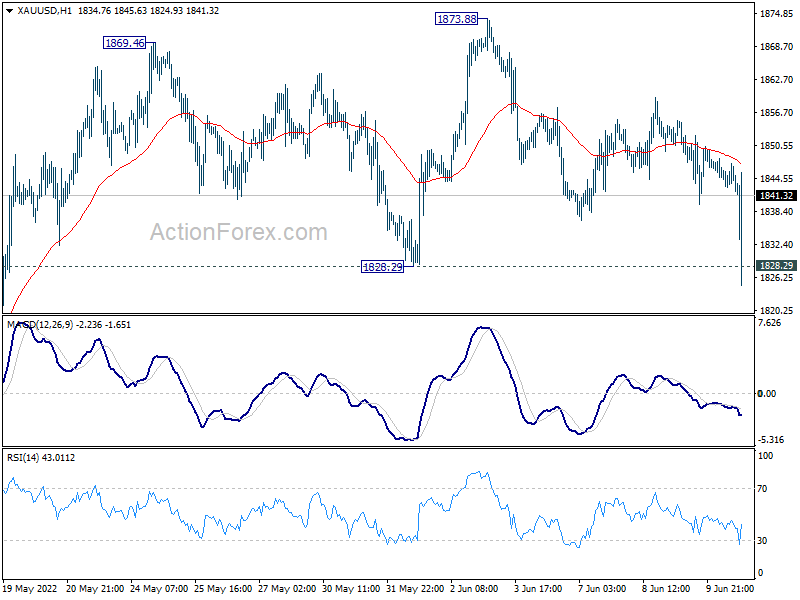
Technically, GBP/USD's break of 1.2429 minor support is another evidence of Dollar strength. One focus before the end of the week would be 0.7034 minor support in AUD/USD. Also, there is some knee jerk actions in Gold, which breached 1828.29 support briefly. Attention will also be on whether Gold's selloff will come back quickly on Dollar strength, and break through 1828.29 firmly.
In Europe, at the time of writing, FTSE is down -1.61%. DAX is down -1.69%. CAC is down -1.90%. Germany 10-year yield is down -0.0113 at 1.421. Earlier in Asia, Nikkei dropped -1.49%. Hong Kong HSI dropped -0.29%. China Shanghai SSE rose 1.42%. Singapore Strait Times dropped -0.87%. Japan 10-year JGB yield rose 0.0038 to 0.254.
US CPI rose to 8.6% yoy, highest since 1981, food price rose 10.1% yoy
US CPI accelerated again from 8.3% yoy to 8.6% yoy in May, well above expectation of 8.2% yoy. That's the highest level since December 1981. CPI core slowed from 6.2% yoy to 6.0% yoy, above expectation of 5.9% yoy. Energy index rose 34.6% yoy, largest 12-month increase since September 2005. Food index rose 10.1% yoy, first rise above 10% since March 1981.
CPI rose 1.0% mom, above expectation of 0.7% mom. Core CPI rose 0.6% mom, above expectation of 0.5% mom.
Canada employment rose 39.8k in May, unemployment rate dropped to 5.1% record low
Canada employment rose 39.8k in May, above expectation of 28.5k. Full time work rose 135k while part time jobs dropped -96k. Services producing jobs rose 81k while goods-producing jobs dropped -41.
Unemployment rate dropped form 5.2% to 5.1%, below expectation of 5.2%. That's a new record low. Total hours worked rose 5.1% yoy. Average hourly wages rose 3.9% yoy.
Bundesbank: Germany inflation to hit 7% or higher, resolute action needed
Bundesbank revised down growth projection for Germany's GDP in 2022 and 2023, and upgraded inflation projection for 2022, 2023, and 2024.
2022 GDP growth is slashed from 4.2% to just 1.9%. 2023 growth was cut from 3.2% to 2.4%. But 2024 growth was raised from 0.9% to 1.8%.
2022 HICP inflation forecast was raised from 3.6% to 7.1%. 2023 HICP forecast was raised from 2.25% to 4.5%. 2024 HICP forecast was raised from 2.2% to 2.6%.
President Joachim Nagel said: "Inflation this year will be even stronger than it was at the beginning of the 1980s. Price pressures have even intensified again recently, which is not fully reflected in the present projections. If this development is assumed to continue, the annual average HICP rate for 2022 could be considerably above 7%".
Euro area inflation rates won't fall by themselves," Nagel added. "Monetary policy is called upon to reduce inflation through resolute action."
Villeroy: ECB will pursue gradual but sustained rate hikes to neutral
ECB Governing Council member Francois Villeroy de Galhau told French radio that inflation is "not only too high but also too broad". The ECB will purse a "gradual but sustained" rate hikes until reaching neutral range. He estimated that it's "somewhere between 1% and 2%".
Separately, another Governing Council member Robert Holzmann said, "financial markets reacted very well to yesterday's announcement." "Even if we had started with a 50 bps rate hike it might have an effect on credibility but it would have raised expectations of bigger rate rises afterwards," he added.
China PPI slowed to 14-mth low, CPI unchanged
China PPI slowed notably from 8.0% yoy to 6.4% yoy in May, below expectation of 6.5% yoy. That's also the lowest level in 14 months since March 2021. CPI was unchanged at 2.1% yoy, below expectation of 2.5% yoy. Core CPI, excluding food and energy, was unchanged at 0.9% yoy.
"In May, the pandemic control continued to improve, with overall sufficient supplies in the consumer market, CPI has decreased compared to last month, and the year-on-year increase remained stable," said senior NBS statistician Dong Lijuan. "As a great amount of fresh vegetables entered the market and logistics gradually smooth, prices of fresh vegetables fell by 15 per cent".
GBP/USD Mid-Day Outlook
Daily Pivots: (S1) 1.2469; (P) 1.2514; (R1) 1.2540; More...
GBP/USD's break of 1.2429 minor support argues that rebound from 1.2154 has completed at 1.2666 already. Intraday bias is back on the downside for retesting 1.2154 low. Firm break there will resume larger down trend. Next target is 61.8% projection of 1.3297 to 1.2154 from 1.2666 at 1.1960. For now, risk will stay on the downside as long as 1.2666 resistance holds, in case of recovery.
In the bigger picture, fall from 1.4248 (2018 high) could be a leg inside the pattern from 1.1409 (2020 low), or resuming the longer term down trend. Deeper decline is expected as long as 1.2999 support turned resistance holds. On resumption, next target is 1.1409 low.
Economic Indicators Update
| GMT | Ccy | Events | Actual | Forecast | Previous | Revised |
|---|---|---|---|---|---|---|
| 22:45 | NZD | Manufacturing Sales Q1 | 1.20% | 8.20% | 11.90% | |
| 23:50 | JPY | PPI Y/Y May | 9.10% | 9.80% | 10.00% | 9.80% |
| 01:30 | CNY | CPI Y/Y May | 2.10% | 2.50% | 2.10% | |
| 01:30 | CNY | PPI Y/Y May | 6.40% | 6.50% | 8.00% | |
| 08:00 | EUR | Italy Industrial Output M/M Apr | 1.60% | -1.60% | 0.00% | |
| 12:30 | CAD | Net Change in Employment May | 39.8K | 28.5K | 15.3K | |
| 12:30 | CAD | Unemployment Rate May | 5.10% | 5.20% | 5.20% | |
| 12:30 | USD | CPI M/M May | 1.00% | 0.70% | 0.30% | |
| 12:30 | USD | CPI Y/Y May | 8.60% | 8.20% | 8.30% | |
| 12:30 | USD | CPI Core M/M May | 0.60% | 0.50% | 0.60% | |
| 12:30 | USD | CPI Core Y/Y May | 6.00% | 5.90% | 6.20% | |
| 14:00 | USD | Michigan Consumer Sentiment Index Jun P | 56.9 | 58.4 |
Canada employment rose 39.8k in May, unemployment rate dropped to 5.1% record low
Canada employment rose 39.8k in May, above expectation of 28.5k. Full time work rose 135k while part time jobs dropped -96k. Services producing jobs rose 81k while goods-producing jobs dropped -41.
Unemployment rate dropped form 5.2% to 5.1%, below expectation of 5.2%. That's a new record low. Total hours worked rose 5.1% yoy. Average hourly wages rose 3.9% yoy.