

Sample Category Title
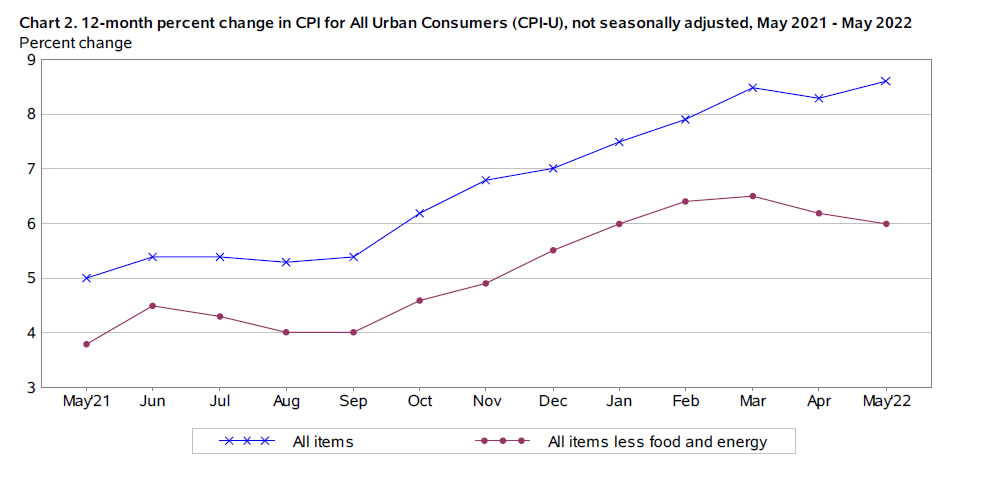
US CPI rose to 8.6% yoy, highest since 1981, food price rose 10.1% yoy
US CPI accelerated again from 8.3% yoy to 8.6% yoy in May, well above expectation of 8.2% yoy. That's the highest level since December 1981. CPI core slowed from 6.2% yoy to 6.0% yoy, above expectation of 5.9% yoy. Energy index rose 34.6% yoy, largest 12-month increase since September 2005. Food index rose 10.1% yoy, first rise above 10% since March 1981.
CPI rose 1.0% mom, above expectation of 0.7% mom. Core CPI rose 0.6% mom, above expectation of 0.5% mom.
EUR/USD: Euro Stands at the Back Foot ahead of Today’s Key Event – US Inflation Data
The Euro is trading within a narrow consolidation in European session on Friday, but keeps negative tone, following 0.92% post-ECB drop on Thursday.
The single currency lost ground as traders were disappointed by a lack of firmer signals from the ECB about more aggressive steps in coming months, which were widely anticipated ahead of the policy meeting.
The structure on daily chart has weakened after falling daily Ichimoku cloud repeatedly capped the action and subsequent fall left large bearish daily candle (the biggest daily loss since May 12).
Rising bearish momentum adds to negative near-term outlook, along with formation of Doji reversal pattern on weekly chart.
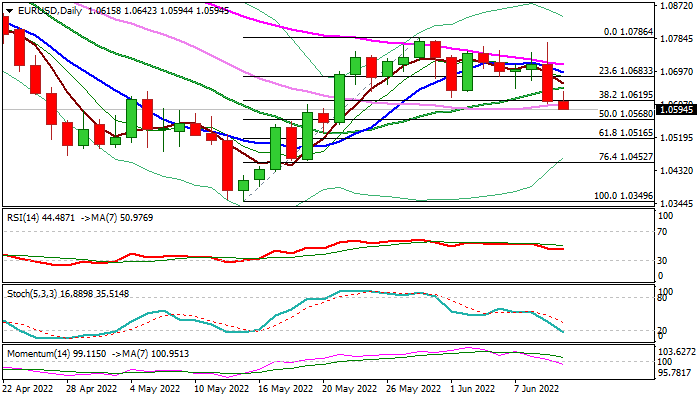
Fresh bears cracked pivotal Fibo support at 1.0619 (38.2% of 1.0349/1.0786 upleg) but need a clear break to confirm negative signal on completion of failure swing pattern on daily chart.
Fibo 50% and 61.8% of 1.0349/1.0789 (1.0568, 1.0516) mark next targets.
On the other side, broken 20DMA (1.0655) reverted to resistance which needs to cap and maintain bearish bias, while bounce and close above 10DMA (1.0696) would sideline bears.
Markets focus on key event today – US inflation data for May.
Annualized figure is expected to remain unchanged at 8.3%, but monthly inflation is seen rising in May (0.7% f/c vs 0.3% in Apr), while encouraging signals come from expectations that closely-watched core CPI (stripped from volatile components) is expected to ease in May, that adds to speculations of peak inflation.
Top US officials continue to describe current levels of inflation as unacceptable, as it hurts the economy as well as politics as anger among Americans rises as prices on petrol stations and supermarkets continue to rise.
The Euro may benefit on inflation peak scenario as this will ease tensions and pressure dollar, while the signal that prices continue to rise will boost expectations for more aggressive steps from Fed and deflate the greenback.
Res: 1.0619; 1.0655; 1.0683; 1.0700
Sup: 1.0568; 1.0516; 1.0500; 1.0452
Markets Eye Canadian Job Report, US Inflation
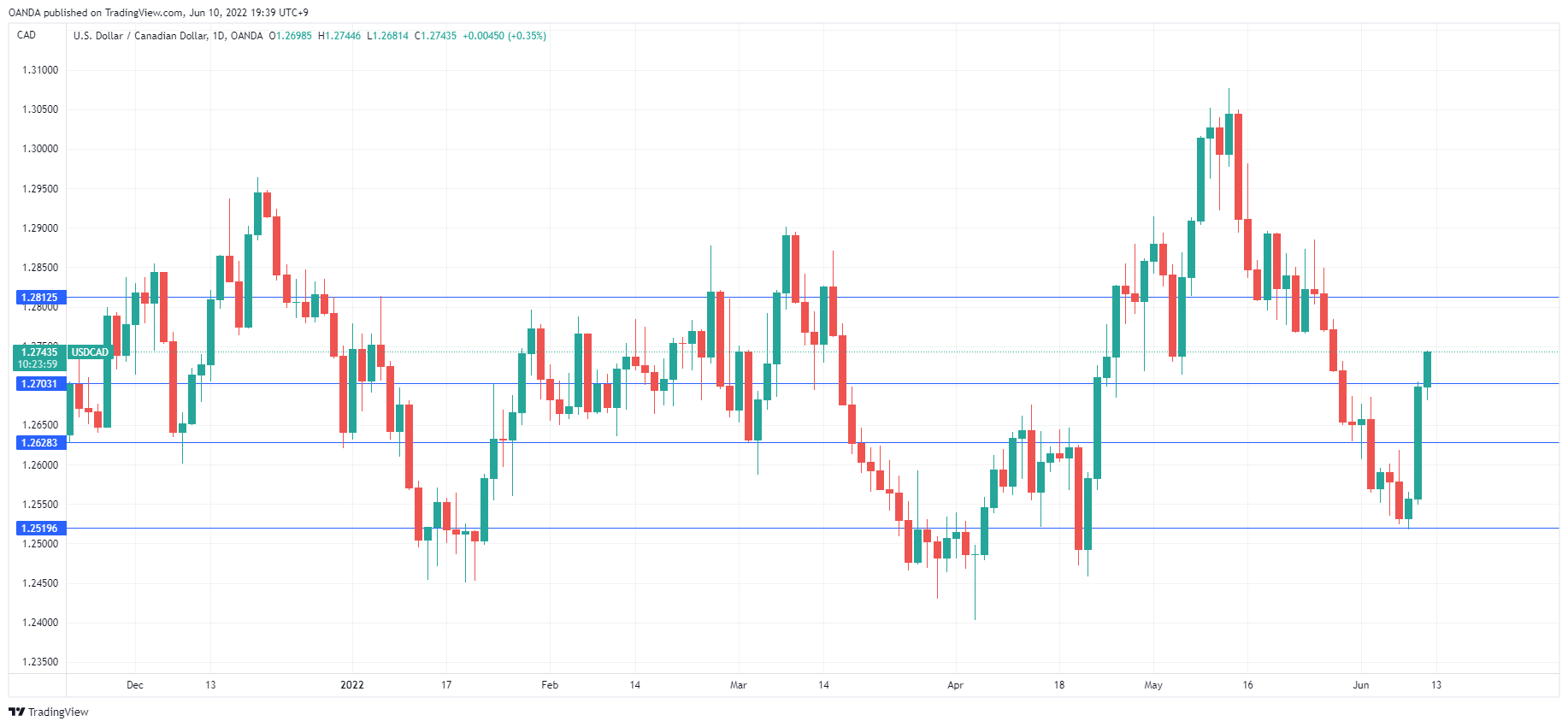
The Canadian dollar has extended its losses today. USD/CAD is trading at 1.2743, up 0.35% on the day.
Thursday saw the US dollar gives its Canadian cousin a spanking, as USD/CAD jumped 1.13%, its highest daily gain this year. A rise in US Treasury yields helped boost the US dollar, as the 10-year yield remains above 3%. As well, US unemployment claims disappointed, rising to 229 thousand. This was higher than the previous release of 202 thousand and above the estimate of 210 thousand. The rise in claims was not massive, but nonetheless has fed into the market’s nervousness over the US economy, and the result was a drop in risk appetite which sent the Canadian dollar tumbling lower.
It could be a busy end to the trading week, with Canada’s employment report and US inflation on today’s schedule. Canada’s job numbers for May are expected to be solid – the economy is projected to have created 30.0 thousand new jobs, up from 15.3 thousand in April. The unemployment rate is forecast to remain unchanged at 5.2%.
All eyes on US inflation
The highlight of the week will be US inflation for May. Headline inflation is expected at 8.3% (unchanged), while Core CPI is forecast to fall to 5.9%, down from 6.2%. If inflation does indeed drop, there will likely be voices proclaiming that the long-sought inflation peak is finally here. It would, however, be premature to assume that inflation is on a downswing based on one reading alone. Still, there is plenty of anticipation around the inflation release, such that it could be a binary outcome for USD/CAD – if inflation outperforms, Fed hiking expectations will rise. If, however, inflation drops, we could see a move to sell US dollars.
USD/CAD Technical
- USD/CAD is testing resistance at 1.2703. Above, there is resistance at 1.2812
- There is support at 1.2628 and 1.2519
Pound Extends Losses, US Inflation Looms
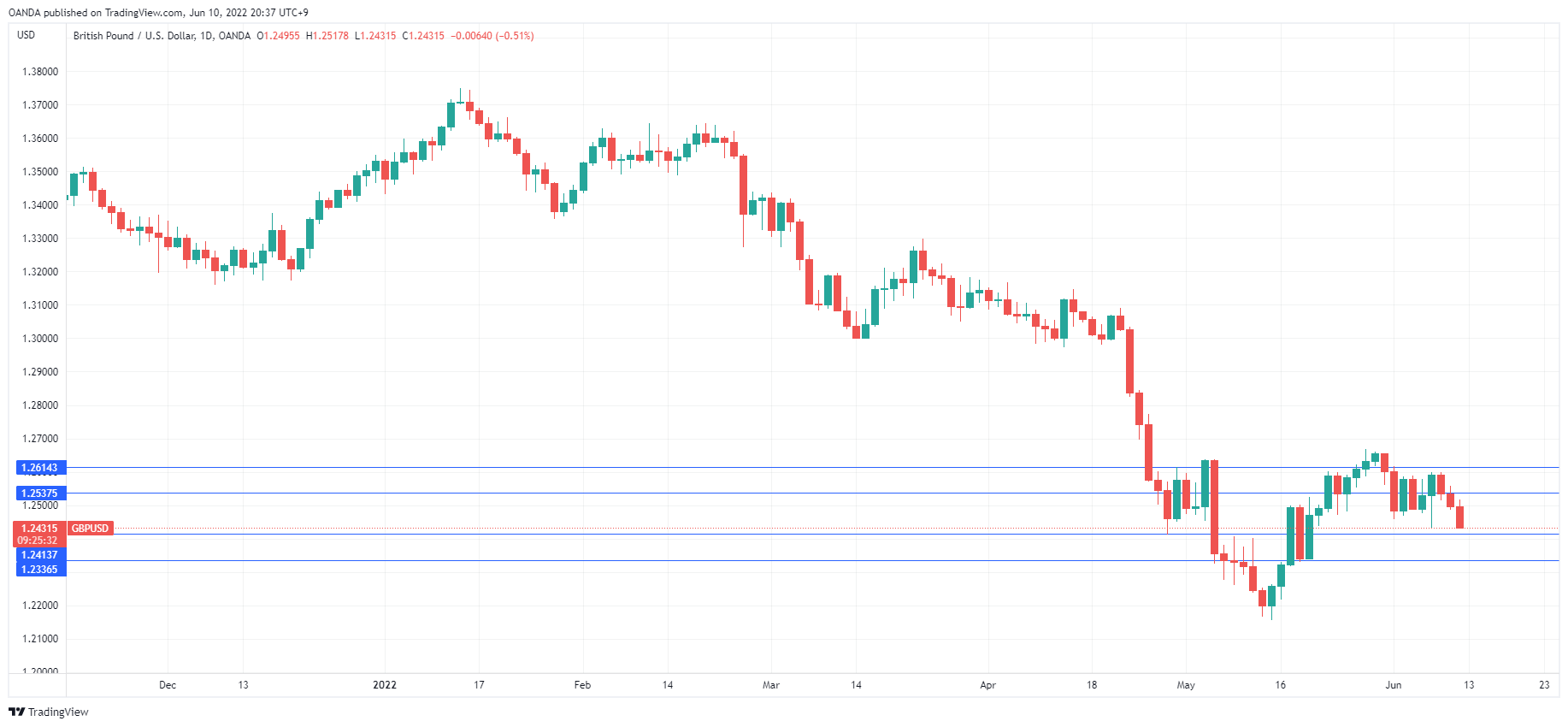
The British pound remains under pressure. GBP/USD is in negative territory today, following back-to-back losing sessions. In the European session, GBP/USD is trading at 1.2439, down 0.45% on the day.
Will US inflation drop?
The highlight of the week will be US inflation for May. Headline inflation is expected at 8.3% (unchanged), while Core CPI is forecast to fall to 5.9%, down from 6.2%. If inflation does indeed drop, there will likely be voices proclaiming that the long-sought inflation peak is finally here. It would, however, be premature to assume that inflation is on a downswing based on one reading alone. Still, there is plenty of anticipation around the inflation release, such that it could be a binary outcome for USD/CAD – if inflation outperforms, Fed hiking expectations will rise. If, however, inflation drops, we could see a move to sell US dollars.
UK inflation expectations rise
It was a light data calendar this week out of the UK. One release that was noteworthy was Inflation Expectations, released earlier today. The BoE survey found that inflation expectations for the next 12 months had risen to 4.6%, up from 4.3% n February. Inflation expectations for 2 years and 5 years were also higher, which is clearly a worrying trend. The danger of inflation expectations becoming unanchored could manifest into actual inflation continuing to accelerate. CPI hit 9% in April, up from 7.0% in March, and the BoE has stated that we could see double-digit inflation.
Asides from inflation, there are plenty of worries for investors with regard to the UK economy. Prime Minister Johnson may be on his way out after a disappointing showing at a non-confidence vote and there is trouble brewing with the EU over the Northern Ireland protocol. This points to a bumpy road for the British pound in the short term.
GBP/USD Technical
- GBP/USD faces resistance at 1.2537 and 1.2614
- There is weak support at 1.2413, followed by support at 1.2336
Bundesbank: Germany inflation to hit 7% or higher, resolute action needed
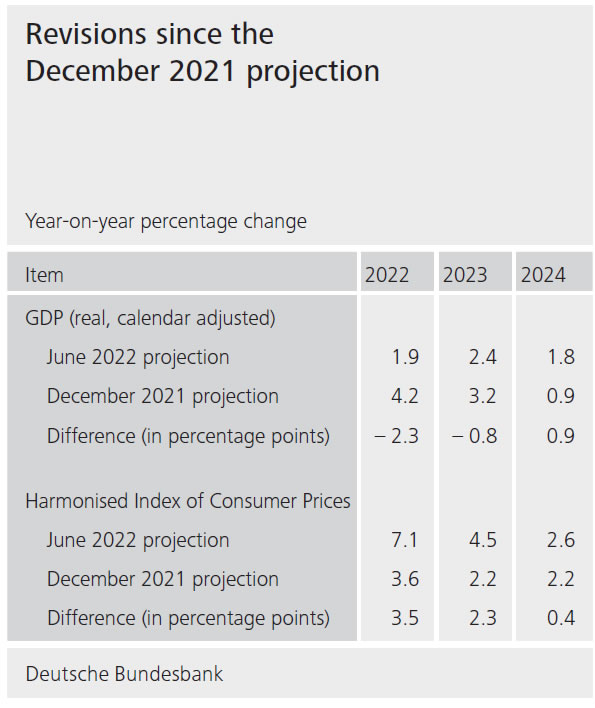
Bundesbank revised down growth projection for Germany's GDP in 2022 and 2023, and upgraded inflation projection for 2022, 2023, and 2024.
2022 GDP growth is slashed from 4.2% to just 1.9%. 2023 growth was cut from 3.2% to 2.4%. But 2024 growth was raised from 0.9% to 1.8%.
2022 HICP inflation forecast was raised from 3.6% to 7.1%. 2023 HICP forecast was raised from 2.25% to 4.5%. 2024 HICP forecast was raised from 2.2% to 2.6%.
President Joachim Nagel said: "Inflation this year will be even stronger than it was at the beginning of the 1980s. Price pressures have even intensified again recently, which is not fully reflected in the present projections. If this development is assumed to continue, the annual average HICP rate for 2022 could be considerably above 7%".
Euro area inflation rates won't fall by themselves," Nagel added. "Monetary policy is called upon to reduce inflation through resolute action."
Villeroy: ECB will pursue gradual but sustained rate hikes to neutral
ECB Governing Council member Francois Villeroy de Galhau told French radio that inflation is "not only too high but also too broad". The ECB will purse a "gradual but sustained" rate hikes until reaching neutral range. He estimated that it's "somewhere between 1% and 2%".
Separately, another Governing Council member Robert Holzmann said, "financial markets reacted very well to yesterday's announcement." "Even if we had started with a 50 bps rate hike it might have an effect on credibility but it would have raised expectations of bigger rate rises afterwards," he added.
Yen Claws Back, US Inflation Next
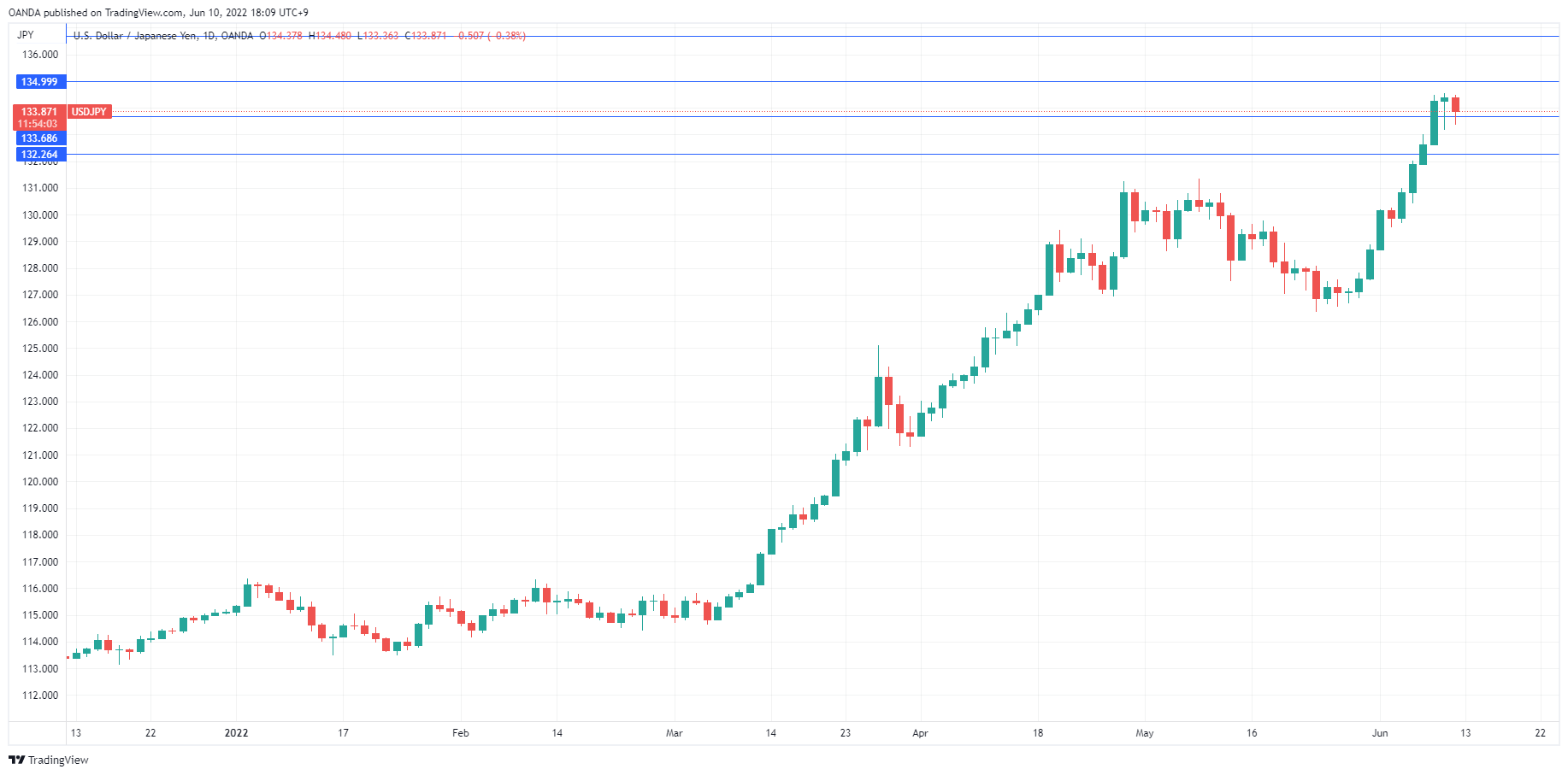
The Japanese yen has reversed directions and is in positive territory. In the European session, USD/JPY is trading at 133.86, down 0.38% on the day.
Despite today’s gains, the yen remains under strong pressure. The currency has mustered just one winning session in the month of June, and USD/JPY rose to 134.56 on Thursday, a new 20-year low for the yen. The symbolic 135 line looks ripe for the taking as early as next week.
Japan’s Minister of Finance issues yen warning
Japanese officials have chosen not to respond to the yen’s most recent descent, although Japan’s Finance Minister Suzuki did issue an underhand warning earlier today about the weak yen. Suzuki said he would not comment on the question of intervention so as to avoid any impact, but added that rapid fluctuations in the exchange rate were “not desirable”.
This latest verbal intervention comes after the yen hit a new 20-year low against the dollar and a 7-year low against the euro. The yen has declined a massive 14% against the dollar this year and could fall further against the euro as the ECB announced yesterday that it tightening policy. The BoJ and Ministry of Finance have tried jaw-boning in the past to support the ailing yen but without success. Investors have been on the lookout for a “trigger point” at which Tokyo would intervene, but the yen has crossed above 125 and 130 without hindrance, and it looks like the 135 line will also be breached without a response from Japanese officials.
It’s been a rough week for the Japanese currency, as USD/JPY has risen 2.29%. We could see some volatility from the pair later today, with the release of the US inflation report. A weak inflation release would pare expectations of Fed hiking and would be bullish for the yen. Conversely, a stronger than expected CPI reading would likely propel the dollar higher.
USD/JPY Technical
- USD/JPY is testing resistance at 133.68. Above, there is resistance at 1.3638
- There is support at 132.26 and 131.24
EUR/USD Pair Moved into a Bearish Zone Below $1.0700
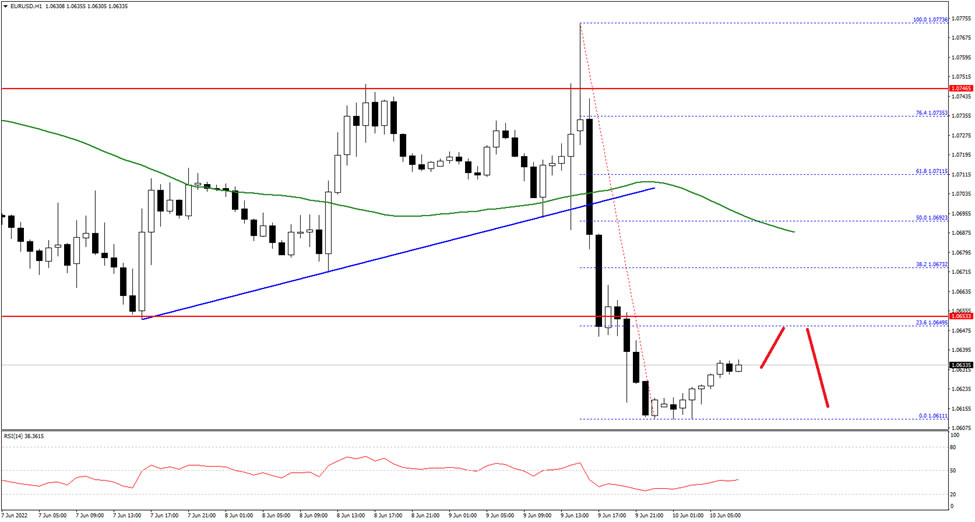
The Euro started a fresh decline from the 1.0775 resistance zone against the US Dollar. The EUR/USD pair traded below the 1.0700 support zone to move into a bearish zone.
The price even traded below the 1.0680 level and the 50 hourly simple moving average. It traded as low as 1.0611 and is currently correcting losses. On the upside, the pair might struggle near 1.0650 on FXOpen.
The next major resistance is near the 1.0700 level. A break above the 1.0700 and 1.0720 resistance levels could start another increase. In the stated case, it could even surpass 1.0750.
An immediate support is near the 1.0610 level. The next key support is near 1.0600, below the pair could decline towards the 1.0550 level in the near term. Any more losses might send the pair towards the 1.0520 level.
US Dollar Index Moving into Technical Resistance Ahead of US CPI Data
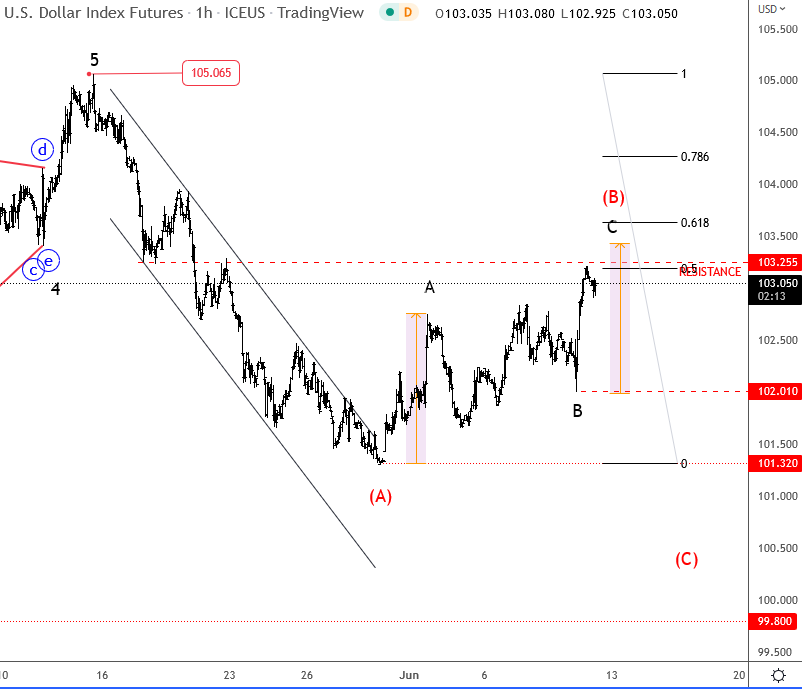
USD came higher yesterday vs the EUR as European Central Bank President (ECB) Christine Lagarde was not clear enough about the upcoming rate if maybe they will stick to 25bp or can this hike be more than that in upcoming meetings. She was not that hawkish, so the euro came down a lot, while USD rallied across the board, supported also by a lower stock market. However, we still think that USD Index can be moving into resistance now and that this is wave B rally. A new turndown can be coming, possibly after the US inflation data later at 12:30GMT as a catalyst. Break below 102.00 will be confirmation for bears. A drop of the USD would be very supportive for commodity currencies.
Loss of Correlation with Stocks will Pave the Way for Crypto to Portfolios
Bitcoin was down 0.3% on Thursday, continuing to hover around $30K. This mild decline was a bonus of last month’s loss of correlation between the cryptocurrency and stock markets.
Ethereum lost 0.4%, settling near $1800. Other top-10 altcoins showed mixed dynamics, ranging from a 2.5% decline (Cardano) to a 3.6% rise (Solana).
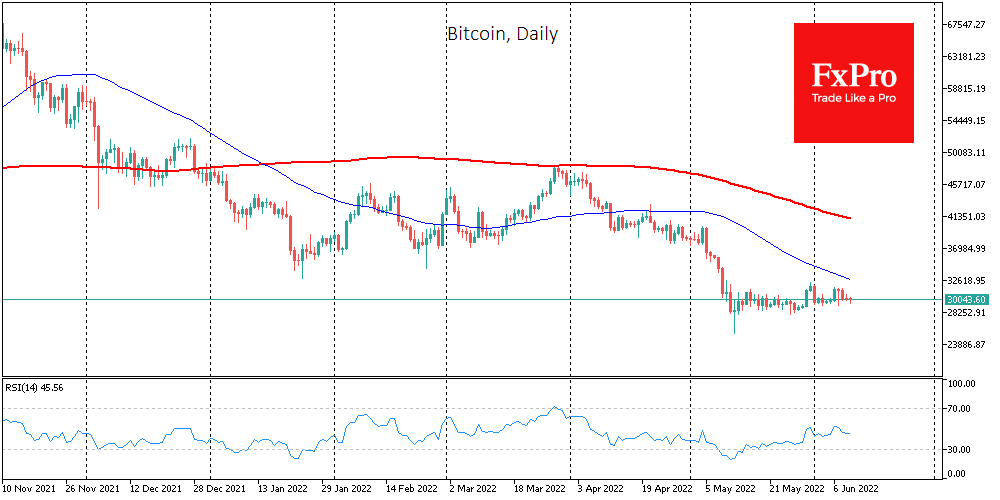
Financial market veteran Peter Brandt believes Ethereum is in a downward triangle and could fall to $1268 within a month.
The total capitalisation of the crypto market, according to CoinMarketCap, fell 0.2% overnight to $1.24 trillion. The cryptocurrency fear and greed index were up 2 points to 13 by Friday and remains in “extreme fear” mode.
Bitcoin has crossed the $30K mark almost daily over the past month, with no significant preponderance of buyers or sellers to form a clear trend.
Generally, the correlation gap between cryptocurrencies and stock markets is long-term good news as it attracts the attention of professional investors. Weakness in equity and bond markets, sagging gold and the murky outlook for the real estate market are turning their eyes to cryptocurrencies as another tool in a diversified portfolio.
CNBC’s Mad Money host Jim Cramer has changed his mind about investing in cryptocurrencies, calling BTC and ETH the best long-term investments. However, they should not account for more than 5% of a portfolio.
PwC, an audit firm, reported that most hedge funds invest less than 1% of their assets in cryptocurrencies because of regulatory uncertainty in the industry.
According to a Deloitte survey, 75% of US retailers will implement support for cryptocurrency payments within two years.
USDT, the world’s most prominent staple by market capitalisation, will be available on the Tezos blockchain powered by the Proof-of-Stake consensus mechanism. The USDT ecosystem is now open on 12 networks, including Ethereum, Solana, Polygon, Tron and Algorand.