

Sample Category Title
USD/JPY Daily Outlook
Daily Pivots: (S1) 129.53; (P) 129.88; (R1) 130.26; More...
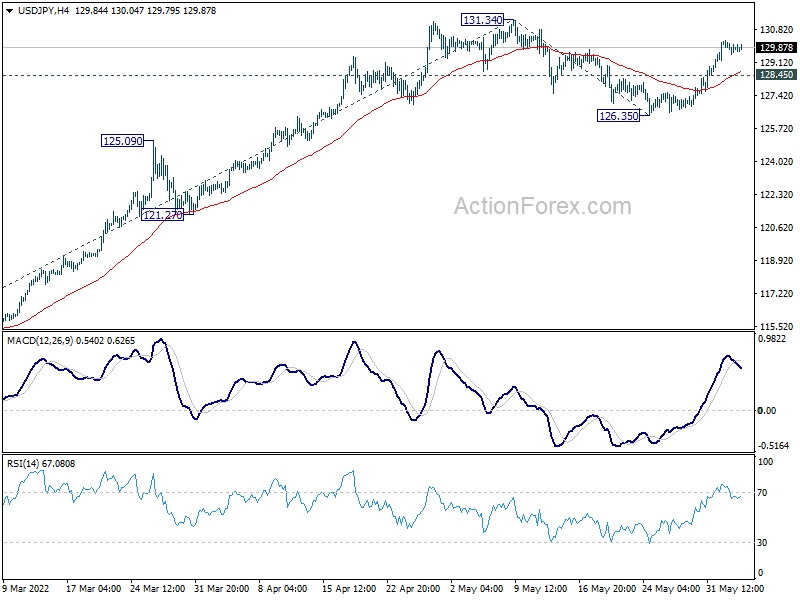
USD/JPY is losing some upside momentum as seen in 4 hour MACD. But further rally is still expected with 128.45 minor support intact. Decisive break of 131.34 resistance will confirm up trend resumption for 61.8% projection of 114.40 to 131.34 from 126.35 at 136.81. On the downside, below 128.45 minor support will turn bias to the downside to extend the corrective pattern from 131.34 with another falling leg.
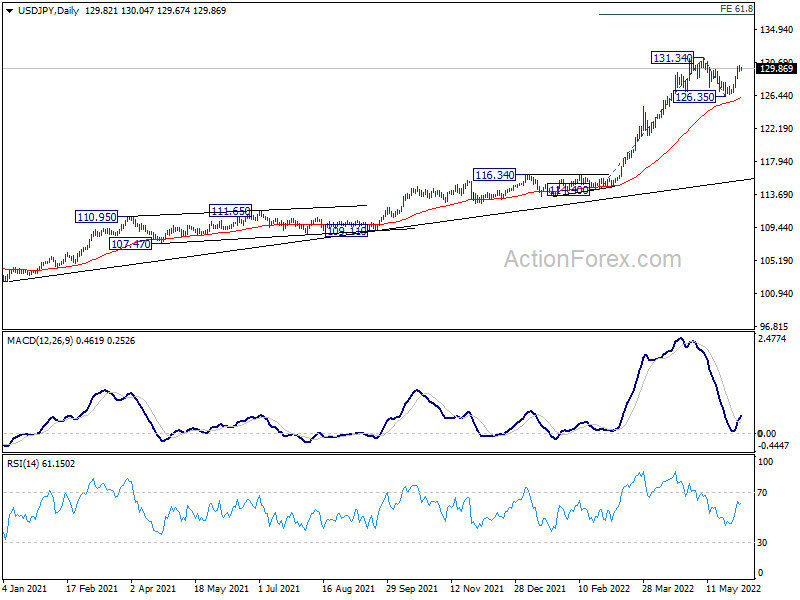
In the bigger picture, current rally is seen as part of the long term up trend form 75.56 (2011 low). Sustained trading above 61.8% projection of 75.56 (2011 low) to 125.85 (2015 high) from 98.97 at 130.04 will pave the way to 100% projection at 149.26, which is close to 147.68 (1998 high). For now, this will remain the favored case as long as 121.27 support holds.
USD/CAD Daily Outlook
Daily Pivots: (S1) 1.2527; (P) 1.2607; (R1) 1.2649; More...
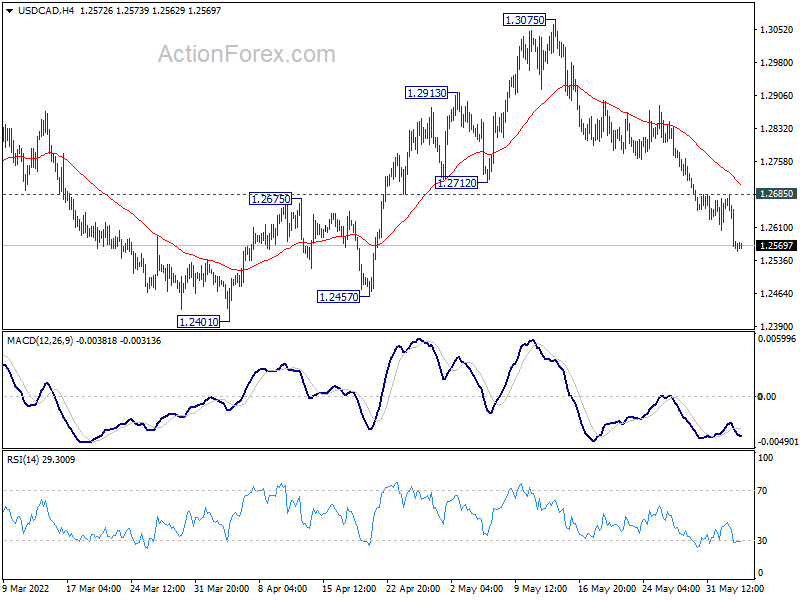
USD/CAD's fall from 1.3075 is still in progress, and intraday bias stays on the downside for 1.2401 support. Decisive break there will argue that whole rebound from 1.2005 has completed, after rejection by 1.3022 fibonacci resistance. Deeper fall would then be seen to retest this low. On the upside, above 1.2685 minor resistance will mix up the near term outlook and turn intraday bias neutral first.
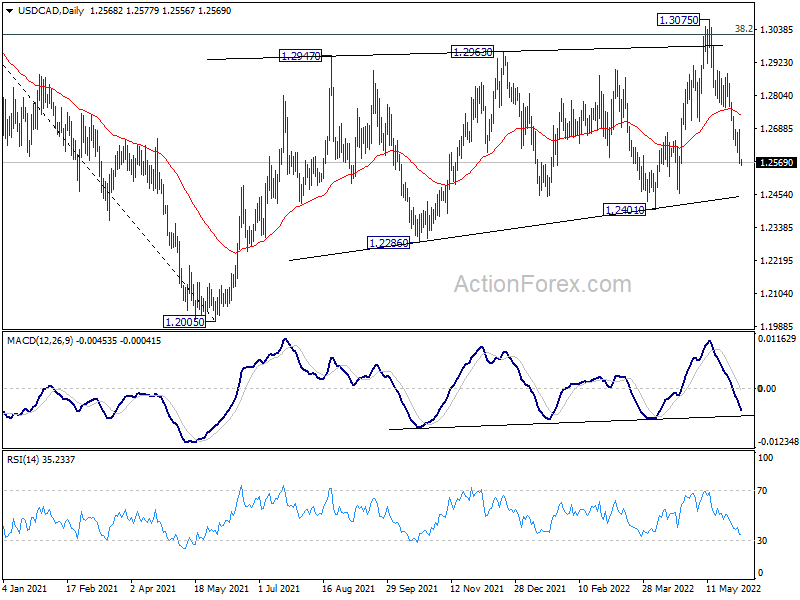
In the bigger picture, focus stays on 38.2% retracement of 1.4667 (2020 high) to 1.2005 (2021 low) at 1.3022. Sustained break there should confirm that the down trend from 1.4667 has completed after defending 1.2061 long term cluster support. Further rise would then be seen towards 61.8% retracement at 1.3650. However, rejection by 1.3022 will maintain medium term bearishness. Break of 1.2005 will resume the down trend from 1.4667 and that carries larger bearish implications too.
UST Outperformance in Combination with Risk-on Deprived Dollar of its Recently Found Momentum
Markets
The economic calendar yesterday focused on the US, with below-consensus ADP job growth and factory orders but slightly better-than-expected weekly jobless claims. None of them had a significant market impact though. US and European stocks snapped a two-day losing streak by adding between 1.33%-2.69% and around 1% respectively.
Core bond markets diverged. USTs stabilized after selling off lately, even as Fed vice governor Brainard and Cleveland Fed’s Mester basically ruled out a September pause in the tightening cycle as suggested by Bostic last month. US yields changes varied between -1.2 bps (2y) and 1.8 bps (30y).
German Bunds hugely underperformed, adding 2.1 bps (30y) to 7.6 bps (2y-5y) as markets keep raising bets that the ECB will have to follow the Fed in going bolder (50 bps hikes). Germany’s 10y yield (+5 bps) closed at 1.237%, just an inch above the 1.234% resistance level (38.2% recovery of the 2008-2020 decline).
Oil prices briefly fell after OPEC+ announced it would raise planned output hikes in July and August by 50%, from 432k to 648 kbarrels per day. The downleg quickly reversed with an intraday turnaround of more than 5% (Brent closed at $117.61/b).
UST outperformance in combination with risk-on deprived the dollar of its recently found momentum again. EUR/USD rebounded from 1.065 to 1.0747. USD/JPY lost a few ticks after hitting 130 resistance. The Swiss franc temporarily appreciated to the strongest level since early May after above-consensus CPI (2.7%) heats up speculation going into the SNB meeting on June 16. EUR/GBP rose further to 0.854 while UK markets were busy celebrating the Queen’s Platinum Jubilee. They continue doing that today.
In Asia, Hong Kong and Chinese markets are closed as well. Markets that are open generally trade in (pale) green. FX markets trade quietly. The euro holds a small advantage over the dollar with EUR/USD nearing 1.0758 resistance. The Chinese yuan strengthens in thin-liquidity trading to USD/CNY 6.66.
Core bonds hover sideways this morning ahead of the US payrolls release and the services ISM later today. Consensus is for a 320k job gain. Hourly earnings will probably remain solid and could be defining for the market reaction. The stronger-than-expected manufacturing ISM earlier this week called off the downward correction in yields. Will the services gauge surprise to the upside similarly?
This week’s batch of strong US eco data in any case convinced investors for the time being that the US economy is strong enough to withstand Fed tightening. We see room for US bond yields to extend gains following decent-to-strong data. Resistance (10-y) is located just south of 3%, marking the right shoulder top of a potential head-and-shoulders pattern in the making with the neckline situated at 2.72%. EUR/USD recapturing 1.0758 ahead of the weekend would be a bullish sign but remains difficult, especially should rising (US) yields result in a shaky equity sentiment.
News Headlines
Inflation in South Korea again jumped at a faster-than-expected pace in May. Headline inflation rose 0.7% M/M and 5.4% Y/Y, compared to 4.8% in April, reaching the highest level since August 2008. Core inflation excluding food and energy prices also jumped from 3.6% to 4.1%. Transportation costs rose 14.5% Y/Y, food prices were 6% higher. Utility prices rose 5%. In a statement, the Bank of Korea warned that inflation may stay high for a considerable period of time with more 5%+ prints expected in June and July. The BoK last week raised its policy rate for a fifth time since the start of its hiking cycle in August last year by 25 bps to 1.75% and signaled further steps. The Korean won which almost touched a multi-year low against the dollar mid-May, today extended its rebound with USD/KRW easing from 1252 yesterday to currently trade near 1240.In an interview at the website of the Czech National Bank (CNB) vice governor Marek Mora indicated that the CNB is likely to raise the policy rate further at the June meeting. He said that all options are open as is necessary to bring inflation back to the target. On a question whether a hike bigger than 75 bps is possible, he said he has no ceiling or limit. At the same time he stated that Czech rates are already quite high and that the CNB is nearing the point where no further rate hikes are needed. In this respect, he considers a scenario of the CNB board unanimously voting for stable rates at the August meeting as possible.
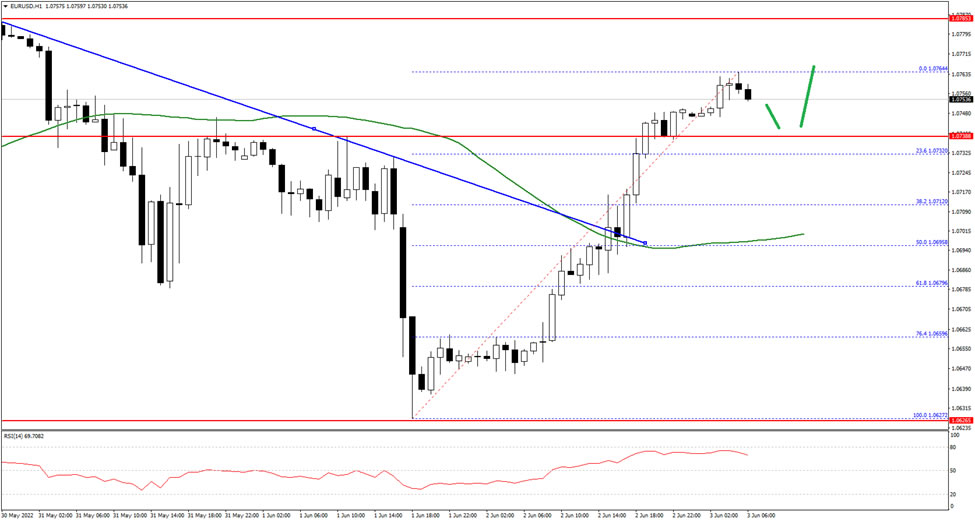
EUR/USD Pair is Currently Consolidating Gains from $1.0764
The Euro started a fresh increase from the 1.0625 support zone against the US Dollar. The EUR/USD pair surpassed the 1.0650 level to move into a positive zone.
The price even traded above the 1.0700 level and the 50 hourly simple moving average. It traded as high as 1.0764 and is currently consolidating gains. An immediate support is near the 1.0740 level.
The next key support is near 1.0700 and the 50 hourly simple moving average, below the pair could decline towards the 1.0650 level in the near term. Any more losses might send the pair towards the 1.0600 level.
On the upside, the pair might struggle near 1.0765. The next major resistance is near the 1.0785 level. A break above the 1.0785 and 1.0800 resistance levels could start another increase. In the stated case, it could even surpass 1.0850 on FXOpen.
Boost to OPEC Production Fails to Calm Oil Markets
Market movers today
The most important data release of the day will be the US May Jobs Report. While the ADP report released yesterday was weaker than expected, most indicators still point towards labour demand remaining at high levels. In addition, ISM Services PMI will be released in the afternoon.
On US monetary policy, Fed's Brainard speaks this evening.
The 60 second overview
New forecast for the global economy: This morning we published our new take on the global economy: Big Picture – A (mild) recession in western economies seems unavoidable, 3 June, looking at the economic prospects for the US, Chinese, euro area, UK, Japanese and emerging market economies as well as a special section on the challenges in achieving the EU green transition. Despite the high inflation eroding consumer purchasing power, economic activity will near term be supported by pent-up demand for services and significant savings. However, as the swift monetary policy tightening in western countries, notably in the US, lead to increasingly tighter financial conditions, we expect first the US economy to fall into a mild recession in Q2 next year, spilling over to the other western economies afterwards. The setback will be somewhat mitigated by solid growth in the Chinese economy supported by policy stimulus.
Increase in OPEC production fails to hold down oil prices: OPEC yesterday came about half way in meeting the market expectations. The cartel agreed to increase output more than previously planned, but did not decide on Russia's status in OPEC+ following the EU embargo announced earlier in the week. Consequently, oil prices erased part of the decline since Tuesday. On the one hand, more output from OPEC (even if the group is struggling to live up to previous pledges) will ease tight market conditions near-term. On the other hand, less spare capacity within OPEC and particularly Saudi Arabia leaves the oil market vulnerable to future supply shocks. We stick to our forecast that Brent should average USD115/bbl short-term and drop below USD100/bbl next year.
Equities: The US equity markets rose yesterday, despite higher oil prices and hawkish signals from Fed members. This morning performance in Asian markets is mixed, while US and European futures point to a higher opening.
FI: With UK out celebrating Jubilee yesterday and today, the European markets were trading mostly sideways with less volatility than what we have seen in the past couple of weeks until the afternoon. However, as US opening and Fed's Brainard saying it's too soon to say if inflation has peaked, combined with surging oil prices (following OPEC only half-way meeting expectations), resulted in intensified concerns about the current inflation pressure and sent rates sharply higher.
FX: OPEC yesterday came about half way in meeting the market expectations. Swiss inflation surprised significantly to the upside with CPI for May reaching 2.9%. DKK-EUR liquidity is set to be turned upside down in the second half of June. EUR/NOK has moved back below the 10.10 mark.
Credit: Yesterday, CDS indices were closed due to UK holiday hence levels are unchanged with iTraxx Main 1.8bp at 89.3bp and Xover at 446bp. Cash bonds performed stable during a quiet session.
Nordic macro
Norwegian unemployment has continued to fall so far this year, which is a good indication that growth is still stronger than normal and capacity utilisation is still rising. With labour shortages hitting record highs, how much further unemployment can come down will depend on the size of matching problems in the labour market. We expect the (seasonally adjusted) jobless rate to drop to 1.8% in May, which would be below Norges Bank's projection of 2.0% in the March monetary policy report.
Dude, Where’s My Oil?
The most anticipated OPEC+ meeting of the year turned out to be a damp squib in the end. OPEC+ agreed to increase output in July and August to 648,000 bpd from the previously agreed 432,000 bpd, with the increased allocation spread across all its members, including, you guessed it, Russia. Given most of OPEC can’t even meet their present targets, with only Saudi Arabia, the UAE, and possibly Iraq, having any sort of spare capacity, and with Russia under sanctions, the entire exercise was nothing more than window dressing.
It is clear which side OPEC’s bread is buttered on and you’d have to say Vladimir Putin is having a good week by his lowly standards. Progress in Eastern Ukraine, OPEC clearly not wanting to upset him, and now a Russian restriction on noble gas exports. (these are inert gases used in the production of semiconductors amongst other things) Ukraine previously produced 30% of the world’s noble gases by the way. He must be loving it when a plan comes together.
The minuscule increase in production was a sop to US President Biden but won’t change a thing in the supply/demand equation on international markets. President Biden is going to have to show up with a lot more goodies on the table during his upcoming visit to the Middle East to change that dynamic. Sabre rattling against China, and a vacuous trade agreement that provided no access to US markets, as per his recent trip to Asia, just isn’t going to cut it. To paraphrase Jerry Maguire, if you want to cut Russian and Chinese influence everywhere Joe, show me the money.
Markets clearly felt the same as oil, which had plummeted pre-meeting on hopes of a much larger increase in production, reversed all their losses. Further indignity was served up by official US Crude Inventories, which plummeted by just over 5 million barrels overnight. That saw both Brent crude and WTI finish a huge turnaround, closing around 2.0% higher on the day.
With Brent crude and WTI within shouting distance of $120.00 a barrel, that made the overnight rally by US equities even stranger things. Wall Street booked impressive gains overnight and I can only put it down to a very weak ADP Employment release, only gaining 128,000 jobs, while April Building Permits fell by 0.60% and April Factory Orders MoM for April only rose by 0.30%.
It was the ADP Employment data that did though, even though it is an appalling indicator for the US Non-Farm Payrolls. I note the JOLTs data this week still showed two jobs for every unemployed American, something Lael Brainard also noted overnight. Still, why let reality get in the way of a good story? A slowing US economy equals less Fed tightening equals lower terminal interest rates equals buy everything. The rally by Wall Street sparked a correlated risk-on rally across the rest of the markets. US yields edged lower, the US Dollar got thumped, with risk-sentiment fashionistas the Euro, Australian Dollar and New Zealand Dollar booking impressive gains. Even Bitcoin and gold rallied as they are inflation hedges, I mean deflation hedges, I mean stagflation hedges; oh, never mind.
We can take two things out of the overnight price actions. Equity markets, having been programmed to buy any dip over the last two decades thanks to the asset price backstop of global monetary policy, are looking for even the most tenuous reasoning to price the end of the bear market. Secondly, the trajectory of US interest rates is the one ring to rule them all with global markets and asset classes everywhere.
Tonight’s US Non-Farm Payroll data is expected to ease to 325,000 jobs added. A large deviation above or below that number should produce a very binary outcome for the FOMO gnomes of the stock market, and by default, be reflected in other asset classes. A high number equals Fed tightening with lots of 0.50% increases, remains on track, equals sell equities, sell currencies, buy US Dollar, sell bonds, sell gold. A low number equals less Fed tightening, buy equities, buy currencies, especially EUR, AUD, NZD, and EM, buy bonds, buy gold, and because it’s the weekend, let's buy some crypto as well. Volatility is the winner either way.
Moving out of the tail-chasing Lala land we call the US financial markets and into the real world, we see a raft of Services PMIs for May also released today. Asian releases have been a mixed bag. Australian Services PMI caught a cost-of-living sniffle as it fell to 53.2 from 56.1 previously. In contrast, Japan's Jibun PMI rose from 51.7 to 52.6 this morning as the reopening boom continues there. European Services PMIs have obvious downside risks as will India’s at 1300 SGT today as rising living costs bite.
None of that should influence the Reserve Banks of Australia and India next week, which will both hike policy rates again. Indonesia’s CPI yesterday was benign and will likely stay Bank Indonesia’s hands this month. We can pencil in another rate hike from the Bank of Korea in July for sure after South Korean inflation for May YoY blew through the topside, rising by 5.40%.
Holidays will impact trading volumes and liquidity internationally today. Mainland China, Hong Kong, and Taipei are all dragon boating. Thailand celebrates their Queen’s birthday. Meanwhile, the UK will be closed again for neighbourhood street parties to celebrate the Queen’s platinum jubilee. Congratulations Your Majesty. On Monday, most of Europe is closed for Whit Monday, with holidays also in New Zealand, South Korea, and Malaysia.
Finally, I know markets can remain irrational longer than you can stay solvent, but did I mention that oil is approaching $120.00 a barrel, and Russia now controls large swaths of the global wheat and plant oil supply, and noble gases? Just saying….
Asian equities edge higher
Overnight, soft US ADP Employment data saw Wall Street rapidly price in less Fed tightening, spurring an impressive rally on Wall Street. With Wall Street clutching at any straw for an excuse to buy, the S&P 500 jumped 1.84% higher, the Nasdaq leapt to a 2.69% gain, and the Dow Jones rallied by 1.29%. US futures have paused for breath in Asia, all three indexes are unchanged.
Asian volatility appears to be suffering a holiday impact, rising more cautiously thanks to holidays in Mainland China, Hong Kong, Taiwan, and Thailand. Japan’s Nikkei 225 has risen by 1.15%, with South Korea’s Kospi adding just 0.42%. Singapore is just 0.10% higher, with Kuala Lumpur easing by 0.25%, Jakarta gaining 0.90%, and Manila unchanged. Higher oil prices overnight may also be tempering gains in Asia.
In Australia, markets are slavishly following the US lead. The ASX 200 is 0.65% higher, while the All Ordinaries has risen by 0.80%, with New Zealand edging 0.30% higher.
European markets rallied overnight, likely on hopes that OPEC+ would ramp up oil production and with Wall Street’s climb. Oil prices closed around 2.0% higher in New York, with the OPEC+ announcement mere window dressing. That is likely to limit gains in Europe initially, especially with the UK away, weekend event risk, and much of Europe on holiday on Monday.
US Dollar loses all of its previous gains
There was a wax on, wax off feel to currency markets overnight. Soft ADP Employment data spurring a risk-on rally across asset classes as the Fed hiking outlook was tempered. The US Dollar staged a broad retreat, unwinding all its gains from the day before in the major space except for USD/JPY. Asian market volatility is being dampened by holidays across the region today, including Mainland China and Hong Kong, and the UK later today.
The dollar index tumbled by 0.78% to 101.75 overnight, an exact reversal of the rally from the day before. It is unmoved in Asia and support/resistance lies at 101.40 and 102.70. Its fate will be decided by this evening’s US Non-Farm Payrolls.
EUR/USD reversed all its previous day’s losses, rising 0.91% to 1.0750 where it remains in Asia. Resistance between 1.0770 and 1.0830 remains a formidable barrier, with support at 1.0650. Sterling reversed all its previous day’s losses, rising 0.75% to 1.2575 where it remains in Asia. It has support/resistance at 1.2460 and 1.2670. USD/JPY was almost unchanged at 129.85 as US bond yields barely moved. It remains unchanged in Asia. It has support/resistance at 129.00 and 131.30. Their fate will be decided by this evening’s US Non-Farm Payrolls.
AUD/USD staged a bullish outside reversal day overnight, making a new low before closing higher than the high of the day before, thanks to the broad-based risk-on rally after the US data. It leapt 1.27% higher to 0.7260 overnight where it remains today. AUD/USD has support at 0.7150, and the overnight rally took it above its 50/100/200-day moving averages (DMAs) between 0.7230 and 0.7255 as well. A soft Non-Farm print tonight could see AUD/USD rise to test 0.7350, with a weekly close at these levels being a bullish signal technically. Its fate will be decided by this evening’s US Non-Farm Payrolls.
Asian FX currencies booked modest gains overnight, with the rise in oil prices tempering the fast money inflows. Both the Malaysian Ringgit and Philippine Peso actually fell overnight, a result I suspect, of rising subsidy bills as oil prices climb higher. The Indonesian Rupiah has rallied 0.70% to 14,420.00 today, while the KRW and MYR have risen by 0.10%. With a swathe of holidays across the region today, and no PBOC USD/CNY fixing, Asian markets look content to watch from the sidelines as we head into US data this evening and the weekend. Their fate will be decided by this evening’s US Non-Farm Payrolls.
Oil stages spectacular reversal higher
A disappointing outcome from the OPEC+ meeting (for consumer nations), saw oil’s selloff in Asia yesterday completely reversed pus interest. Markets were disappointed when OPEC+ only agreed to hike production to 650,000 bpd for the next two months, instead of more structural increases from OPEC to cover the Russian shortfall. Things got worse for oil bears later in the season when the US Crude Inventory data posted a surprise 5.0 million barrel drawdown.
Brent crude fell as low as $112.50 a barrel intraday, before staging a spectacular reversal higher which saw it close 1.93% higher at 118.05 a barrel. WTI fell to near $111.00 a barrel intraday, before it reversed sharply higher, finishing 2.40% higher at 117.55 a barrel. The US Crude Inventory number impacts WTI more and causing the Brent premium over WTI to narrow sharply. In Asia, the swathe of holidays has torpedoed volumes and liquidity. Brent crude and WTI have seen some short-term long-covering, pushing them slightly lower to $117.45 and $116.60 a barrel respectively.
Markets have passed judgment on the OPEC+ moves unequivocally and clearly believe they will have no meaningful impact on the global supply/demand imbalance. The ferocity of the rally overnight leaves little doubt that the upside is the path of least resistance. Brent crude has resistance at $188.40, $120.00, and $124.00, with support distance at $112.50 a barrel. WTI has resistance at $117.70 and then $120.00, with now distant support at $111.25 a barrel.
Gold rises sharply on falling US Dollar
It is a measure of how powerful the risk-on rally was overnight, and how desperate markets are to price in less Fed tightening, that gold leapt 1.20% higher to $1868.50 an ounce as the US Dollar was crushed. Having probed $1874.00 in early Asian trading, it has retreated back to its starting point at $1868.50 as the morning progressed, volumes impacted by holidays in Greater China.
The chart picture shows gold is now eroding resistance at $1870.00, with the 100-DMA at $1886.00 as its next target, followed by $1900.00. there, I suspect, it will encounter heavy option-related selling initially. Support is at $1844.00, $1830.00, and then $1780.00 an ounce. I do not discount a disorderly retreat if the latter fails.
A weaker than expected US Non-Farm Payrolls number tonight should keep the less-Fed-tightening, risk-seeking party going. In that case, a test of $1900.00 is out of the question, followed by a gap higher if it breaks. However, gold bugs will know how quickly joy can turn to disappointment with gold, and a firm data print could well see the overnight gains unwound with interest. Be careful out there.
AUD/USD Daily Report
Daily Pivots: (S1) 0.7181; (P) 0.7226; (R1) 0.7310; More...
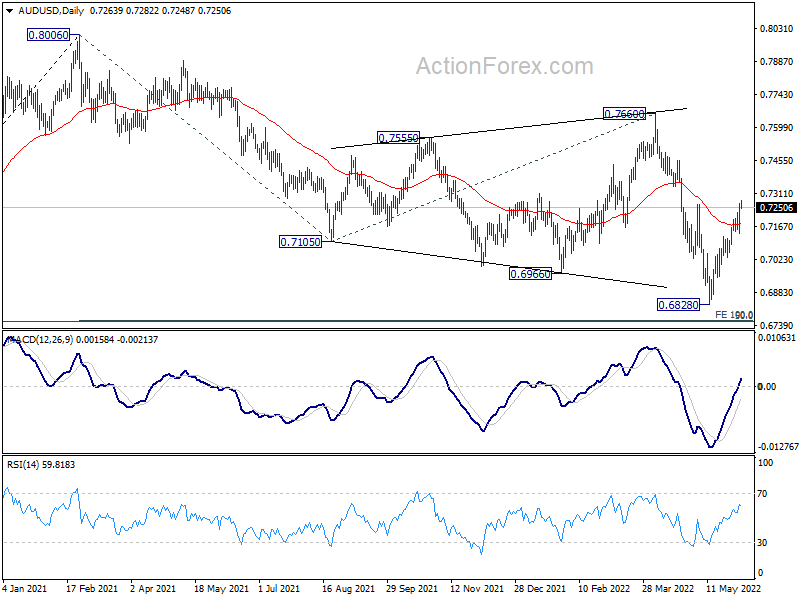
AUD/USD's rebound from 0.6828 extends further and intraday bias stays on the upside. Breach of 0.7265 resistance is a sign that whole corrective fall from 0.8006 has completed with three waves down to 0.6828. Further rise should be seen back to 0.7660 resistance next. On the downside, however, break of 0.7139 minor support will mix up the outlook and turn intraday bias neutral first.
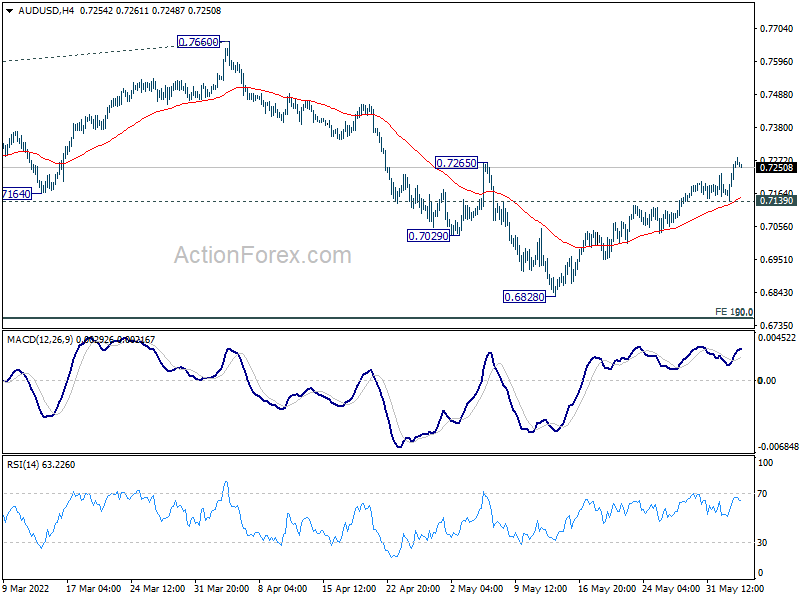
In the bigger picture, price actions from 0.8006 are seen as a corrective pattern to rise from 0.5506 (2020 low). Deeper fall could be seen to 50% retracement of 0.5506 to 0.8006 at 0.6756. This coincides with 100% projection of 0.8006 to 0.7105 from 0.7660 at 0.6760. Strong support is expected from 0.6756/60 cluster to contain downside to complete the correction. Meanwhile, firm break of 0.7660 resistance will confirm that such corrective pattern has completed, and larger up trend is ready to resume.
Yen Extending Selloff, Aussie and Loonie Strong, NFP Watched
Commodity currencies remain in the driving seat for the week, with Aussie having a slight upper hand over Loonie. Both are supported by firmer risk sentiments, as well as expectations for more tightening. Yen is the runaway loser for the week and looks set to resume broad based down trend. Dollar is mixed for now, a little on the soft side, in reaction to risk sentiment. Focus will turn to non-farm payroll report today, and the reaction in the stock markets would be the main driver in FX.
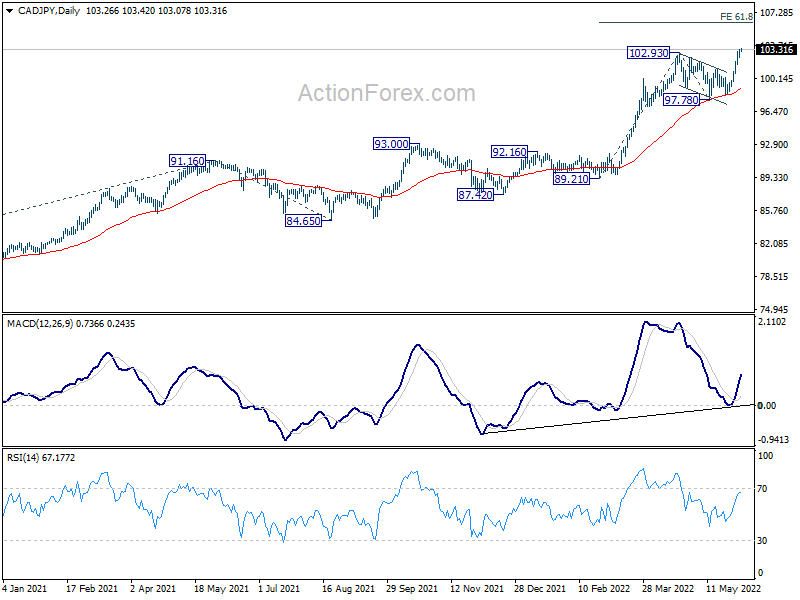
Technically, CAD/JPY's break of 102.93 resistance confirms up trend resumption. Next target is 61.8% projection of 89.21 to 102.93 from 97.78 at 106.25. AUD/JPY is also making some progress by breaking 94.00 resistance. Focus will turn to 95.73 high in AUD/JPY and break will confirm up trend resumption too. Such developments, if happen, should be accompanied by extended rebound in stocks, and probably treasury yields too.
In Asia, Nikkei closed up 1.19%. Hong Kong and China are on holiday. Singapore Strait Times is up 0.13%. Japan 10-year JGB yield is down -0.0076 at 0.238. Overnight, DOW rose 1.33%. S&P 500 rose 1.84%. NADSAQ rose 2.69%. 10-year yield dropped -0.0018 to 2.913.
Fed Mester cannot conclude inflation has peaked
Cleveland Fed President Loretta Mester said yesterday, "if by the September FOMC meeting, the monthly readings on inflation provide compelling evidence that inflation is moving down, then the pace of rate increases could slow. But if inflation has failed to moderate, then a faster pace of rate increases could be necessary."
"I will need to see several months of sustained downward monthly readings of inflation. I have not seen that yet," she said, thus she could not conclude that inflation has peaked.
On the economy, Mester said, "the risk of recession has risen, but because underlying aggregate demand momentum and the demand for labor are so strong, a good case can still be made that as demand and supply come into better balance, a sharp slowdown can be avoided, with growth slowing to a trend pace this year, labor market conditions remaining healthy, and inflation moving down to a 4‑1/2 to 5‑1/2 percent range this year and declining further next year," Mester said.
Fed Brainard: It's very hard to see the case for pause in Sep
Fed Vice Chair Lael Brainard told CNBC yesterday, "right now, it's very hard to see the case for a pause… We've still got a lot of work to do to get inflation down to our 2% target." Atlanta Fed President Raphael Bostic noted earlier that a pause in September might make sense to see how the economy evolves after successive rate hikes.
"We're certainly going to do what is necessary to bring inflation back down," Brainard said. "That's our No. 1 challenge right now. We are starting from a position of strength. The economy has a lot of momentum."
BoC Beaudry: Interest rate may need to go above 3%
BoC Deputy Governor Paul Beaudry said in a speech, "we noted that price pressures are broadening and inflation is much higher than we expected and likely to go higher still before easing."
"This raises the likelihood that we may need to raise the policy rate to the top end or above the neutral range to bring demand and supply into balance and keep inflation expectations well anchored," he added.
Beaudry also indicated that the neutral range, a rate that "neither stimulates nor weighs on growth", is estimated to be "between 2% and 3%"
NASDAQ extends rebound as focus turns to NFP
US non-farm payroll employment is the main focus for today. The US economy is expected to add 325k jobs in May. Unemployment rate is expected to drop from 3.6% to 3.5%. Average hourly earnings are expected to rise another 0.4% mom. Looking at related data, ADP private jobs grew just 128k, well below expectations. ISM manufacturing employment dropped into contraction reading of 49.6. Four-week moving average of initial claims also rose notably from 188k to 206k. There is risk of downside surprise in the heading NFP number today. But wages growth would be the one that matters more.
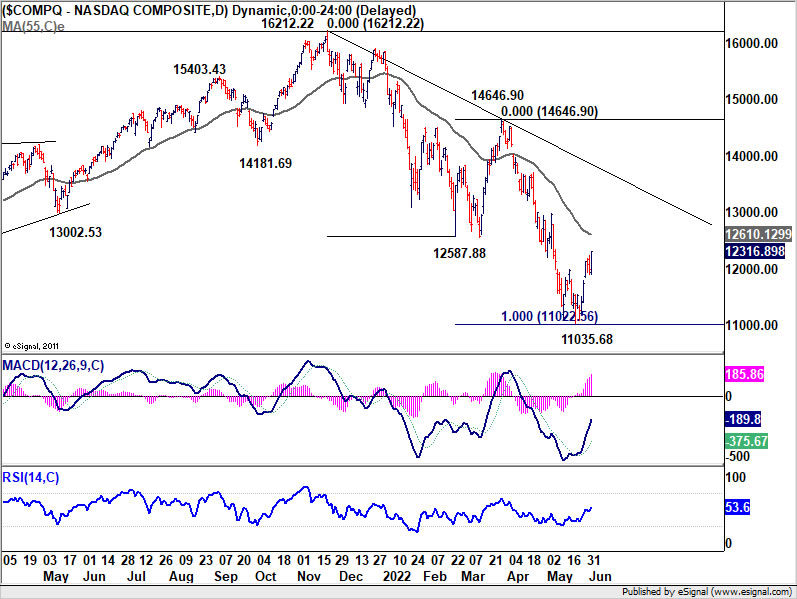
US stocks are trying to extend rebound this week, even though some Fed officials tried to talk down the prospect of a September pause in tightening. NASDAQ's rebound form 11035.68 is in progress for 55 day EMA (now at 12610.13). Sustained break there will raise the chance that whole fall from 16212.22 has completed in form of a three wave correction. Stronger rally would then be seen back towards trendline resistance at around 13800 later in the month. Such development would cap rally attempts in the greenback.
Elsewhere
Australia AiG Performance of Construction dropped sharply from 55.9 to 50.4 in may. Germany trade balance and France industrial output will be released in European session. Eurozone will release PMI services final and retail sales. Later in the day, in addition to NFP, US will also publish ISM services.
AUD/USD Daily Report
Daily Pivots: (S1) 0.7181; (P) 0.7226; (R1) 0.7310; More...
AUD/USD's rebound from 0.6828 extends further and intraday bias stays on the upside. Breach of 0.7265 resistance is a sign that whole corrective fall from 0.8006 has completed with three waves down to 0.6828. Further rise should be seen back to 0.7660 resistance next. On the downside, however, break of 0.7139 minor support will mix up the outlook and turn intraday bias neutral first.
In the bigger picture, price actions from 0.8006 are seen as a corrective pattern to rise from 0.5506 (2020 low). Deeper fall could be seen to 50% retracement of 0.5506 to 0.8006 at 0.6756. This coincides with 100% projection of 0.8006 to 0.7105 from 0.7660 at 0.6760. Strong support is expected from 0.6756/60 cluster to contain downside to complete the correction. Meanwhile, firm break of 0.7660 resistance will confirm that such corrective pattern has completed, and larger up trend is ready to resume.
Economic Indicators Update
| GMT | Ccy | Events | Actual | Forecast | Previous | Revised |
|---|---|---|---|---|---|---|
| 22:30 | AUD | AiG Performance of Construction Index May | 50.4 | 55.9 | ||
| 06:00 | EUR | Germany Trade Balance (EUR) Apr | 5.6B | 3.2B | ||
| 06:45 | EUR | France Industrial Output M/M Apr | 0.40% | -0.50% | ||
| 07:45 | EUR | Italy Services PMI May | 54.5 | 55.7 | ||
| 07:50 | EUR | France Services PMI May F | 58.4 | 58.4 | ||
| 07:55 | EUR | Germany Services PMI May F | 56.3 | 56.3 | ||
| 08:00 | EUR | Eurozone Services PMI May F | 56.3 | 56.3 | ||
| 09:00 | EUR | Eurozone Retail Sales M/M Apr | 0.30% | -0.40% | ||
| 12:30 | CAD | Labor Productivity Q/Q Q1 | -1.20% | -0.50% | ||
| 12:30 | USD | Nonfarm Payrolls May | 325K | 428K | ||
| 12:30 | USD | Unemployment Rate May | 3.50% | 3.60% | ||
| 12:30 | USD | Average Hourly Earnings M/M May | 0.40% | 0.30% | ||
| 13:45 | USD | Services PMI May F | 53.5 | 53.5 | ||
| 14:00 | USD | ISM Services PMI May | 56.7 | 57.1 |
NASDAQ extends rebound as focus turns to NFP
US non-farm payroll employment is the main focus for today. The US economy is expected to add 325k jobs in May. Unemployment rate is expected to drop from 3.6% to 3.5%. Average hourly earnings are expected to rise another 0.4% mom. Looking at related data, ADP private jobs grew just 128k, well below expectations. ISM manufacturing employment dropped into contraction reading of 49.6. Four-week moving average of initial claims also rose notably from 188k to 206k. There is risk of downside surprise in the heading NFP number today. But wages growth would be the one that matters more.
US stocks are trying to extend rebound this week, even though some Fed officials tried to talk down the prospect of a September pause in tightening. NASDAQ's rebound form 11035.68 is in progress for 55 day EMA (now at 12610.13). Sustained break there will raise the chance that whole fall from 16212.22 has completed in form of a three wave correction. Stronger rally would then be seen back towards trendline resistance at around 13800 later in the month. Such development would cap rally attempts in the greenback.
Fed Mester cannot conclude inflation has peaked
Cleveland Fed President Loretta Mester said yesterday, "if by the September FOMC meeting, the monthly readings on inflation provide compelling evidence that inflation is moving down, then the pace of rate increases could slow. But if inflation has failed to moderate, then a faster pace of rate increases could be necessary."
"I will need to see several months of sustained downward monthly readings of inflation. I have not seen that yet," she said, thus she could not conclude that inflation has peaked.
On the economy, Mester said, "the risk of recession has risen, but because underlying aggregate demand momentum and the demand for labor are so strong, a good case can still be made that as demand and supply come into better balance, a sharp slowdown can be avoided, with growth slowing to a trend pace this year, labor market conditions remaining healthy, and inflation moving down to a 41/2 to 51/2 percent range this year and declining further next year," Mester said.