

Sample Category Title
Summary 5/23 – 5/27
Monday, May 23, 2022
[php_everywhere instance="1"]
Tuesday, May 24, 2022
[php_everywhere instance="2"]
Wednesday, May 25, 2022
[php_everywhere instance="3"]
Thursday, May 26, 2022
[php_everywhere instance="4"]
Friday, May 27, 2022
[php_everywhere instance="5"]
Weekly Economic & Financial Commentary: April Economic Data Show Resilient U.S. Economy
Summary
United States: April Economic Data Show Resilient U.S. Economy
- U.S. retail sales topped expectations in April, while industrial production also grew more rapidly than economists expected. Data on housing starts, home sales and homebuilder sentiment, however, showed tentative signs of cooling.
- Next week: New Home Sales (Tue), Durable Goods (Wed), Personal Income & Spending (Fri)
International: U.K. and Canada Inflation Reach New Cycle Highs
- U.K. inflation surged to a fresh 40-year high in April, quickening to 9.0% and placing additional pressure on the Bank of England (BoE) to double down and tighten monetary policy. Inflation in Canada also reached a new high, but this time of "only" 30 years; headline CPI inched up to 6.8% year-over-year in April.
- Next week: Eurozone PMIs (Tue), U.K. PMIs (Tue), RBNZ Rate Decision (Wed)
Interest Rate Watch: Bond Yields Up Significantly in Many Foreign Economies
- The United States is not the only major economy in which long-term interest rates have risen significantly. For example, the yield on the two-year government bond in Germany has risen about 100 bps since the beginning of the year, while the comparable yield in the United Kingdom is up about 80 bps over the same period.
Topic of the Week: The Outlook for Corporate Debt in a Rising Rate Environment
- After nearly tripling from just over $4T at the turn of the century to about $12T today, non-financial corporate (NFC) debt is at an all-time high. With recent Federal Reserve rate hikes and likely more to come, we outlined some hypothetical scenarios to analyze future debt serviceability in the NFC sector considering rising rates.
The Weekly Bottom Line: Energy Prices Eat into Buying Power
U.S. Highlights
- US retail sales rose by 0.9% m/m, while the control group grew by a stronger 1% m/m. Revisions to the month prior were also positive, suggesting Q1 spending ended the quarter on a firmer footing.
- Home sales fell by 2.6% m/m to 5.6M units in April, as deteriorating affordability continues to weigh on demand. Housing starts (-0.2% m/m) also recorded a modest decline but remain at a healthy 1.7M units.
Canadian Highlights
- Canadian inflation topped 6.8% year-on-year, with prices for food and housing lifting the headline figure.
- Housing markets showed a softening in demand in April, as sales and prices both fell. This brought the sales-to-listing ratio closer to a balanced market. Future supply is likely to improve the balance further, with starts rising 8% on the month.
Global Highlights
- Inflation continued to accelerate across the G-7 into April as the effects of rising food and energy prices continue to be felt.
- Moving forward, higher interest rates and reduced real disposable incomes will weigh on demand and help to cool inflation by narrowing the wedge between demand and supply.
Recent TD Economics Research
U.S. - Spending Through the Pain
US equities extended one of their worst losing streaks since 2008 this week, having now recorded seven consecutive weeks of declines. At the time of writing, the S&P 500 is down 2% on the week, and a far greater 18% year-to-date. The selloff in stocks fueled a rally in US treasuries, pushing the 10-year yield down by 10 basis points to 2.83% (Chart 1).
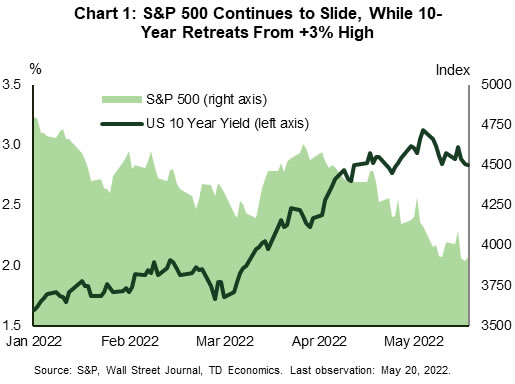
Sentiment soured early in the week as U.S. brick-and-mortar retailers drastically cut future earnings expectations. The common theme was that they are struggling with higher inflation, wages pressures and rising freight costs, all of which are cutting into profits. The dour reaction from financial markets appears to be rooted in the growing concern that the US economy is on the verge of a recession. Investors interpreted the disappointing earnings as a sign that consumers are already on a more precarious footing, further fanning the recession rhetoric. We see things a bit differently.
For starters, many of these big box retailers operate in an environment where margins have always been relatively thin. Even in “normal times”, their ability to pass-on higher costs to consumers is quite limited given the competitive nature of the retail landscape. This problem has been heightened of late, as retailers moved to replenish severely depleted inventories late last year even as consumer demand was already pivoting from goods in favor of services. Retailers were left holding significant inventory, forcing them to discount some merchandise, cutting further into profits.
Retail sales data for April corroborate the notion that consumer spending remains healthy. Headline sales were up 0.9% month-on-month (m/m), while the control measure was up an even stronger 1% m/m. Removing the effects of inflation from the control group did little to change the story, as real sales rose by a healthy 0.9% m/m. Revisions to the prior month were also positive, suggesting consumer expenditures ended last quarter on a much firmer footing than previously thought. While spending is expected to remain robust over the near-term, the combination of higher interest rates and persistent inflationary pressures will present a material headwind in the second half of this year and into 2023. Spending is expected to moderate to a sub-2% pace, though remain supportive of underlying economic growth.
Outside of consumer spending, higher interest rates continue to weigh on housing demand. Existing home sales fell for the third consecutive month in April, falling by 2.4% m/m to 5.6M units (Chart 2). Inventory remained incredibly tight, though the pullback in sales did allow supply to nudge a touch higher to 2.2 months – from 2 months in March. Even still, the market remains undersupplied, which is helping to sustain double-digit price growth of 14.8% y/y.
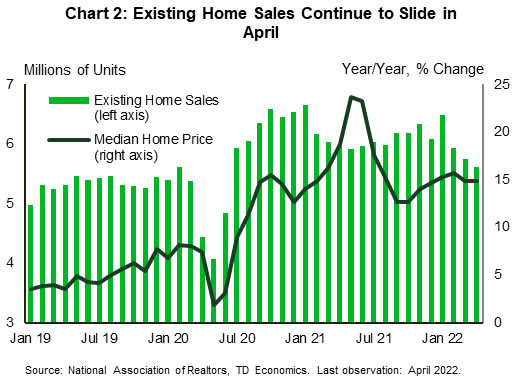
Housing supply relief is coming, but it is taking longer than expected to come to market. Despite recording a modest pullback in April, housing starts remained at a healthy 1.7 million units, while permitting activity continues to point to further gains in construction activity in the months ahead. The combination of softening demand and increased supply should go a long way in rebalancing the market over the coming months, and better align price growth to underlying fundamentals.
Canada - Inflation Heats Up, While Housing Cools
It was a week full of headline grabbing economic data releases, with inflation and housing statistics stealing the show. Consumer prices came in at 6.8% year-on-year (y/y) in April, driven by the two biggest inflation categories, food and shelter. Food purchased at grocery stores continued to advance, up 9.7% y/y, the highest rate in over 40 years. On the shelter side, costs rose 7.4% y/y, led by a significant upturn in the cost of maintaining existing homes and buying new ones. The combination of higher food and shelter costs contributed to over half of the total inflation print.
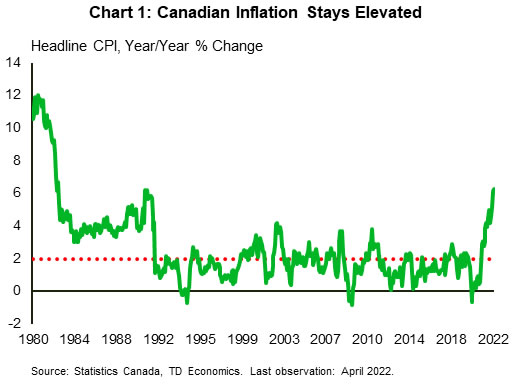
Furthermore, we are seeing a broadening of inflation, with high price growth now showing up in services. While goods inflation is still running at over 9%, the return to more in-person activities in Canada has services inflation starting to ramp-up at 4.6% y/y (vs 3.5% in December). This has the average of the Bank of Canada's three core inflation metrics rising to an uncomfortable high of 4.2%.
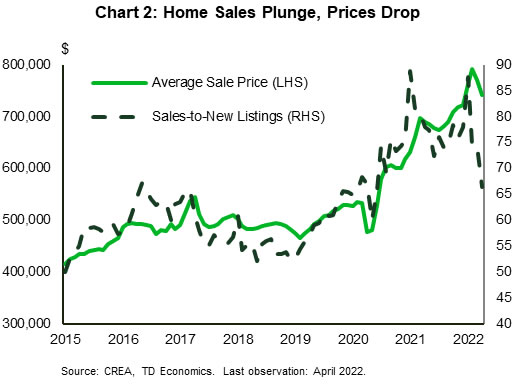
Given the large weight that shelter holds in the CPI basket, the outlook for inflation will be greatly influenced by the path of Canadian housing. This week we received a first look at the impact of higher interest rates on this closely watched sector. In the month of April, housing sales declined 12.6% month-over-month (m/m), falling by 47.2k units - the lowest level of activity since May 2020. The decline was broad, with eight of ten provinces seeing a slowdown. Most notable was the 21% drop in Ontario, followed by 12% and 10% drops in BC and Alberta, respectively. With national new listings declining by only 2%, the sales-to-new listings ratio fell to 66.5%, from 74.4% in March.
Waning demand and move to a more balanced market caused the average home price to decline 3.8% m/m. Ontario was a standout, with prices falling 6.3% on the month. This caused the Canadian average price growth in y/y terms to ease to a more reasonable 7.5%. There is clearly a reset happening in the minds of Canadians. Home buyers have gone from a mentality of needing to buy now before prices go up further, to sitting on the sidelines as they wait to see how much lower prices can go.
With the demand for housing having quickly evaporated in the last two months, the hope is that this does not curtail the push to increase housing supply. We received encouraging data on this, as housing starts rose 8% in April (at 267k unit), continuing a strong trend in building activity. Most of this was driven by the 14% gain in the multi-family category, compared to the 1% increase in single-detached starts. Even with the increase in building activity, the market is still undersupplied, with inventories having failed to keep up with demand for years. This should support housing starts going forward, even as resale demand readjusts to the new higher interest rate environment.
Global - Energy Prices Eat into Buying Power
It's inflation week in the G-7 as the European Union, the U.K., Canada, and Japan all released detailed April inflation numbers. The U.K. made headlines as the consumer price index (CPI) measure reached an eye-watering 9.0% year-over-year (y/y) – the broader measure that includes home ownership services advanced by a more modest 7.8%. Even in Japan inflation hit a seven and a half year high as headline CPI growth reached 2.5%. In general, the surge in energy prices is the rising tide that is lifting the cost of living at a multi-decade high pace.
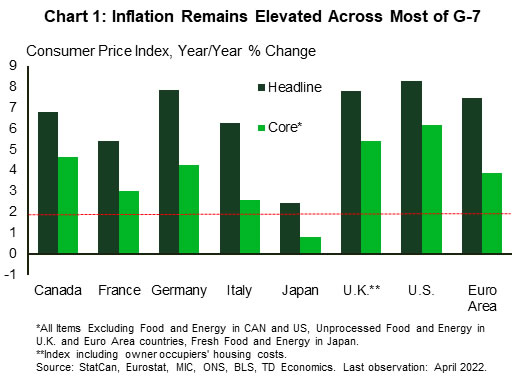
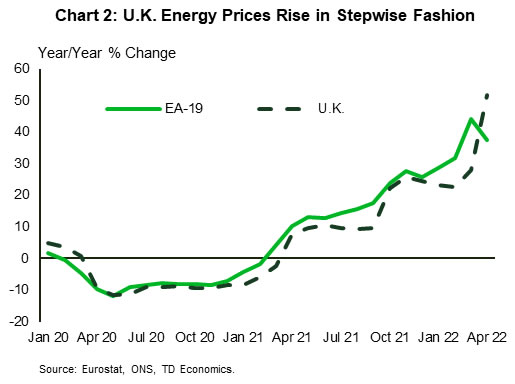
Headline CPI for April in the euro area was 7.3% y/y, while the measure excluding food and energy moved to 3.8%. By comparison, the U.S. registered 8.3% headline and 6.2% core advances, while Canada's release this week showed a 6.8 % and 4.6% increase (Chart 1). The magnitude of the energy shock Europe is witnessing now can't be understated. Energy prices are up 37.5% y/y, 7.3 percentage points ahead of the U.S. and a whopping 11.1 percentage points more than Canada. In the U.K., April saw the semi-annual adjustment to price caps on retail energy products. The cap increase produces abrupt jumps in energy costs followed by relative lulls (like a staircase) that ultimately tracks with the smoother European price profile (Chart 2).
That said, core measures (excluding food and energy) of inflation in most of the G-7 countries are well ahead of policymakers' targets. This reflects demand continuing to outstrip supply as the global economy reckons with a sequence of supply-side shocks.
As inflation continues to accelerate central bankers are concerned about longer-term inflation expectations rising and the entrenchment of a wage-price spiral. That's a key part of the reason why they continue to signal more monetary tightening despite the risk of a slowdown in growth.
Higher interest rates will work to weaken demand growth, albeit with a lag. The effect of inflation on purchasing power will be more immediate. Measures of wages in the U.K. and Europe are not keeping up with inflation. Average weekly earnings in the U.K. (adjusting for purchasing power) are up 3.5% y/y but, when bonuses are excluded, underlying real wages are down 2.0%. Euro area measures are released with a significant lag, but collectively bargained pay in Germany and Italy (which generally track underlying wage growth) are also lagging inflation. Notably, real hourly contractual wages in Japan were up 1.3% in March. However, in general, wage growth is not keeping up with inflation, so consumers will either be tapping accumulated savings or scaling back on purchases.
Moving forward, output growth will slow through the latter half of the year as inflation and higher interest rates erode purchasing power and slow expenditures. The softer demand backdrop will also help to cool inflation as the wedge between demand and supply narrows.
Week Ahead – Recession Fears Increasing
Plenty more to come
It’s been another turbulent week in financial markets and there’s nothing to suggest it’s going to ease up any time soon. For months investors have been asking themselves how many rate hikes are too many? What will tip the economy over the edge and into a recession? This week we may have got a clue as markets went into risk-averse mode and the dollar slipped while yields declined and gold rallied. Are recession fears now creeping in?
Economic surveys next week could tell us just how concerned businesses are about inflation and how bad they expect it to get. Meanwhile, we’ll hear from various central bank policymakers about their views on the latest data and whether they are still confident that a tightening-induced recession can be avoided.
The week starts with elections in Australia over the weekend which could make Monday’s open all the more interesting. We’ll also get rate decisions from New Zealand and Turkey, as well as minutes from the last Fed meeting. Needless to say, it promises to be another fascinating week.
US
In the US, a theme of weaker economic data is expected for the upcoming week. Risk appetite will get challenged as the likely story will be of weaker manufacturing activity, housing data, personal spending, and a very slow deceleration with pricing pressures. The Fed minutes for the May 4th meeting are already dated and will have less impact as recent Fed speak supports a half-point rate increase for the next meeting. The Fed’s Raphael Bostic will speak about the economic outlook on Monday and Esther George will give a speech on Wednesday. Both support raising rates by 50-basis points.
Many traders will focus on President Biden’s five-day Asia trip that will include a press conference with South Korean President Yoon Suk Yeol, a meeting with Japanese Prime Minister Fumio Kishida, and the Quad summit in Japan.
EU
The bulk of the tier one data comes early next week, with bank holiday’s on Thursday ensuring a quieter end. PMI data will be poured over for signs of slowing growth and increasing inflationary pressures. The ECB is late to the hiking party but the first could come as soon as July, after which a number could follow in quick succession. Further hints will be sought from various policymaker appearances.
The bloc is continuing to work towards a Russian oil embargo with Hungary still standing in the way.
UK
The UK is heading for a recession and double-digit inflation, both of which the BoE has resigned itself to. The cost-of-living crisis has caught up with the economy and will weigh for many months to come despite the efforts of the central bank which started tightening late last year, much sooner than many of its peers. Governor Bailey will speak again on Monday but having made multiple appearances recently, I’m not sure what value he can add.
The only data of note in an otherwise quiet week is the PMIs on Tuesday which could offer further clues on the economy and inflation. Forecasts suggest the slower growth across the board.
Russia
We’ll hear from CBR Chair Elvira Nabiullina on a couple of occasions next week. The central bank is continuing to unwind its emergency rate hikes imposed in the aftermath of the Western sanctions as the currency has fully recovered and inflation is expected to perform much better than anticipated. Nabiullina may shed further light on this.
South Africa
A quiet week in store after the SARB on Thursday delivered its first super-sized hike of 50 basis points. Coming after raising rates by 25 basis points at three previous meetings, the acceleration reflected the greater inflation risks to the economy, with the current rate sitting right at the top of the 3-6% band. The repo rate now sits at 4.75% and there’s room to move further, with inflation now only seen returning to the mid part of the range at the end of 2024, later than previously anticipated.
Turkey
The CBRT is expected to leave interest rates unchanged at 14% on Thursday, despite inflation hitting 69.97% in April.
China
China continues to battle the pandemic with a rigid zero-Covid policy. The government has imposed strict lockdowns in Shanghai and other major cities, which have hampered economic growth and disrupted global supply chains.
As Covid cases have been falling, China is slowly easing the pandemic restrictions. Authorities have designated June 1st as a tentative date for Shanghai to fully reopen, but this date will likely be postponed if there is an increase in the number of Covid cases.
India
The RBI opted for an off-cycle hike earlier this month, saying that it needed to respond urgently to rising inflation. Although the markets were expecting a rate hike, the timing of the 40 basis point increase was a surprise. This was the RBI’s first rate hike since August 2018, with additional rate hikes widely expected at upcoming meetings. The next meeting is scheduled for June 6-8.
Australia
Australia holds a federal election on Saturday (May 21st), with the election campaign focusing on economic issues.
Prime Minister Scott Morrison’s centre-right coalition has closed the gap with the opposition Labour party, led by Anthony Albanese. The latest opinion polls show that the race is too close to call.
PMIs and retail sales among the notable economic releases next week.
New Zealand
New Zealand kicks off the week with retail sales for Q1 on Tuesday. Consumers were in a spending mood in Q4 of 2021, as retail sales jumped 8.6% QoQ.
The RBNZ holds a rate meeting on Wednesday. The central bank has been aggressively raising interest rates in order to curb spiralling inflation, which hit 6.9% in Q1. The RBNZ is expected to increase rates by 0.50%, bringing the official cash rate to 2.00%.
On Friday, New Zealand releases the May ANZ consumer confidence. The RBNZ will be keeping a close eye on inflation expectations, which remain above its inflation target of 1%- 3%.
Japan
Core inflation hit 2.1% last month, above the BoJ target for the first time since 2008 (barring a period in 2015 after a sales tax hike). It isn’t expected to last though with energy being a key driver of the increase and wages not rising nearly as much. The central bank is expected to remain committed to ultra-loose policy even as it battles the market on its yield curve control policy tool.
Singapore
Singapore releases its inflation report on Monday. April CPI is expected to rise 0.1% compared with 1.2% previously. On an annualized basis, CPI is forecast to climb 5.6% against 5.4% a month earlier while core inflation is expected to exceed 3%. Higher core inflation is a key reason why the Monetary Authority tightened policy in April.
On Wednesday, Singapore releases GDP for Q1, followed by industrial production for April on Thursday.
Economic Calendar
Saturday, May 21
Economic Data/Events
- Australia’s national election
- President Biden holds a press conference with South Korean President Yoon Suk Yeol in Seoul
Sunday, May 22
Economic Data/Events
- World Economic Forum begins in Davos, Switzerland
Monday, May 23
- Economic Data/Events
- Chicago Fed National Activity Index
- Germany IFO business climate
- President Biden meets Japan PM Kishida in Tokyo
- Singapore CPI
- Fed’s Bostic discusses the economic outlook at an event hosted by the Rotary Club of Atlanta
- Fed’s George speaks at an agricultural symposium
- ECB’s Holzmann and Nagel, BOE Gov Bailey discuss inflation at an Austrian National Bank conference in Vienna
- World Gas Conference in Daegu, Korea begins
Tuesday, May 24
Economic Data/Events
- President Biden attends Quad summit with Japan, Australia and India in Tokyo
- DC Blockchain Summit in Washington, DC
- NOAA releases its initial outlook for the 2022 Atlantic hurricane season
- Sweden’s Riksbank publishes its Financial Stability Report 2022
- Eurozone S&P Global PMIs
- France S&P Global PMIs
- Germany S&P Global PMIs
- Indonesia rate decision
- Mexico international reserves
- Nigeria GDP, rate decision
- UK S&P Global PMIs
- US new home sales, S&P Global PMIs
Wednesday, May 25
Economic Data/Events
- FOMC Minutes
- US Durable goods
- RBNZ Rate Decision: Expected to raise Official Cash Rate by 50 bps to 2.00%
- RBNZ Governor Adrian Orr speaks following the rate decision
- The Treasury’s Office of Foreign Assets Control will let a sanctions exemption that’s allowed US investors to receive payments on Russian debt lapse
- ECB’s Holzmann speaks at the Central & Eastern European Forum in Vienna
- Bank of Finland Governor Rehn speaks at the bank’s annual payments forum
- ECB publishes its Financial Stability Review
- Germany GDP
- Mexico trade, GDP
- Singapore GDP
- EIA Crude Oil Inventory Report
Thursday, May 26
Economic Data/Events
- US GDP, initial jobless claims
- US House Financial Services Committee has a hearing on “Digital Assets and the Future of Finance: Examining the Benefits and Risks of a US Central Bank Digital Currency”
- New Zealand PM Ardern speaks at Harvard University’s 371st Commencement ceremony
- Mexico central bank monetary policy minutes
- Canada retail sales
- Singapore industrial production
- Turkey rate decision: Expected to keep One-Week Repo Rate unchanged at 14.00%
- Hungary one-week deposit rate
Friday, May 27
Economic Data/Events
- US core PCE price index; personal income and spending; wholesale inventories; University of Michigan consumer sentiment
- NATO Parliamentary Assembly spring session begins
- President Biden addresses US Naval Academy Class of 2022
- Australia retail sales
- China industrial profits
- Japan Tokyo CPI
Sovereign Rating Updates:
- Italy (Fitch)
- Sweden (Fitch)
- Switzerland (Moody’s)
- Turkey (Moody’s)
- Poland (DBRS)
Forward Guidance: Surging Travel Demand to Fire Up Spending and Putput Growth
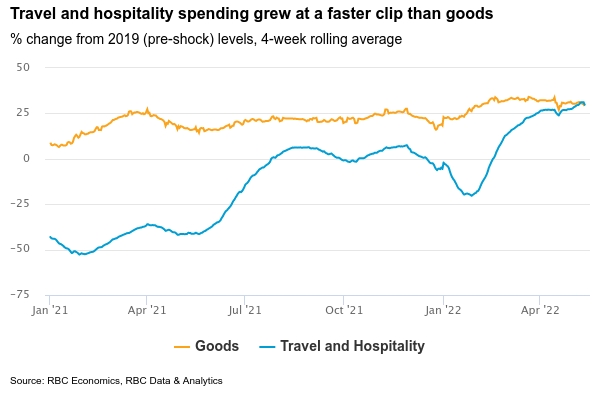
Travel is coming back, hot. Warmer weather, receding COVID-related health concerns, pent-up demand and a stockpile of household savings are all driving a rebound in tourism and hospitality spending. Indeed, our latest card tracker showed that, for the first time, the recovery in spending on services (including airfares, lodging, and dining) overtook spending on physical merchandise. That’s not to say that spending on goods is slowing—StatCan’s preliminary estimate of March retail sales showed a 1.4% increase. The preliminary numbers for April expected next week should look a little softer but will still look strong relative to pre-pandemic levels. Unit auto sales declined in April.
When it comes to goods producing industries, production capacity limits, including global supply chain disruptions and labour shortages, will continue to hamper growth. Auto production has looked stronger over March and April. But manufacturing sales volumes overall were unchanged in March, with higher prices accounting for all of the 2.5% nominal increase. Sales are expected to have ticked higher again in April with price increases offsetting lower hours worked. Headwinds tied to the Russia-Ukraine war and stringent lockdowns in China will continue and labour shortages will pose a more structural long-run challenge that is not easily or quickly addressed. We continue to expect overall GDP growth to slow more substantially once the ongoing bounce-back in travel and leisure spending has run its course.
Week ahead data watch:
- Next week’s SEPH job market data is expected to show still elevated levels of labour demand in March versus available supply. Indeed job postings were close to 70% above February 2020 in March and we expect job vacancy rates in the SEPH data will also remain well-above pre-pandemic levels.
- US personal consumption expenditures are expected to have increased in April given a 0.9% increase in retail sales and higher auto sales already reported.
Week Ahead – Flash PMIs, FOMC Minutes to Dictate Sentiment; RBNZ to Hike Again
Risk sentiment is wavering as investors are constantly evaluating the likelihood of a recession. The flash PMIs for May might help guide those expectations in the coming week. In the US, there will be plenty of additional drivers for the dollar, such as the FOMC minutes and the PCE inflation readings. Markets remain fixated on seeing peak inflation so any trace of this might help calm nerves. In the world of central banks, the Reserve Bank of New Zealand is expected to hike interest rates again.
US economy under the spotlight amid recession risks
There’s been a lot of talk about a recession in Europe but less so for the United States. But reality might be catching up with the markets, which until now, were confident that the American economy is robust enough to evade a sharp downturn. This sudden switch to a bleaker outlook has knocked down the US dollar and pushed Wall Street back into the red.
With quite a lot to choose from on the US calendar next week, senses will be heightened as investors will be on the lookout for recession warnings.
Kicking things off on Tuesday, the flash PMIs by S&P Global will be watched for signs that any part of the US economy began to struggle in May under the weight of soaring prices, higher borrowing costs and growing global uncertainties.
New home sales for April are also out on Tuesday, and durable goods orders will follow on Wednesday. On Thursday, the second estimate of first quarter GDP growth is due alongside pending home sales.
But stealing the limelight will be Friday’s releases, which include personal income and consumption, as well as PCE inflation. Both incomes and spending are expected to have grown at healthy clips in April. So attention will mainly fall on the core PCE price index as speculation builds that inflation in the US is at a turning point.
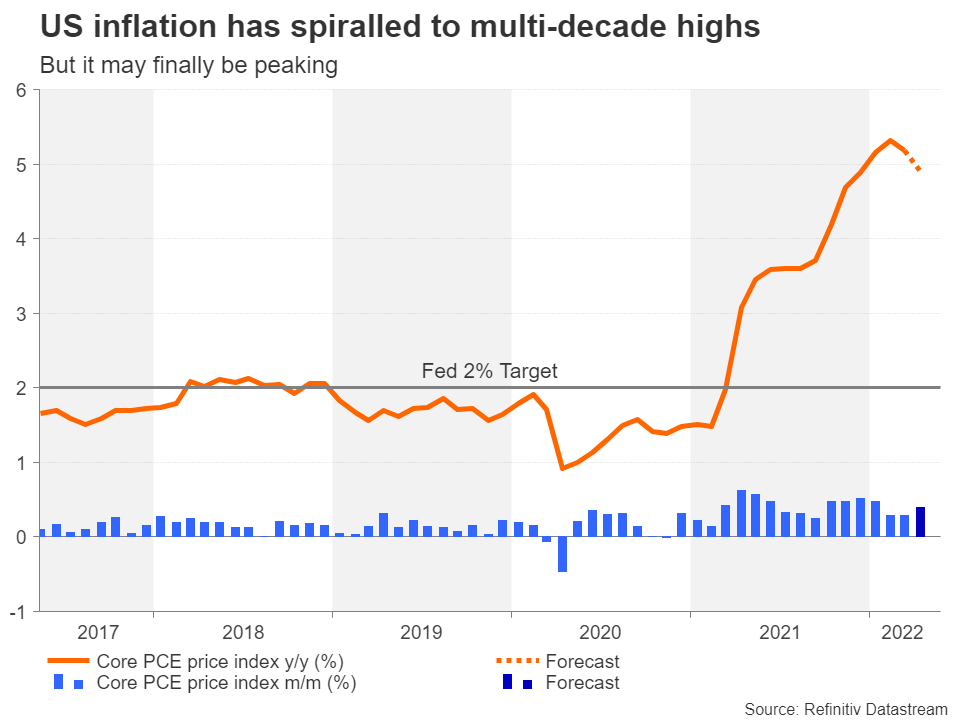
The Fed is hoping that inflationary pressures will subside soon, allowing it to stop front loading rate hikes. Any views on inflation possibly peaking soon will be scrutinized in the minutes of the May FOMC meeting that will be published on Wednesday.
Overall weak figures could intensify the dollar’s pullback but there are upside risks too, both from the economic activity gauges as well as the price data.
Will European PMIs match investors’ pessimism?
There can be no doubt that the European Central Bank and Bank of England are in the most dreaded spot policymakers can find themselves in. The ECB is about to do the unthinkable and abandon its policy of negative rates, possibly tipping the euro area into recession, while the BoE is desperately trying to avoid hiking rates by 50 basis points even though it might not have much choice after UK inflation jumped to 9% in April.
However, with so much doom and gloom in the markets lately, investors may be overlooking some of the positives. For example, the Eurozone economy is still benefiting from the reopening phase post-Omicron and consumers in the UK might not have completely given up on splurging as the labour market is tight.
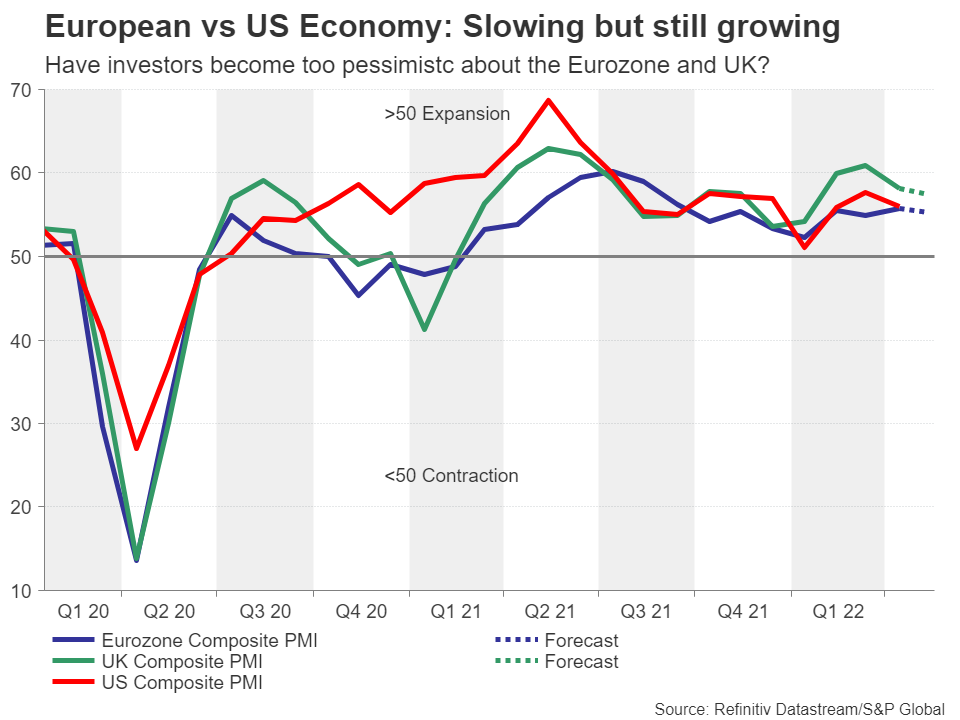
Hence, the euro and pound could enjoy a small boost if Tuesday’s flash PMIs for the Eurozone and UK are a bit better than expected. In Germany, traders will additionally be able to parse the Ifo business climate survey on Monday.
Moreover, reasonably good PMI prints could buoy the broader market mood amid the elevated risk of stagflation that’s weighing heavily on risk assets at the moment.
RBNZ likely to hike by 50 bps again
The Reserve Bank of New Zealand is the only major central bank that holds a policy meeting next week and is poised to tighten for a fifth time in as many months. Analysts are expecting policymakers to stick with the 50-bps increment of the last decision, lifting the cash rate to 2.0% on Wednesday.
Bets for a double hike were solidified after the release of the RBNZ’s latest inflation expectations survey. However, the report was not entirely alarming. Although one-year inflation expectations kept rising, reaching 4.9%, two-year expectations appeared to be steadying just under 3.3%. It’s possible therefore that policymakers might hint at a slower pace of rate increases after the May meeting.
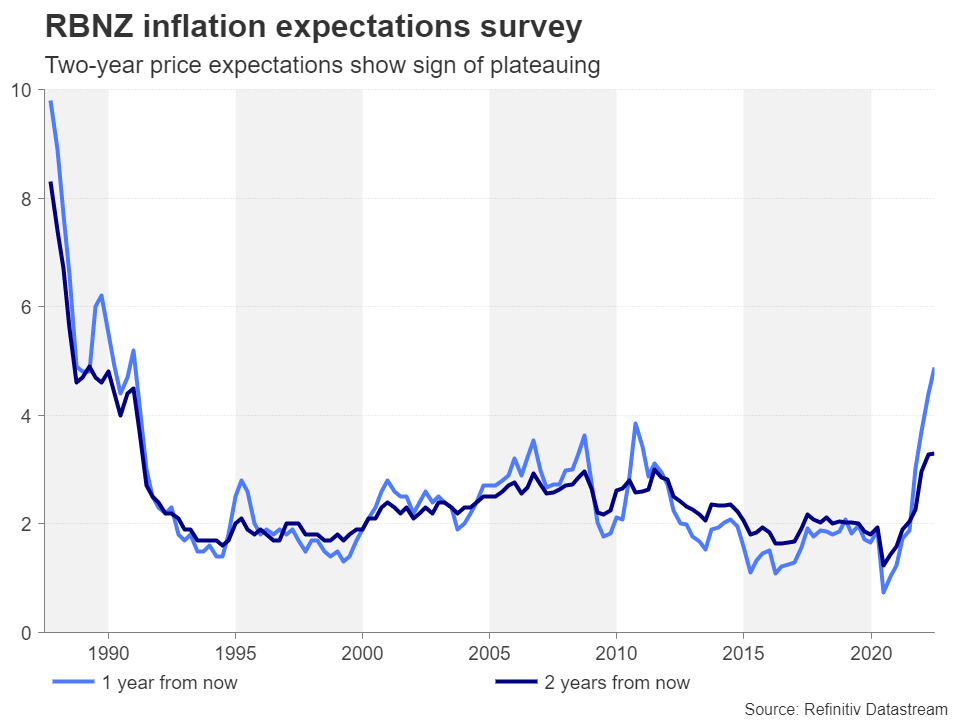
A day earlier, traders will be keeping an eye on the retail sales numbers for the first quarter. The New Zealand dollar is vulnerable to more selling pressure if the data doesn’t impress and the RBNZ slightly tones down its hawkish rhetoric.
Can data provide the aussie with the lift it needs?
In neighbouring Australia, the Reserve Bank there has only just gotten started with its tightening cycle and the size of the rate increase in June is still up for debate. Following the broadly positive jobs report for April, the flash PMIs due on Tuesday could further bolster the case for a rate hike larger than 25 bps in June if they indicate that business activity was little dented in May from rising cost pressures and the lockdowns in China.
On Wednesday and Thursday, the focus will shift to first quarter data on construction output and capital expenditure respectively, and preliminary retail sales numbers for April are out on Friday. Business spending had weakened substantially in the second half of 2021 due to Omicron, so a strong pick up in the first three months of the year would signal that the recovery is now on a much more solid footing.
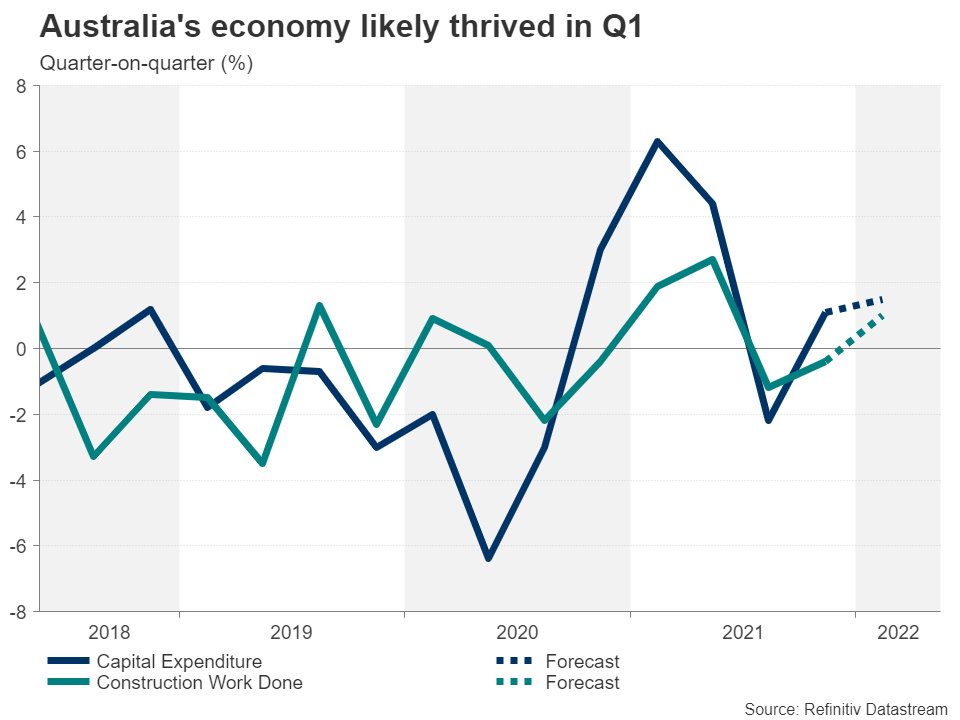
The Australian dollar is struggling to convincingly reclaim the $0.70 handle following a six-week-long slide against the greenback. An upbeat set of figures could provide it with the leg up that it needs. However, at the start of the week, the aussie could be jolted by political risks. Australians go to the polls on May 21 to vote for a new government. If incumbent Prime Minister Scott Morrison’s Liberal-National coalition loses to the opposition Labor Party, the local dollar could slip against its main rivals.
Weekly Focus – Covid-19 Lockdowns Hit the Chinese Economy
Economic releases this week point to widely different growth momentum in the global economy. Chinese activity data for April were much weaker than expected with retail sales dropping 11.1% y/y and industrial production down 2.9% y/y. The weak batch of data points to a negative q/q growth rate in GDP in Q2 and also suggests downside risk to our 4.7% growth estimate for this year. The government's 5.5% target will require a significant amount of stimulus, which China does not look prepared to provide. The credit impulse was slightly weaker in April, pointing to moderate stimulus.
A key driver of the weak Chinese data has been the outbreak of Covid-19 and the lockdowns by the Chinese authorities implemented to maintain their zero-Covid policy. While Shanghai is improving challenges persist in other cities such as Beijing and surrounding areas. The continued outbreaks highlight the difficulty in keeping Omicron contained and warns of more future lockdowns and supply chain disruptions.
On a more positive note, US data released this week showed quite resilient private consumption and industrial production despite geopolitical uncertainty and rising inflation. US retail sales data grew quite strongly in April both in nominal and real terms (taking into account the rise in inflation). At the same time, industrial production was also stronger than expected and capacity utilisation increased further to 79%. This week Fed Chair Jerome Powell said that interest rates will rise until there is "clear and convincing" evidence that inflation is retreating. Global risk appetite remains fragile amid the imminent US monetary policy tightening and weakening Chinese outlook with global equity markets seeing a significant setback this week.
In the euro area, inflation pressures are also broadening as headline and core inflation in April rose 7.4% and 3.5% compared to a year earlier. Especially service price inflation jumped higher in April due to a seasonal rebound in transport and recreational services, but also other services categories continue to rise. Rising input costs are still working their way through the consumer pricing chain. The continued building of underlying inflation pressures leaves little room for complacency from ECB, where we expect a 25bp hike at the July meeting.
This week, Finland and Sweden officially applied for NATO membership amid the Russian invasion of Ukraine. However, the application ran into problems as Turkey voiced opposition to Swedish and Finnish membership given concern about the countries' stance on the Kurds. Meanwhile, Russian president Putin said that were Sweden and Finland to join NATO it would "certainly provoke our response".
There will be plenty of data to absorb for markets over the next two weeks. In the US, a key focus will be the FOMC minutes on 25 May, personal consumption expenditures on 27 May (not so much on the inflation component as we got the CPI already but more the consumption). The jobs report on 3 June will also be very important. In the euro area, the PMIs on 24 May will be key along with the May flash CPI on 31 May, as well as the EU leaders summit on 30-31 May, where an energy embargo will be high on the agenda.
German Inflation Awakens European Hawks by Helping the Euro
Producer inflation continues to accelerate as it reached a 33.5% y/y in April, setting another record for the indicator. Prices added 2.8% last month after jumping 4.9% during March, continuing to gain strength.
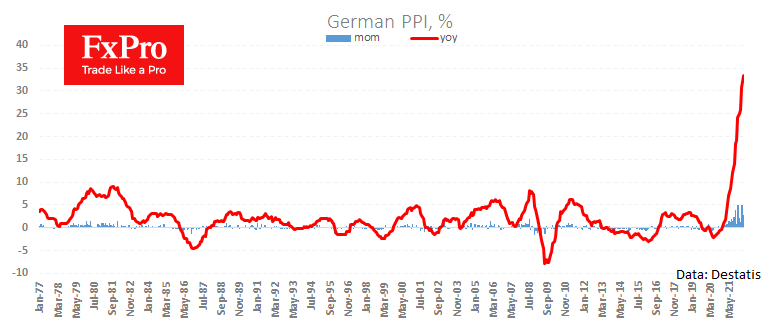
Germany is said to have the most substantial fear of inflation of any European country, which is eating into German savings. However, the Bundesbank cannot act alone in tightening policy but can only form a hawkish coalition by bringing the moment of policy tightening closer.
And we see some movement in that direction. Increasingly the consensus of the ECB officials is tilting towards a rate hike of 25 points in July. Furthermore, policymakers have not ruled out a further rate increase by 50 points.
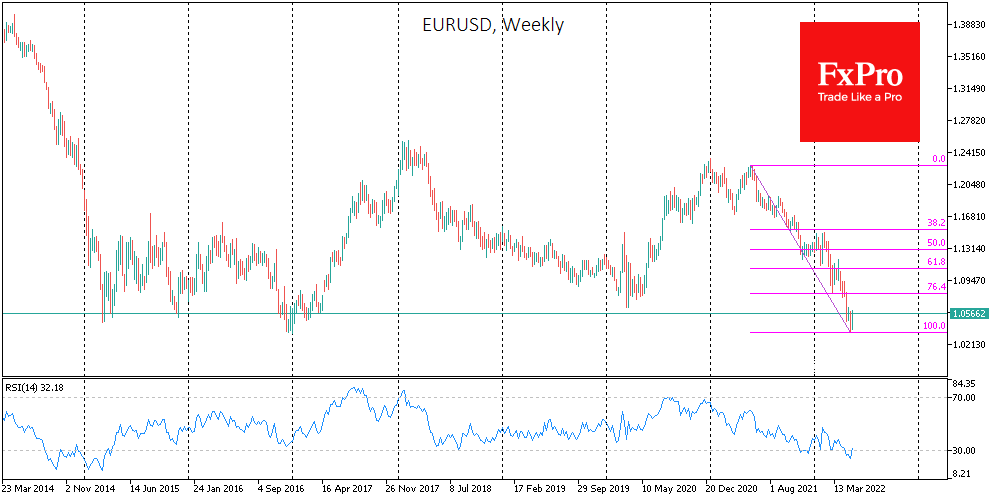
Whilst this ECB stance is softer than that of the Fed and Euro-region inflation is not inferior to that of the USA. There remains a medium-term pressure factor on the Euro against the Dollar. In the short term, however, the Euro is gathering strength after an oversold year of EURUSD declines with brief stoppages.
A rebound in the movement of the last 12 months could correct the EURUSD towards 1.1080, Fibonacci’s 61.8% retracement. However, at 1.08, it might hit the resistance near the previous strong support with the 76.4% retracement level and the 50-day Moving Average.
EUR/USD: Improving Techs Point to Further Short-Squeeze, But Fundamentals Still Rule
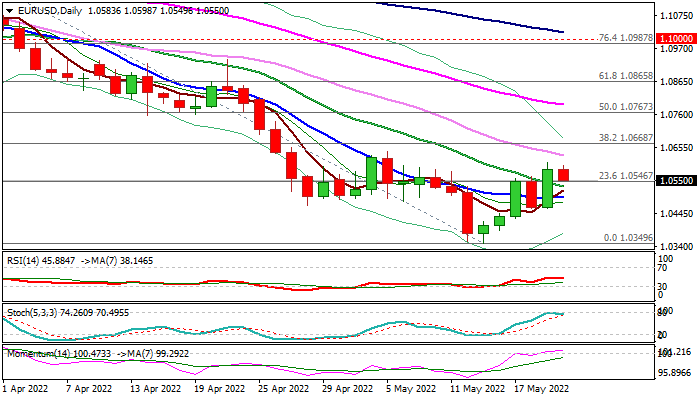
The Euro is standing at the back foot on Friday, following 1.2% advance on Thursday, but dips were so far limited, adding to positive signal from Thursday’s bullish engulfing pattern.
Fresh bullish momentum on daily chart and formation of 5/10DMA bull-cross, underpin the action for potential stronger short squeeze.
Bulls need repeated close above 1.30532/45 (20DMA/Fibo 23.6% of 1.1184/1.0349) to confirm bullish stance and keep in play hopes for stronger correction. Extended recovery will need an extension through 1.0641/43 (May 5 lower top / daily Kijun-sen) and 1.0668 (Fibo 38.2% of 1.1184/1.0349) to generate initial reversal signal.
Positive scenario is supported by formation of bullish engulfing pattern on weekly chart and RSI/stochastic indicators emerging from oversold territory.
Also, formation of long-legged Doji on monthly chart suggests that larger downtrend might be running out of steam.
However, caution is required as geopolitical and economic news remain in play as key risk sentiment drivers and may influence the performance of the pair at any time.
Res: 1.0607; 1.0641; 1.0668; 1.0700.
Sup: 1.0531; 1.0496; 1.0459; 1.0388.
Sunset Market Commentary
Markets
Coming straight from Investopedia: Bear market rally refers to a sharp, short-term rebound in share prices amid a longer-term bear market decline. It has an awful lot of similarities with the surges that we’ve seen over the past couple of days. Sometimes the rally is technically driven, like the one that started end of last week but ended abruptly on Wednesday. On other occasions, such as today, there’s a story that gets investors excited more than it should. The news came from China, where the authorities lowered a key rate by more than expected to boost the economy. While helpful, it’s unlikely this will save the Chinese and by extension global economy from a sharp growth slowdown. We’ll see just how long today’s narrative lasts with PMIs providing a new economic update next week. It does provide some relief on stock markets to the tune of 1.5% in Europe. From a technical perspective, the EuroStoxx50 has about double that amount to run before hitting the downward sloping trendline that has capped upticks ever since the start of the year. US equities inch up to 1.3% higher (Nasdaq). Core bond yields recover here and there but it’s not very convincing. Changes in the US vary from +1.2 bps (2y) to -0.9 bps (30y). The German yield curve steepens by shedding 1.1 bp at the front while adding up to 5.5 bps in the 30y yield. We’ve had another splash of ECB speeches but none of them really influenced markets. Italy’s Visco, Germany’s Nagel and France’s Villeroy all reaffirmed expectations for a July rate lift-off. At Davos next week, themed History at a Turning Point: Government Policies and Business Strategies, we look for president Lagarde to rubberstamp such a scenario. Whether that will suffice for the euro, remains to be seen. The common currency today at least didn’t profit, neither from the ECB comments nor from buoyant sentiment. EUR/USD traded a narrow sideways range of half a big figure. It is currently changing hands a little lower than opening levels (1.056). The dollar is showing little direction either. Trade-weighted DXY is struggling to keep the 102.98 support level (March 2020 high) while USD/JPY is trading unchanged at 127.84. The Japanese yen fails to profit from CPI after 8 years (longer even when discarding effects from a tax increase in 2014/2015) hitting the BoJ’s 2% target. Markets are fully aware that temporary base effects are at play and that the current cost-push inflation (as the central bank describes it) won’t trigger a change in the policy stance. The two-day rally by the Swiss franc is taking a breather. EUR/CHF stabilizes sub 1.03. UK data this morning was a mixed bag: UK consumer confidence tanked to a new historic low, narrowly surpassing the previous one dating back to the GFC. Retail sales on the other hand were surprisingly strong, coming in at 1.4% m/m (both headline and core) and defying expectations for another decline. Sterling strengthens, helped by risk sentiment. EUR/GBP eases from 0.849 to 0.845 currently.
News Headlines
Belgian consumer confidence slightly picked up for a second month straight (-13 from -14), but is nowhere near recovering from the steep drop in March when the index plummeted from 1 to -16. Belgian households were once again slightly more optimistic about the outlook for the general economic situation (-35 from -38). Concerns over a rise in unemployment during the next twelve months also lessened (10 from 15). Households’ expectations regarding their personal financial situation remain decidedly subdued (-9 from -10) despite a very slight improvement this month. Besides, they expect to save less in the months ahead (4 from 8). Belgian business confidence will be published next week on Monday.
Finnish gas importer Gasum Oy said that natural gas imports from Russia will be halted tomorrow as the country refuses to pay for the fuel in roubles. It’s the third European country facing this problem following Poland and Bulgaria. Finland’s move to join defense alliance NATO is probably the untold reason for the move. The lost supplies will probably have a minimal impact on the Finnish economy as it makes up for around 5% of the nation’s energy mix.