Sample Category Title
USD/JPY Mid-Day Outlook
Daily Pivots: (S1) 126.92; (P) 127.94; (R1) 128.84; More...
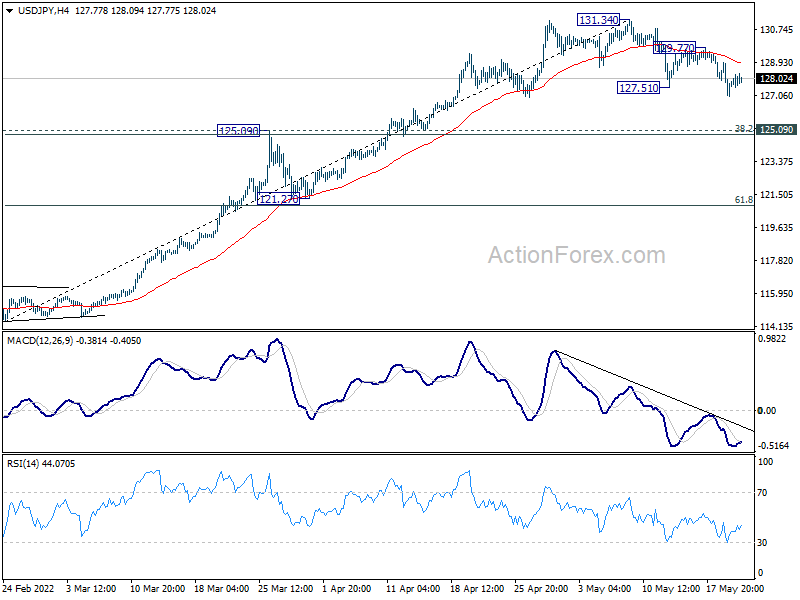
USD/JPY's correction from 131.34 is still in progress and would extend lower to 125.09 cluster support (38.2% retracement of 114.40 to 131.34 at 124.86). Strong support is expected from there to contain downside to bring rebound. On the upside, break of 129.77 minor resistance will suggest that the correction is finished and bring retest of 131.34.
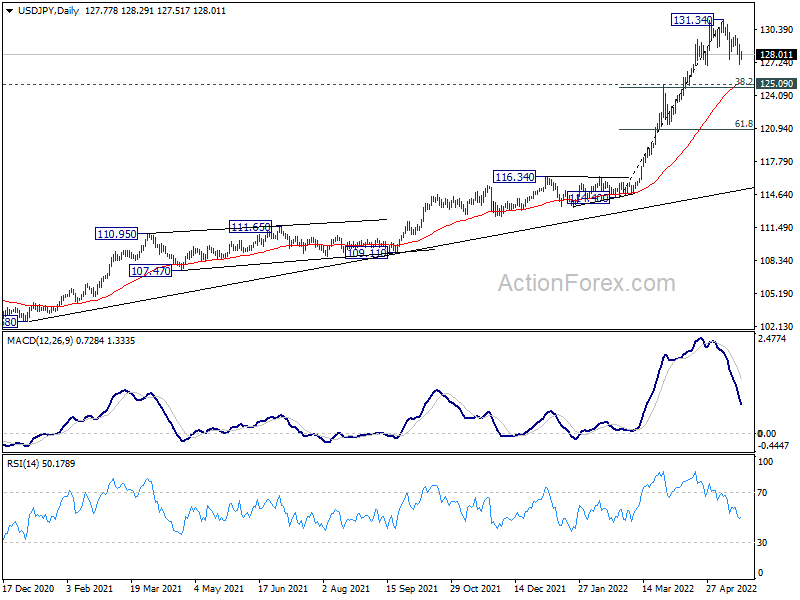
In the bigger picture, current rally is seen as part of the long term up trend form 75.56 (2011 low). Sustained trading above 61.8% projection of 75.56 (2011 low) to 125.85 (2015 high) from 98.97 at 130.04 will pave the way to 100% projection at 149.26, which is close to 147.68 (1998 high). For now, this will remain the favored case as long as 121.27 support holds.
USD/CHF Mid-Day Outlook
Daily Pivots: (S1) 0.9650; (P) 0.9775; (R1) 0.9853; More...
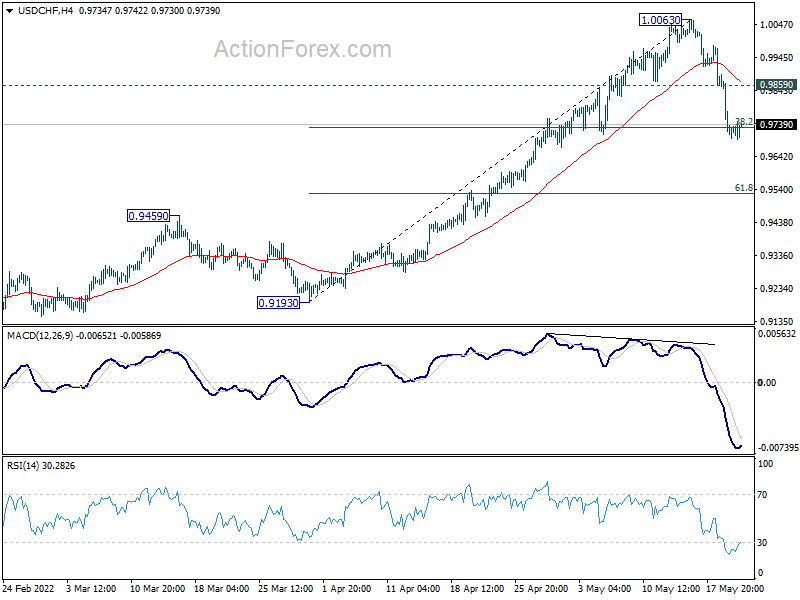
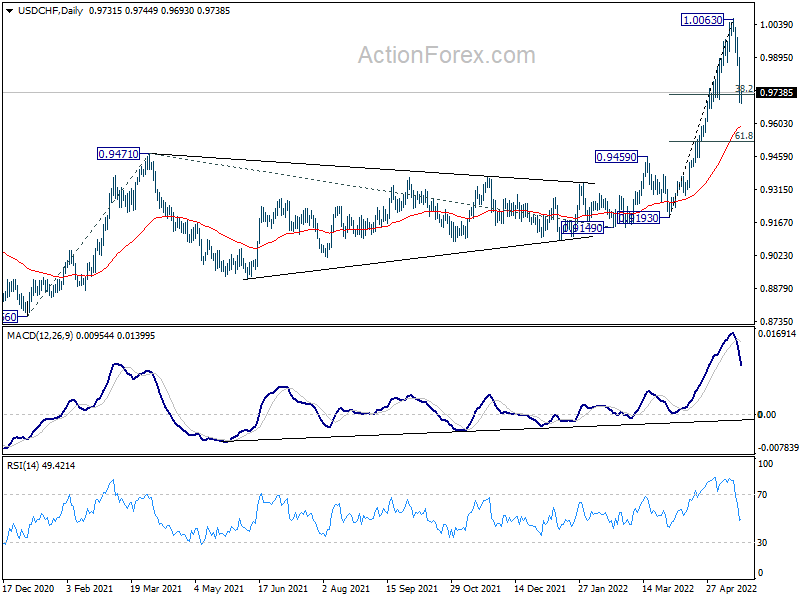
Intraday bias in USD/CHF remains on the downside for the moment, as correction from 1.0063 is extending. Sustained break of 38.2% retracement of 0.9193 to 1.0063 at 0.9731 will target 55 day EMA (now at 0.9589). But downside should be contained by 61.8% retracement at 0.9525 to bring rebound. On the upside, above 0.9859 minor resistance will turn intraday bias neutral first.
In the bigger picture, down trend from 1.0342 (2016 high) should have completed with three waves down to 0.8756 (2021 low) already. Rise from 0.8756 is likely a medium term up trend of its own. Next target is 161.8% projection of 0.8756 to 0.9471 from 0.9149 at 1.0306, which is close to 1.0342 (2016 high). This will remain the favored case as long as 0.9459 resistance turned support holds.
GBP/USD Mid-Day Outlook
Daily Pivots: (S1) 1.2364; (P) 1.2445; (R1) 1.2551; More..
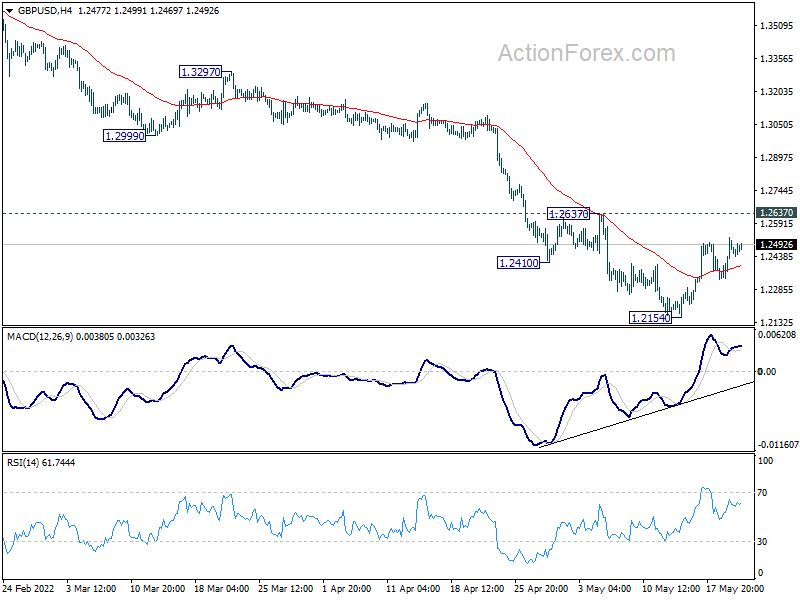
Intraday bias in GBP/USD remains neutral for the moment. Further decline will remain in favor as long as 1.2637 resistance holds. On the downside, break of 1.2154 will resume the down trend from 1.4248. However, considering bullish convergence condition in 4 hour MACD, break of 1.2637 will confirm short term bottoming at 1.2154. Intraday bias will be turned back to the upside for 55 day EMA (now at 1.2789).
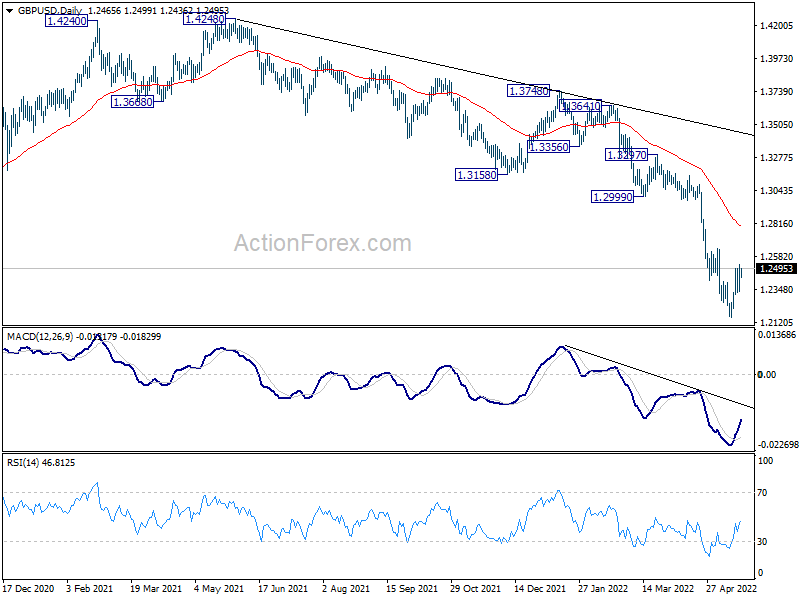
In the bigger picture, based on current momentum, fall from 1.4248 (2018 high) at least at the same degree as the rise from 1.1409 (2020 low). That is, fall from 1.4248 could be a leg inside the pattern from 1.1409, or resuming the longer term down trend. In either case, deeper decline is expected as long as 1.2999 support turned resistance holds. Next target is 1.1409 low.
EUR/USD Mid-Day Outlook
Daily Pivots: (S1) 1.0496; (P) 1.0551 (R1) 1.0642; More...
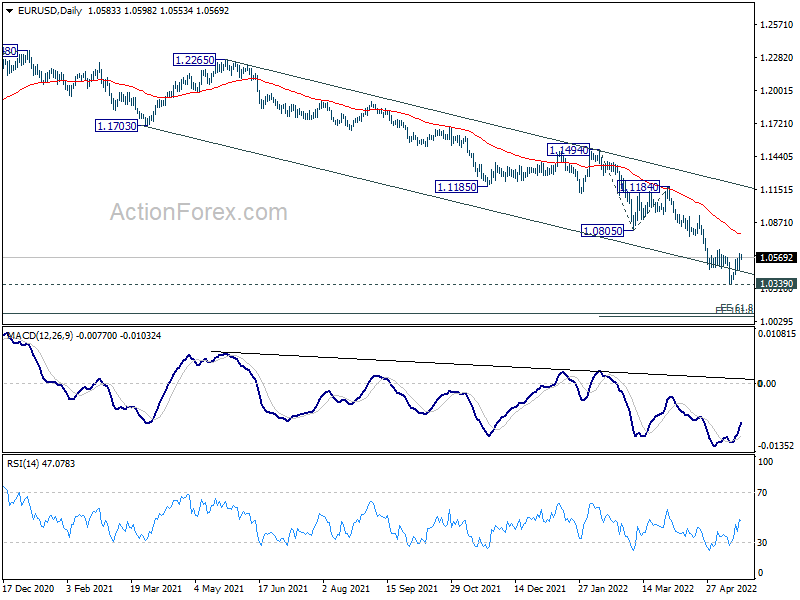
Intraday bias in EUR/USD remains neutral for the moment. Considering bullish convergence condition in 4 hour MACD, break of 1.0641 resistance will confirm short term bottoming at 1.0348, ahead of 1.0339 long term support. Intraday bias will be turned back to the upside for 55 day EMA (now at 1.0774). On the downside, however, decisive break of 1.0339 will carry larger bearish implication and target 161.8% projection of 1.1494 to 1.0805 from 1.1184 at 1.0069.
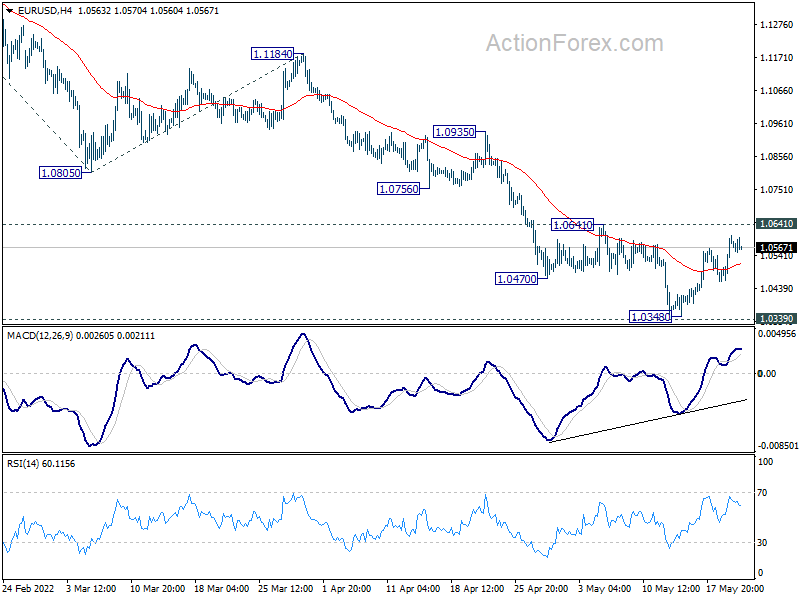
In the bigger picture, break of medium term channel support suggests downside acceleration. Current decline from 1.2348 (2021 high) is probably resuming long term down trend from 1.6039 (2008 high). Decisive break of 1.0339 will confirm this bearish case. Next target is 61.8% projection of 1.3993 to 1.0339 from 1.2348 at 1.0090. This will now remain the favored case as long as 1.0805 support turned resistance holds.
Sentiments Lifted But Forex Tread Water
The forex markets are treading water today. Sentiments were lifted by China's rate cut. UK retail sales came in stronger than expected. ECB officials continued to talk up the prospect of a July hike. But none of these triggered any meaningful moves in the markets. For the week, Swiss Franc is still the best performer, followed by Sterling and Kiwi. Dollar is the worst performing, finally ending the winning streak. Canadian and Yen are the next weakest.
Technically, focuses will stay on whether EUR/USD could break through 1.0641 resistance to confirm successfully defending 2017 low. But Euro itself is not looking too well in crosses, in particular in EUR/CHF. At the same time, EUR/GBP and EUR/AUD could extend the decline that started from last week's high, after completing current consolidations. Such development could drag down EUR/USD. Anyway, Euro would probably wait until next week to unveil the next move.
In Europe, at the time of writing, FTSE is up 1.59%. DAX is up 1.66%. CAC is up 1.16%. Germany 10-year yield is down -0.0071 at 0.945. Earlier in Asia, Nikkei rose 1.27%. Hong Kong HSI rose 2.96%. China Shanghai SSE rose 1.60%. Singapore Strait Times rose 1.56%. Japan 10-year JGB yield dropped -0.0025 to 0.240.
ECB Visco: We will move rates perhaps in July
ECB Governing Council member Ignazio Visco said in a BloombergTV interview, "we can move gradually, raising interest rates in the coming months." June is too early as the central bank will be ending net asset purchase. But, "we will move after that -- after that, means perhaps July."
"Now I think that we can move out of this negative territory," Visco said, referring to the deposit rate, which has been negative since 2014. "Gradual means in my view that we have to understand that we should move without creating uncertainty in the market."
Separately, Governing Council member Madis Muller said the focus needs to be on fighting high inflation. Martins Kazaks said he hoped the first hike will "take place in July".
Released from Germany, PPI came in at 2.8% mom, 33.5% yoy in April, above expectation of 1.4% mom, 31.4% yoy.
BoE Pill: Further work needs to be done to counter inflation
BoE Chief Economist Huw Pill said in a speech,the balance of risk around inflation is "tilted towards inflation proving stronger and more persistent than anticipated in that baseline.". Underlying developments that point in this direction include reduced contestability of UK labour markets by EU immigrants and workers due to Brexit. Broader globalization process looks to have stalled and maybe in retreat. Impact of aging and longer-term health consequences of the pandemic may have led to a decline in UK labour force participation.
Pill added that in this context, "avoiding any drift towards the embedding of such 'inflationary psychology' into the price setting process is crucial". Thus, the time has now come to withdraw monetary policy accommodation.
"It is the need for a continuation of this transition in monetary policy that led me to support the 25bp hike in Bank Rate at the May MPC meeting," he said. "And, even after this hike, I still view that necessary transition as incomplete. Further work needs to be done."
UK retail sales rose 1.4% mom in Apr, ex-fuel sales up 1.4% mom
UK retail sales rose 1.4% mom in April, well above expectation of -0.2% mom decline. That's also more than enough to recover the -1.2% mom decline in March. Ex-fuel sales also rose 1.4% mom, versus expectation of -0.2% mom, reversing the -0.9% mom decline in March.
However, for the most recent 3 months on previous 3 months, headline sales dropped -0.3% while ex-fuel sales dropped -0.5%.
New Zealand export rose 17% yoy in Apr, imports rose 15% yoy
New Zealand goods exports rose 17% yoy to NZD 6.3B in April. Imports rose 15% yoy to NZD 5.7%B. Monthly trade surplus came in at NZD 584m, versus expectation of NZD -350m deficit.
Exports rose for all top destinations except China, which was down -1.8%. Exports to Australia was up 4.9%, US up 26%, EU up 26%, Japan up 58%.
Import from all top partners rose, including China (up 8.9%), EU (up 18%), Australia (up 44%), US (up 29%), Japan (up 0.5%).
Japan CPI core rose to 2.5% yoy in Apr, CPI core-core rose to 0.8% yoy
Japan headline CPI (all items) rose from 1.2% yoy to 2.5% yoy in April. CPI core (ex-fresh food) rose from 0.8% yoy to 2.1% yoy. CPI core-core (ex-fresh food, energy) rose from -0.7% yoy to 0.8% yoy.
The 2.1% CPI core reading was slightly above expectation of 2.0% yoy. It topped BoJ's 2% target for the firs time since March 2015. Also, it should be noted that CPI core-core was positive for the first time since July 2020.
EUR/USD Mid-Day Outlook
Daily Pivots: (S1) 1.0496; (P) 1.0551 (R1) 1.0642; More...
Intraday bias in EUR/USD remains neutral for the moment. Considering bullish convergence condition in 4 hour MACD, break of 1.0641 resistance will confirm short term bottoming at 1.0348, ahead of 1.0339 long term support. Intraday bias will be turned back to the upside for 55 day EMA (now at 1.0774). On the downside, however, decisive break of 1.0339 will carry larger bearish implication and target 161.8% projection of 1.1494 to 1.0805 from 1.1184 at 1.0069.
In the bigger picture, break of medium term channel support suggests downside acceleration. Current decline from 1.2348 (2021 high) is probably resuming long term down trend from 1.6039 (2008 high). Decisive break of 1.0339 will confirm this bearish case. Next target is 61.8% projection of 1.3993 to 1.0339 from 1.2348 at 1.0090. This will now remain the favored case as long as 1.0805 support turned resistance holds.
Economic Indicators Update
| GMT | Ccy | Events | Actual | Forecast | Previous | Revised |
|---|---|---|---|---|---|---|
| 22:45 | NZD | Trade Balance (NZD) Apr | 584M | -350M | -392M | |
| 23:01 | GBP | GfK Consumer Confidence May | -40 | -39 | -38 | |
| 23:30 | JPY | National CPI Core Y/Y Apr | 2.10% | 2.00% | 0.80% | |
| 06:00 | GBP | Retail Sales M/M Apr | 1.40% | -0.20% | -1.40% | -1.20% |
| 06:00 | GBP | Retail Sales Y/Y Apr | -4.90% | -7.20% | 0.90% | 1.30% |
| 06:00 | GBP | Retail Sales ex-Fuel M/M Apr | 1.40% | -0.20% | -1.10% | -0.90% |
| 06:00 | GBP | Retail Sales ex-Fuel Y/Y Apr | -6.10% | -8.40% | -0.60% | -0.20% |
| 06:00 | EUR | Germany PPI M/M Apr | 2.80% | 1.40% | 4.90% | |
| 06:00 | EUR | Germany PPI Y/Y Apr | 33.50% | 31.40% | 30.90% | |
| 14:00 | EUR | Eurozone Consumer Confidence May P | -21 | -22 |
Recovering into the Weekend
Equity markets are back in positive territory on Friday but I'm struggling to get too excited by the moves we see going into the weekend.
The rebound may partly reflect the scale of the declines we've seen in the previous couple of sessions, while the cut to the five-year loan prime rate in China may also be giving global markets a bit of a lift. But ultimately, very little has changed and I expect that will continue to hold these markets back.
The rate cut announced by the PBOC is obviously good news and is clearly targeted a revitalizing the ailing property market which continues to suffer due to the crackdown last year and Covid lockdowns this. Along with other measures already announced, this could help to revive a hugely important part of the economy.
Whether it's enough to help China hit its 5.5% growth target this year is another thing. I imagine we may see further stimulus efforts this year in order to try and get close to that as the country is facing numerous headwinds, as every other is around the world right now. What it has that others lack though is room to manoeuvre on both the fiscal and monetary front.
UK retail sales are not a true reflection of what's to come
The UK is in a very tricky position, regardless of the impression the April retail sales data gave this morning. While spending last month hugely exceeded expectations and was accompanied by a small upward revision in March, we also saw consumer confidence fall to its lowest since records began in 1974. While survey data can be volatile, I expect this is a closer reflection of the squeezed consumer in the UK right now.
The cost-of-living crisis is going to have a big impact on household budgets and will intensify again in October when the energy price cap is lifted once more. Unless the government offers more support, the country is heading for double-digit inflation and a recession. Not exactly consistent with sustainable gains in retail sales.
Oil flat but risks remain to the upside
It's been another volatile week of trade in oil but Brent and WTI are set to end it roughly where they started. They're seeing small gains on the day but price action remains very choppy. There are just so many forces at play at the minute and the increased economic gloom this week and Chinese reopening progress has only added to that.
The risks remain tilted to the upside though given the Chinese reopening and continued efforts towards a Russian oil embargo by the EU. And the data this week from OPEC+ was once again disappointing, to say the least. Unless the economy substantially falters immediately, there isn't much of a bearish case for crude currently. Not in any significant way, anyway.
Gold buoyed by recession fears
The second half of the week has been kind to gold as the trepidation in financial markets has shifted slightly from the pace of monetary tightening to recession risks. So rather than higher yields and a stronger dollar weighing on the yellow metal, we've seen investors pouring into safe havens which have lowered yields slightly and lifted gold.
Whether that will be sustained in this hiking environment will be interesting and ultimately depend on just how real and significant the economic fears are. At the end of the day, rate hikes should lower demand but so should a recession. If the latter continues to be viewed as a likely outcome of the former, gold could see its fortunes improve further.
Can bitcoin hold above $30,000?
Bitcoin has been treading water for a number of days now around $30,000 which has been interesting given the volatility in other risk assets. That it is being driven by economic rather than interest rate fears may explain it. Less focus on stablecoins may also be helping to contain the bleeding. But while some may be encouraged, it's not seeing any momentum above $30,000 at the minute and the longer that goes on, the more prone it looks to another plunge.
Has the Dollar Index Reversed to a Decline?
The dollar in the foreign exchange market is correcting some of the gains of the past three months. The dollar index has retreated below 103 after touching 105 a week ago. The retreat of the US currency goes against a wide range of peers and several asset classes. 10-year Treasury yields, which peaked near 3.2% last week, are still declining.
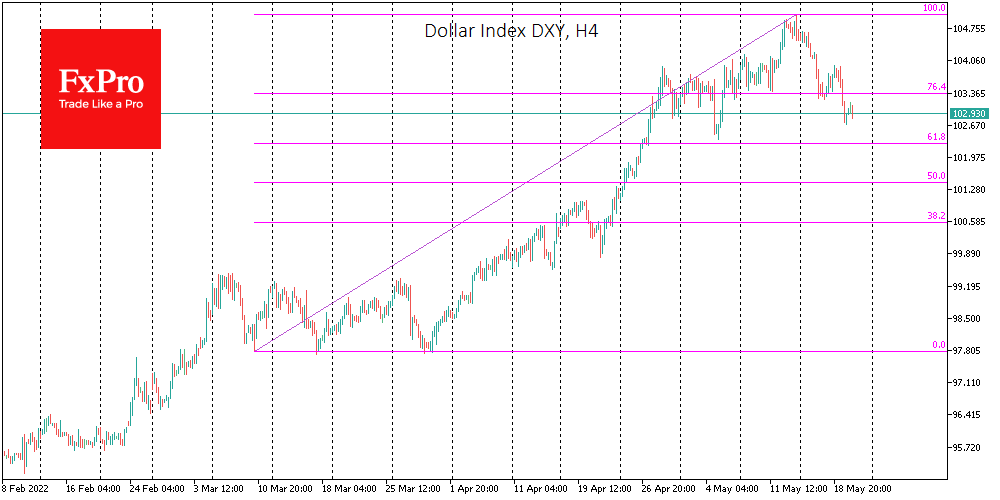
Such dynamics reflect investors’ hesitation regarding the prospects for the US economy, around which recession risks are mounting. The decline in long-term bond yields indicates investors’ doubts that the Fed will be able to raise and keep rates high for a long time, and it reduces the attractiveness of investing in the dollar.
But it is also worth noting the work of other central banks, which are closing the gap between their policy and Fed sentiment by tightening their rhetoric almost daily.
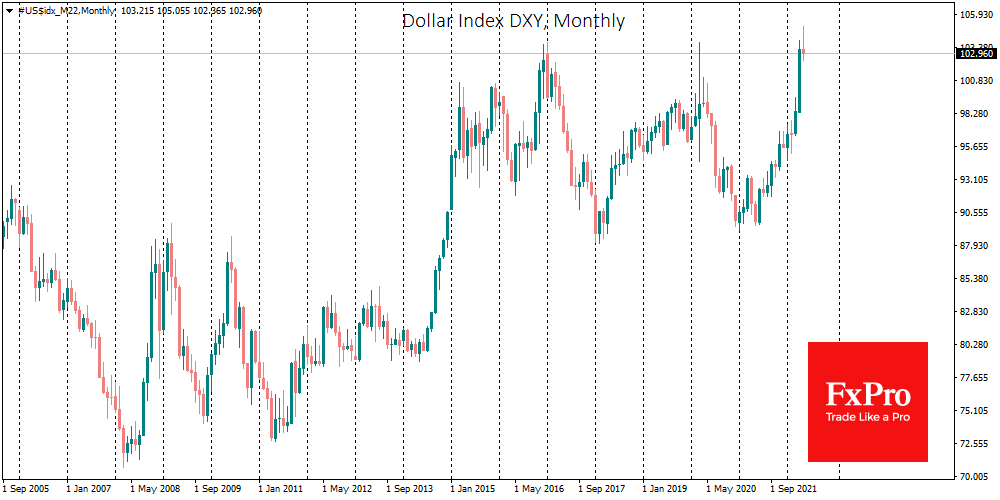
However, the dollar’s weakness is contained within the framework of a correction after a tumultuous rally. Talking about a break of the short-term uptrend is only appropriate if the Dollar Index falls below 102.30, where the lows of May and the 61.8% area of the last rising momentum from the start of April are concentrated.
A break of the latest uptrend is evidence that a false break-up of the long-term resistance at 103.0, earlier this month, was achieved.
However, it has to be noted that the observed weakening of the dollar might be no more than a temporary respite for several reasons.
The pullback in yields of the Treasuries could be a technical correction after a rally like we have seen many times since the middle of last year.
So far, US monetary tightening is moving and set to move to proceed at a higher pace than the major competitors. Other DM central banks are shy to make 50 points step up and are even further away from raising the key rate by 350 points in the year to March expected from the Fed.
Concerns about the economy may be exaggerated as demand remains pretty robust and the labour market is burning, promising growth in income (respectively) and household spending.
Suppose a new round of growth follows a temporary pullback in the US currency. As we previously expected, this momentum could remain in place until 120, returning the dollar’s strength to that of the start of the millennium.
EUR/USD Pair Moved into a Positive Zone from $1.0420
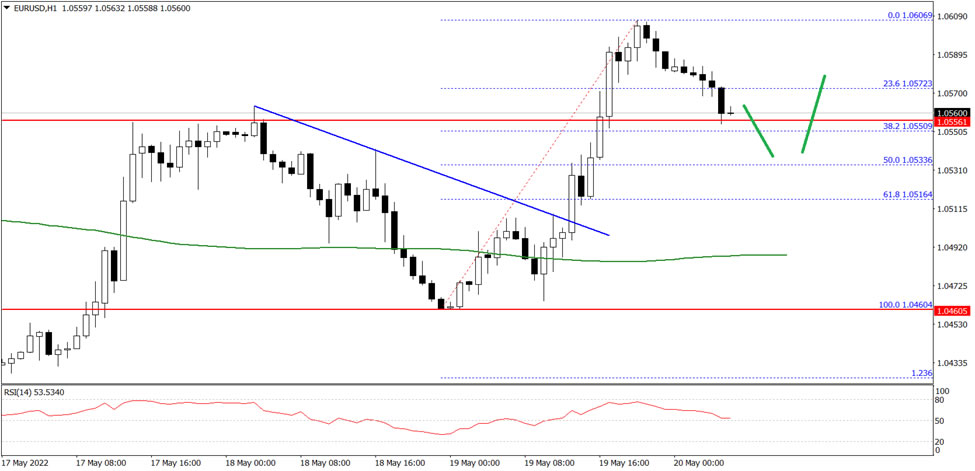
The Euro started a fresh increase from the 1.0420 support zone against the US Dollar. The EUR/USD pair surpassed the 1.0500 level to move into a positive zone.
The price even traded above the 1.0550 level and the 50 hourly simple moving average. It traded as high as 1.0606 and is currently correcting gains. An immediate support is near the 1.0550 level.
The next key support is near 1.0535, below the pair could decline towards the 1.0500 level in the near term. Any more losses might send the pair towards the 1.0450 level.
On the upside, the pair might struggle near 1.0600 on FXOpen. The next major resistance is near the 1.0640 level. A break above the 1.0640 and 1.0650 resistance levels could start a decent increase. In the stated case, the pair could rise towards the 1.0750 level in the near term.
ECB Visco: We will move rates perhaps in July
ECB Governing Council member Ignazio Visco said in a BloombergTV interview, "we can move gradually, raising interest rates in the coming months." June is too early as the central bank will be ending net asset purchase. But, "we will move after that -- after that, means perhaps July."
"Now I think that we can move out of this negative territory," Visco said, referring to the deposit rate, which has been negative since 2014. "Gradual means in my view that we have to understand that we should move without creating uncertainty in the market."
Separately, Governing Council member Madis Muller said the focus needs to be on fighting high inflation. Martins Kazaks said he hoped the first hike will "take place in July".
Pound Yawns on Mixed Retail Sales
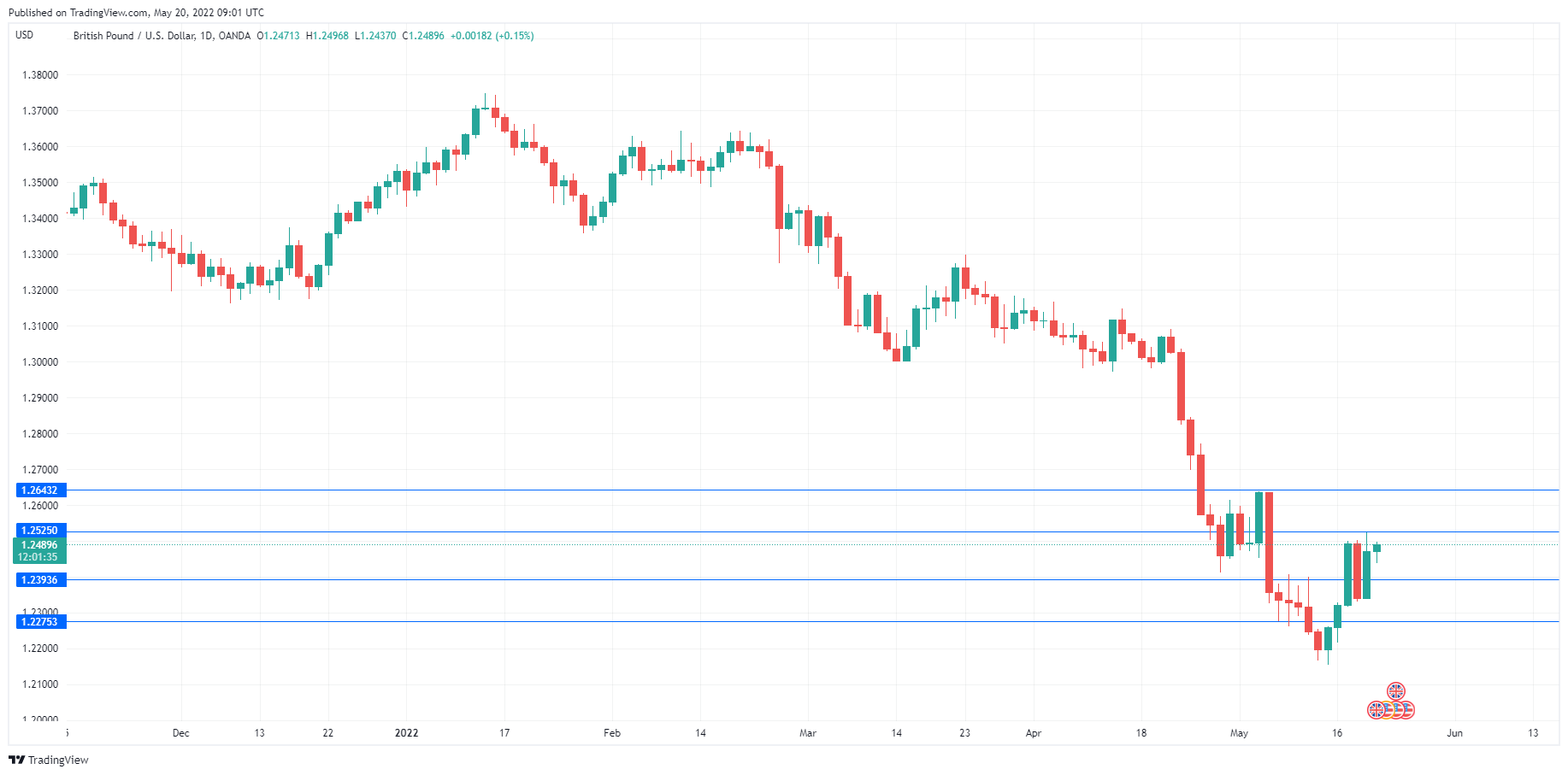
The British pound is drifting on Friday, after showing unusually strong volatility this week. The pound rebounded on Thursday, racking up gains of 1.06% and briefly breaking above the symbolic 1.25 line.
UK retail sales showed a strong gain in April, with a gain of 1.4% MoM. This followed a decline of 1.2% in March. However, on a yearly basis, sales volumes were 4.9% lower, as the broader picture looks grim. The monthly gain for March may have been a blip, as consumers were hit with higher household energy costs as well as an increase in taxes. Add into the mix inflation at 9.0% and possibly heading into double-digits, and it’s difficult to envision retail sales moving higher.
Consumer confidence hits record low
The GfK consumer confidence index remains deep in negative territory. The index dropped to -40 in May, down from -38 in April. How pessimistic are consumers about the economy? The previous record of -39 was set in July 2008, at the height of the global financial crisis. Consumer confidence is considered an early, reliable signal of economic activity, and these massively poor numbers could well indicate that the UK economy is falling into recession. A GfK note summed up the grim situation, saying that the BoE is pessimistic about inflation, consumer confidence is gloomy, and there aren’t any reasons for optimism anytime soon. This certainly does not bode well for the British pound, which has plunged over 7% since the start of the year.
The BoE finds itself playing catch-up with the inflation curve. There have been voices calling for more aggressive rate hikes than the 25-bps increments we’ve seen over the past three meetings, especially with inflation hitting 9%. The central bank has a daunting challenge, as it must raise rates to curb inflation but also needs to be mindful that the economy is still recovering from Covid and could tip into a recession due to high interest rates.
GBP/USD Technical
- 1.2393 has switched back to support. Below, there is support at 1.2275
- There is resistance at 1.2525 and 1.2643