

Sample Category Title
WTI Oil Outlook: Bulls Take a Breather ahead of OPEC+ Meeting, Crude Inventories
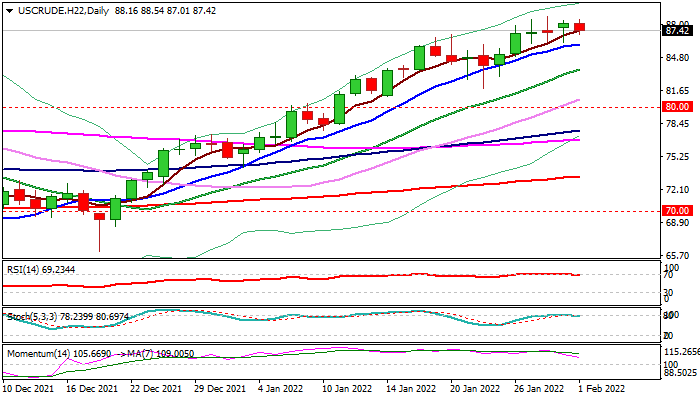
WTI oil is consolidating under new seven-year high ($88.81), posted after six consecutive weeks of gains, as overbought daily studies and expectations of a rise in US crude inventories prompted some profit-taking.
Overall picture remains firmly bullish, supported by solid demand growth and prospects of a limited production increase by OPEC+ group, geopolitical tensions and cold winter.
Rising 10DMA tracks the advance since Dec 22 offers solid support at $86.05, which should ideally keep the downside protected, however deeper pullback cannot be ruled out, as weekly stochastic is strongly overbought.
Extended dips would face 20DMA ($83.67) and should not exceed Jan 24 higher low at $81.89 to keep bulls intact for fresh push higher and probe above $90 level.
Caution on loss of $81.89 handle that may weaken near-term structure, while break below $80 support would sideline bulls and signal deeper correction.
US crude inventories (API late Tuesday and EIA on Wednesday) are eyed for stronger direction signals.
Res: 88.50; 88.81; 90.00; 90.81.
Sup: 86.05; 84.98; 83.68; 81.89.
EURJPY Rebounds ahead of 128 Handle, Neutral Tone Prevails
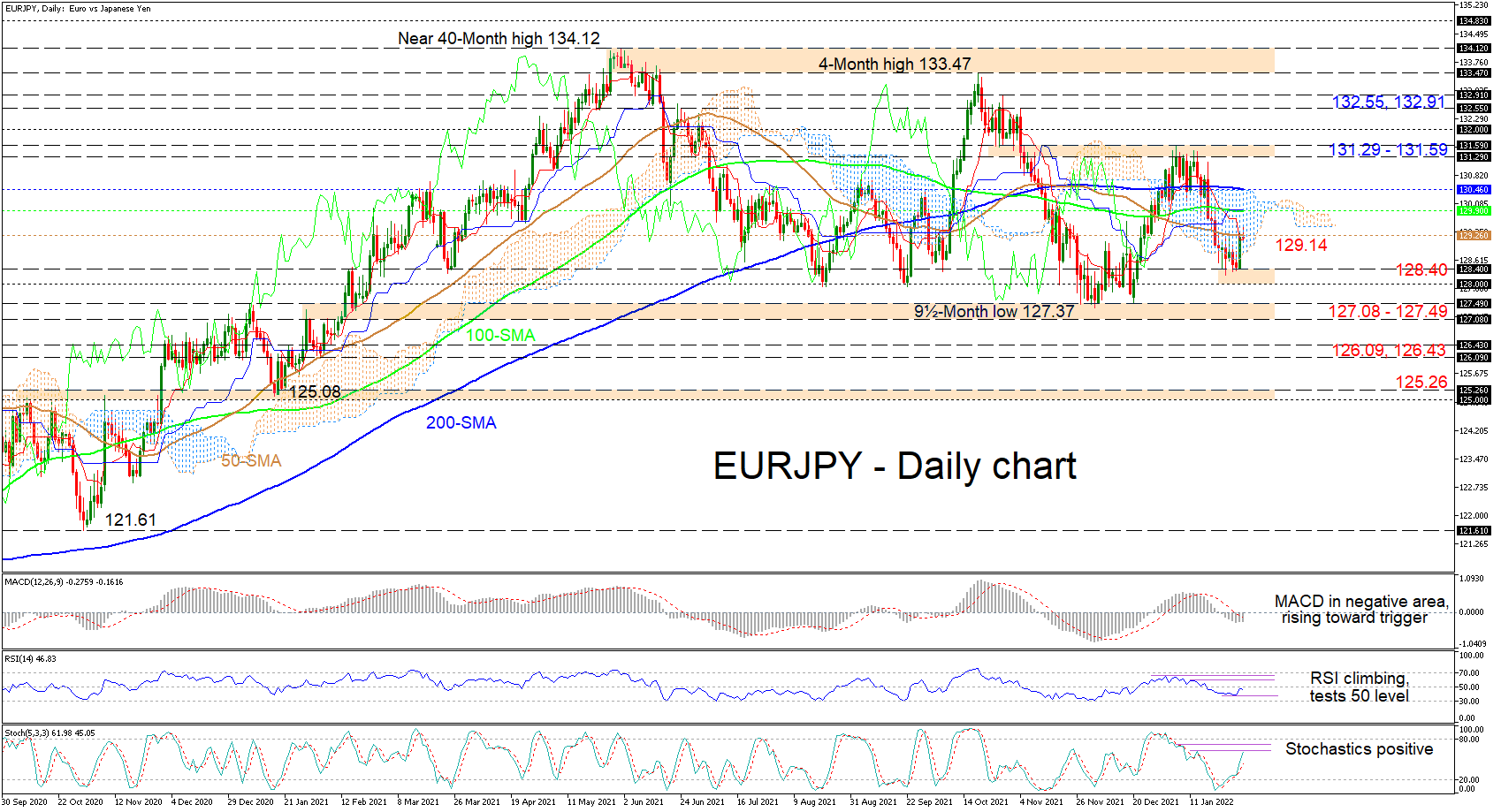
EURJPY buyers have managed to recoup the last week of losses through yesterday’s trading session and are now struggling to beat the 50-day simple moving average (SMA) at 129.26. The positive price action has underpinned the sideways bearing in the pair that has extended for around half a year, an outlook that the SMAs are endorsing too.
Currently, the Ichimoku lines are not indicating a convincing direction in the pair, while the short-term oscillators are reflecting conflicting energy in directional momentum. The MACD, some distance below zero, is rebounding higher towards the red trigger line, while the RSI is failing to overstep the 50 threshold. The positively charged stochastic oscillator continues to sponsor gains in the pair.
If buyers nudge past the 50-day SMA at 129.26, additional advances in the pair could face tough resistance between the 100- and 200-day SMAs at 129.90 and 130.46 respectively. A successful climb above the Ichimoku cloud’s upper band - overlapped by the 200-day SMA - may boost upside momentum to challenge the 131.29-131.59 resistance border. Should the bulls conquer this barrier too, they could then eye the 132.00 hurdle before their focus turns to the 132.55 and 132.91 subsequent highs.
Otherwise, if positive pressures continue to abate at the 50-day SMA, the initial 128.00-128.40 area could try to prevent a drop in the pair from accelerating. However, should negative pressures overwhelm this zone, the 127.08-127.49 support foundation may then contest the intensity of selling in the pair. Furthermore, if this one-year base fails to dismiss a decline from snowballing, the price could snag around the 126.43 and 126.09 lows before confronting the 125.00-125.26 support border that extends back to October 2020.
Summarizing, EURJPY is rangebound between the 127.08-127.49 floor and the 133.47-134.12 ceiling. That said, a dip beneath 128.00 could feed negative pressures, while a hike beyond the 131.59 high would be necessary to boost optimism in the pair.
Euro Gets Some Relief, Stocks Rip Higher
- Euro bounces back as markets price in more ECB tightening
- Stock markets power higher, has the storm passed?
- Aussie unscathed by RBA, earnings season continues
Euro recovers
Market participants are raising their bets that the European Central Bank will hike interest rates this year. A quarter-point rate increase has been fully baked into money markets after data showed that German inflationary pressures are not cooling, despite recent covid restrictions and fading effects from an increase in sales taxes last year.
A similar message was echoed in the latest Eurozone PMI business surveys, which signaled that inflation remains scorching hot as rising wages and energy costs eclipsed the improvement in supply chains. The spike in wages is particularly important as it suggests ‘organic’ inflationary pressures are finally building up, although the ECB will want to see some hard data before it is convinced a paradigm shift is underway.
All this elevates the importance of the ECB meeting on Thursday. President Lagarde will have to walk a tightrope, highlighting signs that inflation might not be so transitory while also warning that it’s premature to discuss rate increases. The euro staged a powerful rebound yesterday but with market pricing around the ECB already so generous, it will be difficult to extend those gains.
Equities snap back
Wall Street staged a tremendous comeback at the end of a chaotic month, with the tech-heavy Nasdaq ripping higher by 3.4% as traders bought back their favorite shares at a discount. There was no obvious catalyst behind this turnaround, although some remarks by Fed officials downplaying a ‘double’ rate hike in March may have helped.
Now the question is whether the storm has really passed or whether this is just a reprieve before the next stomping. Admittedly, it’s difficult to be overly pessimistic at this stage. While trading conditions could remain volatile thanks to fading monetary and fiscal stimulus, the excesses have been washed out of the most frothy parts of the market while corporate and economic fundamentals remain in good shape.
The Fed also seems ‘fairly priced’ here with 5 rate increases baked in for the year, and if anything, some of those bets could be unwound in the coming months if investors sense that inflation has peaked. Everything depends on someone’s investment horizon here - there is no telling what the market will do in the next few months but all this volatility could ultimately be a gift for long term investors.
RBA disappoints, earnings barrage eyed
In Australia, the Reserve Bank ended its asset purchase programme earlier today, albeit with a warning that this move does not imply rate increases are imminent. Policymakers highlighted the modest wage growth in the economy and stressed they will be “patient” until that changes.
The aussie initially took a hit but quickly recouped its losses to trade higher. Markets are still pricing in 5 rate increases by the RBA this year, essentially betting the central bank will be forced to change tune soon. While that may happen, it would take an economic miracle for the RBA to deliver all 5 hikes, which leaves plenty of room for disappointment in the aussie.
As for today, job openings data and the ISM manufacturing survey from the US will top the economic calendar. Finally, there is a storm of earnings releases coming up from big players such as Google, ExxonMobil, Paypal, AMD, and Starbucks.
The general theme throughout this earnings season has been that this is an unforgiving market. Companies that beat analyst estimates find it difficult to stage impressive rallies, while those that disappoint suffer heavy punishment.
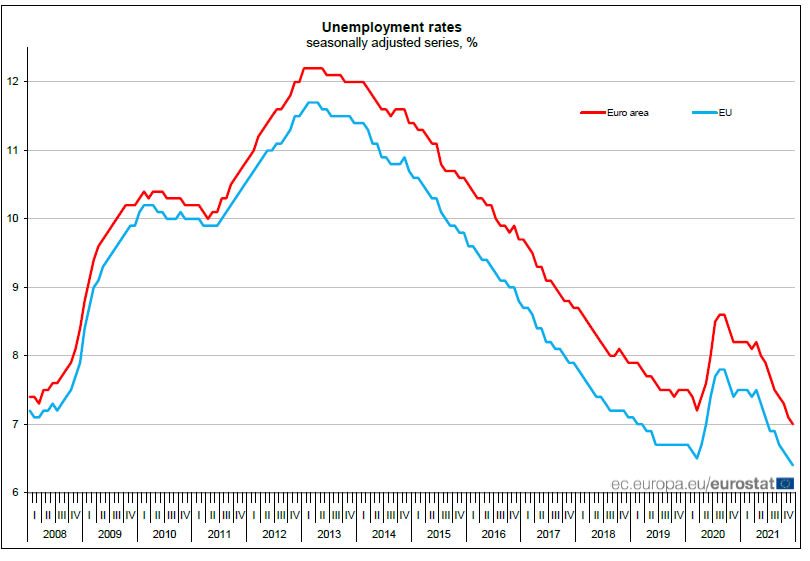
Eurozone unemployment rate dropped to 7.1% in Dec, EU down to 6.4%
Eurozone unemployment rate dropped from 7.1% to 7.0% in December, better than expectation of 7.1%. EU Unemployment rate dropped from 6.5% to 6.4%.
Eurostat estimates that 13.612m men and women in the EU, of whom 11.481m in the euro area, were unemployed in December. Compared with November, the number of persons unemployed decreased by 210k in the EU and by 185k in the euro area.
UK PMI manufacturing finalized at 57.3 in Jan, a solid start to 2022
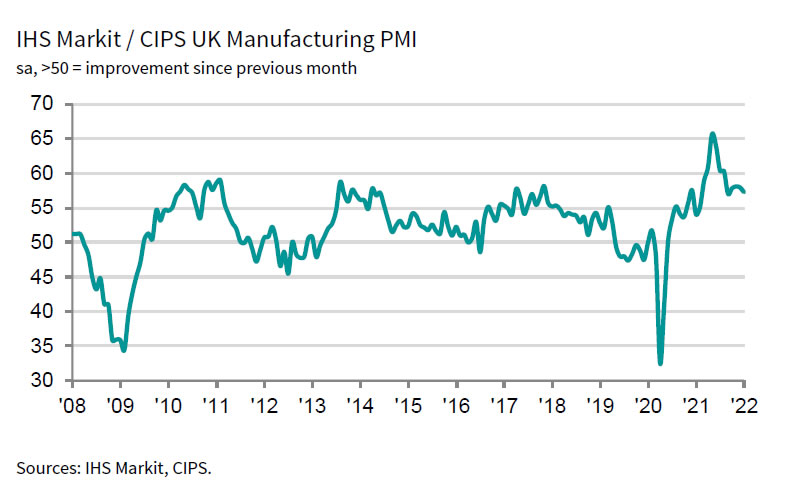
UK PMI Manufacturing was finalized at 57.3 in January, slightly down from December's 57.9. Markit said production rose at fastest rate in six months. new order growth slowed despite mild uptick in new export businesses. Input cost and output price inflation eased.
Rob Dobson, Director at IHS Markit, said: "UK manufacturing made a solid start to 2022, showing encouraging resilience on the face of the Omicron wave, with growth of output accelerating as companies reported fewer supply delays. Causes for concern remain, however, as new orders growth slowed, exports barely rose, staff absenteeism remained high and manufacturers' ongoing caution regarding supply chain disruptions led to the beefing up of safety stocks
"There was some positive news on the supply chains front. Although pressure on vendors remains severe, and still sufficient to stymie output growth and cause difficulty in obtaining required inputs, supplier lead times lengthened to the lowest degree since November 2020 to suggest that the current period of abnormal stress has hopefully passed its peak, despite the surge in cases linked to Omicron. This also lessened the upward pressure on prices, with input costs and output charges both rising at less elevated rates in January."
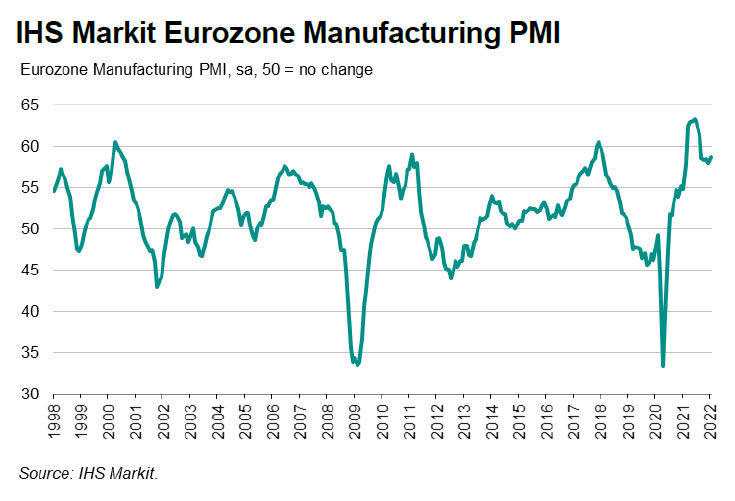
Eurozone PMI manufacturing finalized at 58.7 in Jan, weathering Omicron better than prior waves
Eurozone PMI Manufacturing was finalized at 58.7 in January, up from December's 58.0. Markit said there were faster expansion in output and new orders. Employment growth improved to five-month high. Also, supplier performance had the least marked deterioration for a year.
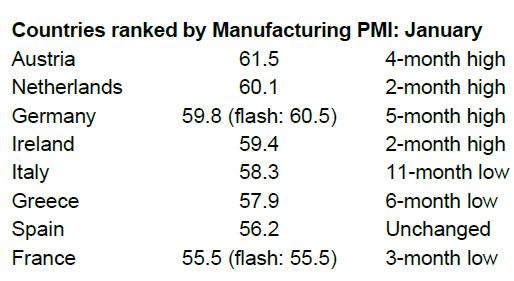
Looking at some member states, Germany PMI manufacturing improved to 59.8, five month high. But Italy dropped to 11-month low at 58.3. France also dropped to 3-month low at 55.5. Overall readings were still strong with Austria at 61.5, the Netherlands at 60.1, Ireland at 59.4, Greece at 57.9 and Spain at 56.2.
Chris Williamson, Chief Business Economist at IHS Markit said: "Eurozone manufacturers appear to be weathering the Omicron storm better than prior COVID-19 waves so far, with firms reporting the largest production and order book improvements for four months in January. Prospects have also brightened, with a further easing in the number of supply chain delays playing a key role in prompting producers to revise up their expectations for growth in the coming year to the highest since last June...
"Escalating tensions surrounding Ukraine, the energy price crisis and prospect of global central bank policy tightening meanwhile create additional headwinds to the outlook, which suggest that - although the global supply crunch may be easing - demand conditions may be less supportive to manufacturers in coming months."
GBPUSD Keeps Moving Up in Short-Term; Next Obstacle at 1.3500
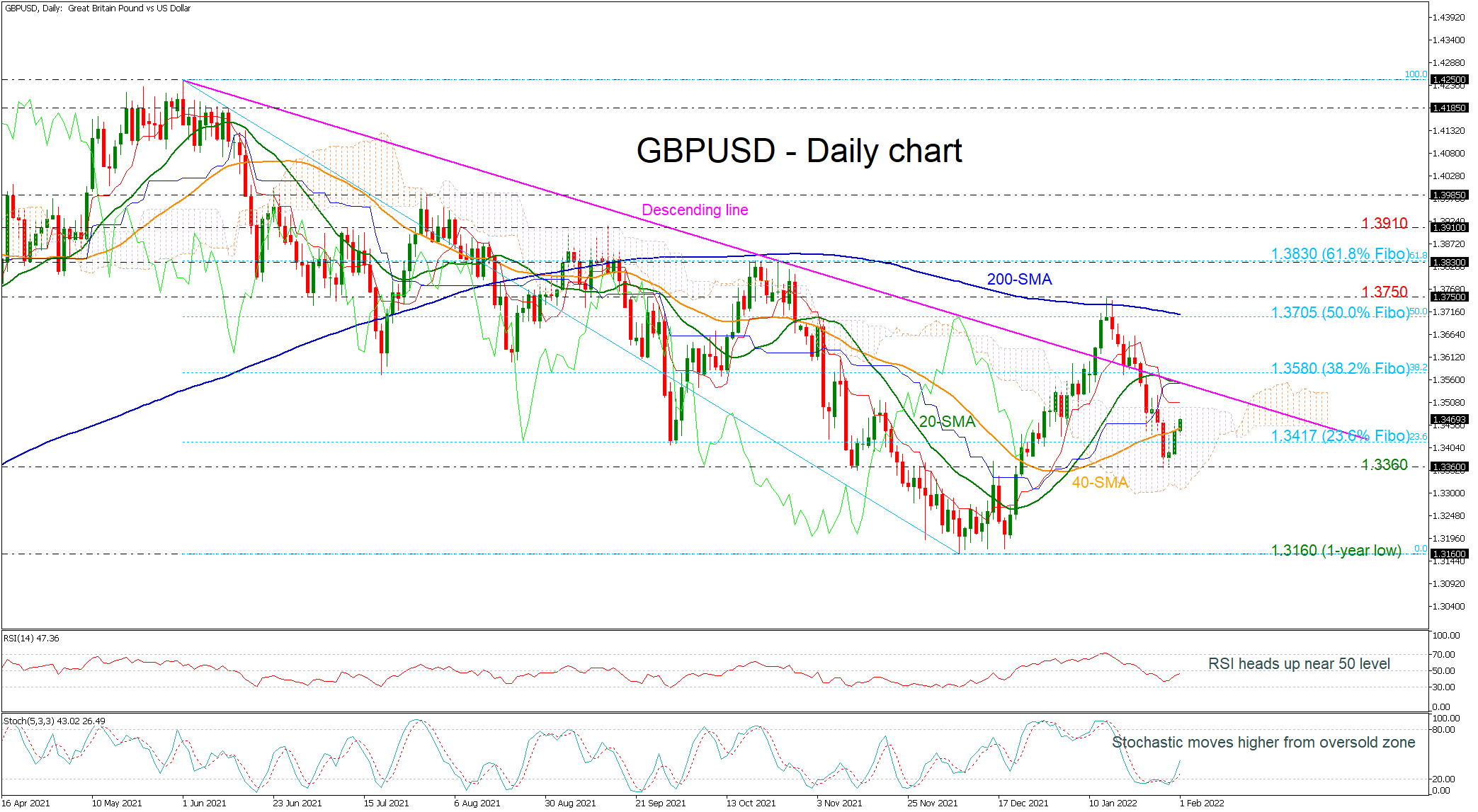
GBPUSD is flirting with the 40-day simple moving average (SMA) after the pullback off the 1.3360 support level, remaining within the Ichimoku cloud. The recent upside move is recovering the declining move from the 1.3750 barrier.
According to technical indicators, the RSI is approaching the 50 level with weak momentum, while the stochastic oscillator posted a bullish crossover within its %K and %D lines in the oversold territory. Both are suggesting a positive movement in the short-term timeframe.
If the market manages to pick up speed, the upper surface of the cloud could offer nearby resistance around 1.3500 ahead of the penetrated descending trend line and the 38.2% Fibonacci retracement level of the down move from 1.4250 to 1.3160 at 1.3580. A significant close above the latter would break the 50.0% Fibonacci of 1.3705, which overlaps with the 200-day simple moving average (SMA), raising chances for further increases.
Should prices decline, immediate support could be found around 1.3417, which is the 23.6% Fibonacci. Then a leg below that level, the pair could meet the 1.3360 support before the focus shifts to the one-year low of 1.3160 before plunging to 1.2855, taken from the low on November 2020.
In the long-term picture, the pair remains negative as it is still holding underneath the falling trend line and the 200-day SMA. However, in the very short-term, GBPUSD advances above the 40-day SMA, indicating a bullish correction.
Daily Technical Analysis
EUR/USD
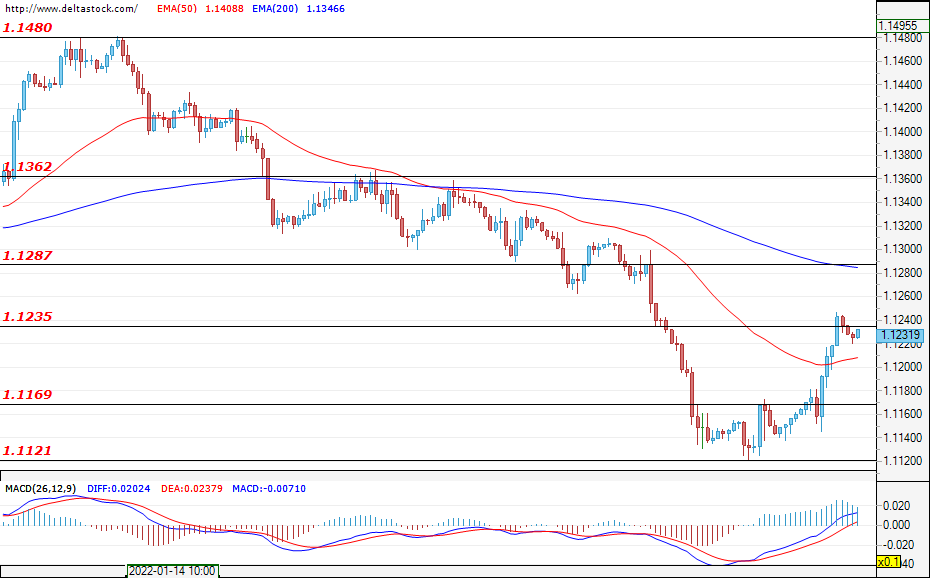
During the first trading session of the week, the currency pair breached the resistance level of 1.1170 and, at the time of writing, is headed towards a test of the next resistance at 1.1235. In case the bulls violate this resistance level, then the corrective phase would develop and the pair would head for a test of the next resistance zone at 1.1287. Alternatively, if 1.1235 withholds the bullish pressure, then we might witness a short-term consolidation in the zone between 1.1170 and 1.1235. Today, heightened activity can be expected around the announcement of the ISM manufacturing PMI data for the United States at 15:00 GMT.
USD/JPY
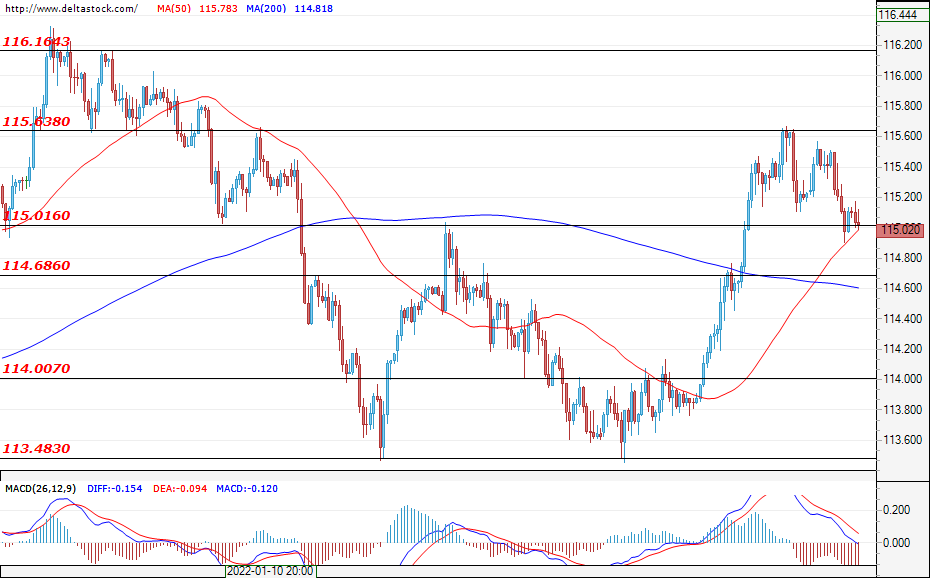
The currency pair is consolidating in the zone of 115.00 – 115.60 following the unsuccessful test of the resistance level at 115.60. At the time of writing, the pair is headed for a test of the lower border of the range. In case the support at 115.00 is violated, then the corrective movement would gain momentum and we would probably witness a test of the next support at 114.68. If the bears fail to breach the support at 115.00, then the pair would likely continue to trade within this range.
GBP/USD
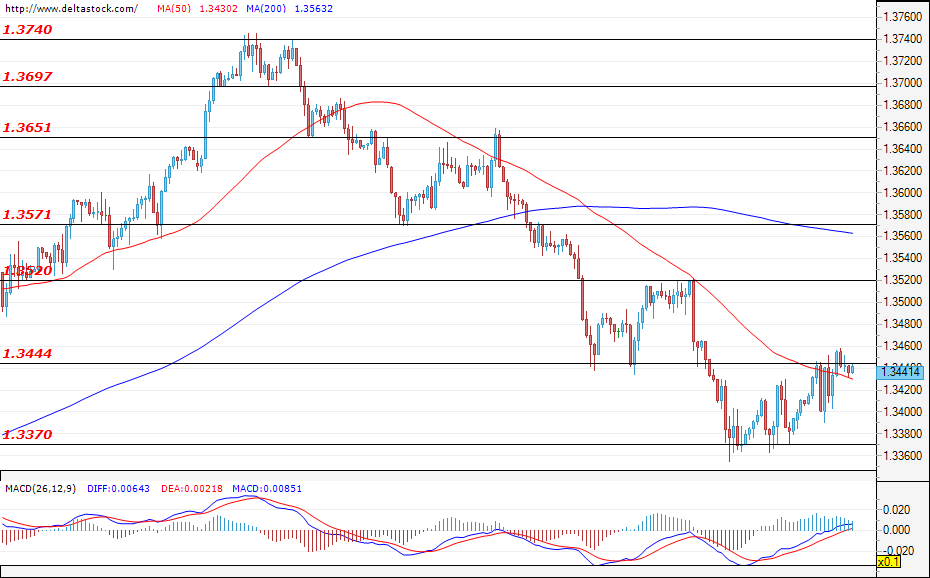
After the massive selloff during the last week, the Cable managed to bounce back from the support zone at 1.3370 and is now headed towards a test of the resistance level at 1.3444. A possible breach of this level would facilitate the bulls’ attack on the next resistance levels at 1.3520 and at 1.3571, respectively. If, however, the resistance at 1.3444 withstands the bullish pressure, then the short-term retracement would be complete and a new test of the local bottom at 1.3370 would be the most likely scenario. Today, an increase in activity can be expected around the announcement of the manufacturing PMI data for the UK at 09:30 GMT.
EUGERMANY40
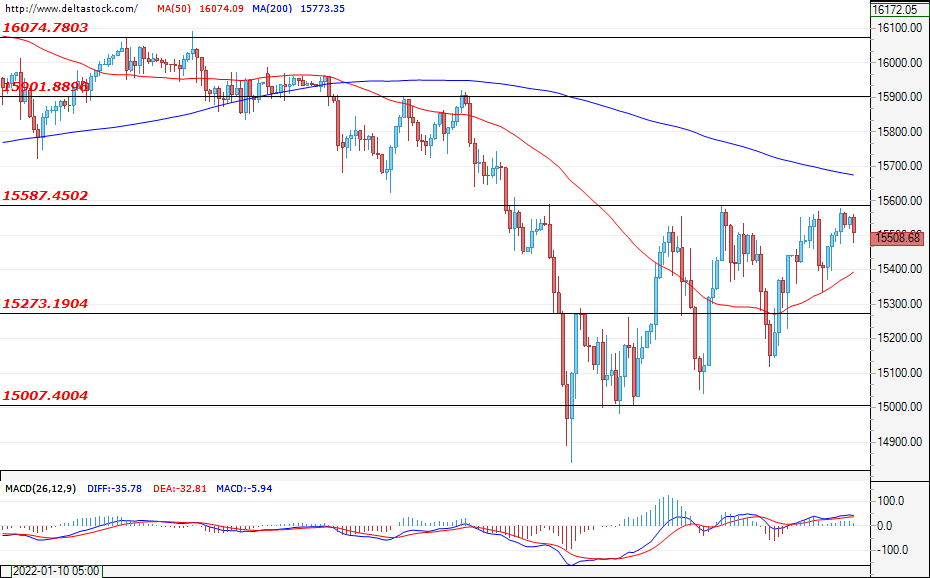
During the last couple of days, the German index has been trading in the range between the support at 15000 and the resistance at 15587. The bulls have so far made an unsuccessful attempt at violating the resistance at 15587 and, at the time of writing, the price is staying just below the upper border of the range. It is likely that the market expects a catalyst to find a unified direction and that it might find one today, when the manufacturing PMI data and the unemployment change data for Germany is announced at 08:55 GMT.
US30
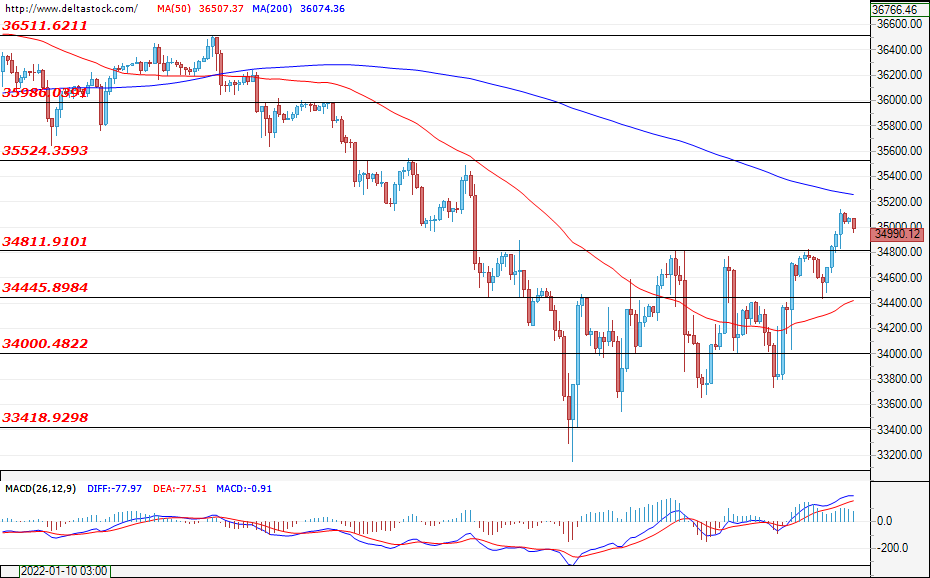
During yesterday's trading session, the U.S. blue-chip index breached the resistance level of 34800 and the forecast is for the index to continue inching towards a test of the next resistance zone of 35520. In the negative direction, the first support lies at 34445. Today, an increase in activity can be expected around the announcement of the ISM manufacturing PMI data for the United States at 15:00 GMT.
Dow Jones and S&P 500 Tilt Higher ahead of Key Tech Earnings
US equities rose on Monday as investors reflected on several catalysts. First, the market remained optimistic that big technology companies like AMD, Facebook, Amazon, and Alphabet will publish strong quarterly results this week. Other tech names that have already reported like Microsoft and IBM have published strong results. Second, there are signs the Omicron variant has peaked as the US continued to publish falling rate of hospitalizations. Third, stocks rose as investors predicted that the US economy will continue its recovery. Still, the pace of rate hikes by the Federal Reserve is a major source of concern to most investors.
The British pound rose after the latest report by Sue Gray. The government report criticized Boris Johnson for his failure of leadership by holding parties amid the Covid-19 lockdowns. She said that most of these events should not have happened. Still, there are signs that the report will not have a major impact on the UK economy. Later today, the sterling will react to the latest UK home price index by the Nationwide Society. It will also react to the final manufacturing PMI data by Markit. The biggest catalyst for the pair will be the latest interest rate decision by the Bank of England.
The economic calendar will have several key events today. Earlier, the New Zealand statistics agency published strong trade numbers for December. The numbers revealed that the country’s imports and exports did well in December as demand rose. In Germany, the country’s statistics agency will publish the latest employment numbers. Economists expect the data to show that the unemployment rate remained at 5.2%. In Canada, the statistics agency will publish the latest GDP numbers.
EURUSD
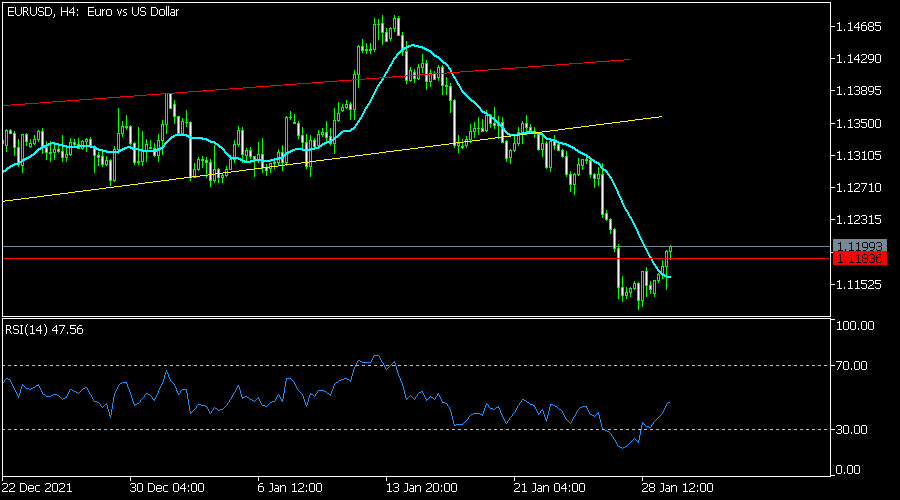
The EURUSD pair bounced back as investors focused on the strong Eurozone GDP data. The pair is trading at 1.1195, which is significantly higher than last week’s low of 1.1120. On the four-hour chart, the pair has managed to move slightly above the key resistance at 1.1183, which was the lowest level in November last year. Therefore, the pair will likely hold steady today even though a pullback cannot be ruled out.
GBPUSD
The GBPUSD pair tilted higher after the Sue Gray report as investors bought the news. It is trading at 3450, which is slightly higher than last month’s low of 1.3360. On the four-hour chart, the pair has moved slightly above the upper side of the bearish flag pattern. It has also declined slightly above the 25-day moving average while the MACD has formed a bullish crossover pattern. Therefore, the pair will likely break out lower because the bearish flag pattern is usually a bearish sign.

EURCAD
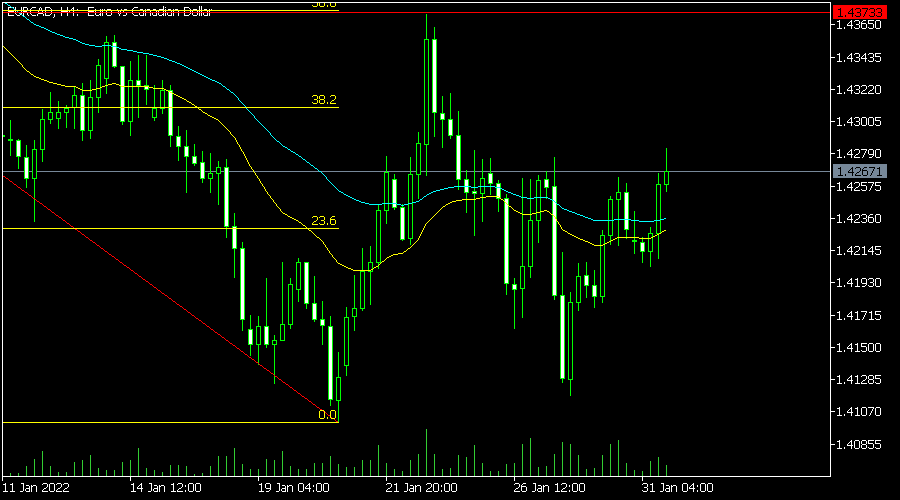
The EURCAD pair tilted higher ahead of the latest Canada GDP data. The pair rose to a high of 1.4274, which was the highest level since February 25th. On the four-hour chart, the pair has moved slightly above the 25-day and 50-day moving average and the 23.6% Fibonacci retracement level. Therefore, the pair will likely keep rising as bulls target the key resistance at 1.4310.
Germany’s 10y Yield Push into Positive Territory Symbolically and TechnicallyImportant
Markets
Wall Street tried to shrug off a rough month by printing impressive back-to-back gains. The Nasdaq outperformed, eking out another 3%+ gain. January is still the worst month for the tech-heavy index since March 2020 though. US yields rose with the belly outperforming the wings. The short end added 1.5 bps even as some Fed governors including Daly leaned against current market expectations of five rate hikes. Fed’s Esther George in an interview preferred “more aggressive action on the balance sheet [that] could allow for a shallower path for the policy rate”. She warns that doing the opposite could flatten the yield curve and distort credit incentives. Other changes vary from 1.5 bps (2y) over flat (7y) to 3.4 bps (30y). German/European yields surged. European GDP growth was largely in line with expectations (0.3% q/q) but German HICP eased much less than markets (and the ECB) hoped it would. Inflation fell from 5.7% y/y to 5.1% y/y with very strong monthly dynamics (0.9% m/m). It poses risks for the European figure to be released tomorrow and ahead of the ECB on Thursday. Germany’s curve bear flattened with yields 7.9 to 8.5 bps higher for the 2y and 5y. The 10y yield (+5.6 bps) closed in positive territory for the first time since 2019. EUR/USD profited from the rising interest rate differential as well as the upbeat risk climate. The pair rebounded from the 1.1163 support area to back north of 1.12, helped by dollar weakness too (DXY eased from 96.54 from 97.24). The same applied for EUR/GBP: bouncing off recent lows around 0.83 to 0.835.
The RBA grabs most attention during Asian-Pacific dealings today (see headline below). The Australian dollar is little affected by the decision. Most other major currencies trade muted too. CHF tops the board. Core bonds have a slight upward bias. Most stock markets show small gains. China remains closed for the week.Today’s economic calendar gets moderately interesting with US ISM business confidence for the manufacturing sector. Consensus expects an easing from 58.8 to 57.5. We keep a close eye at the delivery times component in particular to have a pulse on supply strains. The figure won’t affect the general trading patterns though. Germany’s 10y yield push into positive territory is symbolically and technically important. We look out for follow-up gains in the run-up to the ECB. EUR/USD has still some way to go before capturing first meaningful resistance, situated at around 1.13. A protracted rebound is only likely when the ECB finally takes the turn. British money markets are looking forward to the Bank of England on Thursday. A 25 bps rate hike is discounted. For the time being EUR/GBP 0.83 looks pretty solid.
News Headlines
The Reserve Bank of Australia kept its policy rate unchanged at 0.1%, but decided to cease further purchases under the bond purchase programme after February 10. Governor Lowe stressed that this does not imply a near-term increase in interest rates. The RBA sticks with its guidance to wait until actual inflation is sustainably within the 2%-3% target range. The RBA sees underlying inflation increasing further in coming quarters to around 3.25%, before declining to around 2.75% over 2023. Uncertainties remain about how persistent the pick-up in inflation will be as supply-side problems are resolved. Wage growth picked up but also remains modest even as the unemployment rate already fell to 4.2% in December. The central bank puts it at 3.75% at the end of 2023. The Omicron outbreak didn’t derail the economic recovery with the RBA forecast GDP growth of around 4.25% over 2022 and 2% over 2023. The Aussie dollar holds near AUD/USD 0.7050. Money markets remain convinced that the RBA will pull the trigger on interest rates in coming months (June) even if Lowe pushes back against early tightening expectations.
Germany, the Netherlands, France, Belgium and Italy expressed some worries over the Chips Act proposal from the European Commission. The EU wants to make 20% of the world’s chips by 2030. The 5 nations want to avoid a subsidy race resulting in an overproduction of chips, and rather suggest state aid to go to innovation more than cutting-edge production plants. They agree that the EU needs to keep their markets open to and open for other continents instead of focusing on reshoring only.