Sample Category Title
USD/CHF Daily Outlook
Daily Pivots: (S1) 0.9233; (P) 0.9288; (R1) 0.9324; More....
Intraday bias in USD/CHF remains neutral for the moment. Overall, with 0.9090 support intact, choppy rise from 0.8925 should extend higher. On the upside, above 0.9341 will target 0.9372 and then 0.9471. However, break of 0.9342 minor support will turn bias back to the downside for 0.9090 support.
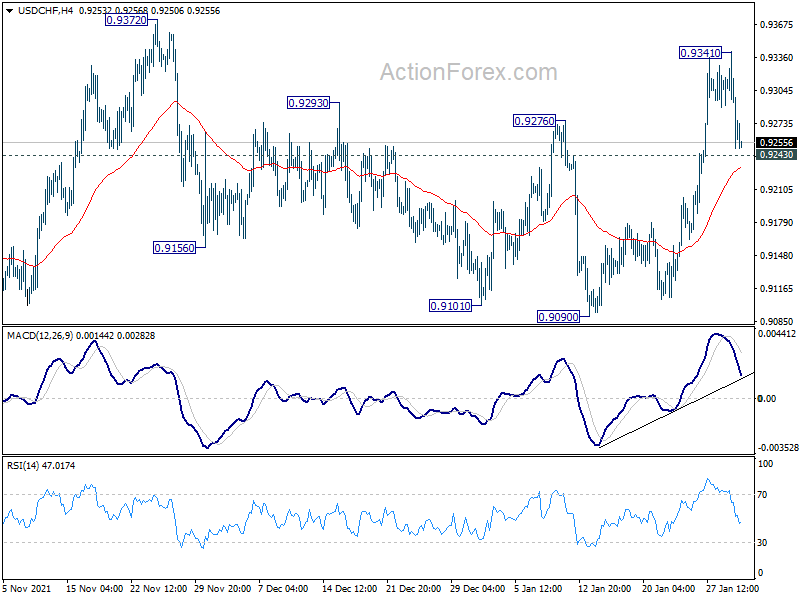
In the bigger picture, medium term outlook will be neutral at best as long as 0.9471 resistance holds. Larger down trend could still extend through 0.8756 (2021 low). However, firm break of 0.9471 will argue that the trend has already reversed and rebound the rally from 0.8756 with another impulsive move.
USD/JPY Daily Outlook
Daily Pivots: (S1) 114.84; (P) 115.21; (R1) 115.50; More...
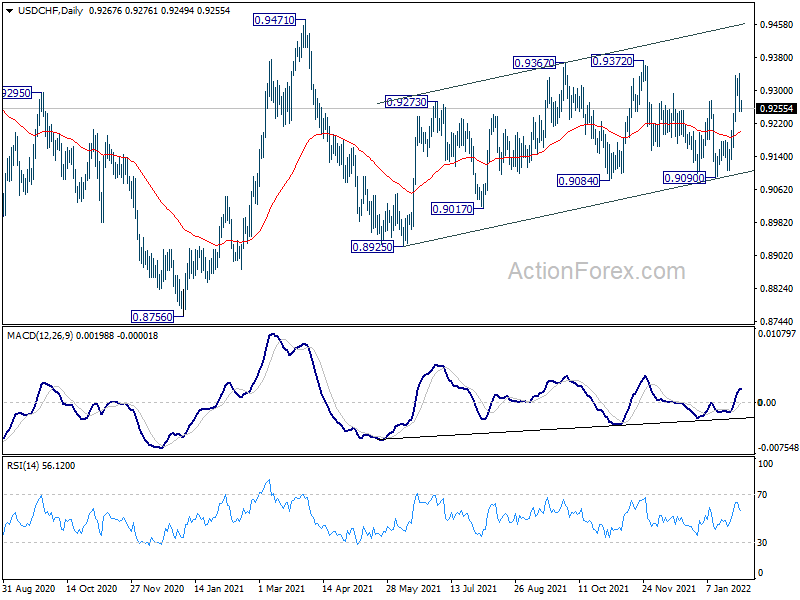
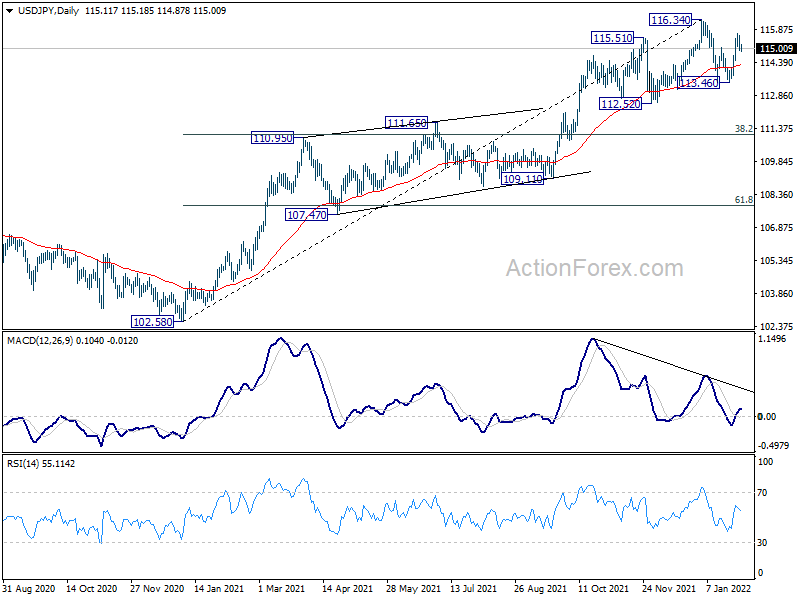
Intraday bias in USD/JPY remains neutral for consolidation below 115.68 temporary top. Further rally is expected with 114.46 minor support intact. On the upside, break of 115.68 will target 116.34 high first. Decisive break there will resume larger up trend for 118.65 long term resistance next. On the downside, break of 114.46 will turn bias back to the downside for retesting 113.46 support instead.
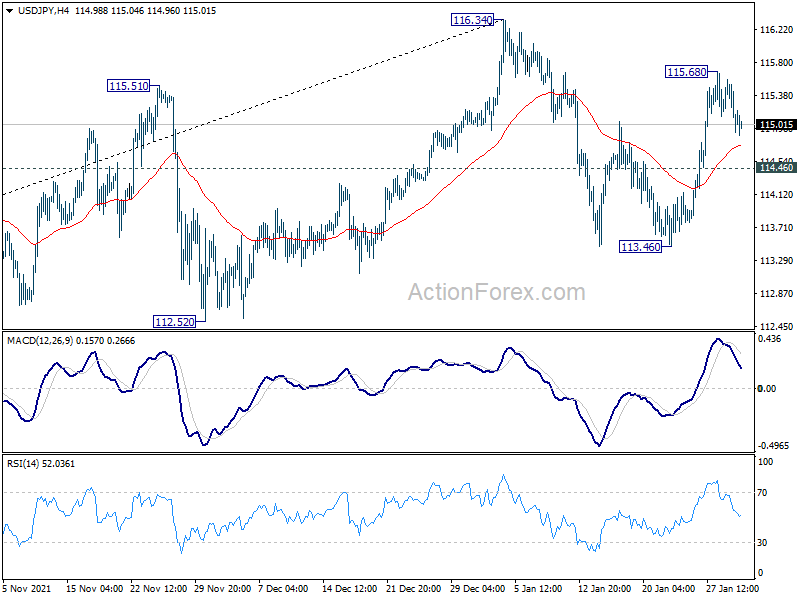
In the bigger picture, no change in the view that rise from 102.58 is the third leg of the up trend from 101.18 (2020 low). Such rally should target a test on 118.65 (2016 high). Sustained break there will pave the way to 120.85 (2015 high) and raise the chance of long term up trend resumption. This will remain the favored case as long as 55 week EMA (now at 111.07) holds.
USD/CAD Daily Outlook
Daily Pivots: (S1) 1.2661; (P) 1.2726; (R1) 1.2769; More...
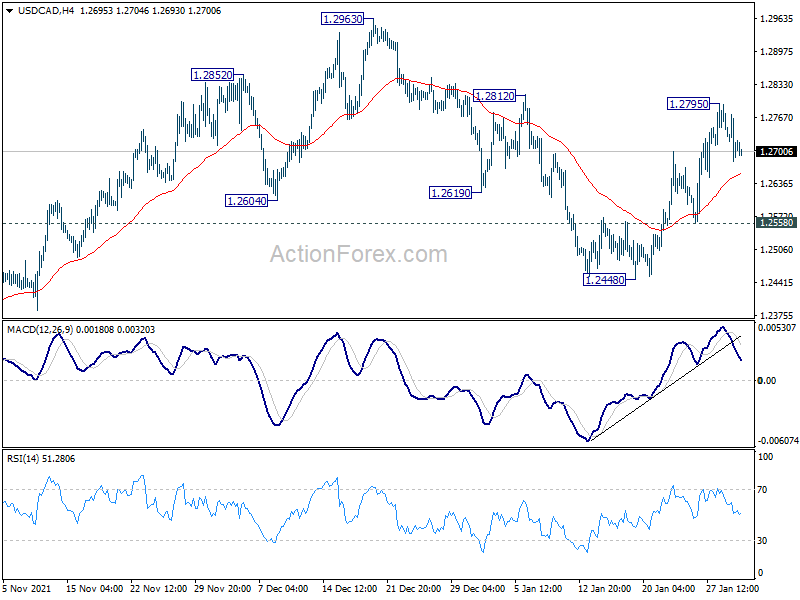
Intraday bias in USD/CAD remains neutral for consolidation below 1.2795 temporary top. Further rise is expected with 1.2558 support intact. On the upside, break of 1.2795 will target 1.2812 and then 1.2963 resistance. However, break of 1.2558 minor support will turn bias back to the downside for 1.2448 instead.
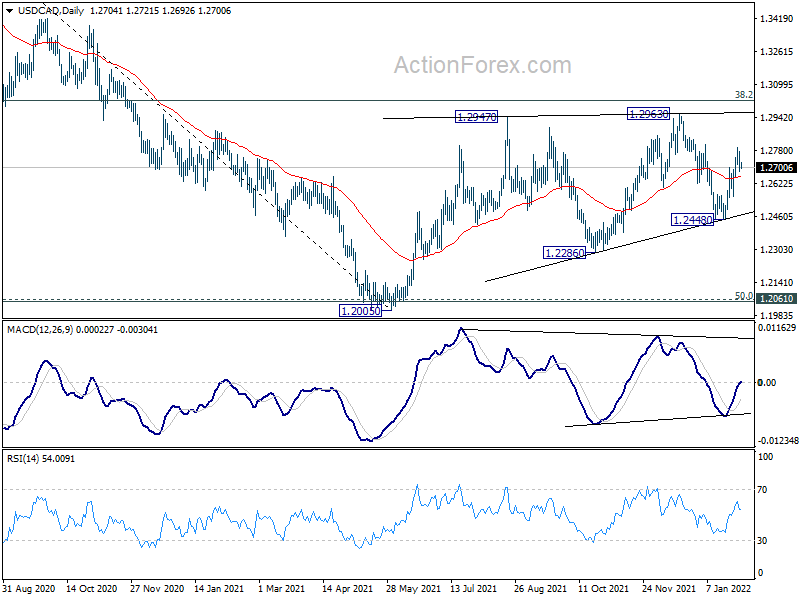
In the bigger picture, focus stays on 38.2% retracement of 1.4667 (2020 high) to 1.2005 (2021 low) at 1.3022. Sustained break there should confirm that the down trend from 1.4667 has completed after defending 1.2061 long term cluster support. Further rise would then be seen towards 61.8% retracement at 1.3650. However, rejection by 1.3022 will maintain medium term bearishness. Break of 1.2005 will resume the down trend from 1.4667 and that carries larger bearish implications too.
RBA Board Ceases Bond Purchases – Lifts Inflation Forecast
The Board has ceased the bond purchase program and significantly lifted its inflation forecasts but the Governor maintains the line that the sustainability of its inflation forecasts can only be achieved with much clearer evidence around wages growth. This is likely to preclude an “early” rate hike but does not dissuade us from our August call.
As expected, the Reserve Bank Governor announced that the Board has decided to cease further purchases under the bond purchase program.
The Board has decided to consider the issue of the reinvestment of the proceeds of future bond maturities at its meeting in May. Readers will be aware that the purchase program was initiated in November 2020 with maturities around the 5 to 10 year spectrum. Consequently, it will be some time before decisions will need to be made about the original bond purchase program.
On the other hand, the Governor did announce the Yield Curve Control Policy on March 19 2020 where 3 year government bonds (April 2023 maturity) were targeted – decisions on those bond maturities will be needed in early 2023.
We are always interested in the Bank’s revised forecasts and this Statement usually includes a number of key observations prior to the full list of forecasts being released on February 4.
The Bank has reduced its forecast for GDP growth in 2022 from 5.5% to 4.25% and from 2.5% to 2% in 2023.
The main source of the reduction in 2022 is likely to be the early evidence that consumer spending contracted in January due to the impact of the Omicron virus on consumers – Westpac has reduced its forecast for GDP growth in the March quarter to zero from 2.2% to reflect exactly that factor and has shaved around 1 ppt from its growth forecast for 2022.
It is also pertinent to recall that the Bank’s forecasts are based on market pricing for the cash rate. With the market forecasting a cash rate of around 2% by end 2023 (higher than in November) it is not surprising to see a growth downgrade in both 2022 and 2023.
The forecast for underlying inflation has been lifted significantly. The expected peak in coming quarters has been lifted from 2.25% (in November) to 3.25% while the forecast is that it will drift back to 2.75% by end 2023 compared to 2.5% in November.
Despite higher rates and lower growth, the forecasts for the labour market have been boosted. The unemployment rate is forecast to fall to “below 4% later in the year” reaching 3.75% at the end of 2023. That compares with 4.25% and 4% respectively in November ‘s forecasts.
The Governor’s rhetoric does not seem to be consistent with the forecasts.
He states, “While inflation has picked up, it is too early to conclude that it is sustainably within the target band.” And yet underlying inflation is currently 2.6%; is forecast by the RBA to increase to 3.25% in 2022 and still be at 2.75% by the end of 2023.”
That is inflation is forecast to hold in the upper half of the target band for at least two years!
These tactics are clearly to dissuade markets from getting too far ahead of themselves in anticipating higher rates.
Note that the has not put a date on the timing of the first move since the October meeting last year when he referred to “this condition will not be met before 2024.”
However, in speeches he maintained the “not in 2022” line as recently as December 16. The most important part of his speech tomorrow to the National Press Club will be whether he retains that” not in 2022” guidance – I would be very surprised if he chooses to do that!
The Governor gives two arguments against the sustainability of the recent inflation increase – “uncertainties about the outlook for supply side problems” and “it is likely to be some time yet before aggregate wages growth is at a rate consistent with inflation being sustainably at target.”
The choice of “aggregate” wages growth would appear to emphasise the Wage Price Index. Recall that its last three quarterly prints have been 0.6%; 0.4%; and 0.6%. The next print will be on February 23 to be followed by May 18.
To get any where near the 3% target at the next release the Index would need to print an unlikely 1.4% - that incredibly high hurdle, coupled with the Governor’s statement today should knock out any expectation of a May rate hike.
Westpac expects that the next two WPI’s will show “aggregate” wages growing at around 2.5% with a 3% 6 month annualised pace – enough, along with the sustained lift in underlying inflation, and 13 year low in the underemployment rate, to justify the August move.
Conclusion
We remain comfortable with our August call for the first move.
Predictably, the Governor has attributed the wages story as the key for the RBA concluding that their revised forecasts (which are consistent with higher rates) are still uncertain and more evidence is required before it can act.
BoE Preview: Another Rate Hike and Passive QT
Key takeaways
We expect the Bank of England (BoE) will hike the Bank Rate by 25bp to 0.50% on Thursday.
We expect the BoE will repeat that "some modest tightening of monetary policy [...] is likely to be necessary", which we would interpret as a small pushback to current market pricing. A removal would be a hawkish signal, in our view.
The BoE will announce the beginning of "passive QT" (ceasing of reinvestments) in connection with the meeting if we are right about the hike. BoE is expected to start "active QT" (actively selling bonds to markets) when the Bank Rate reaches 1.00%.
We still expect two further hikes this year (May and November). Hence, the BoE is likely to announce "active QT" in connection with the November meeting. Risks are skewed towards more hikes than we have pencilled in.
Markets are pricing in nearly five rate hikes. Hence, we also see a higher probability of a dovish surprise than the other way around.
FX: We still think 0.83 is the bottom for EUR/GBP and seeing a case for a slight move higher to 0.84 in 12M in case the BoE is not as hawkish as currently priced.
AUD/USD Daily Report
Daily Pivots: (S1) 0.7011; (P) 0.7044; (R1) 0.7101; More...
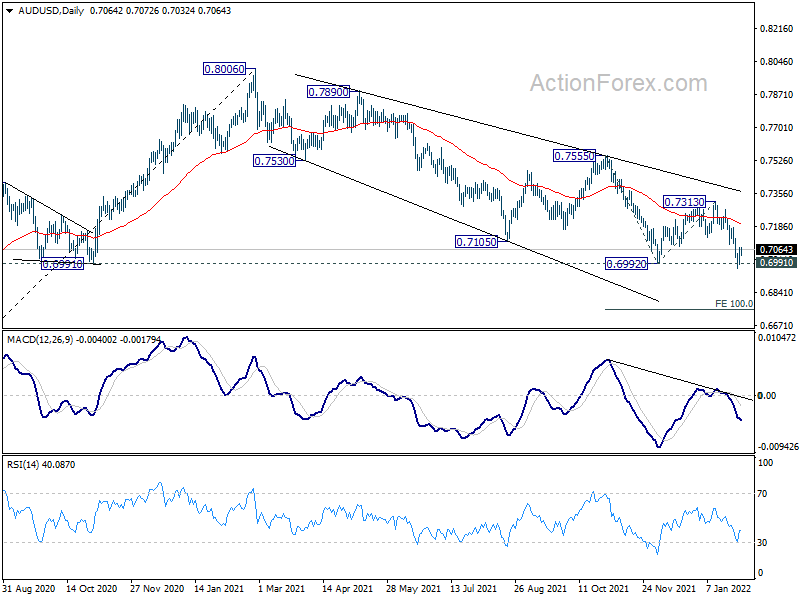
Intraday bias in AUD/USD remains neutral at this point. On the downside, sustained break of 0.6991 key support will confirm resumptions of whole down trend from 0.8006. Next target is 100% projection of 0.7555 to 0.6992 from 0.7313 at 0.6750. However, break of 0.7089 minor resistance will argue that 0.6991 was defended, and turn bias back to the upside for 0.7180 resistance next.
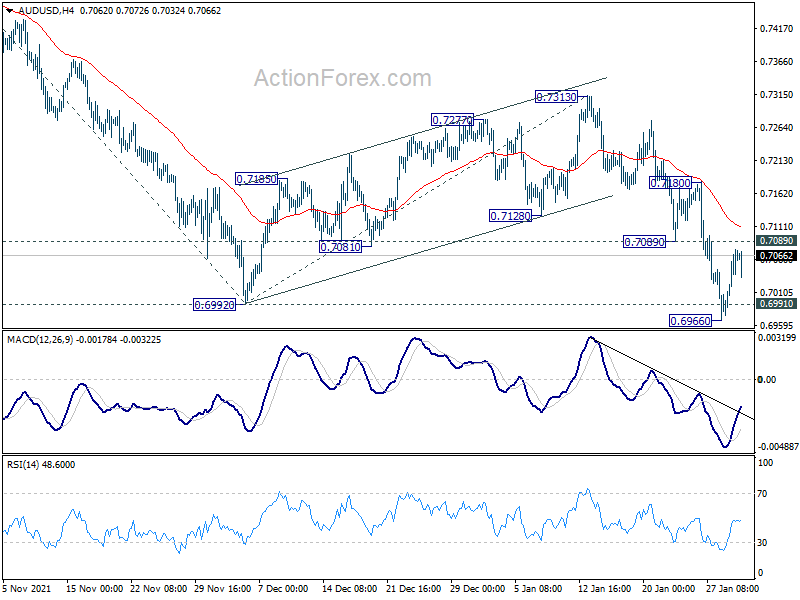
In the bigger picture, focus remains on 0.6991 key structural support. Sustained break there will argue that the whole up trend from 0.5506 might be finished at 0.8006, after rejection by 0.8135 long term resistance. Deeper decline would then be seen back to 61.8% retracement of 0.5506 to 0.8006 at 0.6461. Meanwhile, strong rebound from 0.6991 will retain medium term bullishness. That is, whole up trend from 0.5506 is still in progress.
Aussie Dips Mildly on Cautious RBA, Dollar Paring Gains
Australian Dollar dips broadly after RBA sounds surprisingly cautious regarding raising interest rates. But loss is so far very limited, as supported by improving market sentiment following strong rebound in US stocks overnight. Dollar is the second weakest, continuing to pare recent gains while Yen is also heading lower. Euro is currently a stronger one for the week, as supported by buying in crosses, in particular against Sterling and Swiss Franc.
Technically, there is no clear sign of a larger reversal in Dollar yet, despite current retreat. Levels to watch include 1.1299 minor resistance in EUR/USD, 1.3523 minor resistance in GBP/USD, 0.7089 minor resistance in AUD/USD, 0.9243 minor support in USD/CHF and 114.46 minor support in USD/JPY. More upside in Dollar would remain in favor for the short term if these levels remain intact.
In Asia, at the time of writing, Nikkei is up 0.26%. Japan 10-year JGB yield is up 0.0015 at 0.177. Hong Kong, China and Singapore are on Lunar New Year holiday. Overnight, DOW rose 1.17%. S&P 500 rose 1.89%. NASDAQ rose 3.41%. 10-year yield closed flat at 1.782.
RBA stops QE purchases, to be patient on interest rate
RBA keeps cash rate target unchanged at 0.10% today. It's reiterated that RBA "will not increase the cash rate until actual inflation is sustainably within the 2 to 3 per cent target range". And, it is "too early to conclude that it is sustainably within the target band". Thus, "the Board is prepared to be patient as it monitors how the various factors affecting inflation in Australia evolve.
RBA also decided to stop the asset purchase program after February 10. The issue of reinvestment of the proceeds of future bond maturities will be considered at the meeting in May.
As for the economy, RBA said Omicron "has not derailed" recovery. Central forecast if for GDP to grow around 4.25% over 2022 and 2% over 2.023. Unemployment rate is projected to fall below 4% later in the year, and to be around 3.75% at the end of 2023. Underlying inflation is is expected to increase further in coming quarters to around 3.25%, and decline to around 2.75% over 2023.
Australia retail sales dropped -4.4% mom in Dec, but turnover remains strong
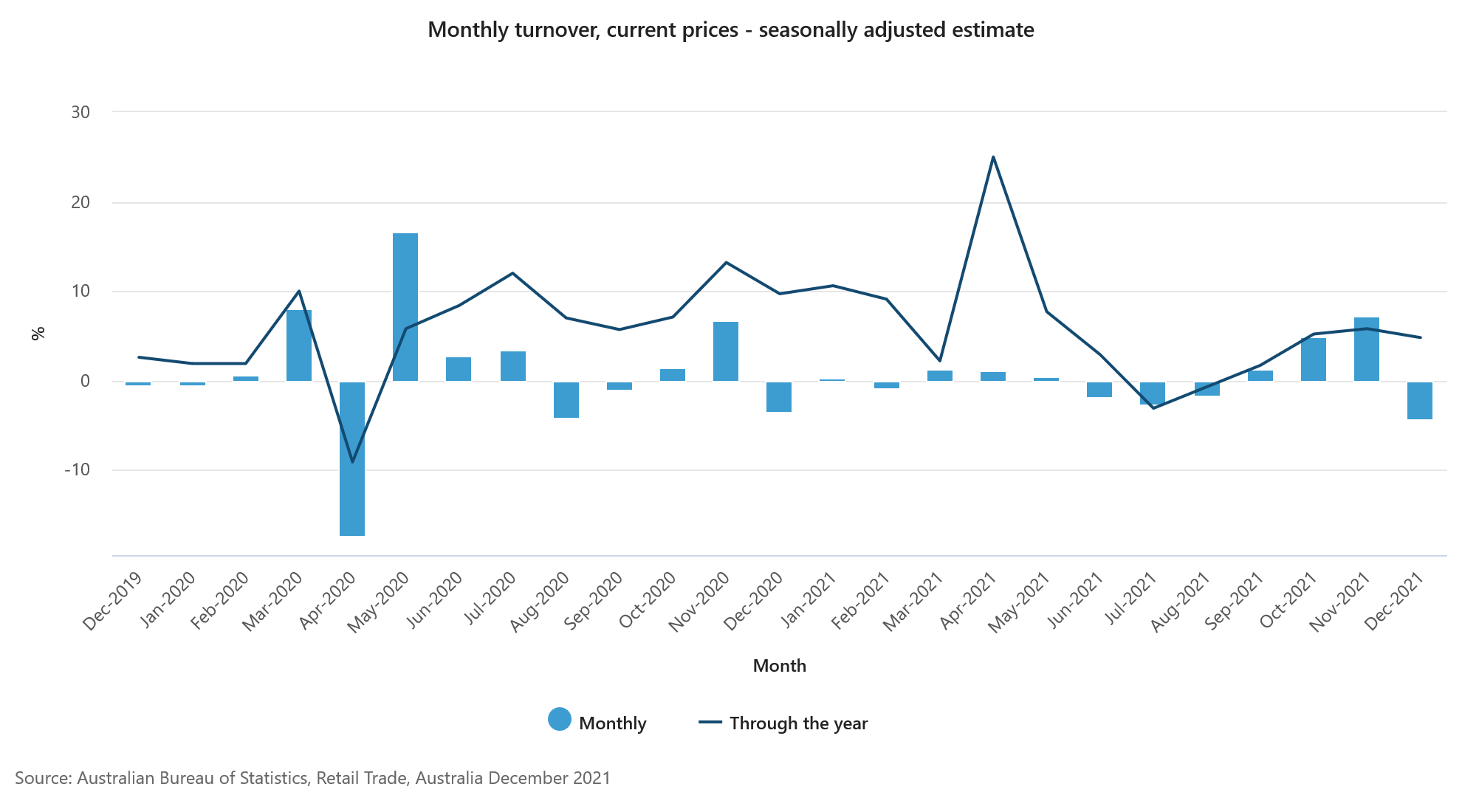
Australia retail sales dropped -4.4% mom in December, much worse than expectation of -1.9% mom. That's also the largest monthly decline since April 2020.
"Despite this month's fall, retail turnover remains strong, up 4.8 per cent on December 2020, with strong consumer spending continuing post the Delta Outbreak," Ben James, Director of Quarterly Economy Wide Statistics, said.
Australia AiG manufacturing dropped to 48.4, modest contraction
Australia AiG Performance of Manufacturing Index dropped sharply by -6.4 pts to 48.4 in January. Production dropped -0.6 to 51.9. Employment dropped -4.6 to 45.4. New orders dropped -8.0 to 51.3. Supplier deliveries dropped -15.6 to 37.8. Exports dropped -9.5 to 45.1. Input prices rose 4.0 to 82.3. Selling prices dropped -3.3 to 64.8. Wages rose 1.1 to 63.5.
Innes Willox, Chief Executive of Ai Group said: "Australia's manufacturers reported a modest contraction in performance over December and January as businesses reported further disruptions to supply chains and as staff availability emerged as a major constraint on many businesses. Cost pressures were keenly felt with input prices continuing to rise and the selling prices index indicating only a partial recovery of these costs in the market."
Fed Daly: We definitely are poised for a March increase
San Francisco Fed Bank President Mary Daly said "we definitely are poised for a March increase." But she added, "after that, I want to see what the data brings us ... let's get through Omicron, let's look at this and let's see."
"If the economy progresses like I see it progressing, then it is clear that it can stand on its own two feet, that we do not need to be providing the same level of extraordinary … accommodation that we provided during the pandemic and have provided for the last two years," Daly said.
Fed Bostic: 50bps hike in March not my preferred action
Atlanta Fed Bank President Raphael Bostic said, 50bps hike in March was "not my preferred policy action." He added, "I had three rate increases in mind. March is looking like the right time" to get that started. From there, however, "we are not on any set progression."
"We are going to need to be thinking very carefully about how things are going, how the economy responds to our first moves," Bostic said. "We are not set on any particular trajectory. The data will tell us what is happening."
Fed Barkin: I don't hear much resistance to rate hikes
Richmond Fed President Thomas Barkin said yesterday, "as I talk to participants in the economy, what I hear is they actually want us to do something now about inflation. They'd like us to get back to at least a normal interest-rate posture and not be simulating more demand on top of normal levels. So, I don't hear much resistance to that."
"I'd like us to be better positioned," Barkin said. "Better positioned is somewhere closer to neutral, certainly, than we are now and I think the pace of that just depends on the pace of inflation."
Fed George: Appropriate to move earlier on the balance sheet
Kansas City Fed President Esther George said Fed's policy normalization approach could be more aggressive on balance sheet reduction, rather than faster rate hikes.
"What we do on the balance sheet is likely to affect the path of policy rates and vice versa," George said during an event "For example, if we took more aggressive action on lowering, pulling down that balance sheet, it might allow for fewer interest rate increases."
He added that raising short-term interest rate while maintaining a large balance sheet "could flatten the yield curve", and lead to "reach-for-yield behavior from long-duration investors."
"All in all, it could be appropriate to move earlier on the balance sheet relative to the last tightening cycle," she said.
Elsewhere
Japan PMI manufacturing was finalized at 55.4 in January. Unemployment rate dropped from 2.8% to 2.7% in December.
New Zealand goods export rose 13% yoy to NZD 6.1B in December. Goods imports rose 23% yoy to USD 6.5B. Monthly trade balance was a deficit of NZD -477m, smaller than expectation of NZD -700m.
Looking ahead, Swiss will release retail sales and SECO consumer climate in European session. Eurozone will release PMI manufacturing infal and unemployment rate. Germany will release unemployment. UK will release PMI manufacturing final and M4 money supply.
Later in the day, Canada will release PMI manufacturing. US will release ISM manufacturing and construction spending.
AUD/USD Daily Report
Daily Pivots: (S1) 0.7011; (P) 0.7044; (R1) 0.7101; More...
Intraday bias in AUD/USD remains neutral at this point. On the downside, sustained break of 0.6991 key support will confirm resumptions of whole down trend from 0.8006. Next target is 100% projection of 0.7555 to 0.6992 from 0.7313 at 0.6750. However, break of 0.7089 minor resistance will argue that 0.6991 was defended, and turn bias back to the upside for 0.7180 resistance next.
In the bigger picture, focus remains on 0.6991 key structural support. Sustained break there will argue that the whole up trend from 0.5506 might be finished at 0.8006, after rejection by 0.8135 long term resistance. Deeper decline would then be seen back to 61.8% retracement of 0.5506 to 0.8006 at 0.6461. Meanwhile, strong rebound from 0.6991 will retain medium term bullishness. That is, whole up trend from 0.5506 is still in progress.
Economic Indicators Update
| GMT | Ccy | Events | Actual | Forecast | Previous | Revised |
|---|---|---|---|---|---|---|
| 21:30 | AUD | AiG Performance of Mfg Index Jan | 48.4 | 54.8 | ||
| 21:45 | NZD | Trade Balance (NZD) Dec | -477M | -700M | -864M | -1060M |
| 23:30 | JPY | Unemployment Rate Dec | 2.70% | 2.80% | 2.80% | |
| 00:30 | AUD | Retail Sales M/M Dec | -4.40% | -1.90% | 7.30% | |
| 00:30 | JPY | Manufacturing PMI Jan F | 55.4 | 54.6 | 54.6 | |
| 03:30 | AUD | RBA Interest Rate Decision | 0.10% | 0.10% | 0.10% | |
| 07:00 | EUR | Germany Retail Sales M/M Dec | -1.20% | 0.60% | ||
| 07:30 | CHF | Real Retail Sales Y/Y Dec | 5.50% | 5.80% | ||
| 08:00 | CHF | SECO Consumer Climate Q1 | 4 | 4 | ||
| 08:50 | EUR | France Manufacturing PMI Jan F | 55.5 | 55.5 | ||
| 08:55 | EUR | Germany Unemployment Change Jan | -8K | -23K | ||
| 08:55 | EUR | Germany Unemployment Rate Jan | 5.20% | 5.20% | ||
| 08:55 | EUR | Germany Manufacturing PMI Jan F | 60.5 | 60.5 | ||
| 09:00 | EUR | Eurozone Manufacturing PMI Jan F | 59 | 59 | ||
| 09:30 | GBP | Mortgage Approvals Dec | 66K | 67K | ||
| 09:30 | GBP | Manufacturing PMI Jan F | 56.9 | 56.9 | ||
| 09:30 | GBP | M4 Money Supply M/M Dec | 0.80% | 0.70% | ||
| 10:00 | EUR | Eurozone Unemployment Rate Dec | 7.10% | 7.20% | ||
| 13:30 | CAD | GDP M/M Nov | 0.40% | 0.80% | ||
| 14:30 | CAD | Manufacturing PMI Jan | 56.5 | |||
| 14:45 | USD | Manufacturing PMI Jan F | 55 | 55 | ||
| 15:00 | USD | ISM Manufacturing PMI Jan | 57.5 | 58.7 | ||
| 15:00 | USD | ISM Manufacturing Prices Paid Jan | 79.5 | 68.2 | ||
| 15:00 | USD | ISM Manufacturing Employment Index Jan | 54.2 | |||
| 15:00 | USD | Construction Spending M/M Dec | 0.70% | 0.40% |
RBA stops QE purchases, to be patient on interest rate
RBA keeps cash rate target unchanged at 0.10% today. It's reiterated that RBA "will not increase the cash rate until actual inflation is sustainably within the 2 to 3 per cent target range". And, it is "too early to conclude that it is sustainably within the target band". Thus, "the Board is prepared to be patient as it monitors how the various factors affecting inflation in Australia evolve.
RBA also decided to stop the asset purchase program after February 10. The issue of reinvestment of the proceeds of future bond maturities will be considered at the meeting in May.
As for the economy, RBA said Omicron "has not derailed" recovery. Central forecast if for GDP to grow around 4.25% over 2022 and 2% over 2.023. Unemployment rate is projected to fall below 4% later in the year, and to be around 3.75% at the end of 2023. Underlying inflation is is expected to increase further in coming quarters to around 3.25%, and decline to around 2.75% over 2023.
(RBA) Statement by Philip Lowe, Governor: Monetary Policy Decision
At its meeting today, the Board decided to maintain the cash rate target at 10 basis points and the interest rate on Exchange Settlement balances at zero per cent. It also decided to cease further purchases under the bond purchase program, with the final purchases to take place on 10 February.
The Omicron outbreak has affected the economy, but it has not derailed the economic recovery. The Australian economy remains resilient and spending is expected to pick up as case numbers trend lower. The RBA's central forecast is for GDP growth of around 4¼ per cent over 2022 and 2 per cent over 2023. This outlook is supported by household and business balance sheets that are in generally good shape, an upswing in business investment, a large pipeline of construction work and supportive macroeconomic policy settings. The main source of uncertainty continues to be the pandemic.
The labour market has recovered strongly, with the unemployment rate declining to 4.2 per cent in December. Hours worked are estimated to have declined significantly in January due to the Omicron outbreak, but high numbers of job vacancies suggest further gains in employment over the months ahead. The RBA's central forecast is for the unemployment rate to fall to below 4 per cent later in the year and to be around 3¾ per cent at the end of 2023.
Wages growth has picked up but, at the aggregate level, has only returned to the relatively low rates prevailing before the pandemic. A further pick-up in wages growth is expected as the labour market tightens. This pick-up is still expected to be only gradual, although there is uncertainty about the behaviour of wages at historically low levels of unemployment.
Inflation has picked up more quickly than the RBA had expected, but remains lower than in many other countries. The headline CPI inflation rate is 3.5 per cent and is being affected by higher petrol prices, higher prices for newly constructed homes and the disruptions to global supply chains. In underlying terms, inflation is 2.6 per cent. The central forecast is for underlying inflation to increase further in coming quarters to around 3¼ per cent, before declining to around 2¾ per cent over 2023 as the supply-side problems are resolved and consumption patterns normalise. One source of uncertainty is the persistence of the disruptions to supply chains and distribution networks and their ongoing effects on prices. It is also uncertain how consumption patterns will evolve and how this will affect the balance of supply and demand, and hence prices.
Financial conditions in Australia remain highly accommodative. Together, the RBA's bond purchase program, the funding provided under the Term Funding Facility and the low level of interest rates are providing important support to the Australian economy as it recovers from the effects of the pandemic. The Australian dollar exchange rate is around its lows of the past year or so. Housing prices have risen strongly, although the rate of increase has eased in some cities. With interest rates at historically low levels, it is important that lending standards are maintained and that borrowers have adequate buffers.
The decision to end purchases under the bond purchase program follows a review of the actions of other central banks, the functioning of Australia's bond market and the progress towards the goals of full employment and inflation consistent with target. Many other central banks have ended, or will soon end, their bond purchase programs. More importantly, faster-than-expected progress has been made towards the RBA's goals and further progress is likely. In these circumstances, the Board judged that now was the right time to end the bond purchase program. Since the start of the pandemic, the RBA's balance sheet has more than tripled to around $640 billion, with this expansion providing continuing support to the economy. The Board will consider the issue of the reinvestment of the proceeds of future bond maturities at its meeting in May.
The Board is committed to maintaining highly supportive monetary conditions to achieve its objectives of a return to full employment in Australia and inflation consistent with the target. Ceasing purchases under the bond purchase program does not imply a near-term increase in interest rates. As the Board has stated previously, it will not increase the cash rate until actual inflation is sustainably within the 2 to 3 per cent target range. While inflation has picked up, it is too early to conclude that it is sustainably within the target band. There are uncertainties about how persistent the pick-up in inflation will be as supply-side problems are resolved. Wages growth also remains modest and it is likely to be some time yet before aggregate wages growth is at a rate consistent with inflation being sustainably at target. The Board is prepared to be patient as it monitors how the various factors affecting inflation in Australia evolve.
Australia retail sales dropped -4.4% mom in Dec, but turnover remains strong
Australia retail sales dropped -4.4% mom in December, much worse than expectation of -1.9% mom. That's also the largest monthly decline since April 2020.
"Despite this month's fall, retail turnover remains strong, up 4.8 per cent on December 2020, with strong consumer spending continuing post the Delta Outbreak," Ben James, Director of Quarterly Economy Wide Statistics, said.