

Sample Category Title
EUR/USD Mid-Day Outlook
Daily Pivots: (S1) 1.1121; (P) 1.1148; (R1) 1.1173; More...
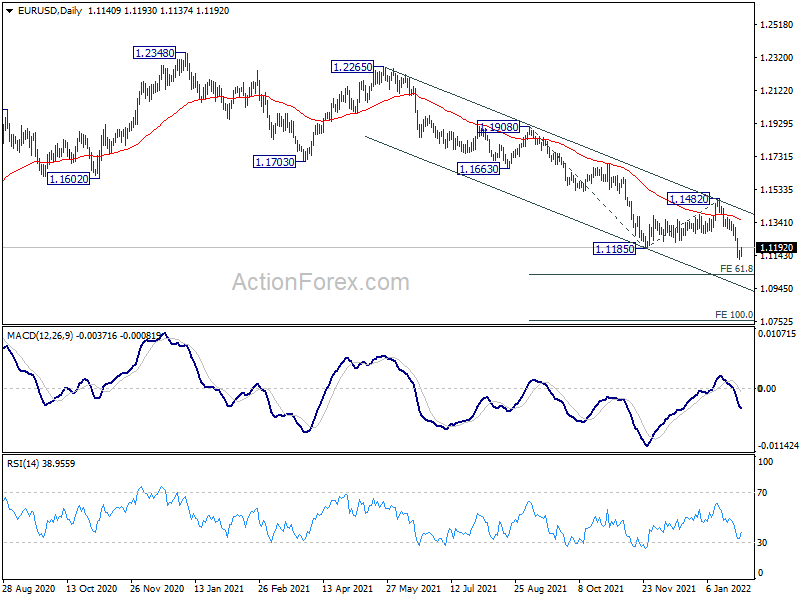
Intraday bias in EUR/USD is turned neutral with current recovery. Some consolidations could be seen but upside should be limited well below 1.1482 resistance. On the downside, break of 1.1120 will resume larger down trend to 61.8% projection of 1.1908 to 1.1185 from 1.1482 at 1.1035. Break will target 100% projection at 1.0759.
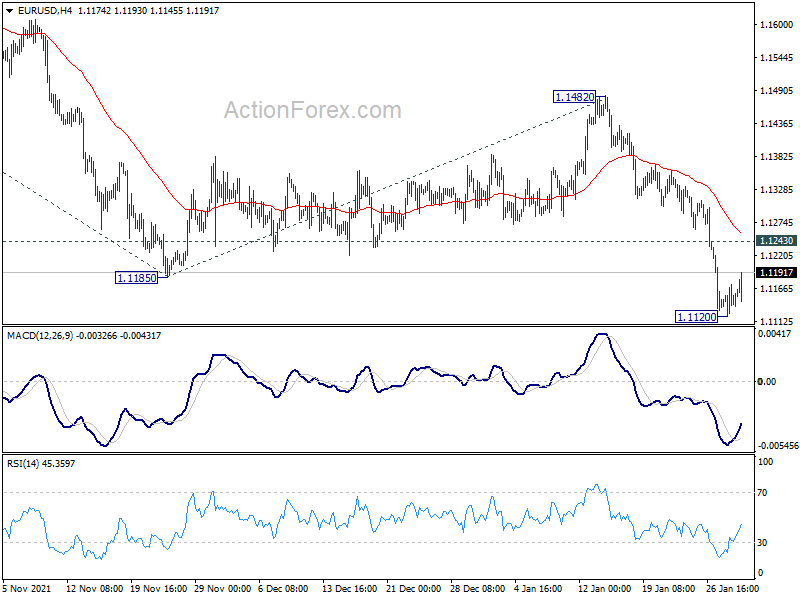
In the bigger picture, the strength of the the decline from 1.2348 (2021 high) suggests that it's not a corrective move. But still, it could be the fourth leg of a sideway pattern from 1.0339 (2017 low), or resuming long term down trend. In any case, outlook will now stay bearish as long as 1.1482 resistance holds. Next target would be 1.0635 low.
Euro Rebounds as German Benchmark Yield Turns Positive, Aussie Firmer ahead of RBA
Euro rebounds notably today as Germany 10-year yield turns positive. Nevertheless, Australian Dollar is even stronger as markets await RBA rate decision. On the other hand, Dollar and Yen are paring some recent gains. Sterling and Canadian Dollar are mixed.
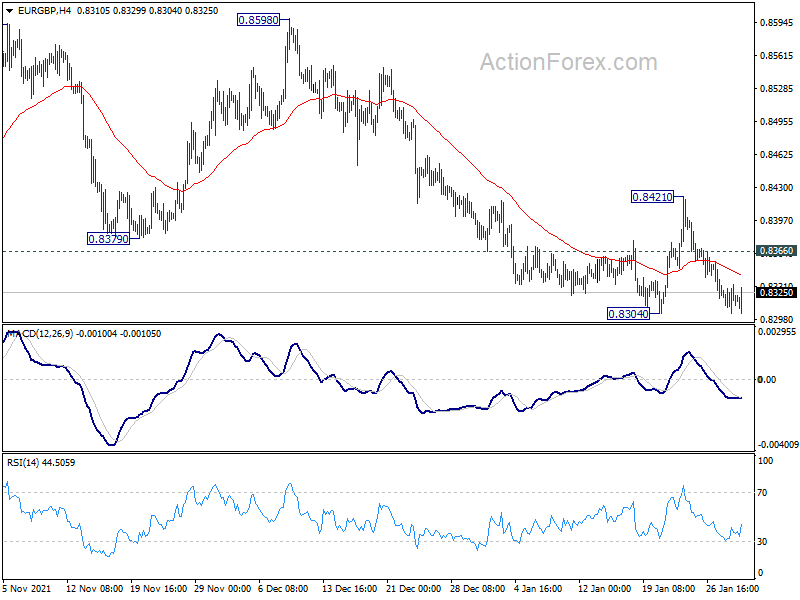
Technically, EUR/GBP appears to be drawing support from 0.8304. Rebound from current level, followed by break of 0.8366 resistance, would bring stronger rise to 0.8421 resistance. That could be a hint on some rise in Euro elsewhere. In particular, while a break of 1.0510 resistance in EUR/CHF is not expected, stronger rise in EUR/GBP could at least pull EUR/CHF closer to this 1.0510 resistance level.
In Europe, at the time of writing, FTSE is up 0.17%. DAX is up 0.61%. CAC is down -0.06%. Germany 10-year yield is up 0.063 at 0.020, turned positive. Earlier in Asia, Nikkei rose 1.07%. Hong Kong HSI rose 1.07%. China Shanghai SSE dropped -0.97%. Singapore Strait Times rose 0.10%. Japan 10-year JGB yield rose 0.0070 to 0.176.
Eurozone GDP grew 0.3% qoq in Q4, EU up 0.4% qoq
Eurozone GDP grew 0.3% qoq in Q4, slightly below expectation of 0.4% qoq. EU GDP grew 0.4% qoq. The 2021 annual growth was at 5.2% based on first estimation for both Eurozone and EU.
Among the EU Member States for which data are available, Spain (+2.0%) recorded the highest increase compared to the previous quarter, followed by Portugal (+1.6%) and Sweden (+1.4%). Declines were recorded in Austria (-2.2%), Germany (-0.7%) and in Latvia (-0.1%). The year on year growth rates were positive for all countries.
From Italy, GDP grew 0.6% qoq in Q4, above expectation of 0.5% qoq. Germany CPI slowed from 5.3% yoy to 4.9% yoy in January, above expectation of 4.3% yoy.
Japan industrial production dropped -1.0% mom in Dec, expected to rebound in Jan and Feb
Japan industrial production dropped -1.0% mom in December, worse than expectation of -0.8% mom. Manufacturers surveyed by the Ministry of Economy, Trade and Industry (METI) expected output to grow 5.2% in January and 2.2% in February.
Retail sales grew 1.4% yoy in December, below expectation of 2.7% yoy. That's nonetheless the third straight month of increase for sales, lifted by demand for general merchandise and food and beverages. Housing starts rose 4.2% yoy in December, versus expectation of 7.1% yoy. Consumer confidence dropped from 39.1 to 36.7, below expectation of 37.3.
AUD/NZD resumes rally as RBA awaited, some previews
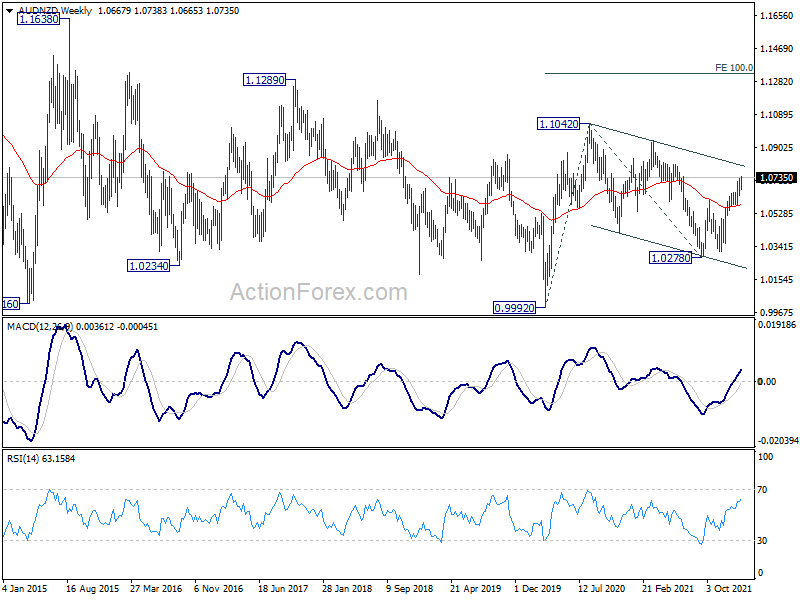
AUD/NZD rises sharply today as markets await RBA rate decision in the upcoming Asian session. Given the surprise drop in unemployment and strong inflation data, RBA is likely to just wrap up the QE program, rather than winding it down to end in May. That would also give the central bank some flexibility to raise interest rate to combat inflation. The question is how RBA would shape market expectation on the timing of the rate hike, or leave it to the Statement on Monetary Policy to be released later in the week. There is prospect of more upside in Aussie in crosses in RBA delivers something more hawkish than expected.
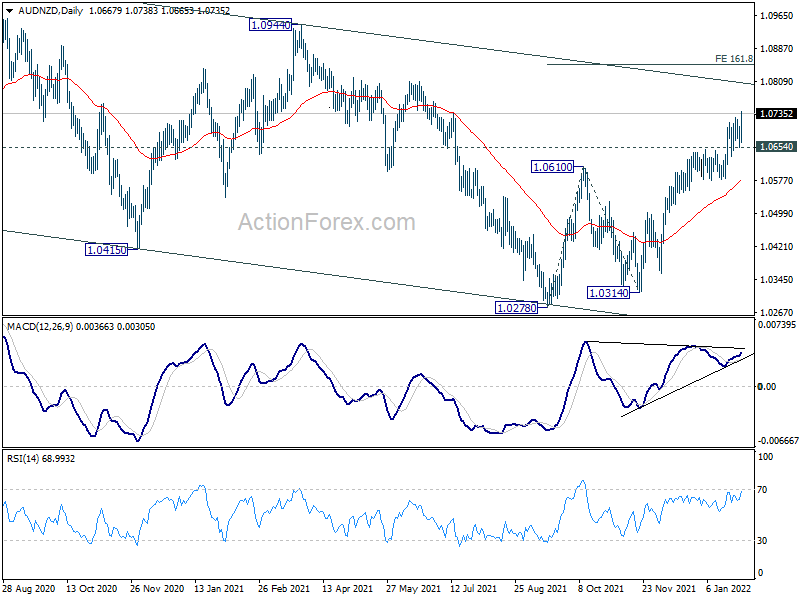
AUD/NZD's is now extending the whole rise from 1.0278. Next target is 161.8% projection of 1.0278 to 1.0610 from 1.0314 at 1.0851. A bullish scenario is that corrective fall from 1.1042 has completed with three waves at 1.0278 and rise from 0.9992 is ready to resume. The reaction to 1.0944 resistance will reveal if it's the case. For now, near term outlook will stay bullish as long as 1.0654 support holds, in case of retreat.
Suggested readings on RBA:
- Two Trades to Watch: EUR/USD, AUD/USD
- Aussie Storms Higher, RBA Next
- New Forecasts in RBA SOMP to Be Consistent with Rate Hike in 2022
- RBA to End QE and Bring Forward Rate Hike Guidance: AUDUSD
- RBA Meeting: Managing Rate Hike Expectations
EUR/USD Mid-Day Outlook
Daily Pivots: (S1) 1.1121; (P) 1.1148; (R1) 1.1173; More...
Intraday bias in EUR/USD is turned neutral with current recovery. Some consolidations could be seen but upside should be limited well below 1.1482 resistance. On the downside, break of 1.1120 will resume larger down trend to 61.8% projection of 1.1908 to 1.1185 from 1.1482 at 1.1035. Break will target 100% projection at 1.0759.
In the bigger picture, the strength of the the decline from 1.2348 (2021 high) suggests that it's not a corrective move. But still, it could be the fourth leg of a sideway pattern from 1.0339 (2017 low), or resuming long term down trend. In any case, outlook will now stay bearish as long as 1.1482 resistance holds. Next target would be 1.0635 low.
Economic Indicators Update
| GMT | Ccy | Events | Actual | Forecast | Previous | Revised |
|---|---|---|---|---|---|---|
| 23:50 | JPY | Industrial Production M/M Dec P | -1.00% | -0.80% | 7.00% | |
| 23:50 | JPY | Retail Trade Y/Y Dec | 1.40% | 2.70% | 1.90% | |
| 00:30 | AUD | Private Sector Credit M/M Dec | 0.80% | 0.70% | 0.90% | 1.00% |
| 05:00 | JPY | Housing Starts Y/Y Dec | 4.20% | 7.10% | 3.70% | |
| 05:00 | JPY | Consumer Confidence Index Jan | 36.7 | 37.3 | 39.1 | |
| 09:00 | EUR | Italy GDP Q/Q Q4 P | 0.60% | 0.50% | 2.60% | |
| 10:00 | EUR | Eurozone GDP Q/Q Q4 P | 0.30% | 0.40% | 2.20% | |
| 13:00 | EUR | Germany CPI M/M Jan P | 0.40% | -0.30% | 0.50% | |
| 13:00 | EUR | Germany CPI Y/Y Jan P | 4.90% | 4.30% | 5.30% | |
| 13:30 | CAD | Industrial Product Price M/M Dec | 0.70% | 0.80% | 0.80% | |
| 13:30 | CAD | Raw Material Price Index Dec | -2.90% | 0.60% | -1.00% | |
| 14:45 | USD | Chicago PMI Jan | 62.5 | 63.1 |
AUD/NZD resumes rally as RBA awaited, some previews
AUD/NZD rises sharply today as markets await RBA rate decision in the upcoming Asian session. Given the surprise drop in unemployment and strong inflation data, RBA is likely to just wrap up the QE program, rather than winding it down to end in May. That would also give the central bank some flexibility to raise interest rate to combat inflation. The question is how RBA would shape market expectation on the timing of the rate hike, or leave it to the Statement on Monetary Policy to be released later in the week. There is prospect of more upside in Aussie in crosses in RBA delivers something more hawkish than expected.
AUD/NZD's is now extending the whole rise from 1.0278. Next target is 161.8% projection of 1.0278 to 1.0610 from 1.0314 at 1.0851. A bullish scenario is that corrective fall from 1.1042 has completed with three waves at 1.0278 and rise from 0.9992 is ready to resume. The reaction to 1.0944 resistance will reveal if it's the case. For now, near term outlook will stay bullish as long as 1.0654 support holds, in case of retreat.
Suggested readings on RBA:
- Two Trades to Watch: EUR/USD, AUD/USD
- Aussie Storms Higher, RBA Next
- New Forecasts in RBA SOMP to Be Consistent with Rate Hike in 2022
- RBA to End QE and Bring Forward Rate Hike Guidance: AUDUSD
- RBA Meeting: Managing Rate Hike Expectations
Brent Crude Oil Going for a Record
The commodity continues rallying. On Monday, 31 January, Brent is trading above $91 and may soon update its highs.
The key trigger that pushes the rally is that investors remain confident of the supply shortage in the commodity market. It was suggested earlier that the demand might become surplus in 2022 but there are no reasons for that so far.
Another factor that makes the oil price rise is the escalation in the Middle East with explosions in Iraq and the United Arab Emirates. They raise concerns about future oil deliveries and help the commodity market to go higher.
As a result, the market remains bullish and bullish only.
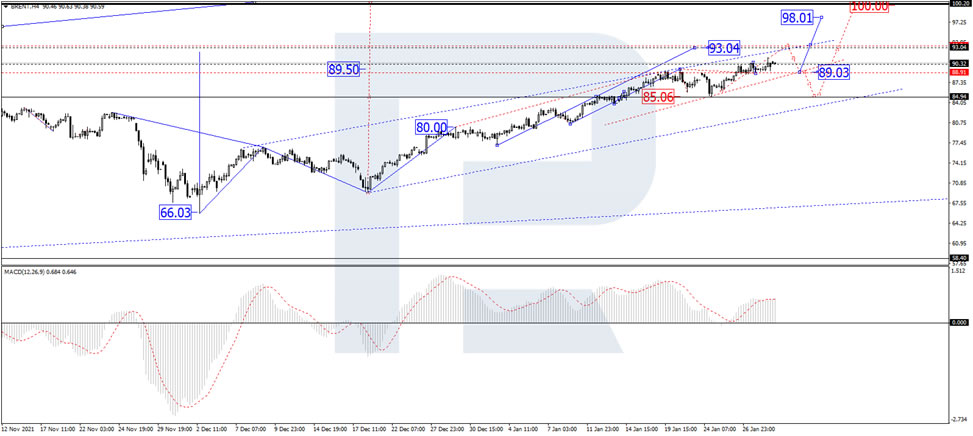
In the H4 chart, having completed the ascending structure at 88.85 along with the correction down to 85.00, Brent has rebounded from the latter level; right now, it is trading upwards with the target at 93.00. After that, the instrument may correct to return to 88.85 and then form another ascending structure to reach 95.00. From the technical point of view, this scenario is confirmed by MACD Oscillator: its signal line is moving above 0 inside the histogram area, thus indicating a further uptrend in the price chart.
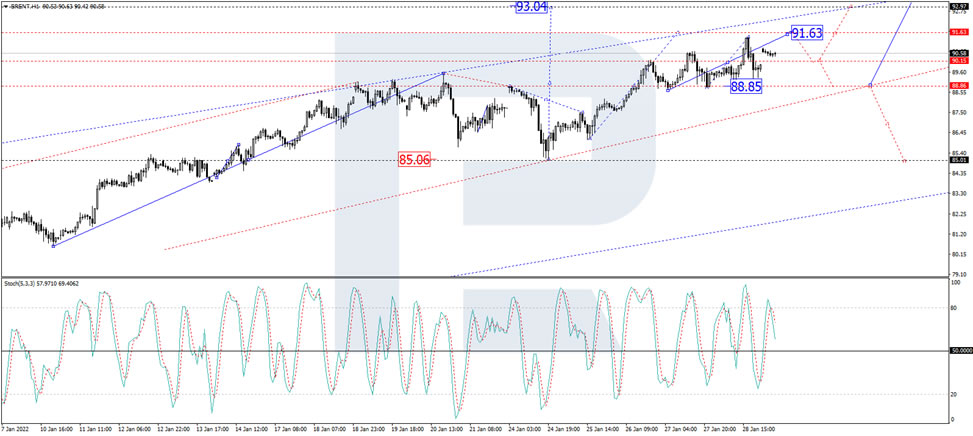
As we can see in the H1 chart, after forming a new consolidation range around 90.15 and breaking it to the upside, Brent has reached the short-term target at 91.40. Today, the asset may continue growing towards 91.63 and then correct to return to 90.15. Later, the market may resume trading upwards with the target at 93.00. From the technical point of view, this idea is confirmed by the Stochastic Oscillator: after breaking 50 to the upside, its signal line is expected to continue growing and reach 80. Later, it may resume falling to reach 20.
Equities Try to Stabilise Following Sharp Selloffs
January has been a month to forget for many investors after hundreds of billions of dollars were wiped off equity and bond markets. Traders have shifted from the speculative corners of the market to safe haven assets as global stocks have tumbled over the past four weeks. Unprofitable growth companies, cryptos, and SPACs have felt most of the pain as the Federal Reserve prepares for its war against inflation, clearly indicating that the game has now changed following two years of extraordinary easy monetary policy.
The Fed last week indicated it would lift interest rates in March for the first time since 2018, with markets guessing how many more hikes would occur during the rest of the year. Raphael Bostic, President of the Fed's Atlanta branch, even hinted at the possibility of a 50-basis point rate hike in March and raising rates at each of the seven remaining policy meetings. However, his base case scenario remains three 25-basis point increases for this year, though much will depend on economic data.
Stocks in Europe and the US are set to open in positive territory for the month's final trading day following a rally in Asian equities. Investors' fear over the prospect of tighter monetary policy has eased somewhat, and safe havens like the US dollar and Treasuries have retreated. Still, it’s a busy week full of risk events and a lot will depend on the upcoming economic data, corporate earnings, and monetary policy meetings from the BoE and the ECB.
So far, a third of the companies in the S&P 500 have reported Q4 2021 results, with 77% managing to beat EPS estimates. However, the beats are coming at a smaller margin than the 5-year average, which explains why earnings have not been very supportive of equity indices. More than 100 S&P 500 companies are due to announce results this week, including tech giants Alphabet, Meta, and Amazon. Given the new environment we're living in today, it will require robust results and positive guidance to encourage investors to buy the latest dip in the growth sector.
On the data front, all eyes will be on Friday's US non-farm payrolls report. The US economy is expected to have added 175,000 jobs in January, compared to 199,000 last month. However, estimates vary widely due to the disruption from the Omicron coronavirus, with some even predicting a negative print. Previously, the bad news was conceived as good news as a deteriorating jobs market meant further monetary policy easing. This time, a negative print shouldn’t deter the Fed from tightening policy, as the central bank focuses on rampant inflation. That's why it makes more sense to focus on wage growth rather than the headline jobs figure in the report. Tuesday's ISM Manufacturing PMI and Wednesday's ISM Services PMI will also provide further guidance on the inflation trajectory and should be on the radar of investors.
Canadian Dollar Starts Week Higher
It was a week to forget for the Canadian dollar. USD/CAD jumped 1.51%, marking the Canadian dollar’s worst weekly performance since mid-August. The currency is in positive territory, as USD/CAD is down 0.31% on the day.
Canada releases the Raw Materials Price Index later today. The inflation index is expected to decline -1.3%, following a -1.1% beforehand. This week’s highlight is GDP for November, which will be released on Tuesday.
In the US, the week wrapped up with mixed numbers. The Fed’s preferred inflation gauge, the Core PCE Price Index, rose in December 4.9% y/y, up from 4.7% and above the forecast of 4.8%. This marks the highest gain since 1983 and reinforces expectations that the Fed will act aggressively to curb surging inflation. However, personal income rose 0.3% m/m, less than the 0.4% consensus. Consumer spending declined by -0.6%, less than the forecast of -0.7%. As well, UoM Consumer Sentiment fell from 6.8 to 67.4, its lowest reading since 2011.
These numbers point to weakness in consumer spending and confidence, which makes for a confusing picture, given that inflation is running rampant. The markets are having difficulty figuring out how many rate hikes are on the way, and Fed policymakers also have differing views on the subject.
Fed poised to raise rates
How hawkish will the Fed be? It is unclear, with forecasts ranging between 3 and 7 hikes this year. A March liftoff seems assured, with the likelihood of a quarter-point hike at 84%, and a 50-bps rise priced at 15%. Traditionally, the Fed raises rates in 0.25% increments, and that’s likely what it will deliver. However, a 0.50% hike cannot be ruled out, even though the Fed hasn’t implemented such a large hike in twenty years. Such a dramatic move would send a decisive message to the markets that the Fed means business and is determined to stamp out high inflation. The Fed could use a credibility-booster after Jerome Powell stuck to the ‘transient inflation’ script even when it was glaringly evident that surging inflation wasn’t going anywhere.
USD/CAD Technical
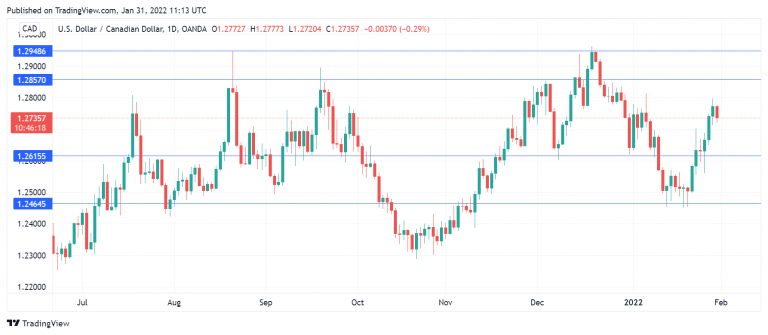
- USD/CAD faces resistance at 1.2857 and 1.2948
- There is support at 1.2615 and 1.2464
EUR/USD Elliott Wave Analysis: More Weakness ahead
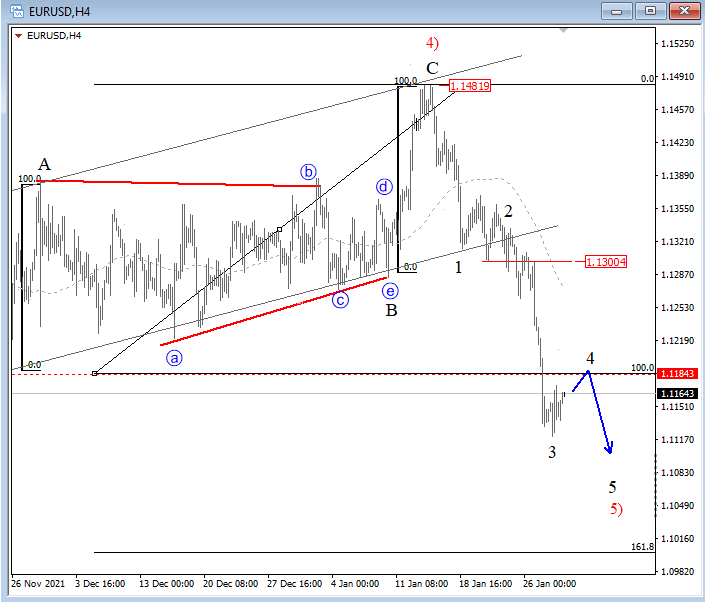
The USD slowed down as US stocks turned higher on Friday, but this can be only a temporary slowdown as stocks may remain in downtrend due to risks between US and Russia. However, there are RBA, BOE and ECB, scheduled for this week, which can be catalysts for some dollar resistance, especially as other CB may follow the FED.
EURUSD is coming to the downside on 4h chart, now even accelerating after hawkish FED last week, so it appears that more weakness is in play now for a fifth wave, which should be completed by a five-wave cycle. This can then be the final leg of wave C) when looking at higher degree waves.
EUR/USD 4h Elliott Wave analysis
EUR/USD Outlook: Limited Correction Likely to Precede Fresh Weakness
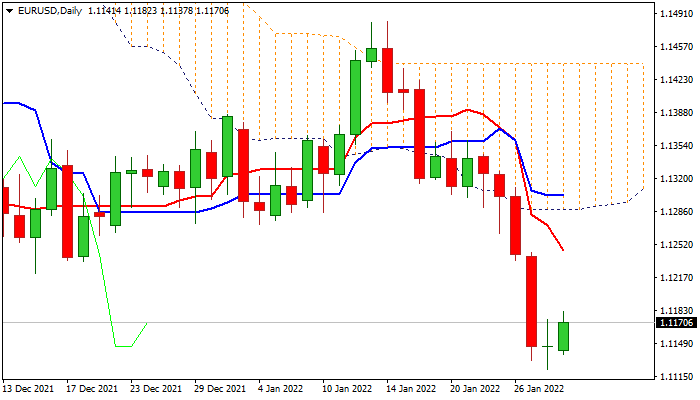
Bears are consolidating above new seven-month low (1.1145, posted on last week’s 1.74% fall) on Monday, with limited bounce before larger bears regain full control, seen as likely scenario.
Oversold stochastic on daily chart signals correction, but 14-period momentum on both, daily and weekly chart, remains deeply in negative territory, reinforcing underlying bearish bias.
Upticks should be capped by strong barriers at 1.1260/90 zone (Fibo 38.2% of 1.1482/1.1121 bear-leg / base of thick daily cloud) to keep bears in play for fresh push towards targets at 1.1040/00 (Fibo 76.4% of 1.0635/1.2349 / psychological).
Fundamentals may also work against the single currency, as ECB is expected to stay on hold on its policy meeting due later this week, that would add to concerns about accelerating divergence from the US Federal Reserve, after the Fed chief Powell sent signals for four rate hikes this year.
Res: 1.1200; 1.1260; 1.1290; 1.1305.
Sup: 1.1121; 1.1100; 1.1040; 1.1000.
US Dollar Index: Dollar Pulls Back from New Multi-Month High on Overbought Conditions
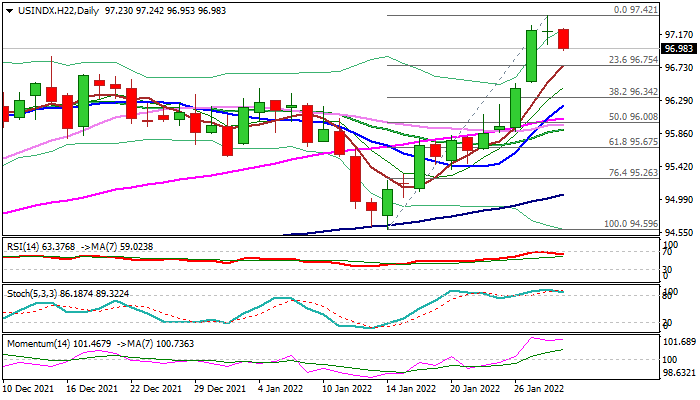
The dollar index edges lower in early Monday’s trading, following last week’s 1.6% advance (the biggest weekly rally since early June 2021) that resulted in hitting the highest in 18 months.
The greenback was lifted by growing expectations for US rate hikes after more hawkish than expected Fed (market expectations for four rate hikes by the end of the year rose above 90%), increased demand for safe-haven assets amid growing geopolitical tensions and weak and volatile equities.
The dollar is on course for solid gains in January, with long-tailed monthly candle suggesting that the downside is well protected and adding to positive signals.
However, overbought conditions on daily chart suggest bulls may take a breather, with bearish close on Monday to complete reversal pattern and signal correction.
Initial support lays at 96.75 (5DMA/Fibo 23.6% of 94.59/97.42 upleg), with extended dips expected to find firm ground at 96.30 zones (top of thick daily cloud/Fibo 38.2% of 94.59/97.42 upleg/rising 10DMA) to keep larger bulls in play and offer better buying opportunities.
Caution on potential loss of 96.30 zones supports that would risk deeper pullback towards 96.00/95.67 (Fibo 50% and 61.8% retracement respectively).
Res: 97.42; 97.78; 98.00; 98.20.
Sup: 96.75; 96.45; 96.30; 96.00.
Dollar Stands Tall, Stocks Rescued by Dip Buyers
- Dollar defends gains, awaits barrage of US economic data
- Stocks bounce back, yen retreats as nerves calm down
- Three major central bank meetings and tech earnings lie ahead
Risk tone improves
Market volatility has returned with a vengeance this month. A sharp repricing in the trajectory for interest rates has sent nervous investors scrambling to insulate their portfolios from any further damage, mostly by reducing leverage and moving higher along the quality spectrum.
Money markets have fully priced in five quarter-point rate increases by the Fed for this year and a similar path for economies like the United Kingdom, Canada, Australia, and New Zealand. This has propelled yields on government bonds much higher, which acts like gravity for riskier assets, knocking the wind out of the stock market.
The good news is that this correction reflects changing views about market conditions, not the real economy. Central banks are trying to raise rates precisely because their economies are solid enough to withstand that, so even though investors might protest, it is ultimately a healthy sign.
As long as recession alarms are not going off, any correction in equities seems like a longer term opportunity in a market that is still starved for yield, especially with valuations becoming more reasonable. This might be what helped Wall Street bounce back on Friday to close the week higher, along with some cheerful earnings from Apple.
Dollar remains elevated, yen retreats
The dollar has been a natural winner in this environment, benefiting both from bets that the Fed will take a sledgehammer to inflation and from the general flight to safety.
Traders have started to flirt with the idea that the Fed could kick off its tightening cycle in March with a shock-and-awe rate hike of 50 basis points after policymakers refused to rule that out. As such, this week’s data releases could be crucial for the greenback, with Friday’s employment report likely to steal the show.
Meanwhile, the beaten-down commodity currencies are enjoying a rare show of strength to start the week while the defensive Japanese yen is on the ropes, mirroring the improvement in risk sentiment. Even the beleaguered euro managed a small rebound after Mario Draghi stayed on as Italian prime minister, fueling hopes he might get to implement a growth-friendly agenda.
China slows, central bank fiesta ahead
Over the weekend, Chinese business surveys painted a grim picture of the world’s second largest economy as the draconian responses to covid outbreaks held back demand and exacerbated supply shocks.
Chinese markets will stay closed for the entire week in celebration of the Lunar New Year, along with other financial hubs across Asia in the next few days. This implies that liquidity will be even thinner during the Asian trading session, putting traders on alert for sharp moves or even flash crashes.
There isn’t much on the agenda for today but the rest of the week promises to be very entertaining with central bank meetings in Australia, the Eurozone, and United Kingdom, the latest edition of nonfarm payrolls, and earnings results from tech heavyweights like Google and Amazon. The Reserve Bank of Australia will get the show rolling early on Tuesday.
With the economy improving, there is growing speculation the RBA will end asset purchases immediately and signal that rate hikes are on the menu this year. However, that might not be enough to lift the aussie, as policymakers could also warn that the five rate hikes currently priced into markets by December are excessive.