

Sample Category Title
Eurozone GDP grew 0.3% qoq in Q4, EU up 0.4% qoq
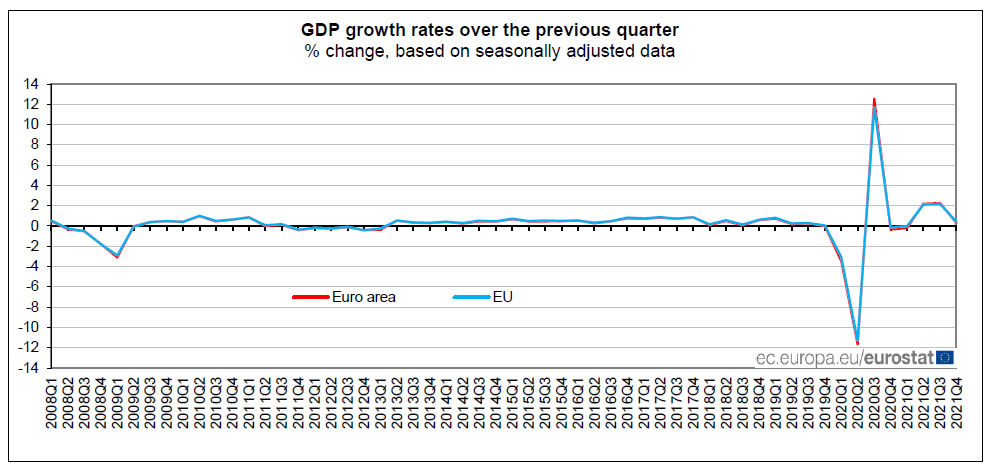
Eurozone GDP grew 0.3% qoq in Q4, slightly below expectation of 0.4% qoq. EU GDP grew 0.4% qoq. The 2021 annual growth was at 5.2% based on first estimation for both Eurozone and EU.
Among the EU Member States for which data are available, Spain (+2.0%) recorded the highest increase compared to the previous quarter, followed by Portugal (+1.6%) and Sweden (+1.4%). Declines were recorded in Austria (-2.2%), Germany (-0.7%) and in Latvia (-0.1%). The year on year growth rates were positive for all countries.
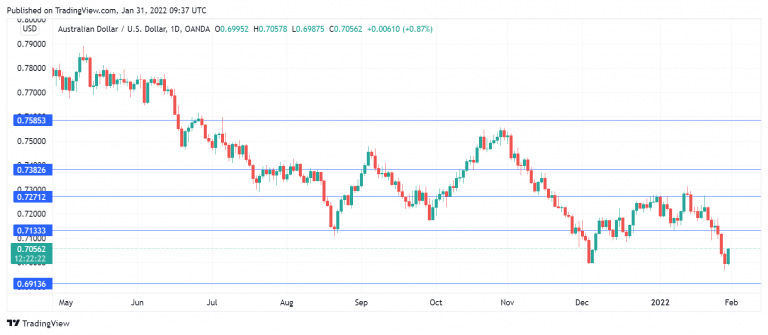
Aussie Storms Higher, RBA Next
We continue to see significant volatility from the Australian dollar. Last week, AUD/USD plunged 2.51%, its worst week since mid-August. After three straight days of losses, the currency has roared back with gains of close to 1% and is back above the symbolic 0.70 level.
The RBA meets on Tuesday and is expected to maintain the Cash Rate at a record low of 0.10%. Still, it will be a significant meeting, as the central bank will wind up its QE programme after 15 months and also revise upwards its inflation forecast.
The Australian recovery continues to gather steam. The labour market has strengthened and inflation continues to rise, although not at the levels we’re seeing in the US and the UK. The unemployment rate has dropped to 4.2% and core CPI has climbed to 2.6%. These are good numbers, but not quite good enough to justify a rate hike in the eyes of the RBA. Governor Lowe has stated that he wants to see unemployment at 4.0% and inflation “sustainably” around 2.5% before he will press the rate trigger. The main factor restraining the RBA from a hike remains wage growth, which is around 2.2%. Lowe has said wages must rise to 3% before a rate move; otherwise, the rise in inflation is temporary.
The RBA had said it would not raise rates until 2024 but has been forced to bring forward its forecast, with unemployment falling and inflation rising more quickly than the bank expected. The most likely scenario is liftoff in the third quarter of 2022 and the markets hope to get more insight from Lowe at Tuesday’s meeting.
In the US, the Fed’s favorite inflation metric, the Core PCE Price Index, rose in December 4.9% y/y, up from 4.7% and above the forecast of 4.8%. This marks the highest gain since 1983 and reinforces expectations that the Fed will act aggressively to curb surging inflation. The markets have priced in five rate hikes in 2022, with the CME Group’s FedWatch pricing in a March hike of a quarter-point at 85%.
AUD/USD Technical
- AUD/USD faces resistance at 0.7133. Above, there is resistance at 0.7271
- There is support at 0.6913 and 0.6831
NZDUSD Reached 16-month Low; Bearish Forces Linger
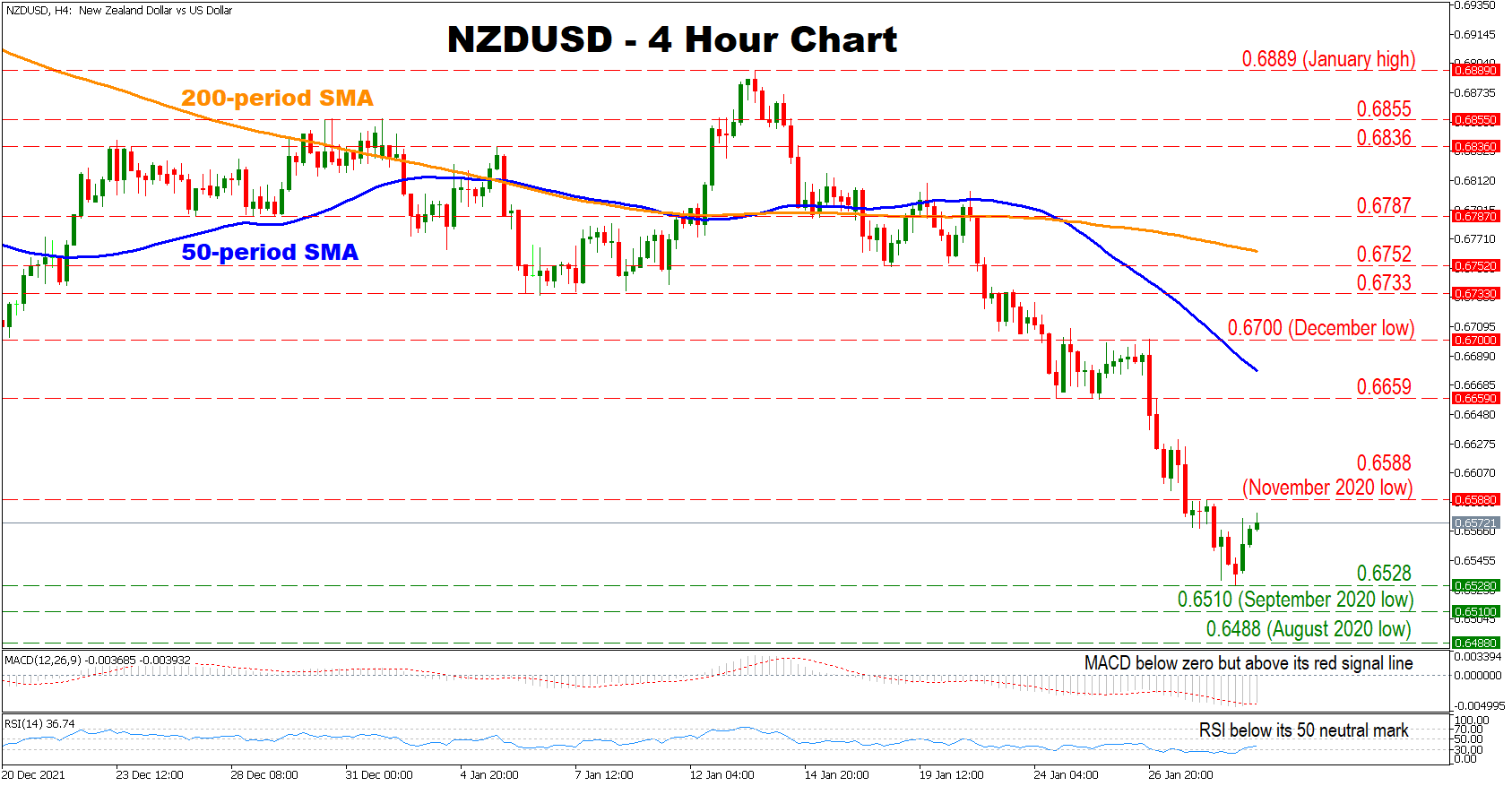
NZDUSD continued its retreat in January reaching a 16-month low amid strong negative forces. Moreover, the pair is currently trading way below its 50- and 200-period simple moving averages (SMA), with the former crossing below the latter, reinforcing fears of a sustained bearish outlook.
Short-term momentum indicators are reflecting a mixed picture as the RSI is located below its 50 neutral mark. However, the MACD is found above its red signal line despite being in negative territory, which indicates that the negative momentum might be fading.
Should the bears maintain control, initial support might be found at the 0.6528 hurdle. Crossing below this point could intensify selling pressures, opening the door towards the September 2020 low at 0.6510. A break below the latter might shift seller’s attention towards the August 2020 low at 0.6488.
On the flip side, initial resistance might be found at the November 2020 low at 0.6588, before buyers eye the 0.6659 obstacle. A decisive move above this point could send the price to test the 50-period SMA currently at 0.6679. Surpassing the latter could turn the fortunes around for the pair, sending the price to test the December low at 0.6700 and the 0.6733 barrier, consecutively.
In brief, the short-term outlook for the pair is bearish. For sentiment to change, buyers would need to break above the 50-period SMA.
Gold’s Collapse Subsides but Downside Risks Remain
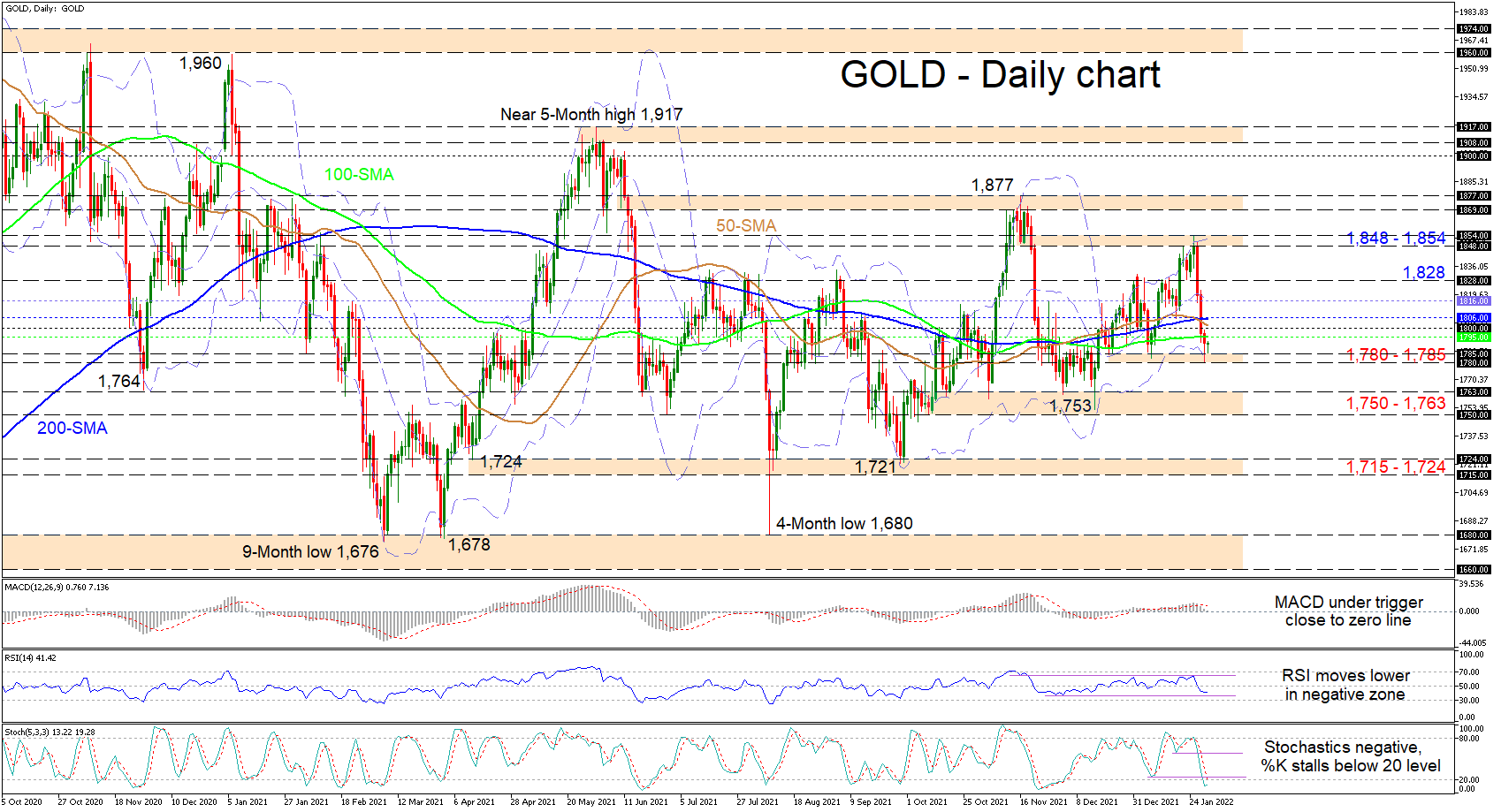
Gold has found some footing in the vicinity of the lower Bollinger band and recent trading session troughs, following a freefall in the commodity - due to a more aggressive message from the Federal Reserve regarding rate hikes in 2022 - from 1,854, which extended below the simple moving averages (SMAs) and the 1,800 handle. The dipping 50-day SMA is reflecting that the trend in the commodity has become increasingly negative.
The short-term oscillators are skewed to the downside but have yet to fully validate that bearish momentum could continue to run hot. The MACD is falling below its red trigger line but has yet to pierce beneath the zero threshold, while in oversold territory, the stochastic %K line, is hinting that negative pressures have become somewhat frail for now. Nonetheless, the RSI is diving in bearish regions, promoting growing downside momentum in the commodity.
In the negative scenario, support could originate from the 1,780-1,785 area, where the lower Bollinger band also resides. If selling interest intensifies again, the price may then tackle the 1,750-1,763 support barricade, which began to take shape around October 2021. A breach of this medium-term base could then cheer sellers to aim for the 1,715-1,724 border that has opposed negative pressures since April 2021.
On the other hand, if buyers manage to find some traction off the lower Bollinger band, an initial zone of resistance could start to emerge from the 100-day SMA at 1,795 until the 200-day SMA at 1,806. Overstepping this crowded section of obstacles, the upside momentum may then stall around the mid-Bollinger band at 1,816. However, if the bulls remain energized, they could drive the price past the inside swing low of 1,828 and challenge the 1,848-1,854 resistance barrier.
Summarizing, gold is sustaining a neutral bias despite recent significant selling. That said, buyers could regain an upper hand if the price pilots above the mid-Bollinger band, while sellers would take the lead should the price slide below 1,780-1,785. Furthermore, the precious metal has been oscillating for more than half a year between 1,715 and 1,877.
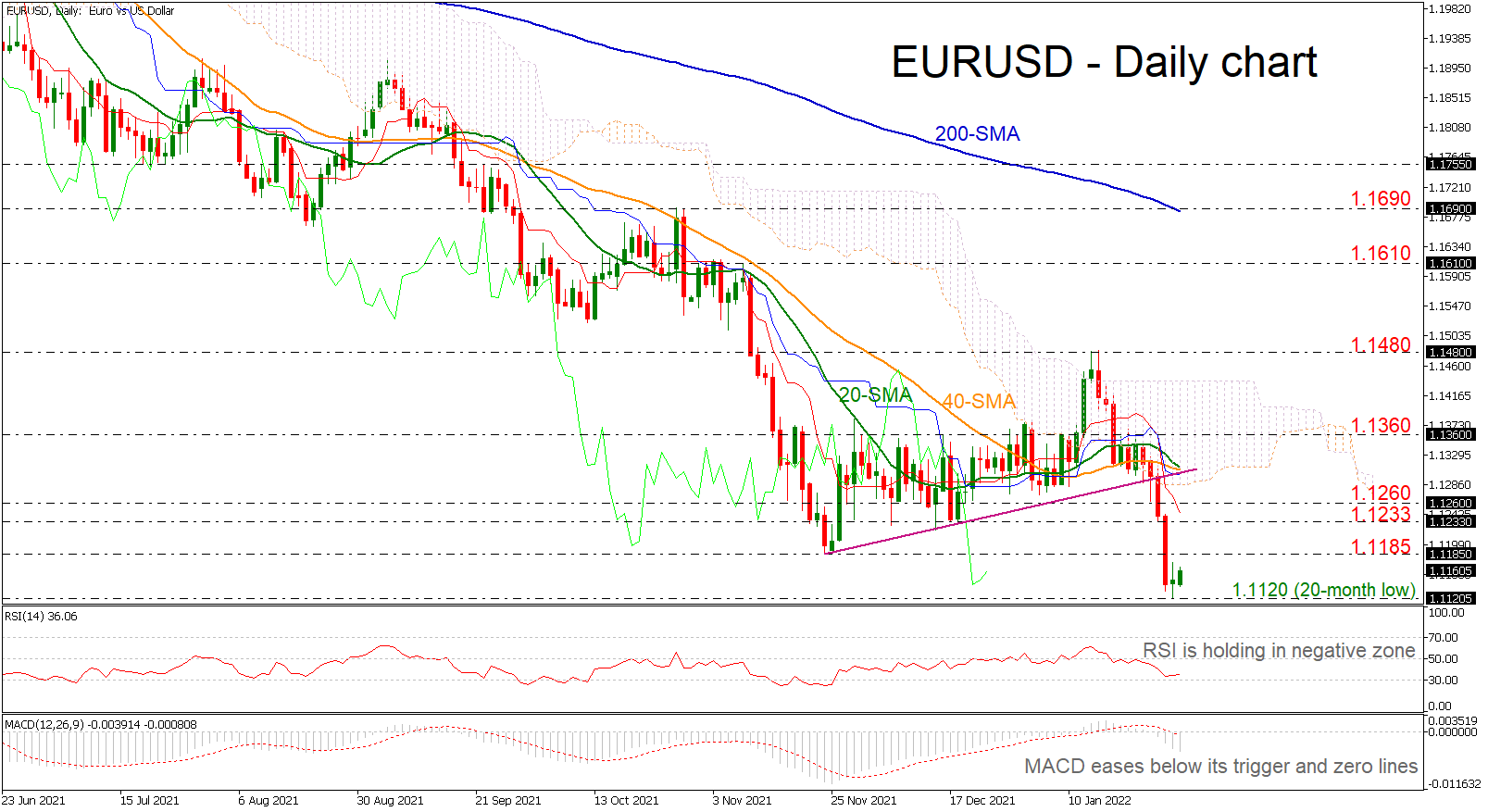
EURUSD Recoups Some Losses from 20-Month Low; Broader Outlook is Bearish
EURUSD rebounded off the 20-month low of 1.1120 that it posted in the previous week after the aggressive downside move below the short-term ascending trend line.
Technically, the 20- and 40-day simple moving averages (SMAs) are ready for a bearish cross in the short-term, and the MACD oscillator is extending its bearish structure below its trigger and zero lines. However, the RSI indicator is pointing upwards in the negative region.
A successful move higher, may find immediate resistance at the 1.1185 barrier ahead of the 1.1233-1.1260 restrictive zone. Surpassing these levels, the bulls may re-challenge the lower surface of the Ichimoku cloud at 1.1290, which stands near the rising line and the short-term SMAs. If the bulls retake charge, the 1.1360 barrier could come in focus.
In the negative scenario, if there is a drop below the latest low of 1.1120, the currency pair could slip until the 1.1015 support, taken from the inside swing low of April 2020. Steeper declines could open the way for a dive until the 1.0765 hurdle, registered in May 2020.
All in all, EURUSD has been in a somewhat upside recovery over the last couple of days, but the broader outlook has shifted to bearish after the new lower low.
Daily Technical Analysis
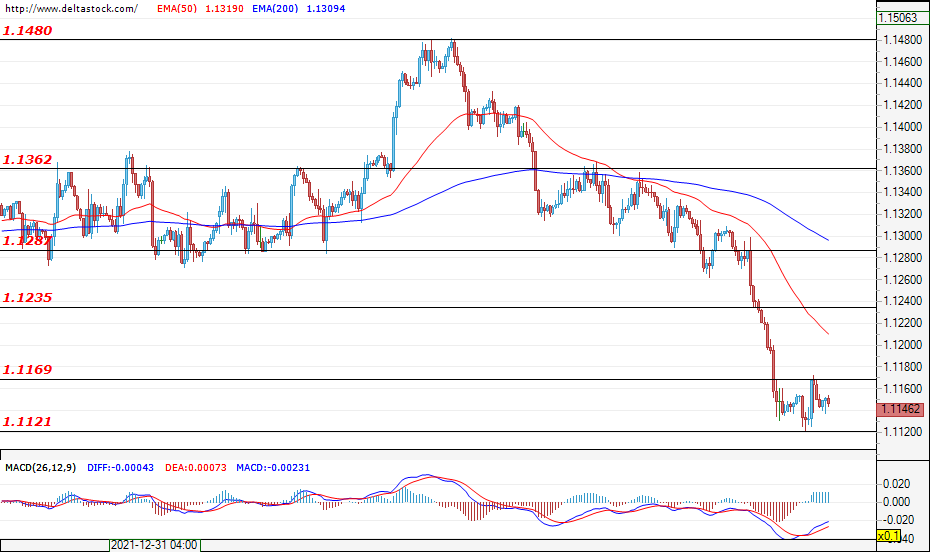
EUR/USD
USD/JPY
GBP/USD
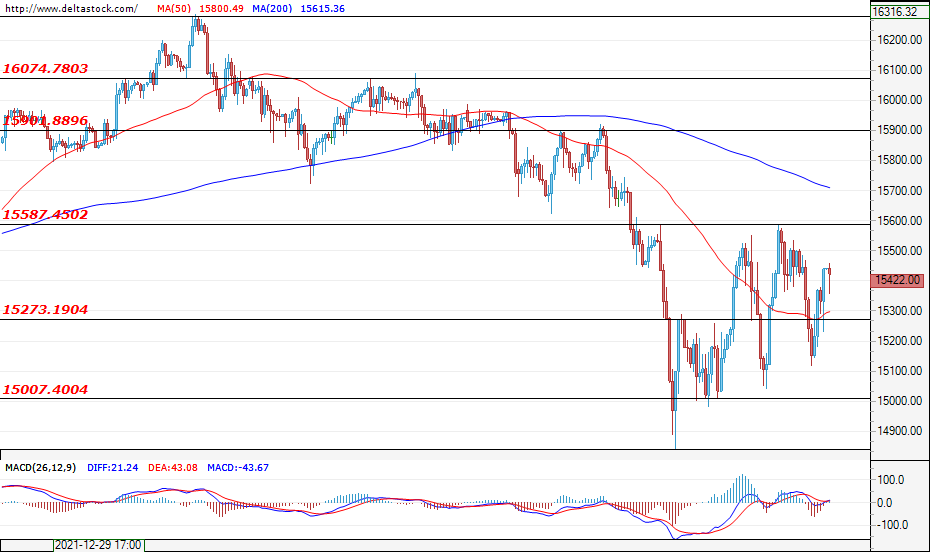
EURGERMANY40
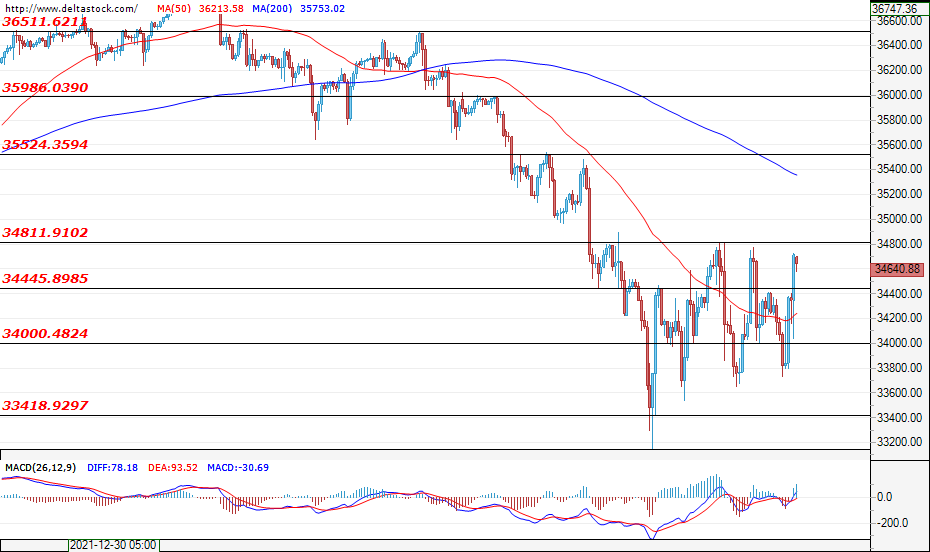
US30
Trading in Europe and US Bound for a Slow Start
Markets
US stock markets ended the week in the way they started: with serious volatility. Opening gains quickly faded into <1% declines before a furious late-session rally hurled the likes of the Nasdaq to more than 3% higher. Solid big-tech earnings (Apple) helped counter geopolitical and Fed policy uncertainty. Core bonds parted ways. USTs gained, bull steepening the curve with changes ranging from -2.6 to 4.6 bps at the short end and -1.8 to -2.9 bps for long tenors. German yields added 0.4 bps (2y) to 1.4 bps (10y). The USD held on to its gains and in some cases (AUD, NZD) extended the bull run on Friday. The trade-weighted dollar index eked out a new recovery high at 97.27. EUR/USD stuck near recent lows around the 1.1163 support (March 2020 interim high). EUR/GBP traded similarly with the pair unable to leave the two-year lows near the 0.83 zone behind. An FT weekend interview and Chinese data are talk of the town this morning. About the former: Atlanta Fed governor Bostic told the Financial Times that every option is on the table, including a 50 bps rate hike if the data warrant it. He’s the first Fed member to mention it this explicitly. On the date front, Chinese PMIs signaled further loss of economic momentum. The Caixin gauge (from Markit) for manufacturing even fell into contraction territory (49.1 vs 50 expected). A factory slowdown is not unusual in the run-up to the one-week holiday for China’s Lunar New Year. It’s testament to the overall economic easing (Covid nonetheless. Anyway, Asian-Pacific stocks kick off the week in good spirits with gains of 1%. Core bonds decline with the short end underperforming, probably in response to the Bostic interview. The dollar is catching a breath after a stellar run last week. Trading in Europe and the US is bound for a slow start given the bulging economic calendar, allowing a currently optimistic sentiment and technical considerations to take the driver’s seat for now. That’s to change later this week though. The Bank of England is due for a back-to-back rate hike on Thursday. The ECB is likely to keep looking the other way even if inflation, published the day before, will remain way above target. It will probably prevent the euro a meaningful comeback, if any. We’re keen to see rates markets react though. They will probably keep the pressure high. Euro area money markets are currently discounting more than two 10 bps rate hikes by end 2022. ISM business confidence and the first payrolls report of 2022 are due in the US. Central banks in Australia and the Czech Republic fill in some of the remaining gaps.
New Headlines
Slovenian parliament will today vote on a measure which puts a retroactive cap on the FX losses suffered by borrowers in low-yielding foreign currencies like the Swiss franc. Several other CEE-countries are already dealing with this problem. Under Slovenian the proposal, which was labelled problematic for the local banking sector by a non-binding ECB-opinion, banks would need to repay for any extra costs incurred beyond 10% going back to 2004. Banks warn that costs will be much larger than the €300mn estimated by in the proposed bill. The latter also includes penalties and potential revocation of banking licenses if financial institutions fail to repay borrowers in time. Eighth time is a charm. The eight ballot to find a new Italian president finally delivered an (unexpected) winner on Saturday. The outgoing president, 80-yr old Mattarella, who previously said that he was no longer the best fit and unwilling to stand for re-election, will stay on. “Duty of the nation, must prevail over my own personal choices”. Mattarella’s re-election means that the ultimate goal – keeping Draghi on as PM of the government as national unity – was reached. The presidential ballot showed how fragile the collaboration between centre-left and centre-right blocs is. They hope that Draghi will steer them through a difficult 2022 reform year, avoiding snap elections and political chaos ahead of the planned ballot in 2023.
Stock Futures Tilt Upwards ahead of Amazon and Alphabet Earnings
American futures tilted higher cautiously as investors waited for key quarterly earnings scheduled for this week. Some of the top companies expected to publish their results are Amazon, Alphabet, AMD, Pentair, Meta Platforms and Electronic Arts. On Amazon, analysts expect that the company’s business did well in the fourth quarter, helped by cloud segment.
Analysts will watch Alphabet’s and Meta’s business because of their advertising business. The fourth-quarter is usually a good period for the businesses as companies boost their holiday marketing budget. On EA, analysts will be watching for the company’s reaction to the ongoing wave of mergers and acquisitions in the gaming industry.
The price of crude oil rose in early trading as investors watched the situation between the United States and Russia. Most Western countries have said that they will not commit their militaries to fight for Ukraine. Therefore, the main policy response to Russia will be sanctions, which will target most industries, including the oil and gas one. As such, there is a likelihood that there will be an oil supply shortage. Another major concern is in the natural gas industry. There is a likelihood that Russia will respond by cutting off gas supplies to Europe which explains why the price of natural gas has surged.
The economic calendar will have some key economic data today. On Sunday, data from China showed that the country’s manufacturing sector continued to struggle in January as the cost of doing business escalated. Later today, Eurostat will publish the latest GDP data from the European Union. Analysts expect the data to show that the bloc’s economy expanded by 4.7% in the fourth quarter. That growth will be driven by countries like France and Spain that had a strong economic growth. Other data to watch today will be the latest Germany CPI data and its import and export price index.
EURUSD
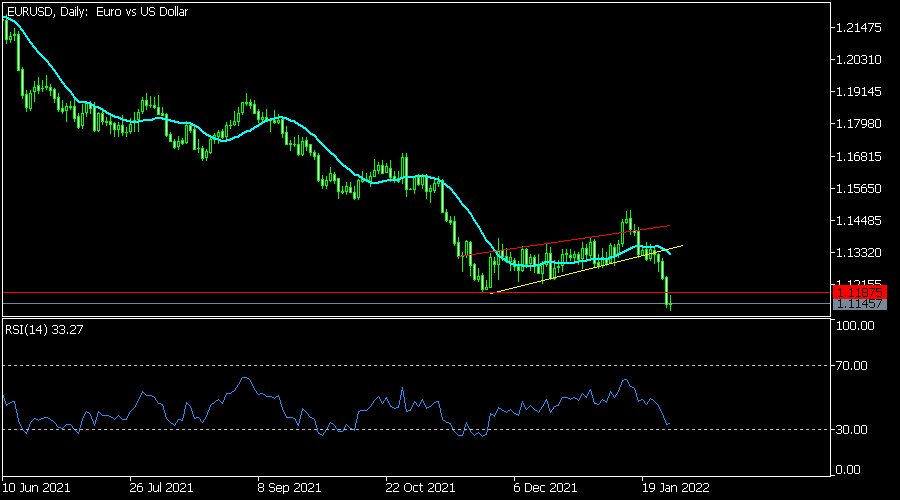
The EURUSD pair has been in a strong bearish trend over the past few days. On the daily chart, the pair managed to break below the bearish flag pattern. It also declined below the 25-day and 50-day moving averages while the Relative Strength Index (RSI) is approaching the oversold level. Therefore, the pair will likely continue falling as bears target the next key support at 1.1100.
USDCHF
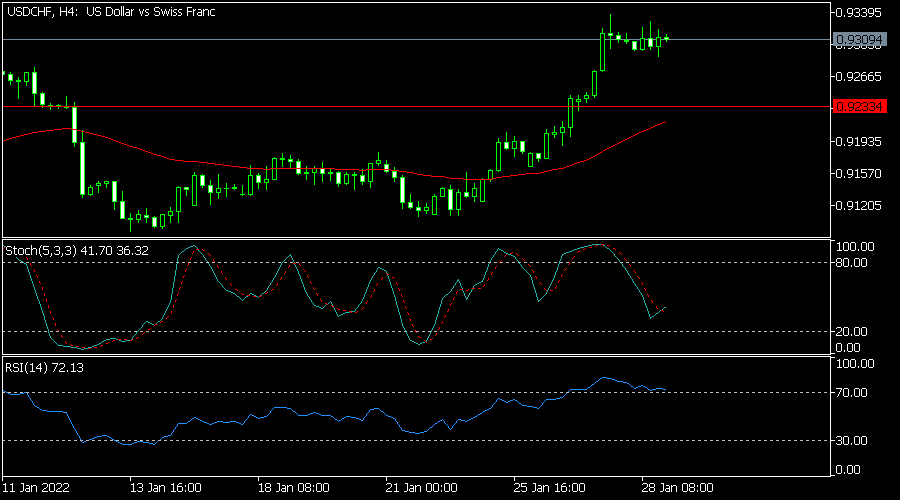
The USDCHF pair continued its bullish momentum as the US dollar strength continued. The pair is trading at 0.9300, which is slightly below last week’s high of 0.9335. On the four-hour chart, the pair has moved above the 25-day and 50-day moving averages. The Relative Strength Index (RSI) has also moved to the overbought level of 70 while the Stochastic Oscillator has stated declining. Therefore, there is a likelihood that the pair will continue rising ahead of US jobs data.
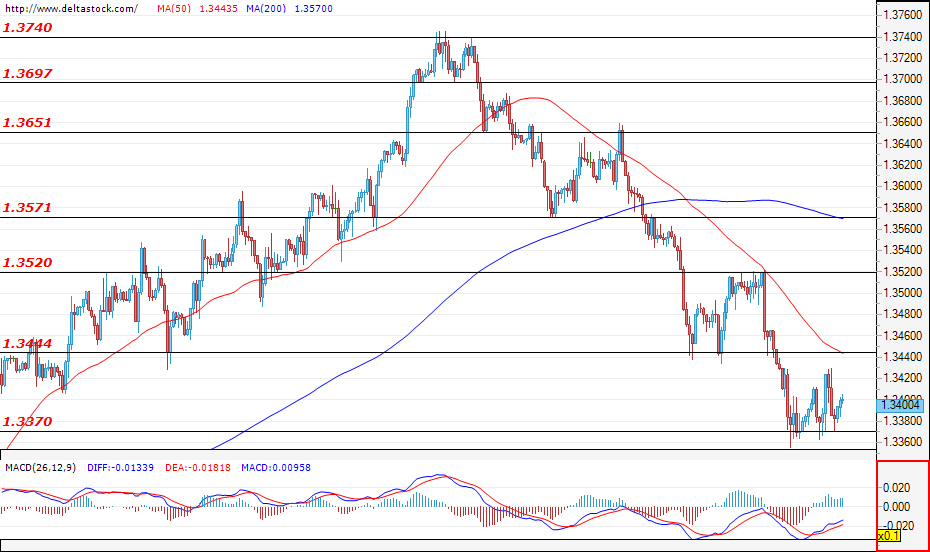
GBPUSD
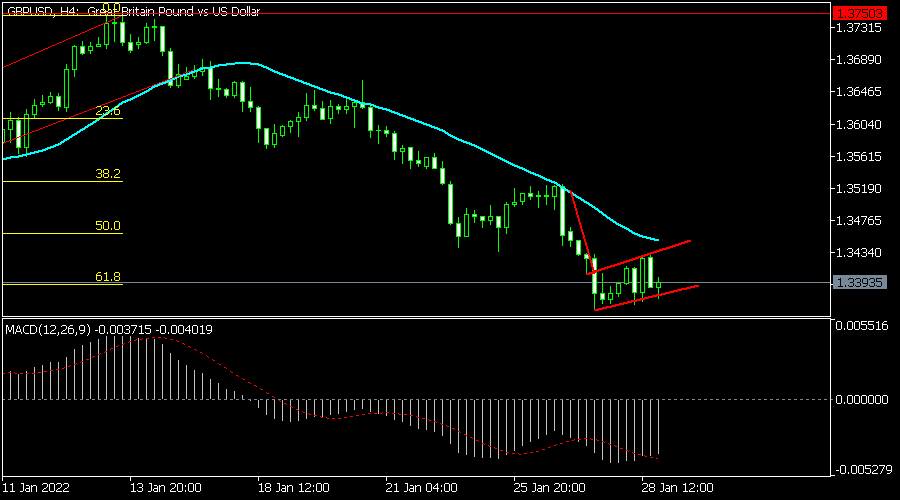
The GBPUSD pair has been under pressure in the past few months. The pair has formed a bearish flag pattern. It has also moved slightly below the 25-day and 50-day moving averages. The MACD has moved below the neutral level. Therefore, the pair will likely keep falling as bears target the next key support at 1.3350.
Central Banks Remain in Focus
Market movers today
We kick off the week with euro area GDP figures for Q4. We expect that growth has edged out a small plus of 0.4% q/q, but the recovery pace cooled markedly at the end of 2021 in light of Omicron and supply chain headwinds, notably in Germany. We also get German CPI figures today. Here we should see a big dip in inflation as the VAT-effect falls out. Energy will continue to keep inflation elevated, though.
Overnight, The Reserve Bank of Australia is widely expected to end QE purchases, and the focus will be on forward guidance. While recent data supports the case for earlier hikes, we think RBA is unlikely to take as hawkish stance as markets are currently pricing.
Later in the week, we will focus on the ECB meeting on Thursday, where we do not expect to hear new policy signals (read more in our ECB Preview, 28 January). Bank of England will also meet on Thursday, and we look for a 25bp hike. Besides central bank meetings, we will keep an eye out for euro area inflation, several interesting Fed speeches and a jobs report from the US.
We will of course also look out for developments in the Russia-Ukraine stand-off.
The 60 second overview
Italy's presidential election: Impasse was resolved over the weekend by incumbent President Mattarella agreeing to serve another term. This gives PM Draghi the opportunity to lead his unity government until the end of the parliamentary term in 2023 and reduces the political uncertainty for businesses and markets. Implementing Italy's ambitious EUR 200bn recovery plan and structural reforms will remain the priority for the remainder of Draghi's term. That said, fragilities within the government have already become more visible during the presidential election and disagreements over spending priorities and reforms (especially on the thorny issues such as tax, pension and labour market still outstanding) will probably only intensify as the next general election approaches.
Macro: US private consumption moderated in December (-1.0% m/m) driven by lower goods consumption. The normalizing goods demand could help alleviate some of the global inflation pressures, although the current level still stands around 5.2% above counterfactual pre-covid trend (down from +15% last March). Over the weekend, China's official Manufacturing PMI's new export orders index remained weak at 48.4 (from 48.1), still signalling contraction in export demand. This week, the US jobs report will be the key US data release to follow, we expect to see around 200k new jobs as faster recovery is unlikely before labour force participation begins to pick up. Omicron likely delayed the recovery in January, as U.S. Census Bureau's Household Pulse survey data indicates that almost 8.8m Americans were unable to work in early January due to Covid-related sick leave or taking care of others who were infected (up from around 3.0m in December).
French election: The French economy continued its outperformance at the end of 2021, with GDP standing 0.9% above pre-pandemic levels, in contrast to a short-fall of 4% in Spain and 1.5% in Germany. A strong recovery in consumer spending and business investment helped France weather the economic fall-out from the Covid-19 pandemic better than other euro area peers. The strong economy remains one of the main selling points for Emmanuel Macron's re-election bid and our base case is for him to secure another term as President. However, as the surprise potential at French elections remains high, we see scope for a higher election risk premium to be priced in fixed income markets, whereas the election impact on EUR/USD should be muted (read more in Research Euro Area - French presidential election: Macron encore? 31 January).
Equities: Equities in a big turn-around on Friday led by the tech sector flying after some solid earnings results. US outperformed Europe by 2.5% due to the turn-around but even more interestingly, tech was up by almost 3.5% while energy and materials were down. As a result, we had the first day in a while where pure optimism took over and hence cyclical growth outperformed. In US Dow +1.7%, S&P 500 +2.4%, Nasdaq +3.1% and Russell 2000 +1.9% Positive sentiment is continuing in Asia this morning as the Lunar New Year starts and therefore some Chinese markets are closed for holiday. European and US are higher as well.
FI: We have a week with several central meetings including the ECB meeting on Thursday as the main event. We expect that ECB will stress that they will not hike in 2022. Hence, if ECB is able to convince the market that they are not going to hike it should be positive for the front end. More support may also come from the EU and German inflation data, which is expected to decline due the base effect from the German VAT.
FX: Friday was a quieter day after the sharp move lower in EUR/USD on Thursday. EUR/USD is now trading closer to 1.11 than 1.12 vs. close to 1.15 in the middle of January. EUR/GBP is trading close to 0.83 ahead of the Bank of England policy announcement on Thursday.
Credit: Credit markets saw further weakness on Friday, with iTraxx Xover widening almost 6bp (to 285bp) and Main 1.7bp, closing in 59bp (its highest level since November 2020). HY bonds sold even more off, with HY bonds widening 9bp and IG 2bp.
Gold Price Moved into a Short-Term Negative Zone Below $1,825
Gold price failed to clear the $1,850 resistance and corrected lower against the US Dollar. The price broke the $1,825 support level to move into a short-term negative zone.
Besides, there was a break below the $1,800 level and the 50 hourly simple moving average. However, the bulls are now protecting the $1,780 support zone. An immediate resistance on the upside is near the $1,795 level.
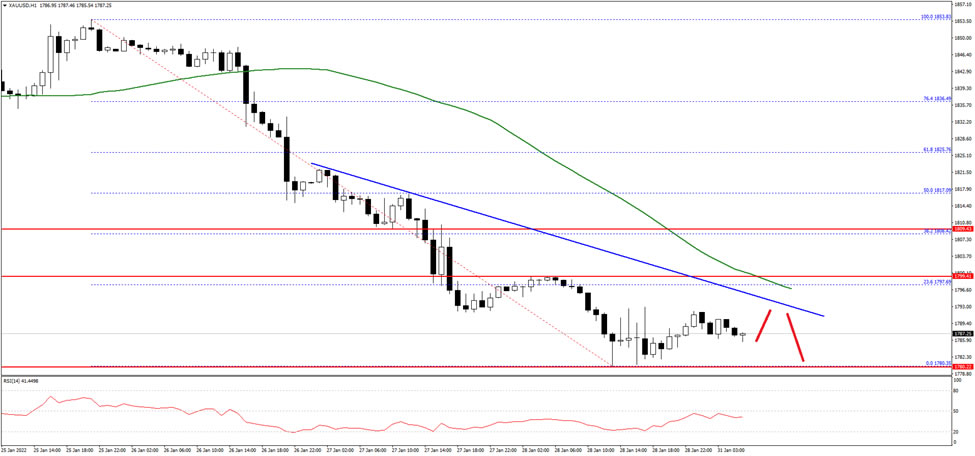
There is also a key bearish trend line with resistance near $1,795 on the hourly chart. The next main resistance could be near the $1,800 level, above which the price could rise towards the $1,820 level.
An initial support on the downside is near the $1,780 level, below which there is a risk of more downsides. In the stated case, the price could start a steady decline towards $1,750 on FXOpen.