

Sample Category Title
Australia retail sales dropped -4.4% mom in Dec, but turnover remains strong
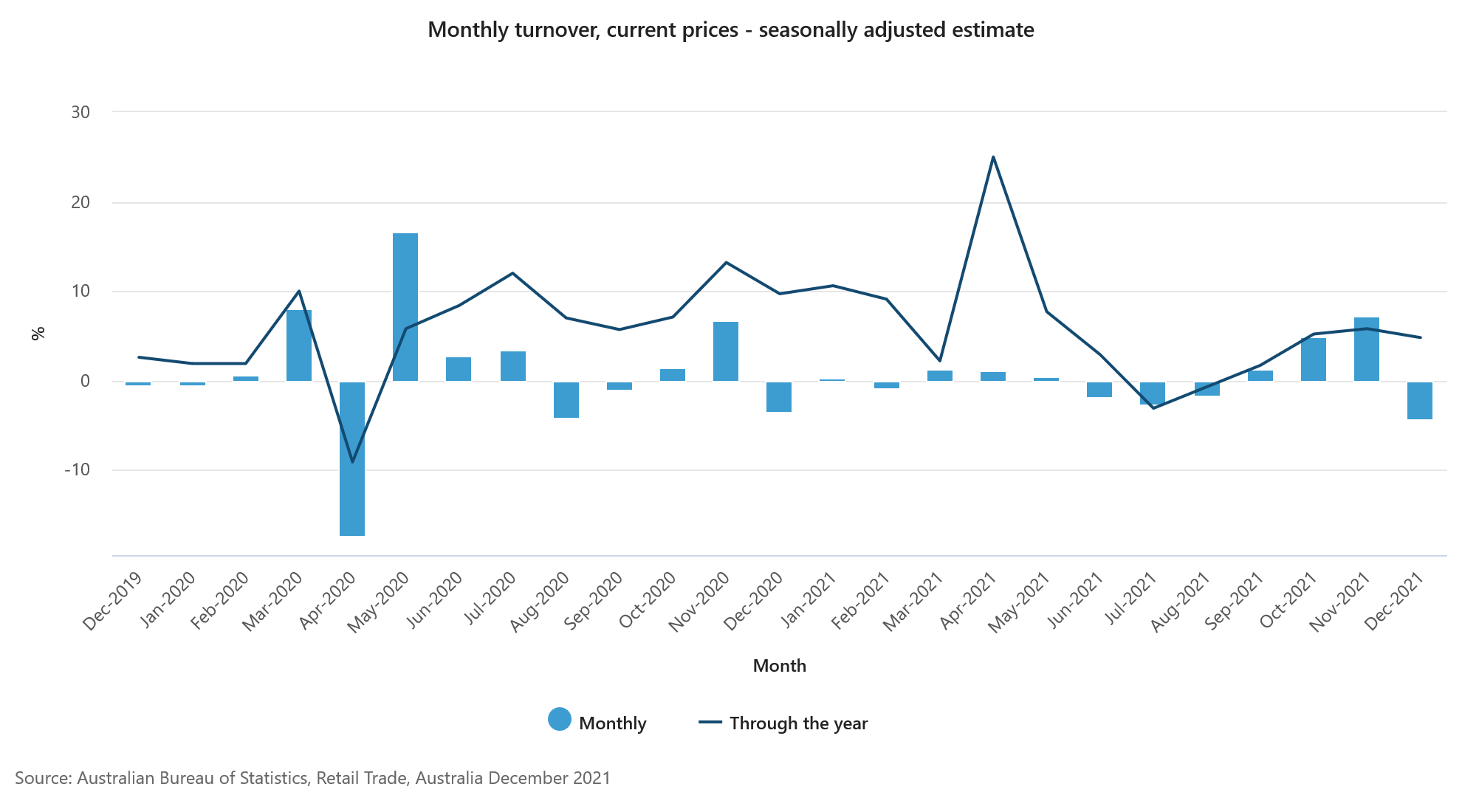
Australia retail sales dropped -4.4% mom in December, much worse than expectation of -1.9% mom. That's also the largest monthly decline since April 2020.
"Despite this month's fall, retail turnover remains strong, up 4.8 per cent on December 2020, with strong consumer spending continuing post the Delta Outbreak," Ben James, Director of Quarterly Economy Wide Statistics, said.
Australia AiG manufacturing dropped to 48.4, modest contraction
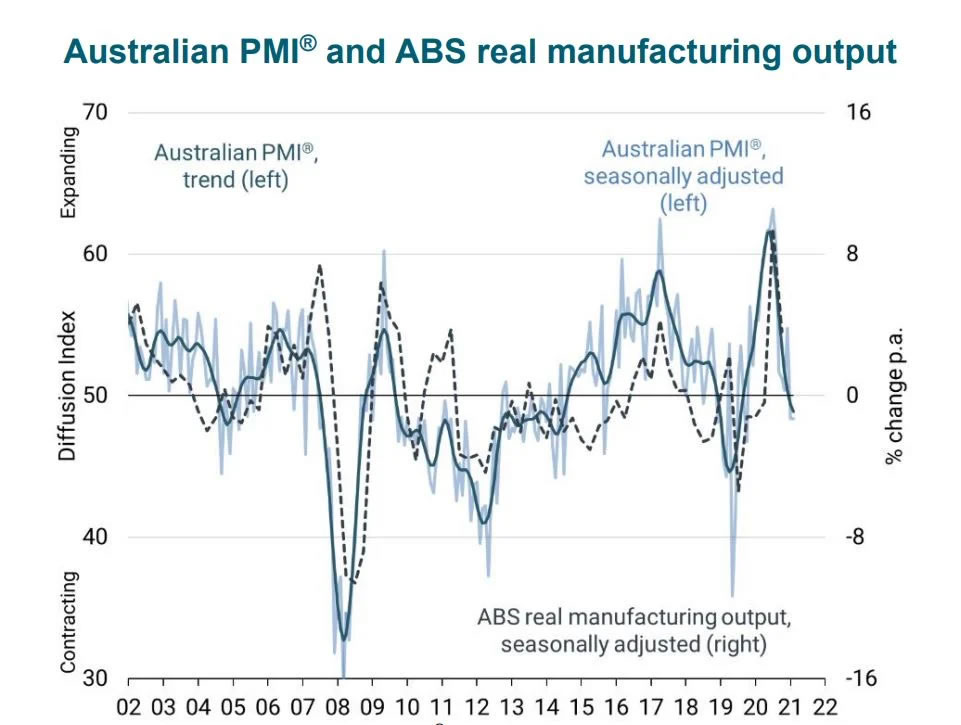
Australia AiG Performance of Manufacturing Index dropped sharply by -6.4 pts to 48.4 in January. Production dropped -0.6 to 51.9. Employment dropped -4.6 to 45.4. New orders dropped -8.0 to 51.3. Supplier deliveries dropped -15.6 to 37.8. Exports dropped -9.5 to 45.1. Input prices rose 4.0 to 82.3. Selling prices dropped -3.3 to 64.8. Wages rose 1.1 to 63.5.
Innes Willox, Chief Executive of Ai Group said: "Australia's manufacturers reported a modest contraction in performance over December and January as businesses reported further disruptions to supply chains and as staff availability emerged as a major constraint on many businesses. Cost pressures were keenly felt with input prices continuing to rise and the selling prices index indicating only a partial recovery of these costs in the market."
Fed Barkin: I don’t hear much resistance to rate hikes
Richmond Fed President Thomas Barkin said yesterday, "as I talk to participants in the economy, what I hear is they actually want us to do something now about inflation. They'd like us to get back to at least a normal interest-rate posture and not be simulating more demand on top of normal levels. So, I don't hear much resistance to that."
"I'd like us to be better positioned," Barkin said. "Better positioned is somewhere closer to neutral, certainly, than we are now and I think the pace of that just depends on the pace of inflation."
Fed Bostic: 50bps hike in March not my preferred action
Atlanta Fed Bank President Raphael Bostic said, 50bps hike in March was "not my preferred policy action." He added, "I had three rate increases in mind. March is looking like the right time" to get that started. From there, however, "we are not on any set progression."
"We are going to need to be thinking very carefully about how things are going, how the economy responds to our first moves," Bostic said. "We are not set on any particular trajectory. The data will tell us what is happening."
Fed Daly: We definitely are poised for a March increase
San Francisco Fed Bank President Mary Daly said "we definitely are poised for a March increase." But she added, "after that, I want to see what the data brings us ... let's get through Omicron, let's look at this and let's see."
"If the economy progresses like I see it progressing, then it is clear that it can stand on its own two feet, that we do not need to be providing the same level of extraordinary … accommodation that we provided during the pandemic and have provided for the last two years," Daly said.
Fed George: Appropriate to move earlier on the balance sheet
Kansas City Fed President Esther George said Fed's policy normalization approach could be more aggressive on balance sheet reduction, rather than faster rate hikes.
"What we do on the balance sheet is likely to affect the path of policy rates and vice versa," George said during an event "For example, if we took more aggressive action on lowering, pulling down that balance sheet, it might allow for fewer interest rate increases."
He added that raising short-term interest rate while maintaining a large balance sheet "could flatten the yield curve", and lead to "reach-for-yield behavior from long-duration investors."
"All in all, it could be appropriate to move earlier on the balance sheet relative to the last tightening cycle," she said.
Elliott Wave View: Bitcoin (BTCUSD) Recovery In Progress
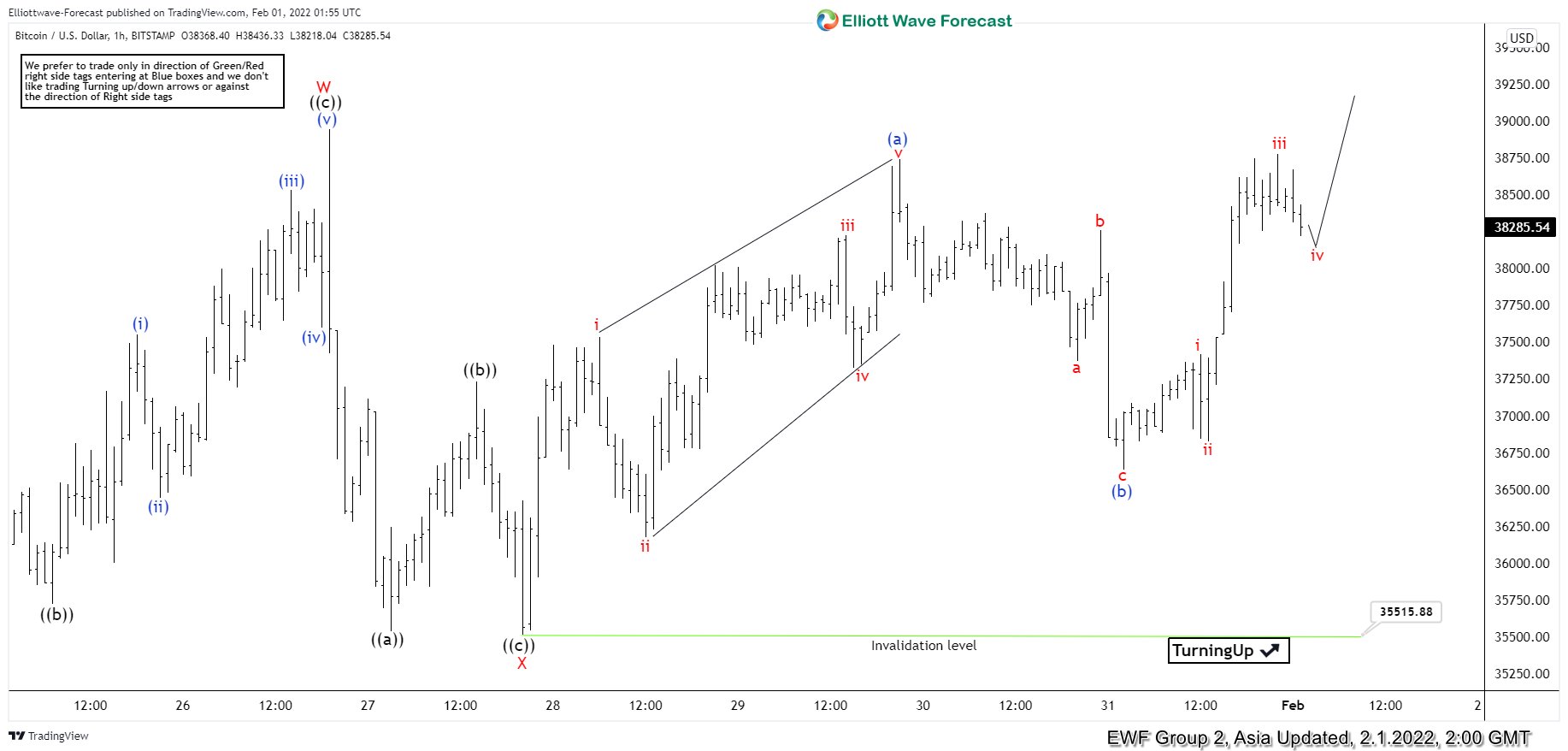
Short Term Elliott Wave view in Bitcoin (BTCUSD) suggests the rally from January 24, 2022 low is in progress as a double three Elliott Wave structure. Up from January 24 low, wave W ended at 38946 and pullback in wave X ended at 35511.32. Wave X has a zigzag structure subdivision as the 1 hour chart below shows. Down from wave W, wave ((a)) ended at 35535, wave ((b)) ended at 37230 and wave ((c)) ended at 35515.88. Wave Y is currently in progress with internal subdivision as a double three in lesser degree.
Up from wave X, wave i ended at 37534.15 and wave ii ended at 36173.98. Wave iii ended at 38225.27, wave iv ended at 37327.79, and wave v ended at 38741.67. This completed wave (a) in higher degree. Wave (b) pullback ended at 36631.66 with internal subdivision as a zigzag. Down from wave (a), wave a ended at 37372.59, wave b ended at 38262.55, and wave c ended at 36631.66. Wave (c) higher is in progress with potential target of 100% – 161.8% Fibonacci extension of wave (a). This area comes at 39862.01 – 40624.37 where wave (c) of ((w)) may end. Near term, as far as pullback stays above 35515.88, expect Bitcoin to extend the recovery higher.
Bitcoin 1 Hour Elliott Wave Chart
GBP/USD Could Recover If It Clears 1.3500
Key Highlights
- GBP/USD started a major decline from well above 1.3600.
- A key bearish trend line is forming with resistance near 1.3480 on the 4-hours chart.
- EUR/USD is attempting a recovery wave above 1.1180.
- The US ISM Manufacturing Index could decline from 58.7 to 57.5 in Jan 2022.
GBP/USD Technical Analysis
The British Pound declined heavily below 1.3600 against the US Dollar. GBP/USD even traded below the 1.3550 support level to enter a bearish zone.
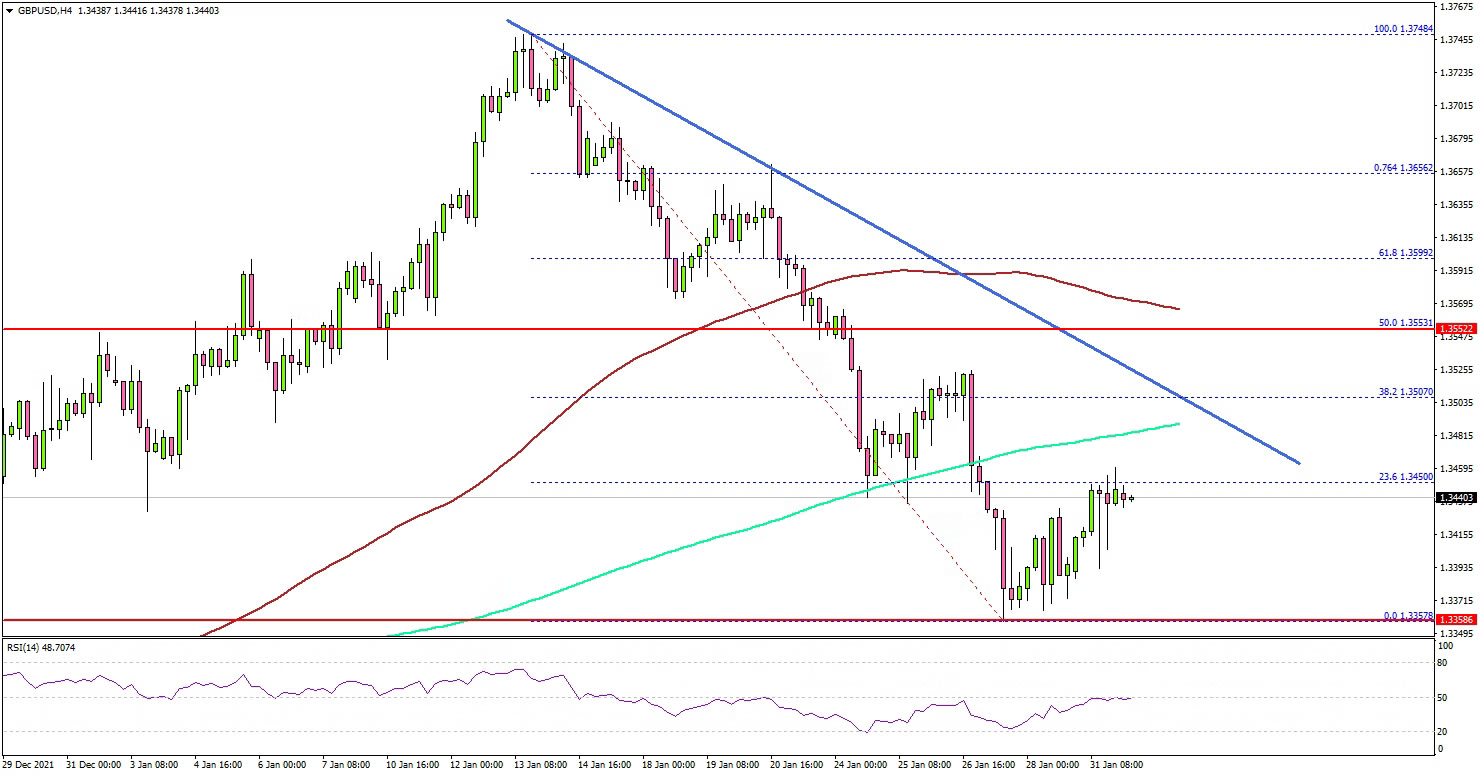
Looking at the 4-hours chart, the pair gained below the 1.3500 level, the 100 simple moving average (red, 4-hours), and the 200 simple moving average (green, 4-hours).
Finally, there was a move below the 1.3400 level and a low is formed near 1.3357. It is now correcting higher and trading above 1.3400. An immediate resistance is near the 1.3480 level. The first major resistance is near the 1.3500 zone.
There is also a key bearish trend line forming with resistance near 1.3480 on the same chart. Any more gains could send the pair towards the 50% Fib retracement level of the downward move from the 1.3748 swing high to 1.3357 low.
If there is no upside break above 1.3500, the pair could start another decline. An immediate support is near the 1.3380 level. The next major support is near the 1.3365 level, below which it could test 1.3280.
Looking at EUR/USD, the pair could recover if there is a clear move above the 1.1220 resistance zone in the near term.
Economic Releases
- Germany’s Manufacturing PMI for Jan 2022 - Forecast 60.5, versus 60.5 previous.
- Euro Zone Manufacturing PMI for Jan 2022 – Forecast 59.0, versus 59.0 previous.
- UK Manufacturing PMI for Jan 2022 – Forecast 56.9, versus 56.9 previous.
- US Manufacturing PMI for Jan 2022 – Forecast 55.0, versus 54.0 previous.
- US ISM Manufacturing Index for Jan 2022 – Forecast 57.5, versus 58.7 previous.
ECB Policy Meeting: Dovish Tune with Hawkish Beats
The euro has been brutally knocked down by the US dollar lately and the big question now is whether the Eurozone's impelling calendar events could help the common currency find its feet this week. The European Central Bank’s policy announcement will be the major highlight on Thursday at 12:45 GMT. Although no changes are expected, traders will be eagerly looking for any hawkish language twists, especially if those follow stonger-than-expected preliminary CPI inflation readings and a smaller unemployment rate on Tuesday. Retail sales will be next watched on Friday, but the US nonfarm payrolls could steal the show later in the day.
ECB to stay out of the hawkish club
While several major central banks have unwrapped or have already put their rate hike plans into action, the ECB is among the few which are still not willing to join the hawkish club. Although Eurozone's inflation topped at a historically high of 5.0% y/y in December and policymakers project an above-target average rise of 3.2% this year, ECB chief Christine Lagarde has clearly telegraphed that an increase in interest rates is unlikely in 2022. Of course, she underlined that the central bank would do its job if its “inflation criteria are satisfied”, but as long as its forecasts point to a slowdown below 2.0% in 2023 and 2024, there is no need for discussion yet.
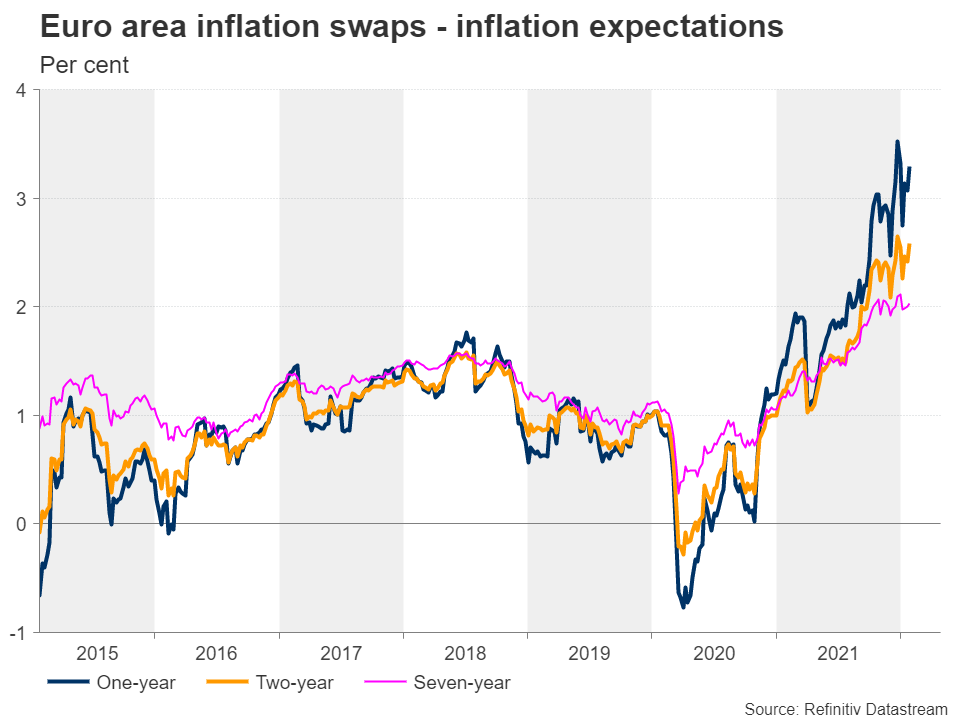
Investors, however, are not very convinced. Despite some stabilization in inflation expectations for the next year and for the following two and five years as reflected in inflation swap rates, they believe that two rate hikes of 10-basis-point modest rate hikes of up to 20 basis points are possible this year, starting in September the earliest, while some others bet that interest rates will crawl up to 0% by the end of 2023.
Inflation may keep teasing monetary policy in the future
Well, perhaps markets are right and reasonably influenced by some key dovish ECB policymakers who have recently said that investors should not attach too much importance to the prospect of price growth falling below the 2% goal in 2023 and 2024.
In addition, the key driver behind the price acceleration is the elevated cost of energy products, marking a 26% annual growth in December. Besides the prolonged boost from the pandemic related supply constraints, the European Union’s seven-year Next Generation programme, which aims to make the bloc the world’s first carbon-neutral region by 2050, could also contribute to higher prices if member states face tougher carbon-energy taxation.
In the financial world, the eurozone's bond market could face more damage if higher interest rates in other regions encourages investors to move their funds out of the bloc. Hence, a wide divergence from other central banks could leave the ECB at a disadvantageous position. Simultaneously, the euro may keep trending downwards in the face of a dovish ECB, making imports more expensive. The latter could result in additional inflation pressures.
Economic recovery in focus
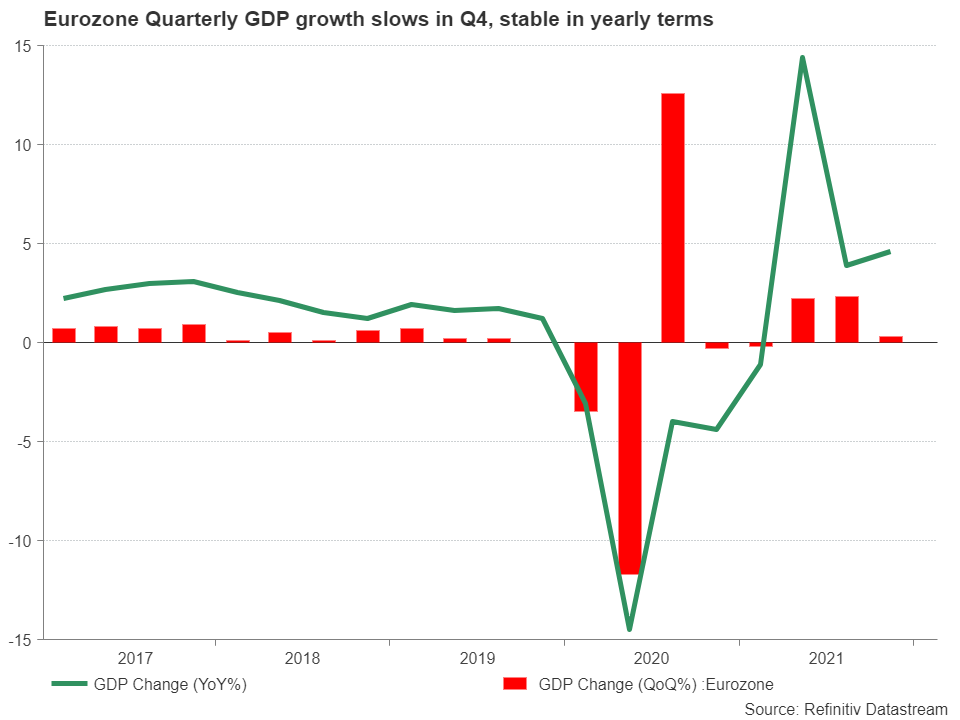
Still, the above could be a longer-term problem. At the current juncture, the eurozone's economic recovery is lagging other advanced regions and is far from certain. Unlike US GDP, which surpassed its pre-pandemic levels during the summer, expansion in the 19-nation bloc has not breached that threshold yet. Of course, the unemployment rate has returned to normal levels, but it is still well above the ones in the UK and the US, while its trade balance has sharply deteriorated, posting a deficit in November for the first time in more than eight years.
Not to mention its political landscape, which could face more hiccups later in the year when the French election takes place, while rising tension in Eastern Europe could generate more anxiety.
Same dovish tune but some hawkish beats could move the euro
Hence, the central bank could sing the same dovish tune for now to keep markets calm, but it could balance its tone with some hawkishness to count for the inflation uncertainty, perhaps by reiterating December's statement that monthly regular asset purchases will be diminishing after the pandemic-led PEPP program ends in March but adding that a faster pace of reductions will also be considered if the inflation situation worsens.
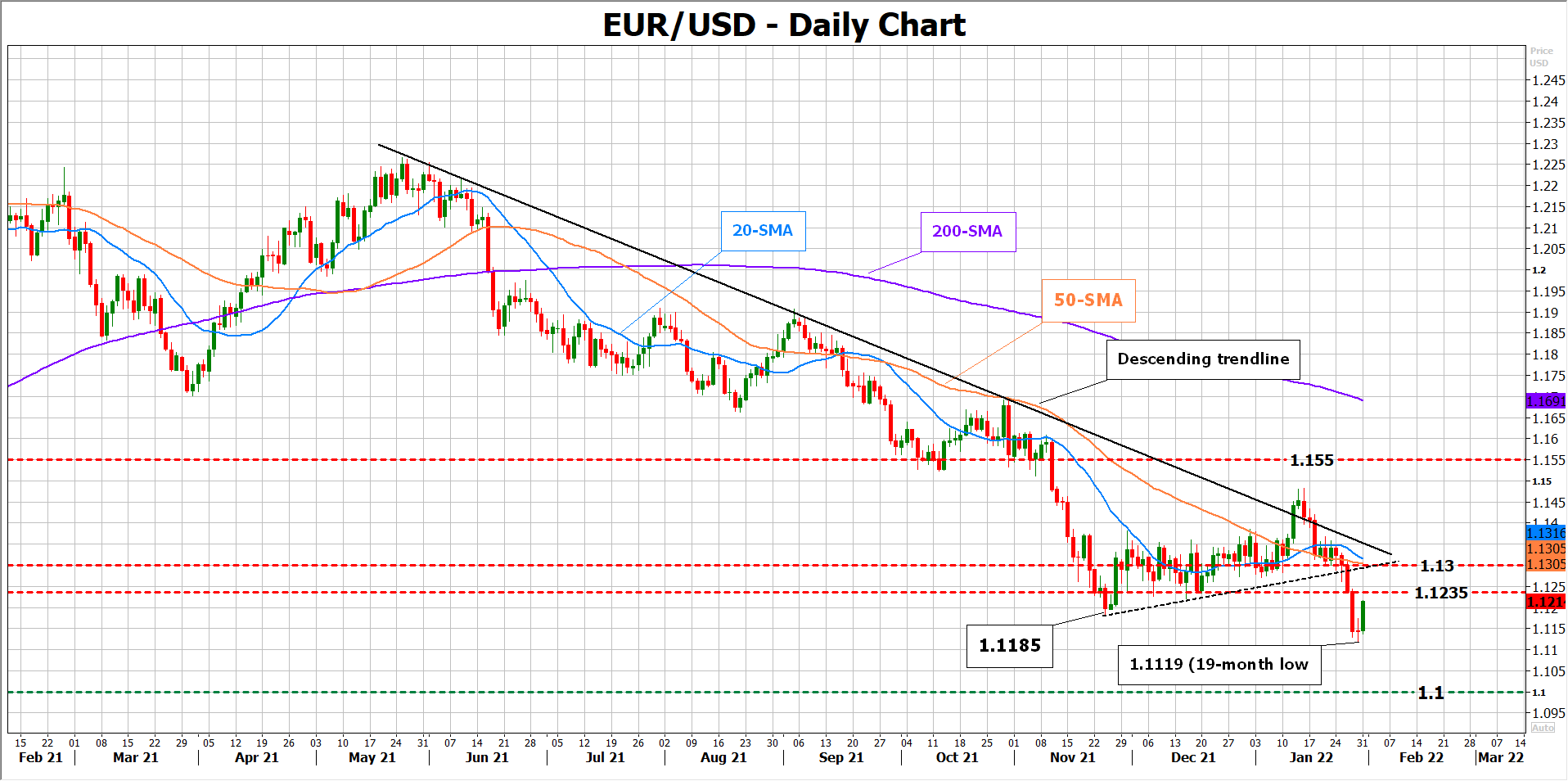
Turning to FX markets, unless investors translate some of the language into new hawkish twists, a steady policy by the ECB may not aggressively move the euro. Nevertheless, Wednesday’s CPI inflation figures for January could send some earlier signals about the central bank’s stance, likely creating some volatility ahead of the meeting. Expectations point to a slowdown to 4.3% y/y from 5.0% before, though an upside surprise cannot be excluded given the faster-than-expected growth in German flash CPI readings. If forecasts are right, inflation would still be among the highest over the past three months, but the pullback in CPI measures could still justify an accommodative attitude, with the euro likely extending its weakness towards the 1.1000 level against the dollar in the aftermath.
Otherwise, if the data come in stronger than expected, with the unemployment rate declining below the 7.1% forecast, the ECB may find it hard to control investors’ rate hike projections. In this case, euro/dollar may attempt to crawl above 1.1185 and run towards the 1.1235 nearby barrier. Higher, the focus will turn to the 1.1300 mark.
Future Looks Gloomy for Crypto Market
The crypto market had a rough start of the year, declining by more than 20% due to the hawkish Federal reserve statements. As a result, the crypto market's capitalization lost 45% and fell to $1.64 trillion, the lowest since August 2021.
Altcoins are falling increasingly faster than the first cryptocurrency, causing an increase in the share of BTC, which is already 42.3% against 39.3% lows in mid-January. Bitcoin's 40% share looks like a turning point that triggered a correction in the crypto market twice before.
The correction is not over
It is well-known the crypto market has a strong positive correlation with the US stock market. This fact should reduce optimism among crypto investors as of the end of trading Tuesday, January 25, 2022, is now, officially, the worst-ever start in the history of the S&P 500.
Some traders hold a belief, called the January barometer, the investment performance of the S&P 500 in January can predict its performance for the rest of the year. If this belief turns out to be true, the crypto market will face a rough year.
Reasons for the pressure
The first reason is macroeconomic news from the USA. According to the Fed's January meeting, the US regulator can raise interest rates faster and earlier. The market is pricing five rate hikes up to 1.5%. Technology companies will remain under pressure with this market trend, dragging the cryptocurrency market into a deeper correction.
The instability of the situation with the cryptocurrencies regulation in Russia also pressures the market. The Russian Central Bank announced that trading and mining cryptocurrencies would be prohibited. Fortunately, later, President Vladimir Putin joined the discussion and offered to regulate cryptocurrencies operations instead of blocking them.
Russia is the third country in the world by mining hash rate. Therefore, the crypto market is highly dependent on the final decision of the Russian government.
Technical analysis
BTC/USD, weekly chart
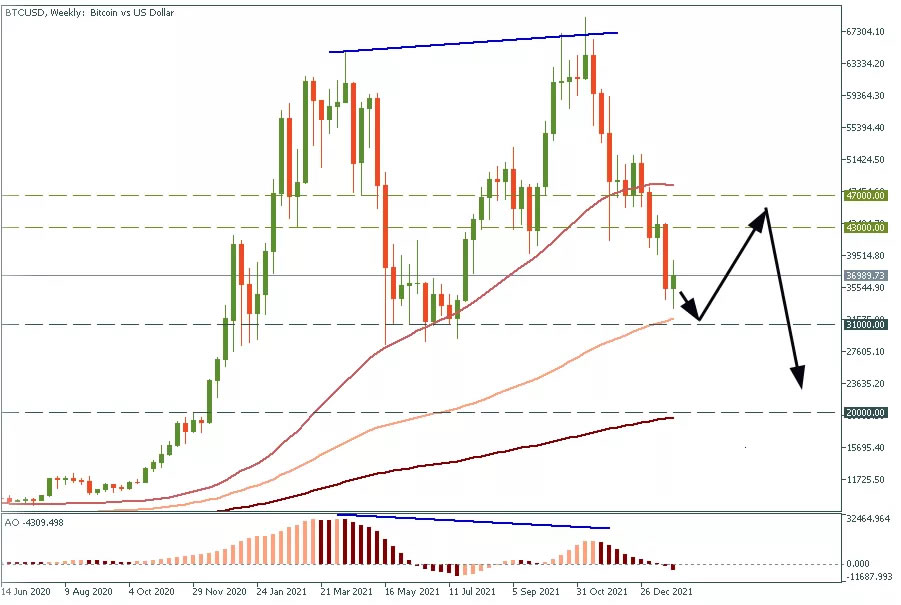
The bearish divergence appeared on the weekly Bitcoin chart. At the moment, the price is trading above the key support level of $30 000. However, we expect Bitcoin not to break this support through right away. Instead, it will rise to $43 000 - $47 000, form a bull trap, and crush down to $20 000 as the Federal Reserve increases the interest rate.
ETH/USD, monthly chart
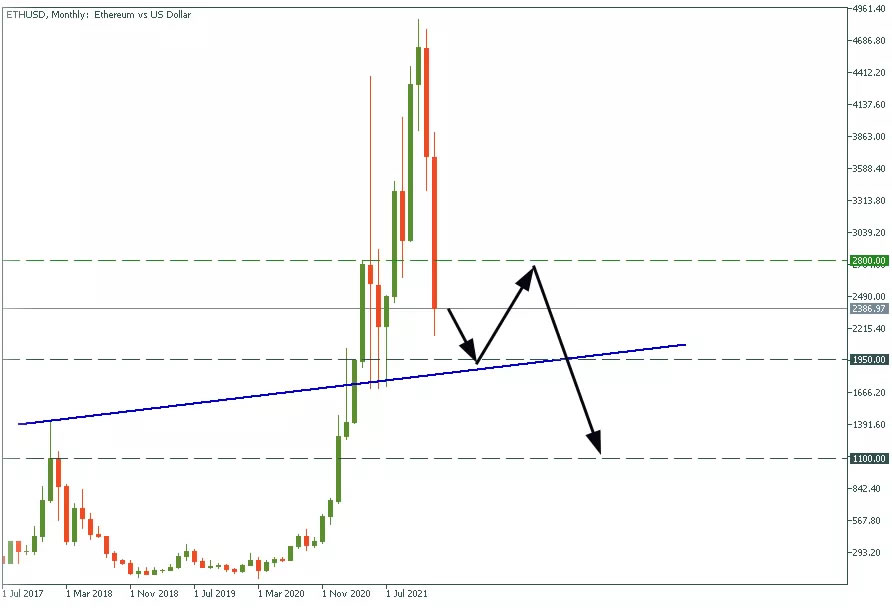
Ethereum will follow "the big brother" and decline down to $1900 first with a solid bounce up to $2800 after. Then, when the price finishes the head-with-shoulders pattern, it will decline to $1100.
BNB/USD, weekly chart
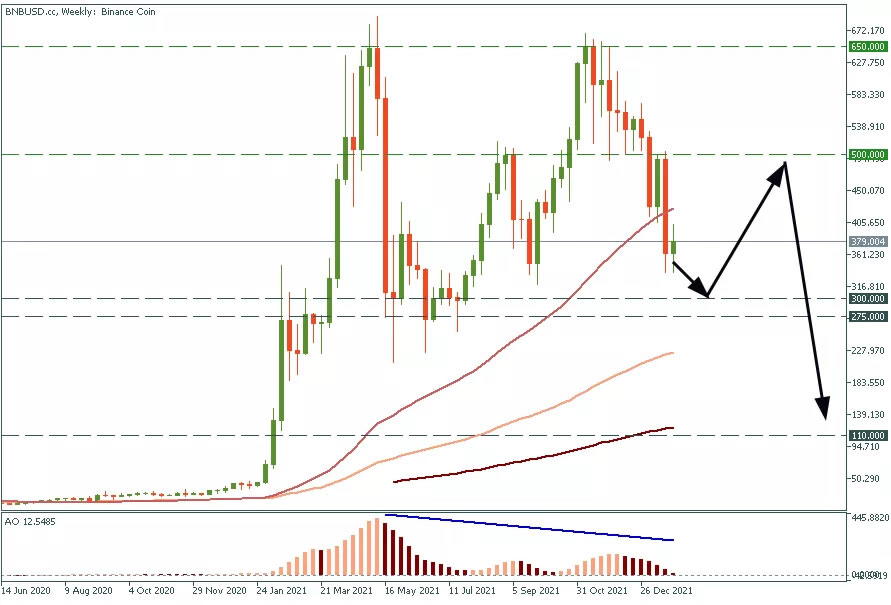
Binance coin can decline to the $275-300 support range. After that, the price might rise as high as $500. As well as Ethereum, BNB/USD might form a head-with-shoulder pattern and drop down to $110 afterward.
Conclusion
The immediate future of the crypto market looks rather gloomy. Fortunately, FBS traders can trade both sides, long and short, and earn the same on bull and bear markets.