Sample Category Title
Dow Jones and S&P 500 Tilt Higher ahead of Key Tech Earnings
US equities rose on Monday as investors reflected on several catalysts. First, the market remained optimistic that big technology companies like AMD, Facebook, Amazon, and Alphabet will publish strong quarterly results this week. Other tech names that have already reported like Microsoft and IBM have published strong results. Second, there are signs the Omicron variant has peaked as the US continued to publish falling rate of hospitalizations. Third, stocks rose as investors predicted that the US economy will continue its recovery. Still, the pace of rate hikes by the Federal Reserve is a major source of concern to most investors.
The British pound rose after the latest report by Sue Gray. The government report criticized Boris Johnson for his failure of leadership by holding parties amid the Covid-19 lockdowns. She said that most of these events should not have happened. Still, there are signs that the report will not have a major impact on the UK economy. Later today, the sterling will react to the latest UK home price index by the Nationwide Society. It will also react to the final manufacturing PMI data by Markit. The biggest catalyst for the pair will be the latest interest rate decision by the Bank of England.
The economic calendar will have several key events today. Earlier, the New Zealand statistics agency published strong trade numbers for December. The numbers revealed that the country’s imports and exports did well in December as demand rose. In Germany, the country’s statistics agency will publish the latest employment numbers. Economists expect the data to show that the unemployment rate remained at 5.2%. In Canada, the statistics agency will publish the latest GDP numbers.
EURUSD
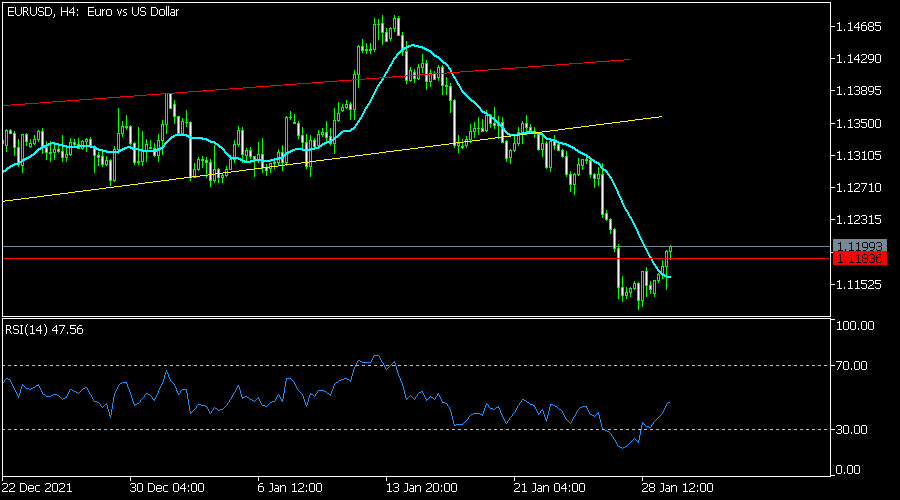
The EURUSD pair bounced back as investors focused on the strong Eurozone GDP data. The pair is trading at 1.1195, which is significantly higher than last week’s low of 1.1120. On the four-hour chart, the pair has managed to move slightly above the key resistance at 1.1183, which was the lowest level in November last year. Therefore, the pair will likely hold steady today even though a pullback cannot be ruled out.
GBPUSD
The GBPUSD pair tilted higher after the Sue Gray report as investors bought the news. It is trading at 3450, which is slightly higher than last month’s low of 1.3360. On the four-hour chart, the pair has moved slightly above the upper side of the bearish flag pattern. It has also declined slightly above the 25-day moving average while the MACD has formed a bullish crossover pattern. Therefore, the pair will likely break out lower because the bearish flag pattern is usually a bearish sign.

EURCAD
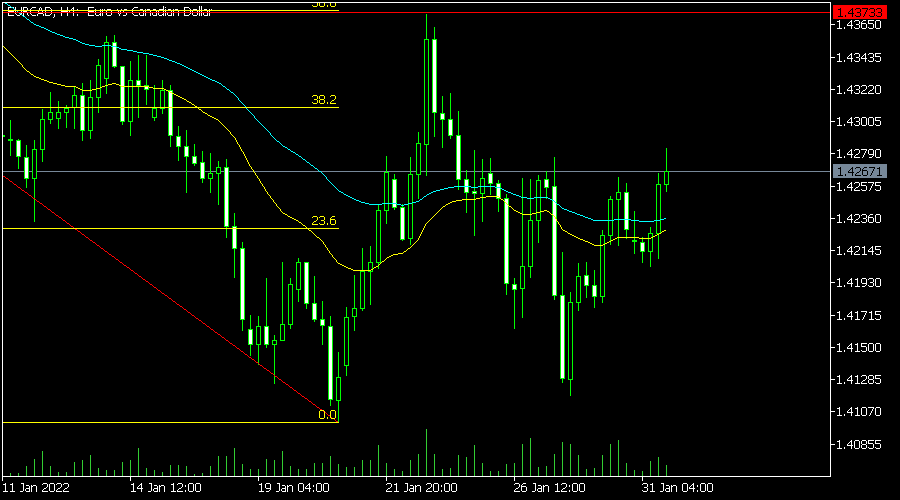
The EURCAD pair tilted higher ahead of the latest Canada GDP data. The pair rose to a high of 1.4274, which was the highest level since February 25th. On the four-hour chart, the pair has moved slightly above the 25-day and 50-day moving average and the 23.6% Fibonacci retracement level. Therefore, the pair will likely keep rising as bulls target the key resistance at 1.4310.
Germany’s 10y Yield Push into Positive Territory Symbolically and TechnicallyImportant
Markets
Wall Street tried to shrug off a rough month by printing impressive back-to-back gains. The Nasdaq outperformed, eking out another 3%+ gain. January is still the worst month for the tech-heavy index since March 2020 though. US yields rose with the belly outperforming the wings. The short end added 1.5 bps even as some Fed governors including Daly leaned against current market expectations of five rate hikes. Fed’s Esther George in an interview preferred “more aggressive action on the balance sheet [that] could allow for a shallower path for the policy rate”. She warns that doing the opposite could flatten the yield curve and distort credit incentives. Other changes vary from 1.5 bps (2y) over flat (7y) to 3.4 bps (30y). German/European yields surged. European GDP growth was largely in line with expectations (0.3% q/q) but German HICP eased much less than markets (and the ECB) hoped it would. Inflation fell from 5.7% y/y to 5.1% y/y with very strong monthly dynamics (0.9% m/m). It poses risks for the European figure to be released tomorrow and ahead of the ECB on Thursday. Germany’s curve bear flattened with yields 7.9 to 8.5 bps higher for the 2y and 5y. The 10y yield (+5.6 bps) closed in positive territory for the first time since 2019. EUR/USD profited from the rising interest rate differential as well as the upbeat risk climate. The pair rebounded from the 1.1163 support area to back north of 1.12, helped by dollar weakness too (DXY eased from 96.54 from 97.24). The same applied for EUR/GBP: bouncing off recent lows around 0.83 to 0.835.
The RBA grabs most attention during Asian-Pacific dealings today (see headline below). The Australian dollar is little affected by the decision. Most other major currencies trade muted too. CHF tops the board. Core bonds have a slight upward bias. Most stock markets show small gains. China remains closed for the week.Today’s economic calendar gets moderately interesting with US ISM business confidence for the manufacturing sector. Consensus expects an easing from 58.8 to 57.5. We keep a close eye at the delivery times component in particular to have a pulse on supply strains. The figure won’t affect the general trading patterns though. Germany’s 10y yield push into positive territory is symbolically and technically important. We look out for follow-up gains in the run-up to the ECB. EUR/USD has still some way to go before capturing first meaningful resistance, situated at around 1.13. A protracted rebound is only likely when the ECB finally takes the turn. British money markets are looking forward to the Bank of England on Thursday. A 25 bps rate hike is discounted. For the time being EUR/GBP 0.83 looks pretty solid.
News Headlines
The Reserve Bank of Australia kept its policy rate unchanged at 0.1%, but decided to cease further purchases under the bond purchase programme after February 10. Governor Lowe stressed that this does not imply a near-term increase in interest rates. The RBA sticks with its guidance to wait until actual inflation is sustainably within the 2%-3% target range. The RBA sees underlying inflation increasing further in coming quarters to around 3.25%, before declining to around 2.75% over 2023. Uncertainties remain about how persistent the pick-up in inflation will be as supply-side problems are resolved. Wage growth picked up but also remains modest even as the unemployment rate already fell to 4.2% in December. The central bank puts it at 3.75% at the end of 2023. The Omicron outbreak didn’t derail the economic recovery with the RBA forecast GDP growth of around 4.25% over 2022 and 2% over 2023. The Aussie dollar holds near AUD/USD 0.7050. Money markets remain convinced that the RBA will pull the trigger on interest rates in coming months (June) even if Lowe pushes back against early tightening expectations.
Germany, the Netherlands, France, Belgium and Italy expressed some worries over the Chips Act proposal from the European Commission. The EU wants to make 20% of the world’s chips by 2030. The 5 nations want to avoid a subsidy race resulting in an overproduction of chips, and rather suggest state aid to go to innovation more than cutting-edge production plants. They agree that the EU needs to keep their markets open to and open for other continents instead of focusing on reshoring only.
GBP/JPY Daily Outlook
Daily Pivots: (S1) 154.34; (P) 154.84; (R1) 155.27; More...
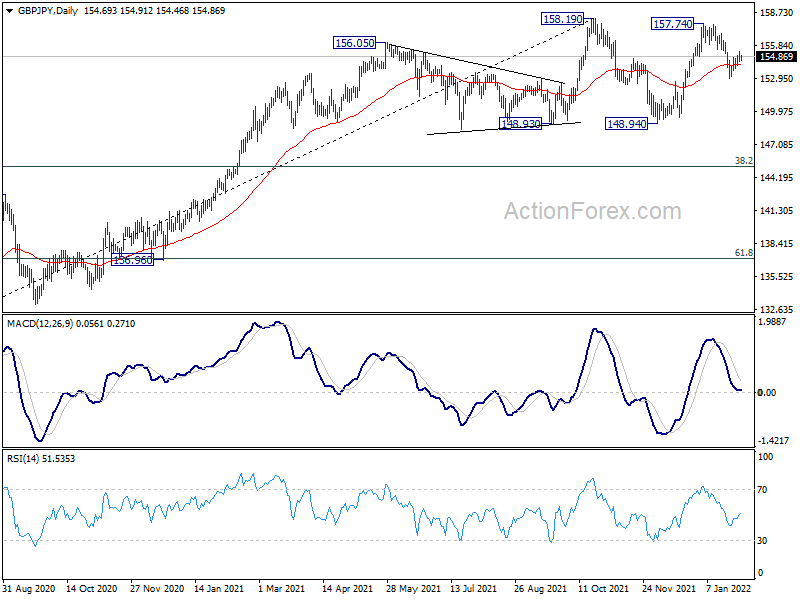
Intraday bias in GBP/JPY remains neutral and outlook is unchanged. Fall from 157.74 should be the third leg of the corrective pattern from 158.19. Deeper decline is expected as long as 155.38 minor resistance holds. Below 152.88 will target 148.94 support next. On the upside, above 155.38 minor resistance will flip bias back to the upside for 157.74/158.19 resistance zone instead.
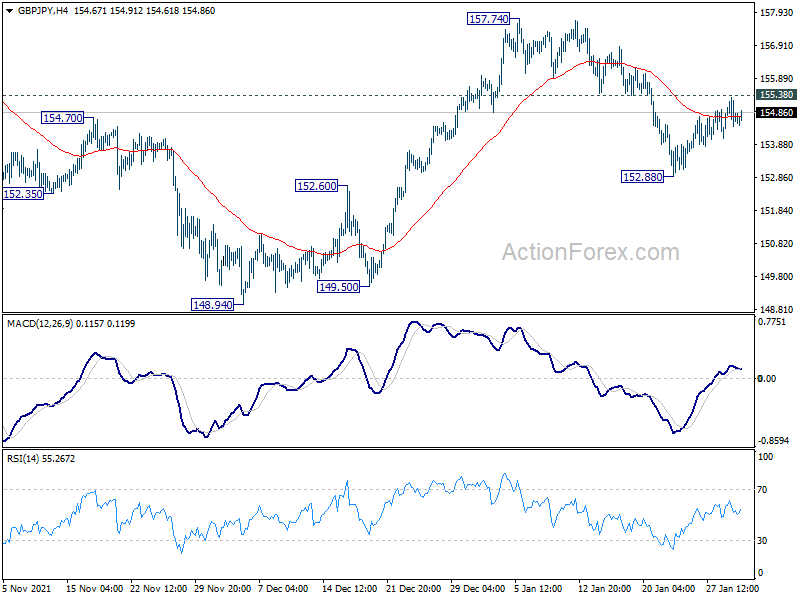
In the bigger picture, price actions from 158.19 are currently seen as developing into a consolidation pattern to up trend from 123.94 (2020 low). Downside should be contained by 123.94 to 158.19 at 145.10 to bring rebound. Firm break of 158.19 will resume the up trend to long term fibonacci level at 167.93. However, sustained break of 145.10 will raise the chance of trend reversal and target 61.8% retracement at 137.02.
EUR/JPY Daily Outlook
Daily Pivots: (S1) 128.73; (P) 129.05; (R1) 129.65; More....
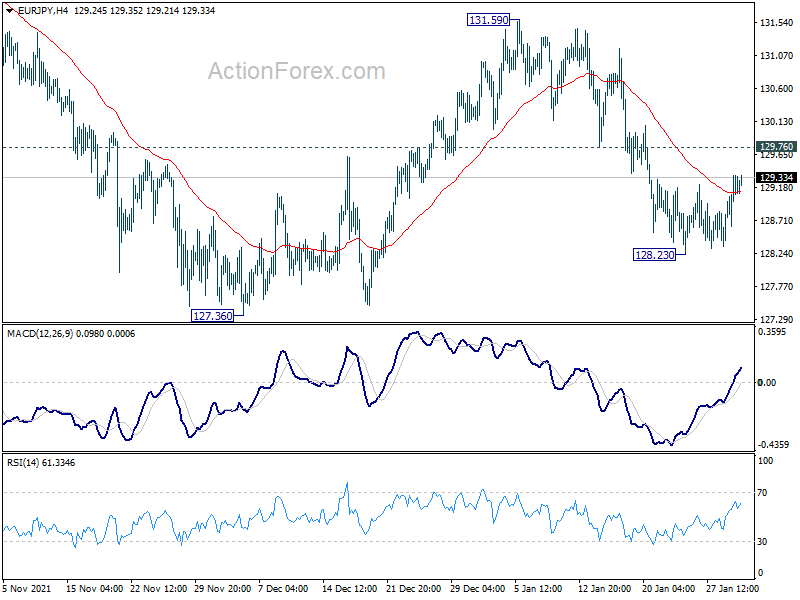
Intraday bias in EUR/JPY remains neutral for consolidation above 128.23 temporary low. Outlook is unchanged that corrective pattern from 134.11 is extending with another falling leg. Further decline is expected as long as 129.76 resistance holds. Below 128.23 will target 127.36, and possibly further to 126.58 fibonacci level. On the upside, above 129.76 minor resistance will turn bias back to the upside to 131.59 resistance instead.
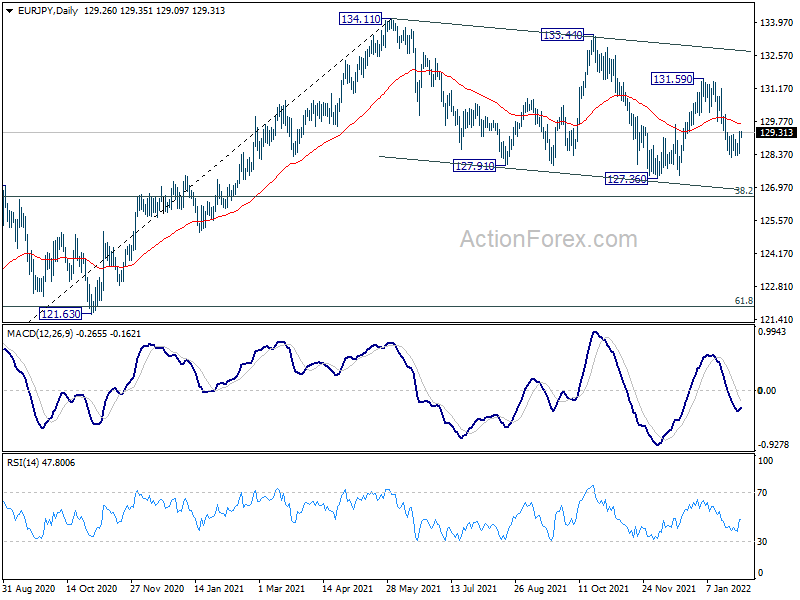
In the bigger picture, price actions from 134.11 are currently seen as a consolidation pattern only. As long as 38.2% retracement of 114.42 (2020 low) to 134.11 at 126.58 holds, up trend from 114.42 is still in favor to continue. Break of 134.11 will target long term resistance at 137.49 (2018 high). However, sustained break of 126.58 will raise the chance of bearish reversal. In this case, deeper decline would be seen to 61.8% retracement at 121.94, and possibly below.
EUR/GBP Daily Outlook
Daily Pivots: (S1) 0.8320; (P) 0.8340; (R1) 0.8374; More...
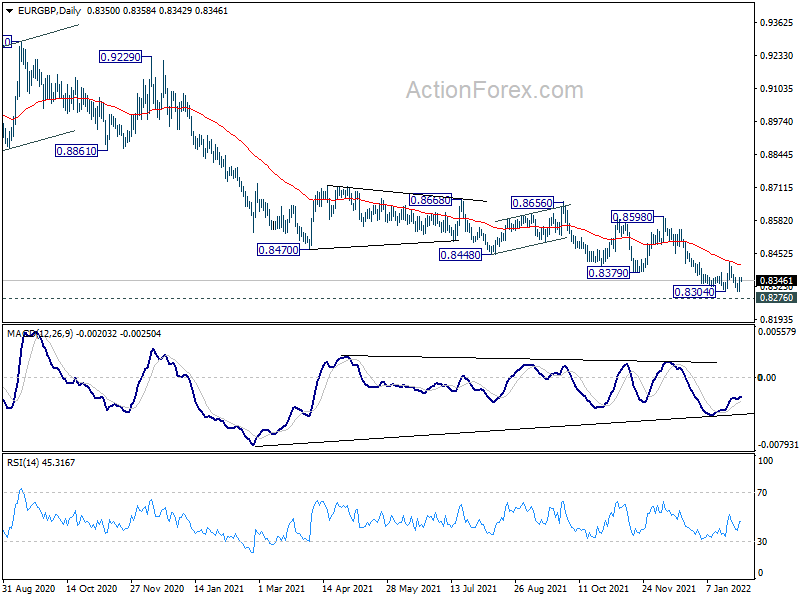
Intraday bias in EUR/GBP is turned neutral as it recovered after touching 0.8304 support. Near term outlook stays bearish as long as 0.8421 resistance holds. Break of 0.8304 will resume larger down trend towards 0.8276 key long term support. However, break of 0.8421 resistance will be a sign of bullish reversal. Further rise would be seen back to 0.8598 structural resistance next.
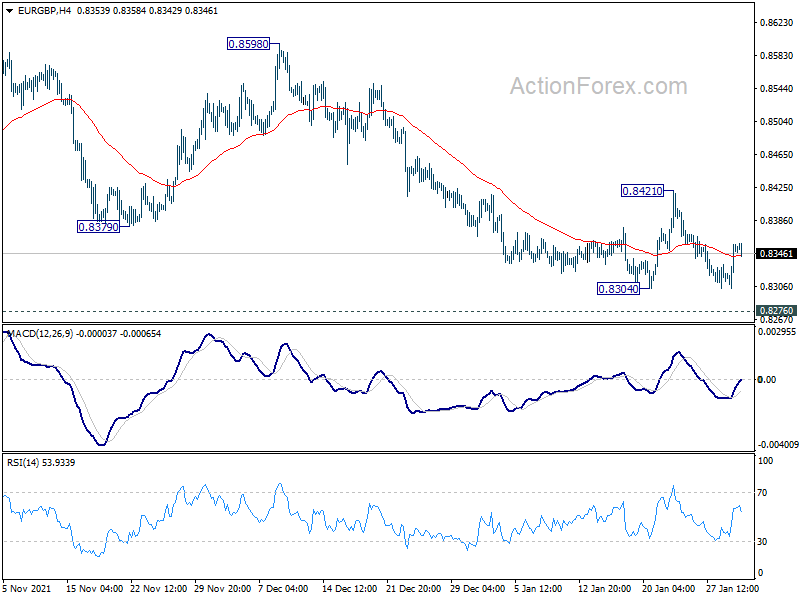
In the bigger picture, price actions from 0.9499 (2020 high) are still seen as developing into a corrective pattern. Deeper fall could be seen as long as 0.8598 resistance holds, towards long term support at 0.8276. We'd look for bottoming signal around there to bring reversal. Meanwhile, firm break of 0.8598 will now be an early sign of medium term bottoming and bring stronger rebound. However, sustained break of 0.8276 will argue that the long term trend has reversed.
EUR/AUD Daily Outlook
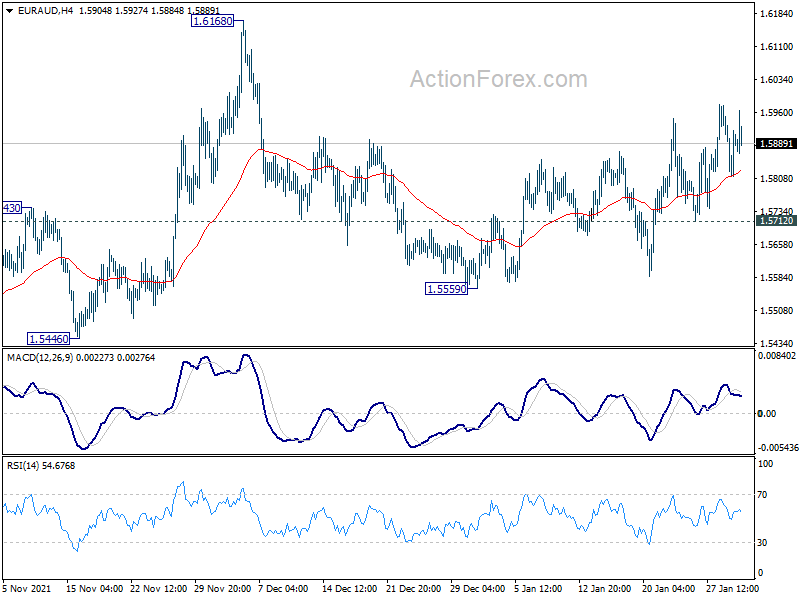
Daily Pivots: (S1) 1.5822; (P) 1.5887; (R1) 1.5960; More...
EUR/AUD is losing upside momentum as seen in 4 hour MACD. But further rise is mildly in favor with 1.5712 support intact. Rebound from 1.5559 would target 1.6168 resistance next. However, on the downside, break of 1.5712 support will turn bias back to the downside for 1.5559 support instead.
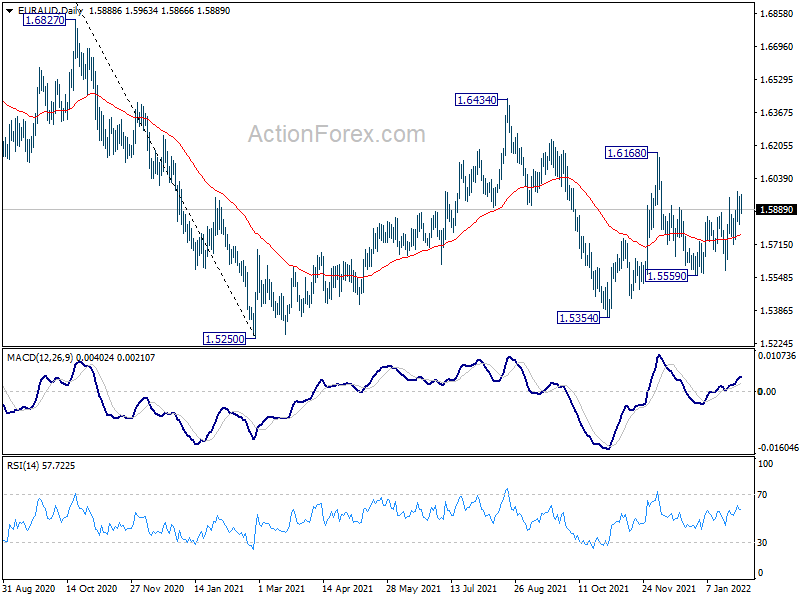
In the bigger picture, rise from 1.5354 is seen as the third leg of the corrective pattern from 1.5250 low. Further rise cannot be ruled out, but even in that case, strong resistance should be seen at 38.2% retracement of 1.9799 to 1.5250 at 1.6988. Larger down trend from 1.9799 is in favor to extend through 1.5250 at a later stage.
EUR/CHF Daily Outlook
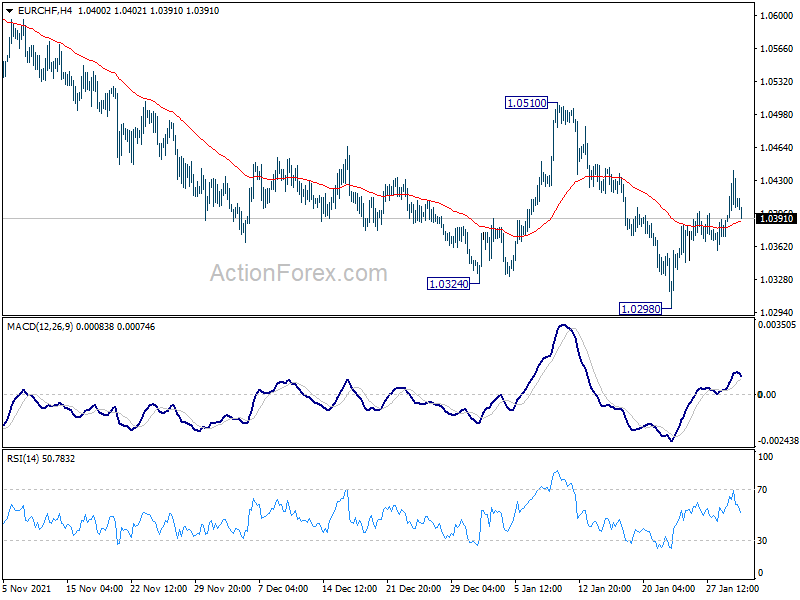
Daily Pivots: (S1) 1.0370; (P) 1.0405; (R1) 1.0448; More....
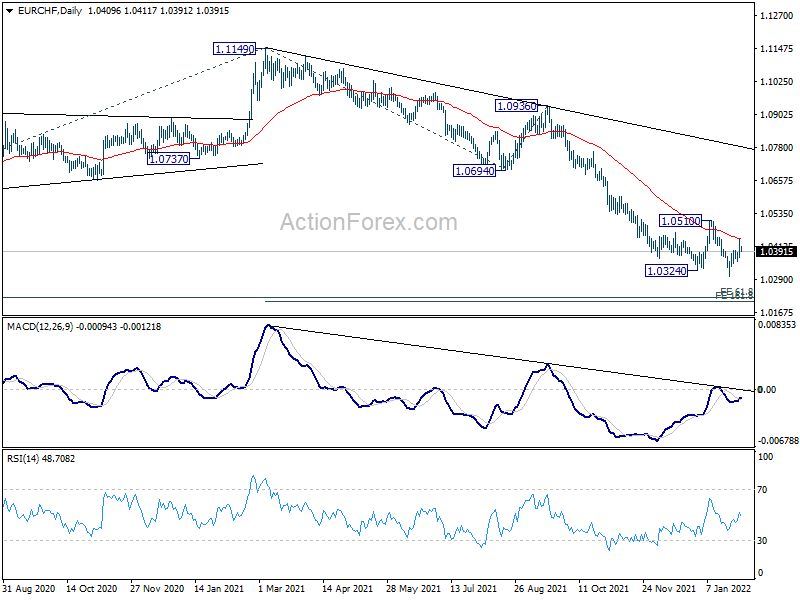
EUR/CHF is staying in the corrective pattern from 1.0298 and outlook is unchanged. Intraday bias remains neutral at this point. Upside should be limited well below 1.0510 resistance. On the downside, break of 1.0298 will extend the down trend from 1.1149 to 161.8% projection of 1.1149 to 1.0694 from 1.0936 at 1.0200 next.
In the bigger picture, long term down trend from 1.2004 (2018 high) is still in progress. Next target is 61.8% projection of 1.2004 to 1.0505 to 1.1149 at 1.0223. On the upside, firm break of 1.0505 support turned resistance is needed to be the first sign of medium term bottoming. Otherwise, outlook will remain bearish even in case of rebound.
Can We Call the End of the Selloff?
The S&P500 finished January with a strong two-day rally, but the index is still more than 5% lower than where it kicked off the year, having recorded its worst month since March 2020. Nasdaq closed yesterday’s session up by more than 3% for the second day in a row.
A part of the rally is explained by dip-buying from those who believe that the stocks hit a bottom as a result of an aggressive hawkish Fed pricing across the market and a part of it is explained by some short covering, which got traders to buy back the shares that they initially bet against to close their positions.
Nasdaq is already up by almost 9% from the January dip. Yet, 3-4% gains are often sign of high volatility and stress, and they could easily melt down in no time. What we need to see now is smaller but more sustainable gains to call the end of the January selloff.
Good news is that some Federal Reserve (Fed) officials are finally out trying to sooth investors’ nerves saying that they still want to avoid unnecessarily disrupting the US economy. The softish remarks help easing the worry of seeing a 50bp hike in FOMC’s March meeting. But does it really matter? The rates and the yields are so low that the difference between a 25 and 50 basis-point hike is only in the head of investors. What will really make the difference is the Quantitative Tightening and given the steep rise in Fed’s balance sheet since March 2020, even halting the growth would be an abrupt change for the market conditions.
US index futures traded slightly in the negative in Asia, while the European indices gained with the Eurostoxx futures adding up to 1% in the overnight trading session.
The DAX index successfully held ground above the 15000 mark in January despite the data showing a slowing German recovery and the rising inflation. The European stocks are set to outperform their American peers with the European Central Bank (ECB) doves nowhere to be found.
The EURUSD is back above the 1.12 mark, and the move is mostly driven by a broadly stronger US dollar than a more bullish pricing on the euro.
Elsewhere, the Reserve Bank of Australia (RBA) maintained its rates unchanged at today’s meeting but decided to stop its A$ 275 billion bond buying program while insisting that the decision doesn’t imply an imminent rate hike. Interestingly, the Australian dollar used to be a high-yield currency, and now it’s about to find itself yielding less than the US dollar. This means that a move below the 70 cents mark in AUDUSD wouldn’t be necessarily short-lived even with the recovery in iron ore prices which is fundamentally positive for the Aussie.
EUR/USD Daily Outlook
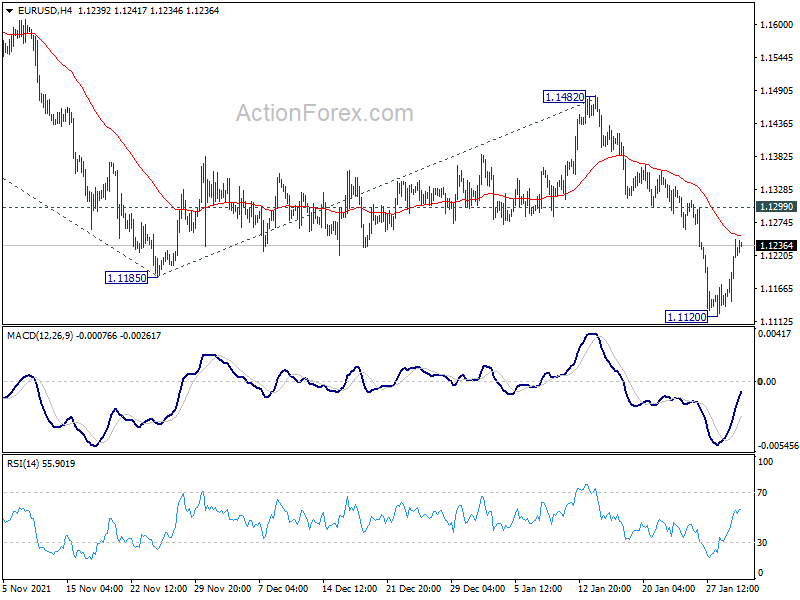
Daily Pivots: (S1) 1.1165; (P) 1.1207; (R1) 1.1274; More...
Intraday bias in EUR/USD remains neutral for consolidation above 1.1120 temporary low. Further fall is expected as long as 1.1299 minor resistance holds. On the downside, break of 1.1120 will resume larger down trend to 61.8% projection of 1.1908 to 1.1185 from 1.1482 at 1.1035. Break will target 100% projection at 1.0759. However, break of 1.1299 minor resistance will bring stronger rebound back towards 1.1482 structural resistance.
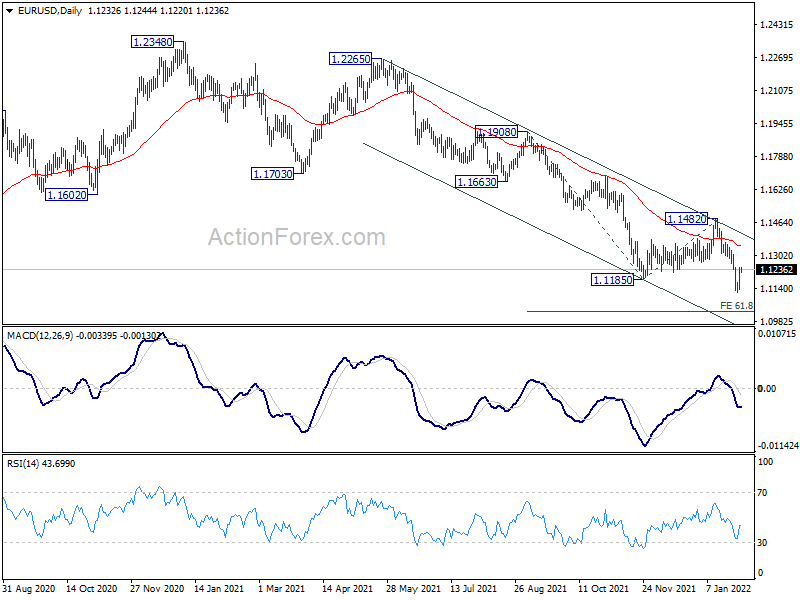
In the bigger picture, the strength of the the decline from 1.2348 (2021 high) suggests that it's not a corrective move. But still, it could be the fourth leg of a sideway pattern from 1.0339 (2017 low), or resuming long term down trend. In any case, outlook will now stay bearish as long as 1.1482 resistance holds. Next target would be 1.0635 low.
GBP/USD Daily Outlook
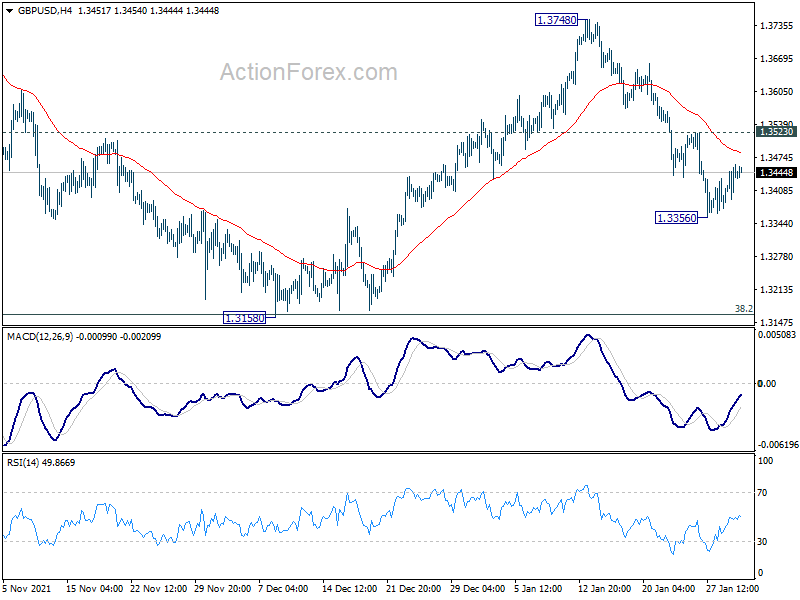
Daily Pivots: (S1) 1.3400; (P) 1.3431; (R1) 1.3475; More...
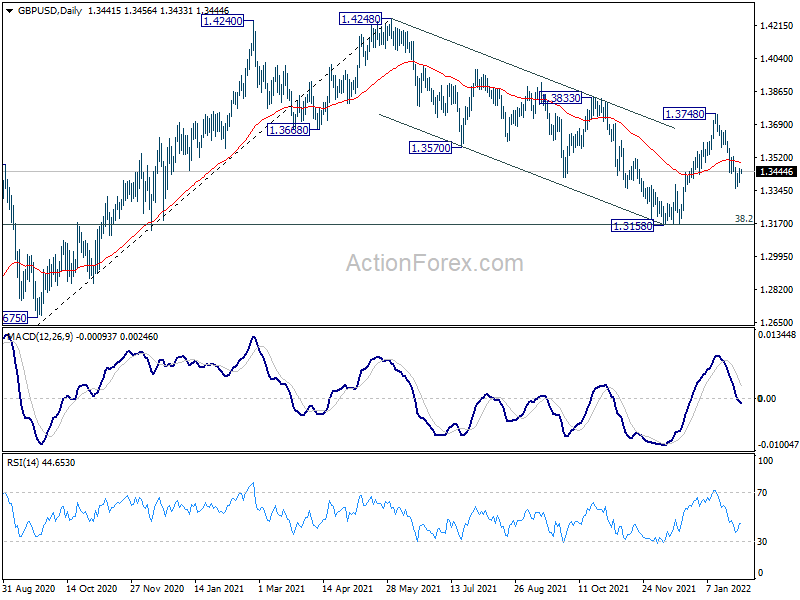
Intraday bias in GBP/USD remains neutral for consolidation above 1.3356 temporary low. Further decline is expected with 1.3523 minor resistance intact. As noted before, rebound from 1.3158 has completed at 1.3748 already, and down trend from 1.4248 is not over yet. Break of 1.3356 will resume the fall from 1.3748 to retest 1.3158 low. On the upside, though, above 1.3523 minor resistance will turn bias back to the upside for retesting 1.3748.
In the bigger picture, as long as 38.2% retracement of 1.1409 to 1.4248 at 1.3164 holds, up trend from 1.1409 (2020 low) is still in progress. On resumption, next target will be 38.2% retracement of 2.1161 to 1.1409 at 1.5134. Nevertheless sustained break of 1.3164 will argue that whole rise from 1.1409 has completed and bring deeper fall to 61.8% retracement at 1.2493.