Sample Category Title
XAU/USD Outlook: Gold Rises Above $1800 on Weaker Dollar But Fresh Bulls Need More Evidence
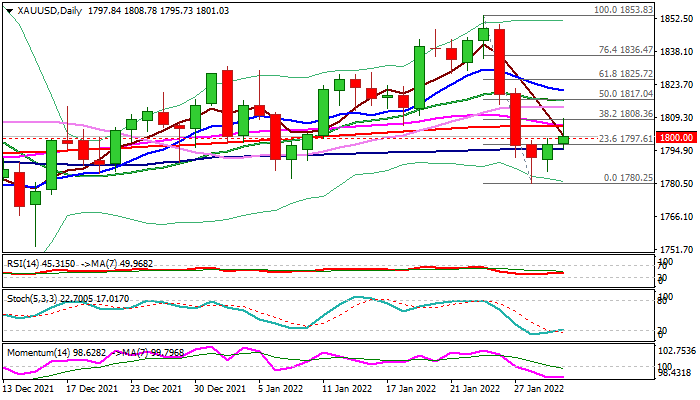
Spot gold regained traction after last week’s sharp post-Fed fall and bounced above key $1800 level.
Recovery from new 1 – 1/2 month low ($1780) extends into second day, driven by weaker dollar, as traders collected profits after euphoria on Fed’s hawkish signals for first rate hike in March and subsequent 3-4 increases until the end of the year faded, and more cautious tones were heard from the US policymakers.
Fed remains on course to end pandemic measures and start tightening policy as inflation skyrocketed but also wants to keep the door open amid uncertain outlook and still ongoing pandemic.
Fresh strength needs close above $1800 today to generate initial bullish signal, with extension above $1815/17 pivots (daily cloud top / 50% retracement of $1853/$1780 bear-leg) to confirm reversal.
Daily studies are still weak as 14-d momentum remains in the negative territory and moving averages remain above the price, with converged 55/200DMA’s on track to for a death-cross and add negative tone on technical outlook.
However, near-term action is expected to remain biased higher while holding above $1800, but the downside will remain vulnerable as long as the price action stays within the daily cloud ($1796/$1815), with more direction signals expected from Friday’s release of US non-farm payrolls for January.
Res: 1805; 1808; 1815; 1821.
Sup: 1800; 1796; 1785; 1780.
Pound Braces for First Back-to-Back Rate Hike by BoE Since 2004
The Bank of England is widely anticipated to raise interest rates to 0.50% on Thursday when it announces its decision at 12:00 GMT. Having already lifted the Bank Rate in December, the expected hike in February would make it the first time since 2004 that the BoE has tightened policy in two meetings in a row, underscoring not only the urgency to cap price growth but also just how long it’s been when inflation was last such a big threat. Yet, rate hike bets haven’t been powerful enough to defend the pound from the US dollar’s recent assault. Can a hawkish tone revive cable’s uptrend?
Worries about rising cost of living
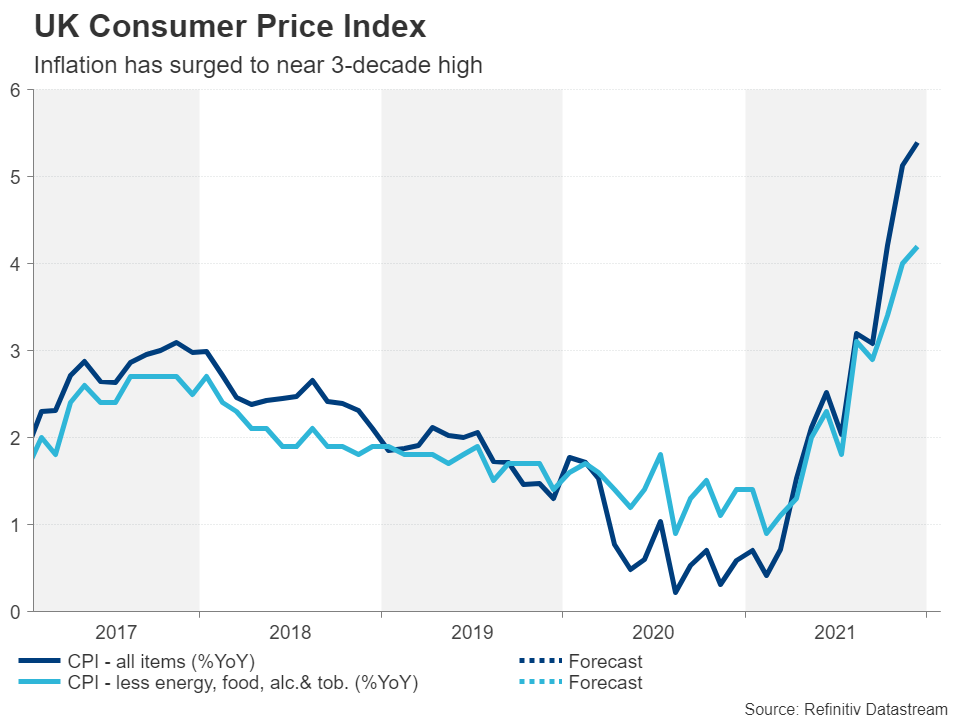
Inflation in the UK hit a near 30-year high of 5.4% y/y in December and the upsurge could get even greater in the coming months as energy bills are set to soar in April when the price cap is raised by the country’s regulator. With Britain’s labour market tightening very rapidly lately, the conditions are ripe for a wage-price spiral as employees feeling the strain of a jump in the cost of living find themselves with wage bargaining powers for the first time in years.
No shocks expected in February
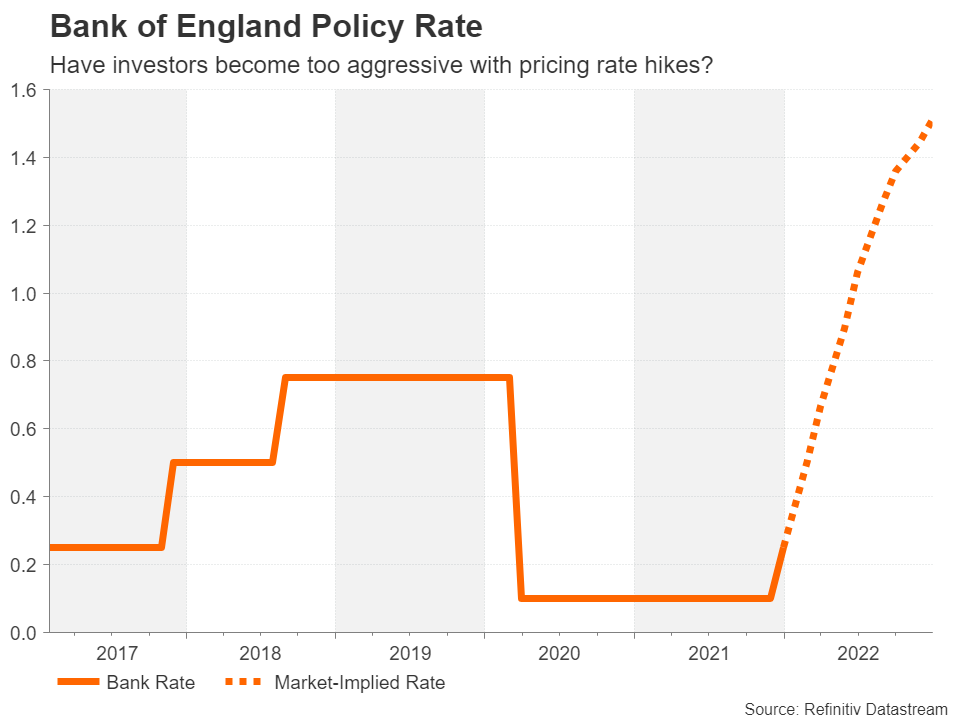
Money markets have fully priced in a 25 basis points rate rise in February, to add to December’s 15-bps increase that lifted the Bank Rate back up to 0.25% from historic lows. But the rate hike expectations don’t stop there as investors are betting on at least four additional increases during the course of the year. Interestingly, the Bank of England is one of the few central banks that generally tends to agree with market pricing, nudging traders in the right direction only if it sees a risk of it missing its 2% inflation target by following the market-implied path.
Policymakers tried to do this back in the Autumn when they first started to panic about higher inflation. But their clumsy communication still ended up wrong-footing many investors in both November and December. That’s not likely to happen this time round, although the BoE could still surprise in two ways on Thursday.
Will BoE flag danger ahead?
Firstly, the Bank’s quarterly Monetary Policy Report will be crucial in letting markets know whether the current implied path is consistent with hitting 2% inflation within the forecast period. The main risk here is that policymakers might think markets have become too aggressive with rate hike expectations.
Whilst it’s fair to say that the UK economy is fairly strong right now and the recovery has been impressive given that it suffered more than all other major economies from the initial pandemic meltdown, the outlook is as uncertain as ever. British consumers face a double squeeze in spending power over the next few months, as apart from the looming surge in fuel bills, they are also about to be struck by higher taxes in the form of an increase in national insurance contributions.
Combined with a rise in borrowing costs, spending by both households and businesses could take a major hit and the Bank might make a point of stressing this risk in its report. However, policymakers’ recent hawkish rhetoric suggests this won’t be a significant concern for them at this point and the bigger question mark heading into the meeting is what the Bank will say concerning the balance sheet.
Balance sheet runoff eyed
Like the Fed, the BoE’s balance sheet has ballooned during the pandemic and with inflationary pressures emerging from all over the place, a decision on reducing it is more than likely. Policymakers already signalled last year that the balance sheet could begin to shrink when the Bank Rate reaches 0.50% instead of their previous guidance of 1.50%. However, they could go one step further than that and announce the outright selling of assets, namely, gilts.
In all likelihood, a decision on the latter will be saved for a later date and the most investors should expect is the balance sheet will be allowed to run off by not reinvesting in maturing bonds. Nevertheless, Governor Andrew Bailey could hint at a future sale of bonds in his press briefing, potentially boosting gilt yields.
Pound finding its feet again
The UK 10-year yield has just crossed above 1.30% for the first time since March 2019 and a further spike could help sterling claw back some of its recent losses against the greenback. The $1.35 and $1.36 level are key targets for cable in the near-term as they stand in the way of re-challenging the January top of $1.3748. Only a break above this high can restore the pound’s bullish posture.
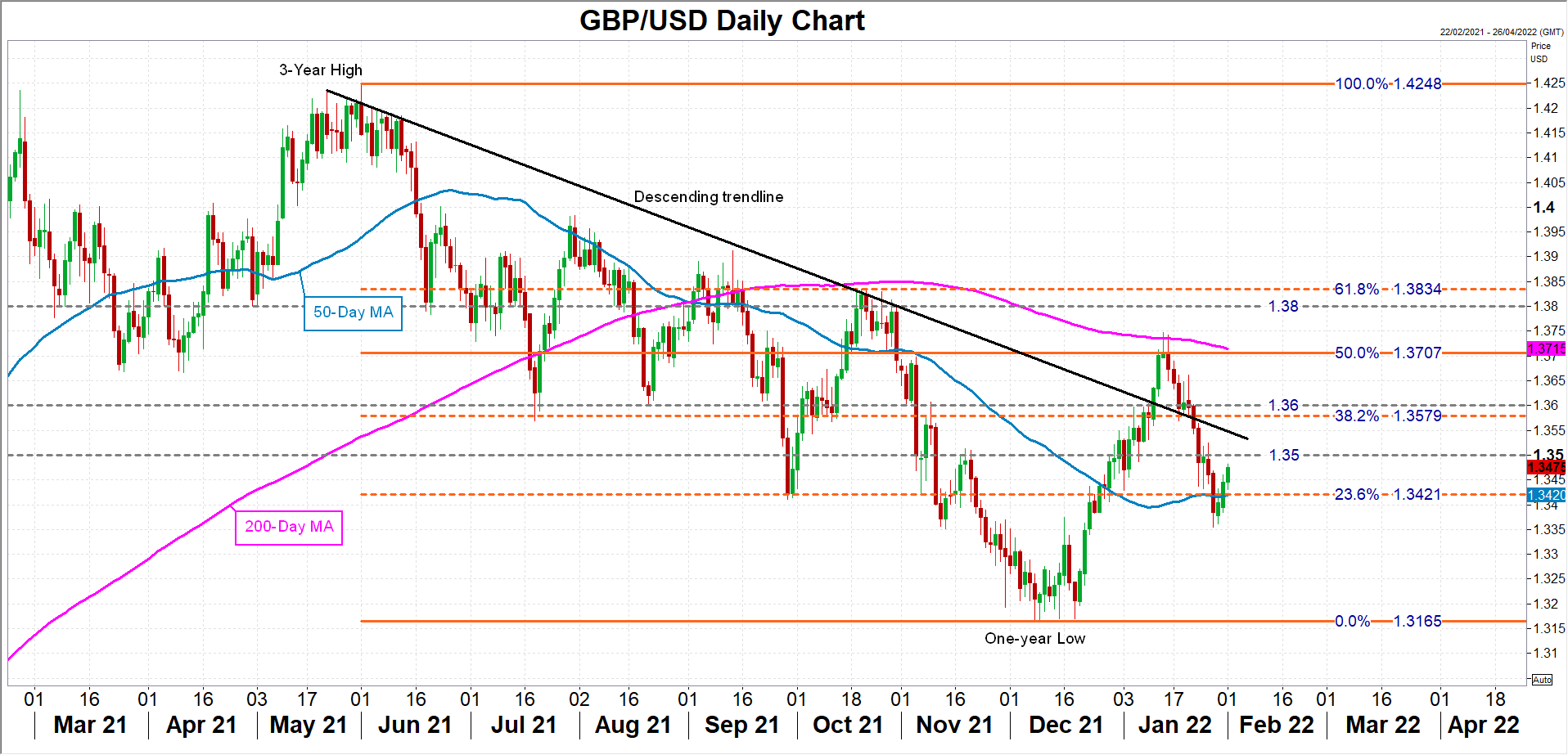
Alternatively, if the BoE tries to talk down some of the more hawkish market expectations, cable can slip back below its 50-day moving average and revisit December’s one-year trough of $1.3165.
In the meantime, the pound has been paying little attention to the happenings in No. 10 Downing Street where Boris Johnson is under pressure to resign. The stripped-down report into the alleged breaches of lockdown rules by Downing Street staff, including the Prime Minister, has found there were serious failings in leadership. Johnson has apologised and appears to be clinging on for now. However, the police are also investigating some of those events and the full report that is expected to be published after the police inquiry has ended could be more damning. Thus, the drama for Johnson is far from over.
US ISM manufacturing dipped to 57.6, corresponds to 3.1% annualized GDP growth
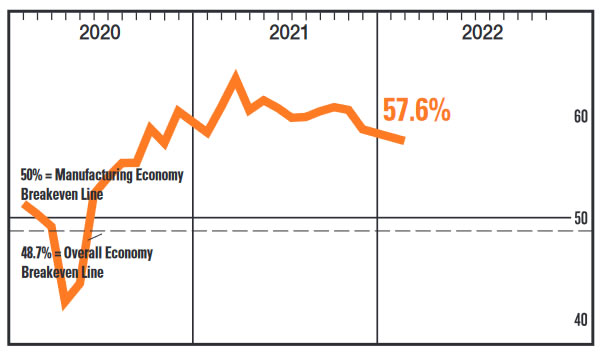
US ISM Manufacturing index dropped -1.2 pts to 57.6 in January, slightly better than expectatio nof 57.5. New orders dropped -3.1 to 57.9. Production dropped -1.6 to 57.8. Employment rose 0.6 to 54.5. Prices rose 7.9 to 76.1.
ISM said: "The past relationship between the Manufacturing PMI and the overall economy indicates that the Manufacturing PMI® for January (57.6 percent) corresponds to a 3.1-percent increase in real gross domestic product (GDP) on an annualized basis."
Sunset Market Commentary
Markets
Short-term yields in the US and Europe finally took a breather after a sharp hawkish repositioning. Fed Powell at last week’s policy meeting signaled the Fed would accelerate policy normalization as inflation is rising faster than expected and probably will last longer than the Fed anticipated until now. Powell’s view for sure prevails within the Fed. However, after Raphael Bostic yesterday opened the debate on a 50 bps rate hike in March, other colleagues (George, Daly) overnight advocated to stick to a gradual approach. Whatever the trigger, markets almost discounting five 25 bps rate hikes this year apparently provides a good enough reason for the interest rate rally to take a pause. The US yields curve slightly steepens with ST yields ceding about 1.5 bps (2-y) as 10’s and 30’s are raising marginally (0.5 bps). The rise in European interest rate markets also slowed, but Europe still slightly underperforms the US with the German yields gaining up to 2.0 bps (30.-y). In line with data evidence from other EMU countries over the previous days French January inflation printed stronger than expected at 0.1% M/M and 3.3% Y/Y (from 3.4%) raising the risk of an upward surprise for the European HICP scheduled for release tomorrow. Anyway, it will be interesting input as the ECB debates monetary policy at its first regular meeting of the year on Thursday. Interestingly, at -0.48% the German 2-y yield is touching the highest level since early 2016 and finally returned north of the ECB deposit rate! The relative calm on the bonds markets also supports a further comeback of equities. European indices are rebounding 1%/1.5% on average. US indices are opening little changed to marginally lower after significant daily gains on Friday and yesterday.
The dollar in the second half of last week was a major beneficiary of the higher short-term US yields and a spike in global volatility post-Fed. However, yesterday, the euro started a remarkably comeback, as short-term interest rates show investors grow ever more convinced that the ECB will be forced to amend its guidance not to raise interest rates until asset purchases will be finished at earliest end 2022. Despite limited moves on interest rate markets today, the euro maintained a positive momentum. EUR/USD is testing the 1.1270 area (compared to a correction low near 1.1121 end last week). At the same time, the dollar is losing further momentum. This doesn’t only apply to EUR/USD. USD/JPY (114.75) and the DXY index (96.31) are also falling prey to further profit taking. After a euro driven rebound yesterday, EUR/GBP today traded sideways near the 0.8350 pivot, awaiting more BoE guidance as Bailey an Co are expected to continue the rate hike cycle at Thursday’s policy meeting.
News Headlines
The Czech Statistical Office published preliminary Q4 GDP numbers today. The economy grew by 0.9% Q/Q and by 3.6% Y/Y, significantly beating consensus (0.2% Q/Q & 2.9% Y/Y). External demand was the biggest growth engine in this quarter. Over the whole of 2021, the Czech economy grew by 3.3% compared to 2020. The growth was supported by final consumption expenditure and a change in inventories, whereas external demand had a negative influence. Employment increased by 0.1% in 2021. In Q4, it remained unchanged in Q/Q terms. The Czech Koruna remains well bid today going into Thursday’s CNB meeting which is expected to deliver another 75 bps rate hike (to 4.5%). EUR/CZK drops towards 24.25 and seems ready for a test of the sell-off low at 24.20.
The European Central Bank published its January bank lending survey. Credit standards for loans or credit lines to enterprises tightened very slightly in Q4 2021. Regarding loans to households for house purchases, EMU banks reported unchanged credit standards while credit standards for consumer credit and other lending to households eased moderately. Banks continue to hold an overall benign view of firm credit risks, owing mainly to a positive assessment of economic outlook. In Q1 2022, banks expect credit standards to remain broadly unchanged for loans to firms, to tighten moderately for housing loans and to ease further for consumer credit. Banks reported, on balance, a considerable increase in firms’ demand for loans or drawing of credit lines in Q4 2021.
US Stocks’ Rally Eases, Dollar Slips as Yields Retreat
Dollar loses ground after Fed officials rule out aggressive hike
The dollar's weakness is resuming today as an increasing number of Fed officials downplayed the possibility of a 50 basis points rate hike in March, suggesting that monetary tightening should be more gradual in order to avoid causing panic in the markets. Moreover, the rebound in global equities, alongside the retreating Treasury yields and a chance for profit-taking after the dollar’s extended rally added further downside pressures on the greenback. Later today, investors will be closely eyeing the US ISM Manufacturing PMI, which will provide insights into the broader health of the US economy.
Meanwhile, the euro is nudging higher, capitalizing on solid data releases earlier today. More specifically, unemployment in the Eurozone decreased to 7.0% versus the 7.1% projection, while Eurozone Manufacturing PMI rose to a five-month high, depicting an acceleration of manufacturing activity as supply disruptions seem to be fading. Furthermore, market anticipation that the persisting inflationary pressures will force the ECB to adopt a more hawkish stance, alongside surging German bond yields added more fuel to the euro’s rally.
In the broader FX spectrum, commodity-linked currencies such as the aussie, kiwi and loonie are appreciating against the dollar on the day, supported by the cautiously positive risk tone in the markets and the elevating commodity prices. Elsewhere, the intensifying geopolitical flare-ups seem to be favoring the safe havens, with the franc and yen both gaining ground in today’s session.
US stocks cool off; global stocks surge
Wall Street is set for a mixed opening today despite yesterday’s strong performance as investors seem to be grappling with uncertainty over the timing and pace of the Fed’s upcoming monetary tightening. E-mini futures for the tech-heavy Nasdaq are edging higher in pre-market trade, while Dow Jones and S&P 500 futures are almost unchanged, fluctuating between -0.05% and 0.05% in the time of writing. On the other hand, major European indices are gaining more than 1% in the current session, catching up with Wall Street’s rally the previous day. Today, tech giants such as Google, AMD and PayPal report their Q4 earnings, which might provide traders with fresh trading impetus.
Oil’s rally pauses; gold shines
Oil futures are trading lower in the current session amid increasing speculations that the OPEC+ is going to proceed with gradual production hikes in the upcoming months. On the other hand, gold is back above its $1,800 mark and continues to edge higher, significantly benefiting from retreating US yields, increasing geopolitical tensions and the softer dollar.
Canada’s Economy Advances Solidly in November
The Canadian economy expanded by 0.6% (month/month) in November, well ahead of Statistics Canada's flash estimate of 0.3% and consensus expectations for 0.4%, respectively. The release means that Canada's real GDP is now 0.2% above its pre-pandemic (February 2020) levels in November.
November's solid increase in activity was broad-based, with output expanding in 17 of the 20 industries. The service-producing sector led the way, up 0.6%, while the goods-producing sector rose 0.5%.
Manufacturing saw a noticeable jump (1.4%) this month, with transportation equipment manufacturing rising 3.6%. With the re-start in production at assembly plants that were shuttered by supply chain issues, vehicle and vehicle parts manufacturing rose significantly.
On the non-durable side, with energy demand soaring, petroleum and coal products at refineries were up 6.8%! Conversely, the mining and extraction of raw material energy products declined by 1.8%. Part of this was due to the B.C. floods, which slowed transportation hubs.
The accommodation and food services sector continued the positive narrative, growing a robust 3.4%. Restaurant activity was robust, with food services and drinking places rising 2%.
In today's report, Statistics Canada stated that the estimate for December GDP was "essentially unchanged". That would mean GDP for the fully year of 2021 would come in at 4.9%.
Key Implications
This was a very solid report as there was a broad increase in output across most industries. This has Canadian GDP decisively above pre-pandemic levels.
Unfortunately, the positives from today's report are unlikely to last. The Omicron wave has slowed activity in December and January. This is going to be most felt in the service-producing industries, which have been in start-stop mode repeatedly over the last two years.
For financial markets, the Bank of Canada will be pleased to see that the economy has recovered all the output lost over the pandemic. That said, we don't think it should be too hung-up on the monthly GDP data that will come out over the next two months. Given that we are likely past the worst of the Omicron wave, we expect a strong boost to monthly GDP in February and March.
Canadian GDP Growth Solid Pre-Omicron
- GDP rose 0.6% in November, back above pre-pandemic (Feb/20) levels
- Early estimate of December output 'little changed'; Q4 growth tracking close to our 6.0% (annualized) forecast
- GDP data to look softer in January, but economic impact of Omicron wave to ease in February
The 0.6% increase in GDP in November was larger than the +0.3% preliminary estimate from Statistics Canada a month ago and built on a 0.8% jump in October. Auto production rose+7.3% after a 19.4% increase in October as supply chain disruptions eased, although that still left motor vehicle and parts production running 17.5% below year-ago levels. Oil & gas extraction fell 2.5% but gains were broadly-based across most other industries, including accommodation and food services and arts, entertainment, & recreation which remain among the industries still operating well-below pre-pandemic levels. Declines in farm product wholesales and coal mining were attributed to severe flooding in BC later in the month, but the floods overall appear to have limited impact on top-line GDP data.
The early estimate of December output was unchanged from November, with growth for the quarter as a whole tracking very close to (slightly above) our 6.0% (annualized) forecast. Economic data is expected to look weaker in January with Omicron spread and re-imposed containment measures in some regions limiting output. But with restrictions already starting to ease, that softening is expected to be short-lived. Beyond near-term disruptions, production capacity limits, global supply chain disruptions, and labour shortages are expected to remain bigger issues in many sectors than shortages of orders. The Bank of Canada acknowledged that most economic indicators would suggest the economy has essentially, on balance, recovered, and is expected to begin hiking interest rates from emergency low levels as soon as March.
Fed Harker a little less convinced of a 50bps hike
Philadelphia Fed President Patrick Harker said he would be "supportive of a 25 basis point increase in March." But he's "a little less convinced of" a 50 bps hike right now. He added, "if inflation stays where it is now, and continues to start to come down, I don't see a 50 basis point increase."
"Right now, I think four 25 basis point increases this year is appropriate," Harker said. "But there's a lot of risk here," including the risk that inflation is worse than expected, or that it eases faster than Fed officials expect.
AUD/USD Mid-Day Report
Daily Pivots: (S1) 0.7011; (P) 0.7044; (R1) 0.7101; More...
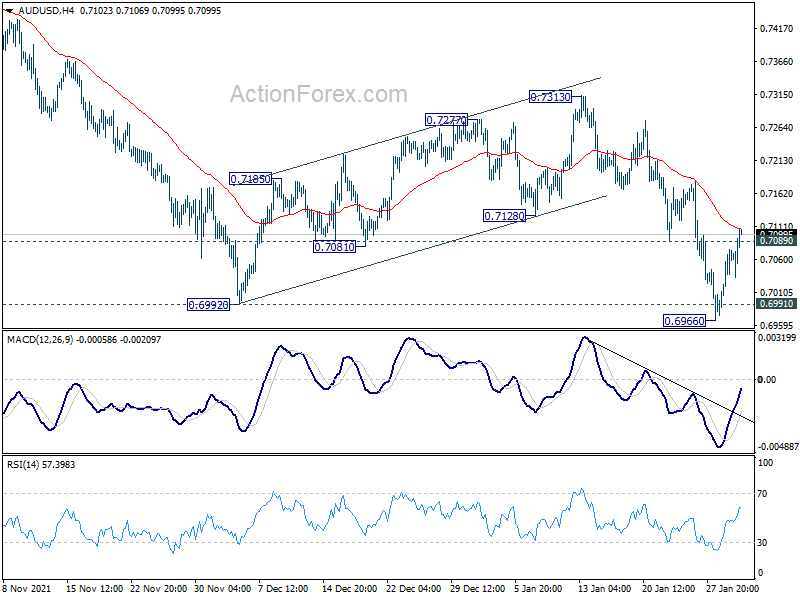
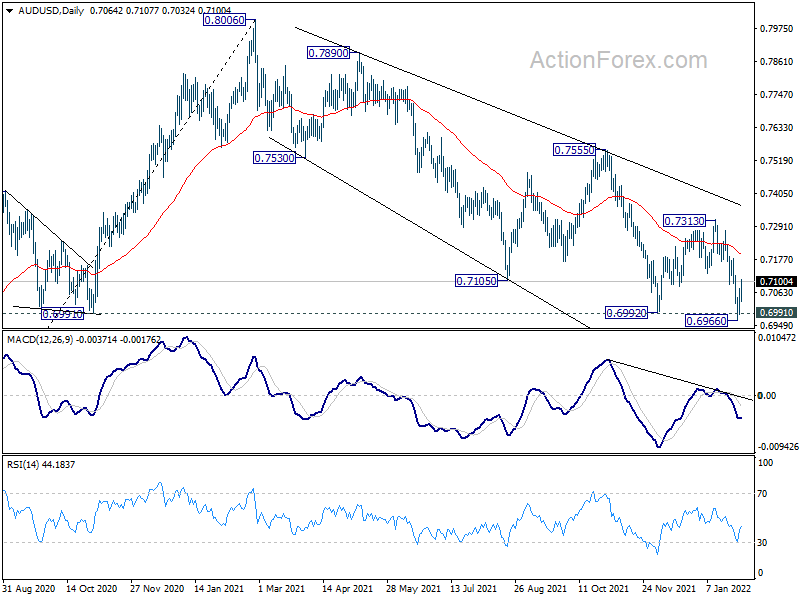
AUD/USD's break of 0.7089 resistance suggests that it has tentatively defended 0.6991 key medium term support. Intraday bias is back on the upside for stronger rebound towards 0.7313 resistance. On the downside, sustained break of 0.6991 will resume the larger fall from 0.8006 and carry larger bearish implication.
In the bigger picture, focus remains on 0.6991 key structural support. Sustained break there will argue that the whole up trend from 0.5506 might be finished at 0.8006, after rejection by 0.8135 long term resistance. Deeper decline would then be seen back to 61.8% retracement of 0.5506 to 0.8006 at 0.6461. Meanwhile, strong rebound from 0.6991 will retain medium term bullishness. That is, whole up trend from 0.5506 is still in progress.
USD/JPY Mid-Day Outlook
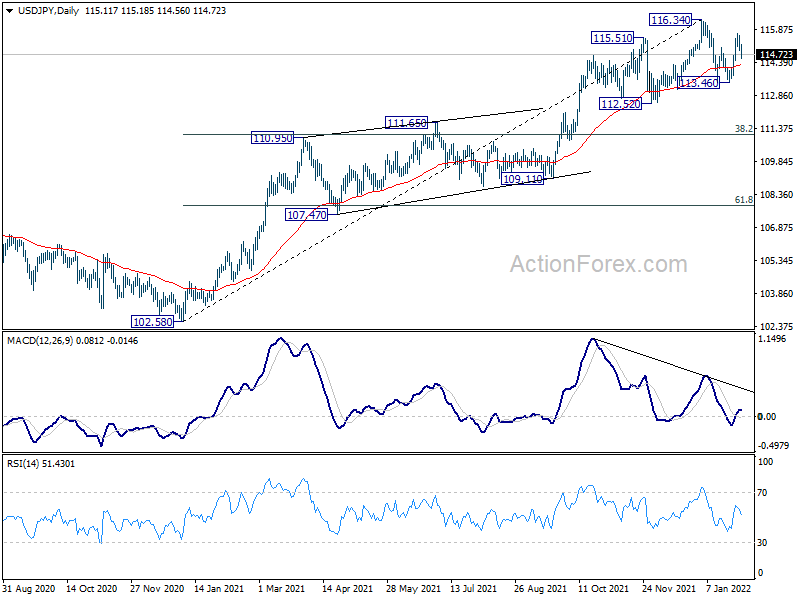
Daily Pivots: (S1) 114.84; (P) 115.21; (R1) 115.50; More...
USD/JPY's fall from 115.68 extends lower today but it stays above 114.46 minor support. Intraday bias remains neutral and further rally is in favor. . On the upside, break of 115.68 will target 116.34 high first. Decisive break there will resume larger up trend for 118.65 long term resistance next. On the downside, however, break of 114.46 will extend the corrective pattern from 116.34 with another falling leg through 113.46 support.
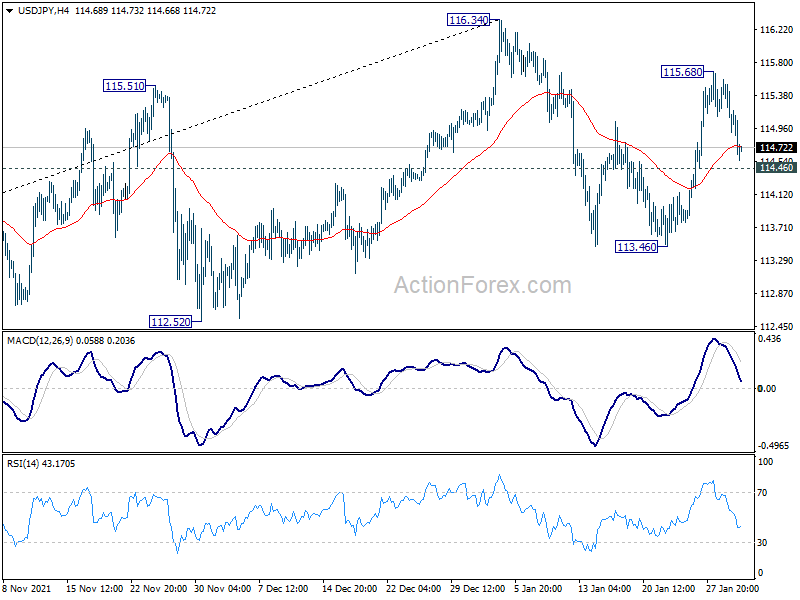
In the bigger picture, no change in the view that rise from 102.58 is the third leg of the up trend from 101.18 (2020 low). Such rally should target a test on 118.65 (2016 high). Sustained break there will pave the way to 120.85 (2015 high) and raise the chance of long term up trend resumption. This will remain the favored case as long as 55 week EMA (now at 111.07) holds.