Sample Category Title
AUD/USD Recoups Losses
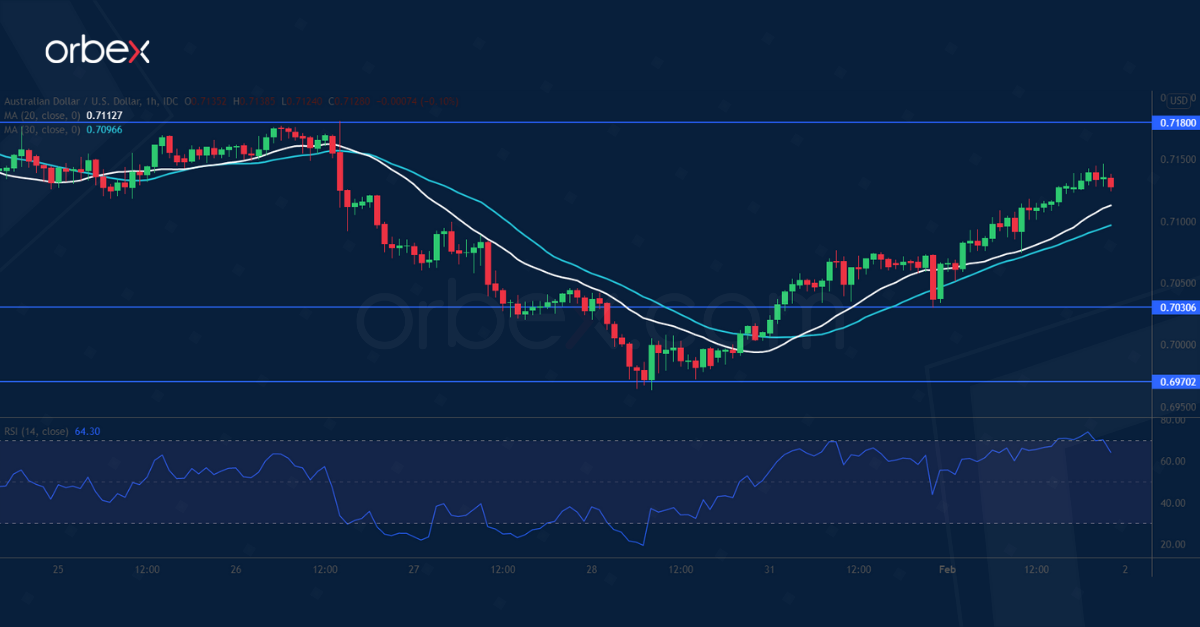
The Australian dollar recovered after the RBA signaled an end to its bond-buying program. The recent sell-off below the daily support and psychological level of 0.7000 further weighed on market sentiment. As the RSI dipped again into the oversold territory, short-term sellers’ profit-taking has driven the price higher.
The bears could be looking to fade the current rebound unless the bulls succeed in pushing past 0.7180. 0.7030 is a fresh support and 0.6970 a major floor before June 2020’s lows near 0.6800.
Dollar Traded on the Back Foot
Markets
The most interesting action occurred on German bond markets yesterday. Yields surged further north in the wake of the much smaller-than-expected HICP decline. The short end of the curve underperformed with the 2y yield gapping another 5.8 bps higher to -0.47%. It closed above the -0.50% ECB deposit rate for the first time since 2016. Yields further down the curve added 1.8 bps (5y) over 2.6 bps (10y) to 3.8 bps (30y) with new recovery highs for the former two. Economic data in the US had little impact. The manufacturing ISM came in at a strong 57.6 vs 57.5 expected and slightly down from 58.8 last month. Production and new orders eased a bit to still lofty levels while employment rose to 54.5. Prices paid advanced again after a drop in December but supplier deliveries declined for a third month straight to the lowest since November 2020, suggesting further relief on supply chains. Jolt openings (10925k) topped consensus estimates and are hovering near the all-time highs. US yield moves were limited between -1.4 bps and +1.4 bps. The 2y yield shows signs of short-term topping after the recent aggressive repositioning towards five Fed policy rate hikes for 2022. The dollar traded on the back foot, allowing EUR/USD to recover further despite a poorly shaped euro. A constructive risk setting (stocks gained about +1%) may have weighed on the greenback as well. Either way, the pair closed at 1.1272. DXY eased to 96.38. Sterling recouped half of Monday’s technical losses against the euro. EUR/GBP grinded lower to finish at 0.834.
Down Under stays in the center of attention during Asian dealings. RBA governor Lowe during a press conference elaborated on the policy decision made yesterday. He repeated that the end of QE does not imply an immediate rate hike but said it’s plausible that the policy rate goes up “later this year”. The Aussie dollar gains marginally. In New Zealand, the unemployment rate hit the lowest on record (see below). News otherwise is limited. Stocks gain 1-2% with Japan outperforming. Core bonds and FX markets are an ocean of calm.
The US ADP job report today precedes the official reading on Friday. Consensus expects omicron to have dampened employment gains to an 184k increase after the whopping 807k in December. Our (and market’s) eye will go to the European inflation figure though. Consensus was already raised from 4% to 4.4% in recent days, limiting but not completely eliminating the scope for an upward surprise after a string of individual country releases earlier. The slower-than-expected easing of inflation heaps ever more pressure on the ECB. After the recent boost, European & German yields may first want to check the outcome of the central bank meeting tomorrow. We expect the euro to stay on the sidelines for the same reason. For sterling the tone of and hints by the BoE tomorrow will be crucial. The market bar is set quite high at 5 policy rate hikes.
News Headlines
Stats NZ published Q4 New Zealand labour market data this morning. The labour market continued to show tightness witnessed in Q3 with both unemployment (3.2%; lowest since start of the series in 1986) and underutilization (9.2%) remaining low. The participation rate declined from 71.2% to 71.1%. The number of employed people remained steady in Q4 (0.1% Q/Q), but the Y/Y reading remained elevated at 3.7% thanks to the previous three quarters. Wage inflation measured by the labour cost index was 2.6% in the year to the December 2021 quarter, while average ordinary time hourly earnings rose 3.8 percent. The private sector experienced stronger wage growth than the public sector in Q4. The kiwi dollar didn’t react to the data, but made a welcome rebound in yesterday’s positive risk climate. NZD/USD trades around 0.6635, up one big figure from last week’s sell-off low.
A survey by the British Retail Consortium showed that shop prices rose by 1.5% Y/Y in January (0.1% M/M), up from 0.8% Y/Y in December and the fastest pace since December 2012. Food prices increased by 0.3% M/M to be up 2.7% Y/Y (from 2.4%), reflecting poor harvests, labour shortages and rising global food prices. Non-food prices rose fell by 0.3% M/M, but were up 0.9% Y/Y (from -0.2%). Exceptionally high demand for furniture and flooring stood out.
Crude Oil Price Steady ahead of February OPEC+ Meeting
The Dow Jones, S&P 500, and Nasdaq 100 indices tilted higher after positive corporate results. On Tuesday, UBS reported that 2021 was its best year in over 15 years as the wealth management segment performed well. In the US, ExxonMobil announced strong results, helped by rising oil and gas prices. The firm made a profit of $8.9 billion, beating the consensus estimate of $8.4 billion. It will launch a $10 billion buyback program. Its annual profit came in at over $23 billion. Alphabet, the parent company of Google and Android announced strong results, helped by strong ad and cloud revenue.
The US dollar eased against most currencies after strong economic numbers from the US. According to Markit, the manufacturing PMI came in at 54.5 in January, which was a better performance than the median estimate of 53.5. On the other hand, data by the Institute of Supply Management (ISM) showed that the PMI rose to 57.6 in January. The strong performance was mostly because of the rising demand from both local and international buyers. Most manufacturers complaint about the rising cost of doing business. Later today, the currency will react to the latest ADP jobs data.
The euro rose against the US dollar and sterling after strong Eurozone jobs and manufacturing PMI data. According to Eurostat, the bloc’s unemployment rate declined to a record low of 7.0% in December. That was a sign that the European recovery is doing better than estimated. Later today, the currency will react to the preliminary inflation data for February. Analysts expect the data to show that consumer prices dropped to 4.4% in January from 5.0% in December.
XBRUSD
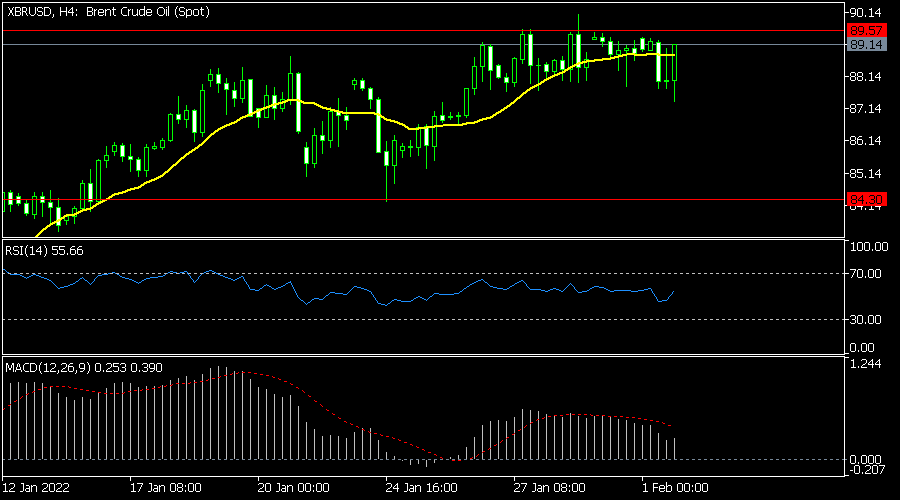
The XBRUSD pair held steady as investors refocused on the upcoming OPEC meeting. There is chatter that the cartel will agree to gradually increase production considering that demand is rising globally. The pair is trading at 88.95, which is slightly below this year's high of 90. It is along the 25-day moving average while the MACD and the Relative Strength Index (RSI) are at a neutral level. Therefore, the pair will likely have a bullish break-out later this week.
EURUSD
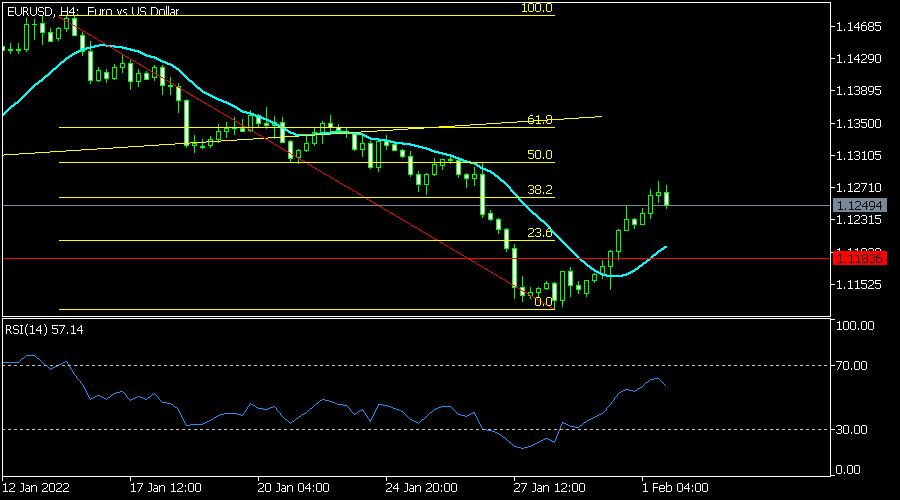
The EURUSD pair rose to a high of 1.1280, which was the highest level since January 27. On the four-hour chart, the price is slightly below the 38.2% Fibonacci retracement level. It is also slightly above the 25-day moving average while the Relative Strength Index (RSI) has been rising. Therefore, the pair will likely keep rising as bulls target the next key resistance at 1.1300.
XAUUSD
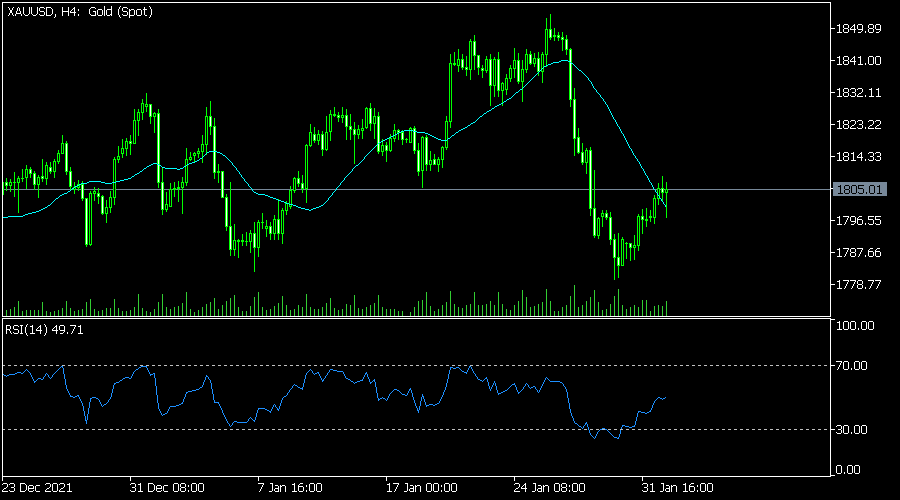
XAUUSD pair held steady as gold attempted to make a comeback. The pair is trading at 1,803, which is higher than this week's low of 1,780. On the four-hour chart, the pair is slightly above the 38.2% Fibonacci retracement level. It has also formed what looks like a bearish flag pattern while the Relative Strength Index (RSI) has moved slightly above the oversold level. Therefore, the pair will likely keep rising ahead of US jobs data.
Fed Hawks Out, Strong Earnings In
US stocks gained for the third consecutive session, and the gains seemed more stable this time, as the VIX index retreated below the 22 mark. The Federal Reserve (Fed) storm is coming to an end, with most hawkish expectations already factored in the asset prices, and the strong corporate earnings help equities bind up their wounds.
We have two important events on today’s macro calendar: the OPEC meeting and the US ADP report.
OPEC: No need to hold your breath…
OPEC will discuss whether and by how much they should increase its oil output at today’s meeting.
Goldman thinks that the outcome of the meeting is evenly balanced between an unchanged 400’000 barrels increase per day or a ‘much bigger hike’. Yet, there is little chance for OPEC to announce a much bigger hike given that many key oil producer countries are already struggling to meet the actual 400’000 barrels increase; putting more pressure on the cartel seems unlikely.
Crude prices are poised for an advance towards the three-digit levels in the coming months given that global glut declines faster than expected due to a stronger recovery in demand, and ongoing supply constraints.
The latest API data showed that the crude inventories may have declined 1.6 million barrels last week, versus analysts expecting a roughly 1.8-million-barrel build. The bigger picture shows that the US crude inventories fell by 76 million barrels since the start of 2021, and about 19 million barrels since the start of 2020. Lower inventories inevitably pressure the crude prices higher.
Plus, tensions between Ukraine and Russia bring an extra pressure through the rising natural gas prices.
All in all, the actual factors are supportive of a further rise in oil prices and all lights are green for an extended rally in oil toward the $100pb mark.
PS: Higher energy costs also mean a higher inflation, and a tighter Fed, but that reasoning has been widely priced in already.
US jobs don’t really matter
According to the latest JOLTS data, more than 10 million Americans quit their jobs in December and today’s ADP data is expected to reveal that the US economy added 185K new private jobs in the final month of 2021 versus more than 800’000 printed a month earlier.
Yet we know that the December ADP figure could come much smaller than that; we could even see a negative print today as the omicron may have taken a severe toll on the US jobs market in December.
The good news is that a bad print will be put on the back of the omicron wave and won’t really affect the improving risk appetite. Whereas there is only a slim chance of seeing a strong-enough read to boost the Fed hawks.
EURUSD Elliott Wave View: Doing A Corrective Bounce
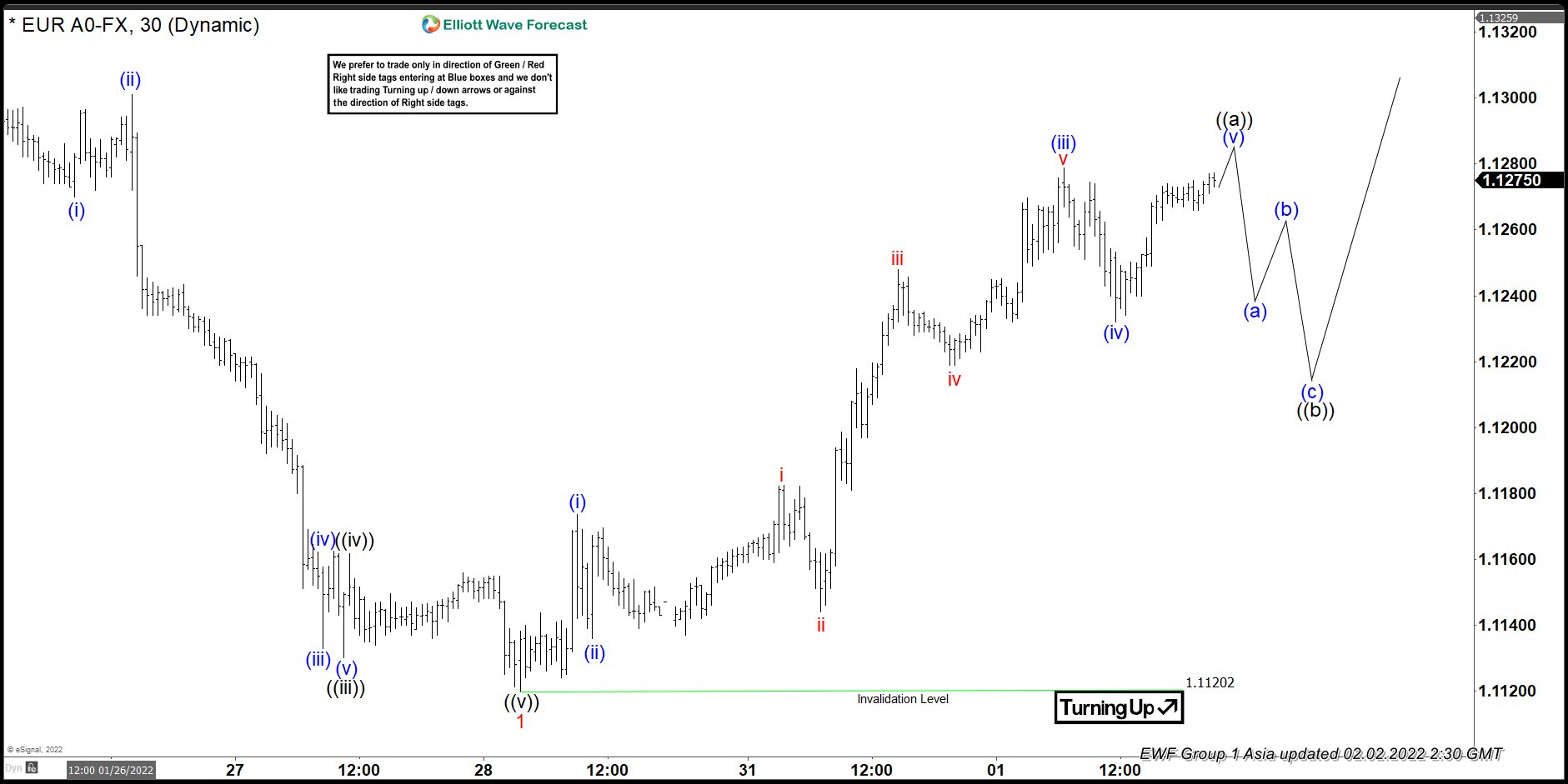
The short-term Elliott wave view in EURUSD suggests that the pair is doing a corrective bounce to correct the cycle from January 14, 2022 high. While the decline to $1.1120 low has ended wave 1 in an impulse sequence. Up from there, the pair is proposed to be in a wave 2 bounce. However, the bounce so far bounce looks impulsive. Therefore it’s proposed to be in a zigzag correction when we must be in the first leg of the bounce.
Above from $1.1120 low, the initial bounce to $1.1173 high ended small wave (i). A pullback to $$1.11326 low ended wave (ii). Then pair rallies in another 5 waves in a lesser degree cycle to complete the wave (iii) at $1.1278 high. Down from there, wave (iv) pullback ended at $$1.1232 low. Near-term, as far as dips remain above that level the pair should be targeting a minimum $1.1289- $1.1307 area to the upside within wave (v) to end wave ((a)). Which is the inverse 1.236%- 1.618% Fibonacci extension area of wave (iv). Afterward, the pair should see the pullback in wave ((b)) in 3 or 7 swings before the next leg higher in wave ((c)) starts.
EURUSD 1 Hour Elliott Wave Chart
GBP/JPY Daily Outlook
Daily Pivots: (S1) 154.68; (P) 154.94; (R1) 155.40; More...
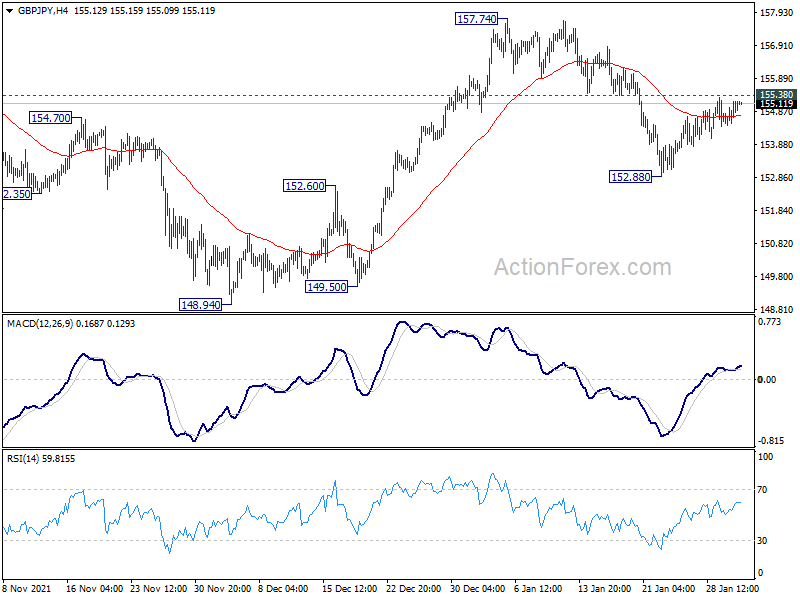
Intraday bias in GBP/JPY remains neutral as consolidation from 152.88 is extending. Fall from 157.74 should be the third leg of the corrective pattern from 158.19. Deeper decline is expected as long as 155.38 minor resistance holds. Below 152.88 will target 148.94 support next. On the upside, above 155.38 minor resistance will flip bias back to the upside for 157.74/158.19 resistance zone instead.
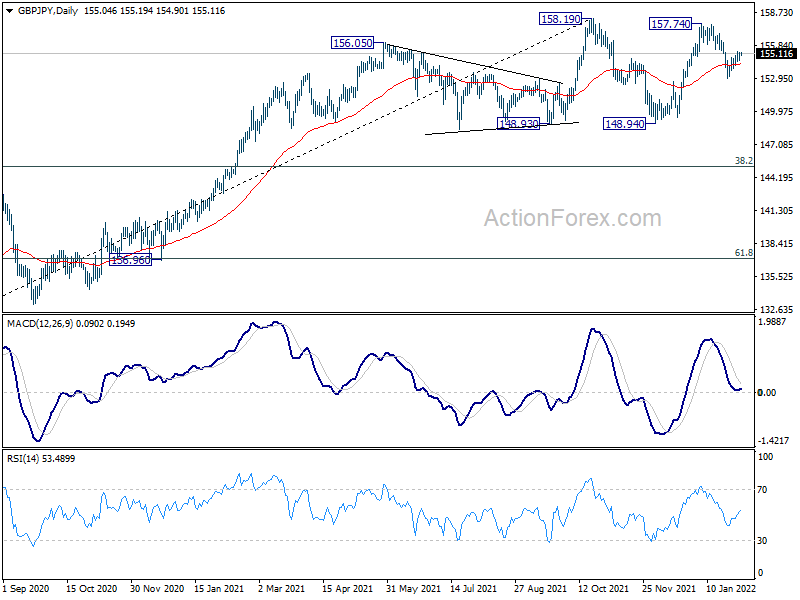
In the bigger picture, price actions from 158.19 are currently seen as developing into a consolidation pattern to up trend from 123.94 (2020 low). Downside should be contained by 123.94 to 158.19 at 145.10 to bring rebound. Firm break of 158.19 will resume the up trend to long term fibonacci level at 167.93. However, sustained break of 145.10 will raise the chance of trend reversal and target 61.8% retracement at 137.02.
EUR/JPY Daily Outlook
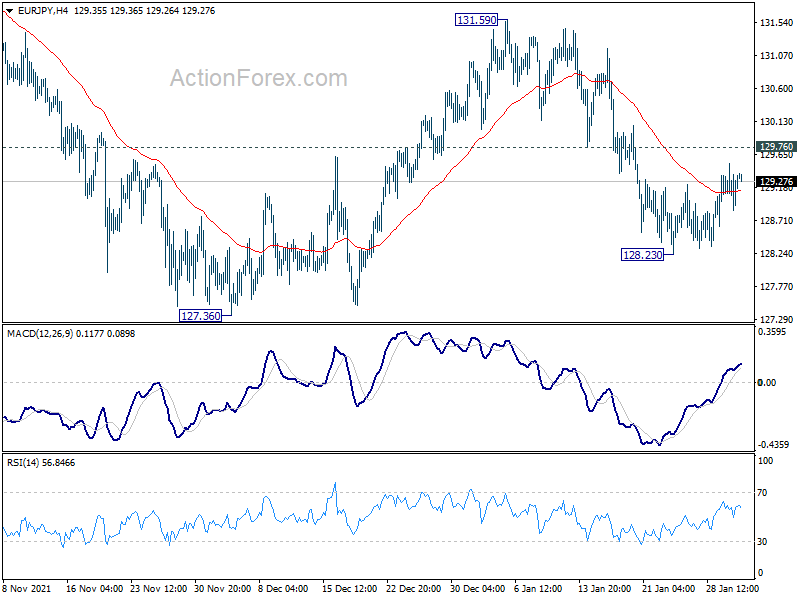
Daily Pivots: (S1) 128.94; (P) 129.23; (R1) 129.60; More....
EUR/JPY is staying in consolidation from 128.23 and intraday bias remains neutral. Outlook is unchanged that corrective pattern from 134.11 is extending with another falling leg. Further decline is expected as long as 129.76 resistance holds. Below 128.23 will target 127.36, and possibly further to 126.58 fibonacci level. On the upside, above 129.76 minor resistance will turn bias back to the upside to 131.59 resistance instead.
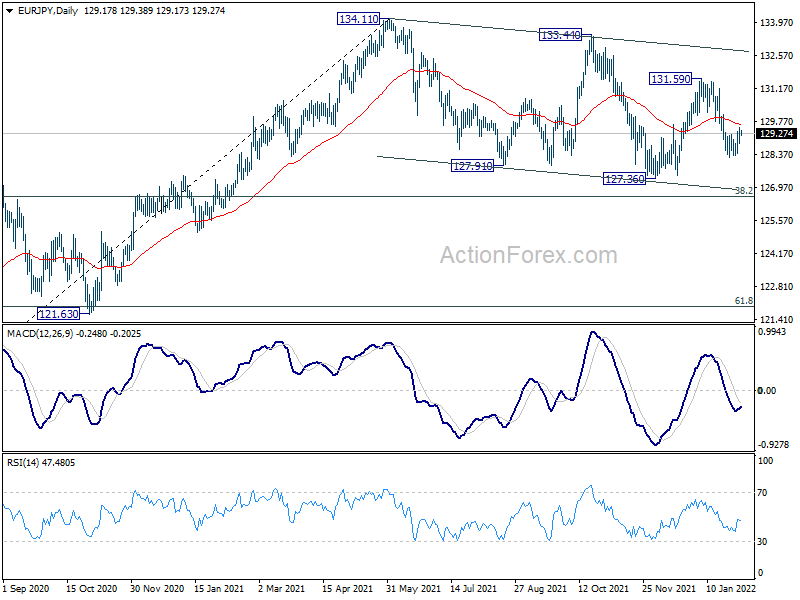
In the bigger picture, price actions from 134.11 are currently seen as a consolidation pattern only. As long as 38.2% retracement of 114.42 (2020 low) to 134.11 at 126.58 holds, up trend from 114.42 is still in favor to continue. Break of 134.11 will target long term resistance at 137.49 (2018 high). However, sustained break of 126.58 will raise the chance of bearish reversal. In this case, deeper decline would be seen to 61.8% retracement at 121.94, and possibly below.
EUR/GBP Daily Outlook
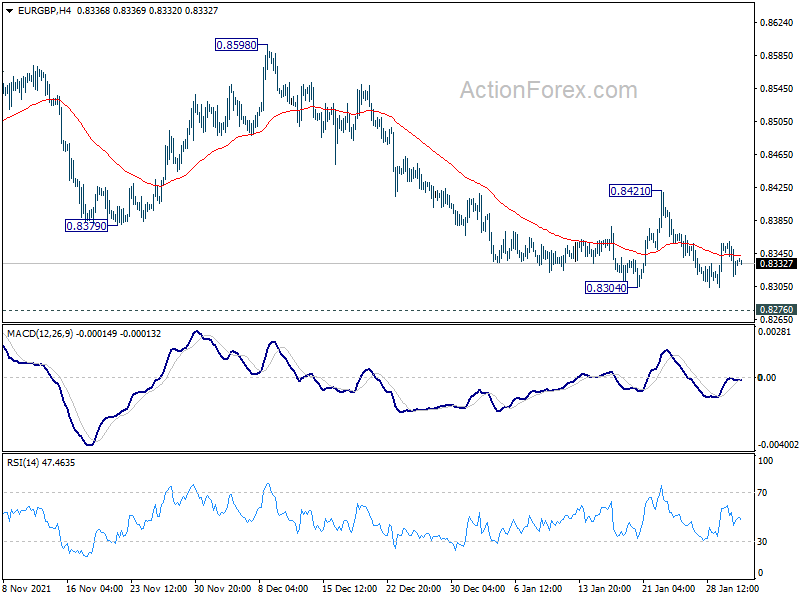
Daily Pivots: (S1) 0.8315; (P) 0.8338; (R1) 0.8357; More...
Intraday bias in EUR/GBP remains neutral first. Near term outlook stays bearish as long as 0.8421 resistance holds. Break of 0.8304 will resume larger down trend towards 0.8276 key long term support. However, break of 0.8421 resistance will be a sign of bullish reversal. Further rise would be seen back to 0.8598 structural resistance next.
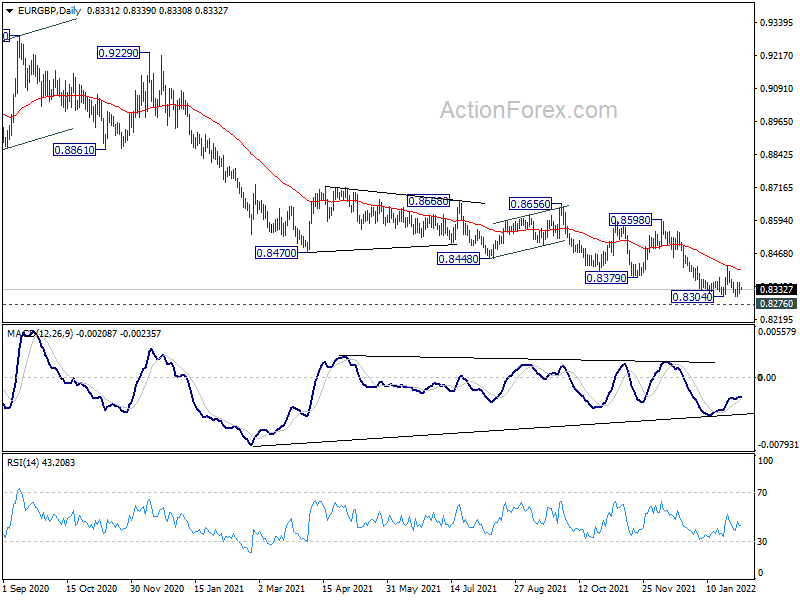
In the bigger picture, price actions from 0.9499 (2020 high) are still seen as developing into a corrective pattern. Deeper fall could be seen as long as 0.8598 resistance holds, towards long term support at 0.8276. We'd look for bottoming signal around there to bring reversal. Meanwhile, firm break of 0.8598 will now be an early sign of medium term bottoming and bring stronger rebound. However, sustained break of 0.8276 will argue that the long term trend has reversed.
EUR/AUD Daily Outlook
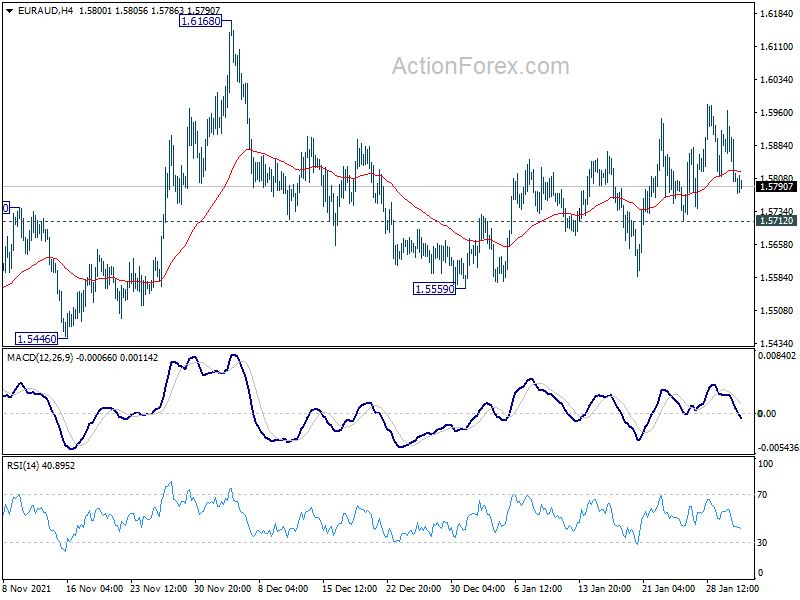
Daily Pivots: (S1) 1.5755; (P) 1.5861; (R1) 1.5918; More...
With 1.5712 minor support intact, further rise is still mildly in favor in EUR/AUD to 1.6168 resistance. However, on the downside, break of 1.5712 support will turn bias back to the downside for 1.5559 support instead.
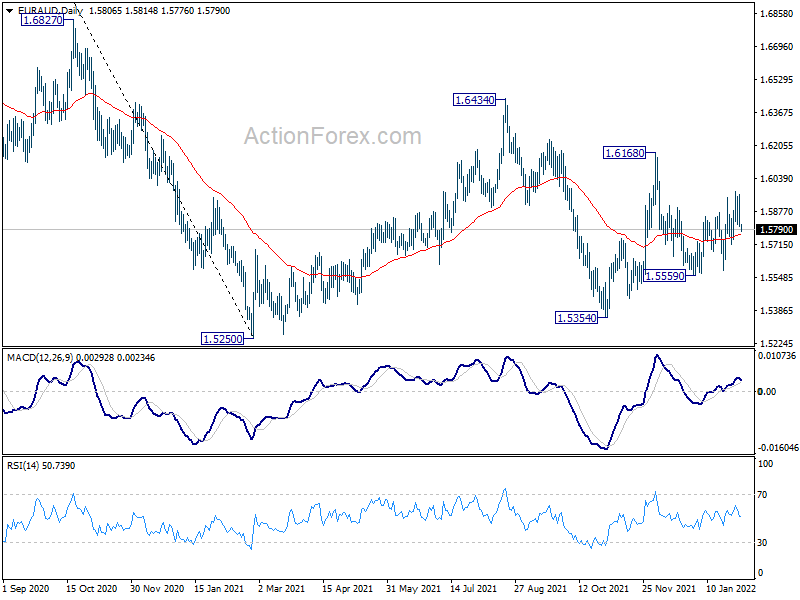
In the bigger picture, rise from 1.5354 is seen as the third leg of the corrective pattern from 1.5250 low. Further rise cannot be ruled out, but even in that case, strong resistance should be seen at 38.2% retracement of 1.9799 to 1.5250 at 1.6988. Larger down trend from 1.9799 is in favor to extend through 1.5250 at a later stage.
EUR/CHF Daily Outlook
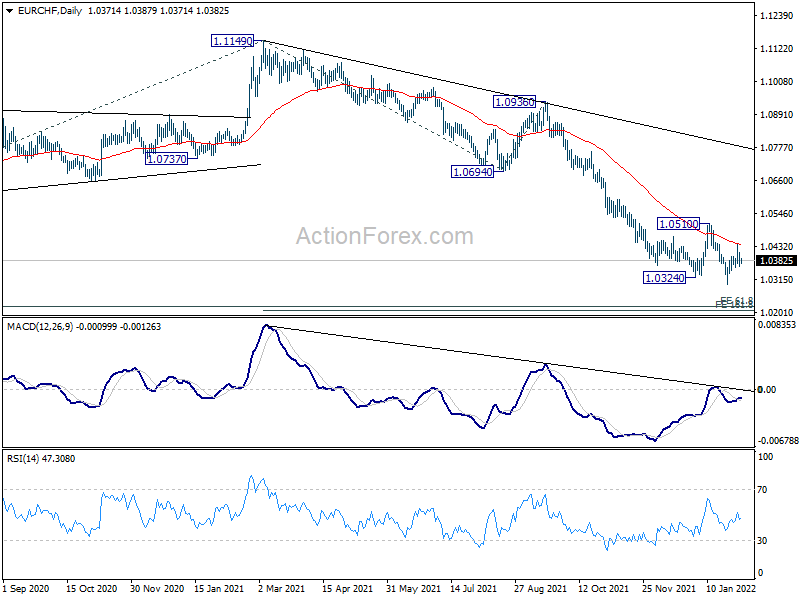
Daily Pivots: (S1) 1.0359; (P) 1.0387; (R1) 1.0411; More....
Intraday bias in EUR/CHF remains neutral as consolidation from 1.0298 is still extending. Upside should be limited well below 1.0510 resistance. On the downside, break of 1.0298 will extend the down trend from 1.1149 to 161.8% projection of 1.1149 to 1.0694 from 1.0936 at 1.0200 next.
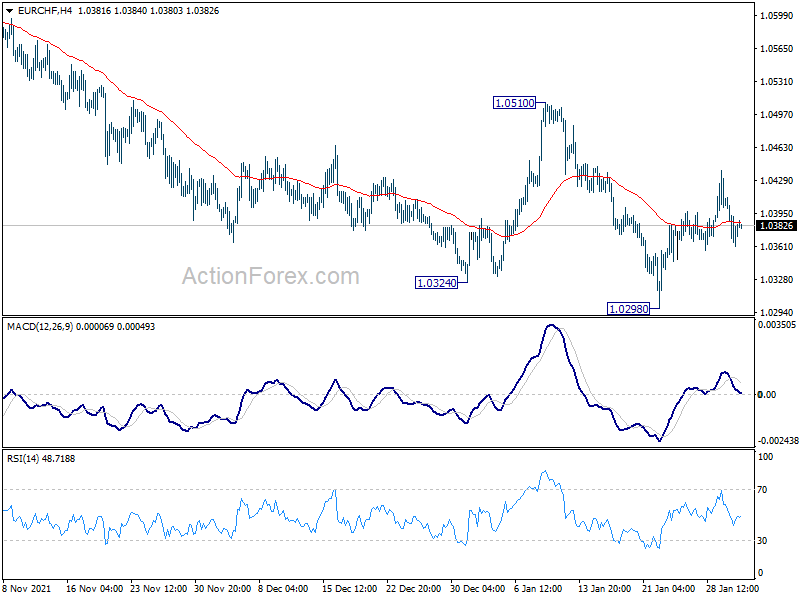
In the bigger picture, long term down trend from 1.2004 (2018 high) is still in progress. Next target is 61.8% projection of 1.2004 to 1.0505 to 1.1149 at 1.0223. On the upside, firm break of 1.0505 support turned resistance is needed to be the first sign of medium term bottoming. Otherwise, outlook will remain bearish even in case of rebound.