Sample Category Title
Euro Jumps on Record Inflation, Dollar Tumbles on Poor ADP Job Data
Dollar tumbles broadly today as markets are staying in risk-on mode. Additional selling pressure is seen on the greenback after shocking poor ADP job data. On the other hand, Euro is lifted by another record reading in consumer inflation data. Sterling is following Euro as markets await tomorrow's BoE rate hike. Aussie is slowing down a bit, but maintains most of this week's gains.
Technically, the case for near term bearish reversal in Dollar is building up with some levels taken out, including 1.1299 minor resistance in EUR/USD, 1.3523 minor resistance in GBP/USD and 114.46 minor support in USD/JPY. Focus is now on the next levels, including 1.1482 resistance in EUR/USD, 1.3748 resistance in GBP/USD, 0.7313 resistance in AUD/USD, 0.9090 support in USD/CHF and 113.46 support in USD/JPY. Break of these levels will suggest that Dollar has already started the bearish reversal.
In Europe, at the time of writing, FTSE is up 0.79%. DAX is up 0.39%. CAC is up 0.67%. Germany 10-year yield is up 0.0074 at 0.044. Earlier in Asia, Nikkei rose 1.68%. Japan 10-year JGB yield dropped -0.0038 to 0.179. Hong Kong, China and Shanghai were on holiday.
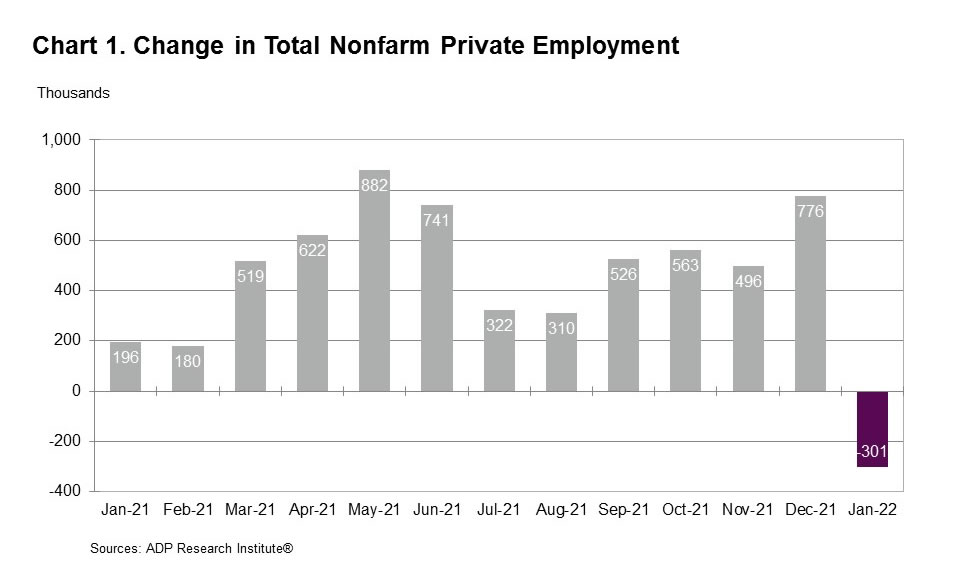
US ADP employment dropped -301k in Jan due to Omicron
US ADP private employment dropped -301k in January, much worse than expectation of 270k growth. By company size, small businesses lost -144k jobs, medium business lost -59k, large business lost -98k. By sector, goods-producing jobs dropped -27k, services-providing jobs dropped -274k.
"The labor market recovery took a step back at the start of 2022 due to the effect of the Omicron variant and its significant, though likely temporary, impact to job growth," said Nela Richardson, chief economist, ADP. "The majority of industry sectors experienced job loss, marking the most recent decline since December 2020. Leisure and hospitality saw the largest setback after substantial gains in fourth quarter 2021, while small businesses were hit hardest by losses, erasing most of the job gains made in December 2021."
Eurozone CPI accelerated to new record 5.1% yoy in Jan
Eurozone CPI accelerated to 5.1% yoy in January, up from December 5.0% yoy, well above expectation of slowing to 4.3% yoy. That's also another record high. CPI core dropped from 2.6% yoy to 2.3% yoy, but still beat expectation of 1.9% yoy.
Energy is expected to have the highest annual rate (28.6%, compared with 25.9% in December), followed by food, alcohol & tobacco (3.6%, compared with 3.2% in December), services (2.4%, stable compared with December) and non-energy industrial goods (2.3%, compared with 2.9% in December).
RBA Lowe: Ending bond purchase does not mean imminent rate hike
In a speech, RBA Governor Philip Lowe said ending the bond purchase program "does not mean that an increase in the cash rate is imminent".
He noted that while inflation has picked up in Australia, it remains "substantially lower" than the 7% in the US, 5.4% in the UK and 5.9% in New Zealand. It has "not been accompanied by strong wages growth" as in the case in the US and UK. "Our lower rate of inflation and low wages growth are key reasons we don't need to move in lock step with others," he added.
Lowe also said it's "too early to conclude" that inflation is sustainably the in the target range. And there is "a range of significant uncertainties" here that will "take time to resolve". He reiterated that "the Board is prepared to be patient as it monitors the evolution of the various factors affecting inflation in Australia."
New Zealand employment dropped to record low 3.2%
New Zealand employment rose 0.1% in Q4, below expectation of 0.4%. Unemployment rate ticked down from 3.3% to 3.2%, slightly better than expectation of 3.2%. Labor force participation rate dropped -0.1% to 71.1%.
"The labour market continued to show the tightness we saw in the September 2021 quarter, with both unemployment and underutilisation rates remaining low," work and wellbeing statistics senior manager Becky Collett said. "This quarter's unemployment rate is now the lowest rate recorded since the HLFS series began in 1986."
EUR/USD Mid-Day Outlook
Daily Pivots: (S1) 1.1236; (P) 1.1258; (R1) 1.1294; More...
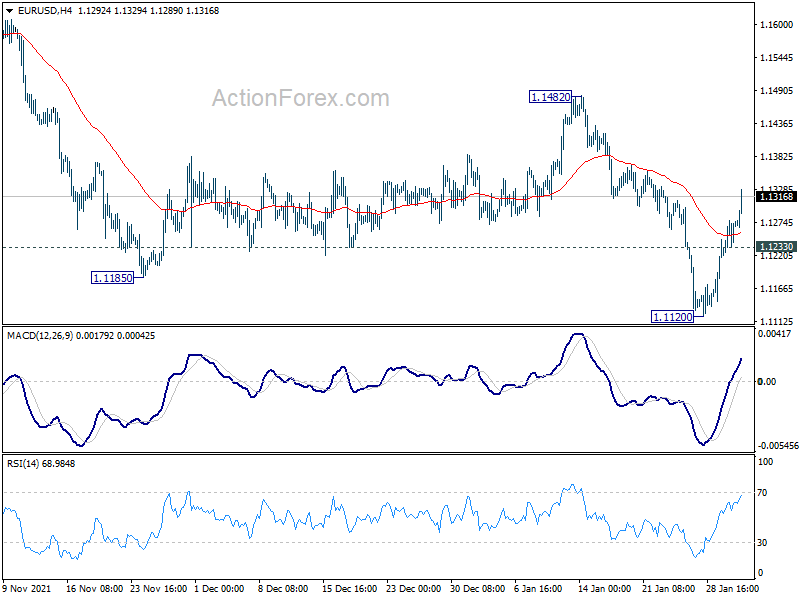
EUR/USD's break of 1.1299 minor resistance suggests that fall form 1.1482 has completed. Intraday bias is back on the upside for 1.1482 resistance first. Firm break there will argue that a medium term bottom was formed on bullish convergence condition in daily MACD. Stronger rally would then be seen back to 1.1703 support turned resistance next. On the downside, break of 1.1233 minor support will flip bias back to the downside for retesting 1.1120 low instead.
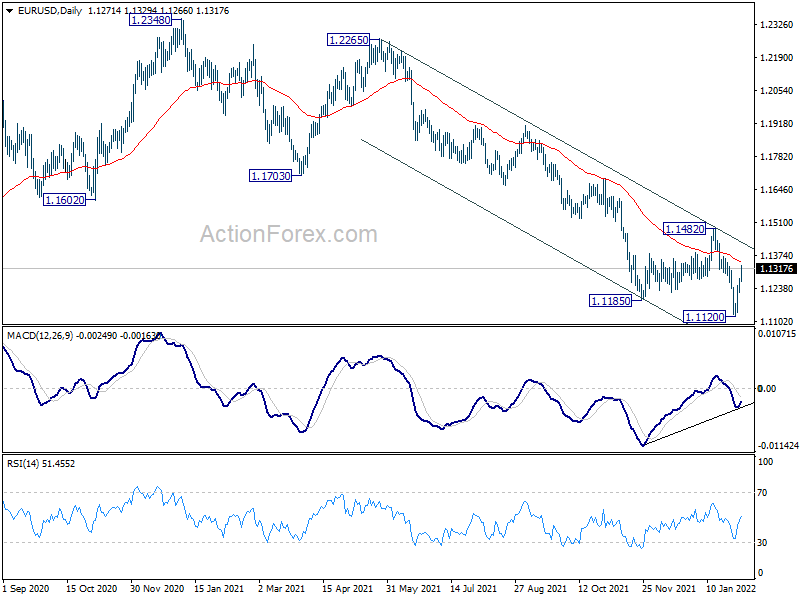
In the bigger picture, the strength of the the decline from 1.2348 (2021 high) suggests that it's not a corrective move. But still, it could be the fourth leg of a sideway pattern from 1.0339 (2017 low), or resuming long term down trend. In any case, outlook will now stay bearish as long as 1.1482 resistance holds. Next target would be 1.0635 low. However, firm break of 1.1482 will raise the chance that whole fall from 1.2348 has completed, and turn focus back to 1.1703 resistance for confirmation.
Economic Indicators Update
| GMT | Ccy | Events | Actual | Forecast | Previous | Revised |
|---|---|---|---|---|---|---|
| 21:45 | NZD | Employment Change Q4 | 0.10% | 0.40% | 2.00% | 1.90% |
| 21:45 | NZD | Unemployment Rate Q4 | 3.20% | 3.30% | 3.40% | 3.30% |
| 23:50 | JPY | Monetary Base Y/Y Jan | 8.40% | 8.50% | 8.30% | |
| 10:00 | EUR | Eurozone CPI Y/Y Jan P | 5.10% | 4.30% | 5.00% | |
| 10:00 | EUR | Eurozone CPI Core Y/Y Jan P | 2.30% | 1.90% | 2.60% | |
| 13:15 | USD | ADP Employment Change Jan | -301K | 270K | 807K | 776K |
| 13:30 | CAD | Building Permits M/M Dec | -1.90% | -1.60% | 6.80% | |
| 15:30 | USD | Crude Oil Inventories | 1.8M | 2.4M |
US ADP employment dropped -301k in Jan due to Omicron
US ADP private employment dropped -301k in January, much worse than expectation of 270k growth. By company size, small businesses lost -144k jobs, medium business lost -59k, large business lost -98k. By sector, goods-producing jobs dropped -27k, services-providing jobs dropped -274k.
"The labor market recovery took a step back at the start of 2022 due to the effect of the Omicron variant and its significant, though likely temporary, impact to job growth," said Nela Richardson, chief economist, ADP. "The majority of industry sectors experienced job loss, marking the most recent decline since December 2020. Leisure and hospitality saw the largest setback after substantial gains in fourth quarter 2021, while small businesses were hit hardest by losses, erasing most of the job gains made in December 2021."
CPI Above Expectations Pushing EURUSD Higher
In Europe, inflation accelerates, contrary to forecasts that the peak has passed. First estimates just released noted an acceleration in CPI from 5.0% to 5.1% y/y against average estimates of a slowdown to 4.4%.
An inflation rate creeping above 5% might wake the ECB from its slumber and put a suppression of inflation on its agenda, following such peers as the Fed and the Bank of England.
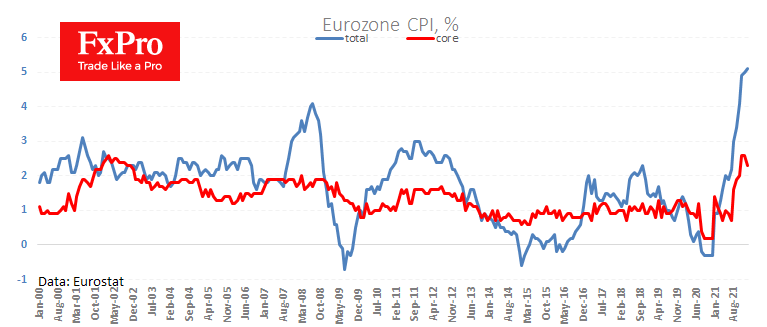
We must say that the ECB has enormous potential for advancement on this issue. Right now, the markets are laying down a slight chance of one rate hike before the end of the year, while the regulator’s representatives so far remain in the position that there will be no hikes this year.
On the hawkish stance of the Fed, EURUSD fell to 1.1122 at the end of January. However, the pair moved above 1.1300 on German and Eurozone inflation data.
With the higher inflation, there are growing expectations that the ECB will make an equally sharp U-turn to suppress inflation as the Fed have. We might hear more about that tomorrow after the next meeting, and then the euro recovery could be on firmer footing.
Australian Dollar Extends Gains
We continue to see strong movement from the Australian dollar, which has gained ground for a third successive day. The currency has gained 2.2% this week, recovering most of last week’s losses.
Lowe preaches patience
After an RBA meeting that contained no surprises, the markets were hoping to gain some insights when Governor Lowe spoke at an event on Wednesday which included a Q&A session. However, Lowe’s comments didn’t really add much and were largely a reiteration of what he said at the policy meeting.
Lowe repeated that there are significant uncertainties as to recent inflationary pressures and that it was too early to determine if inflation was sustainably within the central bank’s 2%-3% target band. He cautioned the markets that the end of the bond purchase programme this month did not mean that a rate rise was imminent and remained non-commital, saying that a hike could be a year away or even longer. The markets, however, are more hawkish and have priced in a rate hike in the second half of 2022, given that inflation remains at high levels.
Lowe has been preaching patience in his messages to the markets this week, and he doesn’t appear to have abandoned his view that inflation is transient. He said on Wednesday that the jump in inflation does not require an aggressive response. This sounds very different than what we have been hearing from the Fed and the BoE, and it remains to be seen if the RBA will stand pat as the Fed and BoE tighten policy or will the RBA follow the lead of the other two central banks and raise rates.
AUD/USD Technical
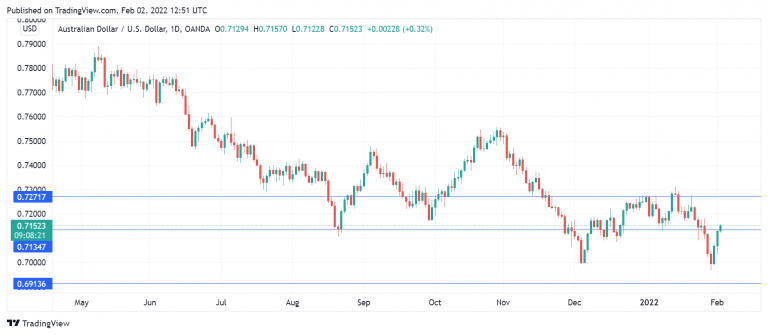
- AUD/USD is testing resistance at 0.7133. Above, we find resistance at 0.7271
- There is support at 0.6913 and 0.6831
NZDUSD Bounces at 16-Month Low but Bearish Tone Persists
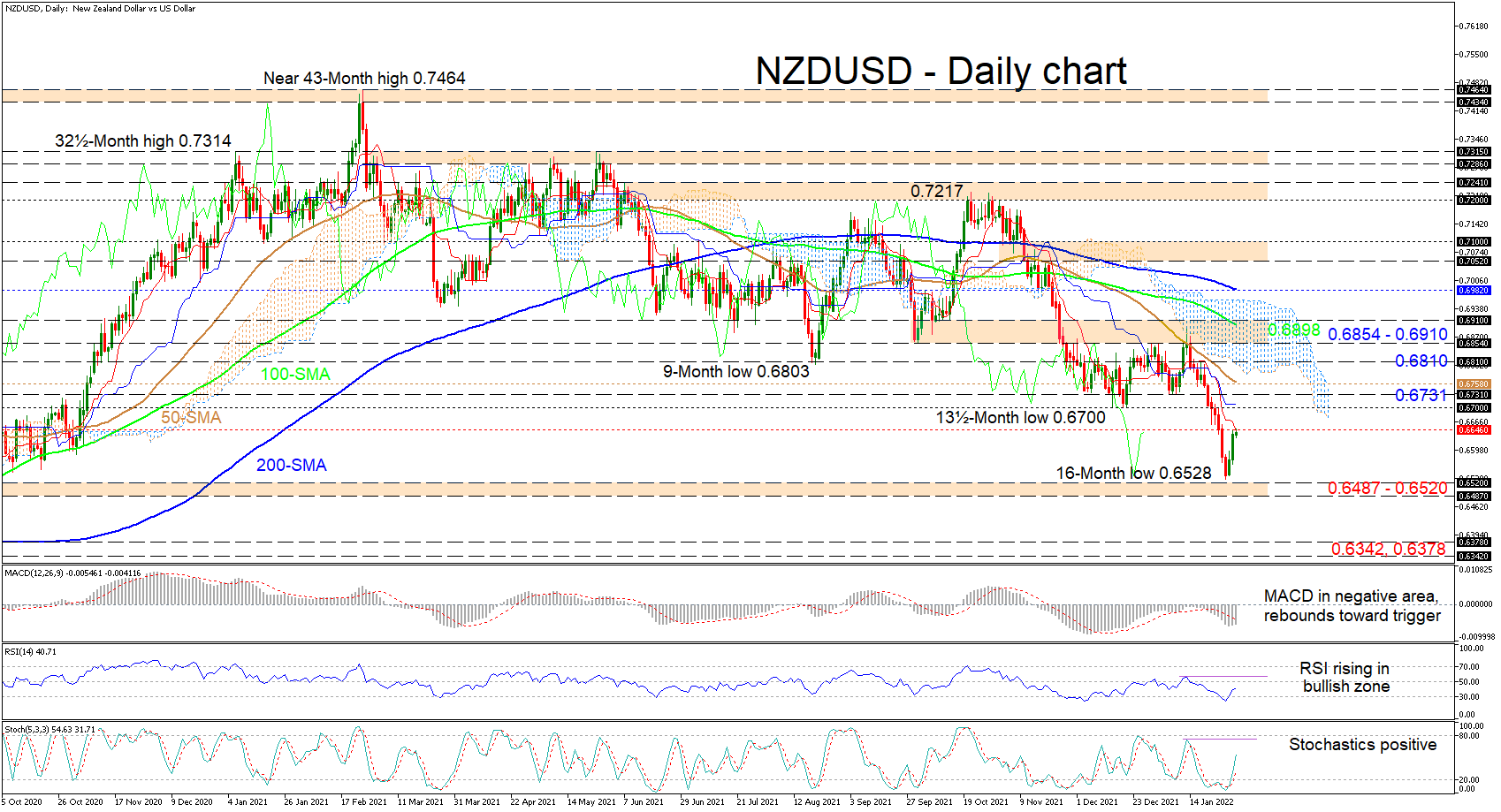
NZDUSD buyers emerged around the 0.6528 mark just shy of a key support base of the broader uptrend, where a five-month rally in the pair began, recording a 3½-year high of 0.7464. The diving simple moving averages (SMAs) are shielding the bearish mood in the pair.
Currently, the Ichimoku lines are indicating a pause in downward forces as buyers are opposing the decline. Moreover, the short-term oscillators are reflecting the fresh surge in positive momentum, which evolved at the 16-month low level. The MACD, some distance beneath zero, is improving towards its red trigger line, while the RSI is climbing towards the 50 neutral threshold. The strong positive charge in the stochastic oscillator hints that additional headways could unfold in the pair.
If the price runs past the red Tenkan-sen line at 0.6646, the pair could then test a zone of resistance between the inside swing lows of 0.6700 and 0.6731. Recouping additional portions of previously lost ground, the pair may meet the descending 50-day SMA at 0.6758 prior to confronting the Ichimoku cloud’s lower band and the adjacent 0.6810 resistance barrier. If buying interest remains elevated, the bulls could then encounter the 0.6854-0.6910 tough resistance section, which is weighing on bullish progress in the pair.
In the negative scenario, if the red Tenkan-sen line puts out the fire in the fresh rally from 0.6528, persisting negative pressures could drive the price back down, revisiting the 16-month low of 0.6528 and taking another crack at the critical 0.6487-0.6520 support base, which was moulded over the July to September 2020 period. A break of this significant upside defence may accelerate the decline in the pair, bringing the 0.6378 border - from June 2020 - and the 0.6342 obstacle into focus.
Summarizing, NZDUSD is sustaining a bearish bias below the falling SMAs and the 0.6854-0.6910 resistance zone. A break below the 0.6487-0.6520 support band could trigger considerable weakening in the pair, while a climb above the 50-day SMA at 0.6758 may soften recent downside pressures. However, buyers would need to steer north of the cloud to restore optimism in the pair.
Improving Risk Appetite Keeps Dollar on the Defensive
- Furious recovery in equity markets continues
- Dollar retreats, sterling shines ahead of BoE
- Oil awaits OPEC, more earnings and data eyed
Optimism returns
Equity markets seem to have shaken off the blues that dominated trading in January. With the resilience in corporate earnings confirming the real economy is still in good shape, investors are coming around to the view that markets can live with higher interest rates even if that means more frequent bouts of volatility.
Wall Street advanced for a third straight session on Tuesday as some traders covered their short bets and others took advantage of the correction in valuation multiples. Fed officials also downplayed the prospect of shock-and-awe rate increases, stressing that they want to avoid disrupting markets and the economy.
The earnings season has brightened up the mood as well. Google-parent Alphabet and chipmaker AMD both smashed analyst estimates and saw their shares jump roughly 10% in after-hours trading. However, Paypal shares tanked by almost 17% after the bell on weak results, highlighting that investors have zero tolerance for disappointment in an environment of higher rates.
Dollar retreats, pound advances
The improving risk tone spilled over into the currency space too, keeping the US dollar under pressure and lifting all other FX boats. The pound and to a lesser extent the euro have been the main beneficiaries of the greenback’s troubles as traders position for the Bank of England and the European Central Bank policy decisions tomorrow.
With markets already pricing in a quarter-point rate increase by the BoE and another four hikes this year, the most crucial variable for sterling will be the guidance about the rest of the year and when balance sheet reduction will begin. As for the euro, although the labor market is improving and inflationary pressures keep intensifying, it remains to be seen whether the ECB will be comfortable with market pricing for a rate increase by December.
Elsewhere, the aussie and kiwi have been trading almost entirely as a function of risk appetite, disregarding developments in their economies. The aussie keeps ignoring warnings by the RBA that there is no rush to raise rates, whereas the kiwi is underperforming today even after New Zealand’s unemployment rate hit its lowest level on record.
Oil grinds higher ahead of OPEC
All eyes will be on OPEC today, which is widely expected to stick to its plan of raising production in a gradual manner. Oil prices have been grinding higher for weeks now as the Omicron wave didn’t hit the global economy quite as hard as feared and the risk of an invasion of Ukraine overshadowed the brighter tone in the nuclear negotiations between America and Iran.
OPEC is unlikely to rock this boat today. Recent reports suggest the cartel and its allies are not seriously discussing the prospect of faster production increases, so oil prices will likely remain in the hands of geopolitics and demand conditions. At this stage, the worst-case scenario for crude would be a simultaneous de-escalation in Ukraine and a deal with Iran being hammered out.
On the data front, the highlight will be the private ADP jobs report from the US, which has not been a great indicator of nonfarm payrolls lately but will nevertheless give markets a taste of what to expect on Friday. So far the tea leaves point to a disappointing and perhaps even negative nonfarm payrolls print as the data was collected during the height of the Omicron wave, which may have artificially skewed the numbers lower.
In earnings, the show will continue today with Facebook-parent Meta Platforms, Qualcomm, and Spotify.
NZ Dollar Pauses after Mixed Jobs Data
The New Zealand dollar has been showing plenty of volatility over the past week but is steady on Wednesday. After plunging 2.56% last week, the currency has rebounded, recovering about half of those losses this week. NZD/USD has taken a pause on Wednesday after New Zealand posted mixed employment data for Q4.
New Zealand’s unemployment rate fell from 3.3% to 3.2%, better than the forecast of 3.4%. However, job creation was minimal with a gain of 0.1%, shy of the consensus of 0.4%. The labour cost index rose slightly, from 2.4% to 2.6%, missing the estimate of 2.9% age growth remains way below inflation, which clocked in at 5.9% in the fourth quarter?
Wage growth lagging inflation
The wage growth release could have a significant impact on monetary policy. The RBNZ is expected to raise rates by 0.25% at the February 23rd meeting, which would mark back-to-back rate rises. With wages lagging inflation by a wide margin, the RBNZ may decide to slow the pace of rate increases in 2022, even if inflation remains high. This stance is based on the premise that high inflation is transient and will ease if wage growth is not strong. The central bank is expected to normalize policy with a series of rate hikes which could extend into 2023.
The New Zealand dollar shot up 0.96% on Tuesday, buoyed by strong trade numbers. Exports were up and imports decreased, and as a result, New Zealand’s trade deficit fell from over NZD 1.06 billion to NZD 477 million. This is another indication that the recovery is gathering steam, even though the country has essentially closed its borders to the outside world.
The New Zealand currency has been under pressure, with investors pricing in five rate hikes from the Federal Reserve over the course of the year. There are projections for as many as seven hikes this year, and any guidance from the Fed, which has not been very clear on how many hikes to expect, could shake up the currency markets.
NZD/USD Technical
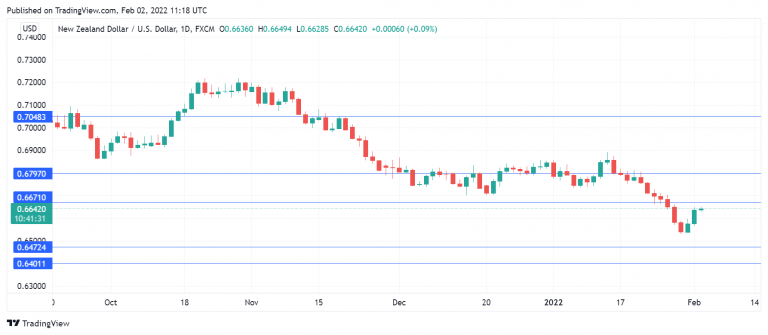
- NZD/USD has support at 0.6472 and 0.6402
- 0.6670 is a weak resistance line, followed by 0.6798
OPEC+ to Stick to Gradual Output Increase
- Oil prices to stay elevated as OPEC+ members struggle to raise production
- Stocks extend relief rally on signs Fed could be less aggressive
- Lower-than-expected NFP print could give fresh legs to stock bulls
- BOE set to hike again Thursday; ECB to stand pat all year
Brent and WTI are edging higher and hovering around their highest levels since 2014 in the leadup to today’s OPEC+ decision. The 23-nation alliance is widely expected to ratify another 400,000 barrels-per-day hike for March.
Overall, the incoming OPEC+ decision is set to have more bark than bite for oil markets. Several OPEC+ members, including Russia, are already struggling with spare capacity, leaving them unable to meet the raised quotas. Unless the still-unlikely Iran deal materialises in the near-term, any incoming supplies aren’t expected to substantially tilt markets back towards oversupply, defying forecasts for the current quarter. Meanwhile, global demand remains resilient as Omicron risks fade into the rearview mirror.
Such supply-demand dynamics are preserving a tight market structure, building a solid platform for oil benchmarks to climb higher and build on January’s gains of over 15%. A spike in geopolitical tensions could even trigger another surge in oil prices, potentially bringing $100 oil closer to reality.
Stocks climb as officials tone down Fed hawkishness
Risk-taking activities overall are being reinvigorated by hopes that the Fed won’t act in haste to curb surging inflation. Asian stock markets are rising alongside European and US futures, while the benchmark dollar index (DXY) and gold hold on to recent losses.
Recent Fed speak suggests that policymakers are trying to dampen market expectations that have perhaps gotten overly hawkish. Although Chair Powell refused to rule out a 50-basis-point hike in March in his post-FOMC meeting press conference last week, other Fed officials such as Kansas City Fed President Esther George have signaled a more measured approach.
Since last week, the Fed Funds futures have pared back their bets closer in line with a conventional 25-basis point hike in March, allowing room for risk sentiment to stage a relief rally. The S&P 500 has recorded its best three-day advance since 2020, registering a 5% move to pull away from correction territory and halve its drop from its record peak.
A subdued US nonfarm payrolls report this Friday could extend the runway for the ongoing relief rally. Markets are forecasting that only 150,000 jobs were added in January amid Omicron-related disruptions to the US labour market. This kind of headline NFP print would mark its slowest growth since May 2019.
Should markets be given further evidence that the Fed doesn’t have to move as aggressively as previously thought, then the recovery in risk assets may extend. Still, there’ll likely be further bouts of volatility in between FOMC meetings, until investors have a more solid grasp of the timing for Fed rate hikes and the eventual balance sheet reduction.
ECB and BOE to lay bare policy divergence
Even as market participants remain obsessed over the Fed’s policy outlook, the Bank of England and the European Central Bank are set to grab some of the spotlight with their respective policy decisions due on Thursday.
Markets appear all but certain that the BOE will raise interest rates again this week, marking their first back-to-back hikes since 2004. The pound could extend its year-to-date gains against most of its G10 peers if the central bank signals a more aggressive approach to dampening UK inflation.
Most analysts expect the ECB to keep its rates at negative 0.5% all through 2022, though the euro is poised to react to any guidance on rates at the upcoming meeting. If ECB President Christine Lagarde aligns her commentary closer to market forecasts for a hike in the third quarter of this year, that could trigger a rally in the euro, allowing it to play catch-up with other major currencies. Alternatively, Lagarde may stick to the lower-for-longer mantra, widening the policy normalisation gap between the ECB and other major central banks which would heap more downward pressure on the euro.
USD/JPY Consolidating Losses from 114.56 Low
The US Dollar started a fresh decline from the 115.70 zone against the Japanese Yen. The USD/JPY pair traded below the 115.00 support level to move into a short-term bearish zone.
The pair even traded below 114.80 and settled below the 50 hourly simple moving average. A low is formed near 114.56 and the pair is now consolidating losses. An immediate resistance is near the 114.80 level and a key bearish trend line forming on the hourly chart.
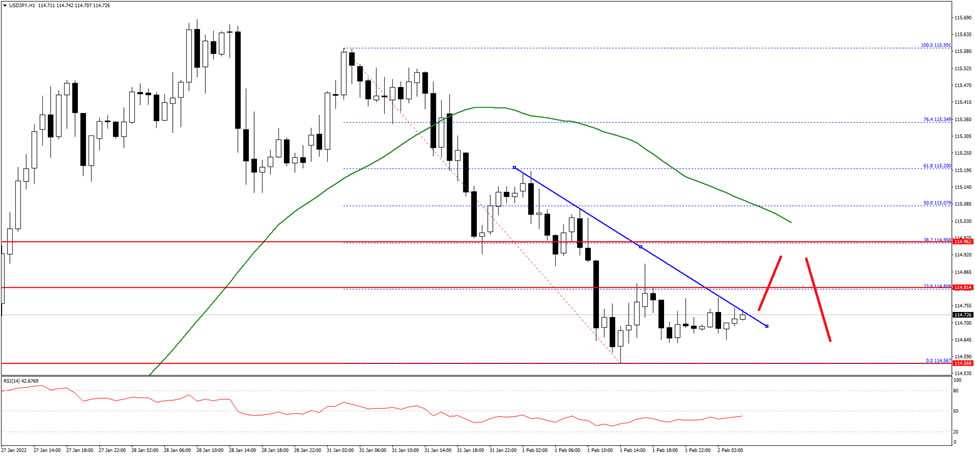
A clear break above the trend line resistance could push the price towards 115.00 on FXOpen. The next major resistance is near the 115.20 level.
An initial support on the downside is near the 114.50 level. The next major support sits near the 114.20 level, below which there is a risk of more downsides. In the stated case, the pair could decline towards the 113.50 level.
EURCHF Struggles to Strengthen Positive Move
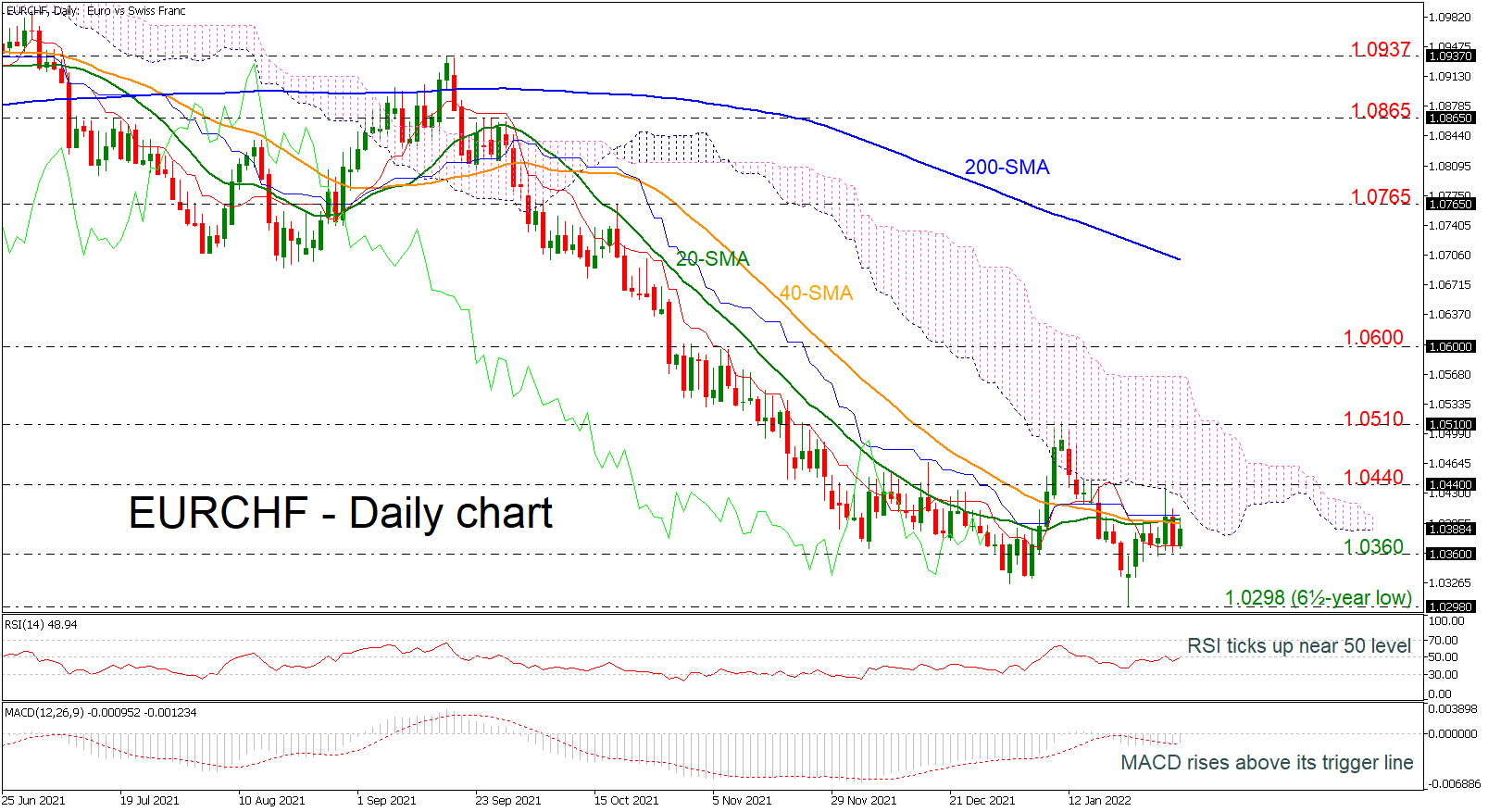
EURCHF is looking neutral in the short-term, hovering within the short-term simple moving averages (SMAs) and the 1.0360 support level. The bullish doji candle that was posted in the previous sessions, is suggesting an upside reversal move that will be completed if the pair climbs above 1.0510.
Regarding the technical indicators, the RSI is holding near the 50 level with steady momentum, while the MACD is surpassing its trigger line below the zero level. The red Tenkan-sen line is standing below the blue Kijun-sen line, suggesting a negative bias.
If the pair overcomes the 20- and 40-day SMAs, the next target could be the 1.0440 barrier before resting around the 1.0510 high, achieved on January 11. Even higher, the 1.0600 psychological mark and the 200-day SMA at 1.0700 could add some optimism for a bullish outlook.
On the flip side, if there is a move below the 1.0360 key level, sellers could meet again the six-and-a-half-year low of 1.0298. Steeper downside moves could take the price towards the 1.0230 support, taken from the bottom on April 2015.
To conclude, the long-term outlook is bearish and only an aggressive advance above the 200-day SMA may change this view.