Sample Category Title
Future Looks Gloomy for Crypto Market
The crypto market had a rough start of the year, declining by more than 20% due to the hawkish Federal reserve statements. As a result, the crypto market's capitalization lost 45% and fell to $1.64 trillion, the lowest since August 2021.
Altcoins are falling increasingly faster than the first cryptocurrency, causing an increase in the share of BTC, which is already 42.3% against 39.3% lows in mid-January. Bitcoin's 40% share looks like a turning point that triggered a correction in the crypto market twice before.
The correction is not over
It is well-known the crypto market has a strong positive correlation with the US stock market. This fact should reduce optimism among crypto investors as of the end of trading Tuesday, January 25, 2022, is now, officially, the worst-ever start in the history of the S&P 500.
Some traders hold a belief, called the January barometer, the investment performance of the S&P 500 in January can predict its performance for the rest of the year. If this belief turns out to be true, the crypto market will face a rough year.
Reasons for the pressure
The first reason is macroeconomic news from the USA. According to the Fed's January meeting, the US regulator can raise interest rates faster and earlier. The market is pricing five rate hikes up to 1.5%. Technology companies will remain under pressure with this market trend, dragging the cryptocurrency market into a deeper correction.
The instability of the situation with the cryptocurrencies regulation in Russia also pressures the market. The Russian Central Bank announced that trading and mining cryptocurrencies would be prohibited. Fortunately, later, President Vladimir Putin joined the discussion and offered to regulate cryptocurrencies operations instead of blocking them.
Russia is the third country in the world by mining hash rate. Therefore, the crypto market is highly dependent on the final decision of the Russian government.
Technical analysis
BTC/USD, weekly chart
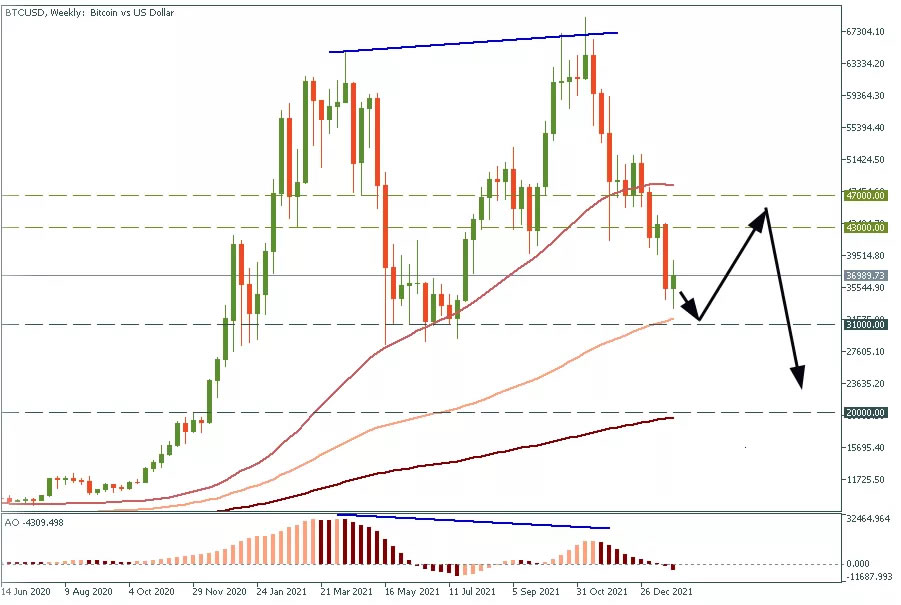
The bearish divergence appeared on the weekly Bitcoin chart. At the moment, the price is trading above the key support level of $30 000. However, we expect Bitcoin not to break this support through right away. Instead, it will rise to $43 000 - $47 000, form a bull trap, and crush down to $20 000 as the Federal Reserve increases the interest rate.
ETH/USD, monthly chart
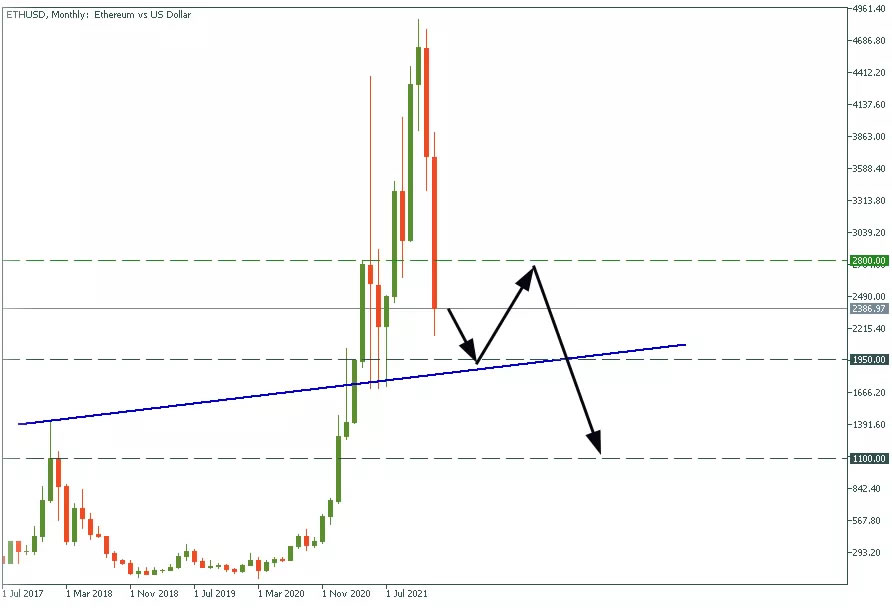
Ethereum will follow "the big brother" and decline down to $1900 first with a solid bounce up to $2800 after. Then, when the price finishes the head-with-shoulders pattern, it will decline to $1100.
BNB/USD, weekly chart
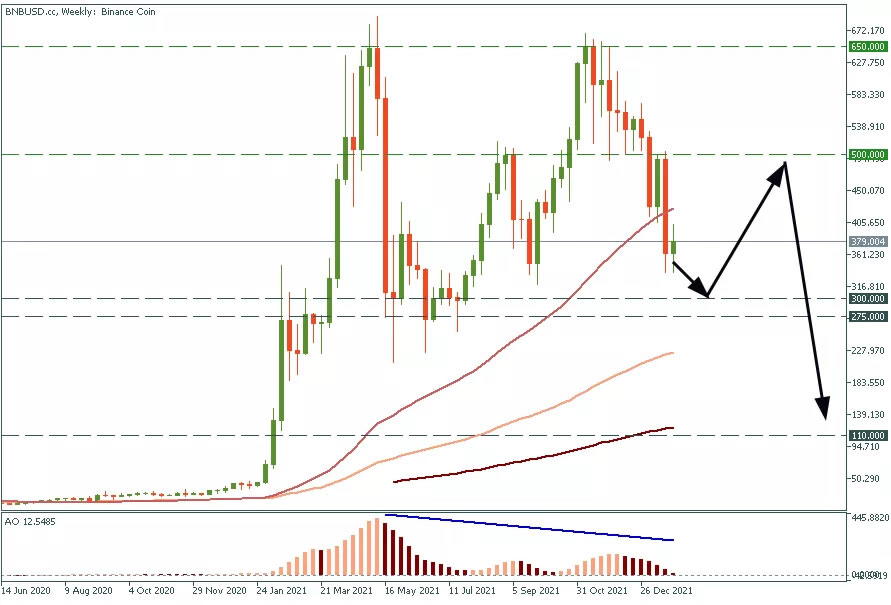
Binance coin can decline to the $275-300 support range. After that, the price might rise as high as $500. As well as Ethereum, BNB/USD might form a head-with-shoulder pattern and drop down to $110 afterward.
Conclusion
The immediate future of the crypto market looks rather gloomy. Fortunately, FBS traders can trade both sides, long and short, and earn the same on bull and bear markets.
Gold Wave Analysis
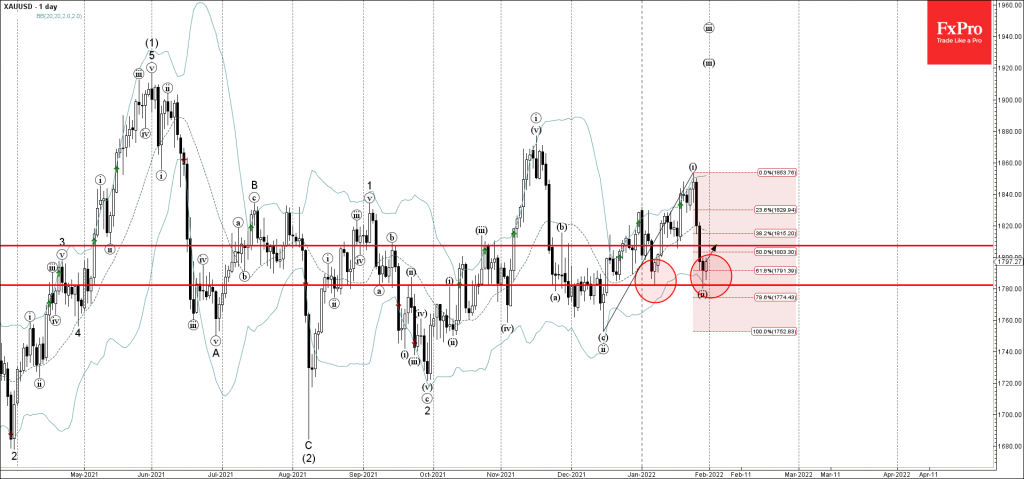
- Gold reversed from support zone
- Likely to rise to resistance level 1810.00
Gold recently reversed up from the support zone lying between the key support level 1780.00 (which reversed the pair at the start of January) and the lower daily Bollinger Band.
The upward reversal from this support zone stopped the earlier minor corrective wave (ii).
Given the strength of the aforementioned support zone – Gold can be expected to rise further toward the next resistance level 1810.00 (former support from the middle of January).
Eco Data 2/1/22
[php_everywhere instance="1"]
Sunset Market Commentary
Markets
Spanish January inflation numbers and German (regional) data soon sent the same message: European inflation won’t fall back as much as thought at the start of the year. The Spanish setback, related to a sharp rise in the electricity bill in January last year, was compensated for by rising core prices such as food and utilities. Downward tax-related German price pressure was partly offset by soaring energy prices and rising costs of services. Spanish and German national readings (EU harmonized) came in at respectively 6.1% Y/Y (from 6.6% vs 5.5% expected) and 5.1% Y/Y (from 5.7% vs 4.3% expected) and pose significant upside risks to Wednesday’s EMU reading. Consensus currently expects an easing from 5% Y/Y to 4.4% Y/Y. Simultaneously, it makes it harder for the ECB to defend its very accommodative monetary policy stance at Thursday’s policy meeting. We nevertheless only expect a U-turn to the ostrich politics in combination with updated inflation forecasts (i.e. March the earliest). Bond markets side with the view that the ECB will forced to acknowledge the inflation problem sooner than later. Today’s price action is testament to that view. German Bunds underperform US Treasuries and UK Gilts. German yields add 7.7 bps (3-yr) to 5.6 bps (30-yr) in a gentle bear flattening move. The German 2-yr yield moved above -0.55% for the first time since March 2019. Key resistance stands around -0.50% which are the 2018/2019 tops. A move above means the highest German 2y rate since January 2016. The German 10-yr yield returned to positive territory. Important resistance kicks in at 0.15% which is 62% retracement on the 2018/2019 decline. The European 10-y swap rate posts a new recovery high at 0.47% with similar resistance at 0.59% (62% retr.). European money markets keep pulling forward expectations on positive 3-month Euribor rates to currently around March next year. 10-yr yield spreads vs Germany narrow by up to 5 bps for Italy after President Mattarella was re-elected, thereby keeping PM Draghi in charge of the fragile government of national unity and avoiding a snap poll in the key reform year 2022. The US yield curve bear steepens today with yields rising by 1.9 bps (3-yr) to 4.3 bps (30-yr). The euro slightly benefits against the dollar and sterling from today’s front end interest rate support. EUR/USD currently changes hands just below the 1.12 handle, coming from an open near 1.1150. EUR/GBP rises from the low 0.83-zone towards 0.8330. European stock markets started on a strong footing, but gradually returned gains as the sell-off on bond markets intensified. Main indices currently trade near Friday’s closing levels. Losses/gains for main US benchmarks at the start of trading vary between -0.3% (Dow) and +0.9% (Nasdaq). Brent crude extends its steep march since mid-December, to currently trade above $91/barrel. The stalemate in the Russia/Ukraine conflict remains.
News Headlines
The IMF’s financial counsellor and head of the monetary and capital markets department Tobias Adrian warned cryptocurrencies are causing “destabilizing” capital flows in emerging markets. Adrian said it is posing ‘immediate and acute risks” with crypto being used to replace traditional, existing currencies (“cryptoisation”). He also flagged the closer correlation between the performance of cryptos and other financial assets in developed countries. IMF officials believe that significant crypto selloffs are increasingly feeding into stock markets. It urged global regulators start building a consistent supervisory framework.
US 30y mortgage rates trade at their highest since the early days of the pandemic. The average bank rate currently stands at 3.74% vs the all-time low at 2.82% in February 2021. It is also a steep increase from the 3.27% just one month ago. MBS have been underperforming USTs lately, pushing spreads substantially higher too. Mortgage rates are generally rising as the Fed prepares to normalize its policy. One of the steps includes reducing the $2.7tn big mountain of mortgage backed securities, almost double the amount compared to before the pandemic.
USD/JPY Mid-Day Outlook
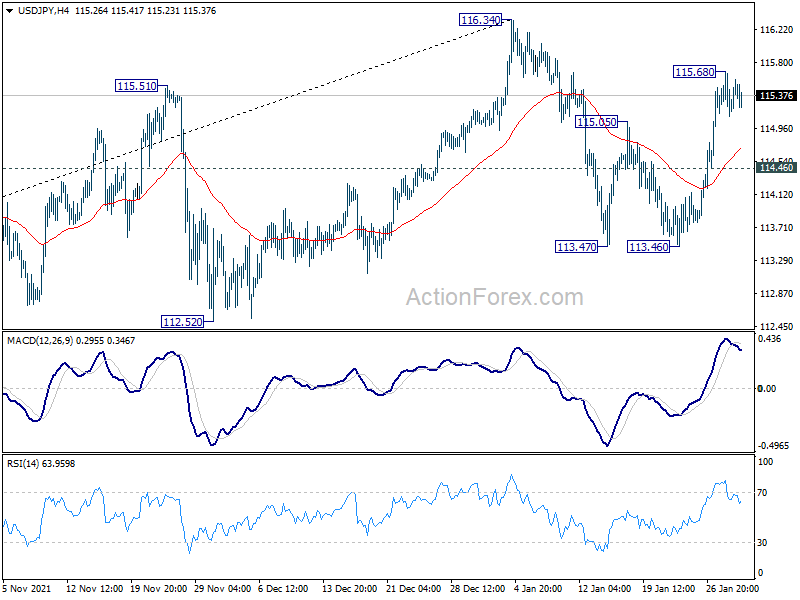
Daily Pivots: (S1) 115.01; (P) 115.35; (R1) 115.58; More...
Intraday bias in USD/JPY is turned neutral with current retreat. But further rise is expected as long as 114.46 minor support holds. Above 115.68 will target 116.34 high first. Decisive break there will resume larger up trend for 118.65 long term resistance next. On the downside, break of 114.46 will turn bias back to the downside for retesting 113.46 support instead.
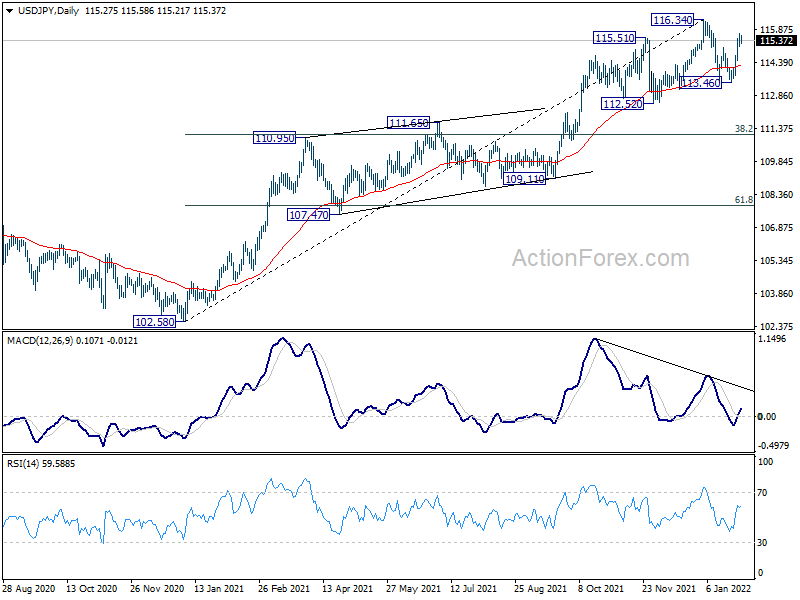
In the bigger picture, no change in the view that rise from 102.58 is the third leg of the up trend from 101.18 (2020 low). Such rally should target a test on 118.65 (2016 high). Sustained break there will pave the way to 120.85 (2015 high) and raise the chance of long term up trend resumption. This will remain the favored case as long as 55 week EMA (now at 111.07) holds.
USD/CHF Mid-Day Outlook
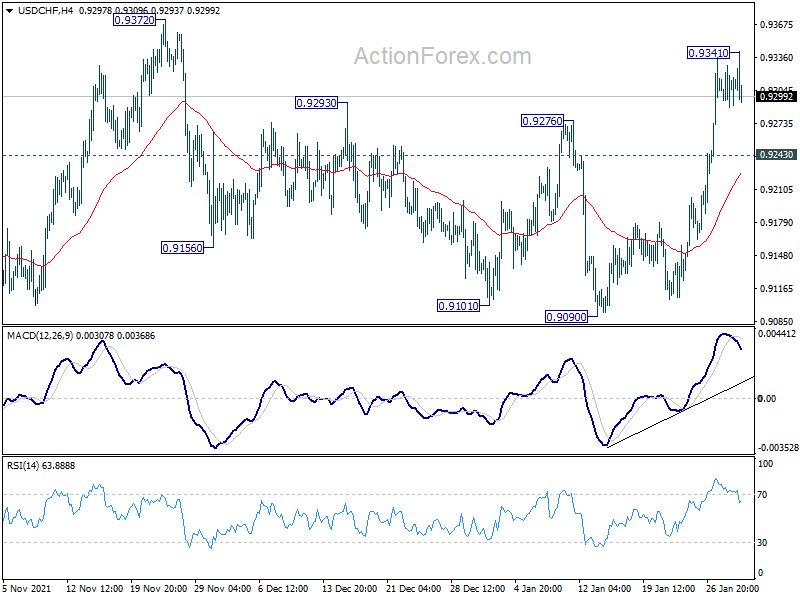
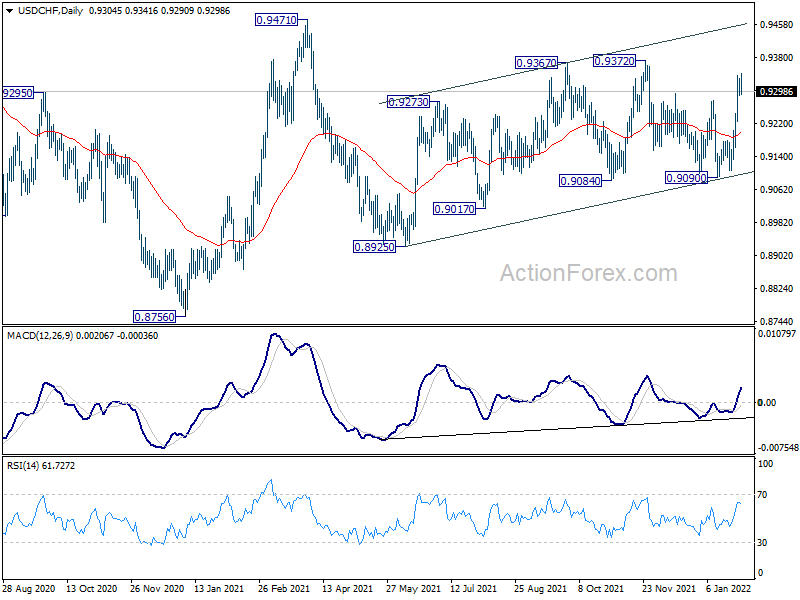
Daily Pivots: (S1) 0.9291; (P) 0.9310; (R1) 0.9331; More....
Intraday bias in USD/CHF is turned neutral with current retreat. Overall, with 0.9090 support intact, choppy rise from 0.8925 should extend higher. On the upside, above 0.9341 will target 0.9372 and then 0.9471. However, break of 0.9342 minor support will turn bias back to the downside for 0.9090 support.
In the bigger picture, medium term outlook will be neutral at best as long as 0.9471 resistance holds. Larger down trend could still extend through 0.8756 (2021 low). However, firm break of 0.9471 will argue that the trend has already reversed and rebound the rally from 0.8756 with another impulsive move.
GBP/USD Mid-Day Outlook
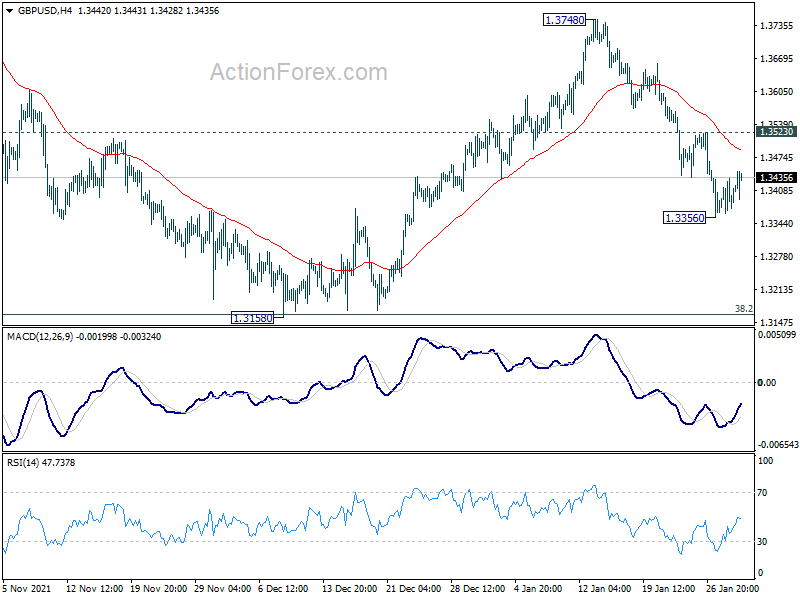
Daily Pivots: (S1) 1.3363; (P) 1.3398; (R1) 1.3430; More...
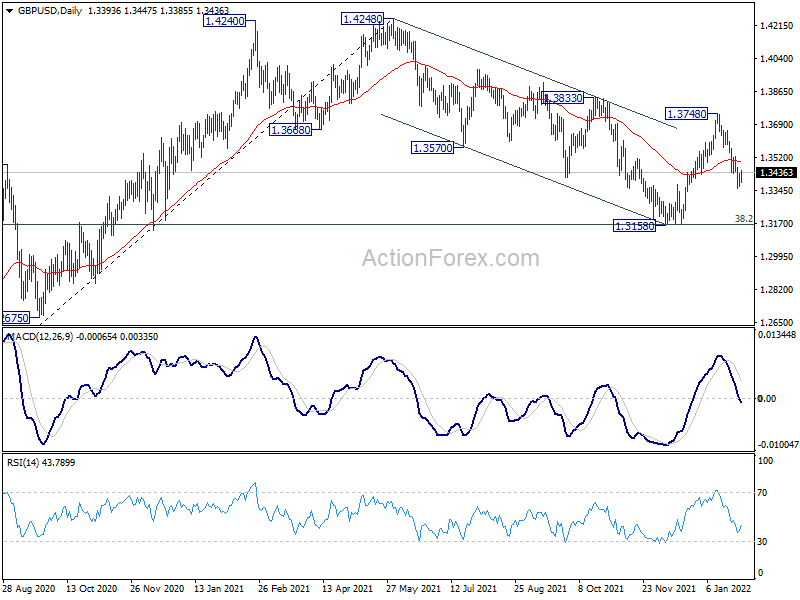
Intraday bias in GBP/USD is turned neutral with current recovery. But further decline is expected with 1.3523 minor resistance intact. As noted before, rebound from 1.3158 has completed at 1.3748 already, and down trend from 1.4248 is not over yet. Break of 1.3356 will resume the fall from 1.3748 to retest 1.3158 low. On the upside, though, above 1.3523 minor resistance will turn bias back to the upside for retesting 1.3748.
In the bigger picture, as long as 38.2% retracement of 1.1409 to 1.4248 at 1.3164 holds, up trend from 1.1409 (2020 low) is still in progress. On resumption, next target will be 38.2% retracement of 2.1161 to 1.1409 at 1.5134. Nevertheless sustained break of 1.3164 will argue that whole rise from 1.1409 has completed and bring deeper fall to 61.8% retracement at 1.2493.
German Inflation Surprise Good for EUR
Today we have seen the first slowdown in annual inflation in seven months, but the data is better than expected.
In January, consumer prices rose 0.4%, up 4.9% on the same month a year earlier. Analysts, on average, were expecting prices to fall by 0.2% and slow inflation to 4.3% YoY.
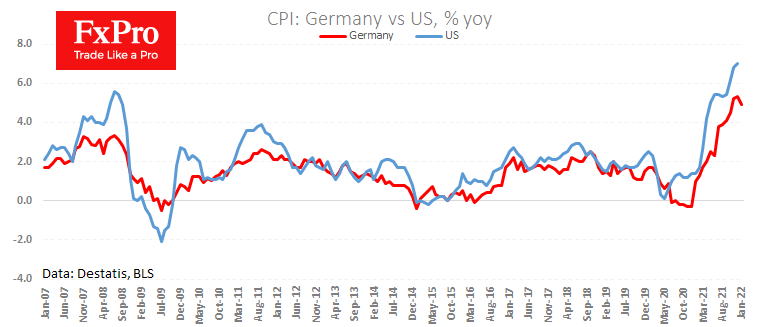
The harmonized price index (adjusted for tax changes) shows an even more significant gap between expectations and reality. The index rose by 0.9% (a fall of 0.4% was expected).
The figures clearly show that inflation has penetrated deeper into the economy and is increasingly taking on the features of permanent price increases.
Sustained inflation raises the expectation that the ECB will also tighten its rhetoric and proceed with policy tightening more quickly than previously promised.
The markets have priced in one rate hike of 0.25% by December. But with the Fed as an example, we can see how quickly things can change. These changes should be positive for the euro.
Stocks to Log a Sharp Monthly Loss; Aussie Picks Up Steam ahead of RBA
Stock indices consolidate January's heavy losses; Eurozone bond yields spike
January has been a rough month for global stock markets as more central banks prioritized their price objectives amid the inflation storm, with the Fed finally taking investors’ side and hinting at a faster pace of rate increases this year. Of course, US earnings releases have not demonstrated any panic so far despite companies keep facing supply constraints, but the reversal of easy-money policies in the near future is enough to frustrate investors, especially those who have a large exposure in overvalued tech stocks, and signal that the pandemic record gains will probably remain in the past.
US futures were pointing to a mixed open during the time of writing, with the S&P 500 and the Dow Jones set to dip back in the negative territory after Friday’s soft upturn, while the tech-heavy Nasdaq 100, which is down by 12% this month, facing its worst sell-off since 2008, could start the session mildly higher.
Meanwhile in Europe, the pan-European STOXX 600 staged a modest rebound on the back of rising tech and industrial shares as the German 10-year bond yields spiked back above zero to unlock an almost three-year high. Other Eurozone bond yields followed suit. On the other hand, declines in basic materials and healthcare stocks are offsetting any upside moves in the UK’s FTSE 100.
Aussie the best performer but wait for the RBA
Turning to FX markets, the risk-sensitive aussie was the best performer across the board followed by its New Zealand cousin, even though both are still pinned near their multi-year lows. The bullish reversal is probably supported by high expectations that the Reserve Bank of Australia (RBA) will terminate its bond buying program when it announces its policy decision on Tuesday at 03:30 GMT, while investors are also eagerly waiting to hear any plans for higher interest rates this year. The RBA governor Philip Lowe, however, has been somewhat conservative recently. Hence, he could still reject any rate increases, though investors will hear more from him when he delivers a detailed speech on Wednesday.
Australian monthly retail sales for December will be out on Tuesday as well a bit earlier at 00:30 GMT.
European currencies cannot get their feet after sharp sell-off
In other currencies, the euro could not capitulate much on stronger-than-expected preliminary German CPI figures and rising eurozone bond yields, ticking to an intra-day high of 1.1180 against the dollar before inching lower again. Earlier in the day, GDP growth figures out of the bloc marked a quarterly slowdown in Q4, adding more evidence that the eurozone’s economic expansion is still fragile and a tighter monetary policy may come with some delay. That said, the slight improvement in risk-on appetite, helped the euro steal some extra ground against the yen and the Swiss franc.
Likewise, pound/dollar is struggling to find buyers today, holding around its 50-day simple moving average at 1.3020 as political noises in Downing Street continue.
Note that the ECB and BoE are the next on the list to announce their policy decisions on Wednesday and Thursday, respectively.
The weakness in European currencies and stable bond yields helped the dollar index to remain elevated near Friday’s four-month high despite today’s soft pullback.
Gold near recent lows; oil neutral
In commodities, gold remained a victim of the dollar, barely moving around $1,792 even if military odds between Ukraine and Russia feed talks of war.
WTI oil crude futures are on a tight range marginally below seven-year highs for the third consecutive day, technically signaling a potential price reversal.
Euro Takes Breather after Rough Week
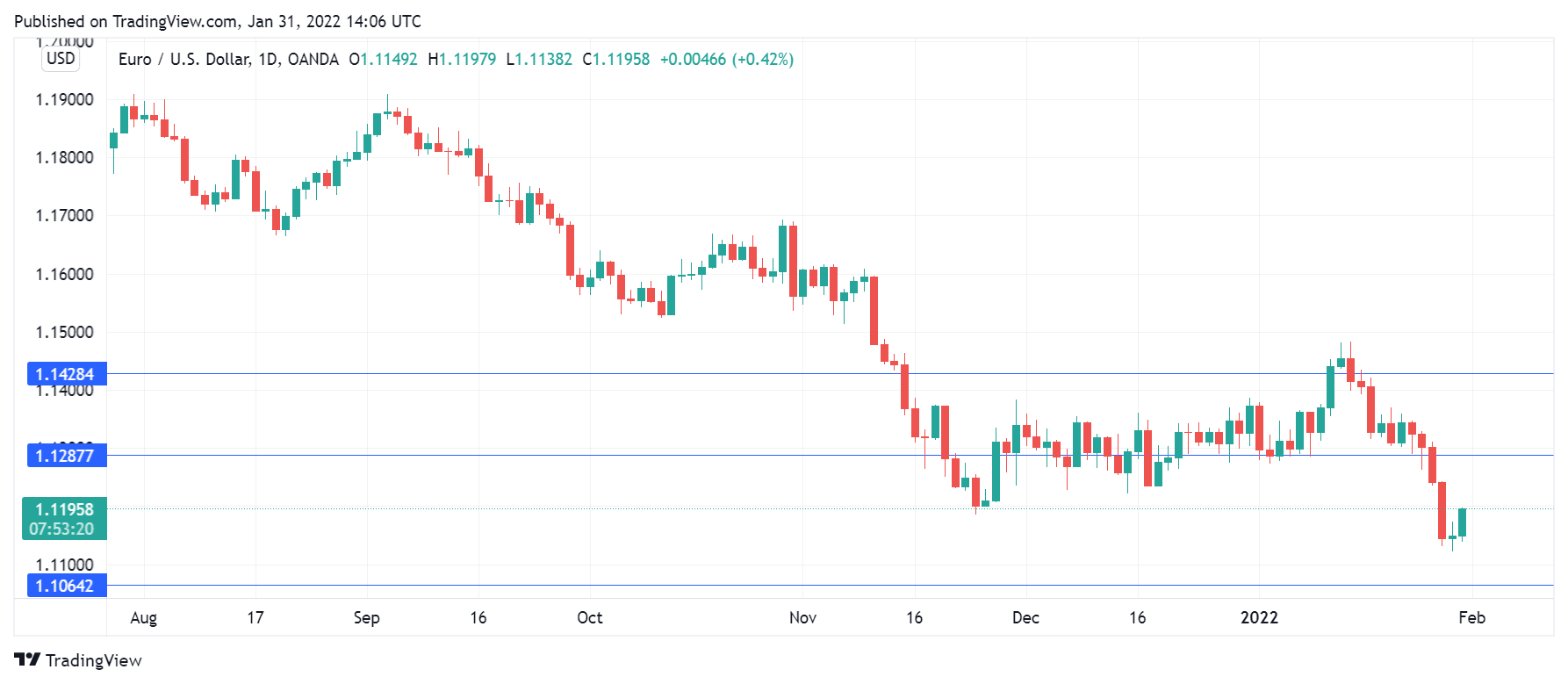
The euro is calm on Monday, after enduring a brutal week. The US dollar was broadly higher last week and steamrolled over the euro, as EUR/USD fell 1.72%. On Friday, the euro dropped as low as 1.1121, its lowest level since June 2020.
It is a busy data calendar for the eurozone, which could mean plenty of action for the euro this week. The ECB holds its policy meeting on Thursday. The central bank is expected to maintain rates, but ECB President Lagarde could provide guidance on when rate hikes could occur. Lagarde has been quite dovish when it comes to eurozone inflation, saying that the rise in inflation is transient (sound familiar? Think Jerome Powell).
Earlier in the day, German CPI for January came in at 4.9% y/y. This was unchanged from November, but somewhat higher than the consensus of 4.3%. It will be interesting to see if Lagarde stays true to her stance or acknowledges at the upcoming meeting that inflation has become more persistent than the ECB expected.
The US delivered some mixed December data on Friday. The Core PCE Price Index, the Fed’s preferred inflation indicator, climbed 4.9% y/y, up from 4.7% and above the forecast of 4.8%. This was the highest gain since 1983 and reinforces expectations that the Fed will act aggressively to curb surging inflation. At the same time, consumer numbers were on the soft side. Personal income rose 0.3% m/m, below the 0.4% consensus. Consumer spending declined by -0.6%, less than the forecast of -0.7%. As well, UoM Consumer Sentiment fell from 68.8 to 67.4, its lowest reading since 2011.
It is almost a given that the Fed will raise rates at the March meeting, but if you’re unclear on what happens after that, you are not alone. The markets have priced in five rates hikes in 2022 (up from four), but economists are nowhere near a consensus, with forecasts ranging as low as three rate hikes and as high as seven. The Fed will need to provide some clarity to this confusion, otherwise, we can expect volatility in the financial markets.
- There is resistance at 1.1287, followed by 1.1428
- There is support at 1.1064 and 1.0982