

Sample Category Title
Dollar Pushes Yen above 114
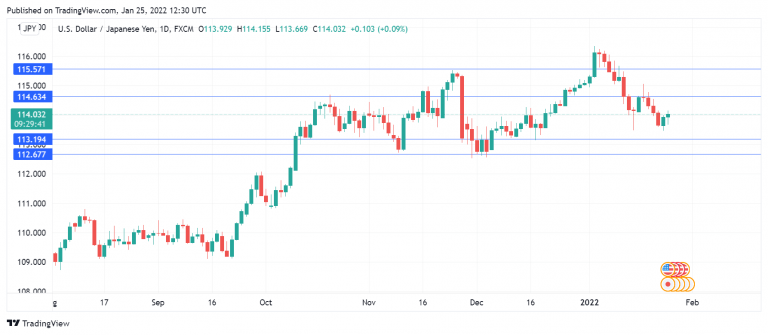
The Japanese yen is slightly lower, as USD/JPY is trading at the 114 line in the European session.
BoJ Core CPI rises
After years of deflation, Japanese inflation indicators continue to point upwards. The latest gauge to confirm the upswing was BoJ core inflation for December, which rose from 0.8% to 0.9% y/y, above the consensus of 0.7%. Later today, the Services Producer Price Index is expected in at 1.0%. Producer inflation has been running at a faster clip than consumer inflation, as businesses have been reluctant to pass on higher costs to consumers.
The weak yen has widely been blamed as being a key factor in higher inflation, but BoJ Governor Haruhiko Kuroda had a different take earlier today, saying that the surge in global commodities was a much bigger factor in boosting Japan’s inflation than the yen. Kuroda stated that he would not consider the yen as being “abnormally” weak and causing higher inflation. This would seem to indicate that the BoJ is not concerned, at least for now, with the depreciation of the yen, with the USD/JPY rising 3.6% since September 1st. The BoJ would not lose any sleep if the yen continued to lose ground, as this would likely lead to higher inflation.
The uptrend is inflation is a new development in Japan, but the bank is unlikely to shift away from its ultra-accommodative policy or raise rates anytime soon. Governor Kuroda has said that a rise in inflation that does not include higher wage growth is not sustainable, which sounds very much like the ‘transient inflation’ phrase that Fed Chair Jerome Powell was using until recently.
Investors are anxiously awaiting the FOMC meeting on Wednesday, with the Fed poised to raise rates in March after a 3-year hiatus. There has also been some speculation that the Fed might depart from incremental hikes of 0.25% and announce a dramatic 0.50% move. This would provide a ‘double punch’ of curbing inflation and sending the markets a strong message in order to restore credibility, which has taken a hit from some market participants that feel that the Fed has been too slow in its response to surging inflation.
USD/JPY Technical
- There is resistance at 114.64 followed by 115.57
- There is support at 113.19 and 112.67
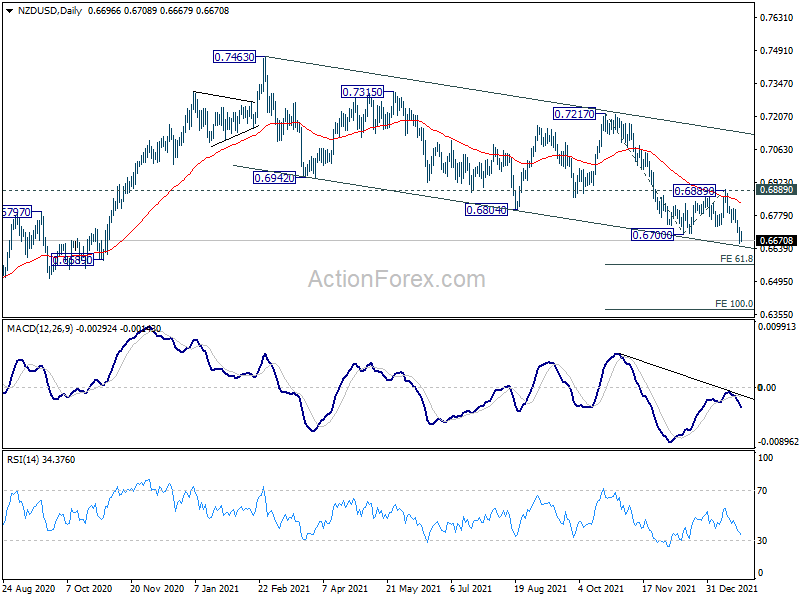
NZD/USD extends down trend, to test channel support first
NZD/USD's down trend resumes this week by breaking 0.6700 support and hit as low as 0.6659 so far. Immediate focus is now on channel support at 0.6640. Firm break there will be a sign of downside acceleration. Next near term target is 61.8% projection of 0.7217 to 0.6700 from 0.6889 at 0.6569 and then 100% projection at 0.6372. In any case, outlook will stay bearish as long as 0.6889 resistance holds, in case of recovery.
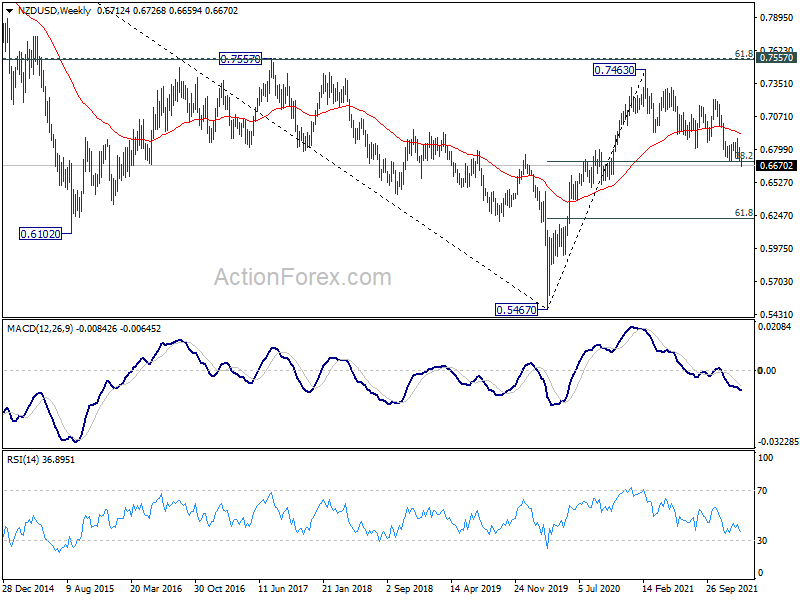
Meanwhile, note that NZD/USD has taken out 38.2% retracement of 0.5467 to 0.7463 at 0.6701. The development argues that rise from 0.5467 has completed at 0.7643 after rejection by 0.7557 long term resistance. Even if fall from 0.7463 is still a correction, there is prospect of deeper fall to 61.8% retracement at 0.6229 before making a bottom. That chance would be high if the above mentioned channel support is firmly taken out.
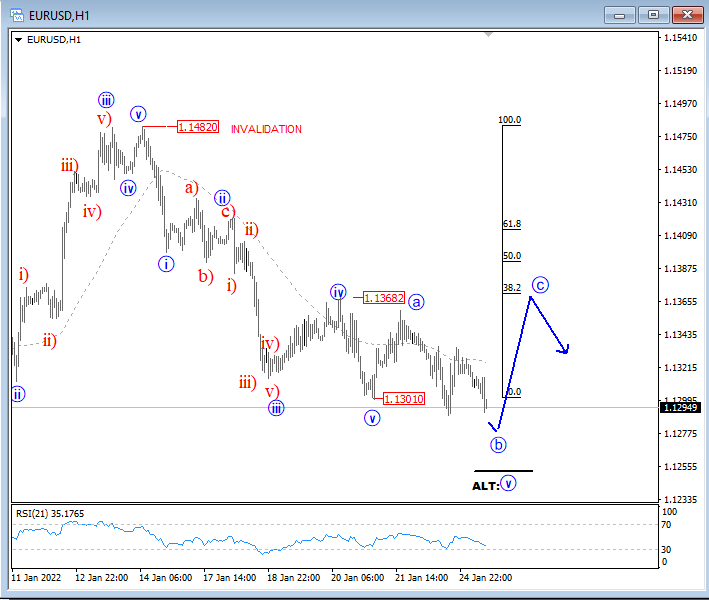
EUR/USD and GBP/USD Elliott Wave Analysis: More Weakness Ahead
The escalation of US-Russian tensions over Ukraine and hawkish Feds policy is worrying for investors which are moving into cash. We see a sharp sell-off on the stock market which may try to stabilize, but technically weakness appears incomplete. If risk-off will resume, then be aware of more JPY and USD strenght.
EURUSD is trading south with nice five waves down to 1.1300 so more weakness will be expected after a three-wave structure. We are talking about a-b-c that can stop at 1.1360/70 resistance.
EUR/USD 1h Elliott Wave analysis
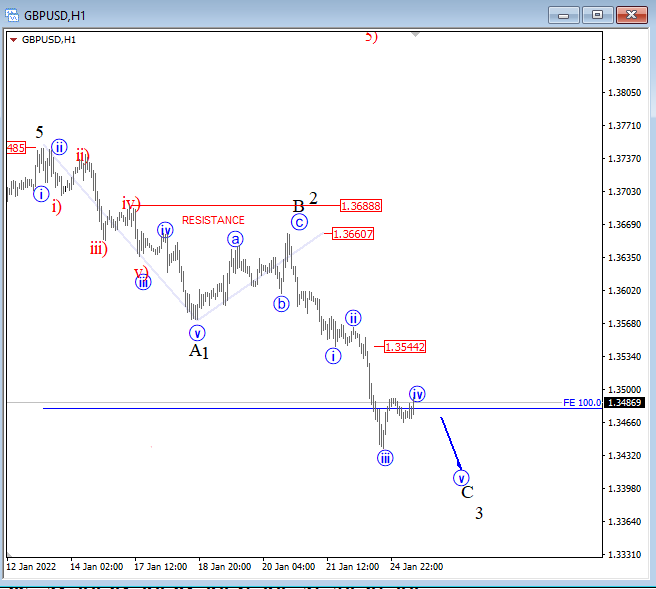
Cable is coming nicely to the downside, into the third leg of a retracement, which can be wave C but even this one must be made by five sub-waves so be aware of a retest of the lows while the market is below 1.3544.
GBP/USD 1h Elliott Wave analysis
ECB Lane: Let’s think about 2020, 2021, 2022 as part of a pandemic inflation cycle
In an interview with Verslo žinios, ECB Chief Economist Philip Lane said, "in the near term, there are some risks from the Omicron variant. But I think it's increasingly clear that the impact is only for a few weeks... In that sense, I think there's less concern about Omicron than we had in December."
On inflation, Lane suggested to think about 2020, 2021, and 2022 as "part of a pandemic cycle". "In the first year 2020, inflation was relatively low. In the second half of 2021, inflation turned out to be quite high. And then, as we look into this year, 2022, we think inflation will remain high at the start of this year, but will fall later this year, especially towards the end of the year," he said.
Lane also said if data suggests that inflation would be too high relative to 2% over the medium term, the response would be "to end net purchasing." Then, only after ending net purchases "would we look at the criteria for raising the interest rates".
GBPUSD Surrenders Ground after 200-MA Curbs Rally
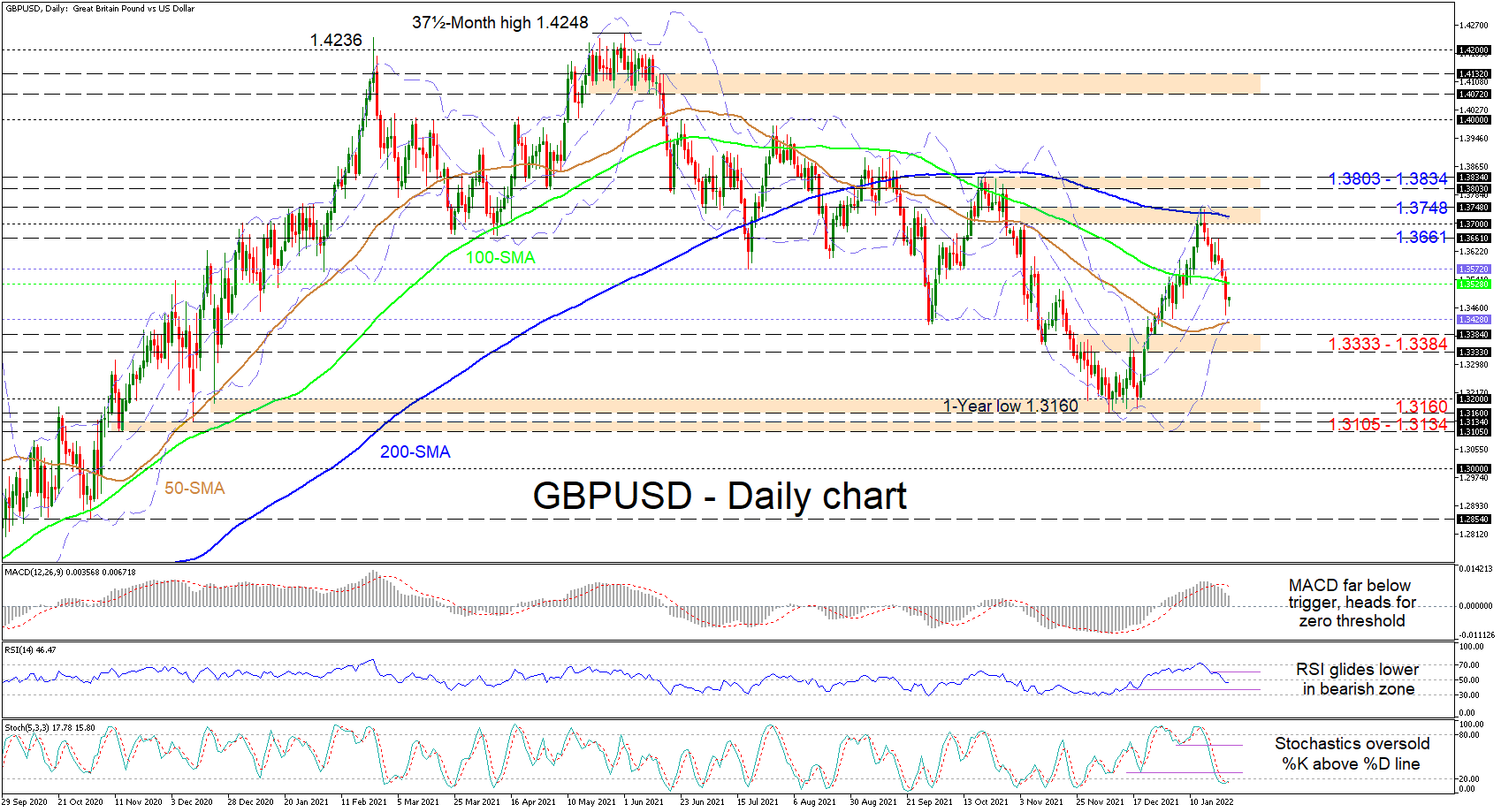
GBPUSD has retraced nearly 50 percent of the three-week rally that began around the 1.3200 handle, but negative forces are diminishing as the drop approaches the lower Bollinger band at 1.3428. The longer-term simple moving averages (SMAs) continue to endorse a broader bearish trajectory in the pair.
The short-term oscillators are tilting more to the downside despite the stochastic oscillator signalling some weakness in bearish pressures. The MACD, in the positive region, is distancing itself beneath its red trigger line, while the RSI is sliding lower in the negative zone. As said, the stochastic lines are attempting to come back from oversold territory, hinting that buyers are fighting back.
If the current price route persists, prompt support could arise from the lower Bollinger band at 1.3428, fortified by the 50-day SMA. However, should the price dip below these obstacles, the nearby 1.3333-1.3384 support barrier may try to impede sellers from fully taking control of the pair. In the event sellers triumph, they could then run the pair towards the one-year low, residing in the 1.3160-1.3200 support area, which holds multiple lows from the first part of December 2021. Nonetheless, downward pressures would need to also break below the adjacent 1.3105-1.3135 support belt to restart the bigger decline in the pair.
On the other hand, if an increase in buying interest overcomes current downward forces, the bulls could face an initial resistance band formed by the 100-day SMA at 1.3528 and the mid-Bollinger band at 1.3572. Should buyers stay in the fight, they may drive the price to test the 1.3661 high before challenging the critical 1.3700-1.3748 resistance section. Only a break of this fortified boundary could encourage the bulls to tackle the neighbouring 1.3803-1.3834 stretch of highs around the latter part of October 2021, in order to try and reinstate a bullish tone in the pair.
Summarizing, GBPUSD is exhibiting a slight tilt to the downside below the longer-term SMAs and the 1.3748 high. That said, for the neutral-to-bearish bias to turn bullish, the price would need to climb above the 1.3803-1.3834 zone, while a decline extending past the 1.3105-1.3134 support band may secure strength in the bearish outlook.
WTI Crude Oil Battle with Ascending Trend Line around 84.00
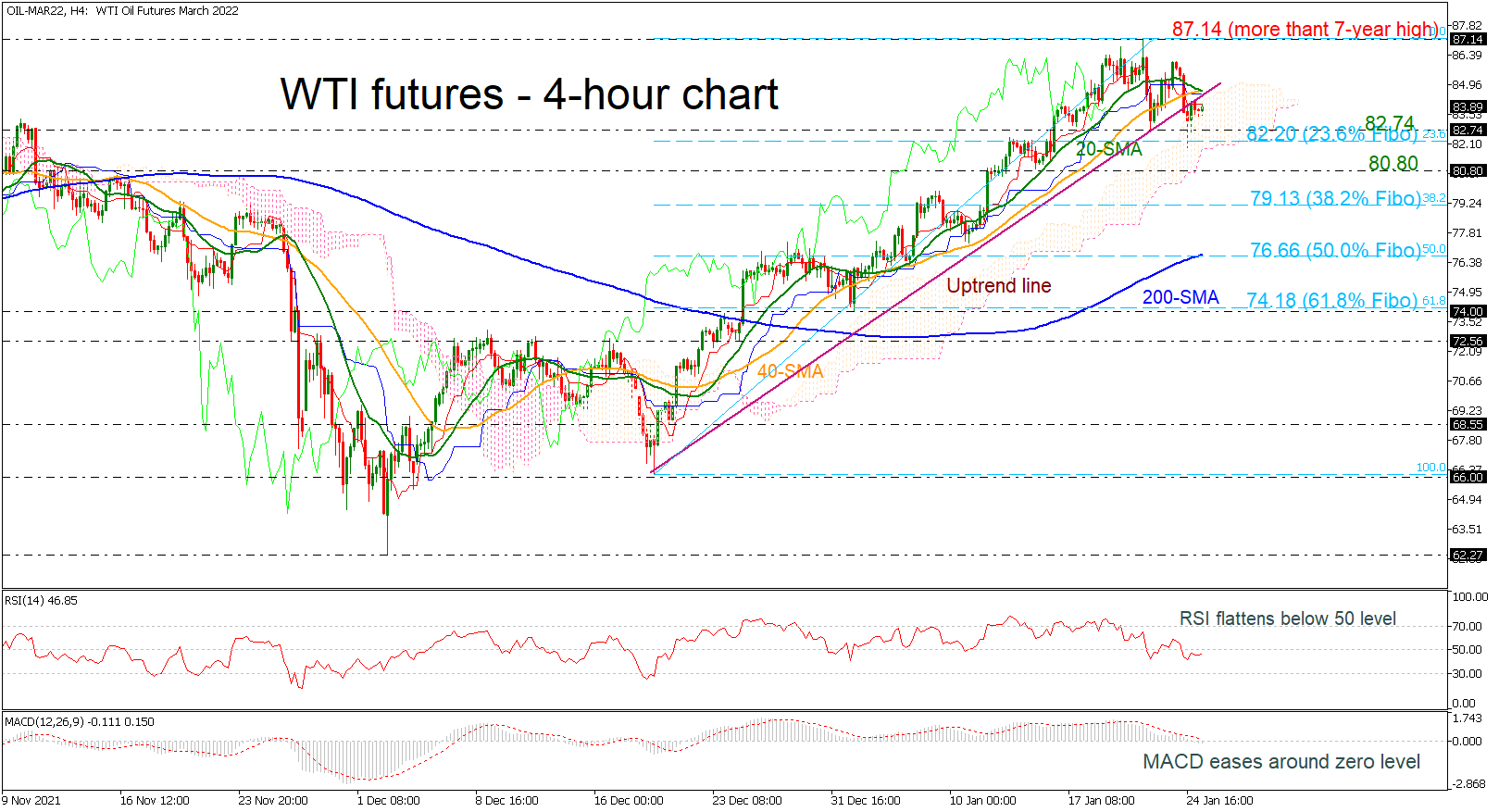
WTI futures have been trading slightly below the long-term ascending trend line over the last few sessions, remaining within the Ichimoku cloud. The RSI indicator is flattening beneath the 50 level, while the MACD oscillator is losing momentum below its trigger line in the short-term. The 20- and 40-period simple moving averages (SMAs) are creating a bearish crossover, confirming the latest down move.
If the price remains below the uptrend line, immediate support could come from the 82.74 barrier ahead of the 23.6% Fibonacci retracement level of the up leg from 66.00 to 87.14 at 82.20. Beneath these crucial levels, the 80.80 support and the 38.2% Fibonacci of 79.13 may act turning points.
On the flip side, a jump beyond the diagonal line and more importantly above the short-term SMAs, the next resistance could be the more-than-seven-year high of 87.14 before the rally continues until the 91.23 barrier.
Summarizing, WTI futures are battling with the long-term rising trend line and if the price continues to fall, the outlook will turn to neutral in the short-term.
Volatile Trading Continues as Fed Meets, Ukraine Tensions Boil
- Wall Street bounces back but futures, Asia sink again; mood brighter in Europe
- Dollar and yen hold firm as Fed angst and geopolitical risks keep havens in demand
- Earnings and US consumer confidence gauge may test investor nerves
More rocky rides for stocks
Shares on Wall Street staged a dramatic rebound on Monday, recovering from heavy losses that briefly took the S&P 500 into correction territory. The benchmark index was down by about 4% at one point before a last minute rally pulled stocks out of the sinkhole. The S&P 500 ended the session 0.3% higher. The Dow Jones closed up a similar amount, while the Nasdaq Composite, which had slumped almost 5%, posted a 0.6% gain. However, the tech-heavy Nasdaq remains in correction territory and futures are down again, suggesting the bounce back was merely a buy-the-dip opportunity rather than a meaningful rebound.
Still, with technical indicators signalling that the near two-week selloff was overdone, a comeback is possible, especially if the upcoming earnings releases and Fed meeting go the markets’ way. In the meantime, there are jitters all around.
Stocks in Asia plummeted today, with China’s CSI 300 index closing at a six-month low and the Nikkei 225 at a 5-month low. It’s a slightly more positive picture in Europe where shares are recouping some of yesterday’s huge losses.
Even if the mood continues to improve somewhat over the course of the day, sentiment remains fragile as investors have quite a lot to contend with.
Fed policy in the spotlight
The US Federal Reserve starts its two-day monetary policy meeting today and although no change is expected at tomorrow’s announcement, speculation is running high that Fed chief Powell will flag a sharp removal of accommodation at the next meetings. Markets are in no doubt now that policymakers need to act quickly to get a grip on inflation. But there’s worries that the Fed has fallen so behind the curve, it won’t be possible to bring inflation back under control without choking off growth.
Yesterday’s flash PMIs out of the US have already raised question marks about the strength of the economy as they pointed to stagnating growth in January.
The fears about the growth outlook might be one reason why Treasury yields have taken a backseat lately, though they are edging slightly up today.
Safe havens bolstered by Ukraine tensions
The US dollar on the other hand has been taking its lead from the broader market anxiety, not just about the Fed but also from geopolitical factors, as well as the elevated volatility in stock markets.
The dollar index is currently trading near two-week highs, as it continues to erase its early January slide. The safe-haven Japanese yen has been another major beneficiary of the recent market panic, appreciating significantly against the riskier currencies such as the pound, aussie and kiwi.
Gold hasn’t fared too badly either from the latest market upheaval, though the strong bids for the dollar in the last couple of sessions have taken some of the shine off bullion. The precious metal was last quoted 0.3% lower at $1,1837/oz.
Whether gold can make more substantive gains in the next few days probably depends on whether the standoff between the West and Russia over Ukraine escalates further. With Russian troops massing on Ukraine’s border, the situation could deteriorate at any moment.
Aussie gets CPI boost, other majors sag
The prospect of a war on Europe’s doorstep is taking a toll on the euro, which has slid back below $1.13. The never-ending partygate saga in the UK seems to be only marginally weighing on sterling.
The New Zealand dollar, meanwhile, is unable to catch a break, skidding to more than 14-month lows versus the greenback. The loonie was off yesterday’s lows as investors eyed a possible rate hike tomorrow by the Bank of Canada. But the Australian dollar got a boost from stronger-than-expected CPI data out of Australia earlier today, bolstering expectations of a hawkish shift by the RBA next week.
Coming up later today, the US consumer confidence index for January could help shape the market tone ahead of the earnings reports by General Electric and Verizon before the market open, and by Microsoft after Wall Street’s closing bell.
Aussie Yawns after Inflation Surges
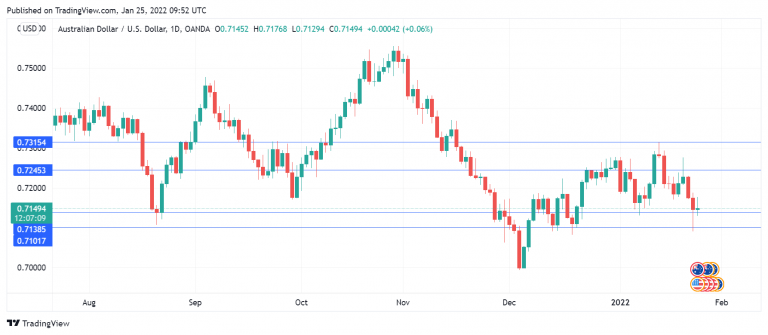
The Australian dollar is flat on Tuesday, trading quietly at 0.7140 in the European session.
Q4 inflation higher than expected
Inflation remains on the move, as fourth-quarter CPI beat expectations. CPI climbed 1.3% q/q (1.0% exp.), up from 0.8% in Q2. On an annualized basis, CPI jumped 3.5% (3.2% exp.), up from 3.0% in Q2. The drivers behind the rise in inflation were higher fuel prices and the cost of new homes, as the construction sector continues to grapple with a shortage of building materials coupled with strong demand.
With annualized inflation running at a 3.5% clip, above the RBA’s target band of 2%-3%, the key question facing the markets is how will the RBA respond? Unemployment has fallen faster and inflation has climbed higher at a faster pace than the RBA anticipated, but this does not mean that a rate hike is around the corner. RBA Governor Philip Lowe has repeatedly stated that he won’t raise rates until unemployment has fallen to 4% and wage growth rises to 3%. Unemployment is close to that requirement, falling to 4.2% in December, but wage growth is well below target, at 2.2%.
Central bankers like to rely on the argument that high inflation without a rise in wage growth is not sustainable, which is why I would urge market participants not to assume that the RBA will shift policy even if inflation keeps climbing – the bank may well decide to hold off on a rate hike until wage growth is at or close to 3%, which is not expected to occur prior to 2023.
Of course, there is always the possibility that Governor Lowe will change course and become more aggressive due to market pressure and the rise in inflation, as was the case with the Federal Reserve which has become more hawkish over the past few months. The strong CPI reading is also significant in that it lends further support to expectations that the RBA will wrap up its bond-buying scheme at the February meeting.
AUD/USD Technical
- AUD/USD is putting pressure on support at 0.7138. Close by, there is support at 0.7101, protecting the round number of 0.7100
- There is resistance at 0.7245 and 0.7315
Germany Ifo business climate rose to 95.7, a glimmer of hope
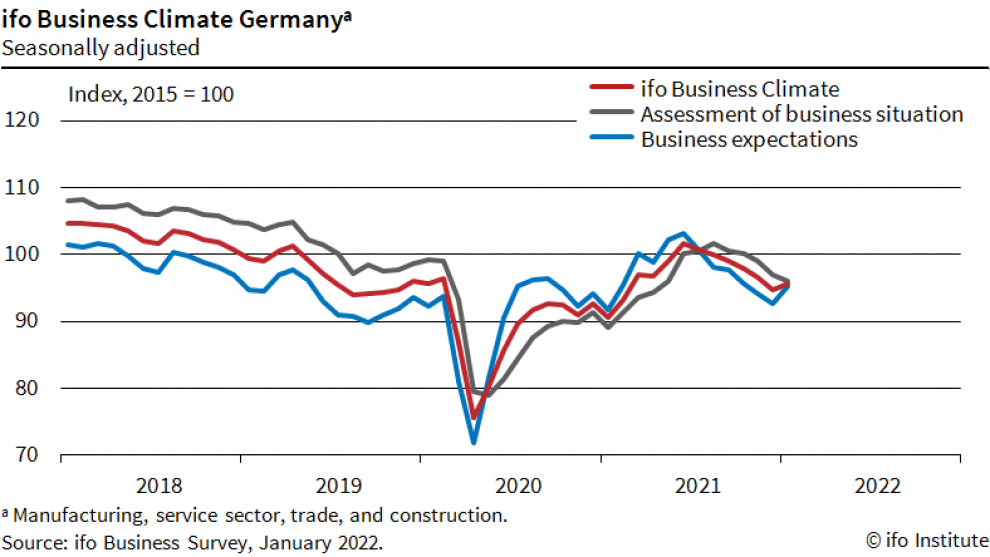
Germany Ifo Business Climate rose from 94.8 to 95.7 in January, above expectation of 94.7. Current Assessment index dropped from 96.9 to 96.1, matched expectations. Expectations index improved from 92.7 to 95.2, above expectation of 93.0.
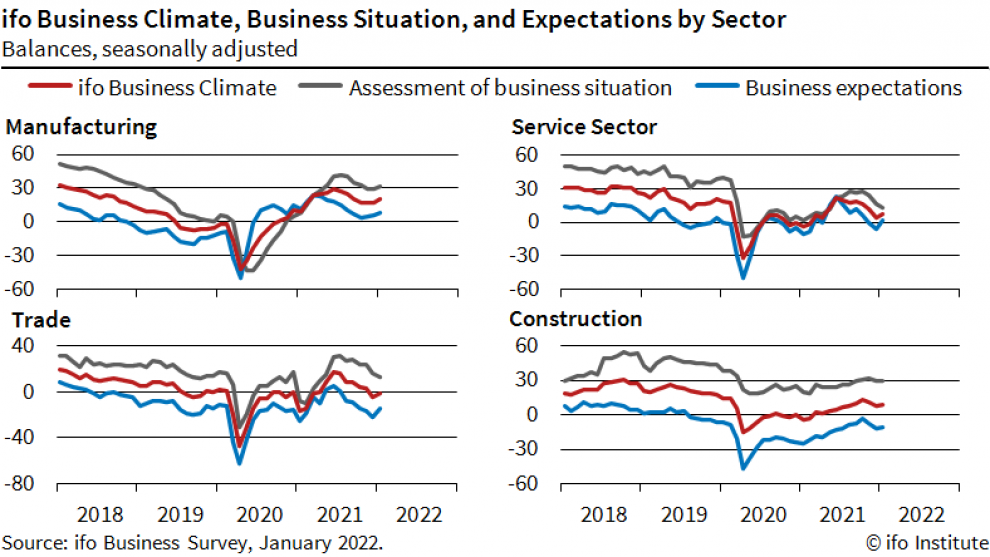
By sector, manufacturing rose from 17.4 to 19.9. Services rose from 4.6 to 7.7. Trade rose from -4.1 to -1.3. Construction rose from 7.6 to 8.7.
Ifo said: "While companies' assessments of the current situation were somewhat less positive, their expectations improved considerably. The German economy is starting the new year with a glimmer of hope."
Markets Cautious Ahead Of Russia-Ukraine Tensions and Fed Meeting
Asian stocks flashed red on Tuesday morning, alongside U.S futures after an explosively volatile session on Wall Street.
Global equity markets were flung on a chaotic rollercoaster ride as investors grappled with Fed hike fears and mounting geopolitical tensions over Ukraine. In the currency space, king dollar edged higher despite the slight retreat in Treasury yields while gold glittered amid the risk aversion.
European markets are catching up on the strong US close this morning, but the caution in Asia has cast a cloud over sentiment as investors would prefer to shrug off the intense volatility that rattled global markets on Monday.
Although Wall Street swung back toward positive territory yesterday as investors exploited the selloff to snatch discounted shares, US equity bulls are certainly not out of the woods. Should inflation concerns, Fed hike fears, and geopolitical tensions fuel risk aversion in the days ahead, this could spell trouble for risk assets across the globe.
Overnight, Australia’s inflation jumped to 3.5% in the fourth quarter of 2021 amid rising petrol and housing costs. The Australian dollar pushed higher during early trading as expectations rose over the RBA adopting a more hawkish tone at its next monetary policy meeting on February 1. Traders are currently pricing in a 58% chance of a rate hike by May 2022, with June fully discounted.
Spotlight swings on Fed meeting
Although monetary policy is widely expected to remain unchanged, the FOMC meeting could provide some key insight into how aggressive the Fed intends to tighten policy throughout 2022. Markets expect the central bank to signal on Wednesday that it plans to hike interest rates in March, with a total of four 25 basis point interest rates increases expected by the end of this year. While the Fed may stick to the script, any hesitancy on future rate increases or a more dovish tone could breathe life back into riskier assets. Alternatively, a hawkish Fed may deal another blow to stock markets, injecting equities bears with fresh confidence.
Commodity spotlight - Gold
Gold kicked off the week on a firm note as geopolitical tensions accelerated the flight to safety.
The slight retreat in Treasury yields also helped zero-yielding gold, as prices ventured towards the $1845 resistance level. There is no doubt that this will be a big week for gold with its near-term outlook likely to be influenced by the Fed meeting.
A hawkish Fed that signals multiple rate hikes could dampen the appetite for gold, resulting in prices sinking back towards $1831 and $1810. If the Fed surprises markets by deviating from the script and shows hesitancy in future rate hikes, this may push the precious metal higher towards $1870.