

Sample Category Title
Sunset Market Commentary
Markets
Calm returned to European stock markets after a manic Monday. EU bourses recoup a modest 0.4 to 1% from the losses that mounted to more than 4%. US stocks are less lucky. The late-session turnaround yesterday proved partially futile. Wall Street opens with losses going up to 2.7% (Nasdaq). It confirms our idea that markets will probably remain on edge at least until the Fed provides them with some clarity tomorrow on how aggressively monetary support is going to be withdrawn. Aside from the Fed, the Russian-Ukraine conflict lingers too. Historical evidence suggests that it’s usually the highly uncertain pre-war period rather than an outright military conflict itself that causes most damage to (equity) markets. The German bond market yesterday outperformed the US since it missed out on the abrupt change in sentiment. Cards are dealt differently today. The US curve bull flattens with yield changes ranging from -1.6 bps (3y) to -2.7 bps (30y). Germany’s yield curve bear steepens up to 2.2 bps (30y). While there was no market impact, we do mention ECB Chief Economist Lane’s speech. The ECB’s most dovish governor may finally have altered his view on inflation. He said that it's possible that inflation stabilizes around 2% as some factors that depressed prices before the pandemic won’t return. Policies to fight very low inflation would then no longer be needed, he added. Before, Lane fenced with the ECB’s sub 2% inflation projections for 2023 and 2024 when justifying the ultra-easy policy stance.
The yen shined bright on FX markets. Japan’s currency gains against all G10 peers. EUR/JPY is testing yesterday’s intraday lows around 128.37. A solid dollar limits the damage for USD/JPY to 113.88. The trade-weighted greenback rises back north of 96(.18) for the first time since early January. EUR/USD (1.127) takes a technically exacerbated hit. It dives below the lower bound of the upward sloping trend channel (daily support level stood at 1.1292). Sterling rebounds and undoes a technical break higher in EUR/GBP. The pair is currently changings hands at 0.836, down from 0.84 in early morning trading. Still no sign of a political premium in sterling, not even now the UK police began formally investigating allegations concerning “partygate”. In Central-Europe, the Hungarian forint outperforms peers today. The Hungarian central bank raised the monthly policy rate with a more-than-expected 50 bps to 2.90% in a catch-up move with the one-week deposit rate (4%). It aggressively jacked up that de facto main policy rate over the past months to support the forint and counter spiraling inflation. Showing its determination on bringing inflation under control, the MNB also raised the ceiling on the interest rate corridor to 4.9% from 4.4%, allowing it to increase the one-week deposit rate even further. EUR/HUF eases from an intraday high of 362 to 358.93 currently.
News Headlines
UK borrowing in the first nine months of the fiscal year 2021/22 came in at £146.8 bln, National Statistics data showed. This was £12.9 bln below the October forecast by the OBR. A bigger than expected rise in tax receipts compensated for a £21bln increase (+69%) of interest rate costs over the same period. Receipts from VAT, corporate taxes and stamp duties related to property transactions were all higher. The better than expected budget data might give UK Finance Minister Sunak room to take measures to ease the pain from a rising cost of living especially as the energy bill of UK consumers is expected to rise sharply in April. The government also can consider to delay/amend a planned rise in payroll taxes at that time.
Confidence among Belgian businesses in January eased further from 3.6 in December to 2.7 in January, the lowest level in since March of last year. The National Bank still describes the decline as ‘only very slight’. Confidence in manufacturing declined to 0.8 from 3.1. The assessment of the industrial sector on employment and demand recovered a bit, but deteriorated on total order books and stock levels. Trade (-4.8 from -3.5) and the building industry (0.2 from 1.2) turned less positive but business related services improved from 10.1 to 16.1 thanks to expectations for general market demand and regarding their own business.
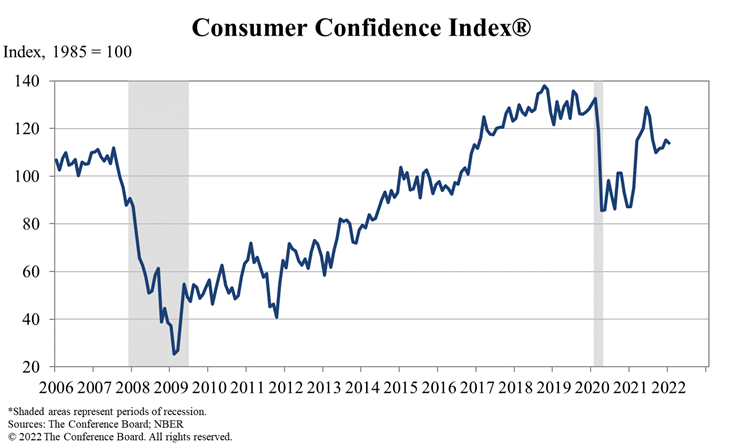
US consumer confidence dropped to 113.8 in Dec, below expectation
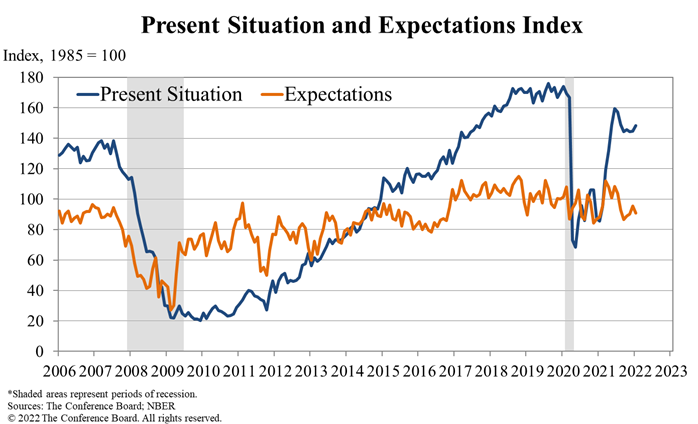
US Conference Board Consumer Confidence Index dropped from 115.2 to 113.8 in December, above expectation of 112.3. Present Situation Index rose from 144.8 to 148.2. Expectations Index dropped from 95.4 to 90.8.
"Consumer confidence moderated in January, following gains in the final three months of 2021," said Lynn Franco, Senior Director of Economic Indicators at The Conference Board.
"The Present Situation Index improved, suggesting the economy entered the new year on solid footing. However, expectations about short-term growth prospects weakened, pointing to a likely moderation in growth during the first quarter of 2022. Nevertheless, the proportion of consumers planning to purchase homes, automobiles, and major appliances over the next six months all increased."
"Meanwhile, concerns about inflation declined for the second straight month, but remain elevated after hitting a 13-year high in November 2021. Concerns about the pandemic increased slightly, amid the ongoing Omicron surge. Looking ahead, both confidence and consumer spending may continue to be challenged by rising prices and the ongoing pandemic."
Swiss Franc Extends Slide
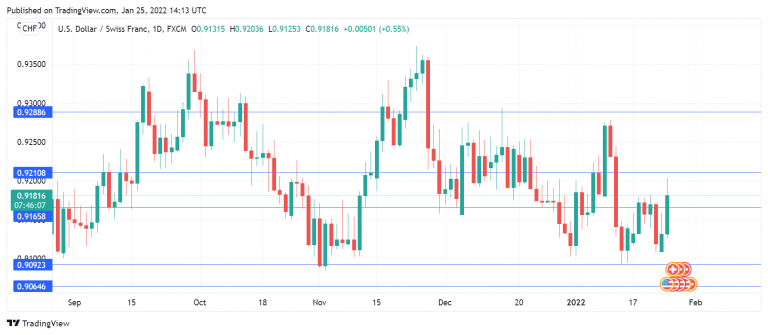
The Swiss franc is down sharply on Tuesday, with USD/CHF climbing above the 92 line for the first time in two weeks. In the North American session, USD/CHF is trading at 0.9184, up 0.58% on the day. Investors will be keeping an eye on Swiss Economic Expectations which will be released on Wednesday. After a dismal reading of -10.8 in November, we may see a rebound in the December data.
Swiss franc down sharply
The Swiss franc kicked off the New Year with sharp losses, and the currency has been marked by considerable volatility in January. The US dollar has risen against the major currencies this week, with the exception of the Japanese yen. The Swiss franc is a traditional safe-haven asset, but with tensions at a fever pitch on the Ukraine-Russia border and stocks market falling, jittery investors have been seeking safety with the US dollar.
US stock markets have been dropping and that has been sweet news for the US dollar. All three major US futures indices were down on Tuesday, as earnings have disappointed and the Fed is set to embark on at least four rate hikes this year. If the selloff continues on Wall Street today, the US dollar could add more gains.
The markets are anxiously awaiting the FOMC meeting on Wednesday, with the Fed set to embark on a series of rate hikes throughout 2022 and possibly into 2023 as well. The likelihood of a hike in March stands at 94%, according to FedWatch.
There has also been some speculation that the Fed might depart from incremental hikes of 0.25% and announce a dramatic 0.50% move. This would show that the Fed is serious about curbing inflation and help restore credibility after the Fed stuck to its script that inflation was transitory for far too long.
USD/CHF Technical
- USD/CHF is testing resistance at 0.9165. Above, there is resistance at 0.9210
- There is support at 90.92 and 90.64
Market Awaits FOMC Meeting, Keeps an Eye on Ukraine Crisis
FOMC minutes attract attention
The two-day FOMC meeting begins today and concludes tomorrow with a decision as the global economy is feeling the pain of omicron variant. The Federal Reserve is widely expected to maintain its hawkish stance as it prepares the market for liftoff at its next meeting.
Anyone hoping for some form of Fed Put this week will likely be disappointed. The Federal Reserve's top aim right now is to keep inflation under control. Because the economy is on the verge of reaching full employment and inflation remains persistently high, the Federal Reserve cannot help the equities market at the same time.
The US dollar index moved higher today, posting a two-week high around 96.20, as investors sought safe-haven currencies amid Russia-West tensions over Ukraine and awaited the result of the Fed meeting. Dollar/yen is hovering above 114.00, while euro/dollar is tumbling below 1.1300. US stock futures suggest a negative open after a green day on Monday. Sterling held at a three-week low of 1.3435 against the dollar as investors remained wary of risk assets in the face of rising tensions in Ukraine and expectations of a Federal Reserve rate hike.
Russian-Ukrainian relations
The Russian-Ukrainian border remains tense. 8,500 American troops have been placed on high alert for possible deployment to reinforce NATO forces in Eastern Europe. "It is pretty evident that the Russians have no intention right now of de-escalating," U.S. officials said, but Russia said it has not heightened tensions. Biden enjoyed a conversation with European leaders, including French President Macron and German Chancellor Scholz, as diplomatic efforts continue. "Total unanimity with all the European leaders," Biden noted. We get the distinct impression that this tale is far from over and that the current impasse will last for some time.
BoC rate hike on Wednesday
The Bank of Canada will host its first policy meeting of 2022 on Wednesday. In the previous week, bets on a rate hike have increased in intensity, and a 25-basis-point increase is currently nearly 85% priced in. Expectations of an early action were bolstered by recent CPI data showing annual inflation hit a 30-year high of 4.8% in December. Dollar/loonie is moving slightly up today near 1.2650.
Australia’s inflation jumped to 7-year high annually
Australia’s inflation rose to its highest annual rate since 2014 in the December quarter, driven by gasoline and housing expenses, stoking market speculation of an early rate hike. The CPI grew 1.3% in the fourth quarter and 3.5% for the year. Aussie/dollar remains above 0.7100 but with a negative bias.
USD/JPY Mid-Day Outlook
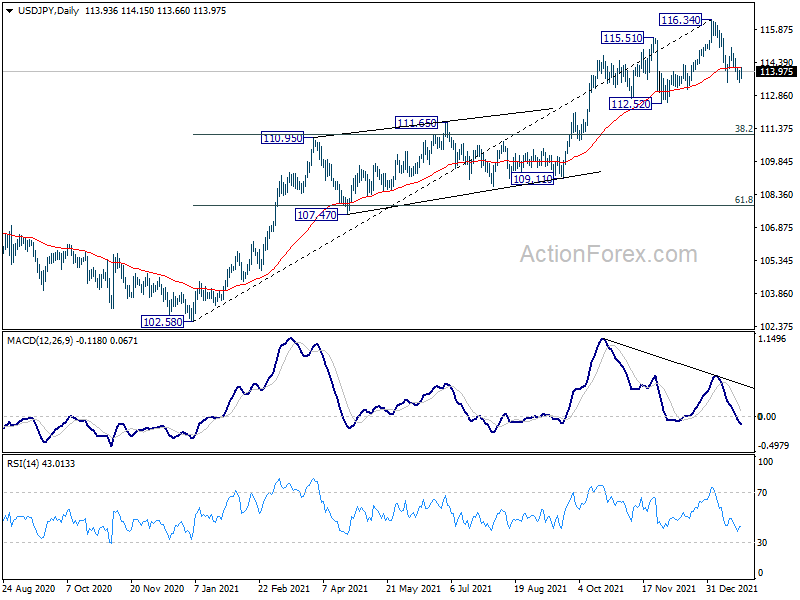
Daily Pivots: (S1) 113.63; (P) 113.82; (R1) 114.16; More...
Intraday bias in USD/JPY remains neutral at this point. As noted before, considering bearish divergence condition in in daily MACD, it's probably already in correction to whole up trend from 102.58. Break of 113.47 will target 112.52 support first, and then 38.2% retracement of 102.58 to 116.34 at 111.08. For now, risk will stay on the downside as long as 115.05 resistance holds, in case of recovery.
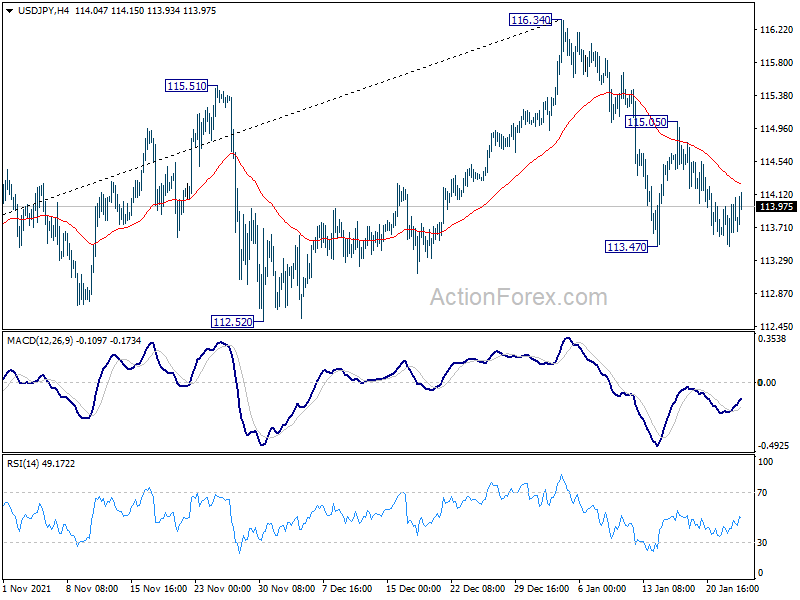
In the bigger picture, no change in the view that rise from 102.58 is the third leg of the up trend from 101.18 (2020 low). Such rally should target a test on 118.65 (2016 high). Sustained break there will pave the way to 120.85 (2015 high) and raise the chance of long term up trend resumption. This will remain the favored case as long as 55 week EMA (now at 110.91) holds.
USD/CHF Mid-Day Outlook
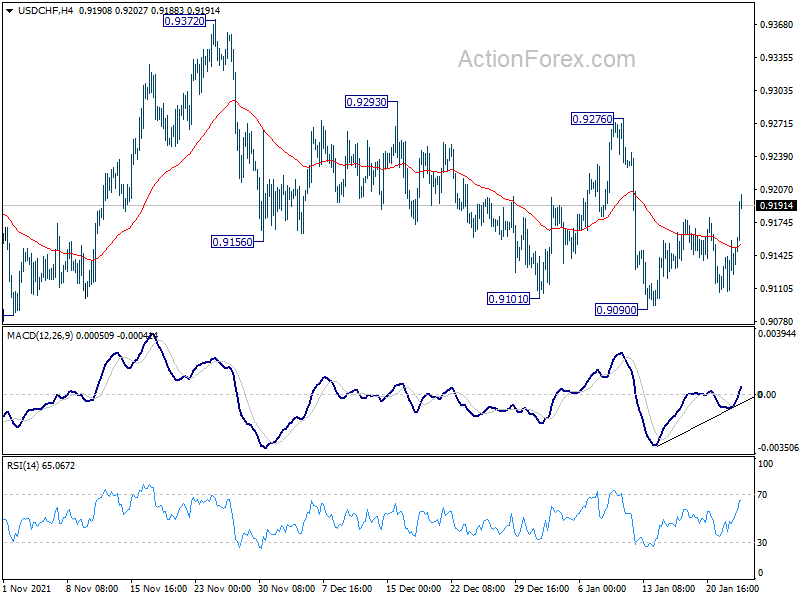
Daily Pivots: (S1) 0.9114; (P) 0.9136; (R1) 0.9164; More....
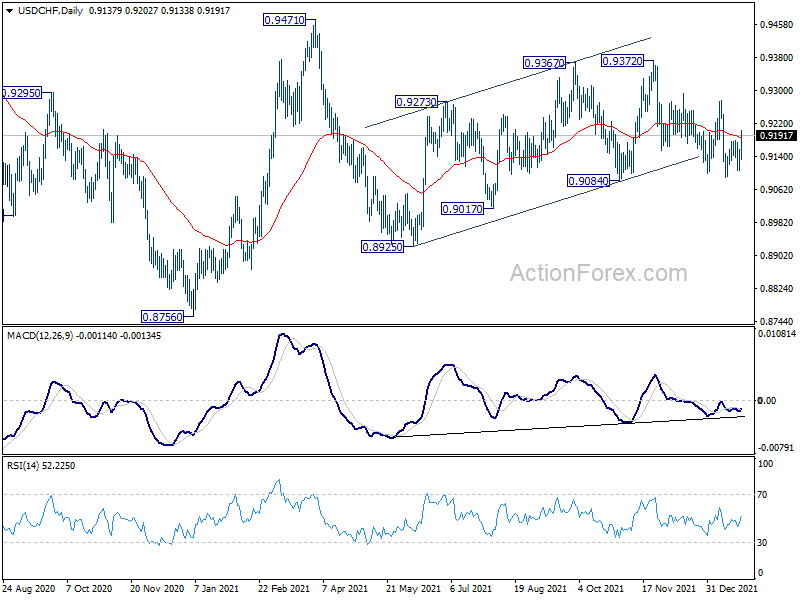
USD/CHF's rebound from 0.9090 extends higher but stays in established range. Intraday bias remains neutral first. On the downside, firm break of 0.9084 support will argue that choppy rise from 0.8925 has completed. Fall from 0.9471 might be ready to resuming. Further decline would be seen back to 0.8925 support first. On the upside, above 0.9276 will target 0.9372 resistance instead.
In the bigger picture, the corrective structure of the rebound from 0.8925 argues that fall from 0.9471 is not complete yet. It could either be the second leg of pattern from 0.8756 (2021 low), or resuming larger down trend from 1.0237 (2018 high). We'd pay attention to the downside momentum and assess the odds later. But for now, medium term outlook will be neutral at best as long as 0.9471 resistance holds.
GBP/USD Mid-Day Outlook
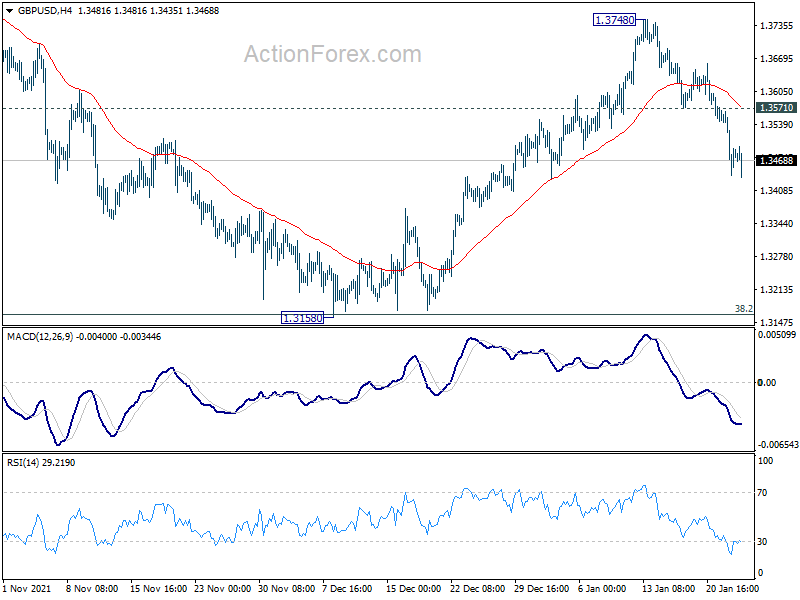
Daily Pivots: (S1) 1.3433; (P) 1.3500; (R1) 1.3558; More...
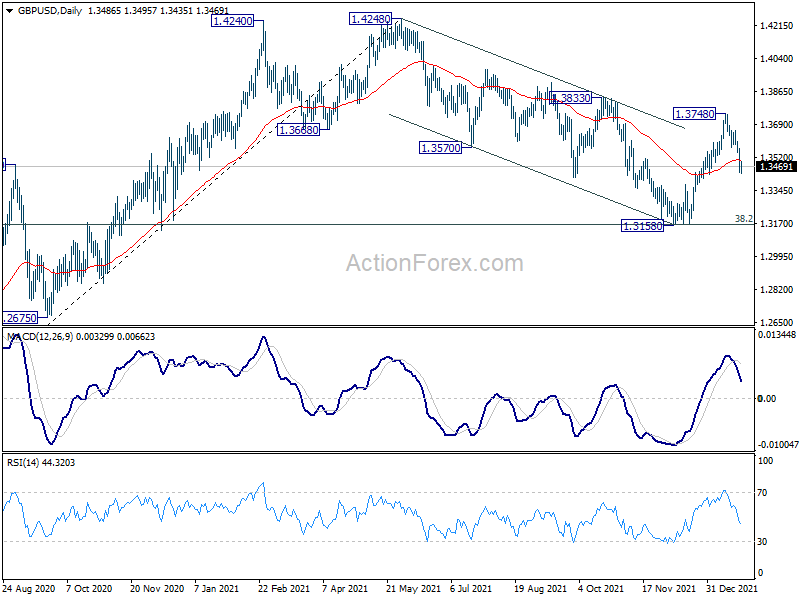
Intraday bias in GBP/USD remains on the downside and outlook is unchanged. Rebound from 1.3158 could have completed at 1.3748 already. More importantly, larger fall from 1.4282 is probably not over yet. Deeper fall would be seen back to retest 1.3158 low. On the upside, though, above 1.3571 minor resistance will turn bias back to the upside for retesting 1.3748.
In the bigger picture, strong support was seen from 38.2% retracement of 1.1409 to 1.4248 at 1.3164. The development suggests that up trend from 1.1409 (2020 low) is still in progress. On resumption, next target will be 38.2% retracement of 2.1161 to 1.1409 at 1.5134. Nevertheless sustained break of 1.3164 will argue that whole rise from 1.1409 has completed and bring deeper fall to 61.8% retracement at 1.2493.
A Huge Few Days for Markets
It's been a rollercoaster start to what was always going to be a massive week in the markets and there's little reason to expect that to change in the coming days.
The turnaround on Monday was incredible. From eye-watering losses to ending the day in the green; it's not often you see that kind of action. Investors will no doubt be relieved but that could prove to be short-lived. US futures are back in negative territory ahead of the open - albeit to a much lesser degree at the moment - and even at the close on Monday, the Nasdaq was more than 13% off its highs.
The next couple of days will be huge. So much could hang on the communication from the Fed tomorrow and whether they strike the right balance between taking inflation seriously and not raising rates too aggressively. It's a tightrope situation but if the central bank can find the right balance, more may be tempted by these levels.
It's not just on the Fed, of course. On Monday, it was geopolitics that appeared to tip investors over the edge. The reaction looked over the top but that is indicative of the level of underlying anxiety in the markets at the moment. And if things don't improve this week, we may see more episodes like that.
Which brings us to earnings season and a week in which numerous companies release fourth-quarter results, including a number of big tech names. A disappointing start to the season hasn't helped to lift the mood but that could change this week. If not, the January blues could turn into something far more unsettling.
Fundamentals remain bullish for oil
Oil got caught up in the sell-everything panic at the start of the week, sliding more than 3% at one stage before recovering a little. There wasn't much sense behind the move, but the fact that the dollar was strengthening and crude was already seeing profit-taking after peaking just shy of $90, probably contributed to it.
The market remains fundamentally bullish and conflict with Russia does nothing to alleviate supply-side pressures. If anything, the risks are tilted in the other direction, not that I think it will come to that. Nor does the market at this point, it seems.
Still, it was only likely to be a matter of time until oil bulls poured back in and prices are up again today. The correction from the peak was less than 5% so that may be a little premature, but then the market is very tight so perhaps not.
Conditions remain favorable for gold
Gold continues to be well supported at the start of the week, following some turbulent trading conditions and dollar strength. It continued to hold over the last couple of sessions around $1,830 and has pushed higher with $1,850 now in its sights.
The yellow metal is pulling back a little today, off a few dollars, but it remains in a good position. There still appears to be momentum behind the rally which could continue to take it higher. A move through yesterday's lows could see that slip but at this point in time, conditions continue to look favorable. Of course, the Fed tomorrow could have a huge role to play in whether that continues to be the case which may explain the consolidation in recent days.
A strong recovery for bitcoin
Bitcoin rebounded strongly on Monday, alongside other risk assets that had also been pummelled earlier in the day. It's trading a little lower today but that won't be a major concern at this stage as broader risk appetite is holding up so far. Whether that is sustainable will determine how bitcoin responds and that may depend on the Fed tomorrow.
Bitcoin found support at $33,000 on Monday which isn't far from a hugely important support zone around $30,000. If risk appetite takes a turn for the worse again, we could see that come under severe pressure. If the price can hold above here in the short term, it could be a very positive sign.
EUR/USD Mid-Day Outlook
Daily Pivots: (S1) 1.1296; (P) 1.1321; (R1) 1.1350; More...
EUR/USD's break of 1.1284 support how argues that corrective rebound from 1.1185 has completed at 1.1482. Intraday bias is back on the downside for 1.1185 first. Firm break there will resume larger down trend from 1.2348 to 61.8% projection of 1.1908 to 1.1185 from 1.1482 at 1.1035. On the upside, above 1.1368 minor resistance will turn intraday bias back to the upside, and extend the consolidation from 1.1185 with another rise.
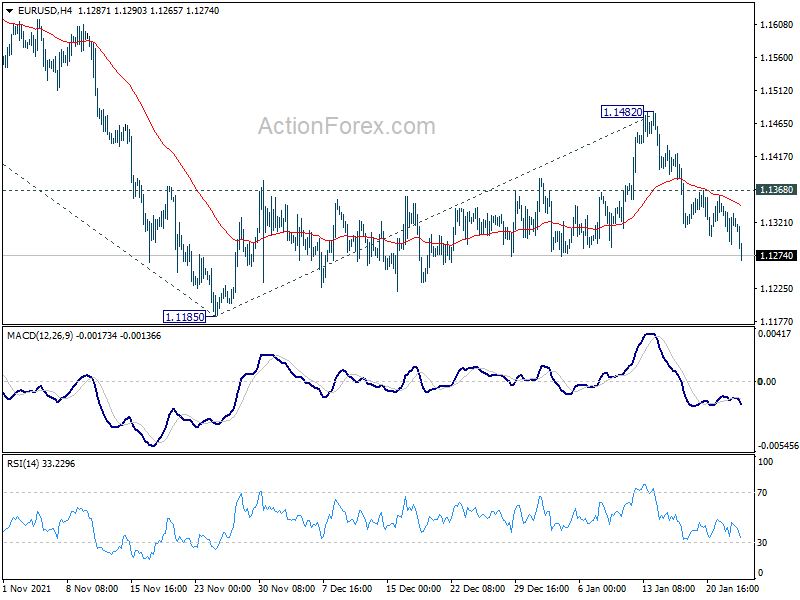
In the bigger picture, there are various ways of interpreting the fall from 1.2348 (2021 high). It could be a correction to rise from 1.0635 (2020 low), the fourth leg of a sideway pattern from 1.0339 (2017 low), or resuming long term down trend. In any case, outlook will now stay bearish as long as 1.1703 support turned resistance holds. Sustained break of 61.8% retracement of 1.0635 to 1.2348 at 1.1289 would pave the way back to 1.0635.
Dollar and Yen Rise Against as US Futures Dive, EUR/USD Ready for Downside Breakout?
Dollar and Yen rise again today as US futures point to sharply lower open. Yesterday's strong U-turn seems lacking momentum to extend. But selling focus has somewhat turned to European session, with Swiss Franc leading the way lower. Commodity currencies, except Kiwi, are mixed. In other markets, Gold is staying in tight range above 1830. WTI crude oil is in range above 83. Bitcoin is also consolidation around 36k.
Technically, EUR/USD's break of 1.1284 support now suggests that larger down trend from 1.2348 is probably ready to resume through 1.1185 low. We'll now see USD/JPY would break through 115.05 minor resistance to reflect Dollar strength. Or it will break through 113.47 to indicate Yen strength, which could be see in downside acceleration in EUR/JPY in this case.
In Europe, at the time of writing, FTSE is up 0.96%. DAX is up 0.55%. CAC is up 0.89%. Germany 10-year yield is up 0.0218 at -0.084. Earlier in Asia, Nikkei dropped -1.66%. Hong Kong HSI dropped -1.67%. China Shanghai SSE dropped -0.258%. Singapore Strait Times dropped -1.08%. Japan 10-year JGB yield rose 0.0018 to 0.141.
ECB Lane: Let's think about 2020, 2021, 2022 as part of a pandemic inflation cycle
In an interview with Verslo žinios, ECB Chief Economist Philip Lane said, "in the near term, there are some risks from the Omicron variant. But I think it's increasingly clear that the impact is only for a few weeks... In that sense, I think there's less concern about Omicron than we had in December."
On inflation, Lane suggested to think about 2020, 2021, and 2022 as "part of a pandemic cycle". "In the first year 2020, inflation was relatively low. In the second half of 2021, inflation turned out to be quite high. And then, as we look into this year, 2022, we think inflation will remain high at the start of this year, but will fall later this year, especially towards the end of the year," he said.
Lane also said if data suggests that inflation would be too high relative to 2% over the medium term, the response would be "to end net purchasing." Then, only after ending net purchases "would we look at the criteria for raising the interest rates".
Germany Ifo business climate rose to 95.7, a glimmer of hope
Germany Ifo Business Climate rose from 94.8 to 95.7 in January, above expectation of 94.7. Current Assessment index dropped from 96.9 to 96.1, matched expectations. Expectations index improved from 92.7 to 95.2, above expectation of 93.0.
By sector, manufacturing rose from 17.4 to 19.9. Services rose from 4.6 to 7.7. Trade rose from -4.1 to -1.3. Construction rose from 7.6 to 8.7.
Ifo said: "While companies' assessments of the current situation were somewhat less positive, their expectations improved considerably. The German economy is starting the new year with a glimmer of hope."
Australia CPI surged to 3.5% yoy in Q4, trimmed mean CPI at 7-yr high
Australia CPI rose 1.3% qoq, 3.5% yoy in Q4, well above expectation of 1.0% qoq, 3.2% yoy. RBA trimmed mean CPI rose 1.0% qoq, 2.6% yoy, also above expectation of 0.7% qoq, 2.4% yoy. The 2.6% yoy rise was the highest since June 2014.
Head of Prices Statistics at the ABS, Michelle Marquardt, said the most significant price rises in the December quarter were new dwellings (+4.2%) and automotive fuel (+6.6%).
Marquardt said: "Annual trimmed mean inflation is the highest since 2014, reflecting the broad-based nature of price increases, particularly for goods."
Australia NAB business confidence dropped sharply to -12
Australia NAB business confidence dropped sharply from 12 to -12 in December. Business conditions dropped from 11 to 8. Trading conditions was unchanged at 14. Profitability conditions rose from 8 to 10. Employment conditions dropped from 11 to 2.
"Overall, the December survey results are consistent with an economy that's starting to slow, with some similarities to the data when NSW and Victoria were first entering lockdown," said NAB Chief Economist Alan Oster. "That probably means conditions will fall in early 2022. However, we don't expect the Omicron variant to derail the recovery longer-term."
BoJ Kuroda keeps an eye on inflation risks while maintaining ultra-easy policy
BoJ Governor Haruhiko Kuroda told the parliament today, "the BOJ will continue its ultra-easy policy so improvements in corporate profits and the economy prop up wages and gradually accelerate consumer inflation."
"We remain vigilant to the risk prices may shoot up before wages begin to rise, or how (rising raw material costs) could hurt smaller firms. We must keep an eye out on these risks, while maintaining our current easy monetary policy," Kuroda said.
Meanwhile, Prime Minister Fumio Kishida said, "it's desirable to create an environment in which companies can pass on rising costs and raise wages, so that increasing consumption spurs economic growth and inflation."
EUR/USD Mid-Day Outlook
Daily Pivots: (S1) 1.1296; (P) 1.1321; (R1) 1.1350; More...
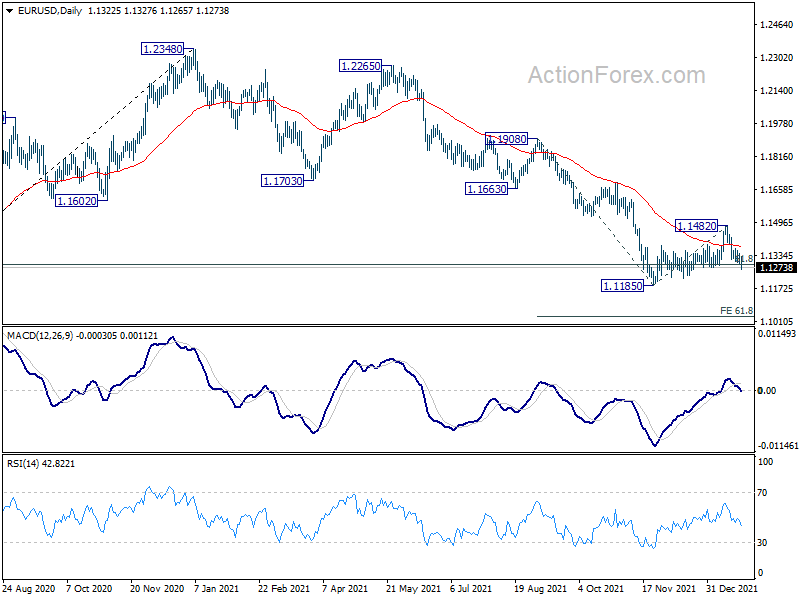
EUR/USD's break of 1.1284 support how argues that corrective rebound from 1.1185 has completed at 1.1482. Intraday bias is back on the downside for 1.1185 first. Firm break there will resume larger down trend from 1.2348 to 61.8% projection of 1.1908 to 1.1185 from 1.1482 at 1.1035. On the upside, above 1.1368 minor resistance will turn intraday bias back to the upside, and extend the consolidation from 1.1185 with another rise.
In the bigger picture, there are various ways of interpreting the fall from 1.2348 (2021 high). It could be a correction to rise from 1.0635 (2020 low), the fourth leg of a sideway pattern from 1.0339 (2017 low), or resuming long term down trend. In any case, outlook will now stay bearish as long as 1.1703 support turned resistance holds. Sustained break of 61.8% retracement of 1.0635 to 1.2348 at 1.1289 would pave the way back to 1.0635.
Economic Indicators Update
| GMT | Ccy | Events | Actual | Forecast | Previous | Revised |
|---|---|---|---|---|---|---|
| 00:30 | AUD | NAB Business Confidence Dec | -12 | 12 | ||
| 00:30 | AUD | NAB Business Conditions Dec | 8 | 12 | ||
| 00:30 | AUD | CPI Q/Q Q4 | 1.30% | 1.00% | 0.80% | |
| 00:30 | AUD | CPI Y/Y Q4 | 3.50% | 3.20% | 3.00% | |
| 00:30 | AUD | RBA Trimmed Mean CPI Q/Q Q4 | 1.00% | 0.70% | 0.70% | |
| 00:30 | AUD | RBA Trimmed Mean CPI Y/Y Q4 | 2.60% | 2.40% | 2.10% | |
| 07:00 | GBP | Public Sector Net Borrowing (GBP) Dec | 16.1B | 14.5B | 16.6B | 14.0B |
| 09:00 | EUR | Germany IFO Business Climate Jan | 95.7 | 94.7 | 94.7 | 94.8 |
| 09:00 | EUR | Germany IFO Current Assessment Jan | 96.1 | 96.1 | 96.9 | |
| 09:00 | EUR | Germany IFO Expectations Jan | 95.2 | 93 | 92.6 | 92.7 |
| 14:00 | USD | S&P/Case-Shiller Home Price Indices Y/Y Nov | 17.80% | 18.40% | ||
| 14:00 | USD | Housing Price Index M/M Nov | 1.00% | 1.10% | ||
| 15:00 | USD | Consumer Confidence Jan | 112.3 | 115.8 |