Sample Category Title
China GDP grew 4.0% yoy in Q4, weak retail sales
China GDP grew 4.0% yoy in Q4, much faster than expectation of 3.3% yoy. On a quarterly basis, GDP grew 1.6% qoq, above expectation of 1.1% qoq. For 2021 as a whole, GDP grew 8.1%, slightly above expectation of 8.1%.
In December, industrial production rose 4.3% yoy, above expectation of 3.6%. Retail sales rose 1.7% yoy, below expectation of 3.7% yoy. Fixed asset investment rose 4.9% ytd yoy, slightly above expectation of 4.8%.
The National Bureau of Statistics said, "we must be aware that the external environment is more complicated and uncertain, and the domestic economy is under the triple pressure of demand contraction, supply shock and weakening expectations."
Also from China, steel production dropped for the first time in six years in 2021, down -3% from 1.065B tonnes to 1.03B tonnes. Birth rate dropped to a record low of 7.52 births per 1000 people in 2021, down from 2020's 8.52 births per 1000 people.
Eco Data 1/17/22
[php_everywhere instance="1"]
Forex and Cryptocurrency Forecast
EUR/USD: Rumors That Drive the Markets
The weather on the market is quite often determined by rumors which have very little to do with reality. Or nothing at all. But those who spread them can earn good money by speculating on them. Something similar seems to have happened last week.
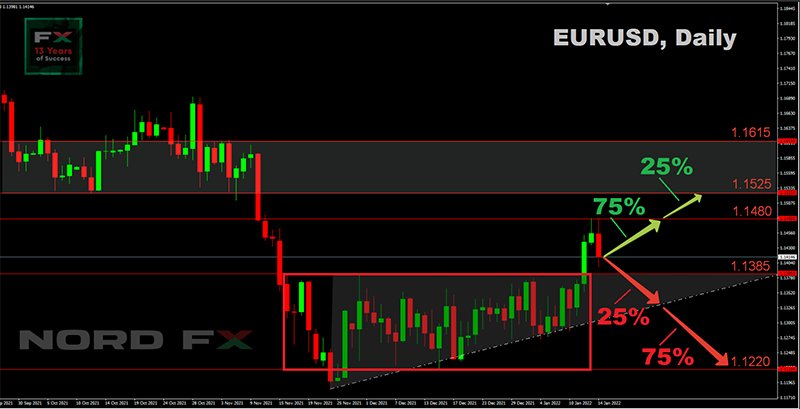
Recall that the EUR/USD pair has been in a sideways trend since November, fluctuating in the range of 1.1220-1.1385. And most analysts voted for the continuation of such a movement a week ago, with a predominance of bearish sentiment. The US Fed's hawkish intentions to end the emergency stimulus program, raise interest rates, and start normalizing the balance sheet were an argument in favor of the dollar's strength.
Note that neither the head of the Fed, Jerome Powell, nor other officials of the American central bank have ever said or even hinted that the rate could be raised four times during 2022. It is unclear where this figure came from, but rumors about such an opportunity began to be actively exaggerated and, as a result, many investors believed in it.
Speaking in the US Congress on Tuesday, January 11, Jerome Powell just repeated what he had already voiced earlier. He said once again that the Fed is going to raise the refinancing rate at least twice this year in order to combat a record inflation in forty years, and that if necessary, it can be raised three times. That is, nothing new was actually said. But the market was waiting for the number "four" and was disappointed because it did not sound.
As a result, the DXY dollar index went into a deep peak, closing below the 50-day moving average, and the EUR/USD pair, instead of moving south, went north.
Thanks to US inflation data, the euro further strengthened its position the next day, on Wednesday, January 12, and the pair EUR/USD, having broken through the border of the medium-term sideways channel, went further up. The breakdown of resistance in the 1.1385 zone served as a trigger for a correction after the strengthening of the dollar that began in May 2021 and the subsequent month-and-a-half sideways trend. The weekly high was reached on the morning of Friday, January 14 at the height of 1.1482.
US retail sales and consumer confidence data released at the end of the week were much worse than previous figures, confirming the negative impact of the Omicron coronavirus strain on the US economy. It is not yet possible to predict exactly how much they will affect the next steps of the Fed. But, judging by the reaction of the market, investors decided that such statistics would push the regulator to take more decisive action. As a result, the EUR/USD pair finished at 1.1415.
Of course, the dollar may retreat a little more in the short term. However, the difference between the hawkish policy of the Fed and the dovish policy of the ECB should still support the USD. Moreover, the head of the Fed once again stressed in recent comments that the fight against inflation is a top priority for the US regulator, and expressed confidence that the US economy will cope with the rate increase.
Also, according to a number of experts, the increase in rates may occur more often than once a quarter, as was the case in the previous cycle of monetary tightening. However, this is just an opinion so far that can give rise to another wave of rumors and expectations. Investors expect to find out what will happen in reality following the results of the January FOMC (Federal Open Market Committee) meeting of the US Federal Reserve on January 26-27.
At the time of writing, 75% of D1 oscillators are green and 25% are giving signals EUR/USD is overbought. Trend indicators have 65% green and 35% red. Among the experts, the majority (75%) does not exclude the growth of the pair in the coming week. However, the weather vane of opinions turns 180 degrees in the forecast for February, and here it is already 75% of analysts who are in favor of the dollar strengthening. Resistances are located at the levels of 1.1450, 1.1480, 1.1525, 1.1570 and 1.1615. Support levels and zones are 1.1385-1.1400, 1.1300, 1.1275, 1.1220. This is followed by the November 24 low of last year at 1.1185 and the 1.1075-1.1100 zone.
As for the economic calendar for the coming week, we can note the release of data on the consumer market of the Eurozone on Monday January 17 and Thursday January 20. The ECB's statement on monetary policy and the issue of statistics on the US labor market are also expected on Thursday. The head of the ECB, Christine Lagarde, is to speak on Friday, January 21.
GBP/USD: Bank of England vs Fed: a Game to Stay Ahead
Naturally, in addition to the meetings of the FRS and the ECB, the meeting of the Bank of England will also take place in January. It should be borne in mind that, unlike its peers, this regulator started attacking rising prices back in December, and this made a strong impression on the market. After inflation in the UK rose to 5.1%, reaching a 10-year peak, the Central bank of the kingdom raised the rate from 0.1% to 0.25% for the first time in three years. The decision was made despite the worsening epidemiological situation due to a new coronavirus strain. And here the opinion of the head of the Bank of England, Andrew Bailey, coincided with that of Jerome Powell: for both, the No. 1 task was to reduce price pressure on the economy and society. But the position of the former looks more hawkish, although the rate increase by 15 basis points is not significant. But the first step has been taken, and the market expects a second rate hike in February.
Such expectations continue to support the British currency, thanks to which the GBP/USD pair was able to update the high of the last eleven weeks, reaching the height of 1.3748. However, it failed to break above the 200-day SMA, and the last chord of the five-day week, after the strengthening of the dollar in the second half of Friday, January 14, sounded at 1.3678.
According to 60% of analysts, the GBP/USD pair may make another attempt to rise above the 1.3800 horizon in the coming days. This scenario is supported by 90% of trend indicators on D1 and 80% of oscillators. The remaining 20% signal that the pair is overbought. However, as in the case of EUR/USD, the scales tilt in favor of the bears, when moving from a weekly to a monthly forecast, and here it is already 55% that are waiting for the pair to move down.
Supports are located at 1.3659, 1.3600, 1.3525, 1.3480, 1.3430, 1.3375, the next strong support is 100 points lower. The resistance levels are 1.3700, 1.3750, 1.3835 and 1.3900.
Important macro data from the UK will suffice next week. There will be data on unemployment and the average wages in the country on Tuesday, January 18. Then, the consumer price index will be known the next day. In addition, the Governor of the Bank of England, Andrew Bailey, will speak on Wednesday, January 19, and retail sales for December 2021 will be published on Friday, January 19. This is an important indicator of consumer spending, which also correlates with consumer confidence and is considered as an indicator of the UK economy development pace. According to forecasts, it is expected to fall from 1.4% to minus 0.6%.
USD/JPY: The Yen Strength Is the Weak Dollar
USD/JPY dropped from 116.35 high (high since January 2017) to 113.47 last week on the back of Jerome Powell's speech and lower US Treasury yields. However, the ultra-dove position of the Japanese regulator is unlikely to further strengthen the yen. The dollar seems to be gaining strength again, and the pair went up again at the end of the weekly session, rising to the level of 114.18.
With USD/JPY moving south for the last week and a half, most of the indicators on D1 turned red. Among the oscillators, these are 80% of them, 10% give signals of the pair being oversold, and 10% have already changed their color to green. Among trend indicators, 60% recommend selling, 40% recommend buying. Among experts, 50% vote for the growth of the pair, 40% for its fall, and 10% have taken a neutral position.
Support levels are 113.50, 113.20, 112.55 and 112.70. The nearest resistance zone is 114.40-114.65, then there are levels 115.00, 115.45, 116.00 and 116.35.
The decision of the Bank of Japan on the key interest rate will be announced on Tuesday, January 18. And it will highly likely remain at the same negative level as before, minus 0.1%. As we wrote earlier, according to this regulator, the country does not need a strong currency, and a weak yen is more likely to help the country's economy, as it supports exports and corporate profits.
CRYPTOCURRENCIES: And Here Too, Thank You Jerome Powell
Satoshi Nakamoto launched the bitcoin mainnet by mining the genesis block with 50 BTC in January 2009. Only some 13 years have passed since then, and The National Development and Reform Commission of China declares crypto mining "obsolete" in January 2022. It follows from the official statement of this top economic planning body that preference will now be given to cleaner and less resource-intensive industries, and mining is on the list of "obsolete" technologies that will be banned from investment and must be eliminated.
William Shakespeare was right; nothing lasts forever under the moon. And after digital currencies were declared "persona non grata" in China, the center of influence on the crypto market shifted completely to the United States. Another proof of this was last week, when a few words from Fed Chairman Jerome Powell were enough to stop the fall of bitcoin and turn the trend of the crypto market upwards.
Speaking at the US Senate Banking Committee, Powell said that stablecoins can be used with the Central Bank official digital currencies CBDC (Central Bank Digital Currency is fiat money in digital form, which are issued and provided by the Central Bank). But this is not what allowed crypto quotes to move north, but the general weakening of the dollar and the return of investors' risk appetites.
As mentioned above, Jerome Powell made it clear that the Federal Reserve has not yet decided to reduce its balance sheet by almost $9 trillion, and that there will be no four rate hikes in 2022, but no more than three. As a result, the DXY dollar index went down, while stock indices and cryptocurrency quotes went up.
BTC/USD dropped to $39,660 on January 10. It has not fallen this low since September 2021. However, then, following the growth of the S&P500, Dow Jones and Nasdaq, it rose to $44,300 on January 12, and the total capitalization of the crypto market exceeded the psychologically important level of $2 trillion once again, reaching $2.091 trillion. But the Crypto Fear & Greed Index did not get out of the Extreme Fear zone, although it rose from 15 to 21 points.
It is clear that it is too early to talk about the beginning of a new rally in the crypto market. The BTC/USD pair is 35% below its all-time high, and the total capitalization is still very far from the almost $3 trillion that it reached on November 10, 2021. And, if the dollar starts to gain strength again, we can expect digital assets to return to a downward trend.
Of course, crypto enthusiasts predict as usual that top coins will soon rise to new heights. Changpeng Zhao, CEO of the Binance crypto exchange, claims in an article for Fortune that global adoption of cryptocurrencies will jump from the current 5% to 20% in 2022. And Galaxy Digital founder Mike Novogratz sees the 35% drop as just a "healthy pullback." In his opinion, the main cryptocurrency will find support around $38,000-40,000, after which it will return to growth. Nigel Green, CEO of consulting company DeVere Group, also states that now is the most convenient time to buy bitcoin in the current cycle.
However, some experts consider such sentiments to be too optimistic. Thus, the ENCRY Foundation predicts that bitcoin may return to growth only after its price drops to $28,000-30,000. "The flows of liquidity to the markets will decrease in the second half of 2022, after the completion of the asset repurchase program in the United States. Then bitcoin may fall to $30,000," the company's specialists explain.
The current levels cannot yet be described as a market bottom. This is indicated by another expert, Viktor Pershikov, a leading analyst at 8848 Invest. According to him, conditions that have not yet been observed must be fulfilled for the formation of the bottom. This is a long flat (at least two months in the current circumstances) with the accumulation of long positions and an increase in open interest, a decrease in BTC sales by market participants as well as clarification of the speed and degree of tightening of monetary policy by world central banks.
"The current state of the crypto market is characterized by emotional selling to a large extent, including at a loss, which is typical for situations when retail participants are shaken out of the market. The current decline does not pose a threat for large BTC holders and is a normal market correction before further growth," Pershikov says. In his opinion, bitcoin will spend most of the year in the price range of $30,000-70,000.
It is clear that a serious growth of BTC is possible only with the same growth of interest in it from institutional investors. But they seem to be a problem for now. According to Bloomberg, only 5% of customers surveyed by JPMorgan believe that the bitcoin price will reach $100,000 by the end of 2022. More than 40% believe that it will only return to the $60,000 level. According to bank strategist Nikolaos Panigirtzoglou, the fair value of the cryptocurrency ranges from $35,000 to $73,000.
As for bitcoin's main competitor, ethereum, crypto analyst Justin Bennett believes that "as long as ETH is below $4,000, you need to be careful" against the backdrop of a downtrend in the entire market. If only ETH returns to this area in the coming weeks and months and can gain a foothold there, then we can talk about the continuation of the strong bullish trend observed in 2021."
The analyst also looks at ETH against BTC and believes that the ETH/BTC pair could start a long-term rally to 0.18 BTC ($7.388) for 1 ETH, but this would require holding the 0.075 BTC ($3.077) level as support.
All of the above shows that the situation is currently ambiguous. And then how do you make money on virtual currencies? The answer to this question is given in our humorous crypto life hacks column by San Francisco (USA) resident Siraj Raval, who uses his 2018 Tesla Model 3 car for ethereum mining. To do this, he launched the corresponding free software on the Apple Mac mini M1, connecting it to the car's center console. Five graphics cards are powered by the Tesla battery. According to Raval, he mined for about 20 hours a day this way and earned from $400 to $800 a month during 2021.
The numbers do look attractive. It only remains to find about $50,000 to buy such a car and find out if the Chinese authorities will not consider this method of mining harmful and obsolete.
EUR/USD Weekly Outlook
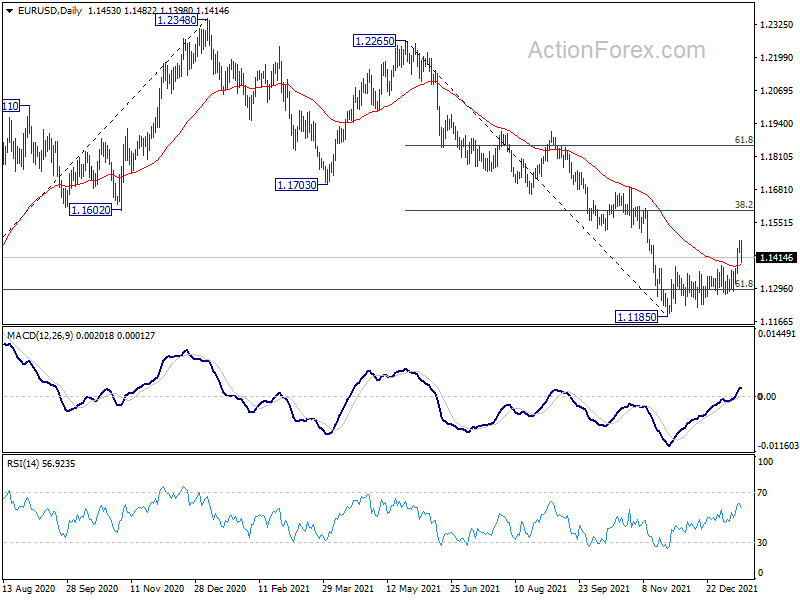
EUR/USD finally resumed the rebound from 1.1185 last week and hit as high as 1.1482. But as temporary top was formed with subsequent retreat, initial bias is neutral this week first. rebound from 1.1185 is seen as a corrective move, hence, in case of another rally, upside should be limited by 38.2% retracement of 1.2265 to 1.1185 at 1.1598. On the downside, below 1.1284 support will bring retest of 1.1185 low. However, sustained break of 1.1598 will argue that the trend is reversing already.
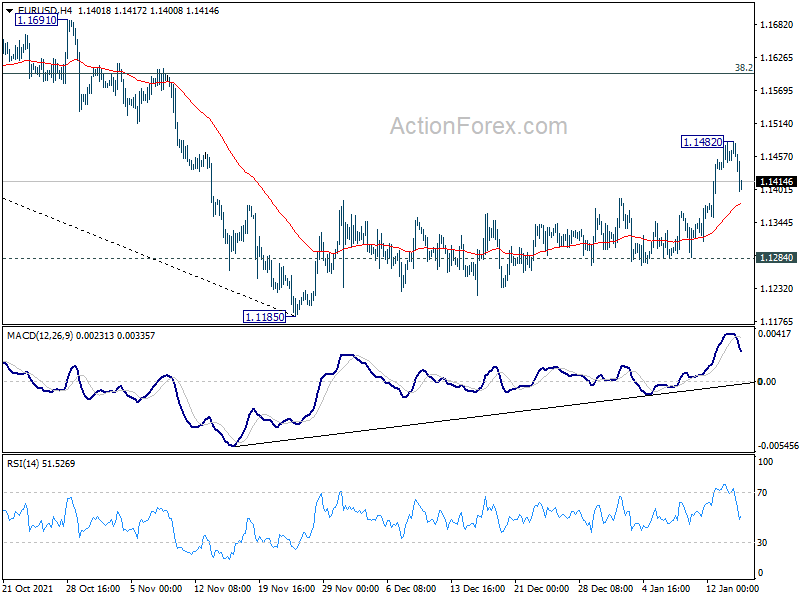
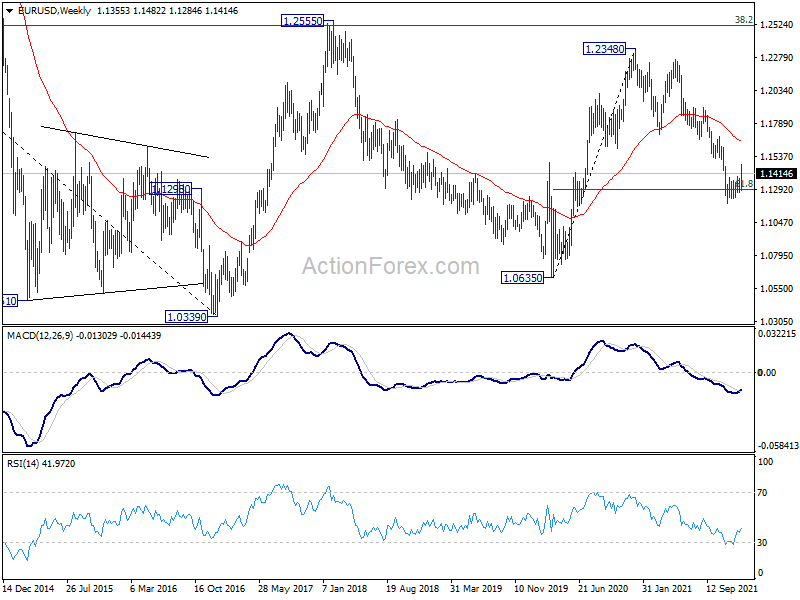
In the bigger picture, there are various ways of interpreting the fall from 1.2348 (2021 high). It could be a correction to rise from 1.0635 (2020 low), the fourth leg of a sideway pattern from 1.0339 (2017 low), or resuming long term down trend. In any case, outlook will now stay bearish as long as 1.1703 support turned resistance holds. Sustained break of 61.8% retracement of 1.0635 to 1.2348 at 1.1289 would pave the way back to 1.0635.
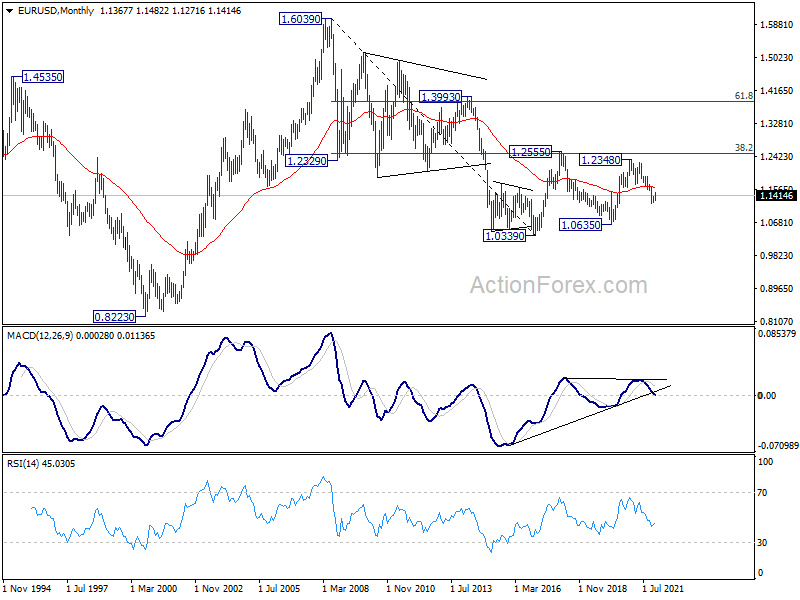
In the long term picture, EUR/USD has possibly failed 1.2555 cluster resistance (38.2% retracement of 1.6039 to 1.0339 at 1.2516) again. Long term outlook will remain neutral as sideway pattern from 1.0339 (2017 low) is extending with another medium term fall. For now, we'd hold back from assessing the chance of downside breakout, and monitor the momentum of the decline from 1.2348 first.
USD/JPY Weekly Outlook
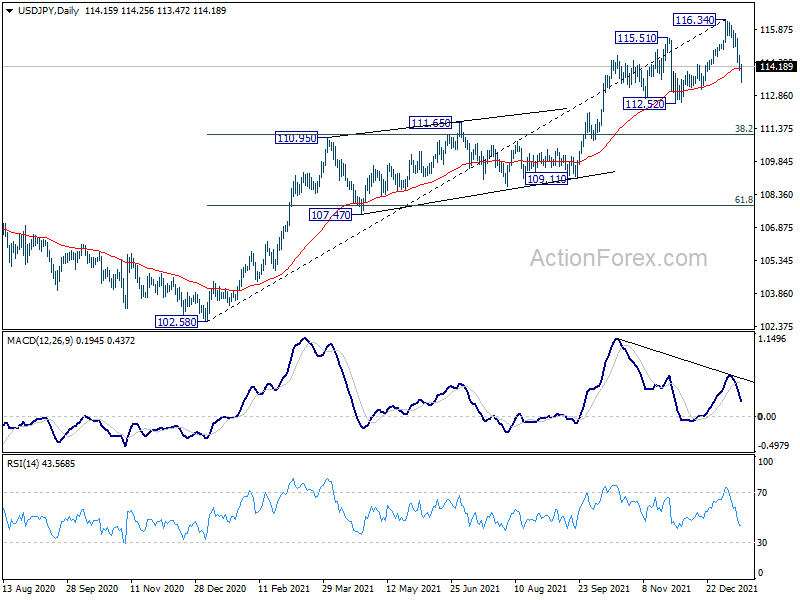
USD/JPY's steeper and deeper than expected decline last week suggests that rise from 112.52 has completed at 116.34 already. But as a temporary low was formed at 113.47, initial bias is turned neutral this week for some consolidations. Risk will stay on the downside as long as 116.34 resistance holds. Below 113.47 will target 112.52 structural support. Considering bearish divergence condition in in daily MACD, break of 112.52 will confirm that it's already in correction to the up trend from 102.58. Deeper decline would be seen to 38.2% retracement of 102.58 to 116.34 at 111.08.
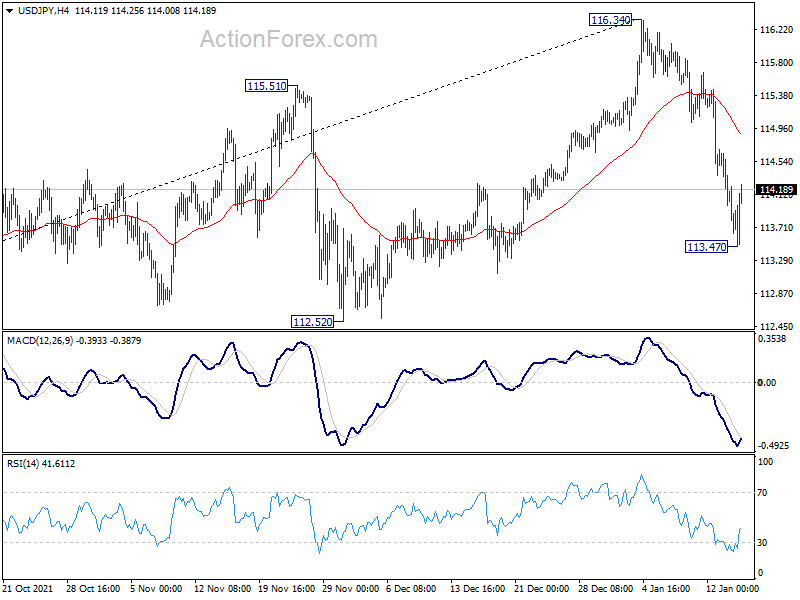
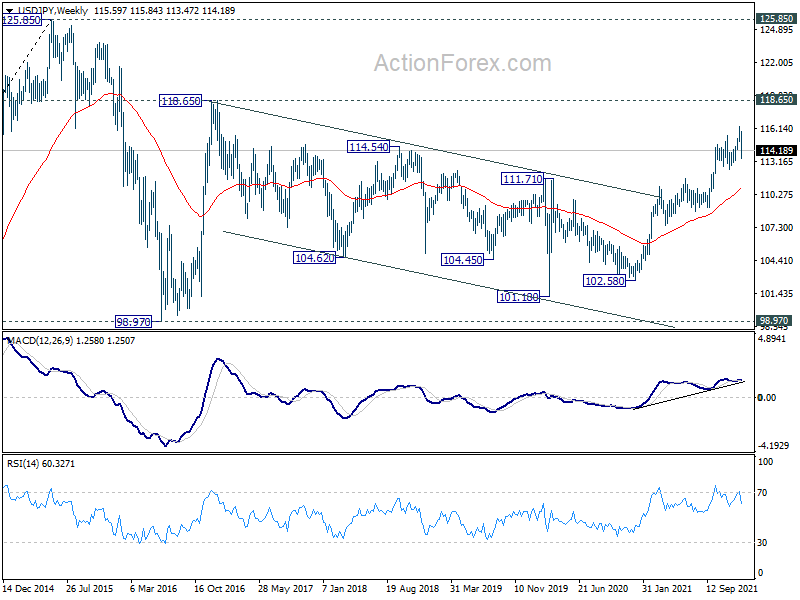
In the bigger picture, no change in the view that rise from 102.58 is the third leg of the up trend from 101.18 (2020 low). Such rally should target a test on 118.65 (2016 high). Sustained break there will pave the way to 120.85 (2015 high) and raise the chance of long term up trend resumption. However, firm break of 112.52 support will dampen this bullish case and we'll assess the outlook based on subsequent price actions later.
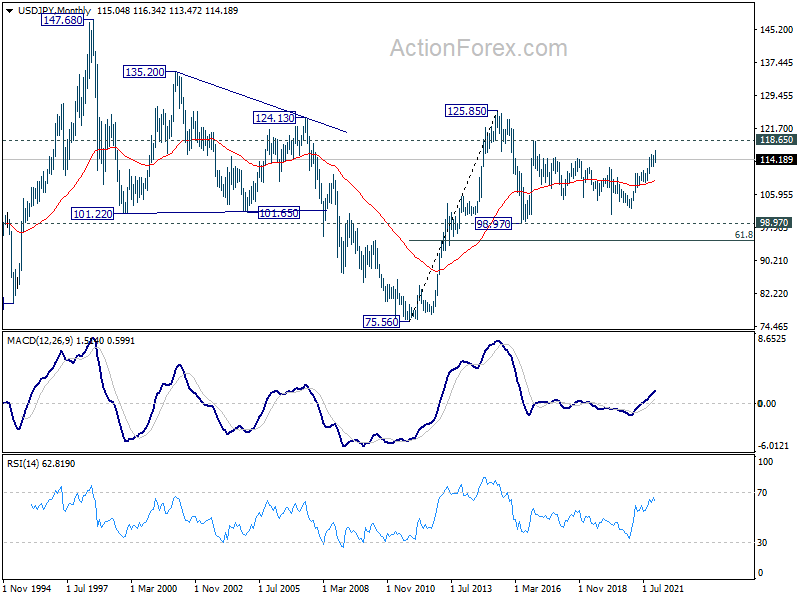
In the long term picture, the rise from 75.56 (2011 low) long term bottom to 125.85 (2015 high) is viewed as an impulsive move, no change in this view. Price actions from 125.85 are seen as a corrective pattern which could still extend. In case of deeper fall, downside should be contained by 61.8% retracement of 75.56 to 125.85 at 94.77. Up trend from 75.56 is expected to resume at a later stage for above 135.20/147.68 resistance zone.
GBP/USD Weekly Outlook
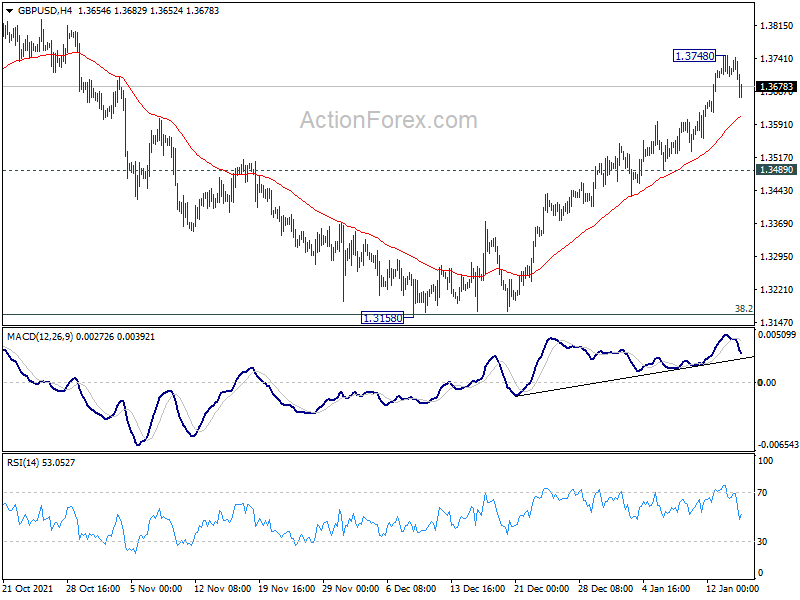
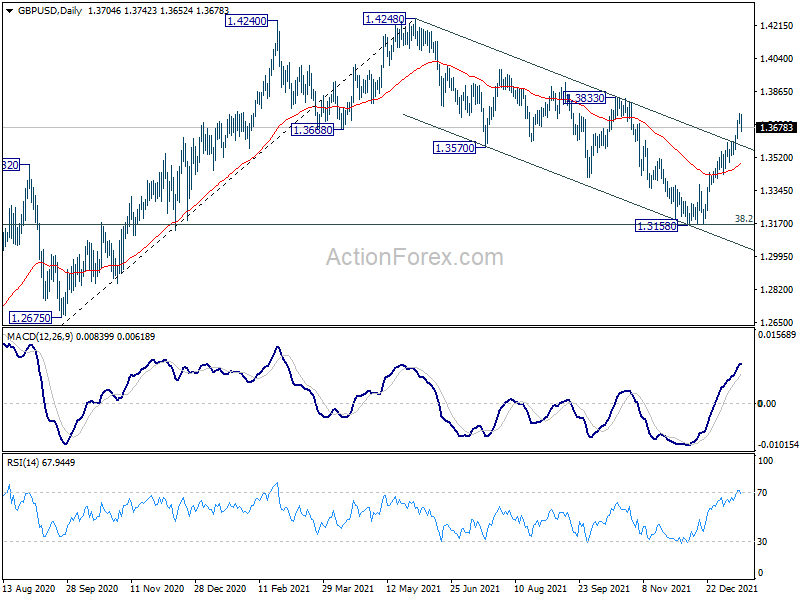
GBP/USD's rise from 1.3158 extended to as high as 1.3748 last week. As a temporary top was formed there, initial bias is neutral this week first. Downside of retreat should be contained by 1.3489 support to bring another rally. As noted before, corrective fall from 1.4282 should have completed with three waves down to 1.3158, after hitting 1.3164 medium term fibonacci level. Above 1.3748 will target 1.3833 first. Sustained break of 1.3833 will pave the way back to retest 1.4248 high.
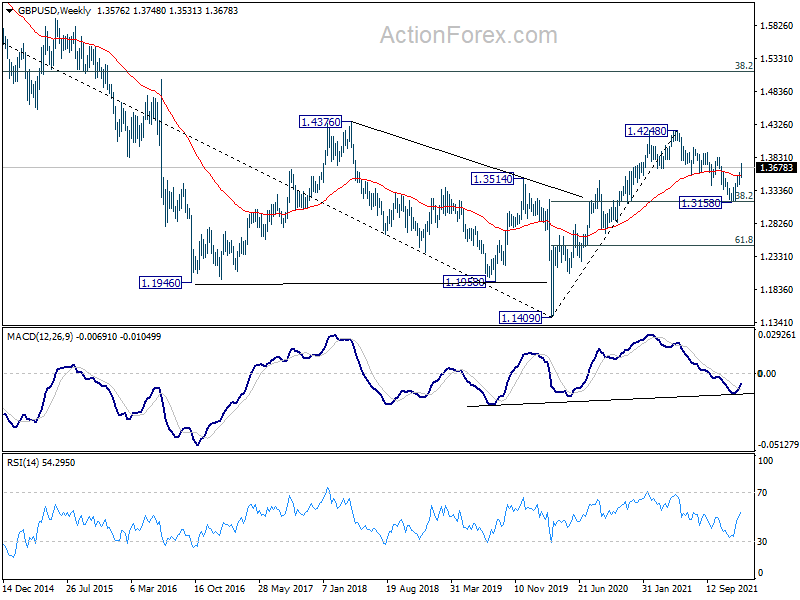
In the bigger picture, strong support was seen from 38.2% retracement of 1.1409 to 1.4248 at 1.3164. The development suggests that up trend from 1.1409 (2020 low) is still in progress. On resumption, next target will be 38.2% retracement of 2.1161 to 1.1409 at 1.5134. Nevertheless sustained break of 1.3164 will argue that whole rise from 1.1409 has completed and bring deeper fall to 61.8% retracement at 1.2493.
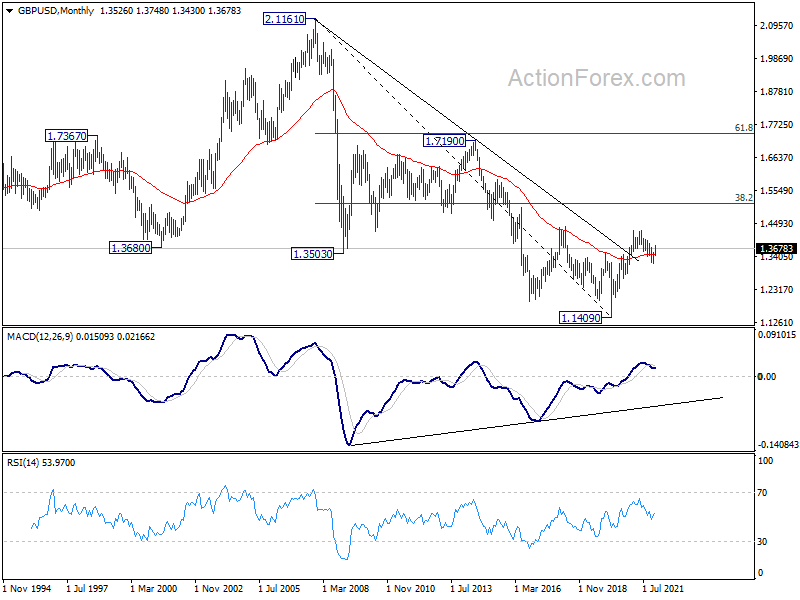
In the longer term picture, a long term bottom should be in place at 1.1409, on bullish convergence condition in monthly MACD. Rise from there would target 38.2% retracement of 2.1161 to 1.1409 at 1.5134. Reaction from there would reveal whether rise from 1.1409 is just a correction, or developing into a long term up trend.
USD/CHF Weekly Outlook
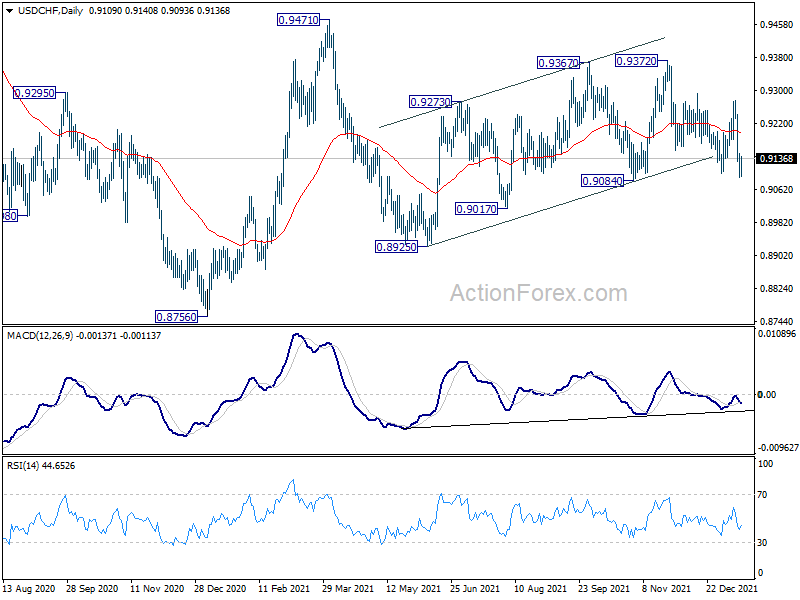
USD/CHF dropped sharply to as low as 0.9090, after rising to 0.9276 last week. As a temporary low was formed, initial bias is neutral this week first. On the downside, firm break of 0.9084 support will argue that choppy rise from 0.8925 has completed. Fall from 0.9471 might be ready to resuming. Further decline would be seen back to 0.8925 support first. On the upside, above 0.9276 will target 0.9372 resistance instead.
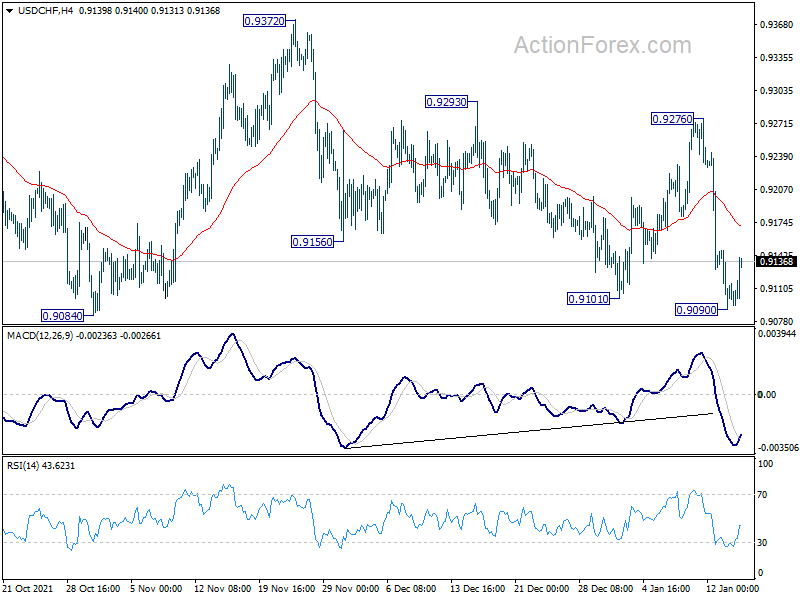
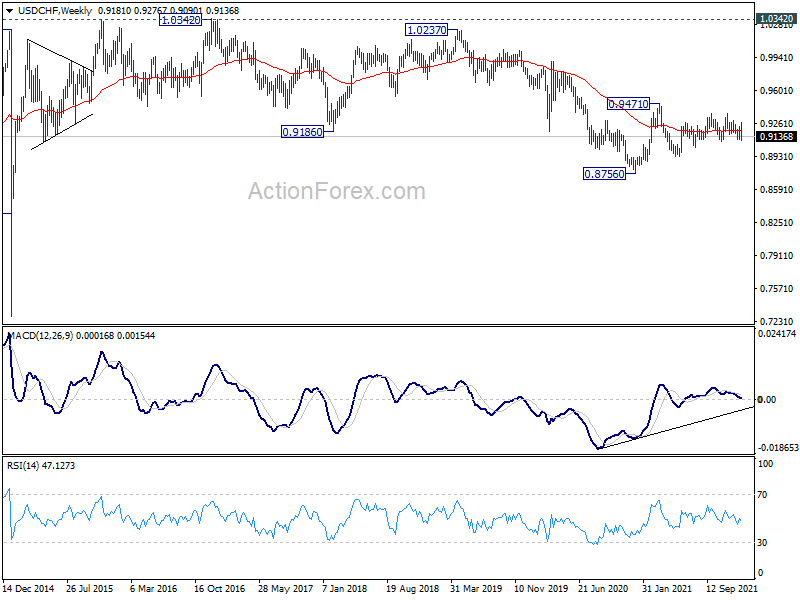
In the bigger picture, the corrective structure of the rebound from 0.8925 argues that fall from 0.9471 is not complete yet. It could either be the second leg of pattern from 0.8756 (2021 low), or resuming larger down trend from 1.0237 (2018 high). We'd pay attention to the downside momentum and assess the odds later. But for now, medium term outlook will be neutral at best as long as 0.9471 resistance holds.
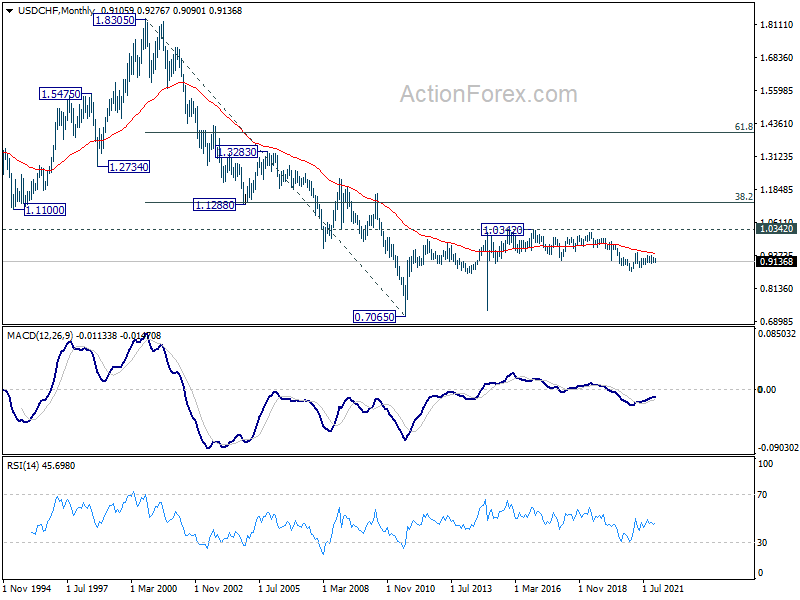
In the long term picture, price actions from 0.7065 (2011 low) are currently seen as developing into a long term corrective pattern, at least until a firm break of 1.0342 resistance.
AUD/USD Weekly Outlook
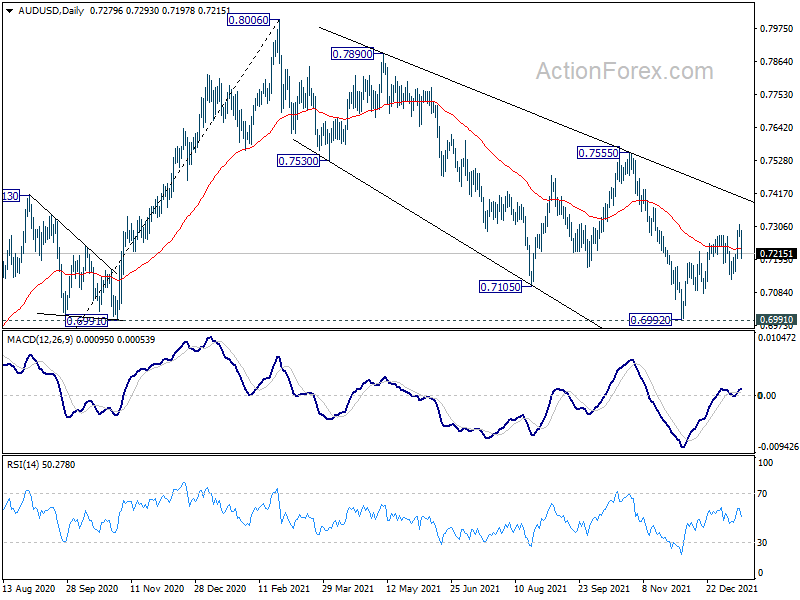
AUD/USD's rebound from 0.6992 resumed last week and hit 0.7313, but retreated sharply since then. Initial bias is turned neutral first. We're still slightly favoring the case that correction from 0.8006 is complete after defending 0.6991. Above 0.7313 will extend the rise from 0.6992 to 0.7555 resistance. However, break of 0.7128 support will dampen this bullish case and bring retest of 0.6991/2 instead.
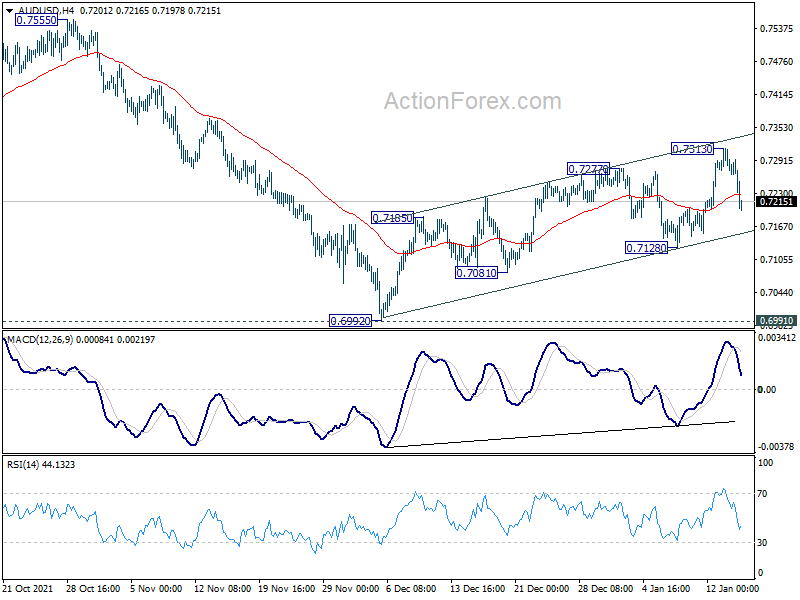
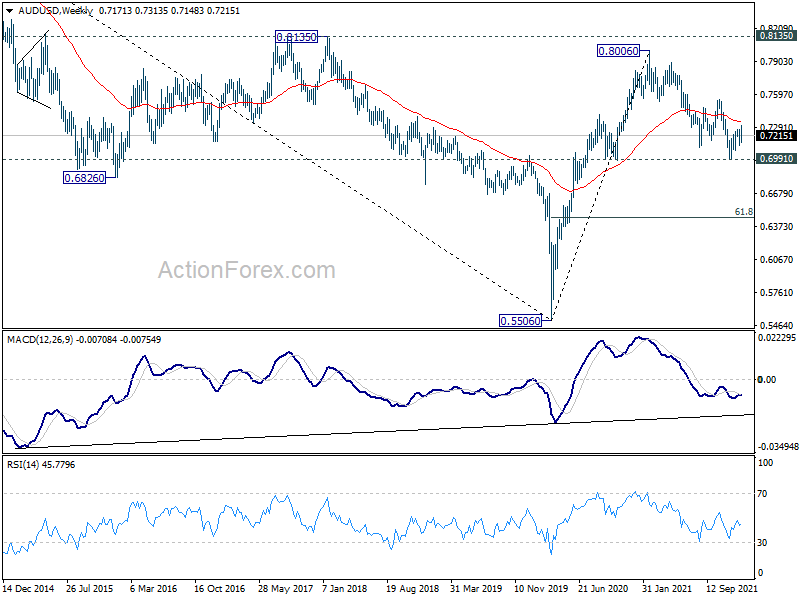
In the bigger picture, strong rebound from 0.6991 key structural support will retain medium term bullishness. That is, whole up trend from 0.5506 is still in progress. Firm break of 0.7555 resistance will target 0.8006 high and above. However, sustained break of 0.6991 will argue that the whole up trend from 0.5506 might be finished at 0.8006, after rejection by 0.8135 long term resistance. Deeper decline would then be seen back to 61.8% retracement of 0.5506 to 0.8006 at 0.6461.
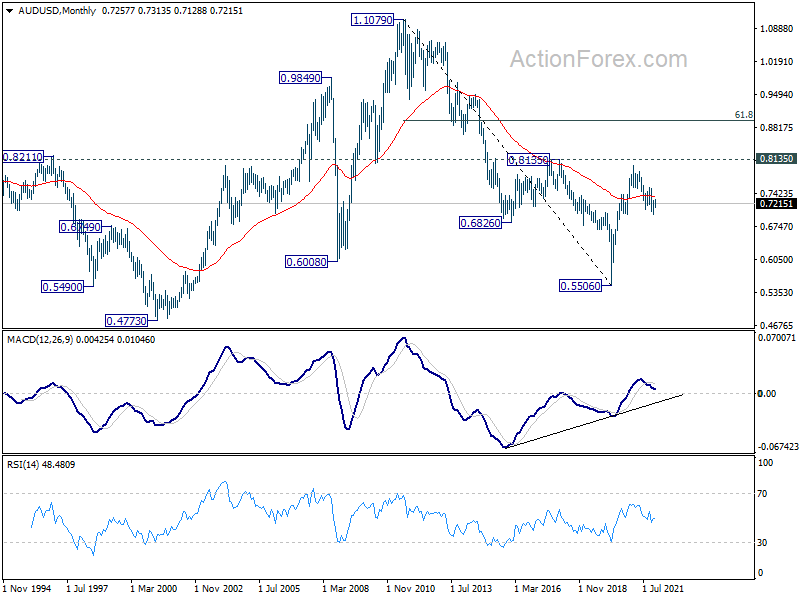
In the longer term picture, focus remains on 0.8135 structural resistance. Decisive break there will argue that rise from 0.5506 is developing into a long term up trend that reverses whole down trend from 1.1079 (2011 high). However, rejection by 0.8135 will keep long term outlook neutral at best.
USD/CAD Weekly Outlook
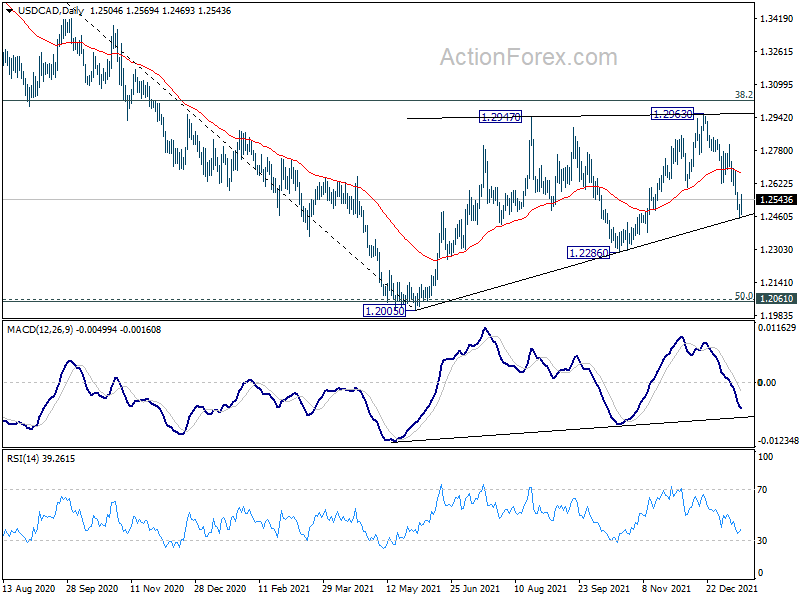
USD/CAD dropped to 1.2452 last week before forming a temporary low there and recovered. Initial bias is neutral this week for some consolidations first. But risk will stay on the downside as long as 1.2812 resistance holds. Current development argues that whole pattern from 1.2005 has completed with three waves to 1.2963. Below 1.2452 will target 1.2286 support, and possibly further to retest 1.2005 low.
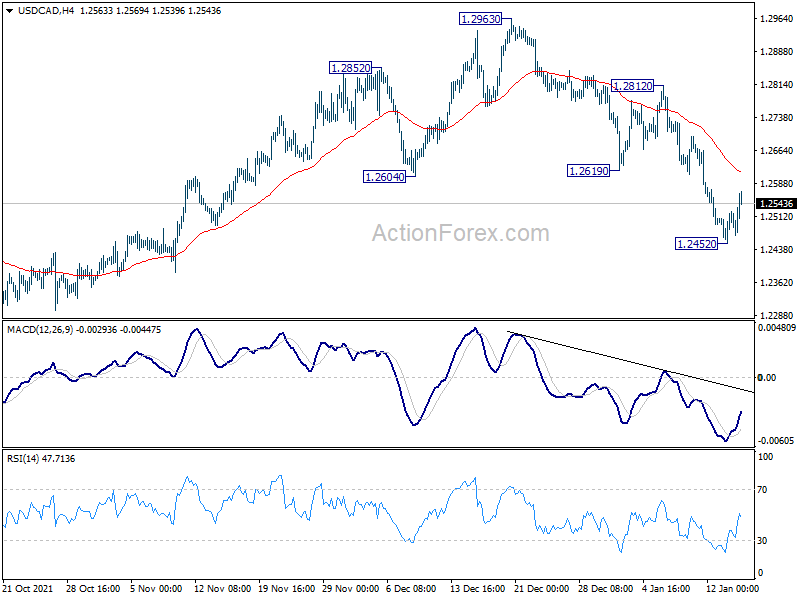
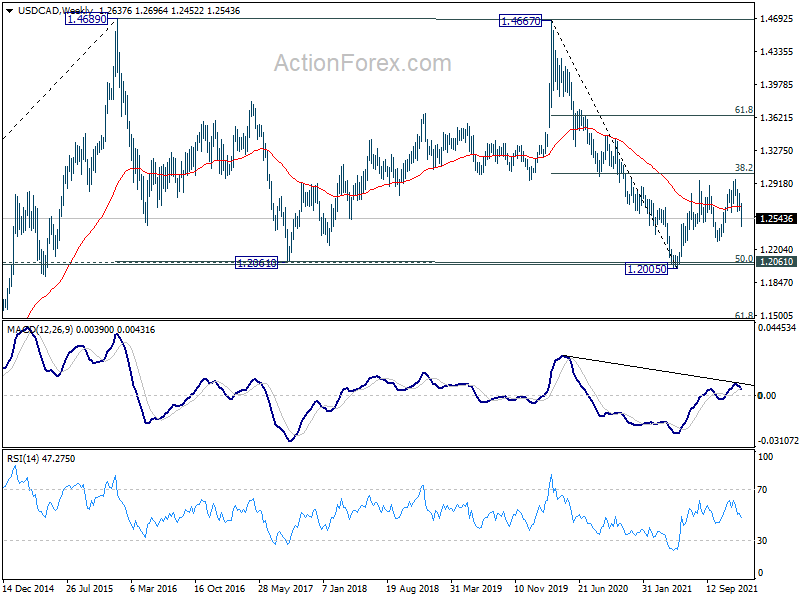
In the bigger picture, focus will be on 38.2% retracement of 1.4667 (2020 high) to 1.2005 (2021 low) at 1.3022. Sustained break there should confirm that the down trend from 1.4667 has completed after defending 1.2061 long term cluster support. Further rise would then be seen towards 61.8% retracement at 1.3650. However, rejection by 1.3022 will maintain medium term bearishness. Break of 1.2005 will resume the down trend form 1.4667 and that carries larger bearish implications too.
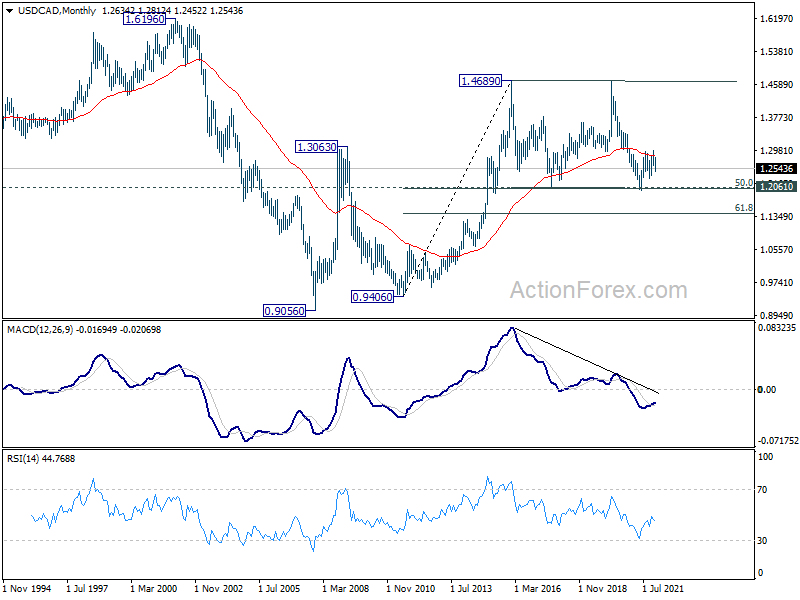
In the longer term picture, we're viewing price actions from 1.4689 as a consolidation pattern. Thus, up trend from 0.9506 (2007 low) is still expected to resume at a later stage. This will remain the favored case as long as 1.2061 support holds, which is close to 50% retracement of 0.9406 to 1.4689 at 1.2048. However, firm break of 1.2061 support will argue that USD/CAD has already started a long term down trend. Next target is 61.8% retracement of 0.9406 to 1.4689 at 1.1424.
GBP/JPY Weekly Outlook
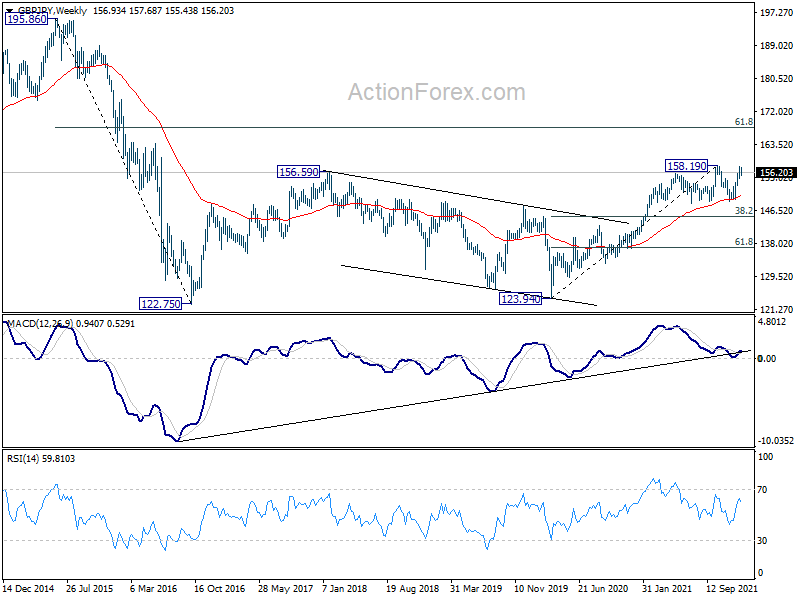
GBP/JPY stayed in consolidation from 157.74 last week. Initial bias remains neutral this week first. Further rally is expected with 154.86 support intact. On the upside, decisive break of 158.19 high will resume larger up trend to 167.93 long term fibonacci level. On the downside, below 154.86 minor support will turn intraday bias back to the downside for deeper pull back.
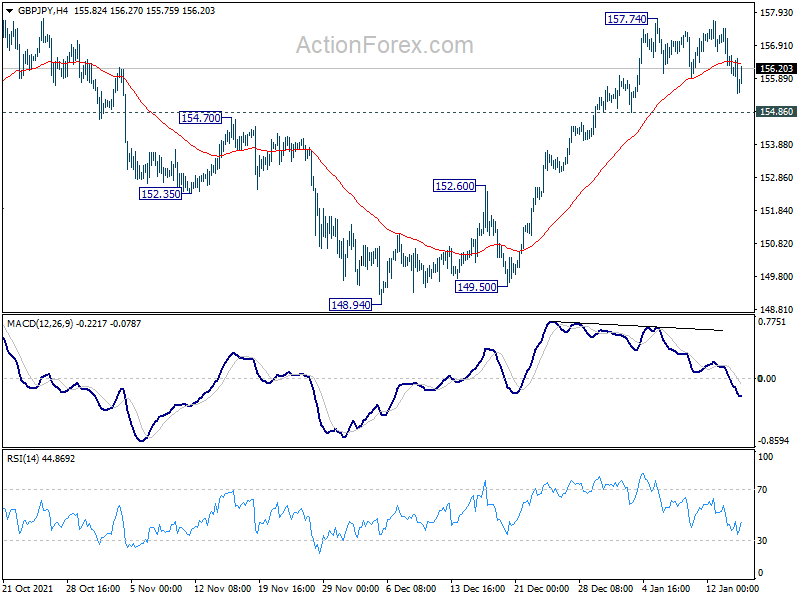
In the bigger picture, strong rebound from 148.93 key structural support retains medium term bullishness. Firm break of 158.19 high will resume whole up trend from 123.94 (2020 low), to 61.8% retracement of 195.86 to 122.75 at 167.93. Nevertheless, firm break of 148.93 will bring deeper correction to 38.2% retracement of 123.94 to 158.19 at 145.10, and possibly further lower, as a correction to up trend from 123.94 at least.
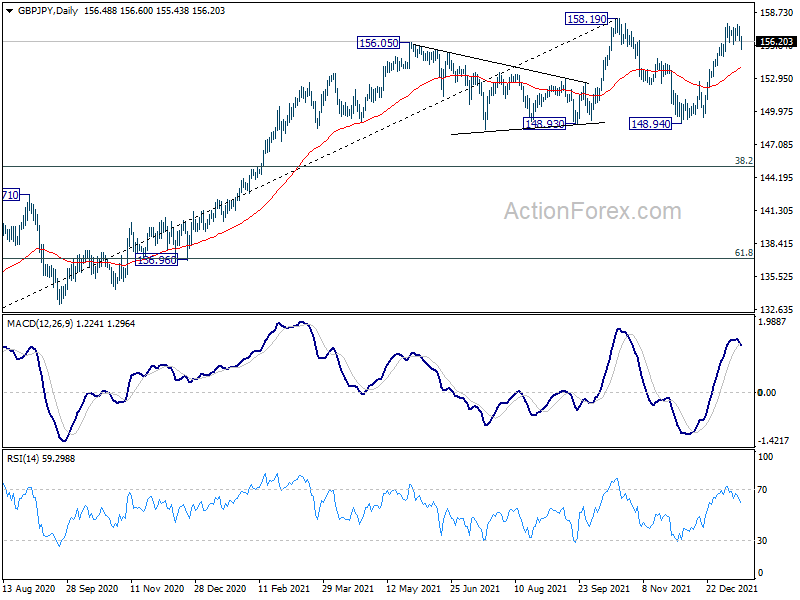
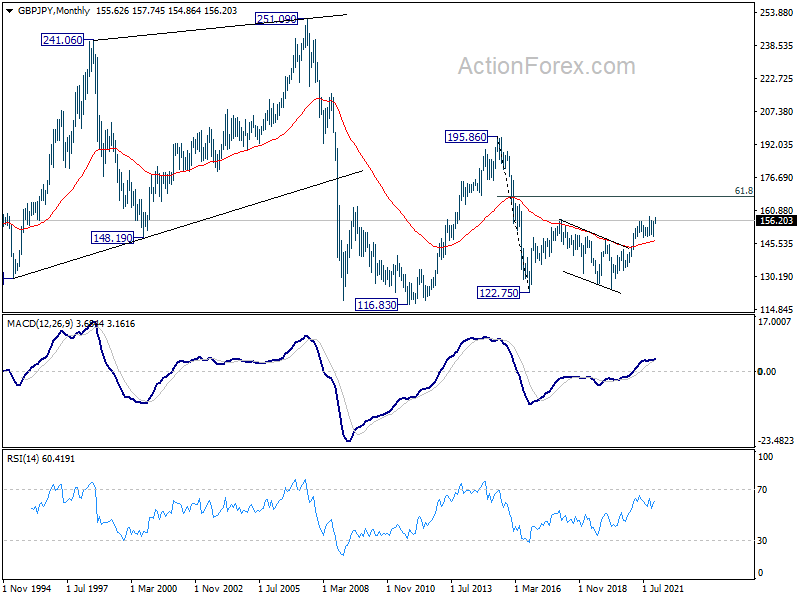
In the longer term picture, as long as 55 month EMA (now at 147.06) holds, we'd still favor more rally to 61.8% retracement of 195.86 to 122.75 at 167.93. But sustained trading below 55 month EMA will at least neutralize medium term bullishness and re-open the chance of revisiting 122.75 low (2016 low).