

Sample Category Title
EUR/JPY Weekly Outlook
EUR/JPY dipped to 129.76 last week but quickly recovered, initial bias is neutral this week first. On the downside break of 129.59 minor support will argue that rebound from 127.36 has completed and turn bias back to the downside for this support. On the upside, break of 131.59 resistance will reaffirm the bullish case that consolidation from 134.11 could have completed with three waves down to 127.36, ahead of 126.58 medium term fibonacci level. Further rally would then be seen to retest 133.44/134.11 resistance zone.
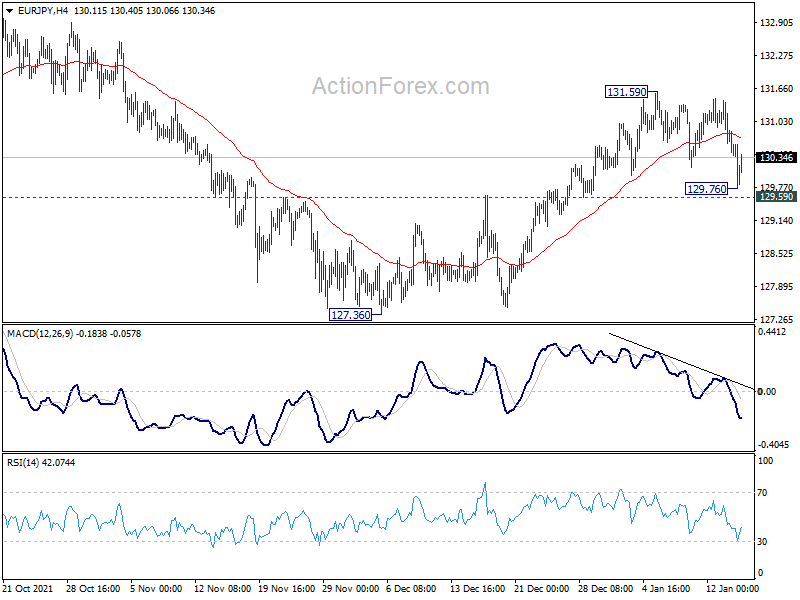
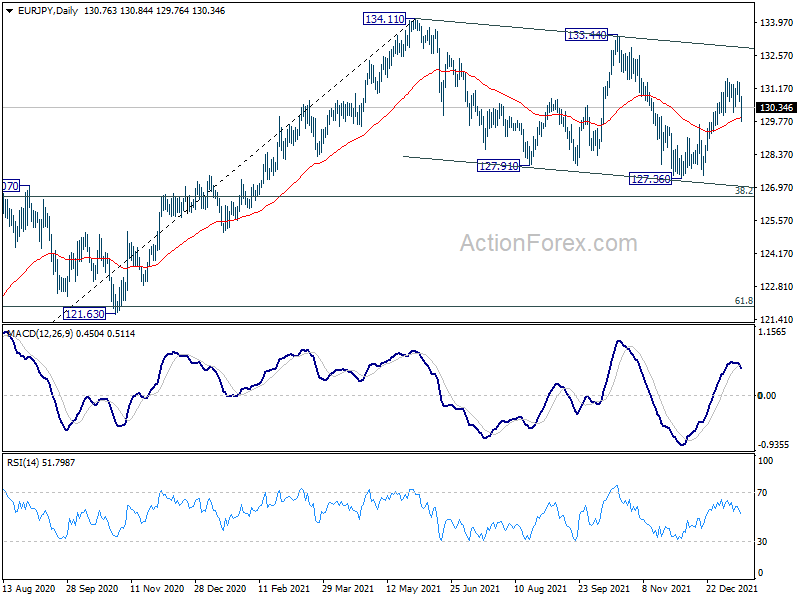
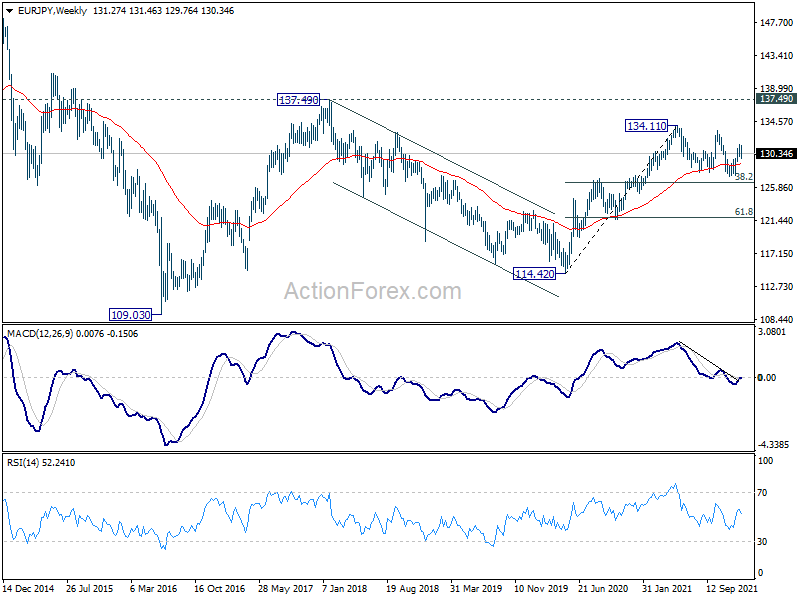
In the bigger picture, as long as 38.2% retracement of 114.42 (2020 low) to 134.11 at 126.58 holds, up trend from 114.42 is still in favor to continue. Break of 134.11 will target long term resistance at 137.49 (2018 high). However, sustained break of 126.58 will raise the chance of medium term bearish reversal. In this case, deeper decline would be seen to 61.8% retracement at 121.94, and possibly below.
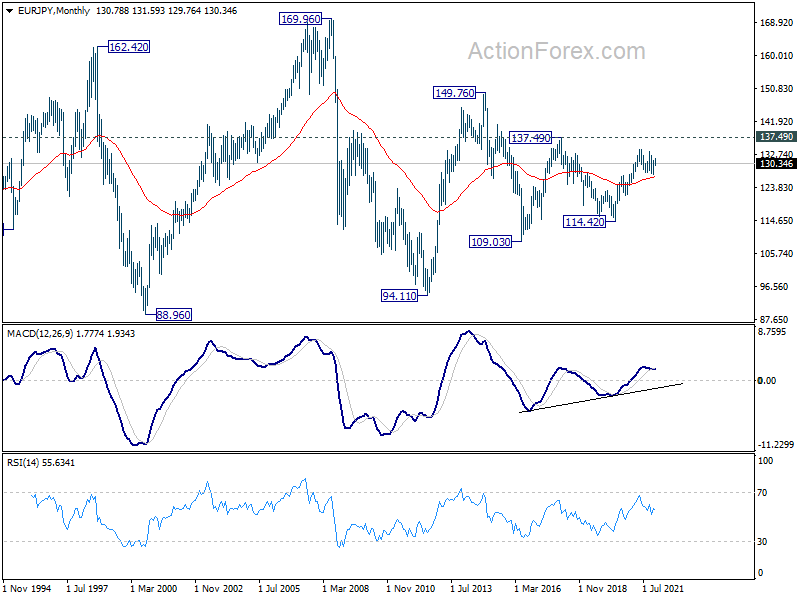
In the long term picture, EUR/JPY is staying in long term sideway pattern, established since 2000. Long term outlook will remain neutral until breakout from the range of 109.03/137.49.
EUR/GBP Weekly Outlook
EUR/GBP edged lower to 0.8322 last week but turned sideway. Initial bias remains neutral this week first. Upside of recovery should be limited by 0.8417 resistance to bring another decline. On the downside, break of 0.8322 will resume recent down trend to 0.8276 key long term support. On the upside, above 0.8417 will turn bias back to the upside for stronger rebound.
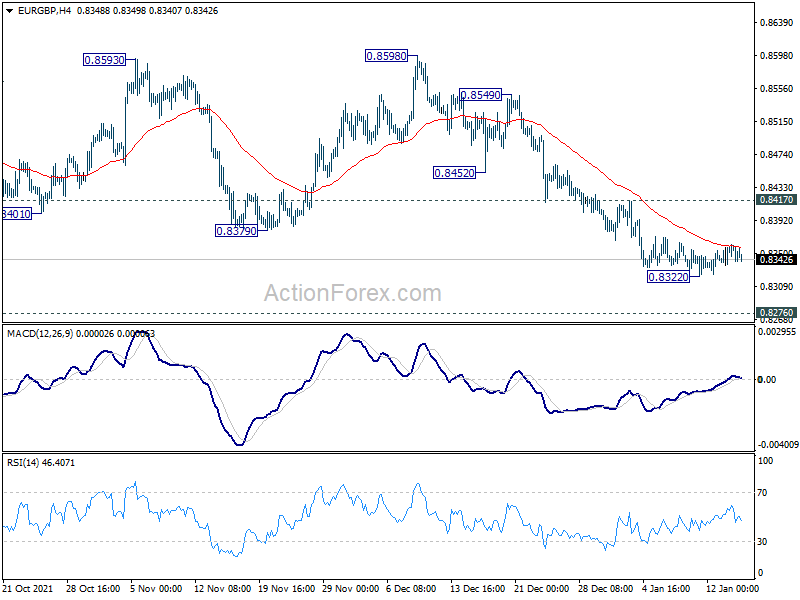
In the bigger picture, price actions from 0.9499 (2020 high) are still seen as developing into a corrective pattern. Deeper fall could be seen as long as 0.8598 resistance holds, towards long term support at 0.8276. We'd look for bottoming signal around there to bring reversal. Meanwhile, firm break of 0.8598 will now be an early sign of medium term bottoming and bring stronger rebound. However, sustained break of 0.8276 will argue that the long term trend has reversed.
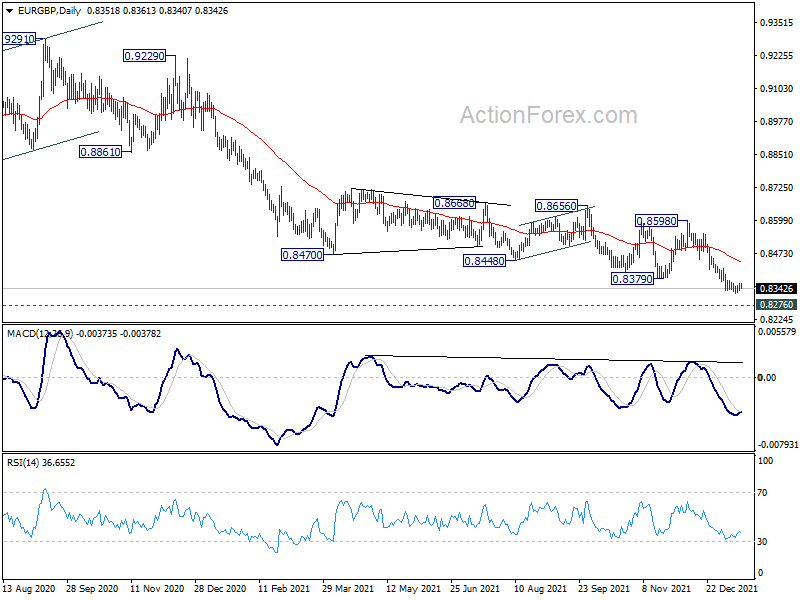
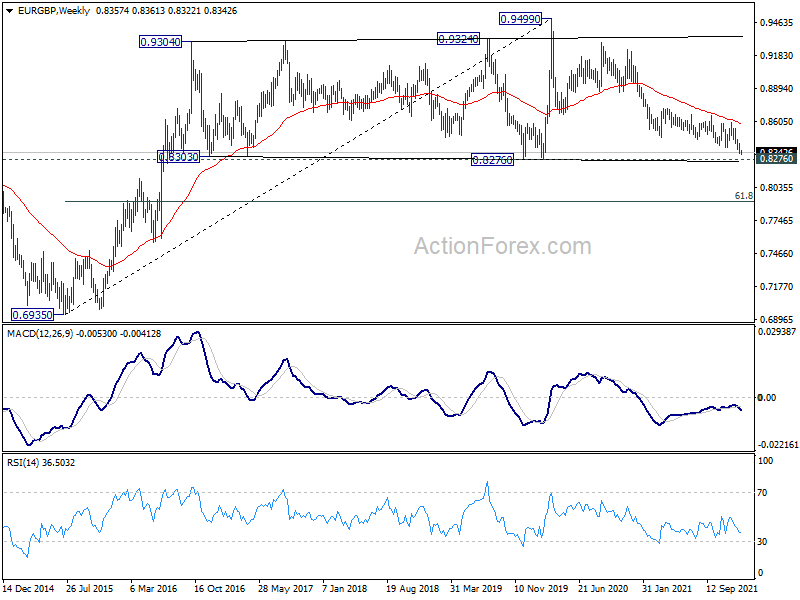
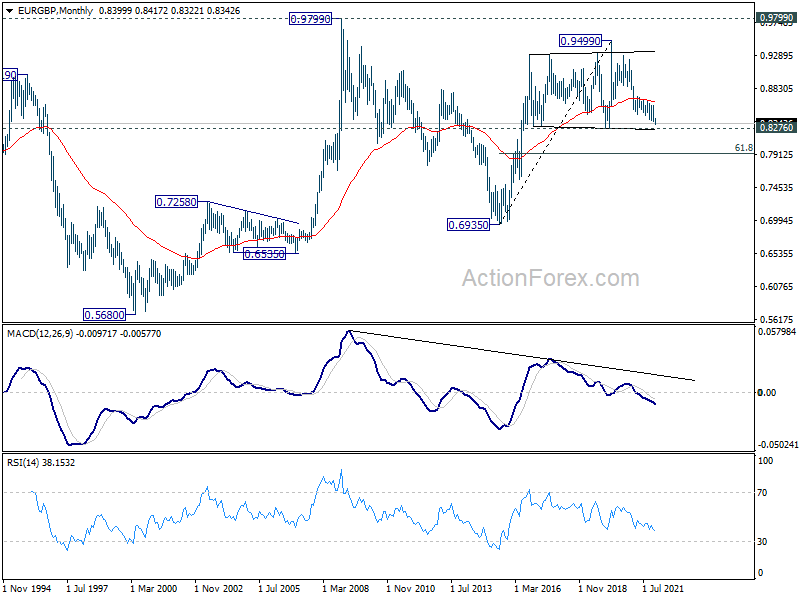
In the long term picture, outlook will stay bullish as long as 0.8276 support holds. Break of 0.9499 is in favor at a later stage, to resume the up trend from 0.6935 (2015 low). However, sustained break of 0.8276 will indicate long term trend reversal, and target 61.8% retracement of 0.6935 to 0.9499 at 0.7917, and possibly below.
EUR/AUD Weekly Outlook
EUR/AUD stayed in range of 1.5550/5898 last week and outlook is unchanged. Initial bias remains neutral this week first. On the downside, break of 1.5559 will resume the fall from 1.6168 to retest 1.5250/5354 support zone. On the upside, however, break of 1.5898 will argue that pull back form 1.6168 has completed. Intraday bias will be back to the upside for 1.6168 resistance.
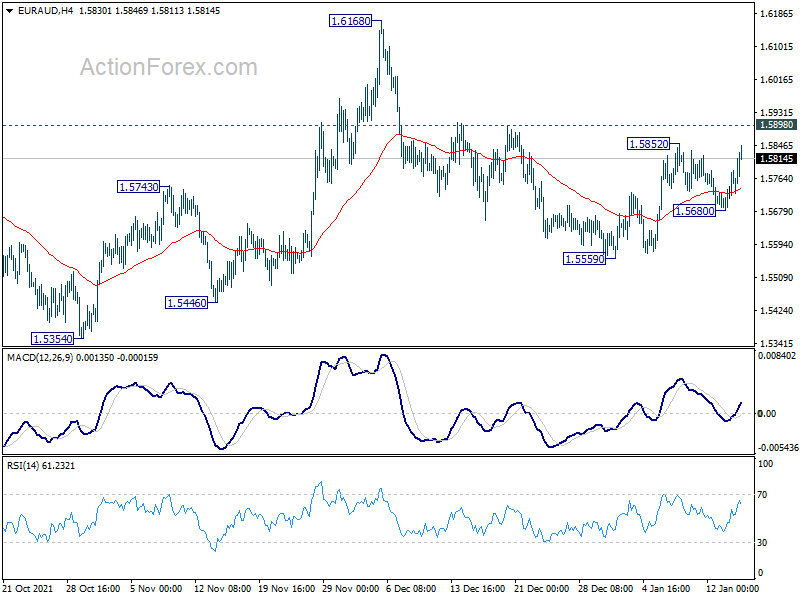
In the bigger picture, rise from 1.5354 is seen as the third leg of the corrective pattern from 1.5250 low. Further rise cannot be ruled out, but even in that case, strong resistance should be seen at 38.2% retracement of 1.9799 to 1.5250 at 1.6988. Larger down trend from 1.9799 is in favor to extend through 1.5250 at a later stage.
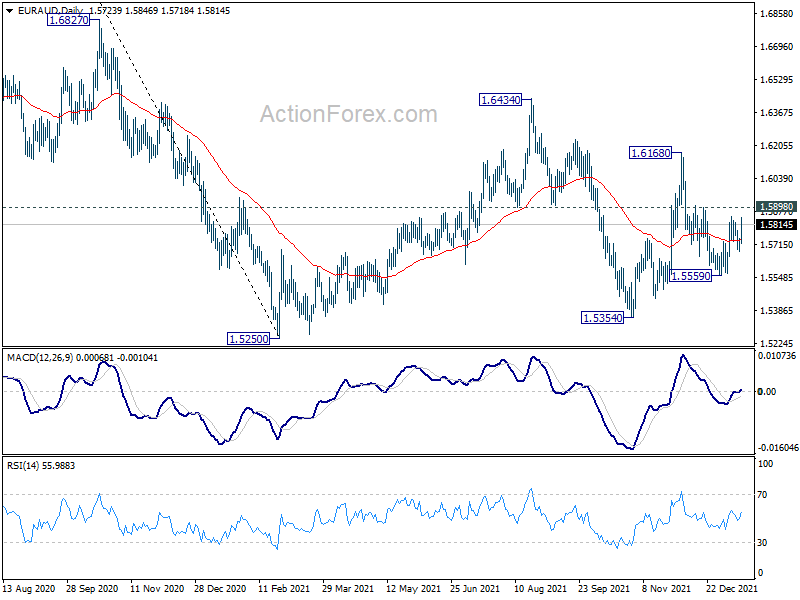
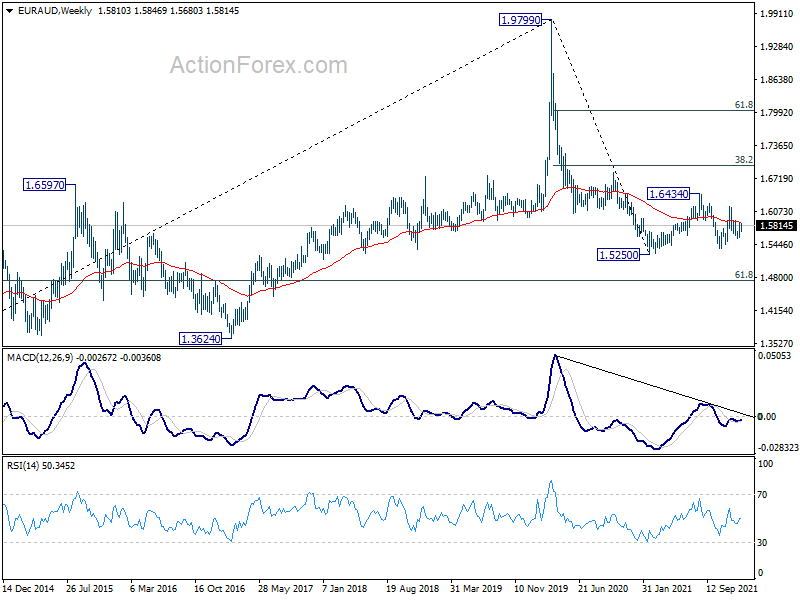
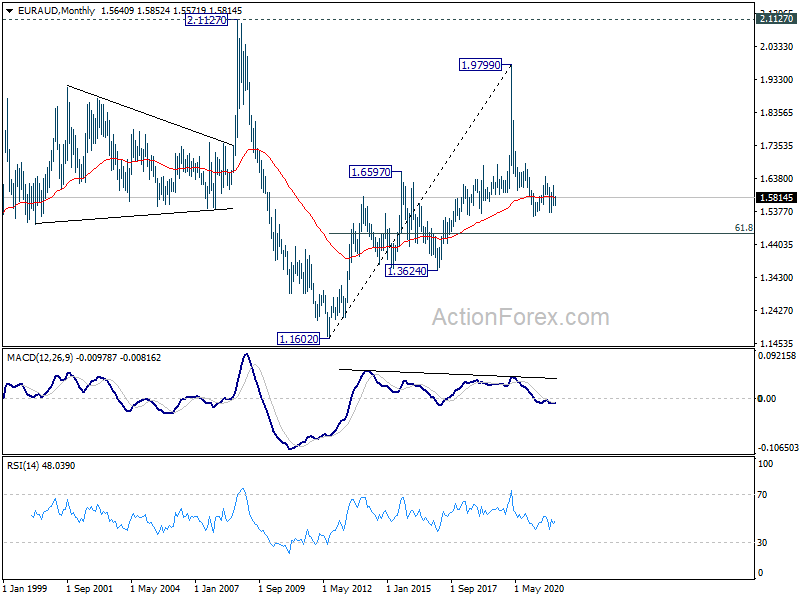
In the longer term picture, fall from 1.9799 (2020 high) is seen as a long term down trend. Further decline will remain in favor as long as 38.2% retracement of 1.9799 to 1.5250 at 1.6988 holds. Break of 1.5250 will target 61.8 retracement of 1.1602 (2012 low) to 1.9799 at 1.4733
EUR/CHF Weekly Outlook
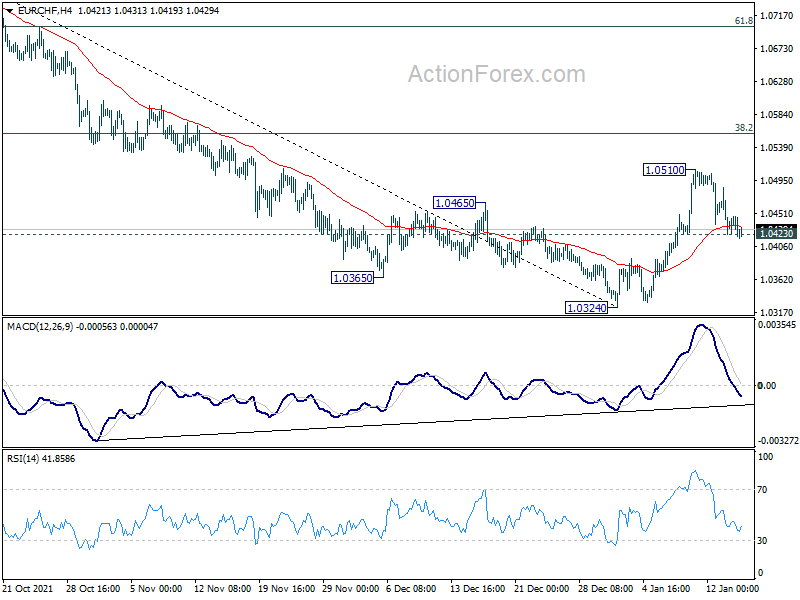
EUR/CHF's rebounded from 1.0324 short term bottom extended to 1.0510 last week but retreated since then. Initial bias remains neutral this week first. Another rise cannot be ruled out yet. But upside should be limited by 38.2% retracement of 1.0936 to 1.0324 at 1.0558. On the downside, firm break of 1.0423 will bring retest of 1.0324 low. Break there will resume larger down trend from 1.1149.
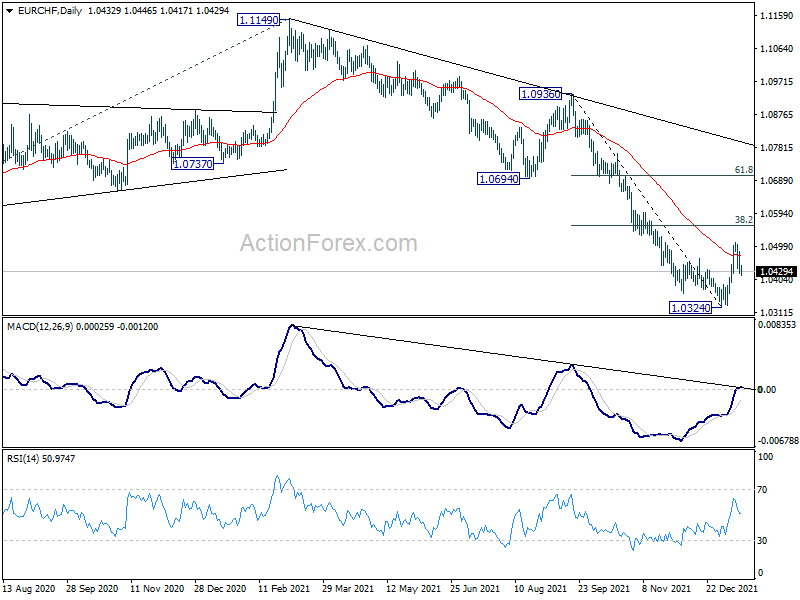
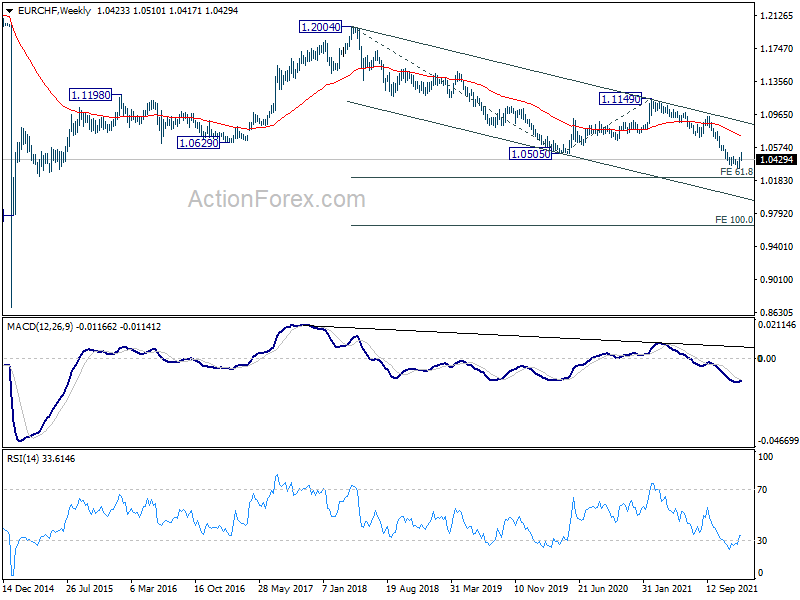
In the bigger picture, long term down trend from 1.2004 (2018 high) is now extending. Next target is 61.8% projection of 1.2004 to 1.0505 to 1.1149 at 1.0223. On the upside, firm break of 1.0505 support turned resistance is needed to be the first sign of medium term bottoming. Otherwise, outlook will remain bearish even in case of rebound.
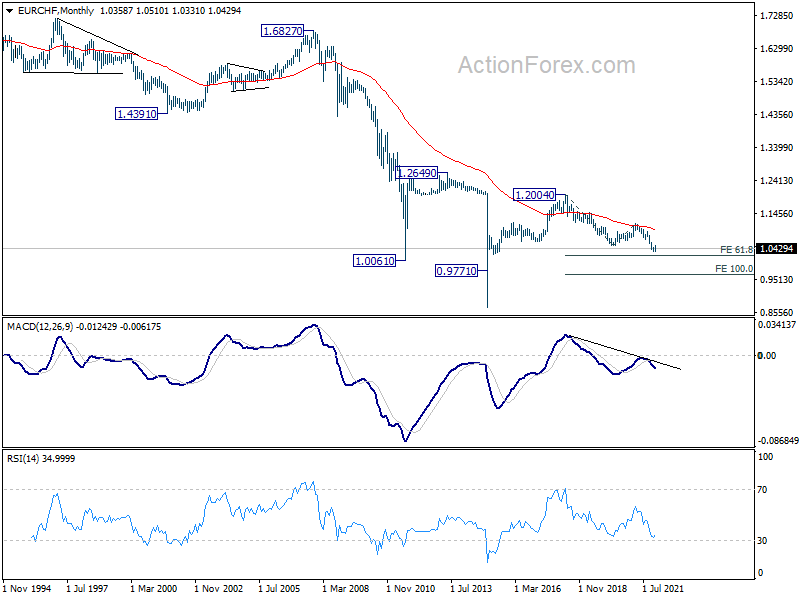
In the long term picture, prior rejection by 55 month EMA (now at 1.0967) maintains long term bearishness. Down trend from 1.2004 is now in progress for 61.8% projection of 1.2004 to 1.0505 to 1.1149 at 1.0223. Firm break there will target 100% projection at 0.9650.
Dollar Ignores Hawkish Fed, Yen and Loonie Surged
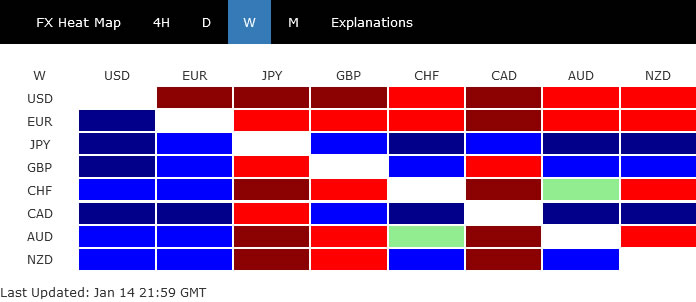
Strong US inflation reading and hawkish comments from Fed officials were the main theme in the markets last week. While much volatility was seen in the stock markets, major indexes remained rather resilient. Dollar got practically no support from expectation of three Fed hikes year this, and tumbled broadly. Euro finally broke out of range against the greenback, but it still ended as the second weakest.
On the other hand, Yen ended as the best performer on speculation that BoJ could finally start talking about rate hikes. Canadian Dollar was the second best, help by the extended rise in oil prices. Other commodity currencies ended mixed, puzzled by the lack of clear direction in risk sentiment. Sterling was also mixed as recent rally in crosses appeared to be losing momentum.
Fed officials and markets firming up expectation of three hikes this year
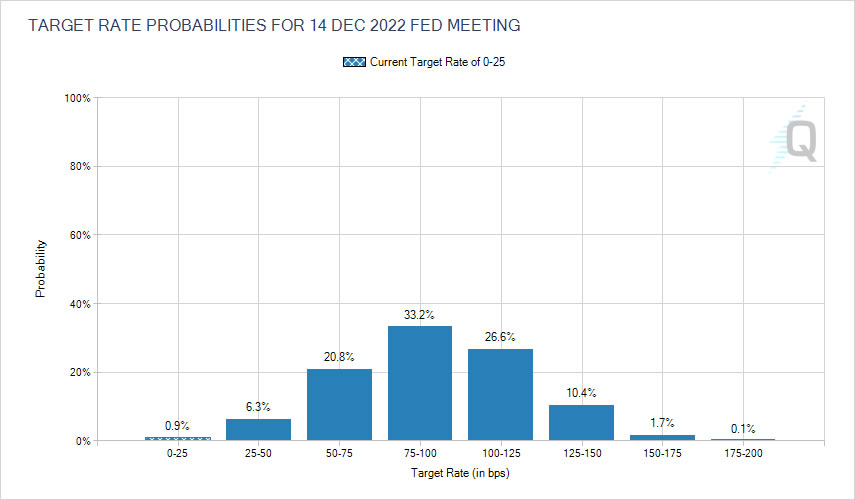
With US consumer inflation hitting 40-year high at 7%, Fed officials became more vocal on the need to raising interest rate. A March lift-off looks more certain than even. And, just as December's dot plot suggests, three rate hikes this year is the baseline, but some FOMC members are clearly open to more. Another question now is when the balance-sheet run-off would start, after three to four hikes, or sooner. According to Fed funds futures, three hikes to 0.75-1.00% by the end of the year is still the main scenario. There is less than 40% chance priced in for higher rates.
Stock investors refusing to give up, SPX holding above trend line
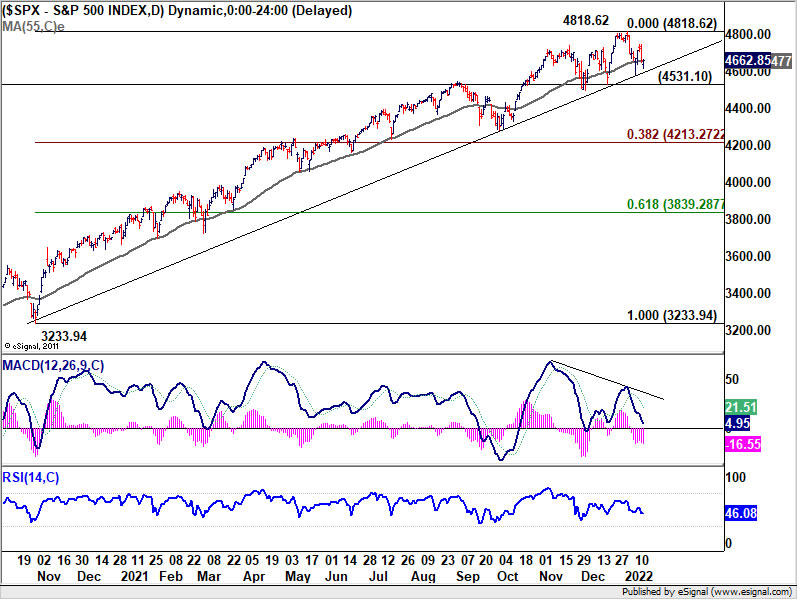
Much volatility was seen in US stocks last week. There were times when major indexes tumbled sharply at open, but reversed to close higher. Investors were refusing to give up. S&P 500 is still holding well to medium term trend line support. The up trend is still in favor to resume at a later stage through 4818.62 towards 5000 handle. Nevertheless, considering bearish divergence condition in daily MACD, break of 4531.10 support will suggest that SPX is already in correction to the rise from 3233.94. Deeper fall would then be seen to 38.2% retracement of 3233.94 to 4818.62 at 4213.27.
Dollar index in medium term correction after steep fall
Dollar was given no support from intensifying expectation of Fed rate hikes. The greenback has indeed ended as the worst performing one for the week. That's partly due to the catch up in global benchmark yields. Even Japan's 10-year JGB yield is now at 0.15 while Germany 10-year yield is on the verge of turning positive.
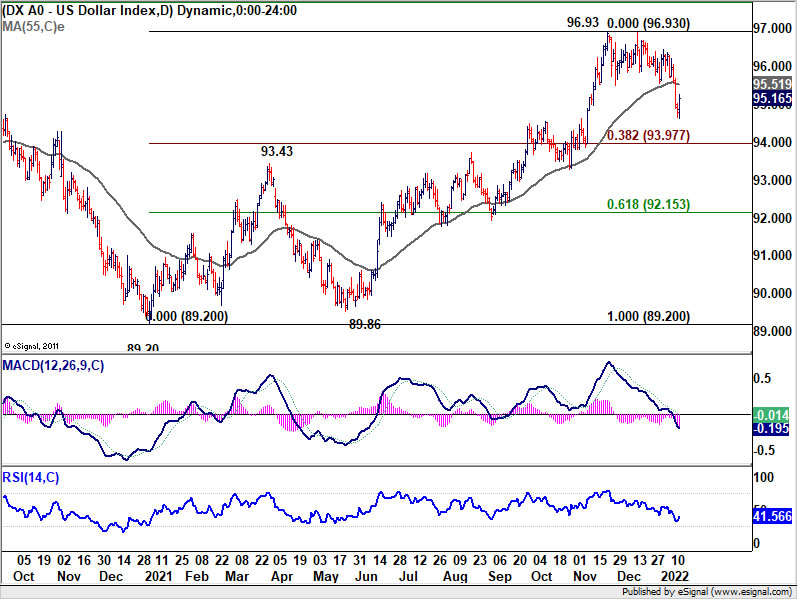
Dollar index dropped sharply to as low as 94.62 last week before recovering to the end. Price actions from 96.93 are currently viewed as a correction to up trend fro 89.20 only. Deeper fall could be seen but there should be strong support from 38.2% retracement of 89.20 to 96.93 at 93.97 to contain downside. However, sustained break of 93.97 will argue the trend might have reversed and deeper fall could be seen to 61.8% retracement at 92.15 and possibly below.
Yen jumped as BoJ might start to telegraph rate hike soon
Yen's rally was rather impressive last week considering that risk aversion couldn't actually take shape. Based on multiple sources, Reuters reported that BoJ policymakers are already debating whether it's time to start communicating the possibility of an eventual rate hike to the markets. While the hike itself is hardly imminent, that would involve some change in the forward guidance. Also, it's possible that the move in rates would come even before core inflation hits the 2% target.
The considerations came at a time when the higher prices are already built into the public's expectations. According the the December public opinion survey, 78.8% respondents said they expect price levels to go up one year from now. That's a notable increase from September's 68.2% and the highest level since 2019. Among them, 13.4% said prices will go up significantly, comparing to September's 8.4%.
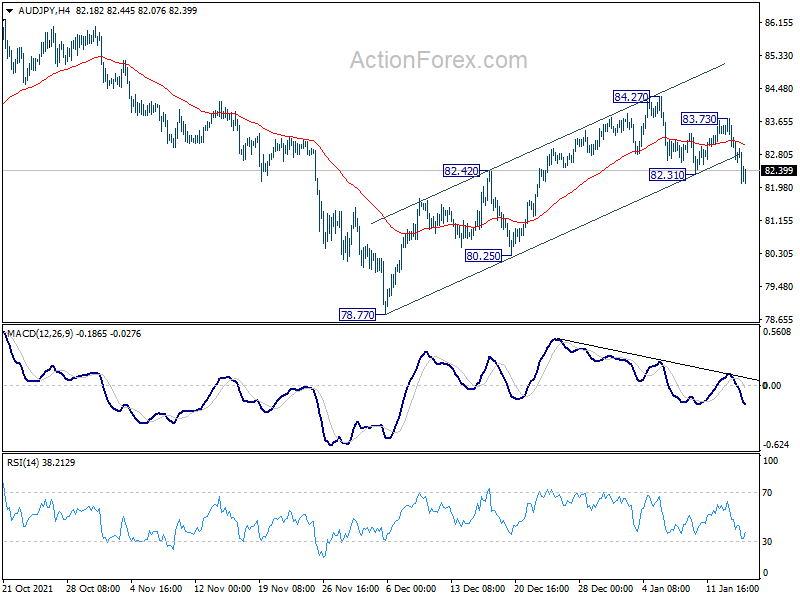
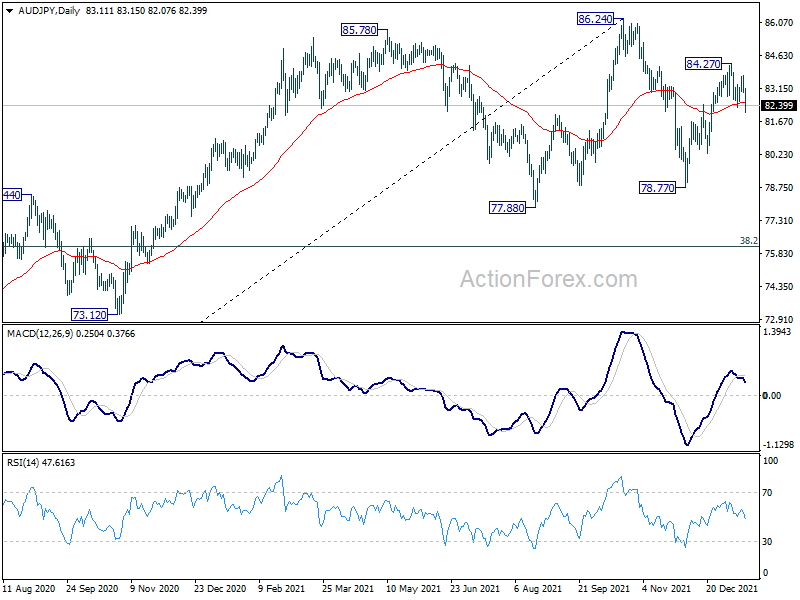
AUD/JPY's recovered to 83.73 last week but was quickly knocked down. Fall from 84.27 resumed by breaking through 82.31 support. With the channel support broken, deeper fall is now in favor back to 80.25 support first. But overall, AUD/JPY could be unfolding a medium term corrective pattern in range of 77.88/86.24. Price actions could be rather mixed and unpredictable for a while.
WTI to test 85.92, EUR/CAD to test 1.4162
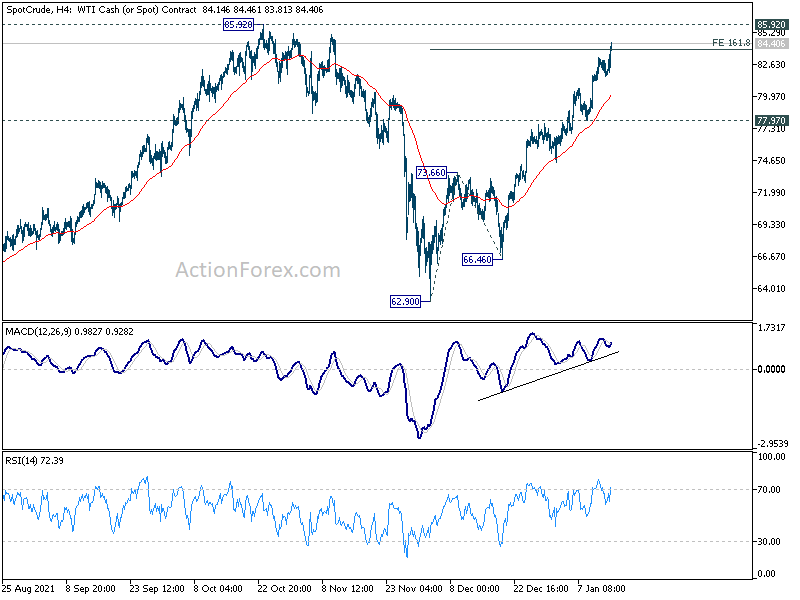
Canadian Dollar ended as the second strongest thanks to persistent rally in oil prices. WTI crude oil extended the rise from 62.90 and met target of 161.8% projection of 62.90 to 73.66 from 66.46 at 83.86. For now, such rally is still viewed as the second leg of the consolidation pattern from 85.92 only. Hence, we're not expecting a firm break of 85.92 yet. Instead, another fall should be seen before the consolidation completes. Break of 77.97 support will indicate rejection by 85.92 and target 73.66 resistance turned support first. However, firm break of 85.92 could pave the way to 90 handle.
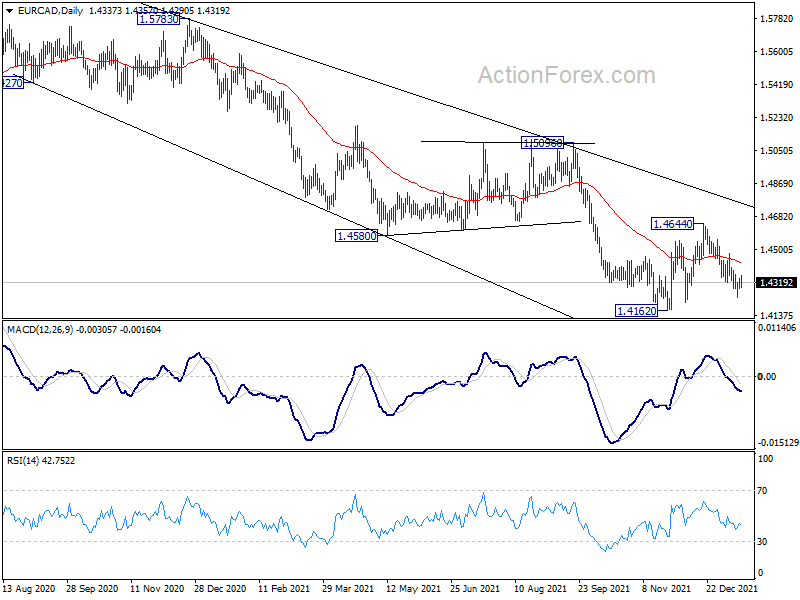
While EUR/CAD's rebound from 1.4162 was slightly stronger than expected, it appeared that it's complete at 1.4644 already. Deeper fall will remain in favor as long as 55 day EMA (now at 1.4426), to retest 1.4162 low. Whether EUR/CAD could break through 1.4162 low to resume larger down trend might depend on WTI's reaction to the above mentioned 85.92 resistance. Rejection by 85.92 could help floor EUR/CAD at or above 1.4162, and bring rebound to extend the corrective pattern with another rising leg.
USD/JPY Weekly Outlook
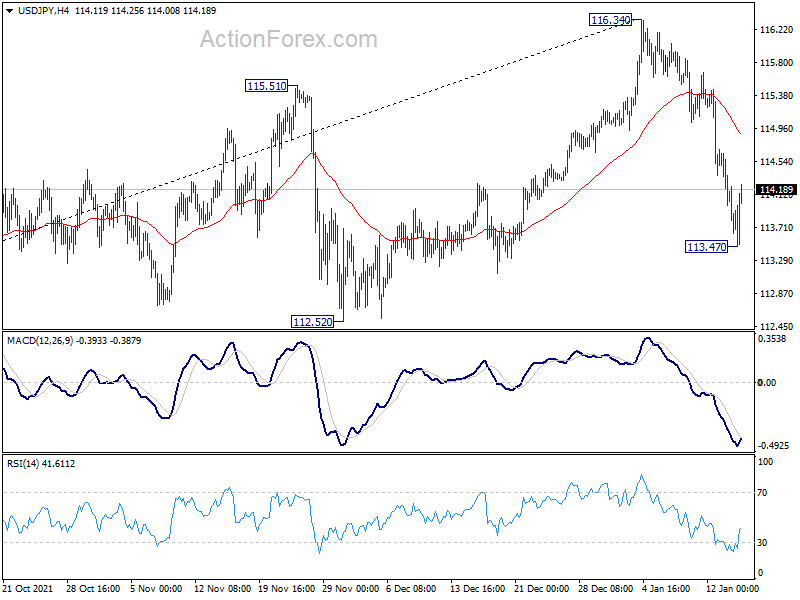
USD/JPY's steeper and deeper than expected decline last week suggests that rise from 112.52 has completed at 116.34 already. But as a temporary low was formed at 113.47, initial bias is turned neutral this week for some consolidations. Risk will stay on the downside as long as 116.34 resistance holds. Below 113.47 will target 112.52 structural support. Considering bearish divergence condition in in daily MACD, break of 112.52 will confirm that it's already in correction to the up trend from 102.58. Deeper decline would be seen to 38.2% retracement of 102.58 to 116.34 at 111.08.
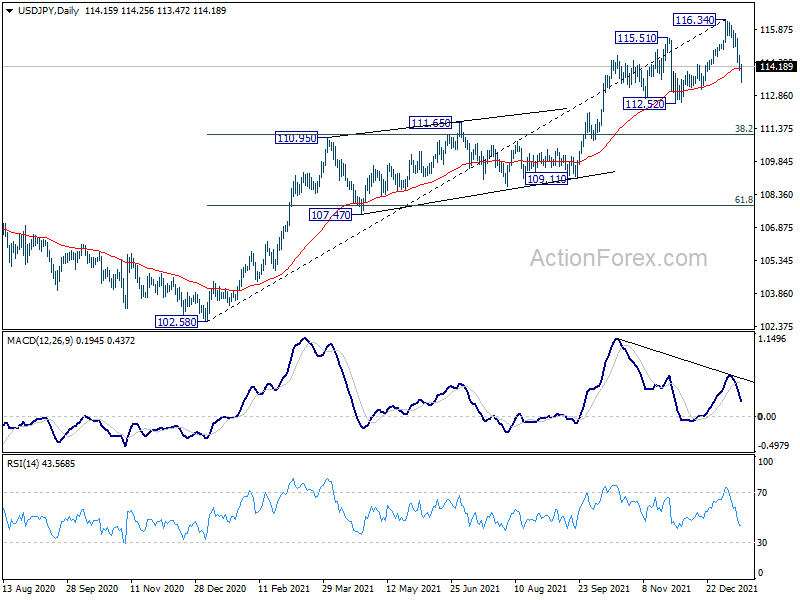
In the bigger picture, no change in the view that rise from 102.58 is the third leg of the up trend from 101.18 (2020 low). Such rally should target a test on 118.65 (2016 high). Sustained break there will pave the way to 120.85 (2015 high) and raise the chance of long term up trend resumption. However, firm break of 112.52 support will dampen this bullish case and we'll assess the outlook based on subsequent price actions later.
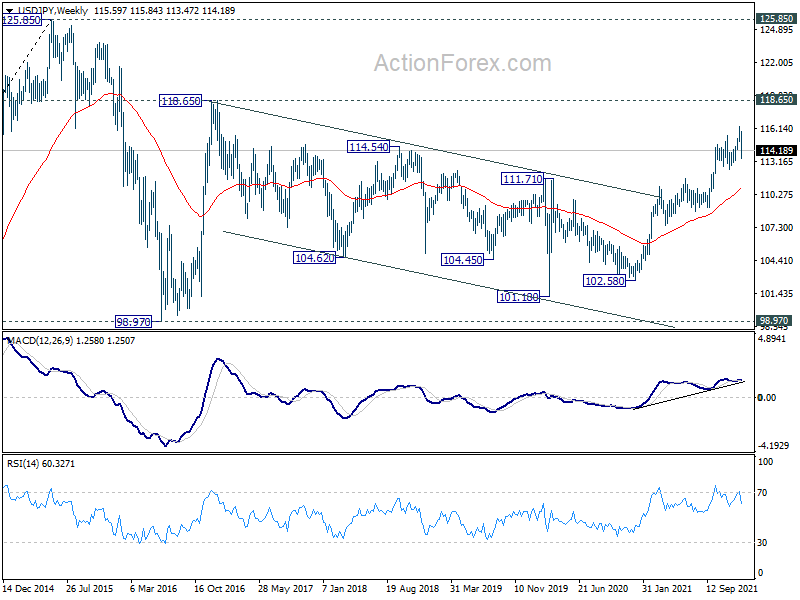
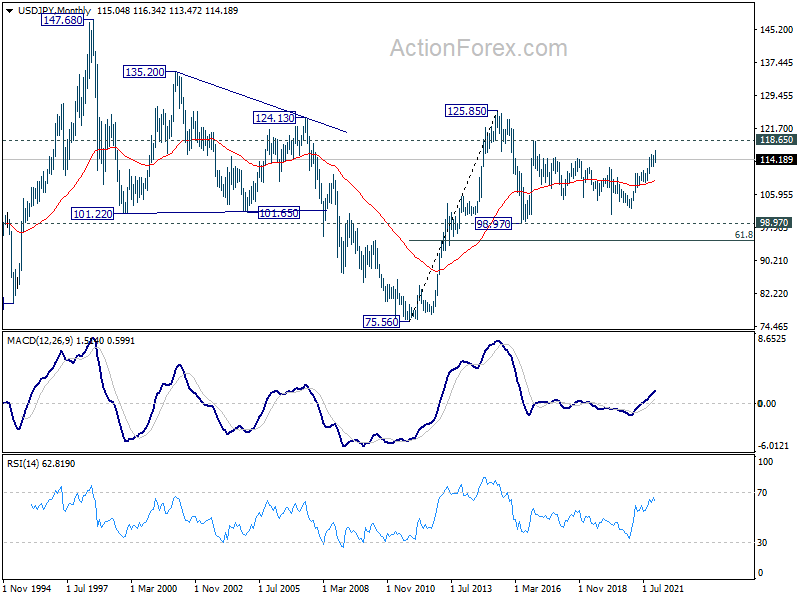
In the long term picture, the rise from 75.56 (2011 low) long term bottom to 125.85 (2015 high) is viewed as an impulsive move, no change in this view. Price actions from 125.85 are seen as a corrective pattern which could still extend. In case of deeper fall, downside should be contained by 61.8% retracement of 75.56 to 125.85 at 94.77. Up trend from 75.56 is expected to resume at a later stage for above 135.20/147.68 resistance zone.
Summary 1/17 – 1/21
Monday, Jan 17, 2022
[php_everywhere instance="1"]
Tuesday, Jan 18, 2022
[php_everywhere instance="2"]
Wednesday, Jan 19, 2022
[php_everywhere instance="3"]
Thursday, Jan 20, 2022
[php_everywhere instance="4"]
Friday, Jan 21, 2022
[php_everywhere instance="5"]
Weekly Economic & Financial Commentary: U.S. Dollar Stumbles to Start the Year
Summary
United States: Not Through with 2021 Just Yet
- Inflation is intensifying and consumer activity is cooling, data covering the month of December reveal. The Consumer Price Index (CPI) rose 7.0% year-over-year, the fastest increase in nearly 40 years. Similarly, the Producer Price Index (PPI) was up 9.7% over the year. Meanwhile, retail sales unexpectedly declined 1.9% in the final month of the year.
- Elsewhere, the NFIB Small Business Optimism Index edged up to 98.9. Industrial production slipped 0.1%, as supply constraints held down manufacturing production. Consumer sentiment fell to 68.8 in January, the first solid sign that the Omicron surge is weighing on economic activity.
- Next week: Housing Starts (Wednesday), Existing Home Sales (Thursday), Leading Index (Friday)
International: U.K. GDP Advances While Australian Retail Sales Surge
- In the G10, U.K. November GDP rose an encouraging 0.9%, while Australia retail sales rose by 7.3% month-over-month in November, the largest gain since May 2020. In emerging markets, price pressures remain present in Brazil, as December CPI came in higher than expected at 10.06% year-over-year, still well above the Central Bank of Brazil's 3.5% target for 2022.
- Next week: China GDP (Monday), U.K. CPI (Wednesday), Japan CPI (Friday)
Interest Rate Watch: When Will the Federal Reserve Shrink Its Balance Sheet, and by How Much?
- The outlook for U.S. monetary policy has shifted significantly in recent months. With tighter monetary policy on the horizon, market attention has turned to possible reductions in the Fed's asset holdings, which total nearly $9 trillion at present, up from $4.2 trillion before the pandemic.
Credit Market Insights: Mortgage Rates Are on the Rise
- According to Freddie Mac, the average rate on a 30-year fixed-rate mortgage jumped almost a quarter of a percent this week, rising to 3.45% from 3.22%—the highest level since the pandemic's onset in March 2020.
Topic of the Week: U.S. Dollar Stumbles to Start the Year
- A hawkish shift from the Fed has not been enough to prevent the U.S. dollar from tumbling to start 2022. Following a year where the broad dollar index (DXY) rose close to 6.5%, in the first few weeks of this year the same index has dropped a little over 1%.
The Weekly Bottom Line: Eyeing Inflation Like a Hawk
U.S. Highlights
- Equity markets saw further losses this week, following more hawkish messaging from the Fed. Between Powell and Brainard’s confirmation hearings and other Fed speakers, the signals for a March rate hike are flashing loud and clear.
- December’s inflation data supported the case for a rate hike, with headline inflation reaching 7% year-on-year (y/y). Core inflation also surprised to the upside, and is now up 5.5% y/y – the highest reading in 30 years.
- Retail sales showed a loss of momentum to end the year, as inflation erodes consumer purchasing power. Consumer spending is looking weaker in both the fourth quarter of 2021 and the first quarter of 2022 relative to our latest forecast.
Canadian Highlights
- The economic calendar was unusually empty this week, but the next week will be anything but. Inflation numbers, the Bank of Canada Business Outlook Survey and Survey of Consumer Expectations will be in focus ahead of the Bank of Canada meeting in two week’s time.
- Inflation has been running hot in Canada, well above the Bank of Canada 2% target. The recent Omicron wave is expected to exacerbate existing supply chain issues, restraining growth and pushing prices higher in the near-term.
- The housing market is another area where prices have been rising rapidly. Monday’s report on home sales and prices is likely to echo this, showing another month of gains in both sales and prices amid low inventory.
U.S. - Eyeing Inflation Like a Hawk
Equity markets experienced further losses this week, following more hawkish language from Fed officials that signaled rate hikes could kickoff as early as March. The S&P500 has fallen just over 3% from the beginning of the year. Treasury yields continue to march higher as markets adjust their expectation for monetary policy.
Looking at the recent inflation data, the case for rate hikes is clear. Headline CPI ended the year up 7% year-on-year (y/y), the fastest pace since 1982. In December, the month-on-month pace of inflation cooled slightly to 0.5%, as energy prices were a drag on the headline for the first time since April. But, core inflation was even hotter, up 0.6% m/m, driven by strong increases in shelter inflation and another jump up in used vehicle prices. While those items were the biggest contributors, prices were up strongly for a host of goods and services, continuing a trend of broadening price pressures that has been evident since October – the same month that Fed Chair Powell changed his tune on whether the run up in inflation is transitory.
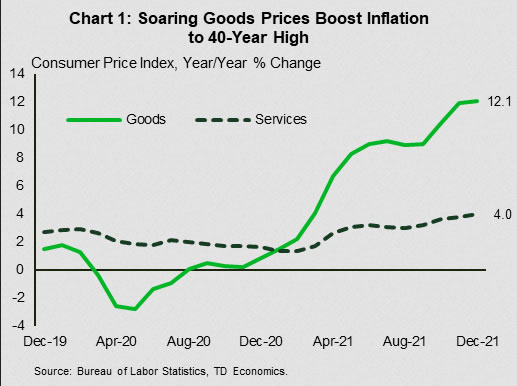
Accelerating goods prices take much of the blame for inflation’s 40-year record high (Chart 1). You have to go back to 1980 to see goods prices rising 12% in one year. Goods prices should cool over the coming year as production, inhibited by the pandemic and global input shortages, begins to normalize. But, just as it does, service price growth looks to accelerate. Services prices were up 4% year-on-year in 2021, an acceleration from a 3% pace immediately prior to the pandemic, but not out of line with past periods of economic strength. This is likely to move even higher in 2022, keeping pressure on the Fed to tighten policy.
The impact of elevated inflation is already evident in retail sales. Retail sales surged in the spring as a third round of stimulus payments from Washington hit Americans’ bank accounts. Nominal sales have plateaued, in part as consumption shifts away from goods, which dominate retail sales, and towards services. However, when you compare to sales adjusted for overall inflation, you see how price growth has increasingly eroded consumer purchasing power (Chart 2). Given that goods prices are up more than services, the picture is even more dire.
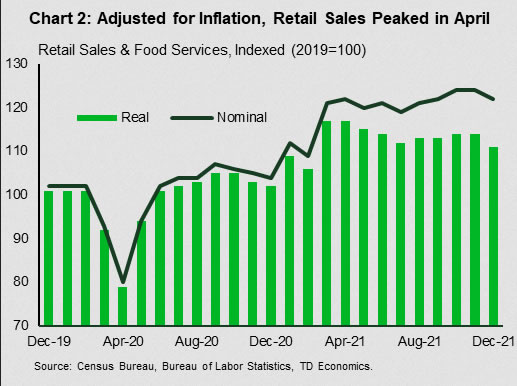
Any way you slice it, December’s retail sales data showed that consumer spending lost momentum towards the end of the year. Our December forecast projected real personal consumption expenditure growth around 6% in the fourth quarter. The data released since suggests that it is going to be closer to 4%. It also provides a soft starting point for the first quarter, where spending is likely to slow to 2% as consumer caution on Omicron weighs on close-contact services.
Inflation is also cutting into wage growth, something that has not gone unnoticed by Fed officials. At his Senate confirmation hearing, Fed Chair Jay Powell delivered his most hawkish messaging on inflation yet. Fed Governor Lael Brainard, who is the nominee for Vice Chair of the FOMC to succeed Richard Clarida, echoed his remarks, mentioning that workers are worried about how far their paychecks would stretch. Other Fed officials who spoke this week similarly signaled that interest rates are forthcoming, likely beginning as early as March.
Canada - All Eyes on Inflation
The economic calendar was unusually empty this week, but the next week will be anything but quiet, with a number key data releases on the docket. With this week's news of inflation south of the border hitting a 7% mark, all eyes will be on inflation numbers in Canada next Wednesday. Fanned by the similar flames of rising goods prices amid supply-chain bottlenecks and strong consumer demand, inflation has been running hot in Canada as well, though reassuringly more than two points below its U.S. counterpart (Chart 1).
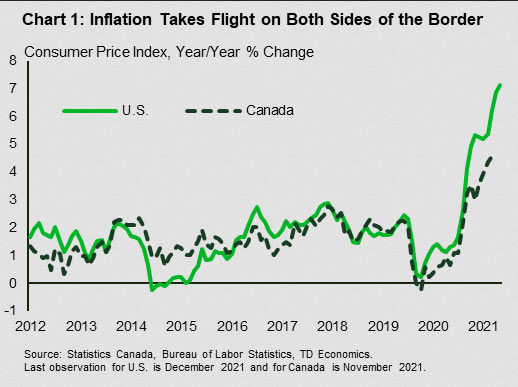
Even while below its U.S. counterpart, inflation is well above the Bank of Canada 2% target. Rising prices have been felt acutely by producers and consumers alike. Indeed, just as important as actual inflation for the central bank, is consumers and businesses expectations for its future evolution. This puts the focus on the Bank of Canada Business Outlook Survey and Survey of Consumer Expectations. Those surveys will shed light on inflation expectations among businesses and consumers at the time when the Omicron wave was taking hold. These will take an added importance ahead of the Bank of Canada meeting in less than two weeks.
While those surveys won't capture Omicron's full impact, they will likely still show an increase in the businesses' near-term inflation expectations and pricing plans. In December's CFIB survey, small businesses' intentions to raise prices over the next 12 months reached a survey's high at 4.6%. At the same time, small businesses' concerns about shortage of inputs and distributional challenges continued to mount, weighing on their ability to ramp up production. Labour shortages, already acute before the Omicron hit, will be made worse in the near-term as workers become sick or are required to isolate. All in all, while Omicron's impact is expected to be relatively short-lived, supply-chain issues may take a turn for the worse in the near-term, restraining growth and pushing prices higher.
The housing market is another area where prices have been rising rapidly, leading to a significant deterioration in housing affordability. Monday's report on home sales and prices is likely to echo this, showing another month of gains in both home sales and prices amid low inventory.
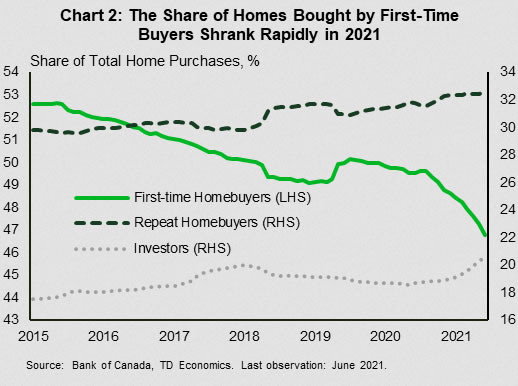
This week's Bank of Canada research showed that first-time buyers are increasingly unable to get their foot in the housing market's door, facing high prices and intense competition from investors and repeat buyers. The share of home purchases by the first-time buyers fell by 3 percentage points since the start of the pandemic, reaching a new low in the mid-2021 at 46.8%, down from 49.8% at the start of the pandemic (Chart 2). Low variable rates on mortgages are boosting demand for real estate. More than 50% of new mortgages borrowers in recent months opted out for a variable rate mortgage. This could be another reason for the Bank of Canada to expedite rate liftoff.
Week Ahead – Interest Rate Anxiety Heightened
Can earnings season soothe investors’ nerves?
It’s been a turbulent start to the year in the markets and that’s unlikely to change as we move into earnings season. Fear of high inflation and accelerated monetary tightening is driving much of the volatility that we’re seeing in financial markets over the last couple of weeks and that’s unlikely to abate any time soon, with peak inflation still probably ahead of us.
Earnings season could go some way to easing the nerves in the coming weeks as we get a reminder that the economy is still in a strong position despite the challenges it’s facing. But even this comes with an element of uncertainty given that omicron hit in late November which will undoubtedly have had an impact. Of course, as we’ve seen the last two years, there are also winners when consumers stay at home and restrictions are imposed.
Ultimately though, central banks remain at the top of the list for investors right now and next week offers a selection of meetings, minutes, and speakers that will surely attract a lot of attention. It’s hard to look past the CBRT on Thursday as being one of the highlights next week. After an aggressive easing cycle that’s come at a huge cost, will the central bank finally slam on the breaks?
US
The upcoming week is busy with economic data and earnings results. Goldman Sachs, Bank of America, and Morgan Stanley will close out earnings for the big banks, while Procter & Gamble may give a better look at how much further price increases the consumer may have to expect. On Tuesday, the Empire Manufacturing Index should show activity cooled in January. Wednesday is all about housing activity that might show both building permits and housing starts edged down. On Thursday, initial jobless claims are expected to resume declining, while the Philadelphia business outlook is anticipated to improve, and Existing home sales may show a small decline.
The blackout dates are in effect for the Fed, so it will be quiet until the January 26th FOMC meeting. With financial markets pricing in over a 90% chance that the Fed will raise rates in March, Treasury yields appear to be forming a range just below the 1.80% level.
EU
With the ECB being among the minority of central banks still singing from the transitory hymn sheet, the focus next week will be on the ECB accounts from December, comments from policymakers including President Christine Lagarde on Monday, and the final inflation numbers for December. At 5%, inflation is uncomfortably high and the central bank may soon finally buckle like the rest if pressures don’t soon ease.
UK
The data dump week for the UK, with labour market, inflation, and retail sales all being released. But Wednesday is undoubtedly the standout, with Governor Bailey due to speak hours after the CPI release which could make for some interesting comments. Three or four rate hikes are expected this year so expectations are quite hawkish but as we’ve seen recently, there is a growing fear that more will be warranted.
Russia
No major data or economic events next week so the focus will remain on the various geopolitical risks that Russia has found itself at the centre of. A possible invasion of Ukraine is very much top of the list, with the week of intense talks between the US and Russia seemingly failing to lead to any breakthrough.
Russia is also intrinsically linked to the energy crisis in Europe which is intensifying as more outages in French reactors put further pressure on limited reserves.
South Africa
Inflation data next week is expected to show price pressures increasing, with the CPI rising to 5.7% which will increase calls for more rate hikes from the SARB.
Turkey
A rare period of relative stability for the lira which is unlikely to last, as the CBRT meets next week. Can the central bank resist the urge to cut again or are more sharp losses on the horizon? Not cutting could provide some support for the lira as it may signal an end, for now, of the easing cycle.
China
China releases fourth-quarter GDP and Retail Sales on Monday. The markets are braced for a downturn in growth, with a consensus of 3.5%, down from the gain of 4.9% in Q3. This would mark the weakest GDP report since Q2 2020.
Retail Sales are forecast at 3.8% y/y in December, down from 3.9% beforehand. The government has enacted a zero-Covid strategy, which has restricted travel and dining out. Slow income growth is also hurting consumers and has put a dampener on consumer spending.
China’s property sector remains in deep crisis, with no signs of any improvement on the horizon. Evergrande and other developers owe billions and investment growth and household loans have decreased. The government has eased restrictions on real estate funding but these measures have so far proven ineffective.
China house price index is released on Saturday which could put a dampener on the open if it’s particularly bad news. The previous release showed 3% growth though and it’s widely regarded as low impact data.
Also on Monday, ahead of the GDP release, the PBOC will decide whether to maintain the MLF rate at 2.95%.
India
No major economic data or events next week.
Australia
Australia releases key employment data for December next week. Employment change is expected to slow to 60,000, down from 366,100 in November. The unemployment rate is forecast to ease to 3.5%, down from 3.6%.
Iron ore prices rose to their highest level in three months, as heavy rains engulfed Brazil’s mining region, which has sparked supply concerns.
New Zealand
It’s a quiet economic calendar next week. On Thursday, New Zealand releases the BusinessNZ Manufacturing PMI for December. The PMI was stagnant in November, with a reading of 50.6 points.
Japan
Inflationary pressures in Japan are much lower than those in the UK or the US, but inflation is nonetheless moving higher after years of deflation. The Bank of Japan is expected to maintain its ultra-loose policy at its meeting on Tuesday, but will likely revise up its view of inflation risks for the first time since 2014.
Inflation remains well below the bank’s target of 2%, but the BoJ could look to raise interest rates before it achieves it.
Economic Calendar
Saturday, Jan. 15
Economic Data/Events
- China new home prices
Sunday, Jan. 16
- The US’ National Retail Federation opens its annual Retail’s Big Show expo at Javits Center, New York
Monday, Jan. 17
Economic Data/Events
- US equity and bond markets are closed for Martin Luther King Jr. holiday
- China GDP, retail sales, industrial production, surveyed jobless, property investment, medium-term lending
- Handelsblatt Energy Summit with German Economy Minister Habeck
- Finance ministers of the Euro region meet in Brussels
- Japan PM Kishida speaks to parliament
- Canada existing home sales
- Poland CPI
- Japan industrial production, core machine orders, tertiary industry index
- Singapore electronic exports
- Russia Trade
- Norway Trade
- Philippines overseas remittances
- UK Rightmove house prices
- Switzerland sight deposits, Bloomberg January economic survey
- Turkey central government budget balance
Tuesday, Jan. 18
Economic Data/Events
- US cross-border investment, empire manufacturing, NAHB Housing Market Index
- BOJ Rate Decision: No change to monetary policy, may adjust its view of inflation risks
- Japan industrial production, capacity utilization
- EU finance ministers meet in Brussels and hold a policy debate on global minimum taxation for multinational companies.
- Australia consumer confidence
- Canada housing starts
- Eurozone new car registrations
- Germany ZEW survey expectations
- New Zealand house sales
- Russia Trade
- Mexico international reserves
- UK jobless claims, unemployment
- Poland CPI
- Switzerland producer and import prices
- South Africa mining, gold, and platinum production
- Turkey house price index
- Sweden Riksbank Gov Ingves speaks on a panel at a blockchain and stablecoin conference
Wednesday, Jan. 19
Economic Data/Events
- US housing starts
- UK CPI, house price index
- French President Macron addresses European Parliament
- BOE Gov Bailey speaks to UK Parliament Treasury Committee
- Canada CPI
- Germany CPI
- South Africa CPI
- Eurozone construction output
- Australia Westpac consumer confidence
- New Zealand card spending
- South Africa retail sales
- Russia current account
- Bank Earnings from BoA and Morgan Stanley
Thursday, Jan. 20
Economic Data/Events
- US existing home sales, initial jobless claims
- ECB Minutes to December policy meeting
- BOJ Minutes of December meeting
- UK RICS house prices
- Norway Rate decision: Expected to keep rates steady
- Turkey Rate decision: Expected to keep rates steady
- Hungary Rate decision: Expected may keep rates steady
- Eurozone CPI
- Hong Kong CPI
- Russia CPI
- Japan Trade
- China loan prime rates, swift global payments
- Australia unemployment, consumer inflation expectations, RBA FX transactions
- New Zealand food prices, ANZ Truckometer heavy traffic
- Germany PPI
- Taiwan export orders
- Mexico unemployment
- Spain house transactions, trade
- France business and manufacturing confidence
- Netherlands unemployment, consumer spending
- Poland consumer confidence
- EIA Crude Oil Inventory Report
- Netflix reports earnings after the bell
Friday, Jan. 21
Economic Data/Events
- US Conf. Board leading index
- Japan CPI
- UK Retail sales
- BOE Mann speaks at the Official Monetary and Financial Institutions Forum
- Canada Retail
- Eurozone Consumer confidence
- Bank of Italy releases the Quarterly Economic Bulletin
- Turkey Consumer Confidence
- New Zealand performance of manufacturing index, net migration
- Singapore home prices
- Switzerland Money supply
- Russia Money supply
- Thailand trade, forward contracts, foreign reserves
- China FX net settlement
- Poland sold industrial output, construction output, employment, PPI
Sovereign Rating Updates
- EFSF (DBRS)
- ESM (DBRS)
BoJ to Defy Peers, Stay on Dovish Course, But for How Long?
The Bank of Japan will conclude its first monetary policy meeting of 2022 on Tuesday and publish an updated set of economic forecasts. So far, the BoJ has been excluded from the global central bank race to normalize policy amid skyrocketing inflation in many parts of the world. However, with price pressures swelling in Japan too, the January meeting might see the Bank take a baby step towards the hawkish side. The question is, would a slightly less dovish stance do much for the yen’s prospects in the short term?
BoJ may soon get its wish of untaming inflation
Policymakers in Japan have been striving for decades to boost inflation in the country but to no avail. Things may be about to change, however, as the pandemic and the ensuing health and economic policy responses have created a price shock that no one could have predicted at the onset. While Japan’s consumer price index currently stands at a paltry 0.6% year-on-year versus a staggering 7.0% in the United States, the inflation picture isn’t quite so subdued under the surface.
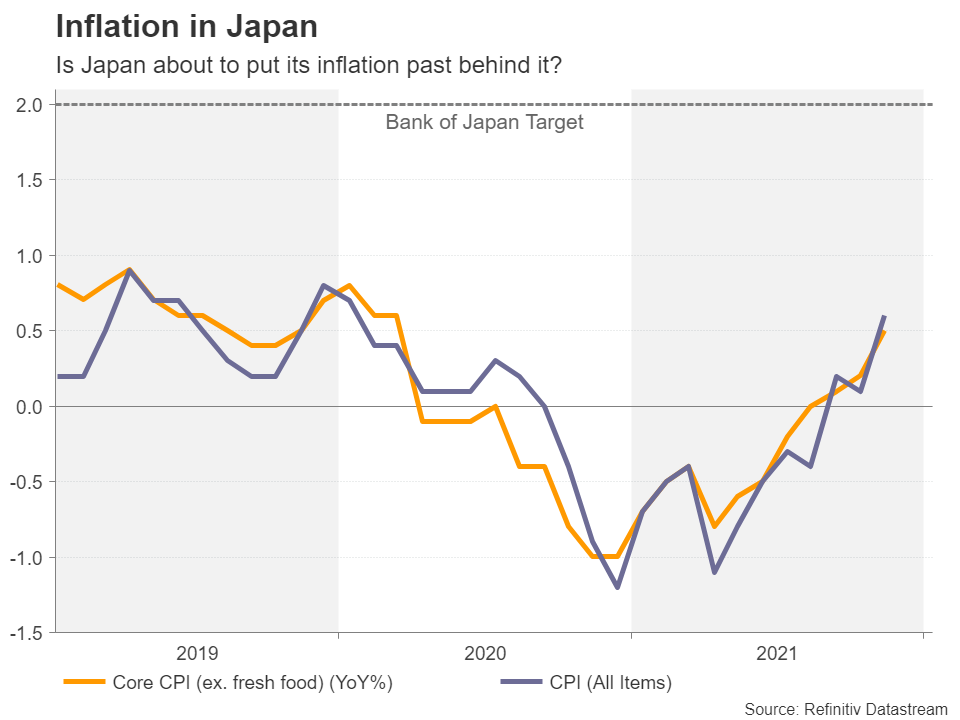
Businesses are facing mounting cost pressures as the global supply-chain bottlenecks and the surge in commodity prices is pushing up prices. Japan relies heavily on imports for its raw materials as well as for its energy needs so there is no escape from the changing global inflation landscape. Making matters worse is the yen’s depreciation against the US dollar; a weaker exchange rate makes imports more expensive.
In the past, Japanese firms have found it difficult to pass higher costs onto price-conscious consumers, but they may have no choice this time given the scale of the squeeze on their profit margins. Wholesale prices have already shot up to a record high of 9.0%. Inflation expectations among businesses and households are also on the rise, although they remain at low levels for now.
Will the BoJ sound the inflation alarm?
It shouldn’t come as much of a surprise therefore if the Bank of Japan ups its inflation projections in its latest outlook report on Tuesday. The bigger question for investors, though, is just how much more worried policymakers have become about inflation. Governor Haruhiko Kuroda has suggested that inflation could soon reach 2%. Yet, unless wage growth catches up, the comparatively modest spike in consumer prices won’t be seen as a risk to an economy that’s been mired in deflation since the 1990s.
Money markets aren’t flagging a rate hike over the next year, although the odds are inching higher for 2023. However, a rate increase isn’t the BoJ’s only option. It might first decide to tweak its yield curve control policy by widening the target band on the 10-year Japanese government bond yield (currently 20 basis points above or below zero). Sovereign bond yields have been rallying lately as the major central banks pivot towards tighter policy so it’s quite probable the BoJ’s yield target could be tested should speculation heat up about higher rates in Japan too.
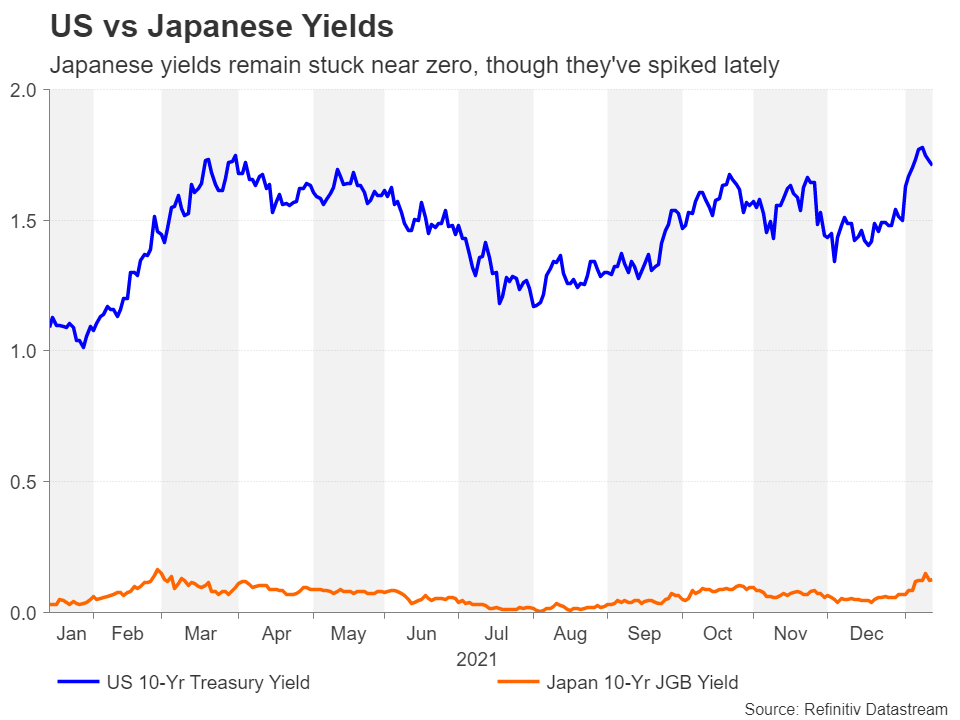
It may be too early to get less bearish about the yen
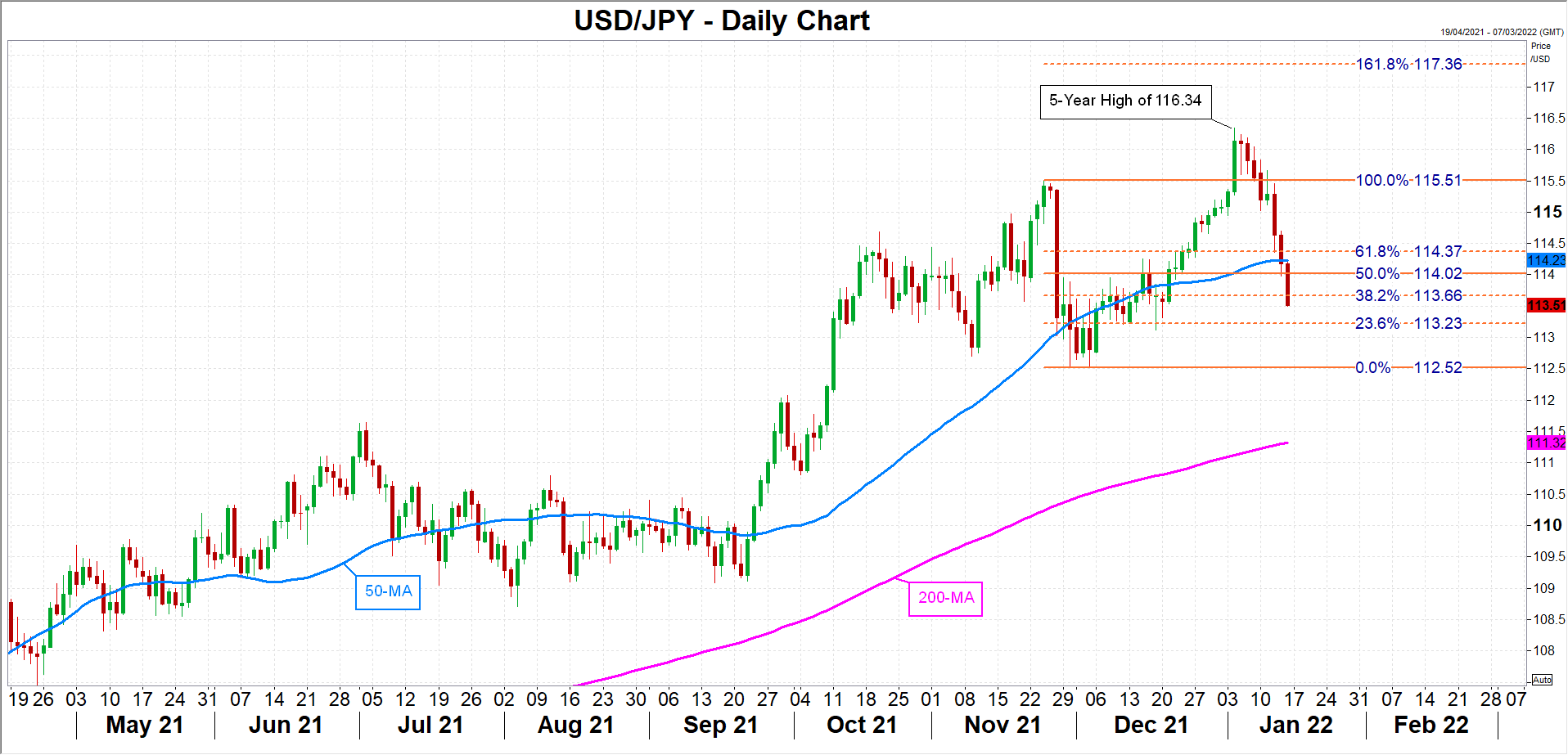
But such a shift in market expectations could be months away and, in the meantime, it’s still all about yield differentials due to other central banks’ actions as far as the yen is concerned. The Fed’s increasingly hawkish tone pushed the greenback to a five-year high of 116.14 yen earlier this month.
A correction is now in process, dragging the pair down to the 38.2% Fibonacci retracement of the November-December down leg at 113.66. A deepening of the correction could see the December trough of 112.28 yen being revisited. However, should the dollar perk up again, the next major target for the yen bears will be the 161.8% Fibonacci extension of 117.36.
To sum up, tighter policy seems some way off still in Japan. But with Japanese exports enjoying strong demand and the BoJ’s own surveys pointing to improved economic conditions, policymakers may not be so hesitant to respond to the rising threat of inflation. Reports suggest that discussions have already started on how the forward guidance on rates should be updated once inflation starts to approach 2%. The danger for the markets is that after such a long period of monetary easing in Japan, the timing of any change in the policy direction may catch them off guard.