

Sample Category Title
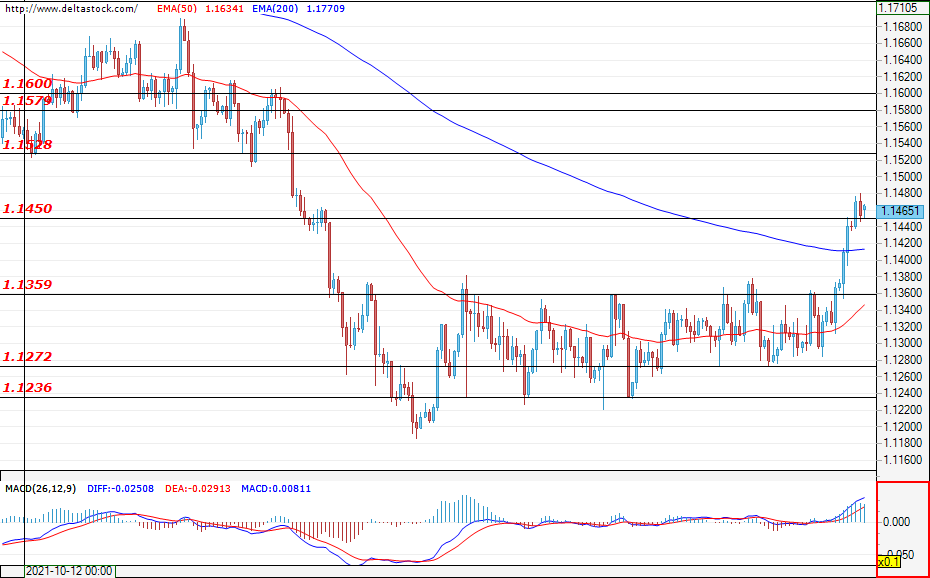
EUR/USD Pair is Consolidating Gains above the 1.1450 Level
The Euro started a steady increase from the 1.1320 support zone against the US Dollar. The EUR/USD pair broke the 1.1380 resistance zone to move into a positive zone.
There was also a move above the 1.1400 level and the 50 hourly simple moving average. It is now consolidating gains above the 1.1450 level. An immediate resistance near the 1.1480 level.
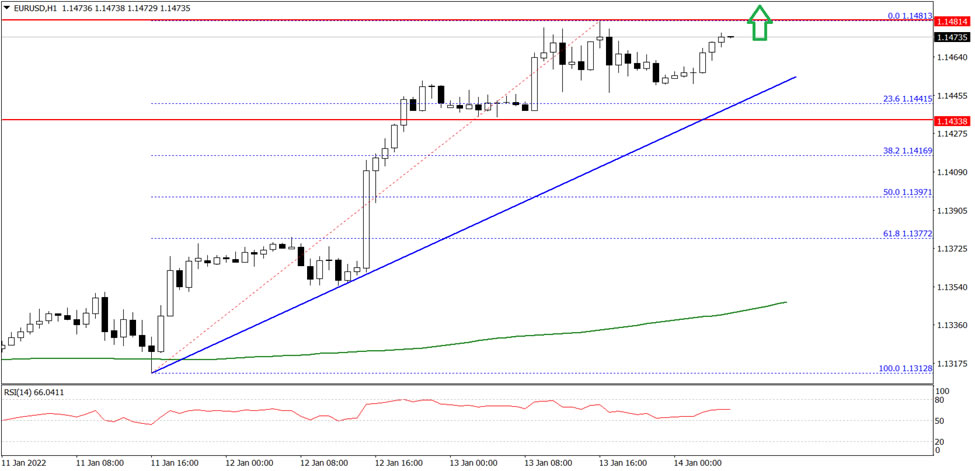
The next major resistance is near the 1.1500 level. A break above the 1.1480 and 1.1500 resistance levels could start a decent increase towards the 1.1550 level in the near term.
On the downside, an initial support is near the 1.1450 level. There is also a key bullish trend line with support near 1.1450 on the hourly chart, below which the pair could extend losses. The next key support is near 1.1420, below the pair could test 1.1400 on FXOpen.
USDCAD Stops Near 200-SMA: Temporary Pause or Bullish Setup?
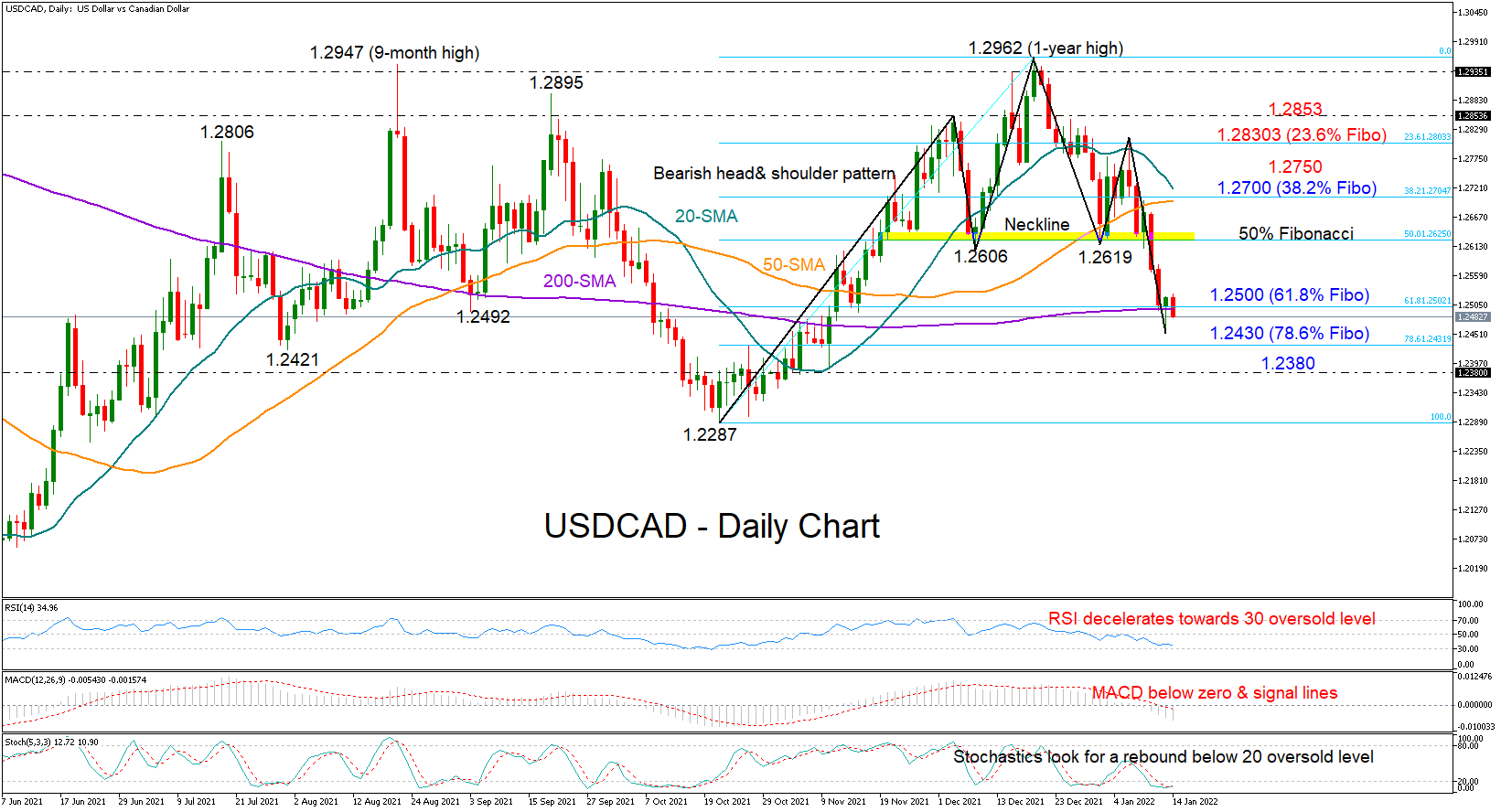
USDCAD slumped towards the 200-day simple moving average (SMA) at 1.2495 after its bullish efforts to cross above the 50-day SMA and enter the 1.2700 territory collapsed, with the pair set to close 1.40% lower this week.
Thursday’s session seems to have formed a bullish hammer candlestick in the chart, which foresees a reversal in price direction, though additional green candlesticks will be needed to confirm that. The Stochastics are also increasing the stakes for an upturn in the coming sessions as the indicator seems to have found a bottom below its 20 oversold level.
Yet, given the persisting negative momentum in the RSI and the MACD, and the fact that the pair has already breached the neckline of a bearish head and shoulder trend pattern, traders may cautiously monitor any upside corrections.
For now, the 61.8% Fibonacci retracement of the 1.2287 – 1.2962 up leg at 1.2500 is guarding the floor around the 200-day SMA, and should the bears violate that bar, selling forces could intensify, turning the spotlight straight to the 78.6% Fibonacci of 1.2430. Steeper declines could drive the price towards the 1.2287 low, unless the 1.2380 handle comes to the rescue.
Alternatively, an improvement in sentiment could lift the pair up to the 50% Fibonacci of 1.2625, but a break above the 1.2700 restrictive area, where the 20- and 50-day SMAs are currently converging, could be a bigger achievement. The 38.2% Fibonacci is also located in the same position. If the bulls knock down that wall, resistance could next emerge somewhere between the 23.6% Fibonacci of 1.2830 and the 1.2850 barrier.
Summarizing, although the latest downfall in USDCAD is showing some signs of exhaustion, the bulls will need to stage a clear bounce around the 1.2500 level to get the upper hand.
GBPUSD Climb Remains Intact Amid Lingering Bullish Forces
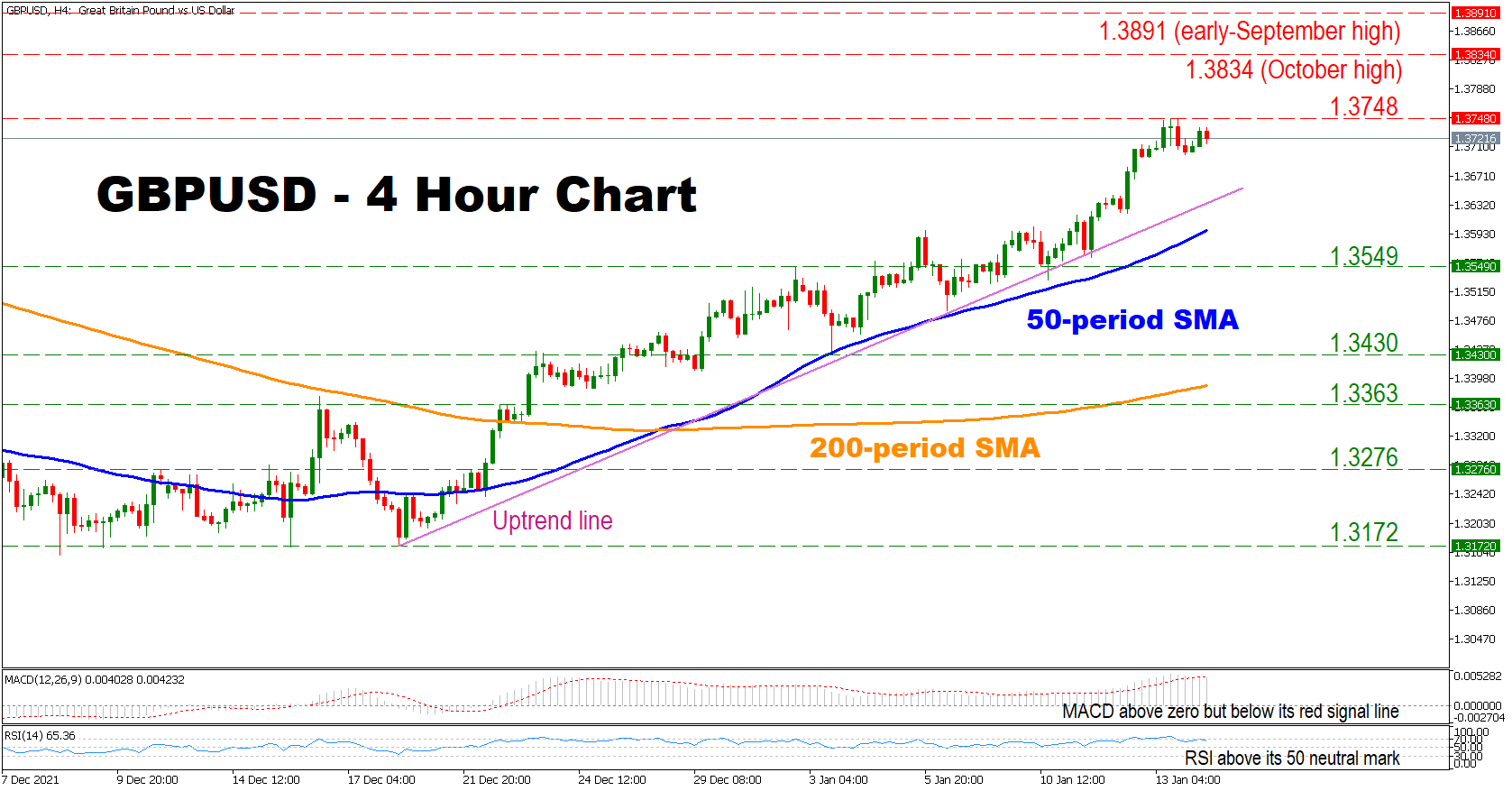
GBPUSD has staged a spectacular uptrend movement from late December amid strengthening positive momentum. Moreover, the pair’s successive higher highs together with the recent golden cross, where the 50-period simple moving average (SMA) has crossed above the 200-period SMA, reinforce the case for a sustained bullish outlook.
Short-term momentum indicators reflect a mixed picture as the RSI is found above its 50 neutral mark. However, despite being above zero, the MACD is located below its red signal line, indicating that the positive momentum might be fading.
Should the bears reassert control, initial resistance might be found at the 1.3748 level. Crossing above the latter could reinforce the pair's positive momentum, opening the door towards the October high at 1.3834, before buyers shift their attention towards the early-September high at 1.3891.
On the flip side, the first major support could be found at the late-December uptrend line before sellers eye the 50-period SMA currently at 1.3597. A break below that level could turn the fortunes around for the pair, pressuring its price towards the 1.3549 hurdle before moving towards the 1.3430 obstacle. Crossing below the latter could open the door towards the 200-period SMA currently at 1.3386.
In brief, the overall outlook for the pair is bullish amid successive higher lows and higher highs. For sentiment to change, sellers would need to drive the price below the 50-period SMA.
Pound Shrugs Off Sharp UK Data
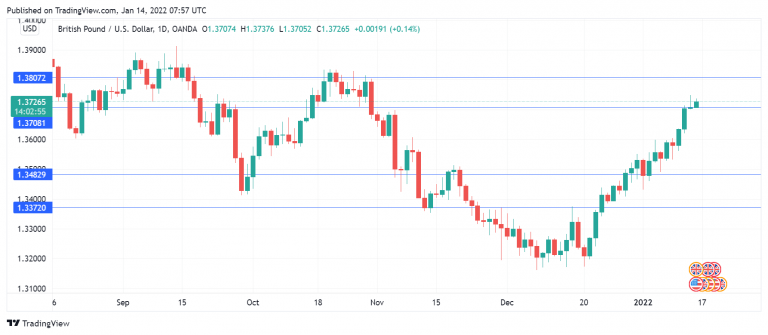
The British pound has posted very slight gains on Friday. In the European session, GBP/USD is trading at 1.3720, up 0.09% on the day.
The pound is yawning despite better than expected UK data today. GDP jumped 0.9% m/m in November, above the consensus of 0.4%, while Manufacturing Production rose 1.1% m/m, crushing the estimate of 0.2%. Both readings were above the October releases, indicating that the UK recovery continues. GDP for Q4 is expected to reach or surpass the pre-Covid level (Q4 2019), barring a disappointing December GDP report.
We continue to see a rotation out of US dollars this week, with the British pound and other majors racking up impressive gains of around 1 percent. The driver behind the US dollar’s weakness has been elevated risk appetite, which has not waned despite exploding Omicron cases, a soft nonfarm payrolls report and a hawkish Federal Reserve. The markets appear to have an answer for all of these developments. The Omicron wave has not wreaked havoc on the global economy, US wage growth is strong, and Fed Chair Jerome Powell is confident that red-hot inflation in the US will ease during the year. Still, risk sentiment can change quickly, and I would not be surprised to see a US dollar comeback in the near term if Omicron is more damaging than anticipated or if inflation heads even higher.
Johnson fighting for political life
Prime Minister Boris Johnson is under intense criticism after revelations that his staff held parties during the height of the Covid lockdowns. One party was apparently held the night before the funeral of Queen Elizabeth’s husband, and a poignant photo of the Queen sitting alone during the funeral has made Party-Gate look even worse. The latest political crisis has not made a dent in the pound’s upswing, perhaps because Johnson is no stranger to controversy or an indication that investors are more concerned about inflation and omicron rather than partying at 10 Downing Street.
GBP/USD Technical Analysis
- There are support lines at 1.3482 and 1.3372.
- GBP/USD continues to test resistance at 1.3708. This is followed by resistance at 1.3818
Daily Technical Analysis
EUR/USD
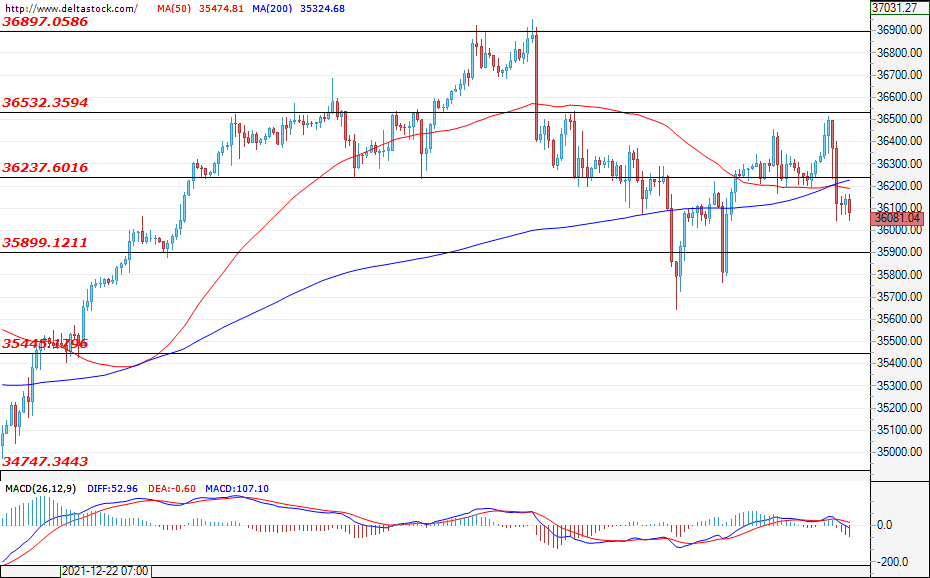
During yesterday's trading session, the U.S. blue-chip index breached the support level of 36237 and the forecast is for the index to test the important support at 35899. A possible breach of this level would deepen the correction, pushing the index towards a test of the support zone of 35445. In case the support at 35899 manages to withhold the bearish pressure, then we may witness a further move towards 36532. Today, increased activity can be expected around the release of the U.S. retail sales data (13:30 GMT).
USD/JPY
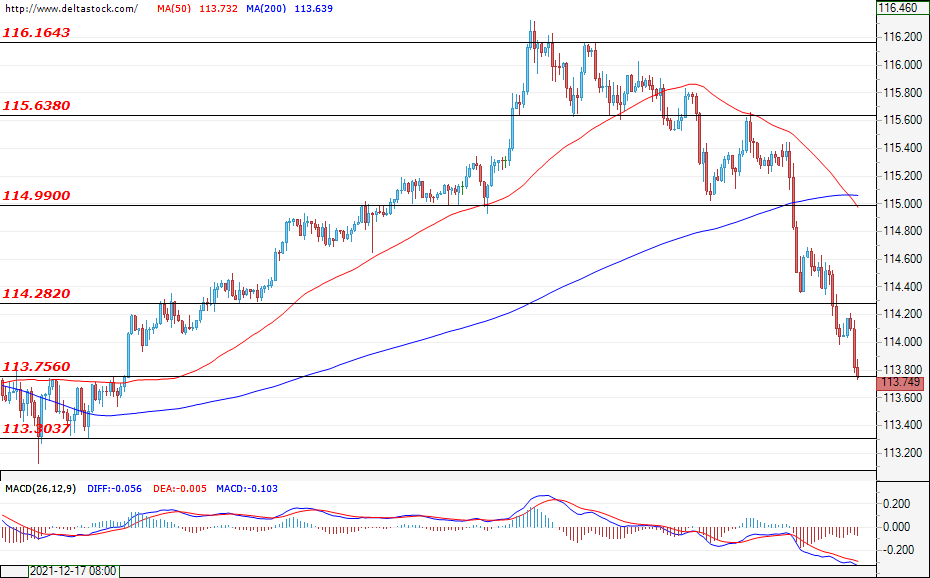
During yesterday's trading session the currency pair breached the support level of 114.28 and, at the time of writing, is headed towards a test at the next support at 113.75. A successful test at this level would deepen the decline, taking the pair towards the support zone at 113.30. In case the support level of 113.75 manages to withold the bearish pressure, then the most likely scenario would be for the pait to enter a consolidation phase in the range between 113.75 and 115.00.
GBP/USD
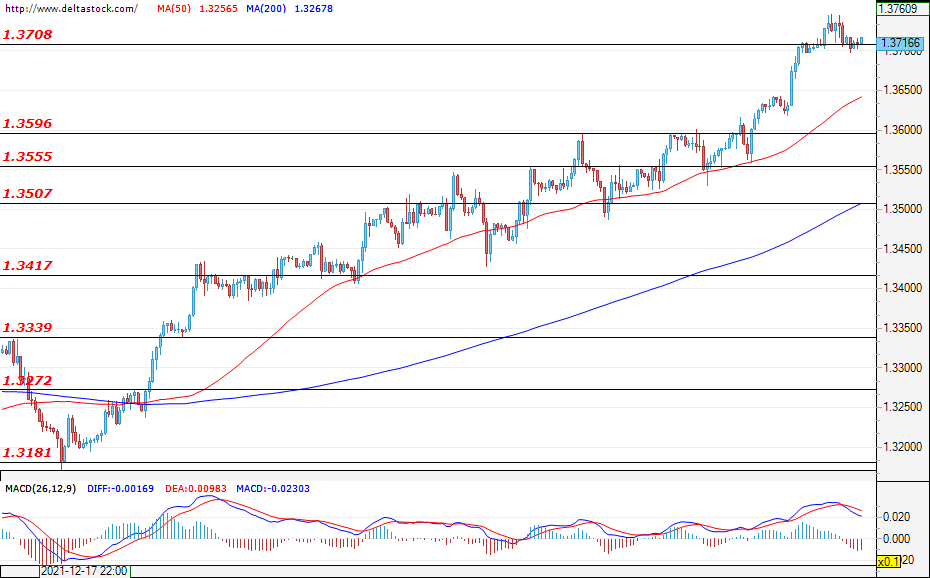
The uptrend of the sterling continues as the Cable breached the psychological level of 1.3700 and, at the time of writing, is consolidating just above this level. The forecast is for the pair to continue its uptrend towards the resistance level of 1.3760, once the consolidation phase is completed. In the negative direction, the first support lies at 1.3596.
EUGERMANY40
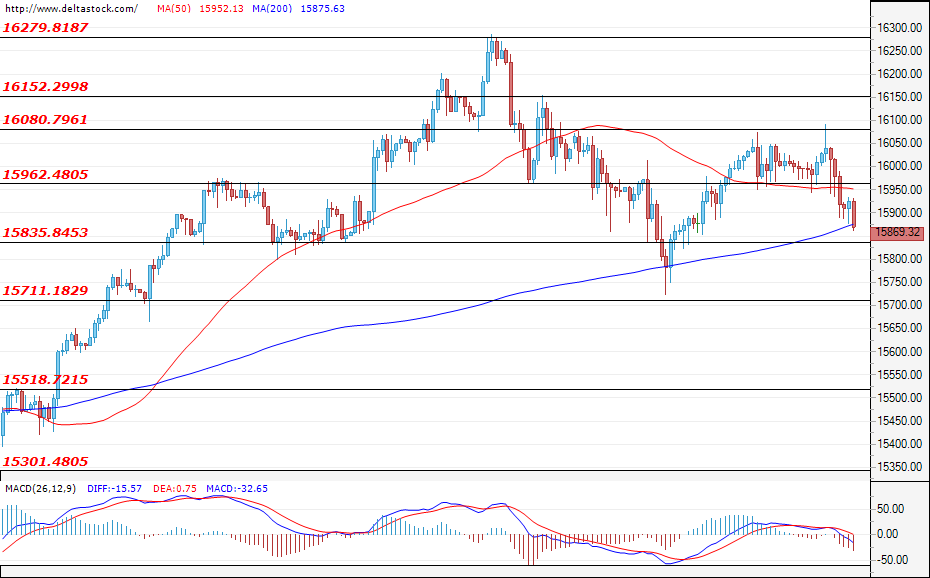
During yesterday's trading session, the German index breached the support level of 15962 and the forecast is for the index to test the important support at 15835. In case the correction ends and the bulls take over the market, then it is possible that we could witness a test of the resistance level of 16080. In case the support at 15835 is violated and the sell-off deepens, then the next targets for the bears would be sitting at 15711 and at 15520, respectively.
US30
During yesterday's trading session, the U.S. blue-chip index breached the support level of 36237 and the forecast is for the index to test the important support at 35899. A possible breach of this level would deepen the correction, pushing the index towards a test of the support zone of 35445. In case the support at 35899 manages to withhold the bearish pressure, then we may witness a further move towards 36532. Today, increased activity can be expected around the release of the U.S. retail sales data (13:30 GMT).
XAG/USD Tests Major Resistance
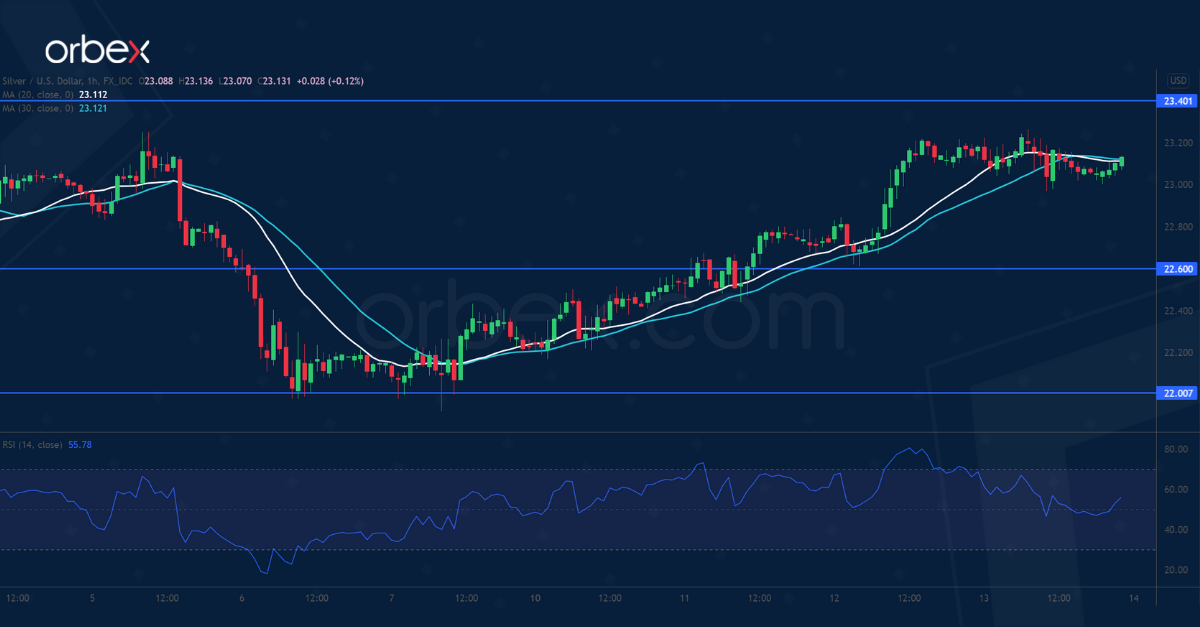
Silver extends its recovery on the back of a weak US dollar. The metal saw support at the psychological level of 22.00.
A break above the resistance at 22.80 and then an acceleration to the upside indicates strong buying interest. An overbought RSI has temporarily held the rally back.
The bulls are testing the daily resistance at 23.40. A breakout could shake sellers out and trigger a reversal above 24.00. On the downside, buyers could be lurking around 22.60 in case of a pullback.
EUR/GBP Stuck in Bearish Trend
The euro rose after ECB Vice President Luis de Guindos said the inflation spike may last longer than projected.
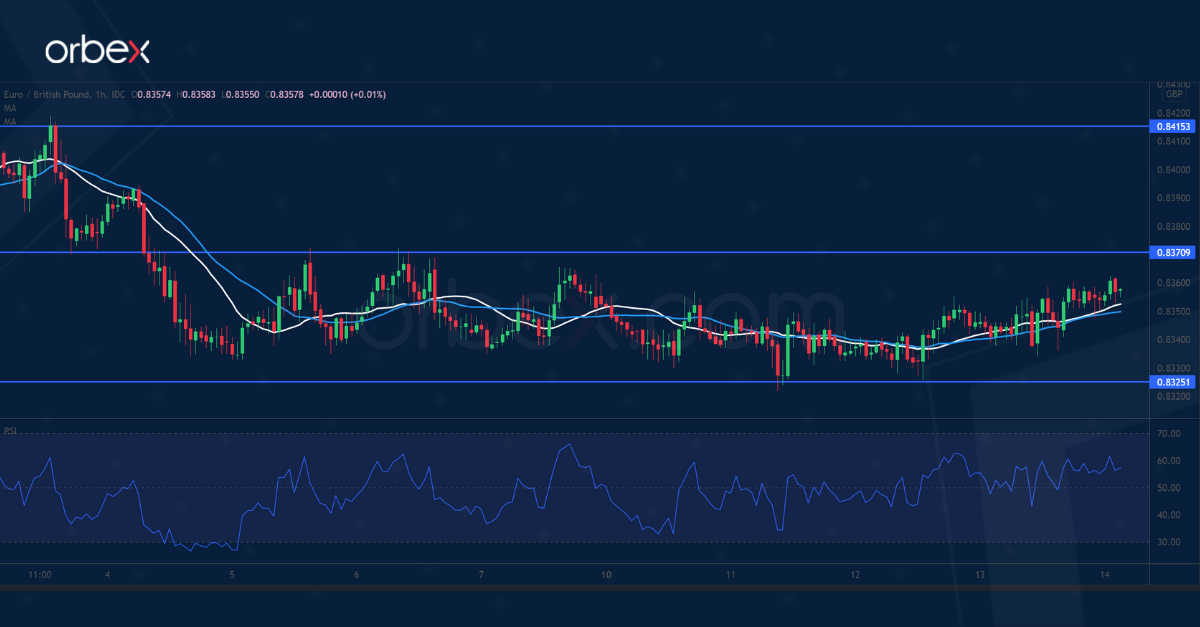
Nonetheless, the bearish sentiment still prevails after the pair failed to hold on to 0.8370. The former support has now turned into a resistance. The current consolidation could be a distribution phase and a drop below 0.8325 could send the price to February 2020's lows near 0.8290.
On the upside, the bulls have the challenging task of lifting offers around 0.8370 and then 0.8415 before they could attract more followers.
US 100 Revisits Major Support
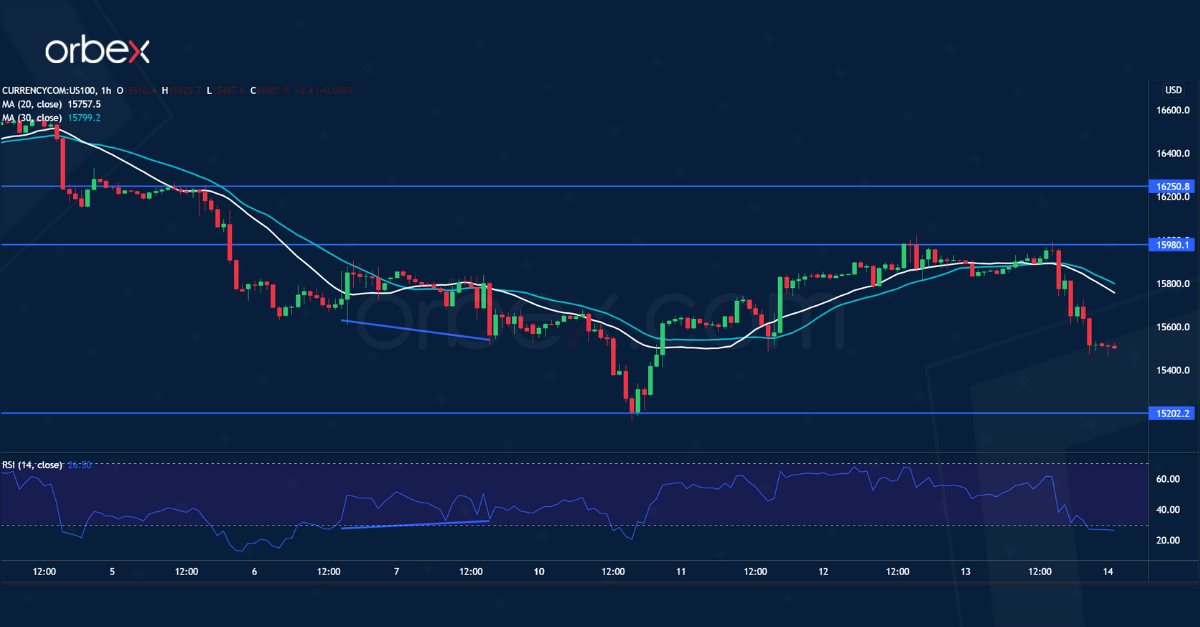
The Nasdaq 100 faltered after an unexpected rise in US initial jobless claims. The tech index bounced off the demand zone around 15200 which used to be a resistance on the daily chart.
A bullish divergence revealed a slowdown in the sell-off momentum. The latest break above 15820 prompted some sellers to cover but came under pressure at 15980.
After intraday traders took profit, 15200 is a critical support to keep the rebound relevant. A deeper correction would send the price to 14900.
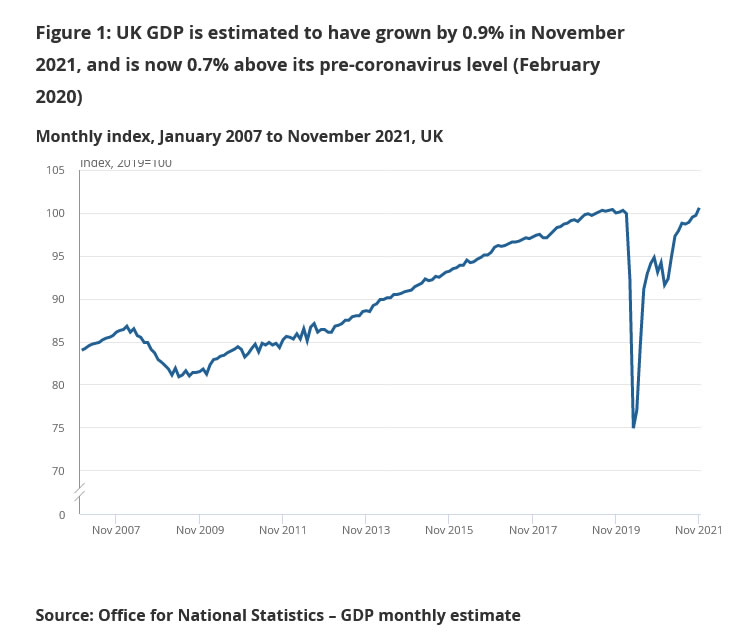
UK GDP grew 0.9% mom in Nov, back above pre-pandemic level
UK GDP rose strongly by 0.9% mom in November, well above expectation 0.4% mom. Looking at some details, services grew 0.7%, production rose 1.0% mom, and production increased 3.5% mom.
Monthly GDP was back above pre-COVID level in February 2020, for the first time, by 0.7%. Also, if there are no other data revision, Q4 GDP should either reach or surpass its pre-coronavirus level in Q4 2019, provided monthly December GDP does not fall by more than -0.2% mom.
Also released, industrial production rose 1.0% mom, 0.1% yoy versus expectation of 0.2% mom, 0.5% yoy. Manufacturing rose 1.1% mom, 0.4% yoy, versus expectation of 0.2% mom, -0.3% yoy. Index of services rose 1.3% 3mo3m, versus expectation of 0.5%. Goods trade deficit narrowed slightly to GBP -11.3B, versus expectation of GBP -14.2B.
Sunrise Market Commentary
Markets
US equities suffered a violent sell-off yesterday. Investors especially targeted the Nasdaq (-2.51%). The tech-heavy stock index is sensitive to (expectations of) higher rates. This is probably what drove Thursday's move. In her Fed chair nomination appearance before the Senate, Brainard held a particular focus on inflation and became the latest governor to advocate a March rate hike. Being one of the biggest monetary doves within the committee, that marks a big shift. She said inflation is expected closer to 2.5% end this year but admitted these projections should be taken with caution. Fed's Waller later said three rate hikes is still a good baseline for this year though added that if inflation stays high it could be four or even five. He currently doesn't favour a 50 bps hike in March but the word is officially out. Waller said shrinking the balance sheet could start by summer. US bond yields stuck to their ST downward momentum, perhaps helped by further easing PPI figures suggesting supply-side inflationary pressures may have peaked. The curve flattened with changes ranging between -2.6 and -4.5 bps. German yields eased 1.2 bps (2y) to 4.7 bps (30y). ECB VP de Guindos warned inflation may not be as transitory as earlier thought. His comments were largely ignored though. EUR/USD closed a tad higher, just south of 1.146 resistance, mainly on continued yet marginal dollar weakness. DXY held below 95. The Japanese yen and Swiss France outperformed. Sterling eased but EUR/GBP remains trapped near recent 2-year lows (0.835/6).
A Japanese shocker. Reuters reported the central bank is debating how to start communicating on a possible interest rate hike. While not imminent, that may come even before inflation reaches its 2% target. Japanese bond yields increase 1-1.6 bps across the curve with the short to medium segment trading near or at the highest level since the introduction of negative rates in early 2016. In other central bank news, South Korea hiked for a third time (see headline below). Asian-Pacific stocks drop with both Japan and SK underperforming. The dollar is under pressure on FX markets, JPY and NOK take the lead. Core bonds retreated from yesterday's rally.
US retail sales and U. of Michigan consumer sentiment put Joe Sixpack in the spotlights. Brainard yesterday said they are "hearing from working families" about inflation. It may indeed have affected spending and confidence. Combined with some cautiousness ahead of the long US weekend (Martin L. King Day), we don't expect the current upward yield move in Asian dealings to go very far. The US 10y does find support relatively soon at 1.70%. For the German 10y support lies at -0.10%/-0.117%. EUR/USD's technical have improved a bit today as well by currently capping 1.146. A close above 1.1495 would be a nice plus for the currency pair.
New Headlines
The Bank of Korea conducted its second consecutive 25 bps rate hike this morning – the third since August – raising the policy rate to 1.25%, matching the pre-pandemic level from Q4 2019. BoK governor Lee Ju-yeol said that inflationary pressures will be much larger than earlier expected (a considerable amount of time over 3%) while uncertainties surrounding the pandemic are unlikely to derail the domestic economic recovery. BoK Lee thinks of monetary policy as still being accommodative, adding that another hike wouldn't amount to tightening. Lee's term as governors ends after the Feb 24 policy meeting. South Korean FM Hong Nam-Ki announced an extra budget (to be funded by debt issuance) ahead of the BoK meeting, also giving more leeway for additional monetary policy tightening. The Korean won didn't really profit from today's decision with USD/KRW stable near 1187.
EU justice commissioner Reynders told the FT that the EC will demand from Poland to pay €69mn in accumulated daily fines since early November. If Warsaw doesn't comply, the EU intends to withhold more than €100mn from EU payments to Poland to cover those unpaid running fines (+interest) imposed by the EU's Court of Justice. Separately, the EC is also moving to withhold around €50mn of fines with regard to another legal dispute involving Poland and the Czech Republic. The latter complained about illegal Polish operations at a lignite mine. The zloty yesterday lost some ground against a strong euro, but EUR/PLN remains near the recent lows at 4.54.