

Sample Category Title
EUR/JPY Weekly Outlook
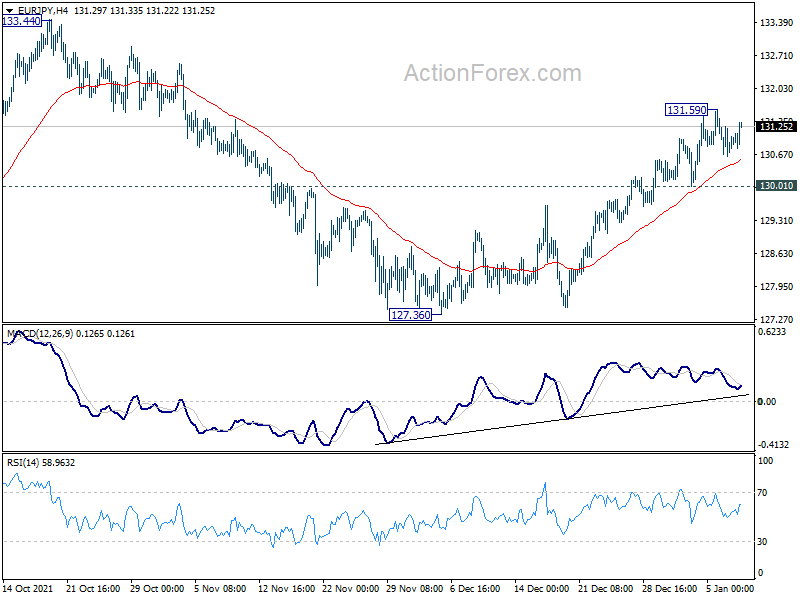
EUR/JPY rose to 131.59 last week but retreated since then. Initial bias stays neutral this week for some consolidations. But further rally is expected as long as 130.01 support holds. Whole consolidation from 134.11 could have completed with three waves down to 127.36, ahead of 126.58 medium term fibonacci level. Break of 131.59 will target a test on 133.44/134.11 resistance zone. On the downside, break of 130.01 minor support will turn bias bias to the downside for retesting 127.36 low instead.
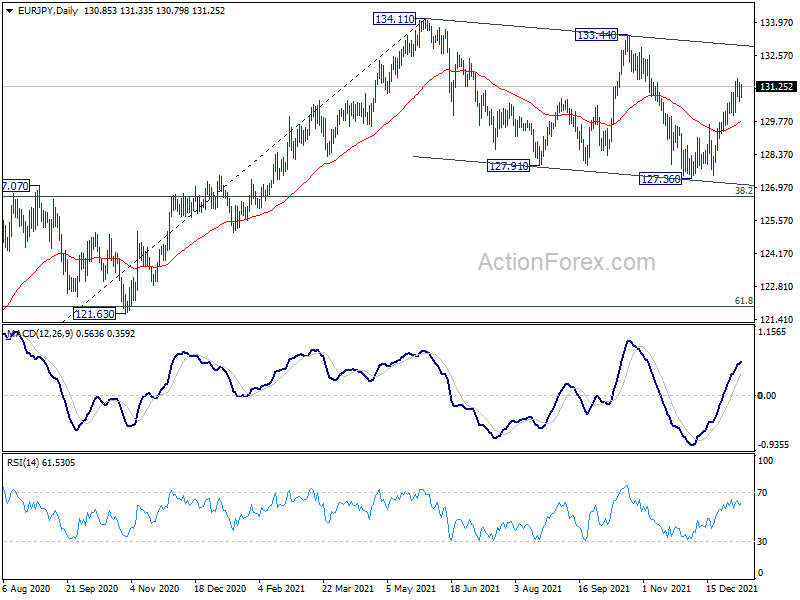
In the bigger picture, as long as 38.2% retracement of 114.42 (2020 low) to 134.11 at 126.58 holds, up trend from 114.42 is still in favor to continue. Break of 134.11 will target long term resistance at 137.49 (2018 high). However, sustained break of 126.58 will raise the chance of medium term bearish reversal. In this case, deeper decline would be seen to 61.8% retracement at 121.94, and possibly below.
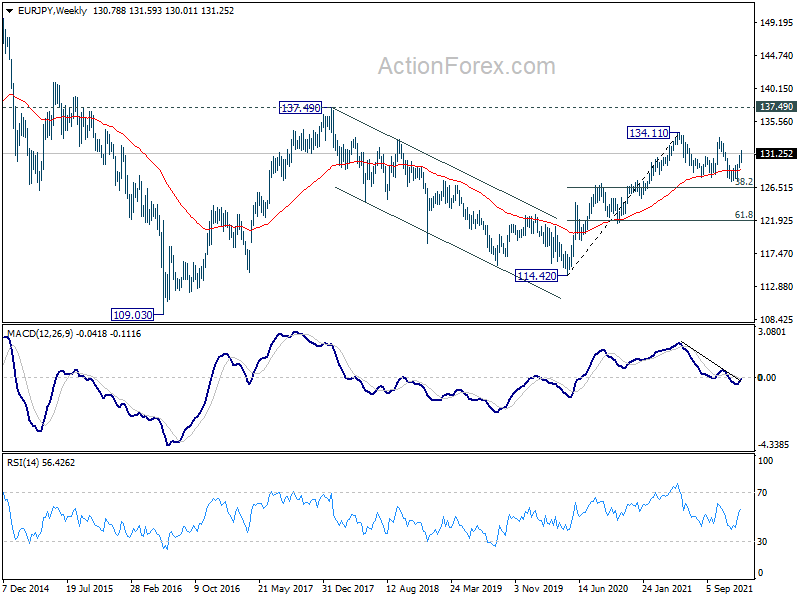
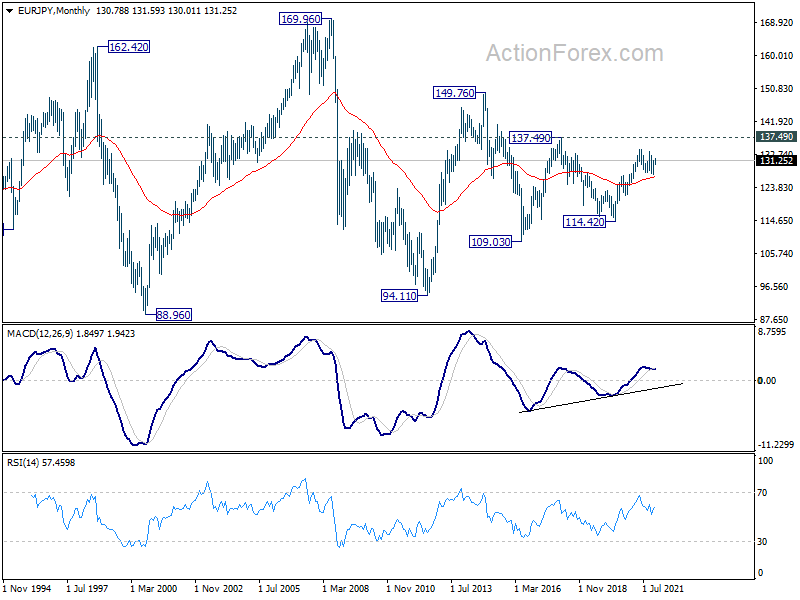
In the long term picture, EUR/JPY is staying in long term sideway pattern, established since 2000. Long term outlook will remain neutral until breakout from the range of 109.03/137.49.
EUR/GBP Weekly Outlook
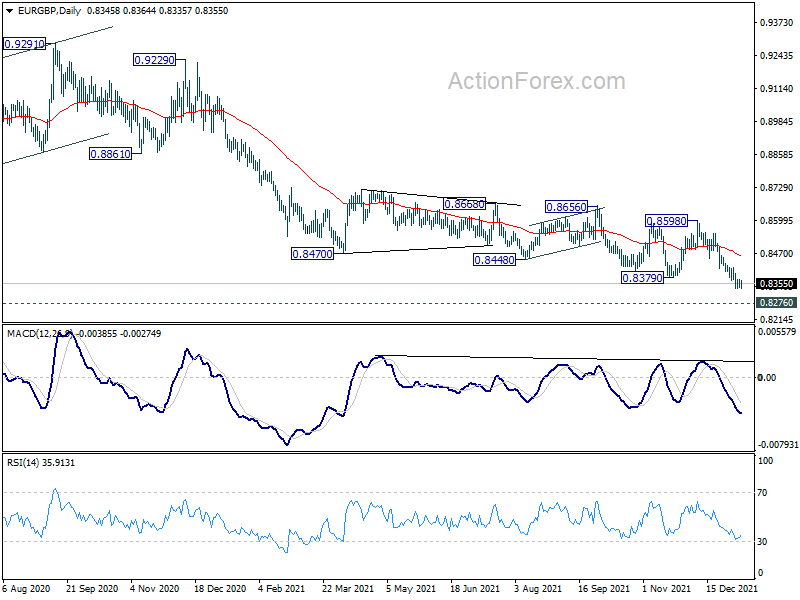
EUR/GBP dropped further to 0.8333 last week but turned sideway since then. Initial bias is neutral this week first for some consolidations. Outlook stays bearish as long as 0.8417 resistance holds. Break of 0.8333 will resume larger down trend for 0.8276 key long term support. On the upside, above 0.8417 minor resistance will turn bias back to the upside for stronger rebound.
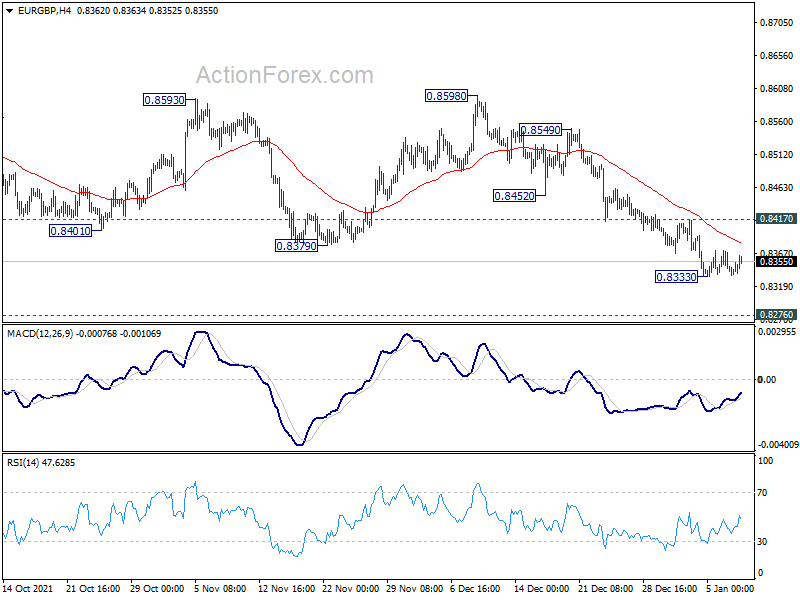
In the bigger picture, price actions from 0.9499 (2020 high) are still seen as developing into a corrective pattern. Deeper fall could be seen as long as 0.8598 resistance holds, towards long term support at 0.8276. We'd look for bottoming signal around there to bring reversal. Meanwhile, firm break of 0.8598 will now be an early sign of medium term bottoming and bring stronger rebound. However, sustained break of 0.8276 will argue that the long term trend has reversed.
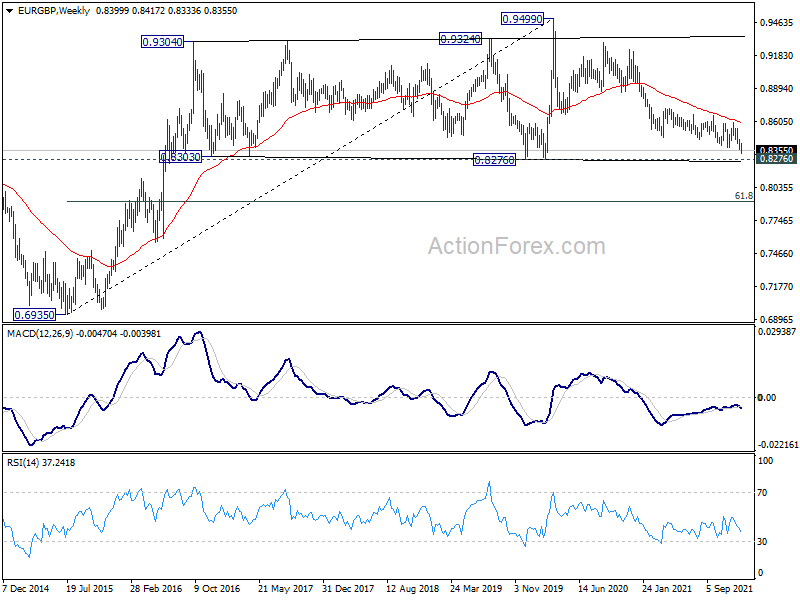
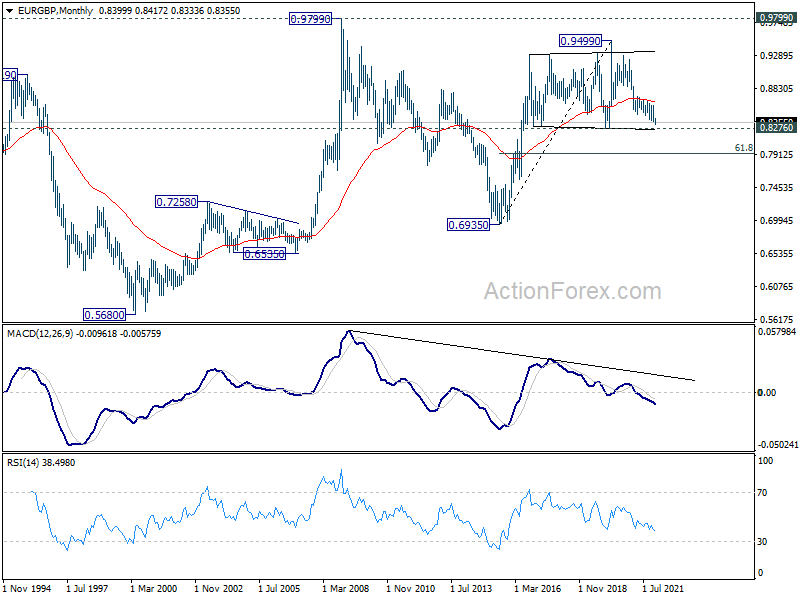
In the long term picture, outlook will stay bullish as long as 0.8276 support holds. Break of 0.9499 is in favor at a later stage, to resume the up trend from 0.6935 (2015 low). However, sustained break of 0.8276 will indicate long term trend reversal, and target 61.8% retracement of 0.6935 to 0.9499 at 0.7917, and possibly below.
EUR/AUD Weekly Outlook
EUR/AUD rebounded notably last week but stayed below 1.5898 resistance. Initial bias remains neutral this week first. On the downside, break of 1.5559 will resume the fall from 1.6168 to retest 1.5250/5354 support zone. On the upside, however, break of 1.5898 will argue that pull back form 1.6168 has completed. Intraday bias will be back to the upside for 1.6168 resistance.
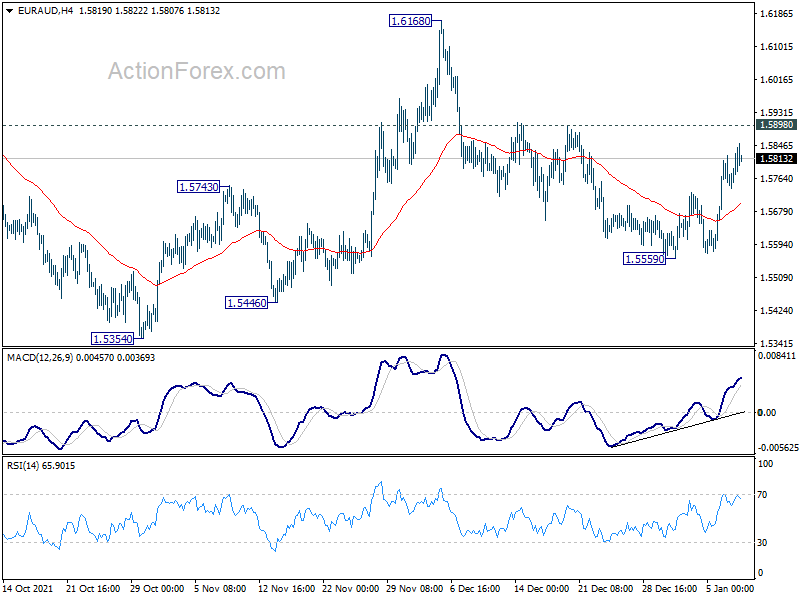
In the bigger picture, rise from 1.5354 is seen as the third leg of the corrective pattern from 1.5250 low. Further rise cannot be ruled out, but even in that case, strong resistance should be seen at 38.2% retracement of 1.9799 to 1.5250 at 1.6988. Larger down trend from 1.9799 is in favor to extend through 1.5250 at a later stage.
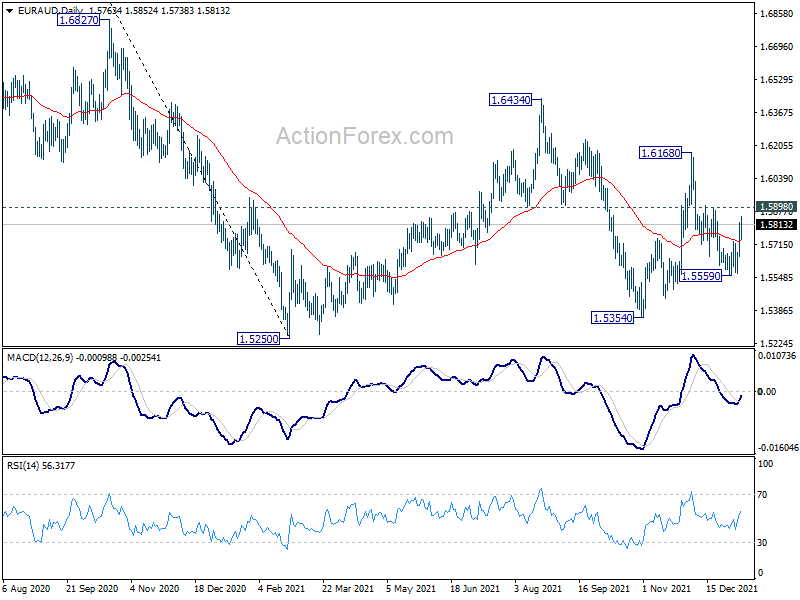
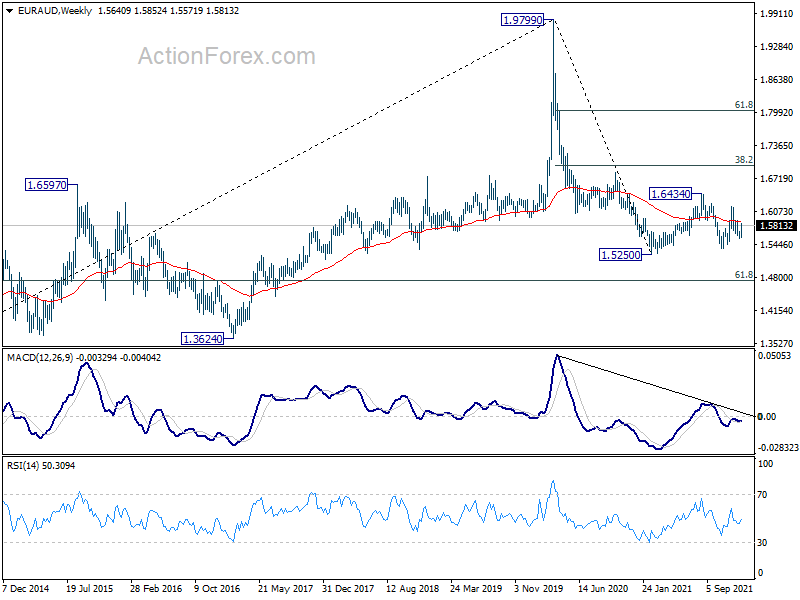
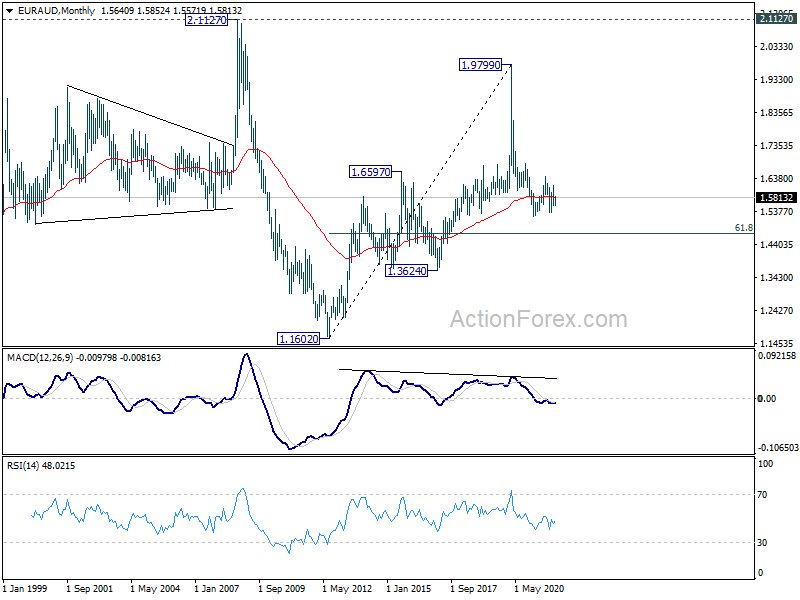
In the longer term picture, fall from 1.9799 (2020 high) is seen as a long term down trend. Further decline will remain in favor as long as 38.2% retracement of 1.9799 to 1.5250 at 1.6988 holds. Break of 1.5250 will target 61.8 retracement of 1.1602 (2012 low) to 1.9799 at 1.4733
EUR/CHF Weekly Outlook
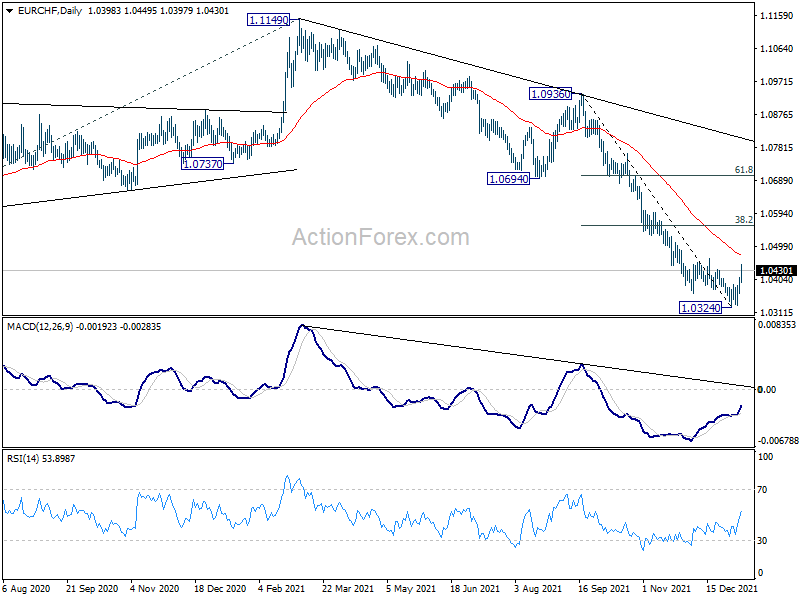
EUR/CHF's strong rebound last week suggests that a short term bottom was already formed at 1.0324, on bullish convergence condition in 4 hour and daily MACD. Initial bias is now on the upside this week for 55 day EMA (now at 1.0474). Sustained break there will target 38.2% retracement of 1.0936 to 1.0324 at 1.0558. On the downside, below 1.0397 minor support will bring retest of 1.0324 low instead.
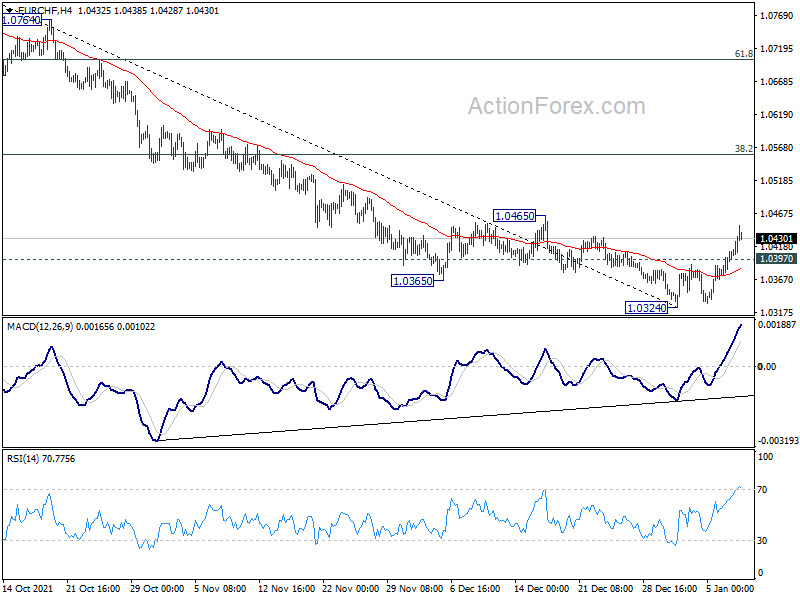
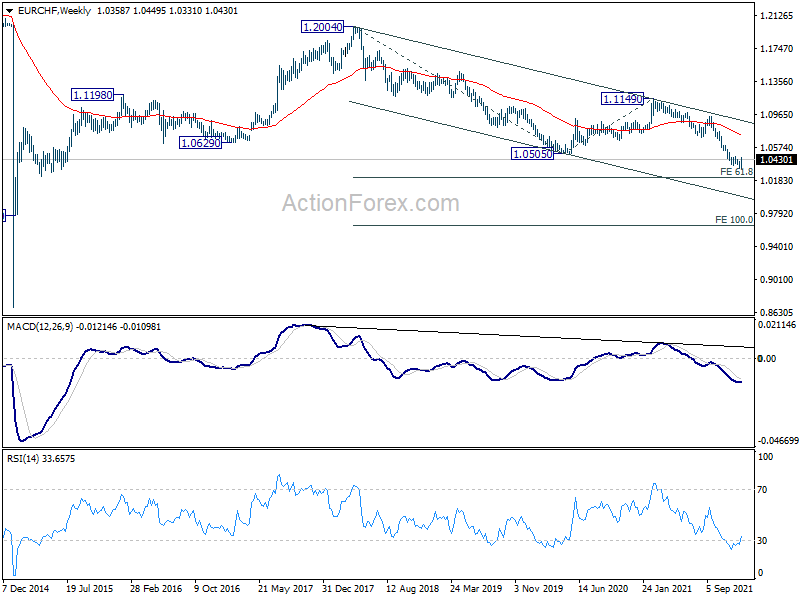
In the bigger picture, long term down trend from 1.2004 (2018 high) is now extending. Next target is 61.8% projection of 1.2004 to 1.0505 to 1.1149 at 1.0223. On the upside, break of 1.0505 support turned resistance is needed to be the first sign of medium term bottoming. Otherwise, outlook will remain bearish even in case of rebound.
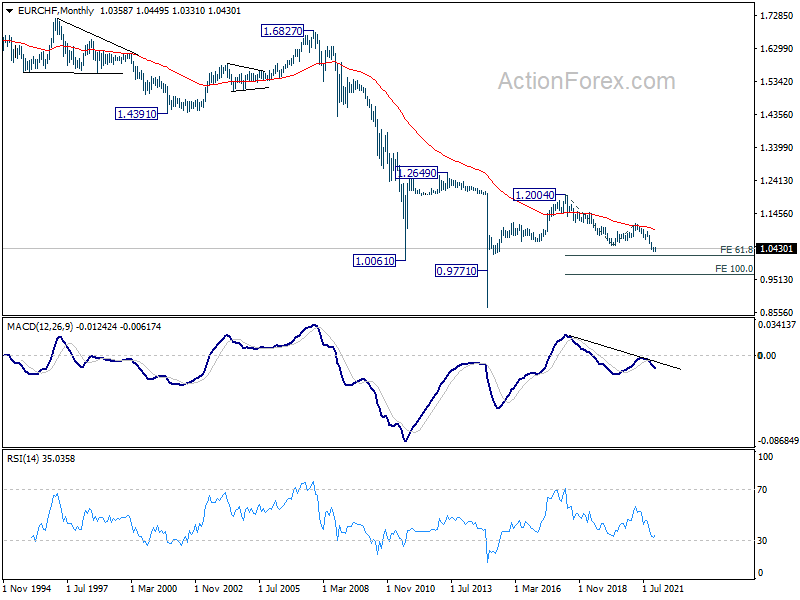
In the long term picture, rejection by 55 month EMA (now at 1.1015) maintains long term bearishness. Down trend from 1.2004 is now in progress for 61.8% projection of 1.2004 to 1.0505 to 1.1149 at 1.0223. Firm break there will target 100% projection at 0.9650.
Dollar Failing to Ride on Hawkish Fed and Surging Yields
It was a roller coaster ride as traders came back for the new year. Markets were in full risk-on mode as worries over Omicron faded. Yet, sentiment turned after more hawkish than expected FOMC minutes. Major stock indexes were than in deep pull back. Major global benchmark treasury yields powered through key resistance level.
In the currency markets, Sterling was the surprised winner. Dollar, ended as the second strongest, has indeed failed to ride on hawkish Fed and surging yields. The greenback was more mixed than the currency heat map suggested. Yen regained some ground ground after initial selloff. Aussie and Kiwi were the worst performer, and would be guided by overall risk sentiment ahead.
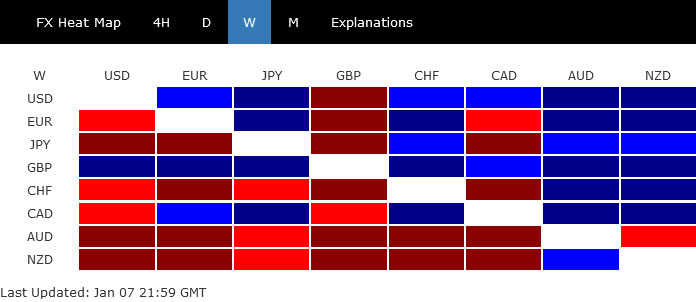
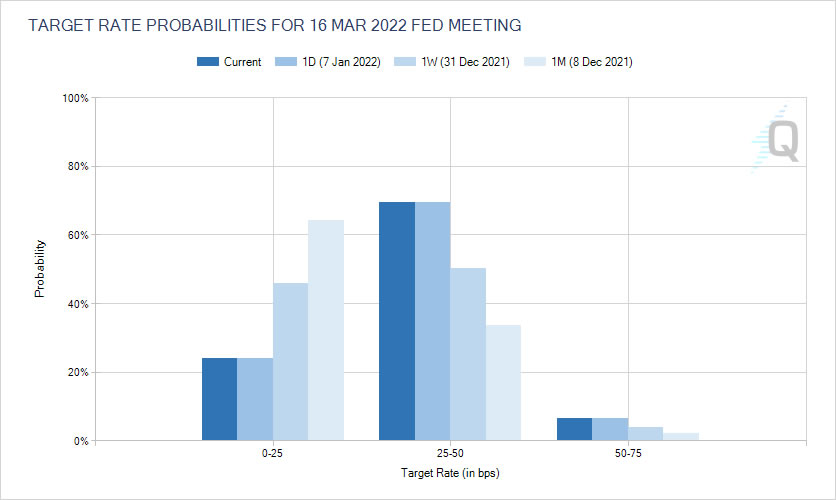
Markets adding more bets to March Fed hike
The surprisingly hawkish minutes of December FOMC meeting were the main driver of market volatility last week. Fed is not only seen as ready to raise interest rate as early as in March. It's even starting to thinking about shrinking the balance sheet soon after rate lift off.
The December non-farm payroll report might disappointed the markets with the much weaker than expected job growth. Yet, unemployment is back below 4% at 3.9%. Wage growth accelerated with average hourly earnings gaining an impressive 0.6% mom. The set of data indicated tightness in the labor market which would continue to put upward pressure on wages and thus inflation. Fed should have came out in a stronger position for stimulus remove.
Indeed Fed funds futures are now pricing in nearly 76% of a rate hike in March, comparing to 65% a week ago, and 36% a month ago.
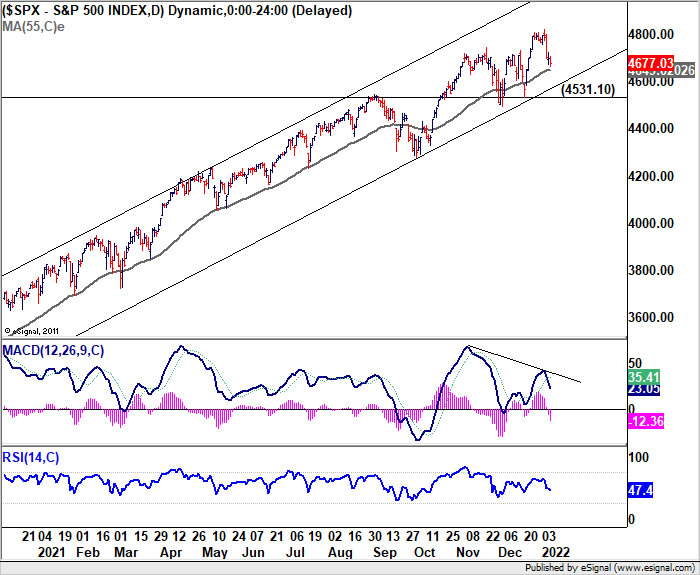
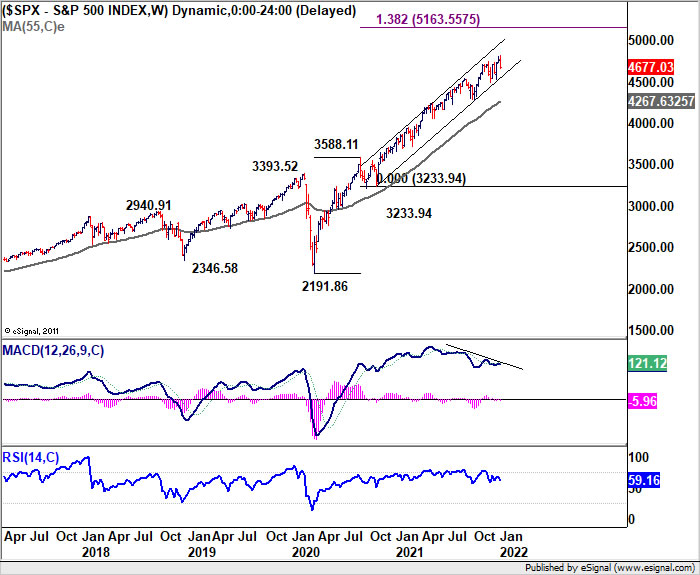
S&P 500 staying in up trend despite deep pull back
Stocks had a rather deep pull back on hawkish Fed, but there was no disaster. S&P 500 is losing upside momentum as seen in daily MACD. But there is no clear sign of major topping yet, with the index staying above 55 day EMA and well inside the medium term rising channel. Current up trend is still on track to 5000 handle, and even further to 138.2% projection of 2191.86 to 3588.11 from 3233.94 at 5163.55.
Nevertheless sustained trading below 55 day EMA (now at 4649.02) will be the first warning of reversal. Further break of 4531.10 support will indicate the start of a medium term correction.
10-year yield resumes medium term up trend towards 2% and above
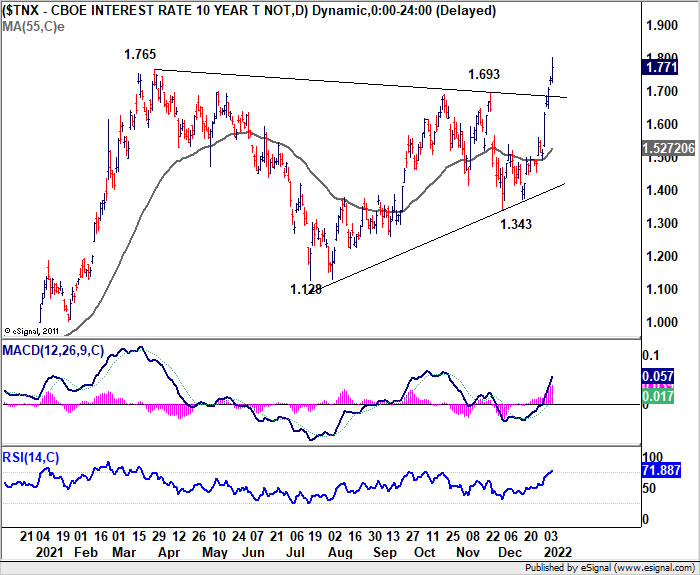
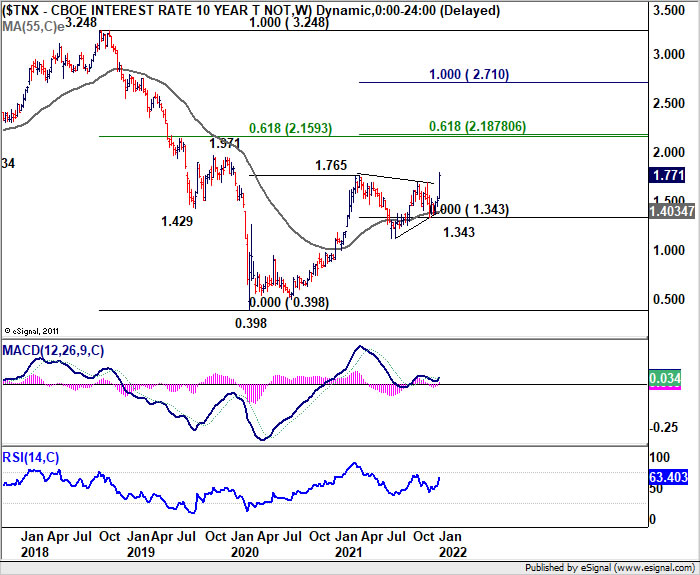
10-year yield surged through 1.765 key resistance to close at 1.771. The development should confirm resumption of whole up trend from 0.398. The strong support from 55 week EMA also affirm medium term bullishness. TNX should target 2% handle, and possibly above.
The next critical zone will be at 61.8% retracement of 3.248 to 0.398 at 2.159, which is close to 61.8% projection from 0.398 to 1.765 from 1.343 at 2.187. Some defining development would need to happen before we see TNX pushing with this resistance zone with conviction.
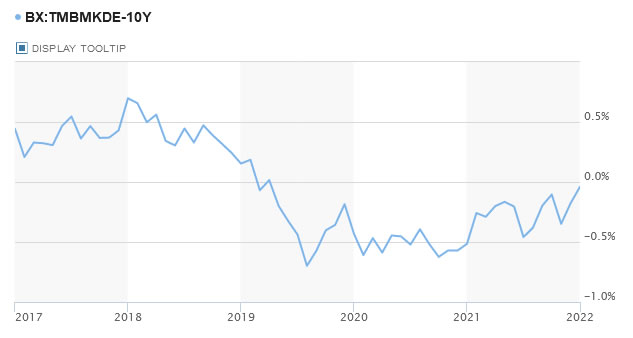
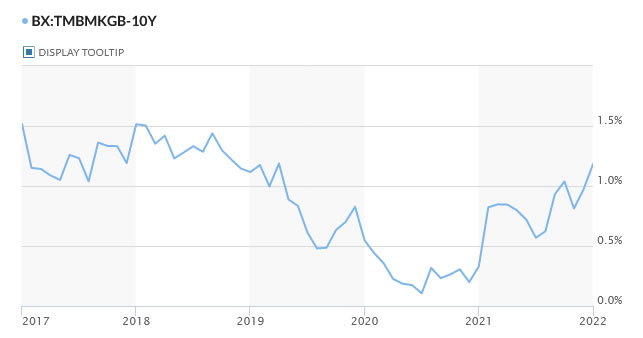
The rally in US treasury yield lost much of the impact on Dollar, as other global benchmark yields were catching up quickly. Germany 10-year bund yield rose to close at -0.04, hitting the highest level since 2019, and looks set to turn positive soon. UK 10-year gilt yield also rose to close at 1.182, highest since 2019. Even Japan 10-year JGB yield surged to 0.135, back above 0.1% handle in nearly a year.
Dollar staying bullish in consolidation... for now
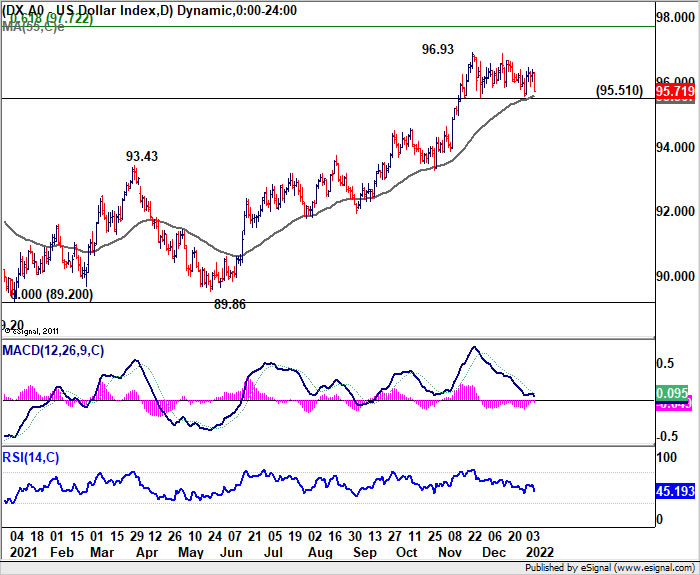
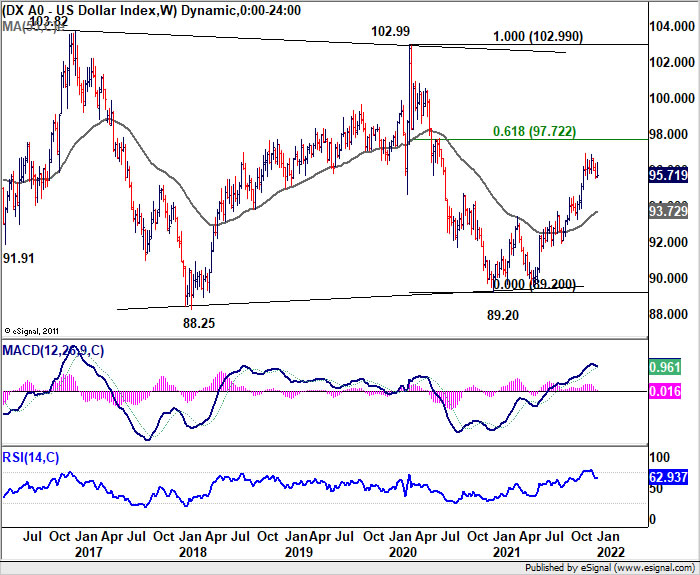
Dollar index stayed in range below 96.93 last week and outlook is unchanged. Further rise is expected as long as 95.51 support holds. The rally from 89.20 should extend to 61.8% retracement of 102.99 to 89.20 next. However, firm break of 96.93 would bring deeper pull back towards 55 week EMA (now at 93.72) instead.
Bitcoin to extend down trend towards 35k
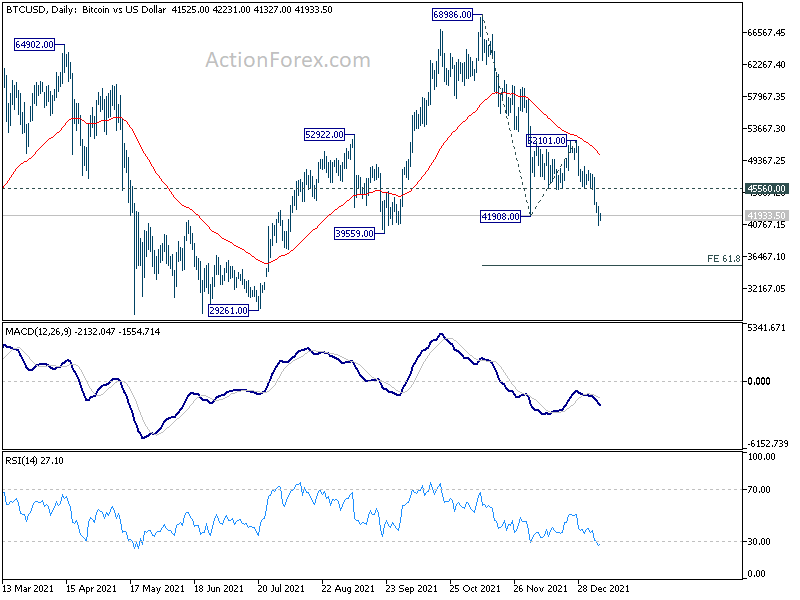
Some other markets seemed to have much more committed response to Fed. For example, Bitcoin dived through 41908 low to resume the decline from 68986. Such fall is seen as at the same degree as the rise from 29161 to 68986. While there might be some support around 39559, which is close to 40k handle, to bring recovery. Upside should be limited by 45560 support turned resistance. Bitcoin should have a take on 61.8% projection of 68986 to 41908 from 52101 at 35366 before forming a bottom.
Gold might have completed recovery, heading back to 1700
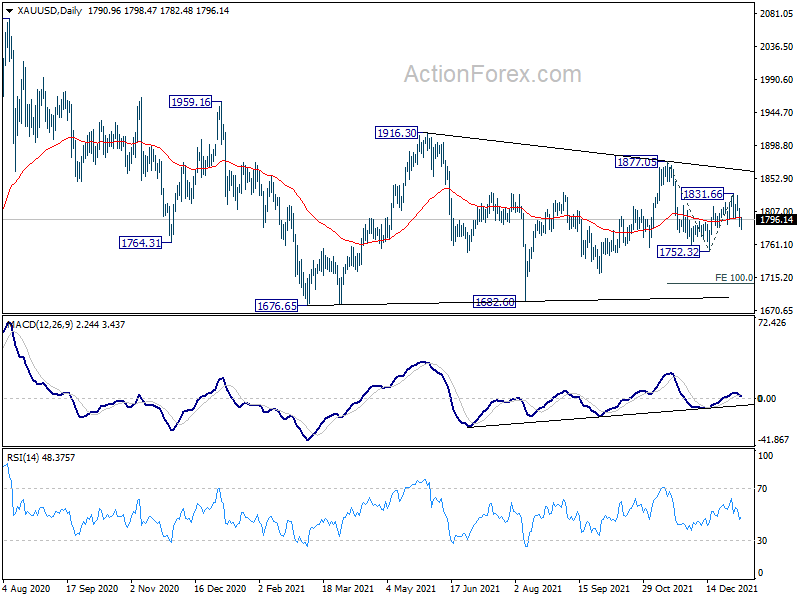
Gold's decline argues that recovery from 172.32 has completed at 1831.66. Fall from 1877.05, as the fourth leg of the pattern from 1676.65, is probably ready to resume. Sustained trading below 55 day EMA (now at 1798.60) will target 1752.32 support. Break will confirm this bearish case and target 100% projection of 1877.05 to 1752.32 from 1831.66 at 1706.93.
GBP/USD Weekly Outlook
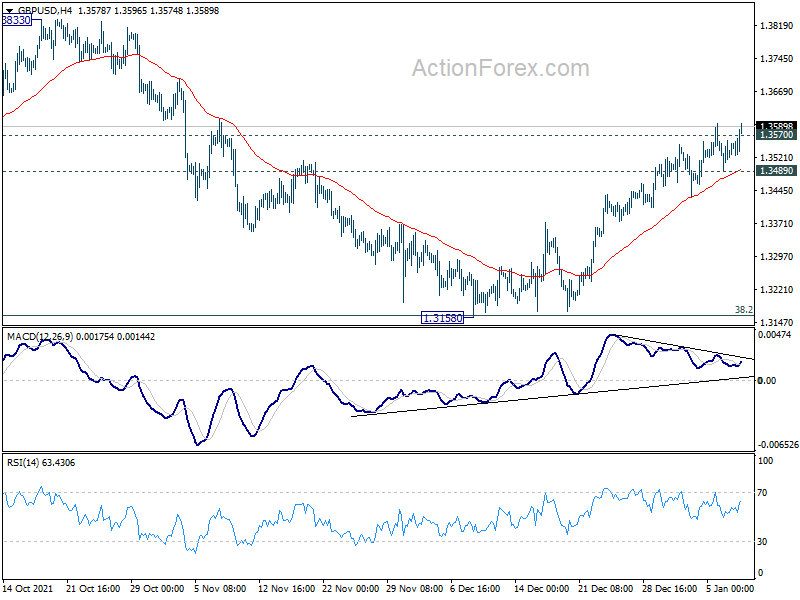
GBP/USD's rebound from 1.3158 extended higher last week and breached 1.3570 support turned resistance. The development affirms the view that corrective fall from 1.4248 as complete with three waves down to 1.3158, after hitting 1.3164 medium term fibonacci level. Sustained trading above 1.3570 will pave the way to 1.3833 resistance next. On the downside, though, break of 1.3489 minor support will mix up the outlook and turn intraday bias neutral first.
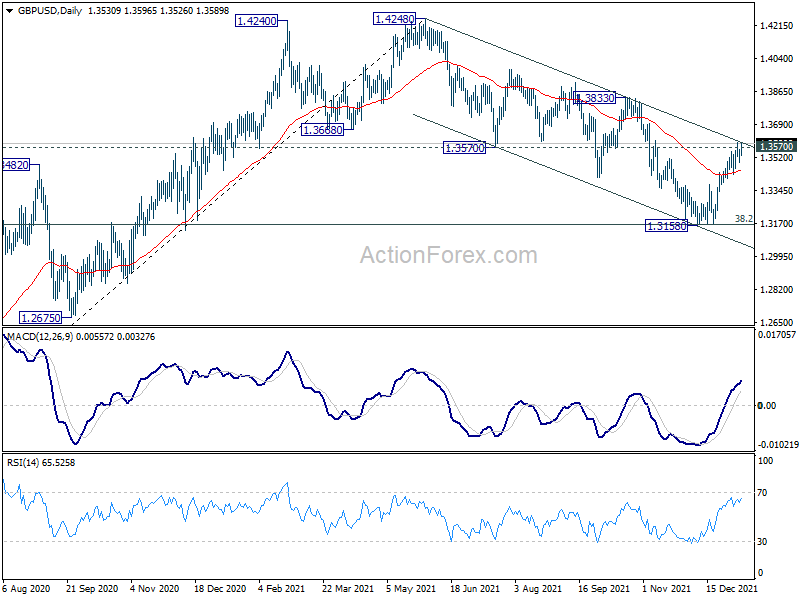
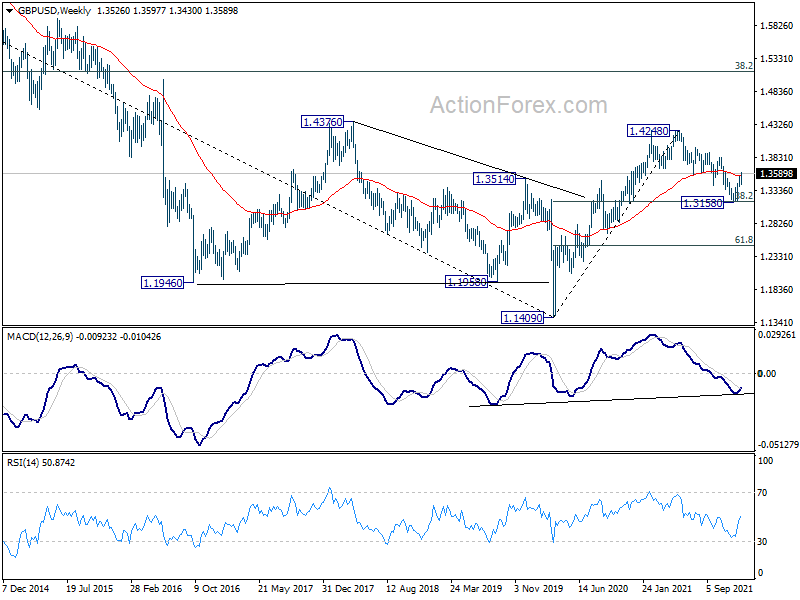
In the bigger picture, strong support was seen from 38.2% retracement of 1.1409 to 1.4248 at 1.3164. The development suggests that up trend from 1.1409 (2020 low) is still in progress. On resumption, next target will be 38.2% retracement of 2.1161 to 1.1409 at 1.5134. Nevertheless sustained break of 1.3164 will argue that whole rise from 1.1409 has completed and bring deeper fall to 61.8% retracement at 1.2493.
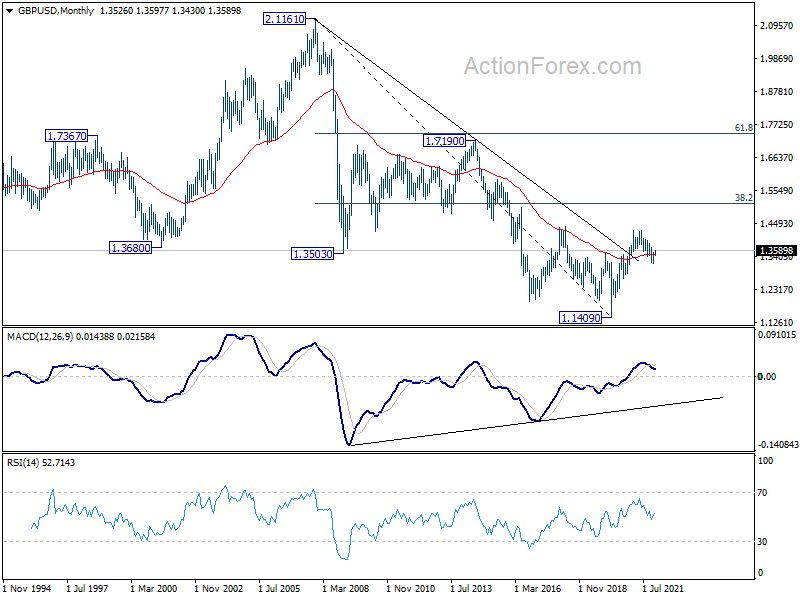
In the longer term picture, a long term bottom should be in place at 1.1409, on bullish convergence condition in monthly MACD. Rise from there would target 38.2% retracement of 2.1161 to 1.1409 at 1.5134. Reaction from there would reveal whether rise from 1.1409 is just a correction, or developing into a long term up trend.
Summary 1/10 – 1/14
Monday, Jan 10, 2022
[php_everywhere instance="1"]
Tuesday, Jan 11, 2022
[php_everywhere instance="2"]
Wednesday, Jan 12, 2022
[php_everywhere instance="3"]
Thursday, Jan 13, 2022
[php_everywhere instance="4"]
Friday, Jan 14, 2022
[php_everywhere instance="5"]
Weekly Economic & Financial Commentary: Strong Momentum Prior to Omicron, Despite December’s Soft Payroll Print
Summary
United States: Strong Momentum Prior to Omicron, Despite December's Soft Payroll Print
- The Fed's more hawkish tone in December's FOMC minutes set the tone for financial markets this week, overshadowing the record surge in COVID infections. December's jobs data were disappointing and a bit confusing. Nonfarm employment rose far less that expected, with employers adding just 199K jobs. The household employment data, however, had another strong gain. The number of employed persons rose by 651K. The unemployment rate fell to 3.9%. Slightly softer-than-expected ISM manufacturing and services reports and a wider trade gap suggest supply-chain issues were easing prior to the Omicron surge. Unfortunately, that surge will likely reverse some of this improvement.
- Next week: CPI (Wednesday), Retail Sales (Friday), Industrial Production (Friday)
International: Eurozone Growth Likely to Slow, Inflation Potentially Nearing a Peak
- The Eurozone December CPI surprised to the upside with a gain of 5.0% year-over-year, although underlying inflation measures were steady to slower, hinting that a peak in inflation may not be far away. On the activity front, Eurozone retail sales rose solidly in November, though that came ahead of a significant surge in COVID cases in recent weeks, and a drop in Eurozone December economic confidence suggests slower growth last month.
- Next week: Australia Retail Sales (Tuesday), Brazil CPI (Tuesday), U.K. Monthly GDP (Friday)
Interest Rate Watch: The Bond Market is Pricing In More Fed Tightening
- The New Year has gotten underway with a notable rise in longer-term interest rates. Recent economic data have contributed to expectations of more aggressive Fed action.
Credit Market Insights: Holders of Student Loans Get Another Payment Reprieve
- The Biden administration has extended student relief to May 1, 2022, pushing back payments for more than 40 million Americans.
Topic of the Week: The Omicron Surge
- COVID is back, and it is everywhere. Fortunately, vaccines, therapeutics, increased immunity and the less intrinsic virulence of Omicron appear to be decreasing severe outcomes. That noted, the Omicron surge represents a clear downside risk to the near-term outlook.
The Weekly Bottom Line: Supply Chain Strains Show Signs of Easing
U.S. Highlights
- The U.S. economy kicked off the New Year with an unprecedented surge in COVID-19 cases. While a return to lockdowns is not expected, rising cases could lead to greater absenteeism, as workers self-isolate due to exposure, putting pressure on already-tight labor supply.
- On the upside, several metrics suggests that the supply chain bottlenecks are beginning to ease. Specifically, supplier deliveries in both the manufacturing and services sector were faster in December than they have been in recent months.
- On the labor front, employment came in softer than expected with 199k jobs added in December. The unemployment rate however continued to trek lower, hitting 3.9% (from 4.2%) while the labor force participation rate held steady at 61.9%.
Canadian Highlights
- Canada’s economy added a healthy 55k jobs in December. The details included a strong increase in full-time employment and a slight drop in the unemployment rate.
- Extending the string of encouraging fourth quarter data, Canada also recorded a solid $3.1 billion merchandise trade surplus in November.
- Renewed restrictions across some provinces amid the Omicron wave will likely take a bite out of economic growth. Our first pass suggests an impact of around two percentage points on annualized growth in Q1.
U.S. - Supply Chain Strains Show Signs of Easing
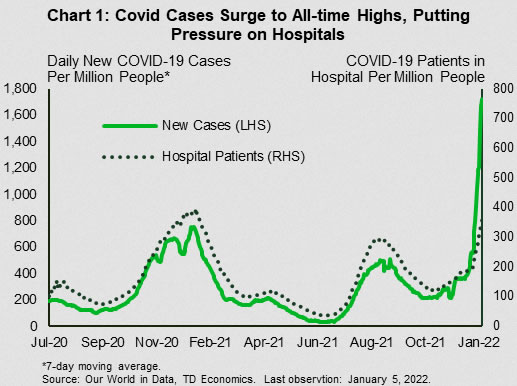
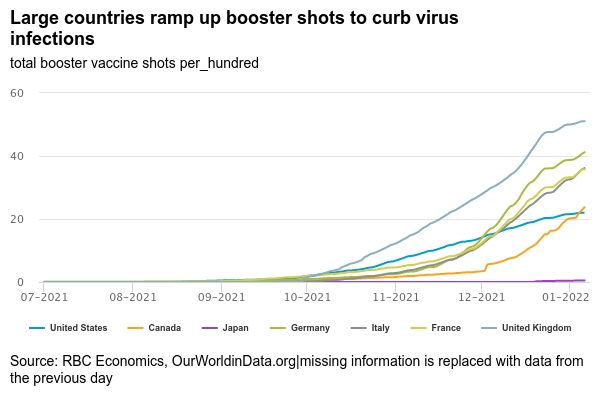
The economic calendar was jammed packed to start the new year. First up, a rapid increase in COVID-19 cases is quickly dwarfing all previous waves (Chart 1). Fortunately, hospitalization rates are not rising as swiftly, but are still ticking up at the same time that healthcare capacity is constrained by staffing shortages. The surge in cases has prompted airlines to cancel flights and companies to cut services and reduce hours as infected workers self-isolate (though for fewer days than past waves). With worker shortages already a pressing issue, the current wave is likely to weigh on near-term business performance and slow the recovery in high-contact services.
Adding to business challenges, workers are quitting their jobs at record rates, while job openings remain near all-time highs. Employers continue to add jobs, but job growth in December came in notably shy of the 450k anticipated by the market, at 199k. The disappointment was softened somewhat by a net 141k upward revision to the two previous months. The unemployment rate also fell from 4.1% to 3.9%, narrowing in on its pre-pandemic level of 3.5%. With high demand for workers and increasingly limited supply, it is little surprise that wage growth remains hot. Average hourly wages were up 4.7% from year ago levels in December, slowing slightly from 5.1% in November.
Such strength in the labor market, combined with more persistent inflationary pressures has added urgency to the Federal Reserve’s task of curtailing pandemic-induced support measures. Minutes from the most recent FOMC meeting showed that more members are inclined to accelerate the pace of policy normalization. This culminated in the Fed’s decision to speed up the taper of their Quantitative Easing program and possibly faster rate increases.
On the production side, there was some good news on easing supply constraints. The ISM manufacturing index slipped to 58.7 in December from 61.1 in November. Despite the slip, manufacturing activity is still expanding at a healthy clip. More encouragingly, there were hints that supply-chain problems could be easing as the supplier delivery sub-index fell to 64.9 in December from 72.2 the previous month (Chart 2). The decline suggests that delivery times are improving, which is a relief given the severe bottlenecks that manufacturers have been facing.
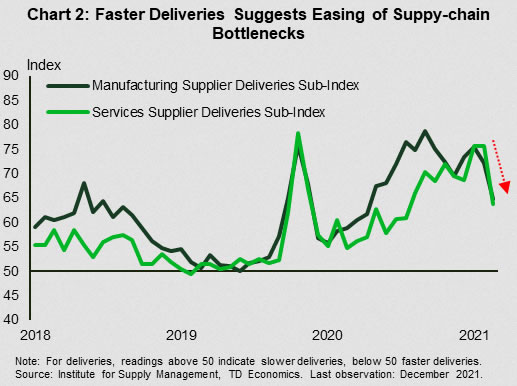
There was also a pullback in the ISM services index to 62 from 69.1 in November. The outturn however was not unexpected, given that the previous reading hit a record. The service sector also saw improvement in supplier delivery times as the index fell by 11.8 percentage points to 63.9 – the lowest reading in the past eight months.
Further good news saw vehicle production levels in December improve from their September lows – inching back closer to the 1.1M recorded in November. While still well below the pre-pandemic level, the improvement points to further easing in supply constraints in this key economic sector. Unfortunately, all of this data is for a time before the latest pandemic wave, and we could very well see a reversal in the months ahead. Still, with evidence this wave is progressing even faster than past waves, its peak should also not be too far in the future, allowing with any luck for the continued return to economic normalcy.
Canada - Starting the Year on a Sombre Note
The Canadian economy ended 2020 on a strong note. This week's data flow corroborated the narrative that growth in the fourth quarter was notably sturdy. But, headwinds are imminent. The Omicron wave and recently announced restrictions across some provinces mean that Canada's economy will likely experience a soft patch in the first quarter of 2022.
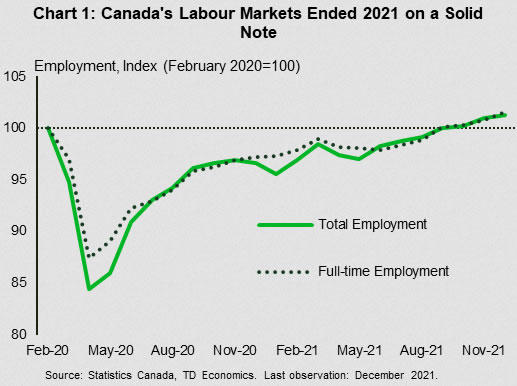
This week's attention was centered on December's Labour Force Survey release, which once again, surprised to the upside. The economy added a robust 55K jobs in December. The details were similarly solid. Full-time employment rose by a whopping 123K, the unemployment rate edged down to 5.9%, and core age participation held sturdy at a record-high 88.3%. Employment is now 1.25% above pre-pandemic levels (Chart 1). Both the goods producing (+44K) and service producing (+11K) sectors saw gains on the month. From an industry perspective, it was encouraging to see a pick-up in hiring in the previously lagging construction industry. The one fly in the ointment was wage growth, which at 2.7% year-on-year is well below the 4.6% increase in the latest consumer price index data. Importantly, the report's reference period does not capture the expected layoffs in the service sector amid renewed restrictions.
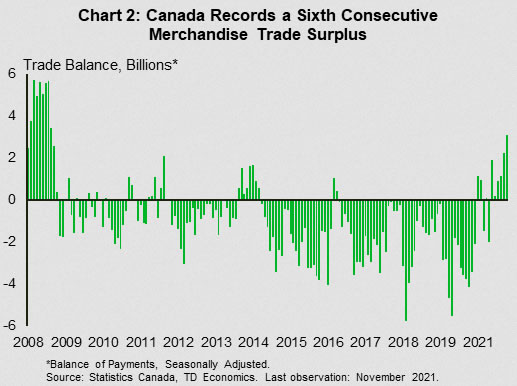
It wasn't just labour markets that continued to surprise on the upside in Q4. Canada recorded a sixth consecutive merchandise trade surplus in November (Chart 2). At $3.1 billion, this is the largest surplus since the autumn of 2008. This materialized despite major disruptions to trade flows from the dismasying floods in B.C. during the month. Export volumes increased significantly (+3.5%), and strength was broad-based across the industries. Strong manufacturing sentiment in the U.S., sturdy global demand and high commodity prices have shored up Canada's trade balances in recent quarters, providing a much needed tailwind to economic growth.
Notwithstanding the constructive trajectory in Q4, recent developments portend some softness in Q1. The Omicron wave of infections and recently announced restrictions on the service sector will weigh on employment and real GDP growth in January. Similar to previous waves, the impacts are expected to be concentrated in service sector (hospitality, entertainment, fitness) activity and employment. Beyond the direct impacts, a potential increase in absences due to infections and school closures, as well as a possible rotation in spending towards goods may exacerbate existing supply pressures. While still subject to uncertainty, our first pass suggests an impact of roughly two percentage points on annualized economic growth during the first quarter. This is predicated on an assumption that restrictions are relaxed in February and that the current wave of infection subsides. The hope is that this hiccup is temporary, and that the subsequent recovery is swift.
Forward Guidance: Omicron Spread to Pause Canada’s Economic Recovery
A quiet economic calendar for Canada next week will keep the focus on virus developments. Provincial governments have re-introduced measures to slow virus spread, including mandated closures of high-contact services like restaurant dining rooms and gyms in Ontario and Quebec. We expect businesses within the travel and hospitality sectors to continue to bear the brunt of restrictions. Indeed, our card spending data already indicated a sharp decline in travel spending in December. And the exceptionally high rate of virus spread has probably pushed a large share of the workforce into self-isolation, adding to near-term labour supply issues in other sectors. All told, we expect Q1 GDP to look decidedly softer and have revised our growth projection to 1.5% from 4% for the quarter. With testing capacity overwhelmed in many regions, hospitalization rates will be carefully scrutinized for a sense of how quickly restrictions could be eased. This latest wave of COVID-19 is multiples larger than those that preceded it. But the speed of the spread means it’s also expected to run its course more quickly, we expect growth in the economy to bounce back in Q2.
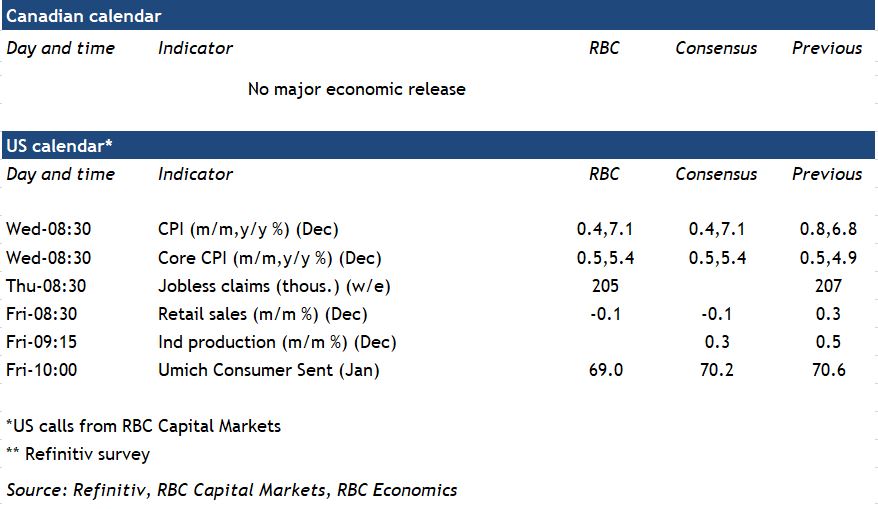
Inflation data will remain a key issue in the United States, with CPI growth expected to tick above 7% on a year-over-year basis. That would be up from 6.8% in November—which was already the highest since the 1980s. Pandemic distortions continue to bias annual price growth higher compared to pre-pandemic levels, with used car and gasoline prices accounting for a disproportionate share of gains. But even controlling for those factors, price pressures have broadened. Central banks have been largely looking through expected near-term Omicron economic impacts and remain focused on both those price pressures and firming labour markets. We do not expect the latest wave of virus spread to prevent the US Fed (or the Bank of Canada) from hiking interest rates in the first half of this year.
Week ahead data watch:
United States CPI: Year-over-year price growth is expected to rise to 7.1% from 6.8% in November underpinned by higher used car prices. We also expect evidence of broadening price growth to continue in December.
US retail sales are expected to tick lower in December on lower auto and gasoline station sales. Retail sales remain very firm relative to pre-pandemic trends.
Week Ahead – Earnings Season is Upon Us
A welcome distraction
It’s been quite the start to the year, with omicron fears subsiding only to be replaced by interest rate anxiety once more. This could be the theme for the coming months, as policymakers are forced to take inflationary pressures more seriously in the hope that a little now will prevent the need for a lot more later.
Earnings season may bring a welcome distraction at a time when fear has again become a dominant driver of the markets. While inflation uncertainty is a major risk, it is worth remembering that the economy is in a very good place and the reporting season, starting next week, should provide a timely reminder of that.
Finally, it’s worth noting that there are various other volatility drivers in the markets at the moment and Russia is only involved in most of them. Although Putin did manage a sly dig at the CBRT in his annual address while praising his own central bank’s approach to inflation. It doesn’t seem President Erdogan has too many allies in his pursuit of low inflation through lower interest rates.
US
The coming week will include a very hot inflation report, the banks kicking off earnings season, US-Russia talks, and a bunch of Fed speak. Inflation is not letting up and will continue to make the Fed uneasy. On Wednesday, the headline year-over-year inflation reading is expected to rise from 6.8% to 7.1%, which is nearly a four-decade high. The last trading day of the week is filled with economic releases that should show a deceleration with retail sales, import price index, industrial production, and consumer sentiment.
EU
Data next week is primarily made up of tier two and three releases which will have little bearing on the central bank in the coming months. Pressure is mounting after inflation hit another record high in December. Traders will be looking for any sign that policymakers will buckle under the pressure despite being assured until now that inflation is transitory.
UK
The tightening cycle got underway in December and traders will continue to monitor the data as markets price in four more hikes this year. But next week is void of tier-one releases, with the most notable being the NIESR GDP estimate on Monday and the official monthly GDP reading on Friday.
Russia
The highlight next week on the data front is inflation on Wednesday, with CPI seen falling slightly to 8.2%. This is still more than double its 4% target but heading in the right direction after an aggressive series of rate hikes from the central bank.
The focus will remain on other activities when it comes to Russia, as is so often the case. Whether that’s activity on the Ukrainian border, gas supplies to Europe (or lack of), or involvement in Kazakhstan.
South Africa
Next week is looking quiet with manufacturing production the only economic release of note.
Turkey
Turkey continues to prefer unconventional approaches to support the currency as it pursues lower interest rates at all costs. So far that has come in the form of soaring inflation (now at 36%) and a large portion of FX reserves as it tries to manipulate the currency and support state-owned businesses. Burning through reserves isn’t sustainable and while the lira is off its lows, it’s been sliding over the last couple of weeks. Erdogan is becoming more desperate and appears in no mood to change course.
China
Chinese property developers will dominate weekend news with Evergrande in a race to roll over CNY 4.5 billion of local denominated debt by this weekend. How this story evolves will determine whether Chinese equities continue retreating or recover on Monday. Additionally, the government appears to be moving towards treating debt used to buy up weak developers by SOE’s separate from official debt ratios. If confirmed as correct, it’s potentially bullish for China/HK equities.
China CPI on Wednesday won’t move the needle, but if the official trade balance falls on Friday sharply, that could weigh on local equities.
Watch for widening lockdowns of cities across China as omicron proves stubborn to remove.
India
The Indian Rupee is surprisingly resilient as other Asian currencies sell-off. The rally in post-omicron sentiment has renewed hot money inflows into India, supporting the INR and local equities. Watch the caseload in India however, it is rising quickly and will be a test of the premise that non-RNA vax countries will also see fewer hospitalizations. Potentially negative if incorrect.
Inflation on Friday has upside risks which could be a stagflationary negative for the INR and Sensex into the end of the week.
Australia
No significant data. Watch for increasing state-wide restrictions as Omicron cases skyrocket. Harsher restrictions could be equity and AUD negative.
AUD is being driven by risk sentiment which is cautious in currency markets as US yields firm up on Fed tightening expectations.
New Zealand
No significant data.
NZD fading on Fed tightening sentiment as per AUD.
Watch for headlines of community omicron transmission, which could be a short-term negative for NZD and local equities, and RBNZ Feb hike could be postponed…again.
Japan
No significant data this week. USD/JPY remains at the mercy of the US/Japan rate differential. That widened this week as US yields soared pushing USD/JPY to 116.00. The Ministry of Finance has started “watching FX” rhetoric, signaling concern at the pace of decline.
The Nikkei continues to show a high correlation to directional movements on the Nasdaq. The BoJ quietly indicated this week they would not look to expand the balance sheet. The upcoming JGB auction this week, if poorly supported, could be a short-term negative for equities.
Economic Calendar
Saturday, Jan. 8
Events
- Atlanta Fed President Bostic and the ECB’s Schnabel speak at The American Economic Association/Allied Social Science Association virtual annual meeting continues
Sunday, Jan. 9
Events
- The BOE’s Mann speaks at the virtual AEA meeting.
- Bilateral U.S.-Russia negotiations to begin in Geneva
- Iraq’s parliament convenes
Monday, Jan. 10
Economic Data/Events
- US wholesale inventories
- Atlanta Fed President Raphael Bostic speaks at the Rotary Club of Atlanta
- Australia building approvals
- Eurozone unemployment
- Italy unemployment
Tuesday, Jan. 11
Economic Data/Events
- Fed Chair Jerome Powell’s confirmation hearing in the Senate Banking Committee.
- Kansas City Fed President George speaks
- St. Louis Fed President Bullard speaks
- Australia trade balance, retail sales
- Mexico international reserves, industrial production
- South Africa manufacturing production
- Spain industrial production
- Turkey current account
Wednesday, Jan. 12
Economic Data/Events
- US CPI, Fed’s Beige Book, WASDE agricultural report
- China PPI, CPI
- Japan BOJ Governor Haruhiko Kuroda speech at the Branch Managers meeting.
- Eurozone industrial production
- India industrial production, CPI
- Russia CPI
- EIA Crude Oil Inventory Report
Thursday, Jan. 13
Economic Data/Events
- US initial jobless claims, PPI
- US Senate Banking Committee hearing for Lael Brainard nominated as Fed vice-chair.
- Richmond Fed President Barkin speaks at an event hosted by the Richmond Chamber of Commerce.
- Philadelphia Fed President Harker speaks at the Philadelphia Business Journal economic event.
- Chicago Fed President Evans speaks at an event hosted by the Milwaukee Business Journal.
- Turkey industrial production
- Italy industrial production
- Japan M2 money stock
- New Zealand building permits
- Norway Norges Bank 4Q survey of bank lending
Friday, Jan. 14
Economic Data/Events
- US Bank Earnings Season Begins: JPMorgan, Citigroup, and Wells Fargo report before the bell
- New York Fed President John Williams speaks at the Council on Foreign Relations.
- US retail sales, business inventories, industrial production, consumer sentiment
- China trade
- India trade, wholesale prices
- France CPI
- Japan PPI
- Spain CPI
- UK industrial production