Sample Category Title
Week Ahead – US Inflation Report to Decide Dollar’s Fate
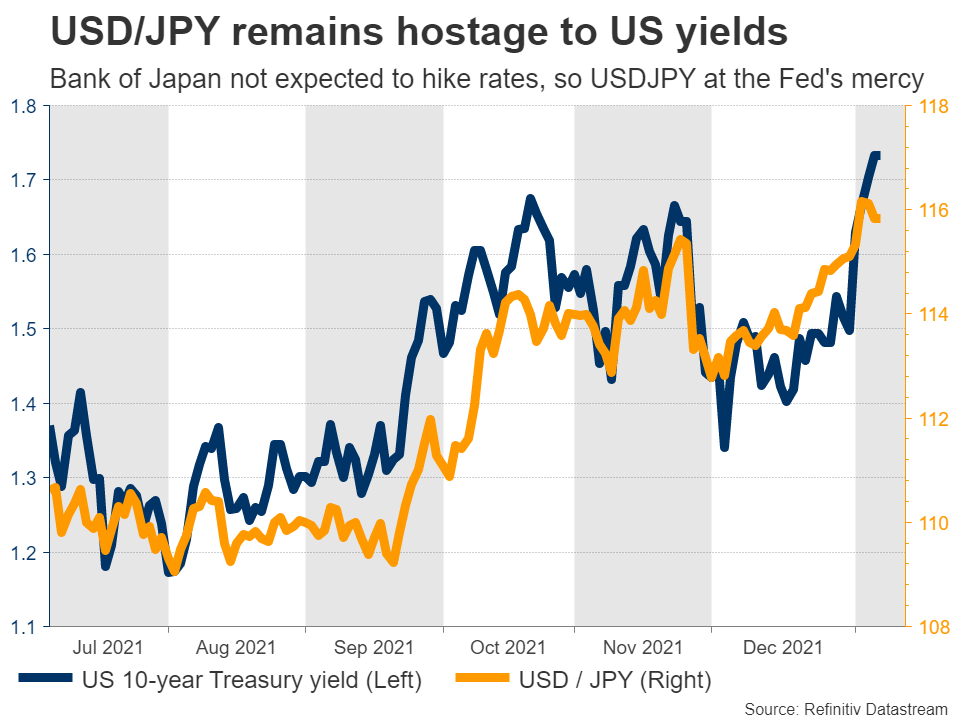
The new year has kicked off with a sharp spike in yields, which has turbocharged the US dollar but demolished the Japanese yen. Whether this trend persists will depend on next week’s US inflation report, as that could decide whether the Fed will begin its rate hike cycle in March already.
Peak US inflation soon?
The US economy is in pretty good shape. The labor market will likely return to full employment this year, consumption is booming, the Atlanta Fed GDPNow model points to growth of 6.7% in the last quarter, and of course inflation is scorching hot.
As such, markets have started to entertain the idea that the Fed could raise interest rates as soon as March to combat inflation, currently pricing in an 85% probability for such an action. This has been a blessing for the dollar but a curse for the yen, as the Bank of Japan is not expected to follow suit anytime soon.
In this light, the upcoming CPI inflation data on Wednesday and retail sales report on Friday could be crucial. Forecasts suggest the yearly CPI rate held steady at 6.8% in December but the core number that excludes energy and food prices is expected to have jumped to 5.4% from 4.9% previously.
The latest PMI surveys from Markit support these projections. Selling prices by companies ‘rose steeply’, but at the slowest pace for three months, which is exactly in line with what the monthly CPI print is expected to show.
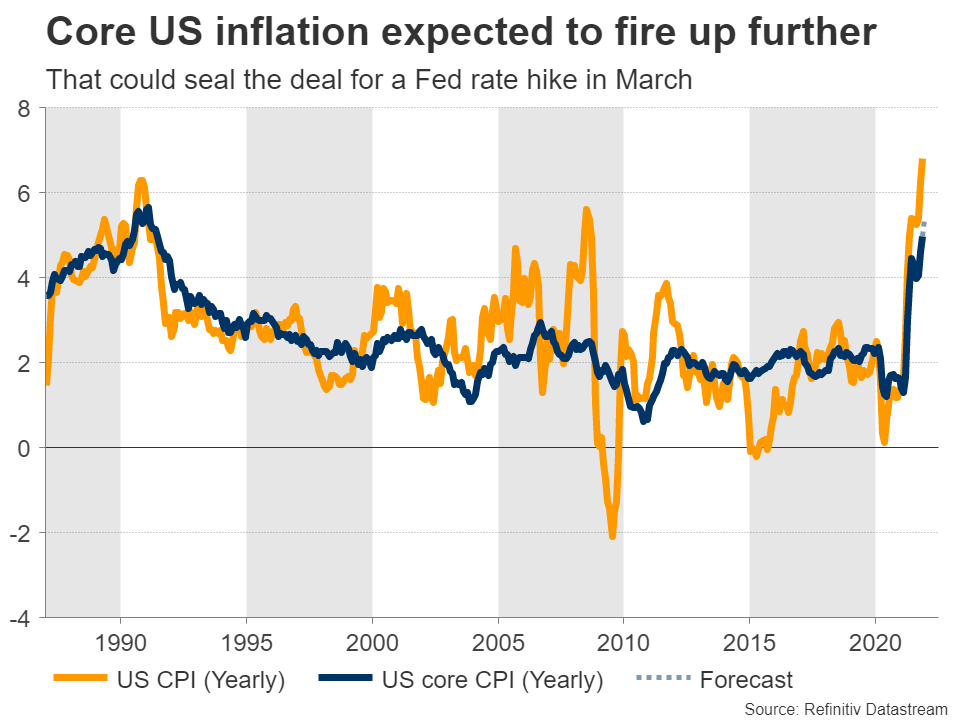
As for the dollar, a sharp spike in the core CPI rate coupled with a solid retail sales report may be just enough to cement expectations that the Fed will get the ball rolling in March. That could keep the reserve currency supported over the next few months.
Looking further out, however, the biggest risk for the dollar are any signs of ‘peak inflation’. A combination of stabilizing energy prices, supply chains coming back online, fading fiscal spending, and tougher year-over-year comparisons from April onwards seems like a recipe for inflation to peak later this year.
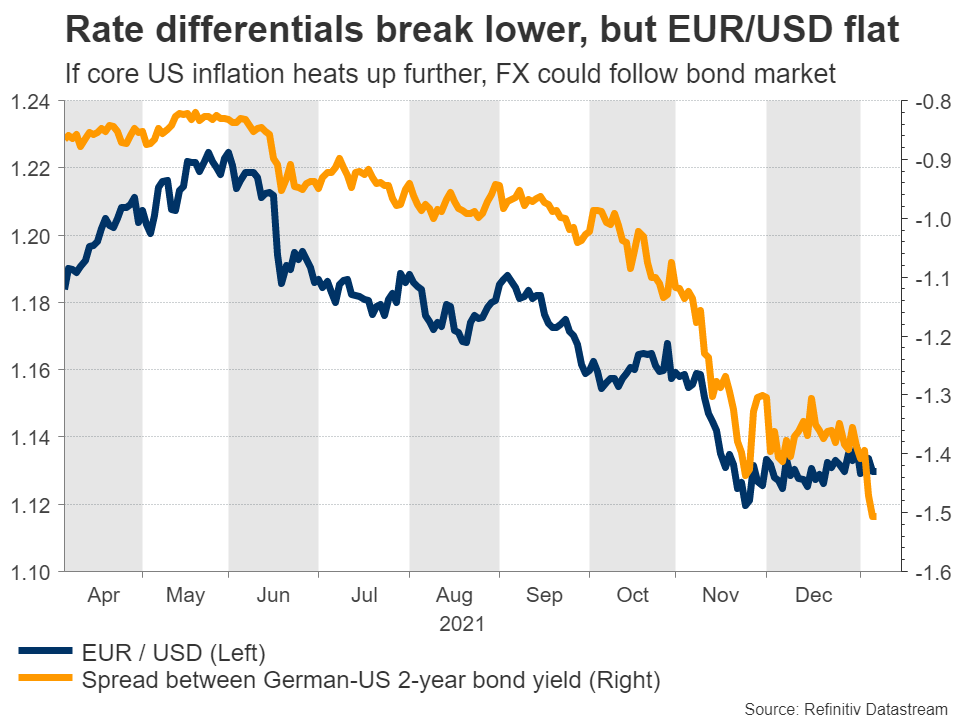
At that point, traders could dial back bets for powerful Fed tightening and US yields might correct lower, especially if the Republicans take control of Congress in the midterms, blocking new spending. Strap in, the dollar could trade like a rollercoaster this year.
Finally, note that Fed chief Powell will appear before Congress both on Tuesday and Thursday, for the hearings to confirm his second term.
British GDP coming up
The other big winner from the latest spike in yields has been the British pound. Investors seem to have concluded that Omicron isn’t dangerous enough to stop the Bank of England from raising interest rates, or even slow down its plans.
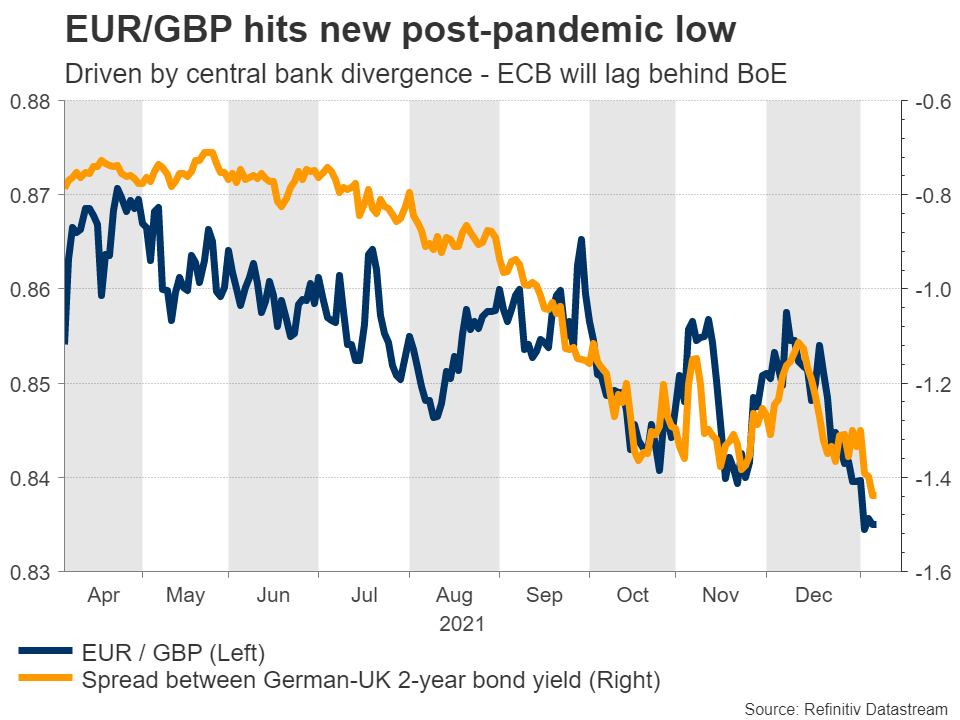
Money markets currently assign a 70% chance for the BoE to raise rates again next month, for a grand total of four hikes this year. This helped push euro/sterling to a new post-pandemic low this week, along with some remarks from Prime Minister Johnson that new covid restrictions are unlikely.
Next week will bring the GDP numbers for November on Tuesday, but those are unlikely to change this rosy narrative. For now, there is still scope for sterling to extend its recent gains, at least against the euro and yen, as markets become more confident about a February rate hike.
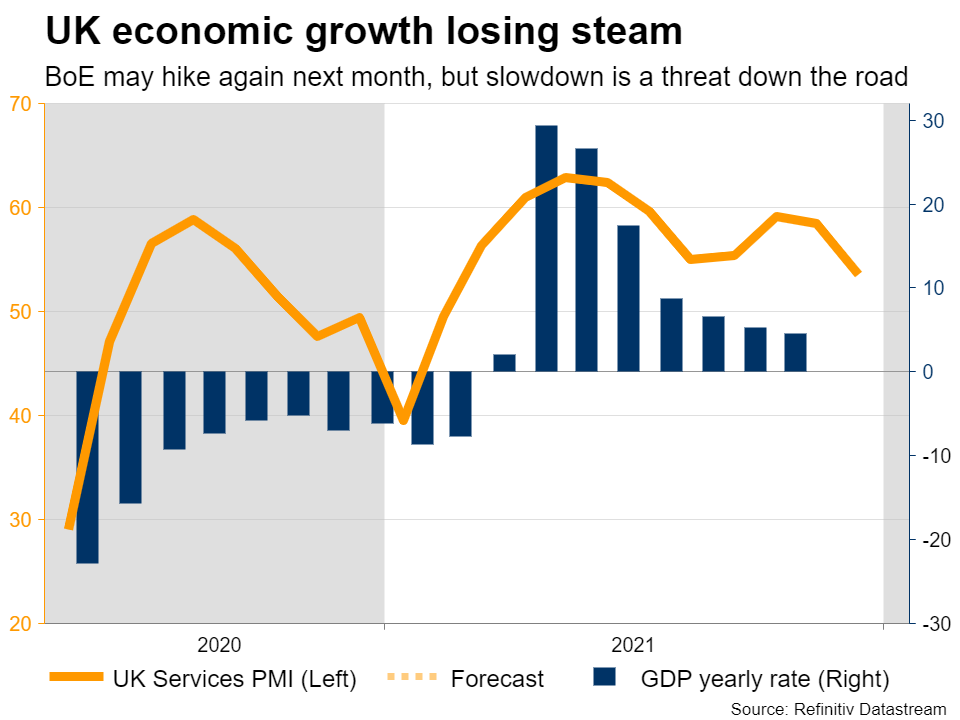
However, in the bigger picture, there are some risks. While the British jobs market is strong and inflation is elevated, the latest PMI surveys suggest economic growth is losing steam. If this trend persists, the BoE might only raise rates twice or three times this year, not four times as markets expect.
Chinese inflation also in the spotlight
Elsewhere, the most important release will be China’s own inflation report on Wednesday. Both consumer and producer prices are expected to have cooled in December, partly thanks to the fading power crisis. Trade data for the same month are due out on Friday.
The slowdown in producer prices could be especially crucial for markets, as it would suggest that China is exporting less inflation abroad, feeding the narrative that inflation globally may be approaching its peak.
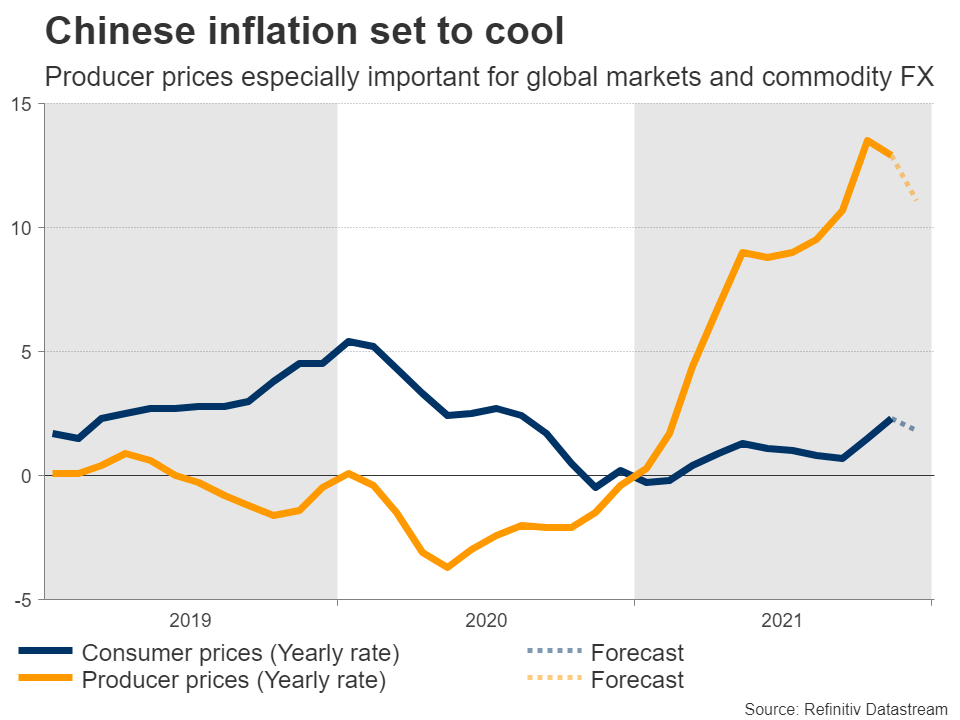
Of course, the risk to all that is China’s zero-covid policy. The government has responded with draconian lockdowns in any cities that report covid cases, which threatens to keep the global supply chain under pressure for longer, even though disruptions have been mild so far.
The worsening outlook for Chinese growth coupled with the gloomy mood in stock markets may also explain why the commodity-linked Australian and New Zealand dollars performed so badly this week.
China’s trade numbers next week could be crucial for these currencies, with the aussie also paying attention to Australia’s final retail sales numbers for November that are due on Tuesday.
Weekly Focus – Hawkish Tilt in FOMC Minutes Caused a Risk Sell-Off
There is still a lot of focus on omicron, as global new cases have moved sharply higher, explained by the fact that the variant is better able to evade immunity, both vaccine-induced and from previous infections. More studies are supporting the hypothesis that omicron is milder (not only because of existing immunity) and investors are buying into the narrative. Still, risk is that there are so many new cases that it dominates the lower individual restrictions forcing governments to implement tougher restrictions. We discussed what we know about omicron in further details in COVID-19 Update: Omicron primer v2 - more studies support "milder but more infectious", 4 January.
The big waves mean that goods consumption is likely to remain elevated, while the production side of the economy will continue struggling due to a still lower labour force, more sick days and the still strict zero-COVID policy in China. Most recently, China implemented a partial lockdown in Ningbo affecting operations at the world's largest port, see Global News. The combination of all these factors means that bottlenecks are unlikely to ease much near-term (and may even get worse), which also means higher inflation pressure, all else equal.
The biggest market mover this week was the FOMC minutes from the December meeting. The minutes indicated that the Fed may already hike in March when tapering ends, which then opens the door for a total of four rate hikes this year. The Fed also hinted that it would like to start shrinking the balance sheet earlier and faster than last time, suggesting that "quantitative tightening" may start already at some point in the second half of the year. US 10yr government bond yields moved above 1.70% and stock markets took a big hit.
Looking ahead to next week, several interesting data are due out in the US. The most important one is the CPI inflation data for December due out on Thursday. Price increases (both for headline and core) have generally surprised to the upside, so do not be surprised if CPI headline and CPI core exceed 7% and 5% y/y, respectively. Besides that we also get retail sales in December (Friday). Also keep an eye on consumer confidence from University of Michigan (Friday) and the NFIB Small Business survey (Tuesday), which will shed more light on how tight labour market is and whether underlying inflation pressure continues to increase.
In China, the main release is credit data. Credit growth is one of the best leading indicator for the Chinese economy and hence also for the world economy. Credit growth has picked up over the past months from quite negative territory and we expect the trend of higher credit growth will continue here in Q1 driven by policy stimulus.
In the UK, monthly GDP in November is due out on Friday.
In the euro area, focus is on the sharp rise in new omicron cases and development in energy prices. Also focus on whether Mario Draghi plans to run in Italy's Presidential election and whether Macron is finally launching his official re-election bid in France.
In the Scandi, CPI data are due out for Denmark, Norwegian and Sweden. Also monthly GDP is due out in Sweden and Norway.
Sunset Market Commentary
Markets
December EMU inflation numbers and US payrolls featured on today’s agenda. European inflation accelerated by 0.4% M/M and from 4.9% Y/Y to 5% Y/Y. It’s the highest yearly reading since the creation of the EMU. Core inflation was unchanged at 2.6% Y/Y. The 5%-reading beat consensus, but didn’t really surprise following higher-than-expected inflation numbers in several European countries earlier this week. Details showed energy prices remain responsible for the lion share of the move (26% Y/Y), but services (2.4% Y/Y) and non-energy industrial goods (2.9%) prices rise more than 2% as well. Markets didn’t respond to the European inflation release and steadied into the US job market report. The outcome was a mixed bag. The headline figure printed at +199k, significantly below 450k consensus. Even when taking into account the +141k upward revision to the previous two month’s data, we’re talking about a 110k miss. The Covid-experience did teach us that wild (statistical) swings turned more rule than exception of late. Average hourly earnings rose more than forecast – 0.6% M/M and 4.7% Y/Y – in a sign of building wage pressure. The unemployment rate declined from 4.2% to 3.9% in a sign of stronger underlying job growth in the household survey. The outcome is the lowest since February 2020 and adds credibility to the Fed’s intention to speed up the normalization process (rate hike in March, together with end to net asset purchases; balance sheet run-off later this year). The drop in the unemployment rate came at an unchanged participation rate (61.9%). Unlike the stoic reaction to EMU inflation, (bond) markets judged the payrolls report as sufficient to keep the Fed on track with its accelerated normalization plans. US Treasuries drifted south, underperforming German Bunds. US yields currently rise by up to 3 bps, but intraday moves have been larger. The US 10-yr yield for example bumped into 1.77% resistance (2021 high), causing some return action. It looks unlikely that this key level will crack ahead of the weekend. German yield changes range between + 1 bp and -1 bps across the curve. The US dollar again failed to profit from the rising yield differential and even trades in the defensive. The trade-weighted greenback slides from a 96.30 open towards the 96 big figure. EUR/USD prefers the area north of the 1.13 big figure, but isn’t contemplating a throw at 1.1383 resistance. US stock markets opened slightly under water.
News Headlines
Polish CPI accelerated to a higher-than-expected 8.6% y/y (0.9% m/m) in December. Food prices printed at a strong 2.1% m/m, contributing the most to the November headline figure. However, KBC Economics calculations show core inflation rose as well to roughly 5.2% y/y. The sharp price increases suggest the National Bank of Poland’s tightening cycle is by no means over. After hiking 50 bps to 2.25% earlier this week, governor Glapinski hinted at a similar move in February but risks for a bigger step have just increased. The very short end of the Polish swap curve jumped more than 10 bps to be above 3%. The zloty strengthened to EUR/PLN 4.55, testing the October interim low. The move occurred hours after the release though.
The Canadian labour market again posted a strong performance in December. Net payrolls grew 54 700 while only a gain of 25 000 was expected. The rise was entirely due to full-time employment (+122.500) which was partially eroded by a decline of 67 700 in part-time jobs. Most jobs were added in the goods-producing sector (44 200 versus only 10.600 in services). The unemployment rate declined from 6.0% to 5.9%. Short-term developments in the Canadian labour market still might be affected by new containment measures due to the surge in Covid- cases. Even so, the data still support the case for an ‘early’ BOC rate hike. Markets currently discount a first rate hike for the early March meeting. The Canadian dollar gained modestly after the data. USD/CAD trades near 1.27.
Pressure Mounts on Central Banks
Stock markets are back in the red on the final day of the week as investors continue to fret about the prospect of higher interest rates this year.
Whether this is just an exhaustion of the omicron relief trade, a case of January blues that will quickly be forgotten once earnings season gets underway next week, or something more significant will only become clear later this month.
But the data isn't offering investors much chance for relief and the jobs report is just another example of that. The headline NFP miss was never going to generate too much relief as signs of tightness elsewhere is always going to take priority. That said, investors may feel they've dodged a bullet as the million new jobs that some predicted could have further convinced policymakers that the US is close to, or at, full employment.
But the average earnings numbers, higher participation, and drop in the unemployment rate will surely overshadow the NFP number as far as the central bank is concerned. Higher participation is encouraging, as the slow recovery on this front is a major contributor to the tight labour market. But wages rising faster than expected will add to the prolonged inflationary pressures which will concern the Fed.
Will ECB fall in line with peers?
Inflation in the eurozone unexpectedly hit another record high in December, intensifying pressure on the ECB to follow in the footsteps of many of its peers and tighten monetary policy. The central bank is now among a minority that view inflation as transitory and while it may be proven correct, the data doesn't make for easy reading.
Other central banks have abandoned the transitory line recently and this will only increase calls for the ECB to do the same. Policymakers appear to firmly believe that inflation will fall without rate hikes over the course of this year. The question now becomes whether they will be afforded the time to be proven right or align with others and the markets.
Oil at two month high as OPEC struggles to hit quotas
Oil prices are continuing to climb at the end of the week as unrest in Kazakhstan and lower output from Libya further hamper producers' ability to gradually return to pre-pandemic levels. We are already seeing OPEC+ struggle to deliver the agreed 400,000 barrel per day increase and this is further exacerbating the problem.
And it's happening at a time when demand is expected to remain strong thanks to omicron symptoms being mild by comparison to other variants. It's no wonder prices are almost back at November highs, with WTI now back above $80 for the first time in two months.
The bullish case for gold is weak
Gold is marginally higher on the day after experiencing a surge in volatility around the release of the jobs report. The yellow metal spiked in the immediate aftermath of the release, with the big NFP miss hitting the dollar. But as is so often the case on jobs day, the knee-jerk reaction to the headline NFP number turned out to be the wrong one overall, and the move was quickly reversed. Volatility has remained since but it appears to be settling a little higher than pre-NFP levels.
There's a lot to digest in the jobs report and it can sometimes take a little time for that to happen. Ultimately, the takeaway has to be that the report doesn't make rate hikes or balance sheet reduction any less likely, especially with wages rising as much as they did. That's not good news for gold and so the bullish case remains weak as it struggles to get a hold of $1,800 again.
Jobs report delivers a blow to bitcoin
It would appear bitcoin traders weren't particularly thrilled with the jobs report either, with the cryptocurrency adding to its post-Fed losses in the immediate aftermath of the release. If loose monetary policy has been one of the major catalysts for the bitcoin boom this last couple of years then the crypto crowd may be in for a rough 2022 as central banks, Fed included, are in tightening mode. And today's wage growth figures will only further galvanize them into acting to slow the pace of inflation. Somehow I don't think they'll be deterred for too long.
AUDUSD’s Progress Curbed by Ichimoku Cloud and MAs
AUDUSD is struggling to push further north of the 0.7300 mark as the 50- and 100-day simple moving averages (SMAs) along with the Ichimoku cloud are directing the pair lower. The overall bearish demeanour of the SMAs is defending the gradual drop in the pair.
The Ichimoku lines are not indicating a dominant directional drive in the pair, while the short-term oscillators are suggesting that negative momentum is growing in power. The MACD has nudged below its red trigger and zero threshold, while the RSI is falling in the bearish region. The stochastic oscillators’ negative charge is promoting additional downward moves in the pair.
If the price continues to glide lower, immediate downside hindrance could occur at the flattening blue Kijun-sen line at 0.7134 ahead of the 0.7082 barrier. Sustaining the bearish trajectory, sellers may then confront the critical 0.6963-0.7020 support foundation, which has safeguarded the broader positive structure since October 2020. From here, if the pair steers south of this boundary, it could target the 0.6900 mark, triggering considerable worries about further deterioration in the pair.
To the upside, buyers are promptly challenged with the cloud, the adjacent red Tenkan-sen line at 0.7203 and the 50-day SMA at 0.7220. Ticking slightly higher, the congested obstacles being the cloud’s upper band at 0.7203 and the 100-day SMA at 0.7290 may cause some difficulty for bullish momentum to gain ignition. However, if buyers are triumphant, they could propel the price towards the 0.7370 high before aiming for the 200-day SMA at 0.7426.
Summarizing, AUDUSD’s positive forces are still losing power and the pair is adopting a neutral-to-bearish bias. That said, for bullish momentum to strengthen, the recent price bounce within the 06963-0.7020 base would need to push beyond the cloud and the 100-day SMA at 0.7290.
Dollar Holds Firm after Mixed NFP Report
Dollar unsurprised by NFP miss
Despite the dollar's initial pullback after the NFP report came short of expectations, delivering 199k job additions versus the 400k projection, the dollar quickly pared its losses as the US unemployment figure fell to 3.9% against the 4.1% expectation. This employment report seems solid enough for the Fed to proceed with its plan to both lift interest rates and reduce the size of its balance sheet at the same time.
Commodity-linked currencies such as the kiwi and loonie are trading higher today, supported by the soaring oil prices, while the aussie is slightly down on the day. In addition, the stronger-than-expected Canadian employment report seems to be adding more fuel to the loonie's rally.
On the other hand, the persistent rally in global yields continues to undermine the safe haven currencies, with the franc and yen losing ground in the current session.
The euro is also gaining traction today since both retail sales and inflation reports for the Eurozone positively surprised the markets. The latter report pointed out that annual inflation reached 5%, while core inflation was higher than 2% in December, reaffirming that price pressures are not abating yet and that the ECB might be forced to accelerate its rate hike timeline to counter inflationary pressures.
US stocks lose ground after the NFP report
Wall Street seems to be resuming yesterday's downfall as the NFP report reinforced the Fed's ultra-hawkish stance and significantly increased expectations for a rate hike in March 2022. E-mini futures for the major US indices are taking a hit in premarket trade as spiking yields seem to be unfavorable for stocks.
In individual stock news, Gamestop announced yesterday that it is launching a division to develop a marketplace for NFTs and establish cryptocurrency partnerships. Hence, with investors pricing in that news on today's session, the stock is up 18% in pre-market trade.
Oil surges; gold stabilizes
Oil prices have climbed to a seven-week high as extremely harsh weather conditions in Canada and the northern US have been disrupting oil flows, boosting prices just as American stockpiles decrease. Moreover, riots in Kazakhstan and outages in Libya raised further concerns over the supply side.
Although geopolitical flare-ups have intensified globally, gold cannot manage to capitalize on them as soaring real yields negatively weigh on the precious metal.
Bitcoin and the broader cryptocurrency market continue to be a sea of red today after the ultra-hawkish FOMC meeting minutes cast a shadow over risky assets.
Canada: Employment Continues to Move On Up in December
The Canadian labour market added 55k positions in December, and was well above the consensus call for a gain of 25k position. Full-time (+123k) employment drove the increase in December, while part-time (-68k) employment fell on the month.
Canada's labour force (+23k) also expanded in December. Given the larger increase in employment, the unemployment rate edged down by 0.1 percentage points to 5.9% in December, and was within touching distance of the 5.7% recorded in February 2020.
By industry, employment growth was strong in the goods-producing sector (+44k) with the construction industry (+27k) doing the heavy lifting for the month. Meanwhile, services-producing employment was little changed (+11k), although, there was a sizeable increase in educational services employment (+17k) in December.
By province, employment was up in Ontario (+47k) and Saskatchewan (+6k), while all other provinces did not see much change last month. Notably, employment in B.C. was steady even as flooding impacted the southwest region of the province. Statistics Canada noted that by December, the province was already in reconstruction.
Lastly, total hours worked rose 0.3% month-on-month, continuing the string of advances seen since July 2021.
Key Implications
Despite the severe flooding in B.C., the Canadian labour market continued to see gains in December. The construction industry recorded its first employment increase since August, and this trend is likely to continue due to rebuilding efforts in southwestern B.C. Interestingly, the accommodation and food services industry saw a 4k decline in employment even with job vacancies at an elevated level, reflecting hiring difficulties in the sector.
It's important to note that today's release did not fully include the impact of Omicron-related public health restrictions as the labour force survey was taken during the week of December 5 to 11, and more stringent measures were imposed later on in the month. With daily caseloads rising at an incredible pace and provinces tightening the screws on mobility, January labour market figures are likely to be more downbeat. Hopefully, the impact of Omicron will be short-lived, allowing the labour market to recover quickly in coming months.
US: Unemployment Rate Drops to 3.9% at the End of 2021
The U.S. economy added 199k new jobs in December, disappointing market expectations for a 400k+ tally. However, the prior two months was revised up by 141k positions, continuing a trend. Even with an average 537k new jobs per month in 2021, payrolls remained 2.3% below their February 2020 level, or 3.6 million fewer jobs.
The unemployment rate dropped to 3.9% in December, narrowing in on its 3.5% pre-pandemic low, as household survey employment rose 651k. Household survey employment has been stronger than payrolls for a couple of months now, and is 1.8% below its pre-pandemic level, a smaller gap than indicated by the payroll measure. The labor force participation rate was unchanged from November at 61.9%. However, November's part rate was revised up as part of the usual annual revisions to the seasonal factors.
Looking at shifts by industry, employment continued to trend up in leisure and hospitality (+53k), professional and business services (+43k), manufacturing (+26k), transportation and warehousing (+19k) and construction (+22k).
Average hourly earnings were up 4.7% from a year ago in December, as a healthy demand for workers is driving wages higher across sectors.
Key Implications
The jobs numbers are typically the most highly anticipated release on the calendar but December's data was captured prior to the surge in Omicron infections, so it feels a bit more stale than usual. We will have to wait until January to see what, if any, impact Omicron has on employment. Consumer caution is likely to dampen activity in some sectors, but given a tight labor market, employers are likely going to hang on to staff. Disruptions from large swaths of infected workers are likely to disrupt activity more than employment.
Despite the disappointment with the headline hiring tally, December's data are consistent with a labor market that is looking pretty tight. Markets may need to recalibrate monthly hiring expectations going forward. Given limited labor market slack, the pace of hiring may look more like pre-pandemic trends going forward. The pace of job gains through November and December is in fact quite similar to the pace of hiring immediately before the pandemic. With the unemployment rate getting quite close to its pre-pandemic low and inflation higher than the Fed would like, rate hikes are likely not too far away, as outlined in our recent forecast. Omicron may prove disruptive in the short run, but as with past waves, we expect activity to bounce back quickly.
EUR/USD Mid-Day Outlook
Daily Pivots: (S1) 1.1279; (P) 1.1305; (R1) 1.1326; More...
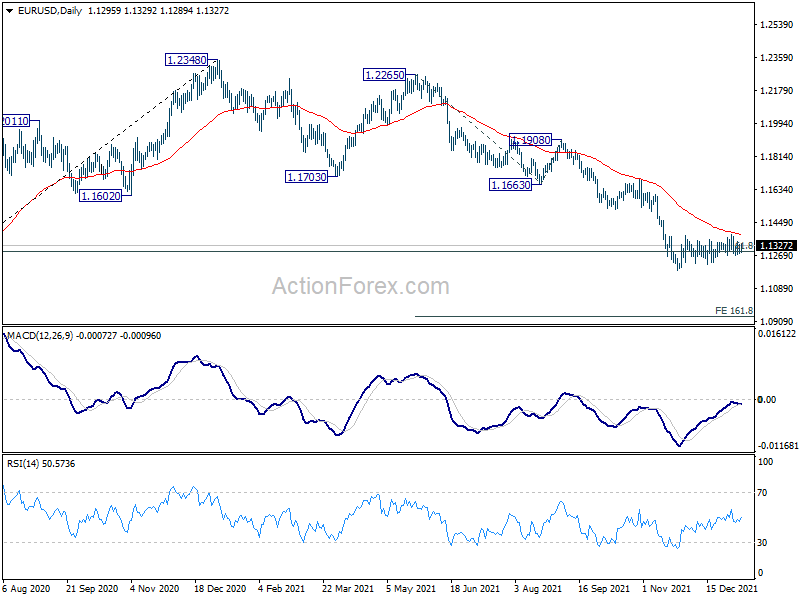
Range trading continues in EUR/USD and intraday bias remains neutral. On the downside, break of 1.1185 will resume larger decline from 1.2348. Next target is 161.8% projection of 1.2265 to 1.1663 from 1.1908 at 1.0934. On the upside, firm break of 1.1385 resistance will resume the rebound from 1.1186. Sustained trading above 55 day EMA (now at 1.1382) will bring stronger rise back to 1.1663 support turned resistance.
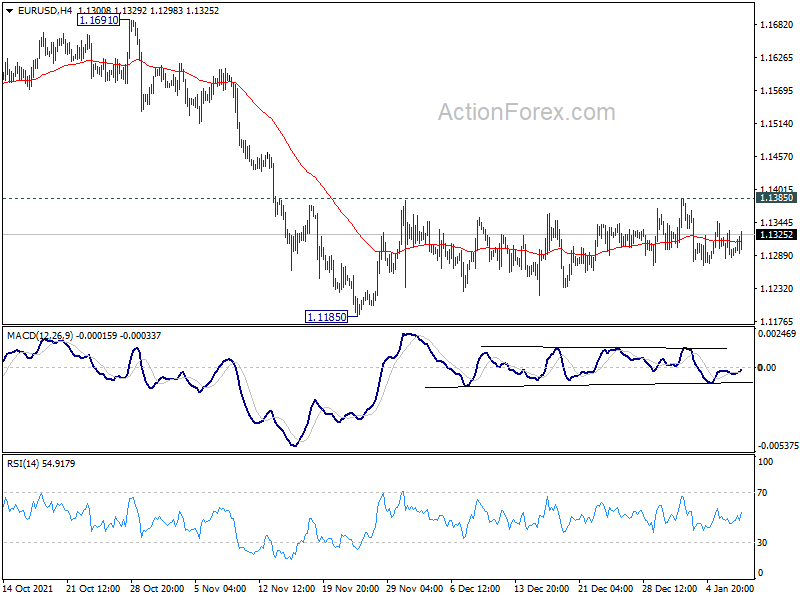
In the bigger picture, there are various ways of interpreting the fall from 1.2348 (2021 high). It could be a correction to rise from 1.0635 (2020 low), the fourth leg of a sideway pattern from 1.0339 (2017 low), or resuming long term down trend. In any case, outlook will now stay bearish as long as 1.1703 support turned resistance holds. Sustained break of 61.8% retracement of 1.0635 to 1.2348 at 1.1289 would pave the way back to 1.0635.
GBP/USD Mid-Day Outlook
Daily Pivots: (S1) 1.3498; (P) 1.3528; (R1) 1.3567; More...
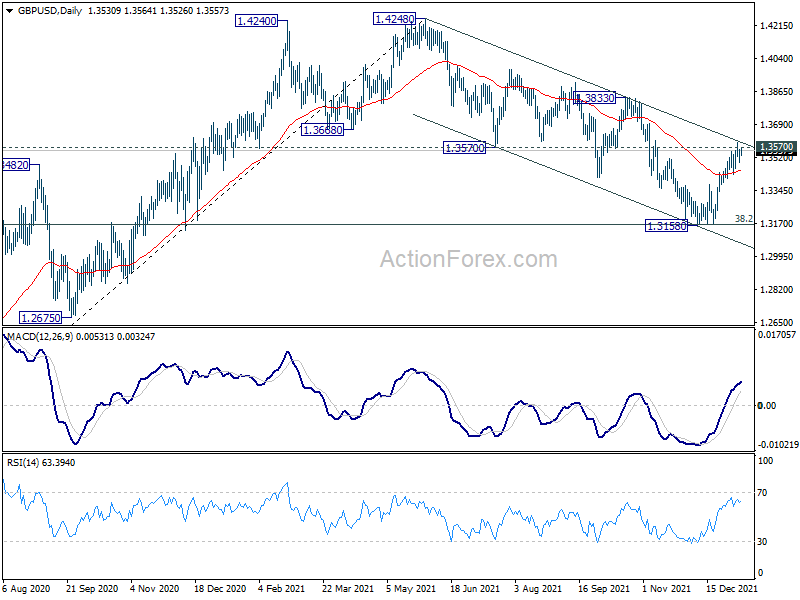
GBP/USD is staying in consolidation and intraday bias remains neutral. Further rally is still expected as long as 1.3430 support holds. We're seeing corrective fall from 1.4248 as complete with three waves down to 1.3158, after hitting 1.3164 medium term fibonacci level. . Sustained break of 1.3570 resistance will further affirm this bullish case and target 1.3833 resistance next. However, break of 1.3375 will turn bias back to the downside for 1.3158 low again.
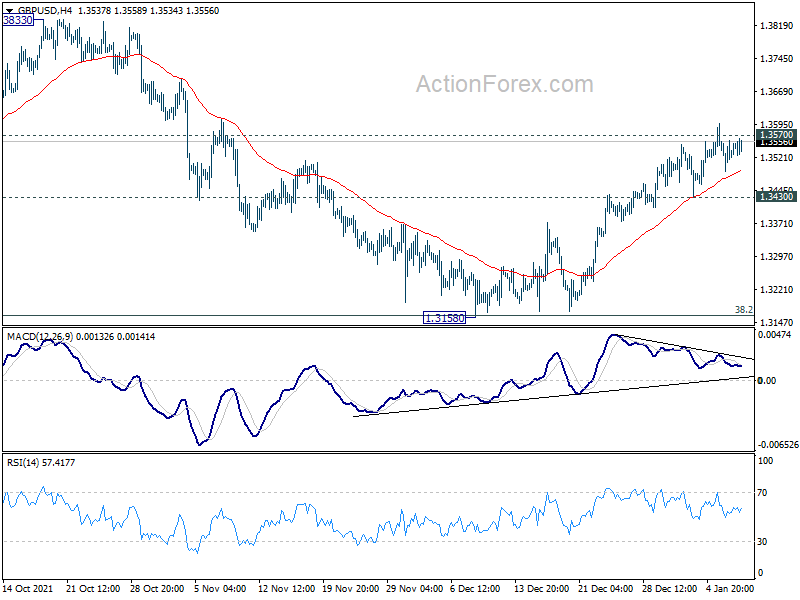
In the bigger picture, focus remains on 38.2% retracement of 1.1409 to 1.4248 at 1.3164. Sustained break there will argue that whole rise from 1.1409 has completed at 1.4248, after rejection by 1.4376 long term resistance. That will revive some medium term bearishness and and target 61.8% retracement at 1.2493. However, strong rebound from current level will revive argue that up trend from 1.1409 is still in progress, and probably ready to resume.