Sample Category Title
Oil Moves Up, Gold Under Pressure
Oil prices rise once again
Oil prices rose once again overnight, albeit at a much more modest pace in line with the price action seen in equity markets. Unlike the equity rally, oils recovery is backed by sound supply and demand fundamentals in addition to diminishing omicron concerns. A potential Russia/Ukraine supply crunch is also supportive even if Europe heads back into deeper virus restrictions through the winter.
Brent crude rose by 1.15% to USD 76.00 overnight, achieving my end of week target early. It has gained another 0.30% to USD 76.20 a barrel in Asia. WTI leapt 1.30% higher to USD 72.60 a barrel, gaining another 0.25% to USD 72.90 in Asia, just short of my target for the week.
Both contracts have recovered above their respective 200-day moving averages (DMAs) at USD 73.00 and USD 70.30 respectively, which should provide support on pullbacks. The 100-DMAs at USD 77.00 and USD 74.00 form initial resistance, although a weaker US CPI tomorrow could see both contracts rise higher with ease. I continue to believe that the lows of last week will be the lows for possibly all of 2022.
Gold risks remain
Gold attempted to rise overnight as sentiment continued to attract previously burnt bullish investors back to precious metals. It failed to overcome the clustered 50,100 and 200 DMAs however and ended the session almost unchanged at USD 1782.80 an ounce. In Asia, it has risen an asthmatic 0.15% to USD 1785.75 an ounce in moribund trading.
Although I am not ruling out further gains as omicron fears recede and a 7.0% US CPI print is priced into markets, gold’s topside failure overnight is a warning that bullishness is very fragile and that selling will resume at the first sign of trouble. The downside continues to be very clearly, the path of least resistance.
In the bigger picture, gold still looks confined to a USD 1770.00 to USD 1800.00 range this week, unable to sustain momentum above or below those levels. The 50,100 and 200-day moving averages (DMAs), clustered between USD 1790.30 and USD 1795.50 are capping gains. USD 1800.00 and USD 1810.00 will prove equally formidable. Support lies at USD 1770.00 and USD 1760.00.
US Dollar Under Pressure
US dollar is vulnerable to a deeper downside correction
The US dollar continues moving lower overnight, despite longer-dated US yields firming once again, a sign that short-term upward momentum is fading. The dollar index fell by 0.35% to 95.96, climbing modestly in Asia to 96.03. The fall overnight was led by gains in EUR/USD, which rose 0.65% to 1.1330, another warning sign that US dollar momentum is fading as crowded positions are trimmed into tomorrow’s US CPI release. A 7.0% print is looking priced in now, and the index could trade as low as 95.50 on an on-expectation print.
EUR/USD is steady at 1.1330 today and could retest the top of its range at 1.1375 into the US CPI. The single currency is likely to struggle at that level though, as European equities show signs of virus nerves. Sterling sank to 1.3205 overnight after the government reinstated work-from-home guidance. Given the caseloads in major Eurozone countries now, it is hard to see the euro avoiding the same fate.
USD/JPY rose slightly with US yields to 113.70 overnight and seems to be back to its interest rate differential business-as-usual best. AUD/USD rode sentiment 0.75% higher to 0.7165, and I don’t discount further gains to 0.7250+ into the US CPI data. NZD/USD has risen much more sedately, trading at 0.6810 today, and continues to be weighed down by inflationary pressures and a central bank sitting like a possum in the headlights.
Asian currencies mostly recorded decent gains overnight on recovering sentiment. That has continued this morning with CNH, MYR, SGD, THB, TWD, and IDR all rising versus the US dollar. Only the Indian rupee has remained unchanged, after the Reserve Bank of India policy meeting yesterday. The RBI quashed any rate hike expectations and reinforced that it remains focused on supporting India’s post-delta recovery.
The price action in US bonds and by the US dollar suggests that the Fed taper trade has become a little crowded, helped along by omicron fears receding rapidly. It will probably take a print well north of 7.0% to jar nerves into the end of the week and I can see the US dollar retreat continuing in the week’s end. But the sentiment remains fragile, and I would caution about picking the top of the US dollar with complacency into the FOMC meeting appearing to be rising.
WTI Futures Struggle Around 73 Mark, Latest Ascent At Risk
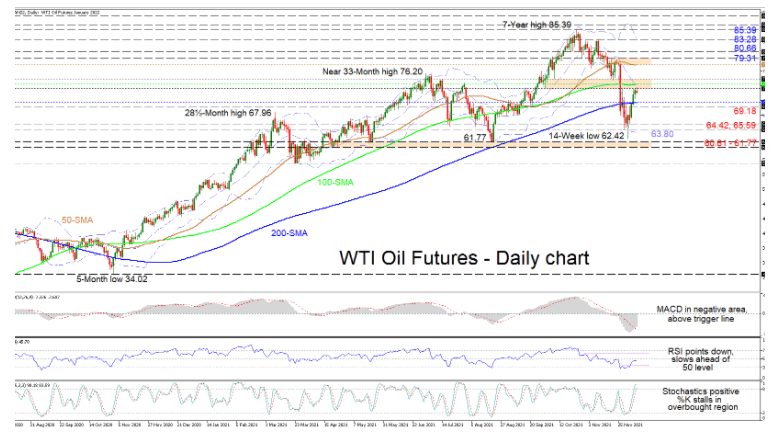
WTI oil futures’ upward thrust from the 14-week low of 62.42 is looking vulnerable as it confronts a critical resistance border formed between the 73.00 and 75.00 handles. That said, the most recent push higher in the price of the commodity seems to have neutralized the growing threat of a negative trend, something also being reflected in the steadier 50- and 100-day simple moving averages (SMAs).
The short-term oscillators are indicating that current bullish forces may not be sufficient to boost upside momentum further. The MACD, in the negative region, has climbed above its red trigger line but remains far below the zero level. The RSI is starting to roll over ahead of its 50 level, showing that negative pressures have yet to fully subside. Moreover, in the overbought zone, the stochastic %K line is hinting that the upward drive may be weakening.
In the positive scenario, an immediate tough section established between the 73.00 and 75.00 handles could curb gains in the commodity. That said, if the price surpasses this important border, reinforced by the mid-Bollinger band and the 100-day SMA, buyers could propel higher for another limiting zone marked by the 50-day SMA at 78.00 and the 79.31 barrier. Conquering these and the adjacent 80.66 high, the bulls may then seek out the upper Bollinger band around 83.28 before targeting the seven-year high of 85.39.
If advances remain capped, preliminary support could arise around the 200-day SMA at 70.12 and the nearby 69.18 obstacle. If bearish powers intensify, the price may dive for the 65.59 and 64.42 neighbouring barriers prior to meeting the lower Bollinger band at 63.80. Should sellers remain in charge, they could then test the 14-week trough of 62.42 before challenging the 60.61-61.77 support base.
Summarizing, WTI futures short-term neutral-to-bullish tone is showing weakness at the 73.00-75.00 key resistance. A break above this could feed optimism in the commodity, while a break below the key 60.61-61.77 foundation may spark worries about the broader uptrend.
Equities Stay Cheery But Dollar Creeps Up, Pound Hits New Low
- Stock market party continues as virus risks sidestepped, though US futures dip slightly
- But Omicron begins to bite as UK’s Johnson brings in Covid Plan B, pound takes a knock
- Loonie also slips as BoC cites Omicron danger; all eyes now on US inflation data
Stocks remain optimistic but rally cools
There were few signs of worry about the Omicron outbreak in equity markets as traders remained hopeful that the economic disruption from this new variant will be kept to a minimum. A small study by Pfizer and BioNTech showed that three doses of their vaccines boost antibodies against Omicron to similar levels as two doses do against other strains. For investors, this was yet another reason not to get gloomy about the near-term growth outlook despite the many uncertainties of the Omicron variant.
Markets may also be hoping that the big central banks will ease up on their hawkish rhetoric of late and exit their pandemic-era emergency programs more slowly. Stocks in Asia have already received a major bump up this week from a series of growth-boosting measures by Chinese policymakers. The drop in China’s producer price inflation in November and the softer-than-forecast rise in consumer prices in data out today raised expectations that more policy action could be on the way.
China’s CSI 300 index led the gains in Asia on Thursday, though the Nikkei 225 bucked the trend to finish the session lower. Stocks in Europe opened mostly higher, while US futures were indicating some profit-taking may be due on Wall Street today.
The S&P 500 came within a whisker of its all-time closing high on Wednesday and the 4,700 level seems a natural resistance point for the recent rally to take a pause, especially as crucial inflation numbers are due out of the US tomorrow that could easily spoil the party.
Dollar pares losses, pound slumps on new Covid restrictions
In the currency markets, however, the optimism receded somewhat as expectations that some central banks might need to dial back on plans to pre-emptively tighten policy to combat surging inflation weighed on the riskier pairs, lifting the greenback.
The dollar index edged back above the 96.0 level after breaching it yesterday. It came under pressure mainly from unusually strong demand for the euro, which convincingly reclaimed the $1.13 handle. However, the pound headed in the opposite direction, slumping against both the dollar and the euro after British Prime Minister Boris Johnson announced a new set of measures to slow the spread of the Omicron variant.
The UK government is making masks mandatory again for most indoor places and introducing a Covid pass for certain venues and events, as well as advising people to work from home. Whilst the new guidelines are nowhere near as strict as the recent restrictions imposed in many other European nations, the UK is coming from a place of near-zero Covid rules so there’s likely to be a mild hit to economic growth.
More significantly, the Bank of England might be less confident to hike interest rates next week given the potentially weaker economic backdrop. Money markets have priced out the odds for a rate increase in December following yesterday’s announcement and are now looking at February for liftoff.
Nevertheless, sterling was steadier today, hovering around the $1.32 level, while the euro fell back slightly. The European Central Bank also meets next week and policymakers are reportedly in agreement to temporarily ramp up the regular asset purchase program once the pandemic program ends in March.
Loonie slides after not-so-hawkish BoC meeting
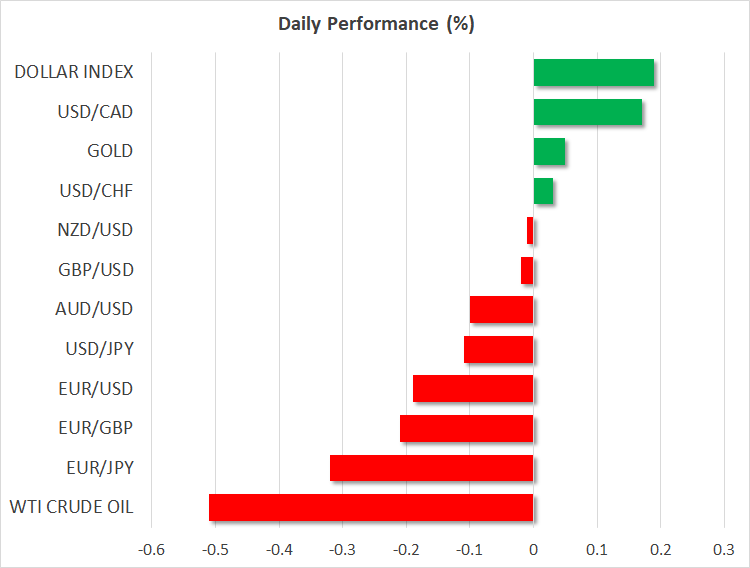
The Canadian dollar was one of the worst performers on Thursday, reversing sharply from yesterday’s 2½-week lows versus its US counterpart. The loonie skidded after the Bank of Canada yesterday dashed hopes of an early rate hike, sticking to its guidance of Q2/Q3 2022. The Bank was unexpectedly downbeat about the immediate growth picture, worried not only about Omicron but also about the impact from the recent floods in British Columbia.
The aussie and kiwi slid too, while the safe-haven Japanese yen thrived on the back of other currencies’ pain, as sovereign bond yields pulled back globally.
Oil prices were down, but surprisingly steady, but the stronger dollar kept gold within a narrow range.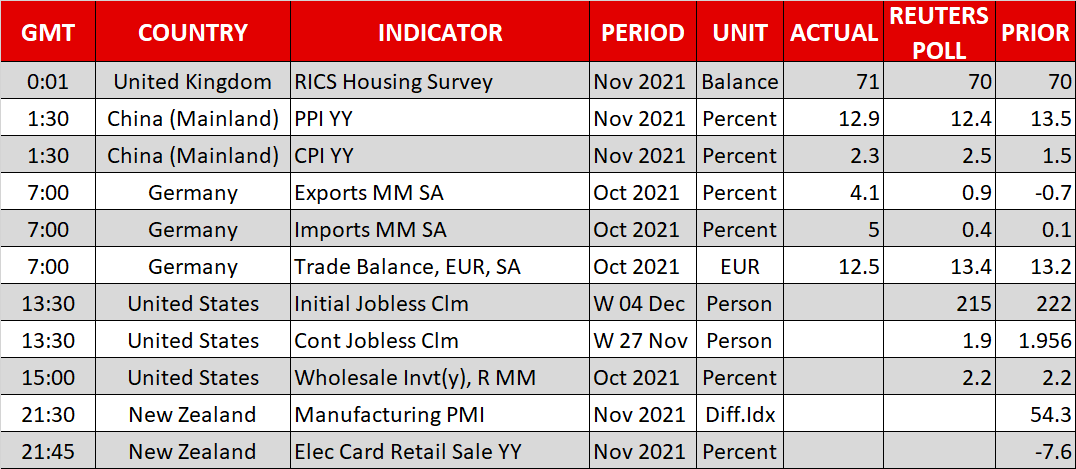
USD/CAD Respects Pivot Points
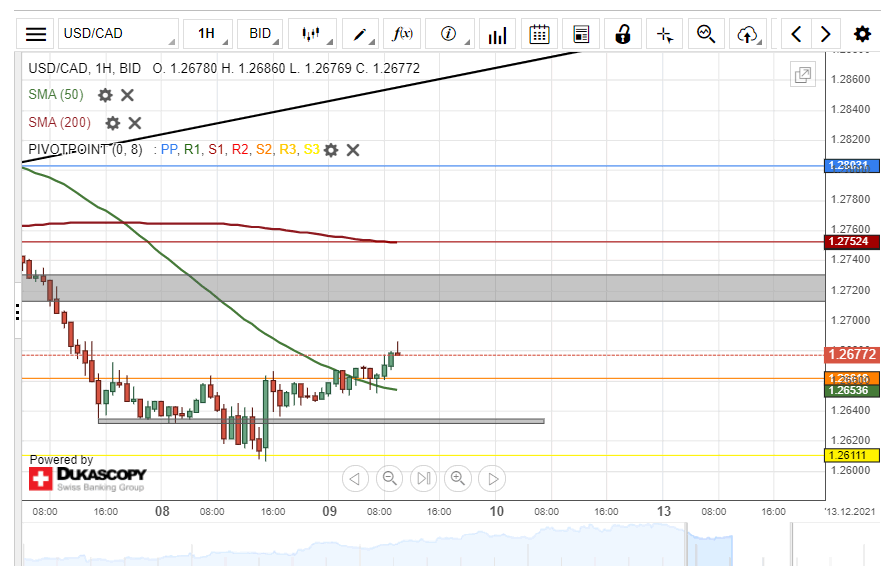
On Wednesday, the USD/CAD found support in the weekly S3 simple pivot point at 1.2611. Meanwhile, resistance was provided by the weekly S2 simple pivot point at 1.2662. On Thursday morning, the rate passed the resistance of the weekly S2 simple pivot point and the 50-hour simple moving average.
If the pair continues to surge, it would most likely reach the resistance of the November 28 and December 1 low levels at 1.2713/1.2730. Above the zone, note the resistance of the weekly S1 simple pivot point and the 200-hour simple moving average at 1.2752.
However, a decline of the currency exchange rate might look for support in the weekly S2 at 1.2662 and the 50-hour SMA near 1.2650. Below these levels, the weekly S3 at 1.2611 could stop a decline.
GBP/JPY Trades Below 150.00
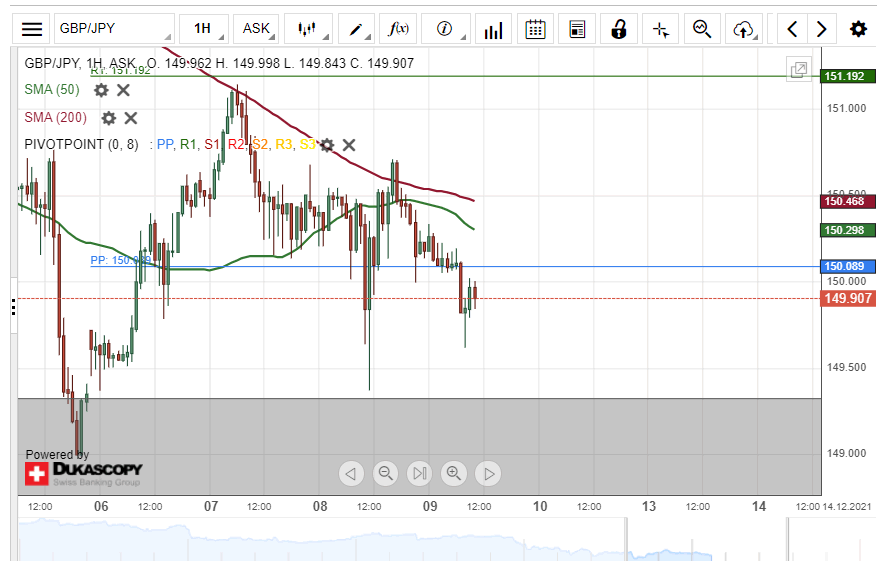
Despite shortly piercing the resistance of the 200-hour simple moving average, the GBP/JPY currency exchange rate returned to trade below it and declined. By the middle of Thursday's trading hours, the rate had reached below the 150.00 mark, which appeared to have started to act as resistance.
If the pair continues to decline, it is expected to approach the support of the July, August, September and October low level zone at 148.46/149.30. Below the zone, the weekly S1 simple pivot point at 148.24 might stop a decline.
However, a recovery of the GBP against the JPY would highly likely encounter resistance in the 150.00 mark, the weekly simple pivot point at 150.09. Afterwards, the 50 and 200-hour simple moving averages are expected to provide resistance at 150.30 and 150.45.
AUD/USD Reaches New December High Level
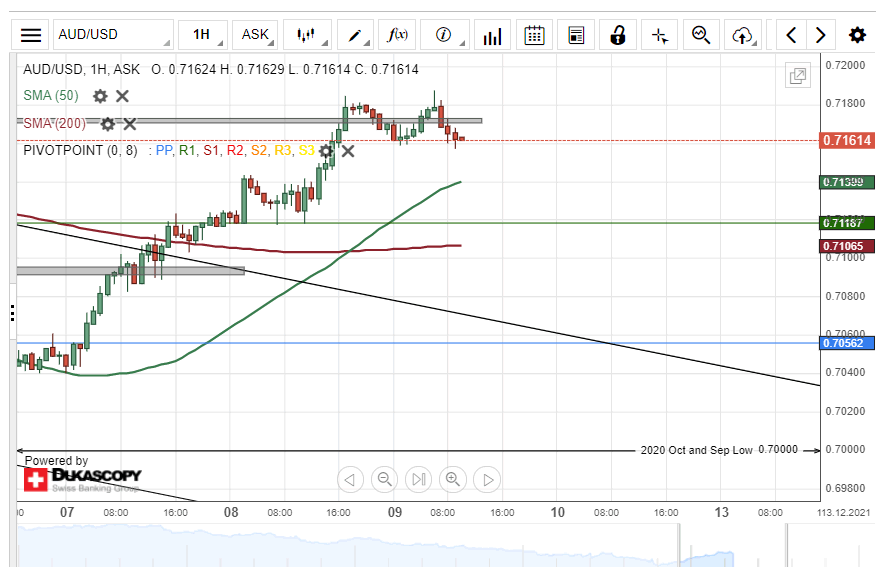
The AUD/USD currency exchange rate has reached above the previous December high level zone at 0.7170/0.7173. However, the event was not followed by a follow up surge. Instead the rate began to consolidate by trading sideways between the 0.7160 and 0.7180 levels.
If the pair resumes its surge, it could do so due to the approaching support of the 50-hour simple moving average. A potential surge might reach the resistance of the weekly R2 simple pivot point at 0.7236. Above the weekly R2, the weekly R3 at 0.7299 might stop an upwards move.
However, a decline would have to first pass the support of the 50-hour SMA near 0.7140, before reaching the weekly R1 simple pivot point at 0.7119. The pivot point provided support during the middle of Thursday's trading.
EUR/JPY Reaches 129.00 Level
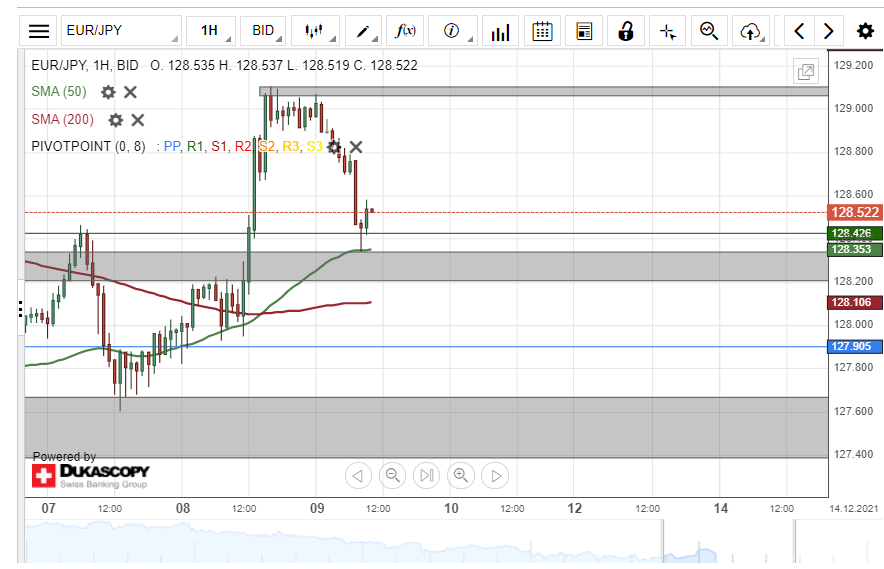
At mid-day on Wednesday, the EUR/JPY currency exchange rate broke the resistance of the zone at 128.20/128.35 and the weekly R1 simple pivot point at 128.35. Afterwards, the pair reached the 129.00 mark and tested its resistance up to midnight to Thursday. On Thursday morning, the pair declined and looked for support at the 128.20/128.35 zone. Note that the zone has been reached by the additional support of the 50-hour simple moving average.
In the case that the rate recovers, it could once again test the resistance of the 129.00 level. Above the 129.00 mark, the weekly R2 simple pivot point at 129.31 might stop a surge. Higher above, note the resistance of the 129.50 level and previous high level zone above it.
On the other hand, a passing of the weekly R1, 50-hour SMA and the 129.20/129.35 zone would highly likely result in the pair looking for support in the 200-hour SMA at 128.10. Further below, the weekly simple pivot point at 127.91 might act as support.
Asian Equities Are In A Positive Mood
Asian markets take cue from optimistic Wall Street
Overnight US equities continued to rally, although the gains were modest compared to the fast-money FOMO stampede of the day before. Comments from pharmaceutical heavyweights that boosters were the answer kept the omicron-is-mild trade alive. The S&P 500 rose 0.31%, with the Nasdaq rising by 0.64% as the growth rebound continued, while the Dow Jones eked out a minuscule 0.09% gain. In Asia, futures on all three indexes have climbed by around 0.10%.
The risks of whipsaw price movement have not disappeared. As I have said before, volatility will be the winner in December, not directional plays. Having said that, I am not calling for the end of days for the 21-month stock market rally, merely that we can now expect a lot more two-way volatility going forward.
The solid, if an unspectacular day on Wall Street, has bolstered sentiment in Asia, where regional investors are also buying into the China property developer debt-restructuring story. Despite the bad news pouring in from the property developer space this week, is taking their pleas for debt restructuring as meaning the government will facilitate “something.”
Japan is seeing profit-taking after the rally yesterday with the Nikkei 225 unchanged. The Kospi is 0.55% higher. In mainland China, benign inflation, property sector restructuring, and stimulus hopes continue to drive gains. The Shanghai Composite and CSI 300 have rallied 0.90% today and Hong Kong has recovered its poise to rally by 1.10%.
Regionally, Singapore is 0.30% higher, with Kuala Lumpur rising 0.20%, and Taipei by 0.10%. Jakarta is 0.40% higher, with Bangkok adding 0.70%, with Manila unchanged. After some impressive gains this week, Australian markets are taking a breather today, perhaps watching the Ashes cricket. The All Ordinaries and ASX 200 have moved 0.15% higher.
European equities should open higher today after a positive overnight session. I expect gains to be limited though, as Eurozone and UK markets are crimped by the spectre of tighter Covid-19 restrictions, omicron or not.
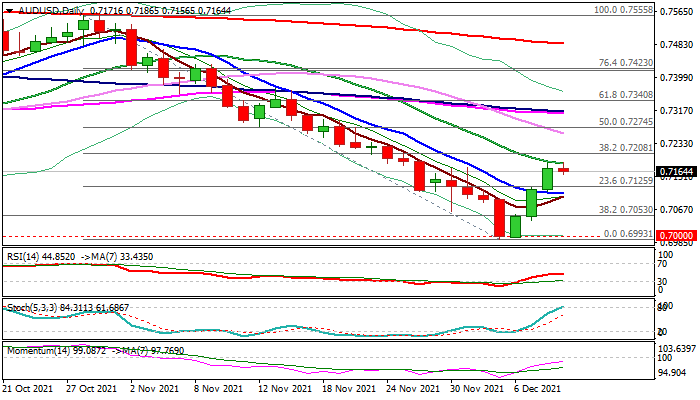
AUD/USD Outlook: Bulls Are Taking A Breather After Strong Three-Day Advance
The Australian dollar is consolidating under new two-week high, hit after nearly 2.5% advance in past three days, sparked by decision of China’s central bank to cut the amount of cash that banks must hold in reserve, as the Aussie as often used as a proxy for China actions.
Higher Asian stocks also added to positive sentiment by boosting risk demand.
Recovery from 0.70 support zone, where larger downtrend found footstep, faced headwinds from falling 20DMA (0.7183) and just ahead of pivotal Fibo barrier at 0.7208 (38.2% of 0.7555/0.6993 downleg), with firm break here needed to generate reversal signal and open way for stronger recovery.
Consolidation should stay above broken 10DMA (0.7108) to keep bulls in play, with rising momentum on daily chart (although still in the negative territory) underpinning the action.
Also, bullish engulfing pattern that is forming on a weekly chart would add to positive signals.
On the other side, the fundamentals may not work in favor of the Aussie, as the Australian central bank decided to keep ultra-loose policy for some time and required patience, while markets await US inflation data this week and Fed policy meeting next week, for fresh signals.
Inflationary pressures are expected to remain high in the US that may prompt the central bank to announce faster tapering process that would lead towards earlier than expected rate hike.
Hawkish Fed (as many expect) would boost the US dollar and widen divergence between two central banks’ policies a that would weigh on the Australian dollar.
Res: 0.7183, 0.7208, 0.7259, 0.7274.
Sup: 0.7135, 0.7108, 0.7100, 0.7063.