Sample Category Title
GER 40 To Test Major Resistance
The Dax 40 recoups losses as fears of the omicron variant start to subside.
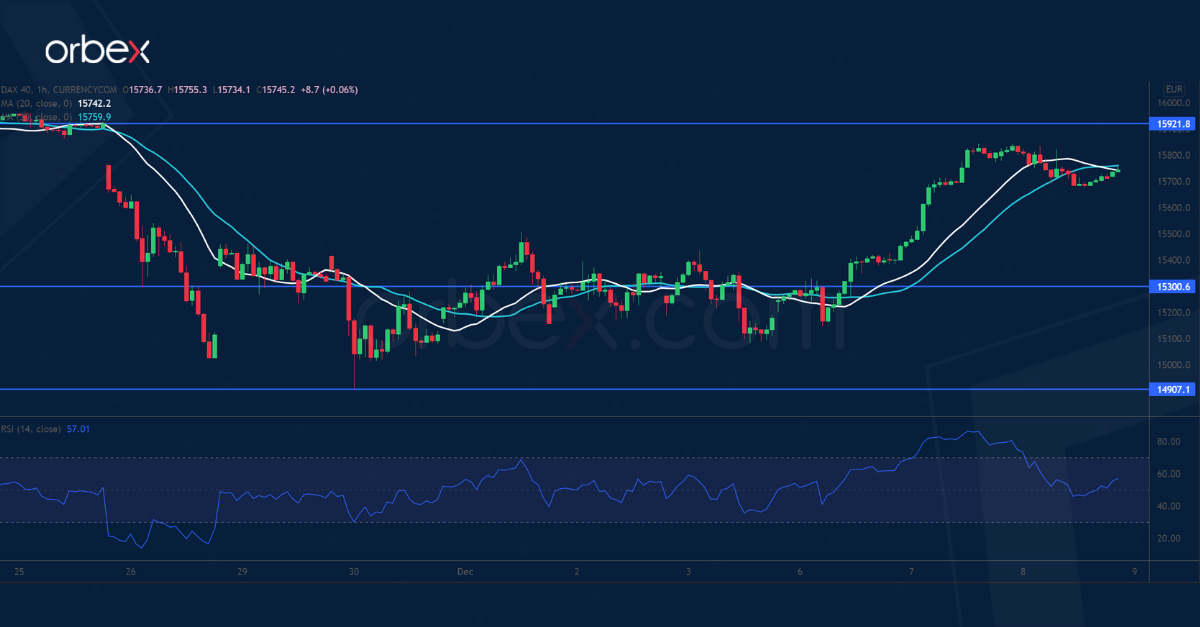
Last October’s lows near 14900 have proven to be a solid support. The rally above 15520 stirred up volatility as the last sellers rushed to the exit. The bulls are pushing towards 15920, where the index took a nosedive in late November.
A bullish breakout could attract more buying interest and turn market sentiment around. Meanwhile, an overbought RSI has caused a pullback, giving time for the bulls to accumulate. 15300 is the closest support.
USOIL Rebounds From Demand Zone
WTI crude bounces back on signs that the new virus strain has a limited impact on demand.
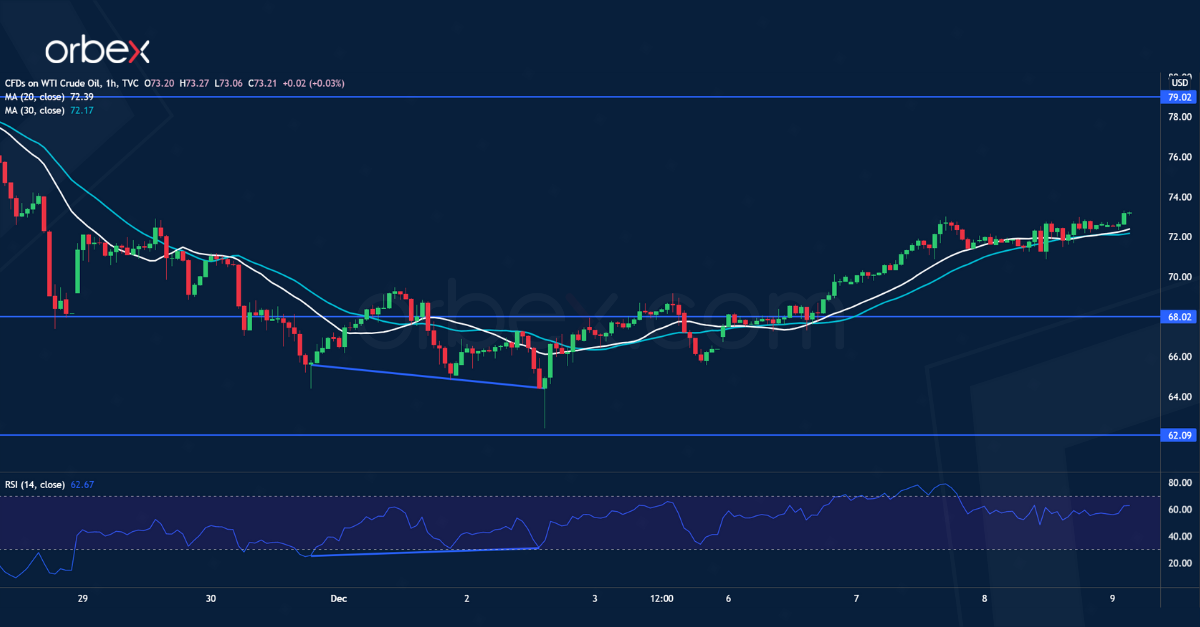
Price action met strong buying interest near last August’s lows at 62.00, a major support from the daily chart to keep the uptrend intact. A bullish RSI divergence in this congestion area indicates a loss of momentum in the bearish drive.
Then a rally above 69.30 forced the sellers to exit, opening the door for an extension towards 79.00. The initial surge has pushed the RSI into the overbought territory. 68.00 is an immediate support.
USDCAD Tests Key Support
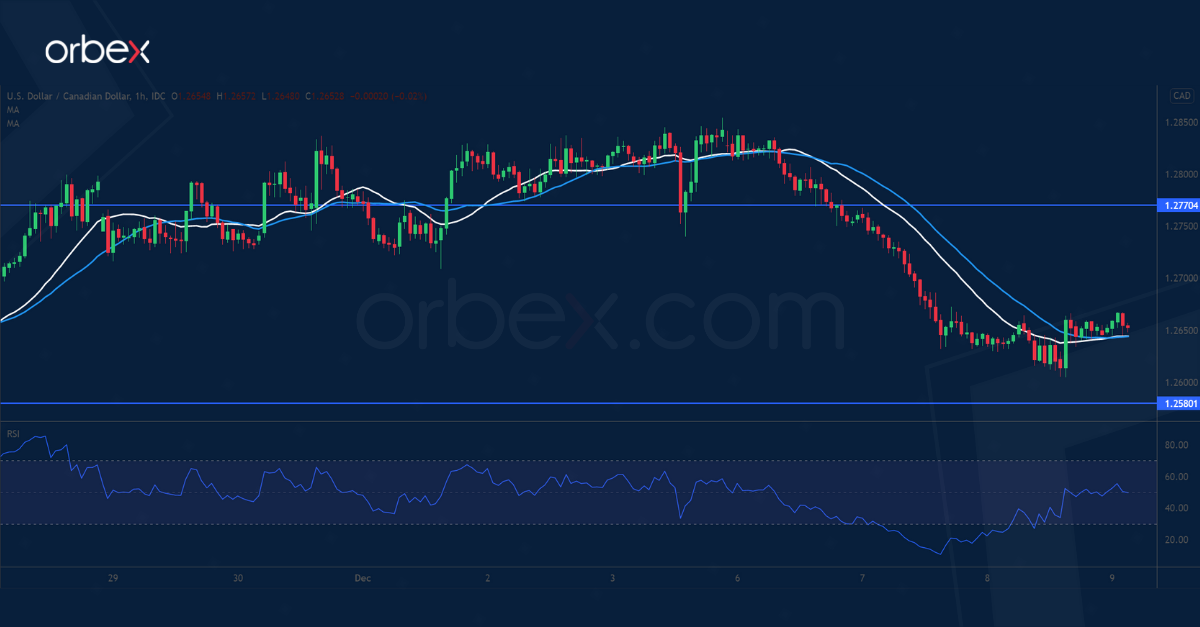
The Canadian dollar inched lower after the BOC left its interest rate unchanged as expected. The pair has met stiff selling pressure at the supply zone around 1.2850, a triple top on the daily chart.
A drop below 1.2720 has forced out short-term buyers. 1.2580 is the next support and it sits on the 30-day moving average. A bearish breakout would deepen the correction to the psychological level of 1.2500.
On the upside, the bulls will need to clear 1.2770 before they could have another attempt at the supply zone.
USD Weakened As Optimism Remains
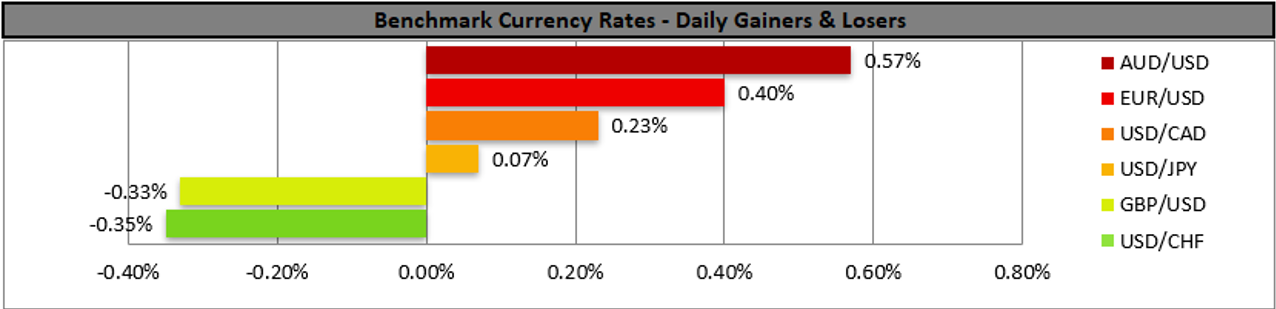
The USD tended to weaken against a number of its counterparts yesterday as markets tended to show some optimism about the Omicron variant of the pandemic and its effects on the global economy yet uncertainty is still present. It’s characteristic how US stockmarkets sent out mixed signals amidst low volatility which underscored the situation of the markets yesterday. On the other hand safe havens such as JPY tended to remain in the retreat as they suffered even greater safe haven outflows, while commodity currency AUD capitalized some gains, while TRY marked new losses as Turkish President Erdogan supported low rates again. Overall we may see this switching between optimism and pessimism about the new variant to continue to affect the market’s fundamentally in the coming days leading safe havens and riskier currencies in different directions. Today we note the release of the weekly initial jobless claims figure, especially after the release of the disappointing NFP figure for November last Friday in order to get a sense on whether the US employment market continues to tighten.
USD/JPY rose yesterday had some bullish tendencies as it tested the 113.70 (R1) resistance line. We note that the pair is marking higher highs and higher lows as an upward trendline is forming yet would require a clear breaking of the 113.70 (R1) resistance line and USD/JPY starting to aim for the 114.45 (R2) level, before switching our sideways bias for a bullish outlook for the pair. Please note that the RSI indicator remains just above the reading of 50 which could imply a rather indecisive market currently. Should the bulls actually take full charge of the pair’s direction we may see USD JPY breaking the 113.70 (R1) line and aim if not reach the 114.45 (R2) level. Should the bears take over we may see the pair aim if not reach the 112.75 (S1) line.
EUR gets some support also from Schnabel
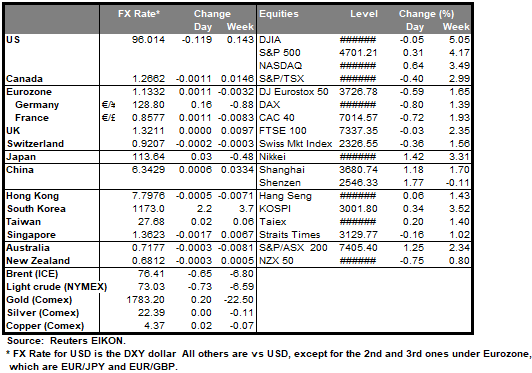
The common currency tended to gain against the USD but also against the broader weaker GBP and JPY in a clear sign of EUR strength. No major financial data provided support for the EUR, however ECB board member Schnabel made some hawkish remarks. The ECB board member warned that the extensive QE program provided by the bank is inflating asset prices highlighting thus the negative effects of the bank’s bond buying program. It should be noted that the statements gained traction also given the bank’s meeting next week but also criticism being expressed by German Bundesbank President Weidmann about ECB’s QE program in the past. Today we expect EUR traders to remain busy with Germany’s trade data, albeit EUR’s direction could be also affected by fundamentals.
EUR/USD jumped yesterday breaking the 1.1300 (S1) resistance line now turned to support. We may see the pair advancing higher today given the bullish sentiment of the market as displayed by the RSI indicator below our 4-hour chart, which is above the reading of 50. On the other hand the correction lower of the pair’s price action during today’s Asian session, tended to create some doubts for the bulls. Should the pair actually find fresh buying orders along its path we may see it breaking the 1.1370 (R1) resistance line which proved its worth on the 18th and the 30th of November and aim for the 1.1435 (R2) resistance level. If the correction lower is extended and the selling interest of the market guides the pair, EUR/USD could break the 1.1300 (S1) line and aim for the 1.1225 (S2) support level.
Today’s events and expectations
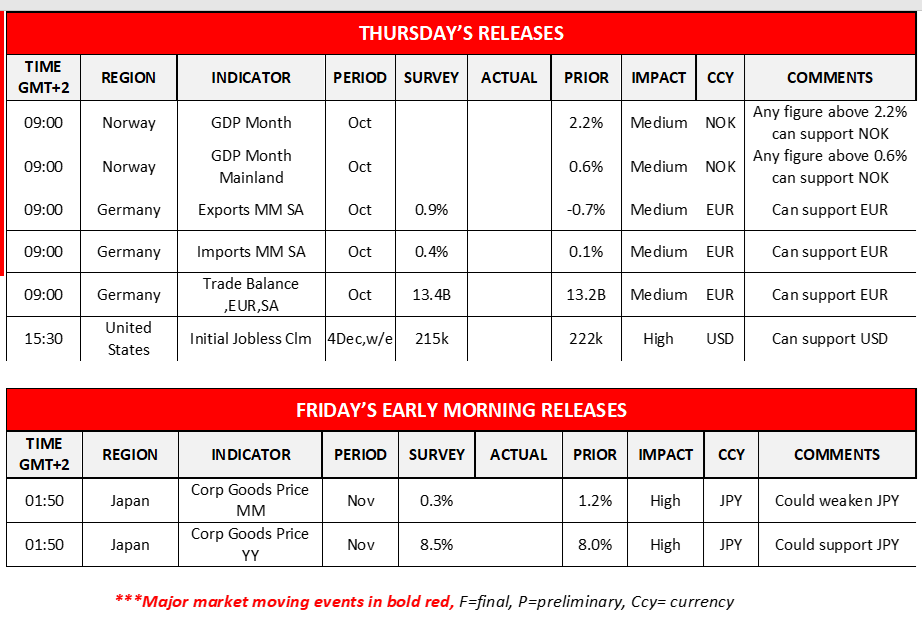
Today we note the release of Norway’s GDP rates for Q3 as well as Germany’s trade data for October both in the early European session. In the American session we note the release of the US weekly initial jobless claims figure and in tomorrow’s Asian session we get from Japan the corporate goods prices for November.
USD/JPY H4 Chart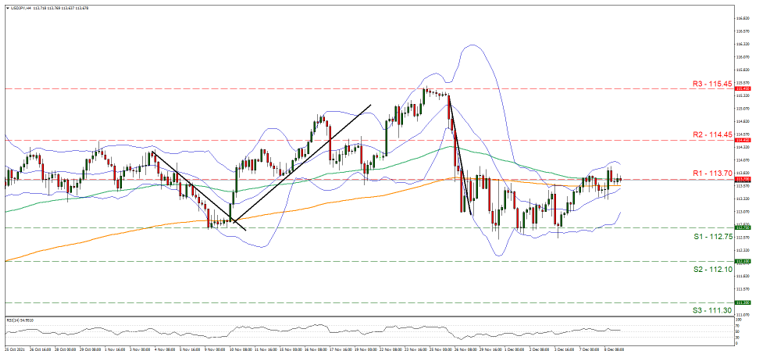
Support: 112.75 (S1), 112.10 (S2), 111.30 (S3)
Resistance: 113.70 (R1), 114.45 (R2), 115.45 (R3)
EUR/USD H4 Chart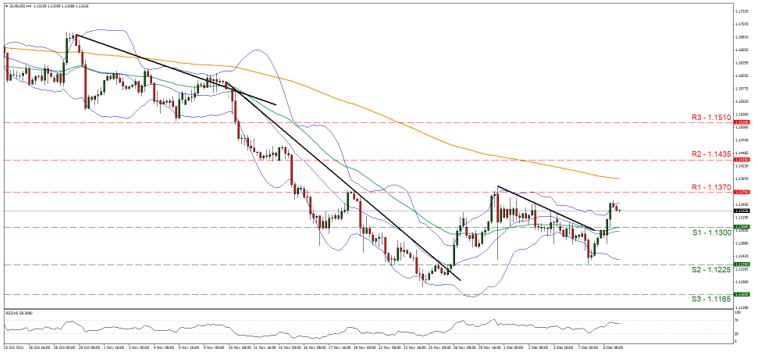
Support: 1.1300 (S1), 1.1225 (S2), 1.1165 (S3)
Resistance: 1.1370 (R1), 1.1435 (R2), 1.1510 (R3)
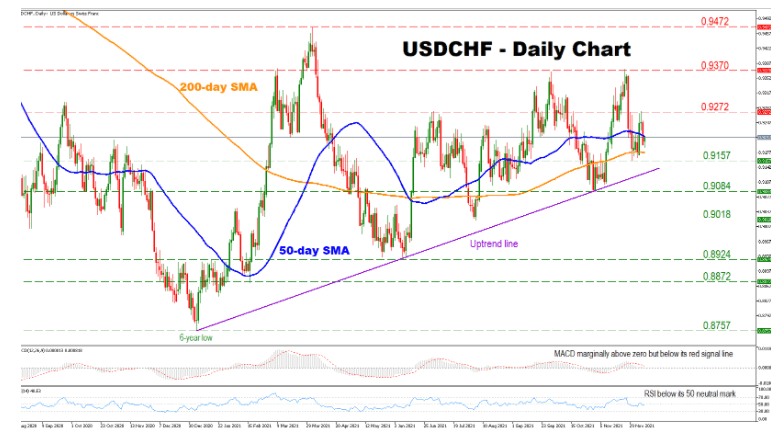
USDCHF Meets Resistance At 50-SMA, Long-Term Bullish Outlook
USDCHF is currently facing resistance at its 50-day simple moving average (SMA), after its late November pullback. However, the long-term prospects for the pair remain cautiously bullish amid successive higher lows.
Short-term momentum indicators on the other hand, are supporting a negative bias, as the RSI is located below its 50 neutral mark. The MACD is found under its red signal line and is looking ready to cross below zero, which could be another sign of strengthening negative momentum.
Should the price break above its 50-day SMA currently at 0.9215, a positive bias could resurface, sending the price to test the 0.9272 barrier. Surpassing the latter could open the door towards the 0.9370 obstacle before the bulls shift their attention towards the 0.9472 resistance.
On the flip side, if the bears resurface, initial support might be found at the region which consists of the 200-day SMA currently at 0.9176, and the 0.9157 barrier. A break below that area could pressure the price towards the uptrend line drawn from the January lows. Crossing below this crucial point could turn the fortunes around for the pair, paving the way towards the 0.9084 obstacle.
In brief, despite the negative bias, the long-term outlook for the pair is cautiously bullish. For sentiment to change, the bears would need to break below the uptrend line.
Markets Stay Booster’ed
Equities rally continues
US markets managed to maintain omicron is weak, buy everything rally overnight, albeit at a much less frenzied pace than the day before. That sits nicely with my V for Volatility outlook for December and readers should not be fooled into thinking the risks of whipsaw price have now disappeared. I'll say it again, volatility will be the winner in December, not directional plays.
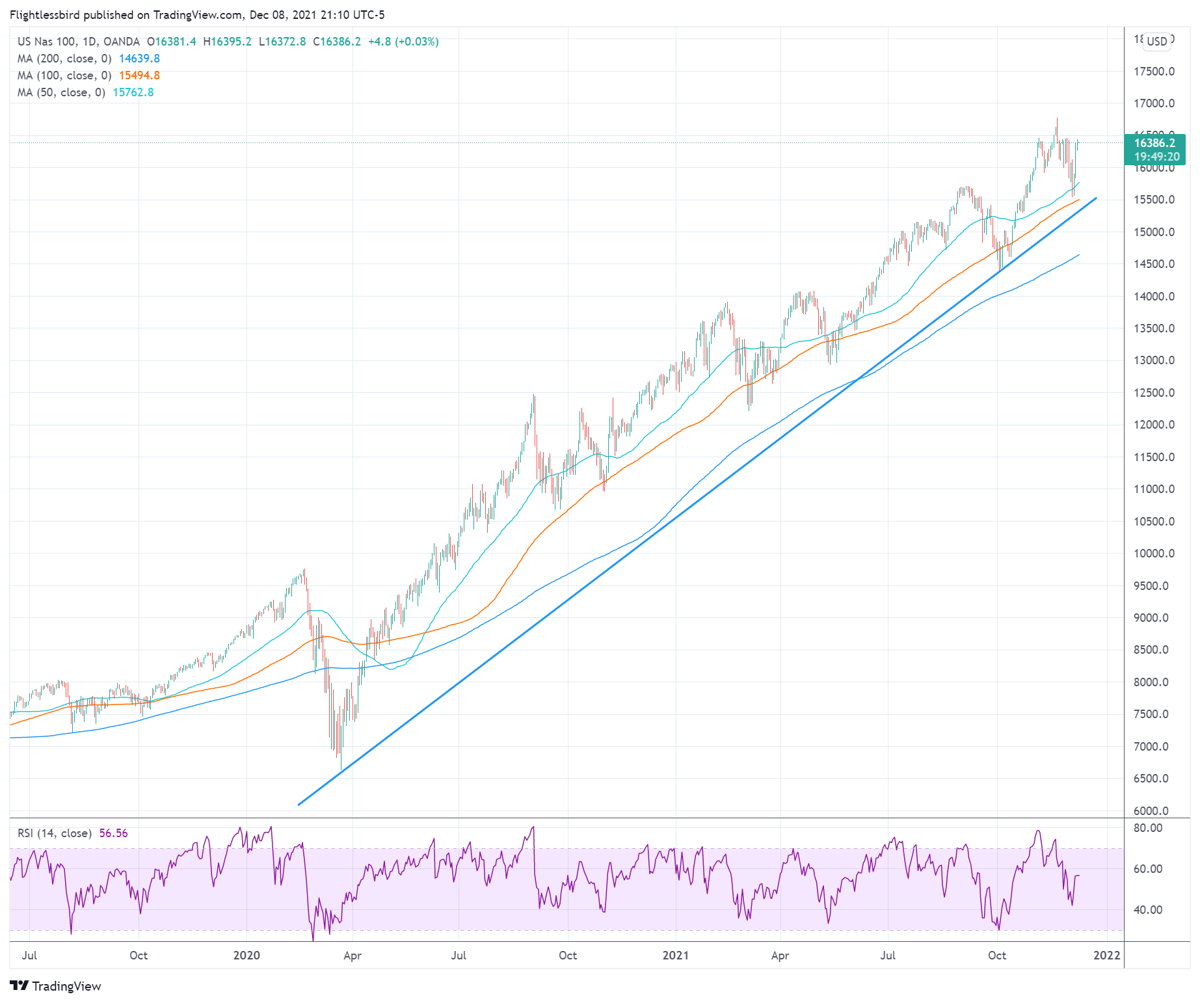
Having said that, I am not calling for the end of days for the 21-month stock market rally, merely that we can now expect a lot more two-way volatility going forward. A case in point is the Nasdaq, which has once again bounced off its mighty March 2020 trendline support and will probably be a classical technical analysis case study for years to come. Here's what CFD from OANDA looks like, the actual physical chart is even sexier, and I'll leave readers to draw the lines on that one themselves.
Another sign that we may need to wait for next week's FOMC meeting to climb aboard the taper trade again comes from currency and bond markets. The Australian dollar, the risk sentiment indicator to rule them all, rallied powerfully overnight. Even the euro managed to recover, and the US dollar generally had a tough day at the office. That came as US 10-year yields rose back above 1.50% to 1.53%.
The divergence in price action is a warning sign for tomorrow night's US CPI. It suggests that the street is positioned for a “risk-off” taper move. With the US 10-year rising around 20 basis points over the last few sessions, reversing recent losses, there may not be much juice in the tank at a 7.0% CPI print. Quid pro quo, US dollar selling and equity buying hint that a 7.0% CPI is increasingly priced in. We likely need to see a print much higher than 7.0% to revive the taper trade in the near term and it wouldn't surprise me if an on-expectation CPI release sees US yields fall, the US dollar fall, and equities jump once again. Remember what I said about V for Volatility and whipsaw price action?
Helping things along, although with a gentler market impact, were comments from Pfizer and Moderna suggesting a third shoot would do the job against omicron. Given that the US and Europe can't even get 65% of their populations to have even two shots, let alone a third, we can assume two things. Omicron will yet have a role to play in surging cases over the winter, and vaccine hoarding by rich countries will continue until 35% of their populations stop taking advice from social media and saying me, me, me, instead of we, we, we. That means that the poor in the rest of the world will be waiting longer, thus allowing a higher chance of more nasty variants to arise. And thus, the cycle continues, sigh…
Today's data calendar in Asia is thin. New Zealand Manufacturing Sales in Q3 fell a dismal 6.20%, suffering from the Auckland Covid lockdown hangover. You can't buy anything in New Zealand these days anyway; it's either too expensive thanks to the RBNZ, or there's none of it left thanks to Covid-19. The New Zealand dollar continues to underperform its Australian cousin, thanks to being another 2,250 kilometers (1,400 statute miles for non-decimal dinosaurs) east of Australia, and the RBNZ hitting the W for Wimp button at its last policy meeting.
On a brighter note, Japan's Large Manufacturing Index QoQ for Q4 outperformed, rising by 7.90%. Some Q3 baseline effects are in there, but overall, it bodes well for next week's Tankan survey and suggests that Japan is recovering after it Q3 delta wave. Services may have a more difficult time as the country shut its borders to Johnny Foreigner again this month.
China's Inflation data has proved benign as well, giving regional markets a small sigh of relief. YoY Inflation for November rose to 2.30% (2.50% exp), while MoM Inflation rose by 0.40% (0.70% exp), giving markets a nil-all draw. That should provide more relief to local equity markets which despite the bad news pouring in from the property developer space this week, is taking their pleas for debt restructuring as meaning the government will facilitate “something.” At least Kaisa suspended trading of their stock in Hong Kong, I'm surprised Evergrande still is. A debt restructuring is not usually good for stock prices, even if they have already fallen by 90%.
The rest of the day's calendar globally is second-tier. Some regional inflation measures from Europe and Germany's Balance of Trade. The focus will be on US Initial Jobless Claim with markets hoping for sub-200k prints to resume. Overnight, US Jolts Job Openings for October jumped to 11 million unfilled jobs. That doesn't really compute with US Non-Farms falling to 210,000, or even a Household Survey suggesting 1.1 million jobs, or unemployment falling to 4.20% with a 61.80% participation rate.
The Federal Reserve may have shot itself in the foot with its unlimited free money we'll backstop the dumbest investment decisions monetary stimulus which should have been a short term “shock and awe,” and not a monetary Vietnam. Macroeconomics is a beautiful thing when the orchestra all plays in tune, but too often, sticking your finger in one leak sees another pop up nearby. By enriching substantially, any American who owns a home, crypto, a meme or any other stock, they have created a situation where people don't have to go back to work or have retired. The inflation trade may waver this week, but don't put it to bed just yet. If James Bond can return from his most diverse and politically correct movie ever (the end credits said he would), inflation sure can as well.
Swiss SECO expects significant slowdown in winter period, lowers 2022 GDP growth forecast
SECO lowered Swiss GDP growth forecast for 2022 from 3.4% to 3.0%. GDP growth is projected to slow further to 2.0% in 2023, as the economy normalizes. 2021 GDP growth forecast is revised up slightly from 3.2% to 3.3%.
It said that "international supply and capacity bottlenecks are putting pressure on the industrial sector and causing sharp price increases globally". Also, "uncertainty surrounding the pandemic has recently become strongly accentuated and several countries have stepped up their containment measures."
SECO expects a "significant slowdown in economic growth globally and in Switzerland in the 2021/22 winter period". But economy recovery is "not, however, expected to come to standstill in the medium term".
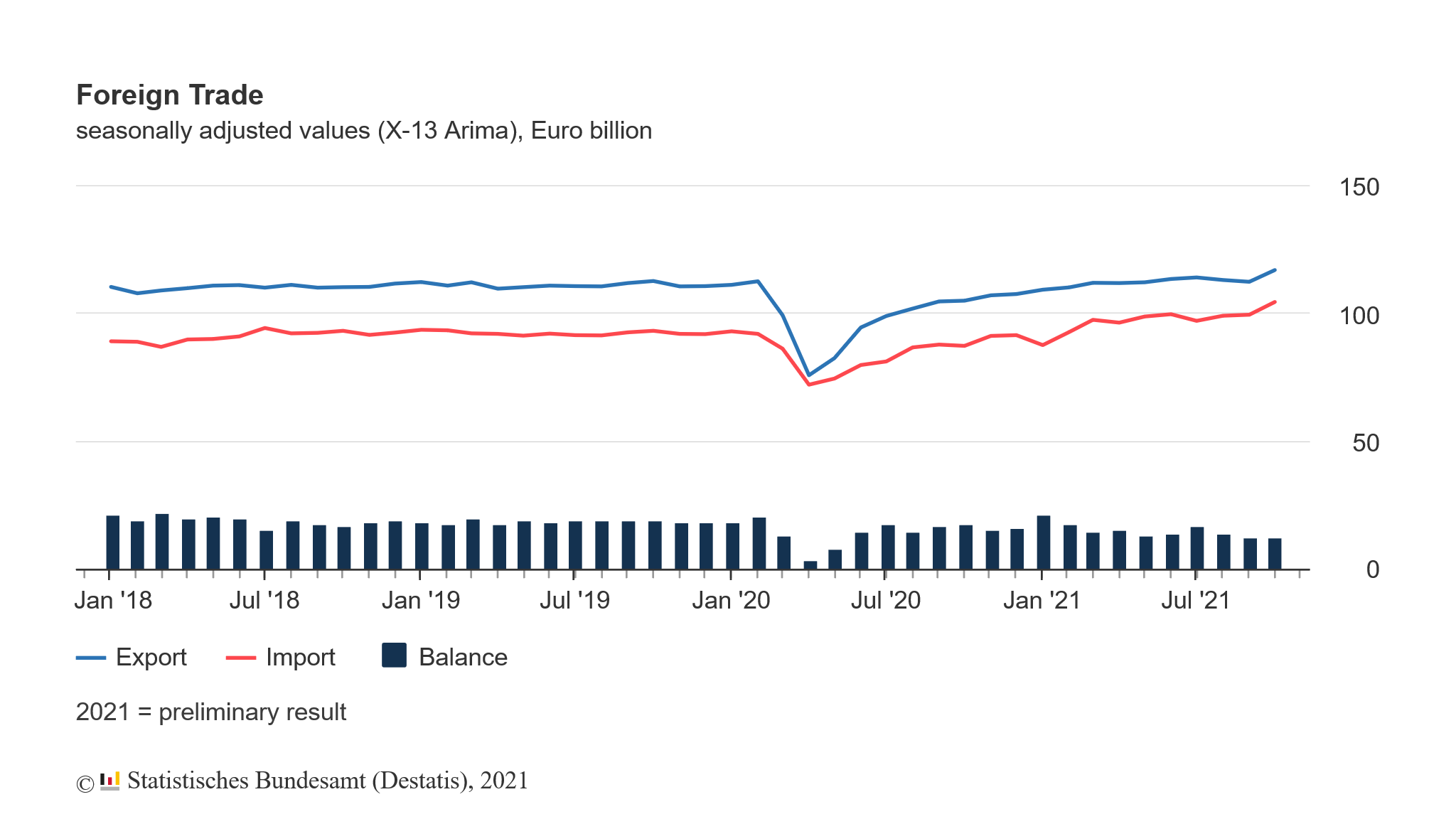
Germany export rose 4.1% mom in Oct, imports rose 5.0% mom
In calendar and seasonally adjusted term, Germany export rose 4.1% mom to EUR 121.3B in October. Imports rose 5.0% mom to EUR 108.5B. Trade surplus narrowed to EUR 12.5B, down from EUR 13.2B, below expectation of EUR 12.9B. Over the year, exports rose 8.1% yoy, while imports rose 17.3% yoy.
In calendar and seasonally adjusted term, exports were 3.8% higher than pre-pandemic level in February 2020. Imports were 13.5% higher.
AUDUSD Short-Term Outlook Brightens, Next Target At 0.7200
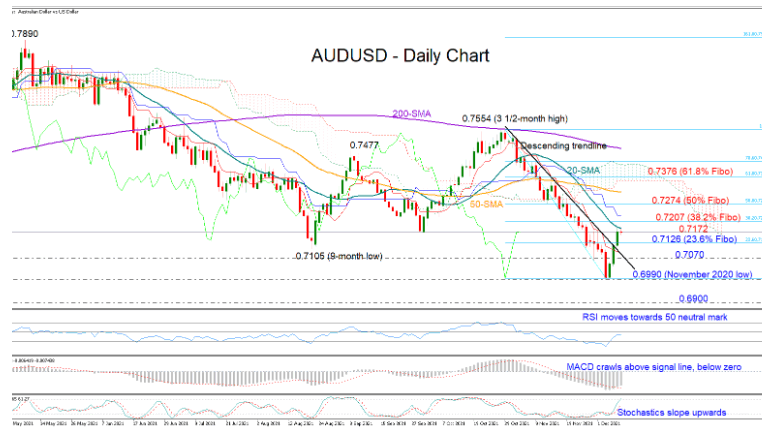
AUDUSD surged above the 6-week-old steep descending trendline and the restrictive red Tenkan-sen line on Wednesday, raising hopes that the downward pattern has finally found a bottom and it’s time for a bullish reversal.
The momentum indicators witness improvement in buying sentiment as the MACD is distancing itself above its red signal line, the Stochastics slope upwards, and the RSI is ramping up to meet its 50 neutral mark. Yet, today’s resistance around the 20-day simple moving average (SMA) at 0.7180 and the 38.2% Fibonacci barrier positioned near the 0.7200 psychological mark, could feed some caution among traders in the near term.
A decisive close above 0.7200 may lead the price straight to the 50% Fibonacci of 0.7274, a break of which could initially see a test around the 50-day SMA before stretching towards the 61.8% Fibonacci of 0.7376.
On the downside, a step below the 23.6% Fibonacci of 0.7126 could immediately seek support around the broken ascending trendline seen at 0.7070. Should the bears claim that territory too, all eyes will turn again to the 0.6990 bottom. Failure to change course here could bring the 0.6900 mark under examination ahead of the 0.6830 handle taken from June’s 2020 limitations.
Summarizing, AUDUSD is facing an improving bias in the short-term picture, with the bulls aiming for a close above 0.7200 to stage another extension higher.
GBP/JPY Daily Outlook
Daily Pivots: (S1) 149.39; (P) 150.04; (R1) 150.68; More...
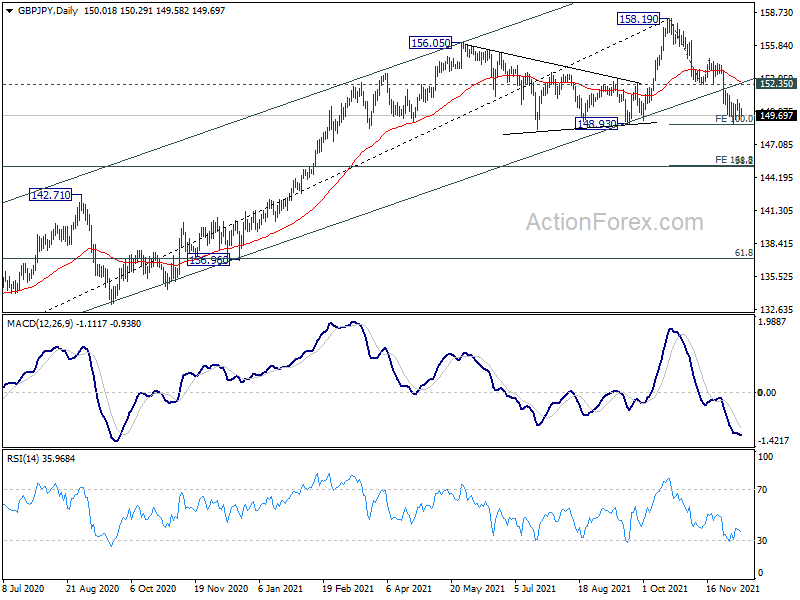
Intraday bias in GBP/JPY remains neutral for the moment. On the downside, firm break of 148.93 key structural support will carry larger bearish implications. Next target is 161.8% projection of 158.19 to 152.35 from 154.70 at 145.25. On the upside, however, break of 152.35 support turned resistance will argue that the pull back from 158.19 is complete. Intraday bias will be turned back to the upside for retesting 158.19 high.
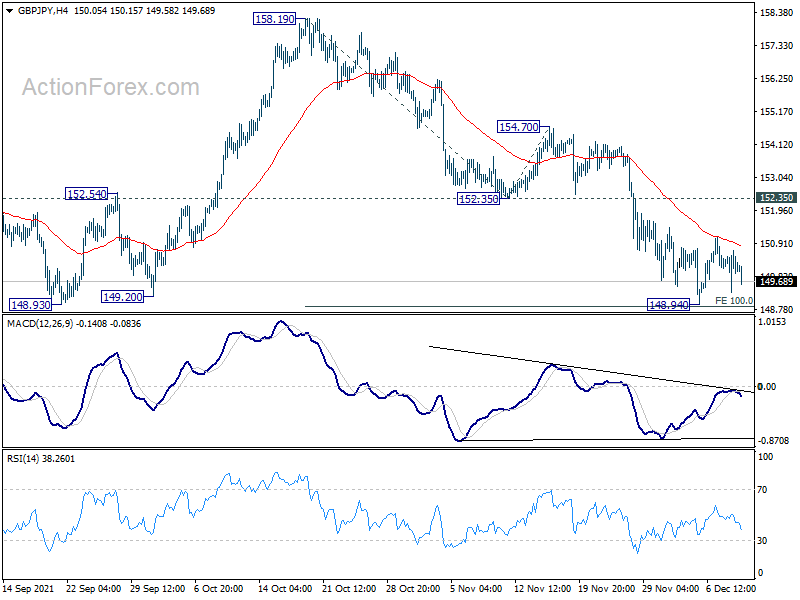
In the bigger picture, the break of medium term channel support, and bearish divergence condition in week MACD are raising the chance of medium term topping at 158.19. Firm break of 148.93 support will argue that GBP/JPY is at least correcting the whole rise from 123.94 (2020 low). In this case, deeper fall would be seen to 38.2% retracement of 123.94 to 158.19 at 145.10. Nevertheless, strong rebound from 148.93 will retain medium term bullishness for another rise through 158.19 at a later stage.