Sample Category Title
Market Morning Briefing: Dollar-Yen Trades Below 114
STOCKS
Equities are mixed. Dow looks stable but while above immediate support, view is bullish for the coming week. Dax can fall to 15500/400 before bouncing back from there. Nikkei and Shanghai look bullish towards 29000/29500 and 3725 respectively. Nifty and Sensex can rise towards 17600/800 and 59000 respectively while above immediate support levels.
Dow (35754.69, -0.059, -0.00016%) has been stable but sustains above support near 35500 for now and while that sustains, a rise towards 36250-36500 can be possible in the near term.
DAX (15639.26, -47.83, -0.30%) came down from levels just above 15800 instead of sustaining higher. A fall to 15500-15400 looks likely in the near term.
Nikkei (28609.84, -115.63, -0.40%) has dipped again today. But while above 28500, the view remains bullish to see a rise towards 29000/29500. Else a fall to 28250-28000 is possible.
Shanghai (3661.49, -11.55, -0.31%) has risen well and can test 3700 before coming off from there. If the index manages a rise above 3700, it would be bullish for a further test of 3725 which is a medium term resistance holding since the beginning of the year..
Nifty (17516.85, +47.10, +0.27%) rose yesterday after opening lower in the morning. The outlook is bullish for a rise towards 17600/800 in the coming days while the index sustains above 17400.
Sensex (58807.13, +157.45, +0.27%) also climbed up. The index needs to break above 59000 to see a rise towards 60000. Else we may expect the 58000-59000 range to hold for the near term.
COMMODITIES
Crude prices have come down as expected but we need to see if it would be in a range or continue to fall in the near term. Gold is ranged within 1790/1800-1770/60 while Silver can test 21 if it breaks below 22. Copper is ranged within 4.25-4.40 and needs to decisively break on either side to give further directional cues.
Brent (74.37) fell in line with our expectation of a fall from 77/78. We need to see if the fall sustains and takes it lower towards 70 again or maintains trade above 70 for now. Overall resistance near 77/78 may hold for the coming week too.
WTI (70.92) has also fallen sharply as expected and can fall to 68/67 before again bouncing back from there.
Gold (1778.60) is raged within 1760-1790/1800 for now and may continue so for a few more sessions before a break on either side of the rang is seen.
Silver (22.02) has dipped to trade near interim support at 22 which if breaks can lead to a fall to 21 before reversing the near term trend from there.
Copper (4.3210) fell sharply from 4.40 and can test 4.25 before again rising back to higher levels. A range of 4.25-4.40 is holding for now.
FOREX
Two-way volatility seen in Chinese Yuan and EURJPY. But USDCNY and EURJPY both look bearish while below 6.39/40 and 129.50 respectively. Dolalr Index is ranged within 95.50-96.50 keeping Euro ranged within 1.1450/00-1.12. Aussie and Pound have bounced from lows seen over the past couple of sessions but we need to see if the bounce sustains of the rates fall back to lower levels in the coming week. USDINR may rise to 75.75/80 while above 75.50. USDJPY is ranged within 112-114
Dollar Index (96.175) is ranged within 95.50 and 96.50 and unless a break on either side is seen, there is lack of directional clarity on further movement.
Euro (1.1297) is holding below 1.1355 and could head towards 1.12 on the downside if 1.1355 holds as a strong resistance in the very near term. Broad range of 1.12-1.14 00/50may hold for now.
EURJPY (128.20) witnesses two way volatility within 129 and 127.9 over the last couple of sessions and need to see a sustained break on either side to give more clarity on direction from here. Till then we may expect trade within the broad 127.50 and 129.50 region.
Aussie (0.7151) has dipped from 0.72 as expected and can fall towards 0.71 or lower towards 0.70 in the near term. 0.70 is an important support below current levels.
Pound (1.3225) almost tested 1.3150 before bouncing sharply from there. Currently trading above 1.32, if the bounce sustains, it can rise further towards 1.33 before again coming off towards 1.32-1.3150.
Dollar-Yen (113.48) trades below 114 and looks likely to fall towards 113 or lower in the near term. The range of 112-114 may continue to hold for now.
USDCNY (6.3684) saw a sharp recovery, rising from 6.34 to 6.3780 yesterday. Two-way volatility is seen just now but view is ranged to bearish while below 6.39/43. While below 6.39, we do not negate a fall towards 6.30 soon.
{USDINR (75.5250) did not fall below 75.44 yesterday. We continue to look at 75.50 and 75.75/80 as important levels in the near term. Broad range of 75.20-75.75/80 and narrow range of 75.40-75.60/65 may hold for the day.
INTEREST RATES
The US Treasury yields have dipped at the far-end but still have room to move up within their respective ranges. The US CPI data release today will need a close watch to see how it can impact the yield movement. The German yields have reversed lower. This keeps the overall bearish view intact. A further fall is possible in the coming days. The 10Yr and 5Yr GoI remained lower and stable. They can fall within their expected sideways range in the coming sessions.
The US 2Yr (0.69%) and 5Yr (1.27%) Treasury yields remain stable while the 10Yr (1.49%) and the 30Yr (1.87%) have fallen back. 1.4% (10Yr) and 1.8% (30Yr) are key near-term supports while above which the yields can rise to 1.65% (10Yr) and 2% (30Yr). We reiterate that 1.35%-1.65% (10Yr) and 1.7%-2% (30Yr) are the broad range of trade that we will be looking for now.
The German 2Yr (-0.72%), 5Yr (-0.60%), 10Yr (-0.36%) and 30Yr (-0.05%) have fallen-back after having risen sharply on Wednesday. The resistances at 0.05% (30Yr) and -0.25% (10Yr) have held very well as expected. This keeps our overall bearish view intact of seeing a fall to -0.45% / -0.5% (10Yr) and -0.1% / -0.2% (30Yr).
The Indian 10Yr (6.3483%) and 5Yr (5.6639%) remained lower and stable yesterday. We retain the view of seeing a dip to 6.3% (10Yr) and 5.63%-5.62% (5Yr) in the coming sessions. Broadly, 6.3%-6.4% and 5.62%-5.73% are the range of trade likely to be seen on the 10Yr and 5Yr GoIs respectively.
USD/JPY Faces Major Hurdle, US CPI Next
Key Highlights
- USD/JPY is facing a major resistance near the 114.00 zone.
- It cleared a contracting triangle with resistance near 113.45 on the 4-hours chart.
- EUR/USD is struggling to clear the 1.1350 resistance zone.
- Gold price could extend decline if it settles below $1,760.
USD/JPY Technical Analysis
The US Dollar started a major decline from well above 115.20 against the Japanese Yen. USD/JPY traded below 115.00 and 114.50 before it found support near 112.50.
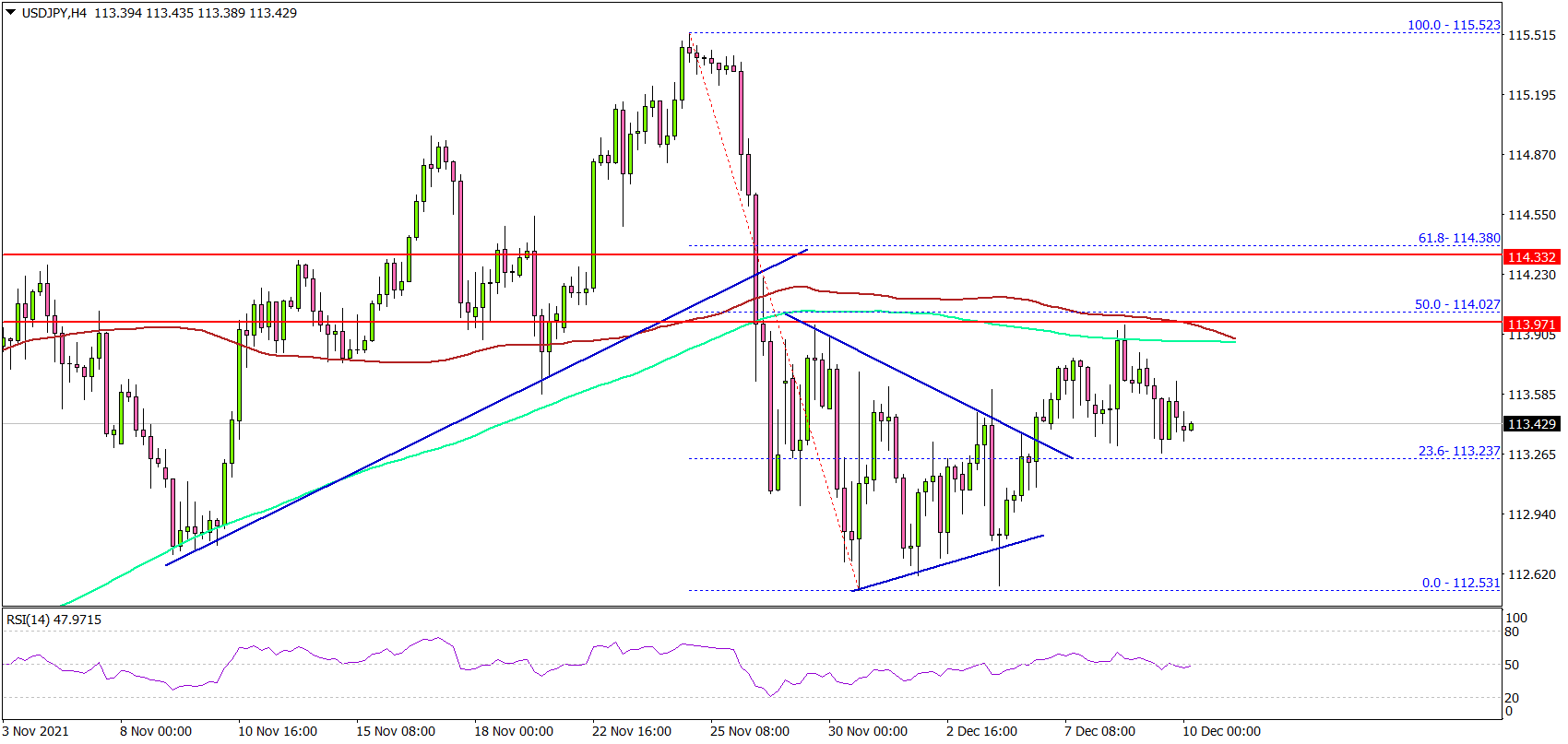
Looking at the 4-hours chart, the pair traded as low as 112.53 and recently started an upside correction. There was a break above the 113.00 resistance level, but it is still well below the 100 simple moving average (red, 4-hours) and the 200 simple moving average (green, 4-hours).
There was a break above a contracting triangle with resistance near 113.45 on the same chart. However, the pair is now facing a strong resistance near the 114.00 level.
It is near the 100 simple moving average (red, 4-hours), and the 50% Fib retracement level of the downward move from the 115.52 swing high to 112.53 low.
A clear break above the 114.00 and 114.05 resistance levels could open the doors for a steady upward move. If not, there could be a fresh decline below the 113.00 support. The next major support is near the 112.50 level, below which the pair could decline heavily.
Looking at EUR/USD, the pair is facing a strong resistance near the 1.1350 level. Besides, GBP/USD could extend losses below the 1.3200 support zone.
Economic Releases
- German Consumer Price Index for Nov 2021 (YoY) – Forecast +5.2%, versus +5.2% previous.
- German Consumer Price Index for Nov 2021 (MoM) – Forecast -0.2%, versus -0.2% previous.
- UK GDP for Oct 2021 (MoM) - Forecast +0.4%, versus +0.6% previous.
- US Consumer Price Index for Nov 2021 (MoM) – Forecast +0.7%, versus +0.9% previous.
- US Consumer Price Index for Nov 2021 (YoY) – Forecast +6.8%, versus +6.2% previous.
- US Consumer Price Index Ex Food & Energy for Nov 2021 (YoY) – Forecast +4.9%, versus +4.6% previous.
Cliff Notes: Global Recovery to Remain Robust into 2022
Key insights from the week that was.
The RBA Board met for the final time for 2021 this week. There was no change in the policy stance and their outlook was broadly in line with that seen in November. On policy, the market’s expectation that the US FOMC will accelerate their taper – with the process to now end in March 2022, in our view – has not affected the RBA’s approach to asset purchases. Confirmed in the decision statement is that the current purchase pace of $4bn per week will continue until at least February 2022. At that time, progress towards their targets for full employment and inflation; market functioning; and the actions of other central banks will dictate the next step for the RBA.
Westpac continues to expect weekly purchases will be reduced from $4bn to $2bn at the February meeting, with the program to conclude by the May Board meeting. The growth outlook is certainly supportive of the expectation that an end to extraordinary policy stimulus is in sight for Australia. The better-than-expected Q3 GDP outcome of -1.9% and evidence of strong momentum since means the “economy is [now] expected to return to its pre- Delta path in the first half of 2022” instead of the second. This expectation is in line with our own view, as detailed by Chief Economist Bill Evans’ video update this week and in conversation with the economics team in the latest Market Outlook in conversation podcast.
The only data point of significance for Australia this week was the ABS’ weekly payrolls survey. For the two weeks to 13 November, payrolls were reported to have risen by only 0.2%. However, this follows a 1.7% gain in payrolls since 16 October, setting the scene for a robust increase in employment in November.
Indeed, comparing the payrolls data for the labour force survey reference period in October and November suggests there is upside risk to our +175k forecast for the month and that healthy gains will also be seen in hours worked. The November labour force survey will be a key release for Australia next week; it is due for release on Thursday 16 December, along with the Federal Government’s Mid-Year Economic Outlook for which we have released a preview.
Another key theme in this month’s Market Outlook in conversation podcast was the opportunity before the global economy as 2022 begins. While significant risks remain, the data flow of recent weeks has continued to point to strong job creation and robust momentum in activity across the developed world. This is despite difficulties in containing delta in the US and Europe, and the threat omicron poses to confidence and activity.
As discussed in depth in our end-of-year edition of Market Outlook, China’s outlook is particularly promising, with authorities’ dual circulation strategy and restrictions on borders expected to result in growth above 5.5% in both 2022 and 2023, in year-average terms. The latest financing and trade data was supportive of such an outlook this week, with aggregate financing up 23% year-to-date in November versus 2019 (prior to the pandemic) and the trade surplus remaining near historic highs.
To us, it is not a surprise that China’s Renminbi and other key Asian currencies have outperformed during this recent period of US dollar strength. Simply, these nations have recovered from successive waves of the pandemic and their long-term capacity for economic development is now shining through. For FX, the breadth and self-sustaining nature of this growth argues for continued outperformance against the US dollar and other currencies into the medium-term. A full view of our expectations for interest rates and FX to end-2025 can be found in our latest set of long-term forecasts.
Given the global economy’s strength, dynamic policy making by the FOMC and other major central banks is not to be feared. Instead, as a baseline expectation, it is best to hold that authorities will continue to adapt their decision making to the evolving circumstances, actual and expected, reducing inflation risks and sustaining growth at or above trend. As a result, we continue to believe that the rate hike cycles to come through 2022-2024 will be modest versus history, but also that policy rates and term interest rates will sustain at or near peak levels to the end of the horizon as healthy growth continues.
Eco Data 12/10/21
[php_everywhere instance="1"]
Euro Falls Below 1.13
The euro has reversed directions on Thursday and has posted losses. In the North American session, EUR/USD is trading at 1.1291, down 0.43% on the day.
What to do with APP?
This week’s calendar in Europe is thin, which has the markets looking ahead to next week’s ECB policy meeting. There are no expectations for any changes in monetary policy at the meeting. The eurozone has not been immune to higher inflation, although inflation is weaker than what the US and UK have been experiencing. Still, some ECB members have expressed unease about rising inflation.
Another key issue on the plate of bank policymakers is QE. The ECB’s 1.85 trillion euro emergency pandemic programme, the PEPP, has been in place since March 2020. Although the eurozone continues to struggle with Covid, the economy is showing improvement and the bank plans to wind up PEPP in March 2022. The burning question is what to do with the bank’s Asset Purchase Programme (APP), which has been utilized to keep inflation close to the 2% target and is running at 20 billion euros per month. There are fears that the termination of the PEPP will hurt eurozone members that are heavily indebted, and could cause a ‘cliff effect’. The ECB is leaning to increase the APP after the PEPP winds up, but there is a disagreement within the ECB if increasing APP is the way to go. With the eurozone on the path to recovery and inflation on the rise, hawkish ECB members are pushing for the bank to tighten policy rather than increase QE.
The financial markets have shown plenty of volatility since Omicron appeared on the scene and caused a panic over fears of a new Covid wave. The World Health Organization is saying that it will need 2-3 weeks to have a more thorough understanding of Omicron. It is also unclear at this stage how effective the Pfizer and Moderna vaccines are against Omicron, although preliminary reports have been positive, which has helped risk appetite rebound this week.
EUR/USD Technical
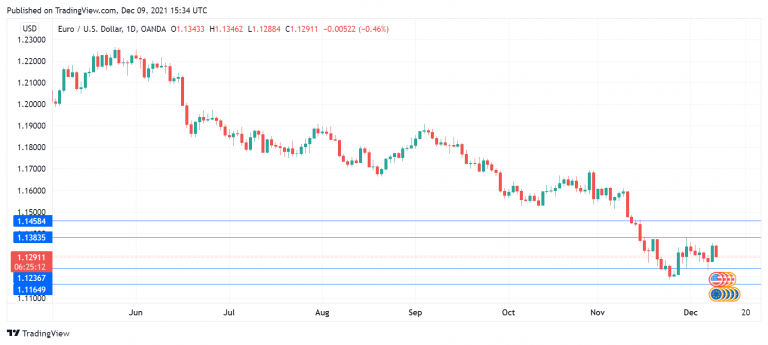
- EUR/USD has support at 1.1236 and 1.1163
- The next resistance lines are 1.1383 and 1.1457
Stocks Give Up Ground Amid Covid Curbs; Pound Remains Muted Near 2021 Lows
Equities take a breather
European stock indices returned to negative territory as infections remained elevated in the region and governments reintroduced new mild measures to counter the spread of the omicron variant despite drug makers defending the efficacy of their vaccines in the past few days.
Energy shares drove losses in the pan-European STOXX 600, but the decline is moderate so far in the day, and negligible compared to Monday’s impressive rally. Likewise, the UK’s FTSE 100 pulled below yesterday’s highs after Boris Johnson confirmed a move to plan B, which will bring masks, mandatory covid passes, and remote working into force in specific settings.
The US session also started on the bearish side, with the S&P 500, Nasdaq 100, and Dow Jones sliding modestly.
Antipodeans the worst performers
In the FX space, the risk-sensitive antipodean currencies were among the worst performers. Even though the Reserve Bank of Australia adopted a more hawkish tone earlier in the week, helping aussie/dollar to escape an outlook deterioration below the 0.6990 floor, pandemic headwinds and a slowing Chinese economy could bring new topside hurdles to the market. The pair is currently capped by the 20-day moving average (MA), while not far above, the 0.7200 psychological mark could be another challenge on the way up.
China’s PBoC reduced the amount of money banks need to set aside and increased the RRR for foreign currency deposits in order to curb yuan appreciation. Those are further steps to avert a continuous downturn in the economy and assist the troubling property market. Yet, whether they will be sufficient to eliminate economic imbalances remains to be seen.
Pound, euro under pressure
Speaking about economic growth, UK monthly GDP growth figures for October will be the next highlight on the calendar on Friday at 06:00 GMT. Forecasts suggest a poor start to the fourth quarter, and should the data arrive worse-than-expected, that could be another blow to the Bank of England as new containment measures roll in and inflation picks up.
Consequently, pound/dollar could pierce below the new 2021 low of 1.3160 in speculation the central bank may delay any monetary tightening plans next week and downplay the aggressive rate hike pricing for next year. Note that US CPI figures are also on the agenda tomorrow. Hence, the data impact could face some disruption.
In the Eurozone, bond yields changed course back to the downside, pressing euro/dollar closer to the 1.1300 level after the ECB called for a light increase in the regular APP bond purchases once the pandemic bond buying program ends in March.
Jobless claims hit fresh lows but dollar not impressed
Meanwhile in the US, weekly jobless claims came to further brighten the outlook for the labor market, marking a fresh five-decade low at 184k compared to 215k expected. Powell’s recent comments on inflation and bond tapering, however, have already prepared investors for a more hawkish meeting next week. Hence, the data provided little new information to markets, leaving dollar/yen around the 50-day MA at 1.1345 and dollar/loonie stable near the 1.2680 barrier.
Overall, the weakness in the euro and the pound is helping the dollar index to recover some lost ground today.
Sunset Market Commentary
Markets
An interesting Reuters article compensated for a rather uneventful trading session. Ahead of next week’s ECB meeting, the traditional “sources” article arrived. Reuters cites six people with knowledge on the matter. Diverging views on the nature of the inflation hump call for a trade-off on how to steer monetary policy during 2022. Next week’s new inflation forecasts will show a 2%+ inflation prognosis for 2022 with headline CPI thus running over 2% for at least 18 months. Those prompt a review of the current extraordinary easy monetary conditions. The ECB is amongst one of the final central banks to buck the global normalization trend for now. One thing stands out: the Pandemic Emergency Purchase Programme will end by the end of March. The key question is how the traditional Asset Purchase Programma should be deployed in order to avoid a cold turkey situation where net purchases drop from €80bn/month to €20bn/month. Options include creating a new envelope (fixed amount) to be spent over the remainder of the year. The caveat would be that it shouldn’t be used completely if not necessary. More hawkish governors probably won’t be willing to commit to purchases until the end of the year, rather preferring asset purchases to be slightly raised initially, but with the amount to be revised for example on a quarterly basis. As a quid pro quo to the doves, the remaining amount under the current €1.85tn PEPP portfolio (expected to be around €100bn) could be used as some kind of back-up in case economic or market developments warrant it. ECB governors currently agree not to drop any hints on potential rate hikes, leaving them up to come in 2023 by the earliest.
Markets didn’t react to the Reuters article. They also ignored the lowest level of US weekly jobless claims (184k) since 1969. The overall market environment is slightly risk-off. European stock markets lost part of this week’s gains, drifting around 0.5% lower. Core bonds profited from the more fragile risk environment. The US yield curve bull flattens with yields declining by 0.1 bp (2-yr) to 3 bps (10-yr). The German yield curve shifted in similar fashion with yields sliding by 1.9 bps (2-yr) to 4.1 bps (10-yr). 10-yr yield spread changes vs Germany were broadly unchanged with Greece underperforming (+4 bps). EUR/USD drifts from around 1.1350 to the low 1.13 area. EUR/GBP ran into resistance around the 0.86 big figure. News Headlines
The Chinese central bank (PBOC) raised the reserve requirement ratio of foreign currencies from 7% to 9%, according to a statement published in late Asian dealings. Doing so reduces available liquidity of the foreign currencies in scope, including the US dollar, forcing them to strengthen and the yuan to weaken. The Chinese yuan recently appreciated to the strongest level in three years, potentially hindering growth at a time the economy is already slowing down. USD/CNY closed at 6.35 yesterday. After the announcement, USD/CNY climbed to the highest level on the day at 6.374. Earlier today, the PBOC already signaled discomfort with the strong yuan, by a fixing the currency pair at a weaker than expected level.
Ukraine’s central bank raised the policy rate as expected from 8.5% to 9% today. It’s the fifth rate hike already this year. Data today showed inflation stayed in the double digits (10.3% y/y). This compares to the central bank’s 5% goal. The policy statement said the decision was aimed at fighting the impact of additional pro-inflationary risks. One of those includes a dramatic weakening of Ukrainian hryvnia last month from USD/UAH 26 to 27.4 on fears that Russia may be preparing to invade the country. The rate hike is also hoped to help prevent expectations from entrenching at too high levels. The hryvnia got some reprieve in recent days, strengthening today as well to USD/UAH 27.07. The move occurred before the central bank decision though.
Caution on Omicron Transmission Claims
Investors are in a cautious mood once more, after stock markets bounced back strongly at the start of the week on reports that omicron symptoms are less severe than feared.
While that comes as a relief and will hopefully remain the case as more evidence is gathered, it's also being reported that it's far more transmissible than delta, perhaps 4.2 times more. There's still too much to learn about the variant to make firm conclusions but what we're seeing is already enough for governments to be imposing new restrictions.
That doesn't bode well for the economy in the near term, at least, and raises plenty of questions about what the coming months will bring. Light touch restrictions are being imposed and the hope is that boosters will negate the need for anything harsher but that is far from certain.
Then it becomes a question of what we can expect from the monetary and fiscal authorities. Central banks are fighting high inflation as a result of the restrictions from the last 18 months; faced with more measures and higher price pressures, we can't expect more from them. Public debt has also grown substantially which may also make governments far more reluctant to announce sweeping support measures. Just a couple of many unknowns over the coming months that investors may have to grapple with.
Evergrande and Kaisa in default
Fitch Ratings has officially downgraded Evergrande and Kaisa to restricted default after failing to make an $82.5m coupon payment before the expiration of the grace period and a $400m dollar bond repayment, respectively. The agency is the first to do so but others will now likely follow which will turn attention to the restructuring process after months of eleventh-hour payments.
The markets are remaining remarkably calm to the news as Chinese authorities have stepped in to manage the fallout. From becoming involved in the process to the PBOC cutting the RRR in order to provide extra liquidity for the market, and more, a managed restructuring is now underway. Whether it will be enough, only time will tell. But investors are taking it in their stride.
Oil falls as EIA downgrades demand forecasts
Oil prices are easing on Wednesday after enjoying a strong first half of the week. Sentiment has softened as we move towards the end of the week following a period of relief as data suggested omicron symptoms are less severe than feared. Unfortunately, the latest data suggests it's far more transmissible through which could still pose a threat.
So much so that countries are exploring new restrictions with the UK government announcing the time has come for "plan B". These light-touch restrictions are aimed at slowing the spread as booster shots are administered but more significant measures may be warranted, given how fast the new variant is spreading.
The EIA alluded to this when releasing their new forecasts which they acknowledged are subject to "significant revisions" due to the level of uncertainty. Still, the group revised down demand forecasts for this year and next, bringing the market back into balance in the first quarter and seeing Brent average $73 per barrel, then $70 for the full year. Opinions on this naturally vary drastically and, as the group said, it's likely those forecasts will change repeatedly and significantly over the course of the next year.
Gold eases but remains range-bound
Gold prices are a little lower again on Thursday, although broadly speaking the yellow metal remains range-bound ahead of next week's Fed meeting. It's been mostly between $1,760 and $1,810 for the last couple of weeks, with gold one of the few instruments not subject to immense volatility throughout the omicron panic.
One explanation for this may be the uncertainty born not just by the new variant but also the inflation outlook. Once upon a time, it was easy to predict what central banks would do when faced with economic turbulence. That's because policymakers weren't also dealing with inflation running at double or triple their targets and on an upward trajectory.
We should learn a lot over the next week, with US inflation data due tomorrow and then the Fed decision next Wednesday. A day later we'll hear from the ECB, BoE and SNB so we may have a much better grasp of how policymakers could respond if tough restrictions are reimposed. Until then, gold may remain stuck in this range.
Bitcoin could suffer more but enthusiasts won't be concerned
Bitcoin is back below $50,000 and struggling to get any real traction above as risk appetite cools. It doesn't bode well for the cryptocurrency in the near term and as we've seen so often in the past, corrections can be deep and painful. But as we saw earlier this year, it has the ability to rebound quickly and scale new highs once more. Crypto backers won't be put off by the latest declines any more than they were in May.
USD/JPY Outlook: Yen Regains Traction But No Direction While Holding Within 113.30/114.00 Range
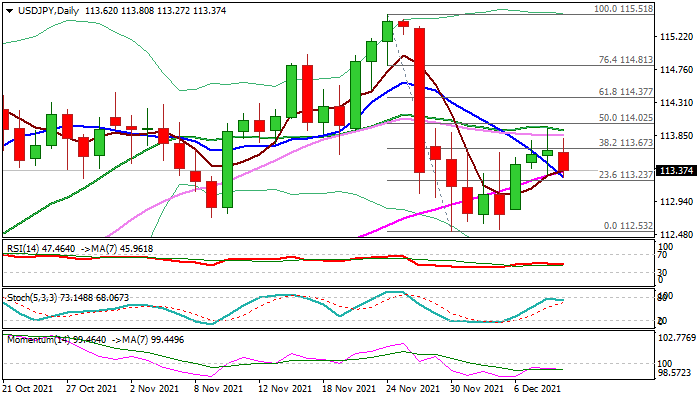
The USDJPY pair extends directionless trading for the third straight day, with the price action holding between the top of thick daily cloud which holds the downside and capped under 114 resistance zone, where Japanese exporters have offers and also 50% retracement of 115.51/112.53 pullback.
Mixed daily techs lack clearer add to indecision, with break of either side to generate initial direction signal.
Penetration and close within daily cloud would weaken near-term structure and increase risk of retesting pivotal112.60 base.
Conversely, close above 114 zone would expose next key Fibo barrier at 114.37 (61.8% of 115.51/112.53).
Investors focus on Friday’s US inflation data which would give more evidence to the Fed ahead their policy meeting next week and also lift dollar on figures near or above forecast.
Res: 113.67; 114.02; 114.37; 114.69.
Sup: 113.30; 113.09; 112.83; 112.53.
EUR/USD Mid-Day Outlook
Daily Pivots: (S1) 1.1290; (P) 1.1322; (R1) 1.1378; More...
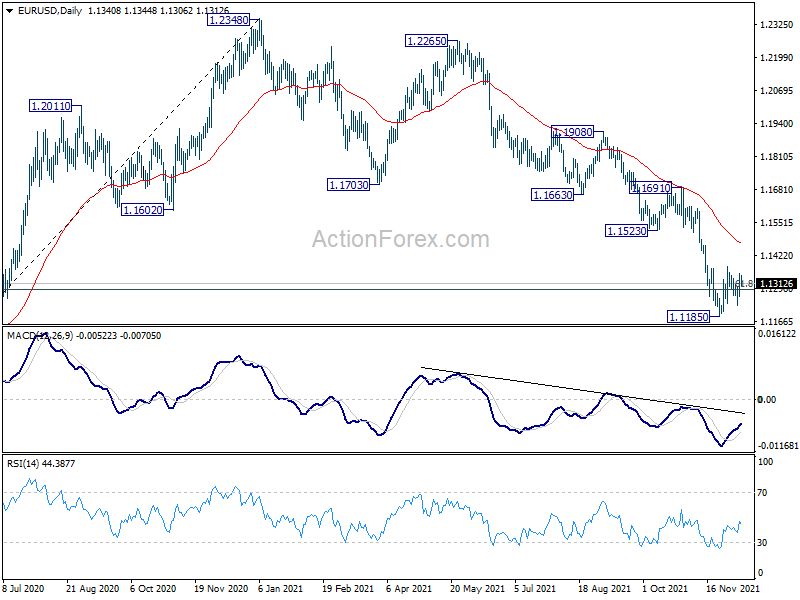
EUR/USD is still bounded in consolidation from 1.1185 and intraday bias remains neutral first. On the upside, firm break of 1.1382 resistance should confirm short term bottoming at 1.1186. Intraday bias will be turned back to the upside for 55 day EMA (now at 1.1469). On the downside, break of 1.1185 will resume larger fall from 1.2348.
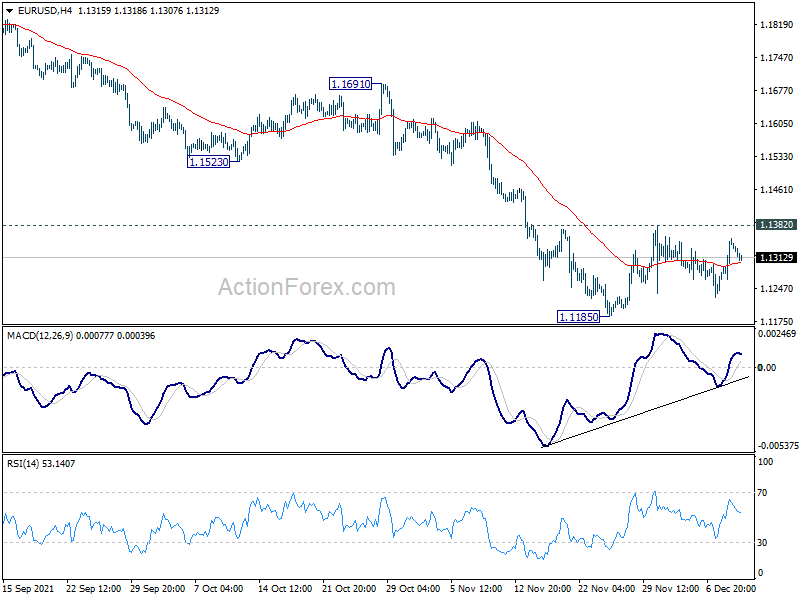
In the bigger picture, there are various ways of interpreting the fall from 1.2348 (2021 high). It could be a correction to rise from 1.0635 (2020 low), the fourth leg of a sideway pattern from 1.0339 (2017 low), or resuming long term down trend. In any case, outlook will now stay bearish as long as 1.1703 support turned resistance holds. Sustained break of 61.8% retracement of 1.0635 to 1.2348 at 1.1289 would pave the way back to 1.0635.