Sample Category Title
Oil Prices Rise, Gold Stuck In Range
Oil sees fast-money long-covering
Oil prices fell overnight with traders using the excuse of omicron contagiousness, and China property defaults, to mark down growth expectations and take profits on tactical long positions built up this week. Brent crude fell by 2.50% to USD 74.00 a barrel, while WTI tumbled 2.80% to USD 70.60 a barrel.
In Asia though, prices have rallied modestly. Brent crude and WTI rose 0.50% to USD 74.35 and USD 71.00 a barrel respectively today. A slightly softer US dollar and Asian physical dip buyers appear to be combining to stabilise prices. However, my targets for the week, the 100-day moving averages at USD 77.00 and USD 74.00 respectively, look unlikely to be tested this week.
I also note the backwardation in the prompt futures calendar spreads, especially Brent, have narrowed to multi-month lows. That suggests that markets are heading to a more balanced arrangement in the near term. Nevertheless, last week’s lows were likely the lows for the month and possibly for 2022, especially with OEPC+’s poison pill still in play. This month’s meeting is officially still open to allow rapid responses to production targets.
Both contracts have recovered above their respective 200-day moving averages (DMAs) at USD 73.00 and USD 70.30 respectively, which should provide support on pullbacks. The 100-DMAs at USD 77.00 and USD 74.00 form initial resistance.
Gold remains marooned
Gold had another uninspiring night as it remains marooned in a USD 1770.00 to USD 1800.00 an ounce range. Gold fell by 0.40% to USD 1775.00 an ounce as the US dollar strengthened, edging higher to 1778.00 in Asia. Gold’s price action continues to disappoint, unable to rally on either a weaker or stronger US dollar, heightened or lessened risk sentiment, or higher or lower US yields.
The 50,100 and 200-day moving averages (DMAs), clustered between USD 1790.30 and USD 1795.50 are capping gains. USD 1800.00 and USD 1810.00 will prove equally formidable. Support lies at USD 1770.00 and USD 1760.00. The path of least resistance is lower.
Headline Tennis Anyone?
Omicron continues to cause volatility
V for Volatility continues to be the biggest winner in December as financial markets continue to scamper between the baseline and the net in a never-ending game of headline chasing tennis. Last night a combination of data confirming omicron is 4x more contagious than delta, and Fitch declaring Evergrande and Kaisa were in selective default, was enough to see the tail-chasing FOMO herd take risk off the table. The US dollar rose, US yields fell, Asian currencies crumbled, oil fell as did equities. You can tell it’s a FOMO herd move, as the Dow Jones was almost unchanged, while the growth gnomes sent the Nasdaq tumbling 1.71% lower.
A massive debt restructuring exercise now beckons for China’s more highly leveraged property developers, raising fears that China’s growth will take a dip next year. That will be enough to keep Asian currencies and regional stock markets nervous, although the new “risk management” committee at Evergrande suggests the government is already behind-the-scenes disembowelment process has begun. The main risk point here, for now, will be if the selective default by Fitch triggers cross-defaults on other debt resulting in immediate calls for payment. Bondholders, especially offshore ones, may leave the gun on safety. Although the PBOC has quite clearly said Evergrande will be resolved on commercial terms, the involvement of the government means immediate payment demands and asset seizures within China are off the table through the courts.
China has further muddied the waters today with the yuan. Yesterday, it set a noticeably weaker fixing, applying its highest “counter-cyclical” factor in many months. It has also hiked the amount of foreign currency reserves Chinese banks must hold. Today, with the subtlety of a sledgehammer falling towards some terrified walnuts, the PBOC set the USD/CNY fix at 6.3702, some 250 points higher than markets forecasts of 6.3449.
With China’s energy crunch easing, imported inflation fears, and despite some denials, fears that the property developer implosion could derail 2022 growth, China has clearly called time on further yuan strength. Offshore USD/CNH shot higher overnight, and onshore USD/CNY did the same this morning. China’s denials of currency manipulation will probably ring hollow with the United States in this day and age. The spectre of heightened trade tensions between the two, and the sense that China has blinked on growth risks, is as good a reason for Asian currencies and equities to be weak as any.
Tonight, we also have US Inflation data which could show YoY inflation for November hitting 7.0%. Baseline effects will ease that number through 2022 (we hope), and if you asked me yesterday, I would have said that a 7.0% print is priced in, as is a faster taper from the FOMC next week, with signals of earlier rate hikes. But with markets still chasing their tails back and forth on omicron headlines and now China headlines, I mean who is seriously surprised after this time that Evergrande is solvent? I am starting to feel that markets are complacent. This lack of conviction price action is very indicative of market inflexion points in my experience. US equities rose through the delta variant, but are trading noisily sideways through omicron, and with much higher day-to-day volatility. Don’t write off big moves lower by equities, and a sharp rise in US yields and the US dollar just yet. All roads still lead to the FOMC.
US Dollar Strength Returns
US dollar rises as risk appetite sours
The US dollar rose overnight, responding to deteriorating risk sentiment from omicron, China, Ukraine, or Iran or whichever other headline you wish to pick. The fact that the US dollar correction does not look like continuing into the US inflation data tonight requires some backpedalling from yesterday on my part as well. It appears that currency markets are as vulnerable to headline tennis as other asset classes. It also suggests that markets are less complacent about the US inflation and FOMC stress points than I thought as well. A high inflation print tonight likely leads to more US dollar strength.
The dollar index rose 0.26% to 96.20 overnight where it remains in Asia. It seems unlikely that support at 95.50 will be retested before the FOMC and the odds are rising that a retest of 97.00 will occur next week. Notably, EUR/USD enjoyed only one day in the sun, and gave back all of its gains overnight, falling to 1.1300 today. That is as good a signal as any that US dollar strength is the path of least resistance, even as GBP/USD and USD/JPY held steady.
Muddying the waters overnight was a weaker CNY fixing by the PBOC yesterday, followed by an even weaker CNY fixing today at 3.3702, some 250 points above market expectations. China also raised the amount of foreign currency Chinese banks are required to hold in reserves. The none too subtle signal from the PBOC about yuan strength sent USD/Asia sharply higher overnight, led by USD/CNH, which rose 0.55% to 6.780.
After the USD/CNY fixing surprise, USD/CNH and USD/CNY has actually fallen 0.20% this morning, leading to some temporary strength in the rest of the Asia bloc. However, and I’m surprised markets tactically ignore this; disregarding guidance from any Chinese authority, let alone the PBOC, is a dangerous business. Given that US dollar strength is coming from both developments in the US itself, fading risk sentiment, and now from the PBOC, any rally in Asian currencies is probably one to sell into.
Asia Seeing Red As Risk Appetite Slips
Souring risk sentiment sends Asian equities lower
The fast money reversed course overnight as omicron and Evergrande default headlines sent equities lower. The worst hit were the growth trades with the S&P 500 falling 0.72%, the Nasdaq tumbling 1.71% lower, whilst the value-heavy Dow Jones said, “hold my beer,” and added 0.02%. In Asia, the futures have reversed course, the Dow Jones adding 0.10%, while the S&P 500 and Nasdaq futures have risen by 0.20%.
To those negative headwinds in Asia, can be added China weakening its currency today, a hint perhaps from China that growth concerns are rising. The Nikkei 225 has fallen 0.53% while the Kospi is 0.65% lower. Mainland China markets have ignored a weaker yuan today, focusing on the Evergrande/Kaisa defaults. The Shanghai Composite and CSI 300 are 0.45% lower, with Hong Kong falling by 0.40%.
Singapore is 0.25% lower, Kuala Lumpur 0.05% down and Jakarta and Taipei retreat by 0.45%. Bangkok has eased by 0.25% and Manila has retreated 0.65%. Australian markets are also lower, compounded by headlines suggesting there will be Christmas beer shortages in the lucky country. Despite a thirst for good news, the ASX 200 and All ordinaries are 0.50% lower today.
European equities will likely open lower as well as the street takes risk of the table into the US inflation data and the weekend, which will now contain plenty of headline risk, be it omicron, China or the Ukraine, etc. The price action shows that equity markets continue to tie themselves up in knots on headline-driven price action. This is not a market comfortable, or pricing in, 7.0% US inflation or a hawkish FOMC next week. The whipsaw price action will continue, and with rising risk pressure points appearing everywhere, the odds that the FOMC next week is the straw on the camel’s back are rising.
GBP/JPY Daily Outlook
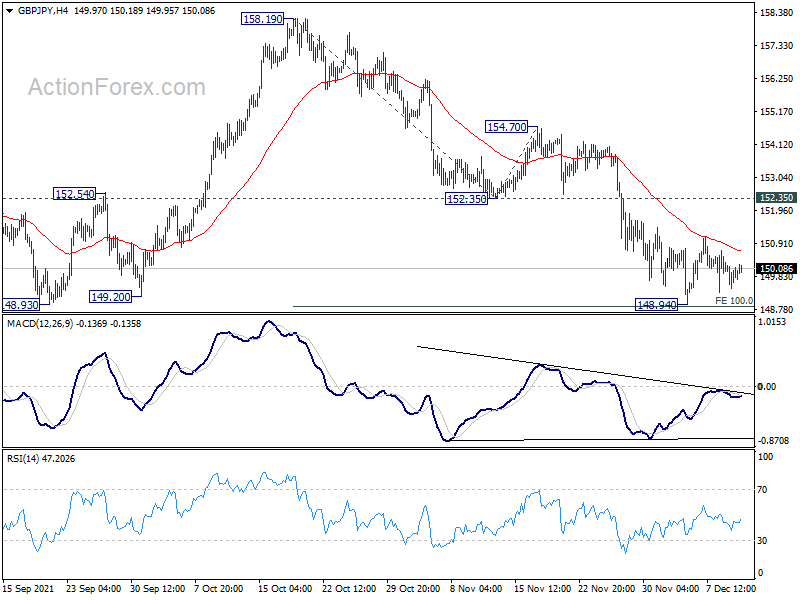
Daily Pivots: (S1) 149.55; (P) 149.94; (R1) 150.38; More...
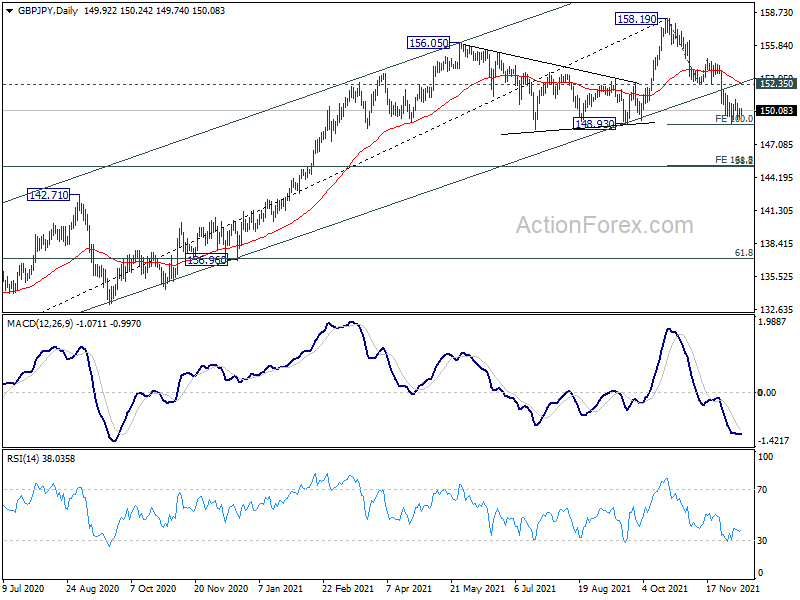
No change in GBP/JPY's outlook and intraday bias stays neutral. On the downside, firm break of 148.93 key structural support will carry larger bearish implications. Next target is 161.8% projection of 158.19 to 152.35 from 154.70 at 145.25. On the upside, however, break of 152.35 support turned resistance will argue that the pull back from 158.19 is complete. Intraday bias will be turned back to the upside for retesting 158.19 high.
In the bigger picture, the break of medium term channel support, and bearish divergence condition in week MACD are raising the chance of medium term topping at 158.19. Firm break of 148.93 support will argue that GBP/JPY is at least correcting the whole rise from 123.94 (2020 low). In this case, deeper fall would be seen to 38.2% retracement of 123.94 to 158.19 at 145.10. Nevertheless, strong rebound from 148.93 will retain medium term bullishness for another rise through 158.19 at a later stage.
EUR/JPY Daily Outlook
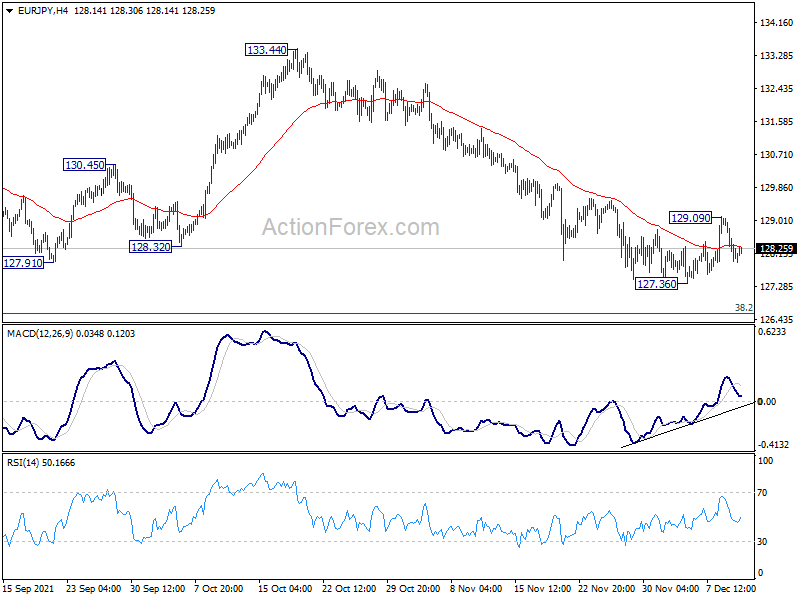
Daily Pivots: (S1) 127.69; (P) 128.38; (R1) 128.82; More....
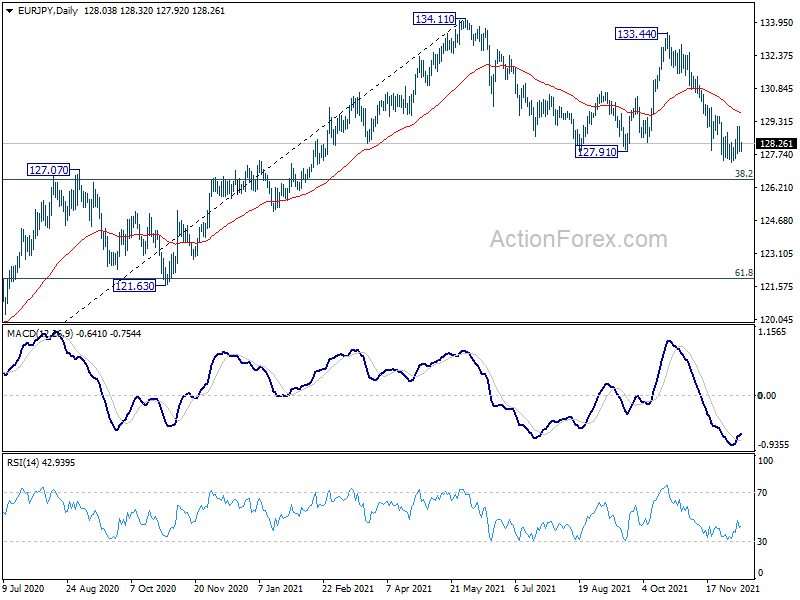
Intraday bias in EUR/JPY remains neutral at this point. On the upside, break of 129.09 will extend the rebound to 55 day EMA (now at 129.71) and above. On the downside, below 127.36 will target 126.58 medium term fibonacci level. We'd look for some support from there to bring rebound. But sustained break of 126.58 will carry larger bearish implications.
In the bigger picture, as long as 38.2% retracement of 114.42 (2020 low) to 134.11 at 126.58 holds, up trend from 114.42 is still in favor to continue. Break of 134.11 will target long term resistance at 137.49 (2018 high). However, sustained break of 126.58 will raise the chance of medium term bearish reversal. In this case, deeper decline would be seen to 61.8% retracement at 121.94, and possibly below.
EUR/GBP Daily Outlook
Daily Pivots: (S1) 0.8524; (P) 0.8559; (R1) 0.8577; More...
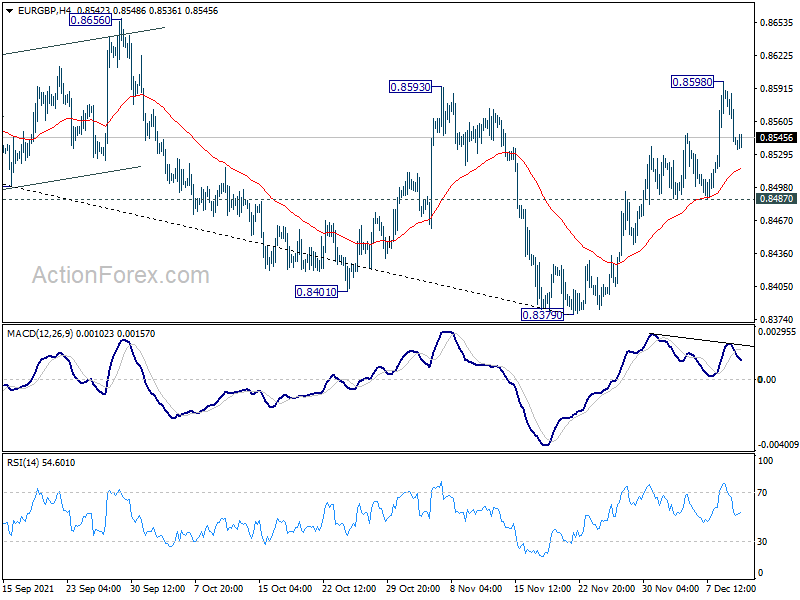
EUR/GBP retreated notably after failing to sustain above 0.8593 resistance an intraday bias is turned neutral first. On the upside, firm break of 0.8593 resistance will be the first sign of larger bullish reversal and target 0.8656 resistance next. On the downside, break of 0.8487 support is needed to indicate completion of the rebound. Otherwise, near term outlook will stay cautiously bullish in case of retreat.
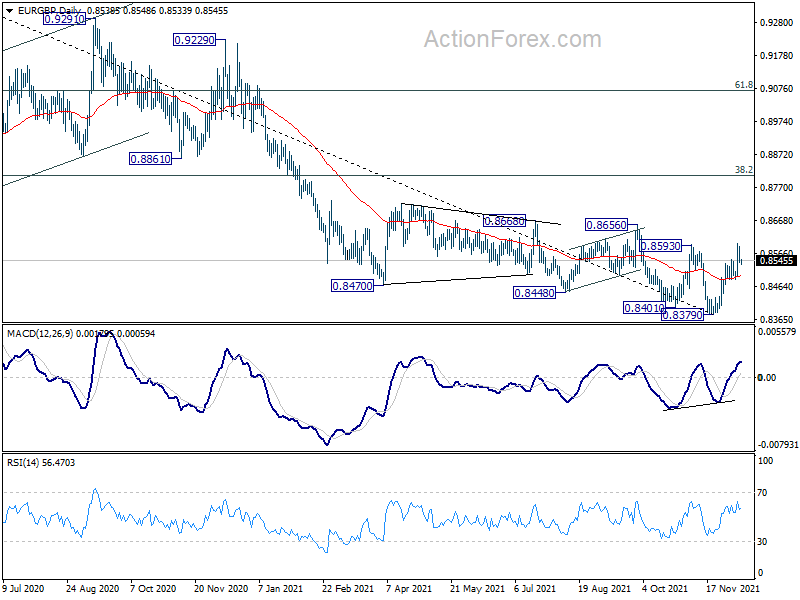
In the bigger picture, price actions from 0.9499 (2020 high) are still seen as developing into a corrective pattern. Deeper fall could be seen as long as 0.8593 resistance holds, towards long term support at 0.8276. We'd look for bottoming signal around there to bring reversal. Meanwhile, firm break of 0.8593 will now be an early sign of medium term bottoming. Further break of 0.8656 will pave the way to 38.2% retracement of 0.9499 to 0.8379 at 0.8807.
USDCAD Accelerates Back Above 1.2700
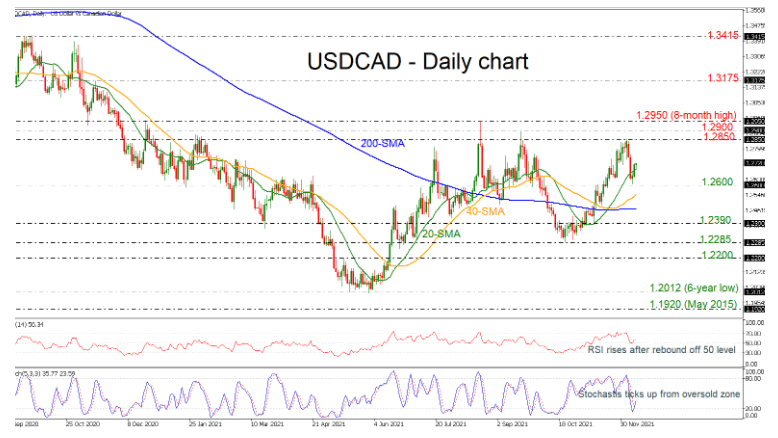
USDCAD gained significant buying traction early on Friday with the price quickly recouping earlier losses to jump above 1.2700 again. The positive slope in the RSI and the growing stochastic are endorsing the current bullish momentum in the price.
A rally higher could reduce negative risks, producing another bullish extension towards the key levels of 1.2850 and 1.2900. Beyond that, traders will target the eight-month high of 1.2950, a break of which would re-activate the uptrend that started last June, Though, any steps higher could be limited if a new barrier pops up near the 1.3000 psychological mark.
Otherwise, if sellers take the lead, the pair may pull back to test the nearby support of 1.2600. Falling lower, the 40-day simple moving average (SMA) at 1.2545, while not far below, the 200-day SMA at 1.2470 could block the way towards the 1.2390 low and 1.2285.
Overall, USDCAD is strengthening the bullish trend in the short-term, but some caution is warranted as the price is swiftly approaching the crucial boundary set around 1.2850.
EUR/AUD Daily Outlook
Daily Pivots: (S1) 1.5762; (P) 1.5808; (R1) 1.5846; More...
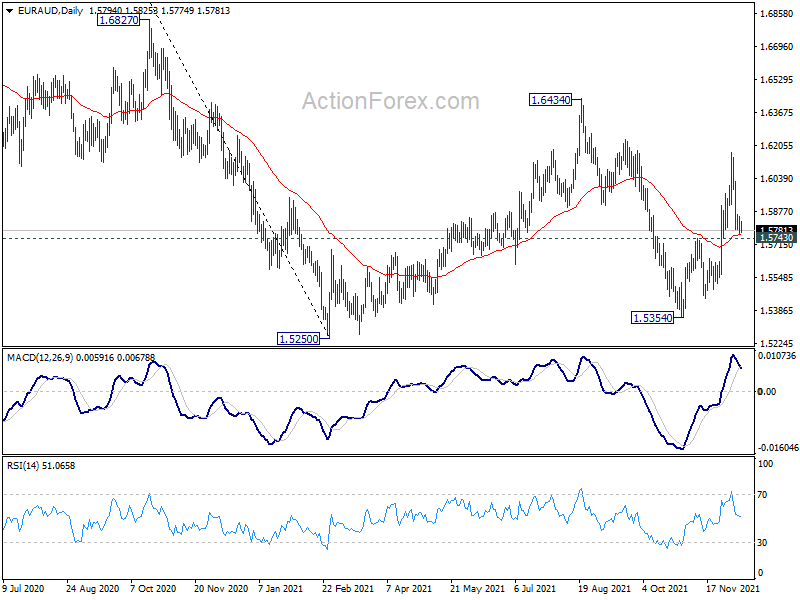
Intraday bias in EUR/AUD stays neutral first, and as long as 1.5743 resistance turned support holds, further rise is mildly in favor. On the upside, above 1.5980 minor resistance will turn bias to the upside for 1.6168 first. Break will resume rise from 1.5354 to 1.6434 resistance next. However, firm break of 1.5743 will indicate that rebound from 1.5354 is over and bring deeper fall back to 1.5250/5354 support zone.
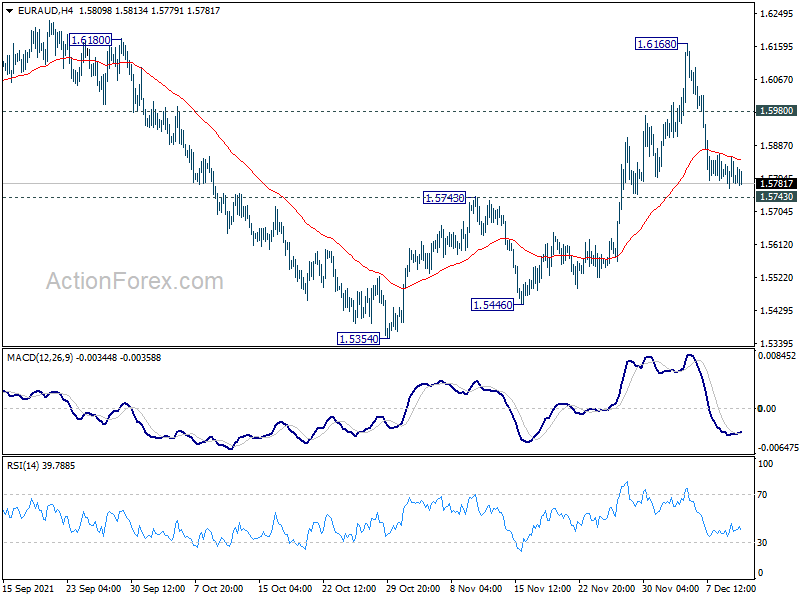
In the bigger picture, medium term outlook is neutral for the moment. Rise from 1.5354 is seen as the third leg of the corrective pattern from 1.5250 low first. Further rise could be seen through 1.6434 towards 38.2% retracement of 1.9799 to 1.5250 at 1.6988. On the downside, however, sustained trading below 55 day EMA (now at 1.5759) will turn focus back to 1.5250 low instead.
EUR/CHF Daily Outlook
Daily Pivots: (S1) 1.0418; (P) 1.0436; (R1) 1.0452; More....
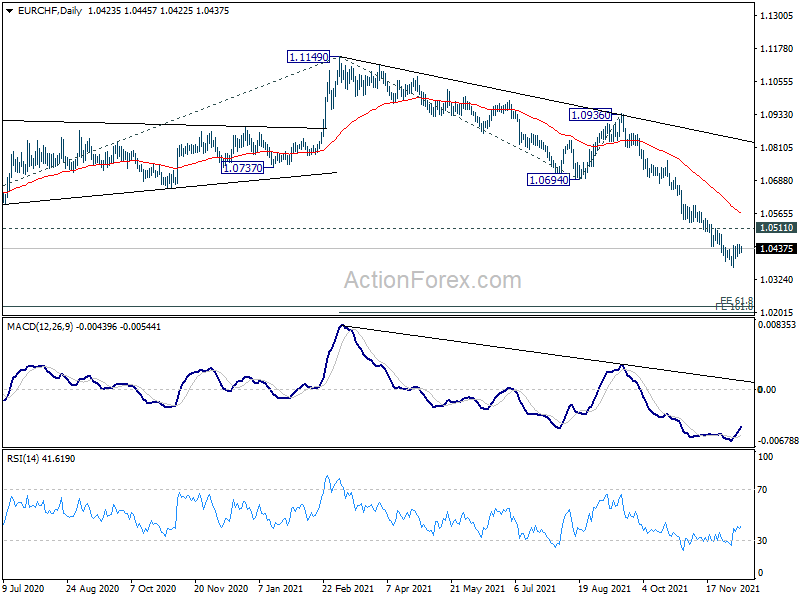
EUR/CHF is still bounded in consolidation from 1.0365 and intraday bias remains neutral at this point. As long as 1.0511 resistance holds, further decline is expected. On the downside, break of 1.0365 will resume larger down trend to 161.8% projection of 1.1149 to 1.0694 from 1.0936 at 1.0200 next. Nevertheless, firm break of 1.0511 will confirm short term bottoming, and bring stronger rebound to 55 day EMA (now at 1.0567) and possibly above.
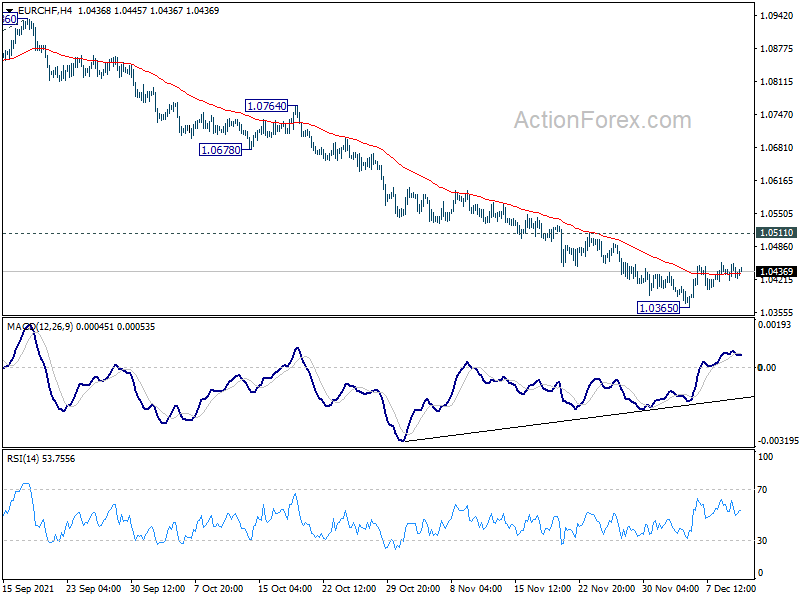
In the bigger picture, long term down trend from 1.2004 (2018 high) is now extending. Next target is 61.8% projection of 1.2004 to 1.0505 to 1.1149 at 1.0223. On the upside, break of 1.0694 support turned resistance is needed to be the first sign of medium term bottoming. Otherwise, outlook will remain bearish even in case of rebound.