Sample Category Title
Cliff Notes: Australia Shows Resilience as US FOMC Focus Attention on Inflation Risks
Key insights from the week that was.
Q3 GDP was centre stage in Australia this week. In all respects, the outcome was well ahead of expectations. In the lead-up to the release, the scale of the anticipated contraction was reduced by Westpac and the market; despite this, there was still a material upside surprise on release, with a contraction of ‘just’ 1.9% reported versus the revised consensus estimate of -2.7%.
The state detail was very interesting, particularly Victoria’s resilience. Whereas NSW’s economy contracted 6.5% under the weight of lockdown, Victorian state demand posted a fall of ‘only’ 1.4%. More striking still was that business investment rose in the quarter, the 5.8% gain driven by a 22% increase in non-residential construction, focused in the renewables sector.
Q3’s combination of a sharp decline in household consumption (-4.8%) and a policy-driven 4.6% surge in household disposable income is very promising for the consumption outlook, seeing the household savings rate jump back to 20% at September, just below the 2020 lockdown peak of 24%. As Australia’s economy returns to normal, these savings should drive strong gains for consumption along with the expected uptrend in employment and wages growth. Full detail by sector and state can be found in Westpac’s GDP bulletin.
It is also worth noting that, ahead of GDP on Wednesday, the balance of payments release provided a detailed view of Australia’s trade position and our nation’s foreign financial assets and liabilities.
In Q3, yet another record current account surplus was reported, equivalent to 4.5% of GDP. Also impressive is that this is the 10th consecutive quarterly surplus, the longest run recorded. Underlying the above result for the current account: a trade surplus equivalent to 7.3% of GDP was achieved as export earnings grew 7.6% (37%yr) on commodity price strength; investment income was a partial offset, the net income deficit growing from 1.2% of GDP in Q2 to 2.7% as some of the profit made by Australian firms (particularly commodity producers) was paid out to their foreign owners.
While the Q3 increase in the net income deficit was sizeable, structurally speaking, developments continue to favour it narrowing over time. Two underlying trends are particularly noteworthy. (1) Australian interest rates seem likely to trail those in key financial centres such as the US and UK, reducing the net flow of interest payments, all else equal. (2) Whereas foreign portfolio investment in Australia is currently split 50/50 between equity and debt, Australian portfolio investment abroad is almost entirely equity focused, resulting in a higher income inflow than outflow on our foreign assets and liabilities.
(2) is likely to prove the dominant force long term for the net income deficit and Australia’s wealth given the strong uptrend apparent in Australia’s foreign financial assets – underpinned by the nation’s rapidly growing superannuation industry. It is also important to point out for the outlook that the net income deficit only captures part of the return on investment from equity investment – dividends. Capital gains should provide significant additional upside over the long run for Australia via higher household wealth, a reduced reliance on social welfare and, as it is cashed in and spent, higher tax receipts.
For offshore, data released to date this week has been constructive on the outlook. In China, further support for our view of a robust gain in Q4 was provided by the official PMIs, with expansionary readings recorded for both the manufacturing and service PMIs. The result for the service sector was particularly notable, implying that the latest round of restrictions to stop the spread of delta have not had a material impact on consumption and business services.
US data was also strong for the most part. In November, the ISM manufacturing index again printed towards the top of the historic range as new orders and employment gained ground. Pending home sales meanwhile jumped higher in October despite limited supply; and through September, home prices continued to grow at a robust pace, despite already being up more than 20% over the year to August.
Tonight, the critical November US employment report will be released. Both the ADP private payroll series and the employment index from the ISM manufacturing survey suggest more than 500k jobs were created in the month, despite persistent weakness in labour force participation. The unemployment rate is again expected to edge lower in the month, to 4.5%.
If realised, these outcomes are likely to confirm for the FOMC that it is appropriate to debate and decide to accelerate the taper at their December meeting, finishing the program in March (in our view) as opposed to mid-year, as decided in November. This week FOMC Chair Powell made clear he personally believes the taper timeline should be discussed at the next meeting, and that a quicker taper is appropriate.
Accelerating the first phase of normalisation will provide scope for the FOMC to tighten from June 2022 (Westpac’s forecast) instead of late in the year, mitigating the risk of inflation well-above target becoming entrenched. Note though, FOMC decision making will remain reactive to data outcomes and evolving expectations, and so are expected to reduce the risks related to inflation without materially affecting economic growth. The federal funds rate peak for this cycle is therefore, in our view, still likely to be low versus history (Westpac forecast 1.625% at June 2024), limiting the rise in the 10-year yield to a peak of 2.30% in 2022 as the rate hike cycle begins after which it will slowly trend lower to 2.00% by end-2024.
Eco Data 12/3/21
[php_everywhere instance="1"]
British Pound Edges Higher
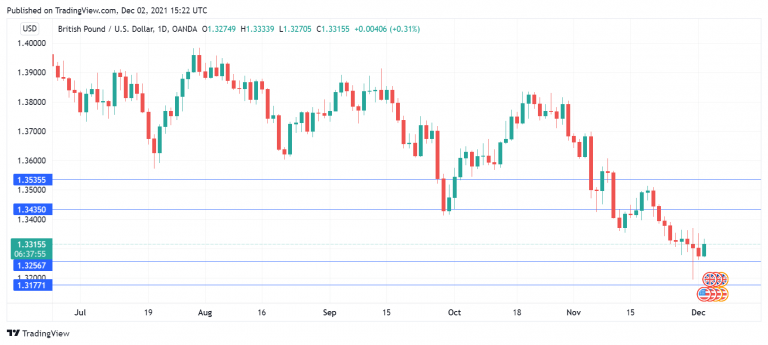
The British pound has edged upwards and punched above the 1.33 line. In North American trade, GBP/USD is currently trading at 1.3319, up 0.34% on the day.
It has been a light calendar for tier-1 events out of the UK. Truth be told, the markets would be showing scant attention to anything other than a BoE policy meeting, given recent developments which have shaken up the financial markets. I am referring to two key events – the spread of the Omicron variant of Covid and the hawkish pivot by Fed Chair Jerome Powell. Investors have been so caught up with these events that the upcoming US payrolls, normally a hotly-anticipated release, has fallen completely off the radar screen.
Omicron has the potential to cause economic havoc and trigger a global wave of Covid, which understandably has led to deep worry on the part of investors. The good news is that preliminary reports indicate that although the variant may spread quickly, most of those infected have not been showing severe symptoms. We will have to wait a week or two until more information is available about Omicron, and the uncertainty in the meantime can be expected to result in market volatility.
Will BoE hike or balk?
The BoE has been the focus of intense speculation with regard to a rate hike. The bank holds its next policy meeting on December 16th and the pound took a spill after the stunning non-move at the November meeting. The BoE had widely signalled a rate hike was coming, but in the end, the MPC voted by a wide margin to stay on the sidelines. Inflation is running high, but this is more a result of supply bottlenecks than a red-hot economy. Some MPC members have voiced concerns that a rate hike would hurt the recovery, and right now it looks like a 50/50 toss-up as to whether the BoE will press the rate trigger later this month or wait until next year.
GBP/USD Technical Analysis
- GBP/USD has support at 1.3256 and 1.3177
- There is resistance at 1.3435 and 1.3535
US Nonfarm Payrolls Take Center Stage after Powell’s Hawkishness
Having locked in a second nomination as Fed chief, Jerome Powell surprisingly addressed the need for a faster taper of bond purchases during his testimony before the Senate's Banking Committee on Tuesday as transitory inflation is now viewed as something more persistent. Even more surprising, however, was the dollar’s reaction, which barely capitalized on the headlines, but the bulls have not completely lost their nerves as Friday’s US jobs data could provide another opportunity for a rebound.
Powell switches to the hawkish side
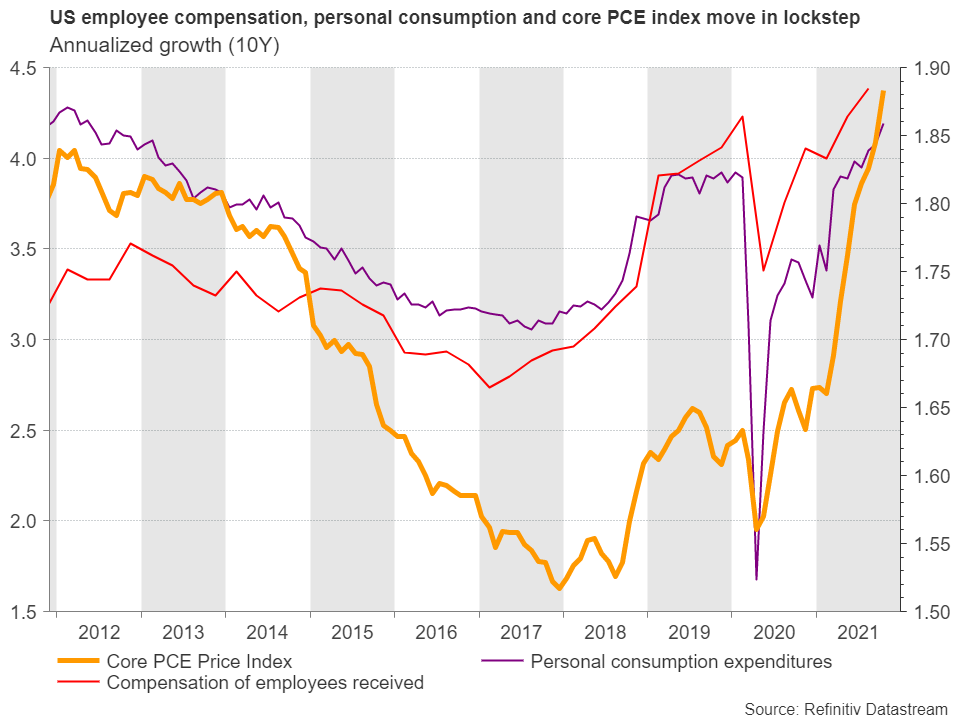
The Fed had been stubbornly reiterating that high price pressures will be a transitory phenomenon but with core PCE inflation showing no signs of abating and the new omicron covid variation signaling prolonged supply crunches at the end of the year, the Fed chief clearly telegraphed that the transitory narrative will probably drop out of the policy statement.
He also admitted that the central bank would discuss the scenario of a faster bond tapering during the upcoming policy meeting, which was initially planned to start with a $15 billion monthly cut, simultaneously boosting speculation that the bond tapering phase may conclude before mid-2022 and eventually interest rates may rise earlier than expected.
To put the tightening procedures into action though, Powell highlighted that the central bank would keep a close eye on covid conditions and seek a confirmation signal from upcoming data releases. Hence, Friday’s nonfarm payrolls report could cause both rate hike expectations and the dollar to swing wildly.
Will the US labor market remain a high priority?
The question that arises at this point is whether the Fed will prioritize its price objective over its employment mandate in the coming months, taking more aggressive measures to mitigate the inflation spiral even before the labor market meets full employment conditions. If that is the case, a softer but healthy growth in employment could still be welcomed by the Fed in the face of relentless increases in consumer prices.
Nonfarm payrolls to show robust growth
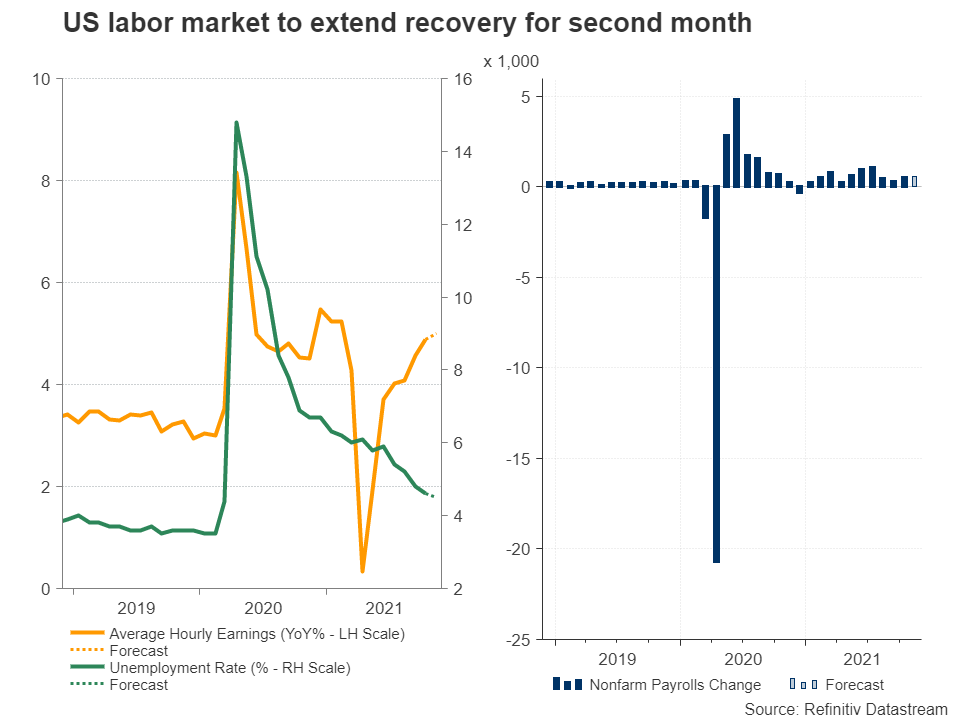
For the month of November, job growth is estimated at 550k compared to 531k registered in the previous month, with the unemployment rate expected to tick lower to 4.5% from 4.6% previously.
At a first glance, such results would not mark a big difference from November’s release, providing little reasoning for traders to alter their rate expectations and hence push the dollar higher. But if the jobs figures come above expectations, that could still be viewed as an extension of October’s rebound and provide extra evidence the Fed may move forward with larger cuts in bond purchases this month, unless of course omicron becomes the next burden for the global economy.
Eyes on wage growth
As regards wage growth, it could be a stronger market mover for the dollar. Apparently, a continuous increase in paychecks would bring some relief to consumers at a time when inflation is eating into their pockets. However, if businesses decide to offset higher wage costs by further raising their prices, making wages, consumption and inflation climb in lockstep, then the Fed may have another incentive to quicken monetary tightening.
EUR/USD
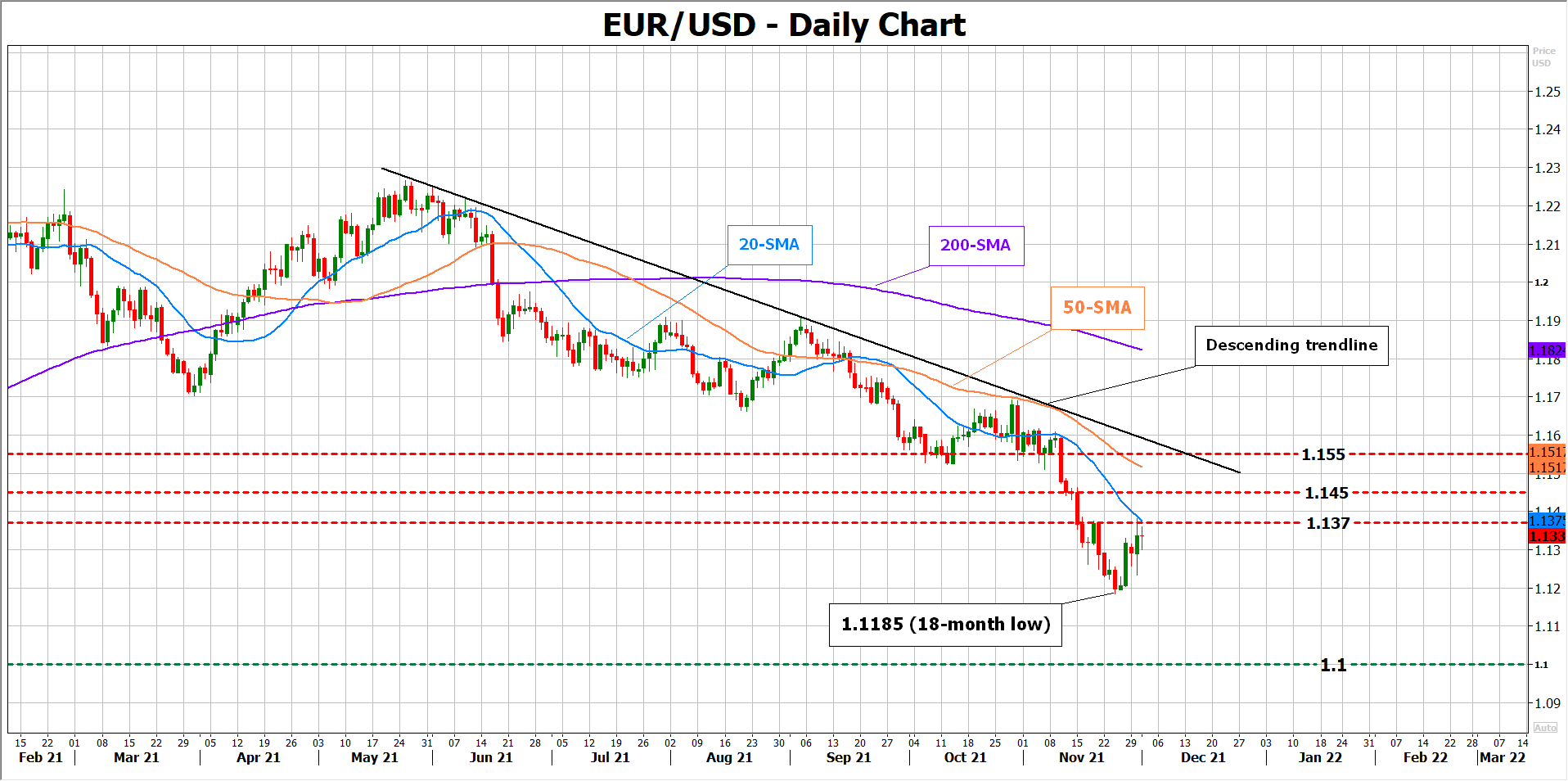
Currently, investors are pricing two rate increases for 2022 and a third one has also started to gain some backing recently. If nonfarm payrolls, and particularly annual average hourly earnings, which are projected to inch up to 5.0% y/y, beat expectations by a wide margin, euro/dollar may give up its recent gains to retest the 18-month low of 1.1185. The private ADP employment report has reduced the case for a significant upside surprise on Friday, but it’s worthy to note that the correlation between the two jobs reports has been mostly broken during the pandemic.
In the bearish scenario, where the NFP disappoints dollar bulls, euro/dollar may surge above the restrictive 20-day simple moving average (SMA) at 1.1370 and stretch towards the 1.1450 barrier. A steeper rally may face heavier resistance somewhere between the 50-day SMA and the descending trendline at 1.1550.
Sunset Market Commentary
Markets
Most analysts and policy makers apparently maintain the working hypothesis that the impact of the new corona waves/the Omicron variant on global growth will be muted, at least manageable. However, global investors, and in particular European ones, for now still keep some ‘better safe than sorry attitude’. The Fed at the same time turning its focus to re-anchoring inflation (expectations) rather than support growth or employment only complicates the story for risk assets. In a session deprived of key economic data, both in the US and EMU, the way south still was the path or least resistance for equities. European indices still had some negative catching-up to do after yesterday’s late-session setback in the US. Losses are substantial with the likes of the EuroStoxx 50 losing up to 2.0%. US indices went from a flat opening to gains of 1.4% (DJI). In fixed income, US and European markets take a completely different path. The US curve continues its bear flattening trend as markets further adapt the new guidance from Fed Chair Powell and Loretta Mester, highlighting rising chances for a rate lift-off already in spring of next year. US jobless claims only give a very fragmented insight on US labour market developments. Still at 220k, this week’s report again printed better than expected. US yields are rising between 4 bpn (2-y) and unchanged (30-y). The picture for the US 10-y yield remains ‘fragile’, but for now the 1.40/41% support area survives. The bottoming out process in US real yields also continues (10-y -1.02%). Yields currently ease off the intraday ‘highs’ on headlines that Russia is proposing a OPEC+ production hike. In volatile trading, the Brent oil price currently trades near $67 p/b, dampening inflation expectations. Contrary to the US, German/European yields are giving up some key support levels, with the German 10-y yield smashing below the key -0.35% support (currently -0.39%). European governments, including Germany, taking additional Covid containment measures, clearly is seen as complicating any ECB steps to join the Fed’s anti-inflationary approach. German yields are declining between 3.3 bps (2-y) and 5 bps (5 & 10-y). Despite the European risk-off, intra-EMU spreads even show a modest narrowing, probably betting that ECB support might be withdrawn slower than expected.
As was often the case of late, FX again decoupled from the trends in fixed income and equity. Despite losing interest rate support and despite a mainly European, Omicron driven risk-off, EUR/USD today showed remarkable resilience, even gaining modestly on a daily basis (1.1345). The yen also remains well bid, but additional interest rate support keeps USD/JPY north of the 112.70/53 support area. Sterling trades slightly in the defensive, but the EUR/GBP 0.8550 resistance area is holding. The lower oil price is causing additional losses for the like of the loonie (USD/CAD 1.2815) and the Norwegian Krone (EUR/NOK 10.31), but the damage could have been worse.News Headlines
The Hungarian central bank raised its one-week deposit rate from 2.90% to 3.10%. By offering to pay a rate higher than the base rate (2.10%), the MNB extracts HUF liquidity from markets to its deposit facility. This mechanism pushes (money market) rates higher and supports the forint. Both are important tools in fighting inflation well above target (6.5% y/y in October). The MNB decides on the deposit rate on a weekly basis, allowing for more flexibility than the monthly base rate policy meeting. EUR/HUF initially weakened (HUF strength) to 361 after the MNB’s decision. The outright risk-off environment caps HUF gains however to 362.24 currently.
The United Nation’s food price index rose with another 1.2% in November to surpass the 2008 peak as the cost of grains and dairy went up. It is now just a mere 3.5% away from the all-time high reached in 2011. The UN expects that level will be hit even before the year is over. Both in 2008 and 2011 high prices contributed to global food crises with mass protests erupting as well. Food inflation today is the result of bad harvests, increased shipping rates and worker shortages. It strongly affects consumers’ disposable income, which was already hit badly by surging energy costs.
NZDUSD Consolidates Around the 0.6800 Mark, Bearish Tone Remains
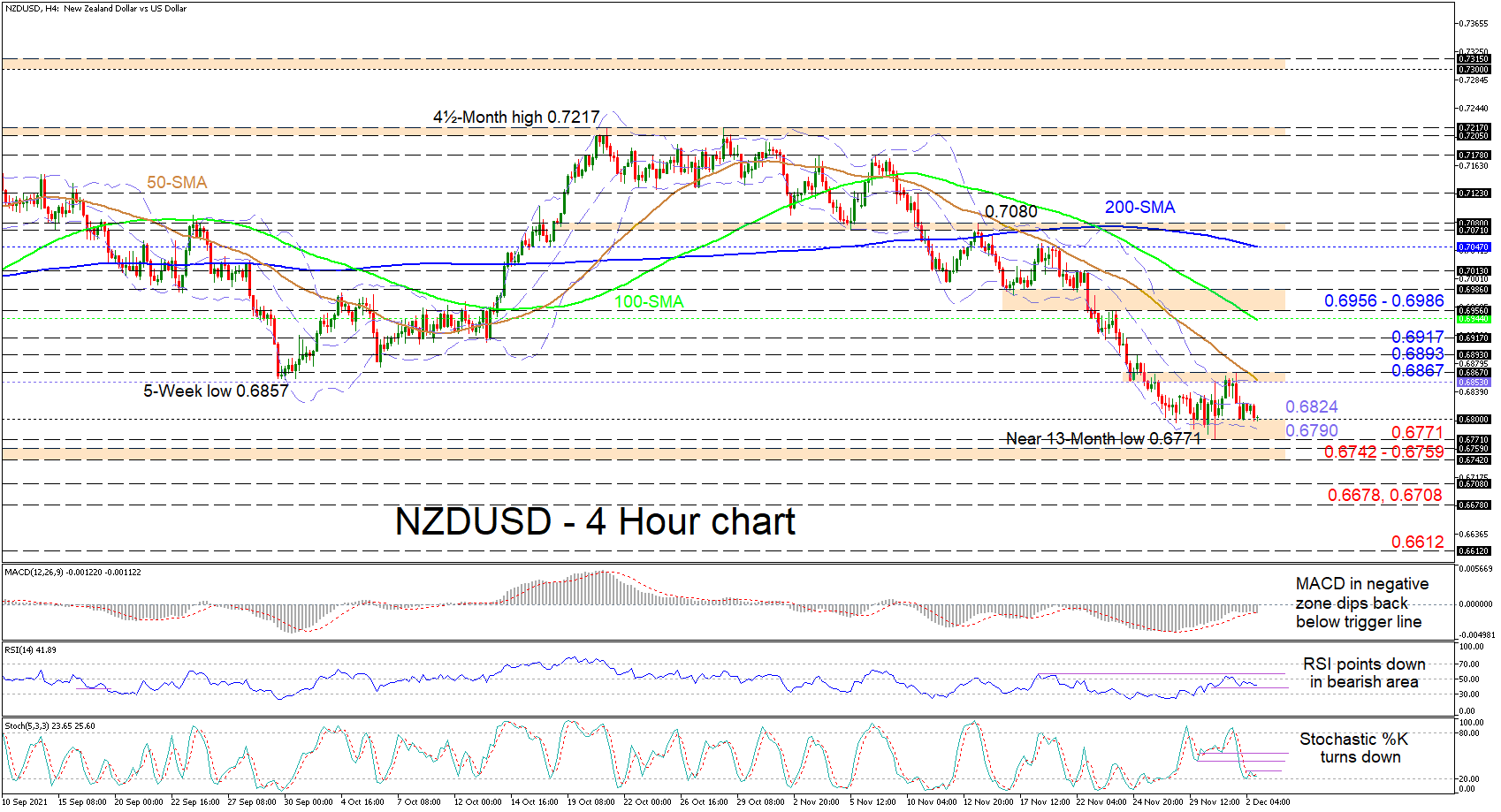
NZDUSD is edging sideways across the 0.6800 mark as clear directional impetus has softened after the pair stretched to a near 13-month low of 0.6771. The diving 50- and 100-period simple moving averages (SMAs) are backing the bearish trajectory of the pair.
The squeeze in the Bollinger bands is hinting of an upcoming surge in volatility, while the short-term oscillators are somewhat suggesting sellers may regain the upper hand. The MACD has marginally returned beneath its red trigger line in the negative region, while the RSI is sliding in the bearish zone. Furthermore, the fresh dip in the stochastic %K line, just overhead of the 20 level, is suggesting negative forces may be strengthening.
To the downside, an immediate buffer zone that encompasses the lower Bollinger band, from the 0.6800 handle until the near 13-month low of 0.6771 could hinder the price from tumbling further. Additional defences could stem from the adjacent 0.6742-0.6759 support border, which could add credence to a forming barricade, preventing the descent from gaining pace. However, if sellers drive the pair underneath these obstacles, the price may then aim for the 0.6708 and 0.6678 barriers from the early part of November 2020 before testing the key 0.6612 trough.
On the other hand, pushing off the 0.6800 hurdle and over the mid-Bollinger band at 0.6824, buyers could encounter a reinforced resistance band existing between the upper Bollinger band at 0.6853 and the 0.6867 high. Overshooting this barrier, the price may then jump for the 0.6893 high and the 0.6917 border. Should buying interest endure, the price may then seek out the 100-period SMA at 0.6944 ahead of the resistance section of 0.6956-0.6986.
Summarizing, NZDUSD is exhibiting a tendency to navigate lower in the near-term picture. That said, for additional negative moves to come into fruition, the price would need to manoeuvre below the 0.6742-0.6759 boundary. Alternatively, for buyers to regain some confidence, the pair would need to rise above the 0.7013 high.
Omicron Variant Continues to Cast a Shadow Over Markets
Dollar edges lower ahead of US jobs report
The US dollar was trading without a clear direction on Thursday, as the markets continue to digest Fed Chair Jerome Powell’s hawkish shift and recent Omicron variant developments. Further hawkish remarks from Cleveland Fed President Loretta Mester, who is an FOMC voter next year, were unable to boost the dollar.
All eyes will fall on the upcoming jobs report set to be released on Friday. Positive data could encourage traders’ speculation over three rate hikes next year, reigniting the US dollar’s positive momentum. Better-than-expected weekly US jobless claims released earlier today suggest the labor market is in pretty good shape.
In the rest of the FX arena, the biggest winner was the British pound, which rose by 0.43% against the greenback to $1.3323, while versus the euro, sterling was relatively flat. The common currency ticked up by 0.31% against the dollar as the Eurozone's unemployment rate continues to creep lower.
Meanwhile, the Turkish lira recorded further losses against the dollar on Thursday, after President Recep Tayyip Erdogan replaced his finance minister who reportedly opposed his demands over lower borrowing costs.
Omicron variant weighs on US equities
Major US indices finished in the red for a second consecutive day on Wednesday, erasing early session gains as investors monitored mixed pandemic headlines. Sentiment was first lifted after the World Health Organization remarked that current vaccines would likely offer protection against the Omicron strain. Yet, uncertainty prevailed as the first case of the new variant was detected in America.
On Thursday, US stocks are headed for a positive opening amid the approval of GlaxoSmithKline’s drug by UK regulators, which appears to be effective against the recently discovered mutation. The S&P 500 and Dow Jones futures rose by 0.25% and 0.60%, respectively at the time of writing. In contrast, the tech-heavy Nasdaq 100 is set for a 0.20% loss at the market’s opening bell.
In the commodity market, WTI crude oil slipped by 0.10% after headlines stating that a senior OPEC source suggested the cartel is likely to stick with the existing output plan. If indeed OPEC announces that it will proceed with raising supply as planned, oil prices could take a further hit.
Apple faces downward pressures
Apple’s share price is down by almost 3% in pre-market trade amid reports claiming that the tech-giant has warned its component suppliers about slowing demand for the iPhone 13 ahead of the holiday season. Moderna was the S&P 500 index’s worst performer during yesterday’s trading session, tumbling by 12% after losing an appeal, which could open the door to a patent infringement suit over its coronavirus vaccine.
AUD/USD Outlook: Aussie Cracks Key Supports on Omicron Concerns
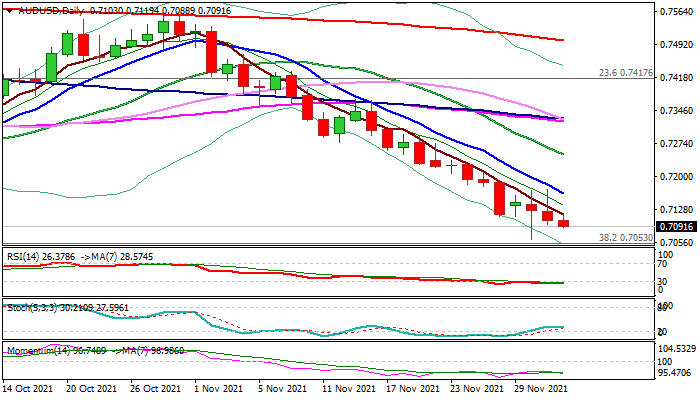
Bears from 0.7555 (Oct 28/29 double-top) faced headwinds from key Fibo support at 0.7053 (38.2% of Mar 2020/Feb 2021 0.5509/0.8007 rally) with third consecutive probe through initial support at 0.7106 (Aug 20 former low) looking for an eventual close below this level.
Risk-sensitive Aussie dollar continues to suffer from growing Omicron uncertainty, with the action in past two days when strong rejections were registered on both sides, reflecting changes in risk flow as market look for more details about Omicron case.
Bearish daily studies support the action needs firm break of 0.7104 pivot as initial signal which will look for confirmation on extension through 0.7053 Fibo level.
On the other side, deeply oversold weekly stochastic warns of prolonged consolidation before bears resume.
Omicron news, US jobs data, and hawkish tones from the Fed chief, likely to be the key near-term drivers.
Res: 0.7116; 0.7164; 0.7200; 0.7248.
Sup: 0.7062; 0.7053; 0.7000; 0.6920.
CAD Calm as Markets Look for Cues
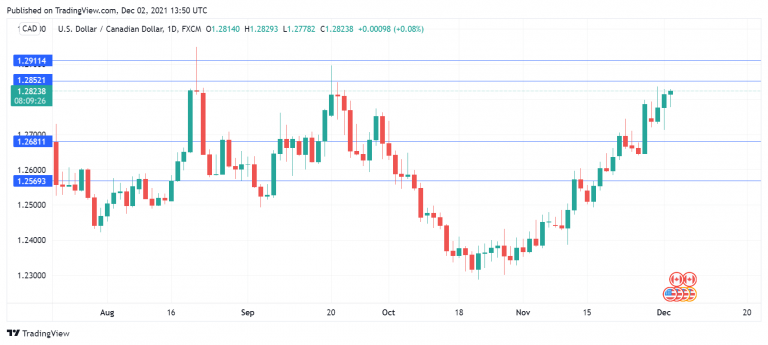
The Canadian dollar is showing limited movement in the North American session. USD/CAD is currently trading at 1.2822, up 0.08% on the day.
Markets eye US, Canadian job reports
The Canadian dollar is reeling after a dismal month of November. USD/CAD rose 3.22%, making it the worst month for the Canadian dollar since March 2020, when Covid-19 first appeared and sent the Canadian dollar tumbling. Earlier this week, USD/CAD broke above the 1.28 line for the first time since September. With investors jittery over the Omicron variant and a potential new wave of Covid, and Fed Chair Powell taking a hawkish pivot, the Canadian dollar could face some significant headwinds.
These two factors are weighing on the Canadian dollar, which has lost ground this week despite Canada posting solid data this week. GDP for Q3 showed a strong gain of 5.4% after a contraction in the second quarter. The Canadian economy is only 0.5% below its pre-pandemic level of February 2020, as the recovery is progressing well.
Fed Chair Powell caught the markets by surprise in his testimony before US lawmakers on Wednesday. Powell said it was time to retire the word ‘transitory’ for inflation and said that the bank would consider wrapping up its bond purchase programme several months ahead of schedule. The December 16th meeting will be a live one and if the Fed does accelerate its bond purchases, the markets will be looking for clues about a rate hike.
The week will wrap up with Canadian and US employment data, highlighted by the US nonfarm payrolls. This event is usually the week’s biggest release and is eagerly awaited, but the minds of investors are more focused on Omicron and the Fed. Still, the nonfarm payroll report could shake up the markets if the consensus of 534 thousand is wide of the mark.
USD/CAD Technical
- There is support at 1.2681. Below, there is support at 1.2569
- USD/CAD faces resistance at 1.2852, which has held since September. This is followed by 1.2911
EUR/USD Mid-Day Outlook
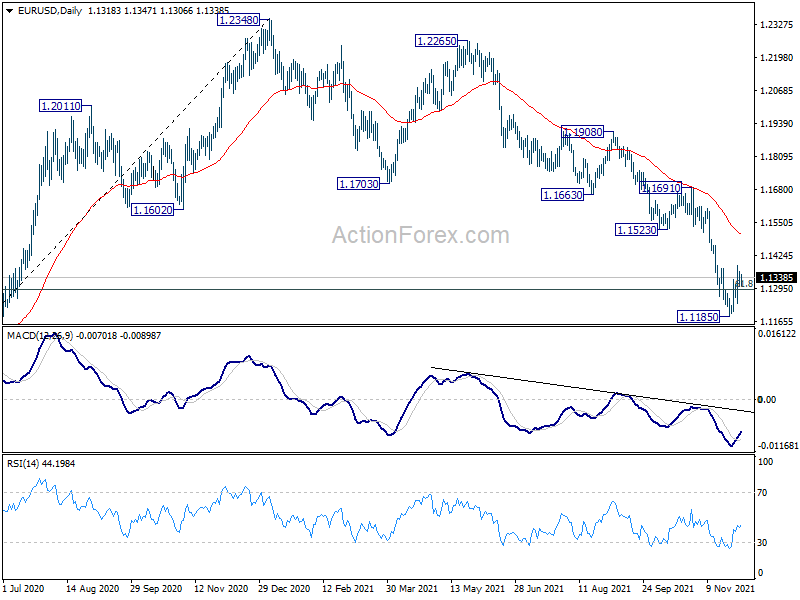
Daily Pivots: (S1) 1.1295; (P) 1.1327; (R1) 1.1352; More...
Outlook in EUR/USD is unchanged and intraday bias remains neutral first. On the upside, firm break of 1.1382 resistance should confirm short term bottoming at 1.1186. Intraday bias will be turned back to the upside for 55 day EMA (now at 1.1509). On the downside, break of 1.1185 will resume larger fall from 1.2348.
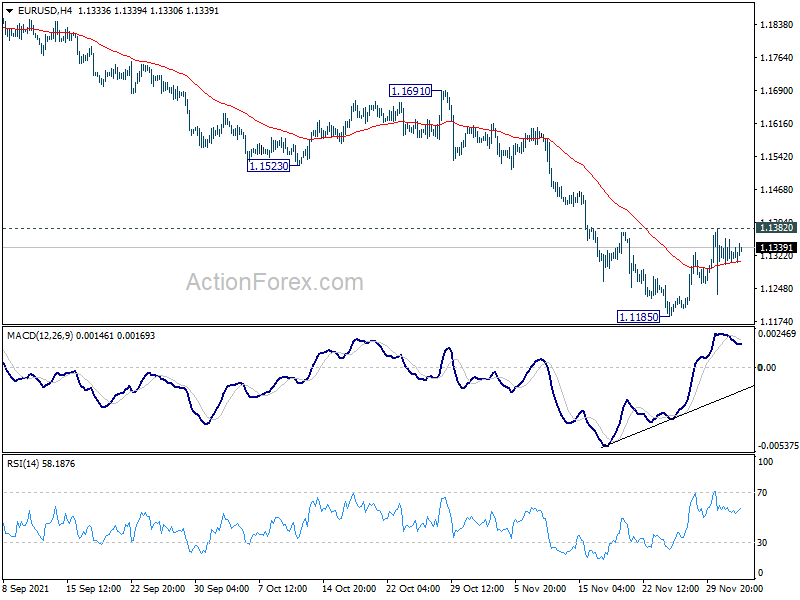
In the bigger picture, there are various ways of interpreting the fall from 1.2348 (2021 high). It could be a correction to rise from 1.0635 (2020 low), the fourth leg of a sideway pattern from 1.0339 (2017 low), or resuming long term down trend. In any case, outlook will now stay bearish as long as 1.1703 support turned resistance holds. Sustained break of 61.8% retracement of 1.0635 to 1.2348 at 1.1289 would pave the way back to 1.0635.