Sample Category Title
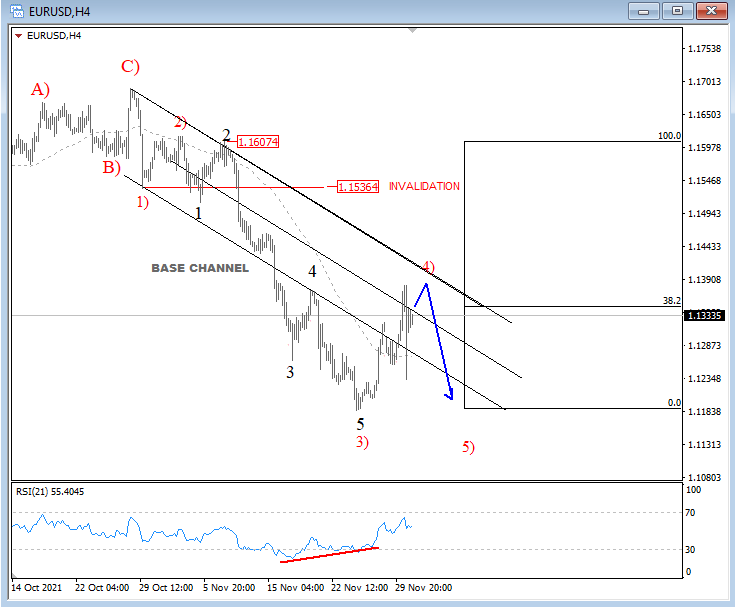
Elliott Wave Analysis: EUR/USD Remains Consolidating
FX market was slow yesterday as Powell did not bring anything new in his testimony, so it appears that traders are waiting on Friday's jobs data. So for now EURUSD remains consolidating, ideally still in wave 4 that can at some point test higher resistance levels, but overall, we think that upside can be limited if lockdowns will spread in Europe, and a threat on a potential new protests as EU has mentioned that it might be a time to start discussing mandatory vaccination.
EUR/USD 4h Elliott Wave analysis
Concerns About The New Omicron Coronavirus Variant Dominate Sentiment
Notes/Observations
- Concerns about the new omicron coronavirus variant dominate.
- OPEC+ ministers meet today; likely to maintain the current production increase policy of 400K bpd.
- Focus on upcoming US payroll report due out on Friday.
Asia
- South Korea Q3 Final GDP unrevised (Q/Q: 0.3% v 0.3% prelim; Y/Y: 4.0% v 4.0% prelim).
- South Korea Nov CPI registered its 8th straight month above target and fastest pace since Dec 2011) (YoY: 3.7% v 3.1%e).
- BOK stated that CPI to be above target for considerable time and the 2021 CPI might be slightly above Nov outlook of 2.3%.
- BOJ Member Suzuki reiterated that BOJ to continue to take appropriate policy steps; reiterated would not hesitate to add easing if needed. BOJ would carry on supporting corporate funding under pandemic relief programs.
- Australia Oct Trade Balance (A$): 11.2B v 11.0Be.
Europe
- EU's Sefcovic called on Britain to reciprocate on Brexit proposals as there was no time to lose. Needed to find solutions to the problems posed by the Northern Ireland protocol.
- Turkey President Erdogan removes Fin Min Elvan, names Nurettin Nebati as new Fin Min.
Americas
- Fed Beige Book ECONOMIC ACTIVITY GREW AT MODEST TO MODERATE PACE IN MOST DISTRICTS; PRICES ROSE AT MODERATE TO ROBUST PACE WITH PRICE HIKES WIDESPREAD.
- Fed's Mester (non-voter, hawk) noted that was very open to considering a faster taper pace, Should be able to hike rates a couple times in 2022 if needed, momentum in economy was clear , seen higher inflation rates.
- Senate Majority Leader Schumer (D-NY) stated that talks with GOP leader McConnell to avert a govt shutdown were making good progress.
Speakers/Fixed income/FX/Commodities/Erratum
Equities
- Indices [Stoxx600 -0.90% at 466.62, FTSE -0.59% at 7,126.27, DAX -0.91% at 15,331.63, CAC-40 -0.72% at 6,832.09, IBEX-35 -0.97% at 8,370.85, FTSE MIB -0.63% at 26,207.00, SMI -0.96% at 12,148.76, S&P 500 Futures +0.68%].
Market Focal Points/Key Themes:
Equities
- European indices opened lower falling yesterday's sell-off in US indices; sectors trending toward the downside include technology and consumer discretionary; in pandemic-related news, drug giant GlaxoSmithKline announced its COVID-19 antiviral pill was effective against new Omicron variant in first testing; shares of European's Apple suppliers trade lower across the board following press speculation that demand for iPhone 13 is weakening; in other corporate news, Thyssenkrupp shares trade down 2% following its CMD targets; earnings expected during the upcoming US session include Kroger, Express, Dollar General, Signet Jewelers and TD Bank.
- Consumer discretionary: Deliveroo [ROO.UK] -5% (share block sale).
- Financials: Serco Group [SRP.UK] +1% (CMD).
- Healthcare: Vifor Pharma [VIFN.CH] +15% (attracts interest), GlaxoSmithKline [GSK.UK] -1% (antibody drug effective against Omicron variant).
- Industrials: Thyssenkrupp [TKA.DE] -2% (CMD).
- Technology: Infineon [IFX.DE] -2%, STMIcroelectronics [STM.FR] -4% (iPhone component suppliers were said to have been told that demand has slowed down).
Speakers
- EU Court said to give non-binding opinion regarding rule of law issue for Poland and Hungary. Stated that principle to link the bloc's budget disbursements to the respect for rule of law were compatible with the bloc's laws and that the challenge by Hungary and Poland should be dismissed.
- Russia Central Bank (CBR) Gov Nabiullina reiterated she expected 2022 CPI to fall to 4.0-4.5% during 2022. Key One-Week Auction Rate to return to neutral zone in 2023.
- Turkey Central Bank (CBRT) Gov Kavcioglu noted that impact of current monetary policy stance to be seen in H1 2022. To continue FX Reserve accumulation. Excessive FX volatility was not wanted and had ability to intervene if necessary.
- Poland Central Bank (NBP) Gov Glapinski stated that inflation was not transitory but burdensome.
- China govt advisers said to have recommended lowering the official 2022 GDP growth target to 5.0-5.5% range (**Note: 2021 GDP Target >6%).
- Biden administration said to tighten its travel policy and expand availability of free COVID-19 tests due to Omicron variant.
- OPEC+ said to likely to discuss pausing oil production increase in January as among its options.
Currencies/Fixed Income
- USD was steady in the session with dealer believing the Fed was on course to normalize policy, despite COVID-risk.
- EUR/USD holding above the 1.13 handle. Dealers noted that the appearance of the Omicron variant would likely affect the upcoming ECB meeting in mid-Dec on its QE outlook. Germany seemed likely to implement "lockdown-like" measures this week which could impact the region’s growth outlook.
Economic data
- (CH) Swiss Oct Real Retail Sales Y/Y: 1.2% v 2.6% prior.
- (ES) Spain Nov Unemployment Change: -74.4K v -0.7K prior (9th straight monthly decline and back to pre-pandemic level).
- (HU) Hungary Sept Final Trade Balance: -€0.1B v €0.0B prelim.
- (BR) Brazil Nov FIPE CPI (Sao Paulo): 0.7% v 0.8%e.
- (HU) Hungary Central Bank raised its One-week Deposit Rate by 20bps to 3.10%.
- (IT) Italy Oct Unemployment Rate: 9.4% v 9.1%e.
- UN FAO Nov World Food Price Index: 134.4 v 133.2 prior (4th straight rise and highest since 2011).
- (EU) Euro Zone Oct Unemployment Rate: 7.3% v 7.3%e.
- (EU) Euro Zone Oct PPI M/M: 5.4% v 3.8%e; Y/Y: 21.9% v 19.0%e.
- (BE) Belgium Oct Unemployment Rate: 6.3% v 6.3% prior.
- (CY) Cyprus Nov CPI M/M: 0.5% v 0.7% prior; Y/Y: 4.3% v 4.3% prior.
Fixed income Issuance
- (ES) Spain Debt Agency (Tesoro) sold total €2.029B vs. €1.5-2.5B indicated range in 2025 and 2031 bonds.
- Sold €1.13B in 2.15% Oct 2025 SPGB bond; Avg Yield: % v -0.013% prior; Bid-to-cover: 2.17x v 1.99x prior.
- Sold €899M in 0.50% Oct 2031 SPGB bonds; Avg Yield: 0.386% v 0.465% prior; bid-to-cover: 2.07x v 1.40x prior.
- (ES) Spain Debt Agency (Tesoro) sold €475M vs. €250-750M indicated range in 0.70% Nov 2033 inflation-linked bonds (SPGBi); Real Yield: -1.047% v -1.074% prior; Bid-to-cover: x v 1.41x prior (Oct 7th 2021).
- (FR) France Debt Agency (AFT) sold total €B vs. €3.0-4.0B indicated range in 2030, 2041 and 2045 bonds.
- Sold €2.22B in 2.50% May 2030 Oat; Avg Yield: -0.19% v -0.05% prior; Bid-to-cover: 2.66x v 2.47x prior.
- Sold €677M in 4.50% Apr 2041 Oat; Avg yield: 0.38% v 0.10% prior; Bid-to-cover: 2.97x v 2.82x prior.
- Sold €1.099B in 3.25% May 2045 Oat Avg Yield: 0.50% v 1.42% prior; Bid-to-cover: 2.70x v 2.66x prior.
Looking ahead
- (RO) Romania Nov International Reserves: No est v $45.0B prior.
- (AT) OPEC and Non-OPEC Ministerial Meeting by Videoconference.
- 05:25 (EU) Daily ECB Liquidity Stats.
- 05:30 (HU) Hungary Debt Agency (AKK) to sell bonds.
- 06:00 (ZA) South Africa Oct Electricity Production Y/Y: No est v 0.0% prior; Electricity Consumption Y/Y: No est v 0.1% prior.
- 06:00 (SE) Sweden Central Bank (Riksbank) Dep Gov Ohlsson.
- 06:45 (US) Daily Libor Fixing.
- 07:00 (BR) Brazil Q3 GDP Q/Q: 0.0%e v -0.1% prior; Y/Y: 4.2%e v 12.4% prior; GDP 4Quarters Accumulated: 3.9%e v 1.8% prior.
- 07:00 (MX) Mexico Oct Leading Indicators M/M: No est v -0.04 prior.
- 07:00 (MX) Mexico Nov Vehicle Domestic Sales: No est v 76.6K prior.
- 07:30 (US) Nov Challenger Job Cuts: No est v 22.8K prior; Y/Y: No est v -71.7% prior.
- 08:00 (RU) Russia Gold and Forex Reserve w/e Nov 26th: No est v $626.3B prior.
- 08:00 (SG) Singapore Nov Purchasing Managers Index (PMI): 51.0e v 50.8 prior; Electronics Sector Index: No est v 51.1 prior.
- 08:00 (UK) Daily Baltic Dry Bulk Index.
- 08:30 (US) Initial Jobless Claims: 240Ke v 199K prior; Continuing Claims: 2.00Me v 2.049M prior.
- 08:30 (US) Weekly USDA Net Export Sales.
- 08:30 (US) Fed’s Bostic on Housing.
- 09:00 (IT) ECB Panetti (Italy).
- 10:30 (US) Weekly EIA Natural Gas Inventories.
- 11:00 (DK) Denmark Nov Foreign Reserves (DKK): No est v 491.9B prior.
- 11:00 (US) Fed’s Quarles.
- 11:30 (US) Fed’s Bostic participates in event.
- 11:30 (US) Fed’s Daly and member Barkin at Peterson Institute.
- 16:00 (KR) South Korea Nov Foreign Reserves: No est v $469.2B prior.
- 17:00 (AU) Australia Nov Final PMI Services: No est v 55.0 prelim; PMI Composite: No est v 55.0 prelim.
- 19:30 (JP) Japan Nov Final PMI Services: No est v 52.1 prelim; PMI Composite: No est v 52.5 prelim.
- 19:30 (SG) Singapore Nov PMI (whole economy): No est v 52.3 prior.
- 19:30 (HK) Hong Kong Nov PMI (whole economy): No est v 50.8 prior.
- 20:01 (IE) Ireland Nov PMI Services: No est v 63.4 prior; PMI Composite: No est v 62.5 prior.
- 20:45 (CN) China Nov Caixin PMI Services: 53.0e v 53.8 prior; PMI Composite: No est v 51.5 prior.
- 22:30 (TH) Thailand Nov CPI M/M: 0.1%e v 0.7% prior; Y/Y: 2.5%e v 2.4% prior; CPI Core Y/Y: 0.3%e v 0.2% prior.
- 22:30 (HK) Hong Kong to sell 1-month bills.
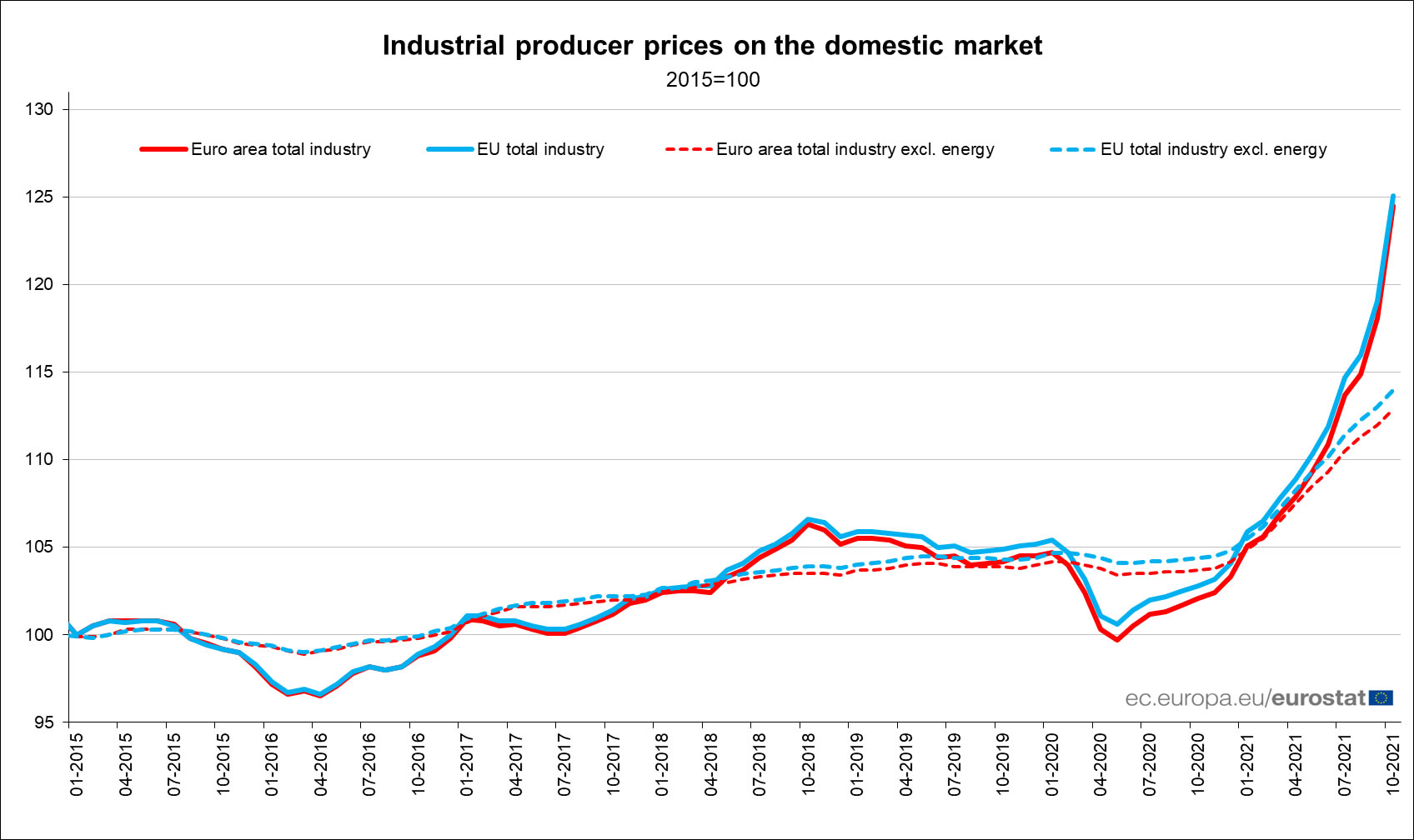
Eurozone PPI at 5.4% mom, 21.9% yoy in October, well above expectations
Eurozone PPI came in at 5.4% mom, 21.9% yoy in October, well above expectation of 3.2% mom, 19.0% yoy. For the month, industrial producer prices increased by 16.8% mom in the energy sector, by 1.4% mom for intermediate goods, by 0.5% mom for durable and for non-durable consumer goods and by 0.4% mom for capital goods. Prices in total industry excluding energy increased by 0.8% mom.
EU PPI rose 5.0% mom, 21.7% yoy. The highest monthly increases in industrial producer prices were recorded in Belgium (+11.2%), Italy (+9.4%) and Romania (+8.6%), while the only decreases were observed in Estonia (-2.1%), Luxembourg (-0.3%) and Sweden (-0.2%).
Stocks Under Pressure, Oil Awaits OPEC Decision
- Wall Street takes another hit as Omicron spreads, Fed can’t help
- FX market generally quiet, albeit with a hint of risk aversion
- With oil prices in freefall, traders look to OPEC for assistance
Equities drift lower
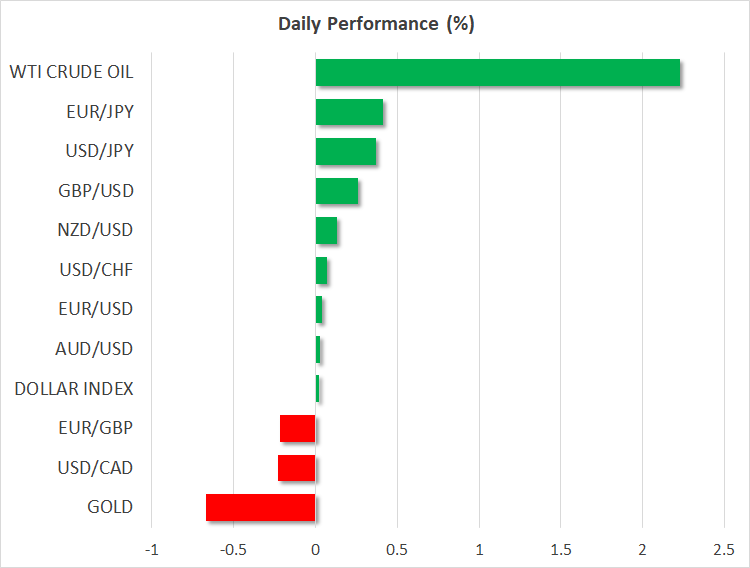
Another wave of selling hit Wall Street on Wednesday. What started out as a strong session for stock markets ultimately turned around, with the major indices closing deeply in the red. There was no clear catalyst behind this sudden reversal, although many point the finger at headlines that the first case of Omicron was detected in America, which may have rattled some trading algorithms.
On the bright side, ‘market generals’ like Apple and Microsoft suffered only minor injuries, preventing the selling from turning into a rout at the index level. The sense of risk aversion was felt across multiple asset classes. Commodity plays got hit alongside stocks, leading investors to take refuge in the safety of bonds and the Japanese yen.
What separates this pullback from every other virus-related dip that has been bought relentlessly is the Fed’s inability to help. Inflation is high and rising, the labor market is healing quickly, and spending is booming, which combined imply the Fed is now shifting into inflation-fighting gear.
With the ‘invisible hand’ of endless liquidity slowly fading, the training wheels are coming off and the market will have to absorb bad news all by itself.
FX market quiet overall
In the currency space, the wild swings in risk sentiment have been reflected mainly in commodity-sensitive currencies like the Canadian and Australian dollars. The defensive Japanese yen and Swiss franc have been the main beneficiaries of all the Omicron nerves, both capitalizing on the global retreat in yields, which reduces their interest rate disadvantage.
For the franc, the question is exactly how much currency appreciation the Swiss National Bank is willing to tolerate, as euro/franc is approaching ‘danger zone’ levels last seen in 2015 after the central bank abandoned its peg. FX interventions have accelerated in recent weeks but not dramatically, begging the question of whether the SNB will cook up a surprise at its mid-December meeting to turn the tide.
Meanwhile, euro/dollar continues to trade with little direction. A battle seems to be raging under the surface, with expectations that the Fed will expedite its normalization plans colliding with hopes that Europe’s energy crisis could calm down now that natural gas prices are falling back to earth.
OPEC takes center stage
All eyes will be on the decision by OPEC and its allies today on whether to keep raising production. Oil prices have fallen by more than 20% in just over a month, putting pressure on the cartel to pause its plans to increase supply. So the question is, will OPEC throw the market a bone today and announce it will withhold some production, fearful of the blow the Omicron will deal to demand?
There haven’t been any signs that the producers intend to change course, but OPEC isn’t shy of surprising markets either. A pause in production increases could provide oil prices with some relief, although any virus news will be more crucial.
Finally, there could be some fireworks when the weekly US jobless claims are released. This is usually a second-tier indicator, but last week it hit a five-decade low, signaling that the labor market is in good shape. We’ll find out today if that was a statistical quirk. If not, the dollar could find some love again as speculation for three Fed rate hikes next year fires up again.
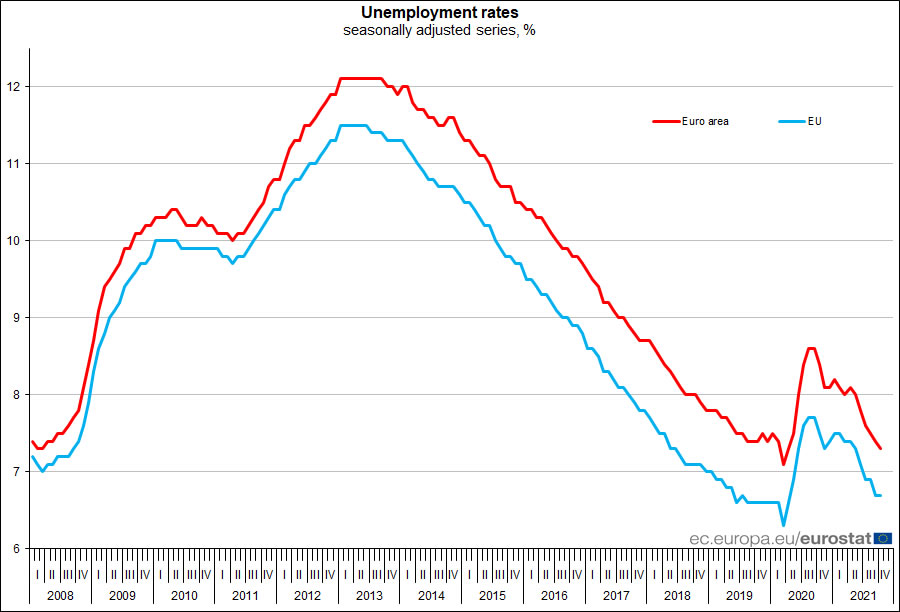
Eurozone unemployment rate dropped to 7.3% in Oct, EU unchanged at 6.7%
Eurozone unemployment rate dropped to 7.3% in October, down from 7.4%, matched expectations. EU unemployment rate was unchanged at 6.7%.
Eurostat estimates that 14.312 million men and women in the EU, of whom 12.045 million in Eurozone, were unemployed in October 2021.
US Futures Rally Eases Asia Equity Pain
Asian markets calm
Asian equities are lower today, but only modestly so in the context of this week’s volatility globally. For that, they can thank the after-market buy-the-dip FOMO gang, who have lifted US index futures higher this morning after the overnight omicron sell-off. In the OTC session, Wall Street took a bath as the first US omicron case was detected. The S&P 500 fell by 1.18%, the Nasdaq tumbled by 1.83%, with the Dow Jones retreating 1.38% lower.
In Asia, US index futures have risen sharply. S&P 500 futures are 0.55% higher, Nasdaq futures are up 0.45%, and Dow Jones futures have jumped by 0.65%. I can see no obvious reason for the futures rally, other than Dr Anthony Fauci saying don’t alter travel plans and that he hopes the US omicron travel restrictions can end soon. As good a reason to turn wildly bullish as any this week I suppose.
That has taken the edge of the potential negativity in Asian markets following the overnight slump by Wall Street. Asian markets are mostly lower, but not drastically so. The Nikkei 225 has fallen by 0.60%. Rising virus cases, new border restrictions, a postponed domestic easing of restrictions and rising inflation hasn’t dented the Kospi, which has rallied 0.95% today with technology and electronics leading the charge as local investors dust of the work-from-home trade.
Mainland China is sedate with the Shanghai Composite unchanged, while the CSI 300 is up just 0.35%. Hong Kong is just 0.25% higher although property heavyweights are outperforming as companies move to issue more debts domestically, easing liquidity crunch fears.
Around the region, Singapore is 0.17% lower while tech-heavy Taipei is following the Kospi lead, rallying by 0.75%. Kuala Lumpur is flat with Jakarta 0.70% higher and Bangkok falling by 0.25%, with Manila, dominated by a small number of heavyweights, has leapt 1.25% into the green. Australian markets have unwound some of their earlier losses as South Australia tightened internal border restrictions, following tightened international restrictions. The rally in US indexes has lifted local markets, leaving the All Ordinaries down just 0.30%, while the ASX 200 is just 0.10% lower.
Equity markets continue to play omicron tennis and traders looking for short-term direction, should just wait for the next virus headline and then act accordingly. As I have said previously, volatility, and not market direction, will be the winner this week.
Omi-Bored
US Omicron case deflates markets
Another day, another massive swing in direction driven by an omicron headline, this time its arrival in the United States aboard a vaccinated traveller from South Africa. An incipient recovery in stock markets was quickly wiped out. The US dollar also staged an uneven rally, even as the US yield curve flattened once again. The process may have been helped along with another round of powerful US data releases, with ISM and Markit Manufacturing PMIs remaining robust, Construction Spending rising, upward revisions in US GDP forecasts and Federal Reserve Cleveland President Mester on the wires in full hawkish mode.
That follows UK CPI hitting 10-year highs in October, with Nationwide House Prices rising by 0.90% in November, far higher than expected. That comes after Eurozone Flash Inflation for November hit 4.90% on Tuesday, the highest since 1991. The inflationary noise continues to rise in volume, and I rather suspect that even without omicron, growth stocks (especially tech), would be enduring some rather wild price swings anyway. For now, inflationary expectations in the US are being reflected in rising short-dated yields with long-dated yields falling. The five-year forward-forward inflation break evens continue to price in very little long0-term inflationary stress, which goes some way to explaining the curve flattening. You wonder how long it will last.
Omicron aside, the upcoming FOMC, Bank of England and European Central Bank meetings will be interesting this morning. The rhetoric from Powell & Co suggests they have not had an omicron blink this time and will announce a faster taper. The BOE has led markets to water before on rate hikes and could do so again this month. That’s a 50/50 in my mind. The European Central Government Debt Monetizer Bank will have some tougher questions to answer. Keeping European government and banking balance sheets afloat has turned into a multi-decade job, and with virus cases surging already over the continent, more movement restrictions, winter energy prices, and now omicron, I am expecting a euro-fudge disguised as no real action. That leaves me to believe that Q1 will still be the quarter of the US dollar, although I acknowledge that the evolution of omicron may make the US dollar rally uneven and throw a few banana skins out there.
In Asia today, South Korean GDP growth eased back to mid-2020 levels with QoQ Q3 climbing just 0.30%, led by a fall in services and domestic consumption. Inflation accelerated though to 3.70% YoY for November, well above the 3.10% expected. The next Bank of Korea meeting will be a live one, but a dusting of stagflation definitions in South Korea won’t be necessary today, with local markets likely to be fixated on noise that more government social restrictions are on the way.
The Bank of Japan’s Suzuki was upbeat in his forecasts for Japan next year, even suggesting that the BoJ had to be alert to accumulating side-effects of monetary policy easing. I’m guessing he means inflation. Who said the BoJ doesn’t have a sense of humour? I’m not sure his concerns will be necessary though as Japan has shut itself off from the world, with only Japanese citizens now allowed to book flights home, assuming there are any flights now.
Down in the lucky country, Retail Sales in October grew by a robust 4.90% while the Trade Balance held steady at AUD 11.22 billion. That disguised falls in both import and export volumes reflecting lower China demand and lower domestic demand due to lockdowns. However, with China’s energy crunch easing, and Australian states reopening despite the fence going up at the international border, I expect the lucky country to stay lucky and get luckier into the end of the year and Q1 2022.
New Zealand’s Export and Import Prices both rose sharply by 4.60% and 3.80% QoQ for Q3. New Zealand has an inflation problem and the RBNZ is well behind the curve with supply chain bottlenecks and rising prices looking ever less “transitory.” As a kiwi homeowner getting some landscaping done, today’s image is a case in point. Work has only just resumed on my retaining walls after New Zealand ran out of the special screws required. The whole country. Today’s image was my overjoyed builder sending me good news. The wall I am building wouldn’t keep Trump happy, but its cost has escalated by 50% in over a year which is about how long you will wait for tradespeople back home. Maybe Bilbo and Frodo were onto something building underground?
Eurozone PPI this afternoon is likely to give the ECB more headaches and food for thought. US markets will be focused on Initial Jobless Claims after ADP Employment overnight gained 534,000 jobs. Another sub 200k number may give some life to the Fed taper trade again, and tomorrow’s Non-Farm Payrolls will if it prints well North of 550k. We also have four Fed speakers tonight as well, all of whom may be in a hawkish mood. Of course, all this is caveated by which omicron headline is on the menu in the “specials of the day” section.
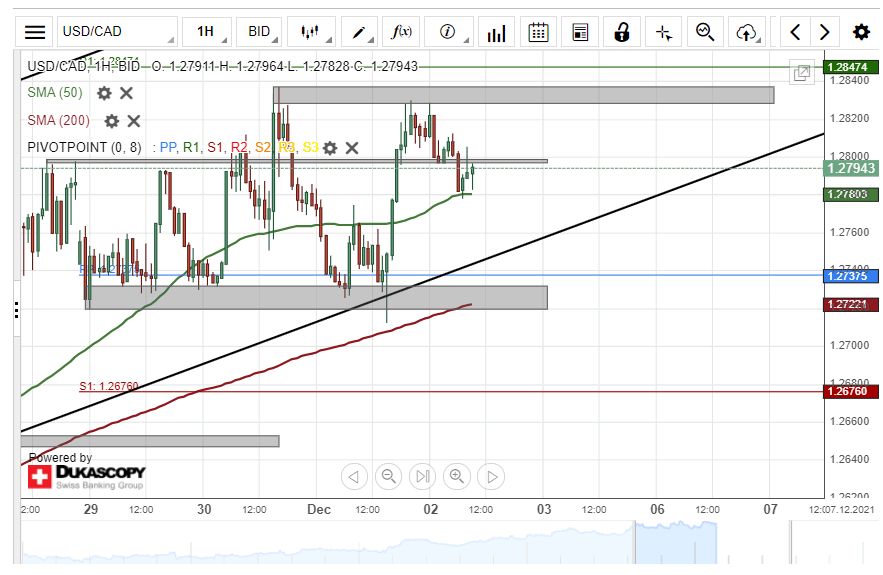
USD/CAD Recovers After Piercing Support Levels
On Wednesday, the USD/CAD shortly pierced the combined support of the 1.2720/1.2732 zone and the lower trend line of the November channel up pattern. Although, afterwards the rate recovered to the 1.2830 level, which provided resistance.
The resistance was enough for a retracement down to occur. By the start of Thursday's European trading hours, the pair had reached the 1.2780 level and the 50-hour simple moving average at it.
A potential move below the 1.2780 level could result in a test of the support of the November channel up pattern's lower trend line near 1.2760. Below the trend line, the 1.2720/1.2732 support zone and the 200-hour simple moving average might stop a decline.
On the other hand, a recovery of the USD against the CAD might result in the test of this week's high levels at 1.2830/1.2840.
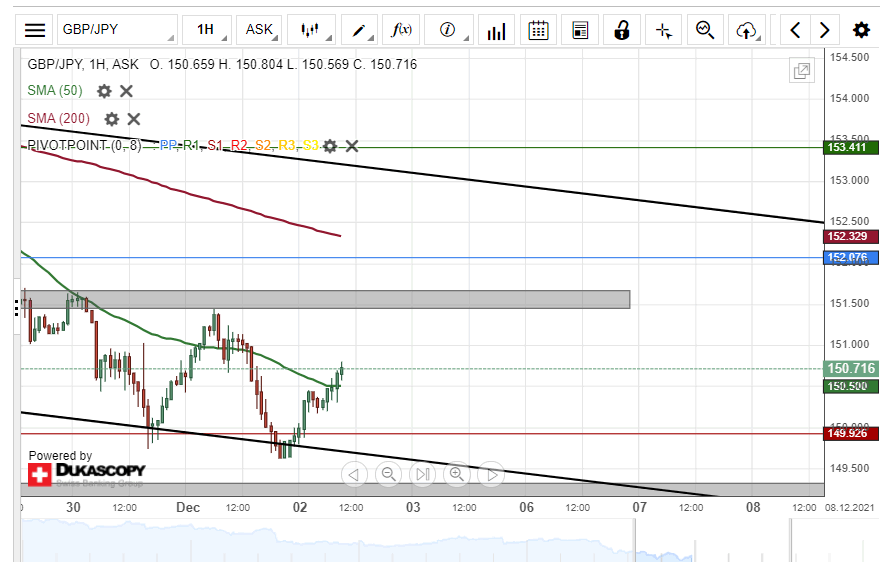
GBP/JPY Tests Large Scale Pattern
On Wednesday, the GBP/JPY currency exchange rate shortly fluctuated below the lower trend line of the large scale channel down pattern, which has guided the rate since mid-October. However, eventually the rate recovered and by the start of Thursday's European trading, the rate had reached above the 150.50 mark and the 50-hour simple moving average.
A continuation of the surge is most likely going to test the resistance of the 151.50 level and the zone above it. If the GBP/JPY breaks this resistance zone, the 152.00 level and the weekly simple pivot point at 152.08 might stop the surge.
In the meantime, a decline of the rate is expected to look for support in the 150.50 mark and the 50-hour simple moving average. Below these levels, the lower trend line of the channel down pattern is located at. In addition, take into account that the pair ignores the weekly S1 simple pivot point at 149.93.
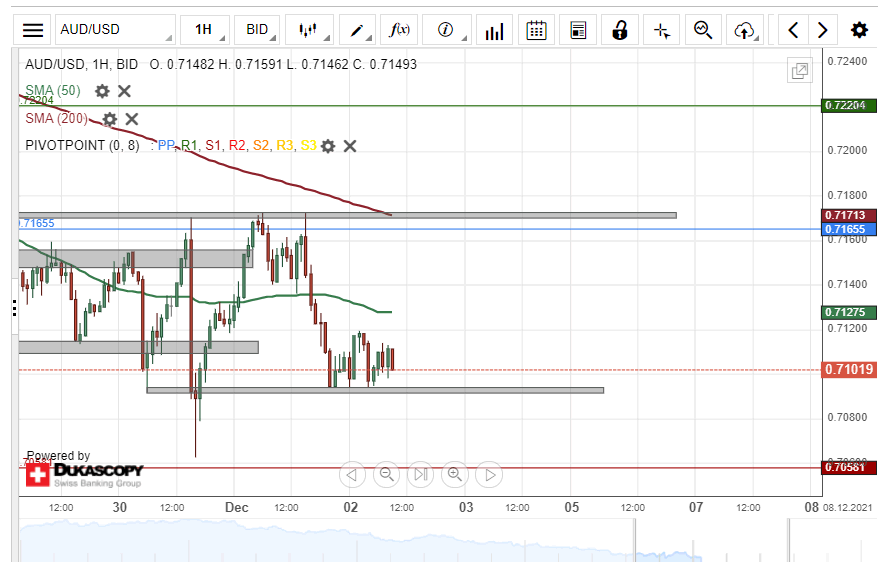
AUD/USD Reveals Support Below 0.7100
The AUD/USD eventually bounced off the resistance of the zone at 0.7170/0.7173 and declined. The decline initially found support in the 50-hour SMA and made another attempt to pass the resistance zone before retreating to the 0.7100 level. On Thursday, it was spotted that the 0.7092/0.7094 zone was providing support.
In the case that the rate recovers, it would most likely first test the resistance of the 50-hour simple moving average near 0.7125. Above the SMA, the weekly simple pivot point at 0.7166 might act as resistance. However, the pivot point did not impact the rate during this week. It is more likely that the 0.7170/0.7173 zone and the 200-hour simple moving average are set to act as resistance.
Meanwhile, a potential decline of the AUD/USD is highly likely going to look for support in the 0.7092/0.7094 zone. Below the zone, the this week's low level at 0.7064 might provide support. Further below, note the weekly S1 simple pivot point at 0.7058.