Sample Category Title
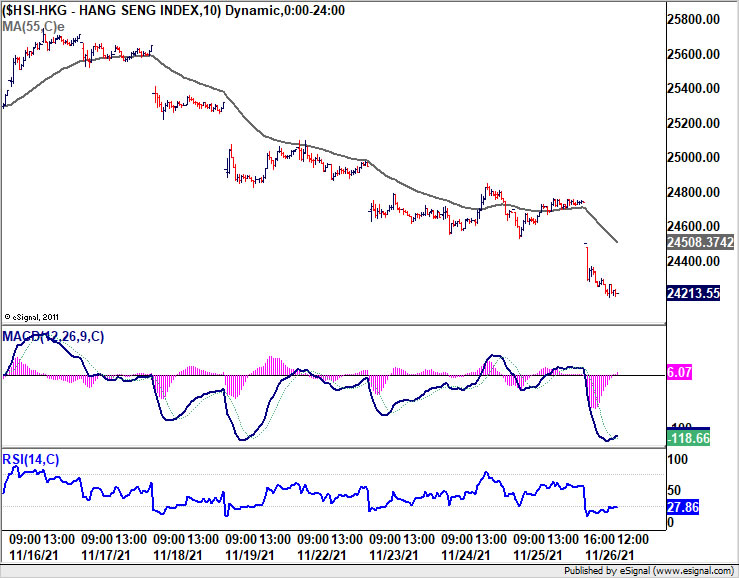
New coronavirus variant sends HK HSI sharply lower
Asian stocks tumble deeply today while US futures are trading sharply lower. The development reflects worries over a new coronavirus variant detected in South Africa. The country's Health Minister Joe Phaahla warned that there has been "more of an exponential rise" in infections over the last four of five days.
UK is banning flights from South Africa and five other southern African countries. Health Secretary Sajid Javid said there were concerns the new variant "may be more transmissible" than the dominant delta strain, and "the vaccines that we currently have may be less effective" against it.
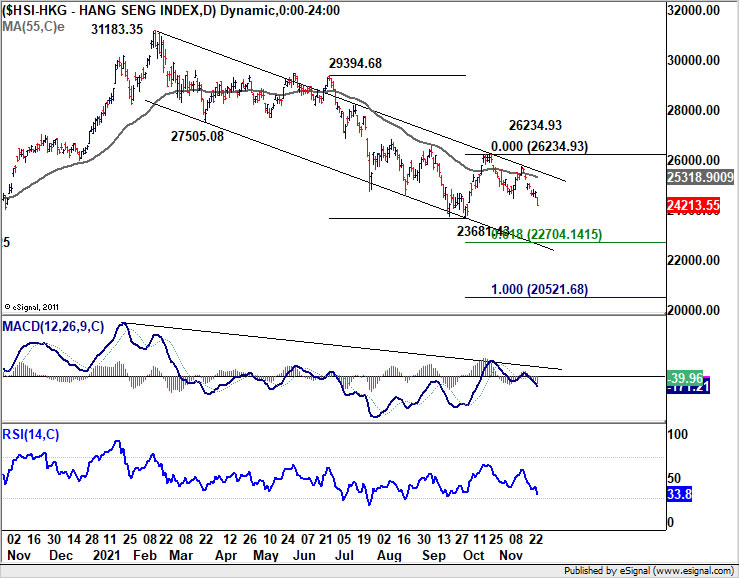
Hong Kong HSI tumbles sharply today in reaction to the new variant news. HSI is trading well inside medium-term falling channel from 31183.35 high. Rejection by 55 day EMA also keeps outlook bearish. We're looking at deeper fall to 23681.43 first and then 61.8% projection of 29394.68 to 23681.43 from 26234.93 at 22704.14 next.
RBNZ Hawkesby: We need to continue this process of removing stimulus
RBNZ Assistant Governor Christian Hawkesby said in a Bloomberg TV interview, "in New Zealand we've had a very resilient economy, we've got core inflation running near the top of our 1-3% target range, we've got an employment market that's through what we think it maximum sustainable employment."
He said, "so we're getting pretty clear signals that we need to continue this process of removing stimulus and getting interest rates back up towards neutral."
"Inflation expectations are going to be absolutely key for us. There are things that could make us go faster, and I think inflation expectations is one, he said. "Five- to 10-year inflation expectations are very well anchored. Short-term inflation expectations have lifted with headline, but lifted in a way that we would anticipate, so I think that's a really key thing to watch."
"On the upside, the risks are that we've had a very strong economy, a big change in the starting point, inflation expectations, there's a risk that they lift," he said. "But on the other side, interest rates have moved a long way here in New Zealand, mortgage rates are nearly 2% up from their lows in January, and ahead of us we're going to have to navigate having Covid in our community."
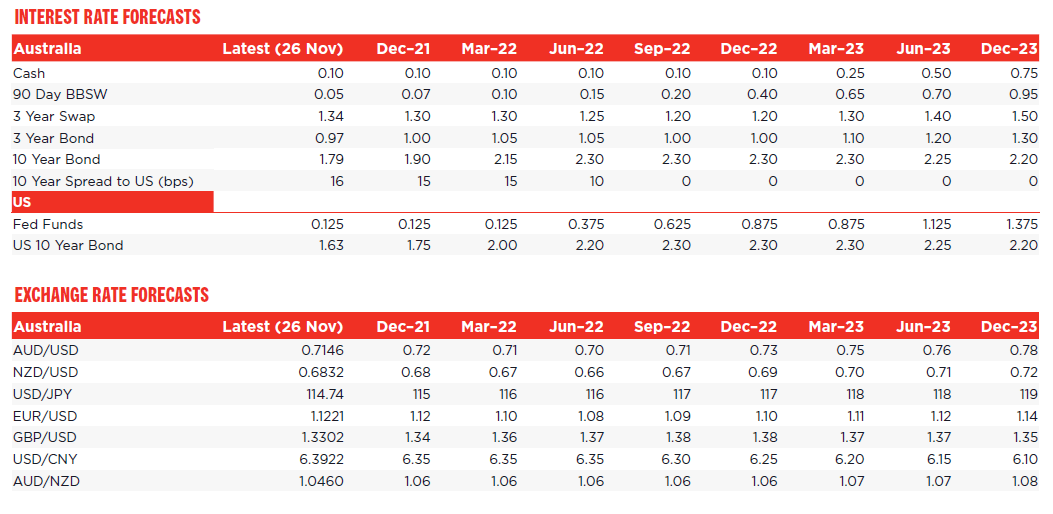
FOMC To Accelerate Rate Hikes, AUD To Settle At USD 0.70 By June
The US economy has experienced two significant shifts in the past two months: the momentum lost in the September quarter because of delta has been regained; and the scale, breadth and expectations of inflation have risen to multi-decade highs. Based on this progress and FOMC member commentary over the past fortnight, the December 14–15 meeting is expected to see significant change in the Committee’s approach to policy.
At that meeting, we now expect the taper to be accelerated to conclude in March 2022, making room for three 25bp rate hikes at the June, September and December 2022 meetings.
This compares with our previous view that the taper would extend to June prior to the first rate hike in December.
This policy approach will be the result of a careful assessment of the spectrum of risks that the US economy faces.
With respect to activity, the threat from delta looks to be subsiding, with rebounding consumption and robust investment pointing to growth at a multiple of potential in Q4 2022 as well as the first half of next year. Further, the run of weak readings for employment through mid-year have largely been revised away, and current momentum in labour demand is more than enough to see the economy reach full employment by the end of 2022.
The risk for activity is now actually that labour demand runs too far ahead of labour supply in coming months as participation remains impaired, leading to unsustainable gains in wages and additional support for already-elevated inflation expectations. These are circumstances which risk turning a transitory period of high inflation into a persistent force which will be difficult to control without inflicting a material cost on the economy. It increasingly looks likely, that price pressures related to supply and re-opening which drove annual inflation to 6.2%yr at October will take time to dissipate.
With this potential prospect of inflationary forces proving to be more persistent than anticipated and further boosting wages growth and inflationary expectations, the FOMC will not want to be seen to be persisting with a policy stance that is unnecessarily fuelling inflation pressures. With the growth prospects pointing to eventual maximum employment, the better policy approach is to begin the wind down of emergency stimulus sooner rather than later.
These issues may preclude the FOMC the luxury of delaying the first rate hike until the goal of maximum employment can be absolutely declared.
Albeit just a month on from the taper commencing, a doubling of the monthly reduction in purchases to $20bn for Treasuries and $10bn of mortgage-back securities, to complete the program in March instead of by June, now seems likely.
Although the market has moved to price in a first hike just a month after the current end of the taper in June 2022, we do not believe such a quick turn is likely given tapering is not tightening and the economic threshold for tightening (i.e. raising rates) has always been much higher.
A three month pause in policy normalisation to June 2022 is most likely, to be followed by two further 25bp increases in September and December as the US economy continues to grow above trend and maximum employment converges with full employment – as individuals currently sitting outside the labour market are attracted back in and find work.
From end-2022 to June 2024, we then see a further three rate hikes (one every six months) to a federal funds rate of 1.625%, unchanged from our prior call. This end point highlights our belief that, while inflation risks are currently rife, prudent policy and the passage of time will see them abate, allowing the FOMC to remain accommodative and the economy to grow at trend in 2023–25.
Moving rates earlier will increase the chances of being able to avoid the overtightening / policy mistake scenario we have seen in previous cycles.
Our expectation that the economy can settle at trend growth with full employment is also behind our view that the US 10-year yield will hold above the federal funds rate over the entire forecast period, only retreating from a peak of 2.30% at September 2022 to 2.20% end-2023 and 2.00% end-2024 as inflation risks abate.
This dynamic, risk-aware policy making by the FOMC is also expected to keep the US dollar in a tight range on a DXY basis over the forecast period. While divergent rate expectations and risks related to delta are set to weaken the Euro to June 2022, once the first hike is delivered by the FOMC and prospects for Europe and the global economy, and Asia in particular, strengthen, the DXY index is forecast to fall back from 98.6 to 97.4 end-2022, and 95.9 end-2023.
Underlying this result is not only the market’s confidence in the FOMC’s ability to deliver growth sustainably at trend without persistent inflation risks, but also a view that the global recovery will continue to strengthen over the period, reducing the US dollar’s attraction as a safe haven. Asia is expected to lead, both in terms of actual outcomes and sentiment.
The Australian Dollar to Reach a Low of USD0.70 by June 2022
This revised profile for FOMC policy has important implications for our views on the AUD.
Readers will have noted that we expect to see the USD peaking around the time of the first rate increase from the FOMC.
That timing will broadly coincide with the likely low point in the AUD/USD.
Our changed view for the FOMC has major implications for the outlook for the AUD.
Market pricing is also bringing forward the timing of the FOMC hikes and that has already taken some toll on the AUD, which has tumbled from USD0.75 to USD 0.715 over the last month.
That 4.5% fall is partly due to USD strength (up 3.2% against EURO and in DXY terms) and particular market negativity around AUD, specifically in the wake of the ultra dovish stance being signalled by the RBA Governor in recent speeches.
We have also seen a 20% fall in the monthly average iron ore price between October and November, although today’s spot is 5% above the November average.
Market pricing continues to anticipate 3-4 rate hikes by the RBA in 2022 – well ahead of the forecast we released in June that the tightening cycle will not begin until February 2023.
Through the first half of 2022 we expect markets to adjust to a much later beginning to the RBA’s tightening cycle triggering some further downward pressure on the AUD.
However, readers will note our view that the USD is likely to reach its high point by June 2022 as Europe and Asia ‘s growth prospects improve relative to the US and a strengthening global recovery weighs against “safe haven” currencies like the USD.
In turn, that modest expected deterioration in the USD will boost the AUD.
Other factors that will provide some support for the AUD will be Australia’s outperformance in terms of vaccination rates; strong growth in Australia in 2022; and stimulatory policy in China.
However, none of those factors will be sufficient to see the RBA lifting the cash rate earlier than our February 2023 target
We now see the low point in the AUD at USD0.70 by June lifting to USD 0.73 by end 2022 and sustaining that upswing in 2023 to USD0.7
In these uncertain times there are multiple risks to this outlook in particular the risk posed by interest rates.
The bottom of the AUD cycle may be even lower than USD0.70. We suspect that some of the multiple rate increases priced in for the RBA reflect distortions, including liquidity, in the Australian interest rate market while currency markets may be more wary of that profile.
Certainly, the jolt to AUD in the wake of the Governor’s recent speeches has not been reflected in interest rate markets.
The disappointment in markets with the RBA’s inertia may be exacerbated when it does not closely follow the FOMC even though it is quite clear that Australia is facing different challenges on the inflation and wages front.
Australia retail sales rose 3.9% mom in Oct, still short of pre-delta level
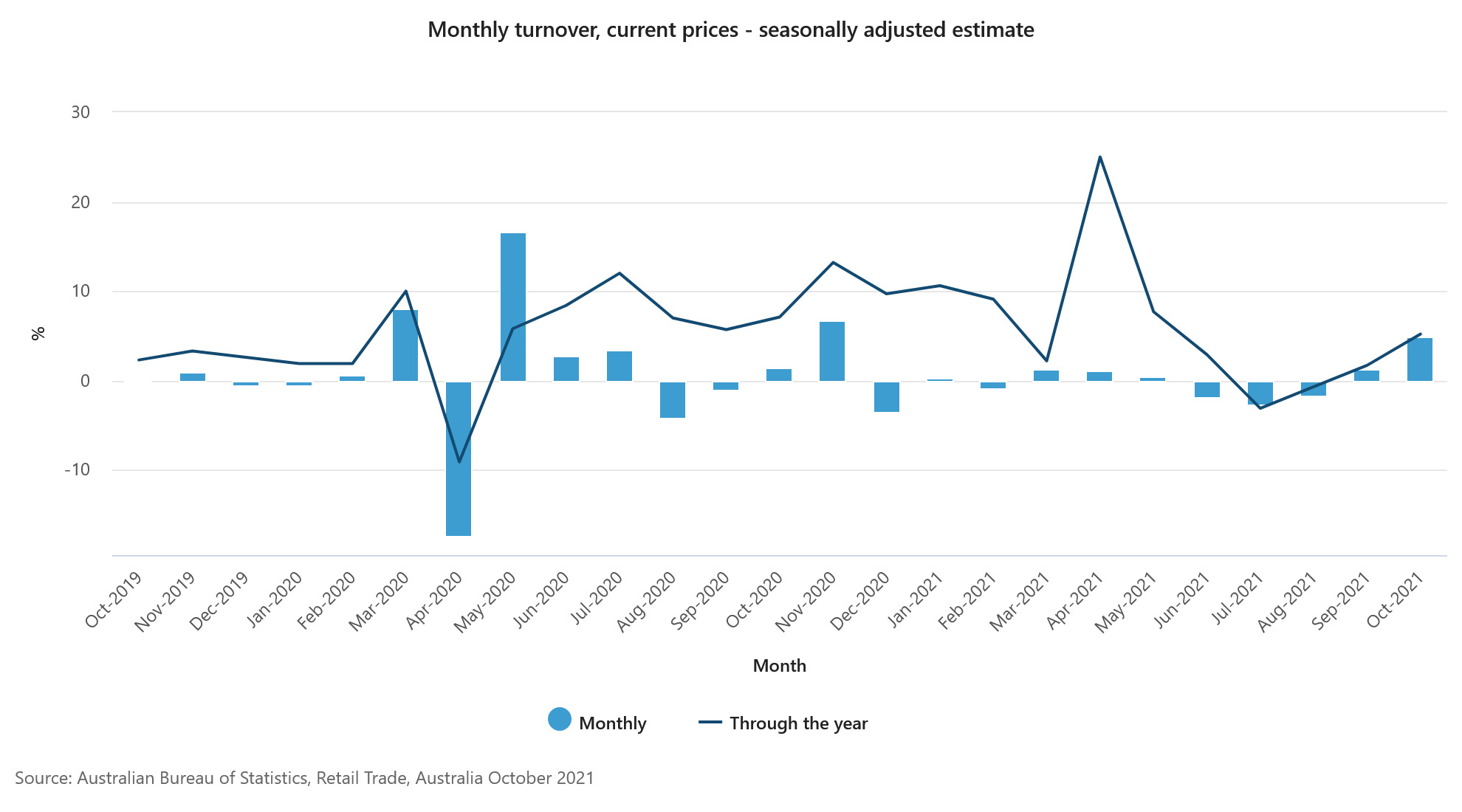
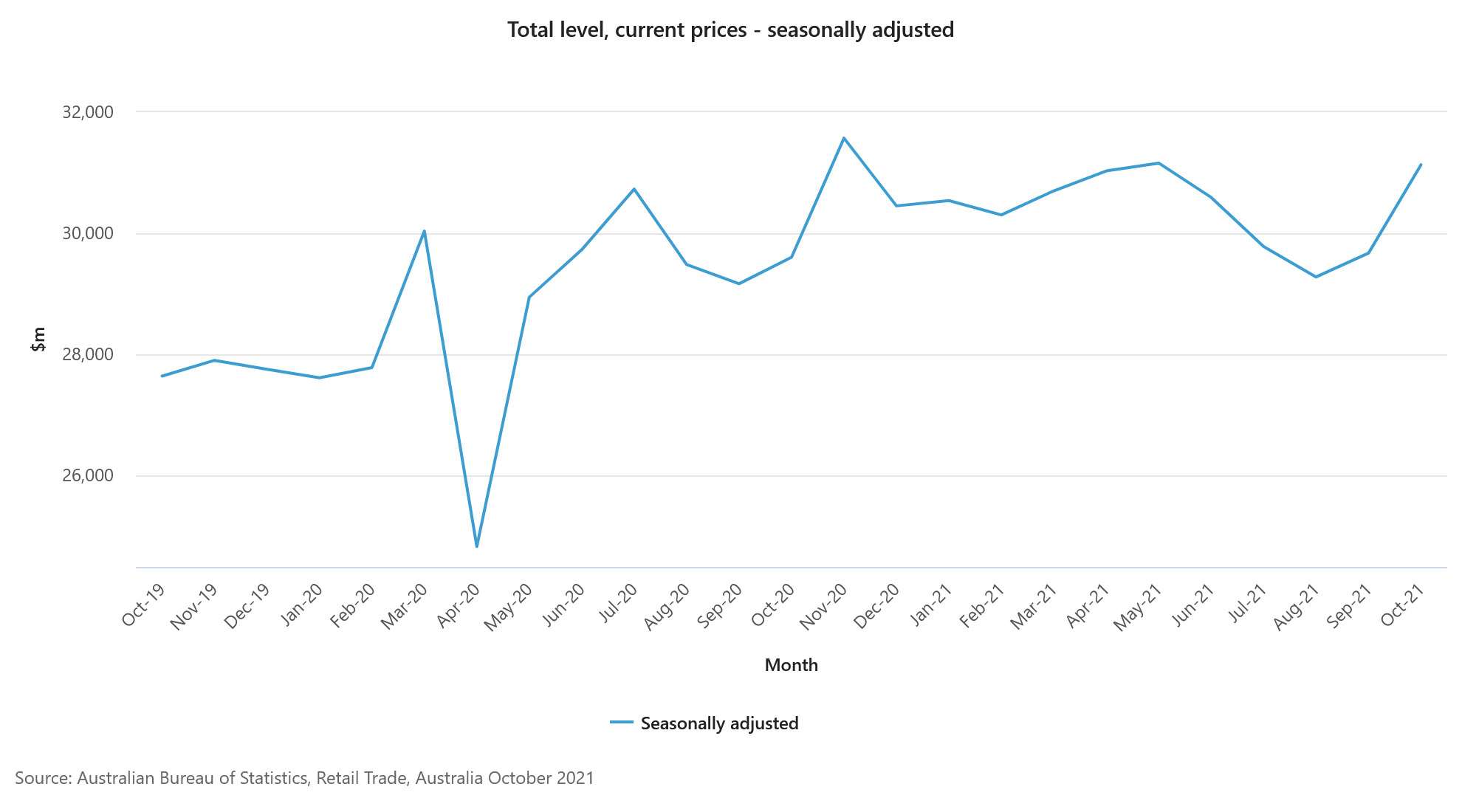
Australia retail sales rose 4.9% mom in October, above expectation of 2.5% mom. That's the strongest rise since Victoria's first lockdown bounce back in November 2020, with retail turnover rising to its highest level since June 2021.
"Retail performance continues to be tied to state lockdowns as this month's recovery was driven by the end of lockdowns in New South Wales, Victoria and the Australian Capital Territory," Ben James, Director of Quarterly Economy Wide Statistics said.
"With lockdown ending on October 11, New South Wales sales rose 13.3 per cent returning to the levels seen in the months immediately prior to the Delta outbreak, while Victoria and the Australian Capital Territory remain below pre-Delta levels."
"Although sales have bounced back strongly following the end of lockdowns, it is important to note that overall retail turnover has not yet reached the level of May 2021, the month prior to the Delta outbreak."
Elliott Wave View: Dow Futures (YM) Looking For More Downside
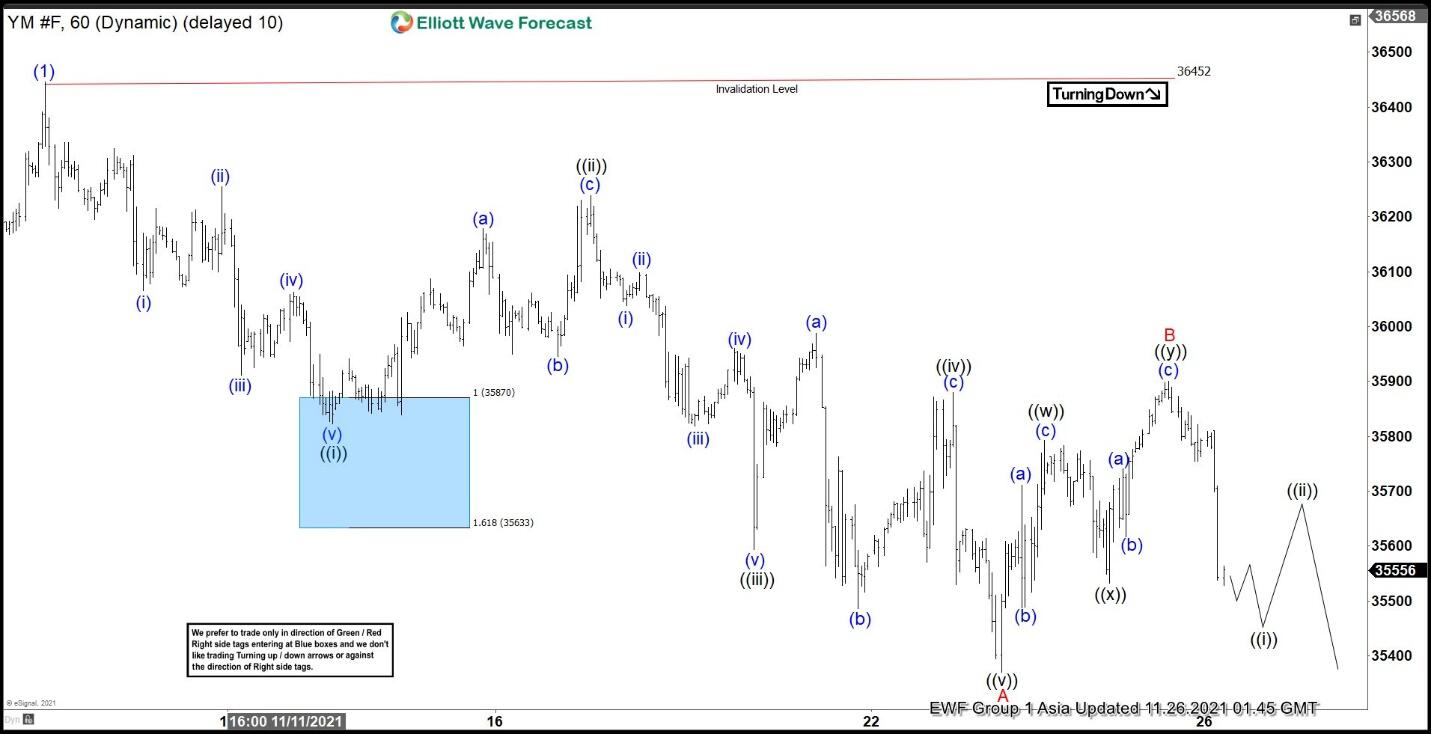
Short-term Elliott wave view in Dow Futures (YM_F) suggests that cycle from October 1, 2021 low ended with wave (1) at 36452. The Index is now correcting that cycle within wave (2). Internal subdivision of wave (2) unfolded as a zigzag Elliott Wave structure. First leg of the zigzag wave A subdivided into an impulse structure. Down from wave (1), wave ((i)) ended at 35823 and rally in wave ((ii)) ended at 36238. Index then resumes lower in wave ((iii)) towards 35593 and bounce in wave ((iv)) ended at 35880. FInal leg lower wave ((v)) ended at 35370 and this completed wave A.
Bounce in wave B ended at 35900 with internal subdivision as a double three Elliott Wave structure. Up from wave A, wave ((w)) ended at 35793 and pullback in wave ((x)) ended at 35532. Final leg higher wave ((y)) ended at 35900 and this completed wave B. While rally fails below 35900, and more importantly below 36452, expect the Index to continue lower in wave C of (2). Potential target for wave C of (2) is 100% – 161.8% Fibonacci extension of wave A at 34188 – 34840.
YM_F 60 Minutes Elliott Wave Chart
USD/JPY Remains In Uptrend Above 114.50
Key Highlights
- USD/JPY started a major increase above the 114.00 level.
- A crucial rising channel is forming with support near 114.50 on the 4-hours chart.
- EUR/USD is stable near 1.1200, and GBP/USD is struggling to stay above 1.3300.
- Gold price started a downside correction and traded below $1,800.
USD/JPY Technical Analysis
The US Dollar started a major increase from the 112.80 zone against the Japanese Yen. USD/JPY gained pace after it broke the 113.50 resistance zone.
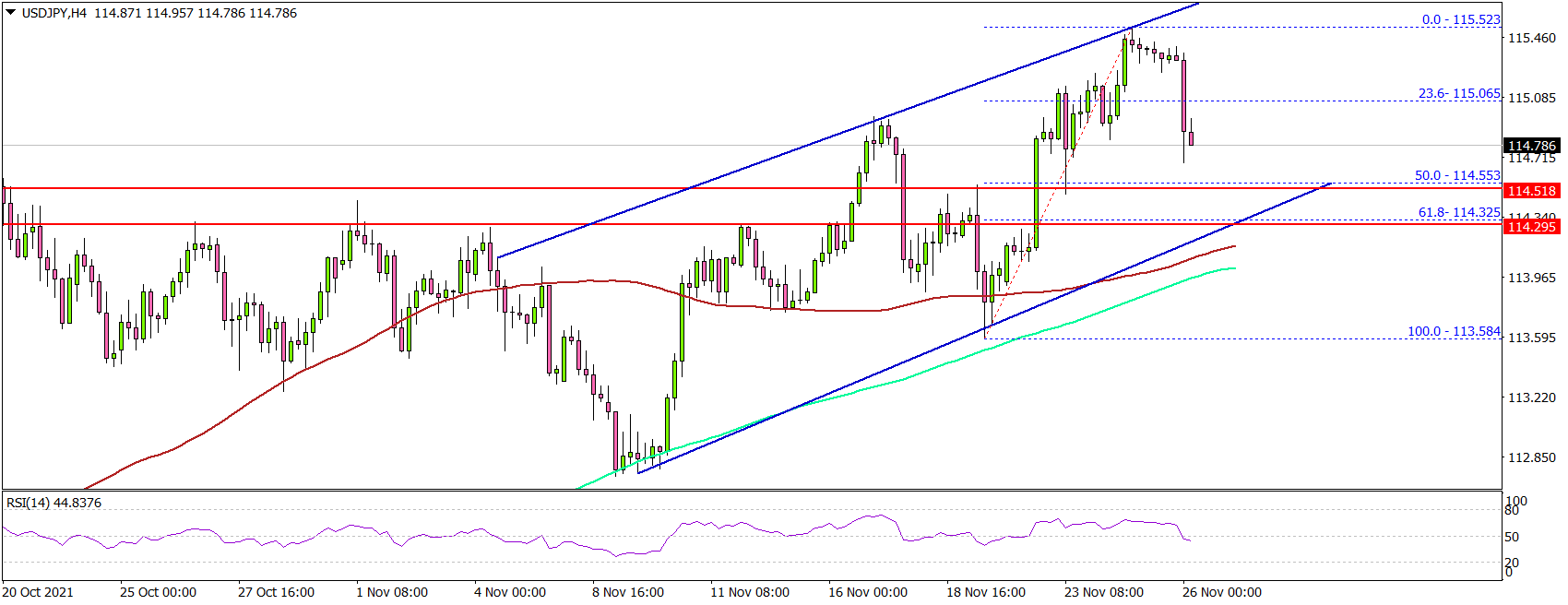
Looking at the 4-hours chart, the pair even broke the 114.00 resistance zone. There was a clear break above 114.50, the 100 simple moving average (red, 4-hours), and the 200 simple moving average (green, 4-hours).
The pair even spiked above the 115.00 level and traded to a new monthly high at 115.52. It is now correcting lower below the 115.00 level.
There was a break below the 23.6% Fib retracement level of the upward move from the 113.58 swing low to 115.52 high. The next major support is near the 114.50 level. There is also a crucial rising channel forming with support near 114.50 on the same chart.
The channel support is near the 50% Fib retracement level of the upward move from the 113.58 swing low to 115.52 high. Any more downsides might lead the price towards the 114.00 level.
On the upside, the pair is facing hurdles near 115.50. The next major resistance is near 116.20, above which the pair could rise towards the 116.80 and 117.20 levels.
Besides, EUR/USD tested the 1.1200 zone, and it is now consolidating losses. Similarly, GBP/USD is stable near the key 1.3300 support zone.
Economic Releases
- Swiss Gross Domestic Product for Q3 2021 (QoQ) – Forecast +2.0%, versus +1.8% previous.
- Swiss Gross Domestic Product for Q3 2021 (YoY) – Forecast +3.2%, versus +7.7% previous.
Market Morning Briefing: Euro Has Risen Slightly While Above 1.12
STOCKS
Amongst the equity indices mentioned below, Nikkei and Sensex have fallen sharply but we need to see if that can impact the Asia-Pac indices If not the equities globally. Nikkei is leading losses in the Asia-Pac region as fresh Covid rising cases create concerns and upon possibility that the US FED could speed up policy tightening. Dow looks stable below resistance near 29000/29500 and can dip to 28000 before rising while Dax can rise to 16000/16100/16400 before falling from there. Shanghai may trade within 3600-3550-3500 region for now. Sensex needs to break above 59000 to turn bullish.
Dow (35804.38, -9.42, -0.026%) has come down slightly. The index has support at 35500 which can hold for now and send the index up to test 36000. A strong break above 36000 is needed for the view to be bullish towards 36250/36300. Immediate view is to see trade within 35500-36000 region.
DAX (15917.98, +39.59, +0.25%) has risen. The support is seen at 15900 which can hold for now and send the index to test 16100 and 16400 eventually.
Nikkei (28779.63, -719.65, -2.44%) has fallen sharply on possibility of US FED policy tightening to speed up and fresh concerns of new Covid variant and rising cases . The Japan stocks lead the fall in the Asia-Pac region as growth stocks and travel/aviation stocks face a hit. While below 29500/29000 a further fall towards 28000 is possible before we see a bounce from there.
Shanghai (3566.87, -17.31, -0.50%) has come down but still trading above 3550. A bounce from there towards 3600 is possible. If we see a break below 3550 then a fall towards 3500 can be seen. We need to see if the fall in Nikkei impacts Shanghai or will Nikkei rise back immediately from current levels.
Nifty (17536.25, +121.20, +0.70%) has bounced from 17200 support. The interim resistance is at 17600 which if broken can take the index towards 17800. However if the resistance holds then a dip towards 17300/200 can be seen again. Overall broad range of 17200-17800 holds for now.
Sensex (58795.09,, +454.10, +0.78%) has risen yesterday. Resistance can be seen at 59000 which can drag the index towards 58000 again.
COMMODITIES
Gold has bounced slightly from support near 1780 and can head towards 1810/30 while Silver can remain narrowly ranged above 23. Copper can trade within 4.50/60-4.30/35. Crude prices have dipped and could fall towards supports near 78/77 on Brent and 75 on WTI before again moving up in the medium term.
Brent (80.86) has dipped again but fell from 83 itself without testing 84/85 as expected. While below 83, we may expect a fall back to 78/77 initially before falling deeper in the longer run. Immediate range of 83-77 looks likely within which a fall can be seen initially.
WTI (76.67) is holding below 79 and can dip to 75 before rising back from there.
Gold (1795) has risen well as support near 1780 is holding well for now. A rise to 1810/30 is possible while above 1780.
Silver (23.56) is ranged near current levels in a very narrow region and may continue so unless we see a sharp movement on either side.
Copper (4.4185) has dipped from 4.50 as expected. A range of 4.60-4.40/30 may hold for now.
FOREX
Most currencies are stable. Dollar Index has dipped slightly but can resume its uptrend again towards 97.50-98. Euro has bounced from 1.12 but if the Dollar Index breaks above 97, Euro can fall to 1.11/10 before posing a reversal from there. Aussie is bearish to 0.71/70 while Pound may hold above support at 1.33 to see a short corrective rise. EURJPY and USDCNY may remain ranged within 130-128 and 6.40-6.37. USDINR is likely to hold below 74.60/70, else a rise to 74.80/75.00 can be seen before reversing from there.
Dollar Index (96.731) has dipped from this week’s high of 96.938. While below 97, a short corrective dip to 96.25/20 can be possible before bouncing back higher to test 97.50-98.00 which would be the next crucial resistance to watch.
Euro (1.1221) has risen slightly while above 1.12. A rally in Dollar index towards 98, if seen can drag down Euro to levels below 1.12 towards 1.11/10 before posing a reversal from there in the medium term. Overall the fall could be limited to a maximum of 1.10 in the coming weeks.
EURJPY (128.69) is trading within 128-130 region and unless a break on either side is seen the range may continue to hold. We would turn bullish on the cross only on a sustained break above 130.
Aussie (0.7145) has broken below 0.72 as warned yesterday and could now head towards 0.71/0.70. View is bearish for the near term.
Pound (1.3303) may hold above 1.33 and see a corrective bounce to 1.34-1.3450 before a fall is again seen in the longer run back to 1.33 or lower. For now watch price action near 1.33.
Dollar-Yen (114.78) has not been able to break above 115.50 and instead has come off sharply from this week’s high of 115.52. While below 115.50, a dip to 114-113.50 looks possible before resuming the upward rally again. Our expected rise to 116.0-116.25 is not negated but can be delayed by some sessions.
USDCNY (6.3910) has moved up towards the upper end of the 6.40/39-6.37 range mentioned yesterday. A break above 6.40, if seen can take the pair up to 6.42 else sideways consolidations could continue between 6.40/39 and 6.37.
USDINR (74.40) has risen to 74.60 on the NDF market on the back of dip seen in the US Dollar Index. We continue to look at crucial immediate resistance near 74.60/70 which needs to hold for USDINR to come down towards 74.20/00. Failure to decline from 74.60/70 can take the pair higher towards 74.80/75.00 in the near term before the said decline is seen. Watch price action near 74.60/70 for now.
INTEREST RATES
The US Treasury yields have come down across tenors. The range resistances are holding well, and the yields can dip further within their expected sideways range. Our view of seeing a broad consolidation in the Treasury yields remains intact. The German yields have dipped slightly but need to fall further from here to avoid a rise beyond their resistances and keep our view of seeing a reversal intact. The 5Yr and 10Yr GoI continue to trade stable and can remain in a broad sideways range for some more time. The bias is bearish to see a downside break their ranges eventually.
The US 2Yr (0.61%), 5Yr (1.30%), 10Yr (1.60%) and the 30Yr (1.93%) have come-off across tenors. The resistance at 1.65%-1.68% has held well on the 10Yr. A dip below 1.6% can drag it to 1.5%-1.45%. The 30Yr has come down after testing 2% and can dip to 1.9%-1.85% now. The broader view of seeing a sideways consolidation between 1.45%-1.65% (narrow) / 1.35%-1.75% (broad) on the 10Yr and 1.75%-2.1%/2.2% on the 30Yr remains intact.
The German 2Yr (-0.76%), 5Yr (-0.58%), 10Yr (-0.25%) and 30Yr (0.09%) yields have dipped slightly. The resistances at -0.2% (10Yr) and 0.1% (30Yr) seems to be holding for now. But a further fall from here is needed to keep our view of seeing a reversal intact. As being mentioned here over the last couple of days, a strong rise past -0.2% (10Yr) and 0.10% (30Yr) will pave way for a further rise to -0.1% (10Yr) and 0.2% (30Yr) and negate our bearish view.
The Indian 10Yr GoI (6.3671%) is stuck in a narrow range of 6.36%-6.38% over the last few days. We reiterate that 6.3%-6.38% could be the range of trade and a dip to 6.34%-6.32% is possible while below 6.38%. From a bigger picture, 6.3%-6.45% will be the broader range of trade (in case if 6.38% is broken) and the bias is bearish to see a break below 6.3% and a fall to 6.2% eventually over the medium-term.
The 5Yr GoI (5.6928%) is slowly inching down within its broad 5.66%-5.75%/5.78 range. While the immediate outlook is mixed and unclear, it looks likely that the 5Yr can dip to 5.66% - the lower end of the range while it sustains below 5.7%.
Eco Data 11/26/21
[php_everywhere instance="1"]
Euro Goes into Freefall; Have Investors Become Too Pessimistic?
The euro’s woes just keep getting worse and worse. The single currency has ploughed more than one-year lows against the US dollar and pound, and six-year lows versus the Swiss franc. Expectations of diverging monetary policies had been weighing for some time, but now there are fresh doubts about the growth outlook that also have investors worried. The resurgence of virus cases in many parts of Europe has caught markets by surprise, endangering the euro bloc’s already fragile recovery. But is the bearish sentiment overdone, and are investors overlooking the risk of infections elsewhere following in a similar direction?
Last in the normalization race
The Eurozone economy has been making solid progress in recovering from the pandemic during 2021, yet the euro has been steadily declining against most of its main peers. The primary explanation behind the euro’s underperformance is simple. With other major economies also either on or past the road to recovery, their central banks are making plans or have already begun to normalize monetary policy after an extraordinary period of unprecedented stimulus.
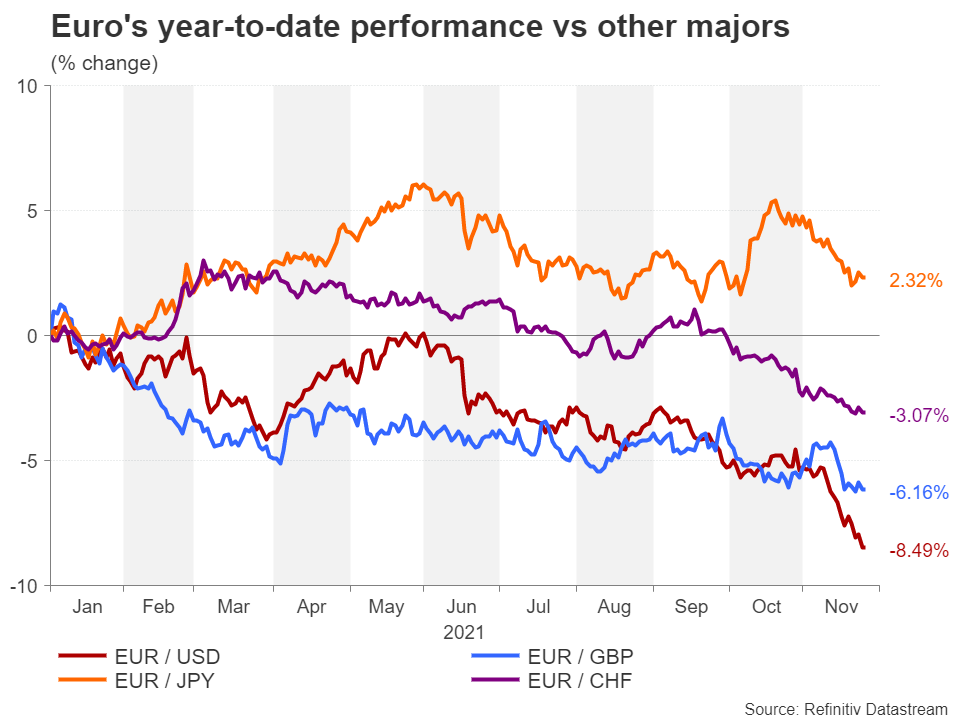
The Federal Reserve recently joined the Bank of Canada and Reserve Bank of Australia in tapering its monthly asset purchases, the Bank of England could hike rates next month, while the Reserve Bank of New Zealand just raised its cash rate for the second time since the pandemic. Although it’s true that the European Central Bank has also slowed its bond purchases and will end its emergency QE in March 2022, it still has its regular asset purchase programme (APP) that has been running concurrently throughout the virus crisis. It is widely expected that the ECB will not only keep APP active for the foreseeable future but may beef it up slightly to partially compensate for the conclusion of the emergency purchases.
More crucially, the ECB is nowhere near lifting its benchmark lending rates, surpassed only by the Bank of Japan when it comes to a delayed liftoff. These expectations have been gradually taking shape during the course of the year, dragging euro crosses lower, but the bearish outlook got additional thumbs ups lately.
A double blow for the euro
First, ECB chief Christine Lagarde doubled down on the Bank’s dovish stance, warning against premature tightening. Lagarde is fast becoming the odd one out amongst central bankers who has yet to deviate from the notion that the current spike in inflation is temporary even as most of her fellow policymakers adopt a more precautionary approach.
Second, infections of Covid-19 are rising rapidly in many parts of Europe. Several countries have recently announced the re-imposition of some restrictions, with many targeted at unvaccinated people. But some nations have gone into a partial or full lockdown. With winter only just starting, the virus picture could get a lot worse before it gets better. Although, as seen from subsequent lockdowns, businesses and consumers have learnt to adjust to the unfolding virus situation, the latest measures are nevertheless expected to take a toll on economic activity over the coming months.
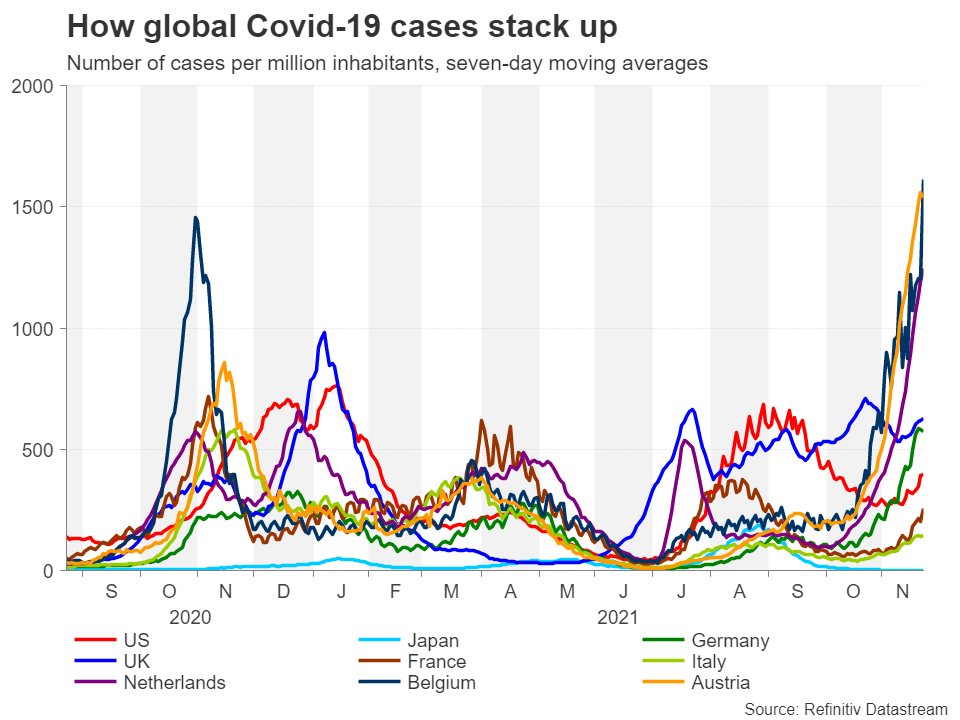
The weaker growth outlook can only mean that there will be even less urgency for the ECB to raise rates in the next year. And despite the fact that money markets continue to price in a 10-basis point rate hike, currency traders aren’t too convinced. Even if the ECB were to put up rates, it would still be a paltry increase compared to the tightening anticipated by other central banks.
The return of lockdowns
Until now, lockdowns in a post-vaccinated world were something that had not been factored in by investors and this might be why the euro’s latest selloff has been so dramatic. After all, countries such as Britain had led the way in proving that it is possible to keep Covid deaths low while lifting almost all social distancing rules. So why are some European nations with stricter curbs than the UK being inundated with a surge in hospitalizations due to Covid?
There is some evidence that suggests that the AstraZeneca jab, which accounts for most of the UK’s vaccine doses, provides better protection for the elderly. Another possibility is that there is greater herd immunity in Britain due to higher previous infections, in particular, the Delta variant spread there much early on than in the rest of Europe.
Will the US be next?
But what about the United States, could it be next in seeing a re-escalation of virus cases? New daily cases and hospitalization rates have begun to creep up and even though America’s booster program has gotten off to a decent start, it lags the UK’s rollout. There is risk that markets have become complacent against the persisting threat of the virus ever since vaccines came into the picture.
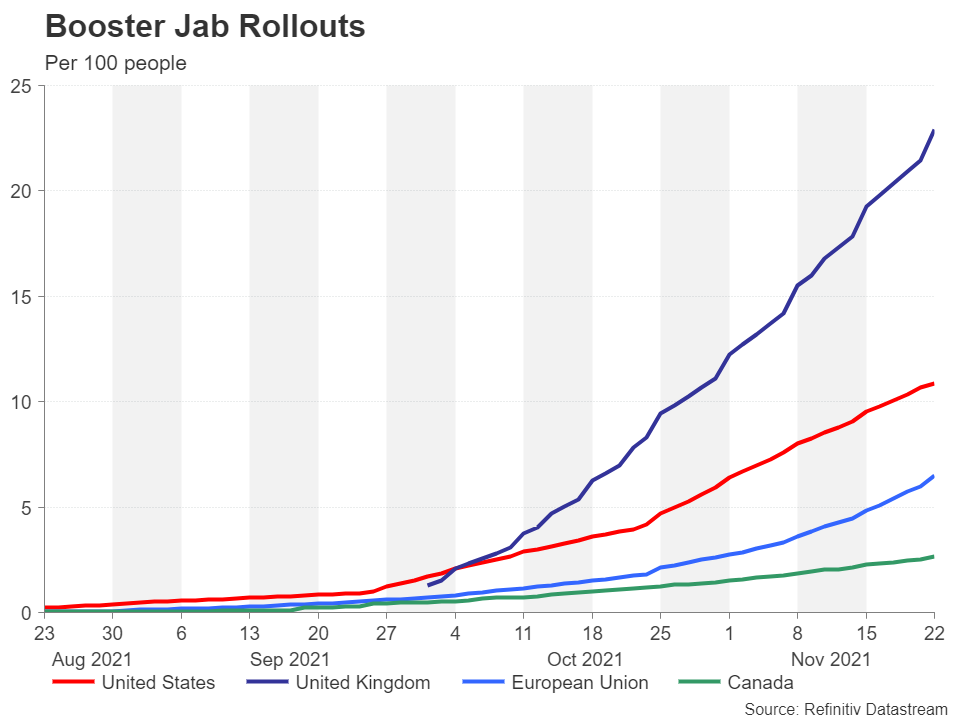
Whilst it’s not very likely that there would be renewed lockdowns in the US, some toughening in restrictions cannot be ruled in the winter months. Furthermore, as observed from previous virus waves, it only takes a blowup in infection levels for consumers to stay at home.
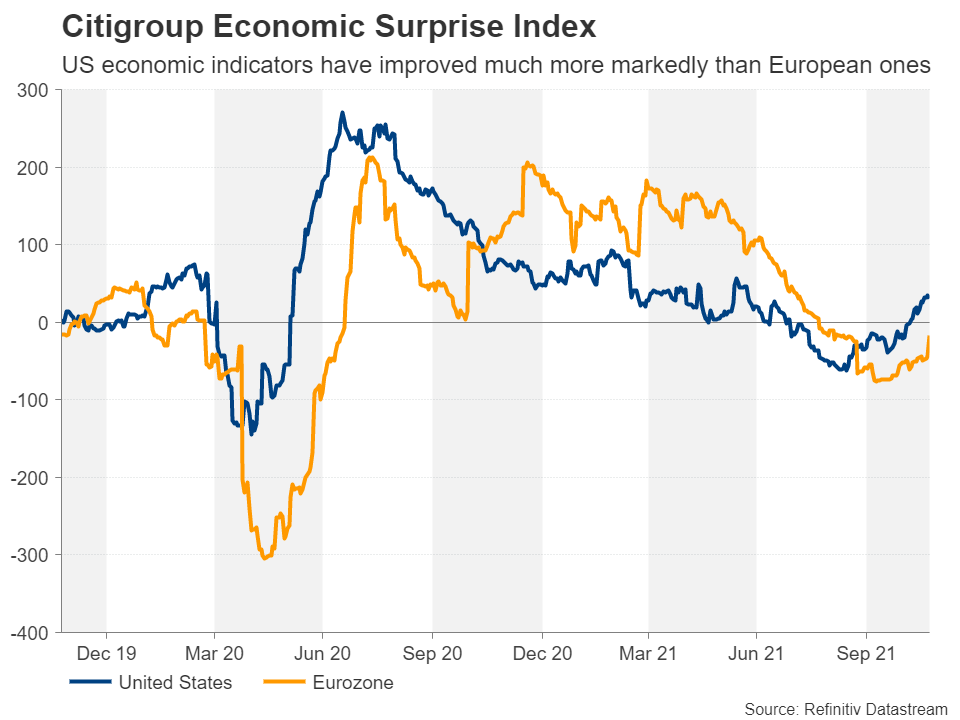
Part of the euro’s downward drive is down to the recent improved optimism for the American economy as the latest indicators suggest growth picked up at the start of the fourth quarter. Should this optimism come into question, the US dollar might lose some of its shine, boosting struggling currencies like the euro.
Too pessimistic?
Another upside risk for the beleaguered single currency is the assumption that growth will be hit hard by the current wave of measures. But with so much pessimism priced in, there’s a good chance Europe’s economies will weather this storm much better than what markets expect.
It’s also worth pointing out that large speculative investors are not overly bearish on the euro. According to CFTC data, speculators have cut their euro long positions substantially this year but were only just net short as of November 19.
Technical indicators on the other hand, imply that the euro is oversold, at least against the US dollar. Should buyers step in, the 61.8% Fibonacci retracement of the March 2020-January 2021 uptrend will be the first critical test at $1.1290 followed by the 50% Fibonacci of $1.1492. Overcoming the latter would also help euro/dollar reclaim its 50-day moving average, which is required for eliminating the selling pressure.
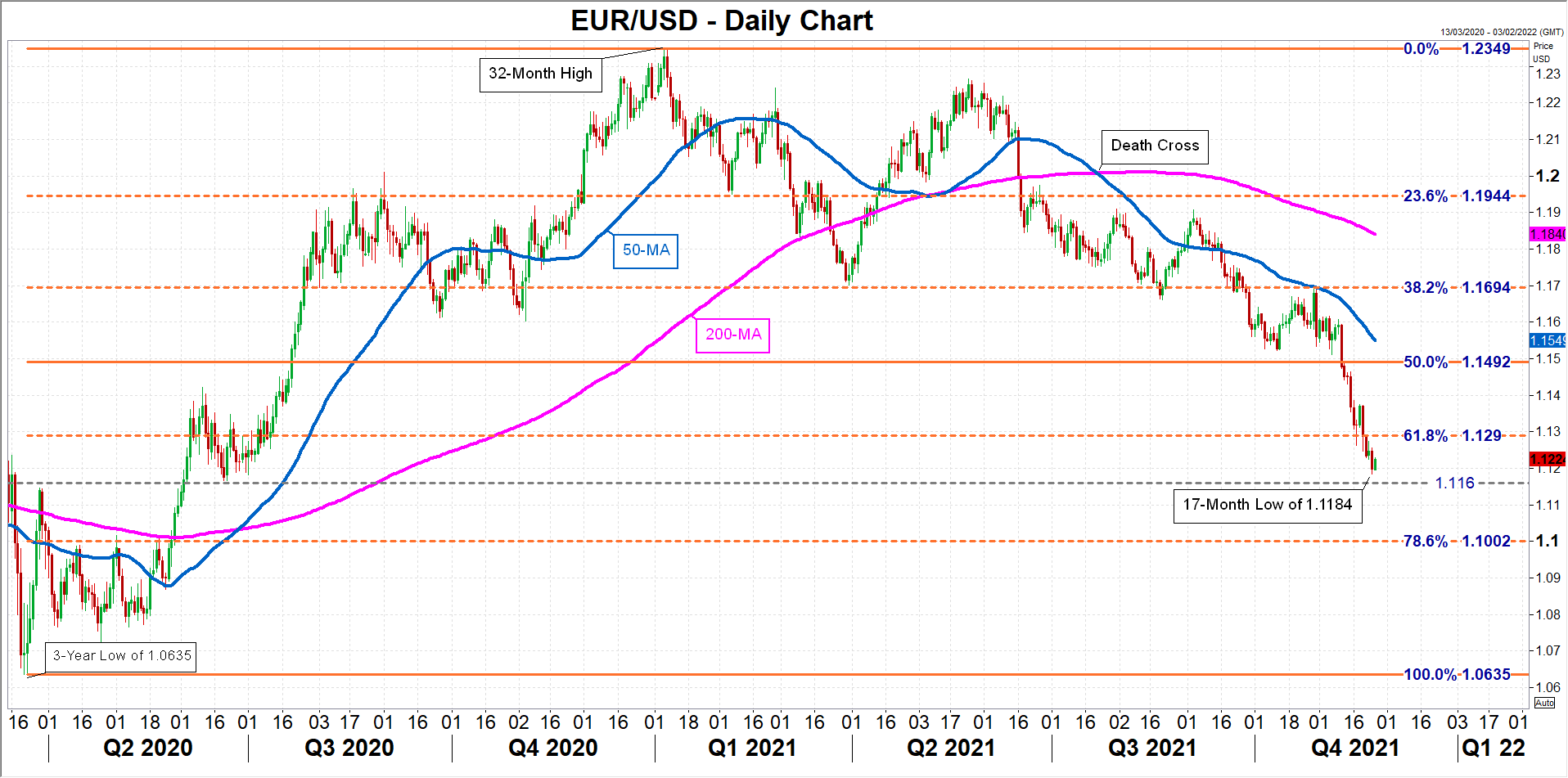
However, if sentiment doesn’t turn soon and the pair breaks below the $1.1160 support, the next test for the bears will be the 78.6% Fibonacci of $1.1002. Crashing below $1.10 would reinforce the euro’s downslide as well as open the door to revisiting the March 2020 trough $1.0635.
It’s all about the ECB
To sum up, the euro remains exposed to surprises in the economic and virus data in the short-term, meaning there’s likely to be more volatility ahead. As things stand, traders may be overlooking some of the upside risks. Ultimately though, its longer-run trend will be determined by how soon the ECB joins other central banks in signalling that rate hikes are just around the corner, and that will probably be decided by whether the jump in inflation in the Eurozone ends up being transitory like Lagarde believes.
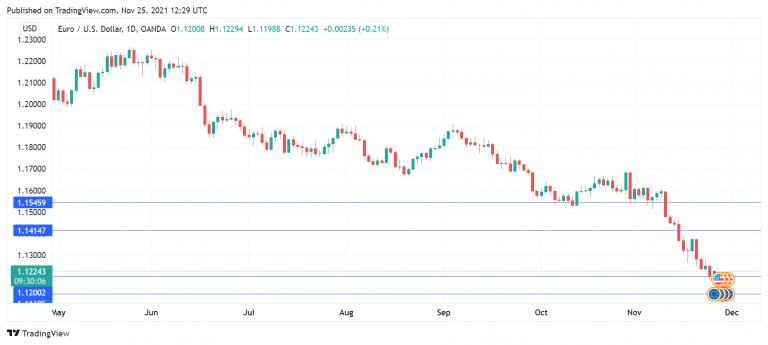
Euro Punches above 1.12
The euro has reversed directions and is back above the 1.1200 level. EUR/USD is trading at 1.1222, up 0.19% on the day.
Where is ECB policy headed? That is no easy question, as we are getting mixed messages from ECB officials. Governor Christine Lagarde has pushed back against market bets of a rate hike in late 2022. Earlier this month, Lagarde said that it was ‘very unlikely’ that the ECB would raise rates in 2022, as inflation was too low. Contrast this stance with that of ECB member Isabel Schnabel, who said this week that “risks to inflation are skewed to the upside”. It is unusual to hear a hawkish view from the dovish ECB, and the markets factored in a 0.10% rate increase in December 2022 following Schnabel’s comments.
ECB expects to end PEPP purchases in March
There is also uncertainty as to the future of the ECB pandemic bond-buying program (PEPP). The bank is expected to announce at its December meeting that it will end bond purchases at the end of March. This stance was reiterated in the ECB minutes on Thursday, which said that based on current developments, the ECB expected to wind up purchases in March.
However, on Wednesday, ECB member Robert Holzmann said that the bank could put the programme on hold rather than abolish it altogether. Holzmann’s comments could be in response to the spike in Covid cases in Germany and other euro area countries. The ECB will have to tread carefully as it assesses the economic outlook. The spike in Covid in Germany and other eurozone countries could undermine the tenuous recovery, while at the same time inflation is at its highest level since 2008 and the ECB may have to reconsider its dovish policy in order to contain inflation.
EUR/USD Technical
- 1.1201 is a weak support line. This is followed by support at 1.1118
- There is resistance at 1.1415 and 1.1546