Sample Category Title
USD/JPY Remains In Uptrend Above 114.50
Key Highlights
- USD/JPY started a major increase above the 114.00 level.
- A crucial rising channel is forming with support near 114.50 on the 4-hours chart.
- EUR/USD is stable near 1.1200, and GBP/USD is struggling to stay above 1.3300.
- Gold price started a downside correction and traded below $1,800.
USD/JPY Technical Analysis
The US Dollar started a major increase from the 112.80 zone against the Japanese Yen. USD/JPY gained pace after it broke the 113.50 resistance zone.
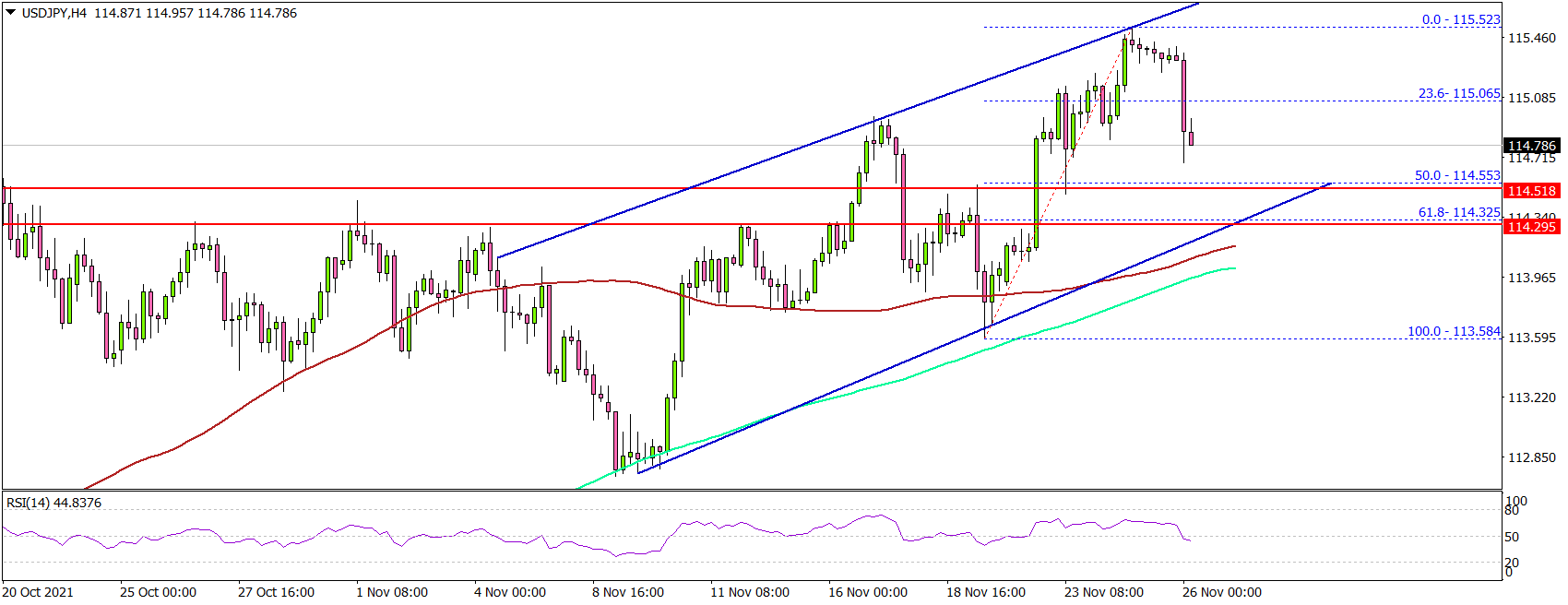
Looking at the 4-hours chart, the pair even broke the 114.00 resistance zone. There was a clear break above 114.50, the 100 simple moving average (red, 4-hours), and the 200 simple moving average (green, 4-hours).
The pair even spiked above the 115.00 level and traded to a new monthly high at 115.52. It is now correcting lower below the 115.00 level.
There was a break below the 23.6% Fib retracement level of the upward move from the 113.58 swing low to 115.52 high. The next major support is near the 114.50 level. There is also a crucial rising channel forming with support near 114.50 on the same chart.
The channel support is near the 50% Fib retracement level of the upward move from the 113.58 swing low to 115.52 high. Any more downsides might lead the price towards the 114.00 level.
On the upside, the pair is facing hurdles near 115.50. The next major resistance is near 116.20, above which the pair could rise towards the 116.80 and 117.20 levels.
Besides, EUR/USD tested the 1.1200 zone, and it is now consolidating losses. Similarly, GBP/USD is stable near the key 1.3300 support zone.
Economic Releases
- Swiss Gross Domestic Product for Q3 2021 (QoQ) – Forecast +2.0%, versus +1.8% previous.
- Swiss Gross Domestic Product for Q3 2021 (YoY) – Forecast +3.2%, versus +7.7% previous.
Market Morning Briefing: Euro Has Risen Slightly While Above 1.12
STOCKS
Amongst the equity indices mentioned below, Nikkei and Sensex have fallen sharply but we need to see if that can impact the Asia-Pac indices If not the equities globally. Nikkei is leading losses in the Asia-Pac region as fresh Covid rising cases create concerns and upon possibility that the US FED could speed up policy tightening. Dow looks stable below resistance near 29000/29500 and can dip to 28000 before rising while Dax can rise to 16000/16100/16400 before falling from there. Shanghai may trade within 3600-3550-3500 region for now. Sensex needs to break above 59000 to turn bullish.
Dow (35804.38, -9.42, -0.026%) has come down slightly. The index has support at 35500 which can hold for now and send the index up to test 36000. A strong break above 36000 is needed for the view to be bullish towards 36250/36300. Immediate view is to see trade within 35500-36000 region.
DAX (15917.98, +39.59, +0.25%) has risen. The support is seen at 15900 which can hold for now and send the index to test 16100 and 16400 eventually.
Nikkei (28779.63, -719.65, -2.44%) has fallen sharply on possibility of US FED policy tightening to speed up and fresh concerns of new Covid variant and rising cases . The Japan stocks lead the fall in the Asia-Pac region as growth stocks and travel/aviation stocks face a hit. While below 29500/29000 a further fall towards 28000 is possible before we see a bounce from there.
Shanghai (3566.87, -17.31, -0.50%) has come down but still trading above 3550. A bounce from there towards 3600 is possible. If we see a break below 3550 then a fall towards 3500 can be seen. We need to see if the fall in Nikkei impacts Shanghai or will Nikkei rise back immediately from current levels.
Nifty (17536.25, +121.20, +0.70%) has bounced from 17200 support. The interim resistance is at 17600 which if broken can take the index towards 17800. However if the resistance holds then a dip towards 17300/200 can be seen again. Overall broad range of 17200-17800 holds for now.
Sensex (58795.09,, +454.10, +0.78%) has risen yesterday. Resistance can be seen at 59000 which can drag the index towards 58000 again.
COMMODITIES
Gold has bounced slightly from support near 1780 and can head towards 1810/30 while Silver can remain narrowly ranged above 23. Copper can trade within 4.50/60-4.30/35. Crude prices have dipped and could fall towards supports near 78/77 on Brent and 75 on WTI before again moving up in the medium term.
Brent (80.86) has dipped again but fell from 83 itself without testing 84/85 as expected. While below 83, we may expect a fall back to 78/77 initially before falling deeper in the longer run. Immediate range of 83-77 looks likely within which a fall can be seen initially.
WTI (76.67) is holding below 79 and can dip to 75 before rising back from there.
Gold (1795) has risen well as support near 1780 is holding well for now. A rise to 1810/30 is possible while above 1780.
Silver (23.56) is ranged near current levels in a very narrow region and may continue so unless we see a sharp movement on either side.
Copper (4.4185) has dipped from 4.50 as expected. A range of 4.60-4.40/30 may hold for now.
FOREX
Most currencies are stable. Dollar Index has dipped slightly but can resume its uptrend again towards 97.50-98. Euro has bounced from 1.12 but if the Dollar Index breaks above 97, Euro can fall to 1.11/10 before posing a reversal from there. Aussie is bearish to 0.71/70 while Pound may hold above support at 1.33 to see a short corrective rise. EURJPY and USDCNY may remain ranged within 130-128 and 6.40-6.37. USDINR is likely to hold below 74.60/70, else a rise to 74.80/75.00 can be seen before reversing from there.
Dollar Index (96.731) has dipped from this week’s high of 96.938. While below 97, a short corrective dip to 96.25/20 can be possible before bouncing back higher to test 97.50-98.00 which would be the next crucial resistance to watch.
Euro (1.1221) has risen slightly while above 1.12. A rally in Dollar index towards 98, if seen can drag down Euro to levels below 1.12 towards 1.11/10 before posing a reversal from there in the medium term. Overall the fall could be limited to a maximum of 1.10 in the coming weeks.
EURJPY (128.69) is trading within 128-130 region and unless a break on either side is seen the range may continue to hold. We would turn bullish on the cross only on a sustained break above 130.
Aussie (0.7145) has broken below 0.72 as warned yesterday and could now head towards 0.71/0.70. View is bearish for the near term.
Pound (1.3303) may hold above 1.33 and see a corrective bounce to 1.34-1.3450 before a fall is again seen in the longer run back to 1.33 or lower. For now watch price action near 1.33.
Dollar-Yen (114.78) has not been able to break above 115.50 and instead has come off sharply from this week’s high of 115.52. While below 115.50, a dip to 114-113.50 looks possible before resuming the upward rally again. Our expected rise to 116.0-116.25 is not negated but can be delayed by some sessions.
USDCNY (6.3910) has moved up towards the upper end of the 6.40/39-6.37 range mentioned yesterday. A break above 6.40, if seen can take the pair up to 6.42 else sideways consolidations could continue between 6.40/39 and 6.37.
USDINR (74.40) has risen to 74.60 on the NDF market on the back of dip seen in the US Dollar Index. We continue to look at crucial immediate resistance near 74.60/70 which needs to hold for USDINR to come down towards 74.20/00. Failure to decline from 74.60/70 can take the pair higher towards 74.80/75.00 in the near term before the said decline is seen. Watch price action near 74.60/70 for now.
INTEREST RATES
The US Treasury yields have come down across tenors. The range resistances are holding well, and the yields can dip further within their expected sideways range. Our view of seeing a broad consolidation in the Treasury yields remains intact. The German yields have dipped slightly but need to fall further from here to avoid a rise beyond their resistances and keep our view of seeing a reversal intact. The 5Yr and 10Yr GoI continue to trade stable and can remain in a broad sideways range for some more time. The bias is bearish to see a downside break their ranges eventually.
The US 2Yr (0.61%), 5Yr (1.30%), 10Yr (1.60%) and the 30Yr (1.93%) have come-off across tenors. The resistance at 1.65%-1.68% has held well on the 10Yr. A dip below 1.6% can drag it to 1.5%-1.45%. The 30Yr has come down after testing 2% and can dip to 1.9%-1.85% now. The broader view of seeing a sideways consolidation between 1.45%-1.65% (narrow) / 1.35%-1.75% (broad) on the 10Yr and 1.75%-2.1%/2.2% on the 30Yr remains intact.
The German 2Yr (-0.76%), 5Yr (-0.58%), 10Yr (-0.25%) and 30Yr (0.09%) yields have dipped slightly. The resistances at -0.2% (10Yr) and 0.1% (30Yr) seems to be holding for now. But a further fall from here is needed to keep our view of seeing a reversal intact. As being mentioned here over the last couple of days, a strong rise past -0.2% (10Yr) and 0.10% (30Yr) will pave way for a further rise to -0.1% (10Yr) and 0.2% (30Yr) and negate our bearish view.
The Indian 10Yr GoI (6.3671%) is stuck in a narrow range of 6.36%-6.38% over the last few days. We reiterate that 6.3%-6.38% could be the range of trade and a dip to 6.34%-6.32% is possible while below 6.38%. From a bigger picture, 6.3%-6.45% will be the broader range of trade (in case if 6.38% is broken) and the bias is bearish to see a break below 6.3% and a fall to 6.2% eventually over the medium-term.
The 5Yr GoI (5.6928%) is slowly inching down within its broad 5.66%-5.75%/5.78 range. While the immediate outlook is mixed and unclear, it looks likely that the 5Yr can dip to 5.66% - the lower end of the range while it sustains below 5.7%.
Eco Data 11/26/21
[php_everywhere instance="1"]
Euro Goes into Freefall; Have Investors Become Too Pessimistic?
The euro’s woes just keep getting worse and worse. The single currency has ploughed more than one-year lows against the US dollar and pound, and six-year lows versus the Swiss franc. Expectations of diverging monetary policies had been weighing for some time, but now there are fresh doubts about the growth outlook that also have investors worried. The resurgence of virus cases in many parts of Europe has caught markets by surprise, endangering the euro bloc’s already fragile recovery. But is the bearish sentiment overdone, and are investors overlooking the risk of infections elsewhere following in a similar direction?
Last in the normalization race
The Eurozone economy has been making solid progress in recovering from the pandemic during 2021, yet the euro has been steadily declining against most of its main peers. The primary explanation behind the euro’s underperformance is simple. With other major economies also either on or past the road to recovery, their central banks are making plans or have already begun to normalize monetary policy after an extraordinary period of unprecedented stimulus.
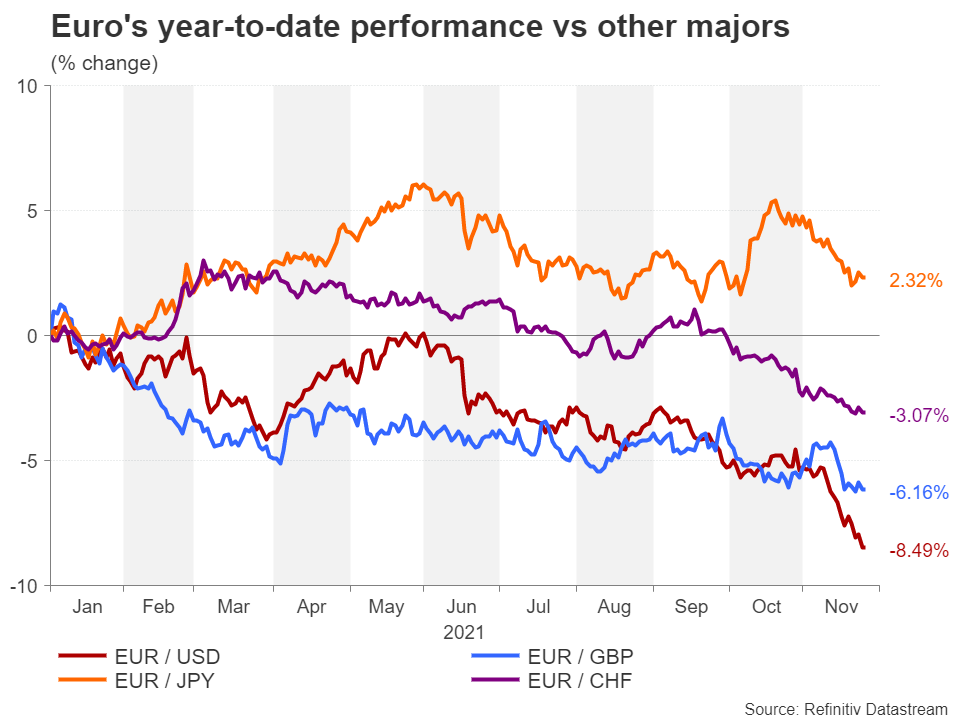
The Federal Reserve recently joined the Bank of Canada and Reserve Bank of Australia in tapering its monthly asset purchases, the Bank of England could hike rates next month, while the Reserve Bank of New Zealand just raised its cash rate for the second time since the pandemic. Although it’s true that the European Central Bank has also slowed its bond purchases and will end its emergency QE in March 2022, it still has its regular asset purchase programme (APP) that has been running concurrently throughout the virus crisis. It is widely expected that the ECB will not only keep APP active for the foreseeable future but may beef it up slightly to partially compensate for the conclusion of the emergency purchases.
More crucially, the ECB is nowhere near lifting its benchmark lending rates, surpassed only by the Bank of Japan when it comes to a delayed liftoff. These expectations have been gradually taking shape during the course of the year, dragging euro crosses lower, but the bearish outlook got additional thumbs ups lately.
A double blow for the euro
First, ECB chief Christine Lagarde doubled down on the Bank’s dovish stance, warning against premature tightening. Lagarde is fast becoming the odd one out amongst central bankers who has yet to deviate from the notion that the current spike in inflation is temporary even as most of her fellow policymakers adopt a more precautionary approach.
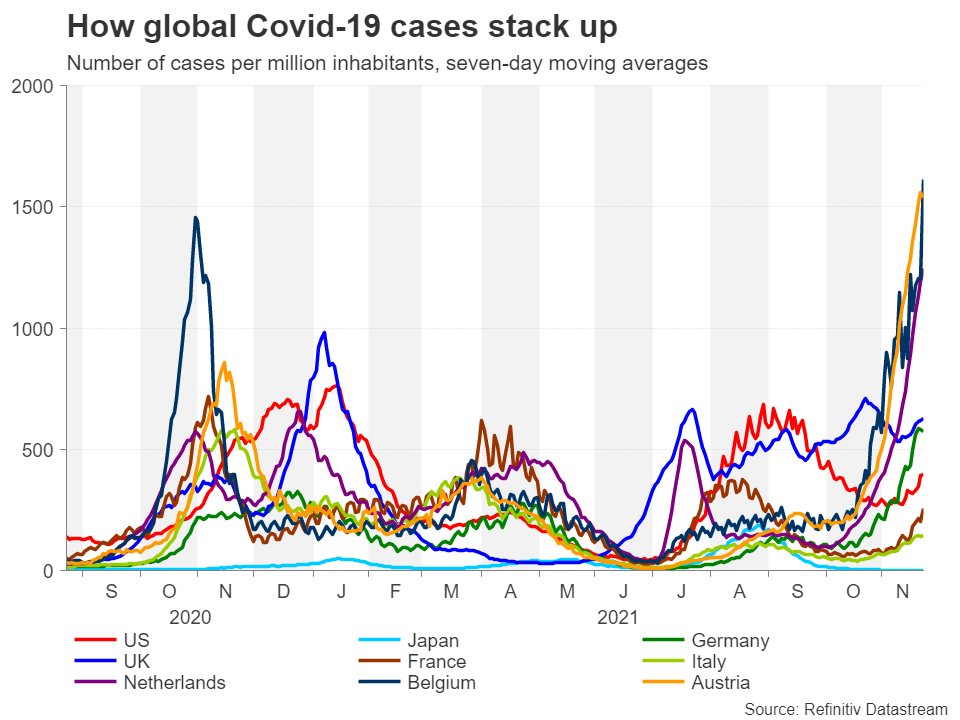
Second, infections of Covid-19 are rising rapidly in many parts of Europe. Several countries have recently announced the re-imposition of some restrictions, with many targeted at unvaccinated people. But some nations have gone into a partial or full lockdown. With winter only just starting, the virus picture could get a lot worse before it gets better. Although, as seen from subsequent lockdowns, businesses and consumers have learnt to adjust to the unfolding virus situation, the latest measures are nevertheless expected to take a toll on economic activity over the coming months.
The weaker growth outlook can only mean that there will be even less urgency for the ECB to raise rates in the next year. And despite the fact that money markets continue to price in a 10-basis point rate hike, currency traders aren’t too convinced. Even if the ECB were to put up rates, it would still be a paltry increase compared to the tightening anticipated by other central banks.
The return of lockdowns
Until now, lockdowns in a post-vaccinated world were something that had not been factored in by investors and this might be why the euro’s latest selloff has been so dramatic. After all, countries such as Britain had led the way in proving that it is possible to keep Covid deaths low while lifting almost all social distancing rules. So why are some European nations with stricter curbs than the UK being inundated with a surge in hospitalizations due to Covid?
There is some evidence that suggests that the AstraZeneca jab, which accounts for most of the UK’s vaccine doses, provides better protection for the elderly. Another possibility is that there is greater herd immunity in Britain due to higher previous infections, in particular, the Delta variant spread there much early on than in the rest of Europe.
Will the US be next?
But what about the United States, could it be next in seeing a re-escalation of virus cases? New daily cases and hospitalization rates have begun to creep up and even though America’s booster program has gotten off to a decent start, it lags the UK’s rollout. There is risk that markets have become complacent against the persisting threat of the virus ever since vaccines came into the picture.
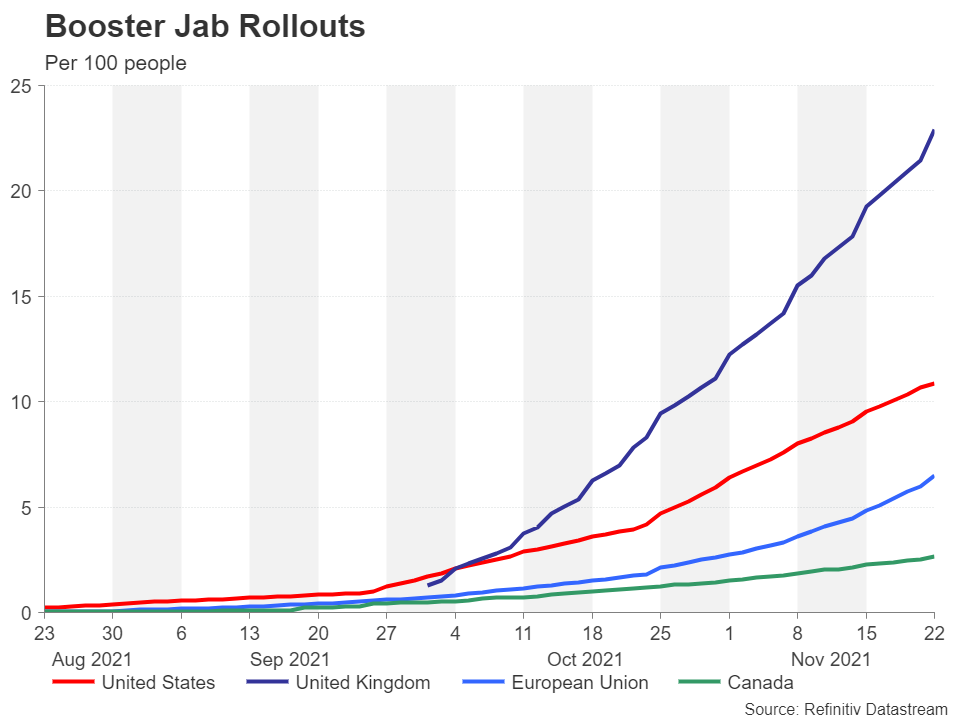
Whilst it’s not very likely that there would be renewed lockdowns in the US, some toughening in restrictions cannot be ruled in the winter months. Furthermore, as observed from previous virus waves, it only takes a blowup in infection levels for consumers to stay at home.
Part of the euro’s downward drive is down to the recent improved optimism for the American economy as the latest indicators suggest growth picked up at the start of the fourth quarter. Should this optimism come into question, the US dollar might lose some of its shine, boosting struggling currencies like the euro.
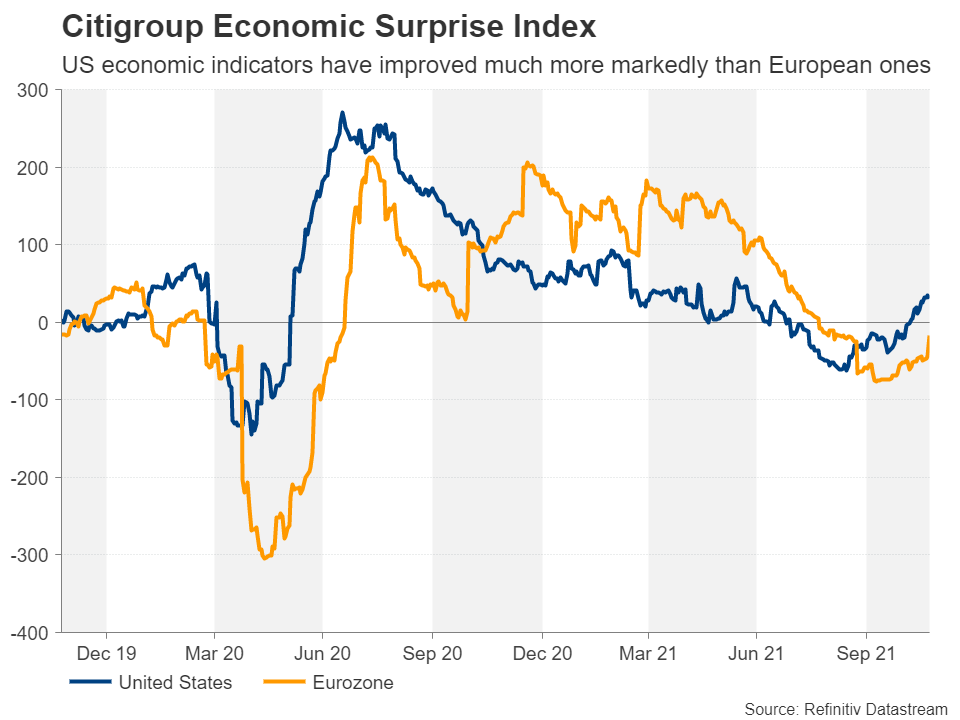
Too pessimistic?
Another upside risk for the beleaguered single currency is the assumption that growth will be hit hard by the current wave of measures. But with so much pessimism priced in, there’s a good chance Europe’s economies will weather this storm much better than what markets expect.
It’s also worth pointing out that large speculative investors are not overly bearish on the euro. According to CFTC data, speculators have cut their euro long positions substantially this year but were only just net short as of November 19.
Technical indicators on the other hand, imply that the euro is oversold, at least against the US dollar. Should buyers step in, the 61.8% Fibonacci retracement of the March 2020-January 2021 uptrend will be the first critical test at $1.1290 followed by the 50% Fibonacci of $1.1492. Overcoming the latter would also help euro/dollar reclaim its 50-day moving average, which is required for eliminating the selling pressure.
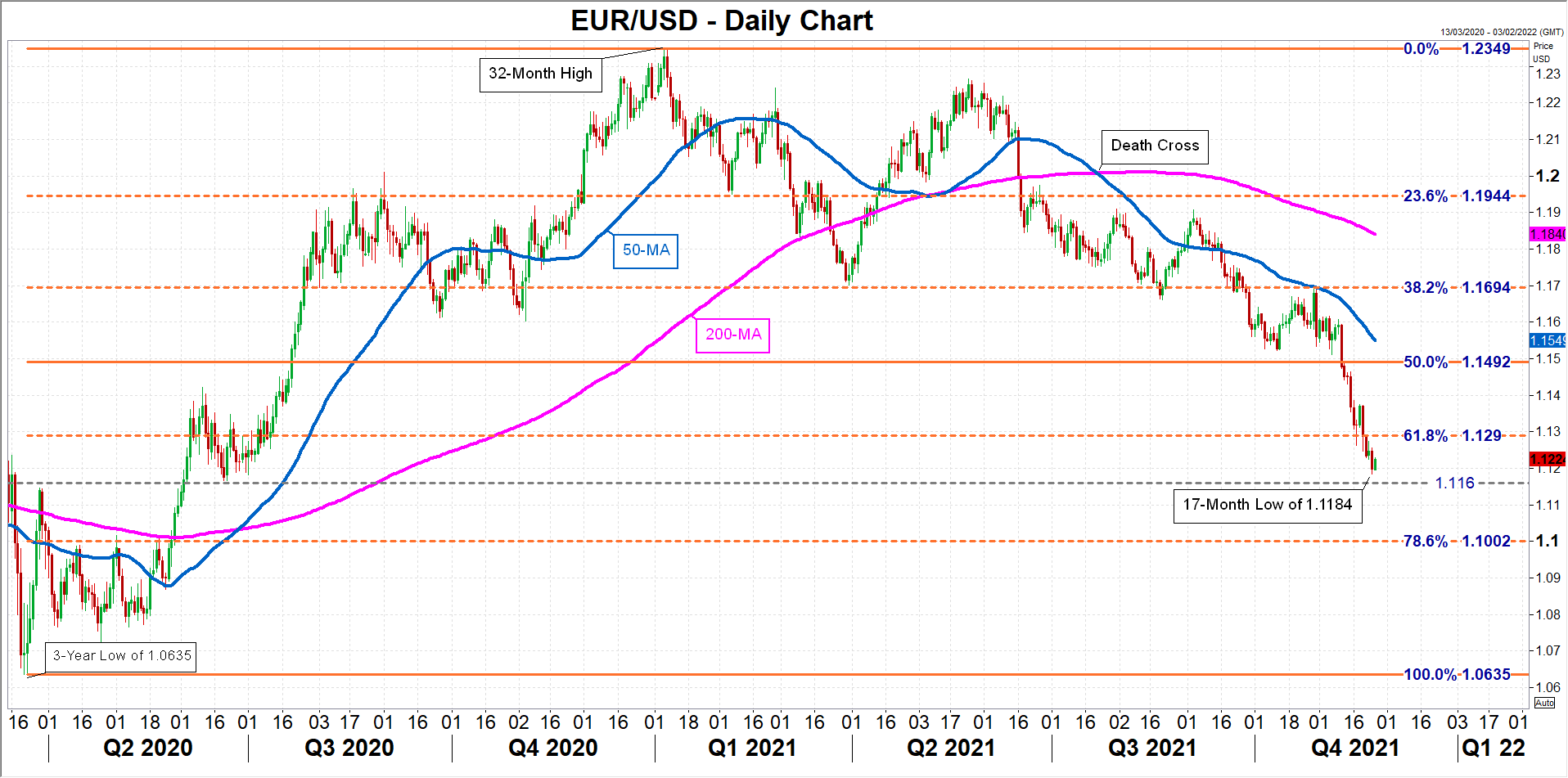
However, if sentiment doesn’t turn soon and the pair breaks below the $1.1160 support, the next test for the bears will be the 78.6% Fibonacci of $1.1002. Crashing below $1.10 would reinforce the euro’s downslide as well as open the door to revisiting the March 2020 trough $1.0635.
It’s all about the ECB
To sum up, the euro remains exposed to surprises in the economic and virus data in the short-term, meaning there’s likely to be more volatility ahead. As things stand, traders may be overlooking some of the upside risks. Ultimately though, its longer-run trend will be determined by how soon the ECB joins other central banks in signalling that rate hikes are just around the corner, and that will probably be decided by whether the jump in inflation in the Eurozone ends up being transitory like Lagarde believes.
Euro Punches above 1.12
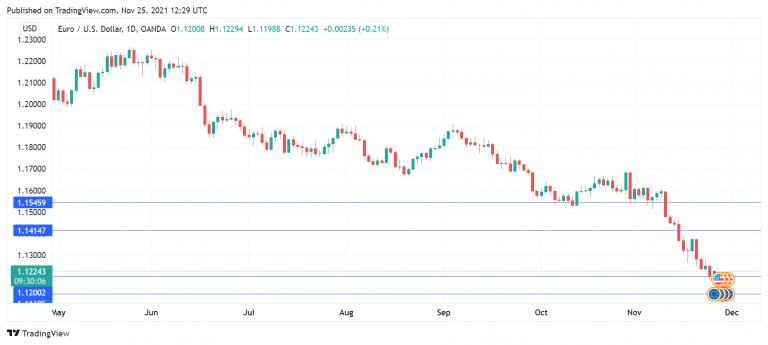
The euro has reversed directions and is back above the 1.1200 level. EUR/USD is trading at 1.1222, up 0.19% on the day.
Where is ECB policy headed? That is no easy question, as we are getting mixed messages from ECB officials. Governor Christine Lagarde has pushed back against market bets of a rate hike in late 2022. Earlier this month, Lagarde said that it was ‘very unlikely’ that the ECB would raise rates in 2022, as inflation was too low. Contrast this stance with that of ECB member Isabel Schnabel, who said this week that “risks to inflation are skewed to the upside”. It is unusual to hear a hawkish view from the dovish ECB, and the markets factored in a 0.10% rate increase in December 2022 following Schnabel’s comments.
ECB expects to end PEPP purchases in March
There is also uncertainty as to the future of the ECB pandemic bond-buying program (PEPP). The bank is expected to announce at its December meeting that it will end bond purchases at the end of March. This stance was reiterated in the ECB minutes on Thursday, which said that based on current developments, the ECB expected to wind up purchases in March.
However, on Wednesday, ECB member Robert Holzmann said that the bank could put the programme on hold rather than abolish it altogether. Holzmann’s comments could be in response to the spike in Covid cases in Germany and other euro area countries. The ECB will have to tread carefully as it assesses the economic outlook. The spike in Covid in Germany and other eurozone countries could undermine the tenuous recovery, while at the same time inflation is at its highest level since 2008 and the ECB may have to reconsider its dovish policy in order to contain inflation.
EUR/USD Technical
- 1.1201 is a weak support line. This is followed by support at 1.1118
- There is resistance at 1.1415 and 1.1546
ECB accounts: Increase in inflation an opportunity to re-anchor inflation expectations
In the accounts of the ECB's October 27-28 meeting, it's noted, "since the monetary policy space was constrained by the effective lower bound on interest rates, the increase in the inflation rate was seen as an opportunity to re-anchor inflation expectations solidly at the Governing Council's 2% target over the medium term."
Also, "a continued accommodative monetary policy stance would also be in line with the Governing Council's new monetary policy strategy, which called for policy to be persistent when interest rates were at the lower bound and explicitly allowed for inflation to moderately exceed the target for a transitory period".
Meanwhile, "some of the upside risks to the September 2021 staff projections had materialised and that the recent uptick in inflation was expected to be more persistent than previously anticipated."
(ECB) Monetary policy accounts 27-28 October 2021
Account of the monetary policy meeting of the Governing Council of the European Central Bank held in Frankfurt am Main on Wednesday and Thursday, 27-28 October 2021
1. Review of financial, economic and monetary developments and policy options
Financial market developments
Ms Schnabel reviewed the financial market developments since the Governing Council's previous monetary policy meeting on 8-9 September 2021.
Market-based measures of inflation compensation in the euro area had surged to their highest levels in over seven years, pushing long-term nominal sovereign bond yields back to levels seen earlier in the year. In the euro area, ten-year inflation swap rates were more than 30 basis points higher than in September 2021 and a full percentage point higher than in December 2020, when the Governing Council had pledged to preserve favourable financing conditions. The five-year forward inflation-linked swap rate five years ahead had, for the first time in more than seven years, risen above the ECB's target of 2%. By contrast, ten-year real rates had fallen further. They were now almost 50 basis points below their December 2020 levels.
This pattern of yield changes suggested that rising long-term rates were not primarily the result of adverse spillovers, which would typically have manifested themselves in rising real rates. Rather they were seen as a reappraisal of the global inflation outlook, mainly reflecting the repercussions of the global energy shock and growing evidence of more persistent supply-side bottlenecks. While at short to medium-term horizons most of the increase in inflation compensation reflected higher genuine inflation expectations, at longer horizons the increase mostly reflected higher inflation risk premia. The fact that long-term inflation risk premia had increased so strongly in previous weeks suggested that market participants were increasingly worried about inflation outcomes above – rather than below – expected inflation, even once the prevailing shocks were expected to fade. Exceptionally high uncertainty surrounding the nature and structure of the post-pandemic global economy was likely to have contributed to rising risk premia.
Although markets had significantly repriced both the baseline inflation outlook and the risks around it, there was no evidence that changes in expectations about asset purchases – either in the euro area or globally – had affected euro area sovereign bond yields. Contrary to developments in the spring, the spread between the ten-year German Bund and overnight index swaps (OIS) had remained highly resilient over recent weeks. Spreads between euro area sovereign bonds and the Bund had also remained resilient and, since the September monetary policy meeting, had even continued to fall to new post-2008 lows in most countries.
Developments in euro area credit and stock markets suggested that higher nominal long-term yields and the prevailing supply shocks were not expected to derail the recovery. Investment grade corporate bond spreads remained close to record low levels. Even though higher yields had weighed on euro area equity markets in previous weeks, the downward pressure had been fully offset by further upgrades of firms' longer-term earnings expectations and a diminishing equity risk premium.
Short-term and money market rates had risen in the euro area but by significantly less than in other major economies. The time of a rate lift-off had been brought forward from mid-2024 to late 2022. Since a non-negligible part of the recent rise in short and long-term rates reflected term premia, the actual time of lift-off priced by investors was likely to be later. This was consistent with the reading of survey-based expectations. Although the latest survey of monetary analysts also pointed to respondents anticipating an earlier lift-off, a first rate hike was only expected in the second quarter of 2024.
Option-implied probabilities for the expected path of short-term interest rates pointed to a significant widening of the distribution of possible future outcomes, which was now clearly skewed to the upside. Such an increase in uncertainty was to be expected when the market attached an increasing probability to expected inflation meeting the conditions for lift-off.
Medium-term inflation expectations, as proxied by the one-year swap rate three years ahead, had stood at 1.99% the day before the Governing Council meeting – their highest level since early 2013. Over the next five years, inflation was expected to be visibly above the Governing Council's target of 2% on average. The rise in measures of inflation compensation had been consistent with a marked shift in the distribution of expected inflation outcomes, as priced in by inflation options markets. The market was now putting the lowest weight on inflation being below 1% over the next five years within the available data sample, which started in 2010, and the highest weight on inflation being above 2% in more than a decade, i.e. a weight of more than 50%.
Conditional on the future path of inflation as embedded at present in inflation swap rates, current market pricing could therefore be consistent with the ECB's state-contingent forward guidance. That the forward guidance remained credible was also supported by the behaviour of forward OIS rates. These continued to react less sensitively to expected inflation than before the pandemic, even if the sensitivity had increased somewhat in previous weeks owing to the strong acceleration in measures of inflation compensation. With short-term nominal rates less sensitive to inflation, the real yield curve in the euro area had fallen to unprecedented levels, while the euro continued to depreciate against the US dollar as expected policy rate differentials widened further. For the first time since the start of the pandemic, investors were no longer holding net euro long positions, implying that they did not expect the euro to reverse recent losses in the near term. Thus, continued policy divergence remained the central scenario for investors, even as markets had brought forward lift-off expectations in response to growing expectations that prevailing inflationary pressures would ultimately prove more persistent than previously anticipated.
The global environment and economic and monetary developments in the euro area
Mr Lane reviewed the global environment and the recent economic and monetary developments in the euro area.
Regarding the external environment, global activity was still in a solid expansionary phase, with the global composite output Purchasing Managers' Index (PMI) remaining above 50 in September. However, there was some natural deceleration compared with the most intense reopening phase a few months earlier. World trade had initially shown a strong recovery to well above pre-pandemic levels but had flatlined since March. The impact of bottlenecks – visible in suppliers' delivery times and the ratio of new orders to inventories – on global exports and industrial production was estimated to have increased lately.
Since the Governing Council's September monetary policy meeting, the euro had declined significantly in both nominal effective terms (-1%) and against the US dollar (-1.9%). Oil prices had increased sharply (+17% in US dollar terms), reflecting both demand and supply effects. The oil price futures curve stood at levels that were much higher than foreseen in the September ECB staff macroeconomic projections, also for 2022 and 2023. Gas prices had increased even more strongly than oil prices over previous months, reflecting both strong global demand related to the economic recovery and supply-side effects.
As at the global level, the euro area outlook was clouded by supply bottlenecks and input price pressures. Industrial production had been fluctuating around the level of pre-pandemic activity, declining again to some extent in August. PMI indicators for manufacturing and services were standing firmly above 50. In particular, PMI data for accommodation and for food and beverages pointed to a significant recovery throughout the third quarter. Nevertheless, there was some variation across industrial sectors. The automotive sector, in particular, was severely affected by semiconductor shortages, also in the context of adjustments in production processes towards electric vehicles.
Looking more closely at manufacturing, supply bottlenecks, together with the rapid recovery in demand, had led to a significant decline in inventories. At the same time, deliveries had slowed. The ECB's Corporate Telephone Survey indicated that well over half the respondents expected supply constraints and high input price pressures to last for at least six more months. A large number of respondents expected the supply constraints and elevated input prices to last even for another full year or longer.
As regards investment, housing investment growth likely moderated in the third quarter of 2021 owing mainly to tightening supply constraints, such as labour and material shortages, in an environment of strong demand. Business investment growth was expected to have remained in positive territory in the third quarter but not to have performed as strongly as previously envisaged on account of supply-side disruptions. Lately, also the PMI for new orders of capital goods, which was still at quite a high level, had been declining.
Turning to trade, the recovery continued at two speeds, with goods exports subdued and services trade rebounding somewhat. The historically large discrepancy between buoyant export orders and weak export volumes illustrated the impact of supply bottlenecks on exports. This shortfall was higher for the euro area than for the rest of the world, as euro area exports required relatively complex supply chains. Services exports had started to recover in the summer and indicators continued to signal a slight rebound.
Regarding labour market developments, the unemployment rate stood at 7.5% in August, similar to the pre-pandemic period. Nevertheless, a significant number of people were still in job retention schemes and the labour participation rate remained well below the pre-pandemic level. Thus, overall, the labour market continued to be weaker than before the pandemic. The PMI composite indicator for employment suggested further strong growth in the third quarter of 2021, with signs of stabilisation in September and October. The job vacancy rate for the total economy had risen in the second quarter of 2021 to the same level as in the corresponding quarter of 2019.
Turning to nominal developments, headline inflation in the Harmonised Index of Consumer Prices (HICP) had increased from 2.2% in July to 3.0% in August and to 3.4% in September. A longer-term perspective revealed that inflation was currently extraordinarily high, with large contributions from energy and goods inflation. Goods inflation was currently much higher than its long-term average of 0.6%, while services inflation could be seen as normalising. Oil price developments and their direct impact on fuel prices had been the main factor in the energy price surge. However, more recently, energy inflation had been driven also by strong upward movements in gas and electricity prices. Services inflation had increased to 1.7% in September with the reopening of the economy, while non-energy industrial goods inflation had eased to 2.1%.
Most indicators of underlying inflation had increased. Prices in contact-intensive sectors continued to drive the current pick-up in the HICP excluding food and energy (HICPX), as demand was returning to those sectors most hit by the pandemic with an upward short-term effect on prices. The model-based Persistent and Common Component of Inflation (PCCI), which was less affected by temporary factors, stood at 1.6% in September, while Supercore, which included only the cyclically sensitive components of the HICPX, had increased from 1.3% in August to 1.6% in September.
Turning to pipeline pressures, producer prices had continued to rise very dynamically. Increases in producer prices were expected to lead to continuing upward pressure on consumer prices for non-energy industrial goods. Growth in negotiated wages had remained low of late, and it remained uncertain whether the upward impact of recent increases in consumer price inflation would pass through to wages. Evidence from the latest Corporate Telephone Survey indicated that a majority of the respondent firms expected wages to rise somewhat more strongly in 2022 than they did in 2021. That wage growth had so far remained muted was a very important element of the overall inflation dynamics for the medium term.
PMI input and output price developments indicated that profit margins continued to be under pressure, and increasingly so in services. Input prices were currently outpacing output prices, not only in intermediate goods industries but also in consumer goods industries and services.
Turning to housing costs, the ECB's residential property price index had increased strongly, by 7.3%, year on year, while the experimental owner-occupied housing price index had also increased strongly, by 4.5%, year on year in the second quarter of 2021. Overall, the costs of owning a house were growing considerably more strongly than the costs of renting a house, which had increased by around 1.3% in the second quarter of 2021.
Longer-term survey-based indicators of inflation expectations and market-based measures of inflation compensation had ticked up, moving closer to 2%. In the latest ECB Survey of Professional Forecasters, five-year ahead inflation expectations had been revised up from 1.8% to 1.9%. Fewer respondents were expecting very low inflation and more respondents were expecting rates of between 1.8% and 2.0%.
Turning to financial and monetary developments, nominal risk-free rates stood markedly higher than at the time of the September monetary policy meeting. Sovereign bond spreads were slightly narrower. Corporate bond spreads had narrowed in view of a positive credit outlook. With risk-free interest rates going up and spreads stable or slightly narrower, there was evidence of an overall tightening of nominal financing conditions. After some volatility, equity prices were at a level similar to at the time of the September meeting.
With respect to monetary developments, lending to firms had remained moderate but had seen an uptick in September. This was consistent with the slight net increase in loan demand reported by banks in the October round of the bank lending survey. Fixed investment had made a positive contribution to loan demand for the second consecutive quarter, which was a positive sign for the economic recovery. Firms' borrowing costs remained below the levels seen at the start of the pandemic and were still insulated from the upward trend in risk-free rates.
Lending to households remained strong, with annual growth in loans much higher than in the period after the 2007-08 Great Financial Crisis, supported by dynamic lending for house purchase. The borrowing costs of households for house purchase remained substantially below their level at the start of the pandemic, as did borrowing costs for consumer lending.
Following sharper net tightening earlier in the pandemic, the latest round of the bank lending survey showed that credit standards for loans to firms remained broadly unchanged in the third quarter of 2021, for the second consecutive quarter. Despite the supply bottlenecks, banks maintained a balanced view of their credit risks, in line with the economic recovery and continued support from the authorities.
Focusing on developments in money creation, the annual growth rate of M3 had stood at 7.4% in September, after 7.9% in August. Monthly household deposit flows had returned to their pre-pandemic average, reflecting the recovery in consumer confidence and spending. By contrast, corporate deposit flows remained strong and above the pre-pandemic average, pointing to a further strengthening of liquidity buffers.
On fiscal policies there was only limited news. The fiscal tightening in 2022 was likely to be less pronounced than had been assumed in the September ECB staff projections, as some new fiscal measures had already been announced and the latest draft budgetary plans indicated a more expansionary fiscal stance. Looking further ahead, budget balances in 2023 were expected to still be more negative than prior to the pandemic in most countries.
Monetary policy considerations and policy options
Summing up, Mr Lane remarked that the euro area economy continued to recover, although momentum had moderated to some extent. The impact of the pandemic on economic activity had declined, with the gradual lifting of restrictions supporting consumer spending, especially on those services most affected by lockdowns – such as tourism and hospitality. The manufacturing sector continued to expand, but at a slower pace owing to ongoing supply chain disruptions. This could be seen in the hard data: industrial production had fallen by 1.6% in August and was 1.2% lower than at the start of the pandemic. It was also visible in the PMI manufacturing output index, which had declined from 55.6 in September to 53.2 in October – a 16-month low. Shortages in the supply of labour, materials and equipment were clouding the outlook for the coming quarters. After the rapid rebound in the earlier stages of reopening, the rate of expansion in the PMI services component had moderated. Accordingly, while the composite PMI for the euro area remained firmly in expansionary territory it had slowed markedly, falling from 59.0 in August to 56.2 in September and subsequently to 54.3 in October – a six-month low.
HICP inflation had increased from 3.0% in August to 3.4% in September. In September energy inflation accounted for about half of overall inflation. Inflation had continued to surprise to the upside, driven by three broad – and intertwined – factors associated with the current energy price shock and the reopening of the economy. First, the surge in energy prices reflected both supply-side and demand-side developments. Part of the increase in gas and electricity prices reflected spillovers from global developments. However, the rise in European gas prices had outpaced global price movements on account of Europe-specific factors, such as the substitution of gas for other fuels, low inventories and higher carbon prices. Second, the recovery in demand linked to the reopening of the economy, combined with pandemic-related factors and global supply-side impediments, was putting upward pressure on prices. These dynamics were especially visible in relation to consumer services and those goods most affected by global supply shortages.
Higher demand for services and supply frictions were pushing up HICPX inflation, which had risen from 1.6% in August to 1.9% in September. Similarly, pipeline price pressures continued to build up for a wide range of goods and had become more visible at later stages of the pricing chain. Accordingly, non-energy industrial goods inflation had stood at 2.1% in September, well above its long-term average. Third, special factors associated with the pandemic – namely base effects related to the drop in oil prices last year and the end of the temporary VAT cut in Germany – were still contributing to higher inflation.
Headline inflation appeared likely to rise further during the year and to peak in the fourth quarter. Although inflation would take longer to decline than previously expected, it was foreseen to diminish in the course of 2022 as the influence of these three factors driving near-term inflation developments eased or fell out of the year-on-year inflation calculation. Looking further ahead, a tightening in the labour market should push up wages, supporting a gradual increase in underlying inflation pressures. However, Mr Lane mentioned that inflation was still expected to fall below the ECB's target in the medium term. That said, the duration of the supply shortages and higher energy prices remained uncertain, constituting a source of upside risk to the near-term inflation outlook. Measures of longer-term inflation expectations had moved closer to 2%, although these generally remained below the target, especially on a risk-adjusted basis.
The recovery continued to depend on the course of the pandemic and further progress with vaccination campaigns. The risks to the economic outlook were still seen as broadly balanced. A faster than anticipated drawdown of accumulated savings for investment and consumption still constituted an upside risk. However, a prolongation of supply chain disruptions could slow down the recovery, while persistently high energy prices could hamper economic activity and dent disposable income, thereby weighing on consumption and investment. In particular, if these factors persisted for longer than expected, the upward shift in the price level could feed through into higher than anticipated wage increases. The latest data still pointed to extensive labour market slack, and wage dynamics remained subdued. Moreover, the negative terms-of-trade shock generated by the surge in energy prices was also denting profitability, reducing the scope for granting wage increases. In monitoring wage developments, it would be essential to differentiate between, on the one hand, wage adjustments that were simply a response to the unexpectedly high current inflation rate or a shift in the expected level of inflation towards the target and, on the other hand, a self-reinforcing process whereby employers accommodated demands for higher pay in expectation of persistent excess inflation in the future.
While financing conditions for firms, households and the public sector remained supportive in broad terms, market interest rates had increased markedly since the September meeting. The increase in longer-term yields had outstripped the improvement in longer-term inflation expectations, as captured by the surveys of professional forecasters and monetary analysts, as well as by risk-adjusted market-based measures of inflation compensation. Similarly, the significant increase in term premia could be related to a shift in inflation risk premia. Over time, a persistent increase in market interest rates would feed into a tightening of financing conditions. Euro area sovereign spreads remained stable, with no indication of a weakening in the transmission from risk-free to sovereign debt markets. Market-based and bank-based financing conditions for firms and households currently remained at supportive levels, despite a slight increase in bank and corporate bond yields. The euro had depreciated noticeably against the US dollar, reflecting expectations of relatively tighter monetary policy in the United States.
Overall, the latest developments broadly confirmed the previous assessment made at the September meeting, suggesting no change to the pace of purchases under the pandemic emergency purchase programme (PEPP). Accordingly, Mr Lane proposed continuing to conduct net asset purchases under the PEPP at a moderately lower pace during the final quarter of the year than the previous two quarters.
Some indicators of market expectations for the future path of the short-term money market interest rate were difficult to reconcile with the ECB's forward guidance on its policy rates. The increase in near-term rates likely reflected higher compensation for bearing a perceived increase in inflation risk, while some market participants might also put more weight on the likelihood of the lift-off conditions being met earlier than envisaged in the ECB staff's assessment. However, current market pricing may have also reflected, in part, an incomplete understanding of the three conditions laid out in the Governing Council's forward guidance that had to be satisfied before lifting the policy rates, especially in view of the ECB staff's assessment that inflation would decline over the course of next year and that inflation was foreseen to settle below the target over the projection horizon.
2. Governing Council's discussion and monetary policy decisions
Economic, monetary and financial analyses
With regard to the economic analysis, members generally agreed with the assessment of the current economic situation in the euro area and the risks to the outlook provided by Mr Lane in his introduction. The euro area economy continued to recover strongly, although momentum had moderated to some extent. Consumers continued to be confident and their spending remained strong. But shortages of materials, equipment and labour were holding back production in some sectors. Inflation was rising, primarily because of the surge in energy prices but also as the recovery in demand was outpacing constrained supply. Inflation was expected to rise further in the near term but to decline in the course of next year.
As regards the external environment, members shared the assessment provided by Mr Lane in his introduction: the bigger picture was still that of a solid global recovery although with some slowing of momentum. While some deceleration was natural, some was connected to the persistence of bottlenecks and supply constraints. Reference was made to increased congestion in ports. The outlook for global oil and gas markets remained surrounded by uncertainty. It was underlined that rising prices were reflecting a confluence of factors related to demand, supply and inventories. It was argued that capacity bottlenecks in energy supply might be longer lasting if the green energy agenda reduced incentives for exploring and maintaining oil extraction. Some concern was also expressed more generally about uncertainties related to the global economic outlook and the implications this would have for euro area foreign demand.
Turning to euro area developments, the economy had continued to grow strongly in the third quarter of 2021. While momentum had moderated to some extent, output was still expected to exceed its pre-pandemic level by the end of the year. The lifting of pandemic restrictions was supporting consumer spending, although higher energy prices might reduce purchasing power in the months to come. At the same time, the labour market continued to improve, supporting the prospect of higher incomes and increased spending. The recovery in domestic and global demand was supporting production and business investment, although various shortages and cost pressures were clouding the outlook for the coming quarters. It was argued that the December 2021 Eurosystem staff projections were likely to see a downward revision to real GDP growth for 2021, given the latest evidence for some euro area countries. Yet this might just be part of a change in the profile over time, with lower growth in the second half of 2021 but higher growth in 2022. It was suggested that, looking beyond certain temporary setbacks, the losses caused by the pandemic had largely been reversed. Accordingly, the focus should shift towards more normal business cycle dynamics and a longer-term perspective.
Members widely acknowledged that supply bottlenecks were lasting longer than initially thought. This was also the view emerging from contacts with firms in the ECB's Corporate Telephone Survey. At the same time, it appeared that there were differences between countries concerning the degree to which bottlenecks were affecting the economy. Firms operating in integrated value chains were likely to be more affected than others. It was observed that this went hand in hand with a strong reliance on "just-in-time" delivery systems, raising the question of whether future systems would return to relying more on inventories and buffers. It was also suggested that, as a result of current experiences, there could be some reversal of the past globalisation of manufacturing. The point was made that the bottlenecks not only reflected the reopening of the economy but also structural forces, with the shift to electric vehicles in car manufacturing being an example. Overall, however, it was stressed that supply bottlenecks would gradually fade away as supply reconnected with demand, even though this was taking longer than expected.
Members assessed the risks to the economic outlook as broadly balanced. Supply bottlenecks and rising energy prices were considered the main near-term risks to the pace of the recovery and the outlook for inflation. If supply shortages and higher energy prices lasted longer, these could slow down the recovery. At the same time, if persistent bottlenecks were to feed through into higher than anticipated wage rises, or if the economy returned more quickly to full capacity, price pressures could become stronger. However, economic activity could outperform expectations if consumers became more confident and saved less than currently expected. More generally, the recovery continued to depend on the course of the pandemic and further progress with vaccination campaigns.
In their exchange of views, members discussed the notion of "stagflation" in relation to risks to the economic outlook. It was recalled that a terms-of-trade shock – as implied by the rise in energy prices – normally came with upward impacts on inflation but downward impacts on economic growth, via lower real disposable income and higher costs. With the economy just coming out of the pandemic crisis, the negative terms-of-trade shock was also seen as increasing the likelihood of "scarring effects" that could hamper future growth. At the same time, it was cautioned that temporary movements in prices and output in different directions should not be labelled as stagflation. It was quite normal for the latter stages of a recovery to be accompanied by lower growth, and most of the recent upward pressure on prices was coming from base effects. It was stressed that the current outlook clearly lacked the stagnation element. Growth momentum was declining, but within a still strong recovery and with robust rates of growth in activity – well above potential growth. Reference was made to the unprecedented wedge between industrial orders and industrial production, which suggested significant potential for a rebound once the supply problems receded, limiting the likelihood of stagflation. Stock markets pricing in higher and rising earnings was also seen as a factor that did not square with stagflation. The same held with regard to the support from fiscal and monetary policy and anchored inflation expectations. In this context, it was recalled that stagflation experiences in the 1970s occurred in a different environment, in which indexation allowed wages to react to energy prices and thus sustained both stagnation and inflation.
With regard to price developments, members broadly agreed with the assessment presented by Mr Lane in his introduction. Inflation had increased to 3.4% in September and was expected to rise further in 2021. While the current phase of higher inflation would last longer than originally anticipated, inflation was expected to decline in the course of 2022. The upswing in inflation largely reflected a combination of three factors: the sharp rise in energy prices, a reopening-driven recovery in demand outpacing supply and base effects related to the end of the VAT cut in Germany. The influence of all three factors was expected to ease or fall out of the year-on-year inflation calculation in the course of 2022. As the recovery continued, the gradual return of the economy to full capacity was expected to underpin a rise in wages over time. Market-based measures and survey-based indicators of longer-term inflation expectations had moved closer to 2%. In addition, options markets had, by and large, priced out low inflation outcomes over the following five years. These factors were expected to support underlying inflation and the return of inflation to target over the medium term.
Members widely agreed on the expected hump-shaped pattern in the shorter-term inflation outlook. Confidence was expressed that the effects of higher energy prices and of supply bottlenecks would be temporary, although the decline in inflation in 2022 would now take longer than previously expected. Reference was made to the recurrent underestimation of the latest outcomes for both headline and underlying inflation, corroborating earlier conjectures that the risks around the September 2021 ECB staff projections had been tilted to the upside. Against this background, it was seen as likely that in the December 2021 Eurosystem staff projections the shorter-term inflation outlook for the euro area would once again be revised upwards.
There was broad agreement among members that the key question at the current juncture was what the latest developments implied for the medium-term inflation outlook. It was pointed out that the medium-term inflation outlook remained surrounded by elevated uncertainty and it was suggested that this warranted an open mind with respect to different scenarios that might unfold. It was recalled that, while mechanical updates of projections pointed to upward revision for 2022, for 2023 these updates also implied a significant effect from downward-sloping oil price assumptions. At the same time, it was suggested that the current surge in market prices for gas would only be reflected in consumer price inflation with some delay, owing largely to administered price-setting.
Looking beyond mechanical updates, it was stressed that more persistent bottlenecks and the increases in energy costs could have repercussions that would ultimately have a dampening effect on underlying inflation and therefore on the medium-term inflation outlook. This would be the case if, for instance, bottlenecks slowed the economic recovery. Similarly, the effect of higher energy prices on the terms of trade implied a "tax" that would need to be absorbed by workers and firms in the domestic economy. This could delay the return of economic activity to pre-pandemic levels, which was consistent with conjunctural indicators that suggested that economic momentum was weakening. It was argued that supply-side shocks would only lead to a self-sustained inflationary process if they hit when the resources in the economy were fully utilised, which was not yet the case in the euro area. Both the number of people in the labour force and the hours worked in the economy remained below their pre-pandemic levels, and those levels had led only to modest inflationary pressures before the pandemic. In addition, the unemployment rate was still being compressed by the impact of job retention schemes. At the same time, the point was made that the strong pent-up demand, together with a greater readiness to pay implied by the very high accumulated savings of households, could allow for a greater pass-through of the current supply-side shocks to inflation.
Members considered that an increase in inflation in the medium term required higher wage growth and inflation expectations. It was argued that such wage growth needed to reflect a persistent shift in the growth rate rather than a one-off shift in the level. The view was widely shared that negotiated wage growth had remained subdued and there were no signs as yet of second-round effects on wages stemming from the higher energy prices. At the same time, it was cautioned that one could not take much reassurance from the few wage negotiations seen in the most recent past, as these had not taken place against the background of the prevailing very high inflation rates. Second-round effects might thus still be observed after some delay and it would only be possible to identify them once the next round of wage negotiations had been completed. The more protracted high inflation proved to be, the more pressure trade unions would face to push through higher wage demands. Reference was also made to the indications of potential second-round effects in the results of the Corporate Telephone Survey.
At the same time, caution was counselled in the current situation so as not to associate any observed increases in wage growth with unwelcome second-round effects. Some catching-up was to be expected and, coming after a long period of low inflation, a pick-up in wage growth driven by tightening labour markets – even if sustained – should be considered a healthy development. Moreover, in terms of the consequences for labour costs, any rise in wage growth would have to be weighed against productivity growth. Generally, the materialisation of second-round effects in response to a terms-of-trade shock depended on the competitive situation and the relative bargaining power of workers and employers. It was argued that the mechanism whereby prices were raised to restore profitability in response to higher wage demands was unlikely to be in operation at this time, owing to the risk of losing market share. Moreover, in comparison with the 1970s and 1980s, there had been a shift in the relative importance of pay and job security in wage bargaining. In this respect, the labour market was seen still to contain a substantial amount of hidden slack, which was related to employees in job retention schemes and to restraints on mobility and migration. While the possibility of second-round effects was considered to be limited in the presence of labour market slack, it was argued that price effects could be greater than currently estimated if labour force participation did not return to pre-crisis levels. Moreover, with infection rates still high and subsidies still generous under job retention schemes, workers' reservation wages might have increased, although this effect was likely to vanish as the labour market normalised after the pandemic. While there was agreement that the bargaining power of trade unions and the scope for wage indexation had decreased over time, it was pointed out that wage negotiations were now taking place against the background of high inflation rates well above the ECB's target.
In their discussion, members also recalled other factors that were relevant for the medium-term inflation outlook. It was argued that, thus far, the projections did not include the rise in carbon prices that would be needed to reach the objectives set in the Paris Agreement. It was acknowledged that energy prices needed to rise in order to affect the behaviour of consumers and enterprises through relative price changes (vis-à-vis non-energy components), but the question was raised as to whether the ultimate effects of higher energy prices on economic activity and inflation would be positive or negative. Related to this, doubts were expressed about the use of typically downward-sloping oil price futures curves as projection assumptions, when fossil fuel prices were bound to remain elevated or rise further. Additionally, growth of owner-occupied housing costs, which at present were not included in the HICP, had accelerated to a rate of 4.5%, year on year, in the second quarter of 2021. This was a source of concern at a time when the latest estimates suggested that owner-occupied housing would have contributed 0.4-0.5 percentage points to inflation in the second quarter of the year according to an experimental HICP (while the difference between such an experimentally augmented HICP and the official HICP would have amounted to 0.2-0.3 percentage points). At the same time, it was cautioned that this supplementary cost indicator should not always be expected to make a positive contribution to inflation, as it partly reflected developments in house prices that could be subject to strong mean reversion over time. Finally, it was recalled that some of the models used in the macroeconomic projections might not adequately capture prevailing inflation dynamics, as these were based on mean reversion to the low historical trend seen over the past few years.
As regards inflation expectations, members took note of the further increase in longer-term survey-based indicators and market-based measures of inflation expectations that Ms Schnabel and Mr Lane had reported in their introductions. Expectations were now seen as being close to or having already reached the 2% target. It was pointed out that this was only a gradual move towards levels more in line with the new inflation target and that such re-anchoring should not be confused with an unanchoring on the upside. It was acknowledged that the individual expectations measures all had some methodological shortcomings, such as a risk premium component or outliers, but that it was useful to have a wide range of information, which qualitatively all pointed in the same direction. The view was expressed that the longer the inflation spike lasted, the more it would become entrenched in longer-term inflation expectations. It was also suggested that, as indicated by the results of household surveys, the way households and firms experienced inflation was quite different from the reading of macro data by market analysts and central banks.
Turning to the monetary and financial analysis, members widely concurred with the assessment provided by Mr Lane in his introduction. Bank lending rates for firms and households remained at historically low levels. The growth of loans to non-financial corporations remained moderate, despite picking up in September. The most recent bank lending survey showed that credit conditions for firms had stabilised and were supported – for the first time since 2018 – by a reduction in banks' risk perceptions. It was remarked that the growth rate of lending to households for house purchase stood above 5% – the highest level since 2008. At the same time, bank balance sheets continued to be supported by favourable funding conditions and remained solid.
Monetary policy stance and policy considerations
Members widely concurred with the view that, at the current juncture, the accommodative monetary policy stance had to be reconfirmed and remained appropriate to support the convergence of inflation to the Governing Council's symmetric 2% target over the medium term. In line with the Governing Council's new strategy, monetary policy had to be patient in the light of the elevated uncertainty, in order to support a self-sustained re-anchoring of inflation expectations at the target. Since the monetary policy space was constrained by the effective lower bound on interest rates, the increase in the inflation rate was seen as an opportunity to re-anchor inflation expectations solidly at the Governing Council's 2% target over the medium term. A continued accommodative monetary policy stance would also be in line with the Governing Council's new monetary policy strategy, which called for policy to be persistent when interest rates were at the lower bound and explicitly allowed for inflation to moderately exceed the target for a transitory period. Moreover, it was conjectured that there had been no fundamental changes in the underlying causes of the low growth and low inflation environment prevailing prior to the pandemic.
However, it was also noted that, despite the increase in nominal rates, short-term real interest rates had decreased. The remark was made that, at some point in the future, the very generous monetary policy support to the economy would need to be reassessed in view of the improved inflation outlook and be brought towards a more neutral configuration over time. Contrary to the situation in the past decade, the Governing Council was now increasingly facing a macroeconomic backdrop of deficient supply rather than deficient demand, in an environment of rising inflation expectations and a fast improving labour market. At the same time, it was recalled that the current macroeconomic outlook depended heavily on the monetary policy support that was in place.
With regard to financing conditions, it was noted that, overall, financial and financing conditions had remained favourable, although market interest rates such as the ten-year OIS rate and euro area sovereign bond yields had increased markedly since the Governing Council's previous quarterly assessment in September. The increase in the ten-year OIS rate reflected exclusively an increase in measures of inflation compensation. A substantial part of the increase in inflation compensation, in turn, was attributed to an increase in the term premium related to spillovers from abroad. At the same time, real interest rates had fallen and government and corporate bond spreads had remained contained. Market-based and bank-based financing conditions for firms and households remained at, or close to, historically supportive levels, despite an increase in bank and corporate bond yields.
Concerns were voiced that expectations regarding the future path of short-term money market interest rates were difficult to reconcile with the Governing Council's forward guidance on interest rates, with market participants anticipating a much earlier date for the first rate increase than at the time of the Governing Council's September meeting. The question was raised as to whether market participants might misunderstand the three conditions laid out in the Governing Council's forward guidance that had to be satisfied before the first increase in policy rates. These conditions were that the Governing Council should see inflation reaching 2% (i) well ahead of the end of its projection horizon and (ii) durably for the rest of the projection horizon, and that (iii) in the Governing Council's judgement realised progress in underlying inflation was sufficiently advanced to be consistent with inflation stabilising at 2% over the medium term. It was recalled that – in contrast to survey-based indicators – market-based measures of inflation compensation and future interest rates contained term premia, which had to be disentangled from the pure expectations component. The increase in term premia on account of the elevated uncertainty could potentially offer one explanation for the discrepancy between market-based measures and survey-based indicators, although both metrics had shifted significantly since the September meeting.
Two main reasons for this shift were discussed. On the one hand, the significant increase in market-based measures of inflation compensation across the maturity spectrum, including over the medium term, suggested that market participants judged that the interest rate lift-off conditions would be met earlier than the Governing Council anticipated. Consistent with the automatic stabiliser function inherent in the Governing Council's forward guidance, it was reasonable to expect changes in the expected time to lift-off as inflation expectations rose. This suggested that the forward guidance remained credible and that it had contributed to a further easing of financing conditions by lowering real short and medium-term interest rates. In this context, it was noted that there was now a gap between the future path of inflation implied by inflation swap markets and the September 2021 ECB staff projections, and attention was drawn to the recent persistent underestimation of inflation in recent staff macroeconomic projections.
On the other hand, market participants were possibly questioning the credibility of the Governing Council's forward guidance. In this context, it was stressed that the Governing Council had to reaffirm all three conditions of its forward guidance and its determination to act forcefully and persistently, in line with its revised monetary policy strategy, in order to anchor inflation expectations solidly at its 2% target. Equally, the Governing Council had to reaffirm its assessment that inflation would decline in the course of next year and could still be expected to settle below the ECB's 2% target over the projection horizon. It was underlined that, by explicitly stressing the need for durability of the underlying inflation developments, the Governing Council's forward guidance was particularly well suited to looking through "cost-push" shocks such as the ones being experienced.
Members concurred that the current and near-term increase in inflation was driven largely by temporary factors that would fade in the medium term. At the same time, members agreed that price pressures were more persistent than had been foreseen in the September ECB staff projections. Although it was judged that second-round effects were not visible so far, medium-term price pressures needed to be monitored closely. In this context, it was noted that medium-term inflation expectations – not just those of market participants but also those of economic agents in general – remained well anchored and generally below the 2% target. Overall, it was acknowledged that the medium-term inflation outlook had improved.
Although the Governing Council's focus on the medium-term inflation outlook suggested looking through the projected hump-shaped path for inflation that resulted from the temporary nature of the current factors affecting the inflation outlook, the uncertainty around the medium-term prospects was seen as elevated. While an increase in the upside risks to inflation had to be acknowledged, it was deemed important for the Governing Council to avoid an overreaction as well as unwarranted inaction, and to keep sufficient optionality in calibrating its monetary policy measures to address all inflation scenarios that might unfold.
Based on the joint assessment of financing conditions and the inflation outlook, all members agreed with Mr Lane's proposal to continue conducting net asset purchases under the PEPP at a moderately lower pace during the final quarter of the year compared with the previous two quarters, while confirming all other monetary policy measures, namely the level of the key ECB interest rates, the Governing Council's forward guidance on their likely future evolution, the purchases under the asset purchase programme (APP), the reinvestment policies and the longer-term refinancing operations.
With regard to the upcoming Governing Council meeting in December, the view was held that, judging on the basis of the current developments, net purchases under the PEPP could be expected to come to an end by March 2022, in line with the date that the Governing Council had announced in its previous communication. At the same time, it was highlighted that monetary policy decisions needed to be data-driven and all incoming data during the coming months needed to be taken into account. While the Governing Council would benefit from new staff macroeconomic projections at its December meeting, it was cautioned that the data available in December would not resolve all the uncertainties around the medium-term inflation outlook. It was seen as important that the Governing Council should keep sufficient optionality to allow for future monetary policy actions, including beyond its December meeting.
Monetary policy decisions and communication
Regarding communication, it was stressed that, in view of the significant shift in the path of short-term money market rates, the Governing Council had to reaffirm its forward guidance and its assessment that, while inflation would take longer to decline than previously expected, in the medium term it was foreseen as remaining below the 2% target. In this context, it was necessary to stress the medium-term inflation outlook and the Governing Council's determination to act forcefully and persistently, in line with its revised monetary policy strategy, to anchor inflation expectations solidly at its 2% target. At the same time, it had to be acknowledged that some of the upside risks to the September 2021 staff projections had materialised and that the recent uptick in inflation was expected to be more persistent than previously anticipated.
Taking into account the foregoing discussion among the members, upon a proposal by the President, the Governing Council took the following monetary policy decisions, which are set out in more detail in the corresponding ECB press release.
The Governing Council continued to judge that favourable financing conditions could be maintained with a moderately lower pace of net asset purchases under the pandemic emergency purchase programme (PEPP) than in the second and third quarters of the year.
The Governing Council also confirmed its other measures, namely the level of the key ECB interest rates, its forward guidance on their likely future evolution, its purchases under the asset purchase programme (APP), its reinvestment policies and its longer-term refinancing operations.
The Governing Council reiterated that it stood ready to adjust all of its instruments, as appropriate, to ensure that inflation stabilised at its 2% target over the medium term.
The members of the Governing Council subsequently finalised the monetary policy statement, which the President and the Vice-President would, as usual, deliver at the press conference following the Governing Council meeting.
Monetary policy statement
Monetary policy statement to the press conference of 28 October 2021
Press release
Meeting of the ECB's Governing Council, 27-28 October 2021
Members
- Ms Lagarde, President
- Mr de Guindos, Vice-President
- Mr Centeno
- Mr Elderson
- Mr Hernández de Cos
- Mr Herodotou
- Mr Holzmann
- Mr Kazāks
- Mr Kažimír*
- Mr Knot
- Mr Lane
- Mr Makhlouf
- Mr Müller
- Mr Panetta
- Mr Rehn*
- Mr Reinesch
- Ms Schnabel
- Mr Scicluna
- Mr Stournaras
- Mr Šimkus
- Mr Vasle
- Mr Villeroy de Galhau*
- Mr Visco
- Mr Weidmann
- Mr Wunsch*
* Members not holding a voting right in October 2021 under Article 10.2 of the ESCB Statute.
Other attendees
- Mr Dombrovskis, Commission Executive Vice-President**
- Ms Senkovic, Secretary, Director General Secretariat
- Mr Smets, Secretary for monetary policy, Director General Economics
- Mr Winkler, Deputy Secretary for monetary policy, Senior Adviser, DG Economics
** In accordance with Article 284 of the Treaty on the Functioning of the European Union.
Accompanying persons
- Mr Arce
- Mr Bitans
- Ms Buch
- Mr Demarco
- Ms Donnery
- Mr Gaiotti
- Ms Goulard
- Mr Haber
- Mr Kuodis
- Mr Kyriacou
- Mr Luikmel
- Mr Lünnemann
- Mr Novo
- Mr Ódor
- Mr Sleijpen
- Mr Tavlas
- Mr Vanackere
- Mr Välimäki
- Ms Žumer Šujica
Other ECB staff
- Mr Proissl, Director General Communications
- Mr Straub, Counsellor to the President
- Ms Rahmouni-Rousseau, Director General Market Operations
- Mr Rostagno, Director General Monetary Policy
- Mr Sousa, Deputy Director General Economics
Release of the next monetary policy account foreseen on Thursday, 20 January 2021.
(FED) Minutes of the Federal Open Market Committee
November 2-3, 2021
A joint meeting of the Federal Open Market Committee and the Board of Governors of the Federal Reserve System was held in the offices of the Board of Governors on Tuesday, November 2, 2021, at 1:00 p.m. and continued on Wednesday, November 3, 2021, at 9:00 a.m.1
Attendance
Jerome H. Powell, Chair
John C. Williams, Vice Chair
Thomas I. Barkin
Raphael W. Bostic
Michelle W. Bowman
Lael Brainard
Richard H. Clarida
Mary C. Daly
Charles L. Evans
Randal K. Quarles
Christopher J. Waller
James Bullard, Esther L. George, Naureen Hassan, Loretta J. Mester, and Kenneth C. Montgomery, Alternate Members of the Committee
Patrick Harker and Neel Kashkari, Presidents of the Federal Reserve Banks of Philadelphia, and Minneapolis, respectively
Meredith Black, Interim President of the Federal Reserve Bank of Dallas
James A. Clouse, Secretary
Matthew M. Luecke, Deputy Secretary
Michelle A. Smith, Assistant Secretary
Mark E. Van Der Weide, General Counsel
Michael Held, Deputy General Counsel
Trevor A. Reeve, Economist
Stacey Tevlin, Economist
Beth Anne Wilson, Economist
Shaghil Ahmed, Brian M. Doyle, Rochelle M. Edge, Anna Paulson, and William Wascher, Associate Economists
Lorie K. Logan, Manager, System Open Market Account
Patricia Zobel, Deputy Manager, System Open Market Account
Ann E. Misback, Secretary, Office of the Secretary, Board
Matthew J. Eichner,2 Director, Division of Reserve Bank Operations and Payment Systems, Board; Michael S. Gibson, Director, Division of Supervision and Regulation, Board; Andreas Lehnert, Director, Division of Financial Stability, Board
Daniel M. Covitz, Deputy Director, Division of Research and Statistics, Board; Sally Davies, Deputy Director, Division of International Finance, Board
Jon Faust and Joshua Gallin, Senior Special Advisers to the Chair, Division of Board Members, Board
William F. Bassett, Antulio N. Bomfim, Burcu Duygan-Bump, Jane E. Ihrig, Kurt F. Lewis, Chiara Scotti, and Nitish R. Sinha, Special Advisers to the Board, Division of Board Members, Board
Linda Robertson, Assistant to the Board, Division of Board Members, Board
David López-Salido, Senior Associate Director, Division of Monetary Affairs, Board
Edward Nelson and Annette Vissing-Jørgensen, Senior Advisers, Division of Monetary Affairs, Board; Jeremy B. Rudd, Senior Adviser, Division of Research and Statistics, Board
Glenn Follette, Associate Director, Division of Research and Statistics, Board; Christopher J. Gust, Associate Director, Division of Monetary Affairs, Board; Jeffrey D. Walker,2 Associate Director, Division of Reserve Bank Operations and Payment Systems, Board
Skander Van den Heuvel, Deputy Associate Director, Division of Financial Stability, Board
Gianni Amisano, Byron Lutz, and Raven Molloy, Assistant Directors, Division of Research and Statistics, Board; Brian J. Bonis, Giovanni Favara, and Dan Li, Assistant Directors, Division of Monetary Affairs, Board
Penelope A. Beattie,3 Section Chief, Office of the Secretary, Board
David H. Small, Project Manager, Division of Monetary Affairs, Board
Randall A. Williams, Group Manager, Division of Monetary Affairs, Board
Michele Cavallo, Principal Economist, Division of Monetary Affairs, Board
Callum Jones and Arsenios Skaperdas, Senior Economists, Division of Monetary Affairs, Board
Jose Acosta, Senior Communications Analyst, Division of Information Technology, Board
Isaiah C. Ahn, Senior Staff Assistant, Division of Monetary Affairs, Board
Ron Feldman, First Vice President, Federal Reserve Bank of Minneapolis
Joseph W. Gruber and Geoffrey Tootell, Executive Vice Presidents, Federal Reserve Banks of Kansas City and Boston, respectively
Anne Baum, Carlos Garriga, Paolo A. Pesenti, and Mark L.J. Wright, Senior Vice Presidents, Federal Reserve Banks of New York, St. Louis, New York, and Minneapolis, respectively
Satyajit Chatterjee and Alexander L. Wolman, Vice Presidents, Federal Reserve Banks of Philadelphia and Richmond, respectively
Edward S. Prescott, Senior Economic and Policy Advisor, Federal Reserve Bank of Cleveland
Karel Mertens, Senior Economic Policy Advisor, Federal Reserve Bank of Dallas
Mark Spiegel, Senior Policy Advisor, Federal Reserve Bank of San Francisco
Brent Meyer, Policy Advisor and Economist, Federal Reserve Bank of Atlanta
Discussion of Financial Markets and Open Market Operations
The manager turned first to a discussion of global financial markets. Sovereign yields rose sharply across many advanced economies with much of the increase concentrated in measures of inflation compensation. In the United States, the five-year measure of inflation compensation based on Treasury Inflation Protected Securities (TIPS) rose by around 45 basis points. Far forward measures of inflation compensation also rose, but by modest amounts. In the Open Market Desk's surveys of primary dealers and market participants, the median forecast for headline PCE inflation in 2021 was revised up notably. Median forecasts beyond 2021move up by less, although the average of the probabilities reported by survey respondents placed on higher inflation outcomes at these horizons increased modestly.
Policy sensitive rates increased across most advanced economies. The central banks of Norway and New Zealand raised their policy rates early in the period, and policy communications from the Bank of England and the Bank of Canada pointed to the potential for earlier policy firming than had been expected, contributing to the upward movement of global rates. The Reserve Bank of Australia ended its yield target for the April 2024 government bond. That central bank signaled that conditions for raising the policy rate could be met in 2023 but were unlikely to be achieved in the earlier timeframe implied by market pricing. Some European Central Bank communications also suggested that market rates were likely not consistent with the outlook for policy.
In the United States, the market-implied path of the federal funds rate rose, implying an earlier date for raising the target range for the federal funds rate and a faster pace of rate hikes than was the case in September. Option-implied volatility on short-dated interest rates increased, reportedly reflecting greater uncertainty over the path of the federal funds rate. Desk survey responses also indicated expectations for an earlier increase in the target range, although the median respondent's modal expectation shifted by less than market pricing. The median survey respondent's modal expectation for the federal funds rate at the end of 2025 was little changed suggesting that investors had not revised their expectations for the cumulative extent of policy firming over the next four years. Expectations for a reduction in the pace of net asset purchases coalesced further, and most survey respondents expected the tapering of asset purchases to start with the November purchase schedule with monthly reductions of $10 billion and $5 billion in Treasury securities and agency mortgage-backed securities (MBS), respectively.
Over the intermeeting period, U.S. equity indexes rose and the one-month option-implied volatility on the S&P 500—the VIX—fell to post-pandemic lows. Continued strong earnings underpinned the rise in equity prices, with firms posting profits near historical highs. Despite signs of robust risk appetite, market participants continued to note prominent risks to the outlook, including ongoing challenges in the Chinese property sector.
Turning to Desk operations, the manager noted that, should the Committee decide to announce a reduction in the pace of net asset purchases at this meeting, the Desk would issue a monthly purchase schedule on November 12 reflecting this change. The mid-December purchase schedule, to be released just before the next FOMC meeting, would reflect additional reductions of the same size. Treasury securities and agency MBS would continue to be purchased across sectors and coupons consistent with current practice.
If similar reductions in the net purchase pace were implemented in subsequent months, the System Open Market Account (SOMA) portfolio would peak around next June at about $8.5 trillion. In terms of composition, Treasury securities and agency MBS would constitute roughly 70 percent and 30 percent of the SOMA portfolio, respectively—roughly in line with the shares of Treasury securities and agency MBS in the total stock of these securities outstanding—and the SOMA portfolio would be more heavily weighted toward Treasury securities than after the conclusion of the third large-scale asset purchase program (LSAP 3) following the global financial crisis. The maturity composition of SOMA Treasury coupon holdings would also be fairly close to that of the outstanding universe of Treasury securities, and the weighted average maturity would be shorter than after LSAP 3.
Turning to money market developments, the manager noted that the transition away from LIBOR (London Interbank Offered Rate) had gained momentum with a pick-up in the interdealer trading volume of Secured Overnight Financing Rate (SOFR) derivatives; that said, much remained to be done to complete the LIBOR transition. Market participants were attentive to some temporary downward pressure on the SOFR over the period. This softness appeared to be the result of technical factors and was observed primarily in centrally cleared repurchase agreement markets. The Federal Reserve's administered rates—the interest on reserve balances rate and the overnight reverse repurchase agreement (ON RRP) rate—continued to support effective interest rate control and, outside of month- and quarter-end, the federal funds rate remained stable over the period.
Regarding the debt ceiling, the short-term resolution reached in October increased the debt limit by $480 billion. Market participants' estimates of the new date when the Treasury would exhaust its extraordinary measures and cash balance were wide-ranging but some estimates suggested the date might be as early as mid-December. Most market participants anticipated that a resolution to the debt ceiling would again be reached without a delayed payment on maturing Treasury securities although uncertainty about the debt ceiling resolution remained a source of concern in financial markets.
By unanimous vote, the Committee ratified the Desk's domestic transactions over the intermeeting period. There were no intervention operations in foreign currencies for the System's account during the intermeeting period.
Staff Review of the Economic Situation
The information available at the time of the November 2–3 meeting suggested that U.S. real GDP growth had slowed markedly in the third quarter after the first half's rapid pace. Labor market conditions continued to improve in September, though employment growth was slower than in recent months. Consumer price inflation in September—as measured by the 12-month percentage change in the PCE price index—was elevated.
Growth in total nonfarm payroll employment slowed further in September, held down by a decline in state and local government employment. As of September, total payroll employment had retraced three-fourths of the losses seen at the onset of the pandemic. The unemployment rate declined from 5.2 percent in August to 4.8 percent in September; the unemployment rates for African Americans and Hispanics also declined over this period, but both rates remained well above the national average. The labor force participation rate edged lower in September, and the employment-to-population ratio moved up. Private-sector job openings, as measured by the Job Openings and Labor Turnover Survey, stepped down in August but remained well above pre-pandemic levels. Initial claims for regular state unemployment insurance moved lower through late October and were approaching the levels seen before the pandemic. Recent weekly estimates of private-sector payrolls constructed by the Board's staff using data provided by the payroll processor ADP were especially volatile but, on balance, appeared consistent with a pickup in the pace of private employment gains relative to September. The employment cost index of hourly compensation in the private sector rose 4.1 percent over the 12 months ending in September; this gain was noticeably larger than the index's year-earlier 12-month change and was the fastest 12-month change since 2001.
Total PCE price inflation was 4.4 percent over the 12 months ending in September, and core PCE price inflation, which excludes changes in consumer energy prices and many consumer food prices, was 3.6 percent over the same period. The trimmed mean measure of 12-month PCE inflation constructed by the Federal Reserve Bank of Dallas was 2.3 percent in September. In the third quarter of 2021, the staff's common inflation expectations index, which combines information from many indicators of inflation expectations and inflation compensation, was little changed relative to the second quarter and remained at its highest level since 2014.
Real PCE posted a modest increase in the third quarter after having risen sharply over the first half of the year. The third-quarter slowdown appeared to reflect a combination of factors, including the waning effect of previous fiscal stimulus measures, the surge in COVID-19 cases over the summer, and a plunge in motor vehicle purchases as extremely low dealer inventories constrained sales. Residential investment dropped further in the third quarter; although demand for housing was strong, shortages of construction supplies as well as tight land and labor markets restrained residential construction activity.
Growth in business fixed investment slowed sharply in the third quarter, as supply bottlenecks—particularly for motor vehicles—weighed on business equipment spending and a limited availability of construction materials held back spending on nonresidential structures.
Manufacturing output declined in September. Motor vehicle output stepped down further as semiconductor shortages continued to restrain production; in addition, Hurricane Ida resulted in prolonged plant outages in the petrochemical, refining, and plastic resins industries.
Total real government purchases posted a small increase in the third quarter after having declined in the second quarter. Although real state and local purchases increased, the gain was largely offset by declines in both federal defense and nondefense purchases.
The U.S. international trade deficit widened in August, reflecting a moderate pace of import growth against a subdued pace of export growth. Real import growth was driven by increases in consumer goods and industrial supplies. Real export growth was held back by declines in capital goods, agricultural products, and automotive products. Bottlenecks in the global semiconductor industry continued to weigh on exports and imports of automotive products, and shipping congestion continued to restrain trade overall. Advance estimates for September suggested that goods imports rose while goods exports fell, pointing to a further widening of the trade deficit. The Bureau of Economic Analysis estimated that a drop in net exports subtracted substantially from real GDP growth in the third quarter.
Foreign GDP growth slowed modestly in the third quarter, as supply chain disruptions and the resurgence of COVID-19 weighed on production, particularly in China and other emerging market economies (EMEs). In several EMEs, public health restrictions were reinstated, resulting in factory closures. Moreover, Chinese manufacturing output was curtailed by the rationing of electricity amid a coal shortage resulting in part from policies to lower carbon emissions. In contrast to EMEs, advanced foreign economies (AFEs) generally continued to recover at a solid pace in the third quarter, as the boost from the further reopening of high-contact services activity was only partially offset by the drag from bottlenecks, the spread of the virus, and, in some places, labor shortages. Twelve-month rates of inflation abroad continued to rise, reflecting further increases in energy prices, persistent pressures from supply bottlenecks, and past exchange rate depreciation in some EMEs.
Staff Review of the Financial Situation
Over the intermeeting period, an increase in perceived inflation risks and an associated upward revision in the market-implied path of the federal funds rate contributed to increases in Treasury yields. Long-term sovereign yields in AFEs also increased notably. Despite these pressures, broad domestic equity indexes increased, on net, supported by strong earnings reports. Spreads of corporate bonds were little changed overall. Short-term funding markets were stable, while participation in the ON RRP facility increased further, to its highest level since the facility was put in place. Market-based financing conditions were accommodative, and bank lending standards eased for most loan categories.
Market participants' views on the expected path for the federal funds rate over the next few years—implied by a straight read of overnight index swap quotes—rose substantially since the September FOMC meeting, apparently in response to perceived risks of higher inflation. Those risks also contributed to increases in Treasury yields, with 2-, 5-, and 10-year yields rising notably on net.
Broad equity indexes increased, on net, over the intermeeting period. Perceptions of increased risks related to inflation were more than offset by a short-term resolution of the debt ceiling, a decrease in perceived risks related to the effect of the pandemic on the pace of the economic recovery, and stronger-than-expected third-quarter earnings. The VIX declined notably to near pre-pandemic levels. Spreads on corporate bonds were little changed, on net, over the intermeeting period and remained at low levels. Spreads of municipal bonds narrowed slightly.
Short-term funding markets were stable over the intermeeting period. The effective federal funds rate remained at 8 basis points throughout the period except on month-ends, while the SOFR averaged 5 basis points. Consistent with relatively low Treasury bill supply and abundant liquidity, participation in ON RRP operations increased from an average of $1.1 trillion over the previous intermeeting period to $1.4 trillion, reaching a new high of $1.6 trillion on the September quarter-end.
In major foreign markets, sovereign yields rose notably over the intermeeting period, as did inflation compensation and market-implied measures of expected policy rates, amid sharp further increases in energy prices, concerns about higher inflation, and communications by some foreign central banks that were seen as signaling a faster removal of monetary policy accommodation. Market concerns about risks of a downturn in the Chinese real estate sector remained elevated, and inflows into funds investing in China slowed, but the effects on broader financial markets were limited. On balance, major foreign equity indexes increased moderately, and the broad dollar appreciated a touch.
In domestic credit markets, financing conditions faced by nonfinancial firms in capital markets remained highly accommodative over the intermeeting period. Gross corporate bond issuance stayed strong in September and October. Gross leveraged loan issuance decreased slightly in September after its strong growth in August. Equity raised through traditional initial public offerings remained robust in September and October, while equity issuance through special purpose acquisition companies remained at the subdued levels seen in recent months.
Commercial and industrial (C&I) loans declined notably in the third quarter amid ongoing forgiveness of Paycheck Protection Program loans. In the October Senior Loan Officer Opinion Survey on Bank Lending Practices (SLOOS), banks reported easing standards and terms, on net, for C&I loans over the third quarter. Banks also reported that demand for C&I loans was about unchanged over the third quarter after strengthening for the previous two quarters; on balance, loan demand was still weaker than before the pandemic.
The credit quality of large nonfinancial corporations remained strong. The volume of credit rating upgrades for speculative-grade nonfinancial corporate bonds outpaced downgrades in September and October. Trailing default rates on corporate bonds and leveraged loans decreased from already low levels, while market indicators of future expected default rates remained benign.
In the municipal bond market, financing conditions remained accommodative despite a modest increase in yields. Issuance of municipal debt was strong in September and October, and indicators of the credit quality of municipal debt remained healthy.
Survey-based indicators suggested that small business owners became less pessimistic about their financial prospects, with the exception of owners in the educational services sector, for whom expectations deteriorated slightly. While loan originations to small businesses fell a bit, the results from the October SLOOS suggested that the decline appeared to reflect weak demand, particularly for small and very small firms.
Commercial real estate loan balances on banks' books strengthened, and, in the October SLOOS, banks reported an easing of standards on such loans over the third quarter. Issuance of commercial mortgage-backed securities (CMBS) remained robust, supported by spreads of agency CMBS generally at or below pre-pandemic levels. Delinquency rates on mortgages in CMBS pools continued to fall but remained elevated for CMBS backed by hotel and retail properties.
In the residential mortgage market, financing conditions remained accommodative, particularly for borrowers who met standard conforming loan criteria. In the October SLOOS, banks reported easing lending standards for almost all major mortgage categories. Mortgage rates increased modestly over the intermeeting period but did not rise as much as the 10-year Treasury yield. Indicators of mortgage originations for home purchases and refinancing remained fairly robust. The share of mortgages in forbearance continued to decline through October, and the rate of new transitions into delinquency stayed low by historical standards.
Financing conditions for consumer credit remained accommodative for most borrowers, especially those with stronger credit scores. Lending standards for nonprime consumers in the credit card market continued to ease but remained slightly tighter than pre-pandemic levels. In the October SLOOS, banks reported easier standards for credit cards and auto loans over the third quarter. While demand for credit cards strengthened, auto loan growth slowed in response to low dealer inventories and a weakening of auto sales.
The staff provided an update on indicators related to the stability of the financial system. The staff noted that asset valuations remained generally high relative to historical norms. In particular, bond and leveraged loan spreads remained narrow, while equity prices continued to increase, supported by strong earnings expectations, still-low Treasury yields, and high risk appetite. House prices rose rapidly, outpacing rents, but the staff did not see signs of loose mortgage underwriting standards or excessive mortgage credit growth that could potentially amplify a shock arising from falling house prices. For households, the level of consumer debt was largely unchanged on an inflation-adjusted basis, while delinquencies returned to pre-pandemic levels or below. For nonfinancial businesses, measures of leverage in the corporate sector fell over the second quarter and largely returned to pre-pandemic levels; in addition, the level of corporate debt became more sustainable as earnings increased and rates remained low. In the financial sector, the staff noted that banks were strongly capitalized, with high levels of stable funding and high-quality liquid assets. The mean level of gross hedge fund leverage was noteworthy and its distribution was skewed, with particularly high leverage among funds in the top decile. Vulnerabilities associated with funding risks remained at money funds and other mutual funds. In addition, funding risks were an emerging concern at entities issuing stablecoins, because they appeared to have structural maturity and liquidity transformation vulnerabilities similar to those for money funds but with considerably less transparency and an underdeveloped regulatory framework. The staff noted that the President's Working Group on Financial Markets was engaged in interagency work to address these risks.
Staff Economic Outlook
The projection for U.S. economic activity prepared by the staff for the November FOMC meeting was slightly weaker than the September projection. Incoming data suggested that the resolution of supply constraints was starting later and would be more gradual than previously assumed; even so, real GDP was expected to post a sizable gain over 2021 as a whole. In 2022, real GDP growth was expected to remain close to its 2021 pace, supported by the continued reopening of the economy and the resolution of supply constraints in most sectors. With the boost from these factors fading, real GDP growth was projected to step down noticeably in 2023 and to be close to potential output growth in 2023 and 2024. However, the level of real GDP was expected to remain well above potential throughout the projection period, and the unemployment rate was expected to decline to historically low levels.
The staff's near-term outlook for inflation was revised up, as consumer food and energy prices had risen faster than expected and production bottlenecks and recent wage gains were seen as putting somewhat greater upward pressure on prices than had been anticipated. As a result, the 12-month change in PCE prices was projected to move up further relative to September's pace and to end the year well above 2 percent. Over the following two years, the boost to consumer prices caused by supply issues was expected to partly reverse, and resource utilization was projected to tighten further. PCE price inflation was therefore expected to step down to 2 percent in 2022 and to 1.9 percent in 2023 before edging back up to 2 percent in 2024.
The staff continued to judge that the risks to the baseline projection for economic activity were skewed to the downside and that the risks around the inflation projection were skewed to the upside. In particular, the possibility of another sizable wave of COVID-19 cases in the winter was seen as an important source of downside risk to activity, while the possibility of more severe and persistent supply issues was viewed as an additional downside risk to activity and as an upside risk to inflation.
Participants' Views on Current Economic Conditions and the Economic Outlook
In their discussion of current conditions, participants noted that, with progress on vaccinations and strong policy support, indicators of economic activity and employment had continued to strengthen. The sectors most adversely affected by the pandemic had improved in recent months, but the summer's rise in COVID-19 cases had slowed their recovery. Inflation was elevated, largely reflecting factors that were expected to be transitory. Supply and demand imbalances related to the pandemic and the reopening of the economy had contributed to sizable price increases in some sectors. Overall financial conditions remained accommodative, in part reflecting policy measures to support the economy and the flow of credit to U.S. households and businesses. Participants noted that the path of the economy continued to depend on the course of the virus. Progress on vaccinations and an easing of supply constraints were expected to support continued gains in economic activity and employment as well as a reduction in inflation, but risks to the economic outlook remained.
Participants observed that growth in economic activity had slowed in the third quarter to a rate significantly below the robust pace seen in the first half of the year. The spread of the Delta variant had contributed to the slowdown in growth in the third quarter by damping household and business spending, holding down labor supply, and intensifying supply chain disruptions. Participants noted that the underlying conditions supporting growth in demand remained strong and that, as the number of COVID-19 cases remained well below the summer's levels, growth in economic activity would likely show a pickup in the fourth quarter. They further foresaw robust growth in 2022, supported by progress on vaccinations and an easing of supply constraints.
In their discussion of the household sector, participants remarked that demand for most consumer goods had remained strong. They noted that businesses had generally recorded robust sales despite labor shortages and other supply disruptions that had prevented them from fully meeting higher demand for their products. Participants interpreted available data as suggesting that the spread of the Delta variant had slowed the shift of consumer demand toward purchases of services and away from spending on goods, stretching out the full reopening of the economy and intensifying supply and demand imbalances. Participants observed that households had strong balance sheets and that consumer spending would also be supported by accommodative financial conditions. A number of participants noted that there was likely to be a drag on household spending as previous fiscal support faded, or thatfiscal policy might provide some support to aggregate demand if the Congress authorized major new federal appropriations.
Participants remarked that supply chain challenges and limited labor availability continued to be major constraints on manufacturing activity and the business sector more broadly. Bottleneck pressures faced by businesses were accompanied by global supply chain disruptions associated with major backlogs in shipments and transportation as well as surging demand for a variety of goods, shortages of labor and other inputs, increases in costs of production, and depleted inventory levels in key sectors. Many business contacts had experienced a worsening of supply chain problems, and participants reported that firms had responded to these challenges by taking a variety of actions, including raising prices, turning away customers, restructuring supply chains, and using alternative, but higher-cost, shipping options. Participants judged that supply constraints would likely continue for longer than they had previously expected.
Participants noted that data received over the intermeeting period indicated that labor market conditions had continued to improve. Although the September increase in payrolls had been moderate compared with recent months, the unemployment rate had declined further and previous months' job growth had been revised up. Participants observed that September's rise in payrolls had been held down by a shortage of workers, in part reflecting the ongoing effect of the virus on labor supply decisions. With COVID-19 cases expected to remain below the summer's levels, participants anticipated better payroll numbers in the months ahead. Participants indicated that District contacts continued to report difficulties in finding and retaining workers and that, in addition to offering higher wages, businesses were turning to increased use of automation.
While recognizing that labor market conditions varied significantly across the country, some participants cited a number of signs that the U.S. labor market was very tight: These included data on quits, job availability, and stronger rates of nominal wage growth reflected in the recent rise in the employment cost index, as well as the readings provided by the Federal Reserve Bank of Kansas City's Labor Market Conditions Indicators. A number of participants observed that the labor force participation rate remained well below the level reached before the pandemic. Several participants judged that labor force participation would be structurally lower than in the past, and a few of these participants cited the high level of retirements recorded since the start of the pandemic. Several other participants suggested that labor supply was currently being depressed by pandemic-related factors such as disruptions related to caregiving arrangements and noted that the importance of such factors would likely diminish as economic and public health conditions improved further.
Participants generally saw the current elevated level of inflation as largely reflecting factors that were likely to be transitory but judged that inflation pressures could take longer to subside than they had previously assessed. They remarked that the Delta wave had intensified the impediments to supply chains and had helped sustain the high level of goods demand, adding to the upward pressure on prices. Participants also observed that increases in energy prices, stronger rates of nominal wage growth, and higher housing rental costs had been forces adding to inflation. Some participants highlighted the fact that price increases had become more widespread. Although participants expected significant inflation pressures to last for longer than they previously expected, they generally continued to anticipate that the inflation rate would diminish significantly during 2022 as supply and demand imbalances abated. Nonetheless, they indicated that their uncertainty regarding this assessment had increased. Many participants pointed to considerations that might suggest that elevated inflation could prove more persistent. These participants noted that average inflation already exceeded 2 percent when measured on a multiyear basis and cited a number of factors—such as businesses' enhanced scope to pass on higher costs to their customers, the possibility that nominal wage growth had become more sensitive to labor market pressures, or accommodative financial conditions—that might result in inflation continuing at elevated levels. Some other participants, however, remarked that although inflationary pressures were lasting longer than anticipated, those pressures continued to reflect the same pandemic-related imbalances and would likely abate when supply constraints eased. These participants also noted that the most sizable price increases may have already occurred, that there was as yet little evidence of a change in inflation dynamics—such as the development of a wage–price spiral—that would tend to prolong elevated levels of inflation, and that forces already in motion would likely bring inflation down toward 2 percent over the medium term. Participants were attentive to the sizable increase in the cost of living that had taken place this year and the associated burden on U.S. households, particularly those who had limited scope to pay higher prices for essential goods and services.
In their comments on inflation expectations, a number of participants discussed the risk that, in light of recent elevated levels of inflation, the public's longer-term expectations of inflation might increase to a level above that consistent with the Committee's longer-run inflation objective; such a development could make it harder for the Committee to achieve 2 percent inflation over the longer run. A couple of participants pointed to increases in survey- and market-based indicators of expected inflation—including the notable rise in the five-year TIPS-based measure of inflation compensation—as possible signs that inflation expectations were becoming less well anchored. Several other participants, however, remarked that measures of near- and medium-term inflation expectations typically had been sensitive to movements in realized inflation and that they had not exhibited greater sensitivity recently. They additionally pointed out that indicators of longer-term inflation expectations—including the five-year, five-year-forward measure of inflation compensation—continued to display less sensitivity to realized inflation and remained well anchored at levels consistent with the Committee's longer-run 2 percent goal.
Participants observed that uncertainty about the economic outlook remained high. They particularly stressed uncertainties associated with the labor market, including the evolution of labor force participation, and with the length of time required to resolve the supply chain situation. Participants cited upside risks to inflation, including those associated with strong demand for goods and a tight labor market. Upside risks to economic activity included a potential near-term boost to aggregate demand that could arise from the drawing down of the substantial savings accumulated by households since the beginning of the pandemic. A few participants mentioned an upsurge in COVID-19 cases during the coming winter or an emergence of new virus strains as possibilities that, if they were realized, would damp economic activity and intensify price pressures.
A number of participants commented on issues related to financial stability. A couple of participants noted factors supporting the strength and resilience of the U.S. financial system, including the solid capital and liquidity conditions of banks and the fact that underwriting standards for residential mortgages had not eased substantially in an environment of rising house prices. A few participants emphasized the importance of maintaining strong bank capital positions, particularly at the largest banks. A few participants also cited a number of factors representing potential vulnerabilities to the financial system: These included elevated asset valuations prevailing widely across asset classes, the growing exposure of banks to nonbank financial firms, and the risk of a sudden reduction in the liquidity of collateral used at central counterparty clearing and settlement systems. In the area of cybersecurity, a few participants stressed the importance of greater preparedness against a cyberattack that could disrupt the nation's payments process and financial system. Several participants commented on the financial stability risks—including those relating to maturity and liquidity transformation—associated with stablecoins and on the need for regulators to address these risks. A few participants noted the importance of developing systematic monitoring of the climate-related risks facing the financial system.
In their consideration of the stance of monetary policy, participants agreed that the economy had made substantial further progress toward the Committee's goals since December 2020, when the Committee adopted its guidance regarding asset purchases. The unemployment rate had declined to 4.8 percent in September—about 2 percentage points lower than the level last December—and job openings and other indicators also were pointing to widespread strength in labor demand, consistent with a broad improvement in labor market conditions. Consequently, participants assessed that the criterion of substantial further progress had been met with regard to the Committee's maximum employment goal. In addition, participants generally judged that the Committee's criterion of substantial further progress had clearly been more than met with respect to inflation. Against this backdrop, all participants judged that, consistent with the Committee's previous policy communications, it would be appropriate to announce at this meeting a reduction in the pace of net asset purchases. Participants generally supported the plan to implement reductions in the pace of net purchases of Treasury securities and agency MBS by $10 billion and $5 billion per month, respectively, over the upcoming intermeeting period and judged that similar reductions in the pace would likely be appropriate in each subsequent month. Some participants preferred a somewhat faster pace of reductions that would result in an earlier conclusion to net purchases. Participants noted that beginning to scale back the pace of net asset purchases was not intended to convey any direct signal regarding adjustments to the target range for the federal funds rate. They highlighted the more stringent criteria for raising the target range, compared with the criteria that applied to beginning to reduce the pace of asset purchases.
Participants stressed that maintaining flexibility to implement appropriate policy adjustments on the basis of risk-management considerations should be a guiding principle in conducting policy in the current highly uncertain environment. Some participants suggested that reducing the pace of net asset purchases by more than $15 billion each month could be warranted so that the Committee would be in a better position to make adjustments to the target range for the federal funds rate, particularly in light of inflation pressures. Various participants noted that the Committee should be prepared to adjust the pace of asset purchases and raise the target range for the federal funds rate sooner than participants currently anticipated if inflation continued to run higher than levels consistent with the Committee's objectives. At the same time, because of the continuing considerable uncertainty about developments in supply chains, production logistics, and the course of the virus, a number of participants stressed that a patient attitude toward incoming data remained appropriate to allow for careful evaluation of evolving supply chain developments and their implications for the labor market and inflation. That said, participants noted that the Committee would not hesitate to take appropriate actions to address inflation pressures that posed risks to its longer-run price stability and employment objectives.
Committee Policy Action
In their discussion of monetary policy for this meeting, members agreed that with progress on vaccinations and strong policy support, indicators of economic activity and employment had continued to strengthen. They noted that the sectors most adversely affected by the pandemic had improved in recent months but that the summer's rise in COVID-19 cases had slowed their recovery. Inflation was elevated, largely reflecting factors that were expected to be transitory. They remarked that supply and demand imbalances related to the pandemic and the reopening of the economy had contributed to sizable price increases in some sectors. Overall financial conditions remained accommodative, in part reflecting policy measures to support the economy and the flow of credit to U.S. households and businesses. Members also acknowledged that the path of the economy continued to depend on the course of the virus. Progress on vaccinations and an easing of supply constraints were expected to support continued gains in economic activity and employment as well as a reduction in inflation, but risks to the economic outlook remained.
Members agreed that the postmeeting statement should acknowledge that the sectors of the economy most adversely affected by the pandemic had improved in recent months, but that the summer's rise in COVID-19 cases had slowed their recovery. They also concurred that it would be appropriate to convey less certainty about the path of inflation by noting that the factors driving elevated inflation "are expected to be transitory." In order to provide additional information about these factors, members further decided that the postmeeting statement would say that "supply and demand imbalances related to the pandemic and the reopening of the economy have contributed to sizable price increases in some sectors." Members also agreed to include a sentence stating that "progress on vaccinations and an easing of supply constraints are expected to support continued gains in economic activity and employment as well as a reduction in inflation."
Members agreed that the Federal Reserve was committed to using its full range of tools to support the U.S. economy in this challenging time, thereby promoting its maximum employment and price stability goals. All members reaffirmed that, in accordance with the Committee's goals to achieve maximum employment and inflation at the rate of 2 percent over the longer run, and with inflation having run persistently below this longer-run goal, they would aim to achieve inflation moderately above 2 percent for some time so that inflation averages 2 percent over time and longer-term inflation expectations remain well anchored at 2 percent. Members expected to maintain an accommodative stance of monetary policy until those outcomes were achieved.
In their discussion of monetary policy in the period ahead, members agreed that, in light of the substantial further progress the economy had made toward the Committee's goals since last December, the Committee should begin to slow the pace of its asset purchases at this meeting. Consistent with this approach, the Committee decided to start reducing the monthly pace of its net asset purchases by $10 billion for Treasury securities and $5 billion for agency MBS. Consequently, the Committee agreed that, beginning with the purchase schedule published in mid-November, it would increase its holdings of Treasury securities by at least $70 billion per month rather than $80 billion per month and would increase its holdings of agency MBS by at least $35 billion per month, rather than $40 billion per month.
Because the Open Market Desk would be releasing two monthly purchase schedules between the November and December FOMC meetings, the Committee further decided to add to the postmeeting statement an indication that, beginning in December, the Committee would increase its holdings of Treasury securities by at least $60 billion per month and of agency MBS by at least $30 billion per month.
Members decided the postmeeting statement should state that the Committee judged that similar reductions in the pace of net asset purchases would likely be appropriate in subsequent months, implying that increases in securities holdings would cease by the middle of next year under the Committee's outlook. Members also noted that the Committee was prepared to adjust the pace of purchases if warranted by changes in the economic outlook and agreed that the postmeeting statement should say so. Members agreed that the addition of this language would acknowledge the importance of maintaining flexibility to adjust the stance of policy as appropriate in response to changes in the Committee's outlook for the labor market and inflation. Members agreed that the statement should continue to note that the Committee's ongoing asset purchases helped foster smooth market functioning and accommodative financial conditions. Additionally, members decided to introduce into the postmeeting statement a reference to the Federal Reserve's "holdings of securities" in the sentence describing the economic effects of asset purchases. This addition would make clear that, even after net increases in the SOMA portfolio ceased, the Federal Reserve's elevated securities holdings would continue to support accommodative financial conditions.
Members agreed that, in assessing the appropriate stance of monetary policy, they would continue to monitor the implications of incoming information for the economic outlook and that they would be prepared to adjust the stance of monetary policy as appropriate in the event that risks emerged that could impede the attainment of the Committee's goals. They also concurred that, in assessing the appropriate stance of monetary policy, they would take into account a wide range of information, including readings on public health, labor market conditions, inflation pressures and inflation expectations, and financial and international developments.
At the conclusion of the discussion, the Committee voted to authorize and direct the Federal Reserve Bank of New York, until instructed otherwise, to execute transactions in the SOMA in accordance with the following domestic policy directive, for release at 2:00 p.m.:
"Effective November 4, 2021, the Federal Open Market Committee directs the Desk to:
- Undertake open market operations as necessary to maintain the federal funds rate in a target range of 0 to 1/4 percent.
- Complete the increase in System Open Market Account (SOMA) holdings of Treasury securities by $80 billion and of agency mortgage-backed securities (MBS) by $40 billion, as indicated in the monthly purchase plans released in mid-October.
- Increase the SOMA holdings of Treasury securities by $70 billion and of agency MBS by $35 billion, during the monthly purchase period beginning in mid-November.
- Increase the SOMA holdings of Treasury securities by $60 billion and of agency MBS by $30 billion, during the monthly purchase period beginning in mid-December.
- Increase holdings of Treasury securities and agency MBS by additional amounts as needed to sustain smooth functioning of markets for these securities.
- Conduct overnight repurchase agreement operations with a minimum bid rate of 0.25 percent and with an aggregate operation limit of $500 billion; the aggregate operation limit can be temporarily increased at the discretion of the Chair.
- Conduct overnight reverse repurchase agreement operations at an offering rate of 0.05 percent and with a per-counterparty limit of $160 billion per day; the per-counterparty limit can be temporarily increased at the discretion of the Chair.
- Roll over at auction all principal payments from the Federal Reserve's holdings of Treasury securities and reinvest all principal payments from the Federal Reserve's holdings of agency debt and agency MBS in agency MBS.
- Allow modest deviations from stated amounts for purchases and reinvestments, if needed for operational reasons.
- Engage in dollar roll and coupon swap transactions as necessary to facilitate settlement of the Federal Reserve's agency MBS transactions."
The vote also encompassed approval of the statement below for release at 2:00 p.m.:
"The Federal Reserve is committed to using its full range of tools to support the U.S. economy in this challenging time, thereby promoting its maximum employment and price stability goals.
With progress on vaccinations and strong policy support, indicators of economic activity and employment have continued to strengthen. The sectors most adversely affected by the pandemic have improved in recent months, but the summer's rise in COVID-19 cases has slowed their recovery. Inflation is elevated, largely reflecting factors that are expected to be transitory. Supply and demand imbalances related to the pandemic and the reopening of the economy have contributed to sizable price increases in some sectors. Overall financial conditions remain accommodative, in part reflecting policy measures to support the economy and the flow of credit to U.S. households and businesses.
The path of the economy continues to depend on the course of the virus. Progress on vaccinations and an easing of supply constraints are expected to support continued gains in economic activity and employment as well as a reduction in inflation. Risks to the economic outlook remain.
The Committee seeks to achieve maximum employment and inflation at the rate of 2 percent over the longer run. With inflation having run persistently below this longer-run goal, the Committee will aim to achieve inflation moderately above 2 percent for some time so that inflation averages 2 percent over time and longer-term inflation expectations remain well anchored at 2 percent. The Committee expects to maintain an accommodative stance of monetary policy until these outcomes are achieved. The Committee decided to keep the target range for the federal funds rate at 0 to 1/4 percent and expects it will be appropriate to maintain this target range until labor market conditions have reached levels consistent with the Committee's assessments of maximum employment and inflation has risen to 2 percent and is on track to moderately exceed 2 percent for some time. In light of the substantial further progress the economy has made toward the Committee's goals since last December, the Committee decided to begin reducing the monthly pace of its net asset purchases by $10 billion for Treasury securities and $5 billion for agency mortgage-backed securities. Beginning later this month, the Committee will increase its holdings of Treasury securities by at least $70 billion per month and of agency mortgage-backed securities by at least $35 billion per month. Beginning in December, the Committee will increase its holdings of Treasury securities by at least $60 billion per month and of agency mortgage-backed securities by at least $30 billion per month. The Committee judges that similar reductions in the pace of net asset purchases will likely be appropriate each month, but it is prepared to adjust the pace of purchases if warranted by changes in the economic outlook. The Federal Reserve's ongoing purchases and holdings of securities will continue to foster smooth market functioning and accommodative financial conditions, thereby supporting the flow of credit to households and businesses.
In assessing the appropriate stance of monetary policy, the Committee will continue to monitor the implications of incoming information for the economic outlook. The Committee would be prepared to adjust the stance of monetary policy as appropriate if risks emerge that could impede the attainment of the Committee's goals. The Committee's assessments will take into account a wide range of information, including readings on public health, labor market conditions, inflation pressures and inflation expectations, and financial and international developments."
Voting for this action: Jerome H. Powell, John C. Williams, Thomas I. Barkin, Raphael W. Bostic, Michelle W. Bowman, Lael Brainard, Richard H. Clarida, Mary C. Daly, Charles L. Evans, Randal K. Quarles, and Christopher J. Waller.
Voting against this action: None.
Consistent with the Committee's decision to leave the target range for the federal funds rate unchanged, the Board voted unanimously to maintain the interest rate paid on reserve balances at 0.15 percent, effective November 4, 2021. The Board also voted unanimously to approve establishment of the primary credit rate at the existing level of 0.25 percent, effective November 4, 2021.
Following these actions, the Chair commented on the critical importance of maintaining the public's trust and confidence in the Federal Reserve as an institution. In this regard, the Chair noted the recent announcement of changes in the rules regarding financial investments and transactions for Federal Reserve officials and indicated that efforts were under way to implement these new rules expeditiously.
It was agreed that the next meeting of the Committee would be held on Tuesday–Wednesday, December 14–15, 2021. The meeting adjourned at 10:35 a.m. on November 3, 2021.
Notation Vote
By notation vote completed on October 12, 2021, the Committee unanimously approved the minutes of the Committee meeting held on September 21–22, 2021.
_______________________
James A. Clouse
Secretary
1. The Federal Open Market Committee is referenced as the "FOMC" and the "Committee" in these minutes; the Board of Governors of the Federal Reserve System is referenced as the "Board" in these minutes. Return to text
2. Attended through the discussion of developments in financial markets and open market operations. Return to text
3. Attended Tuesday's session only. Return to text
US 30 Retreats From All-Time Highs But Bullish Forces Linger
The US 30 cash index has witnessed a minor pullback from its all-time high at 36,560 earlier this month. However, the overall outlook for the index remains bullish as the price is found above its 200-period simple moving average (SMA).
The short-term momentum indicators reflect a positive bias for the index. The RSI is located above its 50 neutral mark, while the MACD is currently above its red signal line and it has recently crossed above zero.
Should the price surpass its 50-period SMA currently at 35,885, the bulls might then target the 36,045 obstacle. Advancing higher, that could pave the way towards the 36,320 barrier before testing the all-time high at 36,560. Breaching this crucial resistance, the price would enter uncharted waters, possibly testing the 161.8% Fibonacci extension of the November 8 to November 23 downleg at 37,265.
On the flip side, if the bears gain control, initial support could be found at the critical area which encapsulates the 20- and 200-period SMA currently found at 35,740 and 35,685, respectively. Breaching this crucial point could turn the fortunes around for the index, sending its price to test the 35,530 level before the sellers shift their attention to the 35,235 obstacle.
In brief, the overall outlook for the index is positive. For that to change, the sellers would need to break below the 200-period SMA.
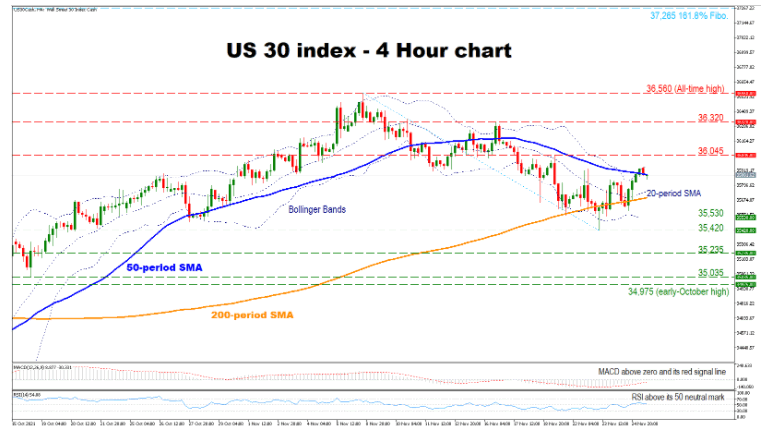
UK 100 Index Pulls Back From Fresh Highs, Bullish Bias Holds
The UK 100 stock index (cash) has been trending upwards since February. However, the index experienced a minor downside correction lately after its rally peaked at the 20-month high of 7,400.
This recent pullback is unlikely to continue as the momentum indicators suggest that the bullish forces are still in play. The stochastic oscillator is sloping upwards near the 80-overbought area, while the RSI is hovering in the positive region.
Should the buying pressure intensify further, the immediate hurdle for the bulls might be found at the 7,331 level. If the price crosses above this barricade, then the next challenge could be the 20-month high of 7,400. Failing to halt there, the price ascent might stop at the 7,500 psychological mark or even higher at the February 2020 high of 7,560.
Alternatively, should the bears retake control, initial support might be met at the 7,188 and 7,026 levels, where the 50- and 200-day simple moving averages (SMAs) are found respectively. If the price dips beneath these levels, then the next obstacle for sellers could be found at the 6,945 region. Breaching this support point, the price would then move towards the 6,824 barrier.
Overall, UK 100 has been in a long-term upward move. Although the index has given up some ground recently, only a clear move below 7,026 could turn the short-term picture back to negative.