

Sample Category Title
AUD/CHF Bearish SHS Pattern M L5 Is The Next Target
AUD/CHF technical analysis
- Bears are still in control.
- Bearish SHS pattern.
- Trend line break.
- Move down is imminent.
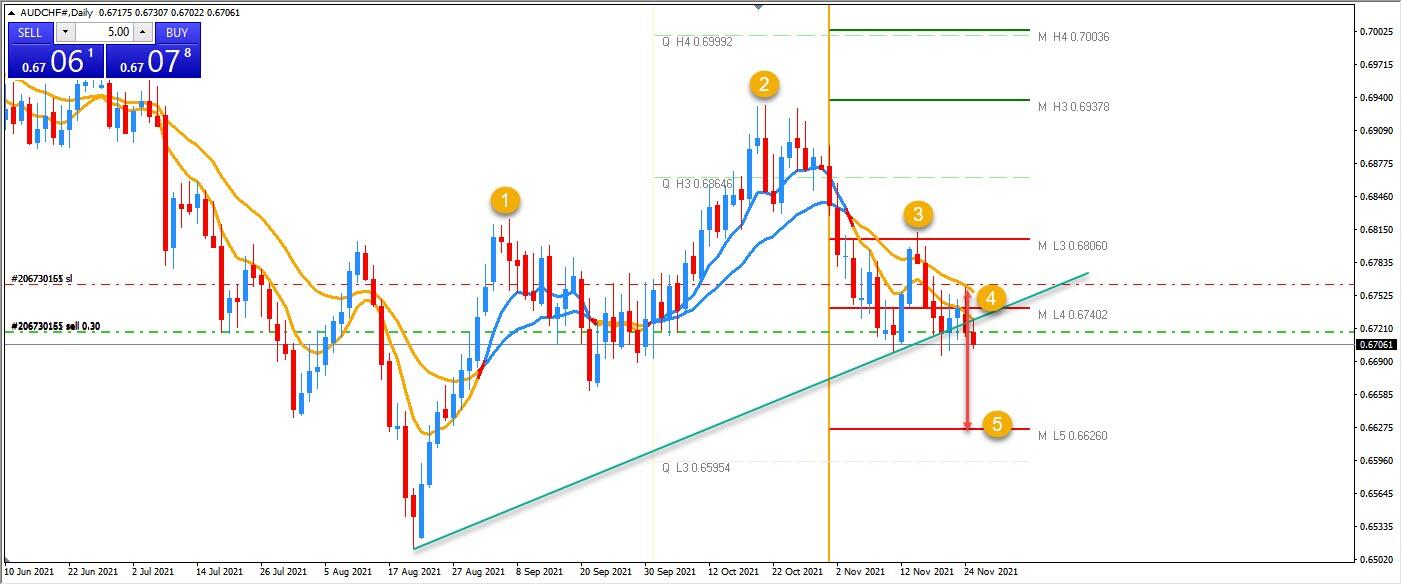
- Left shoulder.
- Head.
- Right shoulder.
- Trend line break & Pinbar.
- Target.
The AUD/CHF is still bearish. Predominant trend in the AUD is bearish. Technical and Fundamentals are aligned as RBA last statement was bearish. The CHF is getting stronger and if CHF/JPY gets higher (which it should concerning that we have a pinbar on daily) then the AUD/CHF drop will be even more exaggerated. Momentum is bearish and a close below 0.6690 should add more sellers in the equation. We can also spot bearish shoulder head shoulder formation which adds to the confluence. The target is M L5 0.6626.
USDCAD: Impulsive Trend Could Weigh On Prices
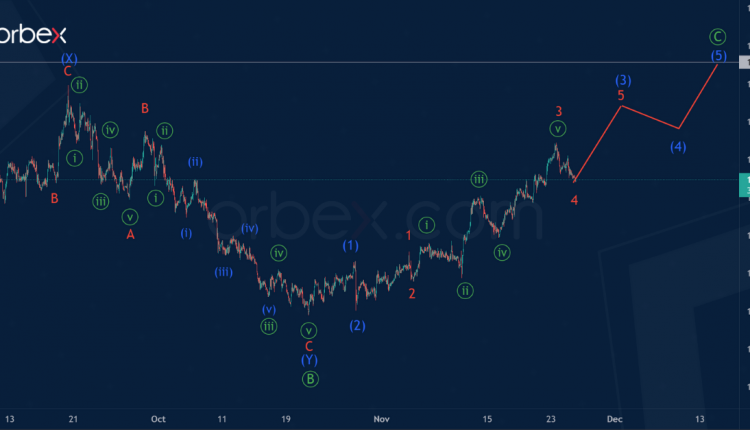
The formation of the USDCAD currency pair suggests the development of a large correction trend. This takes the form of a standard (A)-(B)-(C) zigzag.
At the end of October, the downward movement of the market ended within the primary correction Ⓑ. This took the form of a bearish double zigzag (W)-(X)-(Y) of the intermediate degree. Then we saw an impulsive growth within the primary wave Ⓒ.
Currently, impulse wave (1) and the intermediate correction wave (2) have ended. In the near future, the upward movement of the price in the intermediate sub-waves (3)-(4)-(5) is likely to continue.
The final of the entire primary impulse wave is possible around the level of 1.295. Thus, there is a good chance to make money on purchases, in order to take profit at the end of the wave
An alternative scenario shows the primary double X-Y-Z zigzag is being constructed, with the actionary wave Y under development.
Wave Y can take the form of an (A)-(B)-(C) zigzag of the intermediate degree. So far, the first impulse wave (A) has ended. To confirm the alternative, we should see a decline in the currency pair within the intermediate correction (B).
Most likely, if the market goes down, the price will drop to 1.246. At that level, wave (B) will be at 61.8% of wave (A). After that, the final impulse wave (C) could lead the market higher than 1.296.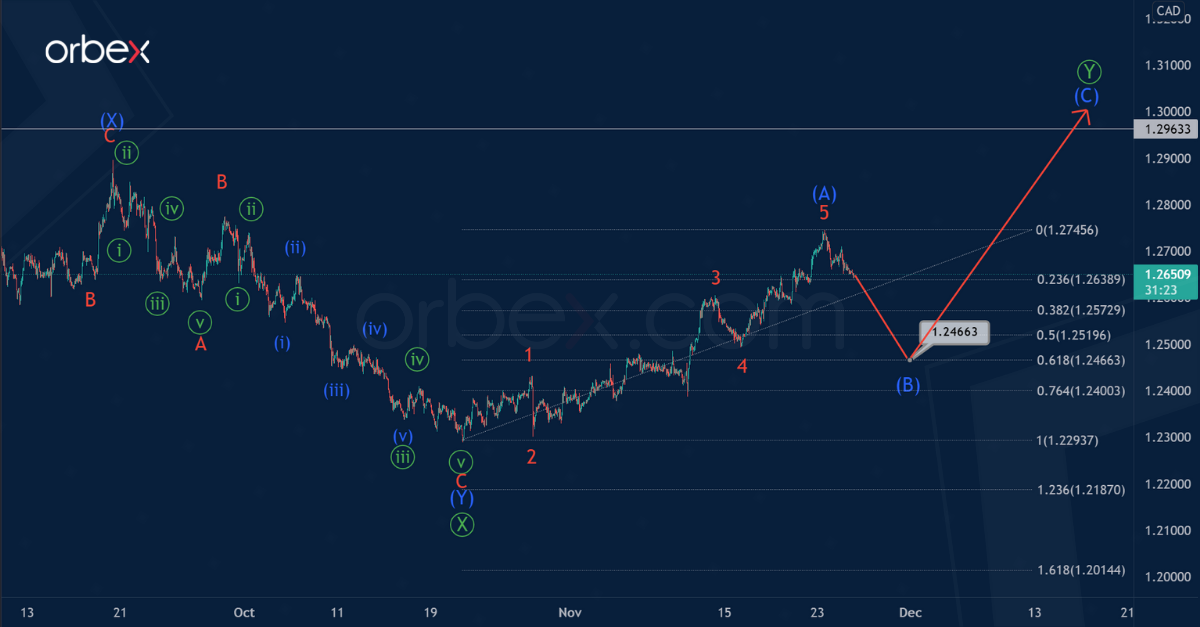
XAUUSD Lacks Support
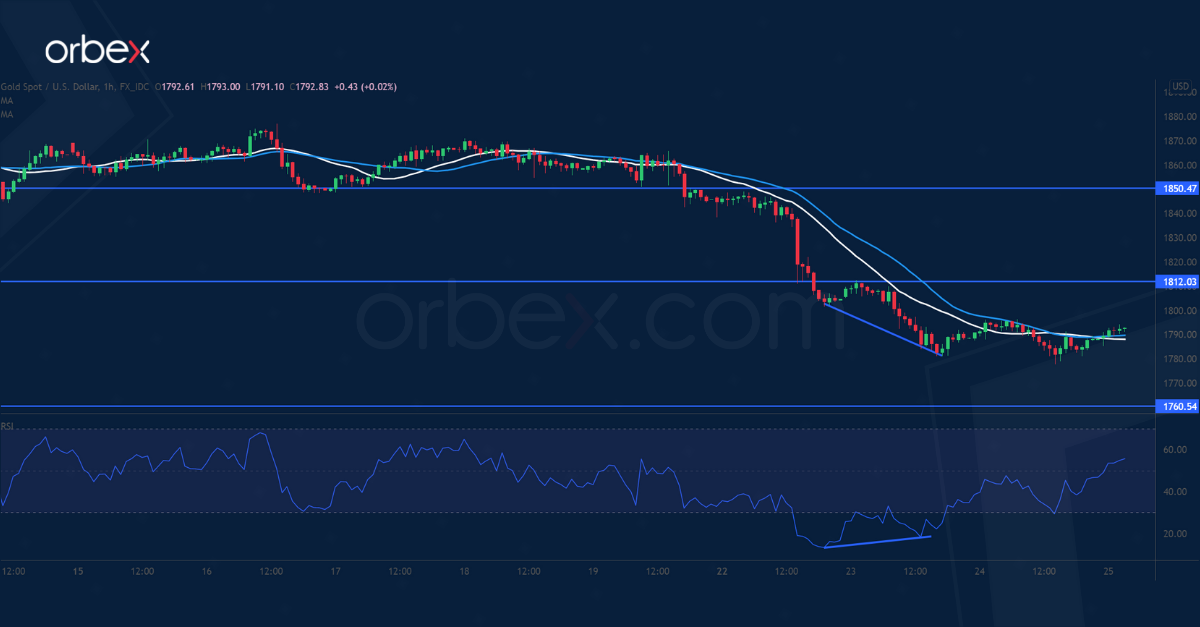
Gold extended losses as expectations for higher interest rates grew. The break below 1823 has forced leveraged buyers to liquidate their positions, stirring up volatility in the process.
The price is heading towards the origin of the November rally at 1760. A bullish RSI divergence shows that the downward pressure could be waning.
As the RSI dips into the oversold territory, buyers have started to bid again from the demand area. 1812 is a key hurdle to lift or the metal could plunge to September’s low at 1730.
EURGBP Remains Under Pressure
The euro struggles due to fears of a new round of covid lockdowns across the continent.
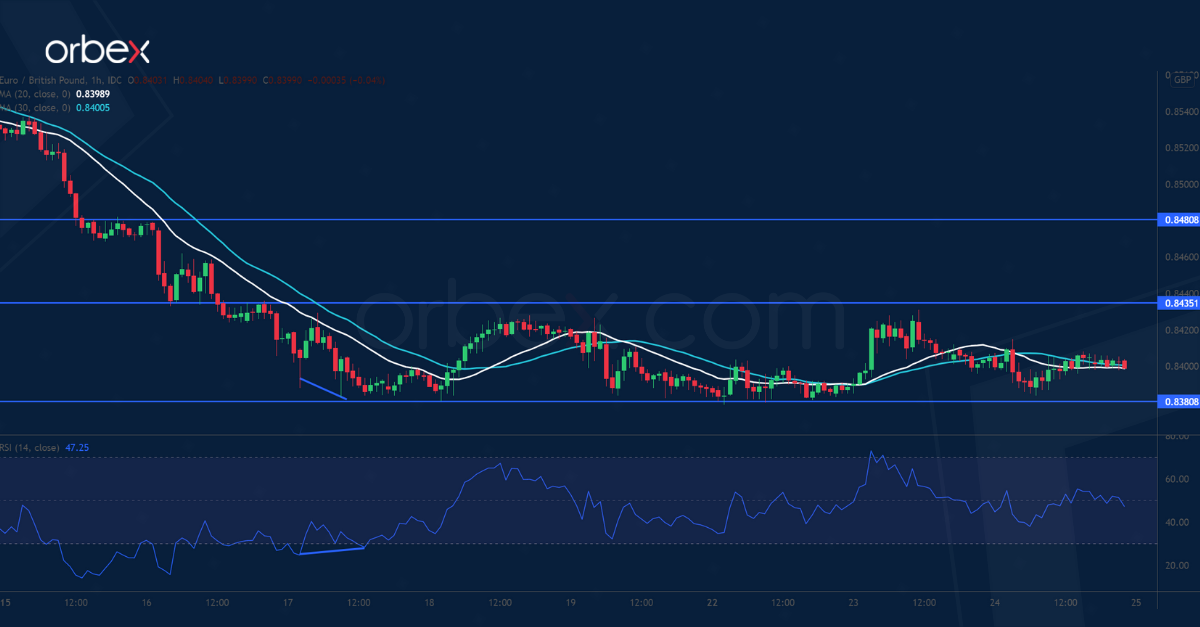
The fall below the daily support at 0.8400 has put the few buyers under pressure. A faded rebound suggests that the bears are still in control of the direction.
The RSI’s bullish divergence points to a deceleration in the sell-off. However, in the absence of confirmation, the current sideways action could be a mere consolidation. Buyers may remain cautious unless offers around 0.8435 get lifted. A break below 0.8380 may send the pair to 0.8300.
USDCHF Tests Key Resistance
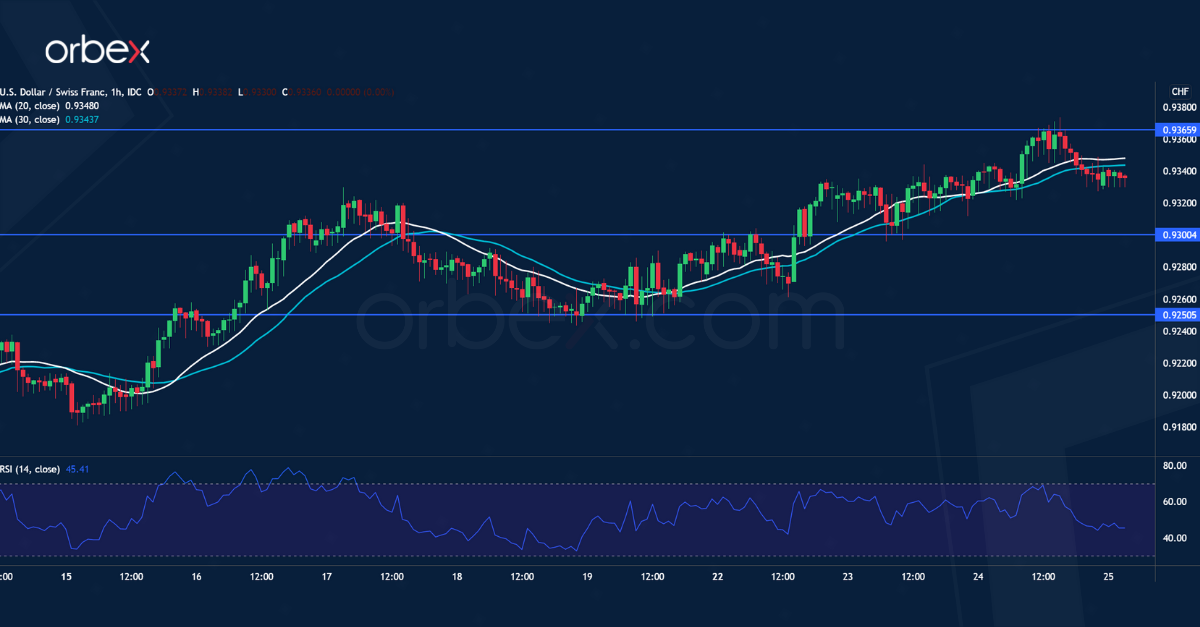
The US dollar consolidates gains after the FOMC minutes signaled for rate hikes if inflation stays high. A bullish MA cross on the daily chart is strong evidence for an upbeat sentiment.
The pair is testing last September’s peak at 0.9365. A breakout would flush the short interest out and attract momentum buyers.
An extended rally may carry the price to April’s high at 0.9470, a major resistance from the daily chart. An overbought RSI may cause a brief pullback. 0.9300 from the previous consolidation would be a new support.
Riksbank Pencils In 1st Potential Rate Hike During Latter Point Of 2024
Notes/Observations
- Riksbank keeps policy steady as expected and tweaked its forward guidance to see a rate hike in the latter part of 2024.
Asia
- Bank of Korea (BoK) raised 7-Day Repo Rate by 25bps to 1.00% (as expected); signals that more hikes could come.
Coronavirus
- Italy Cabinet said to place new tougher COVID rules for vaccinated beginning Dec 6th through Jan 15th. Unvaccinated could not use cinemas, restaurants, hotels and gyms.
Europe
- ECB’s Schnabel (Germany) stated that Inflation would start to slowly normalize starting in January; Did not see serious risk of stagflation.
- ECB's Makhlouf: Inflation drivers to recede in 2022; personal view that rate hikes are not needed.
- Swedish PM Andersson has resigned hours after being named new PM; Coalition partner Greens leave coalition after they could not reach budget agreement.
Americas
- FOMC Nov Minutes noted that the number of participants discussed that long-term inflation expectations might increase above long-run objective; Delta wave had intensified the impediments to supply chain. Some participants suggested that reducing the pace of net asset purchases by more than $15B/month could be warranted so that the Committee would be in a better position to make adjustments to the target range for the federal funds rate.
Speakers/Fixed income/FX/Commodities/Erratum
Equities
- Indices [Stoxx600 +0.47% at 481.96, FTSE +0.19% at 7,300.26, DAX +0.44% at 15,948.51, CAC-40 +0.36% at 7,067.52, IBEX-35 +0.52% at 8,837.52, FTSE MIB +0.47% at 27,237.00, SMI +0.50% at 12,457.64, S&P 500 Futures +0.30%].
Market Focal Points/Key Themes:
Equities
- European indices open generally higher following few sessions of losses; better performing sectors include industrials and consumer discretionary; laggard sectors include financials; Remy Cointreau in Paris trades higher over 10% following its final half-year results and upgraded profit outlook; Swiss insurance giant Swiss Life presented new targets during its investor day as well as announced share buyback, also trading higher about 3%; on M&A front, UK firm Vivo Energy received offer to be acquired, its shares rose almost 20% on London Stock Exchange; As a reminder, US markets will be closed today and set for earlier close tomorrow due to Thanksgiving holiday; S&P500 futures currently stand up 0.3%.
- Consumer discretionary: Remy Cointreau [RCO.FR] +11% (final earnings; raises profit outlook), Studio Retail Group [STU.UK] -19% (earnings), Eco Animal Health [EAH.UK] -16% (earnings).
- Energy: Vivo Energy [VVO.UK] +20% (takeover offer).
- Financials: Swiss Life [SLHN.CH] +3% (CMD).
Speakers
- EU said to endorse 9-month limit on COVID vaccine validity in travel purposes.
- Sweden Central Bank (Riksbank) Policy Statement noted that inflation was expected to be on target going forward. It tweaked its forward guidance and now saw a rate hike in latter part of 2024 (**Note: prior view was expected to remain at zero for entire forecast period, at least until Q3 2024). Announced that it would purchase bonds during Q1 2022 while holdings will gradually decrease after 2022.
- Sweden Central Bank (Riksbank) Gov Ingves post-rate decision press conference noted that an expansionary policy was needed for inflation at target.
- German Bundesbank Financial Stability report stressed that now was time to act against future risks.
- Poland Central Bank's Hardt stated that the Nov inflation reading was probably higher than 7%.
- Japan Cabinet Office Monthly Report maintained its overall economic assessment that the recovery was continuing to improve from an extremely low base but pace was weakening.
- China Defense Ministry spokesperson Wu Qian: Ready to crush Taiwan independence bid at any time.
- China and US said to be planning meeting of their top defense officials by end-2021.
- Iraq Oil Min Jabbar stated that OPEC did not want to lose success because oil markets remained fragile.
Currencies/Fixed Income
- USD held on to its recent strength as the most recent FOMC minutes should that various policymakers said they would be open to speeding up the taper of their bond-buying program if high inflation held. Fed also hinting it could more quickly to raise interest rates.
- GBP/USD was softer despite dealers suggested that post-Brexit relations between the UK and EU might not suffer a further breakdown imminently.
- EUR/SEK steady at 10.19 area after the Riksbank penciled in its first potential rate hike toward the end of 2024.
Economic data
- (FI) Finland Oct Preliminary Retail Sales Volume Y/Y: -0.9% v +2.7% prior.
- (DE) Germany Q3 Final GDP Q/Q: 1.7% v 1.8% prelim; Y/Y: 2.5% v 2.5% prelim; GDP WDA (unadj) Y/Y: 2.5% v 2.5% prelim.
- (DE) Germany Q3 Private Consumption Q/Q: 6.2% v 4.8%e; Government Spending Q/Q: -2.2% v +0.4%e; Capital Investment Q/Q: -2.2% v 0.0%e.
- (DE) Germany Dec GfK Consumer Confidence: -1.6 v -1.0e.
- (DK) Denmark Oct Retail Sales M/M: +1.7% v -1.2% prior; Y/Y: -2.5% v +3.0% prior.
- (NO) Norway Sept AKU Unemployment Rate: 3.6% v 3.9%e.
- (ES) Spain Oct PPI M/M: 6.1% v 5.4% prior; Y/Y: 31.9% v 23.8% prior (highest annual pace in almost 5 decades).
- (SE) Sweden Central Bank (Riksbank) left Repo Rate unchanged at 0.00% (as expected).
- (SE) Sweden Oct PPI M/M: 0.1% v 1.5% prior; Y/Y: 16.8% v 17.2% prior.
- (SE) Sweden Oct Household Lending Y/Y: 6.6% v 6.5% prior.
- (HK) Hong Kong Oct Trade Balance (HKD): -30.5B v -46.1Be; Exports Y/Y: 21.4% v 20.7%e; Imports Y/Y: 17.7% v 19.5%e.
- (IS) Iceland Nov CPI M/M: 0.4% v 0.6% prior; Y/Y: 4.8% v 4.5% prior.
- (PL) Poland Oct Unemployment Rate: 5.5% v 5.5%e.
- (ZA) South Africa Oct PPI M/M: 0.7% v 0.6%e; Y/Y: 8.1% v 8.0%e.
Fixed income Issuance
- (SE) Sweden sold total SEK1.25B in I/L 2030 and 2039 Bonds.
- (IT) Italy Debt Agency (Tesoro) sold €2.25B vs. €1.75-2.25B indicated range in 0.00% Jan 2024 BTP bonds; Avg Yield: -0.26% v -0.23% prior; bid-to-cover: 1.45x v 1.65x prior.
- (IT) Italy Debt Agency (Tesoro) sold €1.0B vs. €0.75-1.0B indicated range in 0.40% May 2030 I/L Bonds (BTPei); Real Yield: -0.65% v -0.85% prior; bid-to-cover: 1.46x v 1.41x prior.
Looking ahead
- (PT) Portugal Year-to-Date Budget Report.
- (AR) Argentina Nov Consumer Confidence Index: No est v 40.2 prior.
- 05:25 (EU) Daily ECB Liquidity Stats.
- 05:30 (HU) Hungary Debt Agency (AKK) to sell HUF20B in 12-month Bills.
- 06:00 (CA) Canada Nov CFIB Business Barometer: No est v 60.5 prior.
- 06:00 (BR) Brazil Nov FGV Construction Costs M/M: 0.8%e v 0.8% prior.
- 06:00 (RO) Romania to sell 3.25% 2026 Bonds.
- 06:45 (US) Daily Libor Fixing.
- 07:00 (BR) Brazil mid-Nov IBGE Inflation IPCA-15 M/M: 1.1%e v 1.2% prior; Y/Y: 10.7%e v 10.3% prior.
- 07:00 (MX) Mexico Q3 Final GDP Q/Q: -0.3%e v -0.2% prelim; Y/Y: 4.5%e v 4.6% prelim; GDP Nominal Y/Y: No est v 29.6% prior.
- 07:00 (MX) Mexico Sept IGEA Economic Activity Index (Monthly GDP) M/M: +0.3%e v -1.6% prior; Y/Y: 2.7%e v 4.3% prior.
- 07:30 (BR) Brazil Oct Current Account Balance: -$4.8Be v -$1.7B prior; Foreign Direct Investment (FDI): $4.0Be v $4.5B prior.
- 07:30 (EU) ECB Account of October Policy Decision (Minutes).
- 08:00 (UK) Daily Baltic Dry Bulk Index.
- 08:00 (RU) Russia Gold and Forex Reserve w/e Nov 19th: No est v $626.2B prior.
- 09:00 (BE) Belgium Nov Business Confidence: 3.6e v 4.0 prior.
- 09:05 (YK) BOE’s Haskel.
- 10:00 (MX) Mexico Q3 Current Account Balance: -$5.0Be v $6.3B prior.
- 10:00 (MX) Mexico Central Bank (Banxico) Nov Minutes.
- 12:00 (UK) BOE Gov Bailey.
- 14:00 (AR) Argentina Sept Supermarket Sales Y/Y: No est v 4.5% prior; Shop Center Sales Y/Y: No est v 245.2% prior.
- 16:00 (NZ) New Zealand Nov Consumer Confidence Index: No est v 98 prior.
- 18:30 (JP) Japan Nov Tokyo CPI Y/Y: 0.4%e v 0.1% prior; CPI (ex-fresh food) Y/Y: 0.3%e v 0.1% prior; CPI (ex-fresh food/energy) Y/Y: -0.3%e v -0.4% prior.
- 19:30 (AU) Australia Oct Retail Sales M/M: 2.2%e v 1.3% prior.
- 22:30 (JP) Japan to sell 3-Month Bills.
- 23:00 (MY) Malaysia Oct CPI Y/Y: 2.8%e v 2.2% prior.
WTI Futures Bounce At 75 Mark, Broader Bullish Bias Holds
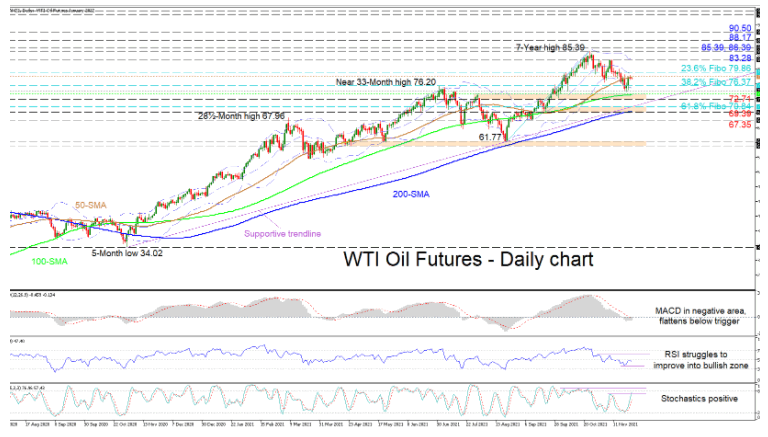
WTI oil futures are striving to overstep the curbing 50-day simple moving average (SMA) after the pullback from the 7-year high rebounded at the 75.00 handle. The 200-day SMA is defending the bigger bullish structure, while the 50 and 100-day SMAs are endorsing the short-term uptrend in the pair.
The short-term oscillators are suggesting that the negative momentum may be running out of steam. The MACD is slightly in the negative region but is flattening below its red trigger line, indicating that negative forces are somewhat subsiding. That said, the RSI is signalling that upside forces are lacking a convincing upwards drive, while the positively charged stochastic oscillator is promoting gains in the pair.
In the positive scenario - reinforced by the lower Bollinger band - buyers could face an immediate zone of resistance between the 50-day SMA at 78.76 and the 79.86 level, which is the 23.6% Fibonacci retracement of the up leg from 61.77 until 85.39. Overstepping this, the price may push higher to test the upper Bollinger band at 83.28. If buying interest intensifies, the bulls could then challenge the seven-year high of 85.39 and the nearby 86.39 barrier, achieved in October 2014. Resuming the climb, the price may then target the 88.17 inside swing low from the early part of October 2014 and the 90.50 border.
If price gains remain capped by the 50-day SMA at 78.76, sellers could encounter preliminary downside limitations from the nearby 38.2% Fibo of 76.37, the lower Bollinger band and the 75.00 hurdle. Dipping past the 75.00 mark, an upside defence formed between the 100-day SMA at 74.20 and the 72.71 obstacle could prove to be a tough boundary for sellers to conquer. If bearish pressures persist, a possible supportive trend line, pulled from the 34.02 trough could deter a deeper decline from challenging the 69.39-70.84 buffer zone, where the 200-day SMA also resides. Slightly lower, the 67.35 barrier could be a critical defence to cement a return of the bearish bias in the bigger picture.
Summarizing, WTI oil futures are sustaining a bullish bearing above the 75.00 psychological number and the 72.71-74.20 support band. Negative concerns could grow with a dive past the 69.39-70.84 boundary.
Fed Teases Faster Taper, Dollar Steamrolls Rivals
- Dollar slices higher after strong US data and Fed signals
- Euro tormented by growth risks, stock markets bounce back
- Thin liquidity to dominate trading as America goes on holiday
Brace for faster tapering
The dollar continues to bulldoze its way through the currency complex, tearing down everything in its path as the prospect of faster Fed tapering gets baked into the bond market cake. A flurry of data releases yesterday reaffirmed the strength of the American economy, but the real hero was the labor market, where the number of people seeking unemployment benefits for the first time hit a five-decade low.
With the jobs market looking healthier, more Fed officials have started to throw their weight behind the idea of accelerating the tapering process. San Francisco Fed chief Mary Daly highlighted the merits of doing so yesterday. Daly usually leans on the side of caution, so this is a crucial signal as it may reflect the consensus within the Committee.
It looks like this will get done in December. The minutes of the latest FOMC meeting showed "some" participants already supported a quicker pace of reductions in asset purchases, and inflation has only fired up further since then.
Yield curve flattens, euro besieged
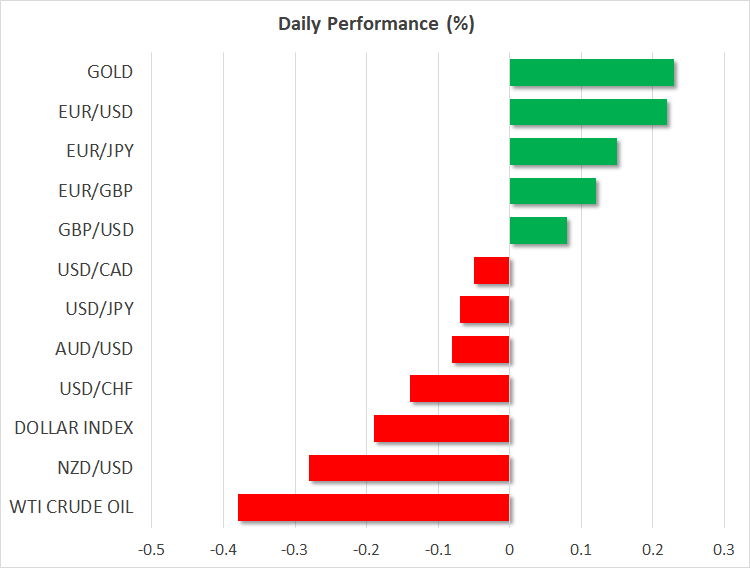
The greenback hit new cycle highs against the euro, yen, and sterling yesterday as the prospect of faster tapering propelled shorter-dated US Treasury yields higher. But longer-dated yields fell as traders priced out some inflation risk. If the Fed tightens earlier and more forcefully, that would likely snuff out inflation.
It is natural to see the yen getting blasted in an environment of rising yields. The Bank of Japan keeps a ceiling on domestic yields, so when foreign yields rise, interest rate differentials automatically widen against the yen.
The euro has also sustained heavy injuries. Germany could go into a lockdown at any moment and growth prospects for the entire Eurozone seem bleak with fresh social restrictions across the continent, energy costs squeezing consumers, and China’s slowdown threatening demand for exports.
Stocks bounce back
Wall Street closed a volatile session higher on Wednesday, on its final full trading day before the long weekend. While the spike in shorter-term yields served as fuel for the dollar, what matters most for stock markets is how longer-dated yields perform.
Hence, the pullback in longer-dated yields gave equity traders the green light to load up on tech and growth stocks again. US markets will remain closed today for the Thanksgiving holiday and will close early tomorrow.
With American traders out of the picture until Monday essentially, liquidity will probably be in short supply. This means there could be sharp moves without much news behind them, and if there is any news, the market reaction may be even larger than usual.
Finally, there’s a litany of ECB speakers on the agenda for today. A speech by Bank of England Governor Bailey at 17:30 GMT will also be crucial ahead of the central bank’s December meeting, where markets are pricing in 50-50 chances of a rate increase.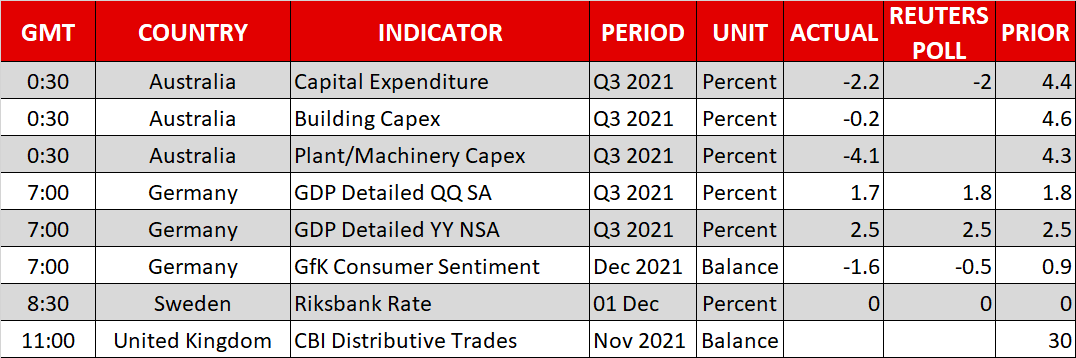
EUR/USD Outlook: Bearish Techs And Weak Fundamentals Keep The Euro Under Strong Pressure
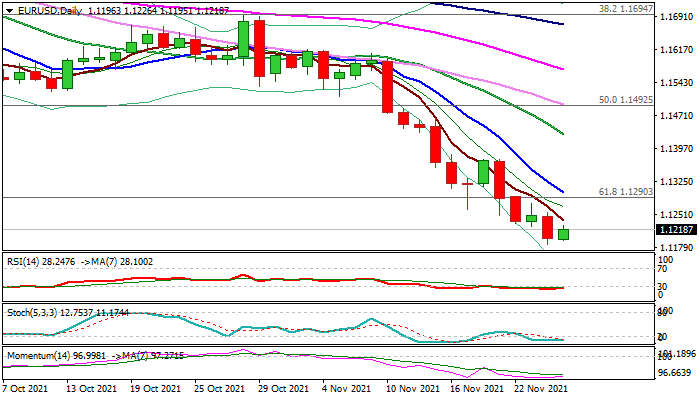
The Euro is consolidating above new 5 ½ month low (1.1186) in early Thursday, but maintains firm bearish tone, reinforced by the recent break of pivotal Fibo support at 1.1290 (61.8% retracement of 1.0635/1.2349 ascend) and probe below 1.1200 handle.
Weak German data (the economy grew at a slower pace in Q3 and consumer morale was soured by high inflation and new wave of coronavirus) are expected to add to Euro’s negative sentiment and keep in play increased risk of further fall.
Bears pressure support at 1.1168 (mid-June 2020 higher base) the last obstacle on the way towards 1.1040 (Fibo 76.4% of 1.0635/1.2349) and psychological 1.10 support.
Limited correction should be expected in coming session as daily RSI is oversold and bearish momentum shows signs of fatigue.
Solid resistance at 1.1300 zone (broken Fibo 61.8% / falling 10 DMA) should ideally cap, with extended upticks to stay under 1.1373 (Nov 18/19 lower tops).
Res: 1.1255, 1.1290, 1.1301, 1.1373.
Sup: 1.1186, 1.1168, 1.1100, 1.1040.
Oil And Gold Consolidate
Oil consolidates post-Biden rally
Oil prices were almost unchanged overnight and remain so in muted Asian trading. Brent crude is trading at USD 82.35 today, with WTI trading at USD 78.35 a barrel. US official Crude Inventories rose unexpectedly by 1 million barrels overnight, temporarily capping gains. Prices were supported though, as markets turn their attention to the OPEC+ meeting next week and any possible response to the Biden-led SPR release from across the globe.
The OPEC+ JMMC meets on November 30th, with the full meeting occurring on 2 December. Chatter is increasing that OPEC+ may less-than-subtly retaliate by slowing the pace of monthly production increases, particularly as their own data indictors a daily surplus in the world by early next year. But the fact that US production has now risen back to 11.5 million barrels a day, and yet oil prices remain near highs, suggests its underlying fundamentals remain strong, especially with OPEC+ compliance above 100%. Notably, the oil futures backwardation curve has flattened as hedgers pile into far-dated contracts, implying that expectations of future oil prices remain well anchored to the higher side.
I do not expect OPEC+ to dial back on production hikes next week in retaliation. The grouping is nothing if not pragmatic. From a geopolitical perspective, rubbing salt in the wounds of their largest customers would be counterproductive although we can expect some peripheral noise from bay boys, Russia and Iran. The high compliance level by OPEC+ implies that the grouping is pumping as fast as it can and will probably struggle to meet increased target allocations anyway, with only Saudi Arabia, the UAE and Iraq having swing production capacity. Taken in totality, prices will remain solidly supported on material dips, as we have seen over the past week.
Brent crude is testing resistance at USD 83.25 a barrel. Support is at USD 81.80 followed by USD 78.60 and USD 75.00 a barrel with the 100-DMA lurking at USD 76.90. WTI has traced out a triple top around USD 79.30 a barrel. That is followed by USD 80.00 and USD 82.00 a barrel. Support is at USD 78.00 and USD 74.85 a barrel, followed by the 100-DMA at USD 74.35.
Gold consolidates near its weekly lows
Gold traded sideways overnight, with a slight flattening of the US yield curve allowing it to finish unchanged at USD 1788.60 an ounce. In Asia, some risk-hedging and a slightly lower US dollar has seen it climb a modest 0.20% higher to USD 1792.20 an ounce. In all likelihood, with the US on holiday today and many in the US making a long weekend of it, gold is likely to range between USD 1780.00 and USD 1810.00 for the rest of the week.
If US yields remain firm gold will be vulnerable to further losses, and it faces a challenging technical outlook in the short term. The 50-day, 100-day, and 200-day moving averages are clumped together at the present level between USD 1789.50 and USD 1793,50 an ounce. That is followed by USD 1800.00 and USD 1810.00 an ounce. Support is nearby at USD 1780.00 an ounce and failure will signal a retest of USD 1760.00 and USD 1740.00 an ounce.