

Sample Category Title
Aust Wages, Back To Pre-Covid Gains But Still Well Short Of 3%Yr
The Q3 Wage Price Index (WPI) lifted 0.6%qtr/2.2%yr. Wages are lifting in sectors with tight labour markets but yet to spread more widely.
- The WPI lifted 0.6% in the September quarter, a bit strong than Westpac’s 0.5% forecast of 0.5% but spot on the market’s 0.6% estimate. This followed a modest 0.4% gain in Q2 which surprised us given it followed two solid 0.6% quarterly increases but, to be fair, those increases were a bounce back from the two softest quarters (0.1% in Q3 2020 and 0.2% in Q2 2020) in the history of the series.
- With the base effects of those two soft quarters dropping out the annual rate lifted to 2.2%, the fastest pace since Q3 2019.
- While slightly higher than Westpac’s expectations this number is just return to pre-Covid rates where wages were underperforming economic activity and so sit sits comfortably within the RBA’s view on wages.
- The ABS noted that the quarterly gain was due to wage and salary reviews around the end of the financial year, scheduled enterprise agreements and annual award rises.
The 0.6% increase in private sector wages the ABS described as being in line with pre-pandemic September outcomes. With base effects the annual pace of private sector wages lifted 0.5ppt to 2.4%yr, the fastest pace since March 2019. The ABS noted more employers conducting salary reviews than observed at the same time last year, when COVID-19 had a bigger influence on business operations. Small, isolated pockets of demand across a number of industries saw larger increases paid to attract and retain experienced staff.
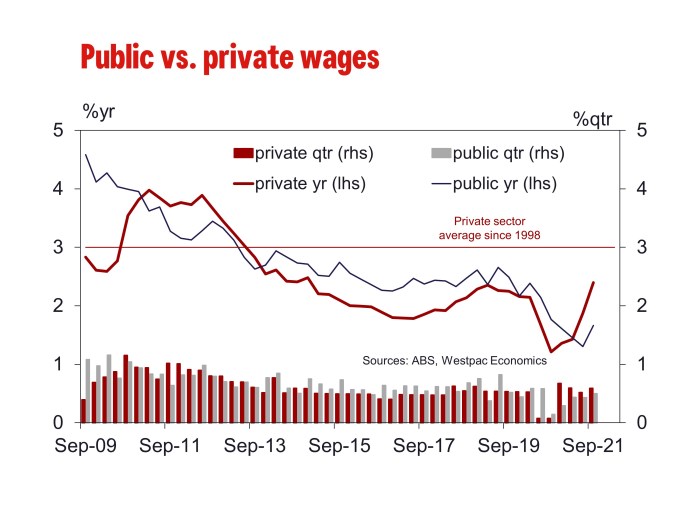
There has been a lot of press lately of bonus being paid to entice experienced workers by various employers. However, the private sector with bonuses series (seasonally adjusted by Westpac) also lifted 0.6% to be up 2.2%yr. It appears that the use of bonus are, at this stage, not as widespread as reported. 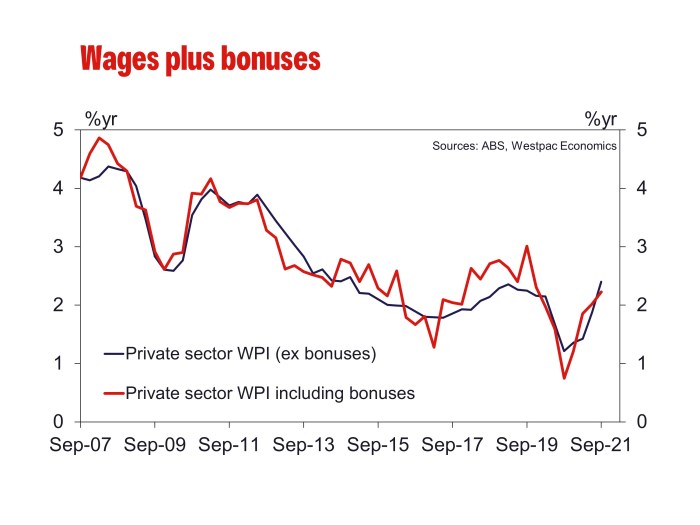 Public sector wage increases improved with a 0.5% gain, the largest quarterly increase since June 2020, lifting the annual pace to 1.7%yr from 1.3%yr (a record low). The ABS noted that this quarter saw a return to regular scheduled increases after a period of public sector wage freezes.
The following data has been seasonally adjusted by Westpac.
The sector with the strongest rise in wages was construction up 1.0% in the quarter (2.6%yr) which was the strongest quarterly print since December 2012. The next strongest was professional, scientific & technical services at 0.9% and as this sector has been running ahead of the average the annual pace lifted to 3.4%.
Retail trade had the weakest gain of just 0.1% but due to base effect of the weakest quarters rolling out the annual pace lifted from 1.6%yr to 2.1%yr.
In the June quarter we were disappointed that the improvement in the Victorian labour market was yet to be reflected in an improvement in wages there. There was a turn around in the September quarter with wages lifting by 0.8% in that state for a 2.5%yr pace. Wages lifted 0.6% in NSW (2.1%yr) and 0.5% in Qld (2.0%yr).
Individual bargaining arrangements are the most responsive to economic conditions and even saw wages decline in June 2020. Of the 0.9% in the original (not seasonally adjusted) rise in the September WPI 0.44ppt came from individual arrangements, 0.34ppt via enterprise agreements and just 0.1ppt from awards. At this stage individual arrangements are not running that much stronger than enterprise agreements suggesting we are just getting back to pre-Covid wages inflation which at 2.0%yr to 2.4%yr is still well short of the RBA goal of 3%yr.
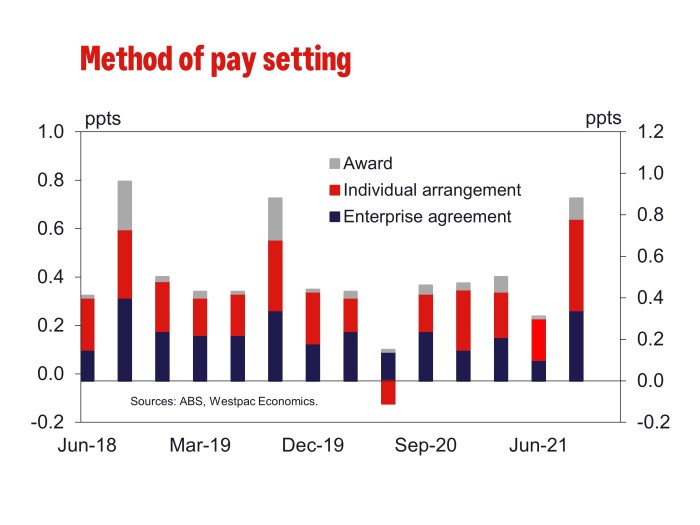 While wages have indeed lifted in industries where labour shortages are more pronounced, we are yet to see broader wage gains. What will be critical is how higher wage outcomes in these sectors, via individual bargaining arrangements, spread to the minimum wage and enterprise bargaining. In 2021 the increase in the minimum wage was 2.50%, up from 1.75% in 2020 but still less than 3.0% in 2019 and 3.5% in 2018. We suspect that in 2022 the minimum wage outcome is likely to be closer to the 2018 outcome than 2019. At this stage enterprise bargaining yet to show a meaningful lift but it should soon appear in any construction agreements being negotiated.
BoC Schembri: Rate to stay at ELB until excess capacity is absorbed
BoC Deputy Governor Lawrence Schembri said yesterday, "Our assessment of labour market conditions and underlying capacity and inflationary pressures is now more difficult. Consequently, more uncertainty exists around the timing of when the output gap will close and inflation will return sustainably to our 2-per-cent target."
"We'll keep the policy rate at the effective lower bound [0.25%] until excess capacity is absorbed … that excess capacity includes all the groups of employees that aren't fully employed at this juncture," Schembri said in response to a question after the speech.
"Now of course, one has to take into account that there's going to be some natural friction in the labour market, people are going to move between jobs, so we're not saying that there has to be zero unemployment," he added.
BoC: Uncertainties in the Labour Market Have Risen Due to the Pandemic
In today's speech, Deputy Governor Larry Schembri explored the impact of the pandemic on Canada's labour market. Specifically, he aimed to shed light on the question of how monetary policy can adapt and promote an inclusive recovery. To answer this question, Deputy Governor Schembri looked at two labour market uncertainties: the maximum level of sustainable employment and the relationship between labour market tightness and inflation.
On the maximum level of sustainable employment, Deputy Governor Larry Schembri clarified that this concept refers to "the highest level of employment that the economy can sustain without triggering inflationary pressure". Structural changes such as an aging population, immigration, globalization, and technological change can all impact the maximum level. With COVID-19 accelerating some pre-pandemic trends, and upending others, it's become harder to assess the overall state of employment and capacity pressures. Next, on the relationship between labour market tightness and inflation, also known as the Phillips curve, Deputy Governor Schembri explained that the association has become weaker and more difficult to measure, and that this is closely related to the fact that the maximum level of employment is also now more uncertain.
To better understand labour market conditions in the conduct of monetary policy, the Bank is looking at a broad set of labour market indicators. The Bank has developed a "three-dimensional" approach to assess labour market performance. The first is a set of overall labour market indicators, the second consists of variables that measure labour market inclusivity, and the third incorporates indicators of job characteristics. Using this approach, the Bank found that the labour market has improved significantly since the start of the pandemic, but there are still areas of slack, particularly among older workers and individuals that have been unemployed over a longer term. In addition, wage growth is also muted.
Deputy Governor Larry Schembri said the comprehensive approach to assessing labour market conditions will have important benefits for monetary policy. However, there is still much uncertainty around when excess slack in the economy will be absorbed. The Bank communicated in October that it will be sometime in mid-2022.
Key Implications
Deputy Governor Larry Schembri took time today to highlight that there is an abundance of uncertainty right now in Canada's labour market and that it has made the conduct of monetary policy challenging. Important macroeconomic variables such as the maximum level of employment are considerably more uncertain now, so the Bank will have to pay close attention to a wide range of indicators as it charts the next steps for monetary policy.
In essence, today's speech points to a more reactionary central bank. As the data evolve, the Bank of Canada will be prepared to shift guidance accordingly. This was a sentiment also expressed by Governor Tiff Macklem in an article released yesterday, where he emphasized that monetary policy will adjust to unexpected shocks to its narrative. Indeed, the future of monetary policy is not set in stone, and this week's Bank of Canada communication underlines that point.
Gold Price Could Start Correction, Dollar Gains
Key Highlights
- Gold price extended increase above the $1,850 resistance zone.
- It traded below a key bullish trend line with support near $1,867 on the 4-hours chart.
- Crude oil price is struggling to stay above the $80.00 support.
- The Euro Zone CPI could increase 4.1% in Sep 2021 (YoY).
Gold Price Technical Analysis
This past week, gold started a major increase above $1,820 against the US Dollar. The price gained pace above the $1,840 level and extended increase.
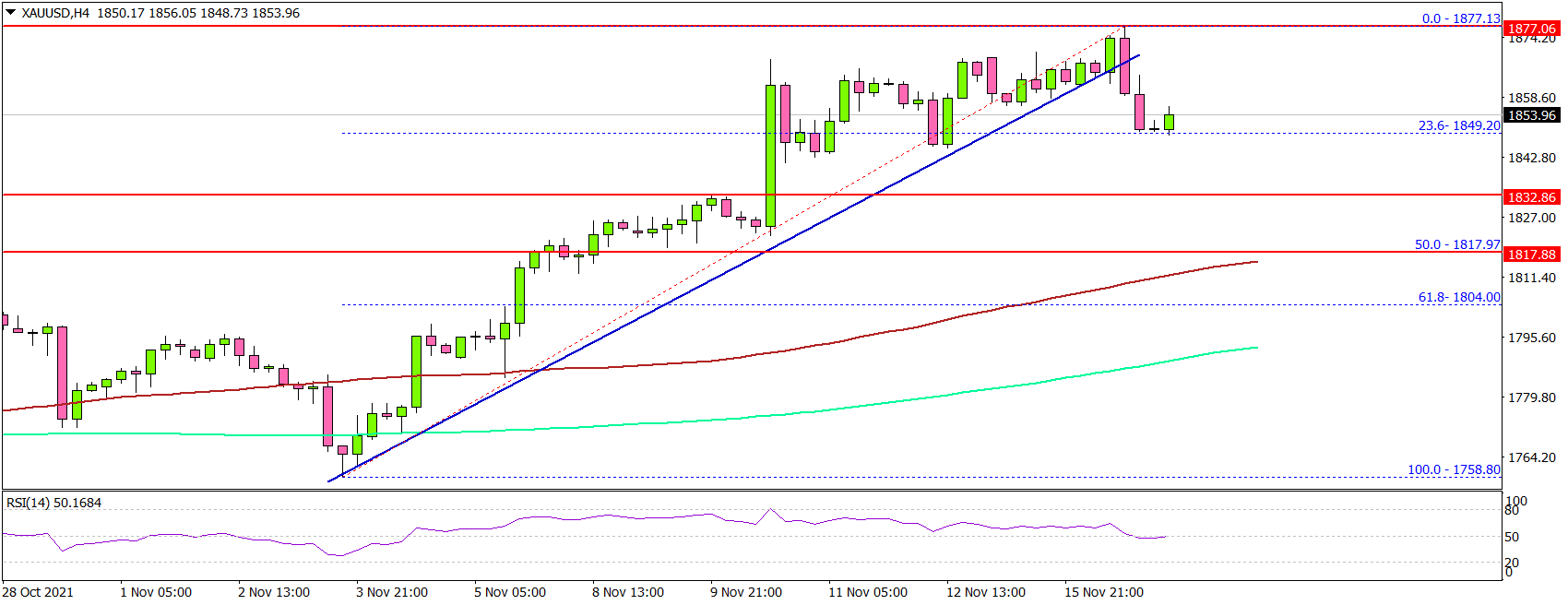
The 4-hours chart of XAU/USD indicates that the price settled nicely above $1,850 level, the 200 simple moving average (green, 4-hours), and the 100 simple moving average (red, 4-hours).
The price traded as high as $1,877 and is currently correcting gains. An immediate support is near the $1,850 level. It is near the 23.6% Fib retracement level of the upward move from the $1,758 swing low to $1,877 high.
The main support is now forming near the $1,820 level. It is near the 50% Fib retracement level of the upward move from the $1,758 swing low to $1,877 high.
On the upside, an immediate resistance is near the $1,878 level. The next key resistance is near the $1,880 level, above which the price might rise towards the $1,900 level.
Looking at EUR/USD, the pair extended its decline and there was a sharp decline below the 1.1400 and 1.1365 support levels.
Economic Releases to Watch Today
- UK Consumer Price Index for Oct 2021 (YoY) – Forecast +0.8%, versus +0.3% previous.
- UK Core Consumer Price Index for Oct 2021 (YoY) – Forecast +3.9%, versus +3.1% previous.
- Euro Zone CPI for Sep 2021 (YoY) - Forecast +4.1%, versus +4.1% previous.
- Euro Zone CPI for Sep 2021 (MoM) - Forecast +0.8%, versus +0.5% previous.
- Canadian Consumer Price Index for Oct 2021 (MoM) – Forecast +0.7%, versus +0.2% previous.
- Canadian Consumer Price Index for Oct 2021 (YoY) – Forecast +4.7%, versus +4.4% previous.
Market Morning Briefing: EURJPY Has Broken Below 130 But While Above 129.60
STOCKS
Dow and Dax rose fairly yesterday and could be headed higher towards 36250 and 16400 respectively before again declining from there. Nikkei can test 30000/30250 while above 29500 while Shanghai is ranged within 3475/3500-3550/75 for the near term. Nifty and Sensex needs to remain above 17800/600 and 60000 respectively to move up eventually.
Dow (36142.22, +54.77, +0.15%) has risen yesterday. Seems to be confused whether to rise above 36250 or to fall below 35900 and needs to break on either side to indicate near term direction. Till then we may consider for a fall towards 35000 while below 36250.
DAX (16247.86, +99.22, 0.61%) has risen significantly today and if sustains can head towards 16400 in line with our expectations before a reversal from there is seen. As mentioned earlier, 16400 is a crucial medium term resistance.
Nikkei (29674.74,-133.38, -0.45%) has come down today but is trading above the crucial support at 29500. While above 29500 a test of 30000/30250 is possible in the very near term. View is moderately bullish while above 29500.
Shanghai (3529.54, +7.75, +0.22%) is still hovering between 3475/3500-3550/75 , a strong break above 3575 would be needed to take the index towards 3600. While a break below 3500/3475 can take it towards 3400. Price action within the mentioned range needs a close watch.
Nifty (17999.20, -110.25,-0.61%) opened higher yesterday at 18127 but came down sharply to close below 18000. While below 18000 a dip towards 17800/600 cannot be negated before we see a bounce towards 18200 or higher in the longer run. For now 17800/600-18000/200 could be a broad range, unless we see a sharp rise above 18200 today itself.
Sensex (60322.37, -396.34, -0.65%) fell sharply yesterday and can test the support at 60000 before we see a bounce from there towards 61000/62000 in the medium term.
COMMODITIES
Brent and WTI have rise from immediate supports and have limited upside indicating a possible sideways movement before a sharp fall is seen. Brent can test 79/78 while below 83/85. WTI on the other hand can fall to 75 on a break below 79. Gold is trading within 1850-1880 within an overall uptrend. Silver needs to hold above 25 to move up else can fall to 24. Copper needs to bounce from support at 4.30 else could be vulnerable to a sharp fall. Watch price action near immediate support and resistance levels.
Brent (81.97) has bounced back from $80. It has resistance at $83/85 which can hold and produce a fall towards $79/78 on the downside.
WTI (80.26) has come down to test 79 again. A further fall below 79 can trigger a fall towards $75 in the coming sessions.
Gold (1857.90) has dipped a bit on Dollar strength and can be ranged within 1850-1880 for sometime before again moving higher in the medium term. Overall trend is bullish.
Silver (25.04) has immediate support at 25 which if holdsc an produce a bounce back to 25.50-26 in the medium term. Failure to hold above 25 can take the price down to 24 before a bounce is seen from there. Watch price action at 25.
Copper (4.3555) has fallen and could test support at 4.35/30 from where a bounce looks possible. Failure to hold above 4.30 will be bearish for the medium term. Watch price action near 4.30.
FOREX
Dollar Index tested 96 without any pullbacks that we have been expecting over the past couple of sessions. Euro can hold above 1.13 while the dollar index holds below 96. Any break on the upside can take dollar index to 98 opening chances of a fall to 1.12/1.10 for Euro. Watch price action in the very near term. EURJPY is ranged above 129.60 while Aussie and pound look bearish. Dollar Yen can rise to 115.00-115.50 before reversing from there. USDCNY has risen back well from levels below 6.3750 seen yesterday. While below 6.40, view continues to remain bearish. USDINR can test 74.25/20 while below 74.60.
Dollar Index (95.89) rose to 96 without any pullbacks that we had been expecting over the past couple of days. We now need to see if it pauses near 96 or rises further to test 98 on the upside before reversing. Preference would be to see a corrective fall from 96 in the next few sessions.
Euro (1.1322) continued to fall sharply yesterday to test 1.1308. Immediate support is seen at 1.13 which if holds can produce a bounce towards 1.1350-1.1380 on the upside. Watch price action near current levels closely.
EURJPY (129.97) has broken below 130 but while above 129.60, there is scope for some more bounce towards 130.40/60. A broad range of 129.6-130.40/60 is possible in the near term.
Aussie (0.7287) has immediate support at 0.7280 which if holds can produce a rise towards 0.73-0.7350 in the near term. But we cannot negate a fall to 0.7260 before such a rise is seen.
Pound (1.3428) tested 1.3472 yesterday but came off sharply from there. While the Poundis unable to sustain above 1.3450, it can trade lower within 1.3450-1.34 just now. A decisive break above 1.3450 is needed to make it bullish.
Dollar-Yen (114.82) tested 114.10 yesterday but has bounced well from there and broken above 114.75. Our expected target of 115.50 can be met soon before a corrective dip is seen from there.
USDCNY (6.3838) rose to test 6.3950 from levels below 6.37 seen yesterday. Immediate resistance is seen at 6.40 and while the pair trades below that, view is bearish for a fall to 6.37-6.36 eventually. A sustained break above 6.40 is needed for the pair to negate bearishness and to head higher towards 6.41/42 or beyond. Watch price action while below 6.40.
USDINR (74.3775) can fall to 74.25/20 while below 74.60. Deeper support visible at 74.00. Surprisingly the Rupee has not shown any strong reaction to weakness in Euro or to the sharp fall in USDCNY yesterday.
INTEREST RATES
The US Treasury yields have moved up further. The 10Yr and 30Yr have limited room on the upside and we expect them to reverse lower going forward. We will be watching closely the movement in the coming days. The German yields have come closer to their first level resistance. It will have to be seen if they are reversing lower from here itself or after an extended rise up to the second level of resistance. The 10Yr and 5Yr GoI have bounced-back yesterday and can see some more uptick within their broad range before reversing lower again.
The US 2Yr (0.52%), 5Yr (1.27%), 10Yr (1.64%) and the 30Yr (2.03%) have moved up further. The 30Yr has room to test 2.1% while the 10Yr can extend the rise up to 1.68%-1.7% on a break above 1.65%. We will have to wait and watch if our expected reversal is happening anywhere from here or not.
The German 2Yr (-0.75%) and 5Yr (-0.57%) yields have declined sharply while the 10Yr (-0.25%) and 30Yr (0.09%) remains higher and stable. Our view remains the same. -0.2% on the 10Yr and 0.1% on the 30Yr are key resistances from where we expect the yields to reverse lower. In case if they break above these levels an extended rise to -0.1% (10Yr) and 0.2% (30Yr) can be seen and then reversal can happen.
The India 10Yr GoI (6.3636%) has inched up slightly and could retest the resistance at 6.38% and then come down towards 6.3%. As mentioned yesterday, 6.3%-6.45% is the broader range of trade and the bias is bearish to see a downside break below 6.3% eventually going forward.
The 5Yr GoI (5.7129%) has risen back above 5.7% and needs to see if it can sustain and break above 5.72% from here. Such a break can then bring back the chances of testing 5.75%-5.76% on the upside before seeing a fall to 5.66% eventually.
Eco Data 11/17/21
[php_everywhere instance="1"]
WTI Futures Advances Curbed by Ichimoku Cloud and 50-MA
WTI oil futures are dipping back beneath the 200-period simple moving average (SMA) at 81.05 after the bounce off the 79.29 level failed to extend above the Ichimoku cloud. The converging SMAs are supporting a more horizontal trajectory in the price, promoting an extension of the two-week trading range.
The Ichimoku lines are not endorsing a clear price course, while the short-term oscillators are signalling that negative forces are strengthening. The MACD, is above its red trigger line in the negative territory but looks to be redirecting back down. The RSI has struggled to improve and has steered back beneath the 50 mark. The bearish stochastic oscillator is promoting growing negative pressures in the pair.
As sellers retain command and push underneath the red Tenkan-sen line at 80.51, they may eye the 79.29 trough. It remains to be seen whether the 79.29 trough could dismiss the drop in the pair from deepening. From here, adjacent to this barrier is the key support foundation of the bullish structure, residing between 78.19-78.95. In the event the price pierces below this floor too, the 77.14 obstacle could come under fire ahead of the 74.96-75.49 border.
If buying interest intensifies, initial upside constraints could stem from the red Tenkan-sen line and the 200-period SMA at 81.05, ahead of a tough resistance zone, which could develop between the 50-period SMA 81.52 and the 100-period SMA at 82.33. Overshooting this area that encapsulates the cloud may boost upside impetus, reeling in the 83.29 level before buyers challenge the resistance ceiling of 84.64-85.39, the latter being a seven-year peak. Should buyers’ confidence increase, they could then target the 86.26 high, achieved in October 2014.
Summarizing, WTI oil futures appear to be trading between the upper limit of 84.64-85.39 and the lower limit of 78.19-78.95. That said, negative pressures are trying to tilt the odds in favour of the downside.
Sunset Market Commentary
Markets
UK labour market data this morning marked the start for a new downleg in EUR/GBP. The pair fell further from 0.8480 to 0.8440. First support stands at 0.8403 which is the October and YTD low. The UK yield curve bear flattened with yields rising by 2.5 bps at the front end and nearly unchanged to slightly lower at the very long end of the curve. The UK economy added 247k jobs in the third quarter compared to 190k consensus. The 14.9k decline in jobless claims in October bodes well for the start of Q4 2021. Filtering the data since the end of the pandemic-related furlough scheme, the net job growth increased by 160k. That’s a very important signal to markets since BoE Bailey circled the September and October labour market reports as being decisive for the December rate hike call. His unease about inflation levels is well-known, but the BoE governor (and his colleagues) wanted that final piece of evidence from the labour market before pushing through with 15 bps rate hike to 0.25%. Today’s numbers work comforting in this respect. Tomorrow’s UK October CPI data can provide the UK currency with another boost in case we see the dominating upward inflation surprise of past months. Consensus expects an acceleration in both headline and core outcomes, respectively from 3.1% Y/Y to 3.9% Y/Y and from 2.9% Y/Y to 3.1% Y/Y.
EUR/USD suffered a fresh spike lower as well. The pair currently changes hands near 1.1330 with key support at 1.1290 already lining up. New dollar strength was the result of a stronger than expected October US retail sales report. Both headline (1.7% M/M) and core sales (1.4% M/M) beat consensus. The consumption-proxy in calculating GDP rose by 1.6% M/M. Markets easily put aside the fact that retail sales are a nominal series. The trade-weighted dollar has the 96 big figure within reach coming from 94 ahead of last week’s US CPI. USD/JPY is about to test the 114.70 recovery high. US Treasuries underperformed German Bunds in the wake of the data. US yield changes vary between -0.4 bps (30-yr) and +1.2 bps (2-yr). The German yield curve steepens with yield differences ranging from -4.2 bps (2-yr) to +1.5 bps (30-yr).
News Headlines
After slowing rate hikes to 15 bps in September and October, the National Bank of Hungary today again accelerated to pace of tightening, raising the policy rate from 1.8% to 2.1%. According to vice governor Virag, the country is entering a new phase in its tightening cycle. The NBH sees a more extensive and longer rate hike cycle needed with further monthly rate hikes to follow as inflation might surpass 7% in November. The NBH also stops providing HUF liquidity via FX swaps. EUR/HUF currently trades near 364, overcoming early weakness after the policy statement.
The German energy regulator announced that it has temporarily suspended the certification of the Nord Stream 2 pipeline. The Swiss based consortium behind Nord Stream 2 needs to form a company under German law to get an operating license. The approval of the Nord Stream 2 project is a highly sensitive political issue. Russia wants to supply gas to Europe via a network that doesn’t transit Ukraine. However, several western countries are objecting bypassing gas supply from Ukraine. At the same time, markets see a risk for Russia to keep gas supplies to Europe tight as long as Nord Stream 2 isn’t approved. European gas prices rose more than 10% today.
October Polish core inflation rose in line with consensus by 4.5 Y/Y (from 4.2% Y/Y). Headline inflation was yesterday confirmed at 1.1% m/m and 6.8% Y/Y. Persistently high inflation is fueling the debate on the pace of further interest rate hikes at the NBP’s next policy meetings. Governor Glapinski doesn’t see current level of the zloty as raising pressure on the central bank to hike rates as it supports growth. Other MPC members feel less comfortable with current inflation and the weak currency. Policy maker Zubelewicz deems a policy rate of 3% as appropriate. The zloty remains under pressure with EUR/PLN touching 4.66, near the historic PLN low of 4.68.
US: Strong Retail Sales Report Pointing to an Early Kick-off to Holiday Shopping Season
Retail sales rose by 1.7% m/m in October, above the consensus forecast of 1.3%. September data, was revised up to an even stronger 0.8% m/m (from 0.7%).
Sales in volatile categories were robust, led by gasoline stations +3.9% m/m, which in turn reflects strong gasoline price growth. Motor vehicles and parts grew by +1.8% m/m, while sales at building materials & garden equipment stores rose by 2.8% m/m.
Sales in the "control group" used in calculating personal consumption expenditures, were up 1.6%. However, September's gain was revised down to +0.5% from +0.8% reported earlier.
- Within the group, the biggest contributors to growth were non-store retailers (+4.0% m/m), building materials retailers (+2.8% m/m), miscellaneous retailers (+2.8 m/m), and department stores (+2.2% m/m). Strong growth in these categories indicates that holiday shopping season got off the ground.
- Not all categories grew on the month. Clothing & accessory stores (-0.7% m/m) and health & personal care (-0.6% m/m) led declines, continuing a pattern since the pandemic.
Food services and drinking places – the only barometer for the services sector in today's reading – grew by a modest 0.4% in October.
Key Implications
Consumers are off to an early holiday shopping season, which may also prove to be a record setting. According to National Retail Federation’s annual winter holiday survey, shoppers plan to spend roughly the same amount on the holidays as last year, while the share of consumers who indicated their desire to shop early this holiday season jumped to almost 50% - the highest in the survey’s history. Some consumers may be hoping to avoid the stress of last-minute shopping or to take advantage of holiday sales, but a large number simply want to secure their purchases in the wake of supply chain challenges and reports of shortages.
The ratio of inventory-to-sales – the measure of how quickly an industry replaces its inventory – is below the pre-pandemic averages across all large retail sectors. With supply jam logs expected to prevail for the remainder of the year, inventory rebuilding will prove to be challenging, making last minute shopping risky this season. Add to this strong consumer purchasing power and you got hothouse conditions for higher retail prices.
Bullard: Fed should tack in a more hawkish direction
St. Louis Fed President James Bullard said Fed should "tack in a more hawkish direction" over the next few meetings. He warned, "if inflation happens to go away we are in great shape for that. If inflation doesn't go away as quickly as many are currently anticipating it is going to be up to (Fed) to keep inflation under control."
He added that if Fed increase the pace of tapering to USD 30B per month, that would open the door for a rate hike at the end of Q1. He has penciled in two hikes for next year and agreed with markets' assessment. Also, he's open to the idea of raising interest rate before tapering completes.