

Sample Category Title
Canadian Housing Starts Decline Again in October
In October, Canadian housing starts dropped 5.3% m/m to a still-healthy 236.6k units. Meanwhile, the six-month moving average dipped by 6.4k to 264.3k units.
In urban markets, multi-family starts fell by 5.3% m/m to 156.8k units. In contrast, urban single-detached starts increased by 1.0% m/m to 58.0k units.
Starts declined in five of 10 provinces:
- In Ontario, starts fell back from their extremely strong September level (-17.1k to 83.0k units)
- Starts also dropped in Quebec (-3.5k to 58.6k units), Manitoba (-4.4k to 5.5k units) and Saskatchewan (-3.9k to 2.8k units) while also being down modestly in B.C. (-0.1k to 35.9k units).
- In contrast, starts increased in Alberta (+9.2k to 35.4k units) and in Atlantic Canada (+6.4k to 15.4k units), boosted by firm gains in all provinces in the region.
Key Implications
As expected, starts continued to unwind from record highs achieved earlier in the year, potentially hindered by on-going labour shortages. This is consistent with our view that residential investment will contract in the fourth quarter. However, building permits are holding at high levels, limiting the downside risk for starts in coming months.
Over the longer term, housing starts should be supported by robust demand and elevated prices. In addition, new housing markets remain extremely tight, evidenced by ultra-low levels of unsold inventories, which will likely add some additional support. Improving population growth should also help keep starts elevated.
Dollar Continues March Higher after the US Retail Sales Release
US retail sales ticks up
US retail sales are the highlight of today. The figure climbed by 1.7% m/m for October as compared to 0.8% in the previous month, driving the greenback higher. Despite supply issues and delivery delays, there is a strong belief that customers will begin their holiday shopping earlier this year.
Vice President Biden has made his selection for the position of Chairman of the Federal Reserve. Powell is the most qualified candidate, even though Brainard has impressive credentials. His performance has improved dramatically since his inauspicious beginning, and the markets have placed their faith in him.
Walmart's fiscal third-quarter results beat analysts' estimates on Tuesday as price-conscious buyers flocked to its stores amid rising food costs. Consumers also spent more on home renovation projects, according to Home Depot's quarterly earnings and revenue.
Several Fed policymakers, notably Richmond Fed President Barkin, San Francisco Fed director Daly, and the Atlanta Fed's Bostic, will be making appearances today, and their statements will be eagerly followed for any new insights into the inflation picture and how it will influence the Fed's decisions.
FX market: dollar is the best performing currency of the day
The dollar is rising across the board, except against the pound. The greenback's momentum may have slowed at the end of last week, but this week is a different story, especially with euro/dollar which is continuing to record new lows around 1.1350. Dollar/yen is climbing above 114.00 and dollar index is moving back to the recent highs of 95.60. However, pound/dollar is moving higher too, near 1.3470. US stock index futures are suggesting a positive open today.
UK releases employment report
The UK announced strong labor market figures earlier today. The unemployment rate for the three months ending September reduced by two tenths of a percent from last month to 4.3%, compared to the predicted 4.4%, thanks to a larger-than-expected 247k growth in employment. Jobless claims declined by 14.9 thousand in October, compared to a revised drop of 85.9 thousand in September. The improvements occurred after the government's jobs furlough program came to an end in September, suggesting that many of the 1.1 million people who were on the program were able to obtain gainful employment after it ended.
RBA announces its minutes
The minutes from the Reserve Bank of Australia were announced earlier today. According to the bank, it is prepared to wait until the bank's inflation target is attained before raising interest rates again. The aussie is flattening today around $0.7337, finding strong resistance at the 40-day simple moving average (SMA) around $0.7373.
Also, the kiwi and the loonie are losing momentum versus the dollar.
In other markets, gold prices are surging near $1,871/per ounce, posting a fresh five-month high, while oil prices are struggling to surpass the 20-day SMA at $82.54/per barrel.
USD/JPY Mid-Day Outlook
Daily Pivots: (S1) 113.86; (P) 114.04; (R1) 114.31; More...
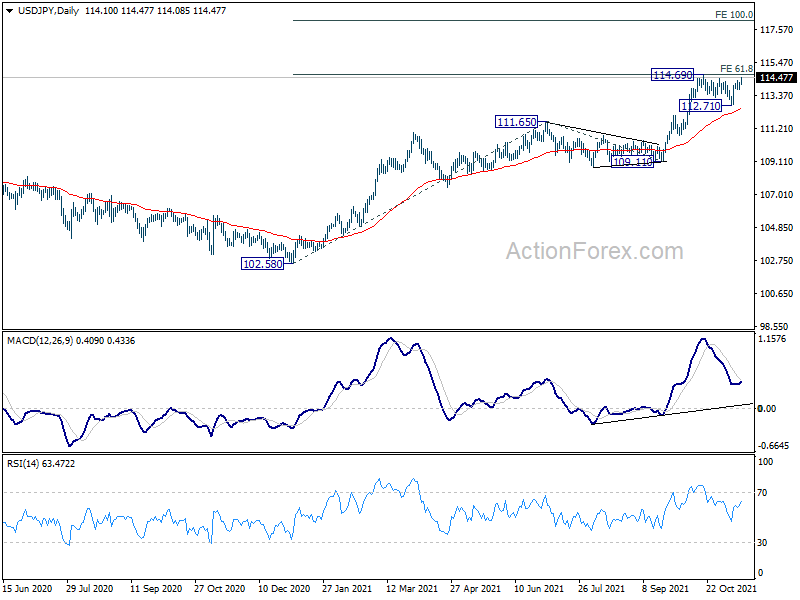
Intraday bias in USD/JPY is back on the upside as rise from 112.71 resumes. On the upside, sustained break of 114.69 will resume larger up trend for 100% projection of 102.58 to 111.65 from 109.11 at 118.18 next. On the downside, below 113.74 minor support will turn bias back to the downside to extend the consolidation pattern from 114.59. But, we'd continue to expect downside to be contained above 112.07 resistance turned support to bring rebound.
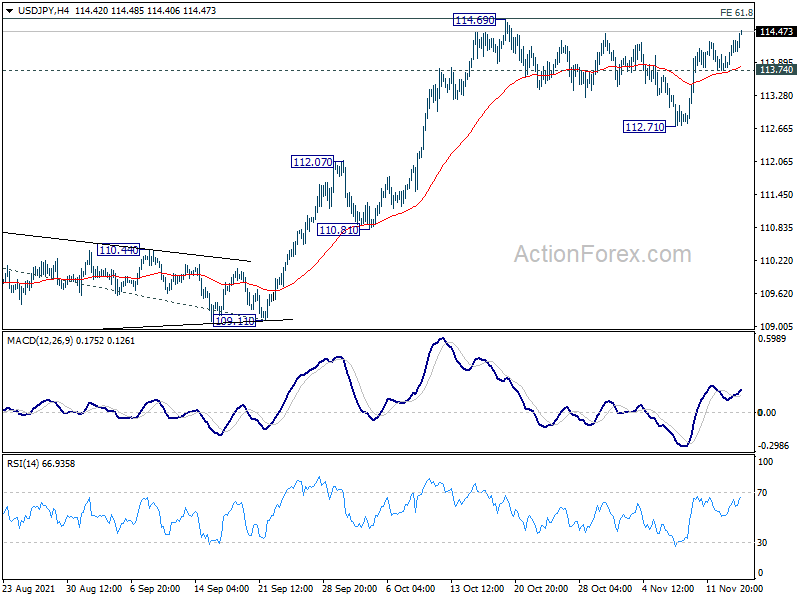
In the bigger picture, corrective decline from 118.65 (2016 high) should have completed at 101.18 already. Rise from the 102.58 is seen as the third leg of the up trend from 101.18. Next target is 114.54 resistance and then 118.65 high. This will now be the preferred case as long as 109.11 support hold, even in case of deep pull back.
USD/CHF Mid-Day Outlook
Daily Pivots: (S1) 0.9206; (P) 0.9231; (R1) 0.9276; More....
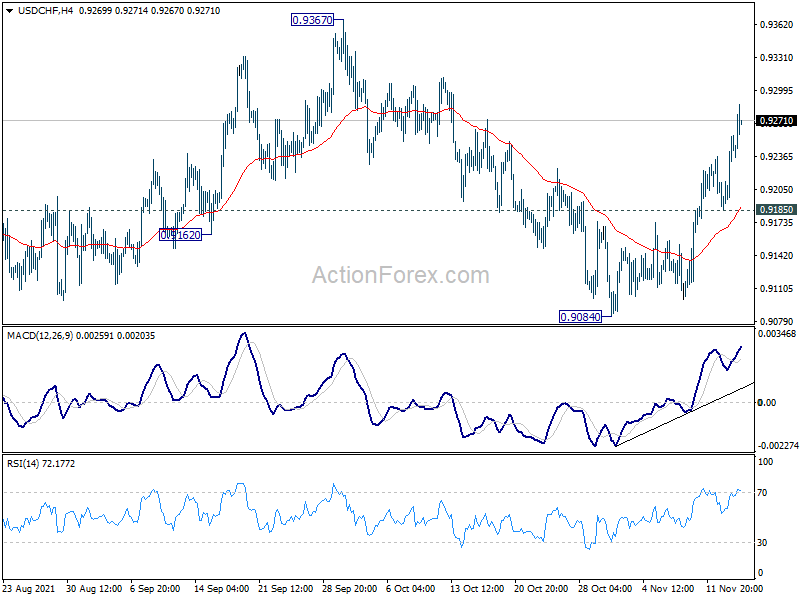
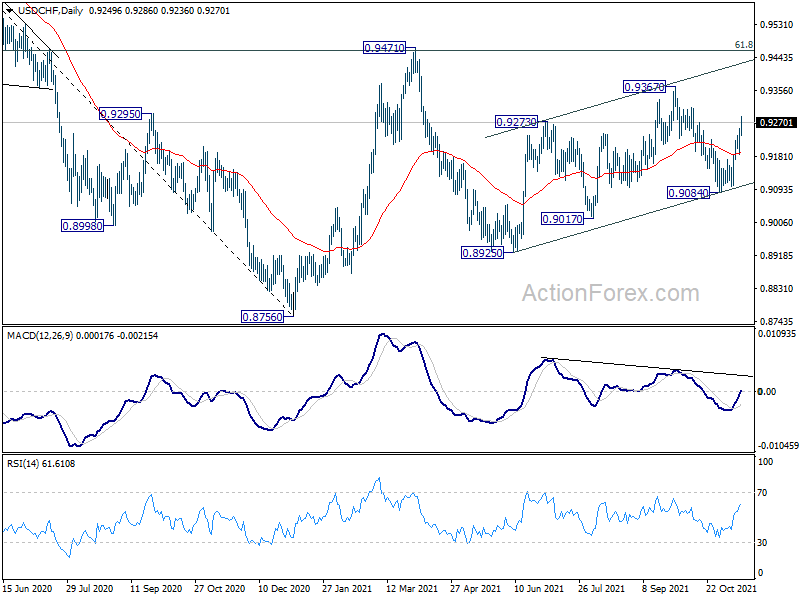
Intraday bias in USD/CHF remains on the upside for the moment. Current rise from 0.9084 would target a retest on 0.9367 resistance. On the downside, below 0.9185 minor support will turn intraday bias back to the downside for 0.9084 instead.
In the bigger picture, the corrective structure of the rebound from 0.8925 argues that fall from 0.9471 is not complete yet. It could either be the second leg of pattern from 0.8756 (2021 low), or resuming larger down trend from 1.0237 (2018 high). We'd pay attention to the downside momentum and assess the odds later. But for now, medium term outlook will be neutral at best as long as 0.9471 resistance holds.
EUR/USD Mid-Day Outlook
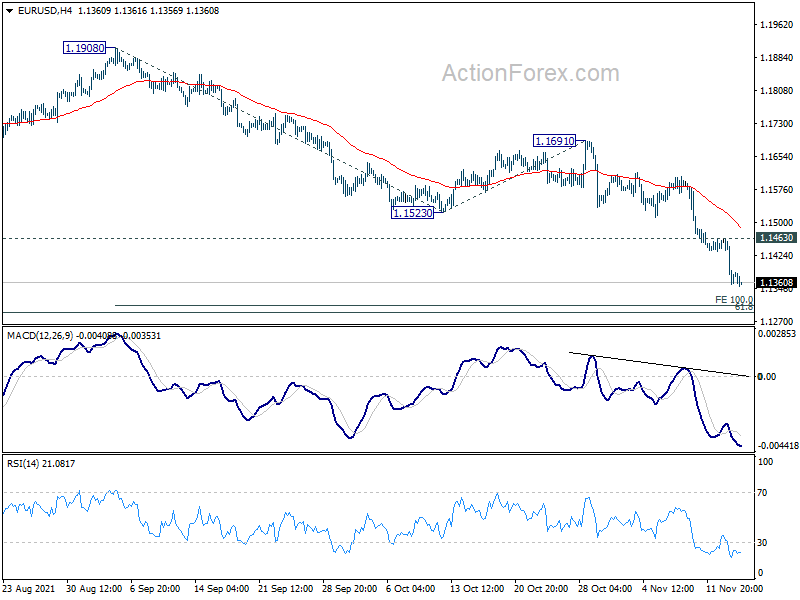
Daily Pivots: (S1) 1.1329; (P) 1.1396; (R1) 1.1437; More...
Intraday bias in EUR/USD remains on the downside for 100% projection of 1.1908 to 1.1523 from 1.1691 at 1.1306, which is close to long term fibonacci level at 1.1289. We'd pay attention to bottoming signal there. Break of 1.1463 minor resistance should now suggest short term bottoming and bring rebound back to 1.1523/1691 resistance zone first. However, decisive break there will pave the way to 161.8% projection at 1.1068 next.
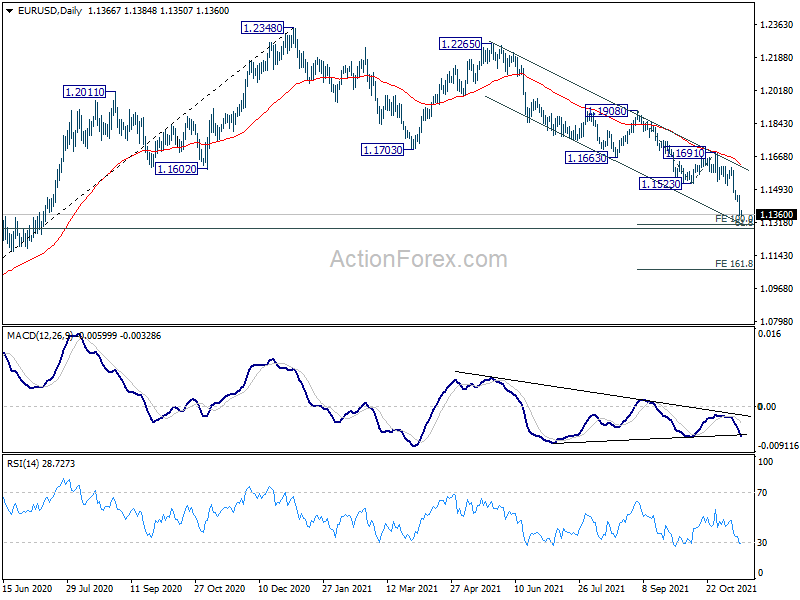
In the bigger picture, there are various ways of interpreting the fall from 1.2348 (2021 high). It could be a correction to rise from 1.0635 (2020 low), the fourth leg of a sideway pattern from 1.0339 (2017 low), or resuming long term down trend. In any case, outlook will now stay bearish as long as 1.1703 support turned resistance holds. Sustained break of 61.8% retracement of 1.0635 to 1.2348 at 1.1289 could pave the way back to 1.0635.
GBP/USD Mid-Day Outlook
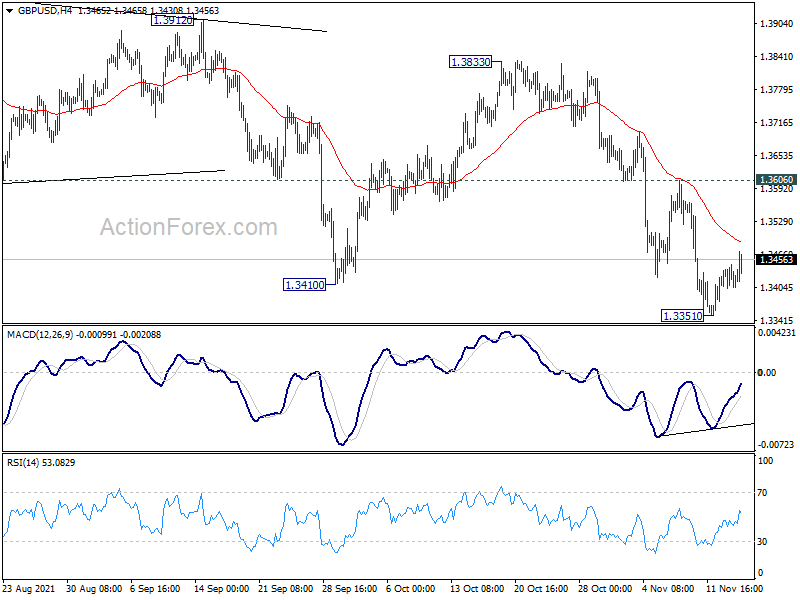
Daily Pivots: (S1) 1.3394; (P) 1.3422; (R1) 1.3440; More...
GBP/USD's recovery from 1.3351 extends higher today but outlook is unchanged. Intraday bias remains neutral first. Upside of recovery should be limited below 1.3606 resistance to bring down trend resumption. On the downside, break of 1.3351 will extend the decline from 1.4248 to 1.3164 fibonacci level next.
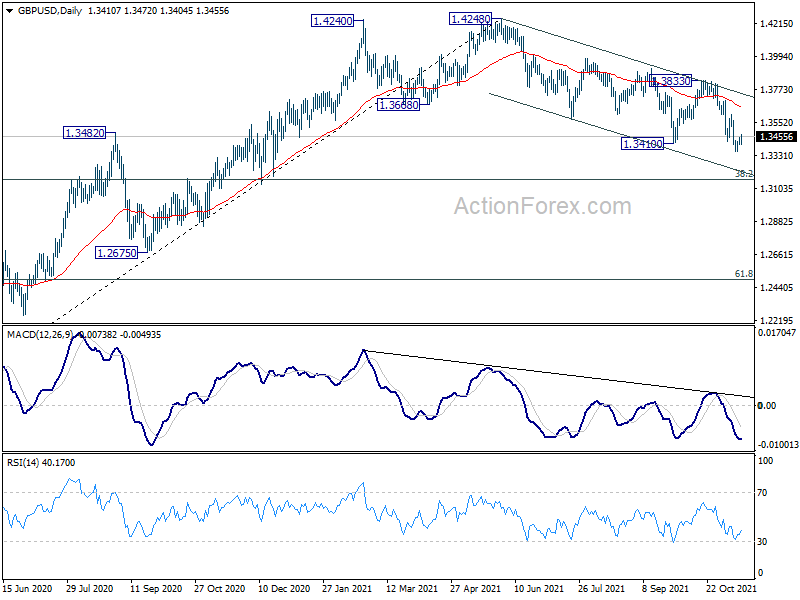
In the bigger picture, the structure of the fall from 1.4248 suggests that it's a correction to the up trend from 1.1409 (2020 low) only. While deeper fall cannot be ruled out yet, downside should be contained by 38.2% retracement of 1.1409 to 1.4248 at 1.3164, at least on first attempt, to bring rebound. On the upside, firm break of 1.4376 key resistance (2018 high) will add to the case of long term bullish reversal. However, sustained trading below 1.3164 will revive some medium term bearishness and target 61.8% retracement at 1.2493.
Sterling Rises on Solid Job Data, Dollar Firm on Retail Sales
Sterling rises broadly today with help from solid job data, which eased the concerns over the impact of end of furlough scheme. Dollar is also firm as supported by better than expected retail sales sales. Euro is trying to digest some losses but stays weak on dovish ECB expectations. On the other hand, commodity currencies are turning softer on mixed risk sentiments.
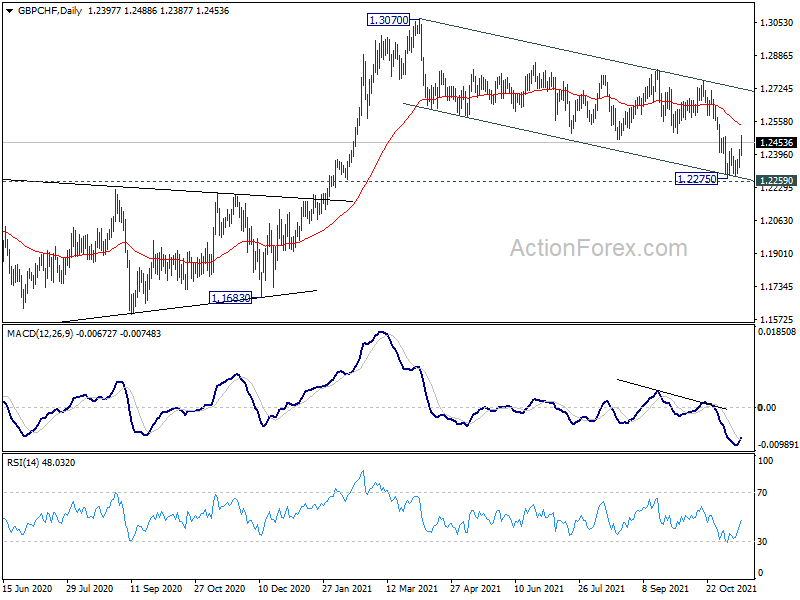
Technically, GBP/CHF's strong rebound today argues that 1.2259 key resistance turned support was well defended, for now. Focus is now on 55 day EMA (now at 1.2542). Sustained break there will raise the chance that medium term correction from 1.3070 has completed and affirms underlying resilience of the Pound.
In Europe, at the time of writing, FTSE is down -0.07%. DAX is up 0.40%. CAC is up 0.34%. Germany 10-year yield is down -0.007 at -0.233. Earlier in Asia, Nikkei rose 0.11%. Hong Kong HSI rose 1.27%. China Shanghai SSE dropped -0.33%. Singapore Strait Times dropped -0.05%. Japan 10-year JGB yield rose 0.0076 to 0.076.
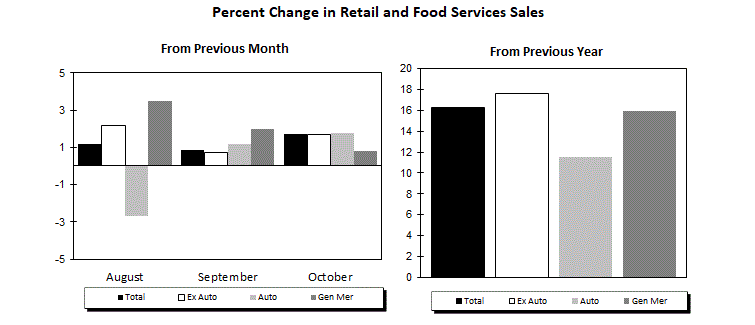
US retail sales rose 1.7% mom in Oct, ex-auto sales up 1.7% mom
US retail sales rose 1.7% mom in to USD 638.2B in October, above expectation of 1.2% mom. Total sales for the August through October period were up 15.4% from the same period a year ago.
Ex-auto sales rose 1.7% mom, above expectation of 1.2% mom. Ex-gasoline sales rose 1.5% mom. Ex-auto, ex-gasoline sales rose 1.4% mom.
Import price index rose 1.2% mom, versus expectation of 1.0% mom.
Eurozone GDP grew 2.2% qoq in Q3, EU rose 2.1% qoq
According to flash estimate, Eurozone GDP grew 2.2% qoq in Q3, 3.7% yoy. Employment grew 0.9% qoq, 2.0% yoy.
EU GDP grew 2.1% qoq, 3.9% yoy. Employment grew 0.9% qoq, 2.1% yoy.
UK unemployment rate dropped to 4.3%, employment rate rose to 75.4%
UK unemployment rate dropped to 4.3% in the three months to September, down from 4.5%, better than expectation of 4.5%. Employment rate rose 0.4% to 75.4%, "driven by a record high net flow from unemployment to employment". Payrolled employment rose 160k.
Wage growth disappointed, however, with average earnings excluding bonus up 4.9% 3moy versus expectation of 6.0%. Average earnings including bonus rose 5.8% 3moy, versus expectation of 7.0%. in October, claimant count dropped -14.9k.
RBA Lowe: Still plausible that rate won't be raised before 2024
In a speech, RBA Governor Philip Lowe reiterated, "the latest data and forecasts do not warrant an increase in the cash rate in 2022." Also, it's "still plausible that the first increase in the cash rate will not be before 2024" even if underlying inflation hits 2.5%.
He said, the central scenario is that underlying inflation will reach "middle of the target by the end of 2023". That would be the first time in nearly seven years that inflation is at the mid-point. And, "this, by itself, does not warrant an increase in the cash rate."
For rate hike, RBA would like to see inflation "well within the 2–3 per cent range", and, " have a reasonable degree of confidence that it will not fall back again". The "trajectory" is important, "with a slow drift up in underlying inflation having different policy implications to a sharp rise."
Another important consideration will be developments in the labor market. wages growth is used as one of the "guideposts" and "it is likely that wages will need to be growing at 3 point something per cent to sustain inflation around the middle of the target band."
GBP/USD Mid-Day Outlook
Daily Pivots: (S1) 1.3394; (P) 1.3422; (R1) 1.3440; More...
GBP/USD's recovery from 1.3351 extends higher today but outlook is unchanged. Intraday bias remains neutral first. Upside of recovery should be limited below 1.3606 resistance to bring down trend resumption. On the downside, break of 1.3351 will extend the decline from 1.4248 to 1.3164 fibonacci level next.
In the bigger picture, the structure of the fall from 1.4248 suggests that it's a correction to the up trend from 1.1409 (2020 low) only. While deeper fall cannot be ruled out yet, downside should be contained by 38.2% retracement of 1.1409 to 1.4248 at 1.3164, at least on first attempt, to bring rebound. On the upside, firm break of 1.4376 key resistance (2018 high) will add to the case of long term bullish reversal. However, sustained trading below 1.3164 will revive some medium term bearishness and target 61.8% retracement at 1.2493.
Economic Indicators Update
| GMT | Ccy | Events | Actual | Forecast | Previous | Revised |
|---|---|---|---|---|---|---|
| 00:30 | AUD | RBA Minutes | ||||
| 02:30 | AUD | RBA's Governor Lowe speech | ||||
| 04:30 | JPY | Tertiary Industry Index M/M Sep | 0.50% | 0.90% | -1.70% | -1.10% |
| 07:00 | GBP | Claimant Count Change Oct | -14.9K | -51.1K | ||
| 07:00 | GBP | ILO Unemployment Rate (3M) Sep | 4.3 | 4.50% | 4.50% | |
| 07:00 | GBP | Average Earnings Excluding Bonus 3M/Y Sep | 4.90% | 6.00% | 6.00% | |
| 07:00 | GBP | Average Earnings Including Bonus 3M/Y Sep | 5.80% | 7.00% | 7.20% | |
| 10:00 | EUR | Eurozone GDP Q/Q Q3 P | 2.20% | 2.20% | 2.20% | |
| 10:00 | EUR | Eurozone Employment Change Q/Q Q3 P | 0.90% | 0.60% | 0.70% | |
| 13:15 | CAD | Housing Starts Y/Y Oct | 237K | 265K | 251K | 250K |
| 13:30 | USD | Retail Sales M/M Oct | 1.70% | 1.20% | 0.70% | |
| 13:30 | USD | Retail Sales ex Autos M/M Oct | 1.70% | 1.00% | 0.80% | |
| 13:30 | USD | Import Price Index M/M Oct | 1.20% | 1.00% | 0.40% | |
| 14:15 | USD | Industrial Production M/M Oct | 0.90% | -1.30% | ||
| 14:15 | USD | Capacity Utilization Oct | 75.90% | 75.20% | ||
| 15:00 | USD | Business Inventories Sep | 0.50% | 0.60% | ||
| 15:00 | USD | NAHB Housing Market Index Nov | 80 | 80 |
US retail sales rose 1.7% mom in Oct, ex-auto sales up 1.7% mom
US retail sales rose 1.7% mom in to USD 638.2B in October, above expectation of 1.2% mom. Total sales for the August through October period were up 15.4% from the same period a year ago.
Ex-auto sales rose 1.7% mom, above expectation of 1.2% mom. Ex-gasoline sales rose 1.5% mom. Ex-auto, ex-gasoline sales rose 1.4% mom.
Aussie Calm after RBA Minutes
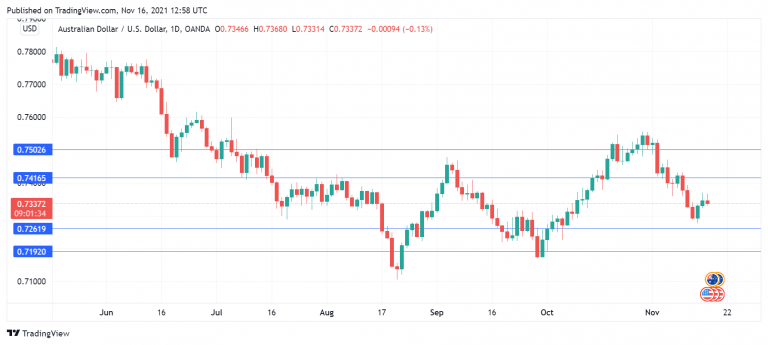
The Australian dollar is drifting in the Tuesday session. AUD/USD is currently trading at 0.7341, down 0.07% on the day.
RBA minutes preach patience
There were no surprises from the RBA minutes, as policymakers indicated that the current pace of QE was appropriate and the cash rate would remain at 0.10% until 2024 or until wages and inflation targets are met. In a speech given after the release of the minutes, Governor Lowe reiterated this point, saying that wages would have to rise to above 3% in order to sustain inflation in the middle of the bank’s target band of 2-3%. Lowe added that wage growth was only one indicator that would determine rate policy.
Perhaps Lowe’s most telling comment was that “the latest data and forecasts do not warrant an increase in the cash rate in 2022”. The Governor is clearly trying to push back against market expectations, which are much more hawkish than those of the central bank. The markets have priced in at least three rate hikes in 2022. It seems that the disconnect between RBA guidance and market expectations will continue for some time. If additional data points to inflation continuing to gallop at high levels, Lowe may find that the markets have tuned out from his message that inflation is transitory.
In the US, inflation has hit its highest level in 30 years, a situation which the Fed is finding increasingly difficult to ignore. The Fed announced earlier this month that it would taper its bond program, but the voices calling for a faster reduction are getting louder. Former New York Fed President Bill Dudley, former US Treasury Secretary Lawrence Summers and other officials are urging the Fed to speed up tapering. The cautious Fed will have to address this issue at its December meeting, but will see the October PCE index, its preferred inflation gauge, as well as the November CPI report ahead of the meeting. The argument against accelerating tapering is that it could trigger a taper tantrum, which occurred back in 2013 and caused a spike in US Treasury yields.
AUD/USD Technical
- There are resistance lines at 0.7416, and 0.7502
- We find support at 0.7261 and 0.7192
Markets Lacking Momentum
There isn't an enormous amount of momentum in the markets at the moment and that's being reflected in stocks which are once again treading water on Tuesday.
Europe is on a slightly positive trajectory but we're talking incremental gains each day that don't add up to much and could collectively be wiped out in a moderately negative session. The US, as we're seeing in large parts of Asia, is a little choppy and not making any significant moves in either direction, with Wall Street eyeing a slightly positive open. Asia ended the day a little mixed with the Hang Seng standing alone in making decent strides forward while other indices were broadly a little lower.
We still seem to be caught between two strong counter-forces, a strong earnings season providing the bullish case and a long list of downside risks - most notably inflation and interest rates - which continue to weigh on sentiment. This could make for some choppy trading into year-end although it's notable that we're seeing strong resilience despite all of the uncertainty around central banks.
One additional layer of uncertainty is who will lead the Federal Reserve out of the pandemic, with the position reportedly down to two candidates - Chair Jerome Powell and Governor Lael Brainard.
A decision is reportedly due very soon and based on how markets reacted when they learned Brainard was in the running, it's clear who's viewed as the more dovish between the two. Ordinarily, that would make her the stock markets pick but that may not necessarily be the case if investors view inflation as a greater risk than the central bank perceives, making inaction the less desirable approach longer term.
UK labour market paves way for December BoE hike
Data released this morning suggest the UK labour market is in a far healthier position than many feared. We'll have to wait a month to see what the full hit will be, with today's unemployment data only covering the three months to September, after which the furlough ended. But what we did see from the report in relation to October payrolls was encouraging. Which makes the December BoE meeting very much a live one.
This follows comments from Andrew Bailey on Monday when he reiterated that the central bank held off on raising rates this month in order to assess the state of the labour market in the aftermath of the furlough scheme. The picture will be clearer again when the October report is released two days before the MPC meeting.
Today's report, along with comments from MPC members yesterday, suggests that the majority of the 1.1 million people that were still using the furlough scheme in September have returned to work. Of course, this doesn't tell us about the number who went back on reduced hours and now qualify as underemployed, contributing to the slack in the labour market. The question now becomes how much demand there'll now be to fill a large number of vacancies without putting much upward pressure on wages and inflation.
Meanwhile, flash GDP data showed growth in the euro area rising 2.2% in the third quarter, leaving the economy just 0.5% smaller than the final quarter of 2019. Employment also rose by 0.9% in the last quarter. Surges in virus cases, supply problems, slowing Chinese growth and more will continue to be major headwinds for the economy in the current quarter when growth is expected to slow.
Oil edges higher off lows
Oil prices are marginally higher on Tuesday after once again seeing strong support around early November lows. We've seen the rally lose momentum recently as growth slows in the final quarter of the year, OPEC revises down demand growth and the White House threatens to release reserves from the SPR.
We've seen some incredible gains in the oil price this past few months as OPEC+ has resisted raising its output target, despite mounting pressure from consuming countries. Higher oil prices are contributing to inflationary pressures and are another headwind for the economic recovery this winter.
We could see prices pull back a little further if the economy continues to slow and rising virus cases further weigh on demand, as OPEC+ has anticipated, but this remains a bullish market and I expect dips continue to attract plenty of interest.
Gold rally losing momentum ahead of Retail Sales
Gold is pushing higher once again, supported by higher inflation indicators which continue to push down real yields. The yellow metal is traditionally viewed as a hedge against inflation and that's exactly what we appear to be seeing now. The last couple of weeks has delivered strong gains for gold which now has its sights set on the summer highs above $1,900.
We shouldn't get too carried away yet though. It's up more than 5% from its November lows and quickly losing momentum, which should catch up at some point. Of course, it could regain momentum, say following the US retail sales report today, but recent trading suggests it's running out of steam and a correction may be on the cards.
Deeper correction for Bitcoin?
In a sign of how different asset classes can be, while I've just referred to a 5% gain in gold over a couple of weeks as being very strong, today's 5% decline in bitcoin is anything but extraordinary. No panic is setting in when bitcoin slips 5% in the way it would for the yellow metal.
The cryptocurrency has quickly seen support around $58,500 after breaking below $60,000, where it also rebounded off just a few weeks ago. A break of this level may point to a deeper downturn, with attention perhaps shifting back towards the $50,000 region, but as ever with bitcoin that is never clear. There is incredible support in the space and a big rally towards the highs never feels that far away.