

Sample Category Title
GBP/USD Daily Outlook
Daily Pivots: (S1) 1.3396; (P) 1.3435; (R1) 1.3464; More...
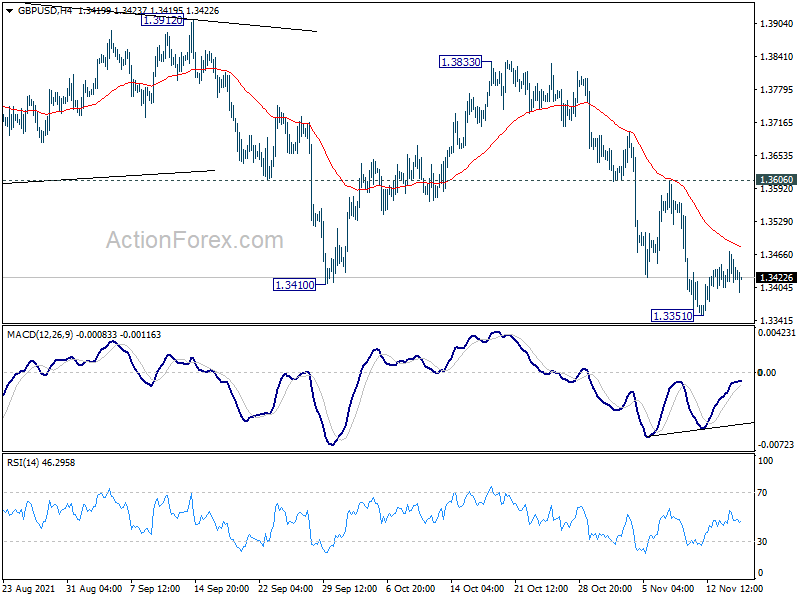
GBP/USD is staying in consolidation from 1.3351 and intraday bias remains neutral for the moment. Upside of recovery should be limited below 1.3606 resistance to bring down trend resumption. On the downside, break of 1.3351 will extend the decline from 1.4248 to 1.3164 fibonacci level next.
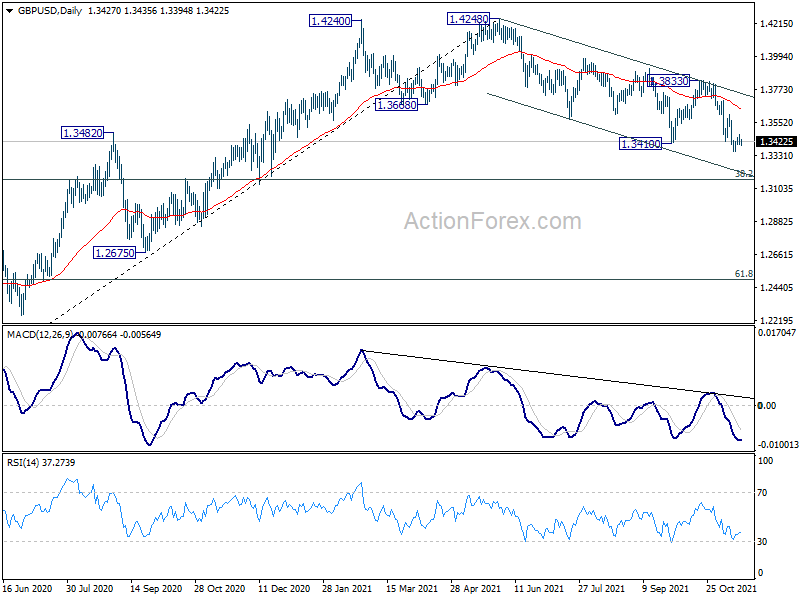
In the bigger picture, the structure of the fall from 1.4248 suggests that it's a correction to the up trend from 1.1409 (2020 low) only. While deeper fall cannot be ruled out yet, downside should be contained by 38.2% retracement of 1.1409 to 1.4248 at 1.3164, at least on first attempt, to bring rebound. On the upside, firm break of 1.4376 key resistance (2018 high) will add to the case of long term bullish reversal. However, sustained trading below 1.3164 will revive some medium term bearishness and target 61.8% retracement at 1.2493.
EUR/USD Daily Outlook
Daily Pivots: (S1) 1.1290; (P) 1.1338; (R1) 1.1366; More...
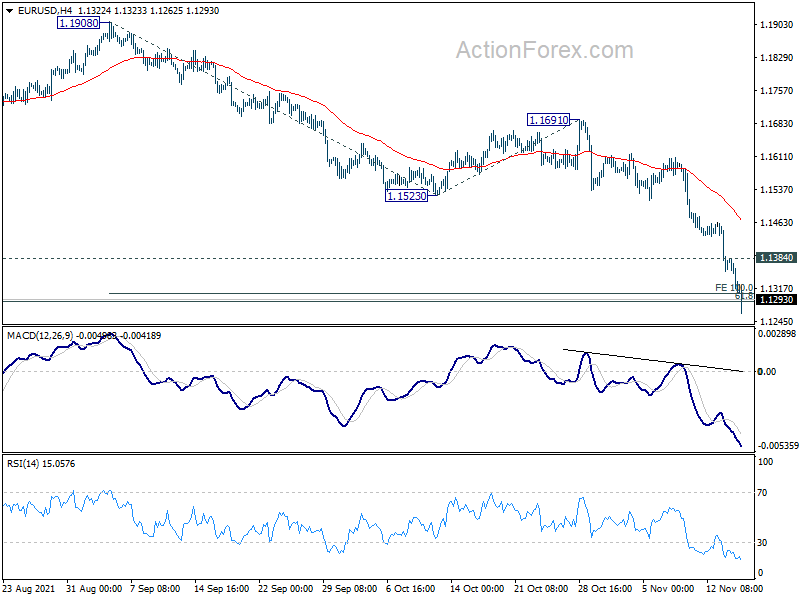
EUR/USD's fall accelerates to as low as 1.1262 so far today and intraday bias stays on the downside. Sustained break of 1.1289 long term fibonacci level will carry larger bearish implication. Next target will be 161.8% projection of 1.1908 to 1.1523 from 1.1691 at 1.1068. On the upside, above 1.1384 minor resistance will turn intraday bias neutral first. But outlook will remain bearish as long as 1.1523 support turned resistance holds.
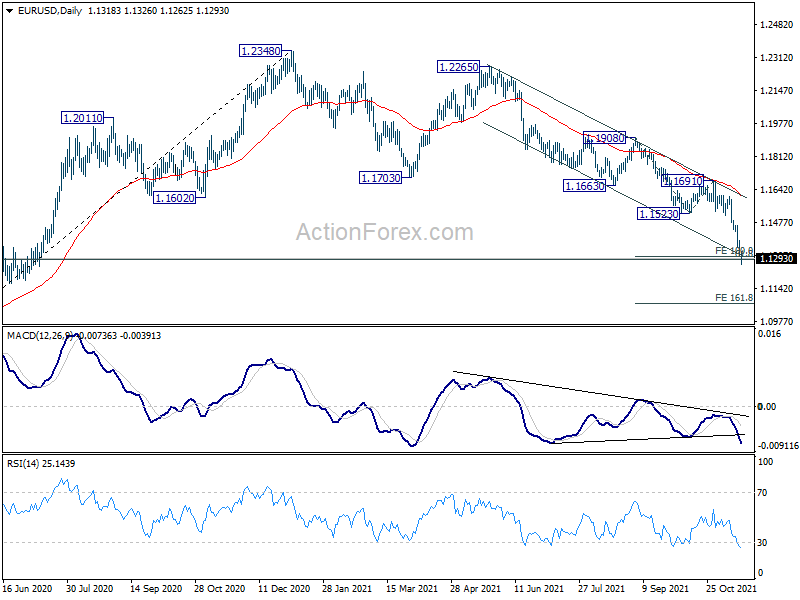
In the bigger picture, there are various ways of interpreting the fall from 1.2348 (2021 high). It could be a correction to rise from 1.0635 (2020 low), the fourth leg of a sideway pattern from 1.0339 (2017 low), or resuming long term down trend. In any case, outlook will now stay bearish as long as 1.1703 support turned resistance holds. Sustained break of 61.8% retracement of 1.0635 to 1.2348 at 1.1289 would pave the way back to 1.0635.
Dollar Extends Rally as Focus Turns to UK and Canada CPI
Dollar's rally extends in Asian session, with EUR/USD breaching 1.13 key support zone. Meanwhile, USD/JPY also breaks 114.86 near term top. Sterling is so far very resilient as markets await inflation data from the UK. Canadian Dollar is just mixed ahead of Canada CPI. Much volatility is likely in the day ahead. In other markets, Gold is back at around 1850 after failing rally attempt. WTI crude oil continues to defend 80 handle.
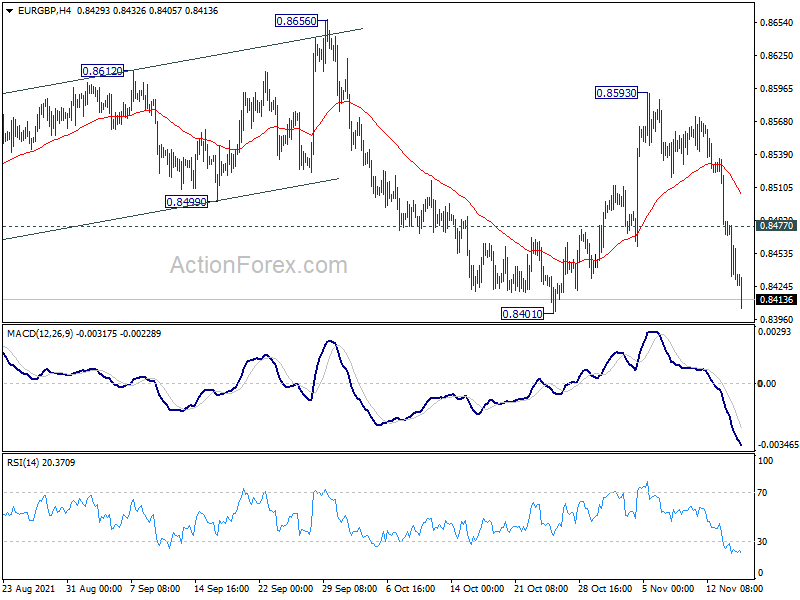
Technically, EUR/GBP is also a pair to watch ahead. Firm break of 0.8401 will resume medium term down trend towards key long term support level at 0.8276. Euro's broad based selloff could further intensify with such development. However, rebound from current level, followed by break of 0.8477 minor resistance will indicate temporary easing of selling pressure, which might be accompanied by recovery in EUR/USD and EUR/CHF.
In Asia, at the time of writing, Nikkei is down -0.30%. Hong Kong HSI is down -0.26%. China Shanghai SSE is up 0.29%. Singapore Strait Times is down -0.30%. Japan 10-year JGB yield is down -0.0010 at 0.075. Overnight, DOW rose 0.15%. S&P 500 rose 0.39%. NASDAQ rose 0.76%. 10-year yield rose 0.011 to 1.634.
BoC Schembri: Rate to stay at ELB until excess capacity is absorbed
BoC Deputy Governor Lawrence Schembri said yesterday, "Our assessment of labour market conditions and underlying capacity and inflationary pressures is now more difficult. Consequently, more uncertainty exists around the timing of when the output gap will close and inflation will return sustainably to our 2-per-cent target."
"We'll keep the policy rate at the effective lower bound [0.25%] until excess capacity is absorbed … that excess capacity includes all the groups of employees that aren't fully employed at this juncture," Schembri said in response to a question after the speech.
"Now of course, one has to take into account that there's going to be some natural friction in the labour market, people are going to move between jobs, so we're not saying that there has to be zero unemployment," he added.
Fed Daly: Ready to act as we get clearer signal
San Francisco Fed Bank President Mary Daly urged patience in assess the economic development before acting on interest rates. "Reacting in response to things that aren't likely to last will move us farther from — not closer to — our goals," she said.
"Over the next several quarters, as tapering occurs, we will watch how the economy does and see whether inflation eases and workers come back."
"As we get a clearer signal, we will be ready to act accordingly, continuing to provide or remove support as needed to ensure the economy settles at a sustainable place."
Japan exports growth slowed to 9.4% yoy on fall in car shipments
Japan exports rose 9.4% yoy to JPY 7.18B in October. That was the slowest expansion since a decline in February. By region, exports to China rose 9.5% yoy, slowed from 10.3% yoy in the prior month, on -46.8% yoy fall in car shipments. Exports to US grew just 0.4% yoy, also weighed down by -46.4% yoy fall in car exports. Imports rose 26.7% yoy to JPY 7.25B. Trade balance came at as JPY -0.07B deficit
In seasonally adjusted terms exports rose 2.7% mom to JPY 6.93B while imports rose 0.3% mom to JPY 7.38B. Trade deficit came in at JPY -0.44B.
Also from Japan, machine orders rose 0.0% mom in September, versus expectation of 1.8% mom.
Australia wage price index rose 0.6% qoq in Q3
Australia wage price index rose 0.6% qoq 2.2% yoy in Q3. Private sector rose 0.6% qoq, 2.4% yoy. Public sector rose 0.5% qoq, 1.7% yoy. The three largest states were the main contributors to growth, New South Wales, Victoria, and Queensland. The most significant industries to contribute to growth this quarter were the Professional, scientific and technical services, Health care and social assistance and Construction industries.
Westpac leading index rose 0.20% mom in October.
From New Zealand, PPI input rose 1.6% qoq in Q3, versus expectation of 1.7% qoq. PPI output rose 1.8% qoq, versus expectation of 1.4% qoq.
Looking ahead
UK CPI and PPI will be the main focus in European session. Eurozone will release CPI final too. Later in the day, Canada CPI will take center stage. US will release building permits and housing starts.
EUR/USD Daily Outlook
Daily Pivots: (S1) 1.1290; (P) 1.1338; (R1) 1.1366; More...
EUR/USD's fall accelerates to as low as 1.1262 so far today and intraday bias stays on the downside. Sustained break of 1.1289 long term fibonacci level will carry larger bearish implication. Next target will be 161.8% projection of 1.1908 to 1.1523 from 1.1691 at 1.1068. On the upside, above 1.1384 minor resistance will turn intraday bias neutral first. But outlook will remain bearish as long as 1.1523 support turned resistance holds.
In the bigger picture, there are various ways of interpreting the fall from 1.2348 (2021 high). It could be a correction to rise from 1.0635 (2020 low), the fourth leg of a sideway pattern from 1.0339 (2017 low), or resuming long term down trend. In any case, outlook will now stay bearish as long as 1.1703 support turned resistance holds. Sustained break of 61.8% retracement of 1.0635 to 1.2348 at 1.1289 would pave the way back to 1.0635.
Economic Indicators Update
| GMT | Ccy | Events | Actual | Forecast | Previous | Revised |
|---|---|---|---|---|---|---|
| 21:45 | NZD | PPI Input Q/Q Q3 | 1.60% | 1.70% | 3.00% | |
| 21:45 | NZD | PPI Output Q/Q Q3 | 1.80% | 1.40% | 2.60% | |
| 23:30 | AUD | Westpac Leading Index M/M Oct | 0.20% | 0.00% | ||
| 23:50 | JPY | Machinery Orders M/M Sep | 0.00% | 1.80% | -2.40% | |
| 00:30 | AUD | Wage Price Index Q/Q Q3 | 0.60% | 0.50% | 0.40% | |
| 07:00 | GBP | CPI M/M Oct | 0.80% | 0.30% | ||
| 07:00 | GBP | CPI Y/Y Oct | 3.80% | 3.10% | ||
| 07:00 | GBP | Core CPI Y/Y Oct | 3.00% | 2.90% | ||
| 07:00 | GBP | RPI M/M Oct | 1.00% | 0.40% | ||
| 07:00 | GBP | RPI Y/Y Oct | 5.60% | 4.90% | ||
| 07:00 | GBP | PPI Input M/M Oct | 1.10% | 0.40% | ||
| 07:00 | GBP | PPI Input Y/Y Oct | 11.60% | 11.40% | ||
| 07:00 | GBP | PPI Output M/M Oct | 0.70% | 0.50% | ||
| 07:00 | GBP | PPI Output Y/Y Oct | 6.80% | 6.70% | ||
| 07:00 | GBP | PPI Core Output M/M Oct | 0.70% | 0.50% | ||
| 07:00 | GBP | PPI Core Output Y/Y Oct | 6.50% | 5.90% | ||
| 10:00 | EUR | Eurozone CPI Y/Y Oct F | 4.10% | 4.10% | ||
| 10:00 | EUR | Eurozone CPI Core Y/Y Oct F | 2.10% | 2.10% | ||
| 13:30 | CAD | CPI M/M Oct | 0.70% | 0.20% | ||
| 13:30 | CAD | CPI Y/Y Oct | 4.70% | 4.40% | ||
| 13:30 | CAD | CPI Common Y/Y Oct | 1.90% | 1.80% | ||
| 13:30 | CAD | CPI Median Y/Y Oct | 2.90% | 2.80% | ||
| 13:30 | CAD | CPI Trimmed Y/Y Oct | 3.40% | 3.40% | ||
| 13:30 | USD | Building Permits Oct | 63M | 1.59M | ||
| 13:30 | USD | Housing Starts Oct | 1.58M | 1.56M | ||
| 15:30 | USD | Crude Oil Inventories | 1.0M | 1.0M |
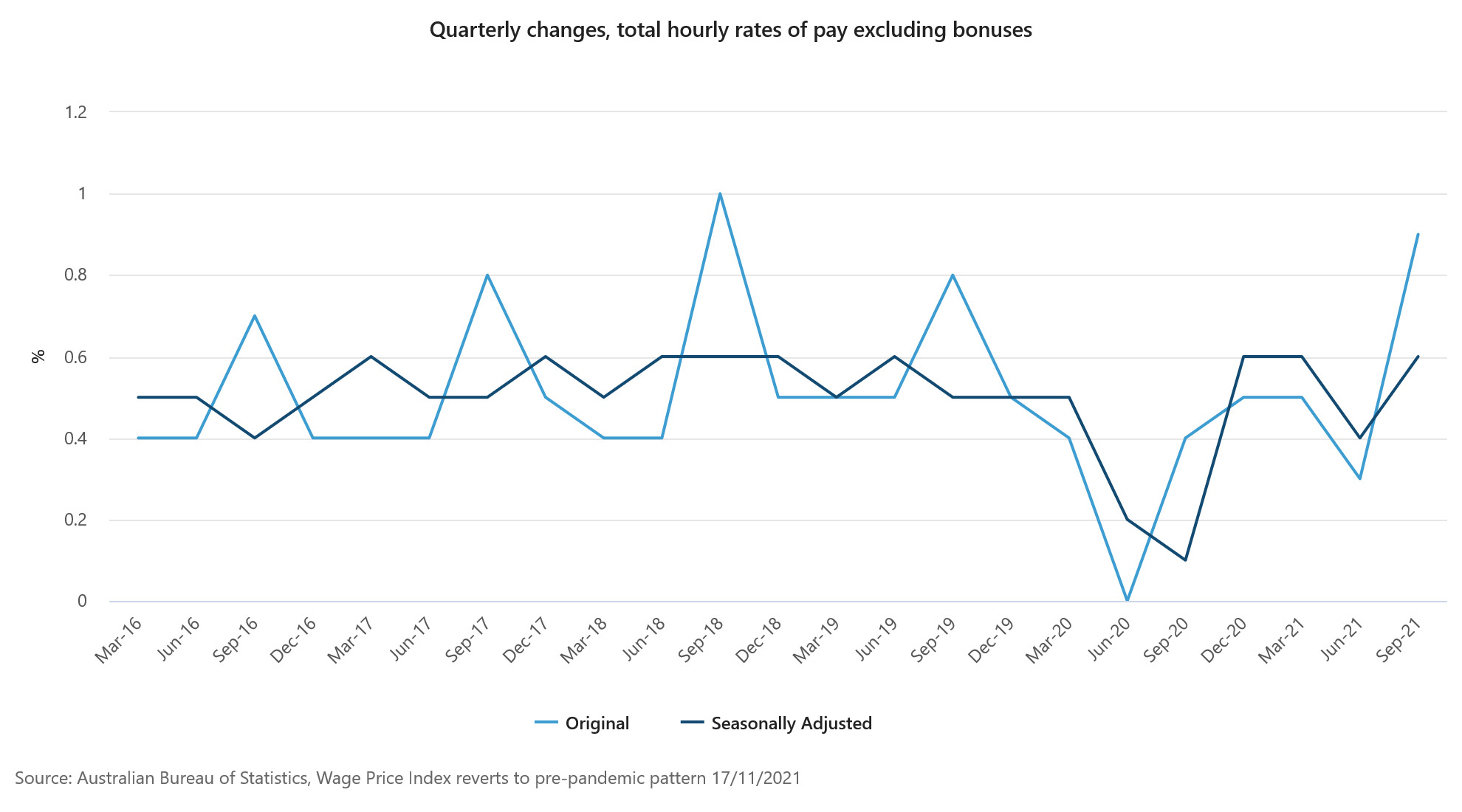
Australia wage price index rose 0.6% qoq in Q3, back to pre-pandemic pattern
Australia wage price index rose 0.6% qoq 2.2% yoy in Q3. Private sector rose 0.6% qoq, 2.4% yoy. Public sector rose 0.5% qoq, 1.7% yoy. The three largest states were the main contributors to growth, New South Wales, Victoria, and Queensland. The most significant industries to contribute to growth this quarter were the Professional, scientific and technical services, Health care and social assistance and Construction industries.
Michelle Marquardt, Head of Prices Statistics at the ABS, said: "This release of WPI shows the return of a more regular September quarter pattern of wage growth, following the labour market disruptions through 2020 and 2021.
"Wage and salary reviews around the end of the financial year, scheduled enterprise agreements and annual award rises all contributed to growth. Pockets of wage pressure continued to build for skilled construction-related, technical and business services roles, leading to larger ad hoc rises as businesses looked to retain experienced staff and attract new staff."
Japan exports growth slowed to 9.4% yoy on fall in car shipments
Japan exports rose 9.4% yoy to JPY 7.18B in October. That was the slowest expansion since a decline in February. By region, exports to China rose 9.5% yoy, slowed from 10.3% yoy in the prior month, on -46.8% yoy fall in car shipments. Exports to US grew just 0.4% yoy, also weighed down by -46.4% yoy fall in car exports. Imports rose 26.7% yoy to JPY 7.25B. Trade balance came at as JPY -0.07B deficit
In seasonally adjusted terms exports rose 2.7% mom to JPY 6.93B while imports rose 0.3% mom to JPY 7.38B. Trade deficit came in at JPY -0.44B.
Also from Japan, machine orders rose 0.0% mom in September, versus expectation of 1.8% mom.
Fed Daly: Ready to act as we get clearer signal
San Francisco Fed Bank President Mary Daly urged patience in assess the economic development before acting on interest rates. "Reacting in response to things that aren't likely to last will move us farther from — not closer to — our goals," she said.
"Over the next several quarters, as tapering occurs, we will watch how the economy does and see whether inflation eases and workers come back."
"As we get a clearer signal, we will be ready to act accordingly, continuing to provide or remove support as needed to ensure the economy settles at a sustainable place."
EURUSD Elliott Wave View: Further Weakness Expected
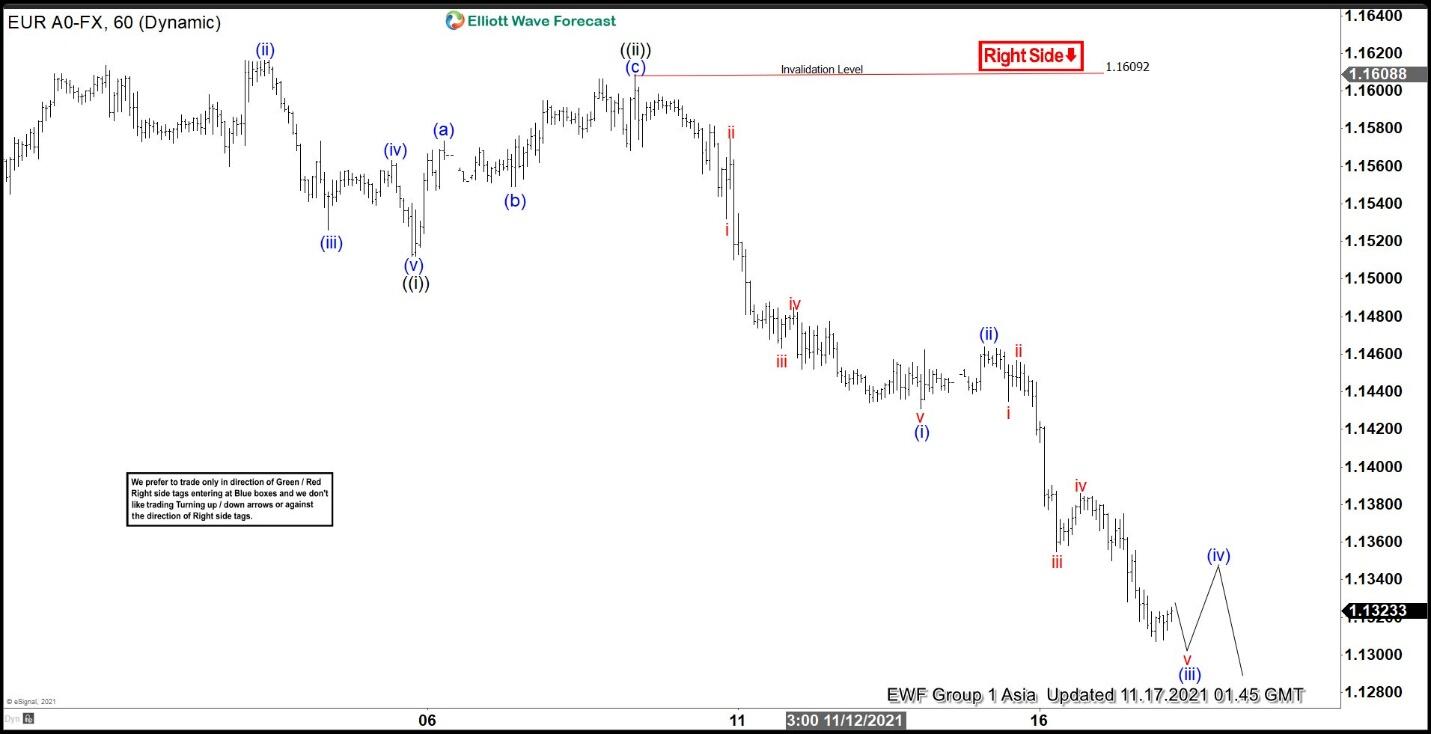
Short Term Elliott Wave view on EURUSD suggests the decline from October 28 peak is unfolding as a 5 waves impulse Elliott Wave structure. Down from October 28, wave (i) ended at 1.1533 and rally in wave (ii) ended at 1.16164. Pair then extends lower in wave (iii) towards 1.1526 and bounce in wave (iv) ended at 1.1563. Pair extends in another leg lower in wave (v) towards 1.1512 to complete wave ((i)) in higher degree.
Wave ((ii)) rally ended at 1.1608 with internal subdivision as a zigzag. Up from wave ((i)), wave (a) ended at 1.1573, wave (b) ended at 1.1549, and wave (c) ended at 1.1608. Pair then resumes lower in wave ((iii)) which is currently still in progress as an impulse in lesser degree. Down from wave ((ii)), wave (i) ended at 1.143 and rally in wave (ii) ended at 1.1464. Expect wave (iii) to end soon, then pair should bounce in wave (iv) before turning lower again in wave (v) to end wave ((iii)). Near term, as far as pivot at 1.1608 stays intact, expect rally to fail in 3, 7, or 11 swing for further downside.
EURUSD 60 Minutes Elliott Wave Chart
Aust Wages, Back To Pre-Covid Gains But Still Well Short Of 3%Yr
The Q3 Wage Price Index (WPI) lifted 0.6%qtr/2.2%yr. Wages are lifting in sectors with tight labour markets but yet to spread more widely.
- The WPI lifted 0.6% in the September quarter, a bit strong than Westpac’s 0.5% forecast of 0.5% but spot on the market’s 0.6% estimate. This followed a modest 0.4% gain in Q2 which surprised us given it followed two solid 0.6% quarterly increases but, to be fair, those increases were a bounce back from the two softest quarters (0.1% in Q3 2020 and 0.2% in Q2 2020) in the history of the series.
- With the base effects of those two soft quarters dropping out the annual rate lifted to 2.2%, the fastest pace since Q3 2019.
- While slightly higher than Westpac’s expectations this number is just return to pre-Covid rates where wages were underperforming economic activity and so sit sits comfortably within the RBA’s view on wages.
- The ABS noted that the quarterly gain was due to wage and salary reviews around the end of the financial year, scheduled enterprise agreements and annual award rises.
The 0.6% increase in private sector wages the ABS described as being in line with pre-pandemic September outcomes. With base effects the annual pace of private sector wages lifted 0.5ppt to 2.4%yr, the fastest pace since March 2019. The ABS noted more employers conducting salary reviews than observed at the same time last year, when COVID-19 had a bigger influence on business operations. Small, isolated pockets of demand across a number of industries saw larger increases paid to attract and retain experienced staff.
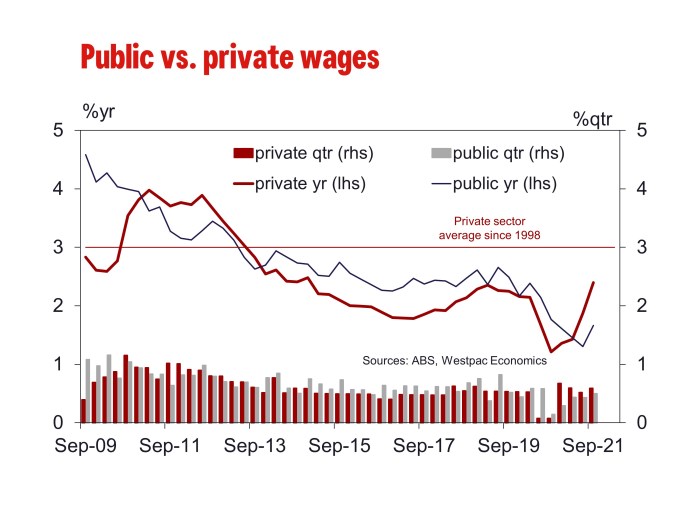
There has been a lot of press lately of bonus being paid to entice experienced workers by various employers. However, the private sector with bonuses series (seasonally adjusted by Westpac) also lifted 0.6% to be up 2.2%yr. It appears that the use of bonus are, at this stage, not as widespread as reported. 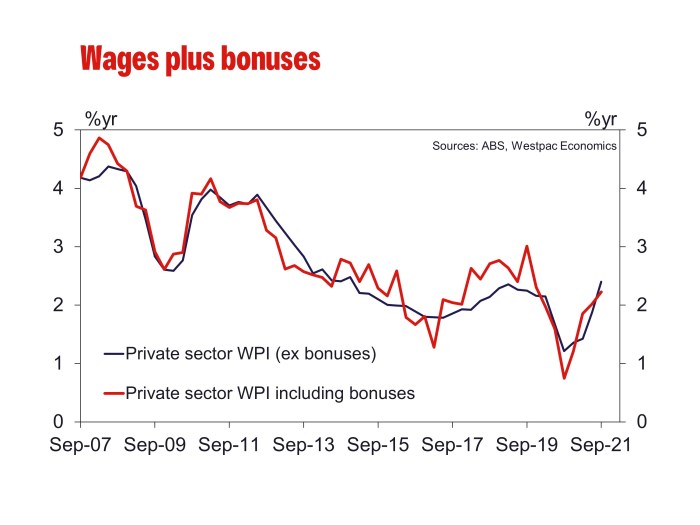 Public sector wage increases improved with a 0.5% gain, the largest quarterly increase since June 2020, lifting the annual pace to 1.7%yr from 1.3%yr (a record low). The ABS noted that this quarter saw a return to regular scheduled increases after a period of public sector wage freezes.
The following data has been seasonally adjusted by Westpac.
The sector with the strongest rise in wages was construction up 1.0% in the quarter (2.6%yr) which was the strongest quarterly print since December 2012. The next strongest was professional, scientific & technical services at 0.9% and as this sector has been running ahead of the average the annual pace lifted to 3.4%.
Retail trade had the weakest gain of just 0.1% but due to base effect of the weakest quarters rolling out the annual pace lifted from 1.6%yr to 2.1%yr.
In the June quarter we were disappointed that the improvement in the Victorian labour market was yet to be reflected in an improvement in wages there. There was a turn around in the September quarter with wages lifting by 0.8% in that state for a 2.5%yr pace. Wages lifted 0.6% in NSW (2.1%yr) and 0.5% in Qld (2.0%yr).
Individual bargaining arrangements are the most responsive to economic conditions and even saw wages decline in June 2020. Of the 0.9% in the original (not seasonally adjusted) rise in the September WPI 0.44ppt came from individual arrangements, 0.34ppt via enterprise agreements and just 0.1ppt from awards. At this stage individual arrangements are not running that much stronger than enterprise agreements suggesting we are just getting back to pre-Covid wages inflation which at 2.0%yr to 2.4%yr is still well short of the RBA goal of 3%yr.
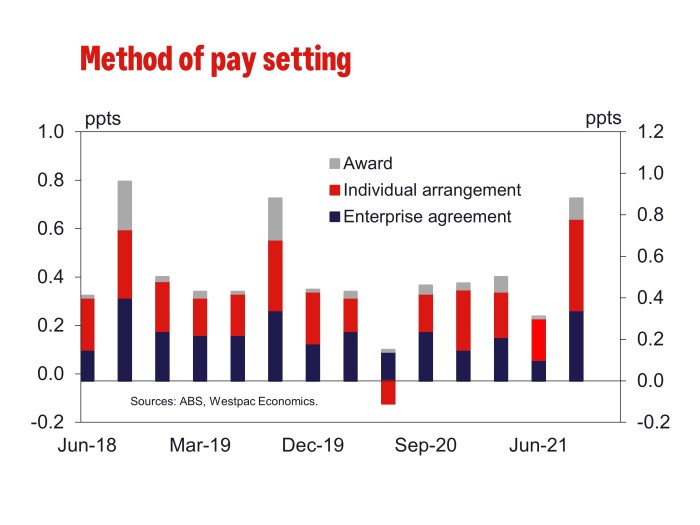 While wages have indeed lifted in industries where labour shortages are more pronounced, we are yet to see broader wage gains. What will be critical is how higher wage outcomes in these sectors, via individual bargaining arrangements, spread to the minimum wage and enterprise bargaining. In 2021 the increase in the minimum wage was 2.50%, up from 1.75% in 2020 but still less than 3.0% in 2019 and 3.5% in 2018. We suspect that in 2022 the minimum wage outcome is likely to be closer to the 2018 outcome than 2019. At this stage enterprise bargaining yet to show a meaningful lift but it should soon appear in any construction agreements being negotiated.
BoC Schembri: Rate to stay at ELB until excess capacity is absorbed
BoC Deputy Governor Lawrence Schembri said yesterday, "Our assessment of labour market conditions and underlying capacity and inflationary pressures is now more difficult. Consequently, more uncertainty exists around the timing of when the output gap will close and inflation will return sustainably to our 2-per-cent target."
"We'll keep the policy rate at the effective lower bound [0.25%] until excess capacity is absorbed … that excess capacity includes all the groups of employees that aren't fully employed at this juncture," Schembri said in response to a question after the speech.
"Now of course, one has to take into account that there's going to be some natural friction in the labour market, people are going to move between jobs, so we're not saying that there has to be zero unemployment," he added.
BoC: Uncertainties in the Labour Market Have Risen Due to the Pandemic
In today's speech, Deputy Governor Larry Schembri explored the impact of the pandemic on Canada's labour market. Specifically, he aimed to shed light on the question of how monetary policy can adapt and promote an inclusive recovery. To answer this question, Deputy Governor Schembri looked at two labour market uncertainties: the maximum level of sustainable employment and the relationship between labour market tightness and inflation.
On the maximum level of sustainable employment, Deputy Governor Larry Schembri clarified that this concept refers to "the highest level of employment that the economy can sustain without triggering inflationary pressure". Structural changes such as an aging population, immigration, globalization, and technological change can all impact the maximum level. With COVID-19 accelerating some pre-pandemic trends, and upending others, it's become harder to assess the overall state of employment and capacity pressures. Next, on the relationship between labour market tightness and inflation, also known as the Phillips curve, Deputy Governor Schembri explained that the association has become weaker and more difficult to measure, and that this is closely related to the fact that the maximum level of employment is also now more uncertain.
To better understand labour market conditions in the conduct of monetary policy, the Bank is looking at a broad set of labour market indicators. The Bank has developed a "three-dimensional" approach to assess labour market performance. The first is a set of overall labour market indicators, the second consists of variables that measure labour market inclusivity, and the third incorporates indicators of job characteristics. Using this approach, the Bank found that the labour market has improved significantly since the start of the pandemic, but there are still areas of slack, particularly among older workers and individuals that have been unemployed over a longer term. In addition, wage growth is also muted.
Deputy Governor Larry Schembri said the comprehensive approach to assessing labour market conditions will have important benefits for monetary policy. However, there is still much uncertainty around when excess slack in the economy will be absorbed. The Bank communicated in October that it will be sometime in mid-2022.
Key Implications
Deputy Governor Larry Schembri took time today to highlight that there is an abundance of uncertainty right now in Canada's labour market and that it has made the conduct of monetary policy challenging. Important macroeconomic variables such as the maximum level of employment are considerably more uncertain now, so the Bank will have to pay close attention to a wide range of indicators as it charts the next steps for monetary policy.
In essence, today's speech points to a more reactionary central bank. As the data evolve, the Bank of Canada will be prepared to shift guidance accordingly. This was a sentiment also expressed by Governor Tiff Macklem in an article released yesterday, where he emphasized that monetary policy will adjust to unexpected shocks to its narrative. Indeed, the future of monetary policy is not set in stone, and this week's Bank of Canada communication underlines that point.