

Sample Category Title
Aussie Extends Losses on China Concerns
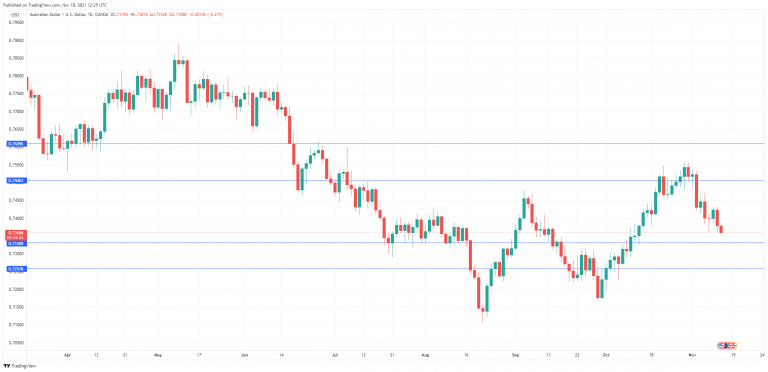
The Australian dollar has edged lower in the Wednesday session. AUD/USD is currently trading at 0.7358, down 0.27% on the day.
The Westpac Consumer Sentiment Index rose in November to 105.3, up slightly from 104.6 in October. Consumers remain positive about the economy, and the success of the vaccination programme and the reopenings in Sydney and Melbourne have boosted consumer confidence.
We continue to see a disparity between market expectations of a rate hike and RBA guidance. The RBA is sticking to its stance that it does not expect economic conditions to be suitable for a hike prior to 2024, while the markets are much more hawkish and have priced in the prospect of several rate hikes in 2022. The central bank meets next on December 7th and we could see a trim in the bank’s bond purchase scheme (QE), perhaps from the current AUD 4 billion to AUD 3 billion. If the bank is satisfied with the pace of the recovery, QE could be further scaled back early next year and would up by mid-2022.
When China sneezes, Australia is prone to catch a cold, as the Asian giant is Australia’s largest trading partner. China’s property sector is weighing on risk sentiment, as Chinese property developer Evergrande faces a final deadline today of about USD 148 million in offshore coupon payments. The wall of silence from Chinese authorities as to how they will respond to the Evergrande crisis is only exacerbating investors’ nerves and is weighing on the Australian dollar, as fears of the collapse of the China property sector and the subsequent contagion are very real.
The markets are keeping a close eye on US inflation, which will be released later today. Inflation remains high, but the markets have bought into the Fed’s message that it will not raise rates for some time, and unless CPI comes in above 6%, I would not expect a sharp reaction from investors.
AUD/USD Technical
The weekly support and resistance levels are as follows:
- There is resistance at 0.7506 and 0.7609
- AUD/USD is putting some pressure on support at 0.7330. Below, there is support at 0.7257
EUR/USD Elliott Wave Analysis: Be Aware of Reversal
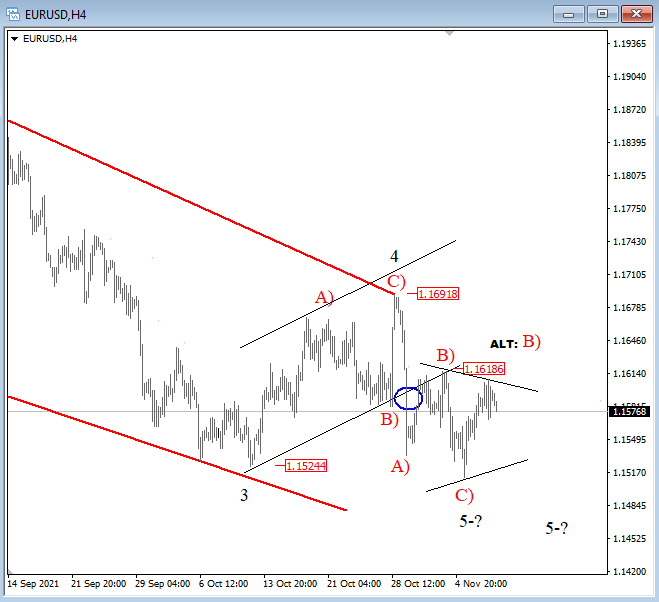
EURUSD came below 1.1524 last week after a corrective B) wave rises to the channel resistance line. We expected that drop into C) which can be now the final stages of wave 5 that belongs to a higher degree ending diagonal.
As such, we are aware of a reversal, but any change in trend can be confirmed only if the upper line of a wedge is broken, plus an impulse back to 1.1690. So for a change in trend is still too early, especially if also current price action since the start of November would be slow; then this can also be a triangle in sub-wave B).
EUR/USD 4h Elliott Wave analysis
Oil Rebounds, Gold Eyes USD 1835
Oil’s recovery continues
Oil prices shot higher once again overnight, aided by a large drop of 2.50 million barrels by US API Crude Inventories. The Biden/SPR story appears to be losing momentum leaving markets to focus on oil’s strong physical fundamentals once again. Regarding the US SPR releases, President Biden’s hands are somewhat tied here. A large release can only be authorised if supplies are disrupted, not if prices rise. It would be hard to spin the former argument as a supply disruption emergency. A tactical release authorised by the President is limited to 30 million barrels over a 60 day period, certainly not enough to cap oil’s rally.
Brent crude finished 1.75% higher at USD 85.10 a barrel, and WTI leapt 2.80% higher to USD 84.50 a barrel. Long-covering from the overnight rally has pushed both contracts slightly lower in Asia, to USD 85.05 and USD 84.20 respectively.
Brent crude has resistance at USD 86.00 and USD 86.70, with support at USD 83.30 and USD 82.50 a barrel. WTI has resistance at USD 85.00 and USD 85.50, with support quite distant at USD 82.00 a barrel after the impressive overnight rally.
Gold prepares to test major resistance
A weaker US dollar and lower US yields once again saw gold move slightly higher overnight. It flirted with the base of its major resistance zone between USD 1832.00 and USD 1835.00 an ounce, before easing but still finishing 0.40% higher at USD 1831.50 an ounce. In Asia, weaker sentiment has lifted the US dollar and yields slightly, forcing gold 0.25% lower to USD 1827.00 an ounce.
Gold’s story still looks one inversely correlated to US yields and the US dollar, and if the inflation story held water, then surely US yields would be higher. Nevertheless, gold’s price action remains constructive, and it has managed to hold onto its gains just below the major zone of longer-term resistance at USD 1832.00 to v1835.00 an ounce.
If gold can break and hold above USD 1835.00 an ounce on a daily closing basis, it will trigger an inverse head-and-shoulders pattern that would target a return to USD 2000.00 an ounce. Support is at USD 1800.00 and USD 1785.00 an ounce, although I suspect that a fall through USD 1810.00 will be enough to trigger nervous longs to exit.
US Dollar Unwind Continues
Lower US yields weigh on greenback
The US dollar eased once again overnight, led by strength in the low yielder space, notably the Japanese yen and the Swiss franc. With asset classes running their own races this week, it seems that the pre-FOMC long US dollar trade is continuing to unwind. The dollar index fell by 0.08% to 93.98 overnight, although a sharp deterioration in equity sentiment today in Asia has seen it rise back to 94.04. The risks remain to the downside for the dollar index as disappointed US bulls continue to unwind strategic long positions after a fence-sitting performance by the FOMC. 93.80 remains initial support and failure targets 93.50. On the upside, resistance above 94.50 has become a formidable barrier.
A weaker US dollar passed the euro and sterling by, with both almost unchanged at 1.1585 and 1.3555. Both continue to be weighed down by dovish central bankers and Brexit/Northern Ireland nerves. EUR/USD has resistance at 1.1625 and support at 1.1515. GBP/USD has resistance at 1.3600 and support at 1.3525.
The Japanese yen was the chief beneficiary of US dollar weakness as US yields edged lower once again across the curve. USD/JPY has fallen to 112.85 and a washout of stale long positioning could see the cross trade as low as 112.00 in the coming days. However, if US yields were to rise meaningfully on US inflation data tonight, the sell-off will be stopped in its tracks. AUD/USD and NZD/USD retreated overnight with US stocks. If sentiment remains heavy, AUD/USD could test nearby support at 0.7360 and potentially fall below 0.7300. NZD/USD is hovering above support at 0.7100 and could retreat to 0.7050.
Asian currencies remain calm today, remaining near yesterday’s levels and maintaining recent gains versus the greenback. Another neutral USD/CNY fix from China today has added a supportive note, although the weakness in Asian stock markets has led to some very gentle weakness in Asian currencies this morning. Regional currency markets look to be in wait-and-see mode once again, ahead of US inflation data this evening.
UK Flash Q3 GDP Growth May Not Be A Game Changer For Pound
Flash GDP growth figures for Q3 will be out of the UK on Thursday at 06:00 GMT, likely displaying waning economic dynamics in the face of fading base effects and global supply crunches. A growth slowdown, however, is already priced in, and unless a significant upside surprise in the data plays into rate hike expectations, the pound could find little support to build on this week’s mild upturn.BoE keeps the door open for higher interest rates
Investors had been growing confident during the month of October that the Bank of England (BoE) would be one of the few major central banks to raise interest rates in November only to see their expectations dashed at the last minute. Despite the hawkish talk over the past two months, the central bank kept all its policy settings unchanged during last week’s policy meeting, squeezing government bond yields and the pound to monthly lows against the US dollar and the yen.
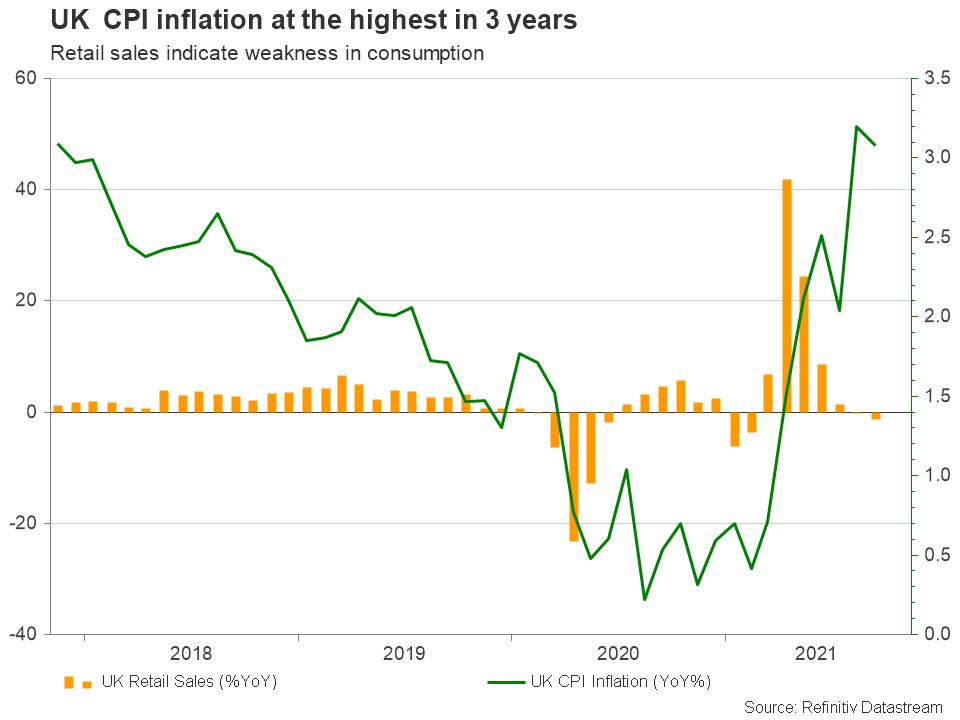
The Bank’s intention, however, was not to entirely exclude the case of higher interest rates but to prevent an aggressive pricing of policy tightening in markets. It actually sent a clear message that a rate hike is imminent in the coming months “to meet sustainably the 2% inflation target in the medium term”, though it also cautioned that some time will be needed to assess the outlook for economic growth and employment as supply bottlenecks continue to restrain business activities and recruitment difficulties persist at a time when consumption is witnessing a continuous deterioration for the fifth consecutive month.
UK GDP growth to slow sharply in Q3
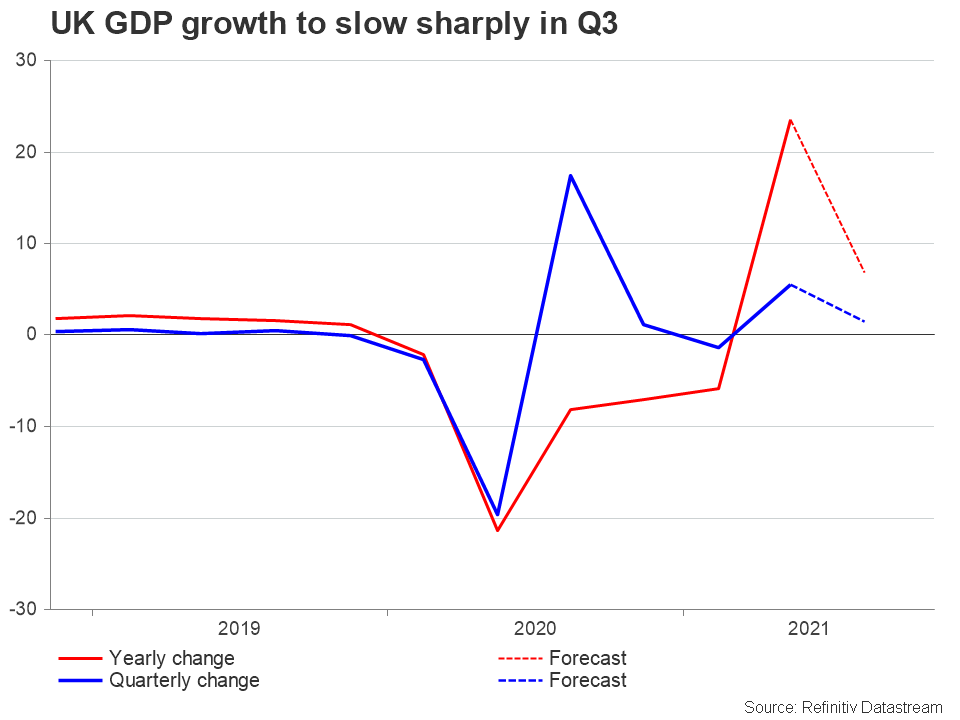
On Thursday, preliminary GDP figures are expected to show an expansion of just 6.8% year-on-year in the three months to September compared to the extraordinary annual boom of 23.6% in Q2, while the quarterly growth rate is also projected to fizzle to 1.5% q/q from 5.5% previously. If materialized, that would still be a robust outcome and not necessarily a negative warning for the UK economy as the blame for the moderation can easily be put on the basis of comparisonas the 2020 dip drops out of the calculations.
Still, the slowdown cannot be ignored either since that emerges at a time when inflation spikes call for a departure from stimulative policies, while the mounting post-Brexit bickering with the EU have been lately increasingly threatening Britain’s abandonment from the withdrawal agreement which was signed last December.
Pound may shrug off GDP data
Hence, the BoE has probably made the right choice of adopting a wait-and-see mode this month, but the longer it stands pat and the more persistent inflationary pressures get, the stronger downside risks could become for the pound. Currently, overnight indexed swaps give a probability of 52.3% for a 25 bps rate hike in December, which reflects some confusion among investors about the next rate decision.
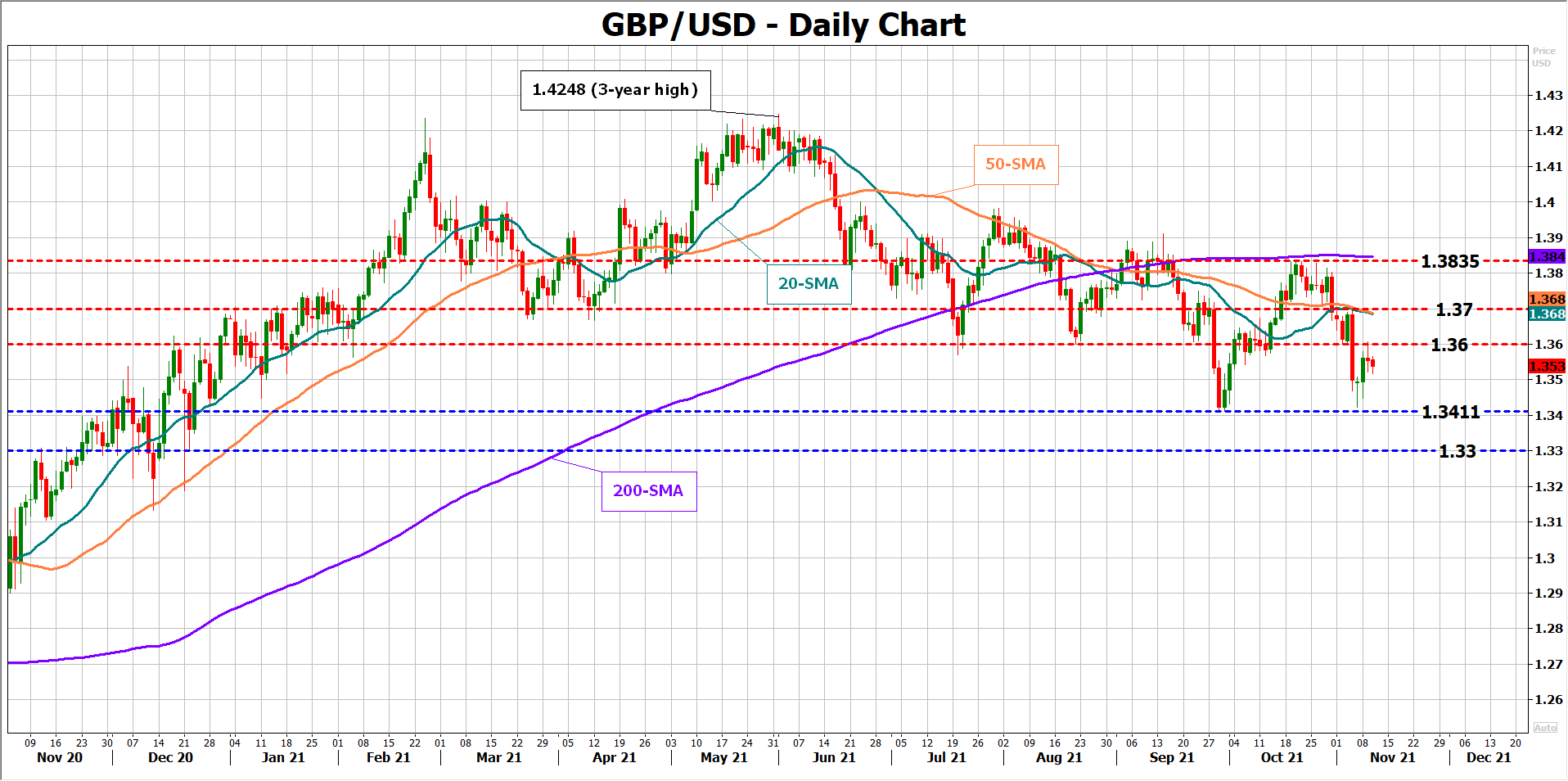
Perhaps a pullback in GDP growth figures may not affect rate sentiment because weak monthly GDP prints in the past two months have already painted a gloomy picture for Q3. Nevertheless, should the stats come in worse-than-expected, traders will keep a close eye on the 1.3411 level in pound/dollar. A break below that floor could cause a sharp decline towards the 1.3300 number.
On the other hand, for pound/dollar to stretch this week’s soft rebound above the 1.3600 resistance, a significant upside surprise in the data will need t0 positively play into rate hike expectations. However, that is currently seen the least possible scenario, as in the case of the Fed, the BoE has clearly stated that changes in employment and wage growth figures will determine the path of interest rates. Therefore, next week’s jobs number could be a bigger market mover for the pound, while trade tensions between the EU and the UK may also be a source of volatility for the pound ahead of the BoE policy meeting in December.
NZDUSD Crossed Below The Red Ichimoku Cloud, Negative Bias Arises
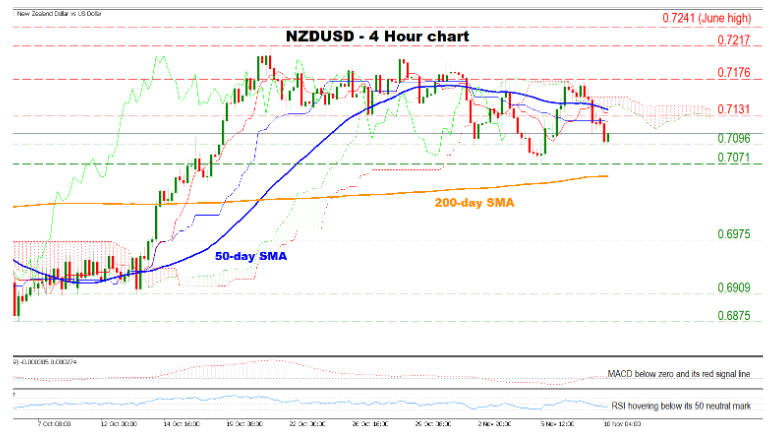
NZDUSD has lost its positive momentum after failing to break above its 0.7176 level in the past couple of sessions. The pair has currently crossed below the red Ichimoku cloud and its 50-day simple moving average (SMA), promoting a negative short-term outlook.
The negative bias and the recent price depreciation of the pair are also supported by the short-term momentum indicators, as the RSI is hovering below its 50 neutral mark, while the MACD is found below zero and its red signal line.
Should the price breaks below its 0.7096 support, the bears may then target the 0.7071 region. A further descending movement from this level could intensify selling pressures, sending the price to test its 200-day SMA currently found at 0.7056. Breaking below this level could strengthen the negative momentum of the pair, paving the way towards the 0.6975 barrier.
On the flip side, if the price breaks above the congested region, which encapsulates the 0.7131 level and the 50-day SMA currently at 0.7140, could turn the cards around for the pair, sending it towards its 0.7176 level. Any advancements beyond that crucial level could revive the positive momentum, sending the price towards the strong 0.7217 barrier.
In brief, the overall outlook for the NZDUSD is cautiously negative. However, this might change if the price breaks above the congested region, including the 0.7131 level and the 50-day SMA, while breaking below its 200-day SMA could strengthen the pair’s negative momentum.
Investors Are Waiting For Key Data On Inflation In The US Today
The US stock markets closed in the red zone yesterday, breaking the longest (8 consecutive sessions) series of records since 1997. By the end of the day, the Dow Jones Industrial Average decreased by 0.31%, the S&P 500 fell by 0.35%, and the Nasdaq lost 0.6%. Macroeconomic data released on Tuesday showed a slight increase in the pace of producer price inflation in October to 0.6% from 0.5% in September. In annual terms, the US producer inflation is rising at a record pace. The US inflation data will be released today. Experts believe US inflation will rise slightly. But if the actual value is much worse than expected, the dollar index may react sharply as the Fed is ready to speed up the pace of stimulus cuts if necessary.
European stock indexes also decreased on Tuesday. The British FTSE 100 fell by 0.36%, the German DAX lost 0.04%, the French CAC 40 decreased by 0.06%, the Italian FTSE MIB lost 0.97%. The exception was the Spanish IBEX 35, which increased by 0.05%. The ECB balance sheet continues to grow rapidly. Total assets rose by another €16.6 billion to a new level of €8,382.7 billion. The ECB will continue to print money as part of its stimulus program until the end of the year. German exports fell by 0.7% in September compared to August, according to data from the country's Federal Statistics. But the index of economic sentiment in Germany and the Eurozone is growing again. Experts forecast renewed economic growth and lower inflation in both Germany and the Eurozone in the first quarter of 2022. Germany will release its inflation report today.
The drug regulator in the EU will soon approve Regeneron-Roche drugs against COVID-19.
The European Union decided to partially suspend the visa facilitation agreement between the EU and Belarus due to the influx of migrants.
Yesterday, oil prices grew amid American Petroleum Institute (API) data on energy reserves in the US, which showed an unexpected decline of oil reserves in the US last week. Today, the US Department of Energy will release an official report on US crude oil and natural gas inventories. Usually, natural gas inventories are released on Thursdays, but tomorrow is a bank holiday in the US. So, the report will be published today.
The price of gold is trading near a two-month high due to declining US bond yields. Investors are waiting for key US inflation data today. Rising inflation could cause the US dollar to strengthen on the expectation that the US Federal Reserve will accelerate the pace of QE cuts. A rise in the dollar index will lead to higher government bond yields and lower gold prices.
China's consumer inflation accelerated in October to its highest in 13 months since September 2020. The inflation rate reached 1.5% in annual terms. Experts predicted inflation at 1.4%. At the same time, China's producer price index jumped to 13.5% in annual terms amid rising prices for coal and other raw materials used by power plants. That has been the highest level since 1996. Asia-Pacific stock markets are decreasing on inflation data in China. Japan's Nikkei 225 index decreased by 0.61%, Hong Kong's Hang Seng decreased by 0.98%, Shanghai's Shanghai Composite lost 0.94%, and Australia's ASX 200 decreased by 0.14%.
Main market quotes:
- S&P 500 (F) 4,685.30 −16.40 (−0.35%)
- Dow Jones 36,320.04 −112.18 (−0.31%)
- DAX 16,040.47 −6.05 (−0.04%)
- FTSE 100 7,274.04 −26.36 (−0.36%)
- USD Index 93.98 −0.07 (−0.08%)
Important events for today:
- Canada BoC Gov Macklem’s Speech at 00:45 (GMT+2);
- China Consumer Price Index (q/q) at 03:30 (GMT+2);
- China Producer Price Index (q/q) at 03:30 (GMT+2);
- German Consumer Price Index (m/m) at 09:00 (GMT+2);
- US Consumer Price Index (m/m) at 15:30 (GMT+2);
- US Initial Jobless Claims (w/w) at 15:30 (GMT+2);
- US Crude Oil Reserves (w/w) at 17:30 (GMT+2);
- US Natural Gas Storage (w/w) at 19:00 (GMT+2).
Focus Remains On Inflation Data To Gauge Whether The Trend Is Transitory
Notes/Observations
- Focus remains on inflation data.
- China PPI data at 26-year highs and added to stagflation concerns.
- Germany Oct CPI YoY confirmed at its highest level since the 1993 unification.
- Dealers note faster rise in CPI could add to Treasury yield upside and spur financial markets to reprice for a swifter pace of Fed normalization.
Asia
- China Oct CPI registered its [fastest annual pace since Sept 2020 (Y/Y: 1.5% v 1.4%e); PPI at 26-year high (Y/Y: 13.5% v 12.3%e).
- China President Xi and US President Biden to have virtual summit during week of Nov 15th (next week). No details given.
Europe
- BOE’s Broadbent stated that he expected participation in the labor market would go up, strains to lesson over time. Higher wages would be seen in some sectors fueling short-term inflation.
- UK Chancellor of the Exchequer Sunak (Fin Min) said to seek to repeal EU laws on the UK financial system and give the FCA more room to set its own rules - financial press.
Americas
- Fed's Kashkari (dove, non-voter) noted that prices had been elevated longer than expected; Did not know how long supply chain disruptions would last. Keeping an open mind regarding monetary policy stance.
- Fed's Daly (non-voter, dove) noted that by summer 2022 should get more clarity, in the meantime it could be a challenging time for consumers.
- Treasury Sec Yellen reiterated that Biden’s Build Back Better plan was anti-inflationary in the medium term; Inflation to be watched carefully. Reiterated concern that a recession could happen if debt limit not raised.
Energy
- Weekly API Crude Oil Inventories: -2.5M v +3.6M prior (1st drawn down in 7 weeks).
Speakers/Fixed income/FX/Commodities/Erratum
Equities
- Indices [Stoxx600 +0.06% at 482.96, FTSE +0.55% at 7,313.87, DAX 0.00% at 16,039.75, CAC-40 -0.15% at 7,032.48, IBEX-35 +0.47% at 9,117.50, FTSE MIB +0.18% at 27,490.00, SMI +0.25% at 12,398.72, S&P 500 Futures -0.17%].
- Market Focal Points/Key Themes: European indices open modestly higher across the board but later slipped to trade generally mixed; sectors among those leading to the upside include financials and energy; while laggards include consumer discretionary and health care; industrials sector getting a boost after Alstom beats expectations; Scopia divests its stake in Indivior; EQT acquires LDP; Nobile and Maersk Drilling to merge; Vodacom to take majority stake in Vodafone Egypt; ICA to be taken private; earnings expected during the upcoming US session include Affimed, Energizer and Perrigo.
Equities
- Consumer discretionary: Adidas [ADS.DE] -6% (earnings; trims gross margin outlook), Marks & Spencer [MKS.UK] +14% (earnings), Asos [ASC.UK] +2% (CMD).
- Consumer staples: ICA Gruppen [ICA.SE] +11% (to be taken private), Ahold Delhaize [AD.NL] +3% (earnings).
- Energy: Electricite de France [EDF.FR] -1% (earnings).
- Financials: Allianz [ALV.DE] +1% (earnings), Credit Agricole [AC.FR] -1.5% (earnings).
- Industrials: Alstom [ALO.FR] +10% (earnings), Maersk Drilling [DRLCO.DK] +18% (merger with Noble), Leoni [LEO.DE] -8% (earnings).
- Technology: Infineon [IFX.DE] +1% (earnings).
Speakers
- Sweden Central Bank (Riksbank) Financial Stability Report: Strong domestic recovery underway but vulnerabilities remain in financial sector.
- German Council of Economic Advisers updated its 2021 and 2022 outlook. Cut the 2021 GDP growth forecast from 3.1% to 2.7% while raising 2022 GDP growth forecast from 4.0% to 4.6%. It forecasted 2021 CPI at 3.1% and 2022 CPI at 2.6%.
- Poland Central Bank member Kochalski stated that rates might rise if the MPC saw no chance of keeping CPI within the target range in mid-term.
- Russia Energy Min Shulginov: 2021 oil production seen at 517M tons and gas production seen at 777B CM.
- Thailand Central bank Policy Statement noted that the decision to keep rates steady was unanimous. Monetary policy to remain accommodative and to focus on recovery. Reiterated stance prepared to use all policy levers. Headline inflation remained in target range. To closely monitor THB currency (Baht) movements; FX to remain volatile. Economy continued to be fragile. Fiscal measures should support economy; GDP to expand close to prior predictions.
Currencies/Fixed income
- USD was steady ahead of key US CPI data for Oct. Dealers note faster rise in CPI could add to Treasury yield upside and spur financial markets to reprice for a swifter pace of Fed normalization. Markets have been questioning whether the pickup in inflation was transitory. The recent PPI data for the US did increase solidly in October.
- EUR/USD steady at 1.1565 despite Germany Oct CPI YoY confirmed at its highest level since the 1993 unification area. German Council of Economic Advisers stated that ECB should focus on fostering price stability. It it acts too late it could hurt the economy.
- USD/JPY moved back above the 113 handle.
Economic data
- (NL) Netherlands Sept Manufacturing Production M/M: +1.0 v -2.2% prior; Y/Y: 10.9% v 9.4% prior; Industrial Sales Y/Y: 13.8%e v 15.9% prior.
- (FI) Finland Sept Industrial Production M/M: 0.5% v 1.3% prior; Y/Y: 6.6% v 4.3% prior.
- (DE) Germany Oct Final CPI M/M: 0.5% v 0.5% prelim; Y/Y: 4.5% v 4.5% prelim (confirmed the highest annual pace since 1993 reunification).
- (DE) Germany Oct Final CPI EU Harmonized M/M: 0.5% v 0.5% prelim; Y/Y: 4.6% v 4.6% prelim.
- (NO) Norway Oct CPI M/M: -0.3% v 0.0%e; Y/Y: 3.5% v 3.8%e.
- (NO) Norway Oct CPI Underlying M/M: -0.3% v 0.0%e; Y/Y: 0.9% v 1.2%e.
- (NO) Norway Oct PPI M/M: 6.2% v 8.0% prior; Y/Y:60.8% v 57.8% prior.
- (DK) Denmark Oct CPI M/M: 0.9% v 0.3% prior; Y/Y: 3.0% v 2.2% prior.
- (DK) Denmark Oct CPI EU Harmonized M/M: 1.0% v 0.4% prior; Y/Y: 3.2% v 2.4% prior.
- (RO) Romania Oct CPI M/M: 1.8% v 1.2%e; Y/Y: 7.9% v 7.1%e (6th month above target range).
- (TR) Turkey Sept Unemployment Rate: 11.5% v 12.1% prior.
- (TH) Thailand Central Bank (BoT) left the Benchmark Interest unchanged at 0.50% (as expected).
- (AT) Austria Sept Industrial Production M/M: -2.3% v -1.2% prior; Y/Y: 3.3% v 7.8% prior.
- (CZ) Czech Oct CPI M/M: 1.0% v 0.7%e; Y/Y: 5.8% v 5.5%e.
- (CZ) Czech Sept Export Price Index Y/Y: 7.5% v 8.6% prior; Import Price Index Y/Y: 8.8% v 9.4% prior.
- (CN) China Oct Aggregate Financing (CNY): 1.590T v 1.700Te.
- (CN) China Oct New Yuan Loans (CNY): 800B v 700Be.
- (CN) China Oct M2 Money Supply Y/Y: 8.7% v 8.3%e.
- (IT) Italy Sept Industrial Production M/M: +0.1% v -0.1%e; Y/Y: 4.4% v 4.0%e; Industrial Production NSA (unadj) Y/Y: 4.5% v 2.9% prior.
- (GR) Greece Sept Industrial Production Y/Y: 9.7% v 10.1% prior.
- (GR) Greece Oct CPI Y/Y: 3.4% v 2.2% prior; CPI EU Harmonized Y/Y: 2.8% v 1.9% prior.
- Fixed income Issuance
- (IN) India sold total INR200B vs. INR200B indicated in 3-month, 6-month and 12-month bills.
- (ES) Spain Debt Agency (Tesoro) sold total €5.133B vs. €4.5-5.5B indicated range in 6-month and 12-month bills.
- (IT) Italy Debt Agency (Tesoro) sold €5.0B vs. €5.0B indicated in 12-month Bills; Avg Yield: -0.533% v -0.474% prior; Bid-to-cover: 1.53x v 1.30x prior.
- (NO) Norway sold NOK2.0B vs. NOK2.0B indicated in 1.5% Feb 2026 Bonds; Avg Yield: 1.50% v 1.45% prior; Bid-to-cover: 3.67x v 4.22x prior.
- (SE) Sweden sold SEK10.0B vs. SEK10.0B indicated in 3-month Bills; Avg Yield: -0.3643% v -0.3875% prior; bid-to-cover: 2.74x v 1.75x prior.
- 05:00 (UK) DMO sold £900M in 0.125% Aug 2031 Inflation-linked Gilts (UKei); Real Yield: -3.242% v -3.009% prior, bid-to-cover: 2.25x v 2.33x prior.
Looking ahead
- (MX) Mexico Oct ANTAD Same-Store Sales Y/Y: No est v 10.1% prior.
- (MX) Mexico Oct Nominal Wages: No est v 4.1% prior.
- 05:25 (EU) Daily ECB Liquidity Stats.
- 05:30 (NL) ECB's Elderson (Netherlands, SSM member).
- 05:30 (DE) Germany to sell €3.0B in 0.0% Aug 2031 Bunds.
- 05:30 (PT) Portugal Debt Agency (IGCP) to sell €0.75-1.0B in 2031 and 2037 OT bonds.
- 06:00 (PT) Portugal Q3 Unemployment Rate: No est v 6.7% prior.
- 06:00 (IL) Israel Oct Consumer Confidence: No est v 126 prior.
- 06:00 (RU) Russia to sell 2031 and 2036 OFZ Bonds.
- 06:30 (CL) Chile Central Bank Economist Survey.
- 06:45 (US) Daily Libor Fixing.
- 07:00 (US) MBA Mortgage Applications w/e Nov 5th: No est v -3.3% prior.
- 07:00 (IS) Iceland Oct Unemployment Rate: No est v 5.0% prior.
- 07:00 (BR) Brazil Oct IBGE Inflation IPCA M/M: 1.1%e v 1.2% prior; Y/Y: 10.5%e v 10.3% prior.
- 07:00 (CZ) Czech Central Bank to comment on CPI data.
- 08:00 (UK) Daily Baltic Dry Bulk Index.
- 08:15 (IE) ECB's Lane (Ireland, chief economist).
- 08:30 (US) Oct CPI M/M: 0.6%e v 0.4% prior; Y/Y: 5.9%e v 5.4% prior.
- 08:30 (US) Oct CPI (ex-food/energy) M/M: 0.4%e v 0.2% prior; Y/Y: 4.3%e v 4.1% prior.
- 08:30 (US) Oct CPI Index NSA: 275.808e v 274.310 prior; CPI Core Index SA: 280.991e v 280.017 prior.
- 08:30 (US) Oct Real Avg Hourly Earning Y/Y: No est v -0.8% prior; Real Avg Weekly Earnings Y/Y: No est v -0.8% prior.
- 08:30 (US) Initial Jobless Claims: 260Ke v 269K prior; Continuing Claims: 2.05Me v 2.105M prior (**Note: Nov 11th is veterans Day).
- 08:30 (US) Weekly USDA Net Export Sales.
- 09:00 (UK) BOE's Tenreyro.
- 10:00 (US) Sept Final Wholesale Inventories M/M: 1.1%e v 1.1% prelim; Wholesale Trade Sales M/M: No est v -1.1% prior.
- 10:30 (US) Weekly DOE Oil Inventories.
- 11:00 (RU) Russia Q3 Advance GDP (1st reading) Y/Y: 4.5%e v 10.5% prior.
- 11:30 00 (US) Treasury to sell 4-week and 8-week bills.
- 12:00 (DE) ECB's Schnabel (Germany).
- 12:00 (SE) Sweden Central bank (Riksbank) Breman.
- 13:00 (US) Treasury to sell 30-Year bonds.
- 14:00 (US) Oct Monthly Budget Statement: -$179.0Be v -$62.0B prior.
- 16:45 (NZ) New Zealand Oct Food Prices M/M: No est v 0.5% prior.
- 18:50 (JP) Japan Oct PPI M/M: 0.4%e v 0.3% prior; Y/Y: 7.0%e v 6.3% prior.
- 19:00 (AU) Australia Nov Consumer Inflation Expectation Survey: No est v 3.6% prior.
- 19:01 (UK) Oct RICS House Price Balance: 65%e v 68% prior.
- 19:30 (AU) Oct Employment Change: +50.0Ke v -138K prior; Unemployment Rate: 4.8%e v 4.6% prior; Full Time Employment Change: No est v +26.7K prior; Part Time Employment Change: No est v -164.7K prior; Participation Rate: 64.8%e v 64.5% prior.
- 21:00 (JP) Japan Oct Tokyo Avg Office vacancies: No est v 6.4 prior.
- 22:00 (KR) South Korea Sept M2 Money Supply M/M: No est v 12.5% prior; “L” Money Supply M/M: No est v 10.3% prior.
Inflation Concerns Bubbling Back To The Surface
- Asian stocks follow US indices lower, futures in the red.
- US inflation key for sentiment this week.
- Gold eases back from key $1834 resistance zone.
Asian stocks are in the red along with US and European futures, while the benchmark dollar index (DXY) is holding on to the psychological 94.0 handle to nudge gold prices below the key $1834 level.
Inflation fears are returning to the fore, with China’s higher-than-expected consumer and producer prices being the latest in a series of red flags about risks to the global economic outlook. China’s October CPI climbed 1.5% compared to a year ago, exceeding market forecasts of 1.3%. Factory gate inflation climbed13.5% which was its highest print in 26 years.
Inflation woes raise specter of stagflation, policy mistake
All eyes are on today’s release of the October US inflation data, with the headline consumer price index expected to come in at 5.9% year-on-year and register its steepest climb since 1990. Further evidence of elevated inflationary pressures in the world’s largest economy would be the latest test for the Fed’s ”transitory” view and challenge the central bank’s stance on policy tightening.
The worry is that such stubborn inflationary pressures could choke the recovery in global demand or hasten policy tightening by major central banks. The likes of the Bank of England and Bank of Canada appear on the cusp of following the RBNZ in raising their respective benchmark rates.
The prospects of higher interest rates could sour the mood surrounding risk assets, and a faster-than-expected inflation print today would only strengthen such a narrative. There are also concerns that a faster cycle of policy tightening, done in the hopes of reining in consumer prices, could instead trigger the next recession. Further clouding the monetary policy outlook is the uncertainty over who will head the Fed next year, with Bloomberg reporting that Fed Governor Lael Brainard has held talks at the White House about potentially replacing Jerome Powell as Fed Chair.
The worries currently in play were enough to take some of the gloss off US equities hot streak overnight. Still, a surprise moderation in today’s US CPI print could help alleviate the risk-off mood and afford more breathing space for stocks to push higher, at least in the near term.
Gold eases back from key resistance level
At the time of writing, spot gold has pulled back from the key $1830 resistance region which already repelled bullion bulls on several occasions in the third quarter. The precious metal’s recent recovery has been driven by falling Treasury yields, with real yields on 10-year Treasuries looking to register a new year-to-date low.
Gold’s traditional role as a hedge against inflation may be used to justify a fresh wave of bids, especially if today’s CPI print runs hotter than expected. However, under current market conditions, the precious metal would have to muscle past alternative assets that are also vying for the role as an inflation hedge. Gold prices also face the downside risk of a strengthening dollar if an eventual rebound in Treasury yields occurs in anticipation of a more hawkish Fed, eroding gold’s recent gains lower along the way.
Asian Equities Dip On China Nerves
China PPI and property sector nerves send equities lower
An elevated PPI print from China this morning and China property sector nerves have seen Asian stock markets fall mostly into the red today after Wall Street finally saw a modest correction low after a multi-day rally. China’s PPI release reached a record high of 13.50% YoY for October, with officials blaming weather, material and energy costs. That overshadowed the Inflation data, released at the same time, which came in elevated, but on target at 1.50% YoY for October. The PPI should retreat into the end of the year, thanks to falling iron ore prices, now at one-year lows, and coal prices. Still, Asia is on inflation alert, fearing future costs of inputs from goods sourced from China.
Overnight, the S&P 500 fell by 0.35%, the Nasdaq lost 0.60% and the Dow Jones eased by 0.31% after multi-year highs in US PPI spurred profit-taking. In Asia, futures on all three indexes have lost another 0.40%, deepening the negative sentiment in regional markets.
The Nikkei 225 is 0.70% lower, while South Korea’s Kospi has dropped by 0.90%. China equity markets are being hit hard with the Shanghai Composite retreating 1.20% with the narrower Shanghai 50 now 1.80% lower. The CSI 300 has fallen by 0.75%, while the Hang Seng has retreated by 1.30%.
In regional markets, Singapore is 0.55% lower and Kuala Lumpur has fallen by 0.35%. Taipei is outperforming relatively, unchanged on the day. Jakarta is 0.20% lower with Bangkok and Manila down 0.45%. Australian markets are slightly lower as well, the ASX 200 falling 0.33% and the All Ordinaries easing by 0.20%.
The broad weakness that has flowed from Wall Street into Asia today is likely to lead to a lower opening for European stocks. It seems that investors are keen to lower exposure into the US CPI data tonight. If that passes without incident, though, it would not surprise me in the least to see the equity rally resume.