Sample Category Title
US inflation breached 6% in October as price growth broadened
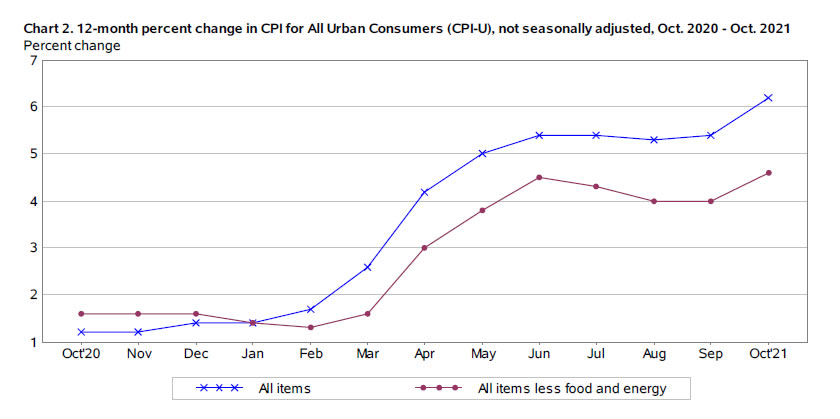
- Headline inflation rose to 6.2% from a year ago, 0.9% on a seasonally adjusted basis from September
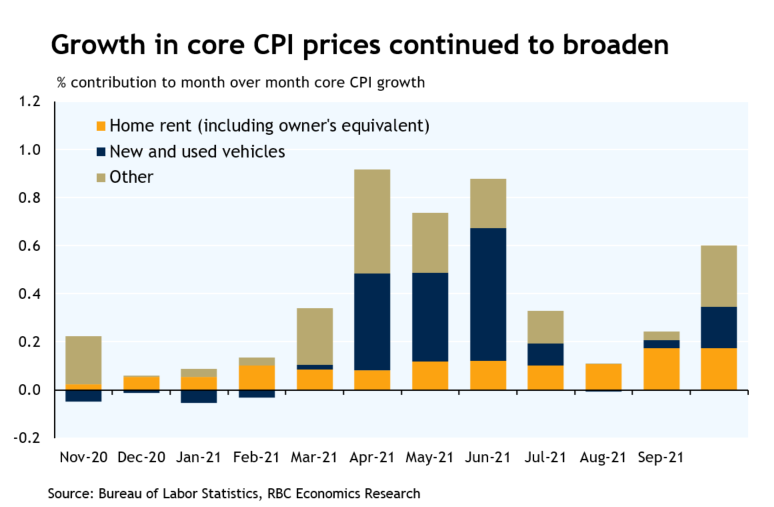
- Core prices (ex-food and energy) grew a faster 0.6% month over month
- Price growth expected to continue to broaden, as higher costs filter through to consumer
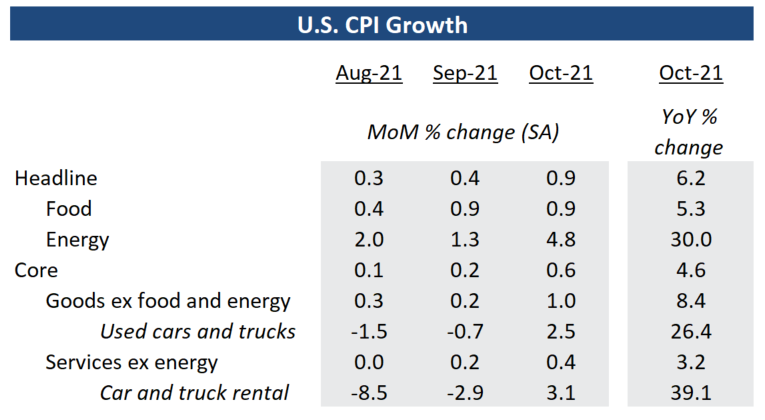
Headline inflation rate in the US reached 6.2% in October, up from 5.4% in September supported by already broadening price growth in almost all categories. That’s the fastest pace of annual CPI growth the US has seen since the early 1990s. Those year-over-year growth numbers continue to be in part inflated by lower year-ago price levels when the economic impact of the pandemic was much more significant, but excluding base effects, inflation was still around 3.7% each year relative to pre-pandemic 2019 levels. Used car prices rose again from already high levels after a surge in prices in the spring and were up 26.4% from last year. That together with growth in new vehicle prices contributed to over a fifth of the headline increase in October, and will continue to distort the headline figure in coming months as the global semiconductor shortage persists. On a month over month seasonally adjusted basis, headline prices rose 0.9% from September, boosted by pricier food (+0.9%) and energy (+4.8%) products, the prior driven mostly by more expensive meat products and the latter tied to higher prices at pump.
Outside of food and energy products, core prices were up 0.6% on a seasonally adjusted basis from September, with more signs that the pace of price growth is broadening outside of auto products. Prices for rent and owners’ equivalent rent, for example, both continued to rise at faster rates (+0.4%) from already stronger readings in September. Our base case view remains that surging input and labour costs, supply chain disruptions, and elevated household purchasing power will keep a floor under near-term price growth. We also expect pressure to continue to broaden across the consumer basket away from pockets like auto that have disproportionately impacted pandemic inflation trends to-date. In terms of expectations, consumers have been dialing that up for the near-term and longer-run expectations have also increased but remained closer to levels just above Fed’s 2% target. With labour markets continuing to improve, and inflation running hot, the Fed is expected to begin hiking rates next year, with earlier rather than later hikes more likely the longer inflation pressures continue to broaden.
Risk off Mood ahead of Key US Data, Dollar Ticks Higher with Yields
US Inflation report and unemployment claims mixed
Investors are digesting today’s US CPI data and unemployment claims, which came out at 13:30 GMT. The figures could force the Fed to consider delivering tighter monetary policy measures, especially as inflation came in stronger. Supply shortages continue to linger and are feeding price pressures, while the rising 10-year yield is aiding the greenback.
The dollar index has steered above the 94.00 mark, while the euro has dipped to $1.1535, and the pound is testing the $1.3480 handle. The US 10-year yield, which has turned back up after yesterday’s Brainard-related fall, following Biden’s interviewing news, appears to have also pulled the USDJPY pair back above the 113.00 per dollar mark, currently at 113.34.
Fed officials are keeping an eye on inflation and rhetoric seems to be getting more hawkish around rate hikes, even from ultra-dovish officials like Kashkari. Yesterday’s October PPI came in as expected, which signals that inflation may remain for a while longer, especially as elevated costs of production are pushed over to the customer.
The data highlight for today, the US inflation and unemployment claims came in mixed. September’s headline number came in at 0.9% versus the estimate of 0.6%, while core inflation from October’s 0.2%, hit 0.6%, also beating expectations of 0.4%.
Weekly jobless claims disappointed hitting 267k unemployment claims in the previous week ending November 5, overshooting the expectations of 257k but coming in softer than the week before that.
The ECB is coming under pressure from German officials who are getting worried about inflation. They are suggesting the ECB come up with a plan to exit ultra-loose policy, otherwise with elevated prices, lasting effects from inflation could become a problem.
Oil dips and Putin delivers boost to natural gas reserves
WTI futures remain largely in the vicinity of its recent highs of $85.39 but have dipped slightly to $83.65 per barrel, surrendering some of yesterday’s gains, on the news that President Biden opts out of the US dipping into its oil reserves. This may have disappointed market expectations and caused prices to retreat slightly.
With colder months on the horizon, it seems Europeans pockets may benefit from the slump in gas prices after its lowest supply inventories in a decade got a boost from Russia. How the situation will evolve in the coming months though is another story.
The Canadian dollar returned to the C$1.2435 level following its drop earlier on in the Asian session, after remarks from BOC Governor Macklem that touched on reducing inequality and inflation worries. The consumer price index has hit an 18-year high, and he reiterated that supply shortages could push up inflation rates further. Ultimately, this puts risks on the cost of living.
Chinese yearly CPI and PPI figures beat estimates coming in at 1.5% and 13.5% respectively, while more loans were issued in September, but commodity currencies like the aussie and kiwi remained on the back foot. The aussie was at $0.7354 and the kiwi has dropped to 0.7085. The Preliminary ANZ business confidence worsened to -18.1, signalling a negative economic outlook as many businesses are continuing to experience higher costs.
At 14:00 GMT, US Final wholesale inventories for October are out followed by US crude oil inventories at 14:30 GMT, which will be interesting to see after last week’s drop of 2.5mln barrels.
At 18:00 GMT, the US 30-year Bond auction will be delivered.
Then at 21:45 GMT, New Zealand’s monthly food price index is planned, while Japan will produce its yearly PPI figures at 23:50 GMT.
Australian consumer inflation expectations are scheduled at 00:00 GMT, while the country’s employment data is expected at 00:30 GMT.
US: Inflation Hits 30-Year High in October
There was no break from the heat in October's CPI report, as seasonally adjusted prices rose 0.9% month-on-month (m/m) from up 0.4% in September. As a result, headline inflation was 6.2% year-on-year (y/y), the fastest pace in over 30 years.
Core inflation (ex. food and energy) also picked up to a 0.6% m/m increase, from 0.2% in September. That saw the year-on-year rate of core inflation pick up to 4.6%, also a 30-year high.
Energy prices were a big part of the story, up 4.8% m/m, driven mostly by gasoline (+6.1% m/m), but natural gas prices were also up sharply (+6.6% m/m). Energy prices are now up 30% versus a year ago, the fastest pace since 2005. Food prices also continued to see healthy increases (+0.9% m/m) and are 5.3% higher than a year ago.
Core prices were lifted by a 0.5% m/m increase in the heavily-weighted shelter component. Rents and owners' equivalent rent rose 0.4% m/m, and lodging away from home jumped up 1.4% m/m. Used vehicle prices rose again in October (+2.5% m/m), and are up 26.4% versus a year ago. New vehicle prices were also up sharply (+1.4% m/m), and are nearly 10% higher than a year ago.
Other big increases included prices for medical care (+0.5% m/m), which saw big price gains for services and goods. One of the few prices to fall were airline fares (-0.7% m/m), which have fallen for four consecutive months.
Key Implications
October's inflation report is one superlative after another: the fastest pace in 30 years and many categories seeing historically large price increases. Sometimes you can point to certain outsized gains in specific categories for higher-than-expected inflation, but October's report had solid price increases nearly everywhere. Price pressures may ease alongside supply chain issues, but it is clear that healthy demand for nearly everything, as the economy recovers from the pandemic, has overwhelmed supply.
Energy has been a headline grabbing story, and we recently upgraded our energy price forecasts. Higher energy prices are likely to weigh on growth and boost inflation in the coming quarters as they take a bite out of purchasing power.
It looks like transitory does not mean short-lived. Stronger inflation pressures will likely lead the Fed to lift interest rates next summer, earlier than in our September forecast.
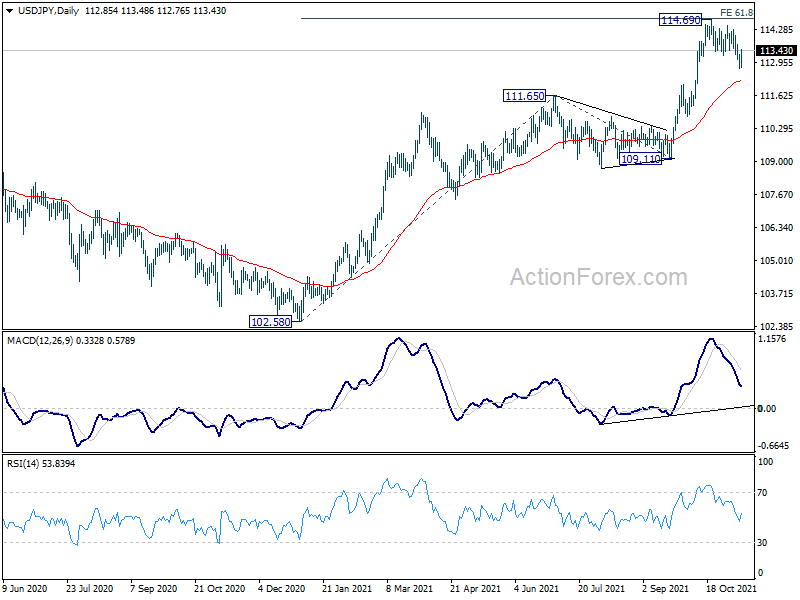
USD/JPY Mid-Day Outlook
Daily Pivots: (S1) 112.64; (P) 112.97; (R1) 113.20; More...
Intraday bias in USD/JPY is turned neutral with today's recovery. In case of another fall, we'd still expect downside to be contained above 112.07 resistance turned support to bring rebound. On the upside, break of 113.65 minor resistance will turn bias back to the upside for retesting 114.69. However, sustained break of 112.07 will dampen our bullish view and bring deeper fall back towards 109.11 structural support.
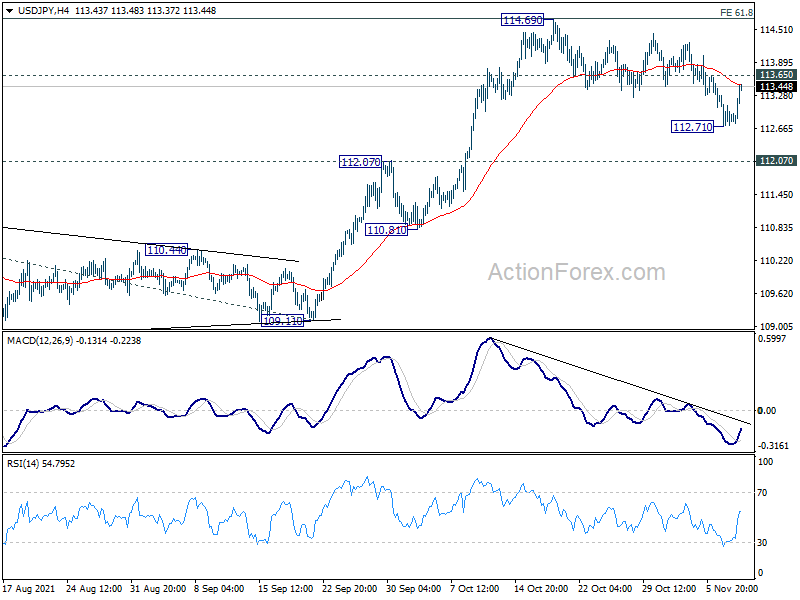
In the bigger picture, corrective decline from 118.65 (2016 high) should have completed at 101.18 already. Rise from the 102.58 is seen as the third leg of the up trend from 101.18. Next target is 114.54 resistance and then 118.65 high. This will now be the preferred case as long as 109.11 support hold, even in case of deep pull back.
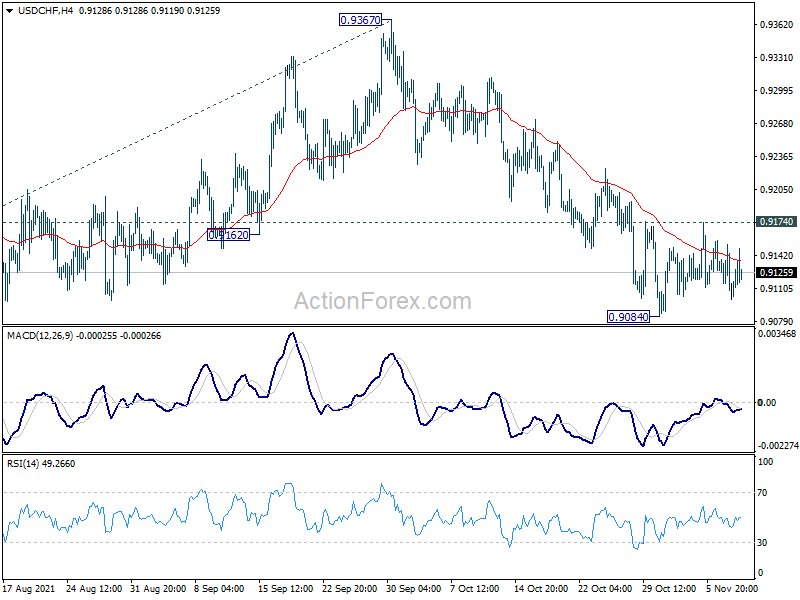
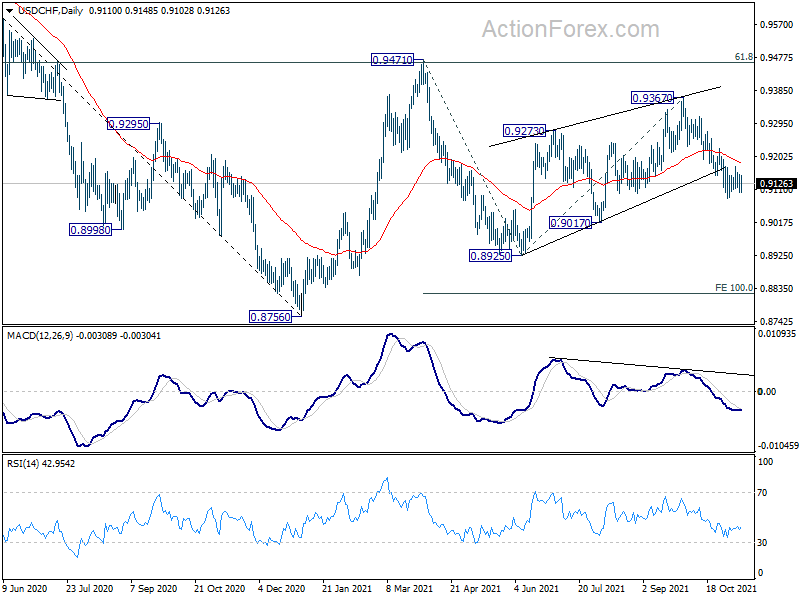
USD/CHF Mid-Day Outlook
Daily Pivots: (S1) 0.9091; (P) 0.9122; (R1) 0.9143; More....
Intraday bias in USD/CHF remains neutral as range trading continues. Further decline is expected as long as 0.9174 resistance holds. Break of 0.9084 will resume the fall from 0.9367 to 0.9017 support, and then 0.8925. On the upside, however, break of 0.9174 resistance will indicate short term bottoming and turn bias back to the upside for stronger rebound instead.
In the bigger picture, the corrective structure of the rebound from 0.8925 argues that fall from 0.9471 is not complete yet. It could either be the second leg of pattern from 0.8756 (2021 low), or resuming larger down trend from 1.0237 (2018 high). We'd pay attention to the downside momentum and assess the odds later. But for now, medium term outlook will be neutral at best as long as 0.9471 resistance holds.
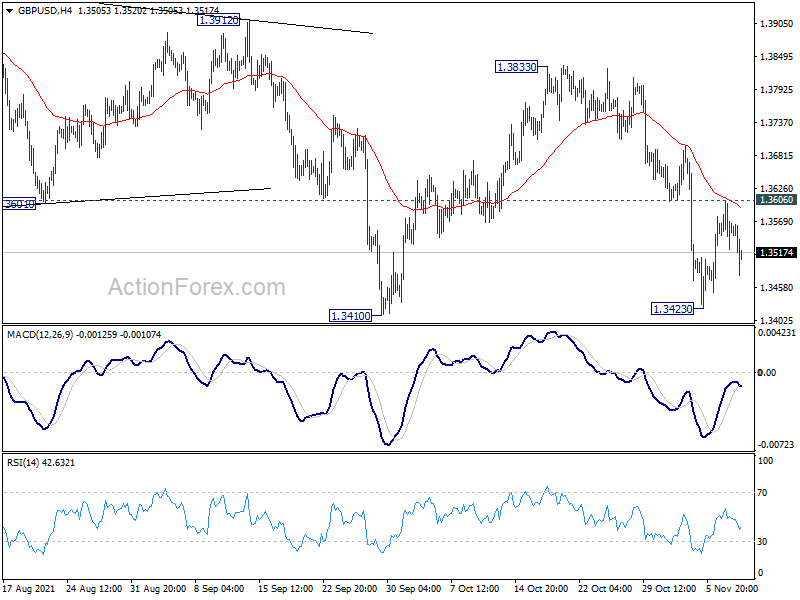
GBP/USD Mid-Day Outlook
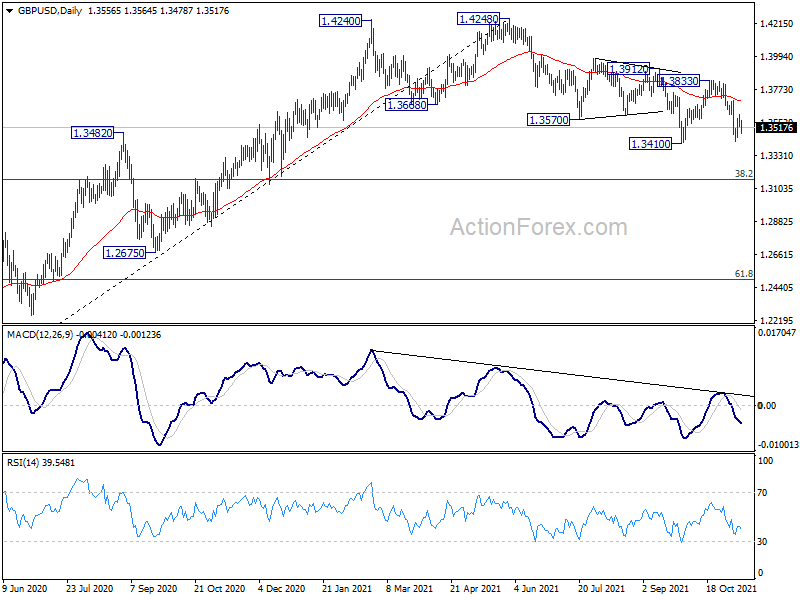
Daily Pivots: (S1) 1.3521; (P) 1.3563; (R1) 1.3603; More...
Intraday bias in GBP/USD remains neutral as it's still staying above 1.3410/23 support zone. On the downside, firm break of 1.3410 low will confirm resumption of larger decline from 1.4248 and target 1.3164 fibonacci level next. However, on the upside, above 1.3604 minor resistance will turn bias back to the upside of 1.3833 resistance. Decisive break there will be a sign of near term bullish reversal.
In the bigger picture, the structure of the fall from 1.4248 suggests that it's a correction to the up trend from 1.1409 (2020 low) only. While deeper fall cannot be ruled out yet, downside should be contained by 38.2% retracement of 1.1409 to 1.4248 at 1.3164, at least on first attempt, to bring rebound. On the upside, firm break of 1.4376 key resistance (2018 high) will add to the case of long term bullish reversal. However, sustained trading below 1.3164 will revive some medium term bearishness and target 61.8% retracement at 1.2493.
EUR/USD Mid-Day Outlook
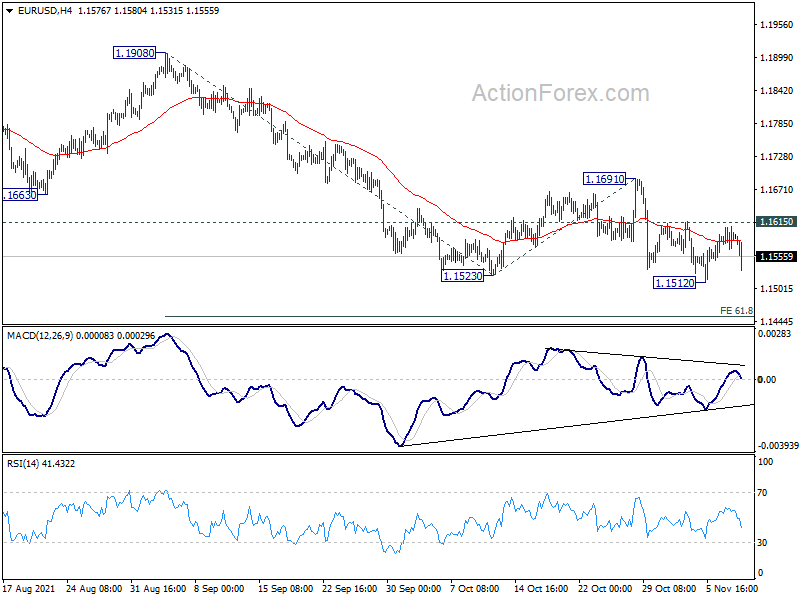
Daily Pivots: (S1) 1.1574; (P) 1.1591; (R1) 1.1612; More...
EUR/USD dips notably in early US session but stays in range above 1.1512. Intraday bias remains neutral first. Further decline is in favor as long as 1.1615 minor resistance holds. Break of 1.1512 will extend the pattern from 1.2348 to 61.8% projection of 1.1908 to 1.1523 from 1.1691 at 1.1453. Break will pave the way to 100% projection at 1.1306. On the upside, though, above 1.1615 minor resistance will dampen the bearish case and turn bias back to the upside for 1.1691 resistance.
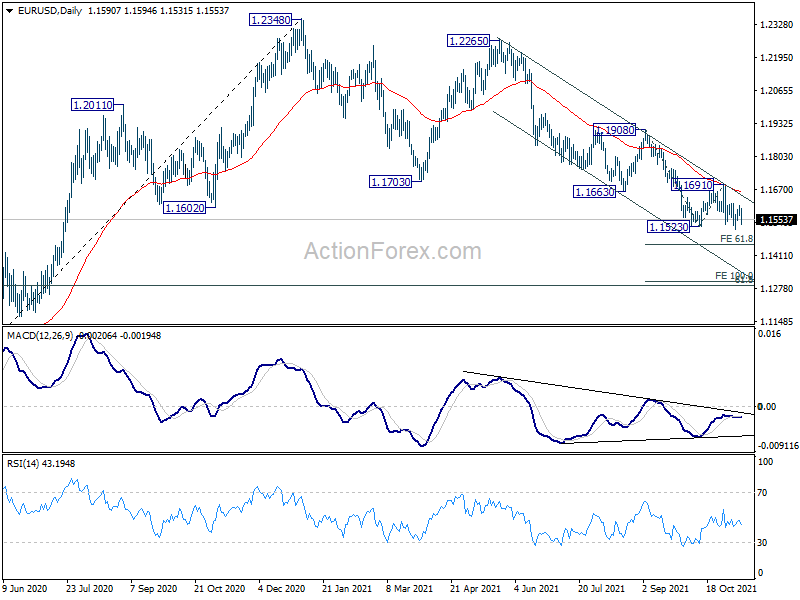
In the bigger picture, price actions from 1.2348 should at least be a correction to rise from 1.0635 (2020 low). As long as 1.1908 resistance holds, deeper fall would be seen to 61.8% retracement of 1.0635 to 1.2348 at 1.1289. Nevertheless break of 1.1908 resistance will revive medium term bullishness and turn focus back to 1.2348 high.
Dollar Rises as US CPI Jumped Sharply Again
Dollar rises sharply in early US session after much stronger than expected consumer inflation data, which hit multi-decade high. For now, New Zealand Dollar is the worst performer today, followed by Sterling and then Euro. Yen is retreating against the greenback but stays steady against others.
Technically, despite notable rally, Dollar is generally still stuck in range at the time of writing. To confirm underlying momentum in the greenback, we'll need to see break of 1.1512 support in EUR/USD, 1.3423 support in GBP/USD, 0.9174 resistance in USD/CHF, and 113.65 minor resistance in USD/JPY.
In Europe, at the time of writing, FTSE is up 0.56%. DAX is down -0.10%. CAC is down -0.25%. Germany 10-year yield is up 0.0232 at -0.273. Earlier in Asia, Nikkei dropped -0.61%. Hong Kong HSI rose 0.74%. China Shanghai SSE dropped -0.41%. Singapore Strait Times dropped -0.37%. Japan 10-year JGB yield dropped -0.0061 to 0.060.
US CPI surged to 6.2% yoy, core CPI to 4.6% yoy, highest since early 90s
US CPI rose sharply by 0.9% mom in October, well above expectation of 0.5% mom. CPI core rose 0.6% mom, also well above expectation of 0.3% mom.
Over the 12-month period, headline CPI accelerated to 6.2% yoy, up from 5.4% yoy, well above expectation of 5.3% yoy. That's also the highest level since November 1990.
Annual core CPI surged to 4.6% yoy, up from 4.0% yoy, above expectation of 4.0% yoy. That's the highest level since August 1991.
US initial jobless claims dropped to 267k
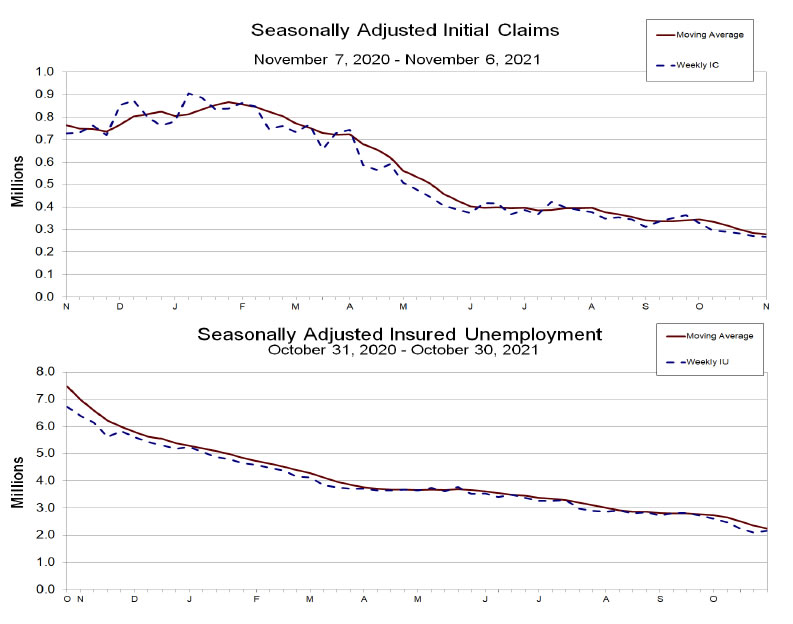
US initial jobless claims dropped -4k to 267k in the week ending November 6, slightly above expectation of 266k. Four-week moving average of initial claims dropped -7k to 278k. Both were lowest since March 14, 2020.
Continuing claims rose 59k to 2160k in the week ending October 30. Four-week moving average of continuing claims dropped -111k to 2245k, lowest since March 21, 2020.
GCEE projects German economy to grow 2.7% this year and 4.6% next
In the latest annual report, the German Council of Economic Experts said, "a variety of bottlenecks on the supply side are disrupting global value chains and, combined with the pandemic-related restrictions that are still in place, are holding back growth."
It forecasts Germany GDP to grow 2.7% in 2021 and 4.6% in 2022. And that subject to "significant risks" including "return of extensive measures to stop the spread of the coronavirus or persistent supply and capacity bottleneck".
The GCEE projections an inflation rate for Germany of 3.1% in 2021 and then 2.6% in 2022. "Longer-lasting supply-side bottlenecks, higher wage settlements, and rising energy prices pose a risk, however, that what are in fact temporary drivers of prices could lead to persistently higher inflation rates," it said.
"Fiscal policy needs to normalise following the crisis. Public finances have to be made more sustainable and crisis-resilient again," says Volker Wieland, member of the GCEE. "The best way for monetary policy to contribute to sustainable economic growth is by maintaining price stability. A normalisation strategy should be published for this purpose."
From Germany, CPI was finalized at 0.5% mom, 4.5% yoy in October. Italy industrial output rose 0.1% mom in September versus expectation of -0.1% mom.
Australia Westpac consumer sentiment rose to 105.3 in Nov
Australia Westpac Consumer Sentiment rose 0.6% to 105.3 in November, up from 104.6. Looking at some details, the index on economic conditions for the next 12 months improved from 103.2 to 106.6, as reopening of major cities looked to have shored up confidence. Unemployment expectations index dropped notably from 107.1 to 95.3, as more consumers expect unemployment to fall than rise.
Westpac expects RBA to continue with the current AUD 4B per week asset purchases to continue as planned till February, and then reduce it to AUD 2-3B until next most likely review in May. Yet, if RBA assess that the pace of achieving its targets is satisfactory, it could decide to cut taper to ADU 2B per week and Fed, and than end the program altogether by May.
New Zealand ANZ business confidence dropped to -18.1, surging inflation expectations
According to preliminary reading, ANZ business confidence dropped to from -13.4 to -18.1 in November. Own activity outlook dropped from 21.7 to 15.6. Export intentions ticked down from 8.6 to 8.0. Investment intentions dropped from 13.8 to 11.6. Employment intentions jumped from 10.9 to 16.1. Cost expectations rose from 87.2 to 89.0. Pricing intentions dropped from 65.6 to 64.6. Inflation expectations surged sharply from 3.45 to 4.33.
ANZ said: "Overall, the survey shows an understandable wariness as we move into a COVID-endemic world. The one certainty is that costs are through the roof."
EUR/USD Mid-Day Outlook
Daily Pivots: (S1) 1.1574; (P) 1.1591; (R1) 1.1612; More...
EUR/USD dips notably in early US session but stays in range above 1.1512. Intraday bias remains neutral first. Further decline is in favor as long as 1.1615 minor resistance holds. Break of 1.1512 will extend the pattern from 1.2348 to 61.8% projection of 1.1908 to 1.1523 from 1.1691 at 1.1453. Break will pave the way to 100% projection at 1.1306. On the upside, though, above 1.1615 minor resistance will dampen the bearish case and turn bias back to the upside for 1.1691 resistance.
In the bigger picture, price actions from 1.2348 should at least be a correction to rise from 1.0635 (2020 low). As long as 1.1908 resistance holds, deeper fall would be seen to 61.8% retracement of 1.0635 to 1.2348 at 1.1289. Nevertheless break of 1.1908 resistance will revive medium term bullishness and turn focus back to 1.2348 high.
Economic Indicators Update
| GMT | Ccy | Events | Actual | Forecast | Previous | Revised |
|---|---|---|---|---|---|---|
| 23:30 | AUD | Westpac Consumer Confidence Nov | 0.60% | -1.50% | ||
| 23:50 | JPY | Money Supply M2+CD Y/Y Oct | 4.20% | 4.30% | 4.20% | |
| 01:30 | CNY | CPI Y/Y Oct | 1.50% | 1.40% | 0.70% | |
| 01:30 | CNY | PPI Y/Y Oct | 13.50% | 12.00% | 10.70% | |
| 07:00 | EUR | Germany CPI M/M Oct F | 0.50% | 0.50% | 0.50% | |
| 07:00 | EUR | Germany CPI Y/Y Oct F | 4.50% | 4.50% | 4.50% | |
| 09:00 | EUR | Italy Industrial Output M/M Sep | 0.10% | -0.10% | -0.20% | -0.30% |
| 13:30 | USD | Initial Jobless Claims (Nov 5) | 267K | 266K | 269K | 271K |
| 13:30 | USD | CPI M/M Oct | 0.90% | 0.50% | 0.40% | |
| 13:30 | USD | CPI Y/Y Oct | 6.20% | 5.30% | 5.40% | |
| 13:30 | USD | CPI Core M/M Oct | 0.60% | 0.30% | 0.20% | |
| 13:30 | USD | CPI Core Y/Y Oct | 4.60% | 4.00% | 4.00% | |
| 15:00 | USD | Wholesale Inventories Sep F | 1.10% | 1.10% | ||
| 15:30 | USD | Crude Oil Inventories | 1.6M | 3.3M | ||
| 15:30 | USD | Natural Gas Storage | 9B | 63B |
US initial jobless claims dropped to 267k
US initial jobless claims dropped -4k to 267k in the week ending November 6, slightly above expectation of 266k. Four-week moving average of initial claims dropped -7k to 278k. Both were lowest since March 14, 2020.
Continuing claims rose 59k to 2160k in the week ending October 30. Four-week moving average of continuing claims dropped -111k to 2245k, lowest since March 21, 2020.
US CPI surged to 6.2% yoy, core CPI to 4.6% yoy, highest since early 90s
US CPI rose sharply by 0.9% mom in October, well above expectation of 0.5% mom. CPI core rose 0.6% mom, also well above expectation of 0.3% mom.
Over the 12-month period, headline CPI accelerated to 6.2% yoy, up from 5.4% yoy, well above expectation of 5.3% yoy. That's also the highest level since November 1990.
Annual core CPI surged to 4.6% yoy, up from 4.0% yoy, above expectation of 4.0% yoy. That's the highest level since August 1991.