Sample Category Title
Elliott Wave View: Nasdaq (NQ) Should Continue Higher
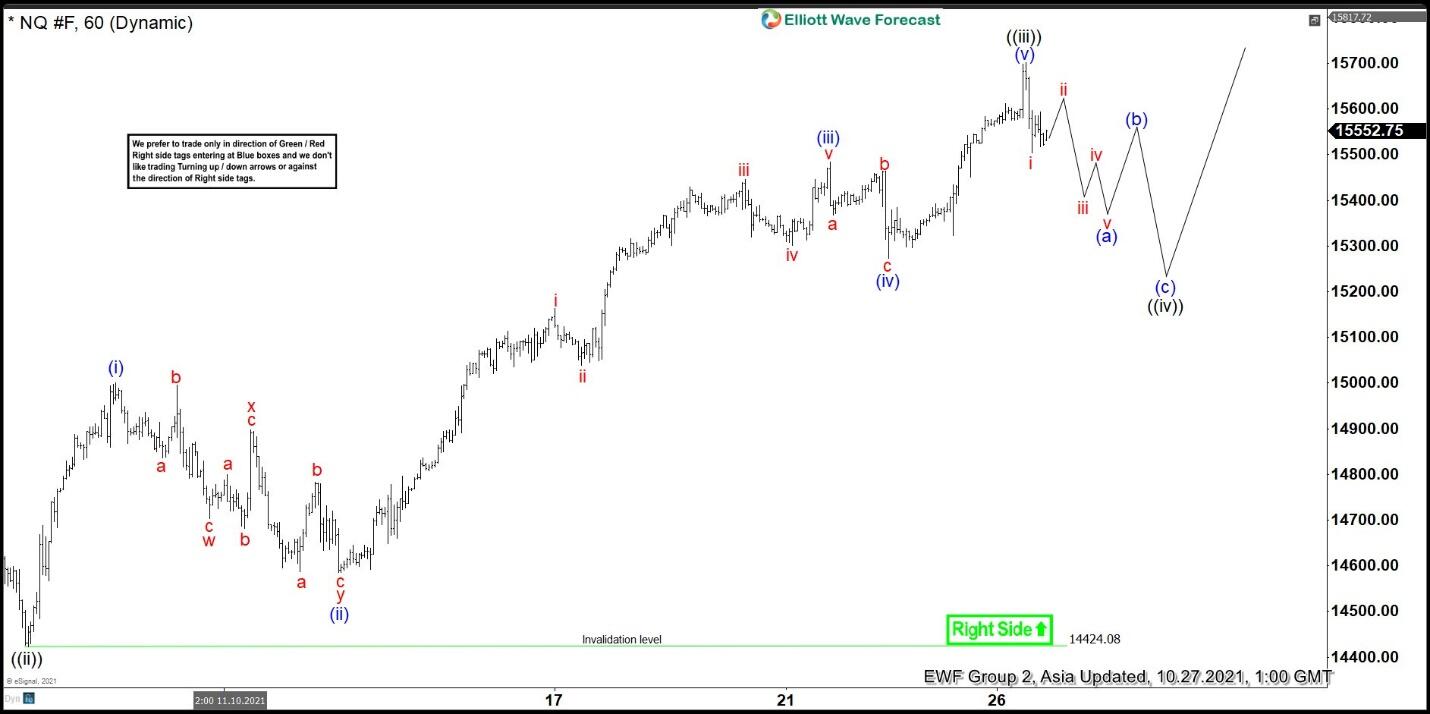
Nasdaq Futures (NQ) breaks to a new all time high above the previous peak on September 7, 2021 at 15708.75. This suggests that buyers remain in control and the next leg higher has started. Short term Elliott Wave view suggests the rally from October 6, 2021 low is unfolding as a 5 waves impulse Elliott Wave structure. Up from October 6 low, wave ((i)) ended at 14754.75 and pullback in wave ((ii)) ended at 14422.50. Index then resumes higher in wave ((iii)) towards 15701. Internal of wave ((iii)) unfolded as another 5 waves in lesser degree. Up from wave ((ii)), wave (i) ended at 15001.25 and dips in wave (ii) ended at 14586.50.
Index then resumes higher in wave (iii) towards 15483.75 and pullback in wave (iv) ended at 15273.75. Final leg higher wave (v) ended at 15701 which also completes wave ((iii)). Expect Index to pullback in wave ((iv)) to correct cycle from October 6 low before the rally resumes. As far as wave ((ii)) low pivot at 14424.08 low remains intact, expect wave ((iv)) pullback to find support in 3, 7, or 11 swing for further upside.
Nasdaq 60 Minutes Elliott Wave Chart
Crude Oil Price Remains Elevated Above $82
Key Highlights
- Crude oil price extended its rally above $80.00 and $82.00.
- A short-term bearish trend line is forming with resistance near $84.85 on the 4-hours chart of XTI/USD.
- EUR/USD is struggling to stay above the 1.1600 support.
- GBP/USD is facing an uphill task near the 1.3800 zone.
Crude Oil Price Technical Analysis
After a close above $78.00, crude oil price extended its increase above $82.00 against the US Dollar. There was a steady increase above the $82.50 and $84.00 resistance levels.
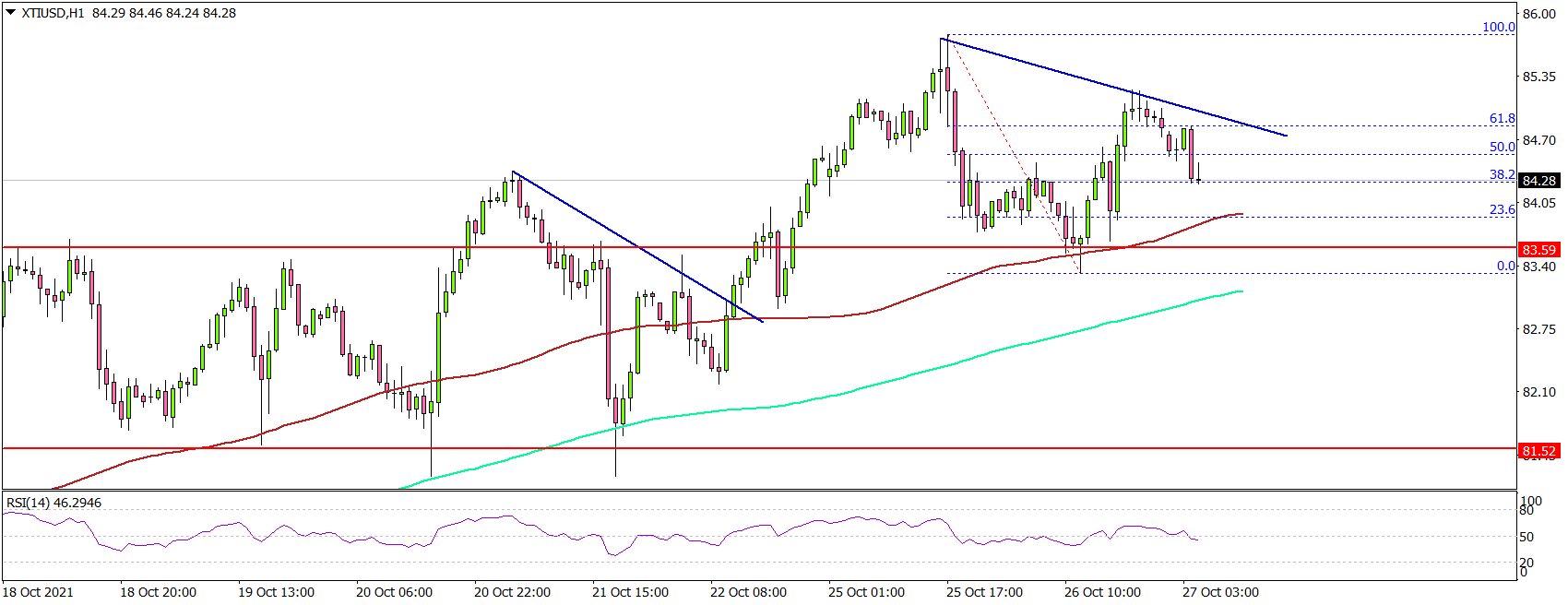
Looking at the 4-hours chart of XTI/USD, the price broke many hurdles near $85.00. It also settled above the $83.50 level, the 100 simple moving average (4-hours, red) and the 200 simple moving average (4-hours, green).
Recently, there was a downside correction from $85.78, but dips were limited below $83.50. The price is rising again and trading above $84.00.
On the upside, an initial resistance is near the $84.80 level. There is also a short-term bearish trend line forming with resistance near $84.85 on the same chart. The next major resistance is near the $85.00 level, above which the price could rise towards the $86.50 level.
An immediate support on the downside is near the $84.000 level and the 100 SMA. The first major support is near $83.50. Any more losses could open the doors for a move towards the $81.50 support.
Looking at EUR/USD, the pair failed to recover above 1.1650 and it is now struggling to stay above the 1.1600 level. Besides, GBP/USD is facing a major resistance near 1.3800.
Economic Releases to Watch Today
- US Durable Goods Orders for Sep 2021 – Forecast -1.1% versus +1.8% previous.
- BoC Interest Rate Decision – Forecast 0.25%, versus 0.25% previous.
Market Morning Briefing: Pound Has Support Near 1.3758
STOCKS
Equities look mixed. While Dow can fall below resistance at 36000, Dax can rise to 15800/900 before coming off from there. Nikkei has resistance at 29250/500 which if holds can produce a fall towards 28500 or lower. A break above 29500 is needed for view to again turn bullish. Shanghai is bullish while above 3550. Nifty and Sensex is bullish for the near term while above 18000 and 60000 respectively.
Dow (35756.88,+15.73, +0.04%) has risen. As mentioned previously, our view is to see a corrective fall from resistance near 36000 towards 35500-35000.
DAX (15757.06, +157.83, +1.01%) has risen too and is trading near the upper end of the range of 15800-15400 mentioned previously. Our view is bullish to see a test of 15800/900 on the upside before we see a corrective fall towards 15400 again.
Nikkei (28946.61, -159.40, -0.55%) has come down below 29000 today as resistance mentioned near 29500/250 has held well. The range of 28000-29500 can hold for some more time before we see a break on either side. Possible rise above 29500 towards 30000 and 31000 looks likely in the medium term.
Shanghai (3562.46, -35.18, -0.98%) has dipped today. While above 3550,the view is still bullish to see a rise towards 3600/3700.Only a strong break below 3550 will indicate bearishness towards 3450/3425. Watch price action near 3550.
Nifty (18268.40, +143, +0.79%) is holding within the range of 18000-18400 and an eventual rise towards 18600/800 looks likely.
Sensex (61350.26, +383.21, +0.63%) has bounced back after testing the support at 60000.The view is now bullish to see a test of 62000 on the upside.
COMMODITIES
Commodities have dipped a bit today and can fall some more in the near term before bouncing back. Gold can test 1780/60 while below 1800 as Silver is headed towards 23.50. Copper can fall to 4.45/35 before rising again. Brent and WTI have supports near 85/86 and 81/82 and can rise towards 87.36-90 and 85/86 respectively in the near term.
Brent (86.13) and WTI (84.23) have support near 85/86 and 81/82 respectively which if hold could be bullish for the prices in the near term. We continue to look for a possible rise towards 87.36-90 and 85/86 respectively in the near term.
Gold (1788.80) fell back to levels below 1790 as it could not sustain the rise above 1800 seen yesterday. While below 1800, it is again heading towards 1780/60 on the downside. Unless a sustained break above 1800 is seen it is difficult to turn bullish on the price.
Silver (24.08) has dipped along with Gold. A fall to 23.50 is possible before a bounce back is seen again.
Copper (4.4930) has fallen as expected and has scope to fall to 4.45/35 before a bounce back is seen in the medium term.
FOREX
Quiet action seen in most currencies just now. Dollar Index needs to see sustained trade above 94 to rise towards 94.50 on the upside. Near term range of 93.50-94.50 may hold. Euro can be bearish towards 1.15 while below 1.16. EURJPY can trade within 131.85-132.70 for the near term. Aussie and Pound looks bullish for the very near term. USDJPY has risen as expected and can continue to move up towards 114.50 before falling from there. USDINR may range within 74.90-75.20/25. A break below 74.90 can drag it lower towards 74.70/50. An eventual fall below 74.90 looks more likely. USDCNY can hold above support at 6.3750.
Dollar Index (93.92) is hovering near 94 and while above support at 93.50 there is scope for a rise to 94.50 on the upside on a confirmed break above 94. On the other hand, a fall below 93.75 is needed for the index to again fall to 93.50. A range of 93.50-94.00 may hold just now and a break on either side can take the index either towards 93.50 or to 94.50 in the near term.
Euro (1.1598) can be ranged within 1.1625-1.1575 for the near term before breaking on either side of the range. While below 1.16, view is bearish for an eventual fall towards 1.15.
EURJPY (132.26) is trading within 131.85-132.70 and a break on either side of the range is needed to see which way the cross moves further. For now, view is to see some ranged sideways consolaidtion.
Aussie (0.7525) has immediate trend resistance near 0.7550 which if holds can produce a short decline towards 0.7450 again. A break above 0.7550 is needed within the current upmove in order to see a straight rally towards 0.760-0.7650 or higher in the medium term. Watch price action near 0.7550.
Pound (1.3773) has support near 1.3758 and while that holds, Pound can rise in the near term towards 1.3840.
Dollar-Yen (114.03) is rising as expected and could head towards 114.50 before reversing from there. A broad range of 113-114.50 can hold for now.
USDCNY (6.3826) trades above 6.3750. While the support holds, a rise towards 6.41/44 looks likely.
USDINR (74.9625) fell from 75.1650, below our expected resistance at 75.20/25. While the resistance holds, a fall to 74.90 is possible. A break below 74.90, if seen will bring in 74.70/50 into the picture indicating a fall in the near term. For now watch price action within 74.90-75.20/25 region.
INTEREST RATES
The US Treasury Yields continue to remain lower. The far-end yields have key near-term supports which if broken can trigger a deeper fall in the coming weeks. The German yields are likely to remain below their crucial long-term resistances and see a fresh fall in the coming weeks. The 10Yr and the 5Yr GoI remains mixed and are stuck in a narrow range. The narrow consolidation can continue for some more time before we see a fresh fall.
The US 2Yr (0.46%) and the 5Yr (1.20%) yields have inched up slightly while the 10Yr (1.63%) remains stable and the 30Yr (2.05%) has dipped further. The yields will have to dip below 1.6% (10Yr) and 2% (30Yr) in order to come under pressure to see a deeper fall to 1.5% (10Yr) and 1.9%-1.85% (30Yr). Such a break is needed to reduce the chances of seeing a rise past 1.75% (10Yr) and 2.2% (30Yr).
The German 2Yr (-0.67%), 5Yr (-0.45%) and the 10Yr (-0.12%) yields remain stable while the 30Yr (0.24%) has dipped slightly. The broader view remains bearish to see a fall to 0.1%-0% on the 30Yr on a break below 0.2%. The 10Yr can fall to -0.2% and lower while it remains below the -0.1%/-0.05% resistance zone.
The Indian 10Yr GoI (6.3630%) sustains stable above 6.33%. As mentioned yesterday, 6.3%-6.4% can be the range of consolidation for some time. While below 6.4%, we remain bearish to see a fall to 6.2% and lower levels. We reiterate that a strong break above 6.4% is needed to move further up towards 6.45%-6.5%.
The 5Yr GoI (5.7347%) is stuck between 5.71% and 5.7450% within its overall 5.66%-5.76% range. As mentioned yesterday, 5.7%-5.76% could be a narrow range of trade for now. A rise to 5.76% is possible while above 5.7% in the near-term.
Eco Data 10/27/21
[php_everywhere instance="1"]
ECB Could Play Some Defense
The European Central Bank (ECB) will wrap up its latest meeting at 11:45 GMT Thursday. Markets are pricing in the first rate increase for next year, which seems premature as the region continues to grapple with growth risks. The ECB could push back against this pricing, playing down the possibility of an early rate hike and consequently dealing a blow to the euro.
Eurozone under pressure
The macroeconomic landscape in the Eurozone has deteriorated significantly in recent months. With the reopening boom from earlier in the year fading and supply chains being an absolute mess, economic growth seems to be slowing down.
Even worse, the power shortage that is ravaging Europe threatens to squeeze consumers, who will be faced with higher energy bills. And on top of everything, China is also battling its own slowdown as the property sector deleverages. With China being the Eurozone’s top trading partner, some collateral damage seems inevitable.
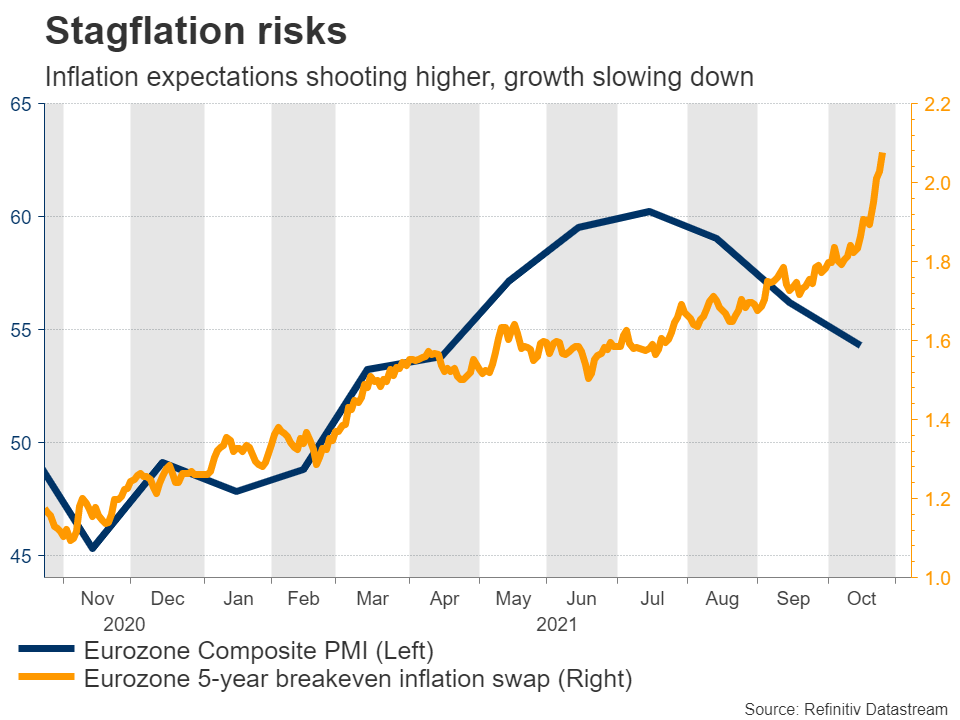
In this light, it is strange that money markets are pricing in an ECB rate increase for next year. Even though it is only 10 basis points, that still seems excessive. Investors are looking at inflation expectations, which have surged to multi-year highs lately. Normally, this is a signal that inflation is here to stay, so the central bank needs to react to prevent the economy from overheating.
But in Europe’s case, it simply reflects the spiral in energy prices. The growth outlook is grim and the labor market is nowhere close to a full recovery, so consumers are unlikely to have the pockets necessary to keep the inflation momentum going once supply problems fade.
Lagarde to push back?
Bearing all this in mind, the ECB is likely to push back against market pricing, playing down the possibility of raising rates next year. President Lagarde could highlight the growing risks around economic growth and stress that the current inflation episode still seems transitory.
As for the QE program, the real decisions will probably be taken in December, when policymakers will also have fresh economic forecasts at their disposal. The emergency bond purchases will almost certainly be terminated next March. The question is whether the regular asset purchases will be beefed up to make up for that shortfall, and if so, by how much.
Euro outlook
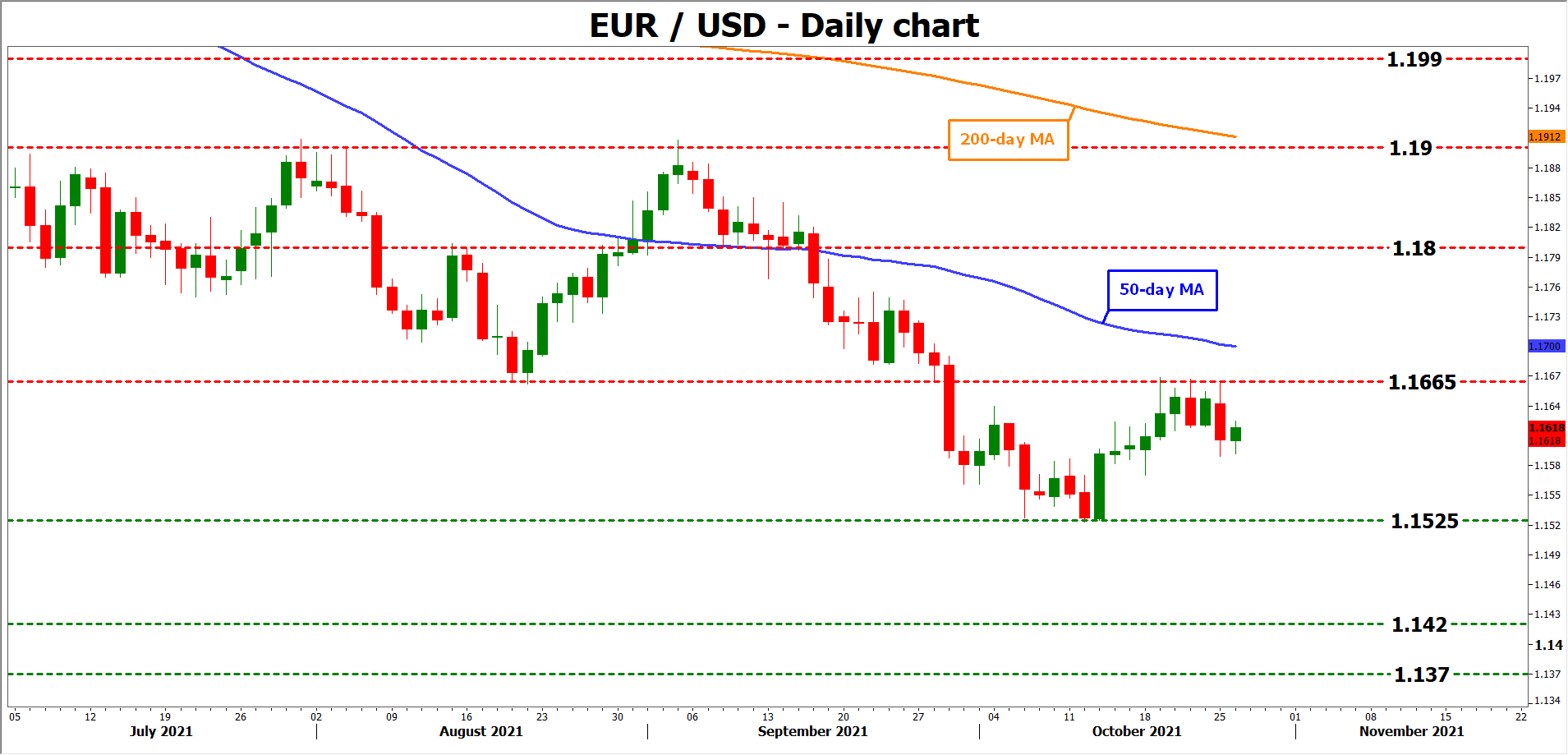
If the ECB indeed pushes back against market pricing, the euro could take a small hit as European bond yields cool down. Taking a technical look at euro/dollar, initial support to any declines might come from the 1.1525 zone.
On the flipside, if Lagarde starts to question whether inflation is transitory, that would reinforce the market’s view for rate increases next year and likely send the euro higher. In this case, the 1.1665 region could provide immediate resistance to advances.
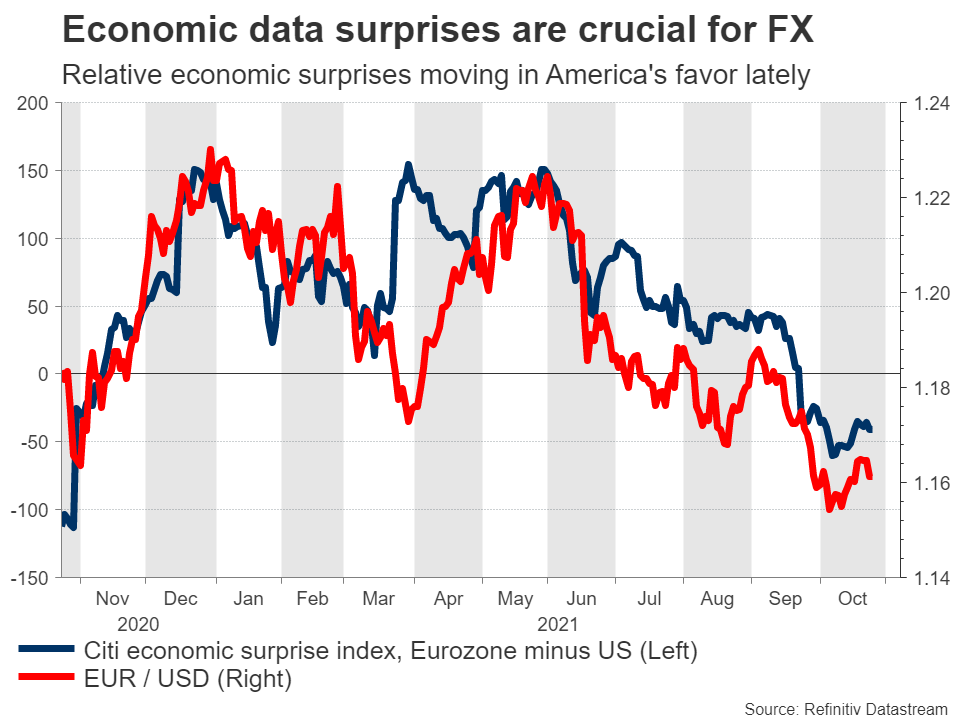
In the big picture, the outlook for the euro still seems gloomy. There are several risks that threaten to kneecap the economic recovery, which is already lagging behind the American one. In contrast, the US economy is shielded from the energy crisis thanks to its energy independence and Congress is working on more spending to power up growth.
The result could be US economic outperformance, which typically translates into Fed/ECB divergence and ultimately, a lower euro/dollar.
Greenback Firms Up Again Ahead of GDP and Inflation Data
The impending batch of US economic statistics due out at the end of this week could be critical in determining the direction of the dollar's fortunes’. The Gross Domestic Product (GDP) figure will be released on Thursday at 12:30 GMT, while the Fed's preferred inflation metric will come out on Friday at 12:30 GMT. Overall, the outlook for the dollar remains positive when compared to the euro and the yen.
GDP and PCE price index in sight
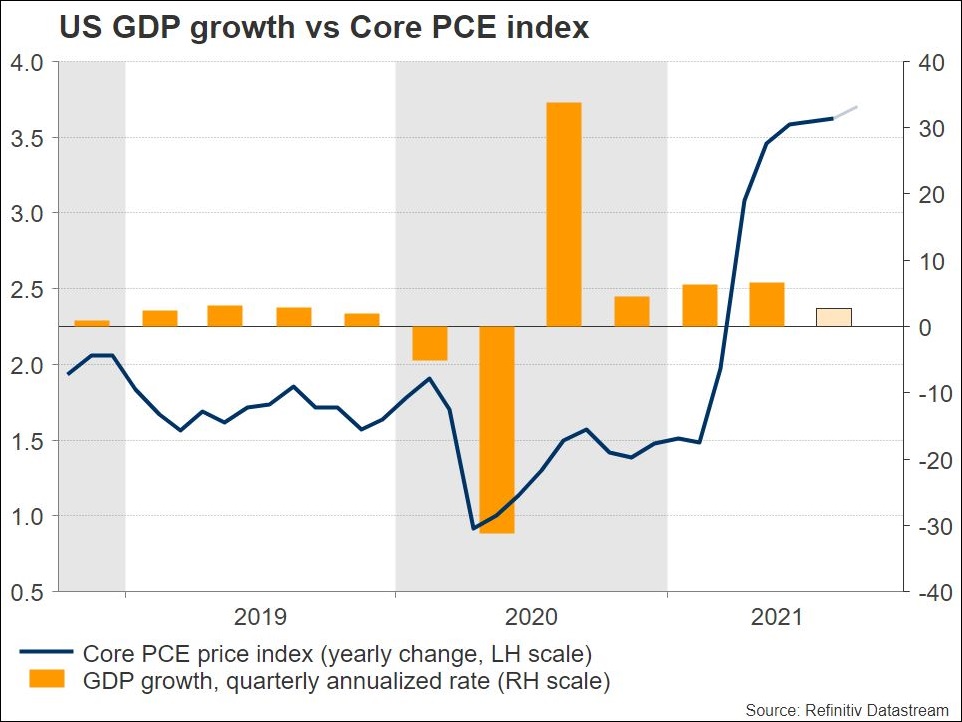
The first estimate of gross domestic product for the third quarter will be revealed on Thursday. On this point, there is a significant divergence between market expectations and Federal Reserve models. While analysts agree that the economy will grow at an annualized rate of 2.7% y/y, the Atlanta Fed's GDPNow model predicts a growth rate of only 0.5%. The American economy grew by 6.7% in the second quarter, which was somewhat below the more optimistic forecasts.
As a result of higher personal consumption spending, exports and private inventory investment, higher imports partially offset the higher personal consumption expenditures and exports. The GDPNow estimate started the quarter at 6% but has slowly declined as economic data has disappointed. This raises concerns about the next GDP statistic.
While rising prices, supply chain difficulties, and labor shortages were projected to have weighed on growth in the third quarter, some of these effects may fade in the fourth quarter, especially if there is no new Covid variant to worry about.
Nevertheless, a negative surprise could cause some worries about the Fed's ability to hike rates and put pressure on the greenback. If the figure is better than expected, yet still showing a slowdown, the inverse may be true.
The core PCE price index, which is what the Fed looks at most closely, increased by 0.3% m/m in August, matching the previous month's gain, owing to increases in services. Within goods, both durable and non-durable items had price increases. PCE prices increased 0.4% in August, matching the increase in July and slightly exceeding market estimates of 0.2%. In September, the prediction is a rise at 3.7% y/y from 3.6% previously while month-on-month is forecasted to fall to 0.2% from 0.3%.
Focus on earnings releases this week
There is a shift in focus to third-quarter corporate earnings reports this week as the September data may be seen as outdated by some Fed policymakers are getting ready for the Federal Open Market Committee meeting next week. Thus, investors will be gauging inflation pressure by how companies describe their expenses and their ability to pass them on to customers. Energy prices are also getting more attention due to the surge in commodity prices.
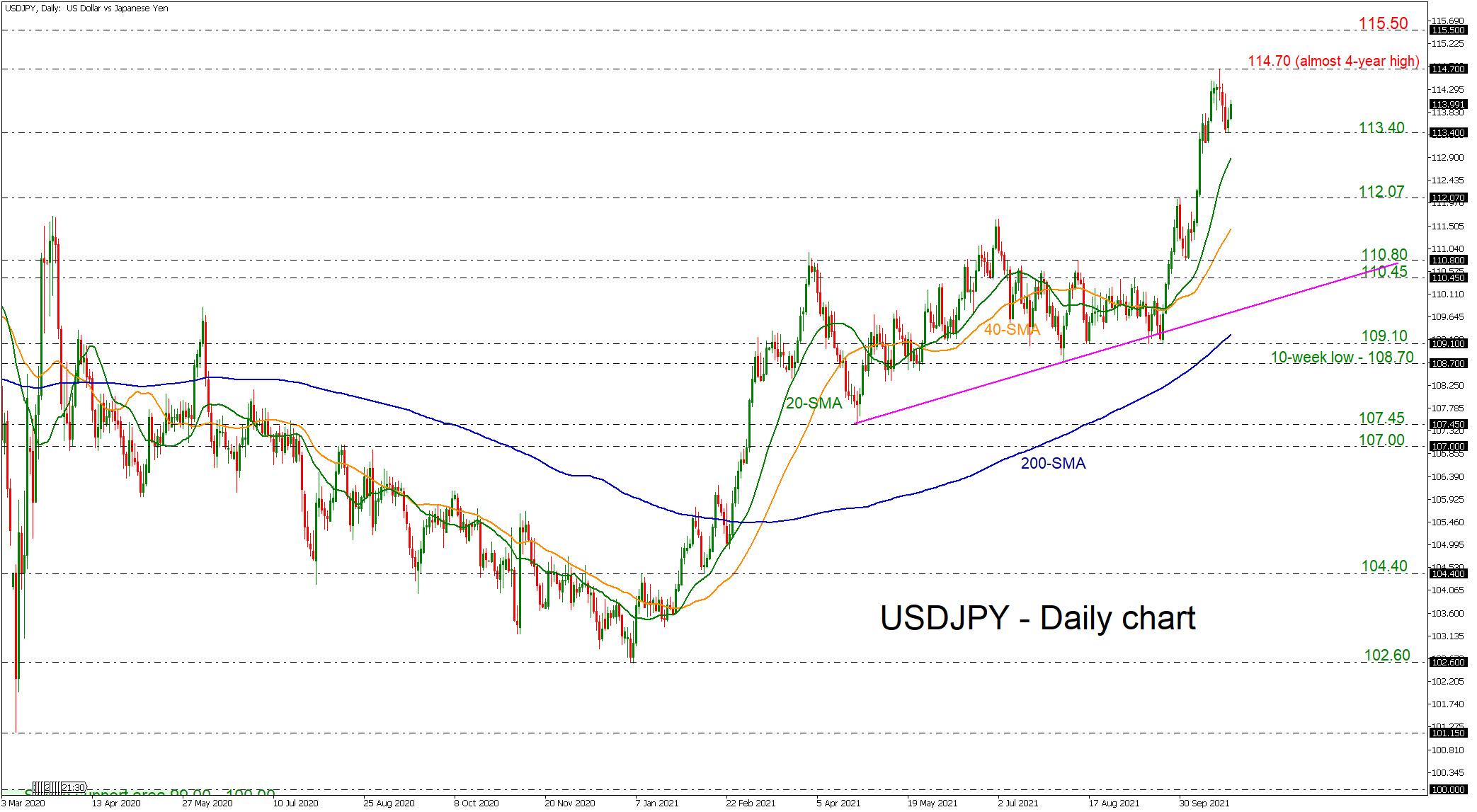
Dollar/yen heads higher
In the big picture, the outlook for the dollar seems positive, particularly against the euro and yen.
Taking a technical look at dollar/yen, if the bulls manage to overcome the almost four-year high of 114.70, their next target might be the 115.50 area, marked by the high in March 2017.
On the flip side, a reversal lower could encounter immediate support near the 113.40 region, before the focus turns towards the 112.07 zone.
Aussie Punches above 75 Line
The Australian dollar has posted gains on Tuesday. AUD/USD has pushed above the 75 line and is trading at 0.7510, up 0.26% on the day. The Australian dollar has been red hot in the month of October, surging 3.93%. The Aussie has benefited from improved risk appetite and the US dollar continues to stumble.
Australian CPI expected to ease
Australian CPI will be released on Wednesday, and the consensus for the third quarter stands at 3.1%, considerably lower than the Q2 reading of 3.1%. A reading within expectations would reinforce the view that the rise in inflation is transitory and would enable the RBA to maintain its current course for monetary policy. The RBA has signalled that it has no plans to raise interest rates prior to 2024. However, the markets have been more hawkish and have priced in a hike for mid-2022. There had been talk of the RBA changing its guidance on the rate outlook and taking a more hawkish stance, but so far that hasn’t happened. If the Q3 reading indicates that inflation is slowing, the central bank will feel less pressure to change course.
The US economy receives a key report card on Thursday, with the release of Advance GDP on Thursday. The consensus stands at 2.7% for the third quarter (QoQ), much weaker than the Q2 gain of 6.4%. This is the first of three GDP readings and is considered to have the most impact. Market participants will also be closely following the Core PCE Price Index, the Fed’s preferred inflation indicator. The estimate is expected to jump to 4.4% for September, up from 3.6% beforehand.
AUD/USD Technical
- The pair tested resistance at 0.7532 in the Asian session. Above, there is resistance at 0.7624
- 0.7476 is under pressure in support and could break later in the day. This is followed by 0.7328

Earnings Lift Equity Markets
Earnings season is continuing to lift stock markets this week, giving investors the reason they've craved to jump back in push equities back to record highs.
Downside risks to the economy remain but investors are opting to look beyond these as companies continue to give us plenty of reason to be optimistic about what lies ahead. The coming months will be challenging and this enthusiasm may come and go, creating plenty of two-way action in the markets, but right now investors are full of optimism.
Facebook earnings on Monday got the week underway for big tech earnings and, in keeping with the trend in the broader markets, the company managed to impress despite facing numerous challenges. Whether that be changes to Apple's data rules, advertising headwinds as supply constraints weigh ahead of the holiday season, or political pressures following the whistleblower revelations.
Despite all of those challenges, the company continued to report strong user growth, revenues and profit. Their forecasts fell slightly short of analyst expectations for the fourth quarter as a result of Apple and advertising difficulties. Ultimately though, these are short-term problems that the company will adapt to, but it's the metaverse that investors are really excited about.
Plenty more to come from big tech today, with Microsoft, Alphabet, and Twitter all reporting after the close this evening. Twitter's share price has suffered this past week on the back of Snap and Facebook results and looks a little vulnerable ahead of its own release, with investors seemingly preparing for the worst.
Oil steady but rapidly losing momentum
Oil prices are pretty steady on Tuesday after once again being pushed higher at the start of the week on some cold weather headlines, something we should become accustomed to over the coming months. With OPEC+ clearly in no mood to pump more than is currently planned, the market is looking very tight and these huge moves in natural gas are going to lift oil prices as well.
While I suspect oil prices still have further to run to the upside in the coming months, especially if we are facing a cold winter period, it's looking like a very overcrowded trade at this point and the rally is rapidly losing momentum. Barring more bullish headlines, which is possible considering what we saw yesterday, we could see some profit-taking in Brent and
WTI which would be healthy for the market.
China is currently recording cases of the Covid delta variant in 11 provinces, which may trigger some profit-taking in crude prices, given the country's zero covid policy. Lockdowns in those areas with breakouts, despite the numbers being very small, could be enough to take some of the heat out of the oil market just as it's losing momentum. Especially if those numbers tick higher and cases become more widespread.
Gold struggling after falling back below $1,800
Gold is once again struggling to hold above the $1,800 handle, with the price slipping more than 1% just as it appeared to take a significant step towards it. After giving up gains on Friday to close the week back below $1,800, the yellow metal rallied on Monday and ended the day back above, potentially setting it up to capitalize on the momentum and take a run at $1,833, a level it's failed at repeatedly in recent months.
But it seems it isn't to be, with gold sliding today and looking in bad shape despite the US dollar and yields being only marginally higher on the day. It doesn't look good for gold which looks set to end the day below yesterday's opening level, a negative technical setup that just compounds the red flag that appeared after Friday's reversal.
A move below $1,780 and it starts to look really bad for gold, which has been in an upward trend throughout the month. This would break the trendline and potentially send it spiraling lower, with the next potential support appearing around $1,760.
Will Dorsey's hyperinflation prophecy spur another Bitcoin surge?
Bitcoin is relatively flat on Tuesday after bouncing back strongly at the start of the week. Despite a brief dip below $60,000, it held onto that psychologically important support level and is now sitting comfortably above there, which begs the question, when will we see another run at record highs. There's been lots of positive momentum in the market recently and there's certainly no shortage of crypto headlines right now. And with Jack Dorsey's warning of impending hyperinflation, perhaps we'll soon see just how good an inflation hedge bitcoin truly is. Probably not, though.
Sunset Market Commentary
Markets
With few data scheduled for release and the focus backloaded toward the end of the week, investors built on yesterday’s trading dynamics. US and European inflation expectations continue rising, with Europe taking the lead. The 10-y euro inflation swap touched 2.20%. Markets apparently aren’t convinced at all that the ECB on Thursday will conclude that inflation expectations are (more than well) anchored. The rise inflation expectations coincides with a further decline in real yields. The US 10-y real yield returns below -1.0% (-1.05%). The German real yield is sinking ever deeper in uncharted territory (-2.15%!!). For nominal yields, this results in a further curve flattening with the US 2-y yield rising 1.5 bps while the 30-y eases 2.0 bps. The German curve even continues an outright bull flattening with the 30-y yield shedding 2.0 bps. It’s far from clear how long this trend of lower real yields can/should continue. At least for now, together with acceptable corporate earnings, it facilitates a favourable equity sentiment. European equities show gains of up to 1.0%. The cycle top in the EuroStoxx50 (reached mid-August) is again within reach. US indices (S&P 500, Dow) even open at a new record. Buy-on-dips still shows remarkable resilience.
Moves in the major currency cross rates are limited. The DXY-USD index trades little changed in the 93.75/80 area. USD/JPY regains the 114 barrier. We assume this is mainly due to the risk-on rather than a result of interest rates. In a similar narrative, EUR/USD resists the decline in EMU real yields, hovering in a tight range just north of the 1.16. Even so, the broader picture still looks fragile with 1.1664 a tough hurdle going into Thursday’s ECB policy meeting. The better global sentiment also arrested the decline in CE-currencies. EUR/HUF stabilizes near 365.50. The Czech koruna (EUR/CZK 25.70) and the zloty (EUR/PLN 4.6050) even try a (very) cautious comeback.
Diverging underlying yield dynamics obviously benefited sterling. EUR/GBP drifted towards the 0.8421 recent low with CBI retail sales providing the final push in the GBP back. Surging retail sales pulled the pair close to 0.84 with GBP/USD testing the recent highs near 1.3835. Next week will be interesting from a UK perspective. UK Chancellor Sunak will set out budget plans tomorrow which will include a higher national living wage and an end to the public sector pay freeze. Better-than-expected growth forecasts imply improved public finance data and allow Sunak to focus more on spending. Such outcome could enhance short term sterling gains. The benchmark for UK trading comes on Friday when Brexit minister Frost meets with EC VP Sefcovic to take stock on talks about the Northern Ireland protocol. A less vigilant tone could further support sterling, especially against a weak euro. Finally, the Bank of England meets next week with an outside chance of an early kick-off to the tightening cycle. Next important support in sterling stands at 0.8277/0.8310 which are the 2019/2020 lows.
News Headlines
The German government slashed growth rates for this year from 3.5% to 2.6%, according to Reuters sources familiar with the decision. It has done so due to supply problems, including scarcity in semiconductors and intermediate goods that are crucial to German manufacturing. Recently, the European Union also warned for shortages in magnesium, an essential component for aluminum as Chinese exports to the bloc have slumped. German growth was revised up for 2022 though, from 3.6% to 4.1% before normalizing to 1.6% in 2023. The government holds the view that the inflation is temporary and sees price increases easing to 2.2% in 2022 and 1.7% in 2023.
The US junk bond market grew to an unprecedented $1.5tn, FT reported based on ICE Data Services. A record 149 companies already joined the high-yield bond market so far this year, already dwarfing the previous record in 2013 (over 120). In a global low-yield environment, high-yielders have particular attention from investors that seek to put huge cash piles to work. The IMF recently warned however that rising financial leverage could exacerbate existing vulnerabilities in the financial system. At the same time, the FT reported that investors start noting the challenge of conducting a proper due diligence on the companies they lend to because of the huge volume and short time between the launch and completion of new deals.
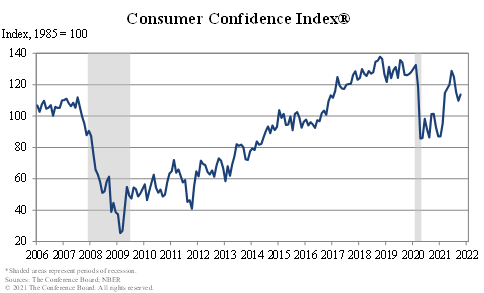
US consumer confidence rose to 113.8, reversing a three-month downward trend
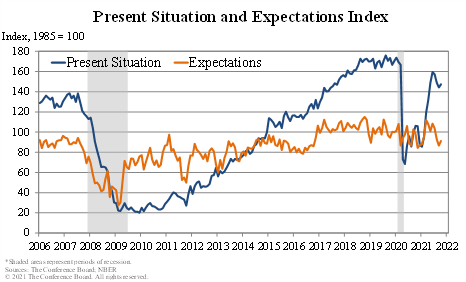
US Conference Board Consumer Confidence Index rose from 109.8 to 113.8 in October, above expectation of 108.4. Present Situation Index rose from 144.3 to 147.4. Expectations index rose from 91.3 to 86.7.
"Consumer confidence improved in October, reversing a three-month downward trend as concerns about the spread of the Delta variant eased," said Lynn Franco, Senior Director of Economic Indicators at The Conference Board.
"While short-term inflation concerns rose to a 13-year high, the impact on confidence was muted. The proportion of consumers planning to purchase homes, automobiles, and major appliances all increased in October—a sign that consumer spending will continue to support economic growth through the final months of 2021. Likewise, nearly half of respondents (47.6%) said they intend to take a vacation within the next six months—the highest level since February 2020, a reflection of the ongoing resurgence in consumers' willingness to travel and spend on in-person services."