Sample Category Title
Fed Bostic penciled in a rate hike in Q3, maybe early Q4 of 2022
Atlanta Fed Raphael Bostic told CNBC he has "penciled in" a rate increase in "late third, maybe early fourth" quarter of 2022. "Our experience from the pandemic has really frankly surprised to the upside," he added "I've really adjusted my expectations moving forward."
Bostic expected the supply chain disruptions to "last longer than we expected". He said, "the labor markets are not going to get to equilibrium as quick as we hoped, but demand was also going to stay high and that combination was going to mean we're going to have inflationary pressures." It's becoming "clearer and clearer" inflation pressure "is going to last into 2022."
Cliff Notes: Global Inflation Angst Grows
Key insights from the week that was.
A quiet week for data saw the market’s focus remain on inflation. This was most notably the case in New Zealand and Australia, with the NZ Q3 print received this week and Australia’s Q3 outcome due next week.
New Zealand’s Q3 CPI report was a spectacular outcome, with the quarterly gain of 2.2% above the RBNZ’s annual inflation target. At September, annual inflation is 4.9%yr, up from 3.3%yr three months earlier and the highest read since 2011’s GST spike. As discussed by our New Zealand economics team, the strength being seen in inflation is broad-based, with “a potent cocktail of supply-side cost pressures and strong demand” present. On the supply side: global production disruptions have reduced the availability of many manufactured goods and increased their price; transport and energy costs have also surged. Regarding demand, its underlying strength and the reduced set of goods and services available for purchase as a result of travel restrictions have amplified the inflation pulse and buoyed inflation expectations.
While the inflation pulse will moderate as life returns to ‘normal’, inflation is expected to remain firm over the forecast horizon. Consequently, the RBNZ is expected to raise the cash rate at the November, February and May meetings before pausing to assess conditions.
Despite being affected by many of the same influences, inflation in Australia is a stark contrast to that in New Zealand. Versus their 2.2% Q3 gain, we expect next week’s ABS release to report a 0.8% increase in Australian consumer prices over the three months to September, 0.5% on a core, trimmed mean, basis. That will leave annual headline inflation at 3.1%yr and trimmed mean inflation circa 1.9%yr. Even on a six-month annualised basis, trimmed mean inflation is only expected to print at the bottom of the RBA’s 2-3%yr target range. All of the detail underpinning our expectations can be found in the CPI preview, along with an assessment of the risks.
As detailed again in this weeks October RBA meeting minutes, the Board continues to believe that, while there are risks, inflation is unlikely to sustainably be in the 2-3%yr target range before 2024, warranting the cash rate remain on hold until then. Meanwhile, market pricing has moved significantly on global inflation concerns and New Zealand’s Q3 outcome. The market now sees the first rate hike by the RBA in late-2022, just ahead of Westpac’s forecast of Q1 2023.
Critical to the policy decisions of the RBA over the forecast period will be wage gains, with growth of more than 3.0%yr believed necessary by the RBA to sustainably meet their inflation target. While, as yet, there is little evidence of a broad-based pick up in wage growth in Australia, there is resilience in employment.
Indeed, this week’s payroll release from the ABS suggests employment may have moved into recovery mode in late September, after the reference period for September’s labour force survey. The payrolls release is volatile and not seasonally adjusted, but it clearly points to the possibility of an abrupt end to the large-scale job losses induced by the recent lockdowns. If employment surprises to the upside in October, then the peak unemployment rate for this contraction may be below our current forecast of 5.1%, revised down from 5.4% before the September labour force survey was released. Such an outcome would lead to strong confidence in the employment rebound and, come the end of 2022, the return of a tight labour market.
Data in the US this week was secondary in nature and proved of little significance for the market. Participants were instead focused on the fiscal outlook, which remains very mirky, and concerns over inflation. From speeches by Governors Quarles and Waller, it is clear that the FOMC maintain a high degree of confidence in the US economy despite a likely poor read for Q3 GDP next week. In terms of the risks, their minds are focused on upside potential for inflation. This focus makes clear that, barring an unforeseen event, the taper decision will be made at the November meeting and proceed to mid-2022. The market has also come to our view on the timing of a first fed funds rate hike, pricing it by December 2022. It is worth noting though that the baseline view of the FOMC, Westpac and the market is still for a measured, reactive tightening cycle, to 1.625% by late-2024 on our forecasts. Such an outturn would arguably still be supportive of growth around trend at the end of the forecast period and beyond.
Finally on China. This week’s Q3 GDP update and September partial data were in line with our expectations. While Q3 was hit by COVID-19 fears and headwinds associated with authorities’ 2020 regulatory changes for residential construction, the September retail sales print implies consumption activity bounced back strongly late in the quarter. Previously released data, the NBS services PMI and trade data for September in particular, also point to a strong rebound in momentum into Q4. As a result, we hold to our 8.5%/5.7% GDP forecasts for 2021 and 2022 despite the uncertainties related to Evergrande and global production.
Eco Data 10/22/21
[php_everywhere instance="1"]
EUR/USD May Test 1.1600-1.1570 Support Before Resuming Uptrend
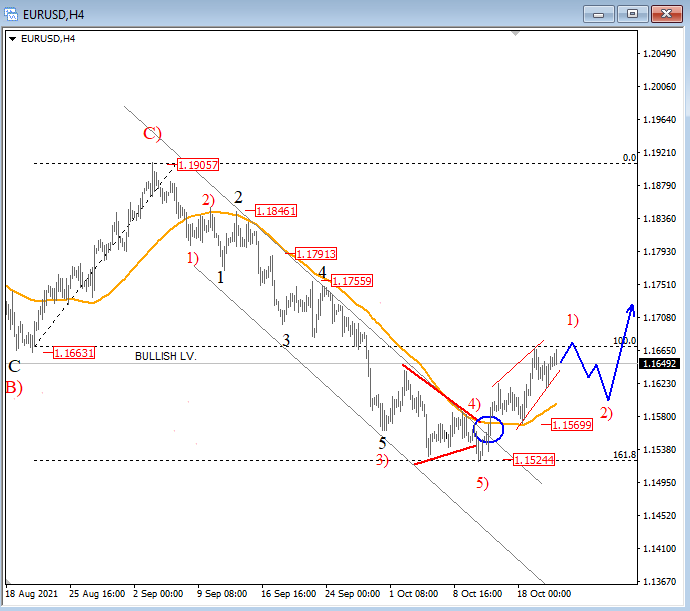
EURUSD is coming higher very nicely back towards 1.1663, the former lows, after a bottom formation at 1.1520/25 area that we recognized because of a five-wave drop and break out of a downward channel. There was also a bullish divergence that was pointing higher at the time.
It seems there can be more gains coming, but after a pullback, if we consider that structure from 1.1524 can also be a leading diagonal. Support is at 1.1600-1.1570.
EUR/USD 4h Elliott Wave analysis
AUDJPY Rockets to 44½-Month High Before Negative Forces Surface
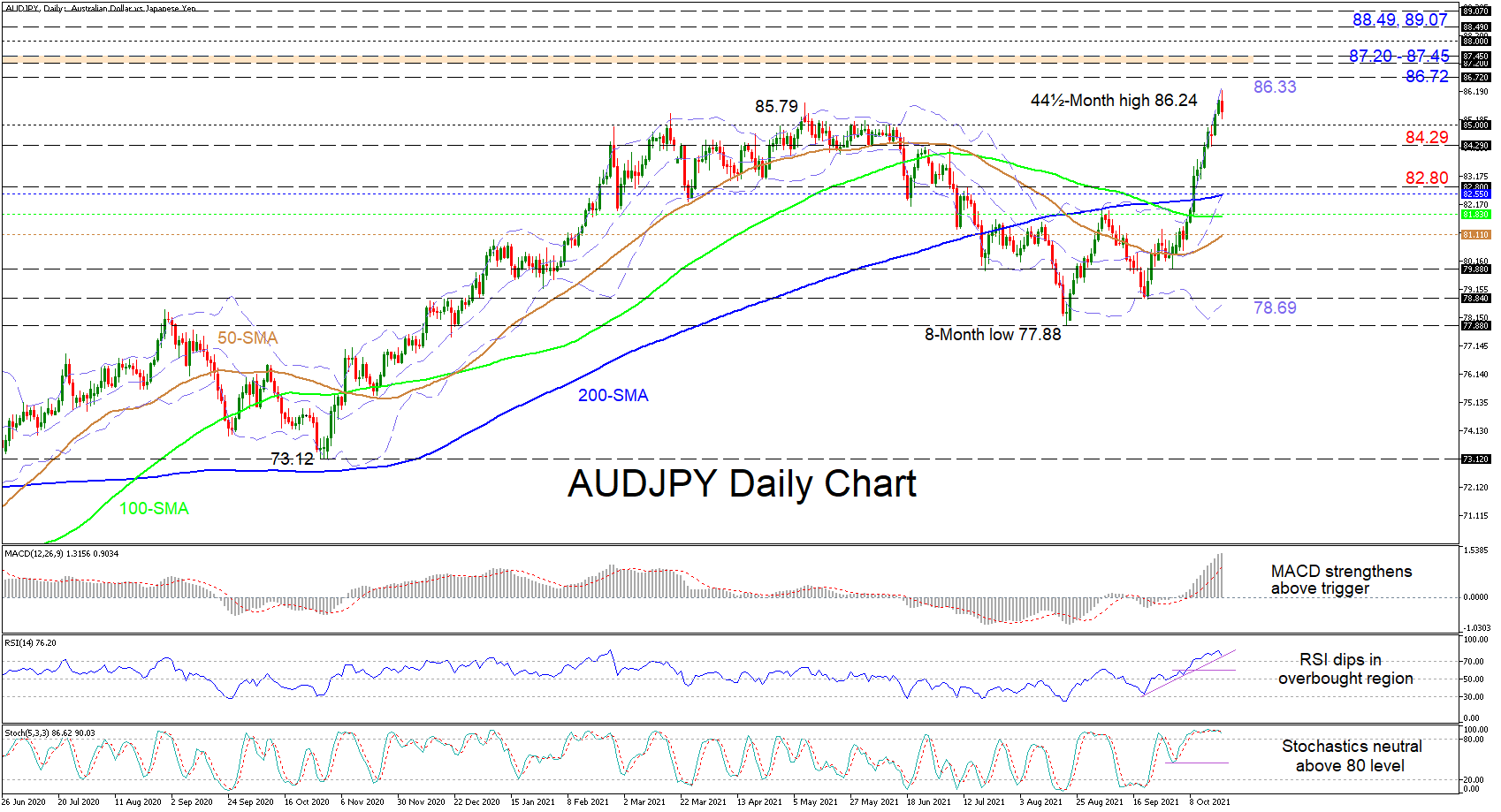
AUDJPY has been tracing the upper Bollinger band for two weeks now, reaching a more than 3½-year high of 86.24, as the pair aims for the 86.72 barrier. The price rally, which extended above the simple moving averages (SMAs) and the 82.00 handle, accelerated from the 79.88 level until the fresh high, before sellers made an appearance. The recent uptrend is not subsiding despite opposing forces, something also being demonstrated in the abated negative bearing of the 100-day SMA and the upturn in the 50-day SMA.
The short-term oscillators have yet to confirm a dry up in positive impetus. The MACD is soaring over its red trigger line, in the positive section, while the RSI, although having dipped, is persisting in overbought territory. Currently, the stochastic oscillator is not indicating a clear price preference as the oscillator’s %K and %D lines are hovering above the 80 level.
If sellers start to make a clear comeback, the pullback in the pair could snag at the 85.00 handle. However, if the pair fails to find support here, the price may seek footing around the 84.29 barrier. If this border also disappoints, the price could pursue the region of support between the 82.80 obstacle and the 200-day SMA at 82.55. Should sellers remain devoted, the next support barriers are the 100-day SMA at 81.83 and the 50-day SMA at 81.11.
If buyers regain control and drive the pair beyond the fresh multi-year high and the upper Bollinger band at 86.33, initial resistance could arise from the 86.72 high. Then, nearby is the resistance band of 87.20-87.45. Moving higher, the 88.00 hurdle could impede the pair from challenging the 88.49 high and the 89.07 level, being a double top back in January 2018.
Summarizing, AUDJPY’s positive tone may remain intact should the price persist above the 85.00 level and the 84.29 low. A break above 86.72 could nourish upside momentum, while a retreat below 84.29 could result in a deeper price retracement.
Sunset Market Commentary
Markets
Today was more or less a copy-paste of yesterday with no or only second tier economic data, including a new pandemic low of 290k in US jobless claims. The Philly Fed Business Outlook retreated more than expected, from 30.7 to 23.8. This, however, relates to the general business activity only. Underlying details actually look pretty good with a strong jump in new orders, shipments on point and the payroll rising. Prices paid remain at very elevated levels. The indicator basically translates yesterday’s Beige Book into numbers, ie: demand is solid but (very) strong price pressures and lack of personnel is hampering output. The forward looking indicator is the odd man out, recovering only marginally from a steep drop in recent months (24.2 compared to the multiyear high of 69.2 in June). Markets largely dismissed the data as irrelevant though, maybe as they await a more high profile-batch of figures tomorrow (PMIs). Core bond yields forced an attempt to inch higher once again but that move soon reversed. The US yield curve at the time of writing flattens with the long end underperforming. Changes range from +2 bps (2y) to -1 bp (30y) with ever-increasing inflation expectations compensating for declining real yields. The 10y yield hit the upper bound of the ST upward sloping trend channel. German yields rise 1.1 bp (2y) over 2.5 bps (5y) to 1.9 bps (10y; tested 0.10% again). UK Gilt yields undergo a steepening trend, shifting 2 to 3.5 bps higher. Turning to FX markets, most action occurred on the EM front (see for example headline below). In advanced economies, the Japanese yen is today’s outperformer as sentiment on risky assets is fragile (oil down 1%, European stocks 0.5% lower, WS: up to 0.3% lower) while the increase in core bond yields is contained this time around. USD/JPY is on track to close below 114 just four days after capturing that barrier for the first time since 2018. EUR/JPY retreats sub 133. EUR/USD again flirted with resistance at 1.1664 but there was zero momentum for an actual break higher. Perhaps activity in EUR/CHF (slipping below 1.07) is weighing on the common currency as well. Sterling is holding decent given the trading background. This might be the result of today’s UK Gilt underperformance. EUR/GBP holds below key 0.845 support. The pound even barely loses vs the USD (GPB/USD testing 1.38 support).
News Headlines
The Central Bank of Turkey (CBTR) cut its policy rate by a bigger than expected 2% to 16%. CBRT already reduced the policy rate by 100 bps in September. The rate cut comes after president Erdogan last week replaced three MPC members as he wants monetary policy to be more supportive to economic growth. The rate hike comes even as both headline inflation (19.58% Y/Y) and core inflation (16.98%) rose further in September. Real rates thus became more negative. The CBRT ‘justifies’ the reduction as the drivers behind the rise in inflation are assessed to be transitory. The committee says it evaluated the impact of demand factors that monetary policy can have an effect on, core inflation developments and supply shocks. At the same time, the impact of earlier monetary tightening is already affecting credit and domestic demand as does macroprudential policy. Even so, the Committee assessed that, till the end of the year, supply-side transitory factors leave limited room for downward adjustment to the policy rate. The lira dropped to record low levels against the dollar and the euro, with EUR/TRY touching the 11-mark.
According to the Trends Survey of the Confederation of British Industry, price pressures in the UK industry remain at historically high levels. After touching the highest level since 1977 in July, the index of costs declined only marginally in October (71 from 73). Firms are passing through these costs to clients. Manufacturers in the three months to October raised prices at the fastest pace since 1980 (index at 59). Expectations for price rises over the next three months also rose to a multi-year high. The picture on activity remains constructive. Order growth slowed to the lowest since April (9 from 22), but output is expected to grow at a solid pace (33 from 25) . Business optimism in the quarterly survey remained in positive territory.
Growth Jitters Bring Risk-off into Play; Dollar’s Slide Halts
Stocks falter as risk-off returns
Better-than-expected corporate earnings have been a buffer to stock markets this month, with Southwest and American airlines flagging today that even the hardest-hit industries by the pandemic can still stand on their feet despite the energy crisis.
Nevertheless, below the surface global economic warnings are still flashing red. The pandemic’s nasty supply shocks will probably keep tempering global inflation pressures for longer and businesses such as Unilever, will not hesitate to transfer costs onto consumers during the next months, especially if central banks start to wind down their stimulative policy settings. Fed board member Christopher Waller, who recently called for a more aggressive policy response next year, said that the next five months will be critical for examining whether inflation is transitory today. Therefore, the Fed will probably provide clearer signals about its monetary strategy in the coming months.
China’s factors are adding to these worries as a potential fallout by the indebted Evergrande is now looking more likely given the company’s continuous failure to secure cash ahead of its 30-day deadline, which expires at the end of this week.
Basic materials faltered on China’s renewed concerns, leading the pan-European STOXX 600 index into the negative territory, while US stock indices were also poised to open with moderate losses.
Commodity currencies drift lower
In FX markets, investors opted for safe-haven currencies, adding some footing under the US dollar and the yen after days of declines. For the same reason, and perhaps with the help of some profit-taking, the rally in commodity currencies took a breather, though marginally, pressing aussie/dollar and kiwi/dollar below 0.7500 and 0.7200 respectively.
A speech by the RBA governor at 19:00 GMT could raise extra volatility in the Australian dollar as the central bank faces pressures to review its framework in the way the Fed and the ECB have followed.
US jobless claims drop to fresh lows, but dollar not impressed
Turning to the calendar, US initial jobless claims continued to hit new lows, reflecting a tightening labor market. The number of people applying for unemployment benefits in the week ending October 9 retreated to 290k – the lowest since March 2020 - from 296k previously, beating expectations of a 300k increase. The dollar, however, could barely move on the news since bond tapering is already a done deal this year.
Euro/dollar and pound/dollar remained stable but lower on the day at 1.1642 and 1.3799 respectively following the job stats. Dollar/yen could not capitalize either, extending today’s slide to a fresh low of 113.81. On the other hand, falling oil prices assisted dollar/loonie rebound on the key1.2300 support level.
In metals, gold is nearing the crucial resistance of 1,795, a break of which could spark stronger bullish extensions.
EUR/USD Mid-Day Outlook
Daily Pivots: (S1) 1.1626; (P) 1.1642; (R1) 1.1668; More...
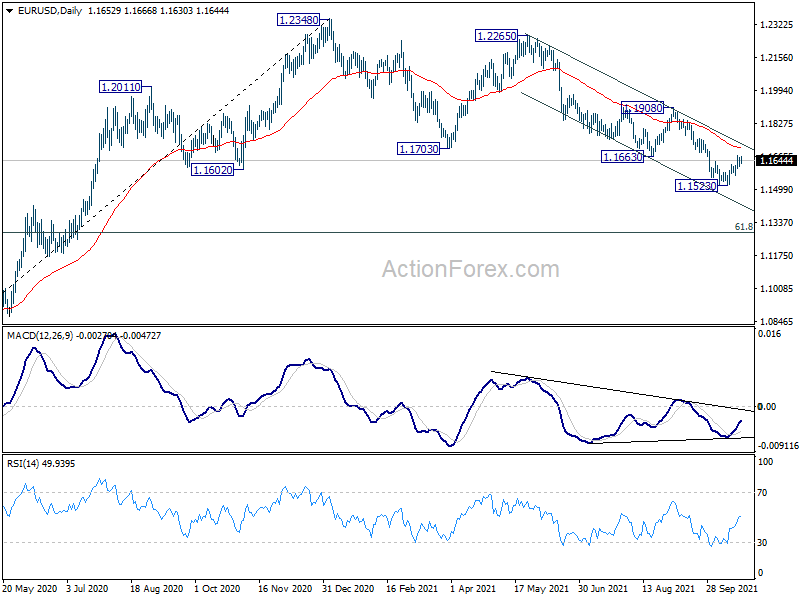
Intraday bias in EUR/USD is neutral for consolidations, but further rise is in favor with 1.1571 minor support intact. On the upside, sustained break of 55 day EMA (now at 1.1707) will be a sign that larger correction from 1.2348 has completed. Stronger rally would be seen to 1.1908 resistance for confirmation. On the downside, though, break of 1.1571 minor support will turn bias back to the downside for 1.1523 support instead.
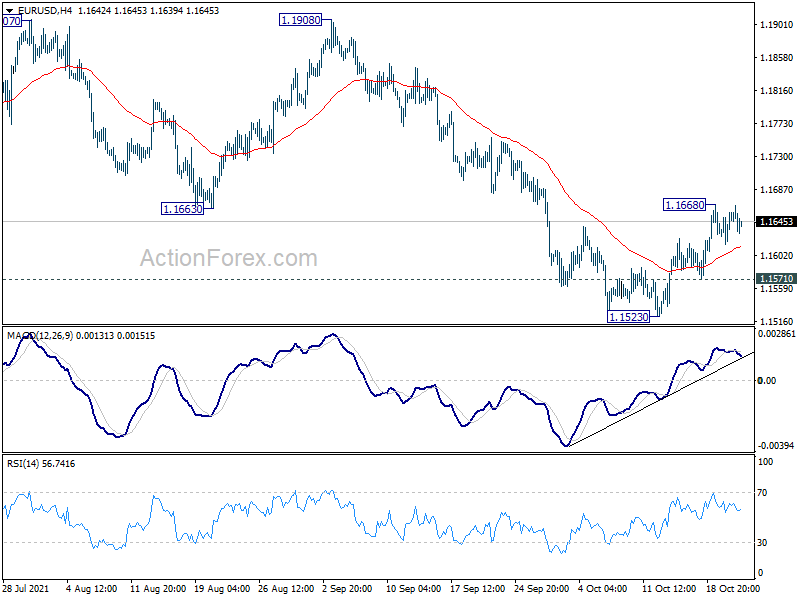
In the bigger picture, price actions from 1.2348 should at least be a correction to rise from 1.0635 (2020 low). As long as 1.1908 resistance holds, deeper fall would be seen to 61.8% retracement of 1.0635 to 1.2348 at 1.1289. Nevertheless break of 1.1908 resistance will revive medium term bullishness and turn focus back to 1.2348 high.
GBP/USD Daily Outlook
Daily Pivots: (S1) 1.3766; (P) 1.3800; (R1) 1.3859; More...
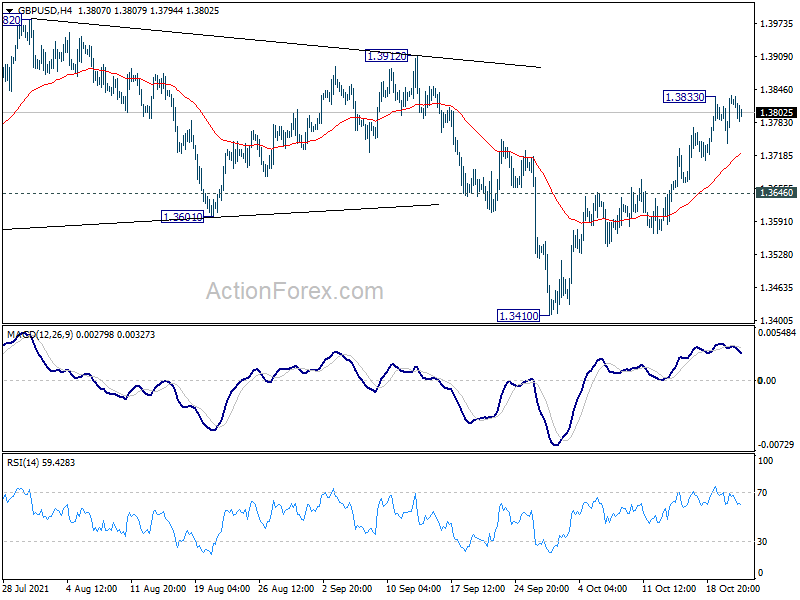
GBP/USD is staying in consolidation from 1.3833 temporary top and intraday bias remains neutral. Further rise is expected as long as 1.3646 support holds. Above 1.3833 will resume the rebound from 1.3410 to 1.3912 key structural resistance. Firm break there will indicate that the correction from 1.4248 is complete with three waves down to 1.3410. Further rally would then be seen to retest 1.4248 high. However, break of 1.3646 will turn bias to the downside for retesting 1.3410 low.
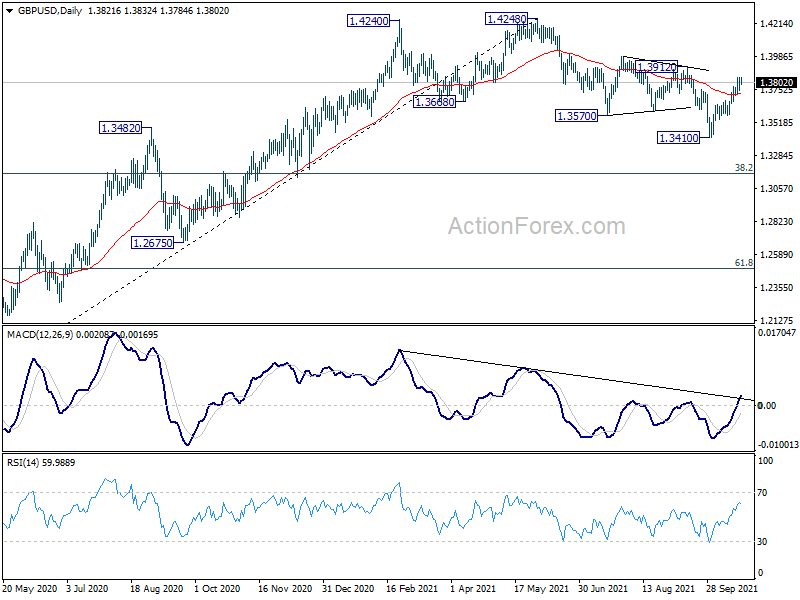
In the bigger picture, the structure of the fall from 1.4248 suggests that it's a correction to the up trend from 1.1409 (2020 low) only. While deeper fall cannot be ruled out yet, downside should be contained by 38.2% retracement of 1.1409 to 1.4248 at 1.3164, at least on first attempt, to bring rebound. On the upside, firm break of 1.4376 key resistance (2018 high) will add to the case of long term bullish reversal. However, sustained trading below 1.3164 will revive some medium term bearishness and target 61.8% retracement at 1.2493.
USD/JPY Mid-Day Outlook
Daily Pivots: (S1) 114.05; (P) 114.37; (R1) 114.66; More...
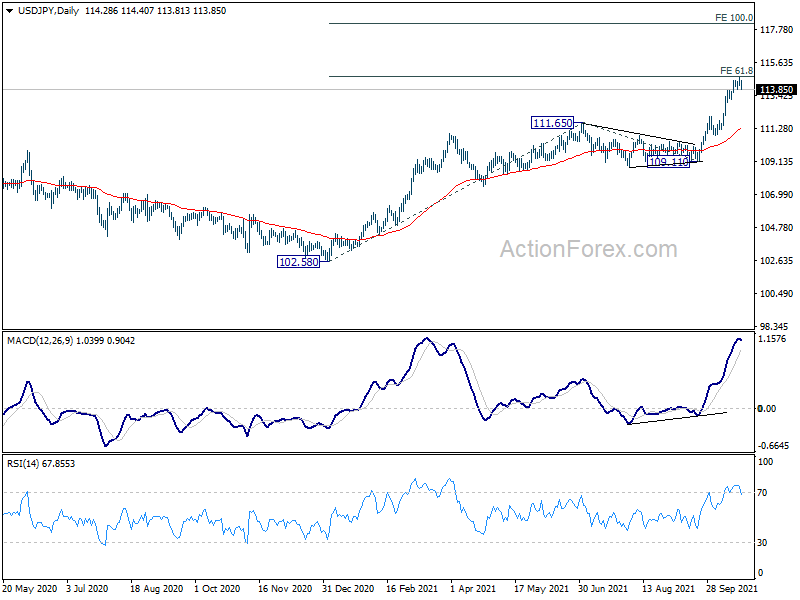
The break of 113.87 minor support suggests short term topping at 114.69, just ahead of 61.8% projection of 102.58 to 111.65 from 109.11 at 114.71. Intraday bias is mildly on the downside for pull back to 4 hour 55 EMA (now at 113.61) and below. But downside should be contained above 112.07 resistance turned support to bring rise resumption. On the upside, sustained break of 114.71 will resume larger up trend from 102.58 to 100% projection at 118.18 next.
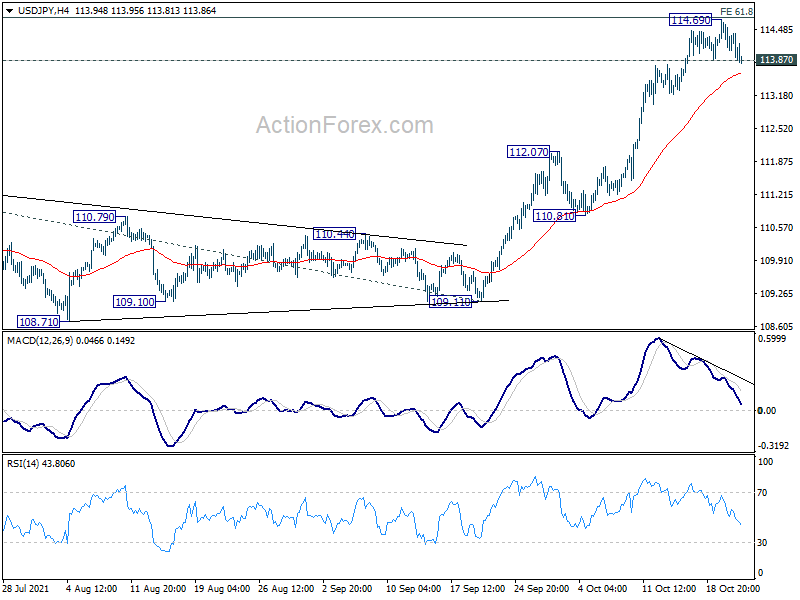
In the bigger picture, corrective decline from 118.65 (2016 high) should have completed at 101.18 already. Rise from the 102.58 is seen as the third leg of the up trend from 101.18. Next target is 114.54 resistance and then 118.65 high. This will now be the preferred case as long as 109.11 support hold, even in case of deep pull back.