

Sample Category Title
USD/JPY Analysis: Retreats Below 114.00
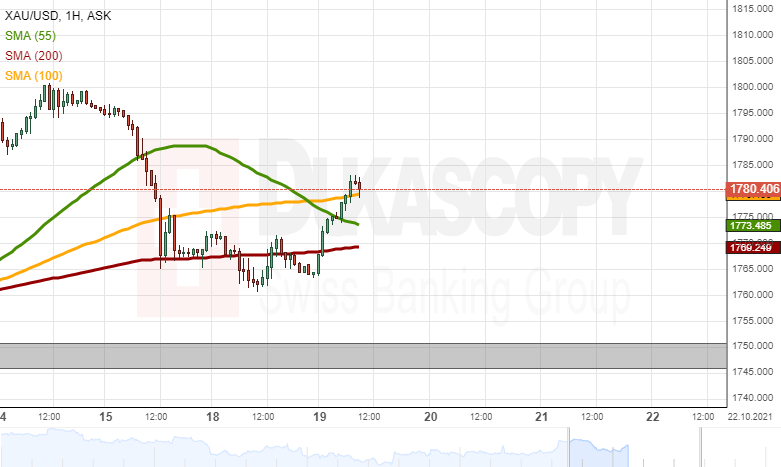
The rate traded near the 1,765.00 mark throughout Monday. From GMT midnight to Tuesday, the price of gold started a surge. Namely, by 09:30 GMT, the bullion had already almost reached the 1,785.00 level. During the surge, the resistance of the 55, 100, and 200-hour simple moving averages was ignored.
A continuation of the surge of the price for gold might eventually reach and once again test the resistance of the 1,800.00 mark. The 1,800.00 mark acted as a resistance level on October 14.
However, a decline might look for support in the 1,760.25/1,763.40 zone, which acted as support on Monday. Below this zone, the October low levels below 1,750.00 could act as support.
Gold Analysis: Recovers On Tuesday
The rate traded near the 1,765.00 mark throughout Monday. From GMT midnight to Tuesday, the price of gold started a surge. Namely, by 09:30 GMT, the bullion had already almost reached the 1,785.00 level. During the surge, the resistance of the 55, 100, and 200-hour simple moving averages was ignored.
A continuation of the surge of the price for gold might eventually reach and once again test the resistance of the 1,800.00 mark. The 1,800.00 mark acted as a resistance level on October 14.
However, a decline might look for support in the 1,760.25/1,763.40 zone, which acted as support on Monday. Below this zone, the October low levels below 1,750.00 could act as support.
Dollar Slumps, Stocks Advance Amid Earnings Optimism
- US tech rebound leads global stocks higher as earnings season about to heat up
- Dollar plunges as mood improves and Fed seen falling behind in the tightening race
- Riskier currencies power ahead as US yields fall back
Focus on earnings as jitters subside
Worries about soaring inflation, supply-chain chaos and slowing growth in China were put on the back burner on Tuesday as investors turned their attention on the Q3 earnings season that kicked off last week with a bang. Shares in America’s tech juggernauts closed more than 1% higher on Monday, pulling the Nasdaq Composite up by 0.8%, on growing optimism that Q3 will be another bumper season. The S&P 500 also extended its rebound, gaining 0.3%, as 80% of the index’s constituents that have reported so far all beat their earnings estimates.
That optimism will be put to the test later today when Netflix announces its results after the market close, while Johnson & Johnson, Procter & Gambler and United Airlines will be among some of the other highlights.
US equity futures were edging higher ahead of Tuesday’s earnings, with Asian shares also enjoying a lift from Wall Street’s positive mood music. Fears about a regional drag on growth by the supply constraints, surging raw materials prices, a property crisis and power outages in China that put a dent in its Q3 GDP appear to have subsided rather quickly.
Investors seem hopeful that Chinese policymakers will be able to successfully steer the economy through the latest storm, with their handling of the Evergrande debt fallout providing some reassurance.
European traders were more cautious, however, with the major bourses mixed at the open.
US yields pressured as Fed rate hike bets ease
The energy crunch in Europe and Britain remains a major concern for investors and the broader supply constraints impacting manufacturers don’t appear to be easing either. Flash PMI data for October due on Friday should shed more light on whether the problems are getting worse.
US manufacturers are also feeling the pain of global supply disruptions, particularly for semiconductors that contributed to the 1.3% drop in industrial production in September, while worker shortages are another headache. However, America is so far not facing soaring power costs due to it being self-sufficient in energy supply and this might be feeding into policy expectations.
If energy prices in the US don’t rise significantly and other price pressures prove to be temporary, then the Fed is unlikely to bring forward its first rate hike. In contrast, other central banks like the Bank of England will have to respond if higher fuel prices begin to push up inflation expectations as there would be a bigger risk of inflation becoming stickier.
US Treasury yields at the short end of the curve tumbled after the industrial output data as the urgency for the Fed to raise rates soon rather than later was seen to have receded somewhat. However, expectations that other central banks are more likely to be forced to begin tightening earlier than anticipated in fact strengthened, pressuring the US dollar.
Dollar skids, aussie and kiwi shine
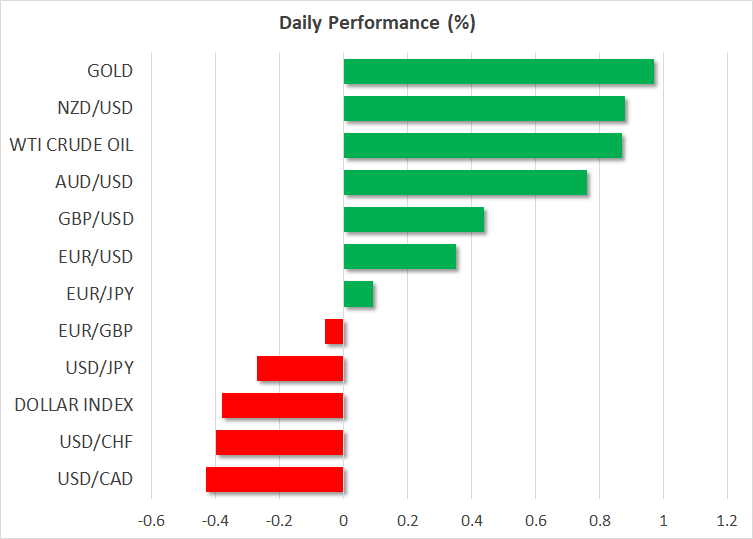
The dollar index slid to a three-week low as the greenback declined against all its major peers, including the safe havens Japanese yen and Swiss franc.
The euro climbed above $1.1650, while the pound was eyeing the $1.38 level. The Australian dollar shot up to more than 1½-month highs despite dovish meeting minutes by the RBA earlier today. Markets are no longer as convinced about dovish rate path forecasts by policymakers following the clear strong upward trend in inflation around the world.
But one central bank that hasn’t shied away from turning hawkish is the Reserve Bank of New Zealand, which could be tempted to hike rates by 50 basis points in November. These expectations are bolstering the kiwi, which is today’s best performer as it surges past the $0.71 level.
Another beneficiary of the dollar selloff was gold, gaining 1%.
Aside from the earnings announcements, investors will also be watching Fed speakers today, including Governors Bowman and Waller, and regional heads, Daly and Bostic.
Oil Rises On Coal, Gold Rises As USD Dips
Coal lifts oil in Asia
Hong Kong coal futures have leapt higher once again this morning at the open, before, once again, quickly retreating to almost unchanged. Unlike yesterday, oil has refused to chase them higher with prices in Asia for Brent crude and WTI almost unchanged from the New York close. A higher US dollar and intra-day retreat by coal and natural gas prices have seen Asia traders move back to their preferred buy-the-dips strategy, rather than chasing prices higher.
Overnight oil prices continued to grind higher, with Brent crude reaching USD 86.00 a barrel. However, oil could not sustain its rally and both contracts fell to close lower on the day. Brent crude finished 0.90% lower at USD 84.10, and WTI finished 0.20% lower at USD 82.30 a barrel.
Oil’s rally ran out of steam for a few reasons. European natural gas prices eased, the US EIA forecast higher US shale production, notably from the Permian Basin. Finally, the Commodity Weather Group forecast warmer than expected weather for the rest of October for the US. The latter is significant, as it induced some temporary bearish price action and hints that a mild northern hemisphere winter would reduce a major pain point in the higher energy price mix. That is a big “if” to base policy on though. Reuters is reporting that OPEC+ compliance is running at 115%. That implies that even if OPEC+ was to blink and raise production targets, some members will struggle to pump more crude anyway.
Circling back to last week’s warnings about the overbought technical picture for oil, I note that the relative strength indexes (RSIs) on both contracts remain in very overbought territory. Given the weight of speculative longs out there, I still do not discount a sharp USD 5+ price correction, but I expect physical buyers to be lining up to buy a material dip in prices, and any dip will be short-lived.
Brent crude has resistance at USD 86.00 and the October 2019 high at USD 86.80, with support at USD 84.00 and USD 82.00 a barrel. WTI has resistance at the overnight highs around USD 84.00 and USD 86.00 a barrel. Only a fall through USD 79.50 a barrel changes the bullish outlook.
Gold rises in Asia on weaker US dollar
Gold traded sideways overnight, as the US dollar went nowhere, with higher yields at the shorter end of the US curve weighing on gold prices. Gold finished the overnight session just 0.15% lower at USD 1765.00 an ounce. General US dollar weakness in Asia has seen gold manage to stage a modest rally, rising 0.53% to USD 1774.20 an ounce. If nothing else, it shows that gold continues to trade inversely to the nuances of the US dollar and US yields. Higher dollar/yields equal lower gold and vice versa.
Firmer US yields will be a headwind for gold rallies, especially if it leads to US dollar strength. Gold is a wonderful head to very high inflation, but it is proving time and time again, to be a poor hedge to rising inflation. Gold has nearby support at USD 1760.00 followed by USD 1745.00 with failure signalling a retest of USD 1720.00 an ounce. Gold has resistance at USD 1780.00 an ounce failed followed by the 100 and 200-day moving averages (DMAs), today at USD 1795.00 and USD 1795.25, formidable resistance.
In the bigger picture, only a rise through USD 1835.00 an ounce, would trigger a multi-month inverse head-and-shoulders technical pattern and swing gold’s outlook back to positive. The risks remain firmly to the downside.
Rehn: ECB leans on the side of not overreacting to inflation
Governing Council Member Olli Rehn said there is still "plenty of economic slack" in Eurozone and inflation is "still mostly transitory".
He added that "evidence speaking for transitory inflation is quite convincing" while core inflation was still "subdued". Also, there is "no major evidence of second round effects". Hence, ECB "leans on the side of not overreacting".
Corporate Earnings To Drive Sentiment
Asian shares were up on Tuesday morning, drawing strength from the tech-driven Wall Street rally overnight. It seems like solid corporate earnings have soothed concerns around inflationary pressures, with the improving risk sentiment elevating equity markets. European markets have opened marginally higher with US futures looking healthy. The Dollar Index (DXY) declined to a one-month low amid the risk-on sentiment while gold is on the move, gaining roughly 0.7% as of writing.
This will a big week for equity markets as the third-quarter earnings season gets in full swing. Since corporate results officially kicked off last week, the reports have painted a positive picture with major US banks smashing analyst forecasts. Big names like Netflix, Tesla, and Intel among many others will be under the spotlight this week as investors pay close attention to their earnings.
The key questions on the minds of investors will be what impact higher inflation, supply chain disruptions, and labor shortages have on third-quarter numbers. Should we have another solid week of results, this may inject S&P500 bulls with enough confidence to venture into uncharted territory beyond its all-time high.
Currency spotlight – GBP/USD
It has not been a great start to the week for sterling which has weakened against most G10 currencies. Bulls struggled to draw inspiration from Bank of England Governor Andrew Bailey’s hawkish remarks over the weekend with expectations rising over the Bank of England raising interest rates at its November meeting. However, concerns around economic growth and stagflation fears continue to weigh on the pound. All eyes will be on Governor Bailey’s speech this afternoon which could provide more hints on interest rate moves.
Looking at the technical picture, the GBPUSD is up this morning on the back of a weaker dollar. Prices are approaching the 100-day Simple Moving Average around 1.3810. A strong move above this point could push the GBPUSD towards the 200-day Simple Moving Average around 1.3850.
Commodity spotlight – Gold
Gold prices are advancing this morning, gaining roughly 0.7% thanks to a weaker dollar and lower Treasury yields. The precious metal is likely to be influenced by conflicting forces this week as investors juggle growth concerns and inflation fears amid prospects of tighter monetary policy.
Should the dollar continue to weaken, gold has the potential to rechallenge $1800, a level just above the 100-day and 200-day Simple Moving Average. In the meantime, intraday bulls seem to be in the driving seat with the first level of interest at $1784. If the 50-day Simple Moving Average offers resistance and weakens bullish momentum, prices could decline back towards $1760.
GBPUSD Nears 1.38 Mark, Bullish Bearing Intact
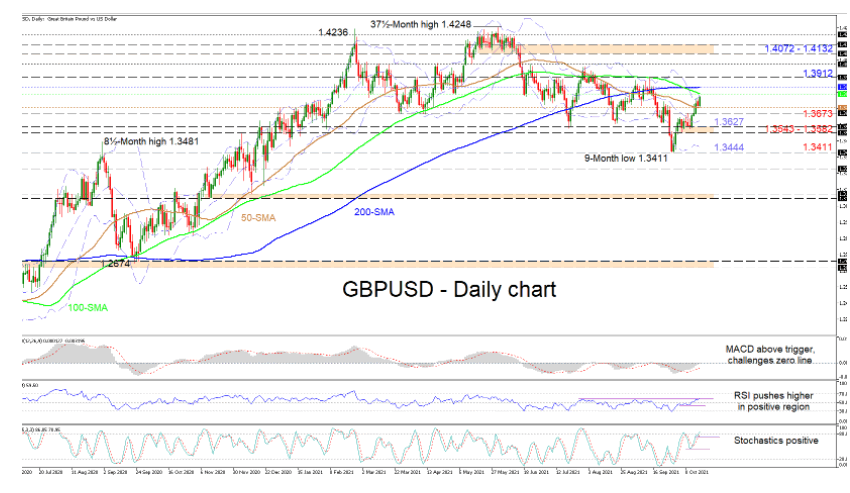
GBPUSD is pushing up against the upper Bollinger band, which is converging with the 100-day simple moving average (SMA) at 1.3801, trying to extend further the hike from the 9-month low of 1.3411. The 200-day SMA is endorsing a neutral tone, while the bearish demeanour in the 50- and 100-day SMAs seems to be easing.
The short-term oscillators are reflecting an increase in positive momentum in the pair. The MACD has advanced above its red trigger line and is currently flirting with the zero line, while the RSI is making headways in the bullish territory. The stochastic oscillator has resumed a positive charge with the %K line pushing into the overbought zone, which is promoting bullish price action in the pair.
If the price maintains the current trajectory, prompt resistance could arise from the area between the 100- and 200-day SMAs at 1.3801 and 1.3849 respectively. Conquering this tough upside constraint, the nearby high of 1.3912 may try to halt the ascent from testing the highs around the 1.4000 border. Should the pair successfully overcome the 1.4000 obstacle, the bulls could then turn their focus to the resistance zone of 1.4072-1.4132.
Alternatively, if the 100-day SMA caps additional gains, sellers may encounter initial downside friction among the 50-day SMA at 1.3710 and the 1.3673 barrier. Diving lower, the price could hit the mid-Bollinger band at 1.3627 before meeting the support band of 1.3543-1.3582, where the early October lows reside. If selling interest persists, a deeper decline may turn its attention to the lower Bollinger band at 1.3444 and the adjacent 9-month trough of 1.3411.
Summarizing, GBPUSD is exhibiting a strong bullish tone above the 1.3700 handle. A thrust past the 1.3912 high could bolster upside impetus, while a price retreat below the 1.3543 low may provide negative forces with fuel.
A Positive Day For Asia
Equities rally in Asia
Equities are rallying across Asia today after a strong overnight performance by Wall Street and a weaker US dollar in Asia relieving some Fed-taper pressures. With only Bank Indonesia’s policy-setting on the Asia calendar today, markets are being left to trade on sentiment, which seems universally positive this morning.
Overnight, US markets shrugged off weaker US Industrial Production data and a flattening US yield curve, indicating shorter-term inflationary pressures will continue rising. The fact that the flattening is occurring at the shorter end i.e., sub-10-years, and markets are not seeing the 10 to 30-tenors rising, has markets assuming that the Fed has the longer-term inflation outlook under control. Famous last words if any. Nevertheless, it’s as good a reason to be positive on stocks as any now, while we wait for further Q3 US earnings releases.
Wall Street closed in the green with the S&P 500 rising by 0.35%, the Nasdaq jumping by 0.85%, and the Dow Jones climbing by 0.10% with these more muted inflation expectations playing more powerfully with rate-sensitive technology stocks. In Asia, futures on all three are unchanged but that has not stopped Asia powering higher, ignoring yet another North Korea missile test.
The Nikkei 225 is up 0.70% with the South Korean Kospi rising by 0.65%. In mainland China, the Shanghai Composite is 0.70% higher, with the more tech-centric CSI 300 rallying by 1.0%. That also sees the Hang Seng 1.10% higher helped by Ali Baba’s cloud computing chip announcements.
Regionally, Singapore is 0.55% higher while Kuala Lumpur is closed today. Taipei has rallied 1.10% higher while Jakarta and Bangkok have eased by 0.50%, possibly due to the currency appreciation or a rotation back into the North Asia heavyweights. Australian markets remain in the green, although rising expectations of a change to RBA guidance seems to be limiting gains. The All Ordinaries rising by 0.25%, while the ASX 200 has recorded a 0.15% gain.
After a tough day yesterday, European stock markets should open higher this afternoon following the US lead. It will be interesting to see if the change in British and European rate expectations starts to weigh on equity valuations there eventually. It certainly is untrodden ground, especially for Europe. The intra-day direction in the US will be driven by Fed speakers and US earnings releases, with the data calendar second-tier today.
Dollar Retreats Against Asian Currencies
The US dollar falls in Asia
The US dollar is in retreat in Asia versus both developed market and regional currencies. That followed a sideways overnight session where the dollar index closed almost unchanged at 93.95. The index has headed south today, tumbling by 0.28% to 94.68, taking out support at 93.70. It could now target its key pivot point at 93.50. News is thin on the ground to explain the US dollar’s broad fall in Asia today. But a series of reports lifting and bringing forward hiking expectations in the UK, Europe, Australia, and New Zealand could be taking the wind out of the Fed taper trade. The dollar fall appears to have sparked some technical breakouts as well which are probably attracting algorithmic fast money.
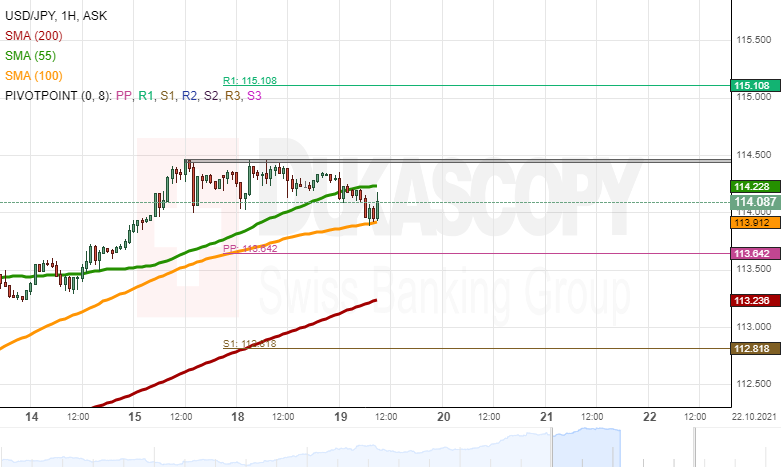
EUR/USD has jumped through resistance at 1.1625 to rise 0.32% to 1.1650 and could extend gains to 1.1700. GBP/USD is 0.30% higher at 1.3765 and is testing resistance at these levels. A rise through 1.3780 would signal a retest of 1.3900 in the coming days. Notably, USD/JPY has remained above 114.00 at 114.10 today, almost unchanged. The US yield curve flattened overnight, but that was led by a rise in short-dated tenors. USD/JPY remains entire a US/Japan rate differential play although a fall through 114.00 could see a quick spike lower to 113.50.
As risk sentiment has improved in Asia today, AUD/USD and NZD/USD have leapt 0.55% higher 0 0.7450 and 0.7125, respectively. A lot of talk is circulating about changed RBA guidance to the tighter policy settings and a potential 0.50% hike by the RBNZ in November. There is also no doubt that sectors of both economies, notably New Zealand, are showing signs of serious overheating. AUD/USD could gain to 0.7600 this week, and NZD/USD to 0.7200 if the hawkish sentiment remains.
In Asia, USD/CNY has slumped by 0.30% to 6.4100, the highest level for the yuan against the US dollar since June. The PBOC is showing no signal in its daily fixings that it wants to halt yuan strength and given the probable size of its imported energy bill in the coming months, I don’t blame them. The CNY strength, part of a general US sell-off today, sees regional currencies also rallying, notably the KRW, THB, INR, PHP, and SGD, i.e., the local currencies most under the hammer over last week. By contrast, the resource-facing IDR and MYR are almost unchanged although Malaysia has a national holiday today, muting trading, and Indonesia has a central bank policy decision this afternoon. The price action is suggestive that much of the gains are fast-money flows that will run for the exit at the first sign of trouble, China excepted.
As I mentioned yesterday, we are starting to see a pattern emerging in the developed market space of currency outperformance from those on a nearer-term hiking path. Great Britain, Europe, Australia, and New Zealand longer-dated yields have firmed this week, giving markets a temporary respite from US dollar strength. The key remains the Fed taper and we have five Fed speakers this evening and hopefully, even more, taper clarity. Ever rising energy prices support the US dollar as most international energy is priced and transacted in US dollars. I am still expecting prolonged US dollar strength in Q4, although this week, may see more sideways action as speculation long US dollar open interest is culled.
Supply Chain Problems Hamper Global Eonomic Growth
The US stock market traded yesterday without a single dynamic. At the close of the stock market, the Dow Jones index decreased by 0.10%, the S&P 500 index increased by 0.34%, and the NASDAQ index added 0.84%. The technology sector and the consumer cyclical sector were the leaders. The health care and utility sectors were the fallers. The US industrial production declined as the ongoing global shortage of semiconductors reduced auto production, further evidence that supply constraints hamper economic growth.
Guggenheim Global Chief Investment Officer Scott Minerd said yesterday that the stock market could jump more than 10% over the next year as risks from inflation or rising interest rates are limited. For this reason, individual investors and funds are buying into falling stocks, despite the obvious macroeconomic problems.
A new insider trading scandal is brewing in the United States. According to SEC reports, Federal Reserve Chairman Jerome Powell sold between $1 million and $5 million of stocks from his personal account on October 1, 2020. This sale occurred just before the Dow Jones Index declined significantly. Recall that three other top Fed officials faced heavy criticism for making stock trades during the pandemic. Dallas Fed President Robert Kaplan and Boston Fed President Eric Rosengren were suspended due to the disclosure of their trades. Fed Vice Chairman Richard Clarida has also been criticized for stock trading. Other trades are currently under investigation by the Fed's inspector general and the SEC.
Data from the Federal Reserve show that the wealthiest 10% of Americans own 89% of all stocks in the United States.
European stock indices closed yesterday in the red zone. German DAX decreased by 0.72%, British FTSE 100 lost 0.42%, French CAC 40 fell by 0.81%, Italian FTSE MIB and Spanish IBEX 35 lost 0.83% and 0.68%, respectively. The market is under pressure from high inflation in the region, the energy crisis, supply chain problems, rising commodity prices, and declining real estate market activity.
The number of British energy companies that have gone bankrupt since the beginning of September amid soaring natural gas prices has reached 13. As the UK Gas and Electricity Markets Authority reported, Goto Energy, Pure Planet, Colorado Energy, and Daligas left the market last week.
According to a Deutsche Bank survey, many investors expect the US Federal Reserve and the European Central Bank to keep a softer monetary policy for much longer.
German digital bank N26 raised $900 million in a new funding round valued at $9 billion, thereby overtaking the country's second-largest bank, Commerzbank, in terms of capitalization.
Oil prices fell slightly yesterday due to a slowdown in economic growth in China and weak US industrial production data. According to Bloomberg, OPEC+ countries produced 15% less oil in September than planned initially. If oil prices do not fall, the union could face political pressure. The White House continues to press OPEC members to solve the oil supply problem. Some traders are betting that Brent crude will hit a record $200 a barrel by December 2022, according to QuikStrike.
Asian stock indexes mostly rose on Tuesday. Japan's Nikkei 225 added 0.68%, the China A50 increased by 1.14%, while the Australian ASX 200 fell by 0.08%. Asian investors are following the US colleagues and are buying back declines in stocks, despite many macroeconomic problems in the region. Electricity problems in China appear to be escalating as coal prices rise again to record highs. The latest data showed that fuel supplies fell in September, heightening fears that domestic production may not be able to meet the growing electricity demand.
Main market quotes:
- S&P 500 (F) 4,486.46 +15.09 (+0.34%)
- Dow Jones 35,258.61 −36.15 (−0.10%)
- DAX 15,474.47 −112.89 (−0.72%)
- FTSE 100 7,203.83 −30.20 (−0.42%)
- USD Index 93.97 +0.03 (+0.03%)
Important events for today:
- Australia RBA Meeting Minutes (m/m) at 03:30 (GMT+3);
- UK BoE Gov Bailey Speaks at 15:05 (GMT+3);
- US Building Permits (m/m) at 15:30 (GMT+3);
- US FOMC Member Daly Speaks at 18:00 (GMT+3);
- US FOMC Member Bostic Speaks at 21:50 (GMT+3).