Sample Category Title
Dollar and Yen Heading South Again, Sterling and Kiwi Strong
Selling in Dollar and Yen persists again today. New Zealand Dollar is currently the biggest winner, on increasing expectation of RBNZ rate hikes. While Aussie is also strong, Sterling is slightly stealing the show too, with help from renewed buying against Euro. The cautious comments from ECB policymakers are not giving much support to Euro, even though it's still gaining against the weak Dollar and Yen.
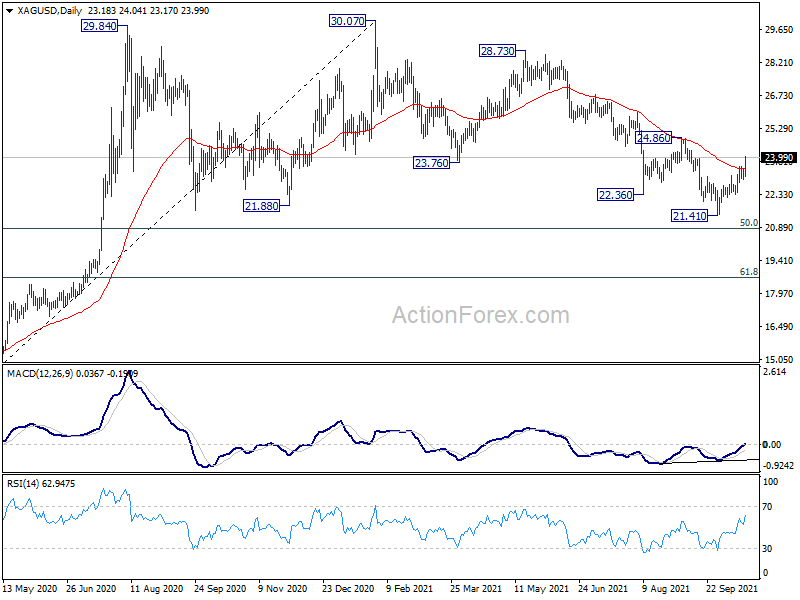
Technically, Silver is outperforming Gold recently, as the rebound from 21.41 accelerates higher. The strong break of 55 day EMA now raises the chance that larger correction from 30.07 has completed at 21.41. Next focus will be 24.86 resistance. Firm break there will add more credence to this bullish case. We'd have on eye on whether Gold would rise through 1833.79 resistance in tandem, which in turn signals more selling in Dollar.
In Europe, at the time of writing, FTSE is down -0.01%. DAX is up 0.5%. CAC is down -0.14%. Germany 10-year yield is up 0.0354 at -0.109. Earlier in Asia, Nikkei rose 0.65%. Hong Kong HSI rose 1.49%. China Shanghai SSE rose 0.70%. Singapore Strait Times rose 0.79%. Japan 10-year JGB yield dropped -0.0060 to 0.090.
Rehn: ECB leans on the side of not overreacting to inflation
Governing Council Member Olli Rehn said there is still "plenty of economic slack" in Eurozone and inflation is "still mostly transitory".
He added that "evidence speaking for transitory inflation is quite convincing" while core inflation was still "subdued". Also, there is "no major evidence of second round effects". Hence, ECB "leans on the side of not overreacting".
ECB Villeroy said French economy to be back to pre-pandemic level by year end
ECB Governing Council member, Bank of France Chairman Francois Villeroy de Galhau said he expected the French economy to be back to pre-pandemic level by year-end. He acknowledged that the auto sector was underperforming, but "areas of the economy are doing well."
He also emphasized "there is still big difference in terms of rising energy prices and overall total inflation." He expected inflation to get back to below 2% level by the end of next year.
"So today there is no reason, for example, for the European Central Bank to raise interest rates next year." Though, "we remain very vigilant on inflation," he added.
Regarding the risk of China's Evergrande turning into a Lehman Brothers, Villeroy said "history is not in the process of being repeated". "I think that Evergrande is mainly a Chinese problem," he added.
ECB Vasle: We should be very careful about second round effects
ECB Governing Council member Bostjan Vasle warned that "there are early signs that in parts of the economy and certain regions, the risk regarding the labour market could become more material."
"In some parts of the economy, labour is in short supply and if this trend will continue, or spread to other sectors, it could pose a risk to inflation," he said said. "That's why I think we should be very careful about second round effects."
He also said if the trends of economic recovery continue, "then in next March it will be appropriate to end PEPP, as announced when the programme was implemented." But he emphasized, "even when we decide to end it, we'll continue to provide plenty of liquidity to the economy with our other instruments."
RBA: Global supply chain disruptions had limited effect on inflation
In the minutes of October 5 meeting, RBA reiterated that economic recovery was interrupted by the outbreak of Delta. Economy is expected to return to growth in Q4, after contraction in Q3, and then back to pre-Delta path in H2 of 2022. Economy recovery was "likely to be slower than in late 2020/early 2021" and "much would depend on health outcomes and the nature and timing of the easing of restrictions on activity."
RBA also noted, "while disruptions to global supply chains were affecting the prices of some goods, the effect of this on the overall rate of inflation in Australia was limited". Wages growth and underlying inflation were "expected to pick up only gradually as the economy recovers.
It acknowledged that house prices and credit growth had continued to rise strongly. "while less accommodative monetary policy would, all else equal, see lower housing prices and credit growth, it would result in fewer jobs and lower wages growth, which would in turn create further distance from the goals of monetary policy – namely, full employment and inflation sustainably within the target range."
Overall, the conditions for rate hike "will not be met before 2020". "Meeting this condition will require the labour market to be tight enough to generate materially higher wages growth than at the time of the meeting."
GBP/USD Mid-Day Outlook
Daily Pivots: (S1) 1.3703; (P) 1.3734; (R1) 1.3759; More...
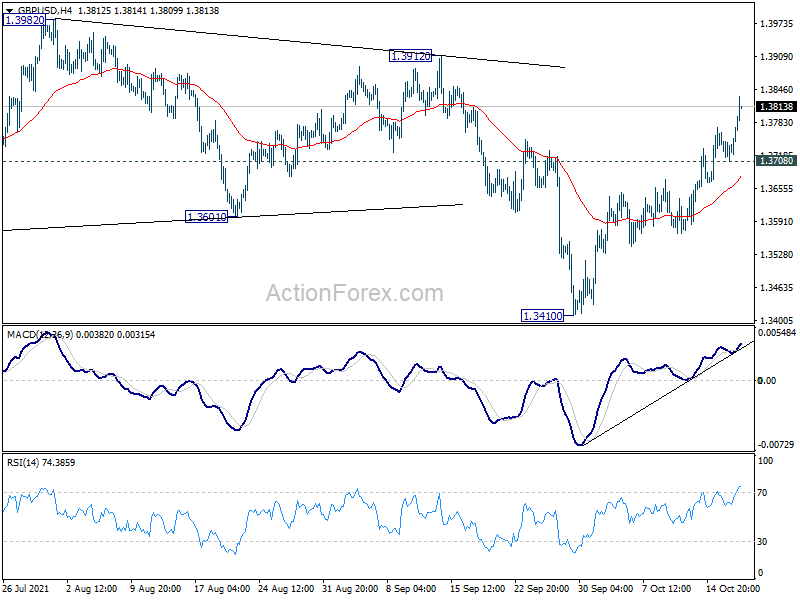
GBP/USD's rebound from 1.3410 extends higher today and intraday bias stays on the upside for 1.3912 key structural resistance. Firm break there will indicate that the correction from 1.4248 is complete with three waves down to 1.3410. Further rally would then be seen to retest 1.4248 high. On the downside, however, break of 1.3708 minor support will dampen the bullish case and turn intraday bias neutral first.
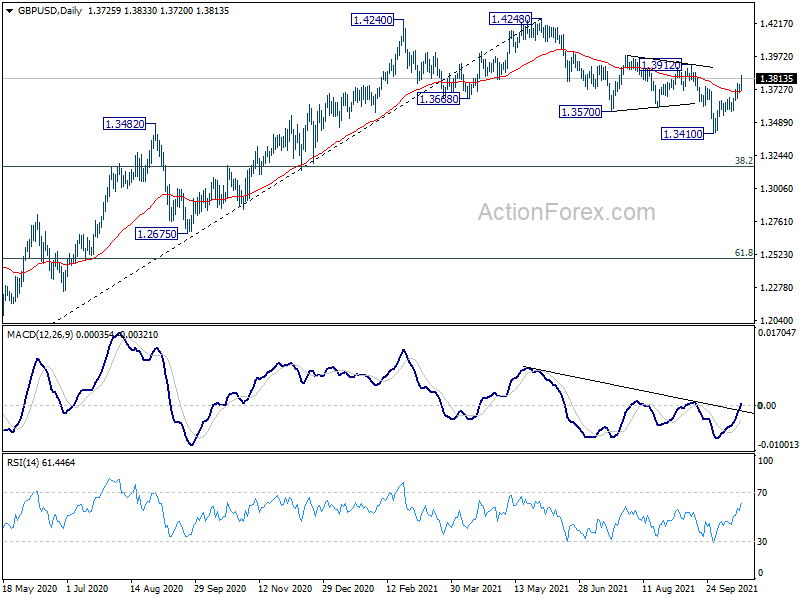
In the bigger picture, the structure of the fall from 1.4248 suggests that it's a correction to the up trend from 1.1409 (2020 low) only. While deeper fall cannot be ruled out yet, downside should be contained by 38.2% retracement of 1.1409 to 1.4248 at 1.3164, at least on first attempt, to bring rebound. On the upside, firm break of 1.4376 key resistance (2018 high) will add to the case of long term bullish reversal. However, sustained trading below 1.3164 will revive some medium term bearishness and target 61.8% retracement at 1.2493.
Economic Indicators Update
| GMT | Ccy | Events | Actual | Forecast | Previous | Revised |
|---|---|---|---|---|---|---|
| 0:30 | AUD | RBA Minutes | ||||
| 6:00 | CHF | Trade Balance (CHF) Sep | 5.05B | 6.23B | 5.06B | 5.13B |
| 12:30 | USD | Housing Starts Sep | 1.56M | 1.61M | 1.62M | |
| 12:30 | USD | Building Permits Sep | 1.59M | 1.67M | 1.72M |
ECB Vasle: We should be very careful about second round effects
ECB Governing Council member Bostjan Vasle warned that "there are early signs that in parts of the economy and certain regions, the risk regarding the labour market could become more material."
"In some parts of the economy, labour is in short supply and if this trend will continue, or spread to other sectors, it could pose a risk to inflation," he said said. "That's why I think we should be very careful about second round effects."
He also said if the trends of economic recovery continue, " then in next March it will be appropriate to end PEPP, as announced when the programme was implemented." But he emphasized, "even when we decide to end it, we'll continue to provide plenty of liquidity to the economy with our other instruments."
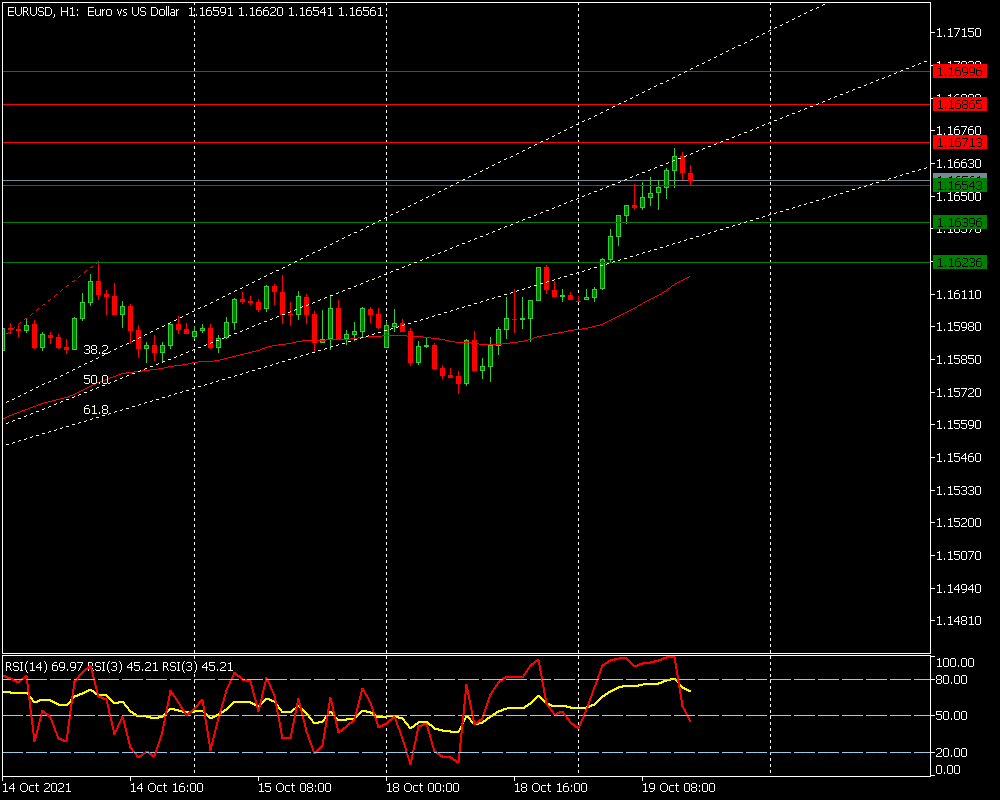
EURUSD Is Possibly Bullish
Technical analysis
The RSI(14) points to an uptrend while the RSI(3) suggests a potential downwards correction
The price is in the uptrend Fibonacci fan channel which is advantageous for bulls
Most likely scenario - BUY
Target prices: 1.16713 1.16865 1.16996
Alternative scenario - SELL
Target prices: 1.16543 1.16396 1.169236
Key levels
Support 1.16543 1.16396 1.169236
Resistance 1.16713 1.16865 1.16996
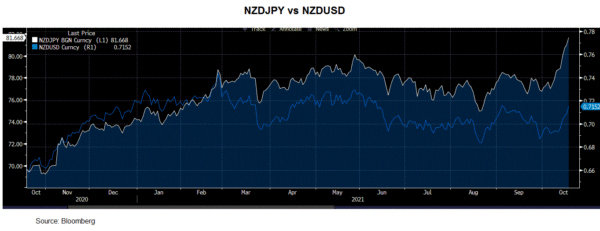
Bets Increased for a Bigger RBNZ Hike in November. Yield Spread Widened to Above 200 bps with Japan
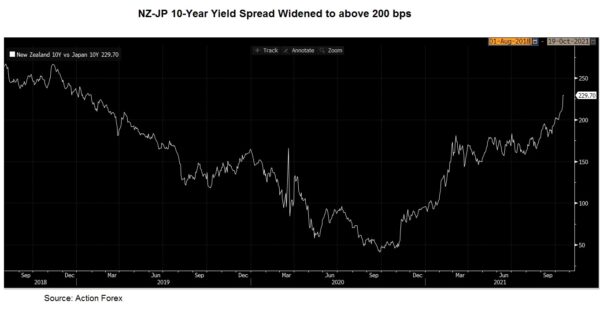
NZD remains firm. Hopes of a +50 bps rate hike in November have heightened after the strong inflation report. NZ-US yield spread widened to a level not seen since 2017. More remarkably, NZ-JP yield spread widened to over 200 bps. A more prominent policy divergence between the RBNZ and BOJ could remain supportive of NZDJPY.
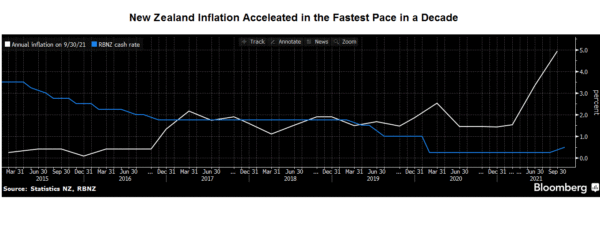
 Headline CPI accelerated to +4.9% y/y in 3Q21, compared with consensus of +1.7% and RBNZ’s estimate of +1.4%. The increase marks the strongest in a decade. The increase in price level was broadly based, encompassing tradable and non-tradable items. For the former, petrol prices soared +21.5% y/y. Meanwhile, prices of recreational equipment, furniture, and other recreation equipment and supplied rose +6.7%, +4.7% and +11.6%, respectively. The major driver in the non-tradable category was housing costs which rose +6% y/y, of which rents inflation accelerated to +3.2% while home ownership costs jumped + 12%. Core CPI (ex-food, petrol and energy) accelerated to +4.8% y/y. RBNZ’s preferred gauges of core inflation averaged at +3.85% y/y, above the central bank’s target.
Monetary Policy Implications
The stronger-than-expected inflation fueled speculations of a bigger rate hike at the upcoming RBNZ meeting. Earlier this month, the RBNZ increased the OCR, by +0.25 bps, to 0.5%. Policymakers signaled that more tightening would be seems in coming months amidst elevated inflation. While a +25bps hike in November is a done deal, the market has now priced in about 50% of a 50 bps increase. New Zealand’s government bond yield curve shifted upward after release of the inflation report. Yield spread between New Zealand and US 10-Year government bond has also widened to 72.7 bps, the largest since 2017.
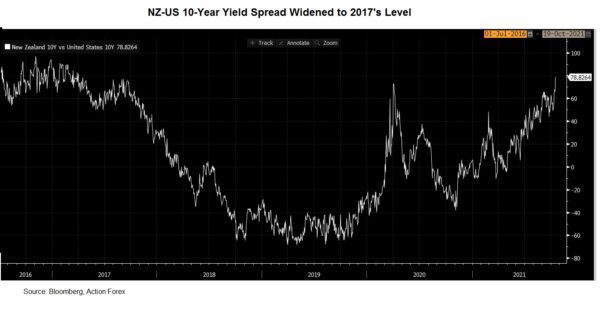
Indeed, NZD’s strength against JPY is more prominent, given the widening policy divergence. While the RBNZ is the first major central bank that has begun the post-pandemic rate hike, there no sign for the BOJ follow suit. Japan’s inflation remained subdued. Headline CPI climbed slightly higher to +0.2% y/y in August, the first positive reading in 13 months. Core-core CPI (similar to core CPI in other major economies) contracted -0.4% y/y, after July’s -0.5%. The BOJ appears the only central bank that has sent no signal about normalization of the ultra-accommodative monetary policy. Undoubtedly, this is a key driver of the recent JPY selloff. The chart below shows that the yield spread between New Zealand and Japan 10-Year government bond has widened to 225 bps. There is more room for NZDJPY strength if the situation persists.
Aussie Jumps On RBA Rate Bets
The Australian dollar has resumed its rally against the US dollar. AUD/USD has risen to 0.7471, up 0.80% on the day. The pair is at its highest level since July 15th.
Markets expect RBA rate hike in 2022
The RBA minutes repeated the central bank’s well-worn message that economic conditions for a rate hike will not be met before 2024. The minutes also indicated that the RBA is projecting that the economy to show growth in Q4 after what is expected to be a decline in GDP in the third quarter. The minutes were relatively dovish, especially regarding rate the RBA’s rate policy.
The markets, however, have become increasingly sceptical about the RBA’s rate stance and have priced in a rate hike for mid-2022. Why are the markets much more hawkish about a rate hike? Inflation has been gaining steam in the major economies, and even though inflation is slightly below the RBA target, this could change as some Australian states have relaxed lockdown restrictions. As well, major central banks, led by the BoE are showing a shift to tightening policy, and the RBA may have to step in line and bring forward plans to normalise monetary policy. The Australian dollar has jumped on the expectations that the RBA will change guidance on the rate look, perhaps as early as this week. If this occurs, AUD/USD could continue to rally and move towards the 0.76 line.
The Aussie is also benefitting from improved risk sentiment on Tuesday, as the US dollar is broadly lower against Asian currencies, as well as the euro and the British pound. As well, higher coal prices have boosted the Australian dollar. China is looking to coal to alleviate energy shortage which is good news for Australian coal producers.
AUD/USD Technical
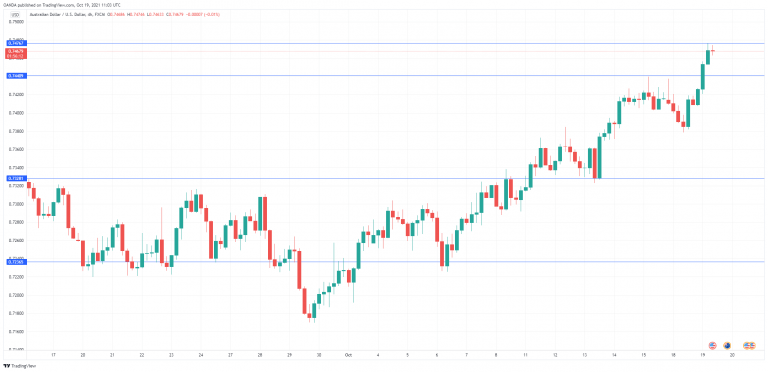
The four-hour chart shows a bullish trend over the past several weeks. In the Asian session, AUD/USD broke above resistance at 0.7440 and is closing in on 0.7476, the September high.
On the downside, there is support at 0.7328 followed by 0.7236
Risk Sentiment Trying To Improve
Notes/Observations
- Inflation to likely keep the pressure on global central banks.
- Session saw improved risk sentiment on hopes China's property market woes would be contained as after some of its peers made bond coupon payments this week.
- Plethora of central bank speak in later part of EU session.
- Corp earning season picking up; Companies due to report during the NY morning include Bank of NY, Fifth Third, Halliburton, J&J, Manpower, Procter & Gamble, Philip Morris, Travelers.
Asia
- RBA Oct Minutes Delta variant had interrupted recovery, in central scenario the economy would return to growth in Dec quarter and pre-Delta path in H2 2022.
- North Korea fired a ballistic missile toward the East Sea Tuesday.
Europe
- France said to set a two-week deadline for Britain and Jersey to give French fisherman more licenses or risk retaliatory measures.
- EU Competition Commissioner Vestager stated that sought to extend relaxation of state aid rules for six months to June 2022. Move seen to to slowly wean corporations off the billions of euros provided by governments across the European Union.
Americas
- Treasury Sec Yellen sent letter to Congressional leaders informing them she would extend extraordinary cash measures to stay under the Federal debt limit until Dec 3rd. Reiterated that was imperative that Congress act to increase or suspend the debt limit in a way that provide longer-term certainty that the government would satisfy all of its obligations.
- Sen Manchin (D-WV) noted that he could not see how deal on Biden's terms could happen by Oct 31st (Reminder: White House spokesperson noted that Biden had been in touch with both Manchin and Sanders on their priorities in the reconciliation bill).
Speakers/Fixed income/FX/Commodities/Erratum
Equities
- Indices [Stoxx600 +0.08% at 467.42, FTSE +0.05% at 7,207.50, DAX -0.03% at 15,469.55, CAC-40 0.00% at 6,673.33, IBEX-35 +0.76% at 9,006.50, FTSE MIB +0.17% at 26,313.00, SMI -0.38% at 11,922.20, S&P 500 Futures +0.31%].
- Market Focal Points/Key Themes: European indices open modestly higher across the board and remained generally positive through the session so far; materials and utilities sectors among those leading higher; while laggards include financials and energy; oil and gas subsector under pressure following concerns over China demand; moneysupermarket buys Quidco; UK CMA to review Meggitt takeover by Parker-Hannifin; earnings expected during the upcoming US session include Bank of New York Mellon, Johnson & Johnson, Philip Morris and Procter & Gamble.
Equities
- Consumer staples: Danone [BN.FR] -1.5% (earnings).
- Industrials: RHI Magnesita [RHIM.UK] +5% (trading update; acquisition).
- Technology: Moneysupermarket.com [MONY.UK] +6% (sales; acquisition), Software AG [SOW.DE] -12% (raises outlook).
- Telecom: Ericsson [ERICB.SE] -3% (earnings), Tele2 [TEL2B.SE] -3% (earnings).
Speakers
- ECB's Villeroy (France) stated that saw no reason to raise rates in 2022; convinced that inflation to be back below 2.0% by end-2022. Big difference in terms of rising energy prices and overall total inflation (**Reminder: On Oct 18th money markets were pricing in 10bps ECB hike in Sept 2022).
- EU Commission chief Von der leyen stated that the situation had worsened after recent Polish court ruling; EU commission would act with infringements being the first option and financial tools were second option.
- Poland PM Morawiecki stated in EU Parliamant that Poland's place was within the EU but rejected financial blackmail by EU over courts.
- Sweden Central Bank (Riksbank) Gov Ingves stated in parliament that country was now moving from a very rapid recovery to more normal growth rates. Expected inflation to fall back at some point in 2022. Underlying inflation signaled no obvious long-term upturn.
- Sweden Central Bank (Riksbank) Dep Gov Floden believed that inflationary pressures were not that strong but added the risks of inflation being higher than in our forecast had increased.
- Norway Central Bank (Norges) Dep Gov Bache stated that the surge in power prices was seen as transitory.
- Hungary Fin Min Varga stated that monetary policy shift that has begun was justified; had a good chance to have CPI back at 3% target by end 2022. The question was whether inflation was transitory or lasting. Did expect inflation to decline from early 2022.
- Indonesia Central Bank (BI) Gov Warjiyo pre-rate decision press conference noted that the domestic economy continued its improvement as pandemic restrictions were eased. Domestic recovery was supported by high exports and improving consumption. Reiterated to stabilize IDR currency (Rupiah) to be inline with fundamentals. Q3 current account balance seen as surplus and saw 2022 current account deficit remaining small.
- China's govt advisor Yao Jingyuan: PBoC should cut RRR in order to boost liquidity and support economic growth.
- China Industry Ministry (MIIT) said to warn of downward pressure in the Industrial sector.
Currencies/Fixed Income
- USD was softer as some unwinding of sale-haven flows occurred. There was hope China's property market woes would be contained as after some of its peers made bond coupon payments this week.
- EUR/USD tested 3-week highs of 1.1658 in the session amid improved risk sentiment. Pair moved off its best level after ECB member played down market expectations versus the ECB forward guidance stressing that they were not consistent with ECB guidance.
- GBP/USD was at a one-month high as the pair approached the 1.38 area. Markets continue to recalibrate potential BOE rate hike by emd of 2021. Key UK inflation data to be released on Wed (Oct 20th).
Economic data
- (CH) Swiss Sept Trade Balance (CHF): 5.1 v 5.1B prior; Real Exports M/M: +0.4 v -0.4% prior; Real Imports M/M: -0.8% v +1.8% prior; Watch Exports Y/Y: 16.6 v 11.5% prior.
- (ID) Indonesia Central Bank (BI) left the the 7-Day Reverse Repo unchanged at 3.50% (as expected).
- (ES) Spain Aug Trade Balance: -€3.9B v -€1.6B prior.
- (PL) Poland Sept Employment M/M: -0.1% v 0.0%e; Y/Y: 0.6% v 0.7%e.
- (PL) Poland Sept Average Gross Wages M/M: 0.0% v 0.0%e; Y/Y: 8.7% v 9.0%e.
- (EU) Euro Zone Aug Construction Output M/M: -1.3% v +0.1% prior; Y/Y: -1.6% v +3.5% prior.
- (IL) Israel Oct 12-month CPI Forecast: 1.8% v 1.4% prior.
Fixed income Issuance
- (ID) Indonesia to sold total IDR5.0T vs. IDR5.0T target in Islamic bills and bonds (sukuk).
- (ES) Spain Debt Agency (Tesoro) sold total €1.926B vs. €1.5-2.5B indicated range in 3-month and 9-month bills.
Looking Ahead
- (AT) Austria Debt Agency (AFFA) to sell €2.0B in 3-month and 6-month Bills.
- 05:15 (FI) ECB’s Rehn (Finland) participates in online conference.
- 05:25 (EU) Daily ECB Liquidity Stats.
- 05:15 (CH) Switzerland to sell 3-month Bills.
- 05:30 (HU) Hungary Debt Agency (AKK) to sell 3-Month Bills.
- 05:30 (EU) ECB allotment in 7-Day Main Refinancing Tender (MRO).
- 05:30 (ZA) South Africa to sell combined ZAR3.9B in 2032, 2035 and 2048 bonds.
- 06:00 (PT) Portugal Sept PPI M/M: No est v 0.8% prior; Y/Y: No est v 11.0% prior.
- 06:00 (UK) BOE’s Mann participates on panel.
- 06:00 (FI) Finland to sell 0.125% Sept 2031 RFGB bonds.
- 06:30 (EU) ESM to sell €1.5B in 6-month Bills.
- 06:45 (US) Daily Libor Fixing.
- 07:00 (TR) Turkey to sell 2027 and 2030.
- 08:00 (HU) Hungary Central Bank (MNB) Interest Rate Decision: Expected to raise the Base Rate by 15bps to 1.80%.
- 08:00 (UK) Daily Baltic Dry Bulk Index.
- 08:00 (HU) Hungary Central Bank (MNB) Interest Rate Decision.
- 08:00 (IT) ECB’s Panetta (Italy) participates in online conference.
- 08:00 (RU) Russia announcement on upcoming OFZ bond issuance (held on Wed).
- 08:05 (UK) BOE Gov Bailey on climate change.
- 08:15 (SE) Sweden Central Bank (Riksbank) Dep Gov Breman.
- 08:30 (US) Sept Housing Starts: 1.613Me v 1.615M prior; Building Permits: 1.680Me v 1.721M prior (revised from 1.728M).
- 08:55 (US) Weekly Redbook LFL Sales data.
- 09:00 (EU) Weekly ECB Forex Reserves.
- 09:00 (UK) BOE Pill (chief economist).
- 09:00 (EU) ECB weekly QE bond buying update.
- 09:45 (UK) BOE to buy £1.47B in APF Gilt purchase operation (20+ years).
- 10:00 (MX) Mexico Weekly International Reserve data.
- 10:00 (IE) ECB’s Lane (Ireland, chief economist) participates in online conference.
- 11:00 (US) Fed’s Daly.
- 11:00 (CO) Colombia Aug Trade Balance: -$1.5Be v -$1.2B prior; Total Imports: $5.2Be v $4.8B prior.
- 12:00 (CO) Colombia Aug Economic Activity Index (Monthly GDP) Y/Y: 16.0%e v 14.3% prior.
- 14:50 (US) Fed’s Bostic.
- 15:00 (US) Fed’s Waller.
- 16:30 (US) Weekly API Oil Inventories.
- 19:30 (AU) Australia Sept Leading Index M/M: No est v -0.3% prior.
- 19:50 (JP) Japan Sept Trade Balance: -¥520.7Be v -¥637.2B prior (revised from -¥635.4B); Adjusted Trade Balance: -¥586.4Be v -¥271.8B prior; Exports Y/Y: 10.3%e v 26.2% prior; Imports Y/Y: 34.5%e v 44.7% prior.
- 21:10 (JP) BOJ Outright Bond Purchase Operation 1~3 Years; 3~5 Years; 5~10 Years and 25 Years~.
- 21:30 China PBoC Monthly Loan Prime Rate (LPR) Operation: Expected to leave 1-Year Loan Prime Rate unchanged at 3.85% and leave 5-Year Loan Prime Rate unchanged at 4.65%.
- 21:30 (CN) China Sept New Home Prices M/M: No est v 0.2% prior.
- 21:30 (KR) Bank of Korea (BOK) to sell KRW1.3T in 3-year Bonds.
- 23:00 (CN) China to sell 2-year and 5-year Upsize Bonds.
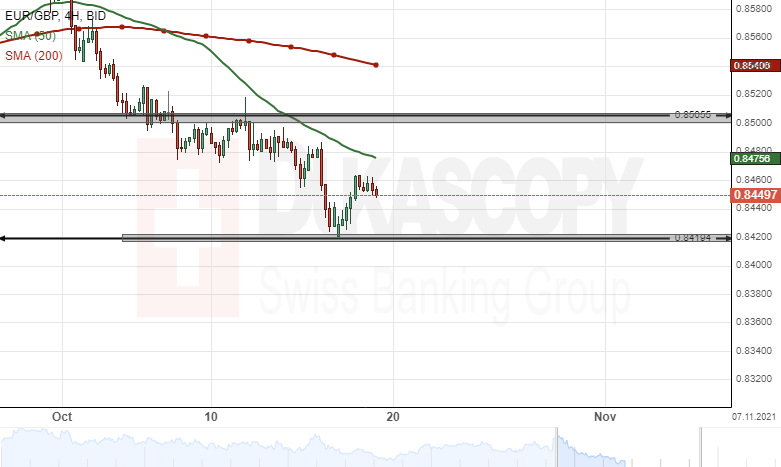
EUR/GBP Decline Could Continue
The Eurozone single currency has edged lower by 2.18% against the British Pound since the beginning of October. The currency pair breached the 0.8500 support level last week.
All things being equal, the exchange rate could continue to trend lower during the following trading sessions. The potential target for bearish traders will be near the 0.8350 area.
However, the currency exchange rate could encounter support at 0.8420 within this week's trading sessions.
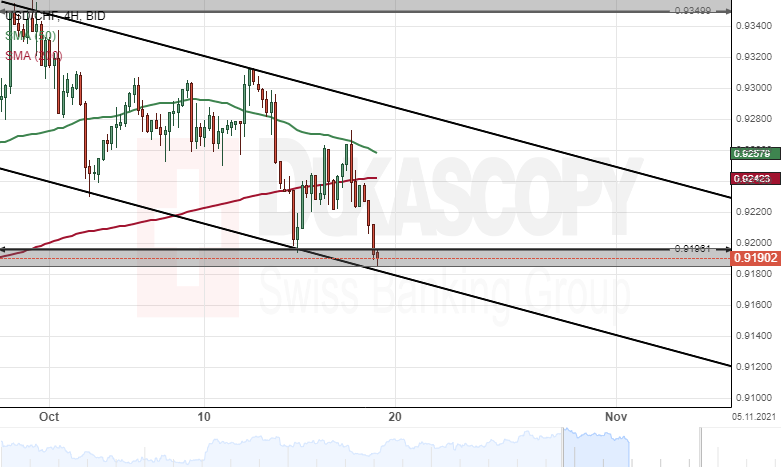
USD/CHF Likely To Maintain Channel
The US Dollar has declined by 1.19% against the Swiss Franc since October 12. The currency pair breached the 50– and 200– period simple moving averages during last week's trading sessions.
As for the near future, the exchange rate could continue to edge lower in a descending channel pattern during this week's trading sessions. The potential target for sellers will be near the 0.9160 area.
However, the USD/CHF currency exchange rate might find support at 0.9196 during the following trading sessions.
EUR/USD Analysis: Breaks Resistance Levels
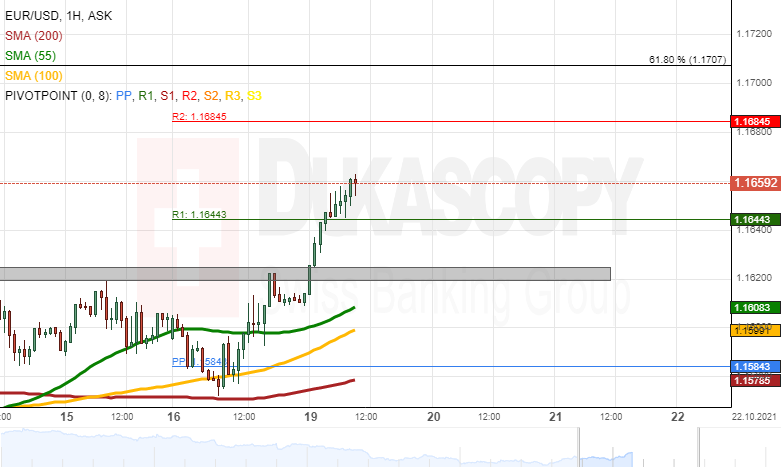
The 200-hour simple moving average's support held, and the EUR/USD began a surge. The surge managed to break the resistance of the high-level zone near 1.1620 and the weekly R1 simple pivot point at 1.1644. During the early hours of Tuesday's trading, the rate had reached the 1.1660 level.
A potential continuation of the surge would most likely face resistance at 1.1685 where the weekly R2 simple pivot point could slow down the surge. Above the pivot point, the 1.1700 mark and a 61.80% Fibonacci retracement level might provide additional resistance.
On the other hand, a decline might find support first in the weekly R1 simple pivot point at 1.1644 before possibly finding support in the previous high-level zone at 1.1620. In addition, note that the 1.1620 mark could be strengthened by the 55, 100, and 200-hour simple moving averages.
GBP/USD Analysis: Surges Despite Breaking Pattern
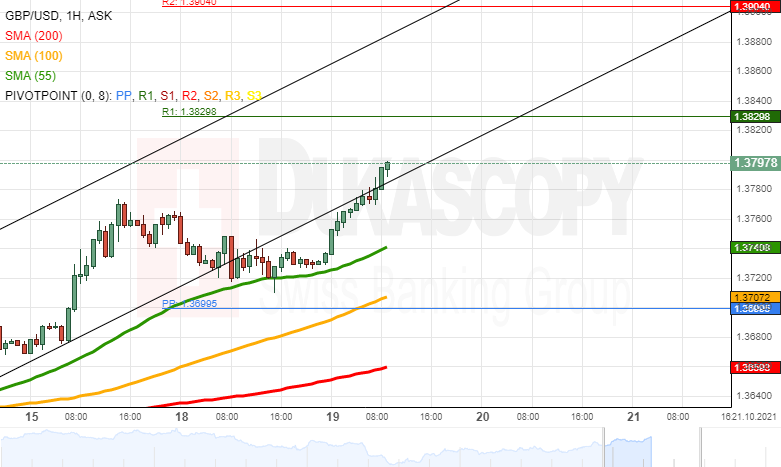
The GBP/USD passed the support of the channel up pattern. However, as the rate approached the 55-hour simple moving average and the 1.3710 level, a recovery began. By the start of Tuesday's European trading hours, the pair had almost reached the 1.3800 mark.
If the rate finds resistance at the 1.3800 mark, it could either trade sideways below it or decline. A potential decline might look for support in the 55-hour simple moving average. Below the 55-hour SMA, the pair might find support in the 100-hour SMA near 1.3700 and the weekly simple pivot point exactly at 1.3700.
A move above the 1.3800 level could aim at the resistance of the weekly R1 simple pivot point at 1.3830. Above the pivot point, resistance would be found at the 1.3900 mark, which is strengthened by the weekly R2 simple pivot point.