Sample Category Title
Fed Harker not expecting rate hike until late 2022 or early 2023
Philadelphia Fed President Patrick Harker said yesterday he's in the camp that believes it will "soon be time" to start tapering asset purchases "begin slowly and methodically — frankly, boringly".
He added that FOMC can then evaluate interest rates after tapering is complete. "I wouldn't expect any hikes to interest rates until late next year or early 2023, unless the inflation picture changes dramatically," he said.
Harker expects the economy to grow by 5.5% this year and 3.5% next. Inflation is expected to be around 4% for 2021, "a bit over" 2% in 2022, and "right at" 2% in 2023.
Eco Data 10/15/21
[php_everywhere instance="1"]
Sterling Hits 3-Week High
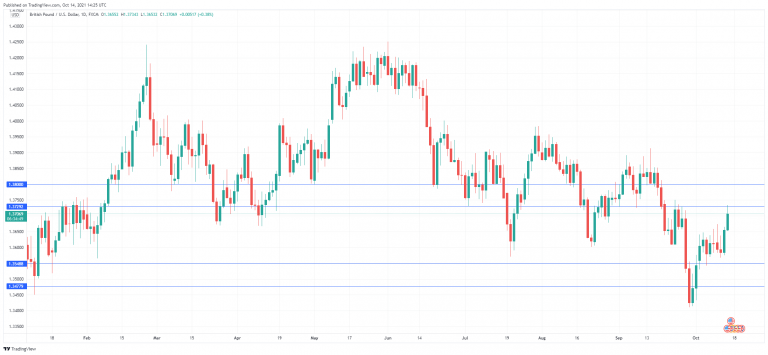
The British pound has extended its gains on Thursday, as the US dollar continues to retreat against the major currencies. GBP/USD is currently trading at 1.3710, up 0.41% on the day. Earlier, the pair rose to 1.3434, its highest level since September 24th.
GDP rises, but is it enough for a rate hike?
The GDP report for August came in at 0.4%, not a huge gain but an improvement over the July reading of -0.1%. The economy has improved as August was the first full month without Covid-19 restrictions after the government eased lockdown regulations in July. With inflation running well above the BoE’s target and the UK economy within 0.8% of its pre-pandemic level, there are strong reasons in favour of the BoE raising interest rates soon.
The central bank has telegraphed that it is looking to raise rates sooner than previously expected, with BoE Governor Bailey and MPC member Saunders sending hawkish messages earlier this month. The markets have responded by betting on a rate hike before the end of the year. This would be a highly significant move, as the BoE would become the first major central bank to raise rates since the start of the pandemic (apologies to the RBNZ, which raised rates last week). What is a sure bet is that with only six weeks left in 2021, market participants will be following every comment from BoE members ahead of the policy meeting on November 4th, looking for hints as to when the BoE plans to hike.
In the US, the FOMC minutes signalled that the Fed expects to taper its bond purchases in November or December. The minutes noted that the Fed would reduce the USD 120 billion/ month gradually, until the programme was completely terminated by July 2022. Rate fever is also gaining steam in the US, as the markets have brought forward the pricing of a rate hike from December 2022 to September 2022.
GBP/USD Technical Analysis
- 1.3674 is under pressure in resistance, as GBP/USD has moved higher. 1.3729 is next.
- There is support at 1.3548. Below, there is support at 1.3477
Sunset Market Commentary
Markets
The curve flattening/correction in LT core bond yields that started in the US earlier this week continued. Since yesterday the move also spilled over to European bond markets. This catching up move was extended with force today. The repositioning still occurs mostly independent of eco data. Yesterday’s US inflation data maybe supported the trend, but nothing more than that. Investors apparently embrace a scenario that central bankers (especially the Fed and the BoE) might try reining in inflation by taking action sooner and in a more decisive way than expected until now. If successful, this might avoid the need for a more long-drawn hiking cycle further out. If successful! The combination of ongoing high inflation expectations and a setback in real yields suggests that CB’s ability to act might be complicated by lower growth further down the road. It will take time for bond markets to sort out this complex matrix. US yields apparently found a new short-term equilibrium. Yields changes are less than 2 bp across the curve. At 1.53%, the uptrend in the US 10-y yield shows cracks but isn’t really broken yet. A beak below 1.45% would suggest a more profound change in sentiment. We’re not that far yet. Regarding today’s eco data, US jobless claims declined below the 300k barrier for the first time post corona (293k). US (core) PPI was softer than expected. EMU yields continued their catching up move with German yields declining between 0.7 bp (2 bp) and 5.1 bp (10-y). The correction is still modest given the protracted rise since mid-August. The uptrend in the 10-y EMU swap still remains intact (see graph 2 infra). Today, comments from several ECB members including Knot, Lagarde and Rehn only illustrated the division within the MPC on the ‘temporary inflation narrative’. The decline in yields still has the power to revive equity sentiment. European equities are gaining 1.0%/1.5%. US indices also opened about 1.0% higher. The oil price holding near recent peak levels (brent $84/b) at this stage is no obstacle.
In FX, the dollar correction continued this morning with EUR/USD trying to regain the 1.16 barrier. However, the US currency regained momentum as US traders rejoined the action. EUR/USD currently trades little changed in the 1.1595 area. DXY hovers just below 94.00. Despite lower LT yields, the yen this time weakened on the global positive risk sentiment with USD/JPY (113.63) again trading near recent top levels. Divergence between the yen and the Swiss franc remains striking. EUR/CHF dropped below the 1.07 handle. The better sentiment also supports sterling despite a (corrective) decline in UK yields. EUR/USD (0.8465) is trading within reach of the 0.8450 support.
News Headlines
Swedish inflation accelerated in September, but not as fast as feared. Headline inflation increased by 0.5% M/M to 2.5% Y/Y (from 2.1% Y/Y). Market consensus stood at 0.6% M/M and 2.7% Y/Y. The underlying CPIF gauge – the Riksbank’s preferred measure – rose by 0.5% M/M to 2.8% Y/Y. It’s the highest Swedish inflation reading since the end of 2008! Yesterday’s Prospera survey of money market players already showed higher inflation expectations for the following years with most respondents expecting a first rate hike in 12-24 months’ time. Accelerating inflation (expectations), even though less than expected, nevertheless managed to put the Swedish koruna on fire. EUR/SEK dived from 10.13 to test key 10 support today. That’s the downside of the narrow 10-10.30 trading channel that guided trading since end last year. A break lower paves the way to 9.80 which is 50% retracement on the 2012-2020 EUR/SEK increase. The Swedish Riksbank holds its final policy meeting of this year at November 25.
ECB Governing Council member Knot said that risks for headline inflation are again tilted to the upside. They are mainly linked to more persistent supply side bottlenecks and stronger domestic wage-price dynamics. He thinks that it’s “good news” that investors take the possibility of a period of higher inflation seriously. The European 10y inflation swap tested the psychologic 2% barrier earlier this month. The ECB’s current baseline scenario is consistent with ending PEPP in March 2022. He added that it would not be proportional to use asset purchase to actively strive for an inflation overshoot.
Stocks Buoyant, Dollar Flashes Green and Commodities Resilient
Market sentiment intact after cheery jobless claims and miss in US PPI’s
Sentiment remains upbeat as US stock futures extend their recent buoyancy after a drop in longer-term yields and echoing rhetoric from the Fed’s latest meeting, which beckons that the taper timeline is likely to begin before the end of the year.
Energy-linked rising prices and the push higher in short-term yields are feeding inflation, increasing concerns around the narrative that inflation may become more persistent. Moreover, softer 10-year yields have added to the greenback’s lately eased power, which has stretched across the forex arena.
The miss in US Producer Price Index (PPI) monthly results reiterates the fact that September US headline inflation (0.4%) was driven more so by rising energy prices. Headline monthly PPI came in softer at 0.5%, from expectations of 0.6%, while the Core PPI number dropped to 0.2%, from an estimation of 0.5%.
The number of people filing new claims for unemployment benefits fell to 293K in the previous week, way below the appraisal of 319K despite lasting effects of the pandemic. This has overshadowed the PPI results and has been a positive for the greenback today.
The dollar index surrendered ample might over the last two days diving to 93.75 but has recently plotted minor improvements.
The euro and the pound are experiencing marginal pullbacks in their Wednesday follow-through traction to the respective $1.1620 and $1.3715 levels, fuelled also by yesterday’s stronger monthly production figures. The euro and the pound are now flirting with the $1.1600 and $1.3700 round numbers. The euro is likely to lag as the pace of QE picture remains unclear and the ECB remains a dove.
The swissie dipped below the 0.9200 handle and the USD/JPY pair is largely unchanged around 113.33 despite the dollar’s latest weakness.
Commodities and their linked currencies; mixed Australian jobs data
The antipodean currencies are among the best performers with the aussie reaching 0.7420 and the kiwi 0.7039.
Despite little progress in wage growth and less people employed in September, with a miss of expectations of -108.5K hitting -138.0K unemployed, the employment market remains somewhat optimistic with Australian unemployment in September improving to 4.6%, down from 4.8%. As lockdowns continue, improved unemployment and dollar weakness have kept the aussie buoyant in spite of today’s softer Chinese inflation.
Gold is flirting with the $1,800/oz mark after its recent aggressive appreciation in price due to a drop in yields and the greenback.
WTI oil futures continue gearing up reaching $81.60 per barrel. The oil dependent loonie has steered lower to C$1.2382, largely on rising oil prices and a weaker dollar.
FOMC Members Bostic and Barkin are due to speak at 14:00 and 17:00 GMT.
US natural gas storage figures will be released at 14:30 GMT, while US crude oil inventories are scheduled for 15:00 GMT.
The UK’s Monetary Policy Committee Member Mann is speaking at 14:40 GMT, while at 21:30 GMT, New Zealand’s Manufacturing Index result is booked.
NZ Dollar Soars, Breaks 70 Line
New Zealand dollar pummels greenback
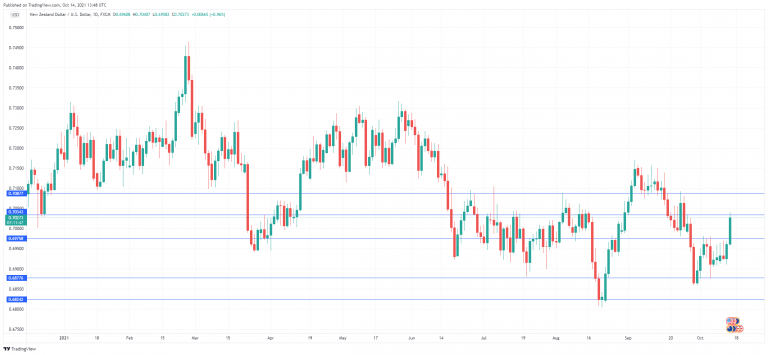
The New Zealand dollar has surged higher on Thursday and is currently trading at 0.7030, up 1.00% on the day. The currency has extended the previous day’s gains of 0.51%, as the US dollar finds itself in retreat mode.
The US dollar index fell as low as 0.9376 today but has recovered slightly in Europe. Currently, the index is at 0.9393, down 0.16% on the day. A strong US 30-year bond auction overnight sent Treasury yields and the dollar index lower. If the index has a daily close below 93.50, that could change the bullish sentiment towards the US dollar. Conversely, if the index can break above resistance at 94.50, it has room to move higher.
US inflation for September was robust but remained within expectations. Headline CPI (YoY) came in at 5.4% and Core CPI was unchanged at 4.0%. These are certainly high levels, but investors reacted calmly, which allowed equities and risk currencies like the New Zealand dollar to rally.
In the US, the FOMC minutes signalled a Fed tapering in November or December. The minutes indicated that the Fed would scale back its bond purchases of USD 120 billion/month gradually, until the programme was completely wound up in July. The markets have brought forward the pricing of a rate hike from December 2022 to September 2022, an indication that the markets are becoming increasingly sceptical about the Fed’s stance that inflation is transitory. If inflation shows no signs of waning, we can expect the market to continue to move forward rate hike expectations, a move that would be supportive of the US dollar.
NZD/USD Technical
- NZD/USD easily broke above monthly tops at 0.6975. The pair is testing resistance at 0.7034, followed by resistance at 0.7087
- There are support lines at 0.6877 and 0.6824
EUR/USD Mid-Day Outlook
Daily Pivots: (S1) 1.1550; (P) 1.1574; (R1) 1.1619; More...
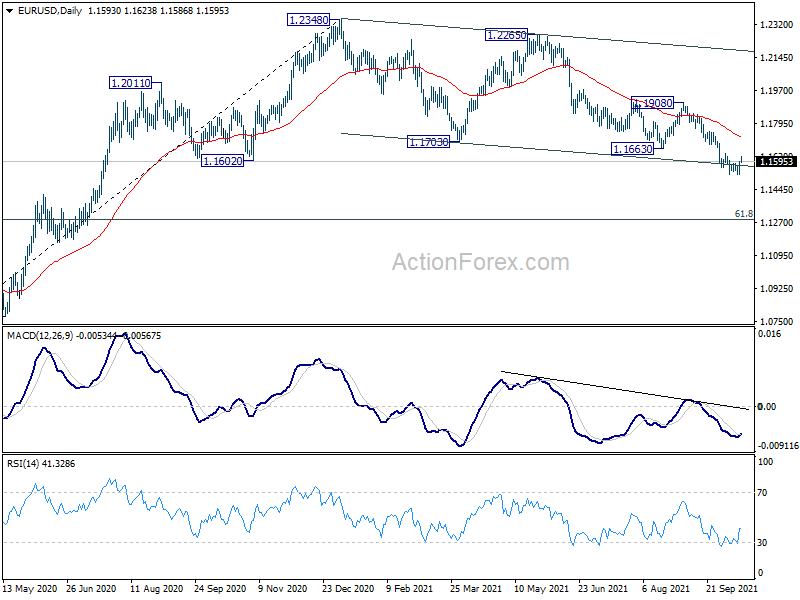
Intraday bias in EUR/USD remains neutral and outlook is unchanged. Further fall is still in favor as long as 1.1639 resistance holds. Break of 1.1523 will resume larger fall from 1.2265 to 1.1289 medium term fibonacci level next. On the upside, break of 1.1639 resistance, however, will indicate short term bottoming. intraday bias will be turned back to the upside for stronger rebound, to 55 day EMA (now at 1.1725).
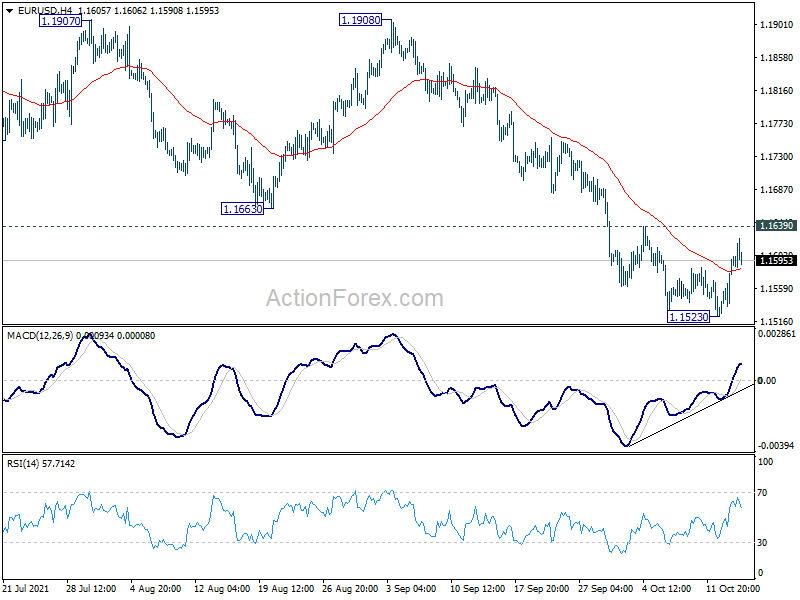
In the bigger picture, sustained break of 1.1602 will argue that rise from 1.0635 (2020 low) has completed at 1.2348. Deeper fall would be seen to 61.8% retracement of 1.0635 to 1.2348 at 1.1289. Note also that rejection by 55 week EMA (1.1830) also carries medium term bearish implication. Firm break of 1.1289 will pave the way to retest 1.0635 low. On the upside, though, break of 1.1908 resistance will revive medium term bullishness and turn focus back to 1.2348 high.
GBP/USD Mid-Day Outlook
Daily Pivots: (S1) 1.3602; (P) 1.3634; (R1) 1.3691; More...
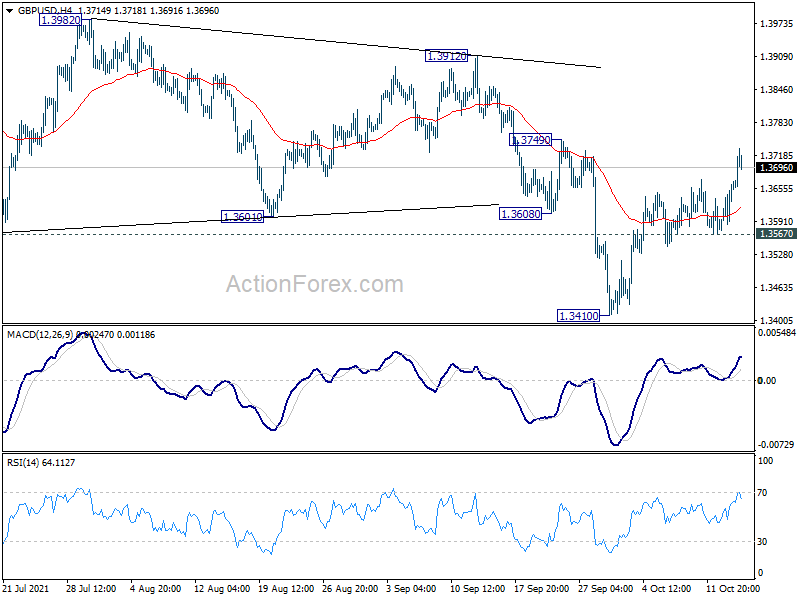
Intraday bias in GBP/USD remains on the upside at this point. Sustained trading above 55 day EMA (now at 1.3717) will target 1.3912 key structural resistance next. On the downside, however, break of 1.3567 minor support suggest that rebound from 1.3410 has completed, and fall from 1.4248 is ready to resume. Intraday bias will be turned back to the downside for 1.3410 and below.
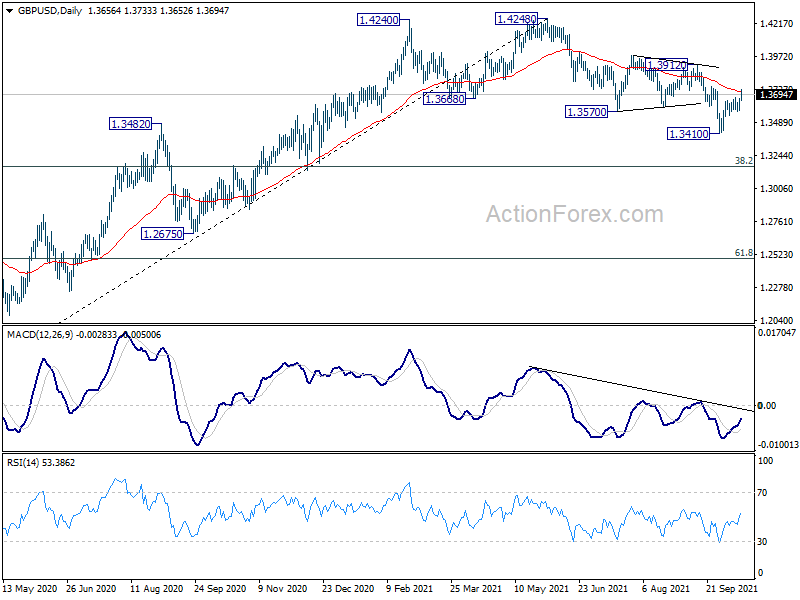
In the bigger picture, fall from 1.4248 is at least a correction to the up trend from 1.1409 (2020 low). Such correction could extend to 38.2% retracement of 1.1409 to 1.4248 at 1.3164 before completion. However, considering the rejection by 1.4376 key resistance (2018 high), sustained trading below 1.3164 will argue that it's indeed a bearish trend reversal and would target 61.8% retracement at 1.2493. Nevertheless, break of 1.3912 resistance will revive medium term bullishness and target 1.4248/4376 resistance zone again.
USD/CHF Mid-Day Outlook
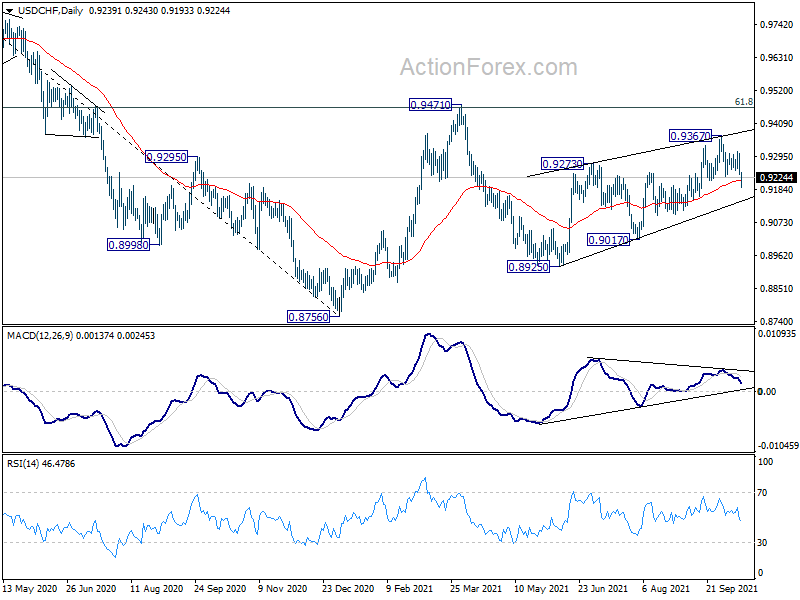
Daily Pivots: (S1) 0.9215; (P) 0.9262; (R1) 0.9288; More....
Intraday bias in USD/CHF remains on the downside at this point. Current development suggests that rise from 0.9017, and that from 0.8925, has completed at 0.9367. Deeper fall would be seen to 0.9162 support first. Firm break there will target 0.9017 support next. On the upside, break of 0.9312 support will bring retest of 0.9367 resistance instead.
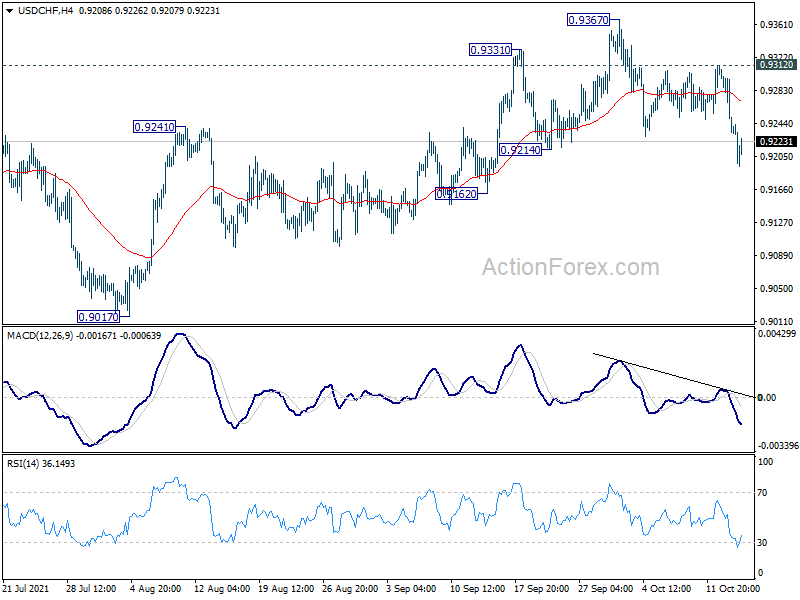
In the bigger picture, the corrective structure of the rebound from 0.8925 argues that fall from 0.9471 is not completed yet. It could either be the second leg of pattern from 0.8756 (2021 low), or resuming larger down trend from 1.0237 (2018 high). We'd pay attention to the downside momentum of assess the odds later. But for now, medium term outlook will be neutral at best as long as 0.9471 resistance holds.
USD/JPY Mid-Day Outlook
Daily Pivots: (S1) 113.05; (P) 113.43; (R1) 113.62; More...
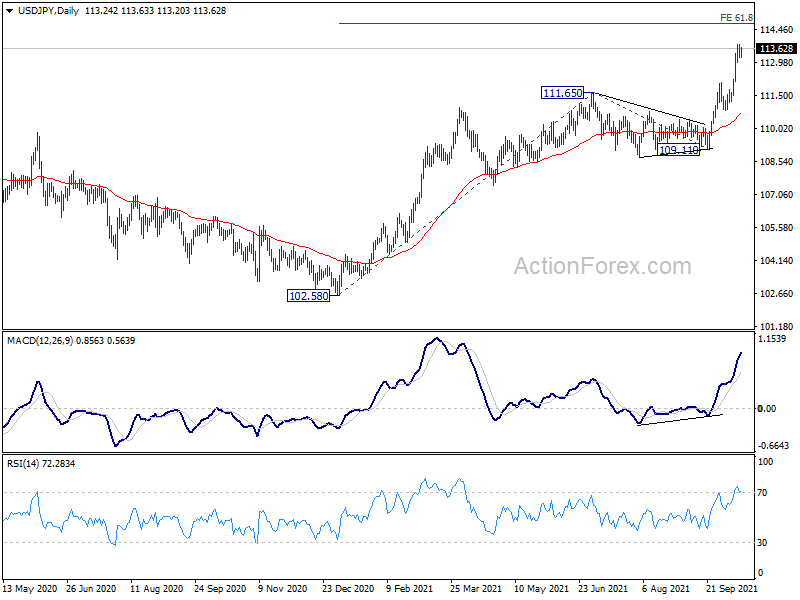
Intraday bias in USD/JPY remains neutral for consolidation below 113.79 temporary top. Downside of retreat should be contained above 112.07 resistance turned support to bring rise resumption. On the upside, break of 113.79 will extend the larger up trend from 102.58, and target 61.8% projection of 102.58 to 111.65 from 109.11 at 114.71. Firm break there will target 100% projection at 118.18 next.
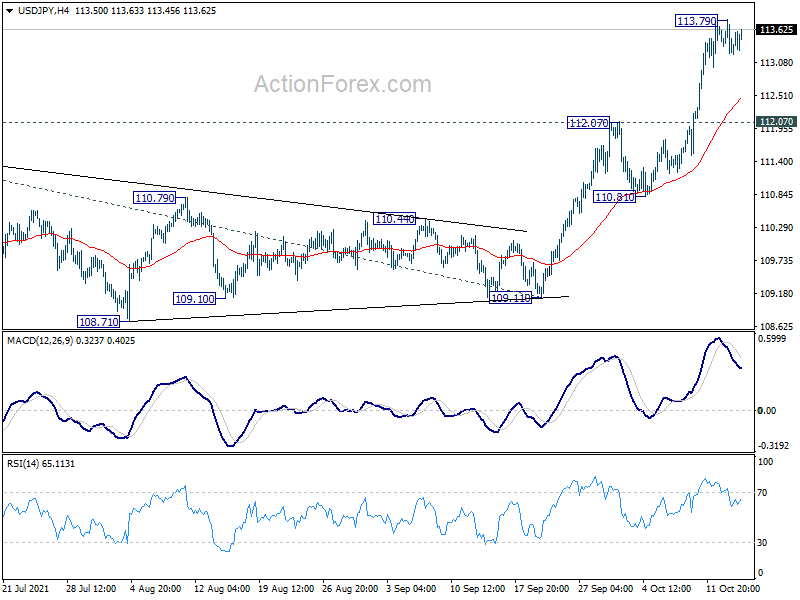
In the bigger picture, corrective decline from 118.65 (2016 high) should have completed at 101.18 already. Rise from the 102.58 is seen as the third leg of the up trend from 101.18. Next target is 114.54 resistance and then 118.65 high. This will now be the preferred case as long as 108.71 support hold, even in case of pull back.