

Sample Category Title
US Retail Sales And Consumer Confidence Due
General trend
- Taiwan Semi rises over 3% after earnings/guidance.
- Nikkei has remained higher; USD/JPY rose to the highest level since late 2018.
- Hang Seng has gained after 2-day closure.
- Shanghai Composite moved slightly higher in morning trading (+0.3%).
- S&P ASX 200 has traded modestly higher after opening flat.
- China Q3 GDP data is due on Oct 18th (Monday, Sunday night in the US).
- Companies due to report during the NY morning include Goldman Sachs, JB Hunt, ProLogis, PNC, Charles Schwab, Sensient Technologies.
Headlines/Economic Data
Australia/New Zealand
- ASX 200 opened flat.
- Rio Tinto [RIO.AU]: Cuts FY21 Pilbara Iron Ore shipments at 320-325Mt (prior 325-340Mt).
- (AU) Australia sells A$1.0B v A$1.0B indicated in 4.25% Apr 2026 bonds, avg yield 0.8669%, bid to cover 7.52x.
- (NZ) New Zealand Sept Manufacturing PMI: 51.4 v 40.1 prior.
- China/Hong Kong
- Hang Seng opened +0.9%, Shanghai Composite -0.2%.
- (CN) China said to ease banks mortgage limits through end of 2021 - Press.
- (CN) CHINA PBOC CONDUCTS CNY500B V CNY500B MATURING IN 1-YEAR MEDIUM-TERM LENDING FACILITY (MLF) AT 2.95% V 2.95% PRIOR.
- (CN) China Premier Li Keqiang: Q3 growth leveled off due to a varied of factors; recovery remains unbalanced but confident to achieve full year targets [Oct 14th].
- Greenland Holdings [600606.CN, property developer]: S&P cuts rating 2 notches to B+ from BB; Outlook Negative.
- (CN) China PBOC Open Market Operation (OMO): Injects CNY10B in 7-day reverse repos v CNY10B prior; Net drain CNY0B v Net drain CNY90B prior.
- (CN) China PBOC sets Yuan reference rate: 6.4386 v 6.4414 prior.
- (CN) China Foreign Ministry spokesman Zhao Lijian: US should take China's concerns over Taiwan seriously.
- (CN) China President Xi: China to set up an innovation center for global transportation.
- (CN) China Commerce Ministry: issues 2022 quota for 13.65Mt of fertilizer imports, flat y/y.
Japan
- Nikkei 225 opened +0.8%.
- (JP) Speculated that newly elected PM Kishida has pledged to steer country away from Abenomics – Press.
- (JP) Japan Cabinet Office Monthly Report: Maintains overall economic assessment; cuts assessment of public investment and exports [first cut in view on exports in 7 months].
- (JP) Japan Fin Min: Declines to comment on FX Levels.
Korea
- Kospi opened +0.8%.
- (KR) Bank of Korea (BOK) Gov Lee: Reiterates Nov rate hike is possible if there is no specific risk – comments in parliament.
- (KR) Bank of Korea (BOK) Report: Reiterates to gradually adjust degree of accommodation.
- (KR) South Korea said to extend current social distancing by 2 weeks, to ease private gathering rules on Oct 18th - Yonhap.
- (KR) South Korea sells 50-year bonds: avg yield 2.270% v 1.990% prior.
North America
- (US) Fed’s Harker (non-voter): Reiterates does not expect rate hikes until late 2022, early 2023; It is soon time to slowly taper asset purchases; Expects GDP growth around 5.5% in 2021.
- Moderna [MRNA]: Confirms FDA advisory committee unanimously votes in support of emergency use for a booster dose of Moderna’s COVID-19 vaccine in the US.
- (US) US President Biden signs bill related to short-term US debt limit increase (as expected).
- (US) President Biden to speak on Economic Agenda at 13:45ET on Oct 15th.
- (CA) Bank of Canada (BOC) Gov Macklem: Slack remains in Canada Labor market; Supply chain disruptions likely to be more persistent than expected.
Europe
- Hugo Boss [BOSS.DE] Reports prelim Q3 EBIT €85M v €57Me, Rev €755M v €662Me, Raises outlook.
Levels as of 01:20 ET
- Nikkei 225, +1.6%, ASX 200 +0.7% , Hang Seng +1.2%; Shanghai Composite +0.3%; Kospi +0.9%.
- Equity S&P500 Futures: +0.4%; Nasdaq100 +0.4%, Dax +0.4%; FTSE100 +0.3%.
- EUR 1.1611-1.1588 ; JPY 114.00-113.66 ; AUD 0.7426-0.7405 ;NZD 0.7061-0.7028.
- Gold -0.2% at $1,793/oz; Crude Oil +0.8% at $81.92/brl; Copper +0.4% at $4.6280/lb.
Focus On US Retail Sales
Market movers today
- Focus today will turn to US retail sales for September. The very high level of US retail sales is a key factor behind the strong goods demand we see globally, and while it has levelled off from the peak in April, it is still very robust. It will be important for bottle necks and inflation pressures whether sales hold up or start to come lower. Consensus is for a rise of 0.5% m/m in core sales so not expecting a big relief on this front.
- US also releases consumer confidence from University of Michigan. Apart from the overall confidence level, which has taken a hit lately, the inflation expectations component will be equally important to watch.
- Finally, the US Empire index is up for release. It rebounded to a strong level last month and is expected to drop back again this month.
- Apart from above numbers also keep an eye on gas markets where prices have started to climb higher again.
The 60 second overview
Macro: Global risk sentiment has generally been positive over the past 24 hours. Solid earnings as well as falling US jobless claims supported this, leading to the biggest increase in the S&P500 since March. The positive risk sentiment from the US has also spilled over to the Asian trading session this morning.
Chinese headlines have taken some focus in the past two days, where the main take-away is that the downward pressure on growth continues and that the stress in credit markets keep worsening. Price pressures add strain on producers but with little spill-over to consumers. We expect the government to soon roll out new stimulus measures but so far there has been limited news on that front.
US debt ceiling: US President Biden signed a short-term funding bill to avert a government shutdown. However, this postponement of the debt ceiling has just kicked the can a few months, so in the course of November we will hear similar discussions as recently.
Equities: Risk appetite returned at full strength on Thursday with most markets significantly higher. The inflation trade reversed and in its place growth and long duration led the gains. In the US, S&P jumped 1.7% (now only -2% off record highs), Dow 1.6%, Nasdaq 1.7% and Russell 2000 1.4%. Besides growth intense sectors (tech, communication services), materials was the standout as commodity prices are rallying. Implied volatility dropped substantially, with VIX at 18 which is the lowest since September. The buoyant sentiment is continuing into this Friday, with solid gains in Asia and US futures higher.
FI: After a choppy session in the early trading hours, the relentless rally similar to the bullish flattening on Wednesday continued. The 10y+ German Bunds led the EGB rally and ended 6bp lower on the day. A hawkish comment from Knot did not weigh on markets, while BoE's Mann (dove) pushed somewhat back on the current narrative of an early hike saying that she 'can wait'. The long-end US rates declined yet again and is 15bp lower in the past three days on a significant repricing on the recent sell-off.
FX: USD reversed lower on broad basis past couple of days. EUR/USD rebounded back towards 1.16 and GBP/USD to around 1.37. Scandies continue to perform, with EUR/NOK briefly falling below 9.80 and EUR/SEK below 10.00.
Credit: Sentiment improved further in credit yesterday - particularly in the high-beta segment where Xover tightened a whole 13bp and Main 2.2bp. HY bonds closed almost 5bp tighter while IG was unchanged.
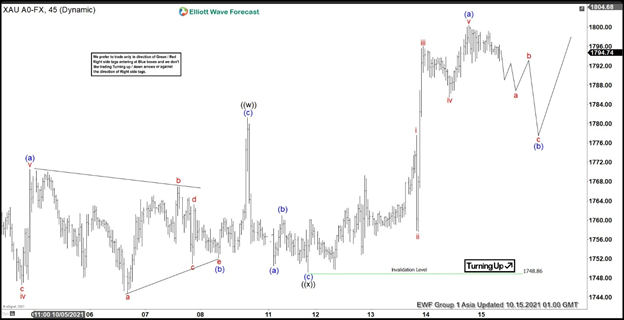
Elliott Wave View: Gold Should Rally Further Short Term
Short Term view in Gold (XAUUSD) suggests the rally from September 30, 2021 low is unfolding as a double three Elliott Wave structure. Up from September 30 low, wave (a) ended at 1770.55 and pullback in wave (b) ended at 1752.20. Final leg higher wave (c) ended at 1781.30 which completed wave ((w)) in higher degree. Wave ((x)) pullback has also ended at 1748.86 with internal subdivision as a zigzag. Down from wave ((w)), wave (a) ended at 1750.55, wave (b) ended at 1760.97 and wave (c) ended at 1748.86. This completed wave ((x)).
The precious metal has resumed higher in wave ((y)) higher. Up from wave ((x)), wave i ended at 1777.64 and wave ii ended at 1757.60. Wave iii ended at 1796.12, wave iv ended at 1785.50, and final leg wave v ended at 1800.50. This completed wave (a) of ((y)). Expect the metal to pullback in wave (b) to correct cycle from October 11, 2021 low before the rally resumes. Potential target higher is 100% – 161.8% fibonacci extension from September 30 low towards 1809.24 – 1846.65. Near term, as far as pivot at 1748.86 low stays intact, expect dips to find support in 3, 7, 11 swing for further upside.
Gold 45 minutes Elliott Wave chart
GBP/JPY Daily Outlook
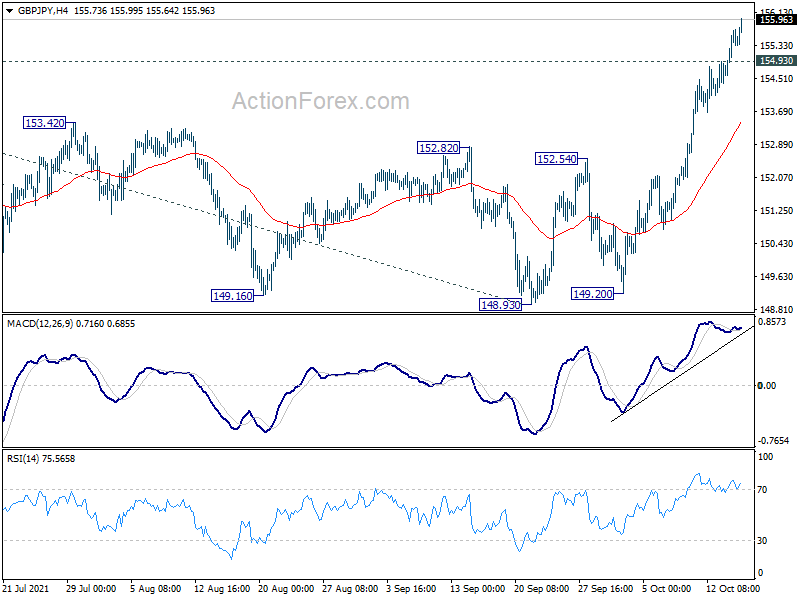
Daily Pivots: (S1) 154.80; (P) 155.27; (R1) 155.91; More...
GBP/JPY rises to as high as 155.98 so far today and intraday bias stays on the upside. Decisive break of 156.05/59 key resistance zone will carry larger bullish implications. Medium term up trend from 123.94 should then target 61.8% projection of 136.96 to 156.05 from 148.93 at 160.72. On the downside, below 154.93 minor support will turn intraday bias neutral and bring consolidations first, before staging another rally.
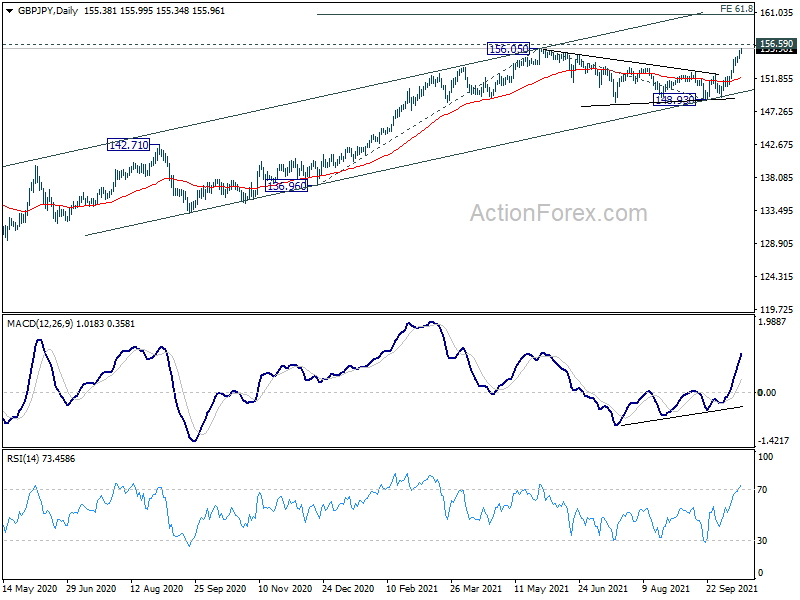
In the bigger picture, rise from 123.94 is seen as the third leg of the pattern from 122.75 (2016 low), which is still in progress. Sustained break of 156.59 (2018 high) would affirm the case of long term bullish reversal, and pave the way to 61.8% retracement 195.86 (2015 high) to 122.75 at 167.93 next. For now, this will be the favored case as long as 148.93 structural support holds.
Yen Selloff Looks Unstoppable as Global Stocks Surge
Yen's selloff continues to look unstoppable as global markets are set to end the week on a strong note. Asian stocks are trading broadly higher following the solid rebound in the US overnight. Dollar is also weak, partly weighed down by the extended retreat in treasury yields, but Euro is not too far away. Commodity currencies are set to end the week as the strongest, and it's just a matter of who's among Loonie, Aussie and Kiwi would be the eventual winner.
Technically, NASDAQ's break above 55 day EMA affirms the case that correction from 15403.43 has completed at 14181.69, after drawing support from 14175.11. A strong close today would help set the stage for further rally to retest 15403.43 high later in the month. Such development could continue to pressure Yen ahead, while capping Dollar's rally elsewhere.
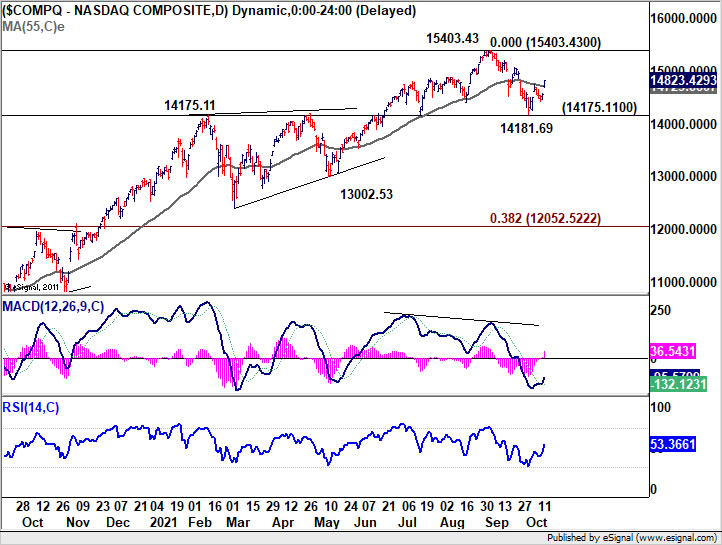
In Asia, at the time of writing, Nikkei is up 1.36%. Hong Kong HSI is up 0.83%. China Shanghai SSE is up 0.29%. Singapore Strait Times is up 0.39%. Japan 10-year JGB yield is down -0.0010 at 0.084. Overnight, DOW rose 1.56%. S&P 500 rose 1.71%. NASDAQ rose 1.73%. 10-year year dropped -0.030 to 1.519.
Fed Harker not expecting rate hike until late 2022 or early 2023
Philadelphia Fed President Patrick Harker said yesterday he's in the camp that believes it will "soon be time" to start tapering asset purchases "begin slowly and methodically — frankly, boringly".
He added that FOMC can then evaluate interest rates after tapering is complete. "I wouldn't expect any hikes to interest rates until late next year or early 2023, unless the inflation picture changes dramatically," he said.
Harker expects the economy to grow by 5.5% this year and 3.5% next. Inflation is expected to be around 4% for 2021, "a bit over" 2% in 2022, and "right at" 2% in 2023.
BoC Macklem: Inflation probably taking a little longer to come back down
BoC Governor Tiff Macklem said yesterday that supply bottlenecks are "not easing as quickly as expected". Global inflation is "probably going to take a little longer to come back down".
But he also added, the central bank's job is "to make sure that these one-off price increases don't become ongoing inflation." He maintained, "there's good reasons to believe that these are one-off price increases. They won't create ongoing inflation."
On the job market, Macklem said returning to the prepandemic employment level "is an important milestone, but it's not the destination". He added, "it is still the case though that low-wage workers are well below their prepandemic level, whereas other workers have slowly recovered. So there still is some space there."
Japan Cabinet Office said exports increasing at a slower pace
In the October Monthly Economic Report, Japan's Cabinet Office downgraded assessment on exports to "increasing at a slower pace", from "continue to increase moderate". That's the first downgrade in seven months.
Overall, the economy is "picking up although the pace has weakened in a severe situation due to the Novel Coronavirus." Private consumption "shows weakness further". Business investment is "picking up". Industrial production is "picking up". Corporate profits are "picking up". Employment situation "shows steady movements in some components". Consumer prices show "steady movements".
As the government lifted state emergency, it will "develop a new economic stimulus package" to address the issues of reopening. It expects BoJ to "pay careful attention to the economic impact of the infections and conduct appropriate monetary policy management".
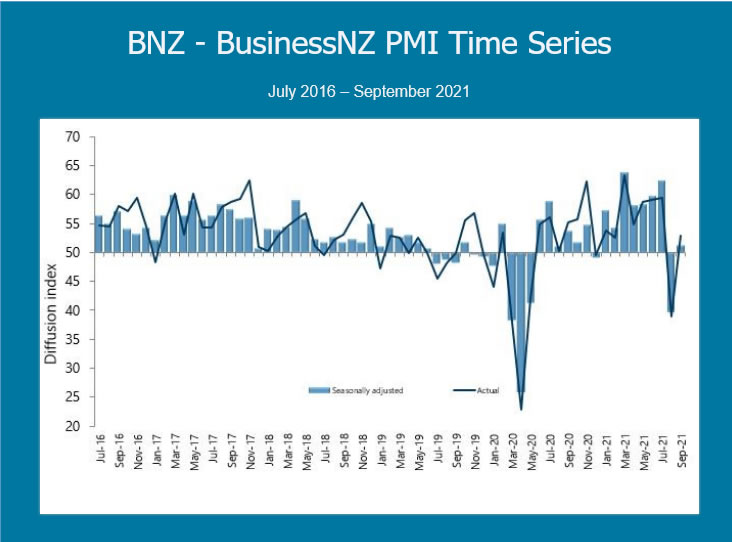
New Zealand BusinessNZ manufacturing rebounded to 51.4
New Zealand BusinessNZ Performance of Manufacturing rebounded strongly from 39.7 to 51.4 in September. Looking at some more details, production rose from 27.2 to 49.9. Employment ticked up from 54.3 to 54.5. New orders rose from 44.1 to 54.3. Finished stocks rose from 45.9 to 50.1. Deliveries also jumped from 33.1 to 47.8.
BNZ Senior Economist, Craig Ebert stated that "the rebound the PMI experienced in September was encouraging, although the survey is not without some still‐frayed parts. Credit where it's due though, as the NZ PMI traced much less of a contraction, and quicker stabilisation, compared to what it went through during the initial outbreak of COVID‐19."
Looking ahead
Eurozone trade balance is the only feature in European session. Main focus will be on US retail sales later in the day. Empire state manufacturing, import price, business inventories will also be released.
GBP/JPY Daily Outlook
Daily Pivots: (S1) 154.80; (P) 155.27; (R1) 155.91; More...
GBP/JPY rises to as high as 155.98 so far today and intraday bias stays on the upside. Decisive break of 156.05/59 key resistance zone will carry larger bullish implications. Medium term up trend from 123.94 should then target 61.8% projection of 136.96 to 156.05 from 148.93 at 160.72. On the downside, below 154.93 minor support will turn intraday bias neutral and bring consolidations first, before staging another rally.
In the bigger picture, rise from 123.94 is seen as the third leg of the pattern from 122.75 (2016 low), which is still in progress. Sustained break of 156.59 (2018 high) would affirm the case of long term bullish reversal, and pave the way to 61.8% retracement 195.86 (2015 high) to 122.75 at 167.93 next. For now, this will be the favored case as long as 148.93 structural support holds.
Economic Indicators Update
| GMT | Ccy | Events | Actual | Forecast | Previous | Revised |
|---|---|---|---|---|---|---|
| 22:30 | NZD | BusinessNZ Manufacturing Index Sep | 51.4 | 40.1 | ||
| 04:30 | JPY | Tertiary Industry Index M/M Aug | -1.7% | -0.30% | -0.60% | |
| 09:00 | EUR | Eurozone Trade Balance (EUR) Aug | 15.3B | 13.4B | ||
| 12:30 | USD | Empire State Manufacturing Index Oct | 27.8 | 34.3 | ||
| 12:30 | USD | Retail Sales M/M Sep | -0.20% | 0.70% | ||
| 12:30 | USD | Retail Sales ex Autos M/M Sep | 0.40% | 1.80% | ||
| 12:30 | USD | Import Price Index M/M Sep | 0.50% | -0.30% | ||
| 14:00 | USD | Michigan Consumer Sentiment Index Oct F | 73.5 | 72.8 | ||
| 14:00 | USD | Business Inventories Aug | 0.70% | 0.50% |
New Zealand BusinessNZ manufacturing rebounded to 51.4
New Zealand BusinessNZ Performance of Manufacturing rebounded strongly from 39.7 to 51.4 in September. Looking at some more details, production rose from 27.2 to 49.9. Employment ticked up from 54.3 to 54.5. New orders rose from 44.1 to 54.3. Finished stocks rose from 45.9 to 50.1. Deliveries also jumped from 33.1 to 47.8.
BNZ Senior Economist, Craig Ebert stated that "the rebound the PMI experienced in September was encouraging, although the survey is not without some still‐frayed parts. Credit where it's due though, as the NZ PMI traced much less of a contraction, and quicker stabilisation, compared to what it went through during the initial outbreak of COVID‐19."
Cliff Notes: Confidence Provides a Robust Foundation for Recovery
Key insights from the week that was.
Confidence was the key theme in Australia and the world this week.
Beginning with Australia’s NAB business survey. In mid-to-late September when the survey was taken, the end of lockdown was in sight for NSW and Victoria thanks to rapid progress with vaccination. This resulted in confidence surging 19pts to +13 nationally – a reading well above the long-run average. In NSW specifically, confidence surged 42pts to +27, while in Victoria (where the re-opening is later and the trajectory of cases more threatening) confidence gained ‘only’ 16pts to +5.
According to our Westpac-MI sentiment survey, consumers also clearly have their eye on re-opening, with confidence levels across Australia’s states broadly in line despite NSW still being under restrictions until after October’s sampling period ended, and Victoria expected to remain locked down until late in the month. At 104.6, the national measure of sentiment remains above average as well as the level seen prior to the pandemic.
While the economic expectations sub-indexes fell in the month, both the 1 and 5-year views remain well above their long-run averages. Views on family finances also fell in the month but are, in contrast, only just above average. The promise of an end to lockdown conditions saw unemployment expectations fall in the month; and, relative to its long-run average, this series is pointing to a strong recovery in employment and a tight labour market.
Housing affordability is clearly a worry for households however, with ‘time to buy a dwelling’ down 14% in the month and 37% from its November 2020 peak. An initial tightening of loan assessment conditions mid-way through the sample week would have been an additional negative for views on affordability in October, in addition to the strong price gains of the past year.
Nonetheless, house price expectations remain strong, holding near 8-year highs in October. Recent results from this survey and in housing markets across the nation have led Westpac Economics to revise up our house price views for 2021 and 2022. Respectively, the annual price growth forecast for each year has been lifted by 4ppts and 3ppts to 22%yr and 8%yr at the national level. The modest decline anticipated in 2023 because of the cumulative effect of macroprudential measures as well as rate increases from early-2023 remains -5%yr. A detailed view by state can be found in the Bulletin released by Chief Economist Bill Evans and Senior Economist Matthew Hassan linked above. Chief Economist Bill Evans also discussed macroprudential policy and the outlook for interest rates in our October edition of the Market Outlook in Conversation podcast.
The other key release for Australia this week was the September labour force survey. The loss of jobs in the month was a little less than anticipated by the market (-138k actual against -150k consensus), continuing the run of outperformance through the pandemic. Despite the loss of jobs, the unemployment rate barely moved (up 0.1ppt to 4.6%) thanks to a 0.7ppt fall in participation. While participation will rebound as each state re-opens in late-2021 and there is likely to be an initial mismatch of workers and jobs, causing the unemployment rate to rise, the September update suggests the peak for the unemployment rate may be closer to 5% than the 5.4% we have forecast.
Offshore, this week data broadly met consensus expectations and was in line with existing policy views. In the US, the September CPI and PPI data supported the belief that the current inflation burst will prove transitory, but also that risks are skewed to the upside. More important for policy, FOMC speakers confirmed they view late-2021 as the right time to announce a taper despite a second-straight downside surprise for nonfarm payrolls in September (released last Friday).
As we detailed on Monday, there is enough strength in the household survey and sufficient reason to look through the soft September nonfarm payrolls print to justify a November taper announcement by the FOMC. Also, per this week’s September FOMC meeting minutes and our own forecasts, the US taper should conclude around mid-2022, leaving space for a first rate hike in December 2022. These key themes were also discussed in this month’s Market Outlook in Conversation podcast.
While this week’s events confirmed the US’ progress towards monetary policy normalisation, the US dollar is ending the week below its starting level on a DXY basis. As per our forecasts, relative growth and policy divergence matter far more than the outright stance of policy in any one jurisdiction, even the US.
To March 2022, we look for the US dollar to take another (modest) leg lower, from around 94 currently to 91.5, as asset purchases are tapered across key markets and fiscal uncertainty challenges the market’s outlook for US growth. From there however, a US dollar uptrend on a DXY basis is set to build strength, taking the index back to, then above, its current spot level through 2022 and 2023.
Currencies heavily exposed to global momentum and economic development such as our own Australian dollar and, more notably, China’s Renminbi are set to outperform this trend. On the outlook for the latter, as our video update outlined this week, current uncertainties with regards to Evergrande and power supply in China are likely to have little consequence for China’s outlook beyond the next few months.
Japan Cabinet Office said exports increasing at a slower pace
In the October Monthly Economic Report, Japan's Cabinet Office downgraded assessment on exports to "increasing at a slower pace", from "continue to increase moderate". That's the first downgrade in seven months.
Overall, the economy is "picking up although the pace has weakened in a severe situation due to the Novel Coronavirus." Private consumption "shows weakness further". Business investment is "picking up". Industrial production is "picking up". Corporate profits are "picking up". Employment situation "shows steady movements in some components". Consumer prices show "steady movements".
As the government lifted state emergency, it will "develop a new economic stimulus package" to address the issues of reopening. It expects BoJ to "pay careful attention to the economic impact of the infections and conduct appropriate monetary policy management".
USD/JPY Remains In Major Uptrend Above 113.00
Key Highlights
- USD/JPY started a steady increase above the 112.50 resistance zone.
- A key bullish trend line is forming with support near 112.60 on the 4-hours chart.
- EUR/USD failed to clear the main 1.1650 resistance zone.
- The US Retail Sales could decline 0.2% in Sep 2021 (MoM).
USD/JPY Technical Analysis
The US Dollar started a major increase above the 112.00 against the Japanese Yen. USD/JPY broke many hurdles near 112.50 and 112.80 to move into a positive zone.
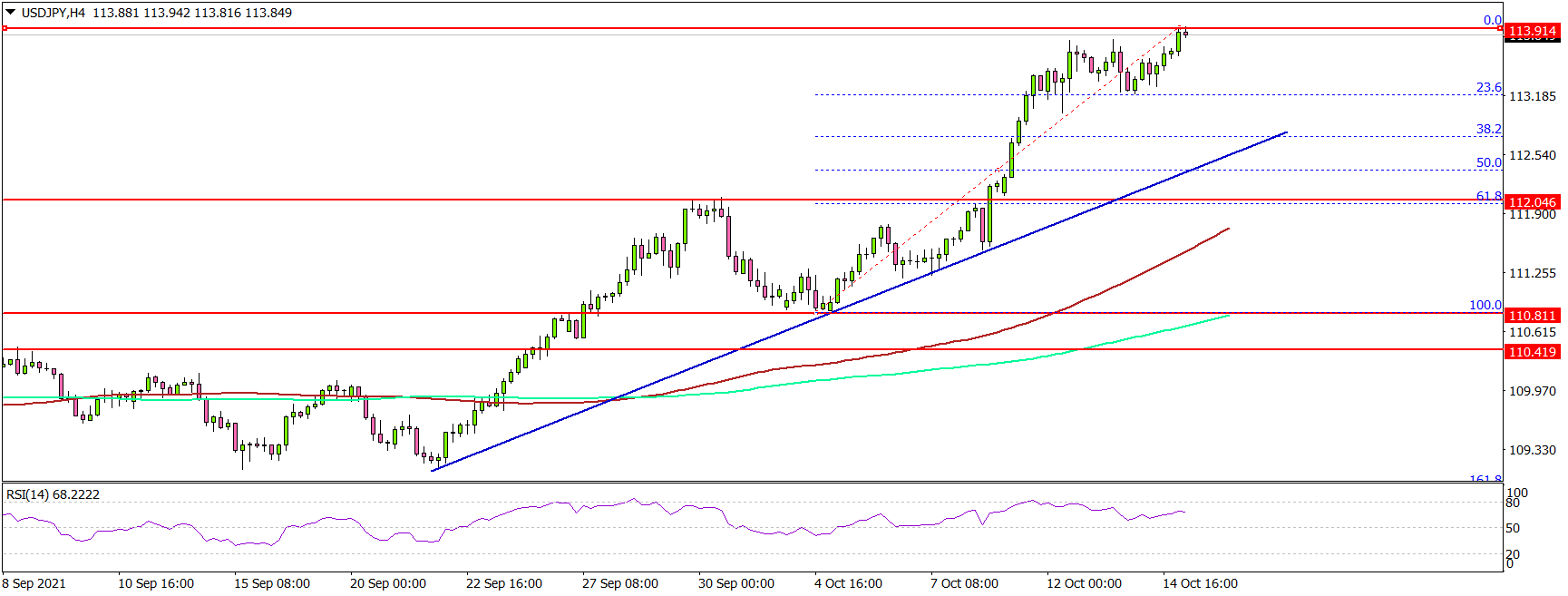
Looking at the 4-hours chart, the pair even surpassed the 113.00 level. The pair even settled above the 113.00 level, the 100 simple moving average (red, 4-hours), and the 200 simple moving average (green, 4-hours).
The pair tested the 113.80 and started consolidating gains. An immediate support is near the 113.20 level. The next major support is near 113.00. There is also a key bullish trend line forming with support near 112.60 on the same chart.
Any more losses below the trend line support may possibly lead the pair towards the 112.20 level. The next major support sits near the 112.00 level.
An immediate resistance on the upside is near the 113.80 level. The first major resistance is near the 114.00 level, above which the pair could rise towards the 115.00 level in the near term.
Looking at EUR/USD, the pair attempted a steady recovery, but the bulls are facing a major hurdle near the 1.1650 level.
Economic Releases
- US Retail Sales for Sep 2021 (MoM) – Forecast -0.2%, versus +0.7% previous.
- Michigan Consumer Sentiment Index for Oct 2021 (Prelim) – Forecast 73.1, versus 72.8 previous.
BoC Macklem: Inflation probably taking a little longer to come back down
BoC Governor Tiff Macklem said yesterday that supply bottlenecks are "not easing as quickly as expected". Global inflation is "probably going to take a little longer to come back down".
But he also added, the central bank's job is "to make sure that these one-off price increases don't become ongoing inflation." He maintained, "there's good reasons to believe that these are one-off price increases. They won't create ongoing inflation."
On the job market, Macklem said returning to the prepandemic employment level "is an important milestone, but it's not the destination". He added, "it is still the case though that low-wage workers are well below their prepandemic level, whereas other workers have slowly recovered. So there still is some space there."