Sample Category Title
Gold Surges, Oil Stays Resilient, Stocks Choppy as US Data Shows No Signs of Transitory Inflation
Just like William Shatner, US stocks went on a wild this morning. Wall Street took a brief break to watch Star Trek's William Shatner, a 90-year old legend set a record in space with a Blue Origin spaceflight.
The S&P 500 index declined after the latest inflation report showed no signs of being transitory, prompting Treasury markets to anticipate a September Fed rate hike next year. The Nasdaq was initially dragged down after reports that Apple could cut their iPhone 13 production targets for 2021 by as many as 10 million units. Short-dated Treasuries jumped after the inflation report, while the 10-year and 30-year declined.
Despite above trend growth for 2022, stocks may struggle over the short-term on rising interest rate expectations from inflation fears, poor inventories for the holidays, and elevated energy prices. A decline in long-end rates and expectations that Apple's revenue shortfall in Q4 will just go to Q1 helped the Nasdaq post a modest gain. Earnings took a backseat to the inflation report and reset of Fed rate hike expectations. JPMorgan posted solid results, Delta warned Q4 might not be profitable given the surge in fuel prices, and BlackRock delivered robust results.
CPI
Rising food prices, energy costs, utilities, and new vehicles all confirmed what every American already knows… Inflation remains elevated. Core inflation mostly steadied but that was weighed down again over weakness in travel. The transitory argument is weakening and that trend will continue to move forward Fed rate hike expectations.
Supply chain
The White House announced that the Port of Los Angeles will switch to a 24/7 schedule to help ease the bottleneck issues. Walmart, Fedex, UPS, Target, Samsung, Home Depot and more are expected to embrace the nonstop schedule. The White House wants to make sure Americans are pleased with Biden’s agenda going into midterm elections next year and exceedingly high gas prices and backordered holiday presents will not bode well.
Apple
It seems semiconductor manufacturers Broadcom and Texas Instruments can’t meet Apple’s iPhone 13 demand, a sign that the chip shortage is nowhere near over and that the iPhone supercycle is alive and well. Holiday shoppers that want to give the gift of iPhone 13 need to buy now. Apple shares fell on the Bloomberg report that this year’s iPhone target might fall 10 million phones short due to supply chain issues. Apple will still remain a favorite mega-cap tech stock as this only delays revenue from the fourth quarter to the next quarter.
JP morgan
A solid earnings report from JPMorgan kicked off earnings season. There was a lot of gold nuggets in this report, but lackluster loan growth and slowing trading revenue is why share prices are not higher. Earnings impressed at $3.74, but when you exclude the reserve release it was only a six cent beat at $3.03. Third quarter recovery of credit losses was the number everyone is focusing on, an impressive $1.53 billion improvement, significantly better than the consensus estimate of $17.9 million.
Adjusted revenue of $30.44 billion was a beat of the $29.86 billion estimate, led by better-than-expected results in investment banking, equities sales & trading, and a 7% increase in corporate & investing. With no changes to the full-year outlook, the bank looks like it hasn't seen any radical shifts to the outlook as the country comes out of the pandemic. JPMorgan’s exposure to China’s property sector and fintech’s encroachment to Wall Street banking does not seem to pose that big of a risk just yet.
Oil
OPEC’s monthly report rattled energy investors as the cartel of energy producers grew cautious with oil demand. The winter outlook was far from optimistic and that helped WTI crude fall further away from the $80 level.
Shortly after the OPEC report, President Putin spoke at an energy forum in Moscow. Putin’s comments were mostly political posturing, noting that Russia is ready to supply as much gas as Europe needs. Putin praised the Saudis and President Trump for reaching the 2020 oil deal. Putin added that it is quite possible for oil prices to hit $100 a barrel. Putin’s main agenda was to get Europe to approve Nord Stream 2, which would help lower their energy prices.
The fact remains that the oil market is still heavily in deficit and until confirmation is made about a crude demand slowdown, energy traders will buy every dip. WTI crude still run higher and might not see profit-taking until prices get closer to the $85 level.
Gold
A Jekyll and Hyde inflation report sent gold prices on a wild ride. Longer lasting inflation just went from rushing interest rate hikes forward to destabilizing large parts of the global economic recovery. This week alone the market went from pricing in a potential December 2022 rate hike to having high confidence that September 2022 will be lift-off time for the Fed.
Gold prices are surging after a massive reversal with the 10-year Treasury yield. Inflation expectations mixed with global growth concerns have made many investors nervous that the business and the consumer will be much weaker in the second half of 2022. Safe-haven flows are starting to come gold’s way, whether it is speculation of a Biden tariff announcement or rising interest rates will destabilize many emerging market recoveries.
Gold has tentative resistance at the $1,800 level, but that might not prove to be too difficult to breach if risk aversion runs wild.
Bitcoin
July data showed that the US has become the leader in Bitcoin mining, clearly not surprising anyone following the massive investments made by Wall Street. China’s loss is the United States’ when it comes to Bitcoin mining. Given the rest of the world is battling an energy crisis, it is no surprise that the US has had an easy path to take over the number 1 spot for bitcoin miners.
Bitcoin is consolidating around the $56,000 level as the cryptoverse awaits a potential SEC update over a Bitcoin ETF on Monday. Bitcoin was unfazed by the latest inflation report that shows inflationary pressures in the economy remain elevated. Bitcoin is not an inflation hedge today.
Euro Edges Closer to 1.16
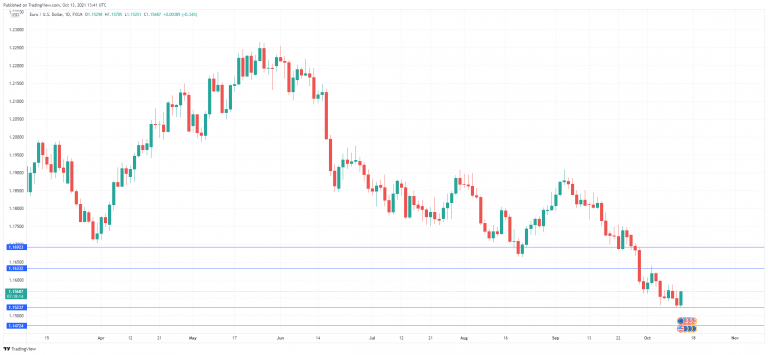
The euro has reversed directions and edged higher on Wednesday. Currently, EUR/USD is trading at 1.1564, up 0.30% on the day.
ECB member Villeroy downplays inflation
Inflation continues to be the hot topic for many of the major central banks, and the markets are becoming increasingly sceptical that ‘high inflation is transitory” as Jerome Powell and other central bank heads have been declaring to anyone who will listen. The ECB has followed this script and downplayed fears of a surge in inflation, even though September CPI in the eurozone hit its highest level since 2008.
ECB member Francois Villeroy, who is also head of the French central bank, has said that he expects inflation to fall below 2%, which is the ECB’s target, within a year. On Tuesday, Villeroy acknowledged that he had concerns over short-term inflationary pressures, but at the same time he noted eurozone inflation could miss the inflation target in 2023. In other words, the ECB is faced with a situation where the inflation has exceeded the target in the short term, but could fall short of the target in the medium-term.
Villeroy’s comments echo what ECB President Christine Lagarde said in September that the ECB should not overreact to what she called a temporary spike in inflation. Lagarde has dismissed the notion of an ECB taper, stating “the lady isn’t tapering”. However, inflation doesn’t look like it will ease anytime soon, given the rise in energy prices, strong domestic demand and chronic supply-chain disruptions. Some analysts are projecting that inflation could rise as high as 4 per cent before the end of the year, which could mean that the ECB may have to take steps to curb inflation from overheating the economy.
EUR/USD Technical
- On the downside, 1.1523 has some breathing room in support as EUR has moved higher. The next support line is 1.1472
- 1.1633 is the next line of resistance, followed by 1.1692
Elliott Wave Analysis: Oil May Slow Down at 80-82 Area
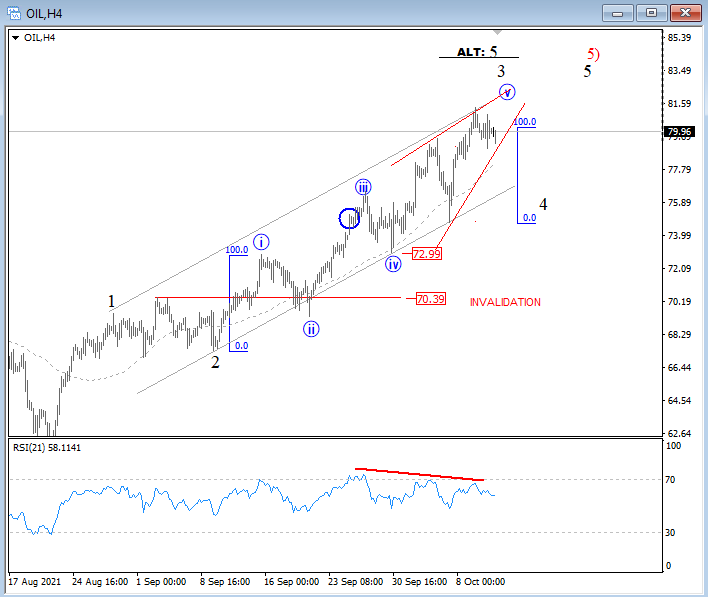
After yesterday's intraday shake out, Crude oil looks corrective on the intraday basis, which means that it can retest the highs and 82-83 area, ideally as part of final leg of an ending diagonal pattern before it finds the resistance.
Crude oil is still at the highs in the 4-hour chart and five-wave cycle looks to be unfinished, so we may see more gains within wave 3 or alternatively wave 5, but wave "v" of 3 or 5 looks to be an ending diagonal pattern, so still watch out for a reversal down here in the 80-82 area, at least in three waves back to 73 support area. A bigger decline back to 70 area is needed to confirm the top.
Crude oil 4h Elliott Wave analysis chart
US: Inflation Pressures Remain High in September CPI
Consumer price growth picked up a bit in September to 0.4% month-on-month (m/m) from up 0.3% in August. As a result, headline inflation was 5.4% year-on-year (y/y), a tick above August's pace.
Core inflation (ex. food and energy) also picked up to a 0.2% m/m increase, from 0.1% in August. That left the year-on-year rate of core inflation unchanged from August at 4.0%.
Both food (+0.9% m/m) and energy (+1.3% m/m) prices rose sharply on the month. Prices for energy goods (gasoline and fuel oil) have had steep monthly increases for four months now, and are up 41.7% versus a year ago. Food prices are up 4.6% y/y, with the largest increases seen for meats, poultry, fish and eggs.
Core prices were lifted by a 0.4% m/m increase in the heavily weighted shelter component. Rents rose 0.5% m/m, their largest monthly increase in over 20 years. Owners' equivalent rent rose 0.4% m/m, its largest increase in five years. Other big increases included prices for new vehicles (+1.3% m/m) household furnishings and operations (+1.0% m/m) and car insurance (+2.1% m/m). Low inventories of new vehicles due to the semiconductor shortages have boosted new vehicle prices 8.7% over the past year, the fastest pace in over 40 years.
In contrast, airline fares continued to fall sharply (-6.4% m/m), as did apparel (-1.1% m/m) and used vehicle prices (-0.7% m/m).
Key Implications
The pandemic continued to drive big price swings in both directions in September. Many travel-related prices that were hot in the spring are trending down, however price pressures elsewhere, namely for shelter, are bubbling to the surface. Consumers are feeling the pinch from higher costs for many essentials, with the pace of inflation outstripping wage growth since the spring.
It is true that the comparison to low prices a year ago is boosting the annual inflation rate, however, we expect these base effects to be with us through the first half of 2022. Still, the monthly pace of core inflation has cooled to a more "normal" pace in aggregate, supporting the Fed's view that the worst of the price spike is largely transitory. But, the more persistent categories like shelter, are expected to help keep inflation above target. We continue to expect the Fed to start tapering asset purchases very soon, and raise rates by the end of next year.
Sunset Market Commentary
Markets
Team temporary suffered another setback today. US CPI unexpectedly accelerated to 5.4% y/y (0.4% m/m) after two months of a slight deceleration. The September reading equals the previous post-pandemic peak in June and is the fastest pace since August 2008. Energy again supported prices, sprinting higher at a rate of 1.3% m/m (24.8% y/y!). Utility gas service prices surged 2.7% m/m. Food prices increased 0.9% m/m. But even without these volatile categories, core inflation remained at an elevated 4% y/y – as expected. This is due to a sharp price rise of new vehicles (1.3% m/m) and shelter (0.4% m/m). The latter is an important observation as the cost of housing is a sticky-price item and accounts for almost a third in the CPI basket. Short-term US yields extended their intraday rise with 1 to 2 bps to 3.2/3.4 bps for the day (2y-3y) as markets further frontload a first rate hike by the Fed. At the current stage, a little less than 1 full rate hike (25 bps) is being discounted for September. Long US tenors erased earlier losses in the wake of the release but soon caved again. Yields trade 2.8 bps (10y) to 4 bps (30y) lower. After two days of marching higher without guidance of (Monday) or even in outright divergence with (yesterday) the US, German yields today retreat with substantial losses at the back of the curve. Changes vary from -0.8 bps (2y) over -4.8 bps (10y) to -7.8 bps (30y). European swap yields dive 10 bps (30y). In other bond news, the Flemish Community successfully sold €1.5bn under a new benchmark 10y bond. Pricing was set at OLO+17 bps vs initial guidance of +20 bps area. Books amounted to more than 5.9bn euro. Peripheral spreads vs Germany widen a few basis points, with Greece (+3 bps) underperforming even as overall (equity) sentiment is not too bad. European stocks rise about ¾ of a percent. Despite the significant UST underperformance across the curve, EUR/USD is holding up pretty well in a sign the dollar bull rally might be losing momentum. EUR/USD’s kneejerk CPI move lower soon reversed with the pair hovering back to intraday highs of around 1.156. USD/JPY even trades a tad lower for the day at 113.48.
UK yields do not escape the core bond surge with the long end of the curve falling off a cliff (-13.4 bps in the 30y). Other changes range from -3.2 bps (2y) to -9.1 bps (10y). Luckily for the pound, however, European yields face a similar faith. EUR/GBP remains within proximity of the 0.847 intermediate support area. Cable (GBP/USD) flipflops around 1.36 – no change here compared to previous days either. The EU is due to unveil a proposal with tweaks to the current Northern Ireland protocol today but there’s no news yet on how it is received by the British side.
News Headlines
Germany’s four economic institutes (DIW, Ifo, RWI and IWH) are expected to slash this year’s economic growth forecast from 3.7% to 2.4% later this week. The main argument is the drag from persisting supply bottlenecks. The IMF yesterday sounded more upbeat at 3.1%. Sources close to the deliberations also suggest that the joint statement from the institutes will show an increase (from 3.9% to 4.8%) for the 2022 GDP forecast while projecting 1.9% growth in 2023.
Czech National Bank board member Benda and board advisor Mateju argue in an opinion piece in the Pravo newspaper that relatively swift interest rate hikes are necessary to curb inflation, make the koruna stronger and help cool the country’s overheated property market. CNB governor Rusnok in a presentation also argued to focus on suppressing second-round inflation pressures by acting in a forward-looking fashion. He also mentions that the CNB will allow monetary tightening to spread both in the interest rate AND the exchange rate component. The Czech koruna profits from the hawkish policy and currency comments with EUR/CZK declining from 25.40 to 25.35. Key support stands at 25.25.
Dollar Remains Stable after CPI and Before FOMC Minutes
US CPI data jumps to 13-year high; dollar still firm
The main event today was the release of the US CPI data ahead of the FOMC minutes later in the session. The annual inflation rate increased to a 13-year high of 5.4%, up from 5.3% in August and beyond market estimates of 5.3%. Consumer prices increased by 0.4% monthly, slightly exceeding predictions of 0.3%.
The dollar seems to be keeping its recent gains. USD/JPY is holding below the 34-month high of 113.70. However, the euro is recouping some losses, trading near $1.1565, after the drop to the low of $1.1525, reached in July 2020. US futures are suggesting a positive open after three consecutive red days.
FOMC minutes is the next event of the day
The minutes of the FOMC's most recent meeting will be made public later in the day. The Fed delivered a hawkish hold at its September meeting. Tapering "may soon be appropriate," according to the Fed, given how well the economy and the job market have been doing lately. If the economy grows as projected, Federal Reserve Chair Jerome Powell indicated that the Fed may make a move on tapering at its next meeting. While a "pretty excellent" jobs report is required by the Fed, he believes the benchmark has been "all but met." Finally, Powell predicted that the gradual withdrawal of stimulus will be completed by the middle of 2022.
Earning releases: Delta, Blackrock and JPMorgan
With a profit of $1.2 billion in the third quarter, Delta AirLines had its second profit since the start of the coronavirus pandemic but its first without US government assistance.
The world's largest asset manager, BlackRock, posted better-than-expected third-quarter earnings, while assets under management fell short of expectations. Growth in performance fees pushed earnings per share by 19% to $10.95, helping BlackRock's profits soar.
JP Morgan reported better-than-expected loan losses of $1.5 billion for the third quarter on Wednesday, beating analyst estimates.
UK's weak data hold pound around $1.36
The release of UK data and adjustments earlier today support the idea that the UK economy is slowing even as policymakers consider reducing stimulus. The trade deficit was -GBP3.7 billion, versus -£2.8 billion predicted, and -£2.95 billion in July. The poor data, Brexit tensions and energy crises continue to mount up, therefore a period of underperformance may come for the pound. Sterling is trading slightly higher above the $1.36 round number.
EUR/USD Mid-Day Outlook
Daily Pivots: (S1) 1.1514; (P) 1.1542; (R1) 1.1559; More...
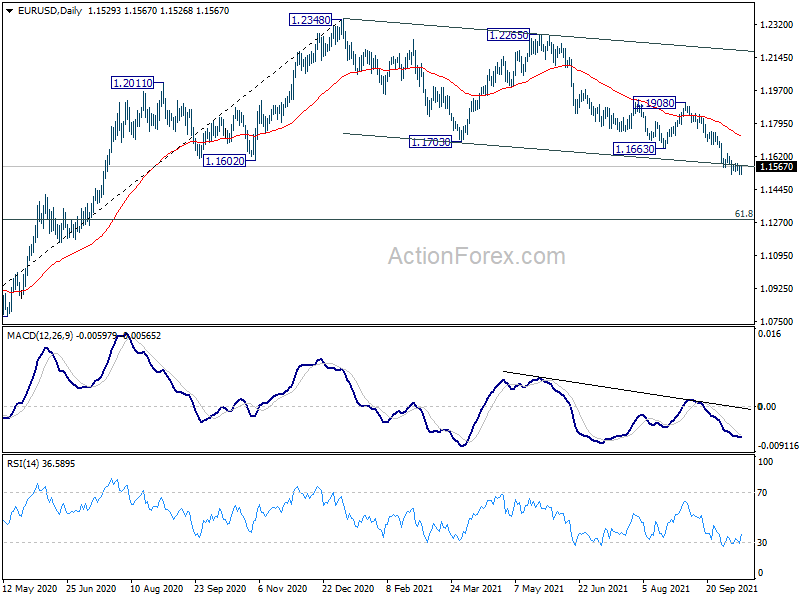
Intraday bias in EUR/USD remains mildly on the downside at this point. Current decline from 1.2265 would target 1.1289 medium term fibonacci level next. On the upside, break of 1.1639 resistance, however, will indicate short term bottoming. intraday bias will be turned back to the upside for stronger rebound.
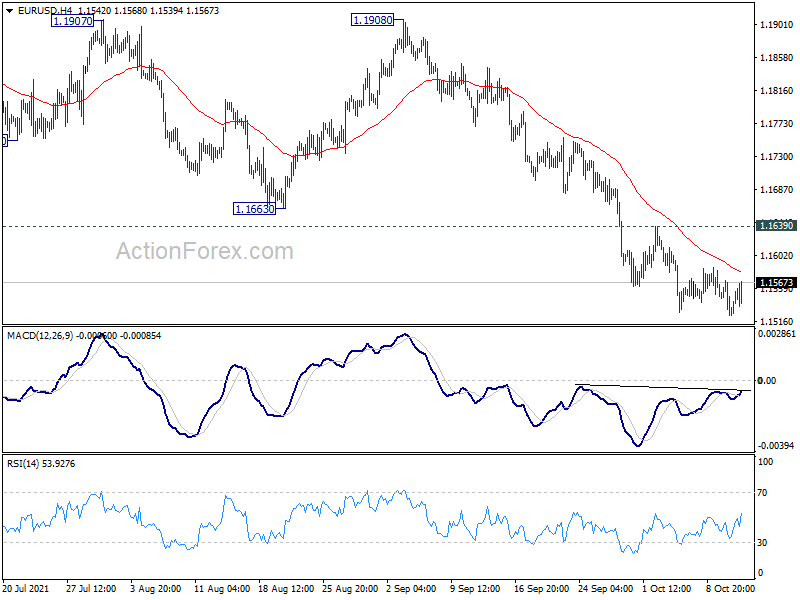
In the bigger picture, sustained break of 1.1602 will argue that rise from 1.0635 (2020 low) has completed at 1.2348. Deeper fall would be seen to 61.8% retracement of 1.0635 to 1.2348 at 1.1289. Note also that rejection by 55 week EMA (1.1830) also carries medium term bearish implication. Firm break of 1.1289 will pave the way to retest 1.0635 low. On the upside, though, break of 1.1908 resistance will revive medium term bullishness and turn focus back to 1.2348 high.
GBP/USD Mid-Day Outlook
Daily Pivots: (S1) 1.3560; (P) 1.3598; (R1) 1.3628; More...
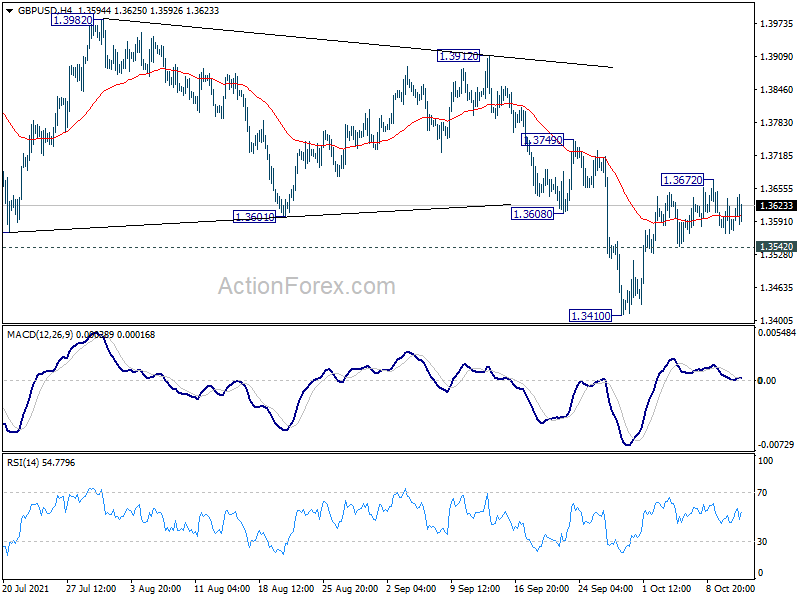
Intraday bias in GBP/USD remains neutral as sideway trading continues. On the downside, break of 1.3542 minor support will suggest that rebound from 1.3410 has completed, and fall from 1.4248 is ready to resume. Intraday bias will be turned back to the downside for 1.3410 and below. On the upside, though, above 1.3672 will resume the rebound to 55 day EMA (now at 1.3717) first.
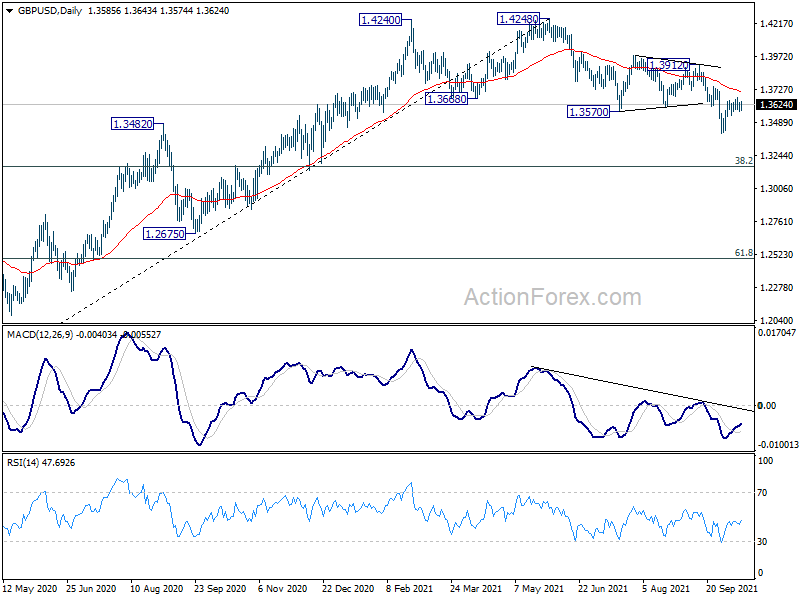
In the bigger picture, fall from 1.4248 is at least a correction to the up trend from 1.1409 (2020 low). Such correction could extend to 38.2% retracement of 1.1409 to 1.4248 at 1.3164 before completion. However, considering the rejection by 1.4376 key resistance (2018 high), sustained trading below 1.3164 will argue that it's indeed a bearish trend reversal and would target 61.8% retracement at 1.2493. Nevertheless, break of 1.3912 resistance will revive medium term bullishness and target 1.4248/4376 resistance zone again.
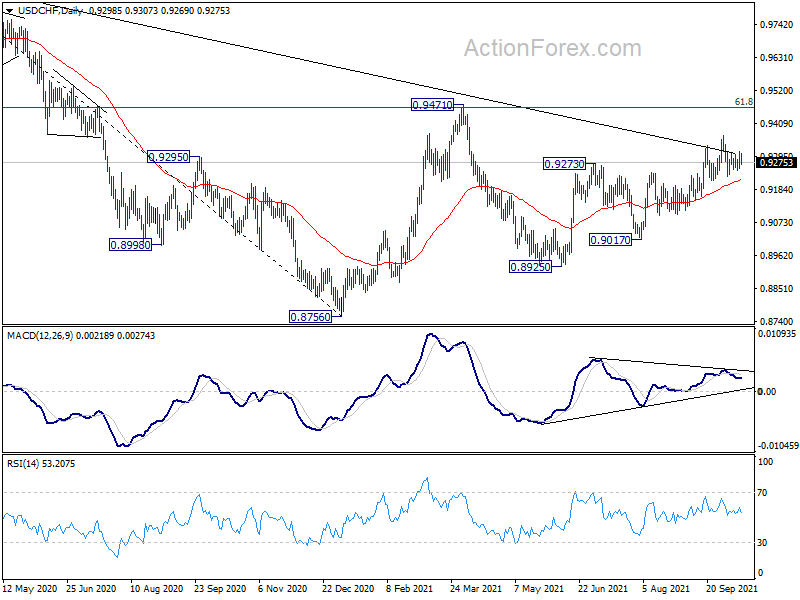
USD/CHF Mid-Day Outlook
Daily Pivots: (S1) 0.9272; (P) 0.9292; (R1) 0.9328; More....
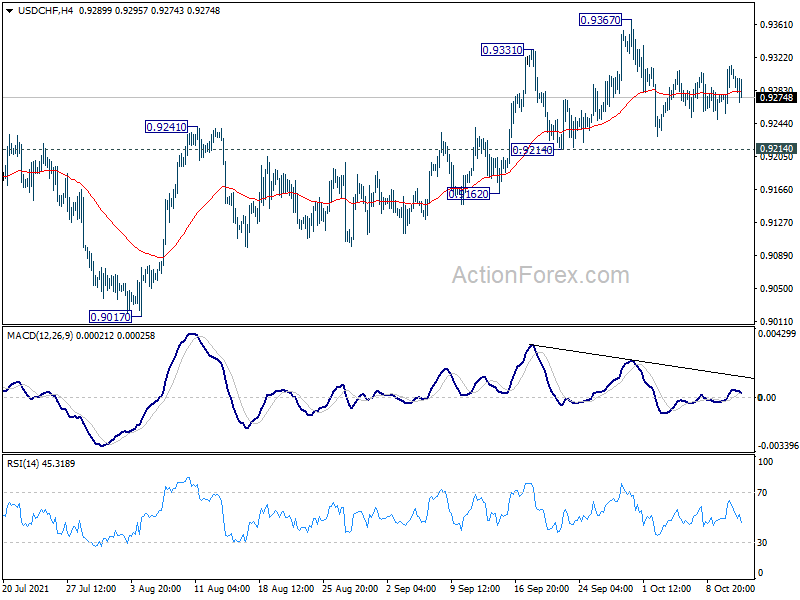
USD/CHF's consolidation from 0.9367 is still in progress and intraday bias remains neutral first. On the upside, break of 0.9367 will resume the rise from 0.8925 to 0.9471 key resistance next. On the downside, however, break of 0.9214 will turn bias back to the downside for 0.9017 support again.
In the bigger picture, the strong rally above 55 week EMA (now at 0.9188) now tilts favor to the case of bullish trend reversal. That is, decline from 1.3042 (2016 high) is probably completed at 0.8756 already. Sustained break of 0.9471 resistance should confirm this case and pave the way to retest 1.0342 ahead. However, rejection by 0.9471 will mix up the outlook again and retain some medium term bearishness.
USD/JPY Mid-Day Outlook
Daily Pivots: (S1) 113.15; (P) 113.47; (R1) 113.93; More...
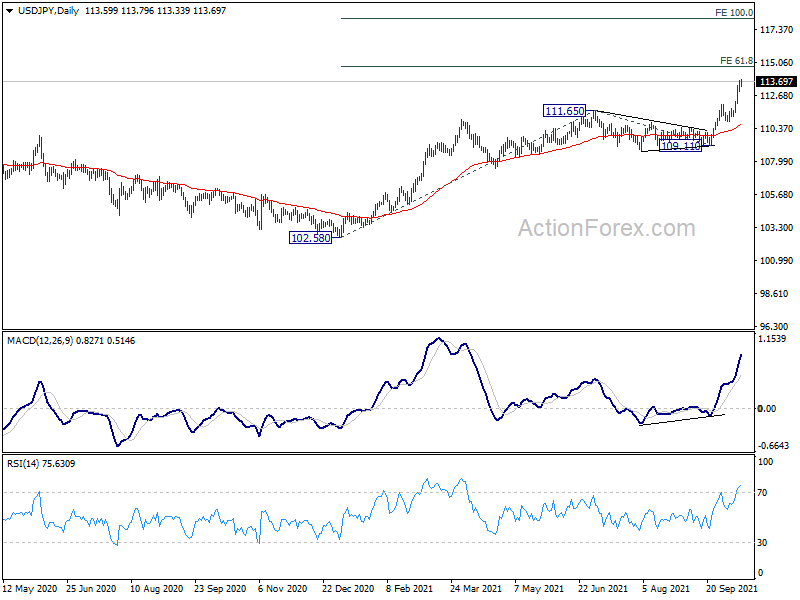
Intraday bias in USD/JPY is back on the upside as it's trying to resume recent rally after brief retreat. The up trend from 102.58 should target 61.8% projection of 102.58 to 111.65 from 109.11 at 114.71. Firm break there will target 100% projection at 118.18 next. On the downside, break of 112.99 minor support will turn intraday bias neutral and bring consolidations again. But strong support should be seen above 112.07 to bring rise resumption.
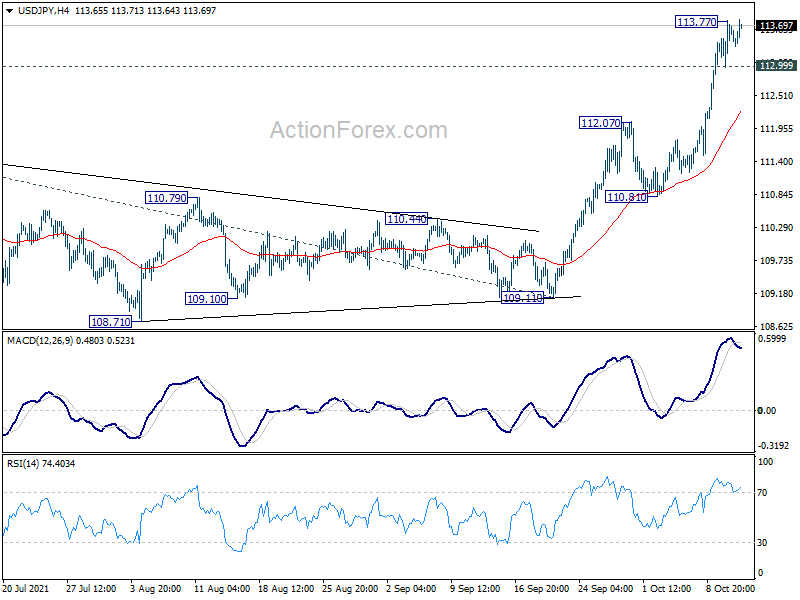
In the bigger picture, corrective decline from 118.65 (2016 high) should have completed at 101.18 already. Rise from the 102.58 is seen as the third leg of the up trend from 101.18. Next target is 114.54 resistance and then 118.65 high. This will now be the preferred case as long as 108.71 support hold, even in case of pull back.