

Sample Category Title
Dollar Firms Up Slightly after CPI, But No Follow Through Buying Yet
Dollar firms up mildly in early US session as headline CPI was back at multi-decade high, which core CPI remains stubbornly strong. The gain in the greenback is so far limited. Overall markets continue to trade in consolidative mode, with mild weakness seen in commodity currencies while Swiss Franc and Euro are rebounding. Next focus is FOMC minutes, but they are unlikely to unveil anything spectacular, other than that Fed is ready to start tapering by the end of the year.
Technically, as Dollar is trying to recover, we'll look at 1.3542 minor support in GBP/USD and 0.7287 minor support in AUD/USD. Break of these level could be a sign that Dollar buying is back. If that happens, we'd also have to seen if EUR/USD would reaccelerate down, while USD/JPY reaccelerates up, to confirm.
In Europe, at the time of writing, FTSE is down -0.03%. DAX is up 0.56%. CAC is up 0.28%. Germany 10-year yield is down -0.032 at -0.114. Earlier in Asia, Nikkei dropped -0.32%. China Shanghai SSE rose 0.42%. Singapore Strait Times rose 1.43%. Japan 10-year JGB yield dropped -0.0060 to 0.090.
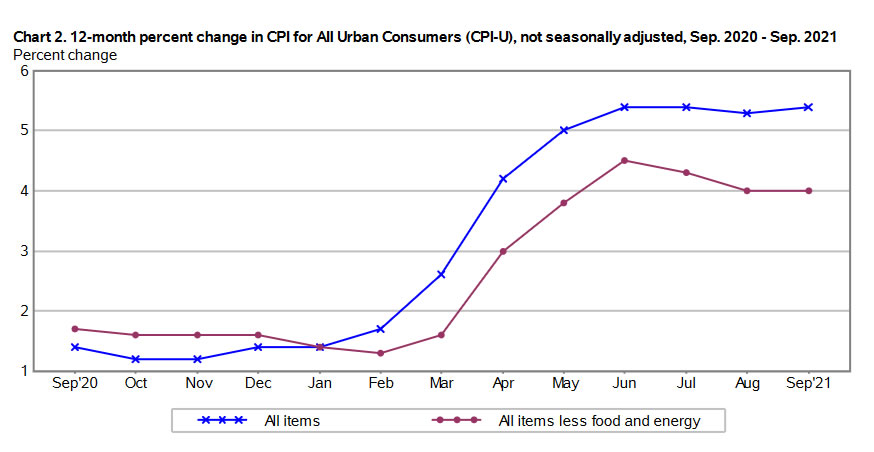
US CPI ticked up to 5.4% yoy in Sep, CPI core unchanged at 4.0% yoy
US CPI rose 0.4% mom in September, above expectation of 0.3% mom. CPI core rose 0.2% mom, matched expectations. For the 12-month period, CPI ticked up to 5.4% yoy, above expectation of 5.3% yoy. It's back at the highest level since January 1991. CPI core was unchanged at 4.0% yoy, matched expectations.
Eurozone industrial production dropped -1.6% mom in Aug, EU down -1.5% mom
Eurozone industrial production dropped -1.6% mom in August, matched expectations. Production of capital goods fell by -3.9%, durable consumer goods by -3.4%, intermediate goods by -1.5% and non-durable consumer goods by -0.8%, while production of energy rose by 0.5%.
EU industrial production dropped -1.5% mom. Among Member States for which data are available, the largest monthly decreases were registered in Malta (-6.3%), Germany and Estonia (both -4.1%) and Slovakia (-3.8%). The highest increases were observed in Denmark (+3.5%), Lithuania (+2.9%) and Luxembourg (+2.1%).
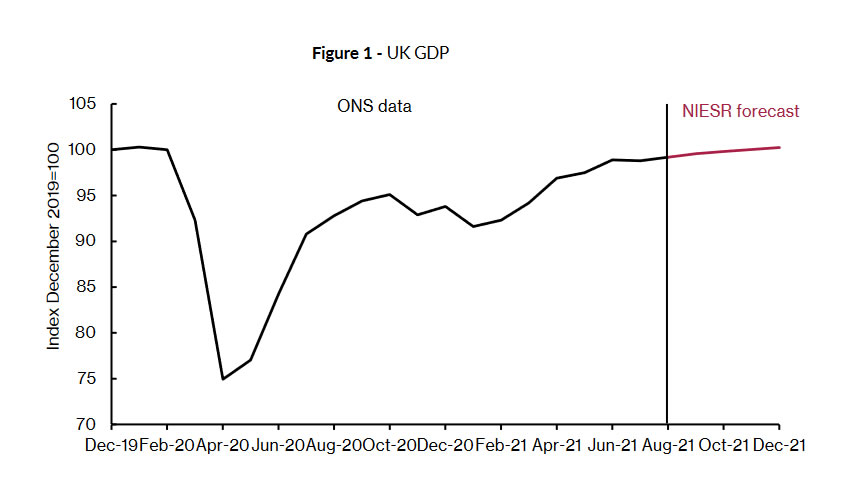
NIESR expects UK GDP to grow 1.5% in Q3, 0.8% in Q4
NIESR said supply constraints are growing and likely to persist through in Autumn. It forecasts UK GDP to grow 1.5% in Q3, followed by 0.8% in Q4. That included an estimated 0.4% mom growth in GDP in September.
Rory Macqueen Principal Economist, NIESR: "The reopening of the economy continued to support growth in August, with the popularity of domestic holidays contributing to 23 per cent month-on-month growth for hotels and campsites in particular. The fact that consumer-facing services remain 5 per cent below their peak suggests ample room for future catch-up in future too. Elsewhere a further fall in construction output may have been down in part to a reported increase in input costs: something likely to affect the economy more broadly if shortages lead to more generalised price rises over the autumn. The coming months could see something of a two-speed recovery, with sectors most affected by shortages in decline while others continue to recover."
UK GDP grew 0.4% mom in Aug, still -0.8% below pre-pandemic level
UK GDP grew 0.4% mom in August, slightly below expectation of 0.5% mom. Services grew 0.3%. Production rose 0.8% mom. Construction contracted by -0.2% mom. In the three months to August, GDP grew 2.9% 3mo3m, mainly due to the performance of services, largely reflects gradual reopening.
Comparing to pre-pandemic levels in February 2020, overall GDP was still down -0.8%. Services was down -0.6%. Production was down -1.3%. Manufacturing was down -2.4%. Construction was down -1.5%.
Also from the UK, goods trade deficit widened to GDP -14.9B in August, versus expectation of GBP -11.9B.
Australia Westpac consumer sentiment dropped to 104.6, still more optimists
Australia Westpac-Melbourne Institute consumer sentiment dropped -1.5% to 104.6 in October, down from September's 106.2. There continued to be a clear majority of optimists nationally, even at state level - NSW (103.4); Victoria (105.4); Queensland (105.3) and Western Australia (105.4).
Westpac expects RBA to "almost certainly maintain its policy settings" at November 2 meeting. Instead, the next change is likely to be another round of tapering in February. Looking forward, Westpac expects a rate hike in Q2 of 2023, while RBA has repeated said the conditions of hike won't be met until 2024.
New Zealand ANZ business confidence dropped slightly to -8.6 in Oct
New Zealand ANZ business confidence dropped slightly to -8.6 in October's preliminary reading, down from September's -7.2. Own activity outlook rose strongly from 18.2 to 26.2. Export intentions rose from 7.4 to 9.2. Investment intentions rose from 9.2 to 14.3. Employment intentions dropped from 14.1 to 12.1. Cost expectations rose form 84.2 to 84.9. Inflation expectations also ticked up from 3.02% to 3.04%.
ANZ said the survey is telling a story of "remarkable resilience", with most forward-looking activity indicators holding up or improving. Inflation pressures remain "intense" and cost pressures are "extreme".
USD/JPY Mid-Day Outlook
Daily Pivots: (S1) 113.15; (P) 113.47; (R1) 113.93; More...
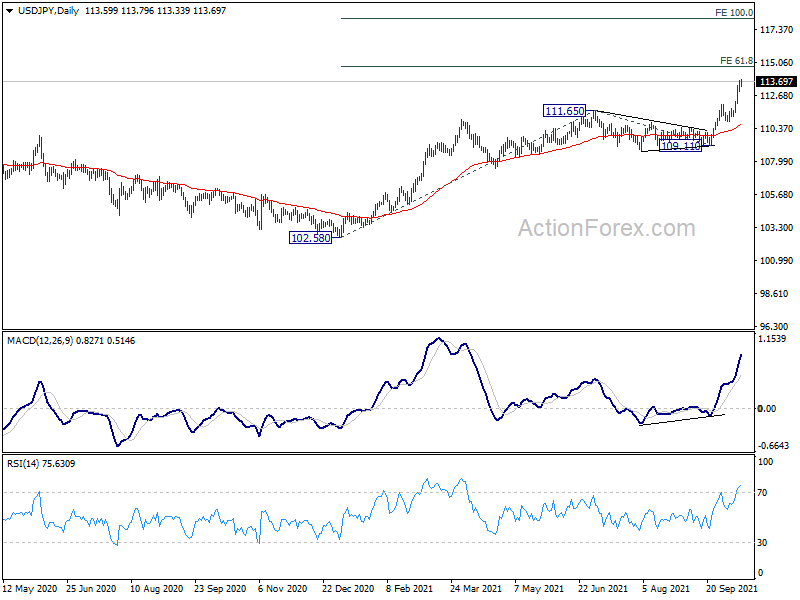
Intraday bias in USD/JPY is back on the upside as it's trying to resume recent rally after brief retreat. The up trend from 102.58 should target 61.8% projection of 102.58 to 111.65 from 109.11 at 114.71. Firm break there will target 100% projection at 118.18 next. On the downside, break of 112.99 minor support will turn intraday bias neutral and bring consolidations again. But strong support should be seen above 112.07 to bring rise resumption.
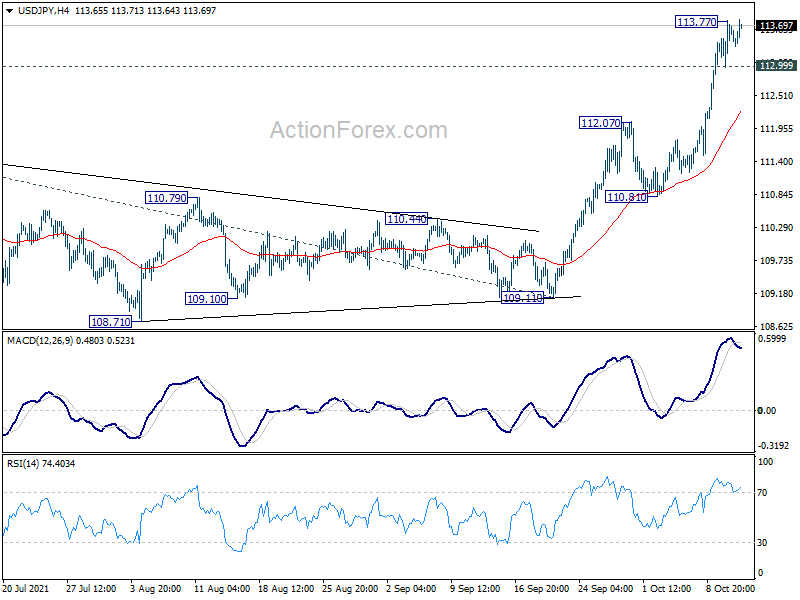
In the bigger picture, corrective decline from 118.65 (2016 high) should have completed at 101.18 already. Rise from the 102.58 is seen as the third leg of the up trend from 101.18. Next target is 114.54 resistance and then 118.65 high. This will now be the preferred case as long as 108.71 support hold, even in case of pull back.
Economic Indicators Update
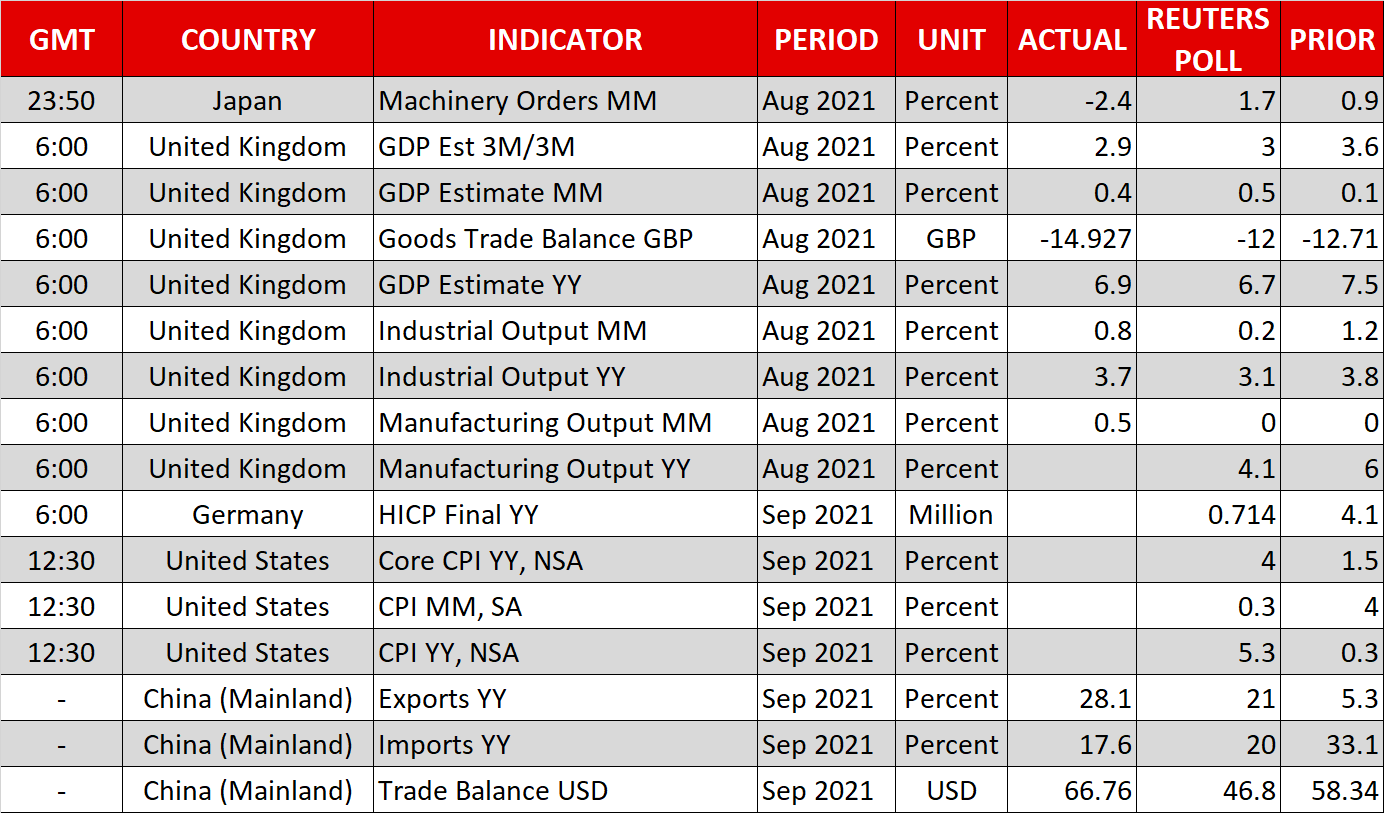
| GMT | Ccy | Events | Actual | Forecast | Previous | Revised |
|---|---|---|---|---|---|---|
| 23:30 | AUD | Westpac Consumer Confidence Oct | -1.50% | 2.00% | ||
| 23:50 | JPY | Money Supply M2+CD Y/Y Sep | 4.20% | 4.20% | 4.70% | |
| 23:50 | JPY | Machinery Orders M/M Aug | -2.40% | 1.60% | 0.90% | |
| 03:00 | CNY | Trade Balance (USD) Sep | 66.8B | 47.2B | 58.3B | |
| 03:00 | CNY | Exports (USD) Y/Y Sep | 28.10% | 21.50% | 25.60% | |
| 03:00 | CNY | Imports (USD) Y/Y Sep | 17.60% | 19.20% | 33.10% | |
| 03:00 | CNY | Trade Balance (CNY) Sep | 433B | 323B | 376B | |
| 03:00 | CNY | Exports (CNY) Y/Y Sep | 19.90% | 17.10% | 15.70% | |
| 03:00 | CNY | Imports (CNY) Y/Y Sep | 10.10% | 22.30% | 23.10% | |
| 06:00 | EUR | Germany CPI M/M Sep F | 0.00% | 0.00% | 0.00% | |
| 06:00 | EUR | Germany CPI Y/Y Sep F | 4.10% | 4.10% | 4.10% | |
| 06:00 | GBP | GDP M/M Aug | 0.40% | 0.50% | 0.10% | -0.10% |
| 06:00 | GBP | Industrial Production M/M Aug | 0.80% | 0.40% | 1.20% | 0.30% |
| 06:00 | GBP | Industrial Production Y/Y Aug | 3.70% | 3.00% | 3.80% | 4.40% |
| 06:00 | GBP | Manufacturing Production M/M Aug | 0.50% | 0.00% | 0.00% | -0.60% |
| 06:00 | GBP | Manufacturing Production Y/Y Aug | 4.10% | 6.00% | 6.00% | 6.10% |
| 06:00 | GBP | Goods Trade Balance (GBP) Aug | -14.9B | -11.9B | -12.7B | |
| 09:00 | EUR | Eurozone Industrial Production M/M Aug | -1.60% | -1.60% | 1.50% | -1.40% |
| 12:30 | USD | CPI M/M Sep | 0.40% | 0.30% | 0.30% | |
| 12:30 | USD | CPI Y/Y Sep | 5.40% | 5.30% | 5.30% | |
| 12:30 | USD | CPI Core M/M Sep | 0.20% | 0.20% | 0.10% | |
| 12:30 | USD | CPI Core Y/Y Sep | 4.00% | 4.00% | 4.00% | |
| 18:00 | USD | FOMC Minutes |
NIESR expects UK GDP to grow 1.5% in Q3, 0.8% in Q4
NIESR said supply constraints are growing and likely to persist through in Autumn. It forecasts UK GDP to grow 1.5% in Q3, followed by 0.8% in Q4. That included an estimated 0.4% mom growth in GDP in September.
Rory Macqueen Principal Economist, NIESR: "The reopening of the economy continued to support growth in August, with the popularity of domestic holidays contributing to 23 per cent month-on-month growth for hotels and campsites in particular. The fact that consumer-facing services remain 5 per cent below their peak suggests ample room for future catch-up in future too. Elsewhere a further fall in construction output may have been down in part to a reported increase in input costs: something likely to affect the economy more broadly if shortages lead to more generalised price rises over the autumn. The coming months could see something of a two-speed recovery, with sectors most affected by shortages in decline while others continue to recover."
US CPI ticked up to 5.4% yoy in Sep, CPI core unchanged at 4.0% yoy
US CPI rose 0.4% mom in September, above expectation of 0.3% mom. CPI core rose 0.2% mom, matched expectations. For the 12-month period, CPI ticked up to 5.4% yoy, above expectation of 5.3% yoy. It's back at the highest level since January 1991. CPI core was unchanged at 4.0% yoy, matched expectations.
Bitcoin – Bullish Momentum Remains
Profit-taking possible in the near-term
Bitcoin has been on an incredible run recently, one that may not come as a surprise to some, but that also begs the question, how much further can it go?
It has run into some resistance on approach to $60,000, a notable psychological resistance level and one that falls just ahead of the all-time high. So it’s not surprising that we’re seeing some resistance around these levels.
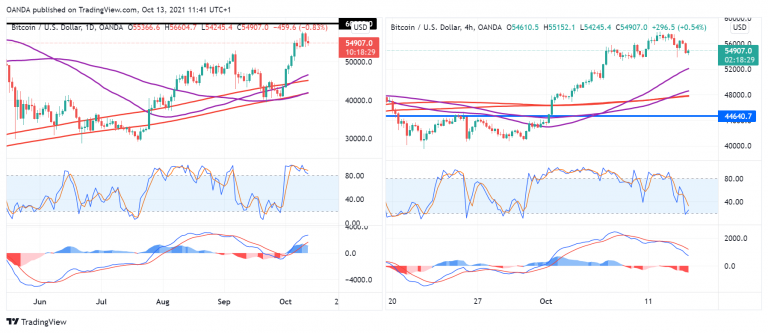
And while it may have plenty of momentum longer-term, near term indicators suggest it may be running a little thin. Perhaps the psychological barrier is proving a big test.
Even if it runs into resistance here, the daily chart suggests there’s plenty of momentum in the rally so a test of the record highs may not be far away and after that, it will get a lot more interesting.
A move below $53,500 may trigger a larger correction in the near term but given the recent trend, support may not be that far away, with the first real test then coming around $50,000.
AUD/USD Is Bullish As The US CPI Is In Focus
AUD/USD technical analysis
- AUD/USD is bullish on H1 timeframe.
- The price needs further bullish momentum.
- Bulls need to keep the price above the D L3 pivot.
- Potential move down only below the D L3 camarilla.
H1 chart AUD/USD
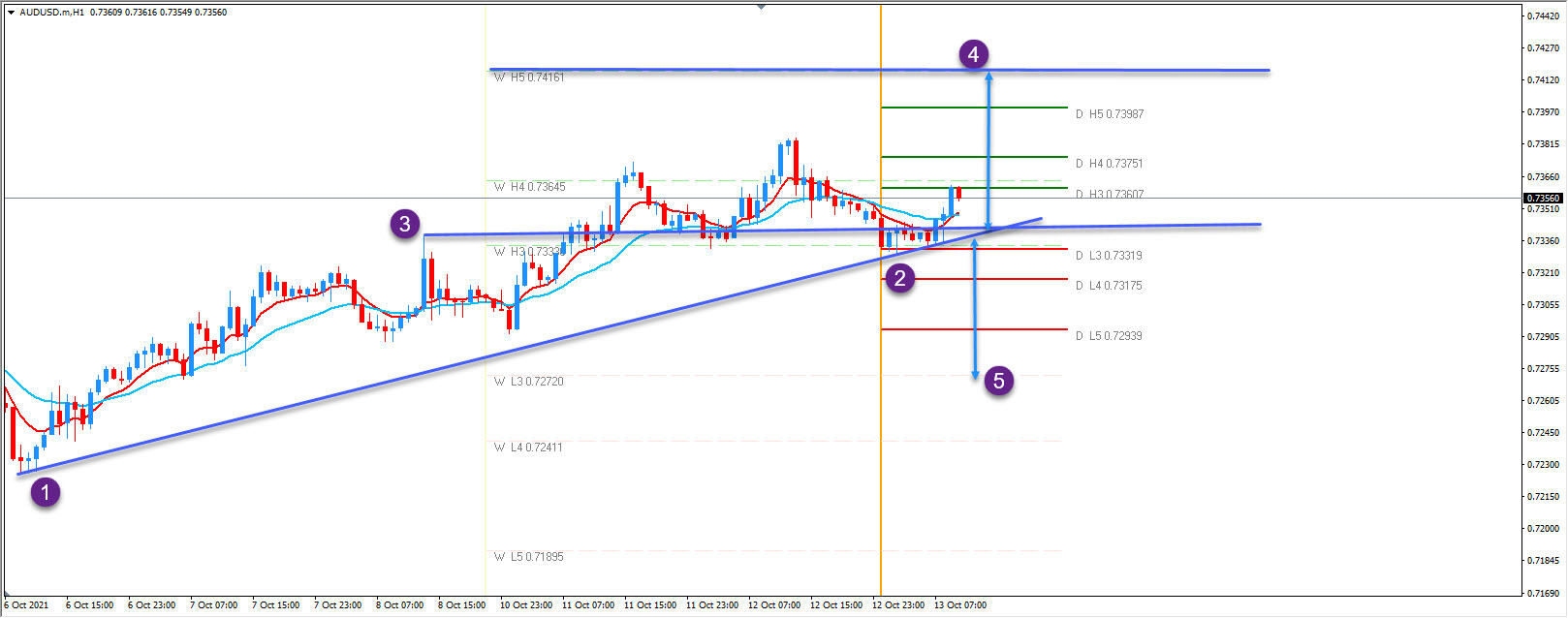
- Ascending trendline.
- Consolidation.
- Order block.
- Bullish target.
- Bearish target.
The price is bullish with a big potential to proceed further up. If the market remains positive with momentum we could see a move up. 0.7350 zone is where the price should bounce from. Have in mind that the daily timeframe also turned bullish but we have the US CPI data. The CPI might determine the short term direction on the AUD/USD. The price above 0.7350 is bullish and it is targeting 0.7415. The price below 0.7330 is bearish and will be targeting 0.7272. This is the intraday setup and prediction for the AUD/USD.
Quiet Session Ahead Of US CPI Data And EU Planned Brexit Concessions
Notes/Observations
- UK Monthly GDP data saw the economy grew less than expected in August as consumers reined in spending.
- German Sept Final CPI unrevised but confirmed the highest annual pace since 1993.
- China’s credit growth slowed as weakness in the property market amid the Evergrande crisis.
- Awaiting the US Sept CPI reading and Sept FOMC Minutes later in today’s session.
Asia
- China Sept Trade Balance: $66.8B v $46.6Be; Exports Y/Y: 28.1% v 21.5%e; Imports Y/Y: 17.6% v 20.7%e.
- China PBOC seen cutting the RRR rate during Q4. Could also conduct 'large' MLF and reverse repo operations.
- South Korea Aug Unemployment Rate: 3.0% v 3.0%e.
- Taiwan Defense Ministry warned that it would issue tougher response to China if military jet flights got 'too close'.
Europe
- UK Brexit Min Frost stated that the govt would not invoke Article 16 'gratuitously'; Prefered 'quick and intensive' discussions over next 2-3 weeks on a new protocol that allows goods to flow freely. If Article 16 was triggered it would be up to the EU whether or not it retaliated. Revised deal would be acceptable only if the EU removed Northern Ireland from the jurisdiction of the European Court of Justice.
- European Union prepared to eliminate most post-Brexit checks on UK goods to Northern Ireland.
Americas
- House passed Bill to increase the country’s debt limit until at least Dec 3rd (vote 219-206 and along party lines).
- Fed's Quarles to no longer be chair of Supervision and Regulation committee when term expires on Oct 13th, committee to meet on un-chaired basis (Note: US President Biden has yet to select a replacement for Quarles).
- Fed's Bostic (FOMC voter, hawk): Inflation was likely to remain above 2% going forward; Pandemic-induced price swings would eventually unwind by themselves without necessarily threatening longer-run price stability. Not seeing signs that current inflation was doing the kind of harm to the economy that would call the Fed's policy stance into question.
- Fed's Barkin (FOMC voter, hawk) reiterated that prices were being pushed higher by shortages.
- Apple [AAPL] said to be looking to cut its projected iPhone13 production targets for 2021 by as many as 10M units citing semiconductor chip shortage.
Speakers/Fixed income/FX/Commodities/Erratum
Equities
- Indices [Stoxx600 +0.39% at 458.98, FTSE -0.27% at 7,110.84, DAX +0.59% at 15,236.75, CAC-40 +0.10% at 6,554.74, IBEX-35 -0.41% at 8,899.50, FTSE MIB -0.09% at 25,967.00, SMI +0.65% at 11,762.43, S&P 500 Futures +0.16%].
- Market Focal Points/Key Themes: European indices open modestly lower across the board but later reversed to trade mixed as the session progressed; sectors leading to the upside include technology and industrials; while consumer discretionary and materials sectors among the laggards; luxury brands supported following LVMH’s earnings overnight; tech sector supported following SAP’s trading update; Spie withdraws from EQUANS bidding; Fastighets Balder raises take in Entra; earnings in the upcoming US session include Blackrock, Delta Airlines and JP Morgan.
Equities
- Consumer discretionary: LVMH [MC.FR] +1.5% (earnings), Just Eat Takeaway.com [JET.UK] -4% (trading update).
- Industrials: Volkswagen [VOW3.DE] +2.5% (job cuts risk; units listing), Barratt Developments [BDEV.UK] +5% (trading update), Infineon [IFX.DE] +1%, AMS [AMS.CH] -1% (Apple rumour on production cut).
- Technology: SAP [SAP.DE] +5% (raises outlook), Darktrace [DARK.UK] +1% (trading update).
Speakers
- Slovakia Prosecutor's office confirmed ECB's Kazimir (Slovakia) charged with corruption.
- Czech Central Banker Benda (hawk) stated that the latest inflation data suggested CNB currently needed relatively rapid rate hikes.
- Japan PM Kishida said not to be planning visit to Yasukuni war shrine (**Note: The prospect that any such visits would trigger fierce criticism from neighboring countries).
- Global Times' Editorial article noted that hope of a peaceful solution to the Taiwan question was declining sharply; Future of the Taiwan Straits situation unlikely to remain peaceful.
- Iraq Oil Min Jabbar stated that oil prices were unlikely to rise further.
- Russia Dep Energy Min Sorokin stated that Russia could increase oil production in line with OPEC+ without problem.
- Russia govt official stated that there could be no gas supplies beyond contractual obligations.
- IEA chief Birol stated that the economic recovery was unsustainable due to fossil fuel demand. Energy transition was not to blame for current high prices.
Currencies/Fixed Income
- USD was slightly softer in quiet trading on Wed but remain near 1-year highs against major pairs. Market participants awaiting the US Sept CPI reading and Sept FOMC Minutes later in today’s session. Expectations remain that the Fed would announce a tapering of stimulus next month.
- EUR/USD steady at 1.1550 area. German CPI reading confirmed the annual pace at the highest level since the 1993 German unification. ECB speak still sees the situation as transitory.
- GBP/USD staying above the 1.36 level. UK Monthly GDP data registered growth as it weathered the surge in Delta virus cases better than feared. Dealers noted that the recovery was nevertheless slowing. Various analysts have brought forward their call for a BOE rate hike into Dec but some believe BoE would wait until 2022 before hiking. Brexit remains in focus as the EU will present its counter-proposal on Northern Ireland Protocol.
USD/JPY remains near 3-year highs as rate differentials favored the greenback . Pair at 113.50 by mid-session.
Economic data
- (FI) Finland Aug Current Account Balance: €0.4B v €0.6B prior.
- (DE) Germany Sept Final CPI M/M: 0.0% v 0.0%e; Y/Y: 4.1% v 4.1%e (highest annual pace since 1993).
- (DE) Germany Sept Final CPI EU Harmonized M/M: 0.3% v 0.3%e; Y/Y: 4.1% v 4.1%e.
- (UK) Aug GDP M/M: 0.4% v 0.5%e; GDP 3M/3M: 2.9% v 3.0%e.
- (UK) Aug Industrial Production M/M: 0.8% v 0.2%e; Y/Y: 3.7% v 3.3%e.
- (UK) Aug Manufacturing Production M/M: 0.5% v 0.0%e; Y/Y: 4.1% v 4.1%e.
- (UK) Aug Construction Output M/M: -0.2% v +0.4%e; Y/Y: 10.1% v 5.7%e.
- (UK) Aug Index of Services M/M: 0.3% v 0.6%e; 3M/3M: 3.7% v 3.8%e.
- (UK) Aug Visible Trade Balance: -£14.9B v -£12.0Be; Overall Trade Balance: -£3.7B v -£2.8Be; Trade Balance Non EU: -£8.4B v -£8.1B prior.
- (EU) Euro Zone Aug Industrial Production M/M: -1.6% v -1.7%e; Y/Y: 5.1% v 4.7%e.
- (GR) Greece Aug Unemployment Rate: 13.9% v 14.2% prior.
- (CN) China Sept New Yuan Loans (CNY): 1.66T v 1.810Te.
- (CN) China Sept Aggregate Financing (CNY): 2.900T v 3.05Te.
- (CN) China Sept M2 Money Supply Y/Y: 8.3% v 8.2%e.
Fixed income Issuance
- (IN) India sold total INR200B vs.INR200B indicated in 3-month, 6-month and 12-month bills.
- (DK) Denmark sold total DKK4.12B in 3-month, 6-month, 9-month and 12-month Bills (**Note: only accepted bids in 6-months; rejected all others).
- (SE) Sweden sold SEK7.5B vs. SEK7.5B indicated in 3-month bills; Avg Yield: -0.3985% v -0.3491% prior; bid-to-cover: 1.84x v 6.15x prior.
- (NO) Norway sold NOK2.0B vs. NOK2.0B indicated in 1.5% Feb 2026 Bonds; Avg Yield: 1.45% v 1.11% prior; Bid-to-cover: 4.22x v 2.27x prior.
- (UK) DMO sold£500M in 0.125% Mar 2051 Inflation-linked Gilts (UKTi); Real Yield: -2.261% v -2.163% prior; bid-to-cover: 2.37x v 2.41x prior.
- (IT) Italy Debt Agency (Tesoro) sold total €6.5B vs. €5.0-6.5B indicated range in 3-year, 7-year and 30-year BTP bonds.
- Sold €3.0B vs. €2.5-3.0B indicated range in 0.0% Jan 2024 BTP; Avg Yield: -0.19% v -0.32% prior; bid-to-cover: 1.45x v 1.58x prior.
- Sold €2.0B vs. €1.5-2.0B indicated range in 0.50% July 2028 BTP; Avg Yield: 0.48% v 0.32% prior; bid-to-cover: 1.65x v 1.58x prior.
- Sold €1.5B vs. €1.0-1.5B indicated range in 1.70% Sept 2051 BTP bonds; Avg Yield: 1.82% v 1.69% prior; Bid-to-cover: 1.53x v 1.47x prior.
Looking Ahead
- 05:25 (EU) Daily ECB Liquidity Stats.
- 05:30 (DE) Germany to sell €1.0B in 0% Aug 2052 Bunds.
- 05:30 (ZA) South Africa announces details of next bond auction (held on Tuesdays).
- 06:00 (IL) Israel Sept Trade Balance: No est v -$3.4B prior.
- 06:00 (PT) Portugal Sept Final CPI M/M: No est v 0.9% prelim; Y/Y: No est v 1.5% prelim.
- 06:00 (PT) Portugal Sept Final CPI EU Harmonized M/M: No est v 0.9% prelim; Y/Y: No est v 1.3% prelim.
- 06:00 (CZ) Czech Republic to sell combined CZK13B in 2028, 2033 and 2036 bonds.
- 06:45 (US) Daily Libor Fixing.
- 07:00 (RU) Russia OFZ Bond auction (if any).
- 07:00 (US) MBA Mortgage Applications w/e Oct 8th: No est v -6.9% prior.
- 07:00 (ZA) South Africa Aug Retail Sales M/M: +9.5%e v -11.2% prior; Y/Y: +2.0%e v -0.8% prior.
- 07:00 (EU) EU Commission to present counter-proposal on Norther Ireland Protocol.
- 07:00 OPEC Monthly Report.
- 07:30 (CL) Chile Central Bank Economist Survey.
- 08:00 (UK) Daily Baltic Dry Bulk Index.
- 08:30 (US) Sept CPI M/M: 0.3%e v 0.3% prior; Y/Y: 5.3%e v 5.3% prior.
- 08:30 (US) Sept CPI (ex-food/energy) M/M: 0.2%e v 0.1% prior; Y/Y: 4.1%e v 4.0% prior.
- 08:30 (US) Sept CPI Index NSA: 274.172e v 273.567 prior; CPI Core Index SA: 280.008e v 279.338 prior.
- 08:30 (US) Sept Real Avg Hourly Earning Y/Y: No est v -0.9% prior; Weekly Earnings Y/Y: No est v -0.9% prior.
- 09:45 (UK) BOE to buy £1.147B in APF Gilt purchase operation (7-20 years).
- 10:30 (UK) BOE's Cunliffe.
- 13:00 (US) Treasury to sell 30-Year Bonds Reopening.
- 14:00 (US) FOMC Sept Minutes.
- 15:15 (IT) ECB’s Franco and Visco (Italy) hold G20 Finance press conference.
- 16:30 (US) Weekly API Crude Oil Inventories: M v +1.0M prior.
- 16:30 (US) Fed’s Brainard at Listens Event.
- 17:00 (CL) Chile Central Bank (BCCh) Interest Rate Decision: Expected to raise the Overnight Rate Target by 75bps to 2.25%.
- 17:00 (KR) South Korea Sept Import Price Index M/M: No est v 0.6% prior; Y/Y: No est v 21.6% prior.
- 17:00 (KR) South Korea Sept Export Price Index M/M: No est v 0.6% prior; Y/Y: No est v 18.6% prior.
- 18:00 (AU) RBA's Debelle at Conference.
- 19:01 (UK) Sept RICS House Price Balance: 70%e v 73% prior.
- 19:30 (AU) Australia to sell combined A$2.0B in 3-month and 6-month Bills.
- 20:00 (AU) Australia Oct Consumer Inflation Expectation: No est v 4.4% prior.
- 20:00 (SG) Singapore Q3 Advance GDP Q/Q: +1.1%e v -1.8% prior; Y/Y: 6.7%e v 14.7% prior.
- 20:00 (SG) Singapore Monetary Authority (MAS) Bi-annual Monetary Policy Statement.
- 20:00 (US) Fed’s Bowman on economy and monetary policy.
- 20:30 (AU) Australia Sept Net Employment Change: -110.0Ke v -146.3K prior; Unemployment Rate: 4.8%e v 4.5% prior; Full Time Employment Change: No est v.
- 68.0K prior; Part Time Employment Change: No est v -78.2K prior; Participation Rate: 64.7%e v 65.2% prior.
- 21:30 (CN) China Sept CPI Y/Y: 0.8%e v 0.8% prior; PPI Y/Y: 10.5%e v 9.5% prior.
- 22:00 (SL) Sri Lanka Central Bank (CBSL) Interest Rate Decision: Standing Lending Rate current ly at 6.00%; Standing Deposit Rate currently at 5.00%.
- 23:35 (JP) Japan to sell 5-Year JGB Bonds.
The Dollar Index Hit A Year High, The Focus Today Is On Inflation Data And The Publication Of FOMC...
The US stock market declined on Tuesday. At the close of the stock market, the Dow Jones index decreased by 0.34%, the S&P 500 index decreased by 0.24%, and the NASDAQ Composite lost 0.14%. US Fed officials Bullard, Bostick, and Brainard believe the labor market has achieved the necessary growth to allow the central bank to cut its $120 billion a month asset purchase program. Therefore, it would be right to start cutting the QE program in November. The longer supply chain problems persist, the more likely inflation expectations will change. However, inflation is likely to stay longer than predicted.
Southwest Airlines again canceled more than 350 flights yesterday. The cancellations accounted for 10% of Southwest's schedule, and at least 1,400 other flights (40%) were delayed. Apple is likely to cut its projected iPhone 13 production targets for 2021 by 10 million units due to chip shortage issues.
Moderna has no plans to share its COVID-19 vaccine formula, Chairman Noubar Afeyan said. Moderna executives have concluded that production extension is the best way to solve the problem of global supplies. The vaccine maker could expand production and deliver billions of additional doses next year.
European stock indices traded flat yesterday. Germany's DAX and France's CAC 40 each lost 0.3%, while Britain's FTSE 100 decreased by 0.2%. Spain's IBEX 35 and Italy's FTSE MIB added 0.4% and 0.2%, respectively. According to the ZEW Economic Institute, Europe is still struggling with constraints on supplies of raw materials and intermediate goods. Analysts at the institute forecast a drop in corporate earnings, especially in export-oriented industries such as automotive and chemicals/pharmaceuticals.
The price of gas in Europe decreased to $970 per thousand cubic meters. However, EU Energy Commissioner Simson said yesterday that gas prices were likely to remain high throughout the winter. Oil prices have stabilized slightly and traded in the $80-81 range for WTI crude.
The energy crisis reduced aluminum supplies, the price of which hit a 13-year high. Prices of other industrial metals are also rising because of inflationary pressures. Coal hit another price record in China as floods in the country exacerbated the energy crisis.
Asian stock indices traded without a single dynamic yesterday. China's CSI 300 has slightly changed from the previous day. Australia's ASX 200 added 0.06%, while Japan's Nikkei 225 lost 0.2%. The Hong Kong stock market was closed this morning due to a typhoon.
China's export growth accelerated in September, despite expectations of a slowdown amid a nationwide power shortage that forced factories to cut production.
China may ban all media not funded by the Communist Party in accordance with the new rules that are likely to restrict freedom of speech further. The government wants to ban private companies from broadcasting live anything related to politics, economics, military and foreign affairs, as well as major events or incidents in society, culture, technology, health care, education, and sports.
Main market quotes:
- S&P 500 (F) 4,350.65 −10.54 (−0.24%)
- Dow Jones 34,378.34 −117.72 (−0.34%)
- DAX 15,146.87 −52.27 (−0.34%)
- FTSE 100 7,130.23 −16.62 (−0.23%)
- USD Index 94.51 +0.20 (+0.21%)
Important events for today:
- UK GDP (m/m) at 09:00 (GMT+3);
- UK Manufacturing Production (m/m) at 09:00 (GMT+3);
- UK Industrial Production (m/m) at 09:00 (GMT+3);
- German Consumer Price Index (m/m) at 09:00 (GMT+3);
- Eurozone Industrial Production (m/m) at 12:00 (GMT+3);
- US Consumer Price Index (m/m) at 15:30 (GMT+3);
- US FOMC Meeting Minutes (m/m) at 21:00 (GMT+3);
- US FOMC Member Braindard’s Speech at 23:30 (GMT+3).
Dollar Turns To Inflation Data For More Fuel
- King dollar reigns supreme ahead of US inflation and Fed minutes
- Stock market bleeding continues as short-term yields fire up
- Earnings season kicks off, gold fights back, oil takes a breather
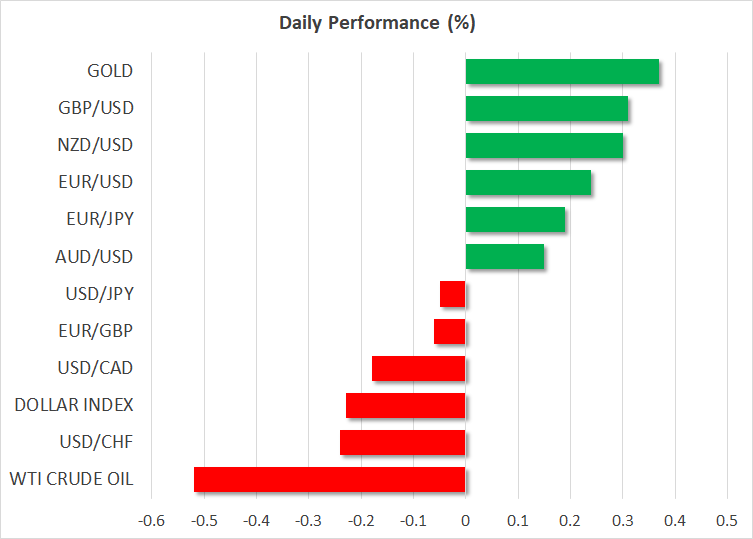
Dollar capitalizes on Fed bets
The main event today will be the release of CPI inflation numbers from America, a few hours before the minutes of the latest Fed meeting. Both the headline and core CPI rates are projected to have held steady in yearly terms, albeit at very elevated levels as the mayhem in supply chains continued to fuel inflationary forces.
Meanwhile, the minutes will provide some clarity about the length of the tapering process. Even more crucial will be the debate on whether inflation is transitory or persistent, as that will guide expectations around the timing of the first rate increase.
Investors are saying the transitory narrative is almost dead. With supply disruptions still raging and energy prices going bananas, US inflation expectations have stormed higher lately, cementing bets that the Fed will hike rates next year and turbocharging the dollar. Money markets are now pricing in almost a 50% probability for a rate increase by July.
The outlook for the dollar remains bright, especially against the euro and yen. The US economy is likely to escape the cataclysm in energy markets with only minor wounds thanks to its power independence and Congress could deliver another round of spending soon to juice up the recovery. A stronger US economy allows the Fed scope to raise rates to fight inflation, a luxury neither the ECB nor the BoJ can afford.
Stocks await earnings clarity
Wall Street closed a volatile session in the red yesterday as the Fed-driven spike in short-term yields played havoc with technology stocks. When markets price in faster Fed rate increases, names with stretched valuations usually get hit the hardest, and those are typically concentrated in the tech and growth sectors.
It has been a rocky few weeks for the major stock indices. Beyond rising yields, there are also concerns that a combination of slower growth but elevated inflation will eat into corporate profit margins until the supply mess finally gets sorted out. The technical picture has suffered heavy damage as well, with the S&P 500 recording lower highs and lower lows lately while trading below its 100-day moving average.
The earnings season is finally here and it will hopefully provide some clarity around how quickly businesses expect supply problems to ease. Delta Airlines, Blackrock, and JP Morgan will kick things off today, which might be good news for the market as the conversation focuses on the strength in consumption and an improving landscape for financials, instead of goods shortages and delivery delays.
Gold attempts a bounce, oil steadies
In the commodity complex, gold has displayed some remarkable resilience in recent sessions, absorbing a stronger dollar and the spike in yields without much trouble. Bullion’s fortunes will hang on any surprises in the US inflation numbers today. A disappointment that hammers yields and the dollar lower is needed to breathe life back into the yellow metal.
We are entering a period of seasonal strength for bullion that begins around November, so that may keep a floor under prices despite the broader outlook turning negative, with central banks quietly heading for the exits and the dollar slicing through its rivals.
Oil prices took a breather after reaching another seven-year high this week, benefiting from the insanity in natural gas and coal prices that has sent power producers scrambling for any cheaper alternatives. The EU sending a top official to Iran for talks may have calmed crude prices too.
Finally, China’s latest inflation data early on Thursday will reveal whether factory prices continued to surge amid the power shortages, enabling even more inflation to be exported abroad soon.
Aussie Flat Ahead Of Job Reports
The Australian dollar is in a holding pattern in Wednesday trading. Currently, AUD/USD is trading at 0.7356, down 0.10% on the day.
AUD eyes inflation, job data
The Australian dollar is treading in calm waters, but that could change later in the day, with the release of key numbers out of Australia and the US. First, the US releases inflation for September. Inflation fears are getting stronger, as CPI has hit a 30-year high. In August, headline CPI came in at 5.3% and core CPI at 4.0 (YoY).
Fed Chair Jerome Powell has long maintained that inflation is transitory, but unless inflation starts to ease soon, the markets will remain somewhat skeptical about this stance. If the September CPI numbers are a repeat or even higher than the August releases, I expect the US dollar to respond with gains.
Another highlight on today’s calendar is the Australian employment report. The August numbers were dismal, as the economy shed 140 thousand jobs, dashing expectations of around -80 thousand. If we don’t see a marked improvement in the today’s report, then the Aussie could take a dip.
Despite the prolonged lockdowns in Sydney and Melbourne, confidence remains high for both consumers and business. Westpac Consumer Consumer Sentiment fell to 104.6, down from 106.2 beforehand. Even with the drop, the reading points to a relatively high level of confidence. On the business side, The NAB Business Confidence report bounced back in impressive form in September, after two successive declines. The index accelerated to 13, up sharply from -6 points. The solid numbers can be attributed to the government’s plans to reopen and ease restrictions. As well, business confidence has been lifted by strong commodity prices, which have bolstered the country’s export sector.
Australia’s business sector is showing renewed optimism about the economy. The strong gain was driven by improved confidence after the states of New South Wales and Victoria announced reopening plans, as well as an increase in vaccination rates. As well, the surge in commodity prices has boosted the export sector and improved business confidence.
AUD/USD Technical
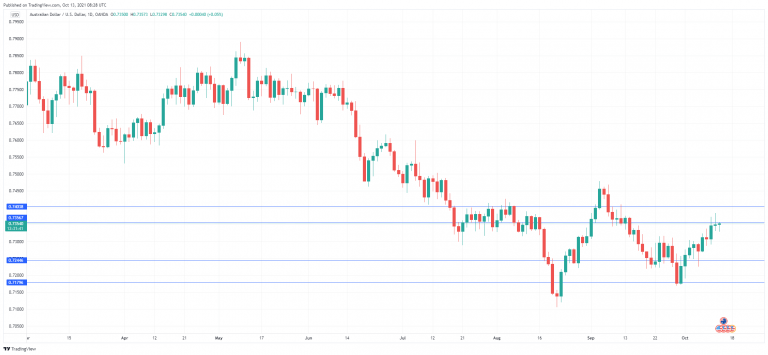
- The resistance line of 0.7356 is fluid. Next, there is resistance at 0.7403
- The pair has support at 0.7244. Below, there is support at 0.7179
Rising US Inflation Concerns Hang Over Risk Appetite
- US futures edging lower, Asian equities mixed.
- Higher-than-expected CPI could weaken ‘team transitory’.
- Dollar, gold, stocks exposed to shifting expectations for Fed’s next move.
- Risk-taking hampered by significant headwinds.
US futures and European equities are edging lower while Asian stocks are mixed ahead of the keenly awaited release of today’s US inflation data. The dollar and oil benchmarks are paring recent gains, while spot gold is adhering to its month-to-date range.
The September CPI will be keenly watched as it portends to the Fed’s next move after next month’s presumed tapering of bond purchases. Persistently intense inflationary pressures, which have already prompted Atlanta Fed President Raphael Bostic to label the term ‘transitory’ as a ‘dirty word’, might force the central bank’s collective hand into hiking interest rates sooner than expected. Fed funds futures have already priced in a rate hike by December 2022, while half of the FOMC have also penciled in such an event for next year.
Should today’s official CPI print force more of ‘team transitory’ to abandon such ‘dirty’ thoughts, that could assist 10-year US Treasury bond yields with reclaiming the 1.60% mark and pushing the dollar index to fresh year-to-date highs. More signs of stubborn inflation could also force bullion to break to the downside and force spot prices back into sub-$1750 domain. It would also weaken the floor below equity markets.
If the headline CPI figures come in lower than the 0.3% month-on-month and 5.3% year-on-year forecasts, that would likely offer only limited relief to gold bugs, knowing that the Fed is still intent on unwinding its asset purchases in due course.
Outlook more important than Q3 earnings
The US earnings season is imminent and investors are likely to place more emphasis on companies’ forward-looking rhetoric rather than last quarter’s actual results. C-suite commentary about the duration of supply-chain woes and inflation’s persistence, and how these will impact pricing power and margins might hold bigger sway over the market’s immediate moves rather than backward-looking earnings.
Risk assets on wobbly legs
Risk sentiment currently appears as though it is lurching from one major test to another. The bull market should’ve enjoyed some reprieve from the better-than-expected China export data as well as US lawmakers having staved off the threat of a government default, at least until mid-December. Yet risk assets didn’t dare rejoice, fully knowing that major headwinds are still there to be dealt with, from the global energy crisis to stagflation fears to looming Fed tapering and policy tightening.
Overall, global equities are exhibiting a much larger propensity for declines rather than gains in the immediate future, with investors and traders grappling with more causes to worry rather than to cheer.