

Sample Category Title
EUR/GBP Hovers Above Major Support
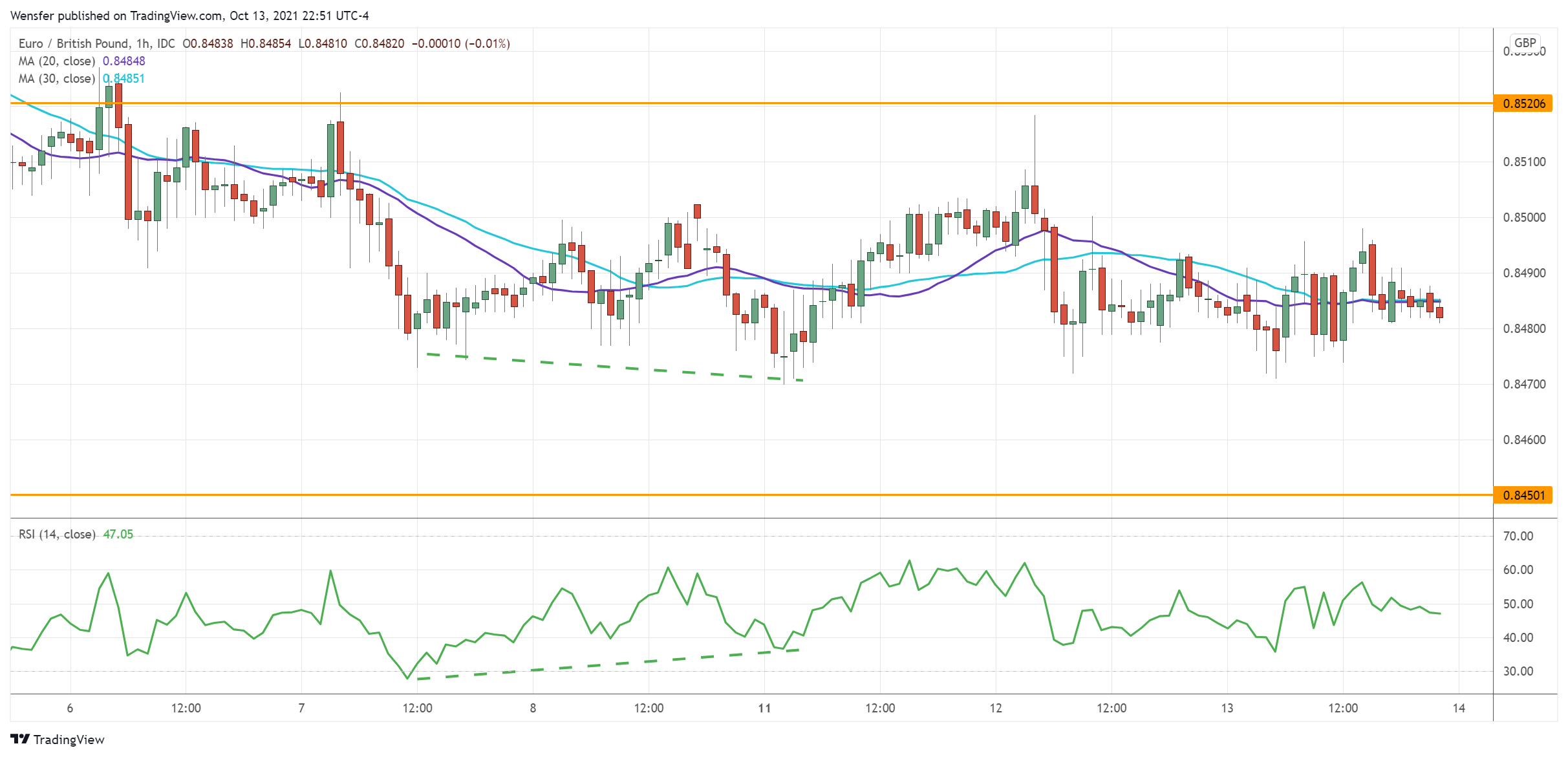
The pound inched higher after Britain’s GDP returned to positive territory in August. The euro, on the other hand, has fallen victim to the selling pressure after it broke below 0.8530.
Price action is heading to 0.8450, a daily support from the August rally. To the bulls’ relief, the RSI’s divergence shows a slowdown in the bearish impetus.
They will need to lift 0.8520 before they could attempt a reversal. Failing that, a breakout below the said floor would trigger an extended sell-off towards 0.8360.
AUD/USD Tests Key Resistance
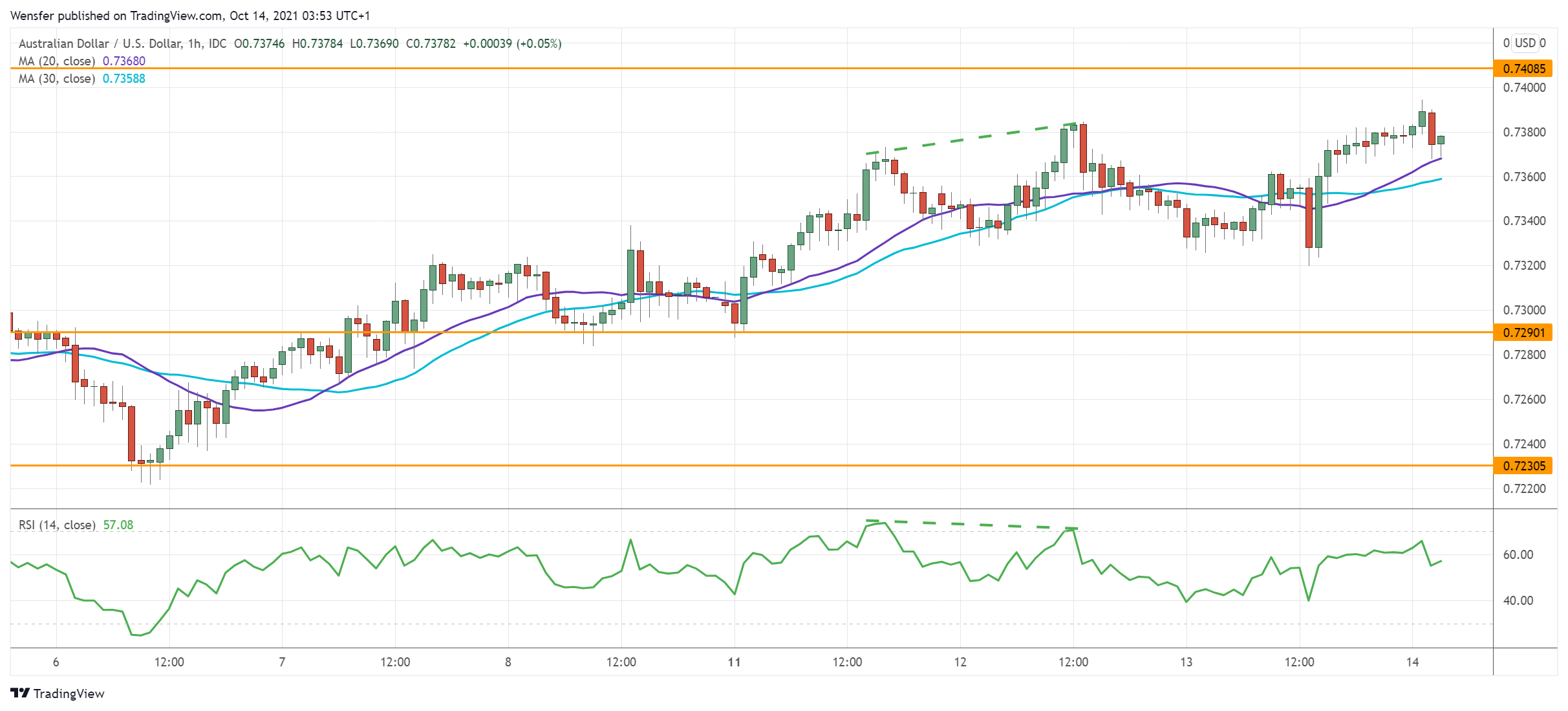
The Australian dollar rallied after the unemployment rate fell to 4.6% in September. The pair has met stiff selling pressure near 0.7480, a supply zone from the sell-off in early September.
The RSI’s double top in the overbought area and its bearish divergence are signs of exhaustion. This has led cautious buyers’ to take some chips off the table with a drop below 0.7335.
0.7290 would be the support to monitor in case of a pullback. On the upside, a greater high would pave the way for September’s peak at 0.7460.
USD/CHF Tests Short-Term Support
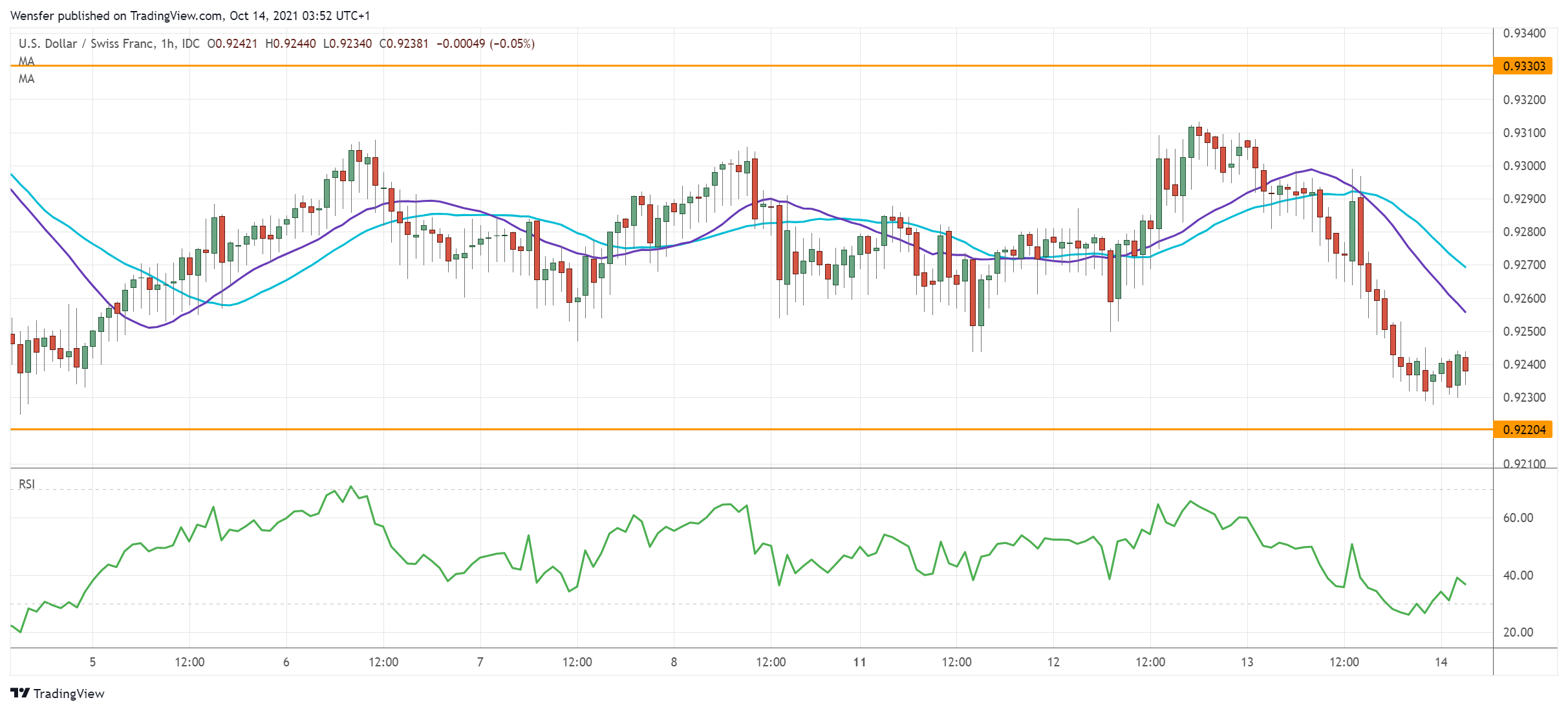
The US dollar eased after the FOMC minutes failed to pinpoint the first rate hike next year. The drop below 0.9280 was a sign of profit-taking after the RSI showed that the rally had overextended.
The pair has then found support along the 20-day moving average (0.9220). This is a major level for the bulls to keep the uptrend intact after a short-lived bounce revealed weakness.
A bearish breakout would send the pair to 0.9150. A rebound could propel the pair to 0.9400 if it succeeds in absorbing offers around 0.9330.
The Setback In Yields To Be Corrective/Temporary In Nature
Markets
Moves on the interest rate markets yesterday suggested that investors still have to navigate a complex of unsure, potentially conflicting, factors. The US curve continued Tuesday’s flattening trend. The US inflation data supported the move, but were not the trigger as the tone was already set before the publication of the data. US September CPI printed marginally higher than expected at 5.4 Y/Y for the headline and 4% Y/Y for core. US yields (both long and short-term) jumped briefly higher but at the end of the day, the 2y yield was up 2bps while the 30y yield declined 6.7 bps! The move at the long end of the cure was supported by a strong US 30y auction. Interestingly (and remarkably), the decline in long term yields was mainly driven by a sharp setback in real yields. Inflation expectations even rose slightly. Several interpretations are possible, but it might suggest that markets ponder a scenario where lower growth can make it difficult for the Fed to start a protracted rate hike cycle after finishing tapering. The Fed minutes indicated that the US central bank will almost certainly start reducing net asset purchases starting mid-November or mid-December at a monthly pace of $15bn (10bn Treasuries, 5 bn MBS). Contrary to Tuesday, European/German yields yesterday followed the broader (corrective?) flattening move with yields declining between 0.7 bps (2y) and 7.7 bps (30y). This halts the recent impressive uptrend in both the 10y German yield and the 10y EMU swap, but for now the technical picture isn’t fundamentally hurt. Equities rebounded on the setback in yields (S&P 0.30%, Nasdaq 0.73%). Despite higher US short-term yields, the dollar fell prey to modest profit taking. DXY closed at 94.08. EUR/USD finished near 1.159. USD/JPY closed near 113.25.
Most Asian markets this morning join the European/US risk rebound. China underperforms. Chinese price data painted a mixed picture with PPI accelerating to 10.7%, but CPI slowing slightly from 0.8% to 0.7%. The dollar remains in the defensive (eg. EUR/USD near 1.1590). Today’s eco calendar contains US jobless claims (expected to ease to 320k) and US PPI (expected to rise further). US (and to a lesser extent German) yields as indicated have to cope with conflicting considerations. Technical factors are probably also in play (German 10y yield nearing the post-corona top of -0.07%). Given the ongoing debate on inflation, we expect the setback in yields to be corrective/temporary in nature. The dollar failed to take out important resistance (DXY 94.47/74 area , EUR/USD 1.1495 area). The jury is still out, but a return of EUR/USD above the 1.1640/64 area would be a first indication that the EUR/USD downside momentum is easing. Is enough good (interest rate) news discounted for the USD currency?
News headlines
Australian employment again fell in September with 138 000 jobs after the 146.3k job loss the month before. The decline was unsurprising given the lockdowns in the two largest states of New South Wales and Victoria and in the nation’s capital. It was, however, more than the anticipated 110 000. Part-time jobs were shed (-164.7k) while fulltime employment recovered 26.7k from the 68k loss in August. Total employment has now fallen back below prepandemic levels, as did hours worked. The unemployment rate rose from 4.5% to 4.6%. That smaller-than-expected increase followed a below-consensus participation rate of 64.5% (down from 65.2%). The Aussie dollar dipped in the wake of the release before recovering back to near-intraday highs of AUD/USD 0.739.
The Turkish lira yesterday late finished with a new all-time low vs the dollar and came close to the previous one in EUR/TRY after Turkish president Erdogan sacked three members of the monetary policy panel in the Turkish central bank. Two of them were deputy governors with one (Kucuk) being the only member of the committee to have voted against the interest rate cut last month, according to people with knowledge of the matter. It is well known that Erdogan seeks lower policy rates to stoke growth at all costs, regardless of spiraling inflation. The move alerts investors who fear more rate cuts are on the horizon. The lira extends losses this morning to USD/TRY 9.14 and EUR/TRY 10.61. The CBRT meets on October 21.
EUR/USD Daily Outlook
Daily Pivots: (S1) 1.1550; (P) 1.1574; (R1) 1.1619; More...
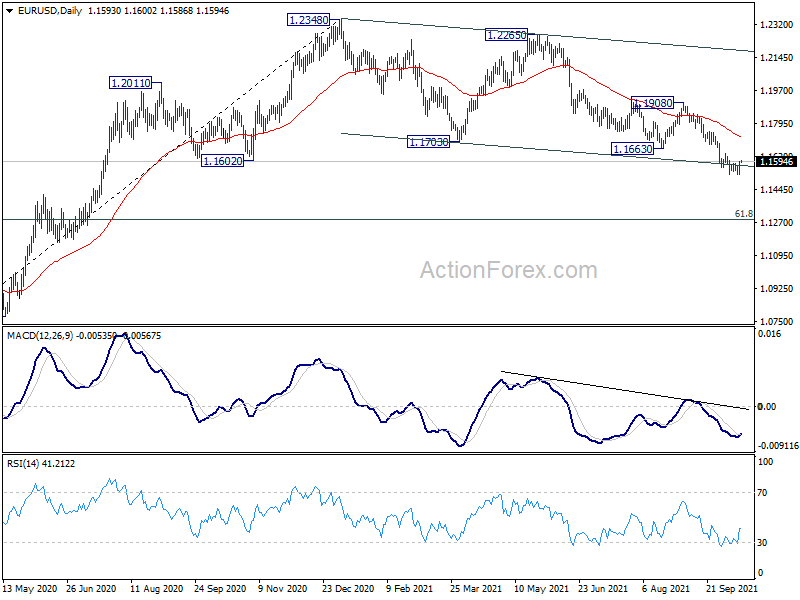
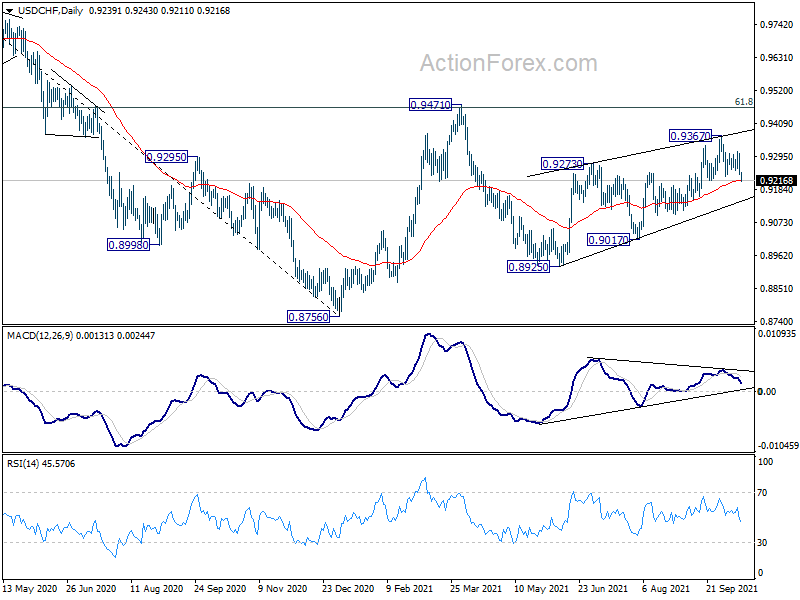
Intraday bias in EUR/USD is turned neutral again with current recovery. Further fall is still in favor as long as 1.1639 resistance holds. Break of 1.1523 will resume larger fall from 1.2265 to 1.1289 medium term fibonacci level next. On the upside, break of 1.1639 resistance, however, will indicate short term bottoming. intraday bias will be turned back to the upside for stronger rebound.
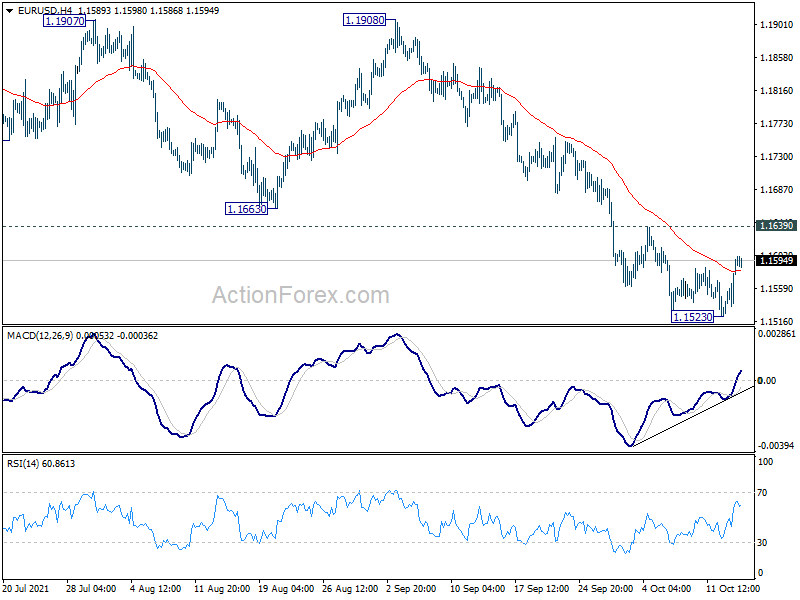
In the bigger picture, sustained break of 1.1602 will argue that rise from 1.0635 (2020 low) has completed at 1.2348. Deeper fall would be seen to 61.8% retracement of 1.0635 to 1.2348 at 1.1289. Note also that rejection by 55 week EMA (1.1830) also carries medium term bearish implication. Firm break of 1.1289 will pave the way to retest 1.0635 low. On the upside, though, break of 1.1908 resistance will revive medium term bullishness and turn focus back to 1.2348 high.
GBP/USD Daily Outlook
Daily Pivots: (S1) 1.3602; (P) 1.3634; (R1) 1.3691; More...
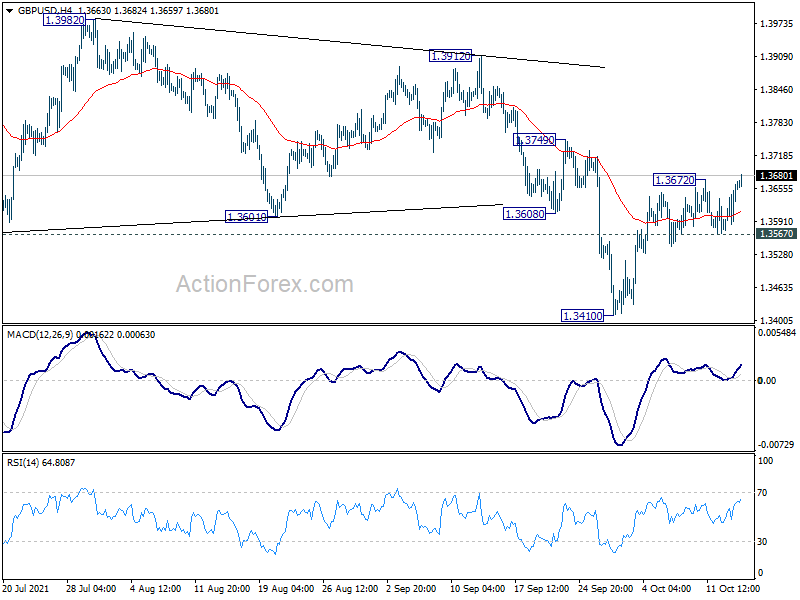
GBP/USD's rebound from 1.3410 resumes by breaking 1.3672 temporary top, and intraday bias is back on the upside. Sustained trading above 55 day EMA (now at 1.3717) will target 1.3912 key structural resistance next. On the downside, however, break of 1.3567 minor support suggest that rebound from 1.3410 has completed, and fall from 1.4248 is ready to resume. Intraday bias will be turned back to the downside for 1.3410 and below.
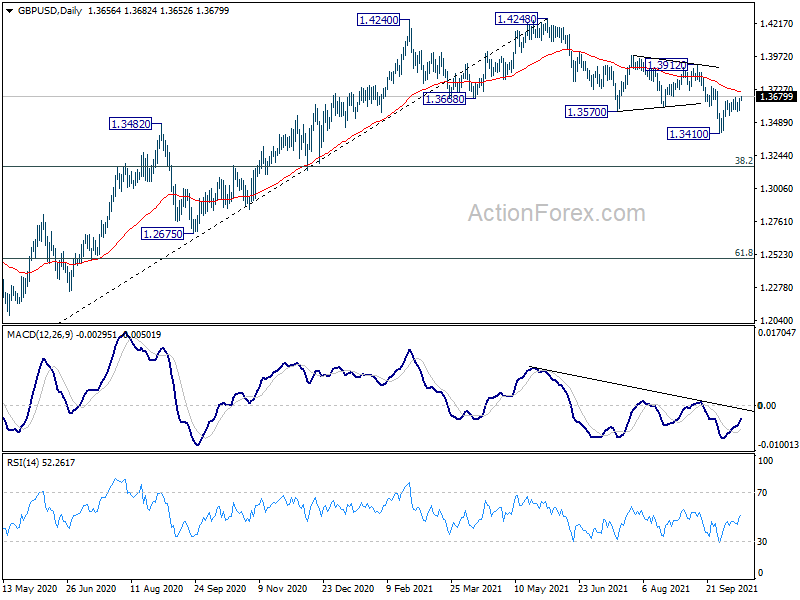
In the bigger picture, fall from 1.4248 is at least a correction to the up trend from 1.1409 (2020 low). Such correction could extend to 38.2% retracement of 1.1409 to 1.4248 at 1.3164 before completion. However, considering the rejection by 1.4376 key resistance (2018 high), sustained trading below 1.3164 will argue that it's indeed a bearish trend reversal and would target 61.8% retracement at 1.2493. Nevertheless, break of 1.3912 resistance will revive medium term bullishness and target 1.4248/4376 resistance zone again.
USD/CHF Daily Outlook
Daily Pivots: (S1) 0.9215; (P) 0.9262; (R1) 0.9288; More....
USD/CHF's decline from 0.9367 extends lower today and the break of 0.9214 support argues that rise from 0.9017 has completed at 0.9367. Considering bearish divergence condition in daily MACD. The rise from 0.8925 might have finished too. Intraday bias is back to the downside for 0.9162 support first. Firm break there will target 0.9017 support next. On the upside, break of 0.9312 support will bring retest of 0.9367 resistance instead.
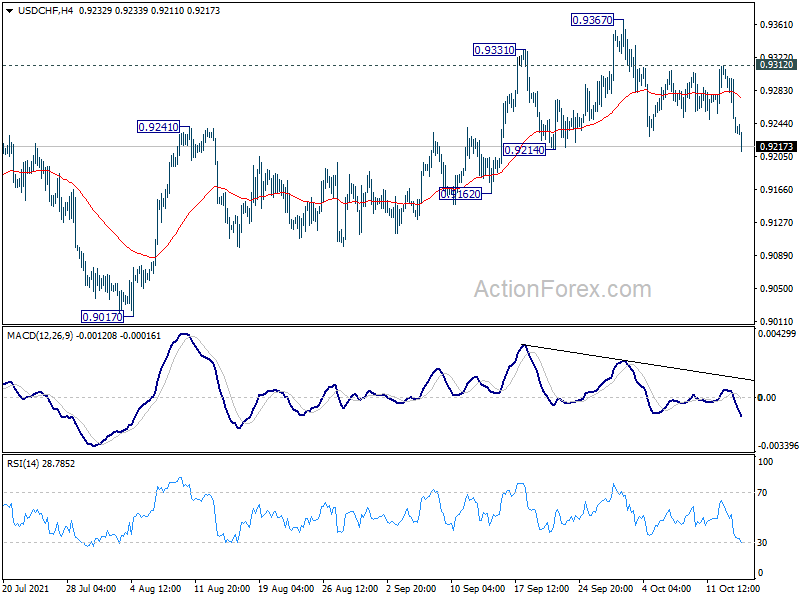
In the bigger picture, the corrective structure of the rebound from 0.8925 argues that fall from 0.9471 is not completed yet. It could either be the second leg of pattern from 0.8756 (2021 low), or resuming larger down trend from 1.0237 (2018 high). We'd pay attention to the downside momentum of assess the odds later. But for now, medium term outlook will be neutral at best as long as 0.9471 resistance holds.
EURUSD Is Possibly Bullish
Technical analysis
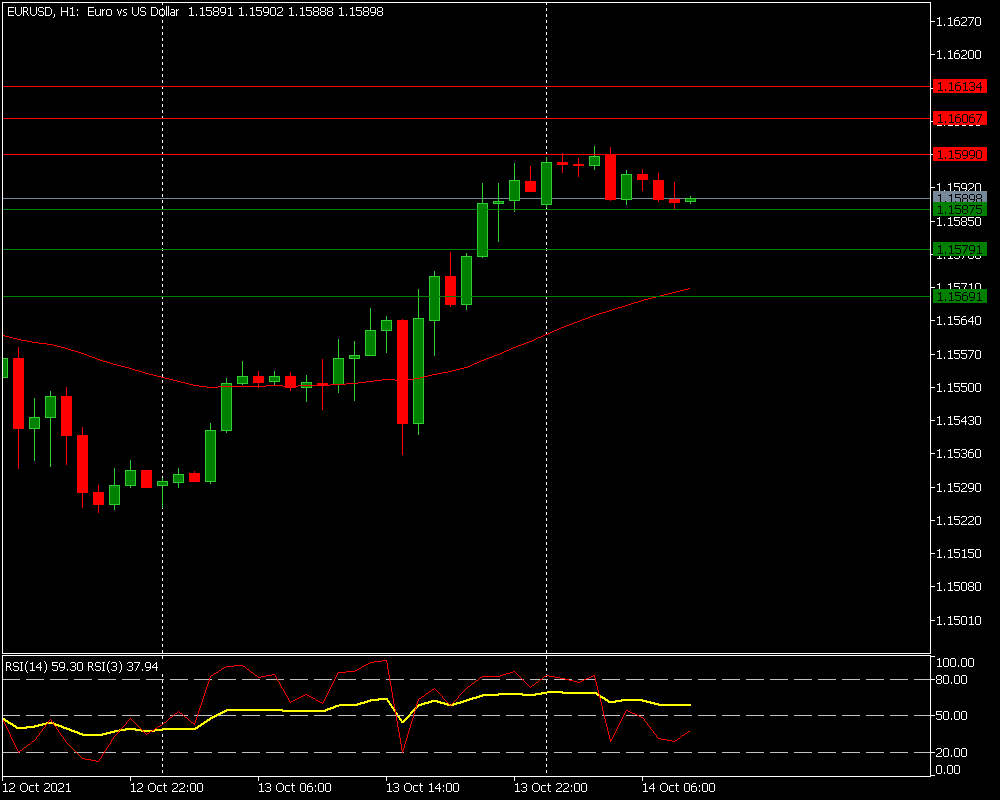
The RSI(14) and the RSI(3) both suggest an upwards movement.
The price is above the EMA(50) which is advantageous for bulls.
Most likely scenario - BUY
Target prices: 1.15990 1.16067 1.16134
Alternative scenario - SELL
Target prices: 1.15875 1.15791 1.15691
Key levels
Support 1.15875 1.15791 1.15691
Resistance 1.15990 1.16067 1.16134
XAUUSD Spikes After Fed Hints Of Tapering
US stocks were little changed on Wednesday as the third-quarter earnings season started. Yesterday, companies like Blackrock, JP Morgan, and Delta Airlines published their earnings. Most of the companies these companies released relatively strong quarterly results. However, Delta warned that higher oil prices will affect its margins in the near term. Later today, the earnings season will continue, with companies like Morgan Stanley, Wells Fargo, and Citigroup will release their results.
Stocks also wavered after the relatively strong American inflation numbers. The data showed that the country’s headline consumer price index rose by 5.4% while core CPI rose by 4.0%. These numbers were significantly higher than the target of the Federal Reserve of 2.0%. There is a high possibility that prices will increase as energy and shipping prices keep rising. These costs have risen as many ports have remained understaffed.
In many American ports, the backlog of container ships has jumped. As such, with inflation rising and the unemployment rate falling, there is a likelihood that the Fed will start tightening. Minutes published yesterday showed that many Fed officials believe that it could start tapering asset purchases as soon as mid-November. The dot plot showed that many Fed officials see rates rising in 2022.
The price of crude oil held steady in the overnight session as traders reflected on the latest monthly report by OPEC. The cartel downgraded its demand outlook for the coming year. It expects that demand will rise by about 5.8 million barrels per day, down from the previous estimate of 5.96 million barrels. The IEA, on the other hand, expects that the daily demand for oil will rise to more than 100.8 million barrels per day. Later today, the price will react to the latest inventories numbers. Economists polled by Reuters expect the data to show that inventories rose by 140k last week.
EURUSD
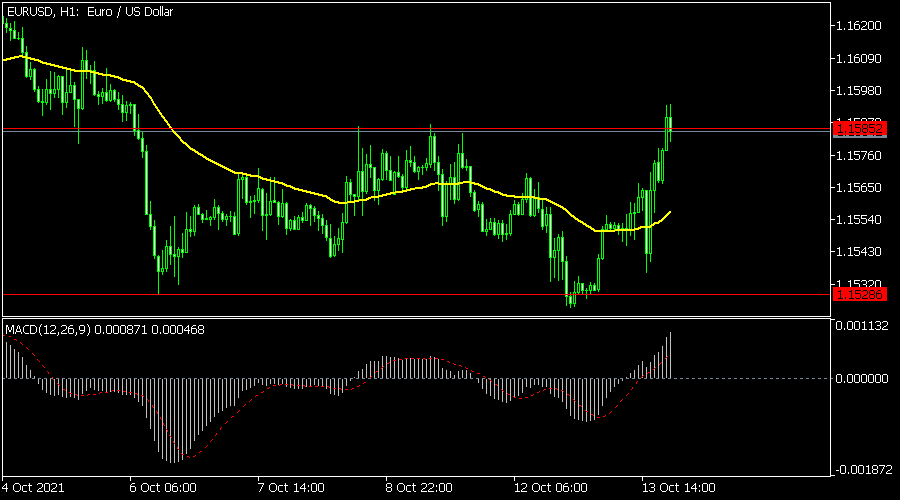
The EURUSD pair rallied as the US dollar weakened after the inflation data and Fed minutes. On the hourly chart, the pair rose above the key resistance at 1.1585. This price was the neckline of the double-bottom pattern whose lower level was at 1.1528. The price managed to move above the 25-day moving average (MA) while the MACD has moved above the neutral level. Therefore, the pair will likely keep rising, with the next key level to watch being at 1.1630.
USDCHF
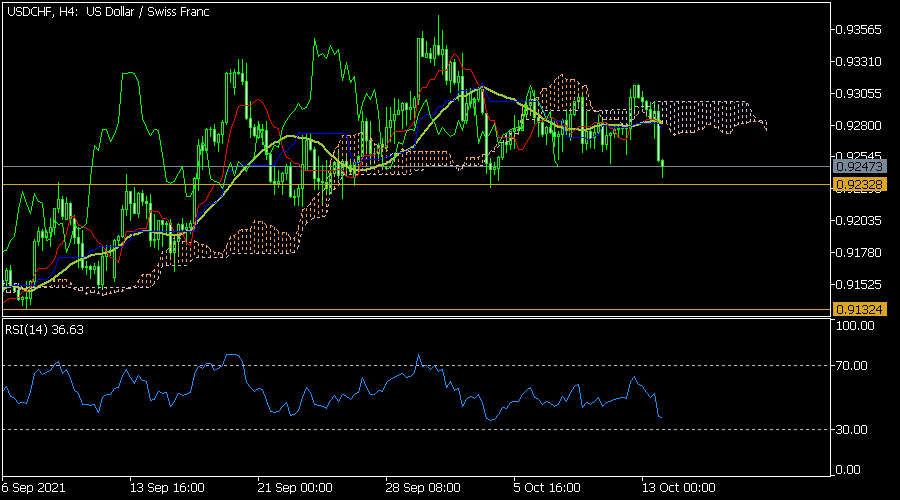
The USDCHF pair broke out lower in the overnight session. The pair declined to a low of 0.9238, which was the lowest level since last week. On the four-hour chart, the pair has formed a head and shoulders pattern, which is usually a bearish signal. It also declined below the short and longer-term moving averages. The pair also dropped below the Ichimoku cloud. Therefore, the pair will likely maintain the bearish momentum.
XAUUSD
The XAUUSD pair jumped sharply after the inflation data. Gold rose to a high of 1,795, which was the highest level since September 16. On the four-hour chart, the pair rose above the key resistance level at 1,777, which was the highest level in October. The pair also moved slightly above the short and longer-term moving averages and is approaching the 23.6% Fibonacci retracement level. Therefore, the pair will likely keep rising.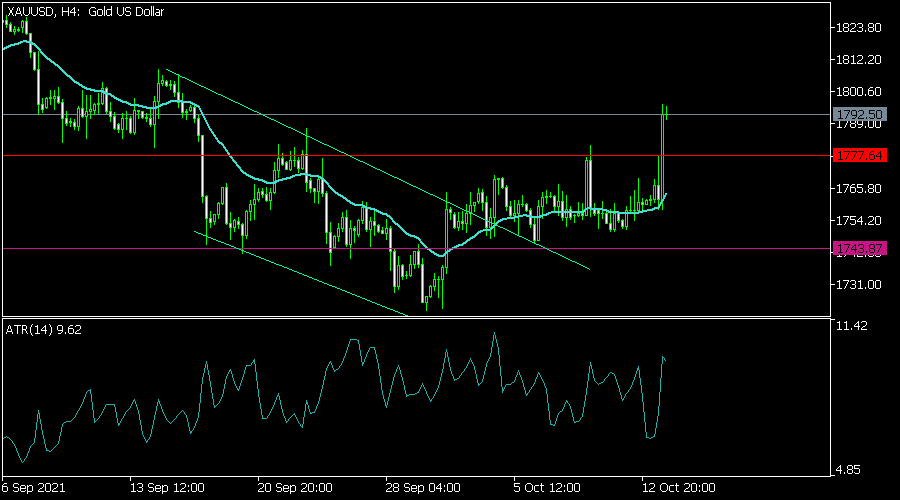
Fed Minutes Confirm Tapering Is A Question On Timing
Market movers today
- US PPI inflation will add more input to the inflation picture. PPI prints have been high lately pointing to pipeline pressure on consumer inflation.
- US initial jobless claims is also due for release today.
- In Scandi, it is time for CPI inflation in Sweden (see below).
The 60 second overview
Fed minutes: Staff presented an "illustrative path" for tapering with the tapering pace of USD15bn per month (USD10bn in Treasuries and USD5bn in mortgage-backed securities (MBS) per month). "Several participants" wanted a faster reduction, however. Policymakers also discussed whether to start actual tapering either in mid-November or mid-December. This means that the tapering pace is at least USD15bn/month but it could also be USD20bn (higher than that now seems unlikely). This means tapering is concluded in July at the latest. We expect an announcement in November and that actual tapering will start in mid-November.
Besides that it is very clear that FOMC members disagree on how to interpret the labour market development, especially why the labour force is not recovering as much as expected. This is also why there are disagreements on when to hike rates and by how much, as some think there are permanent damages while others disagree. On inflation expectations, FOMC members emphasised that longer-term inflation expectations remain well-anchored but some are concerned about the rise in 1-3 year inflation expectations.
Brexit: In yet another attempt to sort out the remaining details of the Brexit saga, the EU offered to remove checks on goods from the UK to Northern Ireland. EU's Brexit negotiator Sefcovic said that this was the final attempt to solve the dispute. In the proposal, EU suggest to remove 80% of the paper work on animal and plant-based products.
The US CPI core rose 0.2% m/m (in line with consensus, but slightly lower than we anticipated) but headline surprised to the upside (0.4% m/m vs 0.3% consensus). Headline inflation is now 5.4% y/y (up from 5.3%) wile core inflation remains unchanged at 4%. Nothing here suggests the stagflation story is going away anytime soon.
Equities: Risk sentiment improved on Wednesday, with most markets higher. The inflation/stagflation trade paused as long duration growth mostly retook leadership. FANMAG outperformed, but also materials on metal prices bouncing. S&P500 snapped its three-day declines and rose 0.3% (still lower for the week), Dow unchanged, Nasdaq 0.7% and Russell 2000 0.3%. This positive sentiment is lingering this morning with Asian markets all higher and US futures in green.
FI: Massive bullish flattening from the long end dominated market yesterday. Both the 30y German cash bond and swap rate was 8-9bp lower. We expect this to be driven by a number of stops and unwinding of carry positions, and not as much repricing of central bank expectations given that the front end was broadly unchanged on the day. Despite the repricing in the long end, inflation swaps ended broadly unchanged on the day. The US CPI figures did not impact markets significantly, nor did the FOMC minutes which said that Fed could start tapering in mid-November or mid-December. We believe that this uncertain and volatile environment will continue in the near future.
FX: Even though US CPI inflation surprised and short-term US interest rates rose further, USD lost against the rest of G10 yesterday. Scandies gained the most with EUR/NOK falling as low as 9.84 and EUR/SEK dropping down to 10.08.
Credit: Credit markets saw signs of stabilization yesterday where iTraxx Xover tightened 2.2bp and Main was unchanged. HY bonds tightened close to 2bp while IG closed 0.5bp wider.
Nordic macro
In Sweden, we expect September inflation to move another leg higher on the back of soaring electricity prices; a 7% monthly increase is what the data suggests. Energy prices may make another push higher in October, this time driven by vehicle fuel prices. Besides energy, we expect relatively seasonally normal increases in clothing and hotels/restaurants and equally seasonally normal declines in recreation and transportation. The latter two have, however, developed very differently than normally so far this year and, hence, the uncertainty is high. We have also made a slight upward adjustment to food prices for the remainder of the year on the back of higher international food prices. In total, we expect September CPIF and CPIF excl. Energy to print 3. 0% y/y and 1.8% y/y, respectively. The first forecast is spot on the Riksbank's forecast and the latter is 0.1 p.p. higher.
In the afternoon, there are two Riksbank speeches, Cecilia Skingsley 13:15 on digital currencies and Henry Ohlsson 15:30 on global impact on Swedish monetary policy. In advance, we are more interested to hear what Per Jansson has to say about 'current monetary policy in his speech tomorrow.