

Sample Category Title
GBP/USD Outlook: Hawkish Comments On Rate Expectations Lift Pound But Bulls Need More Momentum
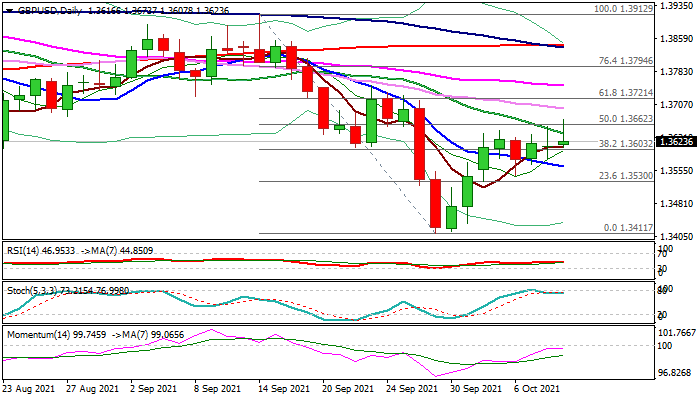
Cable jumped to the new two-week high (1.3673) in early Monday’s trading, lifted by hawkish comments from UK policymakers regarding earlier than expected rate hike, but gains were so far short-lived.
Fresh attempts to break above recent congestion and clear pivotal barriers at 1.3642/62 (20DMA/50% retracement of 1.3912/1.3411) showed initial signs of stall, but the sentiment remains positive and keeps the upside in focus. Broken Fibo 38.2% barrier (1.3603) reverted to solid support, following last Friday’s weekly close above and should protect the downside to keep bulls in play.
Firm break above 1.3662 to expose targets at 1.3721/50 (Fibo 61.8% of 1.3912/1.3411/Sep 23 lower top).
Favor dip-buying but caution on potential return and close below 1.3603 as this and risk drop below pivotal 10DMA (1.3564) and neutralize bulls.
Res: 1.3642, 1.3662, 1.3698, 1.3721.
Sup: 1.3603, 1.3583, 1.3564, 1.3543.
Dollar Index (DXY) Has Reached Inflection Area
Since bottoming earlier this year, US Dollar has steadily caught a bid. One of the primary reasons for the USD strength is because of the expectation that the Fed will start tapering later this year. The Fed has communicated their intent to reduce the emergency measures as the economy starts to recover from global pandemic. The market has more or less priced in this tapering. In the last Fed’s meeting, Chairman Powell indicated a taper ending around mid-2022 may be appropriate.
What is less clear however is how fast the Fed would raise interest rate and returns to a normal monetary policy. Inflation has been well above the the Fed’s 2% target. Even using the Fed’s preferred gauge for inflation, prices were up 3.6% in July year-over-year. The “dot-plot” of interest rate projection shows an even split between Fed officials who see interest liftoff in 2022 and those who see it later than that. Eight of the Fed members saw first interest rate hike in 2023.
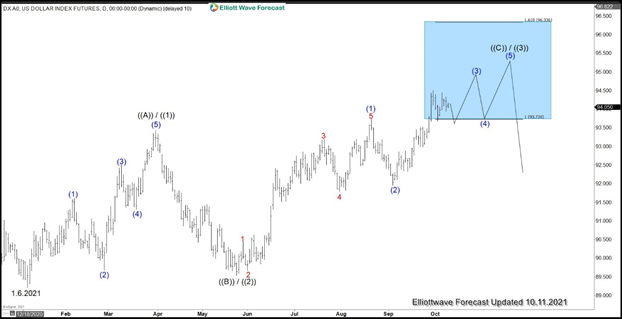
We will look at the weekly Elliott Wave chart for Dollar Index (DXY) below to see the expected move.
The Dollar Index (DXY) has reached inflection area from January 6, 2021 low at the blue box area of 93.7 – 96.3. The current rally from January 6, 2021 low is in 3 swing so far. It could be either an ((A))-((B))-((C)) in a bearish scenario, or ((1))-((2))-((3)) in a bullish scenario. If the move higher extends to 161.8% Fibonacci extension at 96.3, then the odd that it becomes a wave ((3)) of an impulse will increase. As far as it stays within the box, then the move up can be a zigzag ((A))-((B))-((C)).
As the Index has reached blue box, it can soon turn lower in 3 waves at least. Shorter cycle, further upside extension can’t be ruled out. However, a 3 waves pullback can soon happen assuming an ((A))-((B))-((C)) rally from January 6, 2021 low. This view will become less likely if the Dollar Index is able to rally to 161.8% extension at 96.3. If this happens, we may become more bullish in the index.
How Energy Prices Are Pushing USD/JPY To 3-Year High
Asian markets are developing demand for risky assets. Japan's Nikkei225 has gained 1.5% since the start of the day on Monday, thanks to a weaker yen. Bargain hunters are buying shares of IT giants on the Chinese markets on signs that a constructive dialogue between the US and China on trade has returned.
The yen is methodically selling off against the dollar. Since the last Fed meeting on September 22nd, the USDJPY rose 3.4% from levels around 109 to the current 112.7 with a slight pause which investors took to balance portfolios.
This rally was triggered by the difference in monetary policy dynamics between the Federal Reserve and the Bank of Japan. The American regulator continues to move away from crisis measures, promising to soon cut back on its balance sheet purchases. In an era of near-zero interest rates, this is the main instrument of monetary support. In contrast, no such move is expected from the BoJ.
The pressure on the yen against the dollar is also due to a surge in energy prices, which Japan predominantly imports, while the USA has its reserves and production. The jump in oil, gas and coal is putting pressure on the trade balance, turning historically surplus values into deficits. The situation is similar in other countries that actively import commodities.
It is worth noting that before the pandemic, the USA briefly became a net energy exporter. Now oil and gas production is down, and reserves are falling, but the US has considerable potential to ramp up production. Thanks to the diversification of the economy, the US market in general and the dollar are not as exposed to pressure from surging oil and gas prices.
Meanwhile, energy prices have returned to the upside. WTI surpassed $80 on Monday morning, renewing its highs since 2014. The price of US natural gas stabilised near $5.84, pulling back from extremes of $6.5, while more than doubling 2020 support levels at $2.5.
The Americans continue to ramp up production, which has already increased to 11.3m BPD. Further growth in drilling activity promises to translate into increased production over the next 6-9 months. The US energy sector thus promises to benefit from a red-hot energy market. It is not surprising that US lawmakers have abandoned further interventions to sell oil reserves from strategic reserves in such an environment.
A weaker yen supports interest in equities, returning the Nikkei225 to growth. At the same time, high and rising energy prices pose a serious threat to corporate earnings, which is harmful to the stock market and will require an expansion of support programmes from the Bank of Japan.
EUR/CAD close to 1.4353 projection level as fall accelerates
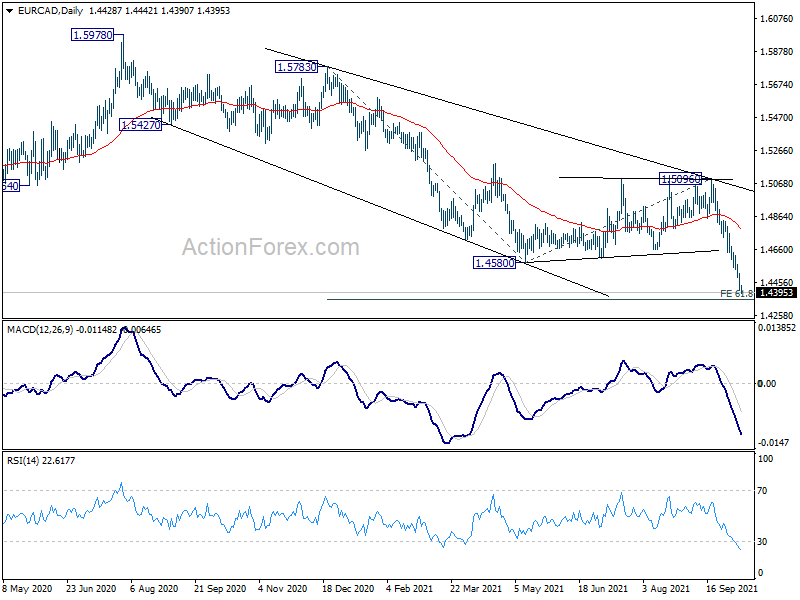
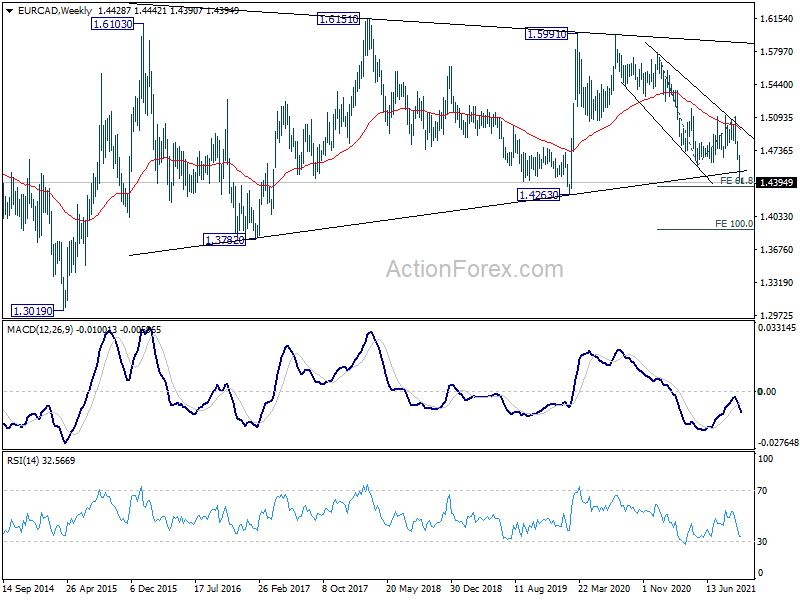
Canadian Dollar is extending near term rally, with help from rising oil price as WTI breaks above 81 handle. EUR/CAD is also accelerating down, and it's now close to 61.8% projection of 1.5783 to 1.4580 from 1.5096 at 1.4353. The reaction to this projection level could set the tone in EUR/CAD for the near to medium term.
Note that firstly, EUR/CAD was previously rejected by 55 week EMA, which is seen as a medium term bearish development. Secondly, the cross has also broken a long term trend line support as seen in weekly chart, which is another bearish development. Sustained break of 1.4353 projection level could bring another round of downside acceleration through 1.4263 support, towards 100% projection at 1.3893.
Fed Taper Bets Alive And Well After NFP Miss
- Treasury yields keep climbing after big miss in US payrolls, pressuring stocks
- Dollar mixed but steady, may get more direction from Fed and CPI data
- Pound edges up as BoE flags rate hike again but EU row casts shadow
Is it still all systems go for Fed taper?
The much anticipated jobs report on Friday raised a lot of question marks about how strong the momentum really is in the US labour market as nonfarm payrolls increased by just 194k in September, far fewer than the 500k anticipated. Fed Chair Jerome Powell had indicated he was looking for a “reasonably good” employment print to give the go ahead for tapering to start. However, once again the Delta variant appears to be causing much more disruption than what either investors or policymakers have been factoring into their economic predictions.
Nevertheless, there were enough strong points in the report to give the Fed the green light. The unemployment rate dropped more than expected to 4.8% while wage growth accelerated to 4.6% y/y.
Given all the worries that this global surge in inflation might quickly become entrenched, the Fed will likely press on with scaling back its asset purchases in November and hope that jobs growth will bounce back in the coming months.
Higher yields support dollar ahead of Fed and US data activity
Those expectations have maintained the upward pressure on US yields in the aftermath of Friday’s NFP release. Ten-year Treasury yields have hit fresh four-month highs today, breaking above 1.60%, even as the jobs data has sparked talk that whilst nothing much has changed in terms of tapering, the Fed may now be more inclined to delay its first post-pandemic rate hike.
Upcoming appearances by a host of Fed speakers this week should provide more clues as to whether markets should expect a dovish or hawkish taper decision in November. CPI numbers out of the US on Wednesday will also be crucial in the run up to the November 2-3 meeting, although the minutes of the September gathering due the same day are unlikely to shed anything new.
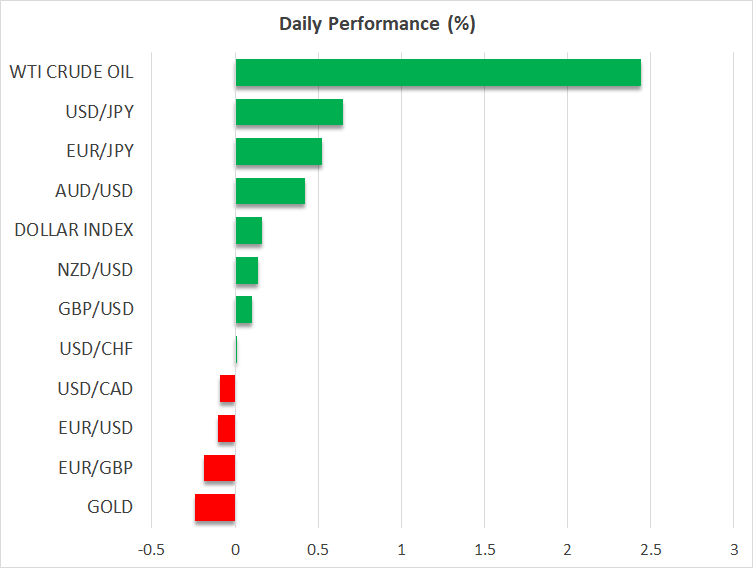
The busy US agenda this week is bound to keep the spotlight on the dollar, which has been soaring against the yen but retreating against riskier currencies. The greenback has jumped to near thee-year highs versus the safe haven Japanese currency, closing in on the 113 handle today. The euro is also struggling against the might US dollar, hovering around the $1.1570 level since Friday.
Pound, aussie and loonie on the offensive
But other majors such as the pound and Australian and Canadian dollars are advancing. Sterling climbed a two-week high of $1.3673 earlier in the session following hawkish remarks over the weekend by Bank of England policymakers. MPC member Michael Saunders warned the British public to expect “significantly earlier” rate hikes, while Governor Andrew Bailey didn’t hide his growing concern about rising inflation.
However, the latest rate hike bets have only modestly been boosting the pound as, apart from the supply and fuel shortages that are clouding Britain’s outlook, the London and Brussels are facing another standoff over Northern Ireland. The EU will reportedly unveil proposals on Wednesday to reduce checks on the Northern Irish border, but the UK government has already signalled they don’t go far enough.
Hopes that booming exports and easing lockdown restrictions will spur a quick rebound in the Australian economy are bolstering the aussie to four-week highs. The loonie is also on a roll following Friday’s super-strong employment report out of Canada and it’s being additionally buoyed by the resumption of the oil rally today.
Oil flying again, but stocks subdued
WTI oil futures have surged past $80 a barrel to the highest since October 2014 amid a worsening energy crunch around the world that’s left many countries scrambling for more supply. But the risk-on theme wasn’t evident in equity markets, with US stock futures and European shares extending Friday’s losses.
Trading is expected to be somewhat lighter on Monday as US markets are partially shut due to Columbus Day, but activity should soon pick up when the big banks kick off the Q3 earnings season on Wednesday. Wall Street ended last week higher despite the NFP-led losses. But whether stocks can recover further could depend more on what the new earnings season holds than what the Fed says this week.
Oil Rises, Gold Slips After Rally
Oil prices rise in Asia on China weather
Oil prices weathered the US data storm on Friday, with Brent crude and WTI almost unchanged, consolidating at the top of their ranges. Brent crude closed at USD 82.55, while WTI closed slightly higher on the day at USD 79.40 a barrel. One storm they are not weathering is the heavy flooding in China’s Shanxi province, a coal mining hub where 60 mines have had to cease production. That has sent oil prices sharply higher today. Brent crude has rallied 1.40% higher to USD 83.70 a barrel, while WTI has leapt 1.80% higher to USD 80.95 a barrel.
Brent crude has taken out last week’s double top at USD 83.50 and is likely to test USD 88.00 a barrel this week. Support appears at USD 82.00 and then USD 80.00 a barrel. WTI has chopped through resistance at USD 80.00 and is moving through USD 81.00 a barrel as I write. Dips to USD 80.00 and dips to USD 78.50 a barrel will be well supported. Only a fall through USD 75.00 changes the bullish technical picture which shows no meaningful resistance until USD 90.00 a barrel. Interesting times.
A US holiday is reducing liquidity but the scramble for energy supplies by Asia and Europe in natural gas and coal markets continues to provide a strong backstop for oil prices, especially with OPEC+ showing no signs of increasing production.
US bonds repel gold recovery rally
Gold rallied strongly on Friday, rising over 20 dollars to test USD 1780.00 an ounce. However, the US Non-Farm Payrolls kept the Fed taper trade alive and saw US bond yields rise once again. That was enough to sap fragile confidence in the gold rally, which gave back all its intra-day gains to finish just 0.10% higher at USD 1757.20 an ounce. An ebbing of the fear gauge in Asia, where equities have powered higher, has unwound some haven buying of gold and sees it 0.10% lower at USD 1755.00 an ounce.
The failure of the gold rally will have disappointed gold bulls and made them more nervous about committing to new longs once again. However, I believe that with the US dollar potentially correcting temporarily lower this week, gold will find plenty of support of dips this week. The US bond market closure for a holiday today will help gold’s cause in that respect.
That is all predicated on US yields trading sideways this week, but if so, gold should trade in a USD 1740.00 to USD 1780.00 an ounce range with an upside bias. Critical support lies at USD 1720.00 an ounce, while the USD 1800.00 region, with the 100 and 200-day moving averages (DMAs) each side of it, remains a formidable barrier.
.
Dollar Dips Against Asian Currencies
Firm yuan setting pushes US dollar lower in Asia
Friday was a choppy session for currency markets with the US dollar on the back foot most of the day before staging a post-Non-Farm taper rally as US bond yields moved north. The dollar index finished just 0.10% lower at 94.10, edging to 94.08 in a dull Asian session. The dollar index is now back to the middle of its 93.50 to 94.50 range. Despite higher US bond yields, the technical picture suggests that resistance around 94.50 became more imposing after multiple forays were repelled ahead of it last week.
I also note that the CFTC Commitment of Trader’s Report showed US dollar longs hitting two-year highs. That is as good a sign as any that speculative momentum has slowed over the end of the last week. I still believe in the higher US dollar/Fed-taper story, and higher yields will provide an underlying bid on dips. But it would not surprise me in the least if the US dollar spent this week on the softer side to cull some of the heavily overweight speculative long interest.
In the G-10 space, EUR/USD continues to mark time, rising slightly to 1.1580 in Asia. EUR/USD still looks vulnerable to another move higher in US yields, but a break of 1.1550 or 1.1650 is required to signal a new directional move. Sterling is outperforming after two Bank of England officials signalled an earlier rate hike could occur over the weekend. The November BOE meeting will be interesting now as inflation pressures mount that don’t look transitory anymore. GBP/USD has risen 0.37% to 1.3665 today, well above the 1.3615 pivot point. A rally through 1.3700 could spark a short-squeeze to 1.3800, while GBP/USD now looks well supported into 1.3600.
USD/JPY is on the move after US yields rose on Friday. USD/JPY rose 0.54% to 112.25 on Friday, jumping by another 0.38% to 112.65 in Asia. The culprit is the US/Japan yield differential and this will continue to drive the crosses direction. With the US in taper mode, push up US bond yields, and Japan looking to open the fiscal taps, supported by an ever-dovish Bank of Japan, those forces will continue. USD/JPY looks set to test longer-term resistance between 114.00 and 114.50 while dips to 111.00 will be well supported. Heavily short yen positioning in the US futures may limit USD/JPY gains initially, though. USD/JPY looks like a true buy-the-dip candidate, however.
With Asian markets brimming with confidence today, the sentiment-driven AUD and NZD have risen to 0.7330 and 0.6735 today. AUD/USD has outperformed, rising 0.35% as Sydney’s reopening, and firm commodity and energy prices flow through to the currency. The larger technical picture still looks shaky though, as both Antipodean’s remains completely at the mercy of the ebbs and flows of global risk sentiment. A negative China headline, or a soft US equity session will see both currencies quickly retrace their gains.
The PBOC set a slightly firmer yuan fixing today at 6.4479, while adding CNY 10 billion of liquidity via the repos. The yuan also hit five-year highs on a TWI basis. With one eye on their potential imported energy bill, it is probably no surprise that the yuan has been kept on the firmer side. Although, a RRR cut this morning by the PBOC may make that situation slightly more challenging. The strong CNY has provided support to Asian currencies which have edged around 0.20% higher on average versus the greenback. A procession of reopening announcements by ASEAN markets over the weekend is also lifting recovery sentiment.
A partial US holiday will dull volumes today, but I doubt the Asia FX fairy-tale will continue once they return, and if energy and US yields keep moving higher. Commodity/energy-centric currencies such as the Indonesian rupiah and Malaysian ringgit are, for once, the best places to weather the storm. Huge energy importers like South Korea, Japan and especially India are among the more vulnerable.
Asian Equities Race Higher
Asian markets in positive territory
With the Fed taper trade alive and well, despite a shocking Non-Farm Payrolls print, US yields moved higher sending Wall Street to a soft close. The S&P 500 eased by 0.19%, while the rate-sensitive Nasdaq dropped by 0.51% with the value-centric Dow Jones finishing just 0.04%. US futures on all three in Asia took a bath earlier in the session but have recovered most of those losses to be hovering on each side of unchanged
The recovery in US equity futures has been driven by a very positive day for the most part in Asia, with no one theme driving the rally. The Nikkei 225 has climbed an impressive 1.55% with a much weaker yen boosting exports, Covid-19 cases falling and the Japanese PM saying he wasn’t contemplating a hike in capital gains tax. South Korean and Taiwan markets are closed for holidays.
China equities are also rallying despite government officials signalling that a clampdown on monopolistic practices by big-tech would continue. E-com giant Meituan received a smaller than expected fine from the Chinese government for just that and in a classic case of no news is good news, sent the Hang Seng sharply higher, led by mainland tech giants. That seems to have lifted sentiment on mainland markets as well despite the flooding in Shanxi darkening the energy outlook. The Shanghai Composite is 0.20% higher although the narrower Shanghai 50 is up by 1.03%. The CSI 300 has climbed by 0.55% while the Hang Seng has leapt 1.80% higher.
Singapore has given back some of its travel stock-related rally after the Government announced more international vaccinated travel lanes over the weekend. But the Straits Times remains up 0.20% on the day. Kuala Lumpur is also easing movement restrictions, and combined with oil’s rally, the KLCi has risen by 0.60%. Jakarta and Bangkok are 0.30% lower but the PSEi in Manila has leapt 3.70% higher today as virus cases fall and a large shipment of COVAX vaccines was received over the weekend.
A healthy rise in commodities prices today and the official reopening of Sydney today has helped Australia overcome another gaming company scandal, which weighed on stocks earlier in the session. The ASX 200 and All Ordinaries have risen 0.65%.
European stocks are set to open in a neutral posture, Friday’s week US close offset by a strong showing by Asian equity markets today. A raft of second-tier regional data is unlikely to move the needle one way or the other. The energy crisis in the background is likely to limit gains, as will a euro that is stubbornly clinging to 1.1600 region. As is their wont of late, European markets will hitch their wagon to the direction of travel of the US markets, and it will be interesting to see if taper nerves persist. With the US bond market closed I would be on the side of a but-the-dip day which should lift European stocks later in the session.
It’s Wet At The Coal Face
Despite China's central government ordering domestic coal producers to increase production to alleviate energy shortages in mainland China, obstacles keep on appearing. Production in one of China's coal production hubs, Shanxi, has been severely disrupted by heavy rains forcing the suspension of output from 60 coal mines, Bloomberg reports. Wet weather has also been disrupting extraction at key supplier Indonesia of late as well. Unsurprisingly oil prices are up 1.0% in early Asia, with natural gas futures rising by 2.0%, while font month iron ore futures in Singapore (steel making uses a lot of coal) have leapt higher by over 4.0%.
Reuters is also reporting that northern Indian states have been suffering electricity outages as coal supplies there remain exceedingly tight. Friday's RBI policy decision left rates unchanged, but the central bank announced it would stop its bond-buying programme that isn't called quantitative easing. Ostensibly bullish for the Indian Rupee, pressure on the INR continued anyway, and I suspect energy is at its core.
Mainland China and India are the no. 1 and 2 largest users of coal. Meanwhile, Russia keeps “subtly” tying more gas supply to Europe with certifying Nord Stream 2 and OPEC+ have shown no signs of wavering on previously agreed production targets. With winter approaching in the northern hemisphere, none of this news is bearish for energy prices and oil is rightly higher in Asia today.
It also isn't bearish for inflation either. Higher energy prices/shortages will inevitably make their way through global value chains in the form of rising prices and potentially in shortages of industrial and consumer goods. I for one, am particularly concerned about the knock-on effects on fertiliser production (which uses natural gas in the manufacturing process.) If global food production starts getting affected, either by shortages and/or much higher prices, things are going to start getting real.
All of this makes the constant blathering from central bankers around the world about inflation being “transitory” ring more and more hollow. If transitory inflation is now defined as being elevated by the last two or three years, what is sticky inflation? Two to three years sounds like more like half an economic cycle these days to me. Of course, much of the inflationary forces are due to pandemic disruptions and thus, out of the hands of central bankers. Some of it though, is a knock-on effect of the ham-fisted quantitative easing policies of the past decade and a bit, pimping up asset price appreciation to give the illusion of recovery, while sharply increasing economic and social inequality under the surface.
Stealing the future wealth creation of our children and NPV-ing to the present day via QE forever and zero percent rates to back stop growth today, had to be paid for eventually. Perhaps that time has come via inflation, which has been on holiday for nearly 20 years. The only bright spot is that the world actually needs a few years of high inflation to deflate the global debt mountain that all of those economics PhDs at the central bank of (insert name here), have enabled the financial system to create.
NFP misses consensus
The threat of inflation is likely one reason Wall Street didn't endure a massive “taper-off” move on Friday after another Non-Farm Payroll shocker. Although the August data got a chunky upward revision to 366,000 jobs, the September print was only 194,000 jibs versus expectations of 500,000-plus, including from the author. As ever, a look under the bonnet is always a good idea once the initial headline reactions have passed. Private payrolls actually showed a healthy gain with government employment, particularly in education where schools are enduring a disrupted reopening. That and the leisure and hospitality sector continue to be the employment laggards, despite millions of jobs being available in the latter.
What saved the markets from a “taper-off” move was unemployment falling to 4.80% from 5.20%, led by a fall in participation rates. The Fed-engineered mother of all stock market rallies may have seen retirement pools bulge and early retirements thinning total workforce. Bulging personal savings and a disrupted return to school may also be stopping some workers from returning. That all points to wage inflation, not PPI inflation and US bond yields shot higher, the 10-year settling above 1.60% while equities fell, and the US dollar held its own. That left the Fed taper live for a December start in the minds of the markets and I shall not disagree. It appears that the US has a labour force problem and not a jobs problem. Transitory inflation? Hmmmm………..
South Korean and Taiwan markets are closed today, and it is a partial holiday in the United States although the stock market is open. South Korea looms as one of the region's highlights though, with the Bank of Korea policy decision tomorrow. Markets are pricing an unchanged base rate of 0.75%; however there is a small chance that it might slip in a 0.25% hike which would boost the beleaguered won. Singapore's MAS announces its semi-annual monetary policy outlook on Wednesday, but I am expecting no surprises with the MAS settings tilted solidly towards supporting the economic recovery.
Australia releases employment data on Thursday, usually good for some intra-day volatility. More attention will be focused on Sydney's partial reopening today. It is a quiet data week for China with only CPI on Thursday to excite. Only a print well above 1.0% for September is likely to provoke a market reaction. Attention remains focused on Evergrande and its still suspended shares. Although it has slipped from the headlines, we can be sure this story has more to run.
The data calendar is thin in Europe today, but a slew of CPI releases from across the Eurozone in the second half of the week could reveal whether inflationary pressures seen elsewhere in the world, are washing up on Europe's shores. The US also releases NFIB small business optimism tomorrow, important for its outlook on wages, hiring and also the effect of material shortages and/or price increases. The JOLTS job openings data should hold around 11 million vacancies and is one of the main reasons why Friday's Non-Farms did not provoke a “taper-off” move. CPI on Wednesday will be closely watched in the context of the above before Retail Sales on Friday.
Finally, Q3 US earnings season starts this week, with the banking heavyweights due to report in the second half of the week. Their outlook for 2022, will arguably, have more market-moving potential than the data calendar this week.
Big Banks Kick Off The US Earnings Season
Asian equities and commodity markets kicked off the week on a strong note, with Chinese technology shares rallying on easing concerns about China’s crackdown on internet companies. The weaker yen, which tested the lowest levels since December 2018 against the dollar, provided a solid boost for Japanese stocks and aviation stocks in Singapore soared after authorities announced that more travel lanes will open. Oil continued to make new highs this morning, with Brent crude approaching $84 and WTI trading at a seven-year high near $81.
The positive sentiment in Asia does not seem to be shared in the US as equity futures edged lower in early trading. The disappointing employment report on Friday is not expected to delay the Fed’s tapering plan which most are scheduling for the November 3 FOMC meeting. Policymakers are set to announce a reduction in asset purchases given higher energy prices, continued supply chain bottlenecks and rising wages that will keep inflation levels elevated more than previously thought.
The US Senate approval to extend the debt ceiling until December removed one of the imminent risks for a delay to tapering, but that wasn’t enough to take stocks to new highs. It’s the third-quarter earnings announcements that will determine the direction of stocks from here.
Investors have high expectations for “Corporate America” and as we learned from the last earnings season, profits and revenues need to beat by considerable margins for the rally to resume. This week, big banks will kick off the earnings season with JP Morgan, Bank of America, Citigroup, Morgan Stanley and Goldman Sachs all announcing results.
Overall, earnings are estimated to grow 27.6% for S&P 500 companies but we should expect growth to be well above 30% given the positive surprises. That should lower current valuations and indicate that growth in profitability is taking the driving seat rather than higher valuations, when it comes to equity prices.
Traders should also keep a close eye on this week’s US economic data. Wednesday’s release of consumer price inflation for September is expected to show a monthly rise of 0.3% compared to August, keeping the annual price increase above 5%. It will be interesting to see how higher energy prices are impacting other areas of the economy. Friday’s US retail sales report will also be of great importance following a mixed jobs report and the expiration of various fiscal measures.