Sample Category Title
CAD Supported by Energy Price Strength. Strong Job Market and Inflation Lifted Yields
Falling to the weakest level since August, USDCAD was the worst performer amongst majors (CAD best performer against USD). Loonie’s rebound was driven by energy prices and strong job data. Elevated inflation also has again heightened speculations about BOC’s rate hike.
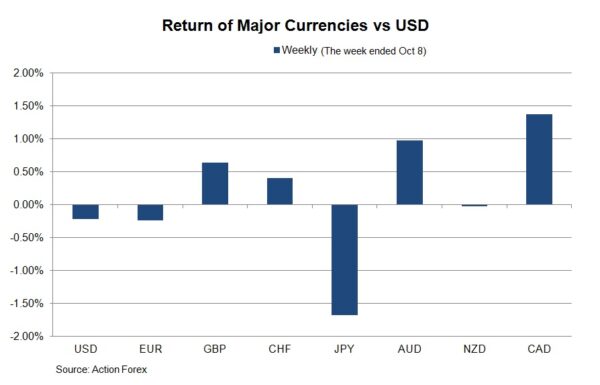
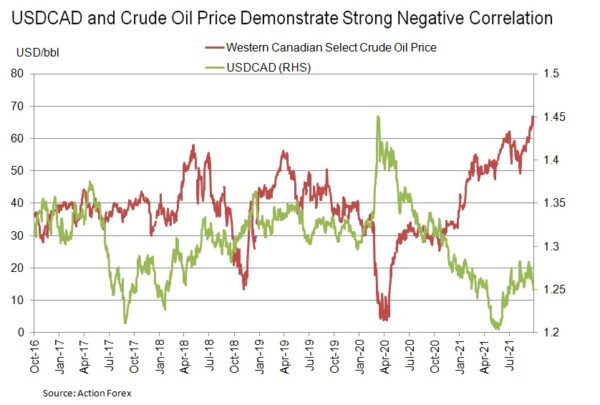
The major driver of loonie’s strength was energy price. Crude oil price rallied as the energy crisis in China, Europe and the UK worsened. The front-month WTI and Brent crude oil futures rallied 5% and +4.95% last week, respectively. The front-month WCS future contract, the benchmark of Canada’s crude oil, also rose +3.3% last week. Higher demand for Canada’s oil exports lifted the Canadian dollar.
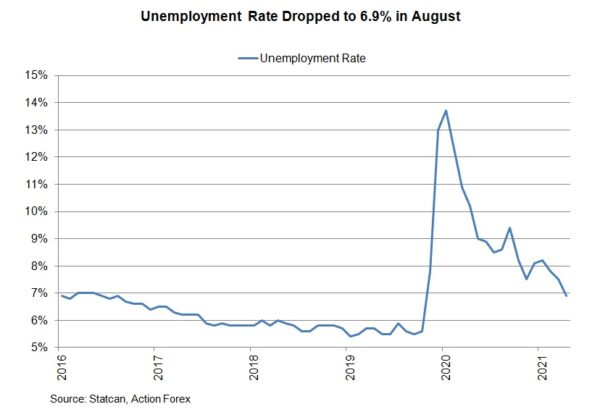
On Canada’s economy, the number of employment soared +157.1K in September, beating consensus of +61.2 K and August’s +90.2K. The unemployment rate slipped -0.2 ppt to 6.9%, in line with expectations and continued to improve to 7.1% in August. This contrasted sharply with the disappointment in US payroll report. The US saw only +194K addition in nonfarm jobs in September, much weaker than consensus of +500K. The August figure was revised higher to an increase of +366K. The unemployment rate, however, fell markedly to 4.8% from 5.2% in August. The market had anticipated a mild drop to 5.1%.
The country’s inflation remained elevated. Headline CPI soared to +4.1% y/y in August, up from +3.7% in the prior month. Gasoline prices, jumping +32.5% from the same period last year, contributed to almost a percentage point to the headline reading. Core CPI also accelerated to +3.5% y/y from +3.3% in July. Moreover, the average of the central bank's three preferred measures registered at +2.6% y/y, its highest since March 2009, and reflecting the broad-based nature of the price increases. Inflation now appears more persistent than previously anticipated. While it is unlikely that supply constraints could be resolved in the near-term, energy crisis is prone to worsen. Both are expected to put further upward pressure on inflation.
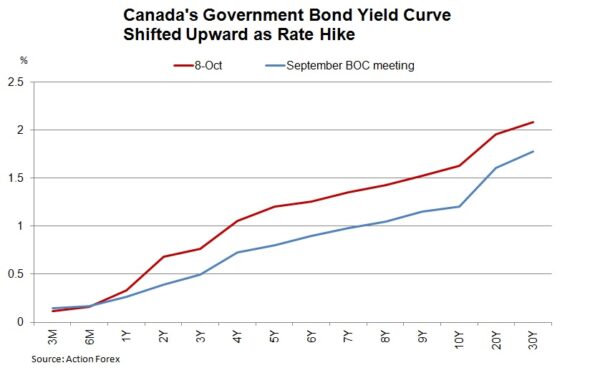
Strong employment and inflation have again raised speculations of a BOC rate hike. Canadian government bond yields increased cross the curve with the 10-year yield reached the highest level since March. We expect the BOC to reduce its QE purchases to CAD 1B/ week at the October meeting, while the first rate hike will arrive in late 2022.
USD/JPY Mid-Day Outlook
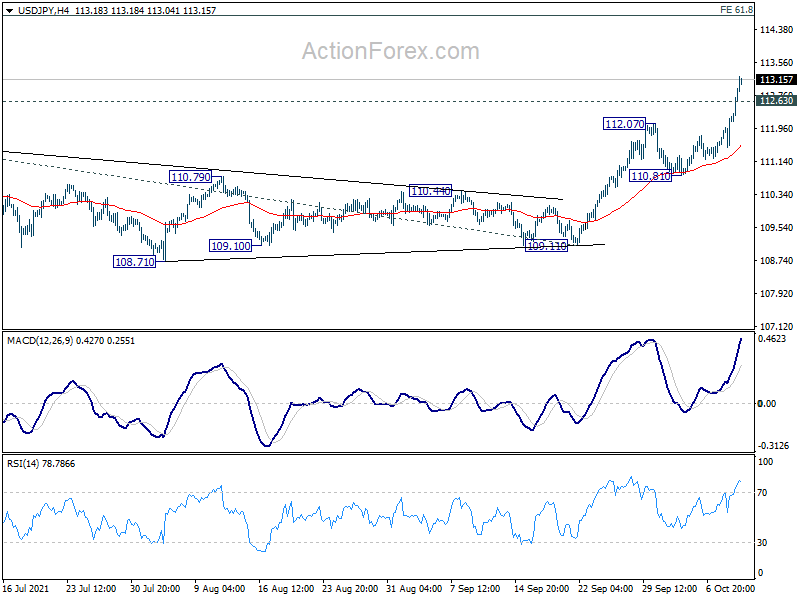
Daily Pivots: (S1) 111.74; (P) 112.00; (R1) 112.49; More...
Intraday bias in USD/JPY remains on the upside, as up trend from 102.58 is in progress to 61.8% projection of 102.58 to 111.65 from 109.11 at 114.71. Firm break there will target 100% projection at 118.18 next. On the downside, below 112.63 minor support will turn intraday bias neutral and bring consolidation first. But retreat should be contained by 110.81/112.07 support zone to bring rise resumption.
In the bigger picture, corrective decline from 118.65 (2016 high) should have completed at 101.18 already. Rise from the 102.58 is seen as the third leg of the up trend from 101.18. Next target is 114.54 resistance and then 118.65 high. This will now be the preferred case as long as 108.71 support hold, even in case of pull back.
USD/CHF Mid-Day Outlook
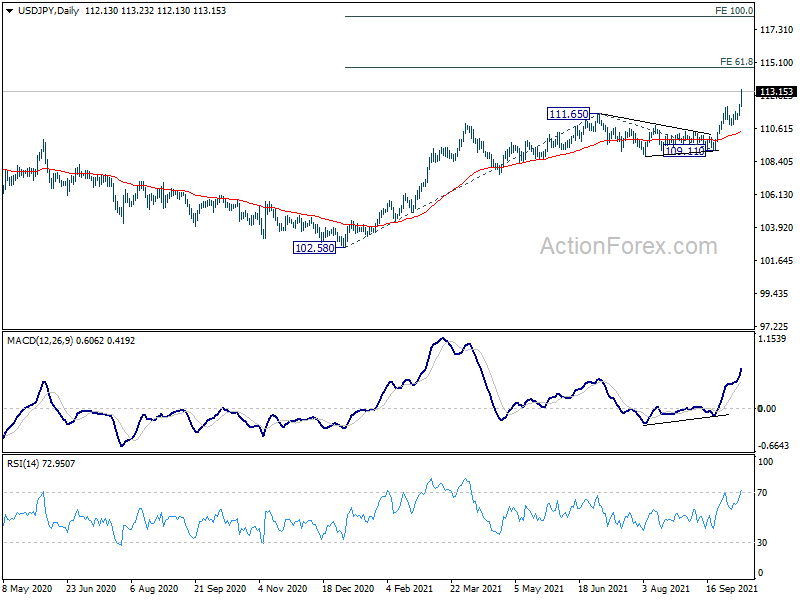
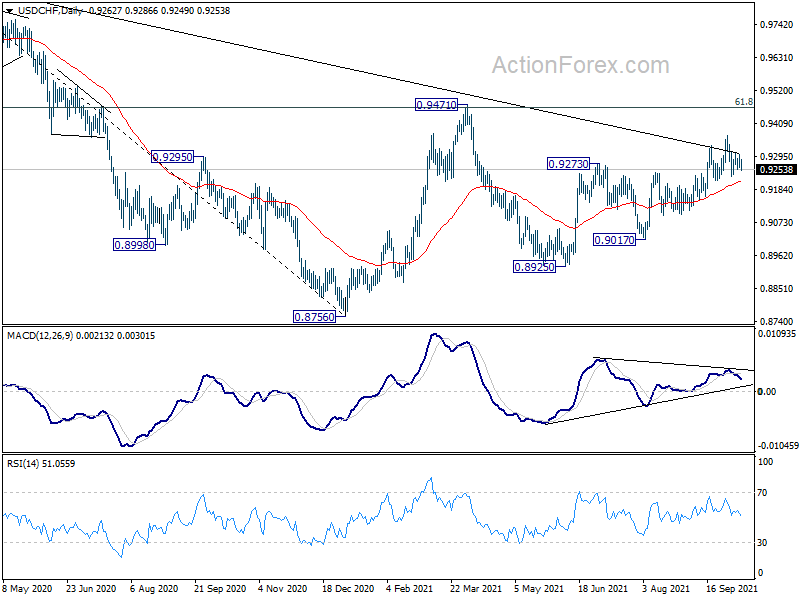
Daily Pivots: (S1) 0.9264; (P) 0.9279; (R1) 0.9304; More....
USD/CHF is staying in consolidation from 0.9367 and intraday bias remains neutral. On the upside, break of 0.9367 will resume the rise from 0.8925 to 0.9471 key resistance next. On the downside, however, break of 0.9214 will turn bias back to the downside for 0.9017 support again.
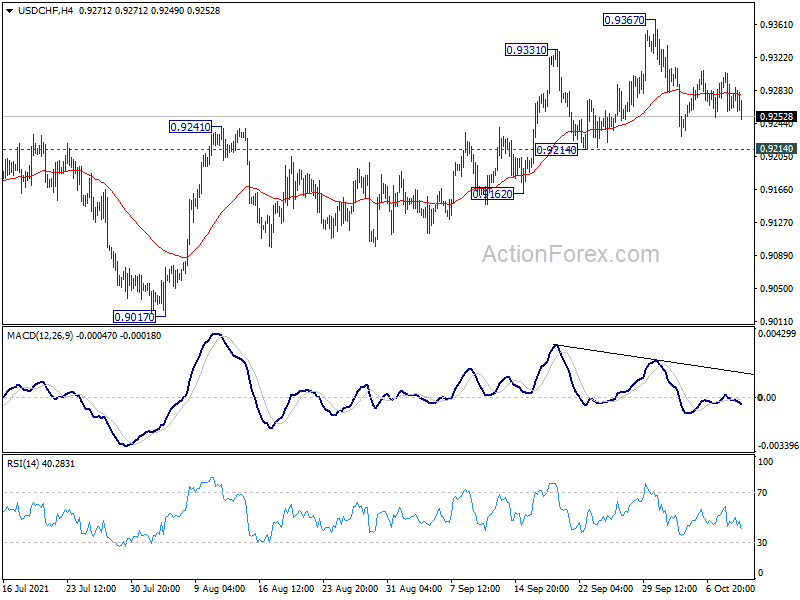
In the bigger picture, the strong rally above 55 week EMA (now at 0.9188) now tilts favor to the case of bullish trend reversal. That is, decline from 1.3042 (2016 high) is probably completed at 0.8756 already. Sustained break of 0.9471 resistance should confirm this case and pave the way to retest 1.0342 ahead. However, rejection by 0.9471 will mix up the outlook again and retain some medium term bearishness.
GBP/USD Mid-Day Outlook
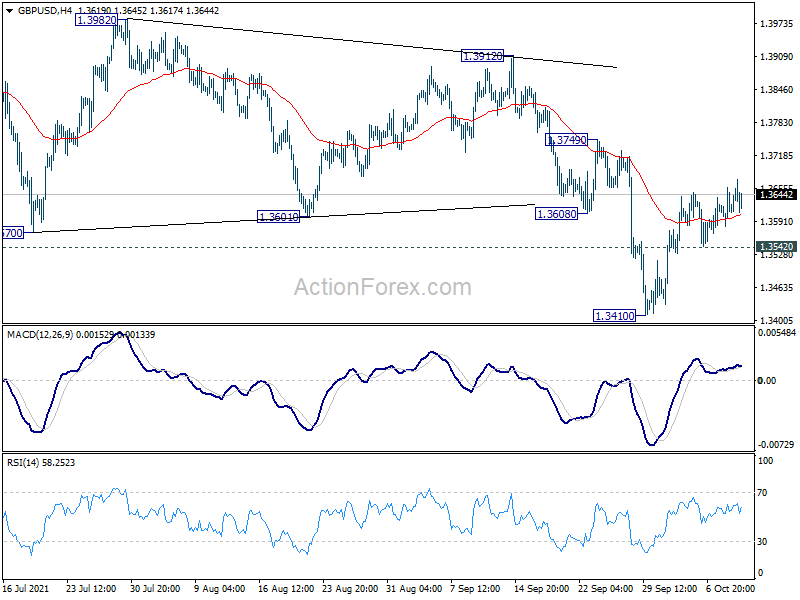
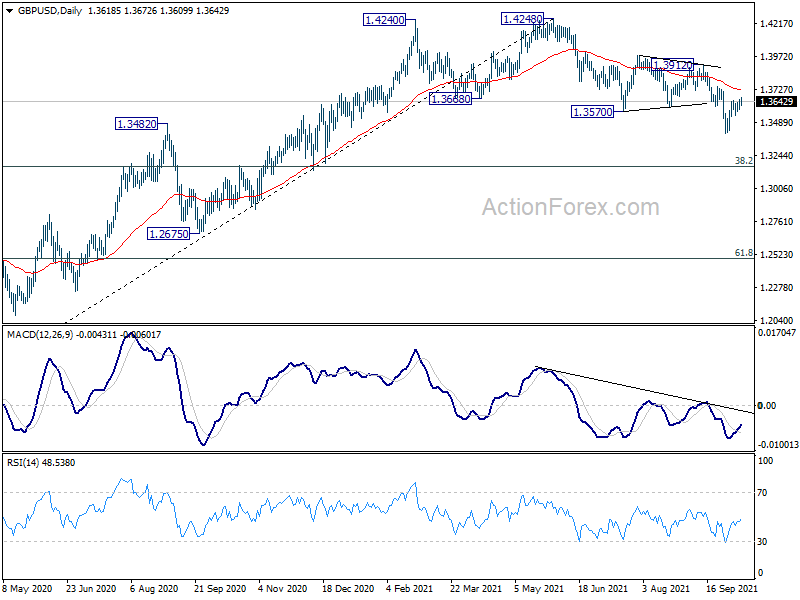
Daily Pivots: (S1) 1.3583; (P) 1.3620; (R1) 1.3657; More...
With 1.3542 minor support intact, intraday bias in GBP/USD remains on the upside. Sustained trading above 55 day EMA (now at 1.3725) will target 1.3912 key near term resistance. On the downside, below 1.3542 minor support will retain near term bearishness, and turn bias back to the downside for 1.3410 low.
In the bigger picture, fall from 1.4248 is at least a correction to the up trend from 1.1409 (2020 low). Such correction could extend to 38.2% retracement of 1.1409 to 1.4248 at 1.3164 before completion. However, considering the rejection by 1.4376 key resistance (2018 high), sustained trading below 1.3164 will argue that it's indeed a bearish trend reversal and would target 61.8% retracement at 1.2493. Nevertheless, break of 1.3912 resistance will revive medium term bullishness and target 1.4248/4376 resistance zone again.
EUR/USD Mid-Day Outlook
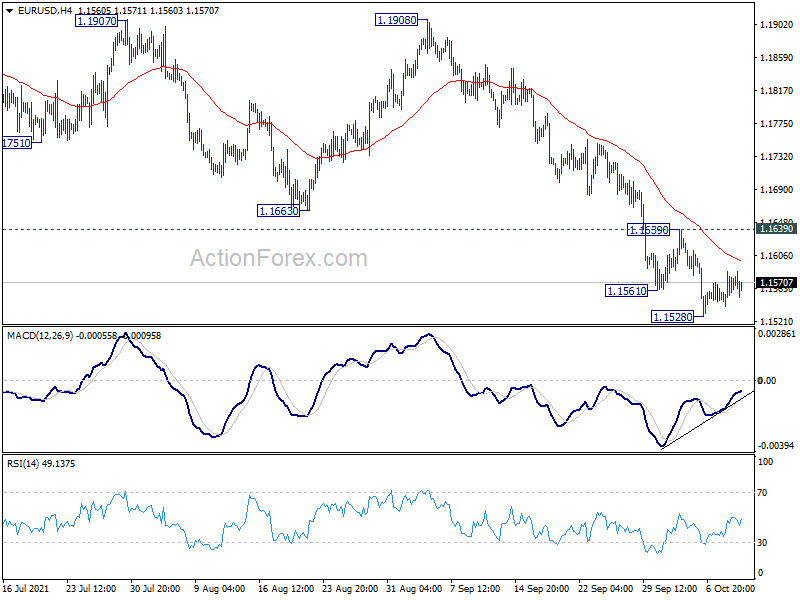
Daily Pivots: (S1) 1.1549; (P) 1.1568; (R1) 1.1593; More...
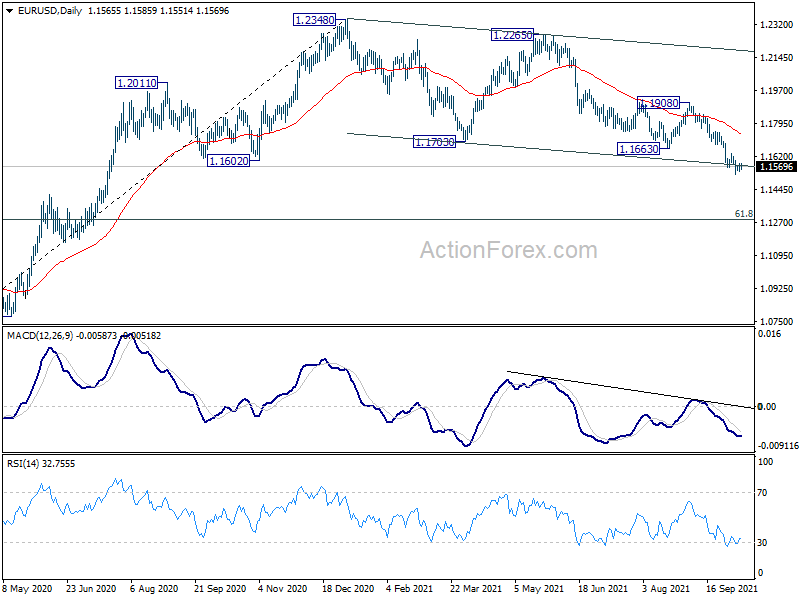
EUR/USD is still bounded in consolidation from 1.1528 temporary low, and intraday bias remains neutral. Further fall is still in favor as long as 1.1639 minor resistance holds. Break of 1.1528 will resume larger decline towards 1.1289 medium term fibonacci level. On the upside, break of 1.1639 resistance, however, will indicate short term bottoming. intraday bias will be turned back to the upside for stronger rebound.
In the bigger picture, sustained break of 1.1602 will argue that rise from 1.0635 (2020 low) has completed at 1.2348. Deeper fall would be seen to 61.8% retracement of 1.0635 to 1.2348 at 1.1289. Note also that rejection by 55 week EMA (1.1830) also carries medium term bearish implication. Firm break of 1.1289 will pave the way to retest 1.0635 low. On the upside, though, break of 1.1908 resistance will revive medium term bullishness and turn focus back to 1.2348 high.
Yen Stays Pressured, Euro Sluggish on ECB Comments
Overall outlook in the financial market is unchanged, with Yen selloff as the main theme, as major global treasury yields continue to march higher. Euro is second weakest after ECB officials talked down the threat of inflation. Australian Dollar is trading broadly higher, followed by Kiwi. Dollar, Sterling and Loonie are mixed, with the greenback trading with a lower hand.
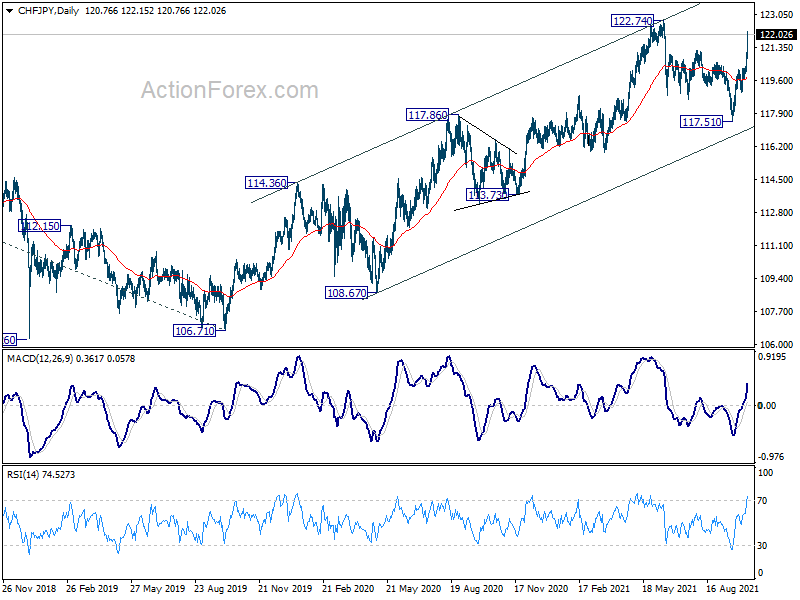
Technically, even Swiss Franc surges sharply against Yen as seen in the strong rally in CHF/JPY. Such development suggests that correction from 122.74 has completed at 117.51. Decisive break there will resume larger up trend from 2019 low at 106.71. If happens, there could be another round of upside accelerations in Yen crosses in general.
In Europe, at the time of writing, FTSE is up 0.38%. DAX is down -0.34%. CAC is down -0.19%. Germany 10-year yield is up 0.0293 at -0.119. Earlier in Asia, Nikkei rose 1.60%. Hong Kong HSI rose 1.96%. China Shanghai SSE dropped -0.01%. Singapore Strait Times rose 0.02%. Japan 10-year JGB yield closed up 0.020 at 0.097.
ECB Lane: We're some distance in terms of medium term from 2% inflation
ECB's chief economist Philip Lane said today, "the medium-term inflation dynamic is too slow, not too fast." "We still think we're some distance in terms of medium term from 2%," he added. "The trigger for monetary policy action is not there."
"In addition to rate forward guidance, calibrating the volume of asset purchases also plays an important role in ensuring that the monetary stance is sufficiently accommodative," said.
"The compression of term premia through the duration extraction channel plays a quantitatively-significant role in determining longer-term yields and ensuring that financing conditions are sufficiently supportive to be consistent with the delivery of our medium-term inflation objective."
ECB Knot: Rise in inflation largely temporary
ECB Governing Council member Klaas Knot said "I still expect the rise in inflation to be largely temporary, but we have to take other scenarios with structurally higher inflation and higher interest rates into account. Because if we don't, it could lead to shock price falls in the future."
"The effect of energy prices on inflation is temporary by nature, as they need to keep rising to keep pushing up inflation", Knot said. "But inflation is also pushed higher by global supply restraints, which might be less temporary. They could be caused by a readjustment in international trade, as supply chains are spread less across the globe."
EUR/CAD close to 1.4353 projection level as fall accelerates
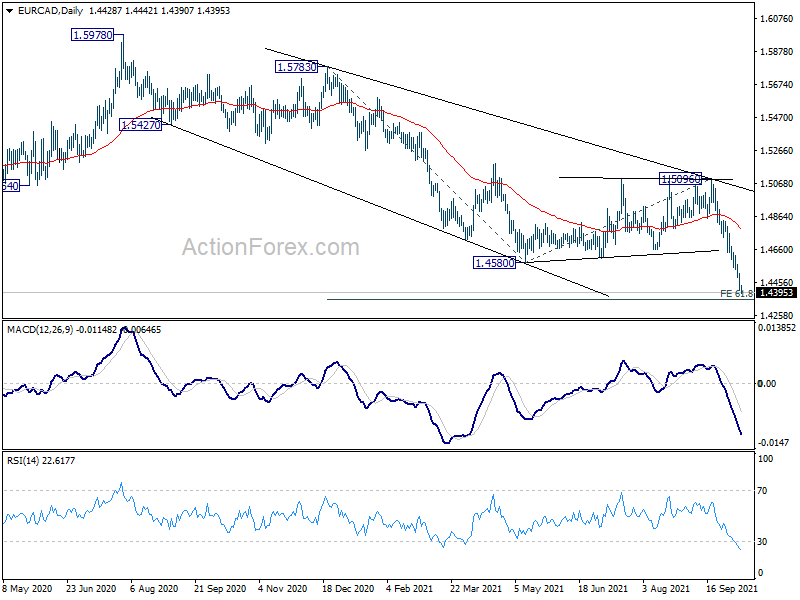
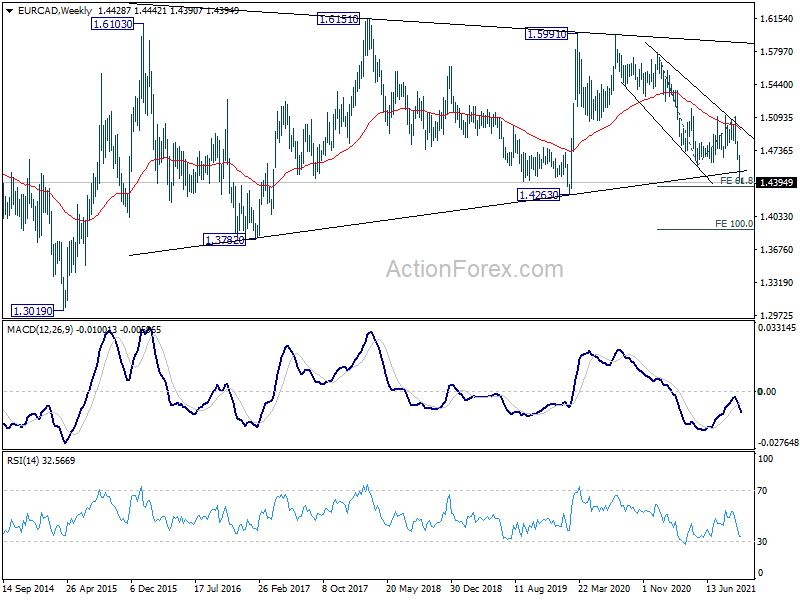
Canadian Dollar is extending near term rally, with help from rising oil price as WTI breaks above 81 handle. EUR/CAD is also accelerating down, and it's now close to 61.8% projection of 1.5783 to 1.4580 from 1.5096 at 1.4353. The reaction to this projection level could set the tone in EUR/CAD for the near to medium term.
Note that firstly, EUR/CAD was previously rejected by 55 week EMA, which is seen as a medium term bearish development. Secondly, the cross has also broken a long term trend line support as seen in weekly chart, which is another bearish development. Sustained break of 1.4353 projection level could bring another round of downside acceleration through 1.4263 support, towards 100% projection at 1.3893.
AUD/JPY accelerating up, to target 85.78 high
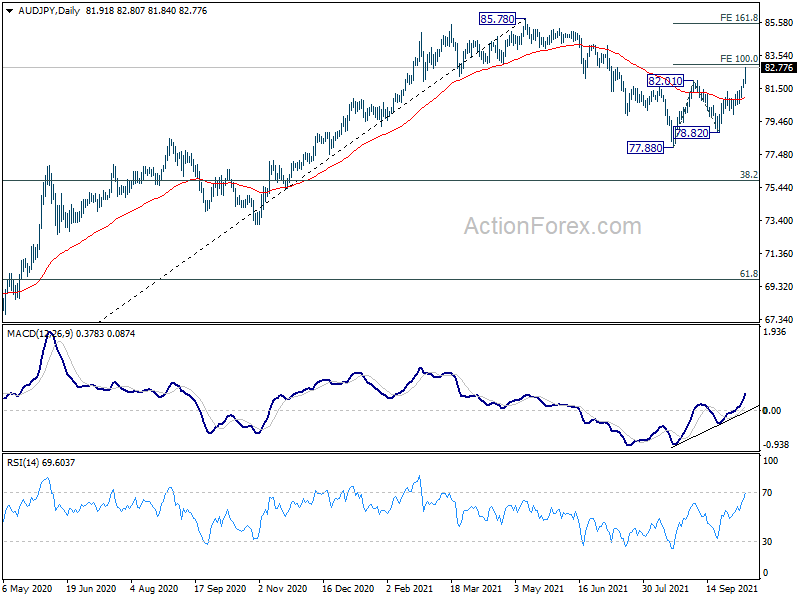
AUD/JPY follows other Yen crosses and accelerates higher today. The decisive break of 82.01 resistance firstly confirms resumption of rebound from 77.88. More importantly, it also affirms that correction from 85.78 has completed. Immediate focus is now on 100% projection of 77.88 to 82.01 from 78.82 at 82.95. Strong break there would indicate further upside acceleration and raise the chance that it's indeed resuming larger up trend from 59.85. Further rise would be seen to 161.8% projection at 85.50, which is close to 85.78 high.
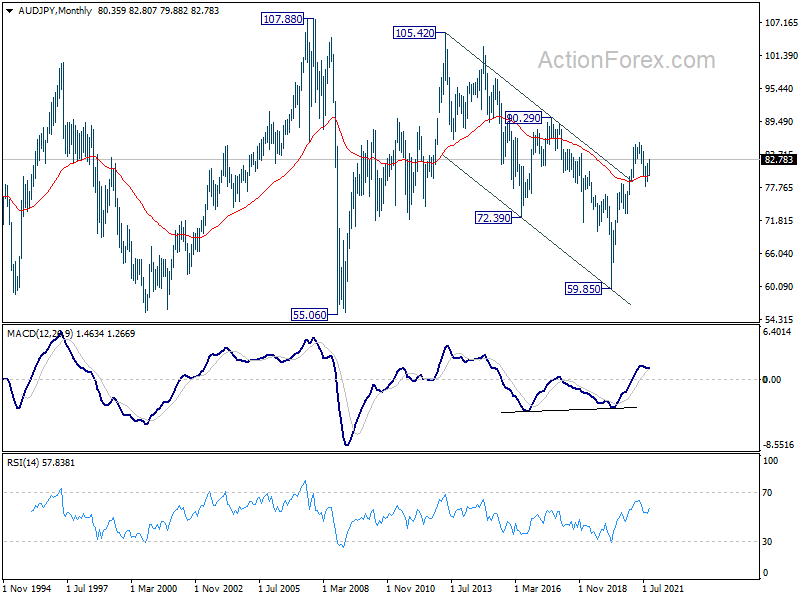
Also, note that AUD/JPY is being support by 55 month EMA, which is a long term bullish sign. That affirms the case that down trend from 105.42 (2013 high) has completed with three waves down to 59.85, on bullish convergence condition in monthly MACD. That is, on resumption, rise from 59.85 should power through 90.29 structural resistance, towards 105.42/107.88 resistance zone in the medium to long term. But of course, let's see how it goes with 85.78 first.
EUR/USD Mid-Day Outlook
Daily Pivots: (S1) 1.1549; (P) 1.1568; (R1) 1.1593; More...
EUR/USD is still bounded in consolidation from 1.1528 temporary low, and intraday bias remains neutral. Further fall is still in favor as long as 1.1639 minor resistance holds. Break of 1.1528 will resume larger decline towards 1.1289 medium term fibonacci level. On the upside, break of 1.1639 resistance, however, will indicate short term bottoming. intraday bias will be turned back to the upside for stronger rebound.
In the bigger picture, sustained break of 1.1602 will argue that rise from 1.0635 (2020 low) has completed at 1.2348. Deeper fall would be seen to 61.8% retracement of 1.0635 to 1.2348 at 1.1289. Note also that rejection by 55 week EMA (1.1830) also carries medium term bearish implication. Firm break of 1.1289 will pave the way to retest 1.0635 low. On the upside, though, break of 1.1908 resistance will revive medium term bullishness and turn focus back to 1.2348 high.
Economic Indicators Update
| GMT | Ccy | Events | Actual | Forecast | Previous | Revised |
|---|---|---|---|---|---|---|
| 6:00 | JPY | Machine Tool Orders Y/Y Sep | 71.90% | 86.20% | 85.20% | |
| 8:00 | EUR | Italy Industrial Output M/M Aug | -0.20% | 0.50% | 0.80% | 1.00% |
ECB Lane: We’re some distance in terms of medium term from 2% inflation
ECB's chief economist Philip Lane said today, "the medium-term inflation dynamic is too slow, not too fast.""We still think we're some distance in terms of medium term from 2%," he added. "The trigger for monetary policy action is not there."
"In addition to rate forward guidance, calibrating the volume of asset purchases also plays an important role in ensuring that the monetary stance is sufficiently accommodative," said.
"The compression of term premia through the duration extraction channel plays a quantitatively-significant role in determining longer-term yields and ensuring that financing conditions are sufficiently supportive to be consistent with the delivery of our medium-term inflation objective."
ECB Knot: Rise in inflation largely temporary
ECB Governing Council member Klaas Knot said "I still expect the rise in inflation to be largely temporary, but we have to take other scenarios with structurally higher inflation and higher interest rates into account. Because if we don't, it could lead to shock price falls in the future."
"The effect of energy prices on inflation is temporary by nature, as they need to keep rising to keep pushing up inflation", Knot said. "But inflation is also pushed higher by global supply restraints, which might be less temporary. They could be caused by a readjustment in international trade, as supply chains are spread less across the globe."
Euro Effectively Recovering
Early in a week, the major currency pair is growing; the asset is trading at 1.1585 and may gain even more weight.
The “greenback” dropped a bit after the USA reported on its labour market for September. For example, the Unemployment Rate fell to 4.8% in September after being 5.2% in August – and that’s great news. The Average Hourly Earnings added 0.6% m/m after expanding by 0.4% m/m the month before.
However, the Non-Farm Employment Change showed only 194K after being 366K in August and against the expected reading of 490K. Obviously, the country’s economy is still suffering from labour shortages and delays in delivery.
This employment data is the last one before the November meeting of the US Federal Reserve System, during which the regulator is theoretically expected to decide on its stimulus program.
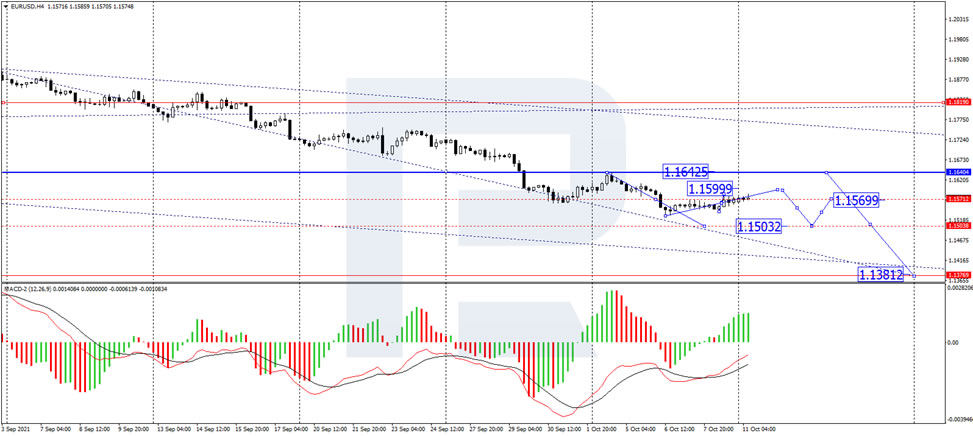
In the H4 chart, after reaching the short-term target at 1.1530, EUR/USD continues forming the descending wave; right now, it is correcting. Possibly, the pair may grow to test 1.1600 from below and then and then forming a new descending impulse towards 1.1500. Later, the market may form a new consolidation range there. After that, the instrument may break this range to the downside and start another decline with the target at 1.1382. From the technical point of view, this scenario is confirmed by MACD Oscillator: its signal line is steadily growing towards 0. Today, the line is expected to rebound from this level and resume falling towards new lows.
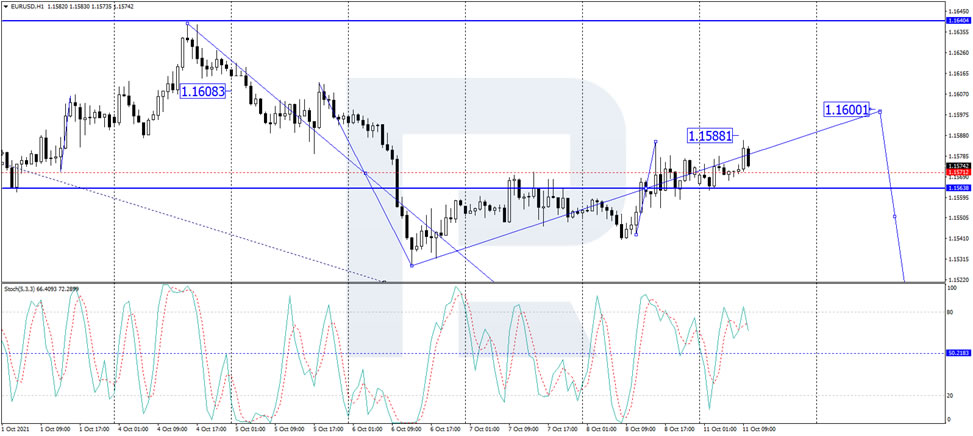
As we can see in the H1 chart, after forming a new consolidation range around 1.1560 and then breaking it to the upside, EUR/USD is expected to continue the correction towards 1.1588. After that, the instrument may fall to reach 1.1570 and then resume trading upwards with the target at 1.1600. All ascending structures should be only considered as correctional – the asset may start plunging towards 1.1500 at any moment. From the technical point of view, this scenario is confirmed by the Stochastic Oscillator: its signal line is moving below 80. Later, the line is expected to fall towards 50, a breakout of which may lead to further decline to reach 20.
Aussie Starts Week with Gains
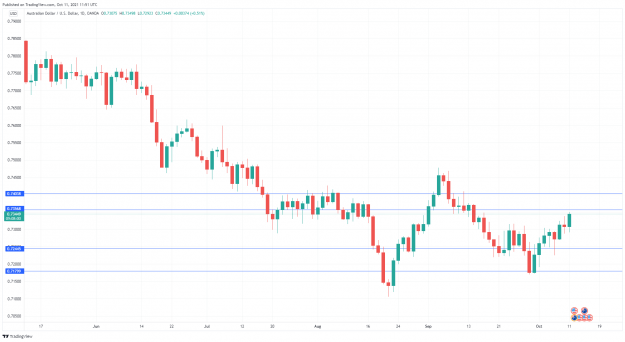
The Australian dollar has posted considerable gains on Monday. Currently, AUD/USD is trading at 0.7342, up 0.48% on the day.
US Nonfarm payrolls miss consensus
On Friday, US nonfarm payrolls underperformed for a second successive month. The September reading of 194 thousand was well off expectations of 500,000-plus, but the sky didn’t fall on the financial markets, and the reaction on the currency markets was muted. In fact, the Australian dollar was almost unchanged on Friday. One reason for the calm was that the unemployment rate fell to 4.8%, down sharply from 5.2% beforehand. In the minds of investors, the Fed taper is on, likely in December. That start date, which hasn’t been confirmed by the Fed, could be delayed, of course. If key economic data were to deteriorate significantly, that could cause Fed policymakers to hold off a taper until early next year. However, unless things really fall apart, the Fed should be good to go with a taper at the December meeting.
Is the Australian business sector any more optimistic about the economy? We’ll get an answer on Tuesday, with the release of the NAB Business Confidence index for September. The past two readings have shown a decline, as prolonged lockdowns have taken a toll on economic activity and hurt confidence. Another negative read could see the Australian dollar retrace today’s gains.
The RBA released its semi-annual Financial Stability Review on Friday. The report focused on the risks due to the surge in housing prices and the rise in borrowing levels, which has been made possible by ultra-low interest rates, and the RBA warned that lending standards must be maintained in order to reduce risks to financial stability. RBA Governor Lowe has faced criticism for opting to leave rates on hold while the housing market is red-hot, but Lowe says he first wants to see stronger inflation and wage growth before raising rates.
AUD/USD Technical
- AUD/USD is putting strong pressure on resistance at 0.7356. Next, there is resistance at 0.7403
- The pair has support at 0.7244. Below, there is support at 0.7177